

Using social and behavioural science to support COVID-19 pandemic response
Open accessThe DOI matches its Crossref record; 257 of the 259 references it cites were found in a registry or an index; 24 of the 89 sources its claims cite were checked for support.
Abstract
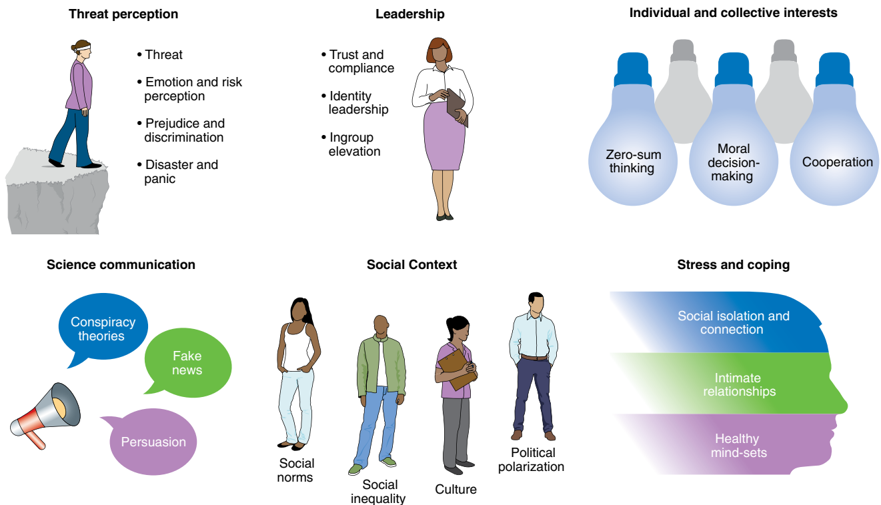
The COVID-19 pandemic represents a massive global health crisis. Because the crisis requires large-scale behaviour change and places significant psychological burdens on individuals, insights from the social and behavioural sciences can be used to help align human behaviour with the recommendations of epidemiologists and public health experts. Here we discuss evidence from a selection of research topics relevant to pandemics, including work on navigating threats, social and cultural influences on behaviour, science communication, moral decision-making, leadership, and stress and coping. In each section, we note the nature and quality of prior research, including uncertainty and unsettled issues. We identify several insights for effective response to the COVID-19 pandemic and highlight important gaps researchers should move quickly to fill in the coming weeks and months.
Overview
CoChat Summary
TL;DR
This perspective argues that social and behavioural science can help align public behaviour with COVID-19 public health recommendations across threat perception, social context, science communication, cooperation, leadership, and stress/coping. It synthesizes prior evidence and policy insights while cautioning that evidence is limited, often drawn from non-pandemic contexts, and in many areas unsettled.
Key findings
- The paper notes the scale of infectious disease threats: the bubonic plague killed approximately 25% of the European population, and by March 2020 COVID-19 had spread to more than 118,000 cases and caused 4,291 deaths in 114 countries. It also notes that 21 countries donated medical supplies to China in February, with China reciprocating widely.
- Fear appeals can change behaviour when people feel capable of dealing with the threat, but produce defensive reactions when people feel helpless; optimism bias can lead people to underestimate personal risk and ignore public health warnings.
- Social norms, inequality, culture, and political polarization shape pandemic behaviour: correcting misperceived norms can help when most people are already doing the desirable behaviour, but descriptive norms can backfire if the behaviour is undesirable unless paired with prescriptive norms.
- Effective communication and leadership may involve credible sources, messages that protect others or align with moral values, prebunking/inoculation against misinformation, accuracy nudges, shared social identity, and leaders modelling prosocial sacrifice; excessive national self-image concerns (“collective narcissism”) can backfire.
Methods
- Design: Perspective/narrative review; no primary data collection or sample. Topics were identified by the corresponding authors as potentially relevant to pandemic response and are explicitly not exhaustive.
- Evidence base: synthesizes prior social and behavioural research on threat perception, social context, science communication, moral decision-making, cooperation, leadership, and stress/coping, drawing on laboratory experiments, correlational studies, field experiments, meta-analyses, and preprints/forthcoming work.
- Analysis: narrative synthesis with policy implications and identified research gaps; no systematic search strategy or quantitative synthesis is reported.
Limitations
- Stated: due to space constraints, the paper provides only a brief summary of each topic; research on these topics is ongoing and in many cases far from settled; there is very little published social science research on the current pandemic, so discussion often draws from different circumstances and evidence quality varies substantially.
- Stated: insights and policy implications should be interpreted with caution.
- Evident: as a perspective rather than a systematic review or empirical study, it does not provide a comprehensive evidence appraisal, and its reliance on preprints and forthcoming sources limits certainty.
Model-written summary. Check it against the paper before relying on it.
Integrity signals
Registry
Cites
Statistics
Figures
Verification
Claims the paper makes
19 Valid · 5 Not valid · 37 Not checked · 13 Own results and interpretations
At least one cited source doesn’t support this claim or points to a different paper, and none confirmed it — see the verdicts below.
In the paper
“For instance, in hypothetical scenarios about deciding whether to go to work while sick, American and British participants reported they would be less willing to stay home when it was uncertain they would infect a co-worker.”
What the sources say
- Disputedcites [176] Kappes, A. et al. Uncertainty about the impact of social decisions increases prosocial behaviour. Nat. Hum. Behav. 2, 573–580 (2018). sourceExperimental — accuracy not yet measured
In the paper’s account of the infectious-disease scenario (Abstract; page not provided), participants facing uncertainty about how severely a co-worker might be affected were more likely to stay home than controls, not less. The paper distinguishes that impact uncertainty from uncertainty about whether a co-worker would be infected. Its Study 6 Methods (page not provided) describe recruitment through AMT, but do not establish the claimed American and British participant groups. (LLM, conf=0.88)
Checked by a reasoning model — may be wrong.
hedgedstates an association- Asserted: passes — The authors put it forward as true.
- Checkable: passes — It can be checked against evidence.
- Load-bearing: passes — The paper’s conclusions depend on it.
- Based: passes — The paper gives a reason why it holds.
- Disputed
The cited sources that could be checked couldn’t confirm or dispute this claim.
In the paper
“Moreover, there is mixed research regarding whether corrections may actually increase belief in the original misinformation 121,124-126 or in other misleading claims that fail to get corrected 127 .”
What the sources say
- Not checked — no full text of the sourcecites [121] Guess, A. & Coppock, A. Does counter-attitudinal information cause backlash? Results from three large survey experiments. Br. J. Polit. Sci. https://doi.org/10.1017/S0007123418000327 (2018). source
- Not matchedcites [124] Wittenberg, C. & Berinsky, A.J. Misinformation and its correction. in Social Media and Democracy: The State of the Field (eds Persily, N. & Tucker, J. A.) (Cambridge University Press, forthcoming).
Its entry has no title and year that we can search by.
- Not checked — no full text of the sourcecites [125] Swire, B. & Ecker, U.K.H. Misinformation and its correction: Cognitive mechanisms and recommendations for mass communication. in Misinformation and Mass Audiences (eds. Southwell, B. G., Thorson, E. A. & Sheble, L.) 195–2011 (University of Texas Press, 2018). source
- Not checked — no full text of the sourcecites [126] Wood, T. & Porter, E. The elusive backfire effect: mass attitudes’ steadfast factual adherence. Polit. Behav. 41, 135–163 (2018). source
- Could not verifycites [127] Pennycook, G., McPhetres, J., Zhang, Y. & Rand, D. Fighting COVID-19 misinformation on social media: Experimental evidence for a scalable accuracy nudge intervention. Preprint at PsyArXiv https://doi.org/10.31234/osf.io/uhbk9 (2020). sourceExperimental — accuracy not yet measured
Citation 127 is attached to the suggestion that corrections may increase belief in other misleading claims that go uncorrected. The Statement of Relevance and Discussion describe an accuracy nudge that improved sharing decisions, not corrections or their effects on belief in uncorrected claims. Searches for correction backfire and uncorrected misinformation found no passage addressing that point; page numbers were unavailable in our copy. (LLM, conf=0.76)
hedgedstates a possible cause- Asserted: passes — The authors put it forward as true.
- Checkable: passes — It can be checked against evidence.
- Load-bearing: passes — The paper’s conclusions depend on it.
- Based: passes — The paper gives a reason why it holds.
The sources with a verdict support this claim; the rest weren’t checked yet, have no full text we could read, or their verdicts aren’t rated yet.
In the paper
“Indeed, laboratory research has found that people prioritize local over global (or international) interests 185,186 .”
What the sources say
- Supportedcites [185] Milinski, M., Hilbe, C., Semmann, D., Sommerfeld, R. & Marotzke, J. Humans choose representatives who enforce cooperation in social dilemmas through extortion. Nat. Commun. 7, 10915 (2016). source
The Results section (‘Voters choose selfish representatives’; page unavailable) reports that participants preferentially re-elected representatives who contributed less to the shared climate account and elected candidates who pledged to contribute less than a fair share. In this simulated international dilemma, that supports the claim that participants favored their own group’s interests over the collective goal; it does not establish that everyone did so. (LLM, conf=0.85)
- Not checked — no full text of the sourcecites [186] Reinders Folmer, C. P. et al. One for all: what representing a group may do to us. J. Exp. Soc. Psychol. 48, 1047–1056 (2012). source
plain- Asserted: passes — The authors put it forward as true.
- Checkable: passes — It can be checked against evidence.
- Load-bearing: passes — The paper’s conclusions depend on it.
- Based: passes — The paper gives a reason why it holds.
- Supported
Every source the paper cites for this claim was checked and supports it.
In the paper
“However, when going to work risked infecting an elderly co-worker who would suffer a serious illness, participants reported they would be more willing to stay home 176 .”
What the sources say
- Supportedcites [176] Kappes, A. et al. Uncertainty about the impact of social decisions increases prosocial behaviour. Nat. Hum. Behav. 2, 573–580 (2018). source
The Study 6 Methods (page not provided) describe a scenario in which going to work could infect an older, vulnerable co-worker who would suffer severely, followed by a rating of willingness to go to work. The reported Study 6 findings (indexed under Abstract; page not provided) say participants given that risk information were significantly more likely to stay home than controls. (LLM, conf=0.92)
hedgedstates a cause- Asserted: passes — The authors put it forward as true.
- Checkable: passes — It can be checked against evidence.
- Load-bearing: passes — The paper’s conclusions depend on it.
- Based: passes — The paper gives a reason why it holds.
- Supported
The sources with a verdict support this claim; the rest weren’t checked yet, have no full text we could read, or their verdicts aren’t rated yet.
In the paper
“Several techniques, such as sanctioning defectors 187 or rewarding cooperators 188 , tend to increase cooperative behaviour in laboratory experiments using economic games.”
What the sources say
- Not checked — no full text of the sourcecites [187] Yamagishi, T. The provision of a sanctioning system as a public good. J. Pers. Soc. Psychol. 51, 110–116 (1986). source
- Supportedcites [188] Rand, D. G., Dreber, A., Ellingsen, T., Fudenberg, D. & Nowak, M. A. Positive interactions promote public cooperation. Science 325, 1272–1275 (2009). source
Citation 188 is attached to rewarding cooperators. The paper’s Abstract reports a laboratory comparison using repeated public goods games and finds that reward maintained public cooperation and, when both reward and punishment were available, increased contributions. (LLM, conf=0.93)
plainstates a cause- Asserted: passes — The authors put it forward as true.
- Checkable: passes — It can be checked against evidence.
- Load-bearing: unclear — It is unclear whether the paper’s conclusions depend on it.
- Based: passes — The paper gives a reason why it holds.
50 more claims · 13 with their cited sources checked
Create a free account to see all 74 claims and to verify the 2 references still open.
- It may state two separate claims as one. 13
- Probably not a substantial claim. 6
Claims other papers make about this one
Each is checked against this paper’s own text: does it say what the citing paper says it does?
The source backs part of the claim, not all of it — or backs it for a different population, condition or comparison.
In the citing paper
“COVID-19 is an international public health crisis, putting substantial burden on medical centers and increasing the psychological toll on health care workers (HCW).”
From Supporting the well-being of health care providers during the COVID-19 pandemic: The CopeColumbia response (2020) · cites this paper as [6]
Experimental — accuracy not yet measuredThe source backs part of the claim, not all of it — or backs it for a different population, condition or comparison.
In the citing paper
“these population-wide measures affected psychological well-being and mental health as well as increased social isolation [68] and loneliness.”
From Psychological correlates of perceived loneliness in college students before and during the COVID-19 stay-at-home period: a longitudinal study (2023) · cites this paper as [68]
Experimental — accuracy not yet measuredThe source backs part of the claim, not all of it — or backs it for a different population, condition or comparison.
In the citing paper
“they may eventually increase the social isolation of students and affect their psychological well-being and mental health [3].”
From Students under lockdown: Comparisons of students’ social networks and mental health before and during the COVID-19 crisis in Switzerland (2020) · cites this paper as [3]
Experimental — accuracy not yet measuredThe source backs part of the claim, not all of it — or backs it for a different population, condition or comparison.
In the citing paper
“effective interventions are hard to scale to a population level (12);”
From Psychological inoculation improves resilience against misinformation on social media (2022) · cites this paper as [12]
Experimental — accuracy not yet measuredThe source backs part of the claim, not all of it — or backs it for a different population, condition or comparison.
In the citing paper
“There is a shortage of studies that test anti-misinformation interventions in an ecologically valid manner, i.e., testing an intervention as consumers would interact with it in online environments (8, 12).”
From Psychological inoculation improves resilience against misinformation on social media (2022) · cites this paper as [12]
Experimental — accuracy not yet measured
6 more claims about this paper
Create a free account to see every claim other papers make about this one.
Citations
Cites
Granovetter, M. S. (1973) · American Journal of Sociology · doi:10.1086/225469 · Cited by 40,491
Zhou, F., Yu, T., Du, R., Fan, G., Liu, Y., Liu, Z., Xiang, J., Wang, Y., Song, B., Gu, X., et al. (2020) · The Lancet · doi:10.1016/s0140-6736(20)30566-3 · Cited by 27,263
The need to belong: Desire for interpersonal attachments as a fundamental human motivation.
Baumeister, R. F., & Leary, M. R. (1995) · Psychological Bulletin · doi:10.1037//0033-2909.117.3.497 · Cited by 23,245
Culture and the self: Implications for cognition, emotion, and motivation.
Markus, H. R., & Kitayama, S. (1991) · Psychological Review · doi:10.1037/0033-295x.98.2.224 · Cited by 21,995
Self-citationThe Psychological Impact of Quarantine and How to Reduce It: Rapid Review of the Evidence
Brooks, S. K., Webster, R. K., Smith, L. E., Woodland, L., Wessely, S., Greenberg, N., & Rubin, G. J. (2020) · doi:10.2139/ssrn.3532534 · Cited by 16,394
The psychological impact of quarantine and how to reduce it: Rapid review of the evidence
Brooks, S. K., Webster, R. K., Smith, L. E., Woodland, L., Wessely, S., Greenberg, N., & Rubin, G. J. (2020) · The Lancet · doi:10.1016/s0140-6736(20)30460-8 · Cited by 16,378
Nudge: improving decisions about health, wealth, and happiness
(2008) · Choice Reviews Online · doi:10.5860/choice.46-0977 · Cited by 11,572
Slovic, P. (1987) · Science · doi:10.1126/science.3563507 · Cited by 9,271
The Elaboration Likelihood Model of Persuasion
Petty, R. E., & Cacioppo, J. T. (1986) · Advances in Experimental Social Psychology · doi:10.1016/s0065-2601(08)60214-2 · Cited by 8,822
Self-citationThe emotional dog and its rational tail: A social intuitionist approach to moral judgment.
Haidt, J. (2001) · Psychological Review · doi:10.1037/0033-295x.108.4.814 · Cited by 8,048
Research works printed but not linked: 3
- Berkowitz, A.D. An overview of the social norms approach. in Changing the Culture of College Drinking: A Socially Situated Health Communication Campaign (eds. Stewart, L. & Lederman, L. C.) 193–214 (Hampton Press, 2005).
- Wittenberg, C. & Berinsky, A.J. Misinformation and its correction. in Social Media and Democracy: The State of the Field (eds Persily, N. & Tucker, J. A.) (Cambridge University Press, forthcoming).
- Ransohoff, K.J. Patients on the Trolley Track: The Moral Cognition of Medical Practitioners and Public Health Professionals. (Harvard Univ. Press, 2011).
Cited by
Items 1,101–1,200 of 5,015
Work, Health and Covid‑19: A Literature ReviewPreprint
Purkayastha, D., Vanroelen, C., Bircan, T., Vantyghem, M. A., & Adsera, C. G. (2021) · SSRN Electronic Journal · doi:10.2139/ssrn.3856915 · Cited by 37
Lettiere-Viana, A., Baraldi, N. G., Carlos, D. M., Fumincelli, L., Costa, L. C. R., & de Castro, P. C. (2021) · Texto & Contexto - Enfermagem · doi:10.1590/1980-265x-tce-2020-0443 · Cited by 29
Campanati, A., Diotallevi, F., Martina, E., Radi, G., & Offidani, A. (2022) · Journal of Clinical Medicine · doi:10.3390/jcm11092422 · Cited by 27
“They should avoid using so-called “crisis language” while presenting the mechanism of action of vaccinations to minimize selfish or competitive behaviors and to prevent undermining people’s sense of social support and caring [95,96].”
BackgroundGenerating impactful situated explanations through digital trace data
Grisold, T., Kremser, W., Mendling, J., Recker, J., Brocke, J. V., & Wurm, B. (2023) · Journal of Information Technology · doi:10.1177/02683962231208724 · Cited by 42
Loneliness trajectories over three decades are associated with conspiracist worldviews in midlife
Bierwiaczonek, K., Fluit, S., von Soest, T., Hornsey, M. J., & Kunst, J. R. (2024) · Nature Communications · doi:10.1038/s41467-024-47113-x · Cited by 32
Κouis, P., Michanikou, A., Anagnostopoulou, P., Galanakis, E., Michaelidou, E., Dimitriou, H., Matthaiou, A. Μ., Kinni, P., Achilleos, S., Zacharatos, H., et al. (2021) · Scientific Reports · doi:10.1038/s41598-021-85358-4 · Cited by 29
Chan, E. Y. Y., Shahzada, T. S., Sham, T. S. T., Dubois, C., Huang, Z., Liu, S., Ho, J., Hung, K. K. C., Kwok, K. O., Kayano, R., et al. (2020) · British Medical Bulletin · doi:10.1093/bmb/ldaa030 · Cited by 33
“It is important to create a bipartisan, shared sense of identity and cooperative responsibility within the population, for example using collective terms such as ‘us’ or ‘we’ in risk communication, and using interdisciplinary approaches that bring together groups from different backgrounds, such as medical practitione…”
BackgroundValidity and Reliability of the Spanish Version of Fear of COVID-19 Scale in Colombian Physicians
Mercado-Lara, M. F., Campo‐Arias, A., & Monterrosa-Castro, Á. D. J. (2021) · International Journal of Mental Health and Addiction · doi:10.1007/s11469-020-00430-w · Cited by 28
Individually optimal choices can be collectively disastrous in COVID-19 disease control
Stoddard, M., Egeren, D. V., Johnson, K. E., Rao, S., Furgeson, J., White, D. E., Nolan, R. P., Hochberg, N. S., & Chakravarty, A. (2021) · BMC Public Health · doi:10.1186/s12889-021-10829-2 · Cited by 33
Durosini, I., Triberti, S., Savioni, L., & Pravettoni, G. (2021) · PLoS ONE · doi:10.1371/journal.pone.0247121 · Cited by 29
Public health decisions in the COVID-19 pandemic require more than ‘follow the science’
de Campos, T. C., & Undurraga, E. A. (2021) · Journal of Medical Ethics · doi:10.1136/medethics-2020-107134 · Cited by 49
Omotayo, A. O., Ndhlovu, P. T., Tshwene, S. C., Olagunju, K. O., & Aremu, A. O. (2021) · Sustainability · doi:10.3390/su13105458 · Cited by 26
Unstandard Deviation: The Untapped Value of Positive Deviance for Reducing Inequalities
Ruggeri, K., & Folke, T. (2021) · Perspectives on Psychological Science · doi:10.1177/17456916211017865 · Cited by 28
“This leaves a critical opening for other behaviorally informed methods to tackle pressing public-policy challenges while building from the tremendous wealth of behavioral evidence available (van Bavel et al., 2020).”
BackgroundCrisis perception and consumption pattern during COVID-19: do demographic factors make differences?
Hasan, S., Islam, M. A., & Bodrud-Doza, M. (2021) · Heliyon · doi:10.1016/j.heliyon.2021.e07141 · Cited by 43
Aranzales, I., Chan, H. F., Eichenberger, R., Hegselmann, R., Stadelmann, D., & Torgler, B. (2021) · Scientific Reports · doi:10.1038/s41598-021-93148-1 · Cited by 29
Huang, J. W., Kwan, M., & Kim, J. (2021) · ISPRS International Journal of Geo-Information · doi:10.3390/ijgi10070490 · Cited by 28
“[21] suggested that people’s behavior is influenced by social norms.”
BackgroundCommunicating expert consensus increases personal support for COVID‐19 mitigation policies
Kerr, J. R., & van der Linden, S. (2021) · Journal of Applied Social Psychology · doi:10.1111/jasp.12827 · Cited by 25
“Among the strategies outlined by Van Bavel et al. (2020), the communication of scientific norms was noted as one approach to shifting beliefs and behavior, drawing on the credibility of the scientific community (see also, Rutjens et al., 2021).”
BackgroundInfluentialSelf-citationBaum, J., & Rahman, R. A. (2021) · NeuroImage · doi:10.1016/j.neuroimage.2021.118572 · Cited by 48
Cohen, A. S., Lutzke, L., Otten, C. D., & Árvai, J. (2021) · Risk Analysis · doi:10.1111/risa.13833 · Cited by 31
“In undertaking this research, we drew on evidence from prior pandemics (Rudisill, 2013), and during COVID-19 (Bavel et al., 2020; Motta Zanin, Gentile, Parisi, & Spasiano, 2020), which suggests that those who perceive health risks more acutely are more likely to take countermeasures to avoid…”
MethodCaddick, Z. A., & Feist, G. J. (2021) · Thinking & Reasoning · doi:10.1080/13546783.2021.1994009 · Cited by 34
“Although social media is no exception to spreading misinformation, it also has the potential to remedy, or alleviate it (Kim et al., 2018; Pennycook et al., 2020; Van Bavel et al., 2020).”
BackgroundThe state of social science research on COVID-19
Liu, Y.-L., Yuan, W.-J., & Zhu, S.-H. (2021) · Scientometrics · doi:10.1007/s11192-021-04206-4 · Cited by 33
Geniole, S. N., Bird, B. M., Witzel, A., McEvoy, J. T., & Proietti, V. M. (2022) · Computers in Human Behavior · doi:10.1016/j.chb.2022.107218 · Cited by 34
Byrne-Davis, L. M. T., Turner, R. R., Amatya, S., Ashton, C., Bull, E. R., Chater, A., Lewis, L., Shorter, G. W., Whittaker, E., & Hart, J. (2022) · Acta Psychologica · doi:10.1016/j.actpsy.2022.103527 · Cited by 33
Religion, politics and COVID-19 risk perception among urban residents in Malawi
Chilanga, E., Dzimbiri, M., Mwanjawala, P., Keller, A., & Mbeya, R. A. (2022) · BMC Public Health · doi:10.1186/s12889-022-13858-7 · Cited by 26
“WHO’s research and development (R&D) Blueprint, aims to facilitate the interactions between health experts and scientists to accelerate the dissemination of scientific knowledge and the social sciences must play a critical role to understand the sociocultural factors influence the pandemic [9].”
BackgroundZalcberg-Block, S., & Zalcberg, S. (2022) · Journal of Religion and Health · doi:10.1007/s10943-022-01662-x · Cited by 27
“At times, this might lead to emphasizing group boundaries, sometimes through hostility and violence toward others outside the community (Bavel et al., 2020), which can be seen in the conduct of the Haredi population.”
BackgroundChen, S. X., Ng, J. C. K., Hui, B. P. H., Au, A. K. Y., Lam, B. C. P., Wu, W. C. H., Pun, N., Beattie, P., Welzel, C., & Liu, J. H.-F. (2022) · Social Psychological and Personality Science · doi:10.1177/19485506221124392 · Cited by 31
Clemente‐Suárez, V. J., Bustamante-Sánchez, Á., Tornero-Aguilera, J. F., Ruisoto, P., & Mielgo‐Ayuso, J. (2022) · International Journal of Molecular Sciences · doi:10.3390/ijms232415584 · Cited by 31
EU Eastern Partnership, Ontological Security and EU- Ukraine/Russian warfare
Kaunert, C., & Pereira, J. D. D. (2023) · Journal of Contemporary European Studies · doi:10.1080/14782804.2023.2183182 · Cited by 40
“According to Bavel (Bavel et al. 2020), the primary emotional response during an existential crisis is fear, which can make threats appear more urgent.”
BackgroundFawole, O. I., Bello, S., Adebowale, A. S., Bamgboye, E. A., Salawu, M. M., Afolabi, R. F., Dairo, M. D., Namale, A., Kiwanuka, S. N., Monje, F., et al. (2023) · BMC Public Health · doi:10.1186/s12889-023-15708-6 · Cited by 31
“Compliance with self-isolation and self-quarantine became a challenge in the drive to prevent and control the epidemic resulting in increased community transmission of the virus [35].”
BackgroundInfluentialIn Science we (should) trust: expectations and compliance during the COVID-19 pandemicPreprint
Bicchieri, C., Fatás, E., Aldama, A., Casas, A., Deshpande, I., Lauro, M., Parilli, C., Spohn, M., Pereira, P. D. C., & Wen, R. (2020) · Research Square · doi:10.21203/rs.3.rs-106840/v1 · Cited by 25
Media use and vaccine resistance
Green, J., Druckman, J. N., Baum, M. A., Ognyanova, K., Simonson, M. D., Perlis, R. H., & Lazer, D. (2023) · PNAS Nexus · doi:10.1093/pnasnexus/pgad146 · Cited by 25
Self-citationLu, X., Du, J., You, M., Chen, L., Xu, F., & Chen, F. (2024) · TrAC Trends in Analytical Chemistry · doi:10.1016/j.trac.2024.118131 · Cited by 26
Human mobility restrictions and inter-provincial migration during the COVID-19 crisis in China
Li, A., Liu, Z., Luo, M., & Wang, Y. (2020) · Chinese Sociological Review · doi:10.1080/21620555.2020.1821183 · Cited by 26
Davis, P., Gustafsson, H., Callow, N., & Woodman, T. (2020) · Frontiers in Psychology · doi:10.3389/fpsyg.2020.599925 · Cited by 28
COVID-19: Against a Lockdown Approach
Kraaijeveld, S. R. (2020) · Asian Bioethics Review · doi:10.1007/s41649-020-00154-y · Cited by 33
Mayer, J. D., Schintler, L. A., & Bledsoe, S. (2020) · World Medical & Health Policy · doi:10.1002/wmh3.377 · Cited by 26
Schou‐Bredal, I., Grimholt, T. K., Bonsaksen, T., Skogstad, L., Heir, T., & Ekeberg, Ø. (2021) · Health Psychology Report · doi:10.5114/hpr.2021.102394 · Cited by 30
Health Care Organizations: Soft Target during COVID-19 Pandemic
Cauwer, H. G. D., & Somville, F. J. M. P. (2021) · Prehospital and Disaster Medicine · doi:10.1017/s1049023x2100025x · Cited by 25
Changes in Consumer Purchasing Behavior Due to COVID- 19 Pandemic
Akter, S., Ashrafi, T., & Waligo, V. M. (2021) · Journal of Marketing and Consumer Research · doi:10.7176/jmcr/77-04 · Cited by 28
“Subjective Norm (SNR): Social norms influence an individual’s decisions as ‘Subjective Norm’: “what they observe others are doing or accept or reject” (Van Bavel et al., 2020).”
BackgroundRisk preferences and risk perception affect the acceptance of digital contact tracing
Albrecht, R., Jarecki, J. B., Meier, D. S., & Rieskamp, J. (2021) · Humanities and Social Sciences Communications · doi:10.1057/s41599-021-00856-0 · Cited by 31
Güss, C. D., & Tuason, M. T. (2021) · Frontiers in Psychology · doi:10.3389/fpsyg.2021.620490 · Cited by 33
“These health behaviors, which mitigate the pandemic, are supported by extant social and behavioral research, including cultural values specified in individual and collective interests and the social and cultural context (Bavel et al., 2020).”
BackgroundRipoll, J., Contreras-Martos, S., Esteva, M., Soler, A., & Serrano-Ripoll, M. J. (2021) · Journal of Clinical Medicine · doi:10.3390/jcm10143191 · Cited by 25
“Those over the age of 45 saw increased levels of symptoms of anxiety, a finding that is in line with the results obtained by Bavel [53], who highlights that the psychological wellbeing of older individuals is more susceptible to worsening in social isolation.”
BackgroundResultSocial psychology and COVID-19: What the field can tell us about behavior in a pandemic
Meier, B. P., Cook, C. L., & Faasse, K. (2021) · The Journal of Social Psychology · doi:10.1080/00224545.2021.1935830 · Cited by 27
Garrote, A., Niederbacher, E., Hofmann, J., Rösti, I., & Neuenschwander, M. P. (2021) · Frontiers in Psychology · doi:10.3389/fpsyg.2021.712447 · Cited by 38
Aguilera, A., Hernandez-Ramos, R., Haro‐Ramos, A. Y., Boone, C. E., Luo, T. C., Xu, J., Chakraborty, B., Karr, C. J., Darrow, S. M., & Figueroa, C. A. (2021) · JMIR Mental Health · doi:10.2196/25298 · Cited by 29
Anxiety among pregnant women during the COVID-19 pandemic in India − A multicentric study
Tikka, S. K., Parial, S., Pattojoshi, A., Bagadia, A., Prakash, C., Tikka, D. L., Jaiswal, J., Puri, M., Kukreti, P., Behera, R. N., et al. (2021) · Asian Journal of Psychiatry · doi:10.1016/j.ajp.2021.102880 · Cited by 33
Pišl, V., Volavka, J., Chvojková, E., Čechová, K., Kavalířová, G., & Vevera, J. (2021) · Frontiers in Psychology · doi:10.3389/fpsyg.2021.717960 · Cited by 31
Weil, A. M., & Wolfe, C. R. (2021) · Applied Cognitive Psychology · doi:10.1002/acp.3894 · Cited by 32
Koch, M., & Park, S. (2021) · Social Science & Medicine · doi:10.1016/j.socscimed.2021.114583 · Cited by 33
A Perspective towards Multi-Hazard Resilient Systems: Natural Hazards and Pandemics
Hariri‐Ardebili, M. A., Sattar, S., Johnson, K., Clavin, C. T., Fung, J. F., & Ceferino, L. (2022) · Sustainability · doi:10.3390/su14084508 · Cited by 28
Johnson, V. A., Butterfuss, R., Kim, J., Orcutt, E., Harsch, R. M., & Kendeou, P. (2022) · Contemporary Educational Psychology · doi:10.1016/j.cedpsych.2022.102084 · Cited by 28
“Since the onset of the COVID-19 pandemic, social scientists have been called to support response efforts because the crisis requires belief and behavior change (Van Bavel et al., 2020).”
Social ties, fears and bias during the COVID-19 pandemic: Fragile and flexible mindsets
Tei, S., & Fujino, J. (2022) · Humanities and Social Sciences Communications · doi:10.1057/s41599-022-01210-8 · Cited by 31
Emotions in Crisis Coverage: How UK News Media Used Fear Appeals to Report on the Coronavirus Crisis
Hase, V., & Engelke, K. M. (2022) · Journalism and Media · doi:10.3390/journalmedia3040042 · Cited by 24
“Negative emotional reactions, including fear, may have amplified the perceived risk of COVID-19 (Breakwell and Jaspal 2020), belief in misinformation (Freiling et al. 2021), or out-group prejudice (van Bavel et al. 2020).”
BackgroundManning, K. F., Zvolensky, M. J., Garey, L., Long, L. J., & Gallagher, M. W. (2021) · Cognitive Behaviour Therapy · doi:10.1080/16506073.2021.1874503 · Cited by 26
Priming reasoning increases intentions to wear a face covering to slow down COVID-19 transmissionPreprint
Capraro, V., & Barcelo, H. (2020) · doi:10.31234/osf.io/wtcqy · Cited by 25
Self-citationSocial and moral psychology of COVID-19 across 69 countriesPreprint
Azevedo, F., Pavlović, T., do Rêgo, G. G., Ay, F. C., Gjoneska, B., Etienne, T. W., Ross, R. M., Schönegger, P., Riaño, J., Cichocka, A. K., et al. (2022) · doi:10.31234/osf.io/a3562 · Cited by 25
Self-citationCulture and COVID-19: Impact of Cross-Cultural Dimensions on Behavioral Responses
Nair, N., Selvaraj, P., & Nambudiri, R. (2022) · Encyclopedia · doi:10.3390/encyclopedia2030081 · Cited by 29
Public response to government alerts saves lives during Russian invasion of Ukraine
Dijcke, D. V., Wright, A. L., & Polyak, M. (2023) · Proceedings of the National Academy of Sciences · doi:10.1073/pnas.2220160120 · Cited by 36
The interplay between energy technologies and human health: Implications for energy transition
Sadegh Seddighi, K., Anthony, E. J., Seddighi, H., & Johnsson, F. (2023) · Energy Reports · doi:10.1016/j.egyr.2023.04.351 · Cited by 35
Zhang, K., Hong, X., Han, Y., & Wang, B. (2024) · Applied Mathematical Modelling · doi:10.1016/j.apm.2024.115672 · Cited by 25
Braun, B., Taraktaş, B., Beckage, B., & Molofsky, J. (2020) · PLoS ONE · doi:10.1371/journal.pone.0238412 · Cited by 30
“A second control method involves individually-determined changes to social behavior, which work in concert with mandated social distancing to mitigate viral transmission [5, 6].”
BackgroundMethodRazzaq, O. A., Rehman, D. U., Khan, N. A., Ahmadian, A., & Феррара, М. (2020) · Results in Physics · doi:10.1016/j.rinp.2020.103715 · Cited by 24
Depression Following COVID-19 Lockdown in Severely, Moderately, and Mildly Impacted Areas in China
Han, X., Chen, S., Bi, K., Yang, Z., & Sun, P. (2021) · Frontiers in Psychiatry · doi:10.3389/fpsyt.2021.596872 · Cited by 29
“Another ramification of COVID-19 is an increase in the feelings of disgust toward outgroups that are believed to pose an elevated risk of infection (6).”
BackgroundZhang, J. S., Keegan, B., Lv, Q., & Tan, C. (2021) · Proceedings of the International AAAI Conference on Web and Social Media · doi:10.1609/icwsm.v15i1.18112 · Cited by 51
“For example, Vieweg et al. (2010) analyze public responses to two disaster events, the Red River Floods and the Oklahoma Grassfires, using Twitter communications.”
BackgroundGuberina, T., & Wang, A. (2021) · International Journal of Innovation and Economic Development · doi:10.18775/ijied.1849-7551-7020.2015.66.2001 · Cited by 32
“The literature on COVID-19 crisis management focuses on strategic decisionmaking for sustaining psychological, economic, social, health and corporate welfare (Van Bavel et al., 2020).”
BackgroundAdamus, M., & Grežo, M. (2021) · Personality and Individual Differences · doi:10.1016/j.paid.2021.110916 · Cited by 34
“, 2020). For example, at the beginning of the pandemic, US consumers increased household spending by 845%, nearly immediately emptying shop shelves of disinfectants, preserved foods and even water (Kirk & Rifkin, 2020). In line with these observations, Garbe, Rau, and Toppe (2020) indicated that stockpiling behaviour…”
BackgroundResultInfluentialXu, W.-J., Youn, H.-J., & Lee, C.-K. (2021) · Sustainability · doi:10.3390/su13105552 · Cited by 26
“[31] also assert that the effectiveness of the behavioral response to COVID-19 through NPIs can be supported by social and behavioral science.”
BackgroundRachev, N. R., Han, H., Lacko, D., Gelpí, R., Yamada, Y., & Lieberoth, A. (2021) · PLoS ONE · doi:10.1371/journal.pone.0257151 · Cited by 32
“influence behavioral outcomes at scale, thus providing an easy and effective solution to the central challenge to policy-makers of presenting information to the public during crises [5, 40, 41].”
BackgroundGarrido‐Cumbrera, M., Foley, R., Braçe, O., Correa-Fernández, J., Lara, E. L., Guzmán, V., González‐Marín, A., & Hewlett, D. (2021) · Urban forestry & urban greening · doi:10.1016/j.ufug.2021.127260 · Cited by 30
Risk perception of COVID-19: Susceptibility and severity perceived by the Brazilian population
Giordani, R. C. F., Giolo, S. R., da Silva, M. Z., & Mühl, C. (2021) · Journal of Health Psychology · doi:10.1177/13591053211044536 · Cited by 26
“Bavel et al. (2020) clarify that emotions tend to influence risk perception more than factual information.”
BackgroundZhang, B., Li, Z., & Jiang, L. (2021) · International Journal of Environmental Research and Public Health · doi:10.3390/ijerph18199988 · Cited by 34
Does the COVID-19 Pandemic Change Human Mobility Equally Worldwide? Cross-Country Cluster Analysis
Czech, K., Davy, A., & Wielechowski, M. (2021) · Economies · doi:10.3390/economies9040182 · Cited by 26
Rehman, U., Shahnawaz, M., Kashyap, D., Gupta, K., Kharshiing, K. D., Khursheed, M., Khan, N. H., & Uniyal, R. (2021) · Death Studies · doi:10.1080/07481187.2021.2006826 · Cited by 31
“Perhaps, perceived social support in the real world (Williams et al., 2018), and in the virtual world such as seeking online mental health help (Bavel et al., 2020) will buffer the relationship between social distancing and distress (see Figure 1).”
BackgroundTrust in Science, Perceived Media Exaggeration About COVID-19, and Social Distancing Behavior
Neureiter, A., Stubenvoll, M., Kaskeleviciute, R., & Matthes, J. (2021) · Frontiers in Public Health · doi:10.3389/fpubh.2021.670485 · Cited by 35
“Despite the rise of scientific uncertainty, misinformation, and conspiracy theories during COVID-19 (34), trust in science has increased during the COVID-19 pandemic (33) which decreases the susceptibility to COVID-19 related misinformation that, in turn, could negatively influence compliance with public health measur…”
BackgroundFocacci, C. N., Lam, P. H., & Bai, Y. (2022) · Humanities and Social Sciences Communications · doi:10.1057/s41599-021-01032-0 · Cited by 25
Alexa, L., Avasilcăi, S., Pîslaru, M., Bujor, A., Avram, E. G., & Lucescu, L. C. (2022) · The Electronic Journal of e-Learning · doi:10.34190/ejel.20.1.2190 · Cited by 28
Wamsler, S., Freitag, M., Erhardt, J., & Filsinger, M. (2023) · European Journal of Political Research · doi:10.1111/1475-6765.12515 · Cited by 30
Lissa, C. J. V., Stroebe, W., vanDellen, M. R., Leander, N. P., Agostini, M., Draws, T., Grygoryshyn, A., Gützgow, B., Kreienkamp, J., Vetter, C. S., et al. (2022) · Patterns · doi:10.1016/j.patter.2022.100482 · Cited by 29
“13 More generally, an international group of behavioral scientists proposed various other psychosocial factors that may predict responses to the COVID-19 pandemic, 14 ranging from individuals’ internal states to their societal attitudes and beliefs.”
Self-citationKreysa, H., Schneider, D., Kowallik, A. E., Dastgheib, S. S., Doğdu, C., Kühn, G., Ruttloff, J. M., & Schweinberger, S. R. (2022) · Healthcare · doi:10.3390/healthcare10040714 · Cited by 32
“mastering challenges, have been affected by this crisis [1,2].”
BackgroundMeasuring Pandemic and Lockdown Impacts on Wellbeing
Grimes, A. (2022) · Review of Income and Wealth · doi:10.1111/roiw.12585 · Cited by 26
“If elimination is viewed as feasible by the population, there is an added advantage: Studies show that people are likely to change their behavior positively to contain a pandemic if they feel the threat can be countered, but are less likely to do so otherwise (Bavel et al., 2020).”
BackgroundFear of Covid-19 and health-related outcomes: results from two Brazilian population-based studies
Meller, F. D. O., Schäfer, A. A., Quadra, M. R., Demenech, L. M., Paludo, S. D. S., da Silva, P. A., Neiva-Silva, L., & Dumith, S. C. (2022) · Psychiatry Research · doi:10.1016/j.psychres.2022.114596 · Cited by 32
Impacts of COVID-19 on Health and Safety of Workforce in Construction Industry
Pamidimukkala, A., Kermanshachi, S., & Nipa, T. J. (2021) · ASCE International Conference on Transportation and Development (ICTD) · doi:10.1061/9780784483541.040 · Cited by 24
Racism and nationalism during and beyond the COVID-19 pandemic
Elias, A., Ben, J., Mansouri, F., & Paradies, Y. (2021) · Routledge eBooks · doi:10.4324/9781003206521-6 · Cited by 27
Technological Integration Factors in Parental Involvement during Distance Learning
Herwin, H., & Dahalan, S. C. (2022) · International Journal of Information and Education Technology · doi:10.18178/ijiet.2022.12.7.1664 · Cited by 25
“In general, the existence of these conditions makes the learning process must be carried out remotely with a distance learning system [10]-[12].”
BackgroundSuicide rates during the COVID-19 pandemic in Japan from April 2020 to December 2021
Nakanishi, M., Yamasaki, S., Endo, K., Ando, S., Sakai, M., Yoshii, H., & Nishida, A. (2022) · Psychiatry Research · doi:10.1016/j.psychres.2022.114774 · Cited by 29
The impact of COVID-19 on visitors' wayfinding within healthcare centers
Khotbehsara, E. M., Askarizad, R., Mehrinejad, M., Nasab, S. N., & Somasundaraswaran, K. (2022) · Ain Shams Engineering Journal · doi:10.1016/j.asej.2022.101957 · Cited by 28
“Due to the fear of becoming exposed to COVID-19, such crowded environments cause panic and distress among individuals [35,36].”
BackgroundDubé, È., Labbé, F., Malo, B., & Pelletier, C. (2022) · Canadian Journal of Public Health · doi:10.17269/s41997-022-00697-7 · Cited by 35
“The role of social networks in influencing individuals’ perceptions of health issues and their adoption of preventive behaviours is increasingly recognized (Bavel et al., 2020; Brunson, 2013), but frequently neglected in communication strategies (Asch & Rosin, 2016; Jenssen et al., 2019).”
BackgroundSingh, A. V., Katz, A., Maharjan, R. S., Gadicherla, A. K., Richter, M., Heyda, J., del Pino, P., Laux, P., & Luch, A. (2022) · The Science of The Total Environment · doi:10.1016/j.scitotenv.2022.160503 · Cited by 28
Spirituality is associated with Covid-19 vaccination scepticism
Zarzeczna, N., Bertlich, T., Većkalov, B., & Rutjens, B. T. (2022) · Vaccine · doi:10.1016/j.vaccine.2022.11.050 · Cited by 34
“As the pandemic unfolded, many people across the globe became sceptical about Covid-19 vaccines [26;39].”
Wang, Y., Ding, A. S., & Xu, C. (2022) · International Journal of Disaster Risk Reduction · doi:10.1016/j.ijdrr.2022.103472 · Cited by 28
“COVID-19 brings a global catastrophic emergency, which has caused psychological and social stress to individuals [57,60].”
Guberina, T., Wang, A., & Obrenovic, B. (2023) · PLoS ONE · doi:10.1371/journal.pone.0284766 · Cited by 31
“As a result of a threat to the economy, many employees were laid off; others were left fearing their employment [1].”
BackgroundDamette, O., & Huynh, T. L. D. (2023) · Scientific Reports · doi:10.1038/s41598-023-34776-7 · Cited by 33
How to better communicate the exponential growth of infectious diseases
Schonger, M., & Sele, D. (2020) · PLoS ONE · doi:10.1371/journal.pone.0242839 · Cited by 35
The cognitive science of COVID-19: Acceptance, denial, and belief change
Thagard, P. R. (2021) · Methods · doi:10.1016/j.ymeth.2021.03.009 · Cited by 30
“Another potentially useful strategy is to inoculate people against fake news by preemptively exposing them to small doses of misinformation [53].”
Adler, G. J., Ortiz, S. E., Plutzer, E., Mayrl, D., Coley, J. S., & Sager, R. (2021) · Sociology of Religion · doi:10.1093/socrel/srab029 · Cited by 29
Accounting for Global COVID-19 Diffusion Patterns, January-April 2020
Jinjarak, Y., Ahmed, R., Nair-Desai, S., Xin, W., & Aizenman, J. (2020) · National Bureau of Economic Research · doi:10.3386/w27185 · Cited by 48
Hutcherson, C. A. C., Sharpinskyi, K., Varnum, M. E. W., Rotella, A., Wormley, A. S., Tay, L., & Grossmann, I. (2023) · American Psychologist · doi:10.1037/amp0001151 · Cited by 28
The nature of misinformation in education
Kendeou, P., & Johnson, V. A. (2023) · Current Opinion in Psychology · doi:10.1016/j.copsyc.2023.101734 · Cited by 32
Borinca, I., Griffin, S. M., McMahon, G., Maher, P. J., & Muldoon, O. T. (2024) · Journal of Applied Social Psychology · doi:10.1111/jasp.13053 · Cited by 24
“At a group/collective level, the pandemic has prompted shifts in social dynamics and collective behavior as communities respond to the crisis (Van Bavel et al., 2020, 2022; Jetten et al., 2020; Marmarosh et al., 2020).”
BackgroundCOVID-19 Pandemic with Human Mobility Across Countries
Zhang, C., Qian, L., & Hu, J.-Q. (2020) · Journal of the Operations Research Society of China · doi:10.1007/s40305-020-00317-6 · Cited by 27
Metadata
- Authors
- Bavel, J. J. V., Baicker, K., Boggio, P. S., Capraro, V., Cichocka, A., Cikara, M., Crockett, M. J., Crum, A. J., Douglas, K. M., Druckman, J. N., Drury, J., Dube, O., Ellemers, N., Finkel, E. J., Fowler, J. H., Gelfand, M., Han, S., Haslam, S. A., Jetten, J., Kitayama, S., Mobbs, D., Napper, L. E., Packer, D. J., Pennycook, G., Peters, E., Petty, R. E., Rand, D. G., Reicher, S. D., Schnall, S., Shariff, A., Skitka, L. J., Smith, S. S., Sunstein, C. R., Tabri, N., Tucker, J. A., Linden, S. V. D., Lange, P. V., Weeden, K. A., Wohl, M. J. A., Zaki, J., Zion, S. R., & Willer, R.
- Affiliations
- New York University (US)
- Universidade Presbiteriana Mackenzie (BR)
- Middlesex University London (GB)
- University of Kent (GB)
- Harvard University (US)
- Yale University (US)
- Stanford University (US)
- Northwestern University (US)
- University of Sussex (GB)
- University of Chicago (US)
- Utrecht University (NL)
- University of California San Diego (US)
- University of Maryland, College Park (US)
- Peking University (CN)
- The University of Queensland (AU)
- University of Michigan (US)
- California Institute of Technology (US)
- Lehigh University (US)
- University of Regina (CA)
- University of Oregon (US)
- The Ohio State University (US)
- Massachusetts Institute of Technology (US)
- University of St Andrews (GB)
- University of Cambridge (GB)
- University of British Columbia (CA)
- University of Illinois Chicago (US)
- University of California, Berkeley (US)
- Carleton University (CA)
- Cornell University (US)
- Corresponding author
- Bavel, Jay J. Van
- Willer, Robb
- ORCID
- Bavel, Jay J. Van
- Baicker, Katherine
- Boggio, Paulo S.
- Capraro, Valerio
- Cichocka, Aleksandra
- Cikara, Mina
- Crockett, Molly J.
- Crum, Alia J.
- Douglas, Karen M.
- Druckman, James N.
- Drury, John
- Ellemers, Naomi
- Finkel, Eli J.
- Fowler, James H.
- Gelfand, Michele
- Han, Shihui
- Haslam, S. Alexander
- Jetten, Jolanda
- Kitayama, Shinobu
- Mobbs, Dean
- Napper, Lucy E.
- Packer, Dominic J.
- Pennycook, Gordon
- Peters, Ellen
- Petty, Richard E.
- Rand, David G.
- Reicher, Stephen D.
- Schnall, Simone
- Shariff, Azim
- Skitka, Linda J.
- Sunstein, Cass R.
- Tabri, Nassim
- Tucker, Joshua A.
- Linden, Sander van der
- Weeden, Kim A.
- Wohl, Michael J. A.
- Zaki, Jamil
- Zion, Sean R.
- Willer, Robb
- Venue
- Nature Human Behaviour
- Published
- 2020-04-30
- Volume
- 4
- Issue
- 5
- Pages
- 460-471
- ISSN
- 2397-3374 (ISSN-L)
- OpenAlex
- W3016902371
- Semantic Scholar
- d81abcd7f053b136423f1e7f57928524e8b0e1a0
- Cited by
- 4,964
- References
- 259
- Citations by year
- 2026: 177 · 2025: 288 · 2024: 483 · 2023: 741 · 2022: 1094 · 2021: 1474 · 2020: 702
- FWCI
- 175.81
- Type
- journal article
- Language
- en
- Open access
- bronze
- doi.org
- Licence
- www.springernature.com/gp/researchers/text-and-data-mining (tdm)
- www.springernature.com/gp/researchers/text-and-data-mining (vor)
- Locations
- Nature Human Behaviour (publishedVersion)
- PubMed (publishedVersion)
- Middlesex University Research Repository (Middlesex University Of London) (acceptedVersion)
- Kent Academic Repository (University of Kent) (acceptedVersion)
- DSpace@MIT (Massachusetts Institute of Technology) (submittedVersion, cc-by-nc-sa)
- Sussex Research Online (University of Sussex) (submittedVersion)
- CaltechAUTHORS (California Institute of Technology) (submittedVersion)
- RePEc: Research Papers in Economics (submittedVersion)
- BOA (University of Milano-Bicocca) (submittedVersion)
- Carleton University's Institutional Repository (MacOdrum Library, Carleton University) (submittedVersion, other-oa)
- Utrecht University Repository (Utrecht University) (submittedVersion)
- Figshare (submittedVersion)
- VU Research Portal (submittedVersion, other-oa)
- Utrecht University Repository (Utrecht University) (submittedVersion, other-oa)
- Data Archiving and Networked Services (DANS) (submittedVersion, other-oa)
- Funders
- U.S. Department of Health and Human Services (2P50 MH094258)
- National Institute of Mental Health (P50MH094258)
- Topics
- Social Sciences › Sociology and Political Science › COVID-19 Prevention and Impact
- Social Sciences › Communication › Communication and COVID-19 Impact
- Physical Sciences › Mathematics › Modeling and Simulation › COVID-19 epidemiological studies
- Keywords
- COVID-19 pandemic, pandemic response, behavior change, science communication, ethical decision-making, leadership, stress coping, psychological burden, public health recommendations
- MeSH terms
- Betacoronavirus, COVID-19, SARS-CoV-2, Adaptation, Psychological, Communicable Disease Control, Decision Making, Humans, Human Activities, Health Knowledge, Attitudes, Practice, Leadership, Pneumonia, Viral, Public Health, Quarantine, Stress, Psychological, Global Health, Coronavirus, Coronavirus Infections, Pandemics, Social Media, Epidemiological Monitoring
About these checks
Registry, retraction, Cites and statistics results are computed, not judged, with one exception: a printed reference that no index lists is read once by a model before it counts as a citation error. Claims are extracted by a model and kept only when their quote appears verbatim in the text; each cited source is then checked, with a model’s help, for whether it says what the claim relies on. Those verdicts can be wrong — read the claim’s quote and the cited source before relying on one.
The claim verdicts this report counts are experimental: their accuracy is not yet measured.
A language model drew the claims from the paper on 2026-10-10, under version 3 of the claim definition (model deepseek-v4.1-flash, prompt extract-v3).
A second model labelled each claim on 2026-10-10 (model jev-1.13-20260917, definition revision gold-guideline-v0.2).
Cited sources are checked with a language model’s help (gpt-6-sol).
Statistics and arithmetic are recomputed, not judged.
Confidence bands are shown only for fields calibrated on our annotated test set. None is calibrated yet, so no band is shown.
What counts as a claim ›How we measure confidence ›How we check this ›
Are you an author, or do you see a problem with this page? Request a review
Data sources
Bibliographic data: Semantic Scholar, OpenAlex, Crossref.
Contains information from the Semantic Scholar Academic Graph Datasets, made available under the ODC Attribution License (ODC-BY 1.0).
Semantic Scholar’s data is described in: Kinney, R., et al. (2023). The Semantic Scholar Open Data Platform. arXiv:2301.10140.
