

Using social and behavioural science to support COVID-19 pandemic response
Open accessThe DOI matches its Crossref record; 257 of the 259 references it cites were found in a registry or an index; 24 of the 89 sources its claims cite were checked for support.
Abstract
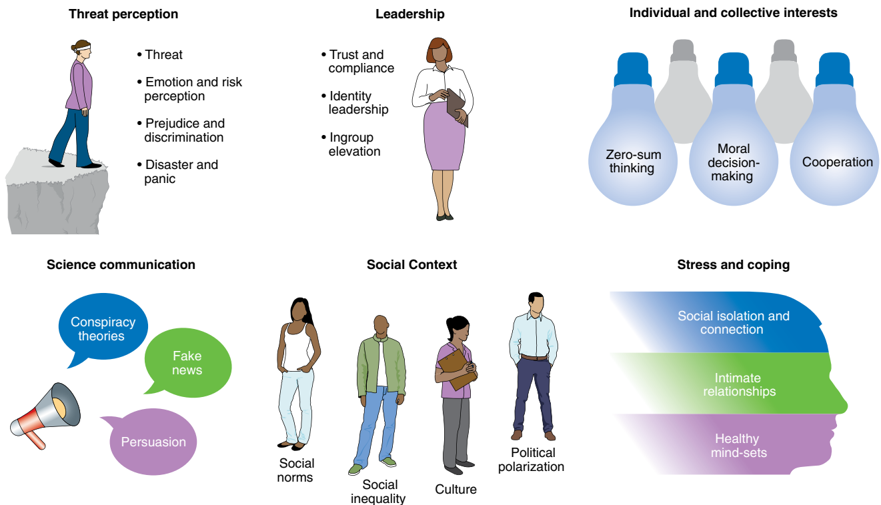
The COVID-19 pandemic represents a massive global health crisis. Because the crisis requires large-scale behaviour change and places significant psychological burdens on individuals, insights from the social and behavioural sciences can be used to help align human behaviour with the recommendations of epidemiologists and public health experts. Here we discuss evidence from a selection of research topics relevant to pandemics, including work on navigating threats, social and cultural influences on behaviour, science communication, moral decision-making, leadership, and stress and coping. In each section, we note the nature and quality of prior research, including uncertainty and unsettled issues. We identify several insights for effective response to the COVID-19 pandemic and highlight important gaps researchers should move quickly to fill in the coming weeks and months.
Overview
CoChat Summary
TL;DR
This perspective argues that social and behavioural science can help align public behaviour with COVID-19 public health recommendations across threat perception, social context, science communication, cooperation, leadership, and stress/coping. It synthesizes prior evidence and policy insights while cautioning that evidence is limited, often drawn from non-pandemic contexts, and in many areas unsettled.
Key findings
- The paper notes the scale of infectious disease threats: the bubonic plague killed approximately 25% of the European population, and by March 2020 COVID-19 had spread to more than 118,000 cases and caused 4,291 deaths in 114 countries. It also notes that 21 countries donated medical supplies to China in February, with China reciprocating widely.
- Fear appeals can change behaviour when people feel capable of dealing with the threat, but produce defensive reactions when people feel helpless; optimism bias can lead people to underestimate personal risk and ignore public health warnings.
- Social norms, inequality, culture, and political polarization shape pandemic behaviour: correcting misperceived norms can help when most people are already doing the desirable behaviour, but descriptive norms can backfire if the behaviour is undesirable unless paired with prescriptive norms.
- Effective communication and leadership may involve credible sources, messages that protect others or align with moral values, prebunking/inoculation against misinformation, accuracy nudges, shared social identity, and leaders modelling prosocial sacrifice; excessive national self-image concerns (“collective narcissism”) can backfire.
Methods
- Design: Perspective/narrative review; no primary data collection or sample. Topics were identified by the corresponding authors as potentially relevant to pandemic response and are explicitly not exhaustive.
- Evidence base: synthesizes prior social and behavioural research on threat perception, social context, science communication, moral decision-making, cooperation, leadership, and stress/coping, drawing on laboratory experiments, correlational studies, field experiments, meta-analyses, and preprints/forthcoming work.
- Analysis: narrative synthesis with policy implications and identified research gaps; no systematic search strategy or quantitative synthesis is reported.
Limitations
- Stated: due to space constraints, the paper provides only a brief summary of each topic; research on these topics is ongoing and in many cases far from settled; there is very little published social science research on the current pandemic, so discussion often draws from different circumstances and evidence quality varies substantially.
- Stated: insights and policy implications should be interpreted with caution.
- Evident: as a perspective rather than a systematic review or empirical study, it does not provide a comprehensive evidence appraisal, and its reliance on preprints and forthcoming sources limits certainty.
Model-written summary. Check it against the paper before relying on it.
Integrity signals
Registry
Cites
Statistics
Figures
Verification
Claims the paper makes
19 Valid · 5 Not valid · 37 Not checked · 13 Own results and interpretations
At least one cited source doesn’t support this claim or points to a different paper, and none confirmed it — see the verdicts below.
In the paper
“For instance, in hypothetical scenarios about deciding whether to go to work while sick, American and British participants reported they would be less willing to stay home when it was uncertain they would infect a co-worker.”
What the sources say
- Disputedcites [176] Kappes, A. et al. Uncertainty about the impact of social decisions increases prosocial behaviour. Nat. Hum. Behav. 2, 573–580 (2018). sourceExperimental — accuracy not yet measured
In the paper’s account of the infectious-disease scenario (Abstract; page not provided), participants facing uncertainty about how severely a co-worker might be affected were more likely to stay home than controls, not less. The paper distinguishes that impact uncertainty from uncertainty about whether a co-worker would be infected. Its Study 6 Methods (page not provided) describe recruitment through AMT, but do not establish the claimed American and British participant groups. (LLM, conf=0.88)
Checked by a reasoning model — may be wrong.
hedgedstates an association- Asserted: passes — The authors put it forward as true.
- Checkable: passes — It can be checked against evidence.
- Load-bearing: passes — The paper’s conclusions depend on it.
- Based: passes — The paper gives a reason why it holds.
- Disputed
The cited sources that could be checked couldn’t confirm or dispute this claim.
In the paper
“Moreover, there is mixed research regarding whether corrections may actually increase belief in the original misinformation 121,124-126 or in other misleading claims that fail to get corrected 127 .”
What the sources say
- Not checked — no full text of the sourcecites [121] Guess, A. & Coppock, A. Does counter-attitudinal information cause backlash? Results from three large survey experiments. Br. J. Polit. Sci. https://doi.org/10.1017/S0007123418000327 (2018). source
- Not matchedcites [124] Wittenberg, C. & Berinsky, A.J. Misinformation and its correction. in Social Media and Democracy: The State of the Field (eds Persily, N. & Tucker, J. A.) (Cambridge University Press, forthcoming).
Its entry has no title and year that we can search by.
- Not checked — no full text of the sourcecites [125] Swire, B. & Ecker, U.K.H. Misinformation and its correction: Cognitive mechanisms and recommendations for mass communication. in Misinformation and Mass Audiences (eds. Southwell, B. G., Thorson, E. A. & Sheble, L.) 195–2011 (University of Texas Press, 2018). source
- Not checked — no full text of the sourcecites [126] Wood, T. & Porter, E. The elusive backfire effect: mass attitudes’ steadfast factual adherence. Polit. Behav. 41, 135–163 (2018). source
- Could not verifycites [127] Pennycook, G., McPhetres, J., Zhang, Y. & Rand, D. Fighting COVID-19 misinformation on social media: Experimental evidence for a scalable accuracy nudge intervention. Preprint at PsyArXiv https://doi.org/10.31234/osf.io/uhbk9 (2020). sourceExperimental — accuracy not yet measured
Citation 127 is attached to the suggestion that corrections may increase belief in other misleading claims that go uncorrected. The Statement of Relevance and Discussion describe an accuracy nudge that improved sharing decisions, not corrections or their effects on belief in uncorrected claims. Searches for correction backfire and uncorrected misinformation found no passage addressing that point; page numbers were unavailable in our copy. (LLM, conf=0.76)
hedgedstates a possible cause- Asserted: passes — The authors put it forward as true.
- Checkable: passes — It can be checked against evidence.
- Load-bearing: passes — The paper’s conclusions depend on it.
- Based: passes — The paper gives a reason why it holds.
The sources with a verdict support this claim; the rest weren’t checked yet, have no full text we could read, or their verdicts aren’t rated yet.
In the paper
“Indeed, laboratory research has found that people prioritize local over global (or international) interests 185,186 .”
What the sources say
- Supportedcites [185] Milinski, M., Hilbe, C., Semmann, D., Sommerfeld, R. & Marotzke, J. Humans choose representatives who enforce cooperation in social dilemmas through extortion. Nat. Commun. 7, 10915 (2016). source
The Results section (‘Voters choose selfish representatives’; page unavailable) reports that participants preferentially re-elected representatives who contributed less to the shared climate account and elected candidates who pledged to contribute less than a fair share. In this simulated international dilemma, that supports the claim that participants favored their own group’s interests over the collective goal; it does not establish that everyone did so. (LLM, conf=0.85)
- Not checked — no full text of the sourcecites [186] Reinders Folmer, C. P. et al. One for all: what representing a group may do to us. J. Exp. Soc. Psychol. 48, 1047–1056 (2012). source
plain- Asserted: passes — The authors put it forward as true.
- Checkable: passes — It can be checked against evidence.
- Load-bearing: passes — The paper’s conclusions depend on it.
- Based: passes — The paper gives a reason why it holds.
- Supported
Every source the paper cites for this claim was checked and supports it.
In the paper
“However, when going to work risked infecting an elderly co-worker who would suffer a serious illness, participants reported they would be more willing to stay home 176 .”
What the sources say
- Supportedcites [176] Kappes, A. et al. Uncertainty about the impact of social decisions increases prosocial behaviour. Nat. Hum. Behav. 2, 573–580 (2018). source
The Study 6 Methods (page not provided) describe a scenario in which going to work could infect an older, vulnerable co-worker who would suffer severely, followed by a rating of willingness to go to work. The reported Study 6 findings (indexed under Abstract; page not provided) say participants given that risk information were significantly more likely to stay home than controls. (LLM, conf=0.92)
hedgedstates a cause- Asserted: passes — The authors put it forward as true.
- Checkable: passes — It can be checked against evidence.
- Load-bearing: passes — The paper’s conclusions depend on it.
- Based: passes — The paper gives a reason why it holds.
- Supported
The sources with a verdict support this claim; the rest weren’t checked yet, have no full text we could read, or their verdicts aren’t rated yet.
In the paper
“Several techniques, such as sanctioning defectors 187 or rewarding cooperators 188 , tend to increase cooperative behaviour in laboratory experiments using economic games.”
What the sources say
- Not checked — no full text of the sourcecites [187] Yamagishi, T. The provision of a sanctioning system as a public good. J. Pers. Soc. Psychol. 51, 110–116 (1986). source
- Supportedcites [188] Rand, D. G., Dreber, A., Ellingsen, T., Fudenberg, D. & Nowak, M. A. Positive interactions promote public cooperation. Science 325, 1272–1275 (2009). source
Citation 188 is attached to rewarding cooperators. The paper’s Abstract reports a laboratory comparison using repeated public goods games and finds that reward maintained public cooperation and, when both reward and punishment were available, increased contributions. (LLM, conf=0.93)
plainstates a cause- Asserted: passes — The authors put it forward as true.
- Checkable: passes — It can be checked against evidence.
- Load-bearing: unclear — It is unclear whether the paper’s conclusions depend on it.
- Based: passes — The paper gives a reason why it holds.
50 more claims · 13 with their cited sources checked
Create a free account to see all 74 claims and to verify the 2 references still open.
- It may state two separate claims as one. 13
- Probably not a substantial claim. 6
Claims other papers make about this one
Each is checked against this paper’s own text: does it say what the citing paper says it does?
The source backs part of the claim, not all of it — or backs it for a different population, condition or comparison.
In the citing paper
“COVID-19 is an international public health crisis, putting substantial burden on medical centers and increasing the psychological toll on health care workers (HCW).”
From Supporting the well-being of health care providers during the COVID-19 pandemic: The CopeColumbia response (2020) · cites this paper as [6]
Experimental — accuracy not yet measuredThe source backs part of the claim, not all of it — or backs it for a different population, condition or comparison.
In the citing paper
“these population-wide measures affected psychological well-being and mental health as well as increased social isolation [68] and loneliness.”
From Psychological correlates of perceived loneliness in college students before and during the COVID-19 stay-at-home period: a longitudinal study (2023) · cites this paper as [68]
Experimental — accuracy not yet measuredThe source backs part of the claim, not all of it — or backs it for a different population, condition or comparison.
In the citing paper
“they may eventually increase the social isolation of students and affect their psychological well-being and mental health [3].”
From Students under lockdown: Comparisons of students’ social networks and mental health before and during the COVID-19 crisis in Switzerland (2020) · cites this paper as [3]
Experimental — accuracy not yet measuredThe source backs part of the claim, not all of it — or backs it for a different population, condition or comparison.
In the citing paper
“effective interventions are hard to scale to a population level (12);”
From Psychological inoculation improves resilience against misinformation on social media (2022) · cites this paper as [12]
Experimental — accuracy not yet measuredThe source backs part of the claim, not all of it — or backs it for a different population, condition or comparison.
In the citing paper
“There is a shortage of studies that test anti-misinformation interventions in an ecologically valid manner, i.e., testing an intervention as consumers would interact with it in online environments (8, 12).”
From Psychological inoculation improves resilience against misinformation on social media (2022) · cites this paper as [12]
Experimental — accuracy not yet measured
6 more claims about this paper
Create a free account to see every claim other papers make about this one.
Citations
Cites
Granovetter, M. S. (1973) · American Journal of Sociology · doi:10.1086/225469 · Cited by 40,491
Zhou, F., Yu, T., Du, R., Fan, G., Liu, Y., Liu, Z., Xiang, J., Wang, Y., Song, B., Gu, X., et al. (2020) · The Lancet · doi:10.1016/s0140-6736(20)30566-3 · Cited by 27,263
The need to belong: Desire for interpersonal attachments as a fundamental human motivation.
Baumeister, R. F., & Leary, M. R. (1995) · Psychological Bulletin · doi:10.1037//0033-2909.117.3.497 · Cited by 23,245
Culture and the self: Implications for cognition, emotion, and motivation.
Markus, H. R., & Kitayama, S. (1991) · Psychological Review · doi:10.1037/0033-295x.98.2.224 · Cited by 21,995
Self-citationThe Psychological Impact of Quarantine and How to Reduce It: Rapid Review of the Evidence
Brooks, S. K., Webster, R. K., Smith, L. E., Woodland, L., Wessely, S., Greenberg, N., & Rubin, G. J. (2020) · doi:10.2139/ssrn.3532534 · Cited by 16,394
The psychological impact of quarantine and how to reduce it: Rapid review of the evidence
Brooks, S. K., Webster, R. K., Smith, L. E., Woodland, L., Wessely, S., Greenberg, N., & Rubin, G. J. (2020) · The Lancet · doi:10.1016/s0140-6736(20)30460-8 · Cited by 16,378
Nudge: improving decisions about health, wealth, and happiness
(2008) · Choice Reviews Online · doi:10.5860/choice.46-0977 · Cited by 11,572
Slovic, P. (1987) · Science · doi:10.1126/science.3563507 · Cited by 9,271
The Elaboration Likelihood Model of Persuasion
Petty, R. E., & Cacioppo, J. T. (1986) · Advances in Experimental Social Psychology · doi:10.1016/s0065-2601(08)60214-2 · Cited by 8,822
Self-citationThe emotional dog and its rational tail: A social intuitionist approach to moral judgment.
Haidt, J. (2001) · Psychological Review · doi:10.1037/0033-295x.108.4.814 · Cited by 8,048
Research works printed but not linked: 3
- Berkowitz, A.D. An overview of the social norms approach. in Changing the Culture of College Drinking: A Socially Situated Health Communication Campaign (eds. Stewart, L. & Lederman, L. C.) 193–214 (Hampton Press, 2005).
- Wittenberg, C. & Berinsky, A.J. Misinformation and its correction. in Social Media and Democracy: The State of the Field (eds Persily, N. & Tucker, J. A.) (Cambridge University Press, forthcoming).
- Ransohoff, K.J. Patients on the Trolley Track: The Moral Cognition of Medical Practitioners and Public Health Professionals. (Harvard Univ. Press, 2011).
Cited by
Items 1,501–1,600 of 5,015
Pandemic Politics in Eurasia: Roadmap for a New Research Subfield
Laruelle, M. A., Alexseev, M. A., Buckley, C., Clem, R. S., Goode, J. P., Gomza, I., Hale, H. E., Herron, E. S., Makarychev, A. S., McCann, M., et al. (2020) · Problems of Post-Communism · doi:10.1080/10758216.2020.1812404 · Cited by 20
Self-citationEdgeley, C. M., & Burnett, J. T. (2020) · Fire · doi:10.3390/fire3030041 · Cited by 19
“Furthermore, optimism bias—the belief that others are more likely to experience negative consequences than oneself—has been identified in studies of both COVID-19 risk perceptions and wildfire impacts or evacuation [26,29,30].”
BackgroundFu, Y.-L., & Liang, K.-C. (2020) · Computer Methods and Programs in Biomedicine · doi:10.1016/j.cmpb.2020.105762 · Cited by 17
Pereira, B. D. C. S., & Stornelli, J. (2020) · Journal of the Association for Consumer Research · doi:10.1086/711837 · Cited by 19
Health-Flow: Criticality-Aware Flow Control for SDN-Based Healthcare IoT
Misra, S., Saha, R., & Ahmed, N. (2020) · Globecom · doi:10.1109/globecom42002.2020.9348058 · Cited by 17
Emerging from COVID-19: Lessons for Action on Climate Change and Health in Cities
Milner, J., Davies, M., Haines, A., Huxley, R., Michie, S., Robertson, L., Siri, J. G., & Wilkinson, P. (2021) · Journal of Urban Health · doi:10.1007/s11524-020-00501-2 · Cited by 17
Chasson, M., Ben‐Yaakov, O., & Ben‐Ari, O. T. –. (2021) · Journal of Happiness Studies · doi:10.1007/s10902-021-00378-1 · Cited by 33
Pabst, A., Bollen, Z., Creupelandt, C., Fontesse, S., Orban, T., Duve, M. D., Pinon, N., & Maurage, P. (2021) · Psychiatry Research · doi:10.1016/j.psychres.2021.113938 · Cited by 17
Bianco, F., Kosić, A., & Pierro, A. (2021) · The Journal of Social Psychology · doi:10.1080/00224545.2021.1900046 · Cited by 20
Bauhr, M., & Charron, N. (2021) · European Societies · doi:10.1080/14616696.2021.1922931 · Cited by 17
Sykes, S., Wills, J., Trasolini, A., Wood, K. V., & Frings, D. (2021) · Health Promotion International · doi:10.1093/heapro/daab103 · Cited by 19
“…will likely be influenced by context, emo- tions and various perception-related biases or heuristics on how they internalize the magnitude of risk from COVID-19 and the willingness to comply with government-advised preventive measures (Bavel, 2020; Dolinski et al., 2020; Druic a, 2020).”
BackgroundGender and pandemic perception: analyzing perceived risk and fear among Brazilian women
Giordani, R. C. F., Giolo, S. R., da Silva, M. Z., & Mühl, C. (2021) · Health Psychology and Behavioral Medicine · doi:10.1080/21642850.2021.1968301 · Cited by 17
“In addition, emotions play a critical role in the perception of risk itself (Bavel et al., 2020), also influencing the cognitive evaluations of risk and triggering responses to”
BackgroundTong, H., Hou, W. K., Liang, L., Li, T. W., Liu, H., & Lee, T. M. C. (2021) · Innovation in Aging · doi:10.1093/geroni/igab034 · Cited by 22
“The Hong Kong government’s goal to put the pandemic under control might have further contributed to its more stringent health measures, increasing its citizens’ mental health burden compared to people in Western countries (Bavel et al., 2020; Gelfand et al., 2011).”
BackgroundThe COVID-19 Pandemic: Are There Any Impacts on Sustainability?
Begum, H., Alam, A. S. A. F., Filho, W. L., Awang, A. H., & Ghani, A. B. A. (2021) · Sustainability · doi:10.3390/su132111956 · Cited by 20
GROUPS 2 CONNECT: An online activity to maintain social connection and well‐being during COVID‐19
Bentley, S. V., Haslam, C., Haslam, S. A., Jetten, J., Larwood, J. L., & Rue, C. J. L. (2021) · Applied Psychology Health and Well-Being · doi:10.1111/aphw.12330 · Cited by 21
Self-citationWilliams, S. N. (2022) · Public Health · doi:10.1016/j.puhe.2022.01.016 · Cited by 23
Wen, X., Rafaï, I., Duchêne, S., & Willinger, M. (2022) · International Journal of Environmental Research and Public Health · doi:10.3390/ijerph19095051 · Cited by 18
Wilta, F., Chong, A. L. C., Selvachandran, G., Kotecha, K. V., & Ding, W. (2022) · Applied Soft Computing · doi:10.1016/j.asoc.2022.108973 · Cited by 19
Institutional Development and the Government Response to COVID-19 in China
Li, X., Hui, E. C. M., & Shen, J. (2021) · Habitat International · doi:10.1016/j.habitatint.2022.102629 · Cited by 19
Mazzoni, N., Bentenuto, A., Filosofi, F., Tardivo, A., Strathearn, L., Zarei, K., de Falco, S., Venuti, P., Iandolo, G., & Giannotti, M. (2022) · International Journal of Environmental Research and Public Health · doi:10.3390/ijerph20010499 · Cited by 18
Boosting Resilience through Spiritual Well-being: COVID-19 Example
Baykal, E. (2020) · Bussecon Review of Social Sciences (2687-2285) · doi:10.36096/brss.v2i4.224 · Cited by 26
Cecchi-Dimeglio, P., Kitson-Pantano, R., Luu, D., et al. (2020) · medRxiv · doi:10.1101/2020.05.15.20103424 · Cited by 17
“92 As the COVID-19 virus emerged in December 2019, sparking an epidemic of acute 93 respiratory syndrome in humans in China, within three months, the virus had spread to more than 94 118,000 cases and caused 4,291 deaths in 114 countries, leading the World Health Organization 95 to declare a global pandemic [10].”
BackgroundThe Impact of COVID-19 on Staff Working Practices in UK Horseracing
Davies, E., McConn-Palfreyman, W., Williams, J. M., & Lovell, G. P. (2020) · Animals · doi:10.3390/ani10112003 · Cited by 18
“Behaviour is significantly influenced by social norms, and group behaviour is key to ensuring individuals stick to changes made [44].”
BackgroundInfluentialResponding to COVID-19 With the Aid of Mutually Beneficial Partnerships in Education
Biag, M., Gomez, L. M., Imig, D. G., & Vasudeva, A. (2021) · Frontiers in Education · doi:10.3389/feduc.2020.621361 · Cited by 18
Varella, M. A. C., Luoto, S., Soares, R. B. D. S., & Valentová, J. V. (2021) · Frontiers in Psychology · doi:10.3389/fpsyg.2021.646711 · Cited by 18
“This homogamy could be the evolutionary process promoting trait covariation (cf. Štěrbová and Valentova, 2012; Varella et al., 2012; Štěrbová et al., 2017; Conroy-Beam et al., 2019; Nishi et al., 2020) between the eveningness chronotype and the constellation of nocturnal psychobehavioral…”
BackgroundYang, A., Yang, J., Yang, D., Xu, R., He, Y., Aragón, A. D., & Qiu, H. (2021) · GeoHealth · doi:10.1029/2021gh000494 · Cited by 20
Emergence of protective behaviour under different risk perceptions to disease spreading
Khanjanianpak, M., Azimi-Tafreshi, N., Arenas, À., et al. (2022) · Philosophical Transactions of the Royal Society A Mathematical Physical and Engineering Sciences · doi:10.1098/rsta.2020.0412 · Cited by 16
“However, people act differently, reacting heterogeneously to the same information, as evidenced during the current COVID-19 pandemic [34].”
BackgroundMoral grandstanding, narcissism, and self-reported responses to the COVID-19 crisis
Grubbs, J. B., James, A. S., Warmke, B., & Tosi, J. (2022) · Journal of Research in Personality · doi:10.1016/j.jrp.2021.104187 · Cited by 21
Effects of E-Government Policy on the Management of Healthcare Systems
Pedawi, S., & Alzubi, A. B. (2022) · Applied Bionics and Biomechanics · doi:10.1155/2022/5736530 · Cited by 19
RetractedZancu, S. A., Măirean, C., & Diaconu‐Gherasim, L. R. (2022) · Current Psychology · doi:10.1007/s12144-022-03069-z · Cited by 23
“The effective promotion of public health recommendations could be supported by strategies to encourage compliance with recommended preventive behaviors (WHO, 2020b; Van Bavel et al., 2020).”
Bock, S., & Schnabel, L. (2022) · PLoS ONE · doi:10.1371/journal.pone.0266562 · Cited by 18
“Unprecedented distress is unsurprising given the hardships faced during the pandemic, where fear of the virus itself joined with existential insecurity, disrupted routines, and general societal upheaval to create a unique array of stressors [8, 9].”
BackgroundPredictors of Vaccine Hesitancy among Health Care Workers during the COVID-19 Pandemic
Elliott, T. R., Perrin, P. B., Powers, M. B., Jacobi, K. S., & Warren, A. M. (2022) · International Journal of Environmental Research and Public Health · doi:10.3390/ijerph19127123 · Cited by 20
“training them with strategies to detect weak, misleading arguments that ignore scientific approaches and available empirical data [28].”
BackgroundInfluentialEffects of the information-driven awareness on epidemic spreading on multiplex networks
Wang, J., Xiong, W., Wang, R., Cai, S., Wu, D., Wang, W., & Chen, X. (2022) · Chaos An Interdisciplinary Journal of Nonlinear Science · doi:10.1063/5.0092031 · Cited by 20
Zięba, M., & Bongiovanni, I. (2022) · Knowledge and Process Management · doi:10.1002/kpm.1707 · Cited by 25
“…about recent developments in the market) or develop/convert existing knowledge into value; on the other hand, it is crucial to carefully sift accurate knowledge from unreliable one, which seems to abound in times of crises (Pennycook et al., 2020; Renkel et al., 2020; van Bavel et al., 2020).”
BackgroundFake News e o Repertório Contemporâneo de Ação Política
Mendonça, R. F., Freitas, V. G., Aggio, C. D. O., & Santos, N. (2023) · Dados · doi:10.1590/dados.2023.66.2.301 · Cited by 51
Promoting engagement with quality communication in social media
Cinelli, M., Peruzzi, A., Schmidt, A. L., Villa, R., Costa, E., Quattrociocchi, W., & Zollo, F. (2022) · PLoS ONE · doi:10.1371/journal.pone.0275534 · Cited by 38
“A crucial challenge is to improve the effectiveness and outreach of science communication [15, 16], especially in tackling the spread of misinformation [17, 18], science denialism [19, 20] and uncertainty of scientific advances [21, 22].”
Drivers of e-government use during the COVID-19 pandemic: the case of Vietnam
Nguyen, H. T., & Borazon, E. Q. (2022) · Online Information Review · doi:10.1108/oir-08-2021-0440 · Cited by 20
The evolvement of trust in response to the COVID-19 pandemic among migrants in Norway
Herrero‐Arias, R., Ortiz-Barreda, G. M., Czapka, E. A., & Díaz, E. (2022) · International Journal for Equity in Health · doi:10.1186/s12939-022-01747-9 · Cited by 20
“Perceived discrimination shapes migrants’ distrust and willingness to engage with the host society (Alesina and La Ferrara, 2002; Horenczyk et al., 2013; Van Bavel et al., 2020).”
BackgroundInfluential‘Riding Out the Pandemic’: Brand Communication on Social Media and Consumer Engagement
Kaushik, K., Mishra, A., & Cyr, D. (2022) · Journal of Business Research · doi:10.1016/j.jbusres.2022.113449 · Cited by 19
Explicating gender disparity in wearing face masks during the COVID-19 pandemic
Looi, K. H. (2022) · BMC Public Health · doi:10.1186/s12889-022-14630-7 · Cited by 19
“The public health response to the COVID-19 pandemic requires large-scale and significant shifts in individual behavior [18, 28] and imposes significant psychological burdens on individuals.”
BackgroundInfluentialConway, L. G., Woodard, S. R., Zubrod, A., Tiburcio, M., Martínez-Vélez, N. A., Sorgente, A., Lanz, M., Serido, J., Vosylis, R., Fonseca, G., et al. (2022) · Frontiers in Psychology · doi:10.3389/fpsyg.2022.937211 · Cited by 19
Risk communication in multistakeholder engagement: A novel spatial econometric model
Liu, S. J., Li, J., Wu, D., et al. (2023) · Risk Analysis · doi:10.1111/risa.14125 · Cited by 16
“Other studies focus on risk perception deviation and regard it as significant in risk communication; for example, Bavel et al. (2020) clarify the existence of risk perception deviation in terms of cognitive strategies and risk information acquisition channels.”
BackgroundAhmed, W., Das, R., Vidal‐Alaball, J., Hardey, M., & Fuster‐Casanovas, A. (2023) · Journal of Medical Internet Research · doi:10.2196/43497 · Cited by 23
“Bavel et al [28] discovered that influential users were successful at fostering community building to generate a sense of credibility and trustworthiness that helped fuel conspiracist attitudes.”
Resource scarcity aggravates ingroup bias: Neural mechanisms and cross‐scenario validation
Cui, F., Deng, K., Liu, J., Huang, X., Yang, J., Luo, Y., Feng, C., & Gu, R. (2023) · British Journal of Psychology · doi:10.1111/bjop.12654 · Cited by 20
Lenoir, R., & Wong, K. K. (2023) · BMJ Open · doi:10.1136/bmjopen-2023-071903 · Cited by 23
Bélanger‐Gravel, A., Janezic, I., Desroches, S., Paquette, M.-C., Therrien, F., Barnett, T. A., Lavoie, K., & Gauvin, L. I. (2023) · BMC Health Services Research · doi:10.1186/s12913-023-09455-y · Cited by 17
Shi, L., Gao, D., Wang, X., Lin, J., Chen, D., Li, T., Xia, Y., & Wang, D. (2023) · International Journal of Disaster Risk Reduction · doi:10.1016/j.ijdrr.2023.104040 · Cited by 16
Alshehri, S., & Sallam, M. (2023) · Human Vaccines & Immunotherapeutics · doi:10.1080/21645515.2023.2275962 · Cited by 18
Sirota, M., Habersaat, K. B., Betsch, C., Bonga, D. L., Borek, A., Buckel, A., Butler, R., Byrne-Davis, L. M. T., Caudell, M. A., Charani, E., et al. (2023) · Nature Human Behaviour · doi:10.1038/s41562-023-01762-y · Cited by 20
Cheng, J., Huang, Y., & Chen, B. (2024) · Journal of Business Ethics · doi:10.1007/s10551-024-05660-9 · Cited by 19
“For example, Chinese consumers not adhering to COVID-related rules and guidelines would face higher punishment of deviant behaviors, while American consumers enjoy greater leeway to negotiate social norms as behavioral freedom is prioritized (Van Bavel et al., 2020).”
Connecting work teams in a remote workplace: an identity leadership perspective
Shi, J., Feenstra, S., & van Vugt, M. (2024) · European Journal of Work and Organizational Psychology · doi:10.1080/1359432x.2024.2362460 · Cited by 31
“Thus, our research explicitly links identity leadership to remote working in a post-pandemic workplace (Ashforth, 2020), and aligns with recent calls to promote identity leadership as an effective management strategy in the workplace (e.g., Leonardelli, 2022; Van Bavel et al., 2020).”
Britwum, K., Catrone, R. G., Smith, G., & Koch, D. S. (2020) · Behavior Analysis in Practice · doi:10.1007/s40617-020-00450-x · Cited by 16
“Previous studies have suggested that prolonged quarantine measures often evoke feelings of fear, loneliness, boredom, and anger among members of the community (Maunder et al., 2003; Bavel et al., 2020).”
BackgroundThe network structure of trust in the COVID-19 pandemic
Tabery, P., & Pilnáček, M. (2020) · European Societies · doi:10.1080/14616696.2020.1834597 · Cited by 20
“According to Bavel et al. (2020), it is the connection between trust and required behaviour that is one of the key aspects of coping with the current pandemic.”
BackgroundPoppe, A. (2020) · Frontiers in Public Health · doi:10.3389/fpubh.2020.607832 · Cited by 16
“The lack of knowledge about remedies and vaccinations are a problem straining the stability of healthcare systems (4, 5).”
Backgroundden Daas, C., Hubbard, G., Johnston, M., & Dixon, D. L. (2021) · BMJ Open · doi:10.1136/bmjopen-2020-044135 · Cited by 18
Gaspar, R., Domingos, S., Brito, D. V., Leiras, G., Filipe, J., Raposo, B., & de Arriaga, M. T. (2020) · Human Behavior and Emerging Technologies · doi:10.1002/hbe2.241 · Cited by 26
COVID‐19 and social psychological research: A silver lining
Jetten, J., Bentley, S. V., Crimston, C. R., et al. (2021) · Asian Journal Of Social Psychology · doi:10.1111/ajsp.12465 · Cited by 16
Self-citationDefending ‘snake oil’: The preservation of contentious knowledge and practices
Tan, C. (2021) · Social Studies of Science · doi:10.1177/0306312721992543 · Cited by 20
“…of experts (Eyal, 2019; Gauchat, 2012; Tom, 2018) – exemplified by vaccine hesitancy (Reich, 2016; Senier, 2008), COVID-19 conspiracy theories (Van Bavel et al., 2020), climate change denial (Jacques and Knox, 2016) and other forms of ‘post-truth politics’ (Collins et al., 2017; Jasanoff and…”
Background“If we move, it moves with us:” Physical distancing in Africa during COVID-19
Bicalho, C., Izama, M. P., & Rosenzweig, L. R. (2021) · World Development · doi:10.1016/j.worlddev.2020.105379 · Cited by 17
“This paper adds to the burgeoning literature examining how behavioral science can help explain and support responses to the pandemic (Van Bavel et al., 2020; Habersaat et al., 2020), by focusing on how social norms shape public health behavior.”
BackgroundBowen, J. D. (2021) · Social and Personality Psychology Compass · doi:10.1111/spc3.12594 · Cited by 23
It's Not the Flu: Popular Perceptions of the Impact of COVID-19 in the U.S.
Niemi, L., Kniffin, K. M., & Doris, J. M. (2021) · Frontiers in Psychology · doi:10.3389/fpsyg.2021.668518 · Cited by 19
Huang, Q., Cao, S., Zhou, S., Punia, D., Zhu, X., Luo, Y., & Wu, H. (2021) · Personality and Individual Differences · doi:10.1016/j.paid.2021.110973 · Cited by 18
“The self-isolation regulation might increase interpersonal distance and decrease interpersonal communication and social network (Bavel et al., 2020).”
BackgroundInfluentialSchunk, D., & Wagner, V. (2021) · Journal of Behavioral and Experimental Economics · doi:10.1016/j.socec.2021.101716 · Cited by 20
The Coronavirus Intervention in Ethiopia and the Challenges for Implementation
Nigussie, H. (2021) · Frontiers in Communication · doi:10.3389/fcomm.2021.562512 · Cited by 25
How can systems thinking help us in the COVID‐19 crisis?
Zięba, K. (2021) · Knowledge and Process Management · doi:10.1002/kpm.1680 · Cited by 21
“Furthermore, there are some more elements that can be potentially included in the model, such as factors capturing cultural differences; research suggest that cultural aspects are important in this context (van Bavel et al., 2020).”
BackgroundInfluentialNguyen, M. H., Pham, T. T. M., Pham, L. V., Phan, D. T., Tran, T. V., Nguyen, H. C., Nguyen, H. C., Ha, T. H., Dao, H. K., Nguyen, P. B., et al. (2021) · International Journal of Public Health · doi:10.3389/ijph.2021.634904 · Cited by 16
“Adopting preventive behaviors and healthy lifestyles was strongly advised for the public to stay well during this difficult time [7, 8].”
BackgroundBrown, C. E., Dexter, L., Schwatka, N. V., Dally, M. J., Tenney, L., Shore, E., & Newman, L. S. (2021) · International Journal of Environmental Research and Public Health · doi:10.3390/ijerph18189702 · Cited by 18
“Research examining the impact of COVID-19 on the workplace is coming from a number of distinct fields—occupational safety and health [1–4], public health [5,6], psychology/psychiatry [7–10], business/management [11–13], and others [14,15]—demonstrating the multidisciplinary interest in understanding the impact of the…”
BackgroundCOVID-19 vaccine rollout management and communication in Europe: one year on
Warren, G. W., & Löfstedt, R. E. (2021) · Journal of Risk Research · doi:10.1080/13669877.2021.2001674 · Cited by 23
“…and medical advisors receiving, and in the case of England’s deputy chief medical officer Jonathan Van-Tam administering, the vaccine has highlighted the importance of leading by example in general to promote NPIs an in specific on public vaccine uptake (BBC News 2021a; van Bavel et al. 2020).”
BackgroundAre we in this together? Changes in anti-immigrant sentiments during the COVID-19 pandemic
Muis, Q., & Reeskens, T. (2021) · International Journal of Intercultural Relations · doi:10.1016/j.ijintrel.2021.12.006 · Cited by 22
Bello-Castillo, I., Camilo, A. L. M., Elías, P. M. P., & Sánchez-Vincitore, L. V. (2021) · Ciencia y Sociedad · doi:10.22206/cys.2021.v46i4.pp31-48 · Cited by 41
Dogerlioglu‐Demir, K., Akpınar, E., & Ceylan, M. (2021) · Journal of Consumer Behaviour · doi:10.1002/cb.2015 · Cited by 24
Roblain, A., Gale, J., Abboud, S., Arnal, C., Bornand, T., Hanioti, M., Klein, O., Klein, P., Lastrego, S., Licata, L., et al. (2022) · Journal of Community & Applied Social Psychology · doi:10.1002/casp.2600 · Cited by 17
“In this context, compliance with public health measures has been a prominent topic in the media, in political discourse as well as in scientific research (e.g., Van Bavel et al., 2020).”
BackgroundSit, R. W. S., Lai, H. H. K., Dong, D., Wang, B., Wong, M. C. S., Chung, R. Y., & Wong, S. Y. S. (2022) · Journal of Geriatric Psychiatry and Neurology · doi:10.1177/08919887221078563 · Cited by 19
The Impact of the COVID-19 Pandemic on Sexual Health in Cis Women Living in Germany
Batz, F., Lermer, E., Hatzler, L., Vilsmaier, T., Schröder, L., Chelariu-Raicu, A., Behr, J., Mahner, S., Buspavanich, P., & Thaler, C. (2022) · The Journal of Sexual Medicine · doi:10.1016/j.jsxm.2022.02.025 · Cited by 19
Wang, Y., He, Y., Sheng, Z., & Yao, X. (2022) · Journal of Business and Psychology · doi:10.1007/s10869-022-09805-3 · Cited by 21
Exploring Undergraduate Biology Students’ Science Communication About COVID-19
Couch, B., Wybren, E., Bryan, M. D. A., Niravong, T., Jin, Y., Bowen, C. D., & Barnes, M. E. (2022) · Frontiers in Education · doi:10.3389/feduc.2022.859945 · Cited by 18
Kanık, B., Uluğ, Ö. M., Solak, N., & Chayinska, M. (2022) · Journal of Social Issues · doi:10.1111/josi.12553 · Cited by 18
Amerio, A., Stival, C., Lugo, A., Fanucchi, T., d’Oro, L. C., Iacoviello, L., Odone, A., Stückler, D., Zucchi, A., Serafini, G., et al. (2023) · Journal of Affective Disorders · doi:10.1016/j.jad.2023.01.006 · Cited by 18
Maunula, L., Dabravolskaj, J., Maximova, K., Sim, S., Willows, N. D., Newton, A. S., & Veugelers, P. J. (2021) · Children · doi:10.3390/children8121185 · Cited by 16
Cultural influence on COVID-19 cognitions and growth speed: the role of cultural collectivismPreprint
Pei, R., Cosme, D., Andrews, M. E., Mattan, B. D., & Falk, E. B. (2020) · doi:10.31234/osf.io/fet6z · Cited by 13
Stefaniak, A., Wohl, M. J. A., & Elgar, F. J. (2022) · Social Science & Medicine · doi:10.1016/j.socscimed.2022.114765 · Cited by 18
Self-citationTrust in science and experts during the COVID-19 outbreak in ItalyPreprint
Battiston, P., Kashyap, R., & Rotondi, V. (2020) · OSF Preprints (OSF Preprints) · doi:10.31219/osf.io/twuhj · Cited by 24
Enticott, J., Slifirski, W., Lavoie, K. L., Bacon, S. L., Teede, H. J., & Boyle, J. A. (2021) · Frontiers in Public Health · doi:10.3389/fpubh.2021.630189 · Cited by 15
“Potentially engaging role models, emphasising social norms (the majority who do adhere) may be useful (1); however, these findings also emphasise that for the small majority, government regulation and punitive measures remain important (1).”
BackgroundMethodInfluentialKwon, S. (2022) · Health Education & Behavior · doi:10.1177/10901981221076396 · Cited by 21
“Collective responses can be manifested in intragroup coordination and collective efforts to defend against threats, such as universal compliance with preventive health practices in the context of a pandemic (e.g., Bavel et al., 2020).”
BackgroundFinancial overconfidence, promotion of financial advice, and aging
García, J., Gómez, Y., & Vila, J. E. (2022) · Journal of Business Research · doi:10.1016/j.jbusres.2022.02.068 · Cited by 22
Yang, Y., Emmen, R. A. G., van Veen, D., & Mesman, J. (2022) · International Journal of Intercultural Relations · doi:10.1016/j.ijintrel.2022.09.001 · Cited by 19
Austin, E. W., Austin, B., Borah, P., Domgaard, S., & McPherson, S. (2022) · American Journal of Health Promotion · doi:10.1177/08901171221132750 · Cited by 18
“Those with more science literacy are better able to adapt to changes made based on scientific evidence and more likely to follow proper health guidelines in the future.(33) Unfortunately, Gallup found that 10% of Americans believe vaccines cause autism, up 4% from 2014, and 46% said they were unsure if it does or not.”
BackgroundBakir, V., & McStay, A. (2022) · Springer eBooks · doi:10.1007/978-3-031-13551-4 · Cited by 38
Wu, T.-L., & Liu, H.-T. (2022) · Buildings · doi:10.3390/buildings13010010 · Cited by 10
Machine Learning-Based Identifications of COVID-19 Fake News Using Biomedical Information Extraction
Fifita, F., Smith, J. J., Hanzsek-Brill, M. B., Li, X., & Zhou, M. (2023) · Big Data and Cognitive Computing · doi:10.3390/bdcc7010046 · Cited by 17
A cost-benefit framework for prosocial motivation—Advantages and challenges
Contreras-Huerta, L. S. (2023) · Frontiers in Psychiatry · doi:10.3389/fpsyt.2023.1170150 · Cited by 15
“In the middle of COVID19 pandemic, a seminal article summarized relevant findings in our field, suggesting policies that could help to face the emergency (80).”
BackgroundZhao, Y., Liang, K., Qu, D., He, Y., Wei, X., & Chi, X. (2023) · Journal of Youth and Adolescence · doi:10.1007/s10964-023-01802-w · Cited by 17
“12 34 56 78 90 () ;,: 12 34 56 78 90 (); ,: (Bavel et al., 2020).”
Haskins, C., Noonan, C., MacLehose, R. F., Buchwald, D., & Manson, S. M. (2023) · Journal of Psychosomatic Research · doi:10.1016/j.jpsychores.2023.111424 · Cited by 16
Measuring innovation through surveys: Main considerations and applications to education
OECD (2023) · Educational research and innovation · doi:10.1787/051587fe-en · Cited by 15
Kunasagran, P. D., Mokti, K., Ibrahim, M. Y., Rahim, S. S. S. A., Robinson, F., Muyou, A. J., Mujin, S. M., Ali, N., Chao, G. G. C., Nasib, R., et al. (2023) · Korean Journal of Family Medicine · doi:10.4082/kjfm.23.0084 · Cited by 20
“6,7) Tragically, real-life accounts reveal har-rowing consequences.”
Pandemic Racism: Lessons on the Nature, Structures, and Trajectories of Racism During COVID-19
Elias, A., & Ben, J. (2023) · Journal of Bioethical Inquiry · doi:10.1007/s11673-023-10312-0 · Cited by 17
“These contexts were remoulded into well-established historical frames of prejudice (Bavel, et al. 2020), echoing, for example, historical naming practices (e.g., “Chinese virus” following other links between pandemics and nations/peoples), longstanding fears about Asian migrants, or deep-seated…”
BackgroundHirotsu, Y., Nagakubo, Y., Maejima, M., Shibusawa, M., Hosaka, K., Sueki, H., Mochizuki, H., & Omata, M. (2024) · Influenza and Other Respiratory Viruses · doi:10.1111/irv.13278 · Cited by 15
“These variations are likely influenced by a complex interplay of factors, including social behaviors, vaccination history, seasonality, health literacy, event hosting, international travel, and prior infections [27–30].”
BackgroundA scoping review of ethics review processes during public health emergencies in Africa
Orievulu, K. S., Hinga, A., Nkosi, B., Ngwenya, N. B., Seeley, J., Akanlu, A., Tindana, P. O., Molyneux, S. C., Kinyanjui, S., & Kamuya, D. (2024) · BMC Medical Ethics · doi:10.1186/s12910-024-01054-8 · Cited by 16
Nawaz, S., Bhowmik, J., Linden, T., & Mitchell, M. (2024) · Entertainment Computing · doi:10.1016/j.entcom.2024.100726 · Cited by 26
Metadata
- Authors
- Bavel, J. J. V., Baicker, K., Boggio, P. S., Capraro, V., Cichocka, A., Cikara, M., Crockett, M. J., Crum, A. J., Douglas, K. M., Druckman, J. N., Drury, J., Dube, O., Ellemers, N., Finkel, E. J., Fowler, J. H., Gelfand, M., Han, S., Haslam, S. A., Jetten, J., Kitayama, S., Mobbs, D., Napper, L. E., Packer, D. J., Pennycook, G., Peters, E., Petty, R. E., Rand, D. G., Reicher, S. D., Schnall, S., Shariff, A., Skitka, L. J., Smith, S. S., Sunstein, C. R., Tabri, N., Tucker, J. A., Linden, S. V. D., Lange, P. V., Weeden, K. A., Wohl, M. J. A., Zaki, J., Zion, S. R., & Willer, R.
- Affiliations
- New York University (US)
- Universidade Presbiteriana Mackenzie (BR)
- Middlesex University London (GB)
- University of Kent (GB)
- Harvard University (US)
- Yale University (US)
- Stanford University (US)
- Northwestern University (US)
- University of Sussex (GB)
- University of Chicago (US)
- Utrecht University (NL)
- University of California San Diego (US)
- University of Maryland, College Park (US)
- Peking University (CN)
- The University of Queensland (AU)
- University of Michigan (US)
- California Institute of Technology (US)
- Lehigh University (US)
- University of Regina (CA)
- University of Oregon (US)
- The Ohio State University (US)
- Massachusetts Institute of Technology (US)
- University of St Andrews (GB)
- University of Cambridge (GB)
- University of British Columbia (CA)
- University of Illinois Chicago (US)
- University of California, Berkeley (US)
- Carleton University (CA)
- Cornell University (US)
- Corresponding author
- Bavel, Jay J. Van
- Willer, Robb
- ORCID
- Bavel, Jay J. Van
- Baicker, Katherine
- Boggio, Paulo S.
- Capraro, Valerio
- Cichocka, Aleksandra
- Cikara, Mina
- Crockett, Molly J.
- Crum, Alia J.
- Douglas, Karen M.
- Druckman, James N.
- Drury, John
- Ellemers, Naomi
- Finkel, Eli J.
- Fowler, James H.
- Gelfand, Michele
- Han, Shihui
- Haslam, S. Alexander
- Jetten, Jolanda
- Kitayama, Shinobu
- Mobbs, Dean
- Napper, Lucy E.
- Packer, Dominic J.
- Pennycook, Gordon
- Peters, Ellen
- Petty, Richard E.
- Rand, David G.
- Reicher, Stephen D.
- Schnall, Simone
- Shariff, Azim
- Skitka, Linda J.
- Sunstein, Cass R.
- Tabri, Nassim
- Tucker, Joshua A.
- Linden, Sander van der
- Weeden, Kim A.
- Wohl, Michael J. A.
- Zaki, Jamil
- Zion, Sean R.
- Willer, Robb
- Venue
- Nature Human Behaviour
- Published
- 2020-04-30
- Volume
- 4
- Issue
- 5
- Pages
- 460-471
- ISSN
- 2397-3374 (ISSN-L)
- OpenAlex
- W3016902371
- Semantic Scholar
- d81abcd7f053b136423f1e7f57928524e8b0e1a0
- Cited by
- 4,964
- References
- 259
- Citations by year
- 2026: 177 · 2025: 288 · 2024: 483 · 2023: 741 · 2022: 1094 · 2021: 1474 · 2020: 702
- FWCI
- 175.81
- Type
- journal article
- Language
- en
- Open access
- bronze
- doi.org
- Licence
- www.springernature.com/gp/researchers/text-and-data-mining (tdm)
- www.springernature.com/gp/researchers/text-and-data-mining (vor)
- Locations
- Nature Human Behaviour (publishedVersion)
- PubMed (publishedVersion)
- Middlesex University Research Repository (Middlesex University Of London) (acceptedVersion)
- Kent Academic Repository (University of Kent) (acceptedVersion)
- DSpace@MIT (Massachusetts Institute of Technology) (submittedVersion, cc-by-nc-sa)
- Sussex Research Online (University of Sussex) (submittedVersion)
- CaltechAUTHORS (California Institute of Technology) (submittedVersion)
- RePEc: Research Papers in Economics (submittedVersion)
- BOA (University of Milano-Bicocca) (submittedVersion)
- Carleton University's Institutional Repository (MacOdrum Library, Carleton University) (submittedVersion, other-oa)
- Utrecht University Repository (Utrecht University) (submittedVersion)
- Figshare (submittedVersion)
- VU Research Portal (submittedVersion, other-oa)
- Utrecht University Repository (Utrecht University) (submittedVersion, other-oa)
- Data Archiving and Networked Services (DANS) (submittedVersion, other-oa)
- Funders
- U.S. Department of Health and Human Services (2P50 MH094258)
- National Institute of Mental Health (P50MH094258)
- Topics
- Social Sciences › Sociology and Political Science › COVID-19 Prevention and Impact
- Social Sciences › Communication › Communication and COVID-19 Impact
- Physical Sciences › Mathematics › Modeling and Simulation › COVID-19 epidemiological studies
- Keywords
- COVID-19 pandemic, pandemic response, behavior change, science communication, ethical decision-making, leadership, stress coping, psychological burden, public health recommendations
- MeSH terms
- Betacoronavirus, COVID-19, SARS-CoV-2, Adaptation, Psychological, Communicable Disease Control, Decision Making, Humans, Human Activities, Health Knowledge, Attitudes, Practice, Leadership, Pneumonia, Viral, Public Health, Quarantine, Stress, Psychological, Global Health, Coronavirus, Coronavirus Infections, Pandemics, Social Media, Epidemiological Monitoring
About these checks
Registry, retraction, Cites and statistics results are computed, not judged, with one exception: a printed reference that no index lists is read once by a model before it counts as a citation error. Claims are extracted by a model and kept only when their quote appears verbatim in the text; each cited source is then checked, with a model’s help, for whether it says what the claim relies on. Those verdicts can be wrong — read the claim’s quote and the cited source before relying on one.
The claim verdicts this report counts are experimental: their accuracy is not yet measured.
A language model drew the claims from the paper on 2026-10-10, under version 3 of the claim definition (model deepseek-v4.1-flash, prompt extract-v3).
A second model labelled each claim on 2026-10-10 (model jev-1.13-20260917, definition revision gold-guideline-v0.2).
Cited sources are checked with a language model’s help (gpt-6-sol).
Statistics and arithmetic are recomputed, not judged.
Confidence bands are shown only for fields calibrated on our annotated test set. None is calibrated yet, so no band is shown.
What counts as a claim ›How we measure confidence ›How we check this ›
Are you an author, or do you see a problem with this page? Request a review
Data sources
Bibliographic data: Semantic Scholar, OpenAlex, Crossref.
Contains information from the Semantic Scholar Academic Graph Datasets, made available under the ODC Attribution License (ODC-BY 1.0).
Semantic Scholar’s data is described in: Kinney, R., et al. (2023). The Semantic Scholar Open Data Platform. arXiv:2301.10140.
