

Using social and behavioural science to support COVID-19 pandemic response
Open accessThe DOI matches its Crossref record; 257 of the 259 references it cites were found in a registry or an index; 24 of the 89 sources its claims cite were checked for support.
Abstract
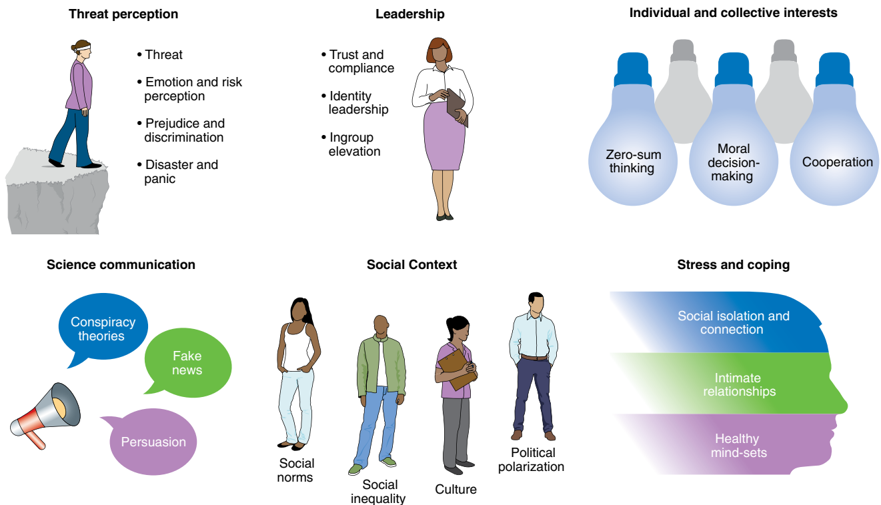
The COVID-19 pandemic represents a massive global health crisis. Because the crisis requires large-scale behaviour change and places significant psychological burdens on individuals, insights from the social and behavioural sciences can be used to help align human behaviour with the recommendations of epidemiologists and public health experts. Here we discuss evidence from a selection of research topics relevant to pandemics, including work on navigating threats, social and cultural influences on behaviour, science communication, moral decision-making, leadership, and stress and coping. In each section, we note the nature and quality of prior research, including uncertainty and unsettled issues. We identify several insights for effective response to the COVID-19 pandemic and highlight important gaps researchers should move quickly to fill in the coming weeks and months.
Overview
CoChat Summary
TL;DR
This perspective argues that social and behavioural science can help align public behaviour with COVID-19 public health recommendations across threat perception, social context, science communication, cooperation, leadership, and stress/coping. It synthesizes prior evidence and policy insights while cautioning that evidence is limited, often drawn from non-pandemic contexts, and in many areas unsettled.
Key findings
- The paper notes the scale of infectious disease threats: the bubonic plague killed approximately 25% of the European population, and by March 2020 COVID-19 had spread to more than 118,000 cases and caused 4,291 deaths in 114 countries. It also notes that 21 countries donated medical supplies to China in February, with China reciprocating widely.
- Fear appeals can change behaviour when people feel capable of dealing with the threat, but produce defensive reactions when people feel helpless; optimism bias can lead people to underestimate personal risk and ignore public health warnings.
- Social norms, inequality, culture, and political polarization shape pandemic behaviour: correcting misperceived norms can help when most people are already doing the desirable behaviour, but descriptive norms can backfire if the behaviour is undesirable unless paired with prescriptive norms.
- Effective communication and leadership may involve credible sources, messages that protect others or align with moral values, prebunking/inoculation against misinformation, accuracy nudges, shared social identity, and leaders modelling prosocial sacrifice; excessive national self-image concerns (“collective narcissism”) can backfire.
Methods
- Design: Perspective/narrative review; no primary data collection or sample. Topics were identified by the corresponding authors as potentially relevant to pandemic response and are explicitly not exhaustive.
- Evidence base: synthesizes prior social and behavioural research on threat perception, social context, science communication, moral decision-making, cooperation, leadership, and stress/coping, drawing on laboratory experiments, correlational studies, field experiments, meta-analyses, and preprints/forthcoming work.
- Analysis: narrative synthesis with policy implications and identified research gaps; no systematic search strategy or quantitative synthesis is reported.
Limitations
- Stated: due to space constraints, the paper provides only a brief summary of each topic; research on these topics is ongoing and in many cases far from settled; there is very little published social science research on the current pandemic, so discussion often draws from different circumstances and evidence quality varies substantially.
- Stated: insights and policy implications should be interpreted with caution.
- Evident: as a perspective rather than a systematic review or empirical study, it does not provide a comprehensive evidence appraisal, and its reliance on preprints and forthcoming sources limits certainty.
Model-written summary. Check it against the paper before relying on it.
Integrity signals
Registry
Cites
Statistics
Figures
Verification
Claims the paper makes
19 Valid · 5 Not valid · 37 Not checked · 13 Own results and interpretations
At least one cited source doesn’t support this claim or points to a different paper, and none confirmed it — see the verdicts below.
In the paper
“For instance, in hypothetical scenarios about deciding whether to go to work while sick, American and British participants reported they would be less willing to stay home when it was uncertain they would infect a co-worker.”
What the sources say
- Disputedcites [176] Kappes, A. et al. Uncertainty about the impact of social decisions increases prosocial behaviour. Nat. Hum. Behav. 2, 573–580 (2018). sourceExperimental — accuracy not yet measured
In the paper’s account of the infectious-disease scenario (Abstract; page not provided), participants facing uncertainty about how severely a co-worker might be affected were more likely to stay home than controls, not less. The paper distinguishes that impact uncertainty from uncertainty about whether a co-worker would be infected. Its Study 6 Methods (page not provided) describe recruitment through AMT, but do not establish the claimed American and British participant groups. (LLM, conf=0.88)
Checked by a reasoning model — may be wrong.
hedgedstates an association- Asserted: passes — The authors put it forward as true.
- Checkable: passes — It can be checked against evidence.
- Load-bearing: passes — The paper’s conclusions depend on it.
- Based: passes — The paper gives a reason why it holds.
- Disputed
The cited sources that could be checked couldn’t confirm or dispute this claim.
In the paper
“Moreover, there is mixed research regarding whether corrections may actually increase belief in the original misinformation 121,124-126 or in other misleading claims that fail to get corrected 127 .”
What the sources say
- Not checked — no full text of the sourcecites [121] Guess, A. & Coppock, A. Does counter-attitudinal information cause backlash? Results from three large survey experiments. Br. J. Polit. Sci. https://doi.org/10.1017/S0007123418000327 (2018). source
- Not matchedcites [124] Wittenberg, C. & Berinsky, A.J. Misinformation and its correction. in Social Media and Democracy: The State of the Field (eds Persily, N. & Tucker, J. A.) (Cambridge University Press, forthcoming).
Its entry has no title and year that we can search by.
- Not checked — no full text of the sourcecites [125] Swire, B. & Ecker, U.K.H. Misinformation and its correction: Cognitive mechanisms and recommendations for mass communication. in Misinformation and Mass Audiences (eds. Southwell, B. G., Thorson, E. A. & Sheble, L.) 195–2011 (University of Texas Press, 2018). source
- Not checked — no full text of the sourcecites [126] Wood, T. & Porter, E. The elusive backfire effect: mass attitudes’ steadfast factual adherence. Polit. Behav. 41, 135–163 (2018). source
- Could not verifycites [127] Pennycook, G., McPhetres, J., Zhang, Y. & Rand, D. Fighting COVID-19 misinformation on social media: Experimental evidence for a scalable accuracy nudge intervention. Preprint at PsyArXiv https://doi.org/10.31234/osf.io/uhbk9 (2020). sourceExperimental — accuracy not yet measured
Citation 127 is attached to the suggestion that corrections may increase belief in other misleading claims that go uncorrected. The Statement of Relevance and Discussion describe an accuracy nudge that improved sharing decisions, not corrections or their effects on belief in uncorrected claims. Searches for correction backfire and uncorrected misinformation found no passage addressing that point; page numbers were unavailable in our copy. (LLM, conf=0.76)
hedgedstates a possible cause- Asserted: passes — The authors put it forward as true.
- Checkable: passes — It can be checked against evidence.
- Load-bearing: passes — The paper’s conclusions depend on it.
- Based: passes — The paper gives a reason why it holds.
The sources with a verdict support this claim; the rest weren’t checked yet, have no full text we could read, or their verdicts aren’t rated yet.
In the paper
“Indeed, laboratory research has found that people prioritize local over global (or international) interests 185,186 .”
What the sources say
- Supportedcites [185] Milinski, M., Hilbe, C., Semmann, D., Sommerfeld, R. & Marotzke, J. Humans choose representatives who enforce cooperation in social dilemmas through extortion. Nat. Commun. 7, 10915 (2016). source
The Results section (‘Voters choose selfish representatives’; page unavailable) reports that participants preferentially re-elected representatives who contributed less to the shared climate account and elected candidates who pledged to contribute less than a fair share. In this simulated international dilemma, that supports the claim that participants favored their own group’s interests over the collective goal; it does not establish that everyone did so. (LLM, conf=0.85)
- Not checked — no full text of the sourcecites [186] Reinders Folmer, C. P. et al. One for all: what representing a group may do to us. J. Exp. Soc. Psychol. 48, 1047–1056 (2012). source
plain- Asserted: passes — The authors put it forward as true.
- Checkable: passes — It can be checked against evidence.
- Load-bearing: passes — The paper’s conclusions depend on it.
- Based: passes — The paper gives a reason why it holds.
- Supported
Every source the paper cites for this claim was checked and supports it.
In the paper
“However, when going to work risked infecting an elderly co-worker who would suffer a serious illness, participants reported they would be more willing to stay home 176 .”
What the sources say
- Supportedcites [176] Kappes, A. et al. Uncertainty about the impact of social decisions increases prosocial behaviour. Nat. Hum. Behav. 2, 573–580 (2018). source
The Study 6 Methods (page not provided) describe a scenario in which going to work could infect an older, vulnerable co-worker who would suffer severely, followed by a rating of willingness to go to work. The reported Study 6 findings (indexed under Abstract; page not provided) say participants given that risk information were significantly more likely to stay home than controls. (LLM, conf=0.92)
hedgedstates a cause- Asserted: passes — The authors put it forward as true.
- Checkable: passes — It can be checked against evidence.
- Load-bearing: passes — The paper’s conclusions depend on it.
- Based: passes — The paper gives a reason why it holds.
- Supported
The sources with a verdict support this claim; the rest weren’t checked yet, have no full text we could read, or their verdicts aren’t rated yet.
In the paper
“Several techniques, such as sanctioning defectors 187 or rewarding cooperators 188 , tend to increase cooperative behaviour in laboratory experiments using economic games.”
What the sources say
- Not checked — no full text of the sourcecites [187] Yamagishi, T. The provision of a sanctioning system as a public good. J. Pers. Soc. Psychol. 51, 110–116 (1986). source
- Supportedcites [188] Rand, D. G., Dreber, A., Ellingsen, T., Fudenberg, D. & Nowak, M. A. Positive interactions promote public cooperation. Science 325, 1272–1275 (2009). source
Citation 188 is attached to rewarding cooperators. The paper’s Abstract reports a laboratory comparison using repeated public goods games and finds that reward maintained public cooperation and, when both reward and punishment were available, increased contributions. (LLM, conf=0.93)
plainstates a cause- Asserted: passes — The authors put it forward as true.
- Checkable: passes — It can be checked against evidence.
- Load-bearing: unclear — It is unclear whether the paper’s conclusions depend on it.
- Based: passes — The paper gives a reason why it holds.
50 more claims · 13 with their cited sources checked
Create a free account to see all 74 claims and to verify the 2 references still open.
- It may state two separate claims as one. 13
- Probably not a substantial claim. 6
Claims other papers make about this one
Each is checked against this paper’s own text: does it say what the citing paper says it does?
The source backs part of the claim, not all of it — or backs it for a different population, condition or comparison.
In the citing paper
“COVID-19 is an international public health crisis, putting substantial burden on medical centers and increasing the psychological toll on health care workers (HCW).”
From Supporting the well-being of health care providers during the COVID-19 pandemic: The CopeColumbia response (2020) · cites this paper as [6]
Experimental — accuracy not yet measuredThe source backs part of the claim, not all of it — or backs it for a different population, condition or comparison.
In the citing paper
“these population-wide measures affected psychological well-being and mental health as well as increased social isolation [68] and loneliness.”
From Psychological correlates of perceived loneliness in college students before and during the COVID-19 stay-at-home period: a longitudinal study (2023) · cites this paper as [68]
Experimental — accuracy not yet measuredThe source backs part of the claim, not all of it — or backs it for a different population, condition or comparison.
In the citing paper
“they may eventually increase the social isolation of students and affect their psychological well-being and mental health [3].”
From Students under lockdown: Comparisons of students’ social networks and mental health before and during the COVID-19 crisis in Switzerland (2020) · cites this paper as [3]
Experimental — accuracy not yet measuredThe source backs part of the claim, not all of it — or backs it for a different population, condition or comparison.
In the citing paper
“effective interventions are hard to scale to a population level (12);”
From Psychological inoculation improves resilience against misinformation on social media (2022) · cites this paper as [12]
Experimental — accuracy not yet measuredThe source backs part of the claim, not all of it — or backs it for a different population, condition or comparison.
In the citing paper
“There is a shortage of studies that test anti-misinformation interventions in an ecologically valid manner, i.e., testing an intervention as consumers would interact with it in online environments (8, 12).”
From Psychological inoculation improves resilience against misinformation on social media (2022) · cites this paper as [12]
Experimental — accuracy not yet measured
6 more claims about this paper
Create a free account to see every claim other papers make about this one.
Citations
Cites
Granovetter, M. S. (1973) · American Journal of Sociology · doi:10.1086/225469 · Cited by 40,491
Zhou, F., Yu, T., Du, R., Fan, G., Liu, Y., Liu, Z., Xiang, J., Wang, Y., Song, B., Gu, X., et al. (2020) · The Lancet · doi:10.1016/s0140-6736(20)30566-3 · Cited by 27,263
The need to belong: Desire for interpersonal attachments as a fundamental human motivation.
Baumeister, R. F., & Leary, M. R. (1995) · Psychological Bulletin · doi:10.1037//0033-2909.117.3.497 · Cited by 23,245
Culture and the self: Implications for cognition, emotion, and motivation.
Markus, H. R., & Kitayama, S. (1991) · Psychological Review · doi:10.1037/0033-295x.98.2.224 · Cited by 21,995
Self-citationThe Psychological Impact of Quarantine and How to Reduce It: Rapid Review of the Evidence
Brooks, S. K., Webster, R. K., Smith, L. E., Woodland, L., Wessely, S., Greenberg, N., & Rubin, G. J. (2020) · doi:10.2139/ssrn.3532534 · Cited by 16,394
The psychological impact of quarantine and how to reduce it: Rapid review of the evidence
Brooks, S. K., Webster, R. K., Smith, L. E., Woodland, L., Wessely, S., Greenberg, N., & Rubin, G. J. (2020) · The Lancet · doi:10.1016/s0140-6736(20)30460-8 · Cited by 16,378
Nudge: improving decisions about health, wealth, and happiness
(2008) · Choice Reviews Online · doi:10.5860/choice.46-0977 · Cited by 11,572
Slovic, P. (1987) · Science · doi:10.1126/science.3563507 · Cited by 9,271
The Elaboration Likelihood Model of Persuasion
Petty, R. E., & Cacioppo, J. T. (1986) · Advances in Experimental Social Psychology · doi:10.1016/s0065-2601(08)60214-2 · Cited by 8,822
Self-citationThe emotional dog and its rational tail: A social intuitionist approach to moral judgment.
Haidt, J. (2001) · Psychological Review · doi:10.1037/0033-295x.108.4.814 · Cited by 8,048
Research works printed but not linked: 3
- Berkowitz, A.D. An overview of the social norms approach. in Changing the Culture of College Drinking: A Socially Situated Health Communication Campaign (eds. Stewart, L. & Lederman, L. C.) 193–214 (Hampton Press, 2005).
- Wittenberg, C. & Berinsky, A.J. Misinformation and its correction. in Social Media and Democracy: The State of the Field (eds Persily, N. & Tucker, J. A.) (Cambridge University Press, forthcoming).
- Ransohoff, K.J. Patients on the Trolley Track: The Moral Cognition of Medical Practitioners and Public Health Professionals. (Harvard Univ. Press, 2011).
Cited by
Items 1,401–1,500 of 5,015
Klümper, L., & Sürth, S. (2021) · Current Psychology · doi:10.1007/s12144-021-01951-w · Cited by 25
Lachowicz‐Tabaczek, K., & Kozłowska, M. A. (2021) · Personality and Individual Differences · doi:10.1016/j.paid.2021.111138 · Cited by 21
Hempel, C., & Roosen, J. (2021) · Food Quality and Preference · doi:10.1016/j.foodqual.2021.104430 · Cited by 29
A world together: Global citizen identification as a basis for prosociality in the face of COVID-19
Wang, Z., Jetten, J., Steffens, N. K., Álvarez, B., Bentley, S. V., Casara, B. G. S., Crimston, C. R., Ionescu, O., Krug, H., Selvanathan, H. P., et al. (2021) · Group Processes & Intergroup Relations · doi:10.1177/13684302211051619 · Cited by 24
Self-citationCoffeng, T., van Steenbergen, E. F., de Vries, F., Steffens, N. K., & Ellemers, N. (2021) · Regulation & Governance · doi:10.1111/rego.12449 · Cited by 30
Self-citationLangenkamp, A., Čaňo, T., & Czymara, C. S. (2022) · Frontiers in Sociology · doi:10.3389/fsoc.2021.785201 · Cited by 24
“Although epidemiologically necessary, social distancing policies contradict the human need for social interaction and intimate social encounters (Baumeister and Leary, 1995; Bavel et al., 2020).”
BackgroundShafi, S., & Mallinson, D. J. (2022) · Policy Studies · doi:10.1080/01442872.2022.2053093 · Cited by 21
“…uninsured, individuals with pre-existing conditions, low-wage employees, the homeless, detained individuals, etc.) in each country are likely to have precluded policy responses — particularly containment policies — from achieving comparable policy outcomes across nations (Van Bavel et al. 2020).”
BackgroundYan, B., Zhang, X., Wu, L., Zhu, H., & Chen, B. (2020) · Routledge eBooks · doi:10.4324/9781003141402-29 · Cited by 21
Desafios e paradoxos do retorno ao trabalho no contexto da pandemia de COVID-19
Filho, J. M. J., & Algranti, E. (2020) · Revista Brasileira de Saúde Ocupacional · doi:10.1590/2317-6369ed0000220 · Cited by 19
Study of the Sudanese perceptions of COVID-19: Applying the Health Belief ModelPreprint
Nasir, E. F., Almahdi, H. M., & Elhag, A. K. (2020) · medRxiv · doi:10.1101/2020.05.28.20115477 · Cited by 18
“While optimism bias may be beneficial for avoiding anxiety emotions during a pandemic, it can lead people to underestimate their chance of contracting a disease, and therefore disregard public health warnings (42).”
BackgroundRanga, V., Pani, P., Kanga, S., Meraj, G., Farooq, M., Nathawat, M. S., & Singh, S. K. (2020) · Preprints.org · doi:10.20944/preprints202006.0325.v1 · Cited by 19
“In the case of pandemics such as the current COVID-19, mapping hotspots in no time shall serve immediate intervention in stopping the contagion of this disease (Van Bavel et al. 2020).”
BackgroundScerri, M., & Grech, V. (2020) · Early Human Development · doi:10.1016/j.earlhumdev.2020.105253 · Cited by 24
RetractedIdiographic Psychology: From Forms of Inference to Levels of Analysis, and Back AgainPreprint
Syed, M. (2022) · PsyArXiv (OSF Preprints) · doi:10.31234/osf.io/hsp5v · Cited by 20
Conti, C., Lanzara, R., Rosa, I., Müller, M. M., & Porcelli, P. (2023) · BMC Psychology · doi:10.1186/s40359-023-01099-1 · Cited by 26
“At the same time, these population-wide measures affected psychological well-being and mental health as well as increased social isolation [68] and loneliness.”
BackgroundStrategic Science Communication: The “Flatten the Curve” Metaphor in COVID-19 Public Risk Messaging
Ruão, T., & Silva, S. (2021) · UMinho Editora/CECS eBooks · doi:10.21814/uminho.ed.46.9 · Cited by 21
Reicher, S. D., neuroscience1, Drury, J., et al. (2021) · BMJ · doi:10.1136/bmj.n2682 · Cited by 18
Self-citationMemory-based meso-scale modeling of Covid-19
Kergaßner, A., Burkhardt, C., Lippold, D., et al. (2020) · Computational Mechanics · doi:10.1007/s00466-020-01883-5 · Cited by 18
“protest against contact restrictions, locally even encouraged by politicians [7], demonstrate rising anger, fear, or even mental health problems due to the current situation [8,9].”
BackgroundKrawiec, J. M., Piaskowska, O. M., Piesiewicz, P. F., & Białaszek, W. (2021) · Globalization and Health · doi:10.1186/s12992-021-00782-5 · Cited by 24
“boosts can be employed to alleviate the effects of the COVID-19 pandemic in different areas [41].”
BackgroundBellingeri, M., Turchetto, M., Bevacqua, D., Scotognella, F., Alfieri, R., Nguyen, Q., & Cassi, D. (2021) · Frontiers in Physics · doi:10.3389/fphy.2021.681343 · Cited by 19
“The Cost of Social Distancing Although NPIs, including lockdown, have been shown to reduce the SARS-CoV-2 spread, they implicate detrimental impact on population health and economies [42], such as physical inactivity [43], increased depression [44], increased domestic violence [45], and reduced access to health care […”
BackgroundPsychological Factors Affecting Risk Perception of COVID-19: Evidence from Peru and China
Monge, F. S., Jiang, H., Zhang, L., Alvarado-Yepez, A. J., Cardona-Rivero, A., Chulluncuy, E. T. H., & Torres-Mejía, A. (2021) · International Journal of Environmental Research and Public Health · doi:10.3390/ijerph18126513 · Cited by 22
“As the pandemic becomes more complex, there is a need for a better understanding of the public perception of risk [7].”
BackgroundA Pandemic of Misbelief: How Beliefs Promote or Undermine COVID-19 Mitigation
Vitriol, J. A., & Marsh, J. K. (2021) · Frontiers in Political Science · doi:10.3389/fpos.2021.648082 · Cited by 26
“…knowledge concerning the risk, transmission, and mitigation of COVID-19, a primary goal of public health recommendations and communication during the pandemic is to increase public understanding and align belief with consensus scientific information (Finset et al., 2020; Van Bavel et al., 2020).”
BackgroundInfluentialLockdowns lose one third of their impact on mobility in a month
Joshi, Y. V., & Musalem, A. (2021) · Scientific Reports · doi:10.1038/s41598-021-02133-1 · Cited by 25
ÖZBEZEK, B. D., Paksoy, H. M., & ÇOPUROĞLU, F. (2021) · IBAD Sosyal Bilimler Dergisi · doi:10.21733/ibad.951414 · Cited by 26
Adherence to COVID-19 protective behaviors: A matter of cognition or emotion?
Shiloh, S., Peleg, S., & Nudelman, G. (2021) · Health Psychology · doi:10.1037/hea0001081 · Cited by 19
Cauberghe, V., Jans, S. D., Hudders, L., & Vanwesenbeeck, I. (2021) · Journal of Community Psychology · doi:10.1002/jcop.22729 · Cited by 23
Contracting COVID-19: a longitudinal investigation of the impact of beliefs and knowledge
Moore, C. A., Ruisch, B. C., Samayoa, J. A. G., Boggs, S. T., Ladanyi, J. T., & Fázio, R. H. (2021) · Scientific Reports · doi:10.1038/s41598-021-99981-8 · Cited by 22
Perkins, S. E., Shilling, F. M., & Collinson, W. (2022) · Frontiers in Ecology and Evolution · doi:10.3389/fevo.2022.833129 · Cited by 19
“Isolation is not a novel solution in a post pandemic world, and we think that this difficult time could drive people to adopt new habits that reduce their ecological footprint and thereby help to safeguard biodiversity (Bavel et al., 2020).”
Alnizar, F., & Manshur, F. M. (2022) · Jurnal Ilmu Sosial dan Ilmu Politik · doi:10.22146/jsp.66443 · Cited by 18
Cheng, B. B. Y., Ryan, B., Copland, D. A., & Wallace, S. J. (2022) · Neuropsychological Rehabilitation · doi:10.1080/09602011.2022.2051565 · Cited by 22
Melariri, H., Osoba, T. A., Williams, M., & Melariri, P. E. (2022) · Journal of preventive medicine and hygiene · doi:10.15167/2421-4248/jpmh2022.63.1.2209 · Cited by 38
Effects of human mobility and behavior on disease transmission in a COVID-19 mathematical model
Gutiérrez-Jara, J. P., Vogt-Geisse, K., Cabrera, M., Córdova‐Lepe, F., & Muñoz-Quezada, M. T. (2022) · Scientific Reports · doi:10.1038/s41598-022-14155-4 · Cited by 24
“The highest number of cases confirmed is found in the Americas (76,182,529), followed by Europe (59,312,787), South East Asia (37,755,175), Eastern Mediterranean (12,255,849), Africa (4,813,735) and Western Pacific (4,287,201).”
BackgroundReeves, D. C., Willems, N., Shastry, V., & Rai, V. (2022) · Journal of Artificial Societies and Social Simulation · doi:10.18564/jasss.4868 · Cited by 23
Responses of the public towards the government in times of crisis
Bagozzi, R. P., Mari, S., Oklevik, O., & Xie, C. (2022) · British Journal of Social Psychology · doi:10.1111/bjso.12566 · Cited by 21
English, A. S., Ding, Y., Zhang, Q., & Kulich, S. J. (2022) · Frontiers in Psychology · doi:10.3389/fpsyg.2022.983875 · Cited by 22
“Researchers have proposed that threat of an infectious illness might lead to bias and violence towards marginalized or blamed populations (Bavel et al., 2020).”
BackgroundPereira, D. B., Leitão, J. C. C., & Ramos, L. (2022) · International Journal of Environmental Research and Public Health · doi:10.3390/ijerph192013035 · Cited by 40
“Public servants closer to citizens, such as municipal workers, were suddenly forced to work remotely, changing public-sector work environments, raising contingent supervisory demands [12], and acting as a major stressor, increasing chronic anxiety, social isolation, and relationship difficulties [48].”
BackgroundUpenieks, L., Hill, T. D., Acevedo, G. A., & Koenig, H. G. (2023) · Sociology of Religion · doi:10.1093/socrel/srac043 · Cited by 20
Vaccine-hesitant people misperceive the social norm of vaccination
Vriens, E., Tummolini, L., & Andrighetto, G. (2023) · PNAS Nexus · doi:10.1093/pnasnexus/pgad132 · Cited by 29
“Vaccine hesitancy is, however, also influenced by social factors, and many experts have advised to leverage the power of social norms to increase vaccination rates (16–19 ).”
Theivendrampillai, S., Cooper, J., Lee, T., Lau, M. W. K., Marquez, C., Straus, S. E., & Fahim, C. (2023) · BMC Public Health · doi:10.1186/s12889-023-15659-y · Cited by 22
Shake it off! Adaptive coping with stress reduces national narcissism
Molenda, Z., Marchlewska, M., Rogoza, M., & Szczepańska, D. (2023) · British Journal of Social Psychology · doi:10.1111/bjso.12660 · Cited by 17
Hameed, Z., Garavan, T. N., Naeem, R. M., Burhan, M., Moin, M. F., & McCabe, T. (2023) · Asia Pacific Journal of Human Resources · doi:10.1111/1744-7941.12384 · Cited by 26
van den Boom, W., van Dijk, M., Snijders, B. E. P., Luijben, G., van der Laan, J., Euser, S., Sanders, J. G., Buitenhuis, A. H., Spruijt, P., Kroese, F. M., et al. (2023) · PLoS ONE · doi:10.1371/journal.pone.0289294 · Cited by 21
Xiang, T., Li, J., Guo, Y., & Ye, X. (2023) · Transportation Research Part F Traffic Psychology and Behaviour · doi:10.1016/j.trf.2023.10.020 · Cited by 18
Grossmann, I., Varnum, M. E. W., Hutcherson, C. A. C., & Mandel, D. R. (2023) · Trends in Cognitive Sciences · doi:10.1016/j.tics.2023.10.005 · Cited by 26
Future Travel Intentions in Light of Risk and Uncertainty: An Extended Theory of Planned Behavior
Erul, E., Woosnam, K. M., Salazar, J., Uslu, A., Santos, J. A. C., & Sthapit, E. (2023) · Sustainability · doi:10.3390/su152215729 · Cited by 23
Xia, M., & Duan, C. (2020) · International Journal of Mental Health Promotion · doi:10.32604/ijmhp.2020.011117 · Cited by 21
I Don’t Want to Go Back: Examining the Return to Physical Workspaces During COVID-19
Liu, Z., Egdom, D. V., Flin, R. H., Spitzmueller, C., Adepoju, O. E., & Krishnamoorti, R. (2020) · Journal of Occupational and Environmental Medicine · doi:10.1097/jom.0000000000002012 · Cited by 23
“Although advisories from medical(15) and public health(16) researchers largely inform return-to-work guidance, psychological research can supplement these directives by identifying psychological mechanisms that inform societal and organizational readiness.(17) Policies should account for the perspectives of the employ…”
BackgroundLet's build the psychological immunity to fight against COVID-19
Nebhinani, N., & Gupta, T. (2020) · Indian Journal of Psychiatry · doi:10.4103/psychiatry.indianjpsychiatry_420_20 · Cited by 18
“[5] Currently, no data is available on digital skills of special education teachers’ in India.”
Kumar, V., Sood, A., Gupta, S., & Sood, N. (2020) · Journal of International Marketing · doi:10.1177/1069031x20966563 · Cited by 19
“However, international marketing has rarely explored the diffusion patterns of the spread of a disease or analyzed the factors explaining the differences in the disease incidence patterns (Dekimpe, Parker, and Sarvary 2000; Lipsitch, Swerdlow, and Finelli 2020; Van Bavel et al 2020).”
BackgroundInfluentialFell, L. (2020) · Digital Government Research and Practice · doi:10.1145/3428472 · Cited by 30
Hancu‐Budui, A., Zorio‐Grima, A., & Blanco‐Vega, J. (2020) · Sustainability · doi:10.3390/su12239816 · Cited by 29
Makhoul, J., Kabakian‐Khasholian, T., & Chaiban, L. (2021) · Global Health Promotion · doi:10.1177/1757975920984178 · Cited by 23
“(11) which follows a social and behavioral science lens to analyze a selection of research topics relevant to pandemics, we demonstrate the need for integrating contextual considerations in designing messages and engaging with various communities.”
BackgroundInfluentialPabst, A., Bollen, Z., Creupelandt, C., Fontesse, S., & Maurage, P. (2021) · Progress in Neuro-Psychopharmacology and Biological Psychiatry · doi:10.1016/j.pnpbp.2021.110282 · Cited by 19
Raman, G., & Peng, J. C. (2021) · Proceedings of the National Academy of Sciences · doi:10.1073/pnas.2026596118 · Cited by 20
“M itigation of the coronavirus disease 2019 (COVID-19) pandemic hinges on effecting massive behavioral changes in individuals across the world, at least until pharmaceutical interventions are developed and made available at scale (1, 2).”
Chan, H. F., Rizio, S. M., Skali, A., & Torgler, B. (2021) · Frontiers in Psychology · doi:10.3389/fpsyg.2021.681975 · Cited by 22
Rump, M., & Zwiener‐Collins, N. (2021) · Journal of Elections Public Opinion and Parties · doi:10.1080/17457289.2021.1924733 · Cited by 25
“In times of crisis, it can be helpful to distribute risks of unemployment, while married people are also less at risk of social isolation – although others have highlighted increased stress and risks of conflict and domestic violence (Van Bavel et al. 2020, 466).”
BackgroundPresti, S. L., Mattavelli, G. C., Canessa, N., & Gianelli, C. (2021) · Personality and Individual Differences · doi:10.1016/j.paid.2021.111090 · Cited by 23
Invincibility threatens vaccination intentions during a pandemic
Leonhardt, J. M., Ridinger, G., Rong, Y., & Talaei‐Khoei, A. (2021) · PLoS ONE · doi:10.1371/journal.pone.0258432 · Cited by 19
“Individual differences and demographic factors may contribute toward differential feelings of personal susceptibility to serious illness from the disease and could foster a sense of invincibility to the negative health ramifications of the disease [3, 4, 10, 13, 16, 17].”
BackgroundFlexible emotion regulatory selection when coping with COVID-19-related threats during quarantine
Shabat, M., Shafir, R., & Sheppes, G. (2021) · Scientific Reports · doi:10.1038/s41598-021-00716-6 · Cited by 18
Religion, social interactions, and COVID-19 incidence in Western Germany
Laliotis, I., & Minos, D. (2021) · European Economic Review · doi:10.1016/j.euroecorev.2021.103992 · Cited by 23
Gilliam, A. N., Schwartz, D. B., Godoy, R., Boduroğlu, A., & Gutchess, A. H. (2022) · Journal of Cross-Cultural Psychology · doi:10.1177/00220221221077710 · Cited by 21
“Tight cultures have been known to feel more fearful, threatened, and hostile toward outgroups (Jackson et al., 2019; van Bavel et al., 2020).”
BackgroundResultBehavioural insights and the evolving COVID-19 pandemic
de Bruin, M., Suk, J. E., Baggio, M., Blomquist, S. E., Romero, M. F., Forjaz, M. J., Godoy‐Ramirez, K., Leurs, M. T. W., Rodríguez‐Blázquez, C., Romay‐Barja, M., et al. (2022) · Eurosurveillance · doi:10.2807/1560-7917.es.2022.27.18.2100615 · Cited by 24
“Background Behavioural sciences – including cognitive psychology, anthropology, social psychology, behavioural economics, sociology and other areas – are an essential complement to medical and epidemiological sciences in the response to the coronavirus disease (COVID19) pandemic [1].”
BackgroundCOVID-19-Related Health Literacy of Socioeconomically Vulnerable Migrant Groups
Ruedin, D., Probst, J., Wanner, P., Efionayi-Mäder, D., & Bodenmann, P. (2022) · International Journal of Public Health · doi:10.3389/ijph.2022.1604664 · Cited by 25
“Some of this information was contradictory, some of it evolved over time, some of it was uncertain, and some of it was manifestly false, making health literacy no less important than is ordinarily the case [1, 9].”
BackgroundInfluentialUnpacking COVID ‐19 and conspiracy theories in the UK black community
Vandrevala, T., Hendy, J., Hanson, K., Alidu, L., & Ala, A. (2022) · British Journal of Health Psychology · doi:10.1111/bjhp.12636 · Cited by 18
Face masks influence emotion judgments of facial expressions: a drift–diffusion model
Williams, W. C., Haque, E., Mai, B., & Venkatraman, V. (2023) · Scientific Reports · doi:10.1038/s41598-023-35381-4 · Cited by 26
How the fear of COVID-19 changed the way we look at human faces
Federico, G., Ferrante, D., Marcatto, F., & Brandimonte, M. A. (2021) · PeerJ · doi:10.7717/peerj.11380 · Cited by 19
“It seems, therefore, plausible that such a characteristic social behaviour might be affected by how severely COVID-19 impacted our psychosocial functioning, habits, and social interaction (Bagcchi, 2020; Bavel et al., 2020).”
BackgroundCoronaNet: A Dyadic Dataset of Government Responses to the COVID-19 PandemicPreprint
Cheng, C. I.-F., Barceló, J., Hartnett, A. S., Kubinec, R., & Messerschmidt, L. (2020) · SocArXiv (OSF Preprints) · doi:10.31235/osf.io/dkvxy · Cited by 27
Prosocial behavior promotes positive emotion during the COVID-19 pandemicPreprint
Varma, M. M., Chen, D., Lin, X., et al. (2020) · doi:10.31234/osf.io/vdw2e · Cited by 18
Velásquez, N., Leahy, R., Restrepo, N. J., et al. (2020) · Research Square · doi:10.21203/rs.3.rs-110371/v1 · Cited by 18
Partouche-Sebban, J., Rezaee Vessal, S., Sorio, R., Castellano, S., Khelladi, I., & Orhan, M. A. (2021) · Journal of Marketing Management · doi:10.1080/0267257x.2021.2012232 · Cited by 17
“Moreover, as recent studies suggest that trust in institutions plays an important role in the way individuals manage the pandemic (Van Bavel et al., 2020), this study also explores the indirect effect of death anxiety on coping strategies through trust in institutions.”
BackgroundGovind, R., Garg, N., & Carter, L. D. (2023) · European Journal of Marketing · doi:10.1108/ejm-12-2022-0911 · Cited by 19
Kamalrathne, T., Amaratunga, D., Haigh, R., Kodituwakku, L., Rupasinghe, C., Ranaweera, P., & Herath, H. (2024) · International Journal of Environmental Research and Public Health · doi:10.3390/ijerph21091238 · Cited by 23
“Understanding policymaking during a global health emergency and prioritizing the safeguarding of citizens is a critical aspect for any country, as seen during the COVID-19 pandemic [92,93].”
BackgroundThe not-so-forbidden triad: Evaluating the assumptions of the Strength of Weak Ties
Neal, Z. P. (2024) · Network Science · doi:10.1017/nws.2024.12 · Cited by 22
“This logic has found application across a range of domains, from public health (Bavel et al., 2020) to physics (Battiston et al., 2020).”
DeVerna, M., Pierri, F., Ahn, Y., Fortunato, S., Flammini, A., & Menczer, F. (2025) · npj Complexity · doi:10.1038/s44260-025-00038-y · Cited by 32
“In a scenario where the misinformation spreads more widely (purple nodes in E ), more individuals get infected (yellow nodes in F ).”
Escolà‐Gascón, Á., Marín, F.-X., Rusiñol, J., & Gallifa, J. (2020) · Frontiers in Psychology · doi:10.3389/fpsyg.2020.607064 · Cited by 19
Alen, N. V., Deer, L. K., Karimi, M., Feyzieva, E., Hastings, P. D., & Hostinar, C. E. (2021) · Developmental Science · doi:10.1111/desc.13099 · Cited by 19
Tyaningsih, R. Y., Arjudin, Prayitno, S., et al. (2021) · Journal of Physics Conference Series · doi:10.1088/1742-6596/1806/1/012119 · Cited by 17
Edmonds, T., Drake, H., Miller, J., Trabue, N., Lister, C., Salunkhe, S. S., O’Keefe, M., Alzahrani, S., White, K. B., & Levinson, A. (2021) · Health Promotion Practice · doi:10.1177/1524839921996796 · Cited by 24
Moral Decision-Making in Healthcare and Medical Professions During the COVID-19 Pandemic
Borhany, H., Golbabaei, S., Jameie, M., & Borhani, K. (2021) · Trends in Psychology · doi:10.1007/s43076-021-00118-7 · Cited by 20
“Many social behaviors are affected during the pandemic (Bavel et al., 2020), and therefore, making decisions that were simple in the past becomes very hard.”
BackgroundBientzle, M., Eggeling, M., Kanzleiter, M., Thieme, K., & Kimmerle, J. (2021) · PLoS ONE · doi:10.1371/journal.pone.0254501 · Cited by 24
“Especially in times marked by fear and the threat of a virus, a punitive and intolerant attitude toward others can be observed [6].”
BackgroundJacquet, A. D. R., Bogard, S., Normandeau, C. P., Degroot, C., Postuma, R. B., Dupré, N., Miyasaki, J. M., Monchi, O., Martino, D., Fon, E. A., et al. (2021) · Parkinsonism & Related Disorders · doi:10.1016/j.parkreldis.2021.08.018 · Cited by 20
Societal values and mask usage for COVID-19 control in the US
Bir, C., & Widmar, N. O. (2021) · Preventive Medicine · doi:10.1016/j.ypmed.2021.106784 · Cited by 18
Wenger, M. R., & Lantz, B. (2021) · Victims & Offenders · doi:10.1080/15564886.2021.1974136 · Cited by 19
“More specifically, prior research has demonstrated that the threat of disease often increases ethnocentrism and intolerance toward out-groups, and that this threat has the potential to lead to discrimination and violent behavior against minority groups more generally (Van Bavel et al., 2020).”
BackgroundInfluentialFacial mask personalization encourages facial mask wearing in times of COVID-19
Palcu, J., Schreier, M., & Janiszewski, C. A. (2022) · Scientific Reports · doi:10.1038/s41598-021-04681-y · Cited by 20
Escaping Loneliness Through Tourist-Chatbot Interactions
Wang, P., & Shao, J. (2022) · Springer eBooks · doi:10.1007/978-3-030-94751-4_44 · Cited by 21
“While the policies of home isolation and social distancing can help keep people physically away from the virus, they have caused more people to feel lonely globally [15].”
BackgroundZhang, W., Hu, L., & Park, J. (2022) · Social Science Computer Review · doi:10.1177/08944393211053743 · Cited by 20
“Indeed, the public ’ s attitude toward the government on their crisis management may be driven by emotional factors besides cognitive reasoning (i.e., attribution) (Van Bavel et al., 2020).”
BackgroundAguilar‐Latorre, A., Oliván‐Blázquez, B., Porroche‐Escudero, A., Méndez-López, F., García-Gallego, V., Benedé-Azagra, B., & Magallón-Botaya, R. M. (2022) · BMC Public Health · doi:10.1186/s12889-022-13083-2 · Cited by 20
“Self-isolation policies can increase social isolation and relationship difficulties [39].”
BackgroundMethodInfluentialFrimpong, J. B., Agormedah, E. K., Srem‐Sai, M., Quansah, F., & Hagan, J. E. (2022) · COVID · doi:10.3390/covid2050050 · Cited by 17
“These findings support the Health Belief Model, which proposes that teachers’ risk perception (including perceived susceptibility and perceived severity of a disease) is a key determinant in explaining their propensity of behavioral responses and coping/adapting behaviors amid global pandemics (COVID-19) and threats […”
Guèvremont, A., Boivin, C., Durif, F., & Graf, R. (2022) · Journal of Consumer Behaviour · doi:10.1002/cb.2083 · Cited by 23
“The current pandemic is a major stress factor characterized by uncertainty and a high anxiety level (Bavel et al., 2020).”
BackgroundExperiences of face mask use during the COVID‐19 pandemic: A qualitative study
Hanna, E. S., Martin, G. P., Campbell, A., Connolly, P., Fearon, K., & Markham, S. E. (2022) · Sociology of Health & Illness · doi:10.1111/1467-9566.13525 · Cited by 23
Nam, B. H., & English, A. S. (2022) · International Journal of Environmental Research and Public Health · doi:10.3390/ijerph191711057 · Cited by 17
“More specifically, potential traumatic symptoms and risk factors can occur due to causes, effects, and objects during a pandemic [13,16].”
BackgroundLee, S. J., Lee, C., & Hwang, H. (2022) · Health Communication · doi:10.1080/10410236.2022.2125119 · Cited by 19
“However, another important factor to consider is political orientation, as perceptions of COVID-19 have become increasingly politicized (Bavel et al., 2020; Grossman et al., 2020; Hart et al., 2020).”
BackgroundCabrera‐Álvarez, P., Hornsey, M. J., & Lobera, J. (2022) · Health Promotion International · doi:10.1093/heapro/daac138 · Cited by 21
“This paper focuses on two classes of factors that can influence people’s adherence to measures intended to stop the spread of the novel coronavirus: social norms and perceived risk (Bavel et al., 2020).”
BackgroundAksoy, O. (2022) · Nature Human Behaviour · doi:10.1038/s41562-022-01465-w · Cited by 22
Ehrke, F., Grommisch, G., Busch, E. P., & Kaczmarek, M. C. (2023) · Social Psychology · doi:10.1027/1864-9335/a000500 · Cited by 25
Stivas, D., & Cole, A. M. (2023) · Journal of Contemporary European Studies · doi:10.1080/14782804.2023.2193733 · Cited by 22
Berendes, S., Mounier‐Jack, S., Ojo-Aromokudu, O., Ivory, A., Tucker, J. D., Larson, H. J., & Free, C. (2023) · BMC Public Health · doi:10.1186/s12889-023-16317-z · Cited by 26
Self-citationMeasuring Innovation in Education 2023: Tools and Methods for Data-Driven Action and Improvement
OECD (2023) · Educational research and innovation · doi:10.1787/a7167546-en · Cited by 55
Social resilience indicators for pandemic crises
Busic-Sontic, A., & Schubert, R. (2023) · Disasters · doi:10.1111/disa.12610 · Cited by 25
Zhang, D., Zhang, Y., & Fu, G. (2024) · Habitat International · doi:10.1016/j.habitatint.2024.103116 · Cited by 20
Stigma in COVID-19: A barrier to seek medical care and family support.
Asadi-Aliabadi, M., Tehrani‐Banihashemi, A., & Moradi‐Lakeh, M. (2020) · PubMed Central · doi:10.34171/mjiri.34.98 · Cited by 17
“In some parts of the world some discriminatory social behaviors have been reported against people of a particular ethnicity who have been infected with COVID-19 (7).”
Background
Metadata
- Authors
- Bavel, J. J. V., Baicker, K., Boggio, P. S., Capraro, V., Cichocka, A., Cikara, M., Crockett, M. J., Crum, A. J., Douglas, K. M., Druckman, J. N., Drury, J., Dube, O., Ellemers, N., Finkel, E. J., Fowler, J. H., Gelfand, M., Han, S., Haslam, S. A., Jetten, J., Kitayama, S., Mobbs, D., Napper, L. E., Packer, D. J., Pennycook, G., Peters, E., Petty, R. E., Rand, D. G., Reicher, S. D., Schnall, S., Shariff, A., Skitka, L. J., Smith, S. S., Sunstein, C. R., Tabri, N., Tucker, J. A., Linden, S. V. D., Lange, P. V., Weeden, K. A., Wohl, M. J. A., Zaki, J., Zion, S. R., & Willer, R.
- Affiliations
- New York University (US)
- Universidade Presbiteriana Mackenzie (BR)
- Middlesex University London (GB)
- University of Kent (GB)
- Harvard University (US)
- Yale University (US)
- Stanford University (US)
- Northwestern University (US)
- University of Sussex (GB)
- University of Chicago (US)
- Utrecht University (NL)
- University of California San Diego (US)
- University of Maryland, College Park (US)
- Peking University (CN)
- The University of Queensland (AU)
- University of Michigan (US)
- California Institute of Technology (US)
- Lehigh University (US)
- University of Regina (CA)
- University of Oregon (US)
- The Ohio State University (US)
- Massachusetts Institute of Technology (US)
- University of St Andrews (GB)
- University of Cambridge (GB)
- University of British Columbia (CA)
- University of Illinois Chicago (US)
- University of California, Berkeley (US)
- Carleton University (CA)
- Cornell University (US)
- Corresponding author
- Bavel, Jay J. Van
- Willer, Robb
- ORCID
- Bavel, Jay J. Van
- Baicker, Katherine
- Boggio, Paulo S.
- Capraro, Valerio
- Cichocka, Aleksandra
- Cikara, Mina
- Crockett, Molly J.
- Crum, Alia J.
- Douglas, Karen M.
- Druckman, James N.
- Drury, John
- Ellemers, Naomi
- Finkel, Eli J.
- Fowler, James H.
- Gelfand, Michele
- Han, Shihui
- Haslam, S. Alexander
- Jetten, Jolanda
- Kitayama, Shinobu
- Mobbs, Dean
- Napper, Lucy E.
- Packer, Dominic J.
- Pennycook, Gordon
- Peters, Ellen
- Petty, Richard E.
- Rand, David G.
- Reicher, Stephen D.
- Schnall, Simone
- Shariff, Azim
- Skitka, Linda J.
- Sunstein, Cass R.
- Tabri, Nassim
- Tucker, Joshua A.
- Linden, Sander van der
- Weeden, Kim A.
- Wohl, Michael J. A.
- Zaki, Jamil
- Zion, Sean R.
- Willer, Robb
- Venue
- Nature Human Behaviour
- Published
- 2020-04-30
- Volume
- 4
- Issue
- 5
- Pages
- 460-471
- ISSN
- 2397-3374 (ISSN-L)
- OpenAlex
- W3016902371
- Semantic Scholar
- d81abcd7f053b136423f1e7f57928524e8b0e1a0
- Cited by
- 4,964
- References
- 259
- Citations by year
- 2026: 177 · 2025: 288 · 2024: 483 · 2023: 741 · 2022: 1094 · 2021: 1474 · 2020: 702
- FWCI
- 175.81
- Type
- journal article
- Language
- en
- Open access
- bronze
- doi.org
- Licence
- www.springernature.com/gp/researchers/text-and-data-mining (tdm)
- www.springernature.com/gp/researchers/text-and-data-mining (vor)
- Locations
- Nature Human Behaviour (publishedVersion)
- PubMed (publishedVersion)
- Middlesex University Research Repository (Middlesex University Of London) (acceptedVersion)
- Kent Academic Repository (University of Kent) (acceptedVersion)
- DSpace@MIT (Massachusetts Institute of Technology) (submittedVersion, cc-by-nc-sa)
- Sussex Research Online (University of Sussex) (submittedVersion)
- CaltechAUTHORS (California Institute of Technology) (submittedVersion)
- RePEc: Research Papers in Economics (submittedVersion)
- BOA (University of Milano-Bicocca) (submittedVersion)
- Carleton University's Institutional Repository (MacOdrum Library, Carleton University) (submittedVersion, other-oa)
- Utrecht University Repository (Utrecht University) (submittedVersion)
- Figshare (submittedVersion)
- VU Research Portal (submittedVersion, other-oa)
- Utrecht University Repository (Utrecht University) (submittedVersion, other-oa)
- Data Archiving and Networked Services (DANS) (submittedVersion, other-oa)
- Funders
- U.S. Department of Health and Human Services (2P50 MH094258)
- National Institute of Mental Health (P50MH094258)
- Topics
- Social Sciences › Sociology and Political Science › COVID-19 Prevention and Impact
- Social Sciences › Communication › Communication and COVID-19 Impact
- Physical Sciences › Mathematics › Modeling and Simulation › COVID-19 epidemiological studies
- Keywords
- COVID-19 pandemic, pandemic response, behavior change, science communication, ethical decision-making, leadership, stress coping, psychological burden, public health recommendations
- MeSH terms
- Betacoronavirus, COVID-19, SARS-CoV-2, Adaptation, Psychological, Communicable Disease Control, Decision Making, Humans, Human Activities, Health Knowledge, Attitudes, Practice, Leadership, Pneumonia, Viral, Public Health, Quarantine, Stress, Psychological, Global Health, Coronavirus, Coronavirus Infections, Pandemics, Social Media, Epidemiological Monitoring
About these checks
Registry, retraction, Cites and statistics results are computed, not judged, with one exception: a printed reference that no index lists is read once by a model before it counts as a citation error. Claims are extracted by a model and kept only when their quote appears verbatim in the text; each cited source is then checked, with a model’s help, for whether it says what the claim relies on. Those verdicts can be wrong — read the claim’s quote and the cited source before relying on one.
The claim verdicts this report counts are experimental: their accuracy is not yet measured.
A language model drew the claims from the paper on 2026-10-10, under version 3 of the claim definition (model deepseek-v4.1-flash, prompt extract-v3).
A second model labelled each claim on 2026-10-10 (model jev-1.13-20260917, definition revision gold-guideline-v0.2).
Cited sources are checked with a language model’s help (gpt-6-sol).
Statistics and arithmetic are recomputed, not judged.
Confidence bands are shown only for fields calibrated on our annotated test set. None is calibrated yet, so no band is shown.
What counts as a claim ›How we measure confidence ›How we check this ›
Are you an author, or do you see a problem with this page? Request a review
Data sources
Bibliographic data: Semantic Scholar, OpenAlex, Crossref.
Contains information from the Semantic Scholar Academic Graph Datasets, made available under the ODC Attribution License (ODC-BY 1.0).
Semantic Scholar’s data is described in: Kinney, R., et al. (2023). The Semantic Scholar Open Data Platform. arXiv:2301.10140.
