

Using social and behavioural science to support COVID-19 pandemic response
Open accessThe DOI matches its Crossref record; 257 of the 259 references it cites were found in a registry or an index; 24 of the 89 sources its claims cite were checked for support.
Abstract
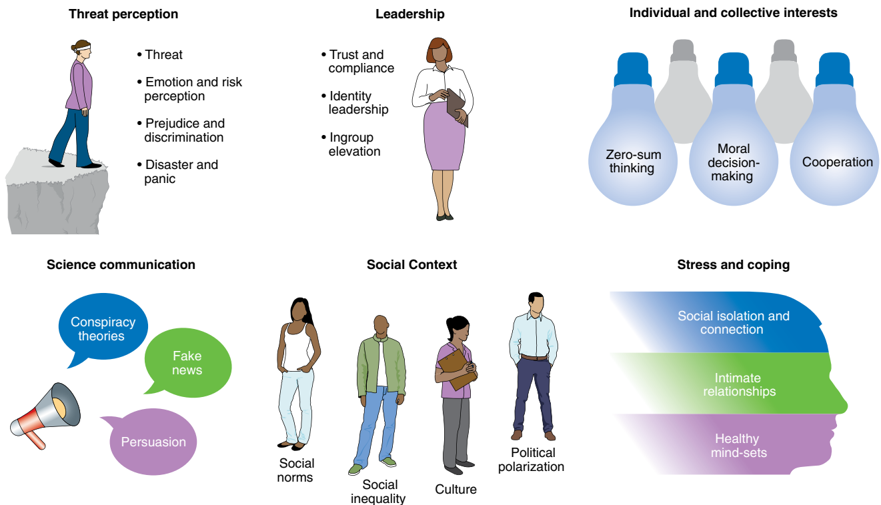
The COVID-19 pandemic represents a massive global health crisis. Because the crisis requires large-scale behaviour change and places significant psychological burdens on individuals, insights from the social and behavioural sciences can be used to help align human behaviour with the recommendations of epidemiologists and public health experts. Here we discuss evidence from a selection of research topics relevant to pandemics, including work on navigating threats, social and cultural influences on behaviour, science communication, moral decision-making, leadership, and stress and coping. In each section, we note the nature and quality of prior research, including uncertainty and unsettled issues. We identify several insights for effective response to the COVID-19 pandemic and highlight important gaps researchers should move quickly to fill in the coming weeks and months.
Overview
CoChat Summary
TL;DR
This perspective argues that social and behavioural science can help align public behaviour with COVID-19 public health recommendations across threat perception, social context, science communication, cooperation, leadership, and stress/coping. It synthesizes prior evidence and policy insights while cautioning that evidence is limited, often drawn from non-pandemic contexts, and in many areas unsettled.
Key findings
- The paper notes the scale of infectious disease threats: the bubonic plague killed approximately 25% of the European population, and by March 2020 COVID-19 had spread to more than 118,000 cases and caused 4,291 deaths in 114 countries. It also notes that 21 countries donated medical supplies to China in February, with China reciprocating widely.
- Fear appeals can change behaviour when people feel capable of dealing with the threat, but produce defensive reactions when people feel helpless; optimism bias can lead people to underestimate personal risk and ignore public health warnings.
- Social norms, inequality, culture, and political polarization shape pandemic behaviour: correcting misperceived norms can help when most people are already doing the desirable behaviour, but descriptive norms can backfire if the behaviour is undesirable unless paired with prescriptive norms.
- Effective communication and leadership may involve credible sources, messages that protect others or align with moral values, prebunking/inoculation against misinformation, accuracy nudges, shared social identity, and leaders modelling prosocial sacrifice; excessive national self-image concerns (“collective narcissism”) can backfire.
Methods
- Design: Perspective/narrative review; no primary data collection or sample. Topics were identified by the corresponding authors as potentially relevant to pandemic response and are explicitly not exhaustive.
- Evidence base: synthesizes prior social and behavioural research on threat perception, social context, science communication, moral decision-making, cooperation, leadership, and stress/coping, drawing on laboratory experiments, correlational studies, field experiments, meta-analyses, and preprints/forthcoming work.
- Analysis: narrative synthesis with policy implications and identified research gaps; no systematic search strategy or quantitative synthesis is reported.
Limitations
- Stated: due to space constraints, the paper provides only a brief summary of each topic; research on these topics is ongoing and in many cases far from settled; there is very little published social science research on the current pandemic, so discussion often draws from different circumstances and evidence quality varies substantially.
- Stated: insights and policy implications should be interpreted with caution.
- Evident: as a perspective rather than a systematic review or empirical study, it does not provide a comprehensive evidence appraisal, and its reliance on preprints and forthcoming sources limits certainty.
Model-written summary. Check it against the paper before relying on it.
Integrity signals
Registry
Cites
Statistics
Figures
Verification
Claims the paper makes
19 Valid · 5 Not valid · 37 Not checked · 13 Own results and interpretations
At least one cited source doesn’t support this claim or points to a different paper, and none confirmed it — see the verdicts below.
In the paper
“For instance, in hypothetical scenarios about deciding whether to go to work while sick, American and British participants reported they would be less willing to stay home when it was uncertain they would infect a co-worker.”
What the sources say
- Disputedcites [176] Kappes, A. et al. Uncertainty about the impact of social decisions increases prosocial behaviour. Nat. Hum. Behav. 2, 573–580 (2018). sourceExperimental — accuracy not yet measured
In the paper’s account of the infectious-disease scenario (Abstract; page not provided), participants facing uncertainty about how severely a co-worker might be affected were more likely to stay home than controls, not less. The paper distinguishes that impact uncertainty from uncertainty about whether a co-worker would be infected. Its Study 6 Methods (page not provided) describe recruitment through AMT, but do not establish the claimed American and British participant groups. (LLM, conf=0.88)
Checked by a reasoning model — may be wrong.
hedgedstates an association- Asserted: passes — The authors put it forward as true.
- Checkable: passes — It can be checked against evidence.
- Load-bearing: passes — The paper’s conclusions depend on it.
- Based: passes — The paper gives a reason why it holds.
- Disputed
The cited sources that could be checked couldn’t confirm or dispute this claim.
In the paper
“Moreover, there is mixed research regarding whether corrections may actually increase belief in the original misinformation 121,124-126 or in other misleading claims that fail to get corrected 127 .”
What the sources say
- Not checked — no full text of the sourcecites [121] Guess, A. & Coppock, A. Does counter-attitudinal information cause backlash? Results from three large survey experiments. Br. J. Polit. Sci. https://doi.org/10.1017/S0007123418000327 (2018). source
- Not matchedcites [124] Wittenberg, C. & Berinsky, A.J. Misinformation and its correction. in Social Media and Democracy: The State of the Field (eds Persily, N. & Tucker, J. A.) (Cambridge University Press, forthcoming).
Its entry has no title and year that we can search by.
- Not checked — no full text of the sourcecites [125] Swire, B. & Ecker, U.K.H. Misinformation and its correction: Cognitive mechanisms and recommendations for mass communication. in Misinformation and Mass Audiences (eds. Southwell, B. G., Thorson, E. A. & Sheble, L.) 195–2011 (University of Texas Press, 2018). source
- Not checked — no full text of the sourcecites [126] Wood, T. & Porter, E. The elusive backfire effect: mass attitudes’ steadfast factual adherence. Polit. Behav. 41, 135–163 (2018). source
- Could not verifycites [127] Pennycook, G., McPhetres, J., Zhang, Y. & Rand, D. Fighting COVID-19 misinformation on social media: Experimental evidence for a scalable accuracy nudge intervention. Preprint at PsyArXiv https://doi.org/10.31234/osf.io/uhbk9 (2020). sourceExperimental — accuracy not yet measured
Citation 127 is attached to the suggestion that corrections may increase belief in other misleading claims that go uncorrected. The Statement of Relevance and Discussion describe an accuracy nudge that improved sharing decisions, not corrections or their effects on belief in uncorrected claims. Searches for correction backfire and uncorrected misinformation found no passage addressing that point; page numbers were unavailable in our copy. (LLM, conf=0.76)
hedgedstates a possible cause- Asserted: passes — The authors put it forward as true.
- Checkable: passes — It can be checked against evidence.
- Load-bearing: passes — The paper’s conclusions depend on it.
- Based: passes — The paper gives a reason why it holds.
The sources with a verdict support this claim; the rest weren’t checked yet, have no full text we could read, or their verdicts aren’t rated yet.
In the paper
“Indeed, laboratory research has found that people prioritize local over global (or international) interests 185,186 .”
What the sources say
- Supportedcites [185] Milinski, M., Hilbe, C., Semmann, D., Sommerfeld, R. & Marotzke, J. Humans choose representatives who enforce cooperation in social dilemmas through extortion. Nat. Commun. 7, 10915 (2016). source
The Results section (‘Voters choose selfish representatives’; page unavailable) reports that participants preferentially re-elected representatives who contributed less to the shared climate account and elected candidates who pledged to contribute less than a fair share. In this simulated international dilemma, that supports the claim that participants favored their own group’s interests over the collective goal; it does not establish that everyone did so. (LLM, conf=0.85)
- Not checked — no full text of the sourcecites [186] Reinders Folmer, C. P. et al. One for all: what representing a group may do to us. J. Exp. Soc. Psychol. 48, 1047–1056 (2012). source
plain- Asserted: passes — The authors put it forward as true.
- Checkable: passes — It can be checked against evidence.
- Load-bearing: passes — The paper’s conclusions depend on it.
- Based: passes — The paper gives a reason why it holds.
- Supported
Every source the paper cites for this claim was checked and supports it.
In the paper
“However, when going to work risked infecting an elderly co-worker who would suffer a serious illness, participants reported they would be more willing to stay home 176 .”
What the sources say
- Supportedcites [176] Kappes, A. et al. Uncertainty about the impact of social decisions increases prosocial behaviour. Nat. Hum. Behav. 2, 573–580 (2018). source
The Study 6 Methods (page not provided) describe a scenario in which going to work could infect an older, vulnerable co-worker who would suffer severely, followed by a rating of willingness to go to work. The reported Study 6 findings (indexed under Abstract; page not provided) say participants given that risk information were significantly more likely to stay home than controls. (LLM, conf=0.92)
hedgedstates a cause- Asserted: passes — The authors put it forward as true.
- Checkable: passes — It can be checked against evidence.
- Load-bearing: passes — The paper’s conclusions depend on it.
- Based: passes — The paper gives a reason why it holds.
- Supported
The sources with a verdict support this claim; the rest weren’t checked yet, have no full text we could read, or their verdicts aren’t rated yet.
In the paper
“Several techniques, such as sanctioning defectors 187 or rewarding cooperators 188 , tend to increase cooperative behaviour in laboratory experiments using economic games.”
What the sources say
- Not checked — no full text of the sourcecites [187] Yamagishi, T. The provision of a sanctioning system as a public good. J. Pers. Soc. Psychol. 51, 110–116 (1986). source
- Supportedcites [188] Rand, D. G., Dreber, A., Ellingsen, T., Fudenberg, D. & Nowak, M. A. Positive interactions promote public cooperation. Science 325, 1272–1275 (2009). source
Citation 188 is attached to rewarding cooperators. The paper’s Abstract reports a laboratory comparison using repeated public goods games and finds that reward maintained public cooperation and, when both reward and punishment were available, increased contributions. (LLM, conf=0.93)
plainstates a cause- Asserted: passes — The authors put it forward as true.
- Checkable: passes — It can be checked against evidence.
- Load-bearing: unclear — It is unclear whether the paper’s conclusions depend on it.
- Based: passes — The paper gives a reason why it holds.
50 more claims · 13 with their cited sources checked
Create a free account to see all 74 claims and to verify the 2 references still open.
- It may state two separate claims as one. 13
- Probably not a substantial claim. 6
Claims other papers make about this one
Each is checked against this paper’s own text: does it say what the citing paper says it does?
The source backs part of the claim, not all of it — or backs it for a different population, condition or comparison.
In the citing paper
“COVID-19 is an international public health crisis, putting substantial burden on medical centers and increasing the psychological toll on health care workers (HCW).”
From Supporting the well-being of health care providers during the COVID-19 pandemic: The CopeColumbia response (2020) · cites this paper as [6]
Experimental — accuracy not yet measuredThe source backs part of the claim, not all of it — or backs it for a different population, condition or comparison.
In the citing paper
“these population-wide measures affected psychological well-being and mental health as well as increased social isolation [68] and loneliness.”
From Psychological correlates of perceived loneliness in college students before and during the COVID-19 stay-at-home period: a longitudinal study (2023) · cites this paper as [68]
Experimental — accuracy not yet measuredThe source backs part of the claim, not all of it — or backs it for a different population, condition or comparison.
In the citing paper
“they may eventually increase the social isolation of students and affect their psychological well-being and mental health [3].”
From Students under lockdown: Comparisons of students’ social networks and mental health before and during the COVID-19 crisis in Switzerland (2020) · cites this paper as [3]
Experimental — accuracy not yet measuredThe source backs part of the claim, not all of it — or backs it for a different population, condition or comparison.
In the citing paper
“effective interventions are hard to scale to a population level (12);”
From Psychological inoculation improves resilience against misinformation on social media (2022) · cites this paper as [12]
Experimental — accuracy not yet measuredThe source backs part of the claim, not all of it — or backs it for a different population, condition or comparison.
In the citing paper
“There is a shortage of studies that test anti-misinformation interventions in an ecologically valid manner, i.e., testing an intervention as consumers would interact with it in online environments (8, 12).”
From Psychological inoculation improves resilience against misinformation on social media (2022) · cites this paper as [12]
Experimental — accuracy not yet measured
6 more claims about this paper
Create a free account to see every claim other papers make about this one.
Citations
Cites
Granovetter, M. S. (1973) · American Journal of Sociology · doi:10.1086/225469 · Cited by 40,491
Zhou, F., Yu, T., Du, R., Fan, G., Liu, Y., Liu, Z., Xiang, J., Wang, Y., Song, B., Gu, X., et al. (2020) · The Lancet · doi:10.1016/s0140-6736(20)30566-3 · Cited by 27,263
The need to belong: Desire for interpersonal attachments as a fundamental human motivation.
Baumeister, R. F., & Leary, M. R. (1995) · Psychological Bulletin · doi:10.1037//0033-2909.117.3.497 · Cited by 23,245
Culture and the self: Implications for cognition, emotion, and motivation.
Markus, H. R., & Kitayama, S. (1991) · Psychological Review · doi:10.1037/0033-295x.98.2.224 · Cited by 21,995
Self-citationThe Psychological Impact of Quarantine and How to Reduce It: Rapid Review of the Evidence
Brooks, S. K., Webster, R. K., Smith, L. E., Woodland, L., Wessely, S., Greenberg, N., & Rubin, G. J. (2020) · doi:10.2139/ssrn.3532534 · Cited by 16,394
The psychological impact of quarantine and how to reduce it: Rapid review of the evidence
Brooks, S. K., Webster, R. K., Smith, L. E., Woodland, L., Wessely, S., Greenberg, N., & Rubin, G. J. (2020) · The Lancet · doi:10.1016/s0140-6736(20)30460-8 · Cited by 16,378
Nudge: improving decisions about health, wealth, and happiness
(2008) · Choice Reviews Online · doi:10.5860/choice.46-0977 · Cited by 11,572
Slovic, P. (1987) · Science · doi:10.1126/science.3563507 · Cited by 9,271
The Elaboration Likelihood Model of Persuasion
Petty, R. E., & Cacioppo, J. T. (1986) · Advances in Experimental Social Psychology · doi:10.1016/s0065-2601(08)60214-2 · Cited by 8,822
Self-citationThe emotional dog and its rational tail: A social intuitionist approach to moral judgment.
Haidt, J. (2001) · Psychological Review · doi:10.1037/0033-295x.108.4.814 · Cited by 8,048
Research works printed but not linked: 3
- Berkowitz, A.D. An overview of the social norms approach. in Changing the Culture of College Drinking: A Socially Situated Health Communication Campaign (eds. Stewart, L. & Lederman, L. C.) 193–214 (Hampton Press, 2005).
- Wittenberg, C. & Berinsky, A.J. Misinformation and its correction. in Social Media and Democracy: The State of the Field (eds Persily, N. & Tucker, J. A.) (Cambridge University Press, forthcoming).
- Ransohoff, K.J. Patients on the Trolley Track: The Moral Cognition of Medical Practitioners and Public Health Professionals. (Harvard Univ. Press, 2011).
Cited by
Items 1,701–1,800 of 5,015
Feng, Y., & Meng, J. (2023) · Journal of Interactive Marketing · doi:10.1177/10949968231156530 · Cited by 17
Richardson, S., Ibinaiye, T., Nikau, J. I., Oresanya, O. B., Marasciulo, M., Roca‐Feltrer, A., Rassi, C., & Adesoro, O. (2020) · Tropical Medicine and Health · doi:10.1186/s41182-020-00288-7 · Cited by 15
The situation during the COVID-19 pandemic: A snapshot in Germany
Kuper, N., Modersitzki, N., Phan, L. V., & Rauthmann, J. F. (2021) · PLoS ONE · doi:10.1371/journal.pone.0245719 · Cited by 17
How the COVID-19 pandemic influences judgments of risk and benefit: the role of negative emotions
Li, O., & Chan, Z. (2021) · Journal of Risk Research · doi:10.1080/13669877.2021.1900338 · Cited by 17
Ramkissoon, H. R. (2021) · OBM Integrative and Complementary Medicine · doi:10.21926/obm.icm.2102016 · Cited by 15
“Mental health interventions will also need to be provided to healthcare staff struggling with professional responsibilities in addition to their personal concerns on COVID-19 and its impact on their family life [15].”
Kim, H. N., & Sutharson, S. J. (2021) · British Journal of Visual Impairment · doi:10.1177/02646196211013860 · Cited by 21
“…uncertainty, loneliness, health-related concerns, job security–related stress, work–family conflict, and discrimination (Anderson, Heesterbeek, Klinkenberg, & Hollingsworth, 2020; Blustein et al., 2020; Qiu et al., 2020; Restubog, Ocampo, & Wang, 2020; Rudolph et al., 2020; Van Bavel et al., 2020).”
Dudás, L., & Szántó, R. (2021) · PLoS ONE · doi:10.1371/journal.pone.0256241 · Cited by 15
How COVID-19 changed Italian consumers' behavior
Cervellati, E. M., Stella, G. P., Filotto, U., & Maino, A. (2021) · Global Finance Journal · doi:10.1016/j.gfj.2021.100680 · Cited by 17
Miller, J. G., Zavlis, O., Hartman, T. K., Bennett, K. M., Butter, S., Levita, L., Martínez, A. P., Mason, L., McBride, O., McKay, R., et al. (2022) · Psychology and Health · doi:10.1080/08870446.2022.2057497 · Cited by 12
“Not only has social distancing required profound shifts in typical social-behavioural norms, which are difficult to achieve (Bavel et al., 2020), but enacting such behaviours during lockdowns has had a cost to health and well-being in some groups (Brooks et al., 2020; Shevlin et al., 2020).”
BackgroundRk, G., Vishwanath, A., & Yang, Y. (2021) · arXiv (Cornell University) · Cited by 14
Ebrahimi, O. V., Hoffart, A., & Johnson, S. U. (2020) · doi:10.31234/osf.io/h7wmj · Cited by 13
Athey, S. C., Grabarz, K., Luca, M., & Wernerfelt, N. (2022) · National Bureau of Economic Research · doi:10.3386/w30273 · Cited by 17
“When considering such interventions to influence vaccine uptake, there has been much advocacy for behaviorally-informed promotions [8, 46].”
BackgroundWork engagement among nurses in the context of the COVID-19 pandemic: A systematic review
Aydoğdu, A. L. F. (2024) · Nursing Ethics · doi:10.1177/09697330241257570 · Cited by 20
“These measures ranged from the establishment of national rules to prevent the spread of the virus, 52 increasing the sense of responsibility among the population, 53 to the prohibition of designation, retirement, and annual leave for healthcare workers.”
Davenport, M. S., Fruscello, T., Bhargavan, M., Weinstein, S., Sensakovic, W. F., & Larson, D. B. (2020) · Journal of the American College of Radiology · doi:10.1016/j.jacr.2020.10.010 · Cited by 13
“010 units, and ventilators; and widespread financial and societal disruption [1-5].”
Xiu, X., Wang, A., Qian, Q., & Wu, S. (2021) · Journal of Medical Internet Research · doi:10.2196/23400 · Cited by 15
“As the number of COVID-19–related deaths rises around the world, understanding the public’s risk perceptions becomes increasingly more important [14].”
BackgroundChiu, W.-T., & Ho, Y. (2021) · Revista de Biología Tropical · doi:10.15517/rbt.v69i4.48189 · Cited by 16
Erchick, D. J., Zapf, A. J., Baral, P., Edwards, J. G., Mehta, S. H., Solomon, S. S., Gibson, D. G., Agarwal, S., & Labrique, A. B. (2022) · BMJ Open · doi:10.1136/bmjopen-2021-051882 · Cited by 19
The transmission game: Testing behavioral interventions in a pandemic-like simulation
Woike, J. K., Hafenbrädl, S., Kanngießer, P., & Hertwig, R. (2022) · Science Advances · doi:10.1126/sciadv.abk0428 · Cited by 17
“The behavioral sciences offer cognitive tools to foster behavioral change and cooperation ( 11 – 13 ).”
Kyere, E., Boddie, S. C., & Jessica, E. L. (2022) · Journal of Ethnic & Cultural Diversity in Social Work · doi:10.1080/15313204.2022.2057379 · Cited by 17
“At the same time, racialized forms of terrorism, including police brutality and killings of Black people and other persons of color, have continued unabated (Bavel et al., 2020; Blankenship & Reeves, 2020; Cohen, 2020).”
BackgroundEffects of Psychological Discomfort on Social Networking Site (SNS) Usage Intensity During COVID-19
Jo, H. (2022) · Frontiers in Psychology · doi:10.3389/fpsyg.2022.939726 · Cited by 14
You Only Live Once! Understanding Indonesian and Taiwan Travel Intention During COVID-19 Pandemic
Akhrani, L. A., Wen, C., Herani, I., Riani, Y. A., Pratiwi, R. D., Fahmi, A. A., Ammaritza, A., & Barlaman, M. H. A. (2022) · Frontiers in Psychology · doi:10.3389/fpsyg.2022.922529 · Cited by 20
Moral reasoning and moral competence as predictors of cooperative behavior in a social dilemma
Miranda-Rodríguez, R. A., Leenen, I., Han, H., Palafox, G. P., & García-Rodríguez, G. (2023) · Scientific Reports · doi:10.1038/s41598-023-30314-7 · Cited by 31
Cai, Q. (2023) · International Review of Administrative Sciences · doi:10.1177/00208523231161297 · Cited by 20
“In addition, when a crisis event occurs, the public judges the development of the event based on various information, which changes the public ’ s expectations of the government (Bavel et al., 2020).”
BackgroundNam, B. H., & English, A. S. (2023) · Psychological Reports · doi:10.1177/00332941231166614 · Cited by 14
“…and behavioral science has sought to understand coping mechanisms for socially vulnerable populations amid the COVID-19 pandemic in terms of clinical and counseling practice (Bavel et al., 2020; Berube, 2021; Bista et al., 2021; Lenton et al., 2022; Sternisko et al., 2021; Van Bavel et al., 2022).”
Fake News, Real Emotions: Emotion Analysis of COVID-19 Infodemic in Weibo
Wan, M., Zhong, Y., Gao, X., Lee, S. Y. M., & Huang, C. (2023) · IEEE Transactions on Affective Computing · doi:10.1109/taffc.2023.3295806 · Cited by 16
“In reaction to the COVID-19 pandemic, people’s quick responses to fake news also demonstrate a triggering effect by certain emotions, such as fear and anxiety [12].”
BackgroundBulut, H., & Samuel, R. (2023) · Health Risk & Society · doi:10.1080/13698575.2023.2256794 · Cited by 16
“…and adherence to preventive or curative measures, as well as behavioural changes in individuals to reduce infection risk (Dryhurst et al., 2020; Hills & Eraso, 2021; Leavitt, 2003; Mohseni & Lindstrom, 2007; O’Malley et al., 2004; Shanka & Menebo, 2022; van Bavel et al., 2020; Wong & Jensen, 2020).”
BackgroundYan, Z., Zhou, X. H., Zhang, Q., Du, R., & Ren, J. (2023) · Computers & Industrial Engineering · doi:10.1016/j.cie.2023.109852 · Cited by 14
Abdelzadeh, A., & Sedelius, T. (2024) · Journal of Contingencies and Crisis Management · doi:10.1111/1468-5973.12531 · Cited by 20
“…are associated with greater adherence to health policies, including compliance with confinement or quarantine measures, vaccination intention, testing and restrictions on group gatherings (Bavel et al., 2020; Devine et al., 2020; Han et al., 2023; Johansson et al., 2021; Paredes et al., 2023).”
BackgroundSustainability: We need to focus on overall system outcomes rather than simplistic targets
Fisher, L., Groß, T., Hillebrand, H., Sandberg, A., & Sayama, H. (2024) · People and Nature · doi:10.1002/pan3.10589 · Cited by 19
Explainable Fake News Detection Based on BERT and SHAP Applied to COVID-19
Men, X., & Mariano, V. Y. (2024) · International Journal of Modern Education and Computer Science · doi:10.5815/ijmecs.2024.01.02 · Cited by 21
An ontological framework for organising and describing behaviours: The Human Behaviour Ontology
Schenk, P. M., West, R., Castro, Ó., Hayes, E., Hastings, J., Johnston, M., Marques, M. M., Corker, E., Wright, A. J., Stuart, G., et al. (2024) · Wellcome Open Research · doi:10.12688/wellcomeopenres.21252.1 · Cited by 27
“Human behaviour plays a central role in creating and solving problems for humankind (Van Bavel et al. , 2020; Hulscher et al. , 2010; Klotz et al. , 2019; Marteau, 2017).”
Kunst, J. R., Gundersen, A. B., Krysińska, I., Piasecki, J., Wójtowicz, T., Ryguła, R., van der Linden, S., & Morzy, M. (2024) · Nature Communications · doi:10.1038/s41467-024-51740-9 · Cited by 33
“Such detrimental impacts of conspiracy theories accentuate the urgency of discerning psychological factors, which can aid in pinpointing at-risk populations and shaping interventions 13 .”
BackgroundSelf-citationThe BSSO Foundry: A community of practice for ontologies in the behavioural and social sciences
Hastings, J., Zhang, L. M., Schenk, P. M., West, R., Gehrke, B., Hogan, W. R., Chorpita, B. F., Johnston, M., Marques, M. M., Webb, T. L., et al. (2024) · Wellcome Open Research · doi:10.12688/wellcomeopenres.23230.1 · Cited by 13
COVID19, mental wellbeing and work engagement: The psychological resilience of senescent workforce
Abbas, S. M., & Zhiqiang, L. (2020) · International Journal of Research in Business and Social Science (2147-4478) · doi:10.20525/ijrbs.v9i4.760 · Cited by 23
Positive and negative affect during a pandemic: Mediating role of emotional regulation strategies
Kara, A. (2020) · Journal of Pedagogical Research · doi:10.33902/jpr.2020064452 · Cited by 18
“Since a clear time limit for the end of infectious disease outbreaks cannot be predicted, this leaves individuals with a sense of constant risk (Van Bavel et al., 2020).”
BackgroundPeng, W., & Berry, E. M. (2021) · Rambam Maimonides Medical Journal · doi:10.5041/rmmj.10425 · Cited by 17
Granieri, A., Bonafede, M., Marinaccio, A., Iavarone, I., Marsili, D., & Franzoi, I. G. (2020) · Frontiers in Psychology · doi:10.3389/fpsyg.2020.584320 · Cited by 13
Investigating TikTok as an AI user platform
Francisco, M. E. Z., & Ruhela, S. (2021) · International Conference on Computation, Automation and Knowledge Management (ICCAKM) · doi:10.1109/iccakm50778.2021.9357752 · Cited by 18
Ye, Y., Liu, Y., & Zhang, X. (2021) · Healthcare · doi:10.3390/healthcare9050529 · Cited by 18
“For the state, their behaviors are related to the (in)ability to deliver policies, achieve goals [4], and improve efficiency [5], as well as the public trust in the government [6].”
BackgroundThe effects of COVID-19 on perceived intergroup competition and negative intergroup outcomes
Gordils, J., Elliot, A. J., Toprakkiran, S., & Jamieson, J. P. (2021) · The Journal of Social Psychology · doi:10.1080/00224545.2021.1918617 · Cited by 15
“…these lines, nonwhite groups, namely Blacks and Asians, have reported an increase in racial discrimination after the onset of COVID-19 (Pew Research Center, 2020), and people of Asian descent, in particular, have increasingly been the target of hate crimes (Russell, 2020; Van Bavel et al., 2020).”
BackgroundInfluentialHow COVID is changing the study of human behaviour
Aschwanden, C. (2021) · Nature · doi:10.1038/d41586-021-01317-z · Cited by 16
The pandemic’s effect on discharge against medical advice from the emergency department
Demir, M. C., Ağaçkıran, İ., Özdamar, Y., et al. (2021) · Journal of Surgery and Medicine · doi:10.28982/josam.907496 · Cited by 13
Fostering participation in digital contact tracing
Rehse, D., & Tremöhlen, F. (2021) · Information Economics and Policy · doi:10.1016/j.infoecopol.2021.100938 · Cited by 16
“False information could play a role in reinforcing such worries ( Bavel et al., 2020 ).”
Prosocial Orientation of Russians During the COVID-19 Pandemic: Caring for Others and Yourself
Kislyakov, P. A., & Shmeleva, E. A. (2021) · Frontiers in Psychology · doi:10.3389/fpsyg.2021.629467 · Cited by 15
Engaging social media users with attitudinal messages during health crisis communication
Yao, L., & Ngai, C. S. B. (2021) · Lingua · doi:10.1016/j.lingua.2021.103199 · Cited by 21
Modeling COVID-19 Transmission Dynamics With Self-Learning Population Behavioral Change
Chan, T.-L., Yuan, H., & Lo, W.-C. (2021) · Frontiers in Public Health · doi:10.3389/fpubh.2021.768852 · Cited by 13
Lê, X. C. (2021) · International Journal of Emerging Markets · doi:10.1108/ijoem-12-2020-1594 · Cited by 15
Rochira, A., Gatti, F., Prati, G., Mannarini, T., Fedi, A., Procentese, F., Albanesi, C., Barbieri, I., Compare, C., Gattino, S., et al. (2022) · International Journal of Behavioral Medicine · doi:10.1007/s12529-021-10052-8 · Cited by 15
“As suggested by the extended parallel process model [59, 60], it is possible that, when worries about personal health are great and people feel unprepared to deal with the burdensome health emergency, negative emotions may instigate denying or defensive responses and inhibit the engagement in self-protective actions […”
BackgroundAhuja, M., Mamudu, H. M., Weierbach, F. M., Dowling-McClay, K., Stewart, D. W., Awasthi, M., & Paul, T. K. (2021) · Humanities and Social Sciences Communications · doi:10.1057/s41599-021-00906-7 · Cited by 18
Bordas, A., Soriano‐Arandes, A., Subirana, M., Malagrida, R., Reyes‐Urueña, J., Folch, C., Soler‐Palacín, P., Gascón, M., Sunyer, J., Antón, A., et al. (2022) · BMJ Open · doi:10.1136/bmjopen-2021-055649 · Cited by 16
Retzlaff, C. O., Burbach, L., Kojan, L., Halbach, P., Nakayama, J., Ziefle, M., & Valdez, A. S. C. (2022) · Journal of Artificial Societies and Social Simulation · doi:10.18564/jasss.4723 · Cited by 17
Costantini, G., Sarno, M. D., Preti, E., Richetin, J., & Perugini, M. (2022) · Acta Psychologica · doi:10.1016/j.actpsy.2022.103529 · Cited by 16
People underestimate the probability of contracting the coronavirus from friends
Schlager, T., & Whillans, A. V. (2022) · Humanities and Social Sciences Communications · doi:10.1057/s41599-022-01052-4 · Cited by 16
“This paper, therefore, contributes to research on behavioral science called for by international organizations (WHO, 2020), as well as scientists (Bavel et al., 2020) by highlighting a critical area for future intervention: reducing the perception that friends are less risky and more trustworthy than strangers, collea…”
BackgroundBarriers to and Facilitators of COVID-19 Prevention Behaviors Among North Carolina Residents
Hill, L. M., Davis, H., Drewry, M., Shelus, V., Bartels, S. M., Combs, K. G., Ribisl, K. M., & Lazard, A. J. (2022) · Health Education & Behavior · doi:10.1177/10901981221076408 · Cited by 14
“* ** p < .0 00 1. or being a member of the same in-group as them (Abrams et al., 1990; Centola, 2011; Van Bavel et al., 2020); thus, messages from peers and leaders of groups that individuals identify with (e.g., political and religious leaders) may be most influential.”
BackgroundChatterjee, S. S., Bhattacharyya, R., Chakraborty, A., Lahiri, A., & Dasgupta, A. (2022) · Frontiers in Psychiatry · doi:10.3389/fpsyt.2022.791001 · Cited by 13
“The finding that almost all are following COVID protocol is encouraging, yet subjected to possible conformity and response bias as observed by prior epidemiological studies (33).”
ResultFrenzel, S. B., Haslam, S. A., Junker, N. M., Bolatov, A., Erkens, V. A., Häusser, J. A., Kark, R., Meyer, I., Mojzisch, A., Monzani, L., et al. (2022) · BMJ Open · doi:10.1136/bmjopen-2021-054980 · Cited by 17
Self-citationConnected in health: Place-to-place commuting networks and COVID-19 spillovers
Seto, C. H.-F., Graif, C., Khademi, A., Honavar, V., & Kelling, C. (2022) · Health & Place · doi:10.1016/j.healthplace.2022.102891 · Cited by 13
Alam, M. T., Sohail, S. S., Ubaid, S., Shakil, Ali, Z., Hijji, M., Saudagar, A. K. J., & Muhammad, K. (2022) · Mathematics · doi:10.3390/math10224165 · Cited by 16
Thürmer, J. L., & McCrea, S. M. (2022) · Scientific Reports · doi:10.1038/s41598-022-23291-w · Cited by 14
Turkmani, S., Smith, R., Tan, A., Kamkong, C. B., Anderson, R., Sakulku, S., Jat, T. R., Biswas, A., & Homer, C. (2023) · PLOS Global Public Health · doi:10.1371/journal.pgph.0000786 · Cited by 17
Avusuglo, W., Bragazzi, N. L., Asgary, A., Orbinski, J., Wu, J., & Kong, J. D. (2021) · Scientific Reports · doi:10.1038/s41598-023-39723-0 · Cited by 16
“(13) H = f (x, ν1, ν2)+ 1Ṡ + 2V̇ + 3Ė + 4 İNQ + 5 İQ + 6 İA + 7Ṙ,”
Luginaah, N. A., Batung, E. S., Ziegler, B. R., Amoak, D., Trudell, J. P., Arku, G., & Luginaah, I. (2023) · International Journal of Environmental Research and Public Health · doi:10.3390/ijerph20237095 · Cited by 17
“It has been suggested that the social distancing and isolation measures that were put in place as part of efforts to curb the virus may have increased stress, aggravated feelings of loneliness, and impacted long-term health [22,23].”
BackgroundGrimani, A., Bonell, C. P., Michie, S., Antonopoulou, V., Kelly, M. P., & Vlaev, I. (2021) · BMJ Open · doi:10.1136/bmjopen-2020-044763 · Cited by 11
Healthcare system and social trust in the fight against COVID-19: the case of France
Amdaoud, M., Arcuri, G., & Levratto, N. (2021) · European Journal of Public Health · doi:10.1093/eurpub/ckab112 · Cited by 13
Rashid, S., Fayez, O., Ismail, H., & Khan, R. F. (2021) · Journal of Public Health Research · doi:10.4081/jphr.2021.2148 · Cited by 19
Okan, N. (2021) · Educational Process International Journal · doi:10.22521/edupij.2021.103.5 · Cited by 14
“Journal of Language Teaching and Research, 2(5), 1168-1174. https://10.4304/jltr.2.5.1168-1174 Van Bavel, J. J., Baicker, K., Boggio, P. S., Capraro, V. Cichocka, A., Cikara, M., Crockett, M. J., Crum, A. J., Douglas, K. M., Druckman, J. N., Drury, J., Dube, O., Ellemers, N., Finkel, E. J., Fowler, J. H., Gelfand, M.,…”
BackgroundInfluentialMcDade, T. W., McNally, E. M., D’Aquila, R. T., Mustanski, B. S., Miller, A. A., Vaught, L. A., Reiser, N. L., Bogdanovic, E., Zelikovich, A. S., & Demonbreun, A. R. (2020) · medRxiv · doi:10.1101/2020.04.28.20081844 · Cited by 17
“COVID-19 is a deadly clinical disease that is now widely acknowledged to have high rates of community spread, where it is having devastating social and economic impacts 17, 18 .”
BackgroundFive Lessons from COVID-19 for Advancing Climate Change MitigationPreprint
Klenert, D., Funke, F., Mattauch, L., et al. (2020) · SSRN Electronic Journal · doi:10.2139/ssrn.3622201 · Cited by 13
Public attitudes to COVID-19 vaccines: A qualitative studyPreprint
Williams, S. N., & Dienes, K. (2021) · medRxiv · doi:10.31234/osf.io/h87s3 · Cited by 28
Does Political Trust Matter? A Meta-analysis on the Consequences of TrustPreprint
Devine, D. (2022) · doi:10.31219/osf.io/47sd2 · Cited by 13
Harel, T. O., Nir, N., Vandermeulen, D., Maoz, I., & Halperin, E. (2025) · Journal of Conflict Resolution · doi:10.1177/00220027241247033 · Cited by 13
Jiang, Y., Liang, R., Zhang, J., Sun, J., Liu, Y., & Qian, Y. (2021) · ACM Transactions on Knowledge Discovery from Data · doi:10.1145/3480246 · Cited by 17
Dong, X., Wei, X., Shu, F., Su, Q., Wang, J., Liu, N., & Qiu, J. (2022) · International Journal of Environmental Research and Public Health · doi:10.3390/ijerph19020879 · Cited by 16
“Among highly cited papers on psychological and behavioral research under COVID-19, the most cited paper was published by Van Bavel and his co-authors [24]; it has been cited 1219 times.”
BackgroundInfluentialMachine Learning Models for Predicting, Understanding, and Influencing Health Perception
Aka, A., & Bhatia, S. (2021) · Journal of the Association for Consumer Research · doi:10.1086/718456 · Cited by 13
Depression, reduced education, and bias perceptions as risk factors of beliefs in misinformation
Delmastro, M., & Paciello, M. (2022) · Scientific Reports · doi:10.1038/s41598-022-20640-7 · Cited by 17
Mäki-Koivisto, V., Sinikumpu, S., Jokelainen, J. J., Aho-Laukkanen, E., Junttila, I., & Huilaja, L. (2022) · Acta Dermato Venereologica · doi:10.2340/actadv.v102.3401 · Cited by 16
“This may be because, during exceptional circumstances, especially, people need contact with other people (19).”
BackgroundXue, B., Wu, Y., Zheng, X., Xue, Y., Dong, F., Xiao, S., Yin, M., Wang, M., Liu, Y., & Zhang, C. (2022) · Frontiers in Public Health · doi:10.3389/fpubh.2022.981649 · Cited by 14
Public Engagement with Romanian Government Social Media Accounts during the COVID-19 Pandemic
Gherheș, V., Cernicova-Bucă, M., & Fărcașiu, M. A. (2023) · International Journal of Environmental Research and Public Health · doi:10.3390/ijerph20032372 · Cited by 16
“Actors were generically common people, longing for normal, happy lives [27].”
BackgroundPandemic and insurance purchase: How do people respond to unprecedented risk and uncertainty?
Chen, S., Lin, Z., Wang, X., & Xu, X. L. (2023) · China Economic Review · doi:10.1016/j.chieco.2023.101946 · Cited by 12
Individual differences and changes in personality during the COVID‐19 pandemic
Rudolph, C. W., & Zacher, H. (2023) · Social and Personality Psychology Compass · doi:10.1111/spc3.12742 · Cited by 15
Eutsler, J., Harris, M. K., Williams, L. T., & Cornejo, O. E. (2023) · Accounting Organizations and Society · doi:10.1016/j.aos.2023.101455 · Cited by 15
“Disparities in political identity may also lead to partisan polarization exemplified by extreme support or opposition to a public concern, including the espousal of distrust and disdain towards the opposing party (Bavel et al., 2020).”
BackgroundInfluentialNon-commuting intentions during COVID-19 in Nanjing, China: A hybrid latent class modeling approach
Ma, X., Zhang, S., Zhu, M., Wu, T., He, M., & Cui, H. (2023) · Cities · doi:10.1016/j.cities.2023.104341 · Cited by 13
“In face of health threats and infection risks, people tended to follow collectivism and societal conformity (Bavel et al., 2020).”
BackgroundSimegn, W., Chanie, G. S., Seid, A. M., & Dagne, H. (2023) · PLoS ONE · doi:10.1371/journal.pone.0287365 · Cited by 19
Brush, G. J., Guo, X., Hunting, A., & Frethey‐Bentham, C. (2023) · Journal of Macromarketing · doi:10.1177/02761467231182300 · Cited by 20
“We draw upon the work of Van Bavel et al. (2020), which argues that a social and behavioral science perspective is required to support the efforts of medical experts to ensure vaccine uptake.”
BackgroundMethodResultInfluentialPublic health leadership in the COVID-19 era: how does it fit? A scoping review
Osti, T., Gris, A. V., Corona, V. F., Villani, L., D’Ambrosio, F., Lomazzi, M., Favaretti, C., Cascini, F., Gualano, M. R., & Ricciardi, W. (2023) · BMJ Leader · doi:10.1136/leader-2022-000653 · Cited by 20
Effects of Scanning Health News Headlines on Trust in Science: An Emotional Framing Perspective
Nabi, R. L., Dobmeier, C. M., Robbins, C. L., Torres, D. P., & Walter, N. (2024) · Health Communication · doi:10.1080/10410236.2024.2321404 · Cited by 19
“In this latter scenario, individuals may not only perceive medical science and public health agencies as incompetent, which undermines their credibility, but they may also be more susceptible to conspiracy theories to explain unfavorable realities (Bavel et al., 2020; de Coninck et al., 2020).”
The impact of environmental accidents on the green apparel purchase behavior of Generation Z
Liu, L., Zhang, W., Li, H., & Zheng, Z. (2024) · Frontiers in Psychology · doi:10.3389/fpsyg.2024.1338702 · Cited by 24
Predictability of human mobility during the COVID-19 pandemic in the United States
Hajlasz, M., & Pei, S. (2024) · PNAS Nexus · doi:10.1093/pnasnexus/pgae308 · Cited by 12
“It is a consensus that next-generation predictive models for infectious diseases need to incorporate the feedback between epidemic spread and behavioral changes (45, 46).”
BackgroundMa, J., Wang, D., McBean, E. A., et al. (2025) · Expert Systems with Applications · doi:10.1016/j.eswa.2024.126367 · Cited by 12
Predictors of the intention to maintain social distancing
Iwaya, G. H., Cardoso, J. G., Júnior, J. H. D. S., & Steil, A. V. (2020) · Revista de Administração Pública · doi:10.1590/0034-761220200177x · Cited by 12
Üniversite Öğrencilerinin Covid-19 Virüsü Hakkında Bilişsel Yapılarının Belirlenmesi
Dönmez, İ., & Gürbüz, S. (2020) · MANAS Sosyal Araştırmalar Dergisi · doi:10.33206/mjss.763029 · Cited by 23
Kovid-19 un (Koronavirüsün) Yerli Turist Davranışı ve Seyahat Eğilimlerine Etkileri
KABADAYI, M., & Kardeş, N. (2020) · Turk Turizm Arastirmalari Dergisi · doi:10.26677/tr1010.2020.586 · Cited by 13
Benevolent Conformity: The Influence of Perceived Motives on Judgments of Conformity
Wice, M., & Davidai, S. (2020) · Personality and Social Psychology Bulletin · doi:10.1177/0146167220963702 · Cited by 15
“Furthermore, encouraging such acts of benevolent conformity could be extremely instrumental in helping society deal with complex social issues, such as global health crises which call for extensive and rapid behavioral changes (e.g., the COVID-19 global pandemic; Van Bavel et al., 2020).”
BackgroundFor Your Eyes Only: A Field Experiment on Nudging Hygienic Behavior
Mobekk, H., Hessen, D. O., Fagerstrøm, A., & Jacobsen, H. (2020) · Frontiers in Psychology · doi:10.3389/fpsyg.2020.603440 · Cited by 13
Messenger effects in COVID-19 communication: Does the level of government matter?
Favero, N., Jilke, S., Wolfson, J. A., Xu, C., & Young, M. (2021) · Health Policy OPEN · doi:10.1016/j.hpopen.2020.100027 · Cited by 18
“5 theory of information overload with regard to COVID‐19 messaging [7], it is likely that respondents who would have been receptive to our intervention had already seen actual government messages prior to taking our survey and adjusted their behaviors accordingly.”
Grüner, S., & Krüger, F. (2021) · PLoS ONE · doi:10.1371/journal.pone.0247517 · Cited by 18
“That makes it hard to correct them, in particular when a huge amount of false news information is generated as it is the case in the corona pandemic [11].”
BackgroundThe Gender Gap in Aversion to Covid-19 Exposure: Evidence from Professional Tennis
Kowalik, Z., & Lewandowski, P. (2020) · PLoS ONE · doi:10.1371/journal.pone.0249045 · Cited by 12
“recommendations of experts and actual human behavior during the COVID-19 pandemic [5].”
BackgroundSARS-CoV-2 Surveillance System in Canada: Longitudinal Trend Analysis
Post, L. A., Boctor, M. J., Issa, T. Z., Moss, C. B., Murphy, R. L., Achenbach, C. J., Ison, M. G., Resnick, D., Singh, L. N., White, J. I., et al. (2021) · JMIR Public Health and Surveillance · doi:10.2196/25753 · Cited by 13
“Adherence to evidence-based guidelines that prevent the transmission of SARS-CoV-2 by political leaders is a critical component to promoting safe behavior and cooperation in the general population with public health guidelines [26].”
Pathak, D., Bharathi, S. V., & Padma Mala, E. (2021) · International Journal of Human Capital and Information Technology Professionals · doi:10.4018/ijhcitp.2021070101 · Cited by 15
Capella, M. (2021) · Journal of Community & Applied Social Psychology · doi:10.1002/casp.2557 · Cited by 15
Metadata
- Authors
- Bavel, J. J. V., Baicker, K., Boggio, P. S., Capraro, V., Cichocka, A., Cikara, M., Crockett, M. J., Crum, A. J., Douglas, K. M., Druckman, J. N., Drury, J., Dube, O., Ellemers, N., Finkel, E. J., Fowler, J. H., Gelfand, M., Han, S., Haslam, S. A., Jetten, J., Kitayama, S., Mobbs, D., Napper, L. E., Packer, D. J., Pennycook, G., Peters, E., Petty, R. E., Rand, D. G., Reicher, S. D., Schnall, S., Shariff, A., Skitka, L. J., Smith, S. S., Sunstein, C. R., Tabri, N., Tucker, J. A., Linden, S. V. D., Lange, P. V., Weeden, K. A., Wohl, M. J. A., Zaki, J., Zion, S. R., & Willer, R.
- Affiliations
- New York University (US)
- Universidade Presbiteriana Mackenzie (BR)
- Middlesex University London (GB)
- University of Kent (GB)
- Harvard University (US)
- Yale University (US)
- Stanford University (US)
- Northwestern University (US)
- University of Sussex (GB)
- University of Chicago (US)
- Utrecht University (NL)
- University of California San Diego (US)
- University of Maryland, College Park (US)
- Peking University (CN)
- The University of Queensland (AU)
- University of Michigan (US)
- California Institute of Technology (US)
- Lehigh University (US)
- University of Regina (CA)
- University of Oregon (US)
- The Ohio State University (US)
- Massachusetts Institute of Technology (US)
- University of St Andrews (GB)
- University of Cambridge (GB)
- University of British Columbia (CA)
- University of Illinois Chicago (US)
- University of California, Berkeley (US)
- Carleton University (CA)
- Cornell University (US)
- Corresponding author
- Bavel, Jay J. Van
- Willer, Robb
- ORCID
- Bavel, Jay J. Van
- Baicker, Katherine
- Boggio, Paulo S.
- Capraro, Valerio
- Cichocka, Aleksandra
- Cikara, Mina
- Crockett, Molly J.
- Crum, Alia J.
- Douglas, Karen M.
- Druckman, James N.
- Drury, John
- Ellemers, Naomi
- Finkel, Eli J.
- Fowler, James H.
- Gelfand, Michele
- Han, Shihui
- Haslam, S. Alexander
- Jetten, Jolanda
- Kitayama, Shinobu
- Mobbs, Dean
- Napper, Lucy E.
- Packer, Dominic J.
- Pennycook, Gordon
- Peters, Ellen
- Petty, Richard E.
- Rand, David G.
- Reicher, Stephen D.
- Schnall, Simone
- Shariff, Azim
- Skitka, Linda J.
- Sunstein, Cass R.
- Tabri, Nassim
- Tucker, Joshua A.
- Linden, Sander van der
- Weeden, Kim A.
- Wohl, Michael J. A.
- Zaki, Jamil
- Zion, Sean R.
- Willer, Robb
- Venue
- Nature Human Behaviour
- Published
- 2020-04-30
- Volume
- 4
- Issue
- 5
- Pages
- 460-471
- ISSN
- 2397-3374 (ISSN-L)
- OpenAlex
- W3016902371
- Semantic Scholar
- d81abcd7f053b136423f1e7f57928524e8b0e1a0
- Cited by
- 4,964
- References
- 259
- Citations by year
- 2026: 177 · 2025: 288 · 2024: 483 · 2023: 741 · 2022: 1094 · 2021: 1474 · 2020: 702
- FWCI
- 175.81
- Type
- journal article
- Language
- en
- Open access
- bronze
- doi.org
- Licence
- www.springernature.com/gp/researchers/text-and-data-mining (tdm)
- www.springernature.com/gp/researchers/text-and-data-mining (vor)
- Locations
- Nature Human Behaviour (publishedVersion)
- PubMed (publishedVersion)
- Middlesex University Research Repository (Middlesex University Of London) (acceptedVersion)
- Kent Academic Repository (University of Kent) (acceptedVersion)
- DSpace@MIT (Massachusetts Institute of Technology) (submittedVersion, cc-by-nc-sa)
- Sussex Research Online (University of Sussex) (submittedVersion)
- CaltechAUTHORS (California Institute of Technology) (submittedVersion)
- RePEc: Research Papers in Economics (submittedVersion)
- BOA (University of Milano-Bicocca) (submittedVersion)
- Carleton University's Institutional Repository (MacOdrum Library, Carleton University) (submittedVersion, other-oa)
- Utrecht University Repository (Utrecht University) (submittedVersion)
- Figshare (submittedVersion)
- VU Research Portal (submittedVersion, other-oa)
- Utrecht University Repository (Utrecht University) (submittedVersion, other-oa)
- Data Archiving and Networked Services (DANS) (submittedVersion, other-oa)
- Funders
- U.S. Department of Health and Human Services (2P50 MH094258)
- National Institute of Mental Health (P50MH094258)
- Topics
- Social Sciences › Sociology and Political Science › COVID-19 Prevention and Impact
- Social Sciences › Communication › Communication and COVID-19 Impact
- Physical Sciences › Mathematics › Modeling and Simulation › COVID-19 epidemiological studies
- Keywords
- COVID-19 pandemic, pandemic response, behavior change, science communication, ethical decision-making, leadership, stress coping, psychological burden, public health recommendations
- MeSH terms
- Betacoronavirus, COVID-19, SARS-CoV-2, Adaptation, Psychological, Communicable Disease Control, Decision Making, Humans, Human Activities, Health Knowledge, Attitudes, Practice, Leadership, Pneumonia, Viral, Public Health, Quarantine, Stress, Psychological, Global Health, Coronavirus, Coronavirus Infections, Pandemics, Social Media, Epidemiological Monitoring
About these checks
Registry, retraction, Cites and statistics results are computed, not judged, with one exception: a printed reference that no index lists is read once by a model before it counts as a citation error. Claims are extracted by a model and kept only when their quote appears verbatim in the text; each cited source is then checked, with a model’s help, for whether it says what the claim relies on. Those verdicts can be wrong — read the claim’s quote and the cited source before relying on one.
The claim verdicts this report counts are experimental: their accuracy is not yet measured.
A language model drew the claims from the paper on 2026-10-10, under version 3 of the claim definition (model deepseek-v4.1-flash, prompt extract-v3).
A second model labelled each claim on 2026-10-10 (model jev-1.13-20260917, definition revision gold-guideline-v0.2).
Cited sources are checked with a language model’s help (gpt-6-sol).
Statistics and arithmetic are recomputed, not judged.
Confidence bands are shown only for fields calibrated on our annotated test set. None is calibrated yet, so no band is shown.
What counts as a claim ›How we measure confidence ›How we check this ›
Are you an author, or do you see a problem with this page? Request a review
Data sources
Bibliographic data: Semantic Scholar, OpenAlex, Crossref.
Contains information from the Semantic Scholar Academic Graph Datasets, made available under the ODC Attribution License (ODC-BY 1.0).
Semantic Scholar’s data is described in: Kinney, R., et al. (2023). The Semantic Scholar Open Data Platform. arXiv:2301.10140.
