

Using social and behavioural science to support COVID-19 pandemic response
Open accessThe DOI matches its Crossref record; 257 of the 259 references it cites were found in a registry or an index; 24 of the 89 sources its claims cite were checked for support.
Abstract
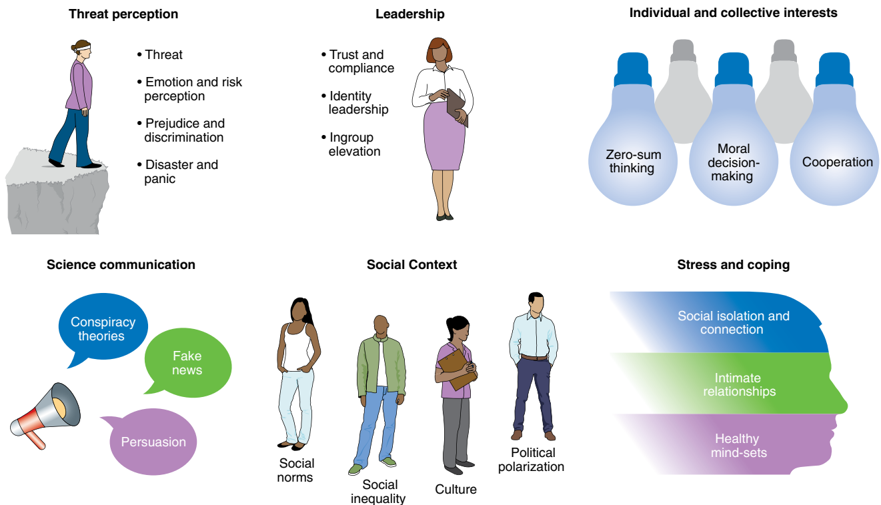
The COVID-19 pandemic represents a massive global health crisis. Because the crisis requires large-scale behaviour change and places significant psychological burdens on individuals, insights from the social and behavioural sciences can be used to help align human behaviour with the recommendations of epidemiologists and public health experts. Here we discuss evidence from a selection of research topics relevant to pandemics, including work on navigating threats, social and cultural influences on behaviour, science communication, moral decision-making, leadership, and stress and coping. In each section, we note the nature and quality of prior research, including uncertainty and unsettled issues. We identify several insights for effective response to the COVID-19 pandemic and highlight important gaps researchers should move quickly to fill in the coming weeks and months.
Overview
CoChat Summary
TL;DR
This perspective argues that social and behavioural science can help align public behaviour with COVID-19 public health recommendations across threat perception, social context, science communication, cooperation, leadership, and stress/coping. It synthesizes prior evidence and policy insights while cautioning that evidence is limited, often drawn from non-pandemic contexts, and in many areas unsettled.
Key findings
- The paper notes the scale of infectious disease threats: the bubonic plague killed approximately 25% of the European population, and by March 2020 COVID-19 had spread to more than 118,000 cases and caused 4,291 deaths in 114 countries. It also notes that 21 countries donated medical supplies to China in February, with China reciprocating widely.
- Fear appeals can change behaviour when people feel capable of dealing with the threat, but produce defensive reactions when people feel helpless; optimism bias can lead people to underestimate personal risk and ignore public health warnings.
- Social norms, inequality, culture, and political polarization shape pandemic behaviour: correcting misperceived norms can help when most people are already doing the desirable behaviour, but descriptive norms can backfire if the behaviour is undesirable unless paired with prescriptive norms.
- Effective communication and leadership may involve credible sources, messages that protect others or align with moral values, prebunking/inoculation against misinformation, accuracy nudges, shared social identity, and leaders modelling prosocial sacrifice; excessive national self-image concerns (“collective narcissism”) can backfire.
Methods
- Design: Perspective/narrative review; no primary data collection or sample. Topics were identified by the corresponding authors as potentially relevant to pandemic response and are explicitly not exhaustive.
- Evidence base: synthesizes prior social and behavioural research on threat perception, social context, science communication, moral decision-making, cooperation, leadership, and stress/coping, drawing on laboratory experiments, correlational studies, field experiments, meta-analyses, and preprints/forthcoming work.
- Analysis: narrative synthesis with policy implications and identified research gaps; no systematic search strategy or quantitative synthesis is reported.
Limitations
- Stated: due to space constraints, the paper provides only a brief summary of each topic; research on these topics is ongoing and in many cases far from settled; there is very little published social science research on the current pandemic, so discussion often draws from different circumstances and evidence quality varies substantially.
- Stated: insights and policy implications should be interpreted with caution.
- Evident: as a perspective rather than a systematic review or empirical study, it does not provide a comprehensive evidence appraisal, and its reliance on preprints and forthcoming sources limits certainty.
Model-written summary. Check it against the paper before relying on it.
Integrity signals
Registry
Cites
Statistics
Figures
Verification
Claims the paper makes
19 Valid · 5 Not valid · 37 Not checked · 13 Own results and interpretations
At least one cited source doesn’t support this claim or points to a different paper, and none confirmed it — see the verdicts below.
In the paper
“For instance, in hypothetical scenarios about deciding whether to go to work while sick, American and British participants reported they would be less willing to stay home when it was uncertain they would infect a co-worker.”
What the sources say
- Disputedcites [176] Kappes, A. et al. Uncertainty about the impact of social decisions increases prosocial behaviour. Nat. Hum. Behav. 2, 573–580 (2018). sourceExperimental — accuracy not yet measured
In the paper’s account of the infectious-disease scenario (Abstract; page not provided), participants facing uncertainty about how severely a co-worker might be affected were more likely to stay home than controls, not less. The paper distinguishes that impact uncertainty from uncertainty about whether a co-worker would be infected. Its Study 6 Methods (page not provided) describe recruitment through AMT, but do not establish the claimed American and British participant groups. (LLM, conf=0.88)
Checked by a reasoning model — may be wrong.
hedgedstates an association- Asserted: passes — The authors put it forward as true.
- Checkable: passes — It can be checked against evidence.
- Load-bearing: passes — The paper’s conclusions depend on it.
- Based: passes — The paper gives a reason why it holds.
- Disputed
The cited sources that could be checked couldn’t confirm or dispute this claim.
In the paper
“Moreover, there is mixed research regarding whether corrections may actually increase belief in the original misinformation 121,124-126 or in other misleading claims that fail to get corrected 127 .”
What the sources say
- Not checked — no full text of the sourcecites [121] Guess, A. & Coppock, A. Does counter-attitudinal information cause backlash? Results from three large survey experiments. Br. J. Polit. Sci. https://doi.org/10.1017/S0007123418000327 (2018). source
- Not matchedcites [124] Wittenberg, C. & Berinsky, A.J. Misinformation and its correction. in Social Media and Democracy: The State of the Field (eds Persily, N. & Tucker, J. A.) (Cambridge University Press, forthcoming).
Its entry has no title and year that we can search by.
- Not checked — no full text of the sourcecites [125] Swire, B. & Ecker, U.K.H. Misinformation and its correction: Cognitive mechanisms and recommendations for mass communication. in Misinformation and Mass Audiences (eds. Southwell, B. G., Thorson, E. A. & Sheble, L.) 195–2011 (University of Texas Press, 2018). source
- Not checked — no full text of the sourcecites [126] Wood, T. & Porter, E. The elusive backfire effect: mass attitudes’ steadfast factual adherence. Polit. Behav. 41, 135–163 (2018). source
- Could not verifycites [127] Pennycook, G., McPhetres, J., Zhang, Y. & Rand, D. Fighting COVID-19 misinformation on social media: Experimental evidence for a scalable accuracy nudge intervention. Preprint at PsyArXiv https://doi.org/10.31234/osf.io/uhbk9 (2020). sourceExperimental — accuracy not yet measured
Citation 127 is attached to the suggestion that corrections may increase belief in other misleading claims that go uncorrected. The Statement of Relevance and Discussion describe an accuracy nudge that improved sharing decisions, not corrections or their effects on belief in uncorrected claims. Searches for correction backfire and uncorrected misinformation found no passage addressing that point; page numbers were unavailable in our copy. (LLM, conf=0.76)
hedgedstates a possible cause- Asserted: passes — The authors put it forward as true.
- Checkable: passes — It can be checked against evidence.
- Load-bearing: passes — The paper’s conclusions depend on it.
- Based: passes — The paper gives a reason why it holds.
The sources with a verdict support this claim; the rest weren’t checked yet, have no full text we could read, or their verdicts aren’t rated yet.
In the paper
“Indeed, laboratory research has found that people prioritize local over global (or international) interests 185,186 .”
What the sources say
- Supportedcites [185] Milinski, M., Hilbe, C., Semmann, D., Sommerfeld, R. & Marotzke, J. Humans choose representatives who enforce cooperation in social dilemmas through extortion. Nat. Commun. 7, 10915 (2016). source
The Results section (‘Voters choose selfish representatives’; page unavailable) reports that participants preferentially re-elected representatives who contributed less to the shared climate account and elected candidates who pledged to contribute less than a fair share. In this simulated international dilemma, that supports the claim that participants favored their own group’s interests over the collective goal; it does not establish that everyone did so. (LLM, conf=0.85)
- Not checked — no full text of the sourcecites [186] Reinders Folmer, C. P. et al. One for all: what representing a group may do to us. J. Exp. Soc. Psychol. 48, 1047–1056 (2012). source
plain- Asserted: passes — The authors put it forward as true.
- Checkable: passes — It can be checked against evidence.
- Load-bearing: passes — The paper’s conclusions depend on it.
- Based: passes — The paper gives a reason why it holds.
- Supported
Every source the paper cites for this claim was checked and supports it.
In the paper
“However, when going to work risked infecting an elderly co-worker who would suffer a serious illness, participants reported they would be more willing to stay home 176 .”
What the sources say
- Supportedcites [176] Kappes, A. et al. Uncertainty about the impact of social decisions increases prosocial behaviour. Nat. Hum. Behav. 2, 573–580 (2018). source
The Study 6 Methods (page not provided) describe a scenario in which going to work could infect an older, vulnerable co-worker who would suffer severely, followed by a rating of willingness to go to work. The reported Study 6 findings (indexed under Abstract; page not provided) say participants given that risk information were significantly more likely to stay home than controls. (LLM, conf=0.92)
hedgedstates a cause- Asserted: passes — The authors put it forward as true.
- Checkable: passes — It can be checked against evidence.
- Load-bearing: passes — The paper’s conclusions depend on it.
- Based: passes — The paper gives a reason why it holds.
- Supported
The sources with a verdict support this claim; the rest weren’t checked yet, have no full text we could read, or their verdicts aren’t rated yet.
In the paper
“Several techniques, such as sanctioning defectors 187 or rewarding cooperators 188 , tend to increase cooperative behaviour in laboratory experiments using economic games.”
What the sources say
- Not checked — no full text of the sourcecites [187] Yamagishi, T. The provision of a sanctioning system as a public good. J. Pers. Soc. Psychol. 51, 110–116 (1986). source
- Supportedcites [188] Rand, D. G., Dreber, A., Ellingsen, T., Fudenberg, D. & Nowak, M. A. Positive interactions promote public cooperation. Science 325, 1272–1275 (2009). source
Citation 188 is attached to rewarding cooperators. The paper’s Abstract reports a laboratory comparison using repeated public goods games and finds that reward maintained public cooperation and, when both reward and punishment were available, increased contributions. (LLM, conf=0.93)
plainstates a cause- Asserted: passes — The authors put it forward as true.
- Checkable: passes — It can be checked against evidence.
- Load-bearing: unclear — It is unclear whether the paper’s conclusions depend on it.
- Based: passes — The paper gives a reason why it holds.
50 more claims · 13 with their cited sources checked
Create a free account to see all 74 claims and to verify the 2 references still open.
- It may state two separate claims as one. 13
- Probably not a substantial claim. 6
Claims other papers make about this one
Each is checked against this paper’s own text: does it say what the citing paper says it does?
The source backs part of the claim, not all of it — or backs it for a different population, condition or comparison.
In the citing paper
“COVID-19 is an international public health crisis, putting substantial burden on medical centers and increasing the psychological toll on health care workers (HCW).”
From Supporting the well-being of health care providers during the COVID-19 pandemic: The CopeColumbia response (2020) · cites this paper as [6]
Experimental — accuracy not yet measuredThe source backs part of the claim, not all of it — or backs it for a different population, condition or comparison.
In the citing paper
“these population-wide measures affected psychological well-being and mental health as well as increased social isolation [68] and loneliness.”
From Psychological correlates of perceived loneliness in college students before and during the COVID-19 stay-at-home period: a longitudinal study (2023) · cites this paper as [68]
Experimental — accuracy not yet measuredThe source backs part of the claim, not all of it — or backs it for a different population, condition or comparison.
In the citing paper
“they may eventually increase the social isolation of students and affect their psychological well-being and mental health [3].”
From Students under lockdown: Comparisons of students’ social networks and mental health before and during the COVID-19 crisis in Switzerland (2020) · cites this paper as [3]
Experimental — accuracy not yet measuredThe source backs part of the claim, not all of it — or backs it for a different population, condition or comparison.
In the citing paper
“effective interventions are hard to scale to a population level (12);”
From Psychological inoculation improves resilience against misinformation on social media (2022) · cites this paper as [12]
Experimental — accuracy not yet measuredThe source backs part of the claim, not all of it — or backs it for a different population, condition or comparison.
In the citing paper
“There is a shortage of studies that test anti-misinformation interventions in an ecologically valid manner, i.e., testing an intervention as consumers would interact with it in online environments (8, 12).”
From Psychological inoculation improves resilience against misinformation on social media (2022) · cites this paper as [12]
Experimental — accuracy not yet measured
6 more claims about this paper
Create a free account to see every claim other papers make about this one.
Citations
Cites
Granovetter, M. S. (1973) · American Journal of Sociology · doi:10.1086/225469 · Cited by 40,491
Zhou, F., Yu, T., Du, R., Fan, G., Liu, Y., Liu, Z., Xiang, J., Wang, Y., Song, B., Gu, X., et al. (2020) · The Lancet · doi:10.1016/s0140-6736(20)30566-3 · Cited by 27,263
The need to belong: Desire for interpersonal attachments as a fundamental human motivation.
Baumeister, R. F., & Leary, M. R. (1995) · Psychological Bulletin · doi:10.1037//0033-2909.117.3.497 · Cited by 23,245
Culture and the self: Implications for cognition, emotion, and motivation.
Markus, H. R., & Kitayama, S. (1991) · Psychological Review · doi:10.1037/0033-295x.98.2.224 · Cited by 21,995
Self-citationThe Psychological Impact of Quarantine and How to Reduce It: Rapid Review of the Evidence
Brooks, S. K., Webster, R. K., Smith, L. E., Woodland, L., Wessely, S., Greenberg, N., & Rubin, G. J. (2020) · doi:10.2139/ssrn.3532534 · Cited by 16,394
The psychological impact of quarantine and how to reduce it: Rapid review of the evidence
Brooks, S. K., Webster, R. K., Smith, L. E., Woodland, L., Wessely, S., Greenberg, N., & Rubin, G. J. (2020) · The Lancet · doi:10.1016/s0140-6736(20)30460-8 · Cited by 16,378
Nudge: improving decisions about health, wealth, and happiness
(2008) · Choice Reviews Online · doi:10.5860/choice.46-0977 · Cited by 11,572
Slovic, P. (1987) · Science · doi:10.1126/science.3563507 · Cited by 9,271
The Elaboration Likelihood Model of Persuasion
Petty, R. E., & Cacioppo, J. T. (1986) · Advances in Experimental Social Psychology · doi:10.1016/s0065-2601(08)60214-2 · Cited by 8,822
Self-citationThe emotional dog and its rational tail: A social intuitionist approach to moral judgment.
Haidt, J. (2001) · Psychological Review · doi:10.1037/0033-295x.108.4.814 · Cited by 8,048
Research works printed but not linked: 3
- Berkowitz, A.D. An overview of the social norms approach. in Changing the Culture of College Drinking: A Socially Situated Health Communication Campaign (eds. Stewart, L. & Lederman, L. C.) 193–214 (Hampton Press, 2005).
- Wittenberg, C. & Berinsky, A.J. Misinformation and its correction. in Social Media and Democracy: The State of the Field (eds Persily, N. & Tucker, J. A.) (Cambridge University Press, forthcoming).
- Ransohoff, K.J. Patients on the Trolley Track: The Moral Cognition of Medical Practitioners and Public Health Professionals. (Harvard Univ. Press, 2011).
Cited by
Items 1,901–2,000 of 5,015
Twitter Sentiment Analysis During Unlock Period of COVID-19
Sharma, S., & Sharma, A. (2020) · International Conference on Parallel, Distributed and Grid Computing (PDGC) · doi:10.1109/pdgc50313.2020.9315773 · Cited by 13
An Exploratory Study of COVID-19 Information on Twitter in the Greater Region
Chen, N., Zhong, Z., & Pang, J. (2021) · Big Data and Cognitive Computing · doi:10.3390/bdcc5010005 · Cited by 15
“The underestimation can be interpreted as optimism bias, which make people believe their exposure to disease is low [49].”
BackgroundEpistemic responsibilities in the COVID-19 pandemic: Is a digital infosphere a friend or a foe?
Ćurković, M., Košec, A., Bedeković, M. R., & Bedeković, V. (2021) · Journal of Biomedical Informatics · doi:10.1016/j.jbi.2021.103709 · Cited by 11
“The question of what should be considered as most valuable information at any given point is also highly variable [8].”
El‐Sayed, M. M., & Ghazi, G. A. (2021) · Egyptian Journal of Health Care · doi:10.21608/ejhc.2021.150261 · Cited by 11
Kalanidhi, K. B., Ranjan, P., Sarkar, S., et al. (2021) · Diabetes & Metabolic Syndrome Clinical Research & Reviews · doi:10.1016/j.dsx.2021.02.019 · Cited by 11
Kumar, A., & Sharma, K. (2021) · Studies in computational intelligence · doi:10.1007/978-3-030-60188-1_4 · Cited by 13
Gray, L., Rose, S. B., Stanley, J., Zhang, J., Tassell-Matamua, N., Puloka, V., Kvalsvig, A., Wiles, S., Murton, S. A., Johnston, D. M., et al. (2021) · Journal of the Royal Society of New Zealand · doi:10.1080/03036758.2021.1879179 · Cited by 15
“Social and cultural determinants, economic disadvantage, and health inequities also impact on people’s ability to change behaviour in response to public health advice in a pandemic (Abrams and Szefler 2020; Van Bavel et al. 2020).”
BackgroundPublic Oral Health Care During COVID-19: Time for Reflection and Action
Singh, S. (2021) · Frontiers in Medicine · doi:10.3389/fmed.2021.610450 · Cited by 13
“From an organizational perspective this requires a shift from health practitioner focus to oral health promotion within a social setting (21, 23).”
BackgroundFuture directions of the National Institutes of Health Science of Behavior Change Program
Keller, C., Ferrer, R. A., King, R. B., & COLLIER, E. S. (2021) · Translational Behavioral Medicine · doi:10.1093/tbm/ibab029 · Cited by 12
“Preliminary research and theory on COVID-19 suggest potential mechanisms that may influence vaccine hesitancy and acceptance: misunderstanding of the pandemic [62]; beliefs about post-infection immunity [66]; trust in institutions [67]; motivated reasoning and rationalizing risk behavior [61]; and other biases in risk…”
BackgroundGe, Y., Sainz, M., Gore, J. E., & Epps, F. R. (2021) · Journal of Religion and Health · doi:10.1007/s10943-021-01332-4 · Cited by 15
Analytic Thinking and Political Orientation in the Corona Crisis
Maglić, M., Pavlovic, T. M., & Franc, R. (2021) · Frontiers in Psychology · doi:10.3389/fpsyg.2021.631800 · Cited by 12
Leaving no one behind: Pakistan’s risk communication and community engagement during COVID-19
Haq, Z. U., Mirza, Z., Oyewale, T. O., et al. (2021) · Journal of Global Health · doi:10.7189/jogh.11.03091 · Cited by 11
The effects of COVID-19 on EU federalism
Martín, J. C., & Román, C. (2021) · Eastern Journal of European Studies · doi:10.47743/ejes-2021-si06 · Cited by 11
“Moreover, the study is also circumscribed within the explicit call made by Bavel et al. (2020) regarding the need for research that could shed some insights that benefit policy makers in the fight against the pandemic.”
BackgroundLuong, P. J., Menon, A., Hicken, A. D., & Rozek, L. S. (2021) · PLoS ONE · doi:10.1371/journal.pone.0256159 · Cited by 15
“Social and behavioral scientists have pointed to a myriad of factors that may affect the extent to which individuals are willing and able to adopt personal and social distancing mitigation behaviors [5].”
BackgroundDettmers, J., & Plückhahn, W. (2021) · Zeitschrift für Arbeits- und Organisationspsychologie A&O · doi:10.1026/0932-4089/a000374 · Cited by 17
Risk Culture and COVID-19 Protective Behaviors: A Cross-Sectional Survey of Residents in China
Bi, X., Zhang, Q., Fan, K., Tang, S., Guan, H., Gao, X., Cui, Y., Ma, Y., Wu, Q., Hao, Y., et al. (2021) · Frontiers in Public Health · doi:10.3389/fpubh.2021.686705 · Cited by 12
“The World Health Organization (WHO) declared the COVID-19 outbreak as a public health emergency of international concern (1, 2).”
BackgroundInfluentialZagefka, H., & Sun, S. (2021) · Analyses of Social Issues and Public Policy · doi:10.1111/asap.12281 · Cited by 13
Keller, J., Kwaśnicka, D., Wilhelm, L. O., Lorbeer, N., Pauly, T., Domke, A., Knoll, N., & Fleig, L. (2021) · International Journal of Behavioral Medicine · doi:10.1007/s12529-021-10042-w · Cited by 12
“Given the importance of effective hand washing, particularly in times of the COVID-19 pandemic, it is crucial that individuals who do not adhere to hand washing guidelines form intentions to do so and maintain hand washing over time [5, 10].”
BackgroundFrom Epidemic to Pandemic: Comparing Hospital Staff Emotional Experience Between MERS and COVID-19
Khalid, I., Imran, M., Imran, M., AKHTAR, M. A., Khan, S., Amanullah, K., & Khalid, T. J. (2021) · Clinical Medicine & Research · doi:10.3121/cmr.2021.1657 · Cited by 11
Holistic Resilience Index: measuring the expected country resilience to pandemic
Pileggi, S. F. (2022) · Quality & Quantity · doi:10.1007/s11135-021-01296-3 · Cited by 13
A dataset for the perceived vulnerability to disease scale in Japan before the spread of COVID-19
Yamada, Y., Xu, H.-Q., & Sasaki, K. (2020) · F1000Research · doi:10.12688/f1000research.23713.1 · Cited by 14
The effects of self-generated and other-generated eWOM in inoculating against misinformation
Dai, Y. H., Jia, W., Fu, L., Sun, M., & Jiang, L. (2022) · Telematics and Informatics · doi:10.1016/j.tele.2022.101835 · Cited by 14
Althobaity, Y. M., Wu, J., & Tildesley, M. J. (2022) · Infectious Disease Modelling · doi:10.1016/j.idm.2022.08.005 · Cited by 17
Bello, I. B., Akinnawo, E. O., Akpunne, B. C., & Mopa-Egbunu, A. (2022) · Cogent Arts and Humanities · doi:10.1080/23311983.2022.2049480 · Cited by 19
“As a result, persons who are more aware about the disease’s etiology are more concerned about becoming infected, implying a relationship between knowledge and risk perception (Vartti et al., 2009).”
BackgroundCommunity engagement in COVID-19 prevention: experiences from Kilimanjaro region, Northern Tanzania.
Mboya, I. B., Ngocho, J. S., Mgongo, M., et al. (2020) · PubMed · doi:10.11604/pamj.supp.2020.35.146.24473 · Cited by 11
“The radio programs contributed to addressing misinformation and ensuring the public have accurate information and counterarguments against false information [7,9].”
Modeling the potential impact of indirect transmission on COVID-19 epidemicPreprint
David, J., Iyaniwura, S. A., Yuan, P., Tan, Y., Kong, J. D., & Zhu, H. (2021) · medRxiv · doi:10.1101/2021.01.28.20181040 · Cited by 14
Ahuja, M., Mamudu, H. M., Weierbach, F. M., Dowling-McClay, K., Stewart, D. W., Awasthi, M., & Paul, T. K. (2021) · Humanities and Social Sciences Communications · doi:10.1057/s41599-021-00974-9 · Cited by 14
Let's (Not) Get Together!: The Role of Social Norms in Social Distancing during COVID-19
Villarreal, D. M., Parilli, C., Scartascini, C., & Simpser, A. (2021) · doi:10.18235/0003044 · Cited by 11
Targeting Behavioral Interventions Based on Baseline Motivation Increases Vaccine UptakePreprint
Brody, I., Dai, H., Saccardo, S., Milkman, K. L., Duckworth, A. L., Patel, M. S., & Gromet, D. M. (2022) · Research Square · doi:10.21203/rs.3.rs-2274413/v1 · Cited by 11
Lakens, D. (2023) · PsyArXiv (OSF Preprints) · doi:10.31234/osf.io/dtvs7 · Cited by 17
COVID-19 Pandemic and Strategizing the Higher Education Policies of Public Universities of Ethiopia
Dereso, C. W., Meher, K. C., & Asfawu, A. (2021) · International Journal of Sociotechnology and Knowledge Development · doi:10.4018/ijskd.2022040101 · Cited by 12
Madness of the crowd: Understanding mass behaviors through a multidisciplinary lens
Brindal, E., Kakoschke, N., Reeson, A. F., & Evans, D. (2022) · Frontiers in Psychology · doi:10.3389/fpsyg.2022.924511 · Cited by 11
“It is important to understand health protective behaviors to improve public health messages and reduce disease transmission (Bavel et al., 2020; West et al., 2020).”
BackgroundReveshty, M. A., Heydari, M. T., & Moghaddam, H. T. (2023) · Spatial Information Research · doi:10.1007/s41324-023-00550-0 · Cited by 12
Zhang, J., Quoquab, F., & Mohammad, J. (2024) · Journal of Risk Research · doi:10.1080/13669877.2024.2328194 · Cited by 11
“…2019, information about COVID-19 has been seen everywhere, including the media and internet, which report the number of infected cases, death toll, epidemic prevention policies, availability and doses of vaccines every day, which have influenced travellers’ behaviour profoundly (Bavel et al. 2020).”
BackgroundPsychometric evaluation of the Trust in Science and Scientists Scale
Wolff, S. M., Breakwell, G. M., & Wright, D. B. (2024) · Royal Society Open Science · doi:10.1098/rsos.231228 · Cited by 14
Standing the test of COVID-19: charting the new frontiers of medicine
Cauchemez, S., Cossu, G., Delzenne, N. M., Elinav, E., Fassin, D., Fischer, A., Härtung, T., Kalra, D., Netea, M. G., Neyts, J. H., et al. (2024) · Frontiers in Science · doi:10.3389/fsci.2024.1236919 · Cited by 14
“A recent reevaluation (66) of the evidence relating to an earlier set of social and behavioral science insights that in fl uenced COVID-19 policies (150) underscored the need for approaches that ensure better communication and collaboration between decision-makers and professionals and all relevant…”
BackgroundThe political representation of minoritized groups in times of crisis: Covid-19 and beyond
Walter, S., & Glas, S. (2024) · Ethnic and Racial Studies · doi:10.1080/01419870.2024.2362318 · Cited by 11
“Particularly research from the social and behavioral sciences has highlighted the impacts of pandemics on intergroup relations and social cohesion (Van Bavel et al. 2020).”
Testing behaviour change with an artificial intelligence chatbot in a randomized controlled study
van Baal, S. T., Le, S. T. T., Fatehi, F., Verdejo‐García, A., & Hohwy, J. (2024) · Journal of Public Health Policy · doi:10.1057/s41271-024-00500-6 · Cited by 18
“Public health communication strategies may be augmented by behavioural interventions to stimulate change in people’s decision making [23, 24].”
BackgroundEspinoza, B., Saad-Roy, C. M., Grenfell, B. T., Levin, S. A., & MARATHE, M. V. (2024) · Proceedings of the Royal Society B Biological Sciences · doi:10.1098/rspb.2024.1772 · Cited by 18
“Additionally, as seen throughout the 2009 influenza A (H1N1) pandemic, the 2014 West African Ebola virus disease (EVD) epidemic and the ongoing COVID-19 pandemic, a crucial factor that contributes to epidemic complexity is human behaviour [9,10].”
SDGs and economic resilience: Evidence from the COVID-19 shock
Ashraf, B. N., Goodell, J. W., & Butt, S. (2024) · Journal of Sustainable Finance and Accounting · doi:10.1016/j.josfa.2024.100015 · Cited by 13
Public Health Messaging on Twitter During the COVID-19 Pandemic: Observational Study
Rao, A., Sabri, N., Guo, S., Raschid, L., & Lerman, K. (2025) · Journal of Medical Internet Research · doi:10.2196/63910 · Cited by 14
“The emergence of contradictory theories and 2 polarized groups of influential elites and experts [23,24] and conspiracy theories about the origins of the COVID-19 pandemic, its severity, and the efficacy of prophylactic measures started to take hold [25,26].”
Why gender and sex matter in infectious disease modelling: A conceptual framework
Auderset, D., Riou, J., Clair, C., Perreau, M., Mueller, Y. K., & Schwarz, J. (2025) · SSM - Population Health · doi:10.1016/j.ssmph.2025.101775 · Cited by 14
“Research indicates that models accounting for heterogeneities — such as age-related differences in contact patterns, protective behaviour, and physical distancing compliance — provided more accurate forecasts of disease spread (Bavel et al., 2020; Prem et al., 2017).”
University’s Contribution to Society: Benchmarking of Social Innovation
Planells-Aleixandre, E., García-Aracil, A., & Isusi-Fagoaga, R. M. (2025) · Sustainability · doi:10.3390/su17083427 · Cited by 10
Khan, M. N. A. (2020) · European Journal of Medical and Educational Technologies · doi:10.30935/ejmets/8299 · Cited by 15
Social Inequalities and Loneliness as Predictors of Ageing Well: A Trend Analysis Using Mixed Models
Klein, J., Knesebeck, O. V. D., & Lüdecke, D. (2020) · International Journal of Environmental Research and Public Health · doi:10.3390/ijerph17155314 · Cited by 13
“There is a lack of information about longitudinal associations with ageing well in Germany and beyond that, the social and spatial distancing in the context of the current Coronavirus disease 2019 (COVID-19) pandemic suggests an increased relevance of loneliness, especially for older people [33].”
BackgroundAnalysis of Change Behavior Prevention of Covid-19 Transmission Based on Integrated Behavior Model
Triyanto, E., & Kusumawardani, L. H. (2020) · Jurnal Keperawatan Soedirman · doi:10.20884/1.jks.2020.15.2.1441 · Cited by 29
Zhang, Z., Zhang, L., Zheng, J., Xiao, H., & Li, Z. (2020) · JMIR mhealth and uhealth · doi:10.2196/20642 · Cited by 10
Kelly, B. C., Pawson, M., & Vuolo, M. (2020) · Journal of Drug Issues · doi:10.1177/0022042620977828 · Cited by 11
“The identification of political beliefs as a strong factor associated with COVID-19 beliefs among e-cigarette users is yet another illustration of the politicization of the COVID-19 pandemic (Van Bavel et al., 2020).”
BackgroundBerkessel, J. B., Ebert, T., Gebauer, J. E., Jónsson, Þ., & Oishi, S. (2021) · Social Psychological and Personality Science · doi:10.1177/19485506211039990 · Cited by 15
“Finally, our research makes much-needed progress toward a distinctively psychological theory of pandemics (Betsch, 2020; Van Bavel et al., 2020).”
MethodCavicchiolo, E., Manganelli, S., Girelli, L., Cozzolino, M., Lucidi, F., & Alivernini, F. (2021) · European Journal of Health Psychology · doi:10.1027/2512-8442/a000083 · Cited by 12
UME KBUBU SEBAGAI WUJUD KEARIFAN LOKAL MASYARAKAT BOTI DALAM MENJAGA KETAHANAN PANGAN DAN BENCANA
Iswanto, I. (2021) · Handep Jurnal Sejarah dan Budaya · doi:10.33652/handep.v4i2.144 · Cited by 10
Otterbring, T., Festila, A., & Folwarczny, M. (2021) · Current Research in Ecological and Social Psychology · doi:10.1016/j.cresp.2021.100023 · Cited by 15
Maleki, M., Arani, M., Buchholz, E. J., Mead, E. L., & Agarwal, N. (2021) · Lecture notes in computer science · doi:10.1007/978-3-030-80387-2_3 · Cited by 14
Montefinese, M., Ambrosini, E., & Angrilli, A. (2021) · PeerJ · doi:10.7717/peerj.11858 · Cited by 12
Bazán, P. R., Neto, R. M. D. A., Lacerda, S. S., Ribeiro, M. W., Balardin, J. B., Amaro, E., & Kozasa, E. H. (2021) · Internet Interventions · doi:10.1016/j.invent.2021.100441 · Cited by 14
In Whom Do We Trust? A Multifoci Person-Centered Perspective on Institutional Trust during COVID-19
Jiang, L., Bettac, E. L., Lee, H. J., & Probst, T. M. (2022) · International Journal of Environmental Research and Public Health · doi:10.3390/ijerph19031815 · Cited by 16
“However, institutional trust, or beliefs about the degree to which the government is honest, cares for the public, has benevolent and caring intentions towards the public, and makes an effort in good faith to react to the needs and concerns of the public [2], is important, especially when a nation faces enormous crise…”
BackgroundThe upside: How people make sense of difficulty matters during a crisis
Kiper, G., Atari, M., Yan, V. X., & Oyserman, D. (2022) · Self and Identity · doi:10.1080/15298868.2022.2033309 · Cited by 24
“People are inherently social beings (Van Bavel et al., 2020), so social isolation takes a toll on mental health (Hawryluck et al., 2004, increasing people’s risk of feeling detached, angry, and frustrated, Brooks et al., 2020).”
Hwang, J., & Kim, S. (2022) · Preventive Medicine Reports · doi:10.1016/j.pmedr.2022.101735 · Cited by 10
“( Bavel et al., 2020; J ø rgensen et al., 2021) Accordingly, how well individuals are aware of or know about the control measures rather than trust or are satisfied with it could help alleviate fear or stress about possible exposure to the virus, so that they are less likely to experience…”
Strömmer, S., Sivaramakrishnan, D., Shaw, S., Morrison, K., Barrett, M., Manner, J., Jenner, S., Hughes, T., Hardy‐Johnson, P., Andreas, M., et al. (2022) · BMC Public Health · doi:10.1186/s12889-022-12755-3 · Cited by 18
“Government leaders and the media should focus on reinforcing the message that adhering to guidance and restrictions is the right thing to do and that most people are trying to do so [28].”
BackgroundSchug, G. R., & Halcrow, S. E. (2022) · Bioarchaeology International · doi:10.5744/bi.2022.6000 · Cited by 23
Explaining Resistance to the COVID-19 Preventive Measures: A Psychological Reactance Perspective
Bokhari, R., & Shahzad, K. (2022) · Sustainability · doi:10.3390/su14084476 · Cited by 13
“The three main insights on the spread of pandemics highlighted in the article were explained as follows: “(i) people do not appreciate the risks they run, (ii) it goes against human nature for people to shut themselves up in rigid isolation as a means of protecting others, and (iii) people often unconsciously act as a…”
BackgroundAn Analysis of French-Language Tweets About COVID-19 Vaccines: Supervised Learning Approach
Sauvayre, R., Vernier, J., & Chauvière, C. (2022) · JMIR Medical Informatics · doi:10.2196/37831 · Cited by 12
“In the same way, as the pandemic progressed, disinformation, “fake news,” and conspiracy theories spread [6] through many parts of society.”
BackgroundBorsati, M., Cascarano, M., & Percoco, M. (2022) · Regional Studies · doi:10.1080/00343404.2022.2035708 · Cited by 11
“Indeed, in the absence of medical treatments, such as vaccines or pharmaceuticals, the limitation of interpersonal contacts was the key policy for containing viral infections (Haushofer & Metcalf, 2020; Van Bavel et al., 2020).”
BackgroundSalehi, M., Zimon, G., Ghaderi, A. R., & Hasan, Z. A. (2022) · International Journal of Environmental Research and Public Health · doi:10.3390/ijerph19105841 · Cited by 12
“[99] noted that fear might be a significant emotional issue caused by a pandemic.”
BackgroundThe Dual Effect of COVID-19 on Intergroup Conflict in the Korean Peninsula
Nir, N., Halperin, E., & Park, J. (2022) · Journal of Conflict Resolution · doi:10.1177/00220027221107088 · Cited by 11
“These responses provide individuals with some relief from anxiety and uncertainty (Mirisola et al. 2014), but at the same time may also undermine more tolerant attitudes towards outgroups (Van Bavel et al. 2020).”
BackgroundGrief and mourning in Covid-19 pandemic and delayed business as a new concept
Erbiçer, E. S., Metin, A., & Doğan, T. (2022) · Culture & Psychology · doi:10.1177/1354067x221118921 · Cited by 17
“They may also experience fear and anxiety of infecting others (Van Bavel et al., 2020).”
BackgroundControllability is key: Goal pursuit during COVID‐19 and insights for theories of self‐regulation
McClure, J. H. C., & Cole, S. N. (2022) · Journal of Applied Social Psychology · doi:10.1111/jasp.12920 · Cited by 11
Effects of official information and rumor on resource-epidemic coevolution dynamics
Huo, L., Ruifang, Z., & Zhao, L. (2022) · Journal of King Saud University - Computer and Information Sciences · doi:10.1016/j.jksuci.2022.09.003 · Cited by 13
I hate you when I am anxious: Anxiety during the COVID‐19 epidemic and ideological hostility
Balmas, M., Harel, T. O., & Halperin, E. (2022) · Journal of Applied Social Psychology · doi:10.1111/jasp.12914 · Cited by 12
“This variable was measured based on four indicators (e.g., Liu et al., 2021; Van Bavel et al., 2020b): Respondents were asked to indicate, on a scale of 1 (not at all) to 6 (to a very large extent), to what extent the coronavirus (COVID‐19) threatened their health; the health of their family members; the health of Isr…”
BackgroundMethodInfluentialWajchman-Świtalska, S., Grabowska-Chenczke, O., Woźniak, M., & Bałaj, B. (2022) · Forests · doi:10.3390/f13101569 · Cited by 10
Szuster, A., Huflejt-Łukasik, M., Karwowska, D., Pastwa, M., Laszczkowska, Z., & Imbir, K. K. (2022) · International Journal of Environmental Research and Public Health · doi:10.3390/ijerph192013497 · Cited by 42
“The psychological, social [45], and health [46,47] effects of the pandemic pose challenges on a scale comparable to those after war cataclysms.”
BackgroundTang, W. C.-Y., Wong, C. S. M., Wong, T. Y., Hui, C. L. M., Wong, S. M. Y., Suen, Y. N., Chan, S. K. W., Chang, W. C., Lee, E. H. M., Lui, S. S. Y., et al. (2022) · Journal of Psychiatric Research · doi:10.1016/j.jpsychires.2022.10.041 · Cited by 13
Kishore, K., Jaswal, V., Pandey, A. K., Verma, M., & Koushal, V. (2022) · JMIR Public Health and Surveillance · doi:10.2196/38371 · Cited by 10
Zingora, T., Birtel, M. D., Graf, S., Hřebíčková, M., Lacko, D., Rupar, M., Točík, J., & Voca, S. (2022) · European Journal of Social Psychology · doi:10.1002/ejsp.2928 · Cited by 17
Varieties of Mobility Measures: Comparing Survey and Mobile Phone Data during the COVID-19 Pandemic
Kalleitner, F., Schiestl, D. W., & Heiler, G. (2022) · Public Opinion Quarterly · doi:10.1093/poq/nfac042 · Cited by 13
“Since the start of the COVID-19 pandemic, social scientific research has contributed immensely to the understanding of human behavior in times of a global health crisis (Bavel et al. 2020).”
Luo, Q., Yang, C., & Yang, J. (2023) · Expert Systems with Applications · doi:10.1016/j.eswa.2023.119545 · Cited by 11
Songco, A., Minihan, S., Fox, E., Ladouceur, C. D., Mewton, L. R., Moulds, M. L., Pfeifer, J. H., van Harmelen, A., & Schweizer, S. (2023) · Journal of Affective Disorders · doi:10.1016/j.jad.2023.01.053 · Cited by 13
“As humans, social connection helps us cope with stress, build meaningful support networks and promote resilience (Bavel et al., 2020), which pregnant women rely on.”
BackgroundIntermediate levels of asymptomatic transmission can lead to the highest epidemic fatalities
Park, S. W., Dushoff, J. G., Grenfell, B. T., & Weitz, J. S. (2023) · PNAS Nexus · doi:10.1093/pnasnexus/pgad106 · Cited by 13
“Our model reinforces the need for dual approaches —prioritizing the reduction of asymptomatic spread (e.g., via risk awareness campaigns (45–47), asymptomatic testing programs (48–50), mask-wearing indoors and in crowded environments (51–53), and through improvements in ventilation (54, 55)) while…”
Liu, A., Xiao, S., Pato, I. D., Mutinda, G., & Wu, Y. (2023) · Healthcare · doi:10.3390/healthcare11081202 · Cited by 17
“The pandemic experience caused various forms of emotional challenges for international students who lacked adequate social support and, therefore, experienced loneliness, homesickness, anxiety, stress, and fear, especially during the lockdown periods [52,53].”
BackgroundWestney, Z. V., Hur, I., Wang, L., & Sun, J. (2023) · Information Technology and People · doi:10.1108/itp-05-2022-0410 · Cited by 13
Boggio, P. S., Nezlek, J. B., Alfano, M., Azevedo, F., Capraro, V., Cichocka, A. K., Pärnamets, P., do Rêgo, G. G., Sampaio, W. M., Sjåstad, H., et al. (2023) · Group Processes & Intergroup Relations · doi:10.1177/13684302231153800 · Cited by 20
Self-citationRole of masks in mitigating viral spread on networks
Tian, Y., Sridhar, A., Wu, C. W., Levin, S. A., Carley, K. M., Poor, H. V., & Yağan, O. (2023) · Physical review. E · doi:10.1103/physreve.108.014306 · Cited by 12
Zheng, W. (2023) · Current Psychology · doi:10.1007/s12144-023-05067-1 · Cited by 11
“Institutional trust appears to have an influence on an individual’s social network, which might shape their decision making and potentially increase their likelihood of getting vaccinated (Bavel et al., 2020 ; Dal & Tokdemir, 2022 ).”
Hill, E. M., Prosser, N. S., Brown, P. E., Ferguson, E., Green, M. J., Kaler, J., Keeling, M. J., & Tildesley, M. J. (2023) · Preventive Veterinary Medicine · doi:10.1016/j.prevetmed.2023.106019 · Cited by 12
Real-time estimation of the effective reproduction number of COVID-19 from behavioral data
Bokányi, E., Vizi, Z., Koltai, J., Röst, G., & Karsai, M. (2023) · Scientific Reports · doi:10.1038/s41598-023-46418-z · Cited by 13
“encode physical and proxy interactions might provide critical input to epidemic models at different levels of aggregation, like in forms of age-stratified contact matrices 9, 21–23 .”
BackgroundDing, E. L., Feigl, A. B., Watson, K. T., Ng, T. L. J., Makerechi, L., Bui, N., Ireifij, A., Farraj, R., & Zoughbie, D. E. (2024) · PLOS Global Public Health · doi:10.1371/journal.pgph.0001514 · Cited by 11
“Public health studies have established the role of social networks in spreading attitudes and behaviors associated with both infectious diseases such as COVID-19 [13], as well as chronic diseases and their prevention [14, 15].”
BackgroundDesigning Behavioural Insights for Policy: Processes, Capacities & Institutions
Mukherjee, I., & Mussagulova, A. (2024) · Cambridge University Press eBooks · doi:10.1017/9781009264464 · Cited by 12
Missed Opportunities? Covid-19, Biosecurity and One Health in the United Kingdom
Enticott, G., & Maye, D. (2020) · Frontiers in Veterinary Science · doi:10.3389/fvets.2020.00577 · Cited by 10
“(39) review of the role of social science in managing Covid-19 ignores social research on the human dimensions of managing animal disease.”
Backgroundda Silva, C. E. M., Neto, C. C. D. C., Bezerra, A. C. V., et al. (2020) · Journal of Health & Biological Sciences · doi:10.12662/2317-3076jhbs.v8i1.3410.p1-7.2020 · Cited by 10
Bera, A., Drela, K., Małkowska, A., et al. (2020) · EUROPEAN RESEARCH STUDIES JOURNAL · doi:10.35808/ersj/1674 · Cited by 10
“Taking into account the current pandemic related situation, acceptable risk ought to be evaluated taking into account macroeconomic conditions, individual factors specific for the tourism enterprise and its competitive environment (Van Bavel et al., 2020).”
BackgroundFassiotto, M. A., Valantine, H. A., Shanafelt, T. D., & Maldonado, Y. (2020) · Academic Medicine · doi:10.1097/acm.0000000000003905 · Cited by 10
“Our behavior is influenced by social norms and social learning from our interactions with others.(11) For example, the more we interact with colleagues who are willing to share their challenges around, for example, racism in the workplace or even the stigma associated with childcare during COVID-19, the more we will s…”
BackgroundWork-life balance during the Covid-19 outbreak: the case of Latvia
Krišjāne, Z., Apsīte-Beriņa, E., Berzins, M., Skadiņš, T., & Burgmanis, Ģ. (2020) · Baltic Region · doi:10.5922/2079-8555-2020-4-3 · Cited by 12
“Presumably low level of threat or optimism bias [39] remains only until a person is a confirmed coronavirus positive as individuals can assume that others are more predefined to any negative events [40], including the COVID-19 virus.”
BackgroundTriana, H. W., Kustati, M., Yusuf, Y. Q., & Reflinaldi, R. (2021) · Journal of Language and Linguistic Studies · doi:10.17263/jlls.903507 · Cited by 10
“In the midst of the vortex of the COVID-19 issue, the SFS representation in Republika and Kompas was influenced by the ideology they professed (Fairclough, 2005; Van Dijk, 2009).”
BackgroundUs and them. Is the COVID-19 pandemic a driver for xenophobia in land transactions in Romania?
Petrescu‐Mag, R. M., Petrescu, D. C., Todoran, S. C., & Petrescu-Mag, I. V. (2021) · Land Use Policy · doi:10.1016/j.landusepol.2021.105284 · Cited by 11
Social mobilization and polarization can create volatility in COVID-19 pandemic control
Hong, I., Rutherford, A., & Cebrián, M. (2021) · Applied Network Science · doi:10.1007/s41109-021-00356-9 · Cited by 10
Implicit Communication Through Social Distancing
Banisetty, S. B., & Williams, T. (2021) · ACM/IEEE International Conference on Human-Robot Interaction (HRI) · doi:10.1145/3434074.3447222 · Cited by 10
“And in fact, researchers have observed just this phenomenon with moral communication surrounding COVID-19 [47].”
BackgroundInfluential"Do you speak Corona?": Hashtags and Neologisms since the COVID-19 Pandemic Outbreak
Al-Azzawi, Q. O., & Haleem, H. A. (2021) · International Journal of Linguistics Literature & Translation · doi:10.32996/ijllt.2021.4.4.12 · Cited by 10
“To cope with the virus outbreak, daily life habits and behaviour need to be adjusted, particularly for aligning human behaviour with the recommended norms as by health specialists (Goldberg et al., 2020; Van Bavel et al., 2020).”
BackgroundMethodInfluentialKuang, Y., Xu, M., Yang, S., Ding, Y., Zheng, R., Taplin, J. E., & Li, S. (2021) · Psychology Research and Behavior Management · doi:10.2147/prbm.s309146 · Cited by 12
“3 Examining the first months of the COVID-19 news coverage may therefore help us to better understand what informed the public’s initial perceptions of COVID-19.”
InfluentialA systematic review of the spread of information during pandemics: A case of the 2020 COVID-19 virus
Shobowale, O. (2021) · Journal of African Media Studies · doi:10.1386/jams_00045_1 · Cited by 12
Aislamiento social obligatorio: un análisis de sentimientos mediante machine learning
Pastrana, C. A. A., & Andrade, C. F. O. (2021) · Suma de Negocios · doi:10.14349/sumneg/2021.v12.n26.a1 · Cited by 20
Metadata
- Authors
- Bavel, J. J. V., Baicker, K., Boggio, P. S., Capraro, V., Cichocka, A., Cikara, M., Crockett, M. J., Crum, A. J., Douglas, K. M., Druckman, J. N., Drury, J., Dube, O., Ellemers, N., Finkel, E. J., Fowler, J. H., Gelfand, M., Han, S., Haslam, S. A., Jetten, J., Kitayama, S., Mobbs, D., Napper, L. E., Packer, D. J., Pennycook, G., Peters, E., Petty, R. E., Rand, D. G., Reicher, S. D., Schnall, S., Shariff, A., Skitka, L. J., Smith, S. S., Sunstein, C. R., Tabri, N., Tucker, J. A., Linden, S. V. D., Lange, P. V., Weeden, K. A., Wohl, M. J. A., Zaki, J., Zion, S. R., & Willer, R.
- Affiliations
- New York University (US)
- Universidade Presbiteriana Mackenzie (BR)
- Middlesex University London (GB)
- University of Kent (GB)
- Harvard University (US)
- Yale University (US)
- Stanford University (US)
- Northwestern University (US)
- University of Sussex (GB)
- University of Chicago (US)
- Utrecht University (NL)
- University of California San Diego (US)
- University of Maryland, College Park (US)
- Peking University (CN)
- The University of Queensland (AU)
- University of Michigan (US)
- California Institute of Technology (US)
- Lehigh University (US)
- University of Regina (CA)
- University of Oregon (US)
- The Ohio State University (US)
- Massachusetts Institute of Technology (US)
- University of St Andrews (GB)
- University of Cambridge (GB)
- University of British Columbia (CA)
- University of Illinois Chicago (US)
- University of California, Berkeley (US)
- Carleton University (CA)
- Cornell University (US)
- Corresponding author
- Bavel, Jay J. Van
- Willer, Robb
- ORCID
- Bavel, Jay J. Van
- Baicker, Katherine
- Boggio, Paulo S.
- Capraro, Valerio
- Cichocka, Aleksandra
- Cikara, Mina
- Crockett, Molly J.
- Crum, Alia J.
- Douglas, Karen M.
- Druckman, James N.
- Drury, John
- Ellemers, Naomi
- Finkel, Eli J.
- Fowler, James H.
- Gelfand, Michele
- Han, Shihui
- Haslam, S. Alexander
- Jetten, Jolanda
- Kitayama, Shinobu
- Mobbs, Dean
- Napper, Lucy E.
- Packer, Dominic J.
- Pennycook, Gordon
- Peters, Ellen
- Petty, Richard E.
- Rand, David G.
- Reicher, Stephen D.
- Schnall, Simone
- Shariff, Azim
- Skitka, Linda J.
- Sunstein, Cass R.
- Tabri, Nassim
- Tucker, Joshua A.
- Linden, Sander van der
- Weeden, Kim A.
- Wohl, Michael J. A.
- Zaki, Jamil
- Zion, Sean R.
- Willer, Robb
- Venue
- Nature Human Behaviour
- Published
- 2020-04-30
- Volume
- 4
- Issue
- 5
- Pages
- 460-471
- ISSN
- 2397-3374 (ISSN-L)
- OpenAlex
- W3016902371
- Semantic Scholar
- d81abcd7f053b136423f1e7f57928524e8b0e1a0
- Cited by
- 4,964
- References
- 259
- Citations by year
- 2026: 177 · 2025: 288 · 2024: 483 · 2023: 741 · 2022: 1094 · 2021: 1474 · 2020: 702
- FWCI
- 175.81
- Type
- journal article
- Language
- en
- Open access
- bronze
- doi.org
- Licence
- www.springernature.com/gp/researchers/text-and-data-mining (tdm)
- www.springernature.com/gp/researchers/text-and-data-mining (vor)
- Locations
- Nature Human Behaviour (publishedVersion)
- PubMed (publishedVersion)
- Middlesex University Research Repository (Middlesex University Of London) (acceptedVersion)
- Kent Academic Repository (University of Kent) (acceptedVersion)
- DSpace@MIT (Massachusetts Institute of Technology) (submittedVersion, cc-by-nc-sa)
- Sussex Research Online (University of Sussex) (submittedVersion)
- CaltechAUTHORS (California Institute of Technology) (submittedVersion)
- RePEc: Research Papers in Economics (submittedVersion)
- BOA (University of Milano-Bicocca) (submittedVersion)
- Carleton University's Institutional Repository (MacOdrum Library, Carleton University) (submittedVersion, other-oa)
- Utrecht University Repository (Utrecht University) (submittedVersion)
- Figshare (submittedVersion)
- VU Research Portal (submittedVersion, other-oa)
- Utrecht University Repository (Utrecht University) (submittedVersion, other-oa)
- Data Archiving and Networked Services (DANS) (submittedVersion, other-oa)
- Funders
- U.S. Department of Health and Human Services (2P50 MH094258)
- National Institute of Mental Health (P50MH094258)
- Topics
- Social Sciences › Sociology and Political Science › COVID-19 Prevention and Impact
- Social Sciences › Communication › Communication and COVID-19 Impact
- Physical Sciences › Mathematics › Modeling and Simulation › COVID-19 epidemiological studies
- Keywords
- COVID-19 pandemic, pandemic response, behavior change, science communication, ethical decision-making, leadership, stress coping, psychological burden, public health recommendations
- MeSH terms
- Betacoronavirus, COVID-19, SARS-CoV-2, Adaptation, Psychological, Communicable Disease Control, Decision Making, Humans, Human Activities, Health Knowledge, Attitudes, Practice, Leadership, Pneumonia, Viral, Public Health, Quarantine, Stress, Psychological, Global Health, Coronavirus, Coronavirus Infections, Pandemics, Social Media, Epidemiological Monitoring
About these checks
Registry, retraction, Cites and statistics results are computed, not judged, with one exception: a printed reference that no index lists is read once by a model before it counts as a citation error. Claims are extracted by a model and kept only when their quote appears verbatim in the text; each cited source is then checked, with a model’s help, for whether it says what the claim relies on. Those verdicts can be wrong — read the claim’s quote and the cited source before relying on one.
The claim verdicts this report counts are experimental: their accuracy is not yet measured.
A language model drew the claims from the paper on 2026-10-10, under version 3 of the claim definition (model deepseek-v4.1-flash, prompt extract-v3).
A second model labelled each claim on 2026-10-10 (model jev-1.13-20260917, definition revision gold-guideline-v0.2).
Cited sources are checked with a language model’s help (gpt-6-sol).
Statistics and arithmetic are recomputed, not judged.
Confidence bands are shown only for fields calibrated on our annotated test set. None is calibrated yet, so no band is shown.
What counts as a claim ›How we measure confidence ›How we check this ›
Are you an author, or do you see a problem with this page? Request a review
Data sources
Bibliographic data: Semantic Scholar, OpenAlex, Crossref.
Contains information from the Semantic Scholar Academic Graph Datasets, made available under the ODC Attribution License (ODC-BY 1.0).
Semantic Scholar’s data is described in: Kinney, R., et al. (2023). The Semantic Scholar Open Data Platform. arXiv:2301.10140.
