

Using social and behavioural science to support COVID-19 pandemic response
Open accessThe DOI matches its Crossref record; 257 of the 259 references it cites were found in a registry or an index; 24 of the 89 sources its claims cite were checked for support.
Abstract
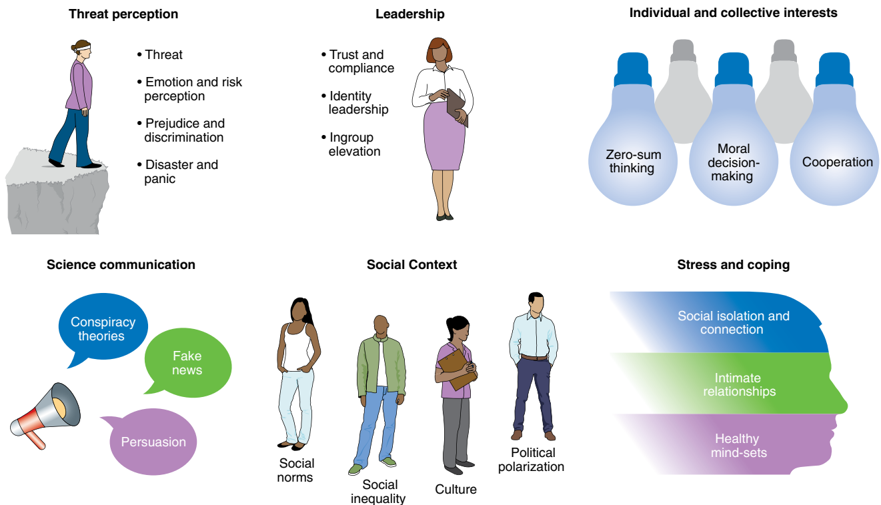
The COVID-19 pandemic represents a massive global health crisis. Because the crisis requires large-scale behaviour change and places significant psychological burdens on individuals, insights from the social and behavioural sciences can be used to help align human behaviour with the recommendations of epidemiologists and public health experts. Here we discuss evidence from a selection of research topics relevant to pandemics, including work on navigating threats, social and cultural influences on behaviour, science communication, moral decision-making, leadership, and stress and coping. In each section, we note the nature and quality of prior research, including uncertainty and unsettled issues. We identify several insights for effective response to the COVID-19 pandemic and highlight important gaps researchers should move quickly to fill in the coming weeks and months.
Overview
CoChat Summary
TL;DR
This perspective argues that social and behavioural science can help align public behaviour with COVID-19 public health recommendations across threat perception, social context, science communication, cooperation, leadership, and stress/coping. It synthesizes prior evidence and policy insights while cautioning that evidence is limited, often drawn from non-pandemic contexts, and in many areas unsettled.
Key findings
- The paper notes the scale of infectious disease threats: the bubonic plague killed approximately 25% of the European population, and by March 2020 COVID-19 had spread to more than 118,000 cases and caused 4,291 deaths in 114 countries. It also notes that 21 countries donated medical supplies to China in February, with China reciprocating widely.
- Fear appeals can change behaviour when people feel capable of dealing with the threat, but produce defensive reactions when people feel helpless; optimism bias can lead people to underestimate personal risk and ignore public health warnings.
- Social norms, inequality, culture, and political polarization shape pandemic behaviour: correcting misperceived norms can help when most people are already doing the desirable behaviour, but descriptive norms can backfire if the behaviour is undesirable unless paired with prescriptive norms.
- Effective communication and leadership may involve credible sources, messages that protect others or align with moral values, prebunking/inoculation against misinformation, accuracy nudges, shared social identity, and leaders modelling prosocial sacrifice; excessive national self-image concerns (“collective narcissism”) can backfire.
Methods
- Design: Perspective/narrative review; no primary data collection or sample. Topics were identified by the corresponding authors as potentially relevant to pandemic response and are explicitly not exhaustive.
- Evidence base: synthesizes prior social and behavioural research on threat perception, social context, science communication, moral decision-making, cooperation, leadership, and stress/coping, drawing on laboratory experiments, correlational studies, field experiments, meta-analyses, and preprints/forthcoming work.
- Analysis: narrative synthesis with policy implications and identified research gaps; no systematic search strategy or quantitative synthesis is reported.
Limitations
- Stated: due to space constraints, the paper provides only a brief summary of each topic; research on these topics is ongoing and in many cases far from settled; there is very little published social science research on the current pandemic, so discussion often draws from different circumstances and evidence quality varies substantially.
- Stated: insights and policy implications should be interpreted with caution.
- Evident: as a perspective rather than a systematic review or empirical study, it does not provide a comprehensive evidence appraisal, and its reliance on preprints and forthcoming sources limits certainty.
Model-written summary. Check it against the paper before relying on it.
Integrity signals
Registry
Cites
Statistics
Figures
Verification
Claims the paper makes
19 Valid · 5 Not valid · 37 Not checked · 13 Own results and interpretations
At least one cited source doesn’t support this claim or points to a different paper, and none confirmed it — see the verdicts below.
In the paper
“For instance, in hypothetical scenarios about deciding whether to go to work while sick, American and British participants reported they would be less willing to stay home when it was uncertain they would infect a co-worker.”
What the sources say
- Disputedcites [176] Kappes, A. et al. Uncertainty about the impact of social decisions increases prosocial behaviour. Nat. Hum. Behav. 2, 573–580 (2018). sourceExperimental — accuracy not yet measured
In the paper’s account of the infectious-disease scenario (Abstract; page not provided), participants facing uncertainty about how severely a co-worker might be affected were more likely to stay home than controls, not less. The paper distinguishes that impact uncertainty from uncertainty about whether a co-worker would be infected. Its Study 6 Methods (page not provided) describe recruitment through AMT, but do not establish the claimed American and British participant groups. (LLM, conf=0.88)
Checked by a reasoning model — may be wrong.
hedgedstates an association- Asserted: passes — The authors put it forward as true.
- Checkable: passes — It can be checked against evidence.
- Load-bearing: passes — The paper’s conclusions depend on it.
- Based: passes — The paper gives a reason why it holds.
- Disputed
The cited sources that could be checked couldn’t confirm or dispute this claim.
In the paper
“Moreover, there is mixed research regarding whether corrections may actually increase belief in the original misinformation 121,124-126 or in other misleading claims that fail to get corrected 127 .”
What the sources say
- Not checked — no full text of the sourcecites [121] Guess, A. & Coppock, A. Does counter-attitudinal information cause backlash? Results from three large survey experiments. Br. J. Polit. Sci. https://doi.org/10.1017/S0007123418000327 (2018). source
- Not matchedcites [124] Wittenberg, C. & Berinsky, A.J. Misinformation and its correction. in Social Media and Democracy: The State of the Field (eds Persily, N. & Tucker, J. A.) (Cambridge University Press, forthcoming).
Its entry has no title and year that we can search by.
- Not checked — no full text of the sourcecites [125] Swire, B. & Ecker, U.K.H. Misinformation and its correction: Cognitive mechanisms and recommendations for mass communication. in Misinformation and Mass Audiences (eds. Southwell, B. G., Thorson, E. A. & Sheble, L.) 195–2011 (University of Texas Press, 2018). source
- Not checked — no full text of the sourcecites [126] Wood, T. & Porter, E. The elusive backfire effect: mass attitudes’ steadfast factual adherence. Polit. Behav. 41, 135–163 (2018). source
- Could not verifycites [127] Pennycook, G., McPhetres, J., Zhang, Y. & Rand, D. Fighting COVID-19 misinformation on social media: Experimental evidence for a scalable accuracy nudge intervention. Preprint at PsyArXiv https://doi.org/10.31234/osf.io/uhbk9 (2020). sourceExperimental — accuracy not yet measured
Citation 127 is attached to the suggestion that corrections may increase belief in other misleading claims that go uncorrected. The Statement of Relevance and Discussion describe an accuracy nudge that improved sharing decisions, not corrections or their effects on belief in uncorrected claims. Searches for correction backfire and uncorrected misinformation found no passage addressing that point; page numbers were unavailable in our copy. (LLM, conf=0.76)
hedgedstates a possible cause- Asserted: passes — The authors put it forward as true.
- Checkable: passes — It can be checked against evidence.
- Load-bearing: passes — The paper’s conclusions depend on it.
- Based: passes — The paper gives a reason why it holds.
The sources with a verdict support this claim; the rest weren’t checked yet, have no full text we could read, or their verdicts aren’t rated yet.
In the paper
“Indeed, laboratory research has found that people prioritize local over global (or international) interests 185,186 .”
What the sources say
- Supportedcites [185] Milinski, M., Hilbe, C., Semmann, D., Sommerfeld, R. & Marotzke, J. Humans choose representatives who enforce cooperation in social dilemmas through extortion. Nat. Commun. 7, 10915 (2016). source
The Results section (‘Voters choose selfish representatives’; page unavailable) reports that participants preferentially re-elected representatives who contributed less to the shared climate account and elected candidates who pledged to contribute less than a fair share. In this simulated international dilemma, that supports the claim that participants favored their own group’s interests over the collective goal; it does not establish that everyone did so. (LLM, conf=0.85)
- Not checked — no full text of the sourcecites [186] Reinders Folmer, C. P. et al. One for all: what representing a group may do to us. J. Exp. Soc. Psychol. 48, 1047–1056 (2012). source
plain- Asserted: passes — The authors put it forward as true.
- Checkable: passes — It can be checked against evidence.
- Load-bearing: passes — The paper’s conclusions depend on it.
- Based: passes — The paper gives a reason why it holds.
- Supported
Every source the paper cites for this claim was checked and supports it.
In the paper
“However, when going to work risked infecting an elderly co-worker who would suffer a serious illness, participants reported they would be more willing to stay home 176 .”
What the sources say
- Supportedcites [176] Kappes, A. et al. Uncertainty about the impact of social decisions increases prosocial behaviour. Nat. Hum. Behav. 2, 573–580 (2018). source
The Study 6 Methods (page not provided) describe a scenario in which going to work could infect an older, vulnerable co-worker who would suffer severely, followed by a rating of willingness to go to work. The reported Study 6 findings (indexed under Abstract; page not provided) say participants given that risk information were significantly more likely to stay home than controls. (LLM, conf=0.92)
hedgedstates a cause- Asserted: passes — The authors put it forward as true.
- Checkable: passes — It can be checked against evidence.
- Load-bearing: passes — The paper’s conclusions depend on it.
- Based: passes — The paper gives a reason why it holds.
- Supported
The sources with a verdict support this claim; the rest weren’t checked yet, have no full text we could read, or their verdicts aren’t rated yet.
In the paper
“Several techniques, such as sanctioning defectors 187 or rewarding cooperators 188 , tend to increase cooperative behaviour in laboratory experiments using economic games.”
What the sources say
- Not checked — no full text of the sourcecites [187] Yamagishi, T. The provision of a sanctioning system as a public good. J. Pers. Soc. Psychol. 51, 110–116 (1986). source
- Supportedcites [188] Rand, D. G., Dreber, A., Ellingsen, T., Fudenberg, D. & Nowak, M. A. Positive interactions promote public cooperation. Science 325, 1272–1275 (2009). source
Citation 188 is attached to rewarding cooperators. The paper’s Abstract reports a laboratory comparison using repeated public goods games and finds that reward maintained public cooperation and, when both reward and punishment were available, increased contributions. (LLM, conf=0.93)
plainstates a cause- Asserted: passes — The authors put it forward as true.
- Checkable: passes — It can be checked against evidence.
- Load-bearing: unclear — It is unclear whether the paper’s conclusions depend on it.
- Based: passes — The paper gives a reason why it holds.
50 more claims · 13 with their cited sources checked
Create a free account to see all 74 claims and to verify the 2 references still open.
- It may state two separate claims as one. 13
- Probably not a substantial claim. 6
Claims other papers make about this one
Each is checked against this paper’s own text: does it say what the citing paper says it does?
The source backs part of the claim, not all of it — or backs it for a different population, condition or comparison.
In the citing paper
“COVID-19 is an international public health crisis, putting substantial burden on medical centers and increasing the psychological toll on health care workers (HCW).”
From Supporting the well-being of health care providers during the COVID-19 pandemic: The CopeColumbia response (2020) · cites this paper as [6]
Experimental — accuracy not yet measuredThe source backs part of the claim, not all of it — or backs it for a different population, condition or comparison.
In the citing paper
“these population-wide measures affected psychological well-being and mental health as well as increased social isolation [68] and loneliness.”
From Psychological correlates of perceived loneliness in college students before and during the COVID-19 stay-at-home period: a longitudinal study (2023) · cites this paper as [68]
Experimental — accuracy not yet measuredThe source backs part of the claim, not all of it — or backs it for a different population, condition or comparison.
In the citing paper
“they may eventually increase the social isolation of students and affect their psychological well-being and mental health [3].”
From Students under lockdown: Comparisons of students’ social networks and mental health before and during the COVID-19 crisis in Switzerland (2020) · cites this paper as [3]
Experimental — accuracy not yet measuredThe source backs part of the claim, not all of it — or backs it for a different population, condition or comparison.
In the citing paper
“effective interventions are hard to scale to a population level (12);”
From Psychological inoculation improves resilience against misinformation on social media (2022) · cites this paper as [12]
Experimental — accuracy not yet measuredThe source backs part of the claim, not all of it — or backs it for a different population, condition or comparison.
In the citing paper
“There is a shortage of studies that test anti-misinformation interventions in an ecologically valid manner, i.e., testing an intervention as consumers would interact with it in online environments (8, 12).”
From Psychological inoculation improves resilience against misinformation on social media (2022) · cites this paper as [12]
Experimental — accuracy not yet measured
6 more claims about this paper
Create a free account to see every claim other papers make about this one.
Citations
Cites
Granovetter, M. S. (1973) · American Journal of Sociology · doi:10.1086/225469 · Cited by 40,491
Zhou, F., Yu, T., Du, R., Fan, G., Liu, Y., Liu, Z., Xiang, J., Wang, Y., Song, B., Gu, X., et al. (2020) · The Lancet · doi:10.1016/s0140-6736(20)30566-3 · Cited by 27,263
The need to belong: Desire for interpersonal attachments as a fundamental human motivation.
Baumeister, R. F., & Leary, M. R. (1995) · Psychological Bulletin · doi:10.1037//0033-2909.117.3.497 · Cited by 23,245
Culture and the self: Implications for cognition, emotion, and motivation.
Markus, H. R., & Kitayama, S. (1991) · Psychological Review · doi:10.1037/0033-295x.98.2.224 · Cited by 21,995
Self-citationThe Psychological Impact of Quarantine and How to Reduce It: Rapid Review of the Evidence
Brooks, S. K., Webster, R. K., Smith, L. E., Woodland, L., Wessely, S., Greenberg, N., & Rubin, G. J. (2020) · doi:10.2139/ssrn.3532534 · Cited by 16,394
The psychological impact of quarantine and how to reduce it: Rapid review of the evidence
Brooks, S. K., Webster, R. K., Smith, L. E., Woodland, L., Wessely, S., Greenberg, N., & Rubin, G. J. (2020) · The Lancet · doi:10.1016/s0140-6736(20)30460-8 · Cited by 16,378
Nudge: improving decisions about health, wealth, and happiness
(2008) · Choice Reviews Online · doi:10.5860/choice.46-0977 · Cited by 11,572
Slovic, P. (1987) · Science · doi:10.1126/science.3563507 · Cited by 9,271
The Elaboration Likelihood Model of Persuasion
Petty, R. E., & Cacioppo, J. T. (1986) · Advances in Experimental Social Psychology · doi:10.1016/s0065-2601(08)60214-2 · Cited by 8,822
Self-citationThe emotional dog and its rational tail: A social intuitionist approach to moral judgment.
Haidt, J. (2001) · Psychological Review · doi:10.1037/0033-295x.108.4.814 · Cited by 8,048
Research works printed but not linked: 3
- Berkowitz, A.D. An overview of the social norms approach. in Changing the Culture of College Drinking: A Socially Situated Health Communication Campaign (eds. Stewart, L. & Lederman, L. C.) 193–214 (Hampton Press, 2005).
- Wittenberg, C. & Berinsky, A.J. Misinformation and its correction. in Social Media and Democracy: The State of the Field (eds Persily, N. & Tucker, J. A.) (Cambridge University Press, forthcoming).
- Ransohoff, K.J. Patients on the Trolley Track: The Moral Cognition of Medical Practitioners and Public Health Professionals. (Harvard Univ. Press, 2011).
Cited by
Items 2,001–2,100 of 5,015
The ‘loneliness pandemic’: implications for gerontological nursing
Laranjeira, C. (2021) · British Journal of Nursing · doi:10.12968/bjon.2021.30.11.652 · Cited by 14
Al-Kazi, L. A., Al‐Sejari, M. M., & Al-Ma’seb, H. B. (2021) · International Social Science Journal · doi:10.1111/issj.12283 · Cited by 11
Coping With COVID-19: Health Risk Communication and Vulnerable Groups
Bailey, A. E., Harris, M. A., Bogle, D., Jama, A., Muir, S. A., Miller, S., Walters, C. A., & Govia, I. (2021) · Disaster Medicine and Public Health Preparedness · doi:10.1017/dmp.2021.225 · Cited by 12
Kaur, K., & Gurnani, B. (2021) · Indian Journal of Ophthalmology · doi:10.4103/ijo.ijo_829_21 · Cited by 10
“[17] Furthermore, many research experts, communities, agencies, and pharma companies are taking action to support the fight against the pandemic with their own expertise and resources.[18] This paved the way for multidisciplinary open research collaborations”
BackgroundDoes the second wave of COVID-19 undermine corporate immunity? International evidence
Hoang, H. V., Nguyen, C. C., & Hoang, K. C. G. (2021) · International Journal of Social Economics · doi:10.1108/ijse-11-2020-0769 · Cited by 10
Compassionate goals predict COVID-19 health behaviors during the SARS-CoV-2 pandemic
Ospina, J., Jiang, T., Hoying, K., Crocker, J., & Ballinger, T. (2021) · PLoS ONE · doi:10.1371/journal.pone.0255592 · Cited by 9
“Consistent with calls for social science research to guide responses to the SARS-CoV-2 pandemic [9], researchers have investigated personality characteristics and social motivations that predict recommended health behaviors during the pandemic [10].”
BackgroundMendoza, D., Benney, T. M., Ganguli, R., Pothina, R., Pirozzi, C. S., Quackenbush, C., Baty, S., Crosman, E. T., & Zhang, Y. (2021) · COVID · doi:10.3390/covid1010016 · Cited by 12
Grimson, S., Brickley, G., Smeeton, N. J., Abbott, W., & Brett, A. (2021) · European Journal of Sport Science · doi:10.1080/17461391.2021.1976841 · Cited by 15
Martins, R. A., Capitão, C., Fialho, M., Feteira-Santos, R., Virgolino, A., Santos, R. R., Alarcão, V., Silva, M. N., de Arriaga, M. T., Graça, P., et al. (2021) · Appetite · doi:10.1016/j.appet.2021.105681 · Cited by 12
Competing Frames and Melodrama: The Effects of Facebook Posts on Policy Preferences about COVID-19
Valenzuela, S., Bachmann, I., Mujica, C., Grassau, D., Labarca, C., Halpern, D. M., & Puente, S. (2021) · Digital Journalism · doi:10.1080/21670811.2021.1943479 · Cited by 11
Jäckle, S., & Ettensperger, F. (2021) · Swiss Political Science Review · doi:10.1111/spsr.12479 · Cited by 12
“In more general terms, this research could be an example of how social and behavioral science can help support COVID- 19 pandemic responses (Bavel et al., 2020).”
BackgroundThe impact of protective masks on outdoor recreation crowding norms during a pandemic
Rice, W. L., Reigner, N. P., Freeman, S., Newman, P., Mateer, T. J., Lawhon, B., & Taff, B. D. (2021) · Journal of Leisure Research · doi:10.1080/00222216.2021.1981791 · Cited by 10
“To this end, Van Bevel et al. (2020) noted, “changing behaviours by correcting such misperceptions can be achieved by public messages reinforcing positive (for example, health-promoting) norms” (p. 463).”
BackgroundUsing a cultural and social identity lens to understand pandemic responses in the US and India
Nair, N., & Selvaraj, P. (2021) · International Journal of Cross Cultural Management · doi:10.1177/14705958211057363 · Cited by 15
“Threat perception in the context of the pandemic is seen as linked to the social and cultural influences shaping behavior (Bavel et al., 2020).”
BackgroundKulcar, V., Straganz, C., Kreh, A., Siller, H. U., File, N., Canazei, M., Bork‐Hüffer, T., & Juen, B. H. (2021) · Applied Psychology Health and Well-Being · doi:10.1111/aphw.12320 · Cited by 10
Shoji, M., Cato, S., Iida, T., Ishida, K., Ito, A., & McElwain, K. M. (2021) · Economics of Disasters and Climate Change · doi:10.1007/s41885-021-00103-5 · Cited by 14
Communicating Mobility Restrictions During the COVID‐19 Crisis on Twitter: The Legitimacy Challenge
Bélanger, M., & Lavenex, S. (2021) · Swiss Political Science Review · doi:10.1111/spsr.12494 · Cited by 14
Gibson, K. E., Sanders, C. E., & Lamm, A. J. (2021) · SAGE Open · doi:10.1177/21582440211061324 · Cited by 11
Integrating COVID-19 health risks into crowding costs for transit schedule planning
Devasurendra, K. W., Saidi, S., Wirasinghe, S. C., & Kattan, L. (2021) · Transportation Research Interdisciplinary Perspectives · doi:10.1016/j.trip.2021.100522 · Cited by 12
“Perceived risk is the primary factor that influences human decisionmaking behaviour (Bavel et al. 2020).”
Choi, Y., & FOX, A. M. (2021) · Journal of Health Psychology · doi:10.1177/13591053211061413 · Cited by 12
“We then examine three other variables to explain potential mechanisms of divergent behaviors: personal anxiety about COVID-19 (Bavel et al., 2020; Nazione et al., 2021), distrust in major governmental and scientific institutions (Newton, 2020), and perceptions of harms to civil liberties/economy…”
BackgroundFranks, A. S., Xiao, Y. J., & Hesami, F. (2022) · Analyses of Social Issues and Public Policy · doi:10.1111/asap.12295 · Cited by 10
Kennedy, E. B., Jensen, E. A., & Jensen, A. M. (2022) · Frontiers in Communication · doi:10.3389/fcomm.2021.736195 · Cited by 10
Smith, T. J., Hong, Z., Hsu, W., & Lu, Y. (2022) · Science Education · doi:10.1002/sce.21725 · Cited by 17
The Societal Impacts of Covid-19: A Transnational Perspective
Bozkurt, V., Dawes, G. D., Gülerce, H., & Westenbroek, P. (2021) · Istanbul University Press eBooks · doi:10.26650/b/ss49.2021.006 · Cited by 30
Ögel-Balaban, H. (2022) · Cyberpsychology Journal of Psychosocial Research on Cyberspace · doi:10.5817/cp2022-3-4 · Cited by 12
“To deal with these negative emotions and uncertainties, keeping their minds away of issues related to the pandemic might be crucial (Fiorillo & Gorwood, 2020; Polizzi et al., 2020; van Bavel et al., 2020).”
BackgroundMethodObreja, D. M. (2022) · SN Social Sciences · doi:10.1007/s43545-022-00427-3 · Cited by 10
“, it is observed that a concrete intention is to activate positive emotions among commentators, appealing to empathy, understanding, and trust in the role of the vaccine (Bavel et al. 2020).”
BackgroundViskupič, F., Wiltse, D. L., & Badahdah, A. M. (2022) · Vaccine · doi:10.1016/j.vaccine.2022.08.014 · Cited by 11
“Scholars believe that these insights could help develop interventions to bring the COVID-19 pandemic under control [15,16].”
COVID-19 and Politically Motivated Reasoning
Maguire, A., Persson, E., Västfjäll, D., & Tinghög, G. (2022) · Medical Decision Making · doi:10.1177/0272989x221118078 · Cited by 17
“What drives this pandemic partisan divide? The answer to this question can help countries and health organizations to develop science communication strategies that effectively increase compliance with public health initiatives and in the long run save lives.(14) When it comes to health-protective behavior during the p…”
BackgroundMeasuring Sensitivity to Social Distancing Behavior during the COVID-19 Pandemic
Kontokosta, C. E., Hong, B., & Bonczak, B. J. (2022) · Scientific Reports · doi:10.1038/s41598-022-20198-4 · Cited by 15
Rakap, S., Batık, M. V., Kalkan, S., Karnas, M., Sarı, H. İ., & Bayrakdar, U. (2022) · Frontiers in Education · doi:10.3389/feduc.2022.827230 · Cited by 23
Covering the Crisis: Evolution of Key Topics and Actors in COVID-19 News Coverage in Switzerland
Ort, A., Rohrbach, T., Diviani, N., & Rubinelli, S. (2023) · International Journal of Public Health · doi:10.3389/ijph.2022.1605240 · Cited by 11
“Establishing what kind of information people encounter in their media environment on a daily basis presents a necessary first step to understanding a range of subsequent processes, such as knowledge acquisition or attitude formation [5], mental health and wellbeing [6], trust [7, 8], and attitudes towards specific mea…”
BackgroundPublic coping discourse in response to government health crisis communication
Wiese, M., & van der Westhuizen, L.-M. (2023) · Corporate Communications An International Journal · doi:10.1108/ccij-07-2022-0089 · Cited by 13
Hendricks, B. M., Quinn, T. D., Price, B. S., Dotson, T., Claydon, E. A., & Miller, R. (2023) · BMC Public Health · doi:10.1186/s12889-023-16819-w · Cited by 10
“This statement is particularly true for most people during the last three years of the COVID-19 pandemic (37).”
BackgroundCOVID-19 in the South Pacific: science communication, Facebook and ‘coconut wireless’
Khosla, V., & Pillay, P. (2020) · Journal of Science Communication · doi:10.22323/2.19050207 · Cited by 15
Aldemir, C., & Kaya, M. (2020) · Gaziantep University Journal of Social Sciences · doi:10.21547/jss.742934 · Cited by 15
“Covid-19 ile mücadele kapsamında, dürtme olgusunun temel dayanaklarından biri olan sosyal norm etkisi etkili bir şekilde kullanıldığı taktirde olumlu sonuçlara yol açacaktır (Bavel et al., 2020).”
Zhang, T., Robin, C., Cai, S., Sawyer, C., Rice, W., Smith, L., Amlôt, R., Rubin, G. J., Reynolds, R., Yardley, L., et al. (2021) · Public Health · doi:10.1016/j.puhe.2021.01.028 · Cited by 12
Kukowski, C. A., Bernecker, K., & Brandstätter, V. (2021) · Social Psychological Bulletin · doi:10.32872/spb.4391 · Cited by 11
“Journal of Personality, 72, 271-324. https://doi.org/10.1111/j.0022-3506.2004.00263.x Van Bavel, J. J., Baicker, K., Boggio, P. S., Capraro, V., Cichocka, A., Cikara, M., . . . Willer, R. (2020).”
BackgroundInfluentialAn Empirical Study of Bugs in COVID-19 Software Projects
Rahman, A., & Farhana, E. (2021) · Journal of Software Engineering Research and Development · doi:10.5753/jserd.2021.827 · Cited by 27
“…Yang and Wang, 2020; Tamm, 2020), biological science (Jin et al., 2020; Wang et al., 2020; De Clercq, 2006; Helms et al., 2020), social science (Van Bavel et al., 2020; Pulido et al., 2020; Evans et al., 2020;Will, 2020; Jarynowski et al., 2020), and policy making (Corey et al., 2020; Mello and…”
BackgroundZiegler, A., Gläser‐Zikuda, M., Kopp, B., Bedenlier, S., & Händel, M. (2021) · Education Sciences · doi:10.3390/educsci11100630 · Cited by 22
van Baal, S. T., Walasek, L., Karanfilovska, D., Cheng, A. C., & Hohwy, J. (2022) · British Journal of Psychology · doi:10.1111/bjop.12554 · Cited by 11
“…future variants, and other disease outbreaks, it is therefore critical to explore the conditions under which the public complies optimally with requests to stay home and to socially distance themselves (Anderson et al., 2020; Bavel et al., 2020; Lunn, Belton, et al., 2020; Zhang et al., 2020).”
BackgroundWise, T., Zbozinek, T. D., Charpentier, C. J., Michelini, G., Hagan, C. C., & Mobbs, D. (2023) · Emotion · doi:10.1037/emo0001088 · Cited by 10
“The pandemic presented individuals globally with a multitude of stressors including economic uncertainty, uncertainty around health, and social isolation (Bavel et al., 2020) on a scale rarely seen.”
Self-citationCOVID-19 with Uncertain Phases: Estimation Issues with An Illustration for ArgentinaPreprint
Ahumada, H., Espina, S., & Navajas, F. H. (2020) · Social Science Research Network · doi:10.2139/ssrn.3633500 · Cited by 10
How Epidemic Psychology Works on Social Media: Evolution of responses to the COVID-19 pandemicPreprint
Aiello, L. M., Quercia, D., Zhou, K., Constantinides, M., Šćepanović, S., & Joglekar, S. P. (2020) · arXiv (Cornell University) · Cited by 13
COVID-19 Data: The Logarithmic Scale Misinforms the Public and Affects Policy PreferencesPreprint
Romano, A., Sotis, C., Dominioni, G., & Guidi, S. (2020) · SSRN Electronic Journal · doi:10.31234/osf.io/42xfm · Cited by 14
Palacios, J., Fan, Y., Yoeli, E., Wang, J., Chai, Y., Sun, W., Rand, D. G., & Zheng, S. (2021) · doi:10.31234/osf.io/q4gmv · Cited by 10
Self-citationConfidence in Public Institutions is Critical in Containing the COVID-19 PandemicPreprint
Adamecz-Völgyi, A., & Szabó‐Morvai, Á. (2021) · SSRN Electronic Journal · doi:10.2139/ssrn.3867690 · Cited by 10
Scaling Nudges: Who Moves and HowPreprint
Saccardo, S., Dai, H., Han, M. A., Raja, N., Vangala, S., & Croymans, D. M. (2022) · SSRN Electronic Journal · doi:10.2139/ssrn.3971192 · Cited by 16
Archiving the COVID-19 pandemic in Mass Observation and Middletown
Clarke, N., & Barnett, C. (2023) · History of the Human Sciences · doi:10.1177/09526951231152139 · Cited by 9
“…were quick to produce editorials, commentaries, reviews, and blogs on the lessons for policymakers from existing theory, experiments, and observation of previous pandemics (e.g. Bonnell et al ., 2020; Eaton and Kalichman, 2020; Michie et al ., 2020; Van Bavel et al ., 2020; Webster et al ., 2020).”
Lim, I., Shim, M., Lee, C., Jeong, S., & Lee, H. (2023) · Mass Communication & Society · doi:10.1080/15205436.2023.2202657 · Cited by 9
“These news trends can have detrimental effects by causing conflicts among social groups in the society and interfering with collaborative efforts to implement policies in tackling the pandemic (Van Bavel et al., 2020).”
BackgroundThe price of quietness: How a pandemic affects city dwellers’ response to road traffic noise
Wang, Y., Tu, Y., & Fan, Y. (2023) · Sustainable Cities and Society · doi:10.1016/j.scs.2023.104882 · Cited by 13
“…outbreak of COVID-19 has increased the sensitivities of city dwellers to urban noise in line of government policies such as social distancing and consequently, has brought a wide range of behavioral changes in social networks (Bavel et al. , 2020) and public health (Betsch et al. , 2020).”
The long-term effects of consecutive COVID-19 waves on mental health
Novotný, J., Gonzalez-Rivas, J. P., Kunzová, Š., Skladaná, M., Pospíšilová, A., Polcrova, A. B., Vassilaki, M. E., Medina‐Inojosa, J. R., López-Jiménez, F. A., Geda, Y. E., et al. (2023) · BJPsych Open · doi:10.1192/bjo.2023.620 · Cited by 13
“…approaches to mental healthcare, more timely strategies to identify and treat individuals at high risk for developing mental health difficulties, 55,56 and a proactive use of online technologies and web-based intervention tools 57 could help curb mental health difficulties that have arisen during…”
BackgroundBates, G., Titi, M. A., Dickson‐Gómez, J., Young, S., Keval, A., & Meurer, J. (2023) · Frontiers in Public Health · doi:10.3389/fpubh.2023.1215367 · Cited by 10
Ding, X., Carik, B., Gunturi, U. S., Reyna, V. F., & Rho, E. H. R. (2024) · CHI Conference on Human Factors in Computing Systems · doi:10.1145/3613904.3642117 · Cited by 15
“This limitation underscores the existing challenges in understanding how health-related discussions on the internet translate into or shape real-world outcomes and decisions [7].”
BackgroundSantana, F. N., Herbert, N., & Wong‐Parodi, G. (2024) · Journal of Risk Research · doi:10.1080/13669877.2024.2315997 · Cited by 10
“The social context of the COVID-19 pandemic, including the social norms related to masking and challenges to existing social support systems, has generated new questions for scholars interested in promoting individual behavior consistent with public health recommendations (Van Bavel et al. 2020).”
BackgroundDutta, S., Dutta, P., Akhtar, P., & Samanta, G. P. (2025) · Chaos Solitons & Fractals · doi:10.1016/j.chaos.2025.117329 · Cited by 13
Efectos en la salud mental durante la pandemia del coronavirus
Ulloa, L. C. Á. (2020) · Derecho y Realidad · doi:10.19053/16923936.v18.n36.2020.12164 · Cited by 9
“La proximidad forzada es un factor de riesgo para la agresión y la violencia doméstica” (Van Bavel, 2020, pág.”
BackgroundMałecka, M. (2021) · Synthese · doi:10.1007/s11229-021-03026-6 · Cited by 14
Determinants of compliance to the facemask directive in Greece: A population study
Labiris, G., Panagiotopoulou, E.-K., Perente, A., Chatzimichael, E., Fotiadis, I. N., Taliantzis, S., Konstantinidis, A., & Dardabounis, D. (2021) · PLoS ONE · doi:10.1371/journal.pone.0248929 · Cited by 9
“Behavioral and social sciences can also support the negative effects of this pandemic [4].”
BackgroundManjunath, N. K., Majumdar, V., Rozzi, A., Wang, H., Mishra, A., Kimura, K., Nagarathna, R., & Nagendra, H. R. (2021) · JMIR Formative Research · doi:10.2196/23630 · Cited by 13
“These countrywise differential cultural influences of perceptions on health and health behaviors during pandemics indicate that endorsement of the same, such as family support and togetherness, should consider existing disparities, especially for western countries [13].”
BackgroundAyalon, L., & Cohn‐Schwartz, E. (2021) · PLoS ONE · doi:10.1371/journal.pone.0251577 · Cited by 14
“This is because, in addition to its health and mortality impact, the pandemic has a major psychological and social impact [7, 8].”
BackgroundSafety Risks in Location-Based Augmented Reality Games
Makhmutov, M., Asapov, T., & Brown, J. A. (2021) · Lecture notes in computer science · doi:10.1007/978-3-030-89394-1_39 · Cited by 9
Strategies of Prosocial Behavior During the COVID-19 Pandemic
Kislyakov, P. A., & Shmeleva, E. A. (2021) · The Open Psychology Journal · doi:10.2174/1874350102114010266 · Cited by 9
Rao, T., Yang, S., & Zhu, X. (2022) · International Journal of Environmental Research and Public Health · doi:10.3390/ijerph19020932 · Cited by 9
“Many researchers have focused on the impact of COVID-19 on individuals’ subjective feelings and objective life [3].”
BackgroundIles, I. A., Gaysynsky, A., & Chou, W. S. (2022) · American Journal of Health Promotion · doi:10.1177/08901171221075612 · Cited by 9
Brauchli, R., Kerksieck, P., Tušl, M., & Bauer, G. F. (2022) · Health Promotion International · doi:10.1093/heapro/daac004 · Cited by 13
Villar, S., Carrera, P., & Oceja, L. V. (2022) · Motivation and Emotion · doi:10.1007/s11031-022-09935-4 · Cited by 12
Zhu, J., Yan, L., & Mu, Y. (2022) · Frontiers in Psychology · doi:10.3389/fpsyg.2022.848993 · Cited by 11
“COVID-19 stigma poses a severe threat to the mental health and social function of a wide range of people (i.e., people who have recovered from COVID-19) and groups (i.e., Asian, Chinese) (Bavel et al., 2020; Zhao et al., 2021).”
BackgroundCOVID-19 regulations, culture, and the environment
Mohanty, A., & Sharma, S. (2022) · Economic Modelling · doi:10.1016/j.econmod.2022.105874 · Cited by 11
Samreen, F., Nagi, S., Naseem, R., & Gul, H. (2022) · Frontiers in Psychology · doi:10.3389/fpsyg.2022.833116 · Cited by 18
Yuan, M., Liu, T., & Yang, C. (2022) · International Journal of Environmental Research and Public Health · doi:10.3390/ijerph19116523 · Cited by 9
McHugh, C., Griffin, S. M., McGrath, M. J., Rhee, J. J.-S., Maher, P. J., McCashin, D., & Roth, J. (2022) · Political Psychology · doi:10.1111/pops.12838 · Cited by 8
“In addition to these factors, we suggest that moral identity is a key predictor of adherence, especially since public health messages are frequently framed in terms of moral obligations or duties that are necessary to protect others (Grant & Hofmann, 2011; Van Bavel et al., 2020).”
BackgroundDeflem, M. (2022) · Society · doi:10.1007/s12115-022-00763-3 · Cited by 10
“…itself as practically useful to find a solution to a medical issue, social scientists then proclaim that their research contributes to an “effective response” to a “massive global health crisis” (Van Bavel et al. 2020) or “optimize[s] our response strategy” (Adams, Light, and Theiss 2020).”
BackgroundCiacchella, C., Veneziani, G., Bagni, C., Campedelli, V., CASALE, A. D., & Lai, C. (2022) · Journal of Personalized Medicine · doi:10.3390/jpm12081302 · Cited by 14
“Governments have taken important preventive measures to limit the spread of infection, such as the mandatory use of masks, social distancing, and quarantines, which have led to profound changes in daily life, with serious impacts on the mental health of the population [1,2].”
BackgroundKwon, R. H., & Jung, M. (2022) · Journal of Preventive Medicine and Public Health · doi:10.3961/jpmph.22.351 · Cited by 10
“Targeting these reference groups could help us slow the spread of infection because doing so can disseminate positive interventions such as social distancing to a wide range of people [37].”
BackgroundWallis, H., Sieverding, T., Schmidt, K., & Matthies, E. (2022) · Journal of Environmental Psychology · doi:10.1016/j.jenvp.2022.101898 · Cited by 13
Face mask use as a categorical dimension in social perception
Castelli, L., Tumino, M., & Carraro, L. (2022) · Scientific Reports · doi:10.1038/s41598-022-22772-2 · Cited by 10
Campbell, S., & Carnevale, F. A. (2022) · BMC Medical Ethics · doi:10.1186/s12910-022-00866-w · Cited by 9
“Public trust must be built over time and requires engagement with behavioural science specialists to ensure pandemic responses are fundamentally activities that promote trust [79], especially with young people Article 3: Best Interests of the Child Article 12: Respect for Children’s Views Article 13: Sharing Thoughts…”
BackgroundCherniak, A. D., Pirutinsky, S., & Rosmarin, D. H. (2022) · Journal of Religion and Health · doi:10.1007/s10943-022-01718-y · Cited by 10
Umer, H. (2022) · Empirica · doi:10.1007/s10663-022-09557-6 · Cited by 12
Contu, F., Santo, D. D., Baldner, C., & Pierro, A. (2023) · Sustainability · doi:10.3390/su15031865 · Cited by 10
Relative deprivation, inequality and the Covid-19 pandemic
Chakrabarty, D., Bhatia, B., Jayasinghe, M. S., & Low, D. (2023) · Social Science & Medicine · doi:10.1016/j.socscimed.2023.115858 · Cited by 26
“Social distancing measures, hygiene, and quarantine measures are more difficult to observe for the homeless, people in dense neighbourhoods, people relying on public transport and low-skilled workers without the option of exercising work-from-home measures (Bavel et al., 2020; Jordan et al., 2020; Qiu et al., 2020; Ru…”
Ballone, C., Pacilli, M. G., Teresi, M., Palumbo, R., & Pagliaro, S. (2023) · Journal of Community & Applied Social Psychology · doi:10.1002/casp.2718 · Cited by 8
Blackburn, A. M., Han, H., Jeftić, A., Stöckli, S., Gelpí, R., Acosta-Ortiz, A., Travaglino, G. A., Alvarado, R., Lacko, D., Milfont, T. L., et al. (2023) · Current Psychology · doi:10.1007/s12144-023-05281-x · Cited by 13
“…been strongly associated with subsequent behavioural intentions (e.g., Fishbein & Yzer, 2003; Habersaat et al., 2020; Noar & Zimmerman, 2005; Peterson et al., 2021; Van Bavel et al., 2020) However, the prolonged transmission of COVID-19 posed an additional challenge to public health communication.”
Kwan, M., Huang, J. W., & Kan, Z. (2023) · International Journal of Health Geographics · doi:10.1186/s12942-023-00354-3 · Cited by 10
“There are considerable cultural differences between the first three study areas (Western) and the latter three study areas (Eastern) (e.g., North American cultures tend to be individualistic while Asian societies tend to prioritize commitment to social norms; Bavel et al. [17]).”
BackgroundInfluentialGould, A., Lewis, L., Evans, L., Greening, L., Howe-Davies, H., Naughton, M., West, J., Roberts, C., & Parkinson, J. A. (2024) · Behavioral Sciences · doi:10.3390/bs14010063 · Cited by 14
“A critical component of the human response to COVID-19 (as with previous outbreaks), was the role of behavior [5,6], and as countries cautiously began to open up their societies (during spring 2021 in the UK), there was a greater dependency on individual behavioral decision making in preventing…”
BackgroundInfluentialVizanko, B., Kadinski, L., Cummings, C. L., Ostfeld, A., & Berglund, E. Z. (2024) · Risk Analysis · doi:10.1111/risa.14287 · Cited by 10
Wang, X., Wu, Y., Chen, Y., Gao, Q., Liu, W., Xu, J., & Zang, S. (2024) · Journal of Affective Disorders · doi:10.1016/j.jad.2024.04.032 · Cited by 10
Publications in Psychology Related to the COVID-19: A Bibliometric Analysis
Alvarez, D. S., Galindo-Caballero, O. J., & Zambrano, D. (2022) · psicología desde el caribe · doi:10.14482/psdc.38.1.616.24 · Cited by 12
Expert endorsement and the legitimacy of public policy. Evidence from Covid19 mitigation strategies
Bogliacino, F., Charris, R., Gómez, C. E., Montealegre, F., & Codagnone, C. (2021) · Journal of Risk Research · doi:10.1080/13669877.2021.1881990 · Cited by 12
“Some scholars suggest taking a behavioral angle similar to a standard Nudge approach (Lunn et al. 2020; Van Bavel et al. 2020; Halpern, Truog, and Miller 2020): this implies using a combination of debiasing and counterbiasing strategies (Shafir 2013) to promote compliance.”
MethodÜnal, Ö., Cesur‐Atintaş, M., Canıöz, E. K., Kaya, H., & Yağmurcu, Y. (2021) · Current Psychology · doi:10.1007/s12144-021-01749-w · Cited by 10
“As Van Bavel et al. (2020) pointed out in their review, it is likely that prosocial behavior of individuals will increase as respected politicians and leaders display examples of prosocial behavior regarding the pandemic.”
BackgroundInfluentialPopular Attitudes Toward the Distribution of Vaccines Against COVID‐19: The Swiss Case
Knotz, C., Gandenberger, M., Fossati, F., & Bonoli, G. (2021) · Swiss Political Science Review · doi:10.1111/spsr.12461 · Cited by 10
“…with vulnerable groups, knowledge of popular attitudes is important because it helps counter ‘us-versus-them’ narratives and the resulting political polarization that have proven to be detrimental to public health efforts throughout the pandemic (Bavel et al. 2020: 464; Green et al. 2020).”
BackgroundMassey, D. S., Huang, C., Lu, Y., Cohen, A., Oren, Y., Moed, T., Matzner, P., Mahajan, S., Caraballo, C., Kumar, N., et al. (2021) · Journal of Medical Internet Research · doi:10.2196/26655 · Cited by 11
Gül, P., Keesmekers, N., Elmas, P., Kose, E. A., KÖSKÜN, T., Wisman, A., & Kupfer, T. R. (2021) · Social Psychological and Personality Science · doi:10.1177/19485506211046462 · Cited by 15
Psychological impact of COVID-19 among frontline financial services workers in Bangladesh
Rana, R. H., & Islam, A. (2021) · Journal of Workplace Behavioral Health · doi:10.1080/15555240.2021.1930021 · Cited by 11
“…rate (Hamza Shuja, Aqeel, Jaffar, & Ahmed, 2020; Kang et al., 2020; Lai et al., 2020), frontline workers who are regularly in close contact with customers in a country with one of the lowest rates of COVID-19 testing (Alam et al., 2020) are at a high risk of infection (Van Bavel et al., 2020).”
BackgroundGeneral population perceptions of risk in the Covid-19 pandemic: A Romanian case study
Popescu, L., & Vîlcea, C. (2021) · Moravian Geographical Reports · doi:10.2478/mgr-2021-0010 · Cited by 9
“Appeal to social consensus or scientific norms; and/or v. Highlight the prospect of social group approval, and thus tend to be persuasive (Bavel et al., 2020).”
BackgroundNelson, T. L., Fosdick, B. K., Biela, L. M., Schoenberg, H. M., Mast, S., McGinnis, E., Young, M. C., Lynn, L., Fahrner, S. L., Nolt, L., et al. (2021) · JAMA Network Open · doi:10.1001/jamanetworkopen.2021.16543 · Cited by 10
Swerdlow, B. A., Johnson, S. L., Timpano, K. R., Porter, P. A., & Dev, A. S. (2021) · Journal of Affective Disorders · doi:10.1016/j.jad.2021.07.093 · Cited by 9
Moral Reasoning in Secondary Education Curriculum: An Operational Definition
Lim, L., & Chapman, E. (2021) · International Journal of Ethics Education · doi:10.1007/s40889-021-00129-z · Cited by 12
Al-Shannaq, Y., & Mohammad, A. A. (2021) · Heliyon · doi:10.1016/j.heliyon.2021.e07826 · Cited by 9
Dimanlig-Cruz, S., Han, A., Lancione, S., Dewidar, O., Podinic, I., OPH-SEPH Collaborative (OSC) Working Group, Haqani, B., Haug, J., Leonard, L. E., Medline, E., et al. (2021) · BMC Public Health · doi:10.1186/s12889-021-11659-y · Cited by 13
Yang, Y., Grol-Prokopczyk, H., Reid, M. C., & Pillemer, K. A. (2021) · Pain Medicine · doi:10.1093/pm/pnab262 · Cited by 12
“The outbreak of the novel coronavirus disease 2019 (COVID-19) has led to profound social changes in the United States and elsewhere [1, 2], including reduced inperson interactions resulting from social distancing requirements.”
BackgroundMethod
Metadata
- Authors
- Bavel, J. J. V., Baicker, K., Boggio, P. S., Capraro, V., Cichocka, A., Cikara, M., Crockett, M. J., Crum, A. J., Douglas, K. M., Druckman, J. N., Drury, J., Dube, O., Ellemers, N., Finkel, E. J., Fowler, J. H., Gelfand, M., Han, S., Haslam, S. A., Jetten, J., Kitayama, S., Mobbs, D., Napper, L. E., Packer, D. J., Pennycook, G., Peters, E., Petty, R. E., Rand, D. G., Reicher, S. D., Schnall, S., Shariff, A., Skitka, L. J., Smith, S. S., Sunstein, C. R., Tabri, N., Tucker, J. A., Linden, S. V. D., Lange, P. V., Weeden, K. A., Wohl, M. J. A., Zaki, J., Zion, S. R., & Willer, R.
- Affiliations
- New York University (US)
- Universidade Presbiteriana Mackenzie (BR)
- Middlesex University London (GB)
- University of Kent (GB)
- Harvard University (US)
- Yale University (US)
- Stanford University (US)
- Northwestern University (US)
- University of Sussex (GB)
- University of Chicago (US)
- Utrecht University (NL)
- University of California San Diego (US)
- University of Maryland, College Park (US)
- Peking University (CN)
- The University of Queensland (AU)
- University of Michigan (US)
- California Institute of Technology (US)
- Lehigh University (US)
- University of Regina (CA)
- University of Oregon (US)
- The Ohio State University (US)
- Massachusetts Institute of Technology (US)
- University of St Andrews (GB)
- University of Cambridge (GB)
- University of British Columbia (CA)
- University of Illinois Chicago (US)
- University of California, Berkeley (US)
- Carleton University (CA)
- Cornell University (US)
- Corresponding author
- Bavel, Jay J. Van
- Willer, Robb
- ORCID
- Bavel, Jay J. Van
- Baicker, Katherine
- Boggio, Paulo S.
- Capraro, Valerio
- Cichocka, Aleksandra
- Cikara, Mina
- Crockett, Molly J.
- Crum, Alia J.
- Douglas, Karen M.
- Druckman, James N.
- Drury, John
- Ellemers, Naomi
- Finkel, Eli J.
- Fowler, James H.
- Gelfand, Michele
- Han, Shihui
- Haslam, S. Alexander
- Jetten, Jolanda
- Kitayama, Shinobu
- Mobbs, Dean
- Napper, Lucy E.
- Packer, Dominic J.
- Pennycook, Gordon
- Peters, Ellen
- Petty, Richard E.
- Rand, David G.
- Reicher, Stephen D.
- Schnall, Simone
- Shariff, Azim
- Skitka, Linda J.
- Sunstein, Cass R.
- Tabri, Nassim
- Tucker, Joshua A.
- Linden, Sander van der
- Weeden, Kim A.
- Wohl, Michael J. A.
- Zaki, Jamil
- Zion, Sean R.
- Willer, Robb
- Venue
- Nature Human Behaviour
- Published
- 2020-04-30
- Volume
- 4
- Issue
- 5
- Pages
- 460-471
- ISSN
- 2397-3374 (ISSN-L)
- OpenAlex
- W3016902371
- Semantic Scholar
- d81abcd7f053b136423f1e7f57928524e8b0e1a0
- Cited by
- 4,964
- References
- 259
- Citations by year
- 2026: 177 · 2025: 288 · 2024: 483 · 2023: 741 · 2022: 1094 · 2021: 1474 · 2020: 702
- FWCI
- 175.81
- Type
- journal article
- Language
- en
- Open access
- bronze
- doi.org
- Licence
- www.springernature.com/gp/researchers/text-and-data-mining (tdm)
- www.springernature.com/gp/researchers/text-and-data-mining (vor)
- Locations
- Nature Human Behaviour (publishedVersion)
- PubMed (publishedVersion)
- Middlesex University Research Repository (Middlesex University Of London) (acceptedVersion)
- Kent Academic Repository (University of Kent) (acceptedVersion)
- DSpace@MIT (Massachusetts Institute of Technology) (submittedVersion, cc-by-nc-sa)
- Sussex Research Online (University of Sussex) (submittedVersion)
- CaltechAUTHORS (California Institute of Technology) (submittedVersion)
- RePEc: Research Papers in Economics (submittedVersion)
- BOA (University of Milano-Bicocca) (submittedVersion)
- Carleton University's Institutional Repository (MacOdrum Library, Carleton University) (submittedVersion, other-oa)
- Utrecht University Repository (Utrecht University) (submittedVersion)
- Figshare (submittedVersion)
- VU Research Portal (submittedVersion, other-oa)
- Utrecht University Repository (Utrecht University) (submittedVersion, other-oa)
- Data Archiving and Networked Services (DANS) (submittedVersion, other-oa)
- Funders
- U.S. Department of Health and Human Services (2P50 MH094258)
- National Institute of Mental Health (P50MH094258)
- Topics
- Social Sciences › Sociology and Political Science › COVID-19 Prevention and Impact
- Social Sciences › Communication › Communication and COVID-19 Impact
- Physical Sciences › Mathematics › Modeling and Simulation › COVID-19 epidemiological studies
- Keywords
- COVID-19 pandemic, pandemic response, behavior change, science communication, ethical decision-making, leadership, stress coping, psychological burden, public health recommendations
- MeSH terms
- Betacoronavirus, COVID-19, SARS-CoV-2, Adaptation, Psychological, Communicable Disease Control, Decision Making, Humans, Human Activities, Health Knowledge, Attitudes, Practice, Leadership, Pneumonia, Viral, Public Health, Quarantine, Stress, Psychological, Global Health, Coronavirus, Coronavirus Infections, Pandemics, Social Media, Epidemiological Monitoring
About these checks
Registry, retraction, Cites and statistics results are computed, not judged, with one exception: a printed reference that no index lists is read once by a model before it counts as a citation error. Claims are extracted by a model and kept only when their quote appears verbatim in the text; each cited source is then checked, with a model’s help, for whether it says what the claim relies on. Those verdicts can be wrong — read the claim’s quote and the cited source before relying on one.
The claim verdicts this report counts are experimental: their accuracy is not yet measured.
A language model drew the claims from the paper on 2026-10-10, under version 3 of the claim definition (model deepseek-v4.1-flash, prompt extract-v3).
A second model labelled each claim on 2026-10-10 (model jev-1.13-20260917, definition revision gold-guideline-v0.2).
Cited sources are checked with a language model’s help (gpt-6-sol).
Statistics and arithmetic are recomputed, not judged.
Confidence bands are shown only for fields calibrated on our annotated test set. None is calibrated yet, so no band is shown.
What counts as a claim ›How we measure confidence ›How we check this ›
Are you an author, or do you see a problem with this page? Request a review
Data sources
Bibliographic data: Semantic Scholar, OpenAlex, Crossref.
Contains information from the Semantic Scholar Academic Graph Datasets, made available under the ODC Attribution License (ODC-BY 1.0).
Semantic Scholar’s data is described in: Kinney, R., et al. (2023). The Semantic Scholar Open Data Platform. arXiv:2301.10140.
