

Using social and behavioural science to support COVID-19 pandemic response
Open accessThe DOI matches its Crossref record; 257 of the 259 references it cites were found in a registry or an index; 24 of the 89 sources its claims cite were checked for support.
Abstract
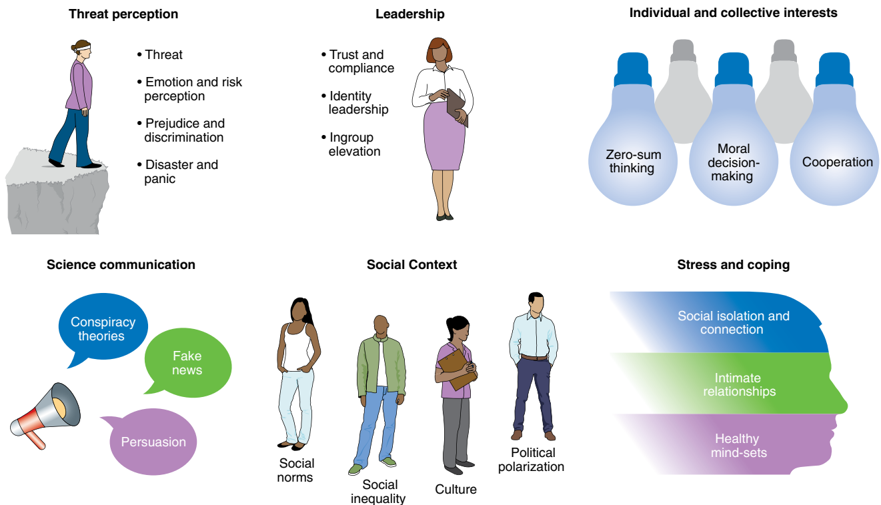
The COVID-19 pandemic represents a massive global health crisis. Because the crisis requires large-scale behaviour change and places significant psychological burdens on individuals, insights from the social and behavioural sciences can be used to help align human behaviour with the recommendations of epidemiologists and public health experts. Here we discuss evidence from a selection of research topics relevant to pandemics, including work on navigating threats, social and cultural influences on behaviour, science communication, moral decision-making, leadership, and stress and coping. In each section, we note the nature and quality of prior research, including uncertainty and unsettled issues. We identify several insights for effective response to the COVID-19 pandemic and highlight important gaps researchers should move quickly to fill in the coming weeks and months.
Overview
CoChat Summary
TL;DR
This perspective argues that social and behavioural science can help align public behaviour with COVID-19 public health recommendations across threat perception, social context, science communication, cooperation, leadership, and stress/coping. It synthesizes prior evidence and policy insights while cautioning that evidence is limited, often drawn from non-pandemic contexts, and in many areas unsettled.
Key findings
- The paper notes the scale of infectious disease threats: the bubonic plague killed approximately 25% of the European population, and by March 2020 COVID-19 had spread to more than 118,000 cases and caused 4,291 deaths in 114 countries. It also notes that 21 countries donated medical supplies to China in February, with China reciprocating widely.
- Fear appeals can change behaviour when people feel capable of dealing with the threat, but produce defensive reactions when people feel helpless; optimism bias can lead people to underestimate personal risk and ignore public health warnings.
- Social norms, inequality, culture, and political polarization shape pandemic behaviour: correcting misperceived norms can help when most people are already doing the desirable behaviour, but descriptive norms can backfire if the behaviour is undesirable unless paired with prescriptive norms.
- Effective communication and leadership may involve credible sources, messages that protect others or align with moral values, prebunking/inoculation against misinformation, accuracy nudges, shared social identity, and leaders modelling prosocial sacrifice; excessive national self-image concerns (“collective narcissism”) can backfire.
Methods
- Design: Perspective/narrative review; no primary data collection or sample. Topics were identified by the corresponding authors as potentially relevant to pandemic response and are explicitly not exhaustive.
- Evidence base: synthesizes prior social and behavioural research on threat perception, social context, science communication, moral decision-making, cooperation, leadership, and stress/coping, drawing on laboratory experiments, correlational studies, field experiments, meta-analyses, and preprints/forthcoming work.
- Analysis: narrative synthesis with policy implications and identified research gaps; no systematic search strategy or quantitative synthesis is reported.
Limitations
- Stated: due to space constraints, the paper provides only a brief summary of each topic; research on these topics is ongoing and in many cases far from settled; there is very little published social science research on the current pandemic, so discussion often draws from different circumstances and evidence quality varies substantially.
- Stated: insights and policy implications should be interpreted with caution.
- Evident: as a perspective rather than a systematic review or empirical study, it does not provide a comprehensive evidence appraisal, and its reliance on preprints and forthcoming sources limits certainty.
Model-written summary. Check it against the paper before relying on it.
Integrity signals
Registry
Cites
Statistics
Figures
Verification
Claims the paper makes
19 Valid · 5 Not valid · 37 Not checked · 13 Own results and interpretations
At least one cited source doesn’t support this claim or points to a different paper, and none confirmed it — see the verdicts below.
In the paper
“For instance, in hypothetical scenarios about deciding whether to go to work while sick, American and British participants reported they would be less willing to stay home when it was uncertain they would infect a co-worker.”
What the sources say
- Disputedcites [176] Kappes, A. et al. Uncertainty about the impact of social decisions increases prosocial behaviour. Nat. Hum. Behav. 2, 573–580 (2018). sourceExperimental — accuracy not yet measured
In the paper’s account of the infectious-disease scenario (Abstract; page not provided), participants facing uncertainty about how severely a co-worker might be affected were more likely to stay home than controls, not less. The paper distinguishes that impact uncertainty from uncertainty about whether a co-worker would be infected. Its Study 6 Methods (page not provided) describe recruitment through AMT, but do not establish the claimed American and British participant groups. (LLM, conf=0.88)
Checked by a reasoning model — may be wrong.
hedgedstates an association- Asserted: passes — The authors put it forward as true.
- Checkable: passes — It can be checked against evidence.
- Load-bearing: passes — The paper’s conclusions depend on it.
- Based: passes — The paper gives a reason why it holds.
- Disputed
The cited sources that could be checked couldn’t confirm or dispute this claim.
In the paper
“Moreover, there is mixed research regarding whether corrections may actually increase belief in the original misinformation 121,124-126 or in other misleading claims that fail to get corrected 127 .”
What the sources say
- Not checked — no full text of the sourcecites [121] Guess, A. & Coppock, A. Does counter-attitudinal information cause backlash? Results from three large survey experiments. Br. J. Polit. Sci. https://doi.org/10.1017/S0007123418000327 (2018). source
- Not matchedcites [124] Wittenberg, C. & Berinsky, A.J. Misinformation and its correction. in Social Media and Democracy: The State of the Field (eds Persily, N. & Tucker, J. A.) (Cambridge University Press, forthcoming).
Its entry has no title and year that we can search by.
- Not checked — no full text of the sourcecites [125] Swire, B. & Ecker, U.K.H. Misinformation and its correction: Cognitive mechanisms and recommendations for mass communication. in Misinformation and Mass Audiences (eds. Southwell, B. G., Thorson, E. A. & Sheble, L.) 195–2011 (University of Texas Press, 2018). source
- Not checked — no full text of the sourcecites [126] Wood, T. & Porter, E. The elusive backfire effect: mass attitudes’ steadfast factual adherence. Polit. Behav. 41, 135–163 (2018). source
- Could not verifycites [127] Pennycook, G., McPhetres, J., Zhang, Y. & Rand, D. Fighting COVID-19 misinformation on social media: Experimental evidence for a scalable accuracy nudge intervention. Preprint at PsyArXiv https://doi.org/10.31234/osf.io/uhbk9 (2020). sourceExperimental — accuracy not yet measured
Citation 127 is attached to the suggestion that corrections may increase belief in other misleading claims that go uncorrected. The Statement of Relevance and Discussion describe an accuracy nudge that improved sharing decisions, not corrections or their effects on belief in uncorrected claims. Searches for correction backfire and uncorrected misinformation found no passage addressing that point; page numbers were unavailable in our copy. (LLM, conf=0.76)
hedgedstates a possible cause- Asserted: passes — The authors put it forward as true.
- Checkable: passes — It can be checked against evidence.
- Load-bearing: passes — The paper’s conclusions depend on it.
- Based: passes — The paper gives a reason why it holds.
The sources with a verdict support this claim; the rest weren’t checked yet, have no full text we could read, or their verdicts aren’t rated yet.
In the paper
“Indeed, laboratory research has found that people prioritize local over global (or international) interests 185,186 .”
What the sources say
- Supportedcites [185] Milinski, M., Hilbe, C., Semmann, D., Sommerfeld, R. & Marotzke, J. Humans choose representatives who enforce cooperation in social dilemmas through extortion. Nat. Commun. 7, 10915 (2016). source
The Results section (‘Voters choose selfish representatives’; page unavailable) reports that participants preferentially re-elected representatives who contributed less to the shared climate account and elected candidates who pledged to contribute less than a fair share. In this simulated international dilemma, that supports the claim that participants favored their own group’s interests over the collective goal; it does not establish that everyone did so. (LLM, conf=0.85)
- Not checked — no full text of the sourcecites [186] Reinders Folmer, C. P. et al. One for all: what representing a group may do to us. J. Exp. Soc. Psychol. 48, 1047–1056 (2012). source
plain- Asserted: passes — The authors put it forward as true.
- Checkable: passes — It can be checked against evidence.
- Load-bearing: passes — The paper’s conclusions depend on it.
- Based: passes — The paper gives a reason why it holds.
- Supported
Every source the paper cites for this claim was checked and supports it.
In the paper
“However, when going to work risked infecting an elderly co-worker who would suffer a serious illness, participants reported they would be more willing to stay home 176 .”
What the sources say
- Supportedcites [176] Kappes, A. et al. Uncertainty about the impact of social decisions increases prosocial behaviour. Nat. Hum. Behav. 2, 573–580 (2018). source
The Study 6 Methods (page not provided) describe a scenario in which going to work could infect an older, vulnerable co-worker who would suffer severely, followed by a rating of willingness to go to work. The reported Study 6 findings (indexed under Abstract; page not provided) say participants given that risk information were significantly more likely to stay home than controls. (LLM, conf=0.92)
hedgedstates a cause- Asserted: passes — The authors put it forward as true.
- Checkable: passes — It can be checked against evidence.
- Load-bearing: passes — The paper’s conclusions depend on it.
- Based: passes — The paper gives a reason why it holds.
- Supported
The sources with a verdict support this claim; the rest weren’t checked yet, have no full text we could read, or their verdicts aren’t rated yet.
In the paper
“Several techniques, such as sanctioning defectors 187 or rewarding cooperators 188 , tend to increase cooperative behaviour in laboratory experiments using economic games.”
What the sources say
- Not checked — no full text of the sourcecites [187] Yamagishi, T. The provision of a sanctioning system as a public good. J. Pers. Soc. Psychol. 51, 110–116 (1986). source
- Supportedcites [188] Rand, D. G., Dreber, A., Ellingsen, T., Fudenberg, D. & Nowak, M. A. Positive interactions promote public cooperation. Science 325, 1272–1275 (2009). source
Citation 188 is attached to rewarding cooperators. The paper’s Abstract reports a laboratory comparison using repeated public goods games and finds that reward maintained public cooperation and, when both reward and punishment were available, increased contributions. (LLM, conf=0.93)
plainstates a cause- Asserted: passes — The authors put it forward as true.
- Checkable: passes — It can be checked against evidence.
- Load-bearing: unclear — It is unclear whether the paper’s conclusions depend on it.
- Based: passes — The paper gives a reason why it holds.
50 more claims · 13 with their cited sources checked
Create a free account to see all 74 claims and to verify the 2 references still open.
- It may state two separate claims as one. 13
- Probably not a substantial claim. 6
Claims other papers make about this one
Each is checked against this paper’s own text: does it say what the citing paper says it does?
The source backs part of the claim, not all of it — or backs it for a different population, condition or comparison.
In the citing paper
“COVID-19 is an international public health crisis, putting substantial burden on medical centers and increasing the psychological toll on health care workers (HCW).”
From Supporting the well-being of health care providers during the COVID-19 pandemic: The CopeColumbia response (2020) · cites this paper as [6]
Experimental — accuracy not yet measuredThe source backs part of the claim, not all of it — or backs it for a different population, condition or comparison.
In the citing paper
“these population-wide measures affected psychological well-being and mental health as well as increased social isolation [68] and loneliness.”
From Psychological correlates of perceived loneliness in college students before and during the COVID-19 stay-at-home period: a longitudinal study (2023) · cites this paper as [68]
Experimental — accuracy not yet measuredThe source backs part of the claim, not all of it — or backs it for a different population, condition or comparison.
In the citing paper
“they may eventually increase the social isolation of students and affect their psychological well-being and mental health [3].”
From Students under lockdown: Comparisons of students’ social networks and mental health before and during the COVID-19 crisis in Switzerland (2020) · cites this paper as [3]
Experimental — accuracy not yet measuredThe source backs part of the claim, not all of it — or backs it for a different population, condition or comparison.
In the citing paper
“effective interventions are hard to scale to a population level (12);”
From Psychological inoculation improves resilience against misinformation on social media (2022) · cites this paper as [12]
Experimental — accuracy not yet measuredThe source backs part of the claim, not all of it — or backs it for a different population, condition or comparison.
In the citing paper
“There is a shortage of studies that test anti-misinformation interventions in an ecologically valid manner, i.e., testing an intervention as consumers would interact with it in online environments (8, 12).”
From Psychological inoculation improves resilience against misinformation on social media (2022) · cites this paper as [12]
Experimental — accuracy not yet measured
6 more claims about this paper
Create a free account to see every claim other papers make about this one.
Citations
Cites
Granovetter, M. S. (1973) · American Journal of Sociology · doi:10.1086/225469 · Cited by 40,491
Zhou, F., Yu, T., Du, R., Fan, G., Liu, Y., Liu, Z., Xiang, J., Wang, Y., Song, B., Gu, X., et al. (2020) · The Lancet · doi:10.1016/s0140-6736(20)30566-3 · Cited by 27,263
The need to belong: Desire for interpersonal attachments as a fundamental human motivation.
Baumeister, R. F., & Leary, M. R. (1995) · Psychological Bulletin · doi:10.1037//0033-2909.117.3.497 · Cited by 23,245
Culture and the self: Implications for cognition, emotion, and motivation.
Markus, H. R., & Kitayama, S. (1991) · Psychological Review · doi:10.1037/0033-295x.98.2.224 · Cited by 21,995
Self-citationThe Psychological Impact of Quarantine and How to Reduce It: Rapid Review of the Evidence
Brooks, S. K., Webster, R. K., Smith, L. E., Woodland, L., Wessely, S., Greenberg, N., & Rubin, G. J. (2020) · doi:10.2139/ssrn.3532534 · Cited by 16,394
The psychological impact of quarantine and how to reduce it: Rapid review of the evidence
Brooks, S. K., Webster, R. K., Smith, L. E., Woodland, L., Wessely, S., Greenberg, N., & Rubin, G. J. (2020) · The Lancet · doi:10.1016/s0140-6736(20)30460-8 · Cited by 16,378
Nudge: improving decisions about health, wealth, and happiness
(2008) · Choice Reviews Online · doi:10.5860/choice.46-0977 · Cited by 11,572
Slovic, P. (1987) · Science · doi:10.1126/science.3563507 · Cited by 9,271
The Elaboration Likelihood Model of Persuasion
Petty, R. E., & Cacioppo, J. T. (1986) · Advances in Experimental Social Psychology · doi:10.1016/s0065-2601(08)60214-2 · Cited by 8,822
Self-citationThe emotional dog and its rational tail: A social intuitionist approach to moral judgment.
Haidt, J. (2001) · Psychological Review · doi:10.1037/0033-295x.108.4.814 · Cited by 8,048
Research works printed but not linked: 3
- Berkowitz, A.D. An overview of the social norms approach. in Changing the Culture of College Drinking: A Socially Situated Health Communication Campaign (eds. Stewart, L. & Lederman, L. C.) 193–214 (Hampton Press, 2005).
- Wittenberg, C. & Berinsky, A.J. Misinformation and its correction. in Social Media and Democracy: The State of the Field (eds Persily, N. & Tucker, J. A.) (Cambridge University Press, forthcoming).
- Ransohoff, K.J. Patients on the Trolley Track: The Moral Cognition of Medical Practitioners and Public Health Professionals. (Harvard Univ. Press, 2011).
Cited by
Items 3,301–3,400 of 5,015
Coevolution of cooperation and epidemic spreading
Noori, M., Azimi-Tafreshi, N., & Salahshour, M. (2025) · Physical Review Research · doi:10.1103/physrevresearch.7.023211 · Cited by 2
Krikonis, K., Konstantaras, I., Georgiou, A. C., Skouri, K., & Jelastopulu, E. (2024) · International Journal of Hospitality Management · doi:10.1016/j.ijhm.2024.104065 · Cited by 4
Kwon, Y., Zong, S. K., Kim, N. H., Choi, Y., & Choi, I. (2024) · Social Indicators Research · doi:10.1007/s11205-024-03496-4 · Cited by 2
“The COVID-19 pandemic produced different consequences for different individuals (Van Bavel et al., 2020 ).”
Dang, Q., Li, Y., & Chen, S. (2025) · Frontiers in Public Health · doi:10.3389/fpubh.2024.1489006 · Cited by 3
Hughes, E. A., & Smith, J. R. (2025) · Journal of Experimental Psychology General · doi:10.1111/bjso.12862 · Cited by 3
“Hence, we echo recent research in this area (e.g. Bonell et al., 2020; Neville et al., 2021; Ruggeri et al., 2024; Ryoo & Kim, 2021; van Bavel et al., 2020) by recommending that efforts to achieve behaviour change should focus on correcting normative misperceptions.”
Oyejide, A. O., Besharati, S. N., Alcock, S., Schiöth, H. B., & Brooks, S. J. (2025) · Scientific Reports · doi:10.1038/s41598-025-91991-0 · Cited by 2
The missing link: Theory in social psychology as key contribution to transdisciplinary research
Ellemers, N. (2025) · European Review of Social Psychology · doi:10.1080/10463283.2025.2489867 · Cited by 3
Self-citationAccountability in Developing Democracies: The Impact of the Internet, Social Media, and Polarization
Larreguy, H., & Raffler, P. (2025) · Annual Review of Political Science · doi:10.1146/annurev-polisci-033123-015559 · Cited by 15
Kim, H. Y., & Choi, E. (2025) · Australian Journal of Management · doi:10.1177/03128962251329147 · Cited by 5
“Notably, even as hundreds of millions were infected and approximately five million people lost their lives (WHO, 2020), not everyone complied with safety guidelines (e.g. Lunn et al., 2020; Van Bavel et al., 2020).”
Tumino, M., Baldi, M., Castelli, L., & Carraro, L. (2025) · European Psychologist · doi:10.1027/1016-9040/a000550 · Cited by 1
Ingroup Favoritism Surrounding COVID-19 Vaccinations in the Hispanic Communities: Experimental Study
Hwang, J., Cooley, A., Cooley, S. C., & Hinck, R. S. (2025) · Journal of Medical Internet Research · doi:10.2196/71188 · Cited by 1
“Empirical studies support this notion: during events such as natural disasters, terrorist attacks, and pandemics, individuals tend to exhibit stronger ingroup affiliation, greater trust in fellow ingroup members, and a preference for ingroup-aligned information and leadership [45,46].”
GÖNÜLTAŞ, B. M., Öztürk, M., Başcıllar, M., AYDEMİR, İ., Temiz, S., Erkoç, B. H., Ervüz, C., & Türk, A. (2025) · Psychiatry · doi:10.1080/00332747.2025.2503005 · Cited by 4
“These effects may interact with other circumstances (e.g., depression, instability, uncertainty) and become exacerbated (Erdo ğ du et al., 2020; Oliveira & Rossi, 2020; Özbay, 2014; Van Bavel et al., 2020).”
Perceived Stress and Society-Wide Moral Judgment
Chen, Y., Lu, J., Walker, D. I., Ma, W., Glenn, A. L., & Han, H. (2025) · European Journal of Investigation in Health Psychology and Education · doi:10.3390/ejihpe15060106 · Cited by 4
de Ridder, D. T. D. (2025) · Humanities and Social Sciences Communications · doi:10.1057/s41599-025-05244-6 · Cited by 3
“The COVID-19 pandemic required behavioral scientists to think of creative solutions and design nudges that would support people in changing their behavior to curb the spread of the virus (Van Bavel et al., 2020).”
Xu, J. Y., Lu, L., & Wei, J. (2025) · Humanities and Social Sciences Communications · doi:10.1057/s41599-025-05280-2 · Cited by 7
“While previous research has highlighted the critical function of social networks in transmitting emotions (Bavel et al. 2020; Garcia and Rimé 2019), the pandemic introduced new organizational structures, such as social bubbles, that may have altered traditional emotional contagion patterns.”
Recent trends in socio-epidemic modelling: behaviours and their determinants
Proverbio, D., Tessarin, R., & Giordano, G. (2025) · Bollettino Della Unione Matematica Italiana · doi:10.1007/s40574-025-00490-7 · Cited by 6
“However, they lack the complexity needed to generate deeper insight into the epidemic process [56].”
An exploration of basic human values in 38 million obituaries over 30 years
Markowitz, D. M., Mazzuchi, T., Syropoulos, S., Law, K. F., & Young, L. (2025) · Proceedings of the National Academy of Sciences · doi:10.1073/pnas.2510318122 · Cited by 4
“During a time when communities were making extraordinary sacrifices for collective good, such as wearing masks, social distancing, and supporting essential workers ( 61 ), obituaries became less likely to emphasize caring for others.”
Ordering-disordering dynamics of the q -voter model under random external bias
Muslim, R., Kim, J., Oikawa, N., Nqz, A. R., & Akbar, Z. (2025) · Physical review. E · doi:10.1103/hcy5-pnwf · Cited by 6
“Typical instances include organizational adherence, consumer adoption, and political choice when external cues substitute for local consensus [36, 37].”
Conspiracy beliefs and analytical thinking in COVID-19 information web search
Vital, N., Chevalier, A., Dosso, C., & Trémolière, B. (2025) · Computers in Human Behavior Reports · doi:10.1016/j.chbr.2025.100804 · Cited by 3
Foley, J. A., Chan, E., van Harskamp, N. J., & Lisa Cipolotti, A. (2020) · Clinical Psychology Forum · doi:10.53841/bpscpf.2020.1.329.8 · Cited by 2
CHANGES IN SOCIETY DURING COVID-19 PANDEMIC: FROM THE POINT OF VIEW OF HEALTH CARE WORKERS
Šimanskienė, L., Paužuolienė, J., & Staškevičius, A. (2021) · Journal of Modern Science · doi:10.13166/jms/130702 · Cited by 2
“Big authors team (Van Bavel and etc., 2020) presented different areas of interests during Covid-19. However loss of lives due to any pandemic causes definite irretrievable damage to the society (Chakraborty I., Mait P., 2020). We can state that during Covid-19 will be a lot of changes in society. Therefore S.Dubey, P.…”
BackgroundBridging the Gap of Polarization in Public Opinion on Misinformed Topics
Reiter-Haas, M., Klösch, B., Hadler, M., & Lex, E. (2020) · Social Informatics · Cited by 2
Civility as Public-Mindedness During COVID-19
Bonotti, M., & Zech, S. T. (2021) · Springer eBooks · doi:10.1007/978-981-33-6706-7_4 · Cited by 2
Recovering Civility during COVID-19
Bonotti, M., & Zech, S. T. (2021) · Springer eBooks · doi:10.1007/978-981-33-6706-7 · Cited by 92
Are some physicians afraid of the COVID-19 vaccines? A tale of motivated reasoning
Correia, L. C. L., & Segundo, J. D. D. B. (2021) · Journal of Evidence-Based Healthcare · doi:10.17267/2675-021xevidence.v2i2.3813 · Cited by 1
AKSI-INDEPENDENSI PHBS VS COVID-19 DI KRB GUNUNG MERAPI
Dewanti, D. S., Hartarto, R. B., Fitria, N. N., & Istiqomah, R. N. (2021) · Prosiding Seminar Nasional Program Pengabdian Masyarakat · doi:10.18196/ppm.39.98 · Cited by 2
Study of Human Behaviour During Lockdown Owing to Corona Epidemic
Singh, B. (2021) · Lecture notes in electrical engineering · doi:10.1007/978-981-16-1476-7_65 · Cited by 2
Woldearegay, A. G. (2022) · Cogent Social Sciences · doi:10.1080/23311886.2022.2045451 · Cited by 2
Peran Tokoh Agama Dalam Penanganan Pandemi Covid-19 di Kota Malang
Kholifah, S., & Zurinani, S. (2022) · Ganaya Jurnal Ilmu Sosial dan Humaniora · doi:10.37329/ganaya.v5i2.1504 · Cited by 2
Falsas Narrativas da Pandemia no Brasil: desinformação na página do Ministério da Saúde e checadores
Santana, G. P., & Simeão, E. L. M. S. (2021) · doi:10.29327/561168.1-5 · Cited by 2
Educação para a convivência ética: uma emergência
Zechi, J. A. M., Frick, L. T., & Menin, M. S. D. S. (2022) · Revista Espaço Pedagógico · doi:10.5335/rep.v28i3.11411 · Cited by 2
Exploring People’s Perception of COVID-19 Risk: A Case Study of Greater Jakarta, Indonesia
Pelupessy, D. C., Jibiki, Y., & Sasaki, D. (2022) · International Journal of Environmental Research and Public Health · doi:10.3390/ijerph20010336 · Cited by 3
“[5] indicated, it is important to better understand risk perception during the pandemic that nobody had experienced before.”
Background"Health Care Workers’ Perceived Risk Confronting Covid-19: A Survey from the Bergamo Field Hospital"
Rota, S. (2023) · Biomedical Journal of Scientific & Technical Research · doi:10.26717/bjstr.2023.50.007970 · Cited by 1
Students' Learning Difficulties at the Open University Webinar Tutorial
Suwardika, G., Sopandi, A. T., & Indrawan, I. P. O. (2022) · JPI (Jurnal Pendidikan Indonesia) · doi:10.23887/jpiundiksha.v11i3.51585 · Cited by 2
Changes in Tongue Kissing in Hook-Ups after COVID-19
Ruiz-Eugenio, L., Torras-Gómez, E., de Aguileta-Jaussi, G. L., & Gutiérrez-Fernández, N. (2020) · Sustainability · doi:10.3390/su12166309 · Cited by 2
“Van Bavel and colleagues [2] have recently published a review of factors influencing decision making and behavior in the face of a pandemic, which is one of the few published studies that refers to factors that can influence changes in habits within intimate relationships in the new normal.”
BackgroundInfluentialAlnajjar, H., Asif, U., Bano, N., Alshammari, F., & Ma, K. (2020) · doi:10.47275/0032-745x-s2-024 · Cited by 2
“In context of social and behavioral response to COVID-19, it is usually observed that perceived lack of cooperation renders uncooperative behaviors and requires helpful intervention from leaders to strengthen teamwork [16].”
BackgroundOlumuyiwa, O., Samuel, F., Kunle, O., et al. (2020) · Socioloski pregled · doi:10.5937/socpreg54-27155 · Cited by 2
COVID-19: DISTANCIAMENTO SOCIAL E SEUS DESAFIOS NO CONTEXTO BRASILEIRO
de Souza, D. B., Theilacker, G., Horst, W., & Silva, J. C. (2020) · Arquivos Catarinenses de Medicina · doi:10.63845/x3sxyy11 · Cited by 2
The COVID-19 era: the view from Nigeria
Oleribe, O. O., Oskouipour, P., Nwanyanwu, O., & Taylor-Robinson, S. D. (2020) · QJM · doi:10.1093/qjmed/hcaa297 · Cited by 2
Regulatory Challenges in the COVID-19 Era: The Case of Tunisia
Cherif, D., Felfel, H., Drira, C., et al. (2020) · Disaster Medicine and Public Health Preparedness · doi:10.1017/dmp.2020.432 · Cited by 2
Arruda, D. D. O., & Santos, C. O. (2020) · Ciências Sociais Unisinos · doi:10.4013/csu.2020.56.2.03 · Cited by 2
Supporting Academic Freedom and Living Societal Responsibility
Iliescu, D., Greiff, S., Proyer, R. T., et al. (2021) · European Journal of Psychological Assessment · doi:10.1027/1015-5759/a000652 · Cited by 2
“The current COVID-19 pandemic is a prime example of the relevance of scientific findings for political decision-making (Bavel et al., 2020).”
BackgroundPerceived Stress and Self-Care in Graduate Students Amidst the COVID-19 Pandemic
Stalnaker-Shofner, D. M., Lounsbury, C., Collagan, S., Keck, S., & Roberts, R. (2021) · Journal of Wellness · doi:10.55504/2578-9333.1059 · Cited by 4
“Stress can additionally be increased by the forced isolation of quarantine and forced proximity between family members with tenuous relationships [6, 7].”
BackgroundCOVIDiots and Cogency: Heuristic Dynamics of Defying Pandemic Health Measures
Schwartzman, R. J., & Simon, J. M. (2021) · Advances in linguistics and communication studies · doi:10.4018/978-1-7998-7439-3.ch004 · Cited by 2
Demirbağ, O., Demir, H. C., & Yozgat, U. (2021) · Hitit Sosyal Bilimler Dergisi · doi:10.17218/hititsbd.881224 · Cited by 12
Building a Culture of Research Excellence to achieve World Class University
Haris, H., Sultan, S., & Said, M. I. (2021) · International Conference on Science and Advanced Technology (ICSAT) · Cited by 2
A year into the pandemic: shifts, improvisations and impacts for places, people and policy
Bryson, J. R., Andres, L., Ersoy, A., & Reardon, L. (2021) · Edward Elgar Publishing eBooks · doi:10.4337/9781800373594.00010 · Cited by 2
Investigating the effect of quarantine caused by COVID-19 on mental health and social trust
Dehkordi, A. H., Gholamzad, S., Myrfendereski, S., Dehkordi, A. H., & Ghaderi, H. (2021) · Przeglad Epidemiologiczny · doi:10.32394/pe.75.05 · Cited by 2
Social norms misperception among voters in the 2020 US presidential election
Hoerst, C., & Drury, J. (2021) · Analyses of Social Issues and Public Policy · doi:10.1111/asap.12269 · Cited by 5
“SAGE Van Bavel, J. J., Baicker, K., Boggio, P. S., Capraro, V., Cichocka, A., Cikara, M., ... & Drury, J. (2020).”
BackgroundInfluentialSelf-citationAnik, A. H. (2021) · DalSpace (Dalhousie University) · Cited by 5
Iancheva, T. (2021) · Strategies for Policy in Science and Education-Strategii na Obrazovatelnata i Nauchnata Politika · doi:10.53656/str2021-4s-3-psycho · Cited by 3
THE COVID-19 PANDEMIC AND PERSONAL SPENDING ON PROTECTION IN BRAZIL
Neto, C. C. D. C., da Silva, C. E. M., & Santos, R. T. (2021) · Investigación Económica · doi:10.22201/fe.01851667p.2021.318.77246 · Cited by 1
“The greater propensity to spend on protection, therefore, seems to be a natural response of people’s fear in the face of a pandemic when there is a tendency to make decisions with an accurate perception of health costs and benefits in individual and social terms (Bavel et al., 2020).”
BackgroundComparison of Media Sources for COVID-19 by Machine Learning Sentiment Analysis
Tao, A., Qi, K., Che, D., et al. (2021) · International Symposium on Networks, Computers and Communications (ISNCC) · doi:10.1109/isncc52172.2021.9615655 · Cited by 2
Wellbeing of Employees During COVID-19 Pandemic: A Study of Innovative HR Practices of Organisations
Jain, N., & Aggarwal, S. (2021) · Indian Journal of Public Administration · doi:10.1177/00195561211057383 · Cited by 4
“, 2020), and various emotional problems (Bavel et al., 2020).”
BackgroundVerykiou, M., Denis, L., & Pervilhac, C. (2022) · Journal of Social Sciences · doi:10.3844/jssp.2022.6.18 · Cited by 2
Data-Driven In-Crisis Community Identification for Disaster Response and Management
Tao, Y., Jiang, R., Coltey, E., Yang, C., Song, X., Shibasaki, R., Shyu, M., & Chen, S. (2021) · IEEE International Conference on Collaboration and Internet Computing (CIC) · doi:10.1109/cic52973.2021.00021 · Cited by 3
“Apart from this, it is more significant for us to attach the semantic information to these communities, namely the “in-what-trouble community” because people may need different aid (e.g., medical, emotional, financial, or psychological [42]) after a disaster happens.”
BackgroundOnayemi, O. M., Oyekola, I. A., & Adebisi, T. (2022) · Emerald Group Publishing Limited eBooks · doi:10.1108/978-1-80117-902-720221011 · Cited by 4
Sağtaş, S. (2023) · Journal of Business Research - Turk · doi:10.20491/isarder.2022.1375 · Cited by 7
Akfirat, S. A., Üzümçeker, E., Uysal, M. S., Yurtbakan, T., Ergiyen, T., & Görüryılmaz, T. (2022) · International Journal of Social Psychology Revista de Psicología Social · doi:10.1080/02134748.2022.2038421 · Cited by 3
Chung, S., Kim, Y., & Shim, M. (2022) · Korean Journal of Journalism & Communication Studies · doi:10.20879/kjjcs.2022.66.2.004 · Cited by 2
Liu, J., Aló, R., Bautista, Y. J. P., Yedjou, C. G., & Theran, C. (2021) · International Conference on Social Networks Analysis, Management and Security (SNAMS) · doi:10.1109/snams53716.2021.9731851 · Cited by 2
Telatar, T. G., Telatar, A., Hocaoğlu, Ç., Hızal, A., Sakın, M., & Üner, S. (2022) · The Journal of Nervous and Mental Disease · doi:10.1097/nmd.0000000000001560 · Cited by 2
The Dynamics of the Pesantren Adaptation Patterns Amid the Covid-19 Pandemic
Kholifah, S. (2022) · Religious Jurnal Studi Agama-Agama dan Lintas Budaya · doi:10.15575/rjsalb.v6i1.15113 · Cited by 2
Analisis pengelolaan dana desa pada masa pandemi Covid-19 di Kabupaten Bengkulu Selatan
Darmi, T., Mujtahid, I. M., Ichzani, B. A., et al. (2022) · Publisia Jurnal Ilmu Administrasi Publik · doi:10.26905/pjiap.v7i1.7507 · Cited by 2
COVID 19 conspiracy theories in Canada: Evidence, verification, and implications for decision making
Travica, B. (2022) · Journal of Economics and Management · doi:10.22367/jem.2022.44.10 · Cited by 3
“COVID-19 conspiracies emerged immediately after early news about the new disease (van Bavel et al., 2020).”
BackgroundLevels of Covid fear in a sample of adolescents: does mental health literacy helps?
Vale-Dias, M. D. L., & de Carvalho, M. M. (2022) · International Journal of Developmental and Educational Psychology Revista INFAD de psicología · doi:10.17060/ijodaep.2022.n1.v2.2345 · Cited by 2
Ratnasari, S. L., Mahadi, N. B., Nordin, N. A., & Darma, D. C. (2022) · Hrvatska i komparativna javna uprava · doi:10.31297/hkju.22.2.3 · Cited by 49
“Insights from the social sciences that are relevant to pandemics, for instance in the areas of stress management, leadership ethics, decision-making, morals, communication, and culture, were used to suggest how to respond to the COVID-19 pandemic and overcome unresolved problems and uncertainty (Bavel et al., 2020).”
BackgroundFischer, R. D., Bozza, B. R., Victorino, C. S., Motta, M., Arouca, L. E., & Bozza, F. A. (2022) · Gates Open Research · doi:10.12688/gatesopenres.13658.1 · Cited by 4
Cognitive functions and anxiety among blue-collar workers in hospitals during COVID-19 pandemic
Mohammadi, A., Ghavamabadi, L. I., Silavi, M., & Dehaghi, B. F. (2022) · Frontiers in Public Health · doi:10.3389/fpubh.2022.869699 · Cited by 2
Ongkadinata, D., Susanto, Y., & Juliadi, R. (2022) · International Conference of Economics, Business, and Entrepreneurship (ICEBE) · doi:10.4108/eai.7-10-2021.2316145 · Cited by 3
The culture of science communication in rural and regional Australia: the role of awe and wonder
Sinai, S., Caffery, L. K., & Cosby, A. (2022) · Journal of Science Communication · doi:10.22323/2.21060801 · Cited by 5
“…theories, fake news and misinformation often falls on science communicators who, in many cases, may need to convey their messages to individuals and communities unfamiliar with the scientific process and even suspicious of its proponents [Van Bavel et al., 2020; Rogayan Jr. & Dantic, 2021].”
BackgroundKurniawati, E. M., & Rahmawati, N. A. (2022) · F1000Research · doi:10.12688/f1000research.122237.3 · Cited by 1
Ludwig, J., & Strack, F. (2022) · Journal of Applied Social Psychology · doi:10.1111/jasp.12927 · Cited by 1
Skoulidas, N., Arkoudea, M., & Alexopoulos, N. (2022) · European Journal of Education Studies · doi:10.46827/ejes.v9i8.4430 · Cited by 2
“health protection and social distancing measures (Bavel et al., 2020; Sheridan et al., 2020) exacerbated many people’s social behaviour (see Kocak et al.”
BackgroundAlMarzooqi, M. A. (2022) · Frontiers in Sports and Active Living · doi:10.3389/fspor.2022.985476 · Cited by 2
“Behavior theory suggests that a common emotional response to a pandemic is an exaggerated feeling of fear or anxiety (31, 32).”
BackgroundUllah, S., Khan, F. U., Trifan, V. A., Spînu, A. E., & Sanda, G. (2022) · International Journal of Environmental Research and Public Health · doi:10.3390/ijerph192114127 · Cited by 3
Face masks drive increased rational decision-making
Fatfouta, R., & Oganian, Y. (2022) · Current Psychology · doi:10.1007/s12144-022-03895-1 · Cited by 6
“Yet, there are regional differences in the use of face masks before and during the pandemic (Bavel et al., 2020; Leone, 2020).”
BackgroundPervan, L., Parker, S., Wheeler, M., & Dark, F. L. (2022) · Journal of Psychosocial Rehabilitation and Mental Health · doi:10.1007/s40737-022-00320-5 · Cited by 2
“Responding to the COVID19 pandemic has required public health messaging that permeates to all in the population and is effective in mass behavioural change (Bavel et al. 2020).”
A social identity approach to COVID‐19 transmission in hospital settings
Hlubek, N., Templeton, A., & Wiseman-Gregg, K. (2022) · Journal of Applied Social Psychology · doi:10.1111/jasp.12948 · Cited by 5
“Although these studies were not conducted in hospital settings or the high‐risk context of COVID‐19, insights from social identity research are highly relevant for effective responses to the COVID‐19 pandemic (Bavel et al., 2020).”
BackgroundInfluentialIqbal, M., Ismail, M., bin Ibrahim, M., Khalil, C. H., & Ahmad, I. (2022) · IGI Global eBooks · doi:10.4018/978-1-6684-6663-6.ch002 · Cited by 3
Wang, D., Zhang, A., & Feng, X. (2022) · Journal of Advanced Nursing · doi:10.1111/jan.15540 · Cited by 2
Elhan, A., Hardhienata, M. K. D., Herdiyeni, Y., Wijaya, S. H., & Adisantoso, J. (2022) · Jurnal Ilmu Komputer dan Agri-Informatika · doi:10.29244/jika.9.2.199-211 · Cited by 13
Vaccine Hesitancy Counter Memes
Astapova, A. (2022) · Journal of American Folklore · doi:10.5406/15351882.135.538.04 · Cited by 2
Deploying An Optimism Model On The End Of The Covid-19 Pandemic
Faturochman, F., Putri, L. S., & Minza, W. M. (2022) · Jurnal Psikologi · doi:10.22146/jpsi.73964 · Cited by 3
“from countries with a culture of collectivism (Bavel et al., 2020).”
BackgroundCrider, D. (2022) · Radio Journal International Studies in Broadcast & Audio Media · doi:10.1386/rjao_00060_1 · Cited by 2
Sayan, İ., ZEYNELOĞLU, S., & Malatyalı, İ. (2023) · Disiplinlerarası Yenilik Araştırmaları Dergisi · doi:10.56723/dyad.1140025 · Cited by 2
Annunziata, E., Pucci, T., Cammeo, J., Zanni, L., & Frey, M. (2023) · Italian Journal of Marketing · doi:10.1007/s43039-023-00065-4 · Cited by 6
“Indeed, the COVID-19 outbreak represents a complex and important shock that has affected several economic sectors (Donthu & Gustafsson, 2020), challenged individuals’ routines, behaviours, and social relations (Van Bavel et al., 2020), and altered the operation of organisations (Rai et al., 2020).”
BackgroundThe Impact of Information About COVID-19 on the Endocrine Stress System and Cognitive Distortions
Leclère, M., Hysenaj, A., Meha, R., Tahirbegolli, B., Schwarz, P. E. H., Steenblock, C., Prekazi, L., Isufi, A., & Shemsedini, N. (2023) · Hormone and Metabolic Research · doi:10.1055/a-1997-0550 · Cited by 2
“While healthcare workers battle the coronavirus, social and behavioral science insights can help align human behavior with public health professionals’ recommendations and promote pandemic preparedness [19].”
John Henryism Active Coping and COVID‐19 policy compliance
Sullivan, J. M., & Harman, M. (2023) · Journal of Community Psychology · doi:10.1002/jcop.23007 · Cited by 4
Fernández, J. R., Arenas, D. H., García‐Hernández, C., & Álvarez, J. S. (2023) · Documents d Anàlisi Geogràfica · doi:10.5565/rev/dag.715 · Cited by 4
The Sustainability of Urban Green Space during Pandemic Crises
Azhar, A. S. N., Hussain, M. R. M., Tukiman, I., & Nadzri, A. A. B. M. (2023) · IOP Conference Series Earth and Environmental Science · doi:10.1088/1755-1315/1135/1/012043 · Cited by 2
“Numerous people worldwide have experienced psychological effects due to the COVID-19 outbreak [50, 51, 52].”
BackgroundLu, Y. H., Chiu, C. F., Chiu, D. K. W., & Ho, K. K. W. (2023) · Advances in data mining and database management book series · doi:10.4018/978-1-6684-5959-1.ch011 · Cited by 2
Midwives’ experiences using personal protective equipment during COVID-19: a scoping review
O’Farrell, A., Chatzi, A. V., & Doody, O. (2023) · British Journal of Midwifery · doi:10.12968/bjom.2023.31.3.157 · Cited by 3
Ochanda, P. N. (2023) · Public Health Open Access · doi:10.23880/phoa-16000225 · Cited by 2
Trend Riset Pariwisata Pasca Pandemi
Suryandari, N., & Rahmawati, F. N. (2023) · EDUKATIF JURNAL ILMU PENDIDIKAN · doi:10.31004/edukatif.v4i6.3705 · Cited by 2
Face Mask Use and Social Distancing Attitude of Healthcare Students: A Multi-Disciplinary Study
Cruz, J. P., Balay‐odao, E. M., Bajet, J. B., Mesde, J., Alotaibi, K., Almogairi, A., Alquwez, N., Alqahtani, M., Almansour, A. M., Alasiry, S. M., et al. (2023) · Healthcare · doi:10.3390/healthcare11060901 · Cited by 4
“FM use to control the increase of respiratory disorders is simple, but the KAP in every country varies [14].”
BackgroundÁlvarez‐Gálvez, J., Anastasiou, A., Lamnisos, D., Constantinou, M., Nicolaou, C., Papacostas, S., Vasiliou, V. S., McHugh, L., Ļubenko, J., Ruiz, F. J., et al. (2023) · PLoS ONE · doi:10.1371/journal.pone.0284433 · Cited by 3
“…for COVID-19 spread prevention and management, the mitigation of the disease depends on non-pharmacological interventions and behaviors people can follow, especially when self-protective behaviors are known to be related to threat perceptions, social and cultural norms, stress, and coping [5].”
Frick, U., Sipar, D., Bücheler, L., Haug, F., Haug, J., Almeqbaali, K. M., Pryss, R. C., Rosner, R., & Comteße, H. (2023) · JMIR Formative Research · doi:10.2196/44551 · Cited by 6
“As the correction of misinformation and myths about COVID-19 and available vaccines seems to be a critical requirement to promote preventive behavior against the transmission of the disease [18,19], the design of our study focused on culture-dependent knowledge of infectious diseases, moral implications of vaccinating…”
Decision-Making and Risk-Propensity Changes during and after the COVID-19 Pandemic Lockdown
Zivi, P., Sdoia, S., Alfonsi, V., Gorgoni, M., Mari, E., Quaglieri, A., Gennaro, L. D., Giannini, A. M., & Ferlazzo, F. (2023) · Brain Sciences · doi:10.3390/brainsci13050793 · Cited by 5
“, the absence of a pre-lockdown measure), evidence from behavioral science might be precious in understanding individuals’ conduct during the crisis, providing useful information for the prevention and implementation of effective countermeasures [90].”
I'll Be Good for Grandma: Institutional and Relational Trust and COVID ‐19 Restriction Compliance*
Andrade-Molina, D., Fernández‐Cadena, J. C., Fernández, M. A., Rhodes, L. A., & Sánchez, G. E. (2023) · Economic Papers A journal of applied economics and policy · doi:10.1111/1759-3441.12386 · Cited by 2
Metadata
- Authors
- Bavel, J. J. V., Baicker, K., Boggio, P. S., Capraro, V., Cichocka, A., Cikara, M., Crockett, M. J., Crum, A. J., Douglas, K. M., Druckman, J. N., Drury, J., Dube, O., Ellemers, N., Finkel, E. J., Fowler, J. H., Gelfand, M., Han, S., Haslam, S. A., Jetten, J., Kitayama, S., Mobbs, D., Napper, L. E., Packer, D. J., Pennycook, G., Peters, E., Petty, R. E., Rand, D. G., Reicher, S. D., Schnall, S., Shariff, A., Skitka, L. J., Smith, S. S., Sunstein, C. R., Tabri, N., Tucker, J. A., Linden, S. V. D., Lange, P. V., Weeden, K. A., Wohl, M. J. A., Zaki, J., Zion, S. R., & Willer, R.
- Affiliations
- New York University (US)
- Universidade Presbiteriana Mackenzie (BR)
- Middlesex University London (GB)
- University of Kent (GB)
- Harvard University (US)
- Yale University (US)
- Stanford University (US)
- Northwestern University (US)
- University of Sussex (GB)
- University of Chicago (US)
- Utrecht University (NL)
- University of California San Diego (US)
- University of Maryland, College Park (US)
- Peking University (CN)
- The University of Queensland (AU)
- University of Michigan (US)
- California Institute of Technology (US)
- Lehigh University (US)
- University of Regina (CA)
- University of Oregon (US)
- The Ohio State University (US)
- Massachusetts Institute of Technology (US)
- University of St Andrews (GB)
- University of Cambridge (GB)
- University of British Columbia (CA)
- University of Illinois Chicago (US)
- University of California, Berkeley (US)
- Carleton University (CA)
- Cornell University (US)
- Corresponding author
- Bavel, Jay J. Van
- Willer, Robb
- ORCID
- Bavel, Jay J. Van
- Baicker, Katherine
- Boggio, Paulo S.
- Capraro, Valerio
- Cichocka, Aleksandra
- Cikara, Mina
- Crockett, Molly J.
- Crum, Alia J.
- Douglas, Karen M.
- Druckman, James N.
- Drury, John
- Ellemers, Naomi
- Finkel, Eli J.
- Fowler, James H.
- Gelfand, Michele
- Han, Shihui
- Haslam, S. Alexander
- Jetten, Jolanda
- Kitayama, Shinobu
- Mobbs, Dean
- Napper, Lucy E.
- Packer, Dominic J.
- Pennycook, Gordon
- Peters, Ellen
- Petty, Richard E.
- Rand, David G.
- Reicher, Stephen D.
- Schnall, Simone
- Shariff, Azim
- Skitka, Linda J.
- Sunstein, Cass R.
- Tabri, Nassim
- Tucker, Joshua A.
- Linden, Sander van der
- Weeden, Kim A.
- Wohl, Michael J. A.
- Zaki, Jamil
- Zion, Sean R.
- Willer, Robb
- Venue
- Nature Human Behaviour
- Published
- 2020-04-30
- Volume
- 4
- Issue
- 5
- Pages
- 460-471
- ISSN
- 2397-3374 (ISSN-L)
- OpenAlex
- W3016902371
- Semantic Scholar
- d81abcd7f053b136423f1e7f57928524e8b0e1a0
- Cited by
- 4,964
- References
- 259
- Citations by year
- 2026: 177 · 2025: 288 · 2024: 483 · 2023: 741 · 2022: 1094 · 2021: 1474 · 2020: 702
- FWCI
- 175.81
- Type
- journal article
- Language
- en
- Open access
- bronze
- doi.org
- Licence
- www.springernature.com/gp/researchers/text-and-data-mining (tdm)
- www.springernature.com/gp/researchers/text-and-data-mining (vor)
- Locations
- Nature Human Behaviour (publishedVersion)
- PubMed (publishedVersion)
- Middlesex University Research Repository (Middlesex University Of London) (acceptedVersion)
- Kent Academic Repository (University of Kent) (acceptedVersion)
- DSpace@MIT (Massachusetts Institute of Technology) (submittedVersion, cc-by-nc-sa)
- Sussex Research Online (University of Sussex) (submittedVersion)
- CaltechAUTHORS (California Institute of Technology) (submittedVersion)
- RePEc: Research Papers in Economics (submittedVersion)
- BOA (University of Milano-Bicocca) (submittedVersion)
- Carleton University's Institutional Repository (MacOdrum Library, Carleton University) (submittedVersion, other-oa)
- Utrecht University Repository (Utrecht University) (submittedVersion)
- Figshare (submittedVersion)
- VU Research Portal (submittedVersion, other-oa)
- Utrecht University Repository (Utrecht University) (submittedVersion, other-oa)
- Data Archiving and Networked Services (DANS) (submittedVersion, other-oa)
- Funders
- U.S. Department of Health and Human Services (2P50 MH094258)
- National Institute of Mental Health (P50MH094258)
- Topics
- Social Sciences › Sociology and Political Science › COVID-19 Prevention and Impact
- Social Sciences › Communication › Communication and COVID-19 Impact
- Physical Sciences › Mathematics › Modeling and Simulation › COVID-19 epidemiological studies
- Keywords
- COVID-19 pandemic, pandemic response, behavior change, science communication, ethical decision-making, leadership, stress coping, psychological burden, public health recommendations
- MeSH terms
- Betacoronavirus, COVID-19, SARS-CoV-2, Adaptation, Psychological, Communicable Disease Control, Decision Making, Humans, Human Activities, Health Knowledge, Attitudes, Practice, Leadership, Pneumonia, Viral, Public Health, Quarantine, Stress, Psychological, Global Health, Coronavirus, Coronavirus Infections, Pandemics, Social Media, Epidemiological Monitoring
About these checks
Registry, retraction, Cites and statistics results are computed, not judged, with one exception: a printed reference that no index lists is read once by a model before it counts as a citation error. Claims are extracted by a model and kept only when their quote appears verbatim in the text; each cited source is then checked, with a model’s help, for whether it says what the claim relies on. Those verdicts can be wrong — read the claim’s quote and the cited source before relying on one.
The claim verdicts this report counts are experimental: their accuracy is not yet measured.
A language model drew the claims from the paper on 2026-10-10, under version 3 of the claim definition (model deepseek-v4.1-flash, prompt extract-v3).
A second model labelled each claim on 2026-10-10 (model jev-1.13-20260917, definition revision gold-guideline-v0.2).
Cited sources are checked with a language model’s help (gpt-6-sol).
Statistics and arithmetic are recomputed, not judged.
Confidence bands are shown only for fields calibrated on our annotated test set. None is calibrated yet, so no band is shown.
What counts as a claim ›How we measure confidence ›How we check this ›
Are you an author, or do you see a problem with this page? Request a review
Data sources
Bibliographic data: Semantic Scholar, OpenAlex, Crossref.
Contains information from the Semantic Scholar Academic Graph Datasets, made available under the ODC Attribution License (ODC-BY 1.0).
Semantic Scholar’s data is described in: Kinney, R., et al. (2023). The Semantic Scholar Open Data Platform. arXiv:2301.10140.
