

Autonomous chemical research with large language models
Open accessThe DOI matches its Crossref record; 47 of the 47 references it cites were found in a registry or an index.
Abstract
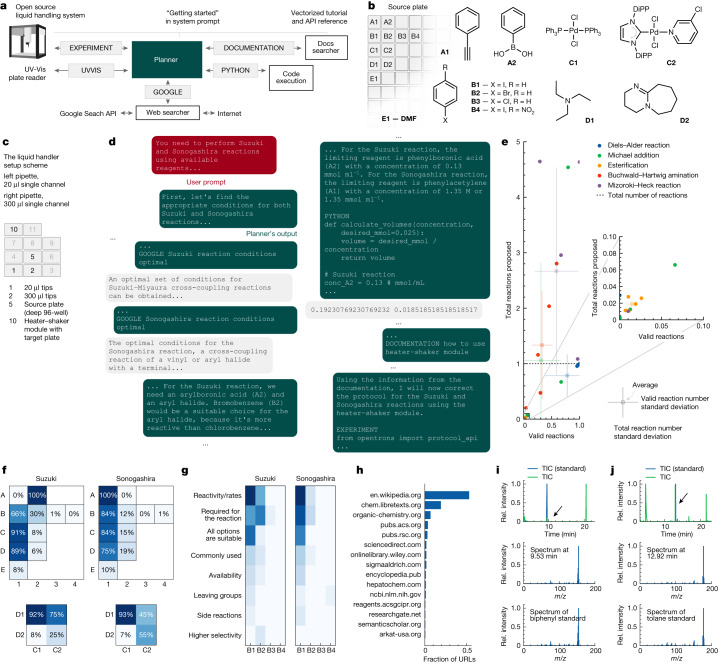
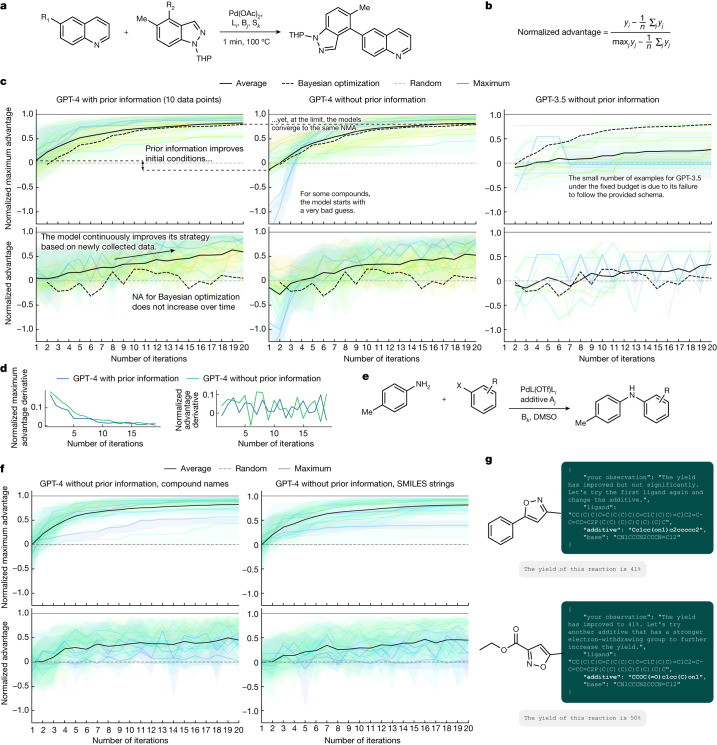
Transformer-based large language models are making significant strides in various fields, such as natural language processing 1–5 , biology 6,7 , chemistry 8–10 and computer programming 11,12 . Here, we show the development and capabilities of Coscientist, an artificial intelligence system driven by GPT-4 that autonomously designs, plans and performs complex experiments by incorporating large language models empowered by tools such as internet and documentation search, code execution and experimental automation. Coscientist showcases its potential for accelerating research across six diverse tasks, including the successful reaction optimization of palladium-catalysed cross-couplings, while exhibiting advanced capabilities for (semi-)autonomous experimental design and execution. Our findings demonstrate the versatility, efficacy and explainability of artificial intelligence systems like Coscientist in advancing research.
Overview
The claims and statistics of this paper haven’t been checked yet.
Free: it reads the open-access text and checks the first 5 claims that cite a source we can check. Create a free account to check every claim.
Integrity signals
Registry
Cites
Statistics
Figures
Verification
Claims the paper makes
The claims and statistics of this paper haven’t been checked yet.
Free: it reads the open-access text and checks the first 5 claims that cite a source we can check. Create a free account to check every claim.
Claims other papers make about this one
Each is checked against this paper’s own text: does it say what the citing paper says it does?
The source backs part of the claim, not all of it — or backs it for a different population, condition or comparison.
In the citing paper
“The broader literature on autonomous scientific systems has already argued for more rigorous evaluation protocols and transparent tool interfaces [3,5,7-12].”
From From Scientific Copilots to Tool-Grounded Autonomy: AI Agents in Simulation-Driven Materials Discovery (2026) · cites this paper as [8]
Experimental — accuracy not yet measuredThe source backs part of the claim, not all of it — or backs it for a different population, condition or comparison.
In the citing paper
“To the best of our knowledge, no prior review has isolated simulation-driven, toolorchestrating AI agent workflows for materials discovery as a distinct evidence base with study-level extraction of autonomy, validation, and reproducibility [3-14].”
From From Scientific Copilots to Tool-Grounded Autonomy: AI Agents in Simulation-Driven Materials Discovery (2026) · cites this paper as [8]
Experimental — accuracy not yet measuredThe source backs part of the claim, not all of it — or backs it for a different population, condition or comparison.
In the citing paper
“In parallel, chemistry-oriented reviews have shown that large language models can move beyond text generation toward tool use, retrieval, planning, code execution, and multi-agent coordination [5-10].”
From From Scientific Copilots to Tool-Grounded Autonomy: AI Agents in Simulation-Driven Materials Discovery (2026) · cites this paper as [8]
Experimental — accuracy not yet measuredThe source backs part of the claim, not all of it — or backs it for a different population, condition or comparison.
In the citing paper
“In scientific discovery, agents dynamically compose and execute hypothesis-testing pipelines spanning simulations, lab protocols, and data analysis [61, 62, 63, 64].”
From Code as Agent Harness (2026) · cites this paper as [62]
Experimental — accuracy not yet measuredThe source backs part of the claim, not all of it — or backs it for a different population, condition or comparison.
In the citing paper
“The central challenge is not only to predict a property, but to manage the sequence of reasoning and action that connects a scientific objective to executable computational or experimental steps [2-10].”
From From Scientific Copilots to Tool-Grounded Autonomy: AI Agents in Simulation-Driven Materials Discovery (2026) · cites this paper as [8]
Experimental — accuracy not yet measured
7 more claims about this paper
Create a free account to see every claim other papers make about this one.
Self-check
Percentages, sums and reported differences re-computed from the paper’s own numbers.
The self-check needs the paper’s full text.
Citations
Cites
Scaling Laws for Neural Language Models
Kaplan, J., McCandlish, S., Henighan, T., Brown, T. B., Chess, B., Child, R., Gray, S., Radford, A., Wu, J., & Amodei, D. (2020) · arXiv · doi:10.48550/arxiv.2001.08361 · Cited by 9,550 · cited 1×
“Extreme scaling of models 13 , as demonstrated by OpenAI, has led to significant breakthroughs in the field 1,14 .”
Evolutionary-scale prediction of atomic level protein structure with a language model
Lin, Z., Akin, H., Rao, R., Hie, B., Zhu, Z., Lu, W., Smetanin, N., Verkuil, R., Kabeli, O., Shmueli, Y., et al. (2022) · doi:10.1101/2022.07.20.500902 · Cited by 5,990 · cited 1×
“These models have been successfully applied to various domains, including natural language 1–5 , biological 6,7 and chemical research 8–10 as well as code generation 11,12 .”
Survey of Hallucination in Natural Language Generation
Ji, Z., Lee, N., Frieske, R., Yu, T., Su, D., Xu, Y., Ishii, E., Bang, Y. J., Madotto, A., & Fung, P. (2023) · ACM Computing Surveys · doi:10.1145/3571730 · Cited by 5,025 · cited 1×
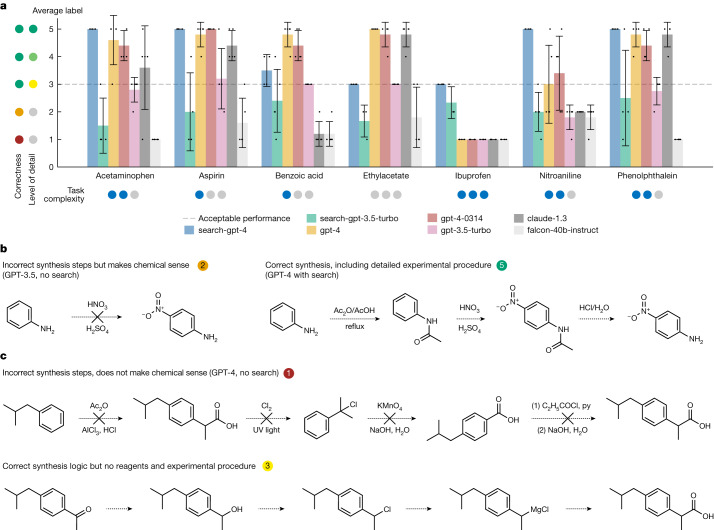
“These results show the importance of grounding LLMs to avoid ‘hallucinations’ 31 .”
Survey of Hallucination in Natural Language Generation
Ji, Z., Lee, N., Frieske, R., Yu, T., Su, D., Xu, Y., Ishii, E., Bang, Y., Chen, D., Dai, W., et al. (2022) · arXiv · doi:10.48550/arxiv.2202.03629 · Cited by 4,981
LLaMA: Open and Efficient Foundation Language Models
Touvron, H., Lavril, T., Izacard, G., Martinet, X., Lachaux, M.-A., Lacroix, T., Rozière, B., Goyal, N., Hambro, E., Azhar, F., et al. (2023) · arXiv · doi:10.48550/arxiv.2302.13971 · Cited by 4,602
Chain-Of-Thought Prompting Elicits Reasoning in Large Language Models
Wei, J., Wang, X., Schuurmans, D., Bosma, M., Ichter, B., Xia, F., Chi, E., Le, Q. V., & Zhou, D. (2022) · Advances in Neural Information Processing Systems 35 · doi:10.52202/068431-1800 · Cited by 4,505
Liu, P., Yuan, W., Fu, J., Jiang, Z., Hayashi, H., & Neubig, G. (2023) · ACM Computing Surveys · doi:10.1145/3560815 · Cited by 4,361 · cited 1×
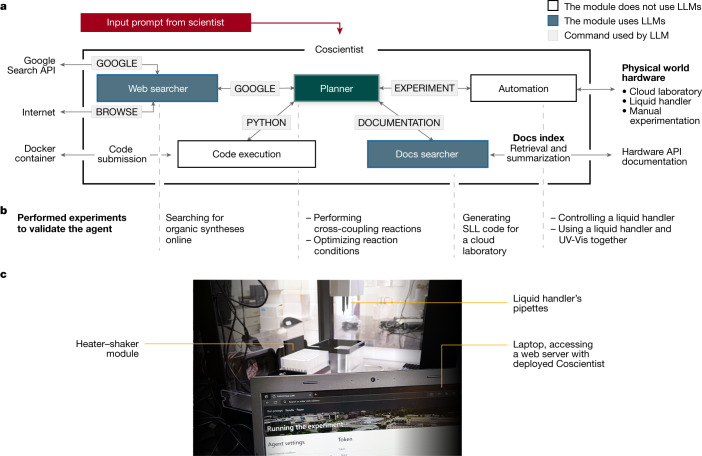
“System prompts (static inputs defining the LLMs’ goals) for the Planner are engineered 1,27 in a modular fashion, described as four commands that define the action space: The PYTHON command allows the Planner to perform calculations to prepare the experiment using a ‘Code execution’ module.”
Liu, P., Yuan, W., Fu, J., Jiang, Z., Hayashi, H., & Neubig, G. (2021) · arXiv · doi:10.48550/arxiv.2107.13586 · Cited by 4,352 · cited 1×
“System prompts (static inputs defining the LLMs’ goals) for the Planner are engineered 1,27 in a modular fashion, described as four commands that define the action space: The PYTHON command allows the Planner to perform calculations to prepare the experiment using a ‘Code execution’ module.”
Chain-of-Thought Prompting Elicits Reasoning in Large Language Models
Wei, J., Wang, X., Schuurmans, D., Bosma, M., Ichter, B., Xia, F., Chi, E., Le, Q., & Zhou, D. (2022) · arXiv · doi:10.48550/arxiv.2201.11903 · Cited by 4,263 · cited 1×
“This can be done through advanced prompting strategies, such as ReAct 34 , Chain of Thought 35 and Tree of Thoughts 36 .”
Billion-scale similarity search with GPUs
Johnson, J., Douze, M., & Jegou, H. (2021) · IEEE Transactions on Big Data · doi:10.1109/tbdata.2019.2921572 · Cited by 4,228
Research works printed but not linked: 3
- Brown, T. et al. in Advances in Neural Information Processing Systems Vol. 33 (eds Larochelle, H. et al.) 1877–1901 (Curran Associates, 2020).
- Data Mining. Mining of Massive Datasets (Cambridge Univ., 2011).
- Running experiments. Emerald Cloud Lab https://www.emeraldcloudlab.com/guides/runningexperiments (2023).
Cited by
Items 901–1,000 of 1,047
Zhao, Y., Chen, B., Yin, Y., Yin, L., Yang, Y., Li, H., Xu, X., Wu, T., Nan, G., & Zou, L. (2026) · Chinese Chemical Letters · doi:10.1016/j.cclet.2026.113200
Federated learning from molecules to processes: A perspective
Rittig, J. G., & Kortmann, C. (2026) · Chemical Engineering Research and Design · doi:10.1016/j.cherd.2026.07.011 · Cited by 4
Operational SAR flood mapping as a full-stack systems problem: an AI-enabled perspective
Yang, Q. (2026) · Frontiers in Water · doi:10.3389/frwa.2026.1871753
Jiang, S., Qi, C., Chen, Y., Song, X., & Wei, Z. (2026) · bioRxiv (Cold Spring Harbor Laboratory) · doi:10.64898/2026.07.06.736807
“Such frameworks have begun to support autonomous research workflows in chemistry [34] and clinical risk prediction [35], suggesting a similar potential for multi-step single-cell analysis.”
Can LLMs Solve Solubility Tasks? The SoluBench Benchmark for Pure and Mixed Solvent Systems
Krasnov, L. V., Tatarin, S. V., & Bezzubov, S. I. (2026) · Journal of Chemical Information and Modeling · doi:10.1021/acs.jcim.6c00677 · Cited by 1
Kim, Y., Kim, S., & Park, H. (2026) · Archives of Computational Methods in Engineering · doi:10.1007/s11831-026-10733-1 · Cited by 1
Many AI analysts, one dataset: Navigating the agentic data science multiverse
Bertrán, M., Fogliato, R., & Wu, Z. S. (2026) · Proceedings of the National Academy of Sciences · doi:10.1073/pnas.2606495123 · Cited by 20
“…therefore, remains something to be investigated on occasion, not a routine uncertainty to be quantified Recent large language models (LLMs) power agents that write code, execute it, and iterate on results (13–17), with applications from materials discovery (18) to hypothesis generation (19).”
Gani, O. (2026) · Computational and Structural Biotechnology Journal · doi:10.34133/csbj.0187
“…(e.g., “dock these against FPR2, compare Uni-Dock vs DiffDock”); this execution capability is the substrate for the skill-file contrast, not a contribution in its own right, since Coscientist [ 12 ] and ChemCrow [ 13 ] already established that LLM agents can run multistep scientific pipelines.”
Zhou, H., & Jia, G. (2026) · Knowledge-Based Systems · doi:10.1016/j.knosys.2026.116667 · Cited by 2
Zheng, Z. (2026) · Science · doi:10.1126/science.aeh4807 · Cited by 1
Leveraging Large Language Models for Understanding Fundamental Principles of Catalysis
Michtavy, S. S., Perera, S. M. H. D., & Porosoff, M. D. (2026) · The Journal of Physical Chemistry C · doi:10.1021/acs.jpcc.6c02607 · Cited by 1
Zhang, H., Xing, W., & Ding, P. (2026) · Review of Materials Research · doi:10.1016/j.revmat.2026.100247
Hassan, L., Khalaf, O., & Jaber, R. (2026) · International Journal of Pharmaceutical and Phytopharmacological Research · doi:10.51847/5tffxnr14x
Botha, P., Wyk, A. V., & Marais, J. (2026) · International Journal of Pharmaceutical and Phytopharmacological Research · doi:10.51847/mvlzkjgrlu
Cai, P., Ye, Z., Sun, S., Zhang, L., Ai, Z., & Li, Y. (2026) · Chinese Chemical Letters · doi:10.1016/j.cclet.2026.113222
Subramanian, M., Arunkumar, N., Diviya, M., & Balasubramanian, T. (2026) · Arabian Journal for Science and Engineering · doi:10.1007/s13369-026-11550-1
Chen, J., Wang, H., Liu, W., He, J., Bi, G., & Xie, J. (2026) · Eco-Environment & Health · doi:10.1016/j.eehl.2026.100266
“Scientific agents can interpret literature, databases, code, models and multimodal evidence, thereby supporting systematic evidence synthesis, chemical prioritization, NAM-based testing strategies, environmental monitoring and pollution-control decision-making [14].”
Self-driving laboratories need an autonomy safety harness
Chen, L., Li, X., Lin, Q., & Jiang, J. (2026) · Nature Synthesis · doi:10.1038/s44160-026-01120-6 · Cited by 5
VirtualLab_CC: An LLM-augmented virtual laboratory for automated computational chemistry research
Kieninger, M., Segovia, M. E., Vega-Teijido, M. A., Katz, A., Martínez, A. O., Vuan, E., Irving, K., & Ventura, O. N. (2026) · Artificial Intelligence Chemistry · doi:10.1016/j.aichem.2026.100129 · Cited by 2
Computational methods in solution-based plastics purification
Altamimi, A., & Lehn, R. C. V. (2026) · Current Opinion in Chemical Engineering · doi:10.1016/j.coche.2026.101285
An agent-guided peptide hydrogel bio-stabilizer clamps pericellular viscoelastic drift
Wei, X., Zhang, L., Chang, Z., Ding, F., Qu, Z., Chen, J., Xu, G., He, W., & Liu, W. (2026) · Nature Communications · doi:10.1038/s41467-026-76070-w
Artificial Intelligence for Chemistry
He, X. D., Wei, G., & Merz, K. M. (2026) · Journal of Chemical Information and Modeling · doi:10.1021/acs.jcim.6c02047 · Cited by 2
Huang, Y., Long, H.-T., Yang, K.-F., Li, Z.-H., Huang, X.-H., Feng, Z.-H., & Wang, Y. (2026) · Journal of Chemical Education · doi:10.1021/acs.jchemed.5c01868
Editorial: Publishing Physical Sciences in the Era of AI
Ceriotti, M., Krenn, M., Lee, A. B., Marzari, N., Nachman, B. P., Pettee, M., & von Lilienfeld, O. A. (2026) · PRX Intelligence · doi:10.1103/prxintell.1.010001 · Cited by 2
Vibe researching: can AI agents with skills replace or augment social scientists?
Zhang, Y. (2026) · Chinese Sociological Review · doi:10.1080/21620555.2026.2707167 · Cited by 8
Large language models as designers for autonomous research of anisotropic polymer thermocells
Liu, W., Wang, J., Yang, Z., Yuan, H., Wang, W., Gao, B., Tan, Q., Li, H., Ouyang, W., Liu, G., et al. (2026) · Cell Reports Physical Science · doi:10.1016/j.xcrp.2026.103502 · Cited by 1
Multi-Agent AI Systems are OrganizationsPreprint
Arrieta, J. P., He, V. F., Puranam, P., & Shrestha, Y. R. (2026) · SSRN Electronic Journal · doi:10.2139/ssrn.6813862 · Cited by 2
Liu, P., Wang, H., Zhang, H., & Li, D. (2026) · SSRN Electronic Journal · doi:10.2139/ssrn.7199721
Liu, P., Wang, H., Zhang, H., & Li, D. (2026) · SSRN Electronic Journal · doi:10.2139/ssrn.7199673
Shibah, S. R. M. (2026) · SSRN Electronic Journal · doi:10.2139/ssrn.6639298
Reaction: Electrochemistry needs agentic AI that explains as well as optimizes
Fan, Y., & Liu, C. (2026) · Chem · doi:10.1016/j.chempr.2026.103137
Diffusion of AI Applications Has Passed the First Inflection Point
C I C C Research CICC Global Institute (2026) · Springer eBooks · doi:10.1007/978-981-92-3270-3_4
Sakib, S. N., Rubaiat, S. Y., & Jamil, H. M. (2026) · International Conference on Scalable Scientific Data Management (SSDBM) · doi:10.1145/3828820.3828822
A New Paradigm: Agentic AI for Scientific Discovery
Taktakidze, A. (2026) · Longevity Horizon · doi:10.65649/ukh4n33x · Cited by 1
“Instead of answering a specific query, an agentic system decomposes a complex problem, devises a strategy, carries out a multi-step plan, and adjusts its course when the evidence demands it (Guo et al., 2024; Boiko et al., 2023).”
InfluentialFrom Task-Specific AI to Battery Foundation Models
Zhao, J., Cai, M., Li, Y., Tao, S., Burke, A. F., & Harris, S. J. (2026) · Journal of The Electrochemical Society · doi:10.1149/1945-7111/ae9406
Shi, D., Chen, Z., Song, K., & Han, Y. (2026) · Chinese Journal of Chemical Engineering · doi:10.1016/j.cjche.2026.07.012
Rank-guided learning accelerates automated enzyme engineering
Xu, J., Zheng, Y., Sundarraj, R., Woycechowsky, K. J., Yuchi, Z., & Yuan, Y. (2026) · Nature Communications · doi:10.1038/s41467-026-76264-2 · Cited by 5
Dartsi, O., Walters, L. N., Trewartha, A., Torrisi, S. B., Volk, A. A., Joyce, L., Ceder, G., & Jain, A. (2026) · Advanced Science · doi:10.1002/advs.76450 · Cited by 2
Taheri-Mousavi, S. M., & Ni, B. (2026) · Research Square · doi:10.21203/rs.3.rs-10329502/v1 · Cited by 2
Khan, S., Samuelsson, J. G., Cai, X., Natarajan, K., & Madhavan, S. (2026) · Drug Discovery Today · doi:10.1016/j.drudis.2026.104754 · Cited by 1
Lin, W., Zhang, H., Sun, J., Ling, C., Zhang, X., Li, Q., Zhou, Q., & Wang, J. (2026) · Journal of the American Chemical Society · doi:10.1021/jacs.6c11778
Skill-Based Autonomous Agents for Material Creep Database Construction
Wu, Y., Su, T., Hu, S., & Pan, D. (2026) · Applied Sciences · doi:10.3390/app16157819 · Cited by 1
ijlessjournal (2026) · مجلة القانون والأعمال الدولية · doi:10.63585/ozsp2793 · Cited by 15
Agentic design of compositional descriptors via autoresearch for materials science applications
Cobelli, M., & Sanvito, S. (2026) · Digital Discovery · doi:10.1039/d6dd00313c · Cited by 1
The Autonomous AI Scientist of 2030 Needs Inferential Arbitrage
Shehu, A. (2026) · ACM SIGKDD Conference on Knowledge Discovery and Data Mining (KDD) · doi:10.1145/3770855.3818657
Xu, R., Wang, X., Gao, C., Liu, S., Zheng, J., & Zhang, Y. (2026) · ACM SIGKDD Conference on Knowledge Discovery and Data Mining (KDD) · doi:10.1145/3770855.3818826
Agents in the Wild: Where Research Meets Deployment
Yang, G. H., Venkit, P. N., Sedghamiz, H., Santus, E., Dibia, V. C., & Baldini, I. (2026) · Knowledge Discovery and Data Mining · doi:10.1145/3770855.3816449
Wu, S., Han, X., Ma, H., & Guo, W. (2026) · Computational Materials Science · doi:10.1016/j.commatsci.2026.114981
Zhao, J., Li, H., He, T., Liu, C., Xu, L., He, X. D., & Fang, G. (2026) · The Journal of Physical Chemistry Letters · doi:10.1021/acs.jpclett.6c02004 · Cited by 1
COMSOL-MCP: An open-source model context protocol interface for AI-assisted multiphysics simulation
Zhang, N., & Wang, J. (2026) · Neurocomputing · doi:10.1016/j.neucom.2026.134481
Johansson, E., Lundberg, S., & Nilsson, A. (2025) · Pharmacophore · doi:10.51847/lzic884grp
Lefevre, P., Schmidt, H., Fischer, T., & Robert, A.-C. (2025) · Pharmacophore · doi:10.51847/ynjwxxwyk3
Luca, M. D., Ferraro, G., Russo, A., & Rossi, E. (2025) · Pharmacophore · doi:10.51847/ajmb8aq7zf
Who Is Accountable When an Artificial Intelligence Agent Chooses the Next Pharmaceutical Experiment?
Larsson, S., Johansson, E., Nilsson, A., & Andersson, L. (2026) · Pharmacophore · doi:10.51847/vwflqbkl2y
Zhang, M., Takahashi, D., Benali, Y., & Liu, X. (2025) · Pharmacophore · doi:10.51847/efvx6kqqna
O'Donnell, M., Byrne, E., O’Connor, N., & Kelly, A. (2025) · Pharmacophore · doi:10.51847/aolckzpo1a
Benitez, L., Gomez, A., Franco, J., & Cardozo, R. (2025) · Pharmacophore · doi:10.51847/iwekfh04ct
Ulloa, D. S. (2026) · SSRN Electronic Journal · doi:10.2139/ssrn.7257319 · Cited by 1
CoSP: Reconfigurable Metamaterial Inverse Design via Contrastive Pretrained Large Language Model
Yang, S., Zhang, Y., Zhao, X., Tang, Y., & Dong, K. (2026) · Advanced Science · doi:10.1002/advs.76917 · Cited by 1
de Araújo, K. R. G., Meirelles, G. D. P., Carneiro, L. M., Godoi, A. B., Aith, F., Costa, J. L., Homem‐de‐Mello, P., & Yonamine, M. (2026) · International Journal of Drug Policy · doi:10.1016/j.drugpo.2026.105467
Exploring Modularity of LLM-Based Agentic Systems for Drug Discovery
van Weesep, L., Genheden, S., Engkvist, O., & Sjölund, J. (2026) · Lecture notes in computer science · doi:10.1007/978-3-032-22820-8_19
Tool-Augmented Agentic Inversion for Budget-Constrained Diagnosis of Dam Drainage Degradation
Yan, H., Liu, X., Nie, W., Xin, J., Wang, X., & Zhao, J. (2026) · International Conference on Electronic Technology and Information Science (ICETIS) · doi:10.1109/icetis70504.2026.11633459
“[28]–[31] Tool-augmented systems have also demonstrated that language models can coordinate laboratory and domain-specific tools in scientific workflows [32], [33].”
Müller, A., Weber, S., Hoffmann, J., Schneider, L., & Klein, T. (2026) · Pharmacophore · doi:10.51847/hn9ejvqjoc
What structured tool interfaces do and do not provide for LLM-based SWAT+ calibration
Park, E., Park, J., Kim, T., & Jin, A. (2026) · Environmental Modelling & Software · doi:10.1016/j.envsoft.2026.107142 · Cited by 2
APPLICATION OF MACHINE LEARNING METHODS IN EARLY DRUG DEVELOPMENT
Maksimov, A. S., & Дергачёва, Ж. М. (2026) · Vestnik Farmacii · doi:10.52540/2074-9457.2026.1.72
Li, J., Li, J., Huang, M., Liang, J., Yan, Y., Liu, K., Yang, Y., Li, P., Li, C., Lei, Y., et al. (2026) · SSRN Electronic Journal · doi:10.2139/ssrn.7311337
From knowledge to rules: Explainable molecular optimization with Large Language Models
Wang, S., Song, Z., Yu, R., Yin, Q., & Song, T. (2026) · Knowledge-Based Systems · doi:10.1016/j.knosys.2026.116850
Meyer, L., Schmid, A., Braun, S., & Keller, L. (2026) · International Journal Of Pharmaceutical Research And Allied Sciences · doi:10.51847/ugyerdbsld
Gold-medal performance by LLMs at the International Olympiad on Astronomy and Astrophysics
Pinheiro, L. C. D., Chen, Z., Piazza, B. C., Shroff, N. B., Liang, Y., Ting, Y.-S., & Sun, H. (2026) · Nature Astronomy · doi:10.1038/s41550-026-02964-w · Cited by 11
Pandolfi, R., Weidner, L., Sethian, J. A., Donatelli, J. J., & Ushizima, D. M. (2026) · Journal of Imaging · doi:10.3390/jimaging12080393
“…[12], Data Formulator [13], and ChartGPT [14], which operate on tabular data and fail Criterion a; and agentic scientific-computing frameworks such as Coscientist [15], ChemCrow [16], and the AI Scientist [17], which execute generated code but are not visualization systems and fail Criterion b.”
Human-Supervised AI-Assisted Knowledge Synthesis Framework for Hydrocyclone DesignPreprint
Hu, Q., Jin, R., Dong, K., & Yang, C. (2026) · SSRN Electronic Journal · doi:10.2139/ssrn.7327841
Conditional VAE framework for lens starting-point generation
Xu, H., Yang, T., Cheng, D., & Wang, Y. (2026) · Optics Express · doi:10.1364/oe.611723
Yang, Y., Yang, J., Lu, H., Liu, H., & Gao, W. (2026) · IEEE Transactions on Automation Science and Engineering · doi:10.1109/tase.2026.3726436
“In scientific laboratory settings, building a multi-robot, multi-task scheduling system [4] and coordinating agents with specific roles [3], [26] can improve the e ffi ciency of complex chemical experiments in autonomous chemistry laboratories [16].”
Iwasaki, Y., Toyama, R., Tamura, R., Matsuda, S., Sakuraba, Y., Kotsugi, M., Igarashi, Y., & Sodeyama, K. (2026) · Communications Materials · doi:10.1038/s43246-026-01304-9 · Cited by 2
“LLMs and related foundation models are also being explored as drivers of autonomous materials discovery, enabling more sophisticated closed-loop work fl ows that can incorporate richer sources of information 35 – 38 .”
AI-powered medicinal chemistry and translational drug development
Kaicheng, U., Zhang, S. M., Yu, Z., Zhang, Z., Zhang, J., He, C., Liu, A., Chen, R., Wang, S., Yan, L., et al. (2026) · Chemical Society Reviews · doi:10.1039/d5cs01469g · Cited by 1
From small molecules to oligonucleotides: artificial intelligence for RNA-targeted drug discovery
Chen, Q. (2026) · Frontiers in Chemical Biology · doi:10.3389/fchbi.2026.1915343
許, 徴., & Liu, J. (2026) · Research Square · doi:10.21203/rs.3.rs-10658253/v1
TriboBERT: A pre-training language model tailored for tribology
He, W., & Lu, Z. (2026) · Tribology International · doi:10.1016/j.triboint.2026.112639
Core AI and Machine Learning Architectures for Biological Sequence and Structure Modelling
Yada, D., Ramya, K. S. S. L., Samidala, N. R., Vemla, C., & Pindiprolu, S. K. S. S. (2026) · Advances in computational intelligence and robotics book series · doi:10.4018/979-8-2600-0161-5.ch002
Yu, Z., Liang, J., Xie, Z., & He, J. (2026) · Analytica Chimica Acta · doi:10.1016/j.aca.2026.346160
Fox, J. W., & Martens, J. R. (2026) · Journal of Biomolecular Techniques JBT · doi:10.7171/001c.167609
Wang, X., Niu, S., Li, D., Wang, Z., Zhou, H., Dong, X., & Yao, Y. (2026) · Energy storage materials · doi:10.1016/j.ensm.2026.105511
Artificial intelligence is reshaping neuroscience across scales
Mathis, M. W. (2026) · Current Opinion in Neurobiology · doi:10.1016/j.conb.2026.103265
Artificial Intelligence in the Discovery and Design of Ionic Liquids for Thermal Energy Applications
Chhipa, P., Baird, Z. S., Abranches, D. O., & Järvik, O. (2026) · Journal of Chemical Information and Modeling · doi:10.1021/acs.jcim.6c02407 · Cited by 1
Haiqian, G., Zhang, Y., Zan, W., Liu, J., Guo, S., Dawuti, A., & Ba, X. (2026) · Frontiers in Materials · doi:10.3389/fmats.2026.1919251
Chen, Y., Liu, B., Li, Y., Wang, Z., Ma, L., Liu, J., Tian, X., & Huang, L. (2026) · Advanced Engineering Informatics · doi:10.1016/j.aei.2026.105205
From mycelia to machines: categorizing AI systems using fungi-inspired analogies
van Lier, M. (2026) · Inquiry · doi:10.1080/0020174x.2026.2720909 · Cited by 2
“An example of such a system is the Coscientist , introduced in Boiko et al. (2023), which is able to conduct chemical experiments autonomously.”
Unlocking Sensitive Data with SPHERE in the Age of AIPreprint
He, Z., Park, J. Y., Pulgrossi, R. C., Lee, J., Butler, R. R., Weber, A., Tian, L., Zhang, X., Wang, J. (., Sha, S. J., et al. (2026) · bioRxiv (Cold Spring Harbor Laboratory) · doi:10.64898/2026.09.01.748580
“Sample sizes range from n=522 to n=10,000 (median 2,109 [908–6,497]) and feature counts from p=5 to p=490 (median 14 [8–25]).”
Huy, N. T., Minh, P. Q., & Bich, L. T. (2025) · Journal of Artificial Intelligence for Materials Science · doi:10.68159/s870334768
Meyer, L., Braun, S., & Schmid, A. (2025) · Journal of Artificial Intelligence for Materials Science · doi:10.68159/j660053005
Negative Knowledge Suppression in Autonomous Materials Engineering: Archival Governance Failures
Grant, O., Brooks, D., & Carter, A. (2025) · Journal of Computational and Data-Driven Materials Engineering · doi:10.68159/n838736242
Delegated Experimentation: Decision Authority Transfer in Closed-Loop Materials Engineering
Petrova, N., Stoyanova, E., & Dimitrov, I. (2025) · Journal of Computational and Data-Driven Materials Engineering · doi:10.68159/d226776771
Cascading Risk in Autonomous Materials Design: Governance Failure Propagation
Kulkarni, S., Joshi, M., & Patil, R. (2025) · Journal of Computational and Data-Driven Materials Engineering · doi:10.68159/e334793787
Beyond ChatGPT: A Roadmap for Agentic AI in Mineral Processing
Chelgani, S. C. (2026) · Mineral Processing and Extractive Metallurgy Review · doi:10.1080/08827508.2026.2731556
“Coscientist, built on GPT-4, planned and ran real chemical reactions, including optimizing an industrially relevant coupling reaction, with very little human input (Boiko et al. 2023).”
Progress in the interdisciplinary field of artificial intelligence and chemistry
Zhao, S., Ma, Y., & Wang, J. (2026) · Science China Chemistry · doi:10.1007/s11426-026-3454-4
Decision-grade evidence for AI-enabled small-molecule discovery
Zhang, S., Shi, B., Wu, J., Fang, J., Yin, L., Chen, J., & Yang, J. (2026) · SLAS DISCOVERY · doi:10.1016/j.slasd.2026.100335
Singhera, F. U., Overhulse, J. M., Lee, T. M., Katz, J. G., Lee, J. S. H., & McKenna, C. E. (2026) · Cancers · doi:10.3390/cancers18182939
Learning to Explain Nature: Synergizing Explainable Artificial Intelligence and Earth System Science
Kumar, S., Singh, T. N., Verma, A. K., & Misra, R. (2026) · Lecture notes in networks and systems · doi:10.1007/978-3-032-31998-2_8
Sharma, A., Jayachandiran, K., Dhanushkodi, S. R., Wang, H., & Chen, Z. (2026) · Electroanalysis · doi:10.1002/elan.70204
Xie, H., Sun, Q., & Zhang, D. (2026) · International Conference on Large Models and Intelligent Agent Technologies (LMIAT) · doi:10.1109/lmiat70705.2026.11682665
“Broader scientific-2742 agent demonstrations further show that autonomous research systems require explicit safety, provenance, and execution constraints before strong scientific claims are made [18].”
Metadata
- Authors
- Boiko, D. A., MacKnight, R., Kline, B., & Gomes, G.
- Affiliations
- Carnegie Mellon University (US)
- Corresponding author
- Gomes, Gabe
- Venue
- Nature
- Published
- 2023-12-20
- Volume
- 624
- Issue
- 7992
- Pages
- 570-578
- ISSN
- 0028-0836 (ISSN-L)
- 1476-4687
- PMC
- PMC10733136
- OpenAlex
- W4389991792
- Semantic Scholar
- 6fe3779fe5f2e9402abdd08ad8db41a0f13a99eb
- Cited by
- 1,050
- References
- 37
- Citations by year
- 2026: 458 · 2025: 401 · 2024: 186 · 2023: 5
- FWCI
- 77.41
- Type
- journal article
- Language
- en
- Open access
- hybrid
- doi.org
- Licence
- cc-by
- creativecommons.org/licenses/by/4.0 (tdm)
- creativecommons.org/licenses/by/4.0 (vor)
- Locations
- Nature (publishedVersion, cc-by)
- PubMed Central (publishedVersion, cc-by)
- PubMed (publishedVersion)
- RePEc: Research Papers in Economics (submittedVersion)
- Funders
- National Science Foundation (2221346, 2202693)
- Carnegie Mellon University
- Topics
- Physical Sciences › Materials Science › Materials Chemistry › Machine Learning in Materials Science
- Physical Sciences › Computer Science › Artificial Intelligence › Artificial Intelligence Applications
- Life Sciences › Pharmacology, Toxicology and Pharmaceutics › Drug Discovery › Computational Drug Discovery Methods
- Keywords
- large language models, GPT-4, experimental automation, reaction condition optimization, palladium-catalyzed cross-coupling, program execution
- MeSH terms
- Artificial Intelligence, Automation, Catalysis, Documentation, Electric Power Supplies
About these checks
Registry, retraction, Cites and statistics results are computed, not judged, with one exception: a printed reference that no index lists is read once by a model before it counts as a citation error. Claims are extracted by a model and kept only when their quote appears verbatim in the text; each cited source is then checked, with a model’s help, for whether it says what the claim relies on. Those verdicts can be wrong — read the claim’s quote and the cited source before relying on one.
Statistics and arithmetic are recomputed, not judged.
Confidence bands are shown only for fields calibrated on our annotated test set. None is calibrated yet, so no band is shown.
What counts as a claim ›How we measure confidence ›How we check this ›
Are you an author, or do you see a problem with this page? Request a review
Data sources
Bibliographic data: Semantic Scholar, OpenAlex, Crossref.
Contains information from the Semantic Scholar Academic Graph Datasets, made available under the ODC Attribution License (ODC-BY 1.0).
Semantic Scholar’s data is described in: Kinney, R., et al. (2023). The Semantic Scholar Open Data Platform. arXiv:2301.10140.
