

Autonomous chemical research with large language models
Open accessThe DOI matches its Crossref record; 47 of the 47 references it cites were found in a registry or an index.
Abstract
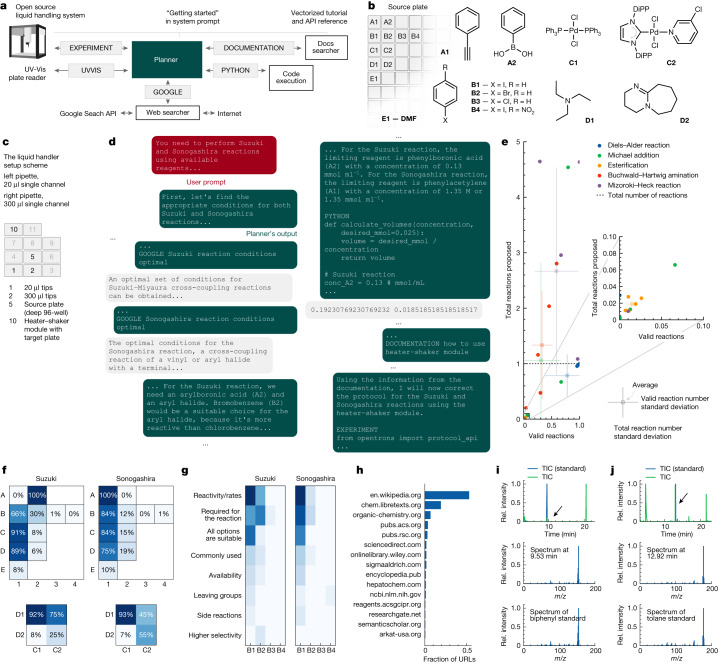
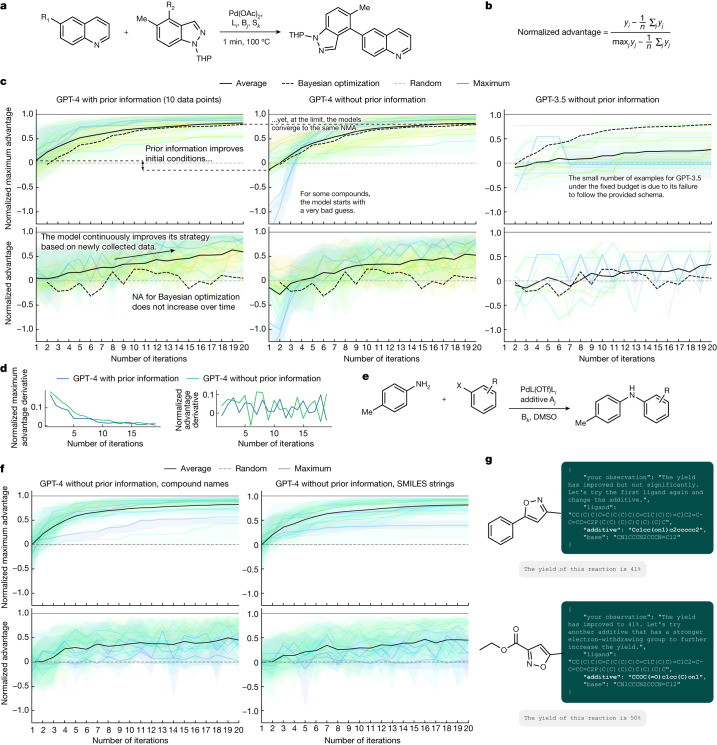
Transformer-based large language models are making significant strides in various fields, such as natural language processing 1–5 , biology 6,7 , chemistry 8–10 and computer programming 11,12 . Here, we show the development and capabilities of Coscientist, an artificial intelligence system driven by GPT-4 that autonomously designs, plans and performs complex experiments by incorporating large language models empowered by tools such as internet and documentation search, code execution and experimental automation. Coscientist showcases its potential for accelerating research across six diverse tasks, including the successful reaction optimization of palladium-catalysed cross-couplings, while exhibiting advanced capabilities for (semi-)autonomous experimental design and execution. Our findings demonstrate the versatility, efficacy and explainability of artificial intelligence systems like Coscientist in advancing research.
Overview
The claims and statistics of this paper haven’t been checked yet.
Free: it reads the open-access text and checks the first 5 claims that cite a source we can check. Create a free account to check every claim.
Integrity signals
Registry
Cites
Statistics
Figures
Verification
Claims the paper makes
The claims and statistics of this paper haven’t been checked yet.
Free: it reads the open-access text and checks the first 5 claims that cite a source we can check. Create a free account to check every claim.
Claims other papers make about this one
Each is checked against this paper’s own text: does it say what the citing paper says it does?
The source backs part of the claim, not all of it — or backs it for a different population, condition or comparison.
In the citing paper
“The broader literature on autonomous scientific systems has already argued for more rigorous evaluation protocols and transparent tool interfaces [3,5,7-12].”
From From Scientific Copilots to Tool-Grounded Autonomy: AI Agents in Simulation-Driven Materials Discovery (2026) · cites this paper as [8]
Experimental — accuracy not yet measuredThe source backs part of the claim, not all of it — or backs it for a different population, condition or comparison.
In the citing paper
“To the best of our knowledge, no prior review has isolated simulation-driven, toolorchestrating AI agent workflows for materials discovery as a distinct evidence base with study-level extraction of autonomy, validation, and reproducibility [3-14].”
From From Scientific Copilots to Tool-Grounded Autonomy: AI Agents in Simulation-Driven Materials Discovery (2026) · cites this paper as [8]
Experimental — accuracy not yet measuredThe source backs part of the claim, not all of it — or backs it for a different population, condition or comparison.
In the citing paper
“In parallel, chemistry-oriented reviews have shown that large language models can move beyond text generation toward tool use, retrieval, planning, code execution, and multi-agent coordination [5-10].”
From From Scientific Copilots to Tool-Grounded Autonomy: AI Agents in Simulation-Driven Materials Discovery (2026) · cites this paper as [8]
Experimental — accuracy not yet measuredThe source backs part of the claim, not all of it — or backs it for a different population, condition or comparison.
In the citing paper
“In scientific discovery, agents dynamically compose and execute hypothesis-testing pipelines spanning simulations, lab protocols, and data analysis [61, 62, 63, 64].”
From Code as Agent Harness (2026) · cites this paper as [62]
Experimental — accuracy not yet measuredThe source backs part of the claim, not all of it — or backs it for a different population, condition or comparison.
In the citing paper
“The central challenge is not only to predict a property, but to manage the sequence of reasoning and action that connects a scientific objective to executable computational or experimental steps [2-10].”
From From Scientific Copilots to Tool-Grounded Autonomy: AI Agents in Simulation-Driven Materials Discovery (2026) · cites this paper as [8]
Experimental — accuracy not yet measured
7 more claims about this paper
Create a free account to see every claim other papers make about this one.
Self-check
Percentages, sums and reported differences re-computed from the paper’s own numbers.
The self-check needs the paper’s full text.
Citations
Cites
Scaling Laws for Neural Language Models
Kaplan, J., McCandlish, S., Henighan, T., Brown, T. B., Chess, B., Child, R., Gray, S., Radford, A., Wu, J., & Amodei, D. (2020) · arXiv · doi:10.48550/arxiv.2001.08361 · Cited by 9,550 · cited 1×
“Extreme scaling of models 13 , as demonstrated by OpenAI, has led to significant breakthroughs in the field 1,14 .”
Evolutionary-scale prediction of atomic level protein structure with a language model
Lin, Z., Akin, H., Rao, R., Hie, B., Zhu, Z., Lu, W., Smetanin, N., Verkuil, R., Kabeli, O., Shmueli, Y., et al. (2022) · doi:10.1101/2022.07.20.500902 · Cited by 5,990 · cited 1×
“These models have been successfully applied to various domains, including natural language 1–5 , biological 6,7 and chemical research 8–10 as well as code generation 11,12 .”
Survey of Hallucination in Natural Language Generation
Ji, Z., Lee, N., Frieske, R., Yu, T., Su, D., Xu, Y., Ishii, E., Bang, Y. J., Madotto, A., & Fung, P. (2023) · ACM Computing Surveys · doi:10.1145/3571730 · Cited by 5,025 · cited 1×
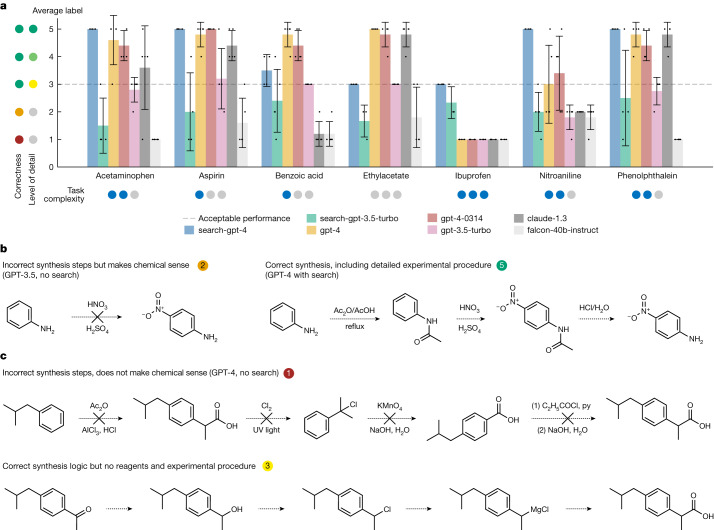
“These results show the importance of grounding LLMs to avoid ‘hallucinations’ 31 .”
Survey of Hallucination in Natural Language Generation
Ji, Z., Lee, N., Frieske, R., Yu, T., Su, D., Xu, Y., Ishii, E., Bang, Y., Chen, D., Dai, W., et al. (2022) · arXiv · doi:10.48550/arxiv.2202.03629 · Cited by 4,981
LLaMA: Open and Efficient Foundation Language Models
Touvron, H., Lavril, T., Izacard, G., Martinet, X., Lachaux, M.-A., Lacroix, T., Rozière, B., Goyal, N., Hambro, E., Azhar, F., et al. (2023) · arXiv · doi:10.48550/arxiv.2302.13971 · Cited by 4,602
Chain-Of-Thought Prompting Elicits Reasoning in Large Language Models
Wei, J., Wang, X., Schuurmans, D., Bosma, M., Ichter, B., Xia, F., Chi, E., Le, Q. V., & Zhou, D. (2022) · Advances in Neural Information Processing Systems 35 · doi:10.52202/068431-1800 · Cited by 4,505
Liu, P., Yuan, W., Fu, J., Jiang, Z., Hayashi, H., & Neubig, G. (2023) · ACM Computing Surveys · doi:10.1145/3560815 · Cited by 4,361 · cited 1×
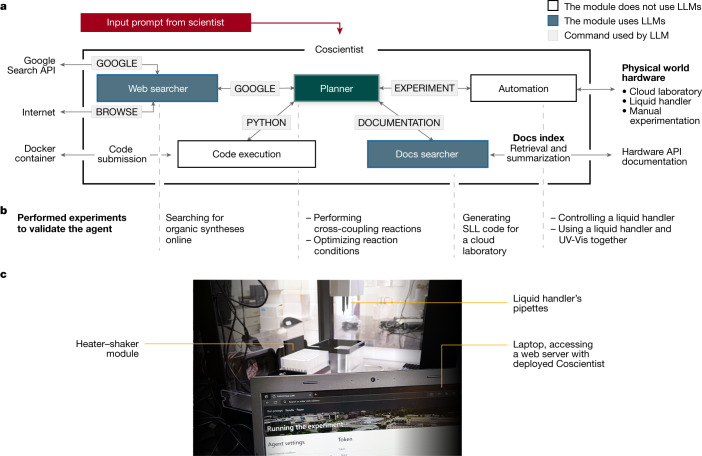
“System prompts (static inputs defining the LLMs’ goals) for the Planner are engineered 1,27 in a modular fashion, described as four commands that define the action space: The PYTHON command allows the Planner to perform calculations to prepare the experiment using a ‘Code execution’ module.”
Liu, P., Yuan, W., Fu, J., Jiang, Z., Hayashi, H., & Neubig, G. (2021) · arXiv · doi:10.48550/arxiv.2107.13586 · Cited by 4,352 · cited 1×
“System prompts (static inputs defining the LLMs’ goals) for the Planner are engineered 1,27 in a modular fashion, described as four commands that define the action space: The PYTHON command allows the Planner to perform calculations to prepare the experiment using a ‘Code execution’ module.”
Chain-of-Thought Prompting Elicits Reasoning in Large Language Models
Wei, J., Wang, X., Schuurmans, D., Bosma, M., Ichter, B., Xia, F., Chi, E., Le, Q., & Zhou, D. (2022) · arXiv · doi:10.48550/arxiv.2201.11903 · Cited by 4,263 · cited 1×
“This can be done through advanced prompting strategies, such as ReAct 34 , Chain of Thought 35 and Tree of Thoughts 36 .”
Billion-scale similarity search with GPUs
Johnson, J., Douze, M., & Jegou, H. (2021) · IEEE Transactions on Big Data · doi:10.1109/tbdata.2019.2921572 · Cited by 4,228
Research works printed but not linked: 3
- Brown, T. et al. in Advances in Neural Information Processing Systems Vol. 33 (eds Larochelle, H. et al.) 1877–1901 (Curran Associates, 2020).
- Data Mining. Mining of Massive Datasets (Cambridge Univ., 2011).
- Running experiments. Emerald Cloud Lab https://www.emeraldcloudlab.com/guides/runningexperiments (2023).
Cited by
Items 1,001–1,047 of 1,047
Park, K., Hwang, E., Choi, Y., & Lee, J. (2026) · Journal of the Society for Information Display · doi:10.1002/jsid.70101
Li, A., Oloughlin, P., Yue, L., Zhang, W. E., Swart, B., & Chen, W. (2026) · Journal of Pathology Informatics · doi:10.1016/j.jpi.2026.100720
Singhania, R., & Chikop, S. A. (2026) · SSRN Electronic Journal · doi:10.2139/ssrn.7459817
Zhao, Y., Song, T., Chen, L., Huang, Y., Sun, K., Han, W., Shen, M., Mao, C., Lan, P., Zhou, M. R., et al. (2026) · Journal of the American Chemical Society · doi:10.1021/jacs.6c13252
Song, P., Wu, J., & Xiao, Y. (2026) · Communications in Mathematical Research · doi:10.4208/cmr.2026-0066
Ma, X., Zheng, Q., Yuan, S., Yang, Z., Zhang, N., & Smith, R. (2026) · Renewable and Sustainable Energy Reviews · doi:10.1016/j.rser.2026.117478
Investigación científica en la era de la inteligencia artificial
Pluas, R. E. M., Fernández-Loor, A. O., Mendizábal, V. L. L., Sánchez-Vivanco, J. P., Urbano, A. P. M., & Angulo, R. M. M. (2026) · doi:10.70577/pd8w9r97
A Roadmap to Make Geoscience Data AI-Ready
Guo, Y.-L., Feng, M., Li, G.-Q., Wang, J.-L., Bai, Y.-Q., Li, L.-L., Ran, Y., Pan, X.-D., & Li, X. (2026) · Information Geography · doi:10.1016/j.infgeo.2026.100061
Kim, Y. L., Yue, T., & Li, Y. (2026) · Digital Discovery · doi:10.1039/d6dd00303f
Noori, A., Fishman, N., Fang, A., Fesser, L., & Žitnik, M. (2026) · Cell · doi:10.1016/j.cell.2026.08.032 · Cited by 6
Mohamed, F. A. A. A., & El-sagheir, A. M. K. (2026) · Medicinal Chemistry Research · doi:10.1007/s00044-026-03616-4 · Cited by 1
Yongco, J. S., Ramayan, A. J. R., DANGDANG, G. O., Bucad, R. G., & Borinaga, N. (2026) · Trends in Food Science & Technology · doi:10.1016/j.tifs.2026.106096
LineShine: online acceleration for HPC-AI converged scientific computing
Lu, Y., Feng, G., & Fu, H. (2026) · Frontiers of Computer Science · doi:10.1007/s11704-026-61591-w · Cited by 2
Li, L., Moses, C., Noh, Y., Hsu, C., Gutierrez, F. C., Ruiz, C., Liu, W., Molina, J. F. M., Fu, K. X., & Chang, H. (2026) · bioRxiv (Cold Spring Harbor Laboratory) · doi:10.64898/2026.09.18.752775
Ping, J., & Liu, Z. (2026) · Journal of Chemical Information and Modeling · doi:10.1021/acs.jcim.6c02058
Generative AI and Neurosymbolic Frameworks in Next-Generation Digital Signal Processing
Mayer, J. (2026) · IntechOpen eBooks · doi:10.5772/intechopen.1017137
Liu, P., Yang, C., Zhu, Y., Zheng, W., Pu, X., Liu, Q., Du, J., & Zhang, L. (2026) · Chinese Journal of Chemical Engineering · doi:10.1016/j.cjche.2026.09.006
Ultra-compact Photonic Encoder for Optoelectronic Fusion Computing
Cheng, W., Ran, C., Deng, C., Zhu, Z., Zhao, L., Mou, X., Wu, J., & Wang, Y. (2026) · ACS Photonics · doi:10.1021/acsphotonics.6c01403
Toward autonomous chemical discovery: agentic AI in organic synthesis and nanochemistry
Babu, B. H., Vutla, P. C., Mahimaluru, J., Chong, B. K. J., & Kambam, S. (2026) · Results in Engineering · doi:10.1016/j.rineng.2026.113180
Physics-Informed Chain-of-Thought Reasoning for Physical Field Prediction
Bai, Y., Bi, X., Feng, Y., Jin, Q., He, B.-G., Sun, Y., & Zhang, Z. (2026) · Lecture notes in computer science · doi:10.1007/978-981-92-5693-8_19
A closed-loop language-model agent for target-specific multi-objective hit-to-lead optimizationPreprint
Cui, W., Tian, L., Qi, X., Wang, H., Wu, H., He, H., Fang, C., & Hu, J. (2026) · bioRxiv (Cold Spring Harbor Laboratory) · doi:10.64898/2026.09.19.752921
Chen, L., Shan, X., Qian, C., Cai, F., Tu, Y., Yu, J., Wang, P., Jin, Z., Cui, Z., Xu, J., et al. (2026) · 中国科学通报:英文版 · doi:10.1016/j.scib.2026.09.077
AI-driven cross-disciplinary idea generation: A multi-agent framework with world café simulation
Chen, J.-Y., & Ning, D.-J. (2026) · Applied Soft Computing · doi:10.1016/j.asoc.2026.116517
Hajal, A. A. (2026) · Journal of Computer-Aided Molecular Design · doi:10.1007/s10822-026-00946-8
“Coscientist demonstrated GPT-4-driven autonomous optimization of palladium-catalyzed cross-coupling reactions on automated experimental hardware [155].”
Advances in the Use of Artificial Intelligence in the Pharmaceutical Industry
Montaña, A. F., Mora, J. A., Martínez, J. J., Pulido, D. F., & Brijaldo, M. H. (2026) · BioMedInformatics · doi:10.3390/biomedinformatics6050083
“Coscientist, built on GPT-4, has autonomously optimized palla-dium-catalyzed cross-coupling reactions, combining internet search, code execution, and laboratory automation [97].”
Tang, D., Li, R., Lei, Z., Mao, Q., Das, R., Zhu, B., Gao, Y., & Qi, R. (2026) · Journal of Materials Informatics · doi:10.20517/jmi.2026.63
Xie, H., Yan, Z., Luo, D., Chen, L., Yu, K., Hui, J., Lookman, T., Rao, Z., Ren, Y., & Zeng, X. (2026) · Progress in Materials Science · doi:10.1016/j.pmatsci.2026.101849
An agentic AI environment to support biomedical research in collaborative academic environmentsPreprint
Wu, T., Browne, T. S., Meawad, M., Emam, H. E., Simsam, N. H., Xia, Y., Jaafar, A., Ma, A., Kabbani, B., Gupta, V., et al. (2026) · bioRxiv (Cold Spring Harbor Laboratory) · doi:10.64898/2026.09.24.753565
Agentic Preparative Thin-Layer Chromatography System for Autonomous Purification
Cai, W., Zhao, B., Yue, Y., Liu, C., Liu, C., Cui, Y., Zhou, Z., Tian, X., Zhang, Z., Yang, Z., et al. (2026) · Journal of the American Chemical Society · doi:10.1021/jacs.6c10800 · Cited by 1
Belmonte-Sánchez, J. R., Romero‐González, R., & Frenich, A. G. (2026) · Analytica Chimica Acta · doi:10.1016/j.aca.2026.346333 · Cited by 1
Jeong, Y., Cho, K.-Y., & Woo, J. H. (2026) · IFIP advances in information and communication technology · doi:10.1007/978-3-032-38614-4_36
Luo, R., Dong, X., Lin, X., He, X., Liu, S., Liu, J., & Wang, G. (2026) · Chemical Engineering Journal · doi:10.1016/j.cej.2026.182582
Artificial Intelligence in the Preparation of Scientific Articles
Aldoshin, S. M., Ananikov, V. P., Beletskaya, I. P., Berlin, A. A., Boinovich, L. B., Bukhtiyarov, V. I., Voshkin, A. A., Gorbunova, Y. G., Григорович, К. В., Dzhemilev, U. M., et al. (2026) · Russian Chemical Reviews · doi:10.59761/rcr5247
Shifting from knowledge retrieval to evidence exploration and synthesis
Shikhare, S., Cohen-Setton, J., & Bulusu, K. C. (2026) · Nature Machine Intelligence · doi:10.1038/s42256-026-01313-w
An Agentic Rest API Framework for Chemical Process Design: Bridging LLM Agents and Aspen Plus
Adi, V. S. K., & Wu, W. (2026) · Asian Control Conference (ASCC) · doi:10.1109/ascc70886.2026.11702255
“…parallel, LLM-based agents have moved into chemistry and chemical engineering more broadly, with autonomous experiment systems such as Coscientist [16], chemistry-tool-augmented agents like ChemCrow [17], autonomous simulation workflows [18], and a recent multi-agent review by Rupprecht et al.…”
De novo molecular design with agentic AI: Integrating tree search and iterative refinement
Lavinia, Y., Ang, D., & Atamian, H. S. (2026) · Intelligent Systems with Applications · doi:10.1016/j.iswa.2026.200737
Shen, L., Chen, Z., Huang, Y., Liu, J., Yuan, J., & Zhuang, S. (2026) · Environmental Science & Technology · doi:10.1021/acs.est.6c10122
Scientific discovery as meta-optimization: a combinatorial optimization case study
Zhang, Y.-H., Sipling, C., & Di Ventra, M. (2026) · arXiv · doi:10.48550/arxiv.2606.26728
“…at scales far exceeding individual researchers, covering the entire loop from generating hypotheses, writing code, designing experiments, to analyzing results and writing academic papers (Lu et al., 2024; Yamada et al., 2025; Gottweis et al., 2025; Boiko et al., 2023; Mitchener et al., 2025).”
Cordon: Semantic Transactions for Tool-Using LLM Agents
Chen, Z., Liu, H., Xu, D., Dong, D., Li, J., Pu, B., & Zhai, J. (2026) · arXiv · doi:10.48550/arxiv.2606.17573
“Equipped with tools, these agents have already delivered substantial productivity gains across software development [44], office and enterprise workflows [18], scientific research [8, 9], and engineering design [29].”
Dead Science Walking: Publication Bias and the AI Scientist Pipeline
Chauhan, K. (2026) · arXiv · doi:10.48550/arxiv.2606.04220
The Last Human-Written Paper: Agent-Native Research Artifacts
Liu, J., Pei, J., Huang, J., Si, C., Qu, A., Tang, X., Lu, R., Chen, L., Bai, X., Zheng, H., et al. (2026) · arXiv · doi:10.48550/arxiv.2604.24658
Agora: Git as Shared Memory for Collective AutoResearch
Zhang, Y., Zou, Y., Zhang, S., Hu, J., Zhang, H., Xu, B., Kautz, J., & Dong, Y. (2026) · arXiv · doi:10.48550/arxiv.2609.18094
SciCoQA: Quality Assurance for Scientific Paper-Code Alignment
Baumgärtner, T., & Gurevych, I. (2026) · arXiv · doi:10.48550/arxiv.2601.12910
Agentic AI Scientists Are Not Built For Autonomous Scientific Discovery
Bisht, H., Kumar, V., Jablonka, K. M., Mausam, & Krishnan, N. M. A. (2026) · arXiv · doi:10.48550/arxiv.2605.08956
Socratic agents for autonomous scientific discovery in high-dimensional physical systems
Zeng, X., Liu, P., Zang, Y., Shen, Y., Yu, F., Yu, C., Liu, M., & Du, Y. (2026) · arXiv · doi:10.48550/arxiv.2606.26722
RSI-Anything: Unlocking Recursive Self-Improvement with World Models
Cui, T., Zeng, P., Xu, W., Xiao, H., Xue, S., Gao, Q., Ouyang, W., Heng, P. A., Yin, Z., Wu, Y., et al. (2026) · arXiv · doi:10.48550/arxiv.2610.13912 · Cited by 2
“In chemistry, language-model tools, yield predictors, Bayesian optimization, and robotic laboratories provide complementary components for selecting and testing reactions [28, 42–46].”
Piao, J., Yan, Y., Zhang, J., Li, N., Yan, J., Lan, X., Lu, Z., Zheng, Z., Wang, J. Y., Zhou, D., et al. (2025) · arXiv · doi:10.48550/arxiv.2502.08691 · Cited by 43
“For example, Boiko et al. [19] construct an agent with large language models to autonomously conduct chemical experiments, by providing computers to browse experimental tutorials and devices controlling interface for the experiments.”
Metadata
- Authors
- Boiko, D. A., MacKnight, R., Kline, B., & Gomes, G.
- Affiliations
- Carnegie Mellon University (US)
- Corresponding author
- Gomes, Gabe
- Venue
- Nature
- Published
- 2023-12-20
- Volume
- 624
- Issue
- 7992
- Pages
- 570-578
- ISSN
- 0028-0836 (ISSN-L)
- 1476-4687
- PMC
- PMC10733136
- OpenAlex
- W4389991792
- Semantic Scholar
- 6fe3779fe5f2e9402abdd08ad8db41a0f13a99eb
- Cited by
- 1,050
- References
- 37
- Citations by year
- 2026: 458 · 2025: 401 · 2024: 186 · 2023: 5
- FWCI
- 77.41
- Type
- journal article
- Language
- en
- Open access
- hybrid
- doi.org
- Licence
- cc-by
- creativecommons.org/licenses/by/4.0 (tdm)
- creativecommons.org/licenses/by/4.0 (vor)
- Locations
- Nature (publishedVersion, cc-by)
- PubMed Central (publishedVersion, cc-by)
- PubMed (publishedVersion)
- RePEc: Research Papers in Economics (submittedVersion)
- Funders
- National Science Foundation (2221346, 2202693)
- Carnegie Mellon University
- Topics
- Physical Sciences › Materials Science › Materials Chemistry › Machine Learning in Materials Science
- Physical Sciences › Computer Science › Artificial Intelligence › Artificial Intelligence Applications
- Life Sciences › Pharmacology, Toxicology and Pharmaceutics › Drug Discovery › Computational Drug Discovery Methods
- Keywords
- large language models, GPT-4, experimental automation, reaction condition optimization, palladium-catalyzed cross-coupling, program execution
- MeSH terms
- Artificial Intelligence, Automation, Catalysis, Documentation, Electric Power Supplies
About these checks
Registry, retraction, Cites and statistics results are computed, not judged, with one exception: a printed reference that no index lists is read once by a model before it counts as a citation error. Claims are extracted by a model and kept only when their quote appears verbatim in the text; each cited source is then checked, with a model’s help, for whether it says what the claim relies on. Those verdicts can be wrong — read the claim’s quote and the cited source before relying on one.
Statistics and arithmetic are recomputed, not judged.
Confidence bands are shown only for fields calibrated on our annotated test set. None is calibrated yet, so no band is shown.
What counts as a claim ›How we measure confidence ›How we check this ›
Are you an author, or do you see a problem with this page? Request a review
Data sources
Bibliographic data: Semantic Scholar, OpenAlex, Crossref.
Contains information from the Semantic Scholar Academic Graph Datasets, made available under the ODC Attribution License (ODC-BY 1.0).
Semantic Scholar’s data is described in: Kinney, R., et al. (2023). The Semantic Scholar Open Data Platform. arXiv:2301.10140.
