

Autonomous chemical research with large language models
Open accessThe DOI matches its Crossref record; 47 of the 47 references it cites were found in a registry or an index.
Abstract
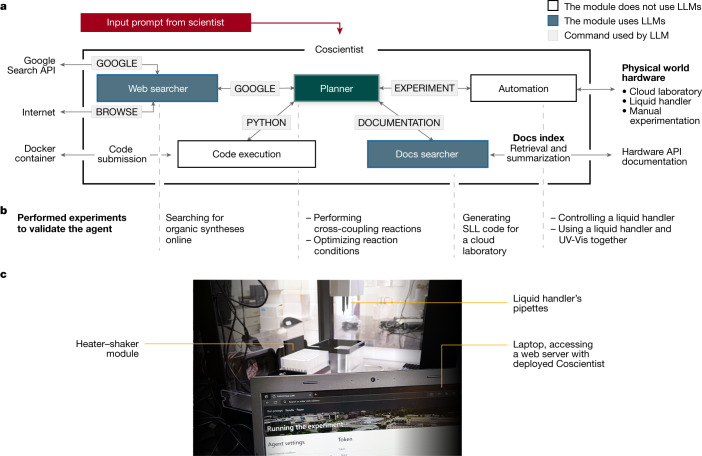
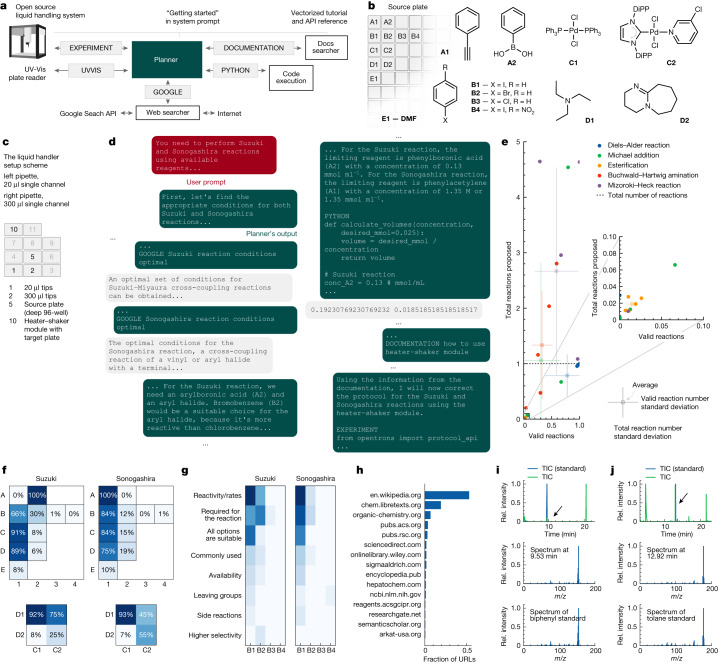
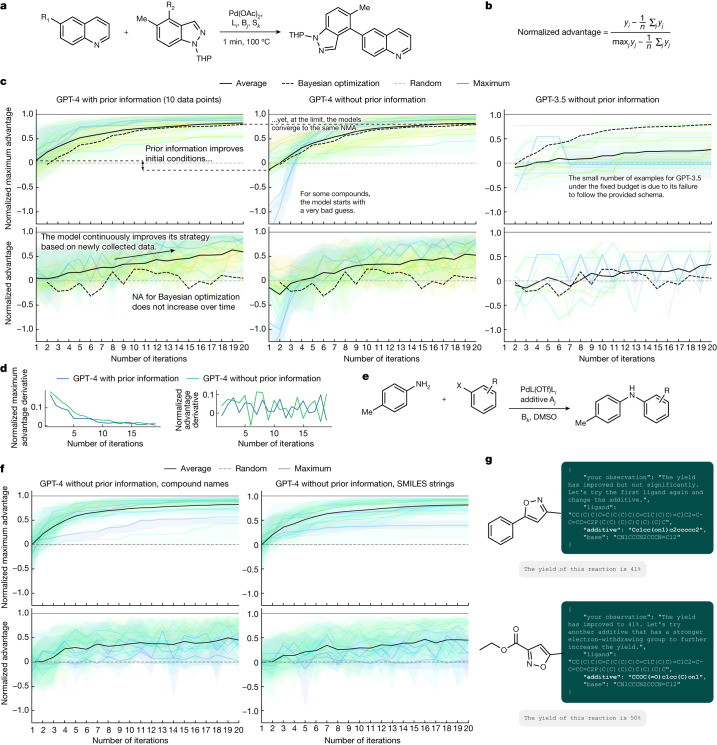
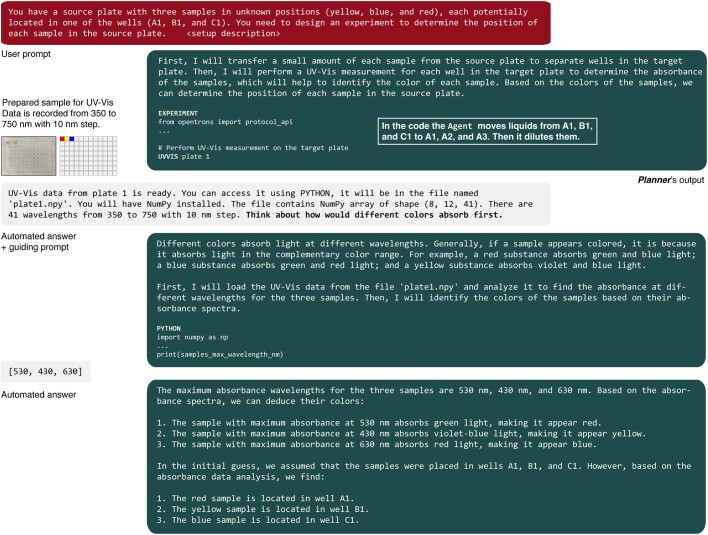
Transformer-based large language models are making significant strides in various fields, such as natural language processing 1–5 , biology 6,7 , chemistry 8–10 and computer programming 11,12 . Here, we show the development and capabilities of Coscientist, an artificial intelligence system driven by GPT-4 that autonomously designs, plans and performs complex experiments by incorporating large language models empowered by tools such as internet and documentation search, code execution and experimental automation. Coscientist showcases its potential for accelerating research across six diverse tasks, including the successful reaction optimization of palladium-catalysed cross-couplings, while exhibiting advanced capabilities for (semi-)autonomous experimental design and execution. Our findings demonstrate the versatility, efficacy and explainability of artificial intelligence systems like Coscientist in advancing research.
Overview
The claims and statistics of this paper haven’t been checked yet.
Free: it reads the open-access text and checks the first 5 claims that cite a source we can check. Create a free account to check every claim.
Integrity signals
Registry
Cites
Statistics
Figures
Verification
Claims the paper makes
The claims and statistics of this paper haven’t been checked yet.
Free: it reads the open-access text and checks the first 5 claims that cite a source we can check. Create a free account to check every claim.
Claims other papers make about this one
Each is checked against this paper’s own text: does it say what the citing paper says it does?
The source backs part of the claim, not all of it — or backs it for a different population, condition or comparison.
In the citing paper
“The broader literature on autonomous scientific systems has already argued for more rigorous evaluation protocols and transparent tool interfaces [3,5,7-12].”
From From Scientific Copilots to Tool-Grounded Autonomy: AI Agents in Simulation-Driven Materials Discovery (2026) · cites this paper as [8]
Experimental — accuracy not yet measuredThe source backs part of the claim, not all of it — or backs it for a different population, condition or comparison.
In the citing paper
“To the best of our knowledge, no prior review has isolated simulation-driven, toolorchestrating AI agent workflows for materials discovery as a distinct evidence base with study-level extraction of autonomy, validation, and reproducibility [3-14].”
From From Scientific Copilots to Tool-Grounded Autonomy: AI Agents in Simulation-Driven Materials Discovery (2026) · cites this paper as [8]
Experimental — accuracy not yet measuredThe source backs part of the claim, not all of it — or backs it for a different population, condition or comparison.
In the citing paper
“In parallel, chemistry-oriented reviews have shown that large language models can move beyond text generation toward tool use, retrieval, planning, code execution, and multi-agent coordination [5-10].”
From From Scientific Copilots to Tool-Grounded Autonomy: AI Agents in Simulation-Driven Materials Discovery (2026) · cites this paper as [8]
Experimental — accuracy not yet measuredThe source backs part of the claim, not all of it — or backs it for a different population, condition or comparison.
In the citing paper
“In scientific discovery, agents dynamically compose and execute hypothesis-testing pipelines spanning simulations, lab protocols, and data analysis [61, 62, 63, 64].”
From Code as Agent Harness (2026) · cites this paper as [62]
Experimental — accuracy not yet measuredThe source backs part of the claim, not all of it — or backs it for a different population, condition or comparison.
In the citing paper
“The central challenge is not only to predict a property, but to manage the sequence of reasoning and action that connects a scientific objective to executable computational or experimental steps [2-10].”
From From Scientific Copilots to Tool-Grounded Autonomy: AI Agents in Simulation-Driven Materials Discovery (2026) · cites this paper as [8]
Experimental — accuracy not yet measured
7 more claims about this paper
Create a free account to see every claim other papers make about this one.
Self-check
Percentages, sums and reported differences re-computed from the paper’s own numbers.
The self-check needs the paper’s full text.
Citations
Cites
Scaling Laws for Neural Language Models
Kaplan, J., McCandlish, S., Henighan, T., Brown, T. B., Chess, B., Child, R., Gray, S., Radford, A., Wu, J., & Amodei, D. (2020) · arXiv · doi:10.48550/arxiv.2001.08361 · Cited by 9,550 · cited 1×
“Extreme scaling of models 13 , as demonstrated by OpenAI, has led to significant breakthroughs in the field 1,14 .”
Evolutionary-scale prediction of atomic level protein structure with a language model
Lin, Z., Akin, H., Rao, R., Hie, B., Zhu, Z., Lu, W., Smetanin, N., Verkuil, R., Kabeli, O., Shmueli, Y., et al. (2022) · doi:10.1101/2022.07.20.500902 · Cited by 5,990 · cited 1×
“These models have been successfully applied to various domains, including natural language 1–5 , biological 6,7 and chemical research 8–10 as well as code generation 11,12 .”
Survey of Hallucination in Natural Language Generation
Ji, Z., Lee, N., Frieske, R., Yu, T., Su, D., Xu, Y., Ishii, E., Bang, Y. J., Madotto, A., & Fung, P. (2023) · ACM Computing Surveys · doi:10.1145/3571730 · Cited by 5,025 · cited 1×
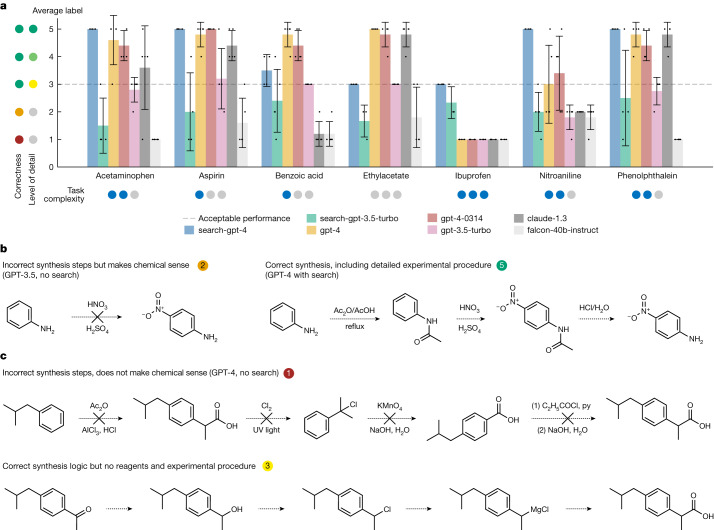
“These results show the importance of grounding LLMs to avoid ‘hallucinations’ 31 .”
Survey of Hallucination in Natural Language Generation
Ji, Z., Lee, N., Frieske, R., Yu, T., Su, D., Xu, Y., Ishii, E., Bang, Y., Chen, D., Dai, W., et al. (2022) · arXiv · doi:10.48550/arxiv.2202.03629 · Cited by 4,981
LLaMA: Open and Efficient Foundation Language Models
Touvron, H., Lavril, T., Izacard, G., Martinet, X., Lachaux, M.-A., Lacroix, T., Rozière, B., Goyal, N., Hambro, E., Azhar, F., et al. (2023) · arXiv · doi:10.48550/arxiv.2302.13971 · Cited by 4,602
Chain-Of-Thought Prompting Elicits Reasoning in Large Language Models
Wei, J., Wang, X., Schuurmans, D., Bosma, M., Ichter, B., Xia, F., Chi, E., Le, Q. V., & Zhou, D. (2022) · Advances in Neural Information Processing Systems 35 · doi:10.52202/068431-1800 · Cited by 4,505
Liu, P., Yuan, W., Fu, J., Jiang, Z., Hayashi, H., & Neubig, G. (2023) · ACM Computing Surveys · doi:10.1145/3560815 · Cited by 4,361 · cited 1×
“System prompts (static inputs defining the LLMs’ goals) for the Planner are engineered 1,27 in a modular fashion, described as four commands that define the action space: The PYTHON command allows the Planner to perform calculations to prepare the experiment using a ‘Code execution’ module.”
Liu, P., Yuan, W., Fu, J., Jiang, Z., Hayashi, H., & Neubig, G. (2021) · arXiv · doi:10.48550/arxiv.2107.13586 · Cited by 4,352 · cited 1×
“System prompts (static inputs defining the LLMs’ goals) for the Planner are engineered 1,27 in a modular fashion, described as four commands that define the action space: The PYTHON command allows the Planner to perform calculations to prepare the experiment using a ‘Code execution’ module.”
Chain-of-Thought Prompting Elicits Reasoning in Large Language Models
Wei, J., Wang, X., Schuurmans, D., Bosma, M., Ichter, B., Xia, F., Chi, E., Le, Q., & Zhou, D. (2022) · arXiv · doi:10.48550/arxiv.2201.11903 · Cited by 4,263 · cited 1×
“This can be done through advanced prompting strategies, such as ReAct 34 , Chain of Thought 35 and Tree of Thoughts 36 .”
Billion-scale similarity search with GPUs
Johnson, J., Douze, M., & Jegou, H. (2021) · IEEE Transactions on Big Data · doi:10.1109/tbdata.2019.2921572 · Cited by 4,228
Research works printed but not linked: 3
- Brown, T. et al. in Advances in Neural Information Processing Systems Vol. 33 (eds Larochelle, H. et al.) 1877–1901 (Curran Associates, 2020).
- Data Mining. Mining of Massive Datasets (Cambridge Univ., 2011).
- Running experiments. Emerald Cloud Lab https://www.emeraldcloudlab.com/guides/runningexperiments (2023).
Cited by
Items 401–500 of 1,047
LLM-Driven Synthesis Planning for Quantum Dot Materials Development
Choi, S. E., Jang, M., Yoon, S., Yoo, S., Ahn, J., Kim, M., Kim, H.-G., Jung, Y., Park, S. S., Kim, Y. C., et al. (2025) · Journal of Chemical Information and Modeling · doi:10.1021/acs.jcim.4c01529 · Cited by 12
Autonomous Self‐Evolving Research on Biomedical Data: The DREAM Paradigm
Deng, L., Wu, Y., Ren, Y., & Lu, H. J. (2025) · Advanced Science · doi:10.1002/advs.202417066 · Cited by 14
Cui, C., Chamasemani, F. F., Reisinger, M., Imrich, P. J., Hartner, W., Robl, W. K., & Brunner, R. (2025) · npj Materials Degradation · doi:10.1038/s41529-025-00603-9 · Cited by 9
GeoFactory: an LLM performance enhancement framework for geoscience factual and inferential tasks
Chen, Z., Wang, X., Zhang, X., Lin, M., Liao, Y., Li, J., & Bai, Y. (2025) · Big Earth Data · doi:10.1080/20964471.2025.2506291 · Cited by 11
“We evaluated two representative agent algorithms, Search Engine and Self-Refine.”
InfluentialApplication of generative artificial intelligence in catalysis
Zhang, T., Cheng, H., Nian, Y., Zhang, J., Li, Q., & Han, Y. (2025) · Chinese Journal of Chemical Engineering · doi:10.1016/j.cjche.2025.05.013 · Cited by 7
CST-LLM: Enhancing airfoil parameterization method with large language model
zheng, K., Wang, Y., Liu, F., Zhang, Q., & Song, W. (2025) · Aerospace Science and Technology · doi:10.1016/j.ast.2025.110548 · Cited by 12
Advancing battery research through large language models: A review
Chen, J., Wang, Y., Guo, D., Liu, Z., Wang, Y. D., Li, S., Xu, W., Qian, L., Shen, Y., Sun, T., et al. (2025) · The Innovation · doi:10.1016/j.xinn.2025.101091 · Cited by 20
Advancing Organic Chemistry Using High‐Throughput Experimentation
Nsouli, R., Galiyan, G., & Ackerman, L. K. G. (2025) · Angewandte Chemie · doi:10.1002/ange.202506588 · Cited by 7
Autonomous Droplet Microfluidic Design Framework with Large Language Models
Nguyen, D.-N., Tong, R. K., & Dinh, N. (2025) · ACS Omega · doi:10.1021/acsomega.5c06253 · Cited by 9
Machine learning anomaly detection of automated HPLC experiments in the cloud laboratory
Gusev, F., Kline, B. C., Quinn, R., Xu, A., Smith, B., Frezza, B., & Isayev, O. (2025) · Digital Discovery · doi:10.1039/d5dd00253b · Cited by 10
Self-citationMulti agent large language models for biomedical hypothesis generation in drug combination discovery
Xu, Q., Soto, C. A., Shahnawaz, M., Liu, X., Jiang, X., & Kim, Y. (2025) · iScience · doi:10.1016/j.isci.2025.113984 · Cited by 14
A VLM-Based Method for Visual Anomaly Detection in Robotic Scientific Laboratories
Lin, S., Wang, C., Ding, X., Wang, Y., Du, B., Song, L., Wang, C., & Liu, H. (2025) · International Conference on Advanced Robotics and Mechatronics (ICARM) · doi:10.1109/icarm65671.2025.11293532 · Cited by 16
“Most existing experimental designs in scientific laboratories focus on workflow planning and schedule optimization, while paying limited attention to potential anomalies that may arise during the experimental process [4]–[6].”
Zhu, Y., Shu, X., Liu, X., Li, Y., Yi, B., & Ma, D. (2025) · Anesthesiology and Perioperative Science · doi:10.1007/s44254-025-00156-9 · Cited by 9
“Boiko et al. [46] reported the development and capabilities of Coscientist, an AI sys-tem driven by GPT-4 that autonomously designs, plans, and performs complex experiments by integrating tools like internet and documentation search, code execution, and experimental automation.”
Deng, H., & Yang, L.-M. (2026) · Matter · doi:10.1016/j.matt.2025.102487 · Cited by 10
General scales unlock AI evaluation with explanatory and predictive power
Zhou, L., Pacchiardi, L., Martínez‐Plumed, F., Collins, K. M., Moros-Daval, Y., Zhang, S., Zhao, Q., Huang, Y., Sun, L., Prunty, J. E., et al. (2026) · Nature · doi:10.1038/s41586-026-10303-2 · Cited by 45
“Ensuring safe and effective use of artificial intelligence (AI) requires understanding and anticipating its performance on new tasks, from advanced scientific challenges to transformed workplace activities 1–3 .”
Artificial Intelligence for Materials Science: Transforming Research Paradigms
Li, Y., Wang, S., Wang, J., Liu, Q., & Zhang, J. (2026) · Chemical Reviews · doi:10.1021/acs.chemrev.6c00012 · Cited by 14
AutoLabs: cognitive multi-agent systems with self-correction for autonomous chemical experimentation
Panapitiya, G., Saldanha, E., Job, H., & Hess, O. (2026) · Scientific Reports · doi:10.1038/s41598-026-45593-z · Cited by 44
The past, present and future of self-driving laboratories
Canty, R. B., & Abolhasani, M. (2026) · Nature Reviews Chemistry · doi:10.1038/s41570-026-00847-2 · Cited by 27
“Such superintelligence is not reducible to automation or prediction; rather, it emerges from networks of interoperable SDLs producing”
Closing the Execution Gap in Generative AI for Chemicals and Materials: Freeways or Safeguards
Subramanian, A., Gao, W., Barzilay, R., Grossman, J. C., Jaakkola, T., Jegelka, S., Li, M., Li, J., Matusik, W., Olivetti, E., et al. (2024) · An MIT Exploration of Generative AI · doi:10.21428/e4baedd9.92e511e3 · Cited by 9
Fabrication of pristine 2D heterostructures for scanning probe microscopy
McKenzie, J., Sharma, N., & Liu, X. (2024) · APL Materials · doi:10.1063/5.0213542 · Cited by 11
Zheng, Z., Florit, F., Jin, B., Wu, H., Li, S., Nandiwale, K. Y., Salazar, C. A., Mustakis, J. G., Green, W. H., & Jensen, K. F. (2024) · Angewandte Chemie · doi:10.1002/ange.202418074 · Cited by 9
This GPT-powered robot chemist designs reactions and makes drugs — on its own
Sanderson, K. (2023) · Nature · doi:10.1038/d41586-023-04073-4 · Cited by 7
A multi-agent-driven robotic AI chemist enabling autonomous chemical research on demandPreprint
Song, T., Luo, M., Chen, L., Huang, Y. H., Zhu, Q. J., Liu, D., Zhang, B., Zou, G., Zhang, F., Shang, W., et al. (2024) · ChemRxiv · doi:10.26434/chemrxiv-2024-w953h-v2 · Cited by 10
Agentic Lab: An Agentic-physical AI system for cell and organoid experimentation and manufacturingPreprint
Wang, W., Swain, S., Lee, J., Lin, Z., Canales, B., Aljović, A., Liu, Y., Li, Q., Marin‐Llobet, A., Liu, M., et al. (2025) · bioRxiv (Cold Spring Harbor Laboratory) · doi:10.1101/2025.11.11.686354 · Cited by 13
Chiu, H.-H., Varghese, A., Shao, K., Lu, Y.-C., Nahar, R., Chen, H., Deng, Q., Bao, X., & Li, C. (2024) · doi:10.1101/2024.10.01.616063 · Cited by 6
“Coscientist 11 , a recent AI copilot for chemical research powered by the OpenAI GPT-4 model, can autonomously design, plan and perform complex experiments.”
Chen, Z., Chen, S., Ning, Y., Zhang, Q., Wang, B., Yu, B., Li, Y., Liao, Z., Wei, C., Lu, Z., et al. (2024) · arXiv · doi:10.48550/arxiv.2410.05080 · Cited by 7
WiseEDA: LLMs in RF Circuit Design
Jin, H., Wang, J., Sheng, J., Wu, Y., Chen, J., Wang, Y., & Liu, J. (2025) · Microelectronics Journal · doi:10.1016/j.mejo.2025.106607 · Cited by 11
Cutting-edge AI tools revolutionizing scientific research in life sciences
Lorenc-Kukuła, K. (2025) · Biotechnologia · doi:10.5114/bta/200803 · Cited by 14
“This system was capable of searching through documents, writing code, and operating robotic lab devices (Boiko et al., 2023).”
Data efficient molecular image representation learning using foundation models
Harnik, Y., Peleg, H. S., Bermano, A. H., & Milo, A. (2025) · Chemical Science · doi:10.1039/d5sc00907c · Cited by 15
Hu, L., Zhou, Z., & Jia, G. (2025) · Separation and Purification Technology · doi:10.1016/j.seppur.2025.133487 · Cited by 9
Gemadzie, G., McPike, P., & Boika, A. (2025) · Current Opinion in Electrochemistry · doi:10.1016/j.coelec.2025.101724 · Cited by 8
Lessons from the Failure of Canada’s Artificial Intelligence and Data Act
Ishaque, A. H., Aidid, A., & Zadeh, G. (2025) · NEJM AI · doi:10.1056/aipc2500153 · Cited by 6
Integrated Biomarker Separation and Detection with Carbon Nanotubes: Advances and Prospects
Liu, Y., Zhang, J., Chen, X., Ren, L., & Wang, M. (2025) · Small Methods · doi:10.1002/smtd.202500117 · Cited by 6
Human Analysis vs. Artificial Intelligence: Analyzing of Qualitative Medical Students’ Narratives
Misgav, K., Neufeld‐Kroszynski, G., Palombo, M., & Karnieli‐Miller, O. (2025) · Qualitative Health Research · doi:10.1177/10497323251359445 · Cited by 12
“However, data are limited about its use and usefulness in research in general (Boiko et al., 2023; Demszky et al., 2023; Hitch, 2024; Jalali & Akhavan, 2024; Xin et al., 2024), and more studies exploring LLMs ’ ability to quickly, ef fi ciently, and accurately analyze written re-fl ective narratives…”
Liu, C., Chen, W.-Y., Xu, H., Du, Y., Yang, J. T., & Du, L. (2025) · International Symposium of Electronics Design Automation (ISEDA) · doi:10.1109/iseda65950.2025.11101698 · Cited by 8
“Many studies [12] have carried out the use of LLM as an agent to make decisions on various tasks, and it has accomplished tasks in fields such as autonomous driving [13], video games [14], and even Nobel-Prize-level chemical experiments [15] outstandingly.”
Yu, W., Zhou, Z., Yang, Y., Li, X., Lu, Z., Liu, Y., Ren, J., & Liu, Y. (2025) · Journal of environmental chemical engineering · doi:10.1016/j.jece.2025.118936 · Cited by 9
Nguyen, D.-N., Tong, R. K., & Dinh, N. (2025) · Digital Discovery · doi:10.1039/d5dd00306g · Cited by 12
The agentic age of predictive chemical kinetics
Dana, A. G. (2026) · Chemical Science · doi:10.1039/d5sc07692g · Cited by 10
Beyond evolution: De novo designed protein toolkit rewriting the rules of synthetic biology
Zhang, G., Liu, C., Li, W., Lu, J., Li, A., & Zhu, L. (2025) · Biosafety and Health · doi:10.1016/j.bsheal.2025.09.004 · Cited by 7
A conversational multi-agent AI system for automated plant phenotyping
Chen, F., Stogiannidis, I., Wood, A., Bueno, D., Williams, D., Macfarlane, F., Grieve, B., Wells, D. M., Atkinson, J. A., Hawkesford, M. J., et al. (2026) · Nature Communications · doi:10.1038/s41467-026-71090-y · Cited by 19
“Recently, LLM-based agent systems have successfully been applied across different scienti fi c domains, including chemistry 15,16 , material sciences 17,18 , biology 19,20 and healthcare 21 – 23 .”
Application and Prospects of Large Language Models in Small-Molecule Drug Discovery
Ma, J., Liu, J., Xu, D., Song, X., & Zhang, Z. (2025) · Analytical Chemistry · doi:10.1021/acs.analchem.5c04083 · Cited by 11
Guidelines needed for the use of AI in the preparation or review of IRB, IBC, and IACUC applications
Hosseini, M., Eisenman, D., Riddle, J., Pyle, S., Peters, A., Cobb, N. L., & Holmes, K. (2026) · Accountability in Research · doi:10.1080/08989621.2025.2612564 · Cited by 5
“Similarly, Coscientist, is an AI system powered by LLMs that can autonomously design, plan and perform certain experiments (Boiko et al. 2023).”
Design of superhydrophobic anti-icing coatings guided by full-process machine learning
Zhang, Z., Liu, Y., Chen, S., Liu, L., Liu, J., Hu, T., Xiao, T., Jiang, L., Li, X., Li, X., et al. (2026) · Surface and Coatings Technology · doi:10.1016/j.surfcoat.2026.133235 · Cited by 6
AI for atmosphere–ocean sciences: advancements, challenges and ways forward
Luo, J., Xia, J., Pan, B., Ham, Y.-G., Li, X., Shangguan, W., Xue, W., Wang, Y., Mu, B., Hong, Y., et al. (2026) · National Science Review · doi:10.1093/nsr/nwag063 · Cited by 25
“In life sciences, general-purpose biomedical agents and virtual laboratories of AI systems are designing experiments, proposing hypotheses and even discovering novel therapeutics such as nanobodies [276 ,277 ].”
Chen, Y., Guo, X., & Xue, W. (2026) · Drug Discovery Today · doi:10.1016/j.drudis.2026.104634 · Cited by 8
Data‐driven discovery of mechanistic ecosystem models with LLMs
Spillias, S., Rogers, J. G. D., Boschetti, F., Fulton, E. A., Guglielmo, M., Yong, S. Y., & Trebilco, R. (2026) · Methods in Ecology and Evolution · doi:10.1111/2041-210x.70244 · Cited by 13
“Recent demonstrations of LLMs automating scientific processes, from autonomous chemical experimenta - tion (Boiko et al., 2023) to biomedical research (Wang et al., 2024), evidence synthesis (Spillias et al., 2025) and even fully automated scientific discovery (Kramer et al., 2023 ), highlight…”
Artificial Intelligence-Driven Wearable Sensors for Cardiovascular Health Monitoring
Deng, H. T., Ma, B., Chen, G., Chi, J., Tong, J., Yu, F., Lü, B., Chen, Y., Zhao, C., Zhang, C., et al. (2026) · ACS Sensors · doi:10.1021/acssensors.5c04840 · Cited by 8
Qi, T., & Zhou, J. (2026) · Molecules · doi:10.3390/molecules31142408 · Cited by 9
Ye, X., Zhai, W., Du, J., Zandt, S. V., & Ye, Y. (2024) · Frontiers of Urban and Rural Planning · doi:10.1007/s44243-024-00046-x · Cited by 6
“Further, when planning experimental procedures and methodologies, ChatGPT stands out as a supportive co-scientist (Boiko et al., 2023).”
Castañeda, R., Martínez-Gomez-Aldaraví, A., Mercadé, L., Gómez, V. J., Mengual, T., Díaz-Fernández, F. J., Lozano, M. S., Navarro‐Arenas, J., Barreda, A. I., Gómez-Gómez, M., et al. (2024) · Knowledge · doi:10.3390/knowledge4040031 · Cited by 12
“Today, AI can be applied not only to process information and make decisions (in fields such as weather forecasting [41] or chemistry [42,43], among many others), but also to generate original text, images and video content, and even if AI has already overcome human performance on several benchmarks…”
Nandy, A. (2025) · Journal of Catalysis · doi:10.1016/j.jcat.2025.116174 · Cited by 7
Considering the ethics of large machine learning models in the chemical sciences
Spotte-Smith, E. W. C. (2025) · Machine Learning: Science and Technology · doi:10.1088/2632-2153/adec3c · Cited by 6
Chiu, H.-H., Varghese, A., Shao, K., Lu, Y., Nahar, R., Chen, H., Deng, Q., Bao, X., & Li, C. (2026) · AIChE Journal · doi:10.1002/aic.70285 · Cited by 15
Are large language models superhuman chemists?
(2025) · Nature Chemistry · doi:10.1038/s41557-025-01865-1 · Cited by 6
“However, despite the growing adoption of LLMs in chemistry for tasks ranging from property predictions to autonomous experimentation 2,3 , there exists limited systematic under standing of their actual chemical compe tencies.”
Reinforcement Learning for Optimized Information Retrieval in LLaMAPreprint
Tu, C.-H., Hsu, H.-J., & Chen, S.-W. (2024) · Research Square · doi:10.21203/rs.3.rs-3847100/v1 · Cited by 62
An autonomous AI agent for universal behavior analysisPreprint
Aljović, A., Lin, Z., Wang, W., Zhang, X., Marin‐Llobet, A., Liang, N., Canales, B., Lee, J., Baek, J., Liu, R., et al. (2025) · bioRxiv (Cold Spring Harbor Laboratory) · doi:10.1101/2025.05.15.653585 · Cited by 8
“These capacities have already enabled breakthroughs in fields such as neural computation 21 , spatial biology 22 , and chemistry 23 , highlighting their potentials for facilitating scientific discovery 24 .”
Bobier, C. A., Hurst, D. J., & Obeid, J. (2025) · Journal of Medical Ethics · doi:10.1136/jme-2025-110750 · Cited by 5
“15 This is concerning for at least three reasons: first, it can be used by others for nefarious ends—anyone or any organisation can use it to cause significant suffering and death for any number of potential malicious reasons (eg, terrorists wanting to make a political statement); second, it may…”
Zhong, L., Xu, Y., Li, X., Cheng, P., & Tao, S. (2025) · Science China Chemistry · doi:10.1007/s11426-025-2676-x · Cited by 8
Design of CO 2 -philic molecular units with large language models
Vogiatzis, K. D. (2025) · Chemical Communications · doi:10.1039/d5cc02652k · Cited by 5
Xu, W., Wang, H., Li, F., Zhong, L., Yang, W., Jiang, W., Tao, S., & Zhang, L. (2025) · Journal of Chemical Education · doi:10.1021/acs.jchemed.4c01072 · Cited by 5
De Novo Design of Polyimides Leveraging Deep Reinforcement Learning Agent
Xu, Y., Feng, W., Gao, L., Wang, L., Lin, J., Ye, X., Liang, L., & Du, L. (2025) · Advanced Materials · doi:10.1002/adma.202511099 · Cited by 11
From Data‐Driven to Intelligence‐Driven: Innovating Research Paradigms of Perovskite Solar Cells
Li, A., & Yi, C. (2025) · Solar RRL · doi:10.1002/solr.202500681 · Cited by 7
“Moreover, multi-LLM systems have already become a reality, capable of handling complex multimodal tasks in parallel [161, 162].”
Toward autonomous discovery: agentic AI and the future of ophthalmic research
Soetikno, B. T., Nielsen, C. S., Pollreisz, A., & Ting, D. S. W. (2025) · Current Opinion in Ophthalmology · doi:10.1097/icu.0000000000001179 · Cited by 5
AI agents for photonic integrated circuit design automation
Sharma, A., Fu, Y., Ansari, V., Iyer, R., Kuang, F., Mistry, K., Aishy, R. I., Ahmad, S., Matres, J., Englund, D. R., et al. (2025) · APL Machine Learning · doi:10.1063/5.0300741 · Cited by 21
Li, C., Ran, N., & Liu, J. (2026) · Journal of Materials Informatics · doi:10.20517/jmi.2025.87 · Cited by 9
Large Language Model Agent for Modular Task Execution in Drug Discovery
Ock, J., Meda, R. S., Badrinarayanan, S., Aluru, N. S., Chandrasekhar, A., & Barati Farimani, A. (2026) · Journal of Chemical Information and Modeling · doi:10.1021/acs.jcim.5c02454 · Cited by 5
“When augmented with external tools, such as domain-specific plugins, APIs, and software libraries, LLM-based agents can overcome the limitations of general-purpose language models and act as interpretable, flexible controllers of scientific workflows.”
Li, Y., Tolosa, L. I., Echeverría, F. I. R., & Márquez, R. (2026) · Journal of Chemical Education · doi:10.1021/acs.jchemed.5c00819 · Cited by 8
Tong, C., Liu, Q., Wang, H., & Yao, M. (2026) · Environmental Science Nano · doi:10.1039/d5en00610d · Cited by 6
Can we automate scientific reasoning in closed-loop experiments using large language models?
Cisse, A., Cooper, M., Zhu, M., Evangelopoulos, X., & Cooper, A. I. (2026) · Digital Discovery · doi:10.1039/d5dd00520e · Cited by 23
Agentic Robotic Boxes for Perovskite Solar Cell Fabrication with Recipe Language Model
Chen, Z., Yu, W., Wu, C., Chen, F., Wang, Z., Zhou, C., You, Y., Li, S., Zhu, Q., Ma, N., et al. (2026) · Engineering · doi:10.1016/j.eng.2026.04.002 · Cited by 8
Bratovčić, A., & Tomašić, V. (2026) · Processes · doi:10.3390/pr14121866 · Cited by 13
The Virtual Biotech: A multi-agent AI framework for therapeutic discovery and development
Zhang, H. G., Eckmann, P., Miao, J., Mahon, A. B., & Zou, J. (2026) · Science · doi:10.1126/science.aeg6779 · Cited by 6
Large language models direct automated chemistry laboratory
Dias, A. L., & Rodrigues, T. (2023) · Nature · doi:10.1038/d41586-023-03790-0 · Cited by 5
Modern Automation in Organic Synthesis Laboratories
Miéville, P., & de Nanteuil, F. (2024) · Elsevier eBooks · doi:10.1016/b978-0-323-96025-0.00047-8 · Cited by 6
Efficient Exploratory Synthesis of Quaternary Cesium Chlorides Guided by In Silico Predictions
MIURA, A. B., Aykol, M., Kozaki, S., Moriyoshi, C., Kobayashi, S., Kawaguchi, S., Lee, C., Wang, Y., Merchant, A., Batzner, S., et al. (2024) · Journal of the American Chemical Society · doi:10.1021/jacs.4c10294 · Cited by 7
He, S., Du, W., Peng, X., & Li, X. (2024) · Chemical Engineering Science · doi:10.1016/j.ces.2024.120916 · Cited by 10
Multi-hierarchical error-aware contrastive learning for event argument extraction
He, S., Du, W., Peng, X., Wei, Z., & Li, X. (2024) · Knowledge-Based Systems · doi:10.1016/j.knosys.2024.112889 · Cited by 7
Neural network emulator for atmospheric chemical ODE
Liu, Z.-S., Clusius, P. S., & Boy, M. H. (2025) · Neural Networks · doi:10.1016/j.neunet.2024.107106 · Cited by 7
Mudd, A., Conroy, T., Voldbjerg, S. L., Goldschmied, A. Z., Feo, R., & Schuwirth, L. (2025) · Journal of Clinical Nursing · doi:10.1111/jocn.17818 · Cited by 11
Automated extraction of materials system charts using a large language model framework
Liu, Q., Polak, M. P., Shuvo, M. A. A., Deodhar, H. S., Han, J., Morgan, D. D., & Oh, H. (2025) · Scripta Materialia · doi:10.1016/j.scriptamat.2025.116815 · Cited by 7
Cross-lingual effects of AI-generated content on human work
Koo, W. W.-Y. (2025) · Scientific Reports · doi:10.1038/s41598-025-16650-w · Cited by 16
Dogan, D., Hecker, B., Hou, X., Dessel, I., Müller, A., Wasserschaff, G., Kocher, S., Karyofylli, V., Kungl, H., Tempel, H., et al. (2024) · Electrochemical Science Advances · doi:10.1002/elsa.202400015 · Cited by 5
Photonic Systolic Array for All‐Optical Matrix–Matrix Multiplication
Kim, J., Zhou, Q., & Yu, Z. (2025) · Laser & Photonics Review · doi:10.1002/lpor.202501995 · Cited by 6
“With the recent rise of large language models [1–3] for generative artificial intelligence, which rely on the attention mechanism involving extensive matrix–matrix multiplication (MMM) operations [4], there has been an increasing demand for energy-efficient and highly parallelized computing…”
Combining knowledge graphs and LLMs for hazardous chemical information management and reuse
Silveira, M. D., Deladiennée, L., Acem, K., & Freudenthal, O. (2024) · IEEE International Conference on Bioinformatics and Biomedicine (BIBM) · doi:10.1109/bibm62325.2024.10821991 · Cited by 5
“Approaches such as ChemCrow and Coscientist [22], [23] combine LLMs with domain tools to augment it capacity of observing and/or acting in the real world for accomplishing tasks that are out of reach of a LLM alone.”
The rise of agents: Computational chemistry is ready for (R)evolution
Aspuru‐Guzik, A., & Bernales, V. (2025) · Polyhedron · doi:10.1016/j.poly.2025.117707 · Cited by 10
Co-intelligent Design of Catalysis Research with Large Language Models: Hype or Reality?
Balcells, D. (2025) · ACS Catalysis · doi:10.1021/acscatal.5c04238 · Cited by 7
A Review of LLM Agent Applications in Finance and BankingPreprint
Batra, D., Hamill, C. B., Hartley, J., Okhrati, R., Seddon, D., Miller, H., Khraishi, R., & Cowan, G. (2025) · SSRN Electronic Journal · doi:10.2139/ssrn.5381584 · Cited by 15
AI agents can coordinate beyond human scale
De Marzo, G., Castellano, C., & Garcia, D. (2024) · arXiv · doi:10.48550/arxiv.2409.02822 · Cited by 4
“Large Language Models (LLMs) have proven individual capabilities for a wide range of applications, such as summarization [13], sentiment analysis [32, 3], scientific research [7] or mathematical reasoning [37].”
Accelerating primer design for amplicon sequencing using large language model-powered agents
Wang, Y., Hou, Y., Yang, L., Li, S., Tang, W., Tang, H. R., He, Q., Lin, S., Zhang, Y., Li, X., et al. (2025) · Nature Biomedical Engineering · doi:10.1038/s41551-025-01455-z · Cited by 17
“Although AI applications are in their nascent stage 26,27 , the adoption of agent-based intelligence for laboratory automation 18,19,28–30 reveals notable potential for autonomously designing and executing complex scientific experiments 26 .”
Deep Learning for Computational Heterogeneous Catalysis: Fundamentals and Applications
Deshmukh, G., Ghanekar, P. G., & Greeley, J. (2025) · Journal of the Indian Institute of Science · doi:10.1007/s41745-025-00484-6 · Cited by 8
“LLM-based agents, such as ChemCrow 219 and CoScientist 220 , coupled with self-driving labs have shown the ability to perform numerous tasks, from planning to performing experiments autonomously.”
Artificial intelligence-driven autonomous laboratory for accelerating chemical discovery
Chen, J., & Xu, Q. (2025) · Chemical Synthesis · doi:10.20517/cs.2025.66 · Cited by 8
Yin, G., Liang, X., Liu, R., Xu, X., Zhang, X., Mo, Y., Zhou, L., Wang, S., Guo, Z., Liu, Y., et al. (2025) · Advanced Functional Materials · doi:10.1002/adfm.202519384 · Cited by 8
An industrial automated laboratory for programmable protein evolution
Shen, D., Wang, X., Gao, Y. H., Wang, W., Li, Y., Chen, H., Guo, Y., Cao, S., Huang, Y., Zhang, Y., et al. (2025) · Nature Chemical Engineering · doi:10.1038/s44286-025-00303-w · Cited by 6
Zhang, Y., Qiu, Q., Liu, X., Yu, X., Fu, D., Liu, X., wang, Z., Lin, H., Chen, Y., Yi, L., et al. (2026) · Journal of Optical Communications and Networking · doi:10.1364/jocn.576017 · Cited by 12
“LLM-based AI agents have shown their potential across diverse fields including chemical research [12], robotics [13], software development [14], recommender systems [15], etc.”
Alloy design paradigms in additive manufacturing: a new era of material innovation
Zhao, L., Liu, T., Kim, H. S., DebRoy, T., Kurzynowski, T., Gruber, K., Hu, X., & Tan, C. (2026) · International Journal of Extreme Manufacturing · doi:10.1088/2631-7990/ae45de · Cited by 10
Pagel, S., Jirásek, M., & Cronin, L. (2026) · Communications Chemistry · doi:10.1038/s42004-026-01993-w · Cited by 27
“While early agents 16,18 have excelled at de novo experiment planning and direct code generation for speci fi c platforms, a critical challenge remains in the faithful digitization of the existing literature.”
Large language model agent for user-friendly chemical process simulations
Liang, J., Groll, N., & Sin, G. (2026) · Digital Chemical Engineering · doi:10.1016/j.dche.2026.100312 · Cited by 17
“Further, models such as Coscientist [36], ChemCrow [37], ChemLLM [38], and BatGPT-Chem [39] enable autonomous experiment design, laboratory automation, retrosynthesis planning, and multi-tool chemical reasoning, highlighting how LLM agents bridge natural-language intent with computational chemistry…”
Yuan, S., Xu, V., Muddana, C., Sureshkumar, P., & Tang, Y. (2026) · Current Opinion in Biotechnology · doi:10.1016/j.copbio.2026.103516 · Cited by 6
Das, I. J., Samal, H. B., Nayak, P., & Swain, S. S. (2026) · Journal of Biomaterials Science Polymer Edition · doi:10.1080/09205063.2026.2675360 · Cited by 4
AI-ML innovations in membrane technology: current progress and future prospects
Ramkumar, N., Chandran, D. G., & Monash, P. (2026) · Chemical Engineering Journal Advances · doi:10.1016/j.ceja.2026.101408 · Cited by 4
Metadata
- Authors
- Boiko, D. A., MacKnight, R., Kline, B., & Gomes, G.
- Affiliations
- Carnegie Mellon University (US)
- Corresponding author
- Gomes, Gabe
- Venue
- Nature
- Published
- 2023-12-20
- Volume
- 624
- Issue
- 7992
- Pages
- 570-578
- ISSN
- 0028-0836 (ISSN-L)
- 1476-4687
- PMC
- PMC10733136
- OpenAlex
- W4389991792
- Semantic Scholar
- 6fe3779fe5f2e9402abdd08ad8db41a0f13a99eb
- Cited by
- 1,050
- References
- 37
- Citations by year
- 2026: 458 · 2025: 401 · 2024: 186 · 2023: 5
- FWCI
- 77.41
- Type
- journal article
- Language
- en
- Open access
- hybrid
- doi.org
- Licence
- cc-by
- creativecommons.org/licenses/by/4.0 (tdm)
- creativecommons.org/licenses/by/4.0 (vor)
- Locations
- Nature (publishedVersion, cc-by)
- PubMed Central (publishedVersion, cc-by)
- PubMed (publishedVersion)
- RePEc: Research Papers in Economics (submittedVersion)
- Funders
- National Science Foundation (2221346, 2202693)
- Carnegie Mellon University
- Topics
- Physical Sciences › Materials Science › Materials Chemistry › Machine Learning in Materials Science
- Physical Sciences › Computer Science › Artificial Intelligence › Artificial Intelligence Applications
- Life Sciences › Pharmacology, Toxicology and Pharmaceutics › Drug Discovery › Computational Drug Discovery Methods
- Keywords
- large language models, GPT-4, experimental automation, reaction condition optimization, palladium-catalyzed cross-coupling, program execution
- MeSH terms
- Artificial Intelligence, Automation, Catalysis, Documentation, Electric Power Supplies
About these checks
Registry, retraction, Cites and statistics results are computed, not judged, with one exception: a printed reference that no index lists is read once by a model before it counts as a citation error. Claims are extracted by a model and kept only when their quote appears verbatim in the text; each cited source is then checked, with a model’s help, for whether it says what the claim relies on. Those verdicts can be wrong — read the claim’s quote and the cited source before relying on one.
Statistics and arithmetic are recomputed, not judged.
Confidence bands are shown only for fields calibrated on our annotated test set. None is calibrated yet, so no band is shown.
What counts as a claim ›How we measure confidence ›How we check this ›
Are you an author, or do you see a problem with this page? Request a review
Data sources
Bibliographic data: Semantic Scholar, OpenAlex, Crossref.
Contains information from the Semantic Scholar Academic Graph Datasets, made available under the ODC Attribution License (ODC-BY 1.0).
Semantic Scholar’s data is described in: Kinney, R., et al. (2023). The Semantic Scholar Open Data Platform. arXiv:2301.10140.
