

Autonomous chemical research with large language models
Open accessThe DOI matches its Crossref record; 47 of the 47 references it cites were found in a registry or an index.
Abstract
Transformer-based large language models are making significant strides in various fields, such as natural language processing 1–5 , biology 6,7 , chemistry 8–10 and computer programming 11,12 . Here, we show the development and capabilities of Coscientist, an artificial intelligence system driven by GPT-4 that autonomously designs, plans and performs complex experiments by incorporating large language models empowered by tools such as internet and documentation search, code execution and experimental automation. Coscientist showcases its potential for accelerating research across six diverse tasks, including the successful reaction optimization of palladium-catalysed cross-couplings, while exhibiting advanced capabilities for (semi-)autonomous experimental design and execution. Our findings demonstrate the versatility, efficacy and explainability of artificial intelligence systems like Coscientist in advancing research.
Overview
The claims and statistics of this paper haven’t been checked yet.
Free: it reads the open-access text and checks the first 5 claims that cite a source we can check. Create a free account to check every claim.
Integrity signals
Registry
Cites
Statistics
Figures
Verification
Claims the paper makes
The claims and statistics of this paper haven’t been checked yet.
Free: it reads the open-access text and checks the first 5 claims that cite a source we can check. Create a free account to check every claim.
Claims other papers make about this one
Each is checked against this paper’s own text: does it say what the citing paper says it does?
The source backs part of the claim, not all of it — or backs it for a different population, condition or comparison.
In the citing paper
“The broader literature on autonomous scientific systems has already argued for more rigorous evaluation protocols and transparent tool interfaces [3,5,7-12].”
From From Scientific Copilots to Tool-Grounded Autonomy: AI Agents in Simulation-Driven Materials Discovery (2026) · cites this paper as [8]
Experimental — accuracy not yet measuredThe source backs part of the claim, not all of it — or backs it for a different population, condition or comparison.
In the citing paper
“To the best of our knowledge, no prior review has isolated simulation-driven, toolorchestrating AI agent workflows for materials discovery as a distinct evidence base with study-level extraction of autonomy, validation, and reproducibility [3-14].”
From From Scientific Copilots to Tool-Grounded Autonomy: AI Agents in Simulation-Driven Materials Discovery (2026) · cites this paper as [8]
Experimental — accuracy not yet measuredThe source backs part of the claim, not all of it — or backs it for a different population, condition or comparison.
In the citing paper
“In parallel, chemistry-oriented reviews have shown that large language models can move beyond text generation toward tool use, retrieval, planning, code execution, and multi-agent coordination [5-10].”
From From Scientific Copilots to Tool-Grounded Autonomy: AI Agents in Simulation-Driven Materials Discovery (2026) · cites this paper as [8]
Experimental — accuracy not yet measuredThe source backs part of the claim, not all of it — or backs it for a different population, condition or comparison.
In the citing paper
“In scientific discovery, agents dynamically compose and execute hypothesis-testing pipelines spanning simulations, lab protocols, and data analysis [61, 62, 63, 64].”
From Code as Agent Harness (2026) · cites this paper as [62]
Experimental — accuracy not yet measuredThe source backs part of the claim, not all of it — or backs it for a different population, condition or comparison.
In the citing paper
“The central challenge is not only to predict a property, but to manage the sequence of reasoning and action that connects a scientific objective to executable computational or experimental steps [2-10].”
From From Scientific Copilots to Tool-Grounded Autonomy: AI Agents in Simulation-Driven Materials Discovery (2026) · cites this paper as [8]
Experimental — accuracy not yet measured
7 more claims about this paper
Create a free account to see every claim other papers make about this one.
Self-check
Percentages, sums and reported differences re-computed from the paper’s own numbers.
The self-check needs the paper’s full text.
Citations
Cites
Scaling Laws for Neural Language Models
Kaplan, J., McCandlish, S., Henighan, T., Brown, T. B., Chess, B., Child, R., Gray, S., Radford, A., Wu, J., & Amodei, D. (2020) · arXiv · doi:10.48550/arxiv.2001.08361 · Cited by 9,550 · cited 1×
“Extreme scaling of models 13 , as demonstrated by OpenAI, has led to significant breakthroughs in the field 1,14 .”
Evolutionary-scale prediction of atomic level protein structure with a language model
Lin, Z., Akin, H., Rao, R., Hie, B., Zhu, Z., Lu, W., Smetanin, N., Verkuil, R., Kabeli, O., Shmueli, Y., et al. (2022) · doi:10.1101/2022.07.20.500902 · Cited by 5,990 · cited 1×
“These models have been successfully applied to various domains, including natural language 1–5 , biological 6,7 and chemical research 8–10 as well as code generation 11,12 .”
Survey of Hallucination in Natural Language Generation
Ji, Z., Lee, N., Frieske, R., Yu, T., Su, D., Xu, Y., Ishii, E., Bang, Y. J., Madotto, A., & Fung, P. (2023) · ACM Computing Surveys · doi:10.1145/3571730 · Cited by 5,025 · cited 1×
“These results show the importance of grounding LLMs to avoid ‘hallucinations’ 31 .”
Survey of Hallucination in Natural Language Generation
Ji, Z., Lee, N., Frieske, R., Yu, T., Su, D., Xu, Y., Ishii, E., Bang, Y., Chen, D., Dai, W., et al. (2022) · arXiv · doi:10.48550/arxiv.2202.03629 · Cited by 4,981
LLaMA: Open and Efficient Foundation Language Models
Touvron, H., Lavril, T., Izacard, G., Martinet, X., Lachaux, M.-A., Lacroix, T., Rozière, B., Goyal, N., Hambro, E., Azhar, F., et al. (2023) · arXiv · doi:10.48550/arxiv.2302.13971 · Cited by 4,602
Chain-Of-Thought Prompting Elicits Reasoning in Large Language Models
Wei, J., Wang, X., Schuurmans, D., Bosma, M., Ichter, B., Xia, F., Chi, E., Le, Q. V., & Zhou, D. (2022) · Advances in Neural Information Processing Systems 35 · doi:10.52202/068431-1800 · Cited by 4,505
Liu, P., Yuan, W., Fu, J., Jiang, Z., Hayashi, H., & Neubig, G. (2023) · ACM Computing Surveys · doi:10.1145/3560815 · Cited by 4,361 · cited 1×
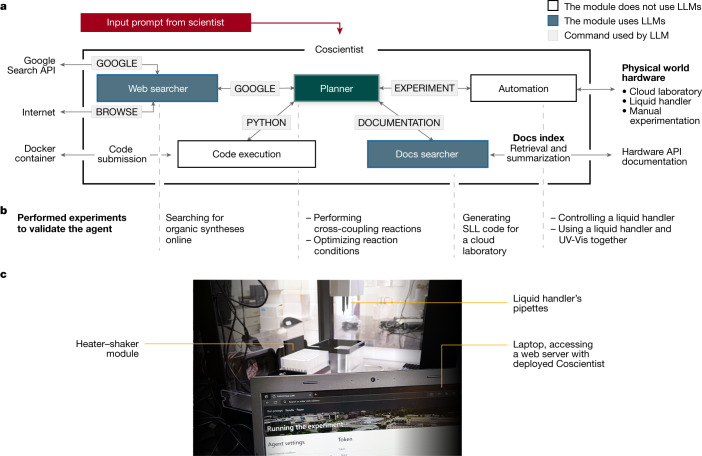
“System prompts (static inputs defining the LLMs’ goals) for the Planner are engineered 1,27 in a modular fashion, described as four commands that define the action space: The PYTHON command allows the Planner to perform calculations to prepare the experiment using a ‘Code execution’ module.”
Liu, P., Yuan, W., Fu, J., Jiang, Z., Hayashi, H., & Neubig, G. (2021) · arXiv · doi:10.48550/arxiv.2107.13586 · Cited by 4,352 · cited 1×
“System prompts (static inputs defining the LLMs’ goals) for the Planner are engineered 1,27 in a modular fashion, described as four commands that define the action space: The PYTHON command allows the Planner to perform calculations to prepare the experiment using a ‘Code execution’ module.”
Chain-of-Thought Prompting Elicits Reasoning in Large Language Models
Wei, J., Wang, X., Schuurmans, D., Bosma, M., Ichter, B., Xia, F., Chi, E., Le, Q., & Zhou, D. (2022) · arXiv · doi:10.48550/arxiv.2201.11903 · Cited by 4,263 · cited 1×
“This can be done through advanced prompting strategies, such as ReAct 34 , Chain of Thought 35 and Tree of Thoughts 36 .”
Billion-scale similarity search with GPUs
Johnson, J., Douze, M., & Jegou, H. (2021) · IEEE Transactions on Big Data · doi:10.1109/tbdata.2019.2921572 · Cited by 4,228
Research works printed but not linked: 3
- Brown, T. et al. in Advances in Neural Information Processing Systems Vol. 33 (eds Larochelle, H. et al.) 1877–1901 (Curran Associates, 2020).
- Data Mining. Mining of Massive Datasets (Cambridge Univ., 2011).
- Running experiments. Emerald Cloud Lab https://www.emeraldcloudlab.com/guides/runningexperiments (2023).
Cited by
Items 301–400 of 1,046
ML@ChemE: Past, Present, and Future of Machine Learning in Chemical Engineering
Özdemir, P., & Yıldırım, R. (2025) · ChemBioEng Reviews · doi:10.1002/cben.70012 · Cited by 15
From lab to fab: A large language model for chemical engineering
Zhou, J., Xu, F., Chang, Z., Liu, D., Li, L., Cui, J., Li, Y., Li, X., Qian, L., Zhang, Z., et al. (2025) · CHINESE JOURNAL OF CATALYSIS (CHINESE VERSION) · doi:10.1016/s1872-2067(25)64725-5 · Cited by 17
Peng, C., Wang, B., Wu, L., Jin, H., Li, Y., Gao, W., Zhou, J., Jiang, G., Wang, C., Wang, J., et al. (2025) · Angewandte Chemie International Edition · doi:10.1002/anie.202508454 · Cited by 14
Accelerated inorganic materials design with generative AI agents
Takahara, I., Mizoguchi, T., & Liu, B. (2025) · Cell Reports Physical Science · doi:10.1016/j.xcrp.2025.103019 · Cited by 32
Harnessing artificial intelligence to decode the rhizosphere microbiome
Ma, J., Qiao, J.-F., Cao, Y.-Y., & Cheng, Z.-Q. (2025) · aBIOTECH · doi:10.1016/j.abiote.2025.100005 · Cited by 17
“Inspired by systems like Coscientist [66] and BehaveAgent [67], these agents coordinate the DT simulations.”
Large language model agent as a mechanical designer
Jadhav, Y., & Farimani, A. B. (2026) · Journal of Engineering Design · doi:10.1080/09544828.2026.2624356 · Cited by 32
Boosting Computational Catalysis and Chemical Reactivity with Artificial Intelligence
Vogiatzis, K. D., Corminbœuf, C., Nova, A., Jorner, K., Kästner, J., Meuwly, M., Schwaller, P., Böttcher, V., Δρόσου, Μ., Fako, E., et al. (2026) · Journal of the American Chemical Society · doi:10.1021/jacs.5c17786 · Cited by 20
Wang, Z., & Zhu, X. (2024) · ACS Applied Nano Materials · doi:10.1021/acsanm.4c00255 · Cited by 15
Can large language models predict antimicrobial peptide activity and toxicity?
Orsi, M., & Reymond, J. (2024) · RSC Medicinal Chemistry · doi:10.1039/d4md00159a · Cited by 24
“…facilitating the integration of various chemical tools through natural language interfaces as is being pioneered by Bran 31 and Boiko et al. 32 Finally, we could demonstrate in the present study that classical machine learning techniques, such as SVMs trained on MAP4C fingerprint…”
GPT-4 as a biomedical simulator
Schaefer, M., Reichl, S., ter Horst, R., Nicolas, A. M., Krausgruber, T., Piras, F., Stepper, P., Bock, C., & Samwald, M. (2024) · Computers in Biology and Medicine · doi:10.1016/j.compbiomed.2024.108796 · Cited by 17
AI agents in chemical research: GVIM – an intelligent research assistant system
Ma, K. (2025) · Digital Discovery · doi:10.1039/d4dd00398e · Cited by 26
Chat-microreactor: A large-language-model-based assistant for designing continuous flow systems
Pan, Y., Xiao, Q., Zhao, F., Li, Z., Liu, J., Ullah, S., Lim, K. H., Huang, T., Yu, Z., Li, C., et al. (2025) · Chemical Engineering Science · doi:10.1016/j.ces.2025.121567 · Cited by 17
DynaMate: Leveraging AI-agents for customized research workflows
Mendible-Barreto, O. A., Díaz-Maldonado, M., Carmona Esteva, F. J., Torres, J. E., Córdova-Figueroa, U. M., & Colón, Y. J. (2025) · Molecular Systems Design & Engineering · doi:10.1039/d5me00062a · Cited by 12
Yager, K. G. (2024) · Digital Discovery · doi:10.1039/d4dd00178h · Cited by 12
Bridging chemistry and artificial intelligence by a reaction description language
Xiong, J., Zhang, W., Wang, Y., Huang, J., Shi, Y., Xu, M., Li, M., Fu, Z., Kong, X., Wang, Y., et al. (2025) · Nature Machine Intelligence · doi:10.1038/s42256-025-01032-8 · Cited by 26
Text mining in MOF research: from manual curation to large language model-based automation
Bae, S., Jeon, M., & Moon, H. R. (2025) · Chemical Communications · doi:10.1039/d5cc02511g · Cited by 16
Illuminating the universe of enzyme catalysis in the era of artificial intelligence
Yang, J., Li, F.-Z., Long, Y., & Arnold, F. H. (2025) · Cell Systems · doi:10.1016/j.cels.2025.101372 · Cited by 27
Large Language Models for Heterogeneous Catalysis
Yao, Y., Zhu, J., Liu, Y., Ren, G., Li, X., & Ou, P. (2025) · Wiley Interdisciplinary Reviews Computational Molecular Science · doi:10.1002/wcms.70046 · Cited by 16
Synthesis-Aware Materials Redesign via Large Language Models
Choi, J., Kim, S.-M., & Jung, Y. (2025) · Journal of the American Chemical Society · doi:10.1021/jacs.5c07743 · Cited by 25
Materials Databases: Foundations of Modern Digital Materials
Zhuang, Y., Yang, X., Zhang, C., Jia, X., Zhang, D., Li, M., Yao, T., Peng, J., Gao, Z., Yang, W., et al. (2026) · Precision Chemistry · doi:10.1021/prechem.5c00449 · Cited by 16
Connecting molecular properties with plain language
Hocky, G. M. (2024) · Nature Machine Intelligence · doi:10.1038/s42256-024-00812-y · Cited by 14
LLM-Enabled Cyber-Physical Systems: Survey, Research Opportunities, and Challenges
Xu, W., Liu, M., Sokolsky, O. V., Lee, I., & Kong, F. (2024) · doi:10.1109/fmsys62467.2024.00013 · Cited by 32
“Research [25] [26] goes even further.”
BackgroundSupercharge Your Academic Productivity with Generative Artificial Intelligence
Lonsdale, H., O’Reilly-Shah, V. N., Padiyath, A., & Allan F. Simpao, M. (2024) · Journal of Medical Systems · doi:10.1007/s10916-024-02093-9 · Cited by 14
“LLMs can be leveraged to suggest study designs based on input objectives or to critique existing plans [21].”
Bräse, S. (2024) · Digital Discovery · doi:10.1039/d4dd00130c · Cited by 20
Torres–Martínez, S. (2025) · AI & Society · doi:10.1007/s00146-024-02165-x · Cited by 20
“The stated goal of endorsing AI-powered automation as a standard for experiment design, data analysis, information collection, and results interpretation (e.g. Boiko et al. 2023), is thus to increase output optimization, rather than true scientific development.”
Large Language Models (LLMs) as Graphing Tools for Advanced Chemistry Education and Research
Subasinghe, S. M. S., Gersib, S. G., & Mankad, N. P. (2025) · Journal of Chemical Education · doi:10.1021/acs.jchemed.4c01498 · Cited by 17
High-throughput DNA melt measurements enable improved models of DNA folding thermodynamics
Ke, Y., Sharma, E., Wayment-Steele, H. K., Becker, W. R., Ho, A., Marklund, E., & Greenleaf, W. J. (2025) · Nature Communications · doi:10.1038/s41467-025-60455-4 · Cited by 17
Xie, L., Jin, Y.-D., Xu, L., Chang, S., & Xu, X. (2025) · Journal of Chemical Theory and Computation · doi:10.1021/acs.jctc.5c00605 · Cited by 17
Taheri-Mousavi, S. M., Xu, M., Hengsbach, F., Houser, C., Ge, Z., Glaser, B., Wei, S., Schaper, M., LeBeau, J. M., Olson, G. B., et al. (2025) · Advanced Materials · doi:10.1002/adma.202509507 · Cited by 29
Jia, M., Cui, Z., & Hug, G. (2026) · IEEE PES International Meeting (PES IM) · doi:10.1109/pesim67009.2026.11438280 · Cited by 30
“C OMBINING laboratory automation technologies with large language models (LLMs) enables automated execution of scientific experiments [1].”
ToPolyAgent: AI agents for coarse-grained bead-spring topological polymer simulations
Ding, L., Carrillo, J.-M., & Do, C. (2026) · Digital Discovery · doi:10.1039/d5dd00471c · Cited by 11
Barman, K. G., Caron, S., Sullivan, E., de Regt, H. W., de Austri, R. R., Boon, M., Färber, M., Fröse, S., Golling, T., Lopez, L. G., et al. (2025) · The European Physical Journal C · doi:10.1140/epjc/s10052-025-14707-8 · Cited by 47
“The primary goal is to develop foundation and LLM models tailored to the needs of science (see [49], in chemistry see [48, 46, 57, 23]).”
Yu, C., Yao, Y., Zhang, X., Zhu, G., Guo, Y., Shao, X., Shibasaki, M., Hu, Z., Dai, L., Guan, Q., et al. (2025) · International Journal of Geographical Information Science · doi:10.1080/13658816.2025.2533322 · Cited by 19
“With their remarkable capabilities in cross-domain knowledge integration and complex reasoning, LLM is becoming powerful domain-specific problem-solving engines, as seen in fields like chemistry (Boiko et al. 2023), law (Yao et al. 2024), and finance (Wu et al. 2023).”
Reaction Space Charting as a Tool in Organic Chemistry Research and Development
Baró, E. L., Rodríguez, P. N., Juárez‐Jiménez, J., Ghashghaei, O., & Lavilla, R. (2024) · Advanced Synthesis & Catalysis · doi:10.1002/adsc.202301205 · Cited by 10
Das, A., Chen, S., Shyu, M., & Sadiq, S. B. (2023) · IEEE International Conference on Collaboration and Internet Computing (CIC) · doi:10.1109/cic58953.2023.00021 · Cited by 22
Dynamic memristor for physical reservoir computing
Zhang, Q., Ouyang, W.-L., Wang, X., Yang, F., Chen, J., Wen, Z., Liu, J.-X., Wang, G., Liu, Q., & Liu, F. (2024) · Nanoscale · doi:10.1039/d4nr01445f · Cited by 13
Chatbot-assisted quantum chemistry for explicitly solvated molecules
(2025) · doi:10.1039/d4sc08677e · Cited by 11
Developing large language models for quantum chemistry simulation input generation
Jacobs, P. F., & Pollice, R. (2025) · Digital Discovery · doi:10.1039/d4dd00366g · Cited by 24
Zhao, Y., Hansen, A., Dahlhaus, A., Brandt, N., Selzer, M. A., Koeppe, A., Nestler, B., Knapp, M., & Ehrenberg, H. (2025) · Materials Today Communications · doi:10.1016/j.mtcomm.2025.112380 · Cited by 16
Benchmarking large language models for materials synthesis: The case of atomic layer deposition
Yanguas-Gil, Á., Dearing, M. T., Elam, J. W., Jones, J. C., Kim, S., Mohammad, A., Nguyen, C. T., & Sengupta, B. (2025) · Journal of Vacuum Science & Technology A Vacuum Surfaces and Films · doi:10.1116/6.0004319 · Cited by 19
“2 This is motivated by the growing number of works that have explored the use of LLMs for tasks such as materials property prediction, reaction optimization, or the design of novel materials 3–5 , as well as the performance of state of the art LLMs on scientific benchmarks such as ChemBench 1 .”
The future of reviews writing in the AI era
Zheng, Z. (2025) · Nature Reviews Chemistry · doi:10.1038/s41570-025-00738-y · Cited by 11
Jia, Z., Jiang, C. H., Li, J., Belgaid, Y., Ge, M., Li, L., Hu, S., Huang, X., Ho, T.-Y., Dong, W., et al. (2025) · Microsystems & Nanoengineering · doi:10.1038/s41378-025-00962-y · Cited by 11
“They have shown great potential in robotic-based platforms by simplifying and minimizing the labor effort 45,47,48 .”
Distributed training of large language models: A survey
Zeng, F., Gan, W., Wang, Y., & Yu, P. S. (2025) · Natural Language Processing Journal · doi:10.1016/j.nlp.2025.100174 · Cited by 24
Large Language Model in Materials Science: Roles, Challenges, and Strategic Outlook
Zhang, J., Chen, X., Ye, X., Yang, Y., & Ai, B. (2025) · Advanced Intelligent Discovery · doi:10.1002/aidi.202500085 · Cited by 23
Lessons from the trenches on evaluating machine learning systems in materials science
Alampara, N., Schilling-Wilhelmi, M., & Jablonka, K. M. (2025) · Computational Materials Science · doi:10.1016/j.commatsci.2025.114041 · Cited by 22
A survey on large language models in biology and chemistry
Ashyrmamatov, I., Gwak, S. J., Jin, S.-Y., Jun, I., Ucak, U. V., Lee, J. Y., & Lee, J. (2026) · Experimental & Molecular Medicine · doi:10.1038/s12276-025-01583-1 · Cited by 17
“Coscientist 154 , ChemCrow 155 and ChatMOF 156 exemplify such frameworks, integrating web search, retrosynthesis tools and laboratory protocols into interactive agents.”
Hundred-layer photonic deep learning
Zhou, T., Jiang, Y., Xu, Z., Xue, Z., & Fang, L. (2025) · Nature Communications · doi:10.1038/s41467-025-65356-0 · Cited by 15
From Prompt to Drug: Toward Pharmaceutical Superintelligence
Zhavoronkov, A. A., Gennert, D. G., & Shi, J. (2026) · ACS Central Science · doi:10.1021/acscentsci.5c01473 · Cited by 20
“Notably, ChemCrow 81 and Coscientist, 80 LLM-based platforms with Retrieval-Augmented Generation (RAG)-like abilities to utilize external tools for subtasks such as literature search, molecular property analysis and prediction, synthesis planning, and safety assessment, can take a plain-language prompt, such as “Plan…”
InfluentialScientific Discovery at the Press of a Button: Navigating Emerging Cloud Laboratory Technology
Arias, D. S., & Taylor, R. E. (2024) · Advanced Materials Technologies · doi:10.1002/admt.202400084 · Cited by 12
Thieme, A., Renwick, S., Marschmann, M., Guimarães, P. I., Weissenborn, S., & Clifton, J. (2024) · SLAS TECHNOLOGY · doi:10.1016/j.slast.2024.100180 · Cited by 11
Valcamonico, D., Baraldi, P., Macêdo, J. B., Moura, M. D. C., Brown, J., Gauthier, S., & Zio, E. (2025) · Reliability Engineering & System Safety · doi:10.1016/j.ress.2025.110834 · Cited by 13
Liu, J., Xiong, P., Li, C., Hao, H., & Liu, H. (2025) · ACS Sustainable Chemistry & Engineering · doi:10.1021/acssuschemeng.4c10430 · Cited by 10
Toward Full Autonomous Laboratory Instrumentation Control with Large Language Models
Xie, Y. J., He, K., & Castellanos-Gómez, A. (2025) · Small Structures · doi:10.1002/sstr.202500173 · Cited by 25
Data-driven recommendation of agents, temperature, and equivalence ratios for organic synthesis
Sun, X., Liu, J., Mahjour, B. A., Jensen, K. F., & Coley, C. W. (2025) · Chemical Science · doi:10.1039/d5sc04957a · Cited by 15
Key requirements for advancing machine learning approaches in single entity electrochemistry
(2024) · doi:10.1016/j.coelec.2024.101526 · Cited by 10
Large Language Models are Catalyzing Chemistry EducationPreprint
Du, Y., Duan, C., Bran, A. M., Sotnikova, A., Qu, Y., Kulik, H. J., Bosselut, A., Xu, J., & Schwaller, P. (2024) · ChemRxiv · doi:10.26434/chemrxiv-2024-h722v · Cited by 14
Bai, J., Rihm, S. D., Kondinski, A., Saluz, F., Deng, X., Brownbridge, G., Mosbach, S., Akroyd, J., & Kraft, M. (2025) · Digital Discovery · doi:10.1039/d5dd00069f · Cited by 18
Using a GPT-5-driven autonomous lab to optimize the cost and titer of cell-free protein synthesisPreprint
Smith, A. A., Wong, E. L., Donovan, R. C., Chapman, B., Harry, R., Tirandazi, P., Kanigowska, P., Gendreau, E. A., Dahl, R. H., Jastrzebski, M., et al. (2026) · bioRxiv (Cold Spring Harbor Laboratory) · doi:10.64898/2026.02.05.703998 · Cited by 15
“Early efforts have illustrated the potential of autonomous labs across multiple disciplines including chemical research, 1 material science 2–6 and biological design.”
Multi-Agent Risks from Advanced AI
Hammond, L., Chan, A., Clifton, J., Hoelscher-Obermaier, J., Khan, A., McLean, E., Smith, C., Barfuss, W., Foerster, J., Gavenčiak, T., et al. (2025) · arXiv · doi:10.48550/arxiv.2502.14143 · Cited by 305
Perspective on AI for accelerated materials design at the AI4Mat-2023 workshop at NeurIPS 2023
Miret, S., Krishnan, N. M. A., Sánchez-Lengeling, B., Skreta, M., Venugopal, V., & Wei, J. N. (2024) · Digital Discovery · doi:10.1039/d4dd90010c · Cited by 10
Zhou, H.-Y., Li, Y., Li, J., Meng, J., & Wu, A. (2024) · The Innovation Medicine · doi:10.59717/j.xinn-med.2024.100091 · Cited by 19
Yu, B., Xing, H., Ge, W., Zhou, L., Yan, J., & Li, Y.-A. (2024) · PLoS ONE · doi:10.1371/journal.pone.0310724 · Cited by 11
Materials laboratories of the future for alloys, amorphous, and composite materials
Banerjee, S., Meng, Y. S., Minor, A. M., Zhang, M., Zaluzec, N. J., Chan, M. K. Y., Seidler, G. T., McComb, D. W., Agar, J., Mukherjee, P. P., et al. (2025) · MRS Bulletin · doi:10.1557/s43577-024-00846-y · Cited by 13
Application of LLMs/Transformer-Based Models for Metabolite Annotation in Metabolomics
Liu, Y., Zhang, F., Ge, Y., Liu, Q., He, S., & Shen, X. (2025) · Health and Metabolism · doi:10.53941/hm.2025.100014 · Cited by 10
Mathur, S., van der Vleuten, N., Yager, K. G., & Tsai, E. H. R. (2025) · Machine Learning Science and Technology · doi:10.1088/2632-2153/add9e4 · Cited by 33
“Rapid development in large language models (LLMs) has led to growing interests in leveraging LLMs for accelerating physical science, including in biomedical research [22–24], material synthesis [25], inverse design of materials with specific properties [26–31] or targeted morphologies [32].”
A revolutionary paradigm in chemistry and materials science research: self-driving laboratories
Qiu, J., Zhu, L., Feng, Z., Luo, Z., & Wang, L. (2025) · Chemical Communications · doi:10.1039/d5cc01959a · Cited by 10
Automating care by self-maintainability for full laboratory automation
Ochiai, K., Tahara-Arai, Y., Kato, A., Kaizu, K., Kariyazaki, H., Umeno, M., Takahashi, K., Kanda, G. N., & Ozaki, H. (2025) · Digital Discovery · doi:10.1039/d5dd00151j · Cited by 13
Mukhtar, A., Hadwiger, M., Wotawa, F., & Schweiger, G. (2025) · Energy and AI · doi:10.1016/j.egyai.2025.100658 · Cited by 17
Augmenting Large Language Models for Automated Discovery of F-Element Extractants
Zhang, B. Y., Summers, T. J., Augustine, L. J., Taylor, M. G., Geist, A., Li, R., Batista, E. R., Pérez, D., Yang, P. X., & Schrier, J. (2026) · Journal of the American Chemical Society · doi:10.1021/jacs.5c19738 · Cited by 11
Chemist-Guided Human–AI Workflow for Covalent Organic Framework Synthesis
Chen, L., Lu, Z., Chen, L., Hou, L., & Zhang, D. (2026) · Journal of the American Chemical Society · doi:10.1021/jacs.5c20068 · Cited by 13
Artificial Intelligence agents for biological research: a survey
Qi, C., Wang, W., Jiang, S., Liu, Q., Song, X., Fang, H., & Wei, Z. (2026) · Briefings in Bioinformatics · doi:10.1093/bib/bbag075 · Cited by 24
“Multi-agent architectures such as Biomni [37], CellAgent [10], and Co-Scientist [97] emphasize collaborative reasoning and distributed task decomposition, while neuro-symbolic models including AutoMAxO [52],Tokensome[99],andmergen[101]embedsymbolicconstraintsor ontology structures within…”
Ahlawat, D. K., Mishra, V., Singh, S., Zaki, M. F. M., Bihani, V., Grover, H. S., Mishra, B., Miret, S., Mausam, & Krishnan, N. M. A. (2026) · Nature Machine Intelligence · doi:10.1038/s42256-026-01199-8 · Cited by 33
Korolev, V., & Mitrofanov, A. A. (2024) · iScience · doi:10.1016/j.isci.2024.109644 · Cited by 11
Tu, X., Zou, Z., Li, J., Zeng, S., Luo, Z., Li, G., Gao, Y., & Zhang, K. (2024) · Chinese Medical Journal · doi:10.1097/cm9.0000000000003387 · Cited by 10
“It even optimized the “palladium-catalyzed cross-coupling reaction” in just a few minutes, [31] indicating the potential of LLMs to accelerate drug development.”
Controlling risks of AI in chemical science with agents
He, J., Guan, H., Feng, W., Min, Y., Yi, J., Tang, K., Li, S. C., Zhang, J., Chen, K., Zhou, W., et al. (2025) · AI for Science · doi:10.1088/3050-287x/adfee5 · Cited by 49
Turón, G., Arora, D., & Duran‐Frigola, M. (2024) · ACS Infectious Diseases · doi:10.1021/acsinfecdis.4c00585 · Cited by 11
Multi-agentic AI framework for end-to-end atomistic simulations
Vriza, A., Kornu, U., Koneru, A., Chan, H., & Sankaranarayanan, S. K. R. S. (2026) · Digital Discovery · doi:10.1039/d5dd00435g · Cited by 8
Xu, M., & Xu, D. (2024) · Springer eBooks · doi:10.1007/978-981-97-2166-5_12 · Cited by 8
Hatakeyama‐Sato, K., Ishikawa, H., Takaishi, S., Igarashi, Y., Nabae, Y., & Hayakawa, T. (2024) · Polymer Journal · doi:10.1038/s41428-024-00930-9 · Cited by 8
“While GPT-4-level language models are becoming capable of performing such tasks, we determined that their accuracy is still insuf fi cient [3, 4].”
Huang, H., Chen, M., Zhang, Y., Wang, X., Xie, Q., Pu, Y., He, Y., Zhu, L., He, Y., & Guo, J. (2025) · Langmuir · doi:10.1021/acs.langmuir.4c04262 · Cited by 10
Liu, X., Qiu, Q., Zhang, Y., Cheng, Y., Yi, L., Hu, W., & Zhuge, Q. (2025) · Optical Fiber Communication Conference · doi:10.1364/ofc.2025.th1a.2 · Cited by 15
AI4Protein: transforming the future of protein design
Wang, D., Tan, Z., Gao, J., Zhang, S., Shen, J., & Lu, Y. (2025) · Science China Life Sciences · doi:10.1007/s11427-024-2906-3 · Cited by 15
“CRISPR-GPT (Huang et al., 2024), for instance, automates gene-editing design, while Coscientist integrates AI with robotic systems to autonomously execute complex chemical tasks (Boiko et al., 2023).”
Synthesis planning for atomically precise metal nanoclusters
Lyu, J., Qian, J., Yang, Z., & Xie, J. (2025) · Nanoscale Horizons · doi:10.1039/d5nh00353a · Cited by 10
Liu, Z., Tang, J., Zhang, L., Liu, F., & Ye, Y. (2025) · Chemical Engineering Journal · doi:10.1016/j.cej.2025.169745 · Cited by 19
Umer, M. S., Nabeel, M., Athar, U., Lynch, I., Afantitis, A., Ullah, S., & Fraz, M. M. (2025) · Archives of Computational Methods in Engineering · doi:10.1007/s11831-025-10437-y · Cited by 15
Artificial intelligence‐enabled digital biomedical engineering
Song, P., Tang, X., Lv, X., Reis, R. L., Chen, X., Bai, L., & Su, J. (2025) · BMEMat · doi:10.1002/bmm2.70049 · Cited by 10
DDD-GenDT: Dynamic Data-Driven Generative Digital Twin Framework
Lin, Y.-Z., Shi, Q., Yang, Z., Latibari, B. S., Satam, S., Shao, S., Salehi, S., & Satam, P. (2025) · IEEE Transactions on Artificial Intelligence · doi:10.1109/tai.2025.3612920 · Cited by 14
“Boiko et al. [21] proposed an LLM-powered system called Coscientist, to automate chemical experiments by controlling heating, stirring, and liquid handling devices, design of GPT-4 based Planner Module, that assists the users through document search, Python code development and experimentation, and…”
Accelerating multimetallic catalyst discovery with robotics and agentic AI
Peng, J., Liu, C., Luo, Y., & Dandapat, K. (2025) · AI Agent · doi:10.20517/aiagent.2025.07 · Cited by 12
General-Purpose Models for the Chemical Sciences: LLMs and Beyond
Alampara, N., Aneesh, A., Ríos-García, M., Mirza, A., Schilling-Wilhelmi, M., Aghajani, A. A., Sun, M., Prastalo, G., & Jablonka, K. M. (2026) · Chemical Reviews · doi:10.1021/acs.chemrev.5c00583 · Cited by 37
Unveiling the correlation between high-entropy alloy element systems and electrocatalytic activity
Shan, X., Cai, F., Tu, Y., Zhang, D., Pan, Y., Chen, L., Liang, J., Gao, H., Xu, J., Li, H. C., et al. (2026) · National Science Review · doi:10.1093/nsr/nwag161 · Cited by 8
“Looking forward, further progress can be achieved by developing integrated high-throughput synthesis-characterization platforms [28 ], incorporating multimodal AI models [27 ], introducing Bayesian optimization and reinforcement learning strategies [30 ], and establishing cross-scale…”
Beyond petrochemicals: challenges and opportunities in industrial-scale biomanufacturing
Kim, J. Y., Yu, H. E., Kim, M. H., & Lee, S. Y. (2026) · Nature Communications · doi:10.1038/s41467-026-73835-1 · Cited by 11
“Multi-agent large language model systems have demonstrated autonomous design and execution of scienti fi c experiments 134,135 .”
Artificial intelligence for food innovation
Datta, B., Buehler, M. J., Chow, Y. Y. S., Gligorić, K., Jurafsky, D., Kaplan, D. L., Ledesma‐Amaro, R., Missier, G. D., Neidhardt, L., Pichara, K., et al. (2026) · Nature Food · doi:10.1038/s43016-026-01380-7 · Cited by 29
“The emerging discipline of AI for Food will benefit from rapid progress in reasoning models and agentic systems that design and execute tasks with external tools [105].”
New roles of research data infrastructure in research paradigm evolution
Li, Y., Dong, L., Fan, X., Wei, R., Guo, S., Ma, W., & Li, Z. (2024) · Journal of Data and Information Science · doi:10.2478/jdis-2024-0011 · Cited by 14
“With AI scientists (Boiko et al., 2023; Koscher et al., 2023; Merchant et al., 2023; Romera-Paredes et al., 2023) working in digital, autonomous labs (Szymanski et al., 2023), the RIDs will serve as the interface for providing efficient, flexible and intelligent knowledge services in physical or…”
From predicting to decision making: Reinforcement learning in biomedicine
Liu, X., Zhang, J., Hou, Z., Yang, Y., & Gao, Y. Q. (2024) · Wiley Interdisciplinary Reviews Computational Molecular Science · doi:10.1002/wcms.1723 · Cited by 9
“With training on the scientific data, LLM has great potential to be constructed as general AI model in the field of chemistry, 124 biology 125,126 and clinics.”
Spike sorting AI agentPreprint
Lin, Z., Marin‐Llobet, A., Baek, J., He, Y., Lee, J., Wang, W., Zhang, X., Lee, A. J., Liang, N., Du, J., et al. (2025) · bioRxiv (Cold Spring Harbor Laboratory) · doi:10.1101/2025.02.11.637754 · Cited by 19
“While LLM-based AI agents 19 has begun to emerge in fields such as chemistry 20, 21 and material science 22 , their application to neuroscience, especially for spike sorting, remains unexplored.”
Jiang, J., Hu, J., Xie, S., Guo, M.-H., Dong, Y., Fu, S., Jiang, X., Yue, Z., Shi, J., Zhang, X., et al. (2025) · bioRxiv (Cold Spring Harbor Laboratory) · doi:10.1101/2025.03.03.641178 · Cited by 10
Management of experimental workflows in robotic cultivation platforms
Kaspersetz, L., Englert, B., Krah, F., Martínez, E., Neubauer, P. B., & Bournazou, M. N. C. (2024) · SLAS TECHNOLOGY · doi:10.1016/j.slast.2024.100214 · Cited by 7
Benchmarking large language models on safety risks in scientific laboratories
Zhou, Y., Yang, J., Huang, Y., Guo, K., Emory, Z. C., Ghosh, B., Bedar, A., Shekar, S., Liang, Z., Chen, P., et al. (2026) · Nature Machine Intelligence · doi:10.1038/s42256-025-01152-1 · Cited by 54
“The rapid integration of LLMs into scientific laboratories—rang-ing from procedural guidance for novices to autonomous experiment orchestration 17–19 —builds on their demonstrated abilities in tasks such as chemical reaction prediction 20 .”
AI in materials science: Charting the course to Nobel-worthy breakthroughs
Chen, C. (2024) · Matter · doi:10.1016/j.matt.2024.11.012 · Cited by 7
LLM-Driven Synthesis Planning for Quantum Dot Materials Development
Choi, S. E., Jang, M., Yoon, S., Yoo, S., Ahn, J., Kim, M., Kim, H.-G., Jung, Y., Park, S. S., Kim, Y. C., et al. (2025) · Journal of Chemical Information and Modeling · doi:10.1021/acs.jcim.4c01529 · Cited by 12
Metadata
- Authors
- Boiko, D. A., MacKnight, R., Kline, B., & Gomes, G.
- Affiliations
- Carnegie Mellon University (US)
- Corresponding author
- Gomes, Gabe
- Venue
- Nature
- Published
- 2023-12-20
- Volume
- 624
- Issue
- 7992
- Pages
- 570-578
- ISSN
- 0028-0836 (ISSN-L)
- 1476-4687
- PMC
- PMC10733136
- OpenAlex
- W4389991792
- Cited by
- 1,050
- References
- 37
- Citations by year
- 2026: 458 · 2025: 401 · 2024: 186 · 2023: 5
- FWCI
- 77.41
- Type
- journal article
- Language
- en
- Open access
- hybrid
- doi.org
- Licence
- cc-by
- creativecommons.org/licenses/by/4.0 (tdm)
- creativecommons.org/licenses/by/4.0 (vor)
- Locations
- Nature (publishedVersion, cc-by)
- PubMed Central (publishedVersion, cc-by)
- PubMed (publishedVersion)
- RePEc: Research Papers in Economics (submittedVersion)
- Funders
- National Science Foundation (2221346, 2202693)
- Carnegie Mellon University
- Topics
- Physical Sciences › Materials Science › Materials Chemistry › Machine Learning in Materials Science
- Physical Sciences › Computer Science › Artificial Intelligence › Artificial Intelligence Applications
- Life Sciences › Pharmacology, Toxicology and Pharmaceutics › Drug Discovery › Computational Drug Discovery Methods
- Keywords
- large language models, GPT-4, experimental automation, reaction condition optimization, palladium-catalyzed cross-coupling, program execution
- MeSH terms
- Artificial Intelligence, Automation, Catalysis, Documentation, Electric Power Supplies
About these checks
Registry, retraction, Cites and statistics results are computed, not judged, with one exception: a printed reference that no index lists is read once by a model before it counts as a citation error. Claims are extracted by a model and kept only when their quote appears verbatim in the text; each cited source is then checked, with a model’s help, for whether it says what the claim relies on. Those verdicts can be wrong — read the claim’s quote and the cited source before relying on one.
Statistics and arithmetic are recomputed, not judged.
Confidence bands are shown only for fields calibrated on our annotated test set. None is calibrated yet, so no band is shown.
What counts as a claim ›How we measure confidence ›How we check this ›
Are you an author, or do you see a problem with this page? Request a review
Data sources
Bibliographic data: Semantic Scholar, OpenAlex, Crossref.
Contains information from the Semantic Scholar Academic Graph Datasets, made available under the ODC Attribution License (ODC-BY 1.0).
Semantic Scholar’s data is described in: Kinney, R., et al. (2023). The Semantic Scholar Open Data Platform. arXiv:2301.10140.
