

Mapping single-cell data to reference atlases by transfer learning
Open accessThe DOI matches its Crossref record; 85 of the 85 references it cites were found in a registry or an index.
Abstract
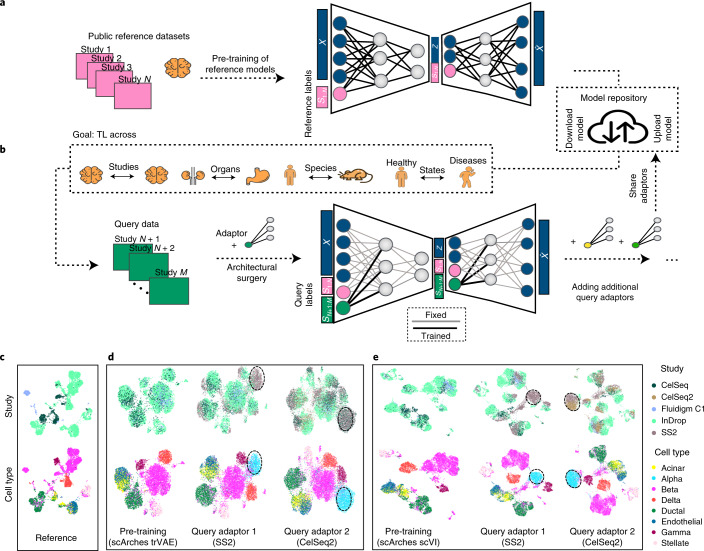
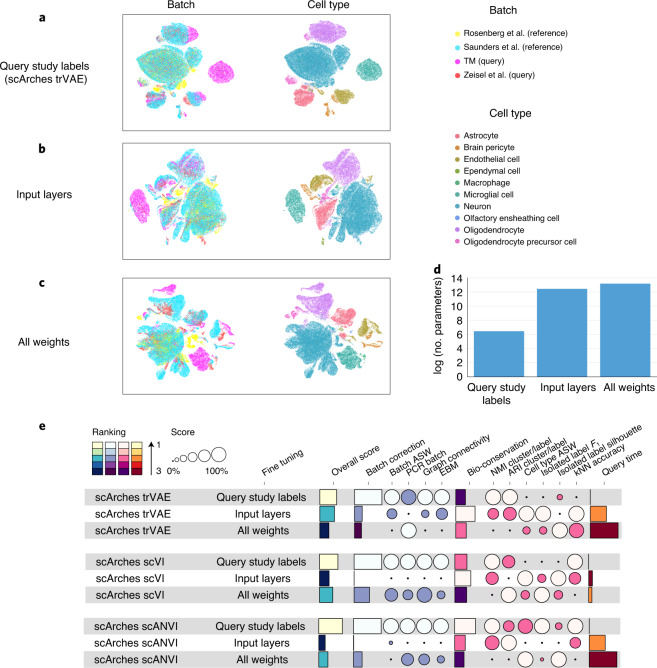
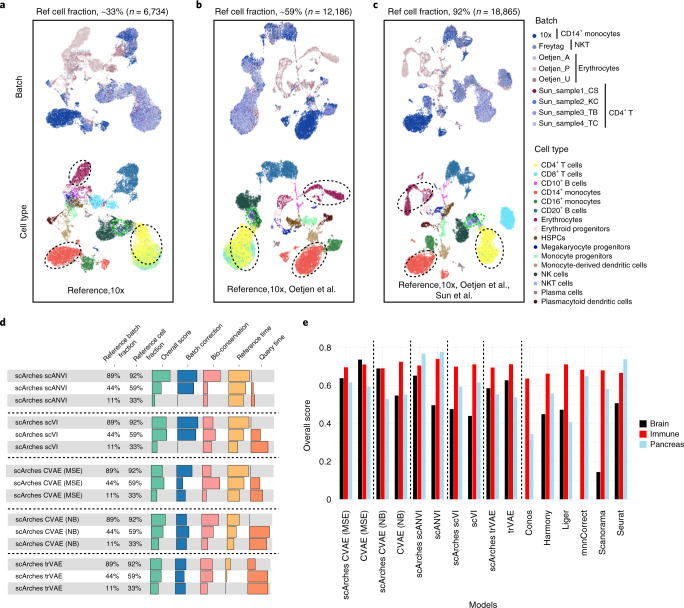
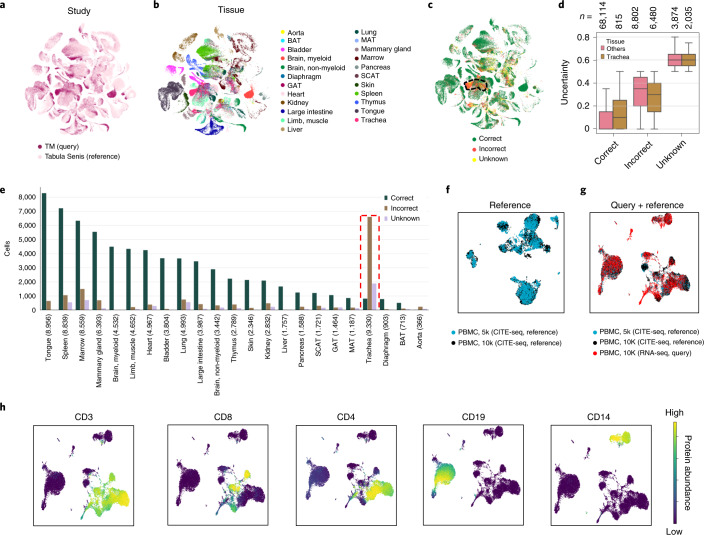
Large single-cell atlases are now routinely generated to serve as references for analysis of smaller-scale studies. Yet learning from reference data is complicated by batch effects between datasets, limited availability of computational resources and sharing restrictions on raw data. Here we introduce a deep learning strategy for mapping query datasets on top of a reference called single-cell architectural surgery (scArches). scArches uses transfer learning and parameter optimization to enable efficient, decentralized, iterative reference building and contextualization of new datasets with existing references without sharing raw data. Using examples from mouse brain, pancreas, immune and whole-organism atlases, we show that scArches preserves biological state information while removing batch effects, despite using four orders of magnitude fewer parameters than de novo integration. scArches generalizes to multimodal reference mapping, allowing imputation of missing modalities. Finally, scArches retains coronavirus disease 2019 (COVID-19) disease variation when mapping to a healthy reference, enabling the discovery of disease-specific cell states. scArches will facilitate collaborative projects by enabling iterative construction, updating, sharing and efficient use of reference atlases.
Overview
The claims and statistics of this paper haven’t been checked yet.
Free: it reads the open-access text and checks the first 5 claims that cite a source we can check. Create a free account to check every claim.
Integrity signals
Registry
Cites
Statistics
Figures
Verification
Claims the paper makes
The claims and statistics of this paper haven’t been checked yet.
Free: it reads the open-access text and checks the first 5 claims that cite a source we can check. Create a free account to check every claim.
Claims other papers make about this one
Each is checked against this paper’s own text: does it say what the citing paper says it does?
The cited source says what the claim attributes to it.
In the citing paper
“Lotfollahi et al. applied transfer learning for mapping query single cells with a decentralized and iterative updating reference model [12].”
From Challenges in AI-driven Biomedical Multimodal Data Fusion and Analysis (2025) · cites this paper as [12]
Self-check
Percentages, sums and reported differences re-computed from the paper’s own numbers.
The self-check needs the paper’s full text.
Citations
Cites
ImageNet classification with deep convolutional neural networks
Krizhevsky, A., Sutskever, I., & Hinton, G. E. (2017) · Communications of the ACM · doi:10.1145/3065386 · Cited by 112,155 · cited 1×
“These references help to understand the cellular heterogeneity that constitutes natural and inter-individual variation, aging, environmental influences and disease.”
BackgroundBERT: Pre-training of Deep Bidirectional Transformers for Language Understanding
Devlin, J., Chang, M.-W., Lee, K., & Toutanova, K. (2018) · arXiv · doi:10.48550/arxiv.1810.04805 · Cited by 73,173
Scikit-learn: Machine Learning in Python
Pedregosa, F., Varoquaux, G., Gramfort, A., Michel, V., Thirion, B., Grisel, O., Blondel, M., Müller, A., Nothman, J., Louppe, G., et al. (2012) · arXiv · doi:10.48550/arxiv.1201.0490 · Cited by 71,016 · cited 2×
“22 ) and logistic regression classifiers 50 (Supplementary Fig.”
BackgroundMethodBERT: Pre-training of Deep Bidirectional Transformers for Language Understanding
Devlin, J., Chang, M.-W., Lee, K., & Toutanova, K. (2019) · Proceedings of the 2019 Conference of the North American Chapter of the Association for Computational Linguistics: Human Language Technologies, Volume 1 (Long and Short Papers) · doi:10.18653/v1/n19-1423 · Cited by 54,325
Auto-Encoding Variational Bayes
Kingma, D. P., & Welling, M. (2013) · arXiv · doi:10.48550/arxiv.1312.6114 · Cited by 20,067
Integrated analysis of multimodal single-cell data
Hao, Y., Hao, S., Andersen-Nissen, E., Mauck, W. M., Zheng, S., Butler, A., Lee, M. J., Wilk, A. J., Darby, C., Zagar, M., et al. (2020) · doi:10.1101/2020.10.12.335331 · Cited by 15,508
Comprehensive Integration of Single-Cell Data
Stuart, T., Butler, A., Hoffman, P., Hafemeister, C., Papalexi, E., Mauck, W. M., Hao, Y., Stoeckius, M., Smibert, P., & Satija, R. (2019) · Cell · doi:10.1016/j.cell.2019.05.031 · Cited by 15,453
Fast, sensitive and accurate integration of single-cell data with Harmony
Korsunsky, I., Millard, N., Fan, J., Slowikowski, K., Zhang, F., Wei, K., Baglaenko, Y., Brenner, M., Loh, P.-R., & Raychaudhuri, S. (2019) · Nature Methods · doi:10.1038/s41592-019-0619-0 · Cited by 10,488
SCANPY: large-scale single-cell gene expression data analysis
Wolf, F. A., Angerer, P., & Theis, F. J. (2018) · Genome Biology · doi:10.1186/s13059-017-1382-0 · Cited by 8,881
Self-citationConditional Generative Adversarial Nets
Mirza, M., & Osindero, S. (2014) · arXiv · doi:10.48550/arxiv.1411.1784 · Cited by 8,863
Research works printed but not linked: 2
- Stuart T Comprehensive integration of single cell data Cell 2019 177 1888 1902 31178118 PMC6687398 · DOI · Paper page
- Sohn, K., Lee, H. & Yan, X. Learning structured output representation using deep conditional generative models. in Advances in Neural Information Processing Systems (eds. Cortes, C. et al.) 28, 3483–3491 (Curran Associates, 2015).
Cited by
Items 301–400 of 615
Realistic Cell Type Annotation and Discovery for Single-cell RNA-seq Data
Zhai, Y., Chen, L., & Deng, M. (2023) · International Joint Conference on Artificial Intelligence · doi:10.24963/ijcai.2023/552 · Cited by 11
Transfer Learning‐Based Vehicle Collision Prediction
Li, Y., Wang, Z., Ma, L., & Dai, W. (2022) · Wireless Communications and Mobile Computing · doi:10.1155/2022/2545958 · Cited by 6
“used transfer learning and parameter optimization to achieve efficient, decentralized, and iterative reference construction and the upper and lower culture of new data sets and existing references [7].”
MethodGeneralized Cell Type Annotation and Discovery for Single-Cell RNA-Seq Data
Zhai, Y., Chen, L., & Deng, M. (2023) · Proceedings of the AAAI Conference on Artificial Intelligence · doi:10.1609/aaai.v37i4.25672 · Cited by 8
“To take into account a more realistic situation, many researchers have begun to settle the open-set scenario, that is C r ⊂ C t (Kimmel and Kelley 2020; Lotfollahi et al. 2022; Chen et al. 2022a,b).”
BackgroundMethodIntegration of single‐cell proteomic datasets through distinctive proteins in cell clusters
Koca, M. B., & Sevilgen, F. E. (2023) · PROTEOMICS · doi:10.1002/pmic.202300282 · Cited by 5
“The four datasets used for comparison contain 2000 gene expressions obtained from 56,399 mouse brain cells in 10 different cell types [35].”
MethodMFmap: A semi-supervised generative model matching cell lines to tumours and cancer subtypes
Zhang, X., & Kschischo, M. (2021) · PLoS ONE · doi:10.1371/journal.pone.0261183 · Cited by 7
scEMB: Learning context representation of genes based on large-scale single-cell transcriptomicsPreprint
Hsieh, K., Chu, Y., Li, X., Pilie, P. G., & Dai, Y. (2024) · bioRxiv (Cold Spring Harbor Laboratory) · doi:10.1101/2024.09.24.614685 · Cited by 8
“However, these methods 18,19 were mainly task-specific and the perturbation effect were encoded on different embedding systems 9 , hindering the transfer learning performance.”
MethodWehbe, F., Adams, L., Babadoudou, J., Yuen, S., Kim, Y.-S., & Tanaka, Y. (2024) · Genome Research · doi:10.1101/gr.278812.123 · Cited by 7
Ngassam, B. T., Niu, H., Pang, S., Shydlouskaya, V., & Andrews, T. S. (2026) · Frontiers in Bioinformatics · doi:10.3389/fbinf.2025.1715821 · Cited by 5
“Two non-DL approaches are consistently among top-performers in independent benchmarks: Harmony and scMerge (Luecken et al., 2022; Tran et al., 2020; Antonsson and Melsted, 2024; Lin et al., 2019).”
InfluentialMcLean, A. K., Reynolds, G., & Pratt, A. G. (2024) · Biomedicines · doi:10.3390/biomedicines12061297 · Cited by 4
Predicting lung aging using scRNA-Seq data
Song, Q., Singh, A., McDonough, J. E., Adams, T. S., Vos, R., Man, R. D., Myers, G., Ceulemans, L. J., Vanaudenaerde, B. M., Wuyts, W. A., et al. (2024) · PLoS Computational Biology · doi:10.1371/journal.pcbi.1012632 · Cited by 5
“…assignments, we transferred the HLCA cell types to all other datasets using scArches pipeline available at https://github.com/ theislab/scarches [27]. scArches maps a query dataset to a reference dataset by adding new batch nodes to its neural network trained on the reference dataset and…”
Huang, L., Gong, W., & Chen, D. (2025) · Briefings in Bioinformatics · doi:10.1093/bib/bbaf279 · Cited by 7
“Machine learning and deep learning (ML/DL) techniques are becoming increasingly essential in single-cell analysis [14].”
CellMemory: hierarchical interpretation of out-of-distribution cells using bottlenecked transformer
Wang, Q., Zhu, H., Hu, Y., Chen, Y., Wang, Y., Li, G., Li, Y., Chen, J., Zhang, X., Zou, J., et al. (2025) · Genome biology · doi:10.1186/s13059-025-03638-y · Cited by 8
“Currently, only a limited number of methods can perform both [6–9] simultaneously.”
scGPT: end-to-end protocol for fine-tuned retinal cell type annotation
Ding, S., Li, J., Luo, R., Cui, H., Wang, B., & Chen, R. (2025) · Nature Protocols · doi:10.1038/s41596-025-01220-1 · Cited by 8
Triple-effect correction for Cell Painting data with contrastive and domain-adversarial learning
Yan, C., Zhang, Y., Feng, J., Hua, H., Ruan, Z., Li, Z., Li, S., Yan, C., Li, P., Liu, J., et al. (2025) · Nature Communications · doi:10.1038/s41467-025-62193-z · Cited by 12
“Metrics such as average silhouette width (ASW) 29 , technic average silhouette width (tASW) 30 and graph connectivity 30 are used to measure the model ’ s ability to remove technical effects, while perturbation average silhouette width (pASW) 30 , normalized mutual information (NMI) 30 , phenotypic…”
InfluentialA message passing framework for precise cell state identification with scClassify2
Ding, W., Cao, Y., Fu, X., Torkel, M., & Yang, J. Y. H. (2025) · Genome biology · doi:10.1186/s13059-025-03722-3 · Cited by 4
“Secondly, we use a dual layer architecture to enable joint learning from both the expression information and gene co-expression pattern derived from the log-ratio of genes.”
Towards a reference cell atlas of liver diversity over the human lifespan
Taylor, S. A., Bader, G. D., MacParland, S. A., Mullen, A. C., Andrews, T. S., Cuenca, A. G., DasGupta, R., Gehring, A. J., Grün, D., Guilliams, M., et al. (2025) · Nature Reviews Gastroenterology & Hepatology · doi:10.1038/s41575-025-01114-3 · Cited by 5
“State-of-the-art machine learning techniques, such as deep neural networks, will also facilitate cell type annotation of disease datasets and identify cell-subset-specific transitional states between normal and disease states 125–127 .”
Benchmarking porcine pancreatic ductal organoids for drug screening applications
Karampelias, C., Yang, K., Farkas, F. J., Sterr, M., den Bosch, M. M. V., Renner, S., Fuß, J., von Toerne, C., Franzenburg, S., Kin, T., et al. (2025) · EMBO Molecular Medicine · doi:10.1038/s44321-025-00330-3 · Cited by 6
MASI enables fast model-free standardization and integration of single-cell transcriptomics data
Xu, Y., Kramann, R., McCord, R. P., & Hayat, S. (2023) · Communications Biology · doi:10.1038/s42003-023-04820-3 · Cited by 5
“We selected linear and non-linear support vector machine (SVM) classi fi ers as supervised methods, as another benchmark study has demonstrated that SVM outperformed other sophisticated cell-type annotation methods 54 . scNym 10 and scArches 11 are semi-Fig.”
Repapi, E., Agarwal, D., Napolitani, G., Sims, D., & Taylor, S. (2023) · F1000Research · doi:10.12688/f1000research.121829.3 · Cited by 4
Representing and extracting knowledge from single-cell data
Mihai, I. S., Chafle, S., & Henriksson, J. (2023) · Biophysical Reviews · doi:10.1007/s12551-023-01091-4 · Cited by 6
“Interested readers should investigate SCVI (Gayoso et al. 2022) and scArches (Lotfollahi et al. 2022), which uses this for solving VAEs; and Cell2location (Klesh-chevnikov et al. 2022) which uses this to link single-cell data to spatial transcriptomics data.”
BackgroundContinual learning approaches for single cell RNA sequencing data
Saygılı, G., & Yigin, B. Ö. (2023) · Scientific Reports · doi:10.1038/s41598-023-42482-7 · Cited by 8
“Experimental results on the latent space confirm the results of the intra-dataset experiment. scArches 34 and its recent advanced version with scHPL, treeArches 15 , map the high-dimensional scRNA-seq data to a latent space to combine multiple atlases or datasets for downstream analysis.”
ResultStemDriver: a knowledgebase of gene functions for hematopoietic stem cell fate determination
Luo, Y., Guo, J., Wen, J., Zhao, W., Huang, K., Liu, Y., Wang, G., Luo, R., Niu, T., Feng, Y., et al. (2023) · Nucleic Acids Research · doi:10.1093/nar/gkad1063 · Cited by 4
Weigao, E., Fei, L., Wang, J., Wang, X., Wang, R., Wang, X., Zhang, P., Chen, J., Wu, J., Jiang, M., et al. (2025) · Advanced Science · doi:10.1002/advs.202409642 · Cited by 5
Automated and reproducible cell identification in mass cytometry using neural networks
Saihi, H., Bessant, C., & Alazawi, W. (2023) · Briefings in Bioinformatics · doi:10.1093/bib/bbad392 · Cited by 5
Urgilez‐Clavijo, A., Rivas-Tabares, D. A., Gobin, A., & de la Riva, J. (2024) · Sustainability · doi:10.3390/su16041566 · Cited by 4
Ferrari, I., Battistella, M., Vincenti, F., Gobbini, A., Marini, F., Notarbartolo, S., Costanza, J., Biffo, S., Grifantini, R., Abrignani, S., et al. (2025) · BMC Bioinformatics · doi:10.1186/s12859-025-06320-z · Cited by 3
“CIA is a versatile framework that”
Osorio, D., McGrail, D. J., Sahni, N., & Yi, S. S. (2022) · bioRxiv (Cold Spring Harbor Laboratory) · doi:10.1101/2022.04.06.487357 · Cited by 4
“data sets using the metadata associated in the existing reference with high precision and without the need of recomputing the reference embedding (26, 27).”
MethodPrincipled feature attribution for unsupervised gene expression analysisPreprint
Janizek, J. D., Spiro, A. E., Celik, S., Blue, B. W., Russell, J., Lee, T.-I., Kaeberlin, M., & Lee, S.-I. (2022) · bioRxiv · doi:10.1101/2022.05.03.490535 · Cited by 2
“The increasing number of available samples in large transcriptomic compendia has enabled deep learning as a viable option for reference mapping [2], data integration [3], dimensionality reduction and visualization [4].”
BackgroundLang, N. J., Gote-Schniering, J., Porras-Gonzalez, D., Yang, L., Sadeleer, L. D., Jentzsch, R. C., Shitov, V. A., Zhou, S., Ansari, M., Agami, A., et al. (2023) · bioRxiv (Cold Spring Harbor Laboratory) · doi:10.1101/2023.01.16.524219 · Cited by 4
Self-citationConsensus prediction of cell type labels with popVPreprint
Ergen, C., Xing, G. K., Xu, C. A., Jayasuriya, M., McGeever, A., Pisco, A. O., Streets, A., & Yosef, N. (2023) · bioRxiv (Cold Spring Harbor Laboratory) · doi:10.1101/2023.08.18.553912 · Cited by 4
Self-citationSIMVI reveals intrinsic and spatial-induced states in spatial omics dataPreprint
Dong, M., Su, D. G., Kluger, H. M., Fan, R., & Kluger, Y. (2023) · bioRxiv (Cold Spring Harbor Laboratory) · doi:10.1101/2023.08.28.554970 · Cited by 4
“Additionally, fine-tuning of trained SIMVI models on scRNA-seq datasets may facilitate niche annotation and spatial effect identification in single-cell sequencing datasets [57].”
Molecularly stratified hypothalamic astrocytes are cellular foci for obesityPreprint
Harkany, T., Tretiakov, E. O., Varela, L., Jarc, J., Rebernik, P., Newbold, S. A., Keimpema, E., Verkhratsky, A., Horváth, T. L., & Romanov, R. A. (2024) · Research Square · doi:10.21203/rs.3.rs-3748581/v1 · Cited by 4
Pal, A., Noble, M. A., Morales, M., Pal, R., Baumgartner, M., Yang, J. W., Yim, K., Uebbing, S., & Noonan, J. P. (2024) · bioRxiv (Cold Spring Harbor Laboratory) · doi:10.1101/2024.06.25.600691 · Cited by 4
Hierarchical Interpretation of Out-of-Distribution Cells Using Bottlenecked TransformerPreprint
Wang, Q., Zhu, H., Hu, Y., Chen, Y., Wang, Y., Zhang, X., Zou, J., Kellis, M., Li, Y., Liu, D., et al. (2024) · bioRxiv (Cold Spring Harbor Laboratory) · doi:10.1101/2024.12.17.628533 · Cited by 4
CytoVI: Deep generative modeling of antibody-based single cell technologiesPreprint
Ingelfinger, F., Levy, N., Ergen, C., Bakulin, A., Becker, A., Boyeau, P., Kim, M., Ditz, D., Dirks, J., Maaskola, J., et al. (2025) · bioRxiv (Cold Spring Harbor Laboratory) · doi:10.1101/2025.09.07.674699 · Cited by 4
Self-citationRamirez, A., Orcutt-Jahns, B. T., Pascoe, S., Abraham, A. A., Remigio, B., Thomas, N., & Meyer, A. S. (2025) · Cell Systems · doi:10.1016/j.cels.2025.101294 · Cited by 5
GNODEVAE: a graph-based ODE-VAE enhances clustering for single-cell data
Fu, Z., Chen, C., Wang, S., Wang, J., & Chen, S. (2025) · BMC Genomics · doi:10.1186/s12864-025-11946-7 · Cited by 3
“Harmony [32] employs iterative clustering and linear correction for batch effect removal, while scArches [33] enables reference-based integration across datasets.”
Guided co-clustering transfer across unpaired and paired single-cell multi-omics data
Li, H., Liu, Y., & Zeng, P. (2025) · Bioinformatics · doi:10.1093/bioinformatics/btaf639 · Cited by 3
“Transfer learning has emerged as a powerful strategy for integrative analysis of single-cell data, yet most approaches [e.g. scArches (Lotfollahi et al. 2022), singleCellNet (Tan and Cahan 2019)] rely on explicit cell-type labels from reference datasets, limiting their applicability to unannotated…”
Liu, Z., Jiang, S., Hu, T., Xue, Z., Chen, Y., Ruan, D., Xia, H., Feng, Y., Hao, J., Li, W., et al. (2026) · Patterns · doi:10.1016/j.patter.2025.101471 · Cited by 5
Interpretable modality-aware mapping of gene regulation in single-cell multiomics with scMAGCA
Wang, Y., Zhou, Liu, W., Zhang, P., Cheng, Y., Su, Y., Wang, F., Wong, K., & Li, X. (2026) · Nature Communications · doi:10.1038/s41467-026-73055-7 · Cited by 6
“…conservation metrics: Isolated labels score 94 , KMeans NMI, KMeans ARI, Silhouette label, and Conditional Local Inverse Simpson ’ s Index (cLISI) 95 , batch correction metrics: Sil-houette batch, Inverse Simpson ’ s Index of Integration (iLISI) 95 , KBET score 51 , and Graph connectivity (GC) 37 .”
Single-cell and spatial RNA sequencing in prostate cancer
Ali, A., Mikutenaite, M., Weischenfeldt, J., & Bristow, R. G. (2026) · Nature Reviews Urology · doi:10.1038/s41585-026-01149-4 · Cited by 4
scBaseCount: An AI agent-curated, standardized, auto-updated single-cell data repository
Youngblut, N. D., Carpenter, C., Nayebnazar, A., Adduri, A., Shah, R., Ricci-Tam, C., Prashar, J., Ilango, R., Teyssier, N., Konermann, S., et al. (2026) · Cell · doi:10.1016/j.cell.2026.08.025 · Cited by 56
HyGAnno: hybrid graph neural network–based cell type annotation for single-cell ATAC sequencing data
Zhang, W., Cui, Y., Liu, B., Loza, M., Park, S., & Nakai, K. (2024) · Briefings in Bioinformatics · doi:10.1093/bib/bbae152 · Cited by 6
“Cell type annotation problem is initially considered in the context of scRNA-seq [6–8] and can be majorly solved in two ways [9, 10]: (1) manual labeling: after cell clustering with unsupervised approaches, biologists manually annotate each cell cluster by comparing its differential expression…”
MethodGuo, Q., Yuan, M., Zhang, L., & Deng, M. (2024) · Briefings in Bioinformatics · doi:10.1093/bib/bbae305 · Cited by 5
“The competing methods include Seurat [1], Single R [20], scMAP [3], scArches [8], Symphony [4], Liger [9] and expiMap [21].”
MethodYuan, J., Yu, J., Yi, Q., Ye, Z., Peng, X., & Liu, W. (2025) · Journal of Translational Medicine · doi:10.1186/s12967-025-07245-0 · Cited by 6
Liu, Q., Liang, Y., Wang, D., & Li, J. (2022) · Frontiers in Genetics · doi:10.3389/fgene.2022.1068075 · Cited by 4
“Another group ofmethods consists of two steps: embedding unlabeled cells into the subspace of labeled cells and then assigning the unlabeled cells according to the nearest neighborlabeled cells (Pliner, Shendure, and Trapnell, 2019; Lotfollahi et al., 2021).”
scEVOLVE: cell-type incremental annotation without forgetting for single-cell RNA-seq data
Zhai, Y., Chen, L., & Deng, M. (2024) · Briefings in Bioinformatics · doi:10.1093/bib/bbae039 · Cited by 4
“On a similar note, scArches employs domain adaptation and parameter optimization techniques to construct references and contextualize target data [15].”
MethodSpathopoulou, A., Podlesnic, M., Gaetano, L. D., Kirsch, E. M., Tisch, M., Finotello, F., Aigner, L., Günther, K., & Edenhofer, F. (2024) · Stem Cell Reviews and Reports · doi:10.1007/s12015-024-10698-3 · Cited by 3
“5.1) with the single-cell variational inference (scVI) in Python, according to the default settings [39, 40].”
MethodInfluentialKion-Crosby, W., & Barquist, L. (2024) · Bioinformatics Advances · doi:10.1093/bioadv/vbae066 · Cited by 3
“Our fi rst architecture implements gradual compression, drawing from early AE work (Hinton and Salakhutdinov 2006), a widely-adopted choice in the AE literature (Srivastava et al. 2014, Eraslan et al. 2019, Lotfollahi et al. 2021).”
BackgroundMethodMulti-organ functions of yolk sac during human early developmentPreprint
Botting, R. A., Goh, I., Rose, A., Webb, S., Engelbert, J., Gitton, Y., Stephenson, E., Londoño, M. Q., Mather, M., Mende, N., et al. (2022) · bioRxiv (Cold Spring Harbor Laboratory) · doi:10.1101/2022.08.03.502475 · Cited by 3
“The trained LR models and weights from trained scVI models 132 are provided via our interactive web portal to enable mapping of scRNA-seq datasets using 133 CellTypist (14) and transfer learning with single-cell architectural surgery (scArches) (15), 134 respectively.”
MethodProjectSVR: Mapping single-cell RNA-seq data to reference atlases by supported vector regressionPreprint
Gao, J., Guo, S., & Zhang, Y.-W. (2023) · bioRxiv · doi:10.1101/2023.07.31.551202 · Cited by 6
“However, the integration methods used in this atlas prevent direct projection of query data using commonly employed reference mapping algorithms 12,13,23 .”
MethodIdentification of cell types, states and programs by learning gene set representationsPreprint
Hediyeh-zadeh, S., Whitfield, H. J., Kharbanda, M., Curion, F., Bhuva, D. D., Theis, F. J., & Davis, M. J. (2023) · bioRxiv (Cold Spring Harbor Laboratory) · doi:10.1101/2023.09.08.556842 · Cited by 3
Self-citationflowVI: Flow Cytometry Variational InferencePreprint
İnecik, K., Meric, A., König, L. M., & Theis, F. J. (2023) · bioRxiv (Cold Spring Harbor Laboratory) · doi:10.1101/2023.11.10.566661 · Cited by 3
Self-citationScaling deep identifiable models enables zero-shot characterization of single-cell biological statesPreprint
Dong, M., Agrawal, K., Fan, R., Sefik, E., Flavell, R. A., & Kluger, Y. (2023) · bioRxiv (Cold Spring Harbor Laboratory) · doi:10.1101/2023.11.11.566161 · Cited by 3
“…additional batch label inputs (Harmony, scVI) [8, 9], label-unaware approaches including transfer-learning based scArches with scVI backbone [20] and an online batch integration method SCALEX [23], and four perturbation modeling approaches (Mixscape, contrastiveVI, CPA, sVAE) [24, 25, 27,…”
Φ-Space: Continuous phenotyping of single-cell multi-omics dataPreprint
Mao, J., Deng, Y., & Cao, K. L. (2024) · bioRxiv (Cold Spring Harbor Laboratory) · doi:10.1101/2024.06.19.599787 · Cited by 3
Mitri, Z. I., Creason, A., Stommel, J. M., Ozmen, T. Y., Rames, M. J., Ozmen, F., Bottomly, D., Jeong, B. Y., Lim, J. Y., Sivagnanam, S., et al. (2024) · medRxiv · doi:10.1101/2024.08.29.24312245 · Cited by 4
ArchMap: A web-based platform for reference-based analysis of single-cell datasetsPreprint
Lotfollahi, M., Bright, C. A., Skorobogat, R., Dehkordi, M. N., George, X., Richter, S., Shitov, V. A., Melcher, H., Nussbaumer, N., Fomm, A., et al. (2024) · bioRxiv (Cold Spring Harbor Laboratory) · doi:10.1101/2024.09.19.613883 · Cited by 3
“Mapping to these atlases is made possible through scArches 23 , ArchMap’s backbone for query mapping.”
Self-citationPhenotype Scoring of Population Scale Single-Cell Data Dissects Alzheimer's Disease ComplexityPreprint
He, C.-F., Li, A. Z., Arachchilage, K. H., Gupta, C., Huang, X., Zhao, X., Girdhar, K., Voloudakis, G., Hoffman, G. E., Bendl, J., et al. (2024) · medRxiv · doi:10.1101/2024.11.01.24316586 · Cited by 3
Biologically Informed Variational Inference Enables Interpretable Cell Phenotyping and DiscoveryPreprint
Arnoldt, L., zu Belzen, J. U., Herrmann, L., Nguyen, K., Ishaque, N., Theis, F. J., Wild, B., & Eils, R. (2025) · bioRxiv (Cold Spring Harbor Laboratory) · doi:10.1101/2025.06.10.657924 · Cited by 4
“For query-to-reference mapping, NetworkVI adapts the scArches framework (Lotfollahi et al. 2022) (Figure 1d, see Methods).”
Self-citationBahrami, M., Tejada-Lapuerta, A., Becker, S., G., F. S. H., & Theis, F. J. (2025) · bioRxiv (Cold Spring Harbor Laboratory) · doi:10.1101/2025.10.14.682419 · Cited by 17
“The HLCA atlas incorporates scArches 22 as a tool to map new unseen dissociated datasets onto the core atlas by training an adaptor added to a reference scANVI model, thereby enabling it to generate a common embedding of the new data.”
Self-citationUnified Generation of Regionalized Neural Organoids from Single-Lumen NeuroepitheliumPreprint
Rao, J., He, Z., Loskarn, S., Bender, A., Jo, Y., Lückel, J., Curcio, M., Cubela, I., Camp, J. G., Treutlein, B., et al. (2025) · bioRxiv (Cold Spring Harbor Laboratory) · doi:10.1101/2025.11.18.689013 · Cited by 5
Wang, J., Huang, Y., & Winther, O. (2026) · Nature Computational Science · doi:10.1038/s43588-026-01016-7 · Cited by 6
“Moreover, we applied the model to two single-cell datasets, including batches collected from coronavirus disease 2019 (COVID-19; batches) 30 and metastatic lung adenocarcinoma (14 batches) 31 .”
Zhou, J., Xue, J., Li, Y., Liu, F., Du, F., & Yu, Z. (2025) · Briefings in Bioinformatics · doi:10.1093/bib/bbaf400 · Cited by 3
“…architecture to jointly optimize multimodal integration and cross-modal translation via a shared latent space. scArches [19] leverages transfer learning and architecture surgery to adapt pretrained conditional neural networks for imputing missing modalities. scCobra…”
Larcombe, S. D., Paxton, E. A., Vrettou, C., Steketee, P. C., Matthews, K. R., Morrison, L. J., & Briggs, E. M. (2025) · Nature Communications · doi:10.1038/s41467-025-64750-y · Cited by 6
“The scArches package[49] was used to identify the cell types in cattle derived transcriptomes based on in vitro and mouse derived slender and stumpy T. brucei cell types that had characterised previously.”
ProjectSVR: mapping single-cell RNA-seq data to reference atlases by supported vector regression
Gao, J., Fang, J., Zhu, Q., Li, G., Bi, Z., Hu, Y., Hong, B., Zhang, Y., Guo, S., & Wang, H. (2025) · Briefings in Bioinformatics · doi:10.1093/bib/bbaf586 · Cited by 8
Zhang, M., Liu, X. S., Chu, W., Zhang, H., & Wang, Y. (2025) · Journal of Chemical Information and Modeling · doi:10.1021/acs.jcim.5c01397 · Cited by 2
JADE: Joint Alignment and Deep Embedding for Multi-Slice Spatial Transcriptomics
Guo, Y., Liu, J. S., Cheng, H., & Ma, Y. (2025) · neural information processing systems · doi:10.52202/085713-0867 · Cited by 3
“…of SRT continue to improve, there is growing interest in multi-slice SRT datasets, where multiple adjacent or replicated tissue sections are profiled to reconstruct 3D structures, map spatial trajectories, or assess reproducibility across individuals and conditions [19, 57, 21, 42, 14, 31, 41, 35].”
Liu, Y., Xia, Y., Yan, H., Shen, L.-C., Zhu, Y., Qiang, J.-P., & Wei, G. (2026) · PLoS Computational Biology · doi:10.1371/journal.pcbi.1013824 · Cited by 3
“Meth-ods such as scGPT [6], scBERT [7], itClust [22], and scArches [23] apply label propagation within scRNA-seq data, which usually limits their applicability.”
Ding, H., Deng, W., & Song, F. (2026) · Applied Soft Computing · doi:10.1016/j.asoc.2026.114846 · Cited by 2
Lee, H., Lee, J., Ahn, H., Park, K., Cha, B., Lee, C., Kwon, O., Jo, S. J., & Kim, J.-I. (2026) · Journal of Allergy and Clinical Immunology · doi:10.1016/j.jaci.2026.01.028 · Cited by 3
The Elusive Origin of Glioblastoma: Where Do We Stand?
Marin, M. P., Almabrok, H., Miller, M. L., & Haggiagi, A. M. (2026) · Cells · doi:10.3390/cells15070590 · Cited by 2
Probabilistic modelling of single-cell bisulfite sequencing data with MethylVI
Weinberger, E., Qiu, W., Tian, W., Zeng, Q., Ergen, C., Kronfeld, O., Kim, M., Yosef, N., Ecker, J. R., & Lee, S. (2026) · Nature Machine Intelligence · doi:10.1038/s42256-026-01225-9 · Cited by 2
“Second, we further extended our model for fast reference mapping via the scArches transfer learning approach 32 (Fig.”
Self-citationKalaga, P., & Ray, S. K. (2026) · Brain Sciences · doi:10.3390/brainsci16050531 · Cited by 2
“The scArches model further supports transfer learning and reference mapping, which is highly relevant when organoid datasets must be aligned to patient tumors or spatial reference frameworks to interpret evolutionary relevance [253].”
Liu, L., Gao, L., Wang, Z., Liu, Y., Ju, H., Lin, H., Shi, Z., Cai, W., Li, X., Huang, Y., et al. (2026) · New Phytologist · doi:10.1111/nph.71285 · Cited by 4
“…conventional approaches, including scVI (Lopez et al ., 2018), BERMUDA (Wang et al ., 2019), Harmony (Korsunsky et al ., 2019), CCA (Hardoon et al ., 2004), scArches (Lotfollahi et al ., 2021), rPCA (Partridge & Jabri, 2000), BBKNN (Pola (cid:1) nski et al ., 2019), and the uncorrected data (Fig.”
Azbukina, N. V., He, Z., Lin, H., Santel, M., Kashanian, B., Maynard, A., Török, T., Okamoto, R., Nikolova, M. T., Seimiya, M., et al. (2026) · Nature Neuroscience · doi:10.1038/s41593-026-02316-x · Cited by 12
“To apply the two-scoring model to the organoid data, scArches 68 was used to project the organoid data to the scANVI model of the primary atlas to obtain the projected latent representation.”
CFM-GP: unified conditional flow matching to learn gene perturbation across cell types
Abir, A. R., Dip, S. A., & Choi, J. M. (2026) · NAR Genomics and Bioinformatics · doi:10.1093/nargab/lqag087 · Cited by 6
“We benchmark CFM-GP on five biologically diverse datasets including SARS-CoV-2 infection [ 29 ], IFN-β stimulation, glioblastoma drug treatment, systemic lupus erythematosus, and cytokine-driven progenitor fate transitions from the Statefate collection.”
Liang, C. (2024) · IEEE Access · doi:10.1109/access.2024.3351365 · Cited by 2
“The scale of the source domain is usually larger than the target domain [31], [32].”
BackgroundA primer on single‐cell RNA ‐seq analysis using dendritic cells as a case study
Protti, G., & Spreafico, R. (2024) · FEBS Letters · doi:10.1002/1873-3468.15009 · Cited by 2
“Several tools are available for cell type annotation, including SingleR [82], scmap [83], symphony [81], Azi-muth [12], scArches [84], and Cell Typist [85].”
Cao, L., Zhang, W., Yang, F., Chen, S., Huang, X., Zeng, F., & Wang, Y. (2024) · Briefings in Bioinformatics · doi:10.1093/bib/bbaf013 · Cited by 2
“The state-of-the-art transfer learning-basedmethodsrequirefine-tuningwhenmappinganewquerying dataset [45].”
scMUSCL: multi-source transfer learning for clustering scRNA-seq data
Khoeini, A., Sar, F., Lin, Y., Collins, C. C., & Ester, M. (2025) · Bioinformatics · doi:10.1093/bioinformatics/btaf137 · Cited by 3
“Among our baseline methods, MARS (Brbi � c et al. 2020) and scArches (Lotfollahi et al. 2022) are the most relevant to our work as both are transfer learning methods that exploits multiple annotated source datasets.”
A systematic assessment of single-cell language model configurations
Waele, G. D., Menschaert, G., & Waegeman, W. (2026) · NAR Genomics and Bioinformatics · doi:10.1093/nargab/lqag095 · Cited by 5
Sun, Y., Zhao, Y., Shang, J., Qin, B., Zhang, X., & Liu, J. (2025) · Briefings in Bioinformatics · doi:10.1093/bib/bbaf344 · Cited by 3
“While these methods offer improved cell type annotation performance, they are highly dependent on high-quality input data and lack mechanisms specifically designed to address batch effects [9], which can affect the overall cell type annotation performance.”
Towards foundation models that learn across biological scales
Kalfon, J., Cantini, L., & Peyré, G. (2026) · Machine Learning Health · doi:10.1088/3049-477x/aea764 · Cited by 5
ArchMap is a web-based platform for reference-based analysis of single-cell datasets
Lotfollahi, M., Bright, C. A., Skorobogat, R., Dehkordi, M. M., George, X., Richter, S., Shitov, V. A., Melcher, H., Nussbaumer, N., Fomm, A., et al. (2026) · Nature Genetics · doi:10.1038/s41588-026-02756-y · Cited by 5
Self-citationWang, L., Nie, R., Zhang, Z., Gu, W., Wang, S., Wang, A., Zhang, J., & Cai, J. (2023) · Cell Reports Methods · doi:10.1016/j.crmeth.2023.100558 · Cited by 3
“Furthermore, the new development of a transfer learning framework, called single-cell architectural surgery (scArches), shouldenhance thecapabilitiesof theoriginal deep generative model.(21) A Python library for probabilistic analysisofsingle-cell omicsdatahasalsobeenestablished.”
BackgroundRheaume, B. A., Xing, J., Theune, W. C., DeRosa, S., & Trakhtenberg, E. F. (2021) · bioRxiv (Cold Spring Harbor Laboratory) · doi:10.1101/2021.10.15.464552 · Cited by 4
“…2-step algorithm (DeNoise followed by MapTo), we comparatively evaluated its performance to more integration mapping algorithms (CIDER 25 , scArches 26 , and Symphony 27 , in addition to Seurat’s MapQuery 17 ) and on five different scRNA-seq datasets: Adult mouse retinal ganglion cells (RGC) used…”
BackgroundMethodA time and single-cell resolved model of hematopoiesisPreprint
Kuciński, I., Campos, J., Barile, M., Severi, F., Bohin, N., Moreira, P. N., Allen, L., Lawson, H., Haltalli, M. L. R., Kinston, S., et al. (2022) · bioRxiv (Cold Spring Harbor Laboratory) · doi:10.1101/2022.09.07.506735 · Cited by 2
Ferreira, P., Kuipers, J., & Beerenwinkel, N. (2022) · bioRxiv (Cold Spring Harbor Laboratory) · doi:10.1101/2022.10.15.512383 · Cited by 4
Ng, M., Borst, R., Gacaferi, H., Davidson, S., Machado, C. C., Reekie, I. R., Attar, M., Windell, D., Kurowska‐Stolarska, M., MacDonald, L., et al. (2023) · bioRxiv (Cold Spring Harbor Laboratory) · doi:10.1101/2023.01.16.522218 · Cited by 2
“, the adult capsule on to the cells from the knee synovium through semi-supervised machine learning using scANVI of scArches(26) with condition as the batch variable.”
MethodBoosting Single-Cell RNA Sequencing Analysis with Simple Neural AttentionPreprint
Davalos, O. A., Heydari, A. A., Fertig, E. J., Sindi, S., & Hoyer, K. K. (2023) · bioRxiv (Cold Spring Harbor Laboratory) · doi:10.1101/2023.05.29.542760 · Cited by 2
“We compared our approach against the current state-of-the-art TL models, scArches (Lotfollahi et al., 2022) and sc-Nym (Kimmel and Kelley, 2021).”
MethodResultFriedrich, V. D., Pennitz, P., Wyler, E., Adler, J. M., Postmus, D., Alves, L. G. T., Prigann, J., Pott, F., Vladimirova, D., Hoefler, T., et al. (2024) · bioRxiv (Cold Spring Harbor Laboratory) · doi:10.1101/2024.01.11.574849 · Cited by 2
Deep Learning Based Models for Preimplantation Mouse and Human DevelopmentPreprint
Proks, M., Salehin, N., & Brickman, J. M. (2024) · bioRxiv (Cold Spring Harbor Laboratory) · doi:10.1101/2024.02.16.580649 · Cited by 2
Karimzadeh, M., Momen-Roknabadi, A., Cavazos, T. B., Fang, Y., Chen, N.-C., Multhaup, M., Yen, J. L., Ku, J., Wang, J., Zhao, X., et al. (2024) · medRxiv · doi:10.1101/2024.04.09.24304531 · Cited by 2
“The flexibility of these models allows for reference building through transfer learning (Lotfollahi et al., 2022) or modeling specific perturbations through contrastive learning (Weinberger et al., 2023).”
BackgroundGerstner, N., Fröhlich, A., Matosin, N., Gagliardi, M., Cruceanu, C., Ködel, M., Rex-Haffner, M., Tu, X.-M., Mostafavi, S., Ziller, M., et al. (2024) · medRxiv · doi:10.1101/2024.04.24.24306179 · Cited by 22
Hu, Z., Przytycki, P. F., & Pollard, K. S. (2024) · bioRxiv (Cold Spring Harbor Laboratory) · doi:10.1101/2024.05.17.594770 · Cited by 2
Aberrant TNF signaling in pancreatic lymph nodes of patients with Type 1 DiabetesPreprint
Abedi, M., Rai, P., Zhou, Y., Liu, C., Johnson, I., Chandra, A., Fasolino, M., Rostami, S. Y., Kaestner, K. H., Naji, A., et al. (2024) · bioRxiv (Cold Spring Harbor Laboratory) · doi:10.1101/2024.05.31.596885 · Cited by 2
Sallese, M. R., Aiello, V., Villa, C. E., Riso, P. L., & Testa, G. (2025) · bioRxiv (Cold Spring Harbor Laboratory) · doi:10.1101/2025.02.11.637633 · Cited by 3
Sikkema, L., Lkandushi, M., Scarcella, D., Moinfar, A. A., Engelmann, J. P., & Theis, F. J. (2025) · bioRxiv (Cold Spring Harbor Laboratory) · doi:10.1101/2025.05.23.655749 · Cited by 2
“Mapping was therefore done exclusively with scArches[8], currently the only query-to-reference mapping method available that is compatible with conditional variational autoencoder-based integrations such as those generated with scVI and scANVI.”
Self-citationFang, C., Montgomery, K. D., Maguire, S. E., Ramnauth, A. D., Guo, B., Miller, R., Kleinman, J. E., Hyde, T. M., Martinowich, K., Maynard, K. R., et al. (2025) · bioRxiv (Cold Spring Harbor Laboratory) · doi:10.64898/2025.12.12.694021 · Cited by 2
“These are broadly referred to as “single-cell reference mapping” or “label transfer” algorithms where the goal is to align the -omic (e.g. transcriptomic) profiles of samples in a target dataset to a reference atlas in order to transfer annotations at a single-cell resolution to the target dataset.”
Gupta, S., Heinrichs, E., Rodriguez, C., Friedman, E., Gallardo, S., Demirjie, T., Panosian, T., Phan, K. D., Tahmasian, A., Verdin, Y., et al. (2025) · SSRN Electronic Journal · doi:10.64898/2025.12.22.696129 · Cited by 2
Metadata
- Authors
- Lotfollahi, M., Naghipourfar, M., Luecken, M. D., Khajavi, M., Büttner, M., Wagenstetter, M., Avsec, Ž., Gayoso, A., Yosef, N., Interlandi, M., Rybakov, S., Misharin, A. V., & Theis, F. J.
- Affiliations
- Helmholtz Munich (DE)
- Technical University of Munich (DE)
- University of California, Berkeley (US)
- Ragon Institute of MGH, MIT and Harvard (US)
- University of Münster (DE)
- Northwestern University (US)
- Corresponding author
- Theis, Fabian J.
- ORCID
- Venue
- Nature Biotechnology
- Published
- 2021-08-30
- Volume
- 40
- Issue
- 1
- Pages
- 121-130
- ISSN
- 0733-222X (ISSN-L)
- 1087-0156
- 1546-1696
- PMC
- PMC8763644
- OpenAlex
- W3196650609
- Semantic Scholar
- cec0cf40c589ecaa6d779b8433d96393fdcd9fdc
- Cited by
- 602
- References
- 76
- Citations by year
- 2026: 130 · 2025: 144 · 2024: 146 · 2023: 116 · 2022: 57 · 2021: 7
- FWCI
- 26.29
- Type
- journal article
- Language
- en
- Open access
- hybrid
- doi.org
- Licence
- cc-by
- creativecommons.org/licenses/by/4.0 (tdm)
- creativecommons.org/licenses/by/4.0 (vor)
- Locations
- Nature Biotechnology (publishedVersion, cc-by)
- PubMed Central (publishedVersion, cc-by)
- PubMed (publishedVersion)
- PuSH - Publication Server of Helmholtz Zentrum München (submittedVersion, cc-by)
- eScholarship (California Digital Library) (submittedVersion)
- mediaTUM (Technical University of Munich) (submittedVersion, other-oa)
- Site cant be reached (submittedVersion, cc-by)
- Funders
- Deutsche Forschungsgemeinschaft (ZT-I-0007)
- Topics
- Life Sciences › Biochemistry, Genetics and Molecular Biology › Molecular Biology › Single-cell and spatial transcriptomics
- Life Sciences › Biochemistry, Genetics and Molecular Biology › Molecular Biology › Gene Regulatory Network Analysis
- Life Sciences › Biochemistry, Genetics and Molecular Biology › Molecular Biology › Bioinformatics and Genomic Networks
- Keywords
- transfer learning, single-cell data integration, batch effect correction, mouse brain atlas
- MeSH terms
- Deep Learning, COVID-19, SARS-CoV-2, Animals, Humans, Organ Specificity, Reference Standards, Mice, Single-Cell Analysis, Datasets as Topic
About these checks
Registry, retraction, Cites and statistics results are computed, not judged, with one exception: a printed reference that no index lists is read once by a model before it counts as a citation error. Claims are extracted by a model and kept only when their quote appears verbatim in the text; each cited source is then checked, with a model’s help, for whether it says what the claim relies on. Those verdicts can be wrong — read the claim’s quote and the cited source before relying on one.
Statistics and arithmetic are recomputed, not judged.
Confidence bands are shown only for fields calibrated on our annotated test set. None is calibrated yet, so no band is shown.
What counts as a claim ›How we measure confidence ›How we check this ›
Are you an author, or do you see a problem with this page? Request a review
Data sources
Bibliographic data: Semantic Scholar, OpenAlex, Crossref.
Contains information from the Semantic Scholar Academic Graph Datasets, made available under the ODC Attribution License (ODC-BY 1.0).
Semantic Scholar’s data is described in: Kinney, R., et al. (2023). The Semantic Scholar Open Data Platform. arXiv:2301.10140.
