

Mapping single-cell data to reference atlases by transfer learning
Open accessThe DOI matches its Crossref record; 85 of the 85 references it cites were found in a registry or an index.
Abstract
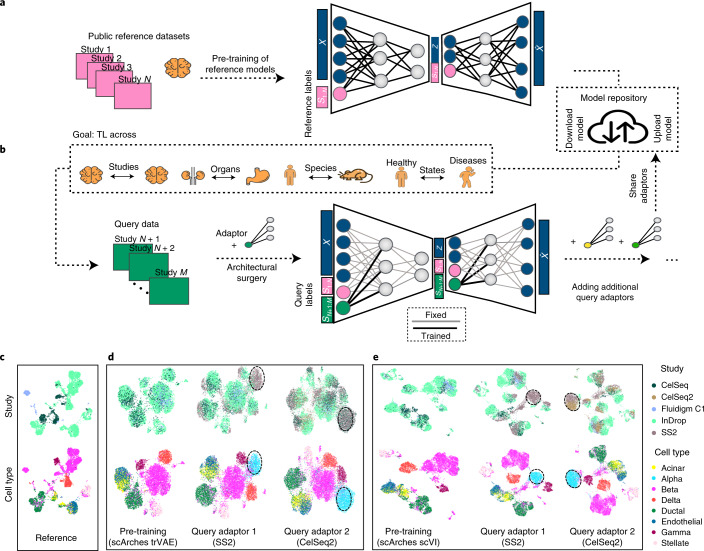
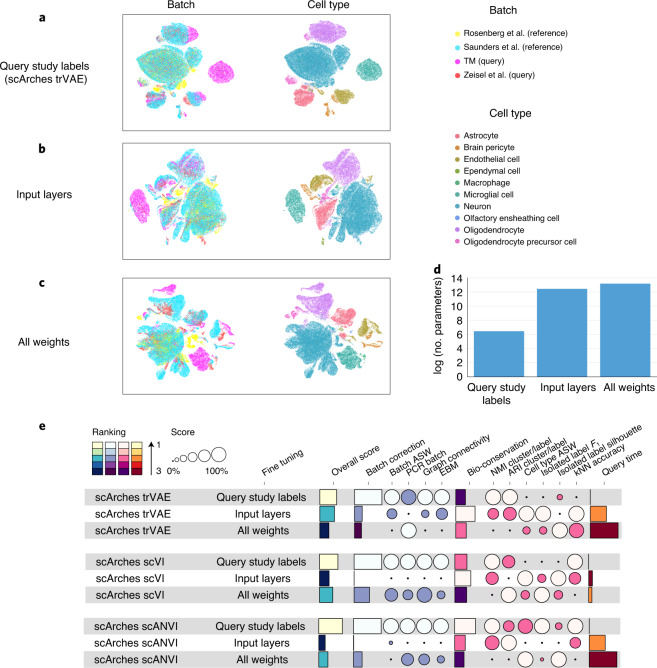
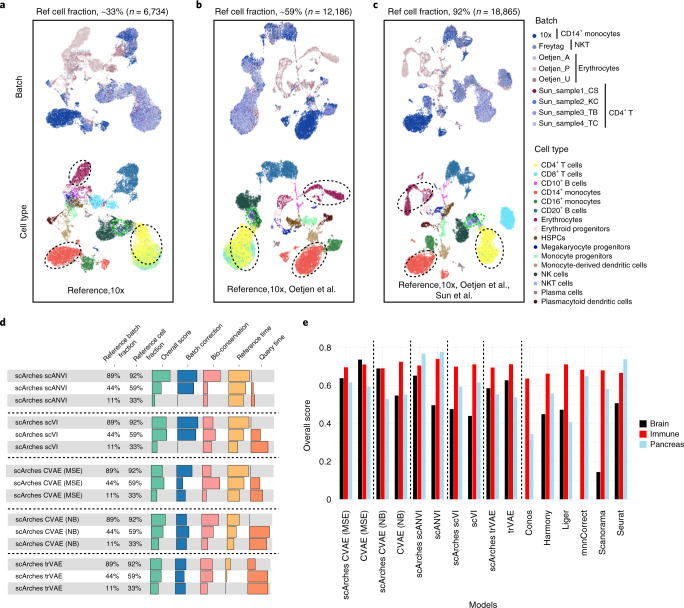
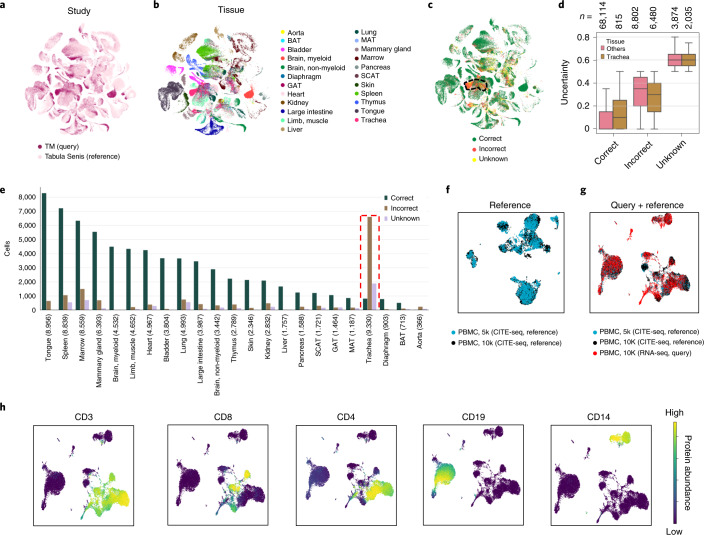
Large single-cell atlases are now routinely generated to serve as references for analysis of smaller-scale studies. Yet learning from reference data is complicated by batch effects between datasets, limited availability of computational resources and sharing restrictions on raw data. Here we introduce a deep learning strategy for mapping query datasets on top of a reference called single-cell architectural surgery (scArches). scArches uses transfer learning and parameter optimization to enable efficient, decentralized, iterative reference building and contextualization of new datasets with existing references without sharing raw data. Using examples from mouse brain, pancreas, immune and whole-organism atlases, we show that scArches preserves biological state information while removing batch effects, despite using four orders of magnitude fewer parameters than de novo integration. scArches generalizes to multimodal reference mapping, allowing imputation of missing modalities. Finally, scArches retains coronavirus disease 2019 (COVID-19) disease variation when mapping to a healthy reference, enabling the discovery of disease-specific cell states. scArches will facilitate collaborative projects by enabling iterative construction, updating, sharing and efficient use of reference atlases.
Overview
The claims and statistics of this paper haven’t been checked yet.
Free: it reads the open-access text and checks the first 5 claims that cite a source we can check. Create a free account to check every claim.
Integrity signals
Registry
Cites
Statistics
Figures
Verification
Claims the paper makes
The claims and statistics of this paper haven’t been checked yet.
Free: it reads the open-access text and checks the first 5 claims that cite a source we can check. Create a free account to check every claim.
Claims other papers make about this one
Each is checked against this paper’s own text: does it say what the citing paper says it does?
The cited source says what the claim attributes to it.
In the citing paper
“Lotfollahi et al. applied transfer learning for mapping query single cells with a decentralized and iterative updating reference model [12].”
From Challenges in AI-driven Biomedical Multimodal Data Fusion and Analysis (2025) · cites this paper as [12]
Self-check
Percentages, sums and reported differences re-computed from the paper’s own numbers.
The self-check needs the paper’s full text.
Citations
Cites
ImageNet classification with deep convolutional neural networks
Krizhevsky, A., Sutskever, I., & Hinton, G. E. (2017) · Communications of the ACM · doi:10.1145/3065386 · Cited by 112,155 · cited 1×
“These references help to understand the cellular heterogeneity that constitutes natural and inter-individual variation, aging, environmental influences and disease.”
BackgroundBERT: Pre-training of Deep Bidirectional Transformers for Language Understanding
Devlin, J., Chang, M.-W., Lee, K., & Toutanova, K. (2018) · arXiv · doi:10.48550/arxiv.1810.04805 · Cited by 73,173
Scikit-learn: Machine Learning in Python
Pedregosa, F., Varoquaux, G., Gramfort, A., Michel, V., Thirion, B., Grisel, O., Blondel, M., Müller, A., Nothman, J., Louppe, G., et al. (2012) · arXiv · doi:10.48550/arxiv.1201.0490 · Cited by 71,016 · cited 2×
“22 ) and logistic regression classifiers 50 (Supplementary Fig.”
BackgroundMethodBERT: Pre-training of Deep Bidirectional Transformers for Language Understanding
Devlin, J., Chang, M.-W., Lee, K., & Toutanova, K. (2019) · Proceedings of the 2019 Conference of the North American Chapter of the Association for Computational Linguistics: Human Language Technologies, Volume 1 (Long and Short Papers) · doi:10.18653/v1/n19-1423 · Cited by 54,325
Auto-Encoding Variational Bayes
Kingma, D. P., & Welling, M. (2013) · arXiv · doi:10.48550/arxiv.1312.6114 · Cited by 20,067
Integrated analysis of multimodal single-cell data
Hao, Y., Hao, S., Andersen-Nissen, E., Mauck, W. M., Zheng, S., Butler, A., Lee, M. J., Wilk, A. J., Darby, C., Zagar, M., et al. (2020) · doi:10.1101/2020.10.12.335331 · Cited by 15,508
Comprehensive Integration of Single-Cell Data
Stuart, T., Butler, A., Hoffman, P., Hafemeister, C., Papalexi, E., Mauck, W. M., Hao, Y., Stoeckius, M., Smibert, P., & Satija, R. (2019) · Cell · doi:10.1016/j.cell.2019.05.031 · Cited by 15,453
Fast, sensitive and accurate integration of single-cell data with Harmony
Korsunsky, I., Millard, N., Fan, J., Slowikowski, K., Zhang, F., Wei, K., Baglaenko, Y., Brenner, M., Loh, P.-R., & Raychaudhuri, S. (2019) · Nature Methods · doi:10.1038/s41592-019-0619-0 · Cited by 10,488
SCANPY: large-scale single-cell gene expression data analysis
Wolf, F. A., Angerer, P., & Theis, F. J. (2018) · Genome Biology · doi:10.1186/s13059-017-1382-0 · Cited by 8,881
Self-citationConditional Generative Adversarial Nets
Mirza, M., & Osindero, S. (2014) · arXiv · doi:10.48550/arxiv.1411.1784 · Cited by 8,863
Research works printed but not linked: 2
- Stuart T Comprehensive integration of single cell data Cell 2019 177 1888 1902 31178118 PMC6687398 · DOI · Paper page
- Sohn, K., Lee, H. & Yan, X. Learning structured output representation using deep conditional generative models. in Advances in Neural Information Processing Systems (eds. Cortes, C. et al.) 28, 3483–3491 (Curran Associates, 2015).
Cited by
Items 401–500 of 615
Progress and new challenges in image-based profiling
Serrano, E., Peters, J., Wagner, J., Graham, R. E., Chen, Z.-H., Feng, B. Y., Miranda, G., Kalinin, A. A., Vulliard, L., Tomkinson, J., et al. (2026) · Molecular Systems Biology · doi:10.1038/s44320-026-00197-7 · Cited by 7
“Tran et al, 2020; Lotfollahi et al, 2022; De Donno et al, 2023).”
InfluentialA cellular reference atlas of the human lung
Sikkema, L., & Luecken, M. (2023) · Nature Medicine · doi:10.1038/s41591-023-02329-0 · Cited by 1
Self-citationPPPCT: Privacy-Preserving framework for Parallel Clustering Transcriptomics data
Tadi, A. A., Alhadidi, D., & Rueda, L. G. (2024) · Computers in Biology and Medicine · doi:10.1016/j.compbiomed.2024.108351 · Cited by 2
Neural Network-Based Filter Design for Compressive Raman Classification of Cells
Semrau, S. (2024) · Journal of Chemical Information and Modeling · doi:10.1021/acs.jcim.3c01856 · Cited by 1
s CIRCLE—An interactive visual exploration tool for single cell RNA-Seq data
Seeger, M., Schöls, E., & Barquist, L. (2024) · NAR Genomics and Bioinformatics · doi:10.1093/nargab/lqae084 · Cited by 1
Zhu, Q., Li, A., Zhang, Z., Zheng, C., Zhao, J., Liu, J., Zhang, D., & Shao, W. (2024) · IEEE Transactions on Computational Biology and Bioinformatics · doi:10.1109/tcbb.2024.3487574 · Cited by 2
Zhou, W., Fan, X., Li, L., Zheng, J., Liu, X., Jin, W., & Tian, L. (2026) · Briefings in Bioinformatics · doi:10.1093/bib/bbag432 · Cited by 3
“Additionally, to mitigate batch effects, Garfield applies MMD [ 40] loss as an alignment strategy, which is widely utilized in batch correction [ 32, 41].”
Fan, X., Xiang, G., Liao, W., Xiao, L., He, S., Luo, N., Lu, H., & Yan, X. (2025) · Synthetic and Systems Biotechnology · doi:10.1016/j.synbio.2025.06.005 · Cited by 3
Sketching T cell atlases in the single‐cell era: challenges and recommendations
Bojović, I., Sousa, A. G. G., Junttila, S., & Elo, L. L. (2025) · Immunology and Cell Biology · doi:10.1111/imcb.70040 · Cited by 1
“For example, scArches relies on a conditional autoencoder-based model, 50 while Coralysis uses logistic regression models.”
Fang, Y., Fu, T., Xiong, Z., Zhang, Q., Liu, W., Yu, K., & Le, A. (2025) · MedComm · doi:10.1002/mco2.70284 · Cited by 1
“Subsequently, the scArches (version 0.5.0) [51] tool was employed to integrate all single-celldatasets,followingstrategiesoutlinedinpreviousstud-ies [52].”
InfluentialSANNO: A Graph-Transformer Enhanced Optimal Transport Tool for Spatial Transcriptomic Annotation
Zeng, Y., Chen, Y., Shangguan, N., Li, W., Cai, X., Zhang, H., Wang, Z., & Zhao, H. (2025) · Interdisciplinary Sciences Computational Life Sciences · doi:10.1007/s12539-025-00752-0 · Cited by 1
“…to enhance intra-class similarity while emphasizing differences across distinct cell types [25]. scNym integrates gene expression data using a semi-supervised and adversarial learning framework, and scArches combines transfer learning with parameter optimization for improved performance [26, 27].”
Motor bearing fault diagnosis based on industrial internet of things and transfer learning
Guo, D. (2025) · Frontiers in Mechanical Engineering · doi:10.3389/fmech.2025.1647310 · Cited by 2
Kumar, S., Malviya, R., Sridhar, S. B., Shareef, J., & Wadhwa, T. (2025) · Anti-Inflammatory & Anti-Allergy Agents in Medicinal Chemistry · doi:10.2174/0118715230389406250906142050 · Cited by 1
Qadir, M. M. F., Dana, C., Pittigher, M., Mauvais-Jarvis, P., Haque, N., dos Santos, T., MacDonald, P. E., Gaulton, K. J., & Mauvais‐Jarvis, F. (2026) · npj Systems Biology and Applications · doi:10.1038/s41540-026-00742-y · Cited by 1
“While our current framework was trained on transcriptomic features, its extension to mul-tiomic modalities (chromatin accessibility, proteomics, metabolomics) will be critical in re fi ning disease trajectories 13,14 .”
The cell as a token: high-dimensional geometry in language models and cell embeddings
Gilpin, W. (2025) · Bioinformatics · doi:10.1093/bioinformatics/btaf595 · Cited by 4
“Conceptually, these approaches resemble language models that combine tokenization with queries to an external data-base that provides richer context (Borgeaud et al. 2022; Khandelwal et al. 2020).”
scSpecies: enhancement of network architecture alignment in comparative single-cell studies
Schächter, C., Treppner, M., Hackenberg, M., Raum, H., Boedecker, J., & Binder, H. (2025) · Genome biology · doi:10.1186/s13059-025-03866-2 · Cited by 2
“Architecture surgery is used by a diverse set of models, enabling integration of varied datasets [9–12].”
Luo, X., Huang, Y., Zeng, H., Tao, Y., Bao, X., Feng, F., Hopkirk, A. L., Pham, T. H., Bate, T. S. R., Saunders, D. C., et al. (2025) · Nucleic Acids Research · doi:10.1093/nar/gkaf1270 · Cited by 6
“In addition to the eight baseline methods previously compared, we included three additional baselines—Matilda [ 28 ], totalVI [ 29 ], and scArches [ 30 ]—which are specifically designed for integrating multi-omic datasets measured from the same cell.”
Immune Ageing Clocks: A Methods-Oriented Review of Tasks, Modalities, Models, and Recalibration
Yu, G., Shao, Z., Zhuo, J., & Chen, Z. (2026) · Cells · doi:10.3390/cells15050421 · Cited by 3
HRCHY-CytoCommunity identifies hierarchical tissue organization in cell-type spatial maps
Xie, R., Wang, Z., Liu, J., Xu, H., Xu, Y., Lin, J., Hu, Y., & Gao, L. (2026) · Nature Communications · doi:10.1038/s41467-026-70069-z · Cited by 2
A highly resolved integrated single-cell atlas of HPV-negative head and neck cancer
Kroehling, L., Chen, A., Spinella, A., Reed, E. R., Kukuruzinska, M. A., Varelas, X., & Monti, S. (2026) · Communications Medicine · doi:10.1038/s43856-026-01401-3 · Cited by 2
SAD: Sparse-Aware Diffusion Model for Single-Cell Gene Expression Completion
Li, T., Xiang, Y., Wang, Z., Liu, M., Zou, Q., & Zhang, Y. (2026) · IEEE Transactions on Computational Biology and Bioinformatics · doi:10.1109/tcbbio.2026.3674362 · Cited by 1
A benchmark of semi-supervised scRNA-seq integration methods in real-world scenarios
Shen, X., He, C., & Guan, L. (2026) · PLoS Computational Biology · doi:10.1371/journal.pcbi.1014008 · Cited by 1
“The second most difficult is the lung atlas dataset [37], with 32,472 cells across 16 batches, followed by the human immune dataset [38], which contains 33,506 cells from 10 batches.”
Mapping the transcriptional diversity of calcium signaling in the mouse and human brain
Rayyes, I. A., Louhivuori, L. M., Ellström, I. D., Smedler, E., & Uhlén, P. (2026) · iScience · doi:10.1016/j.isci.2026.116055 · Cited by 1
He, Y., Wei, Y., Zhi, J., Huang, C. J., Han, L., Liu, S., & Wang, L. (2026) · GigaScience · doi:10.1093/gigascience/giag075 · Cited by 1
“Computational label transfer methods may force such cells into the nearest healthy category, thereby obscuring novel disease-associated states or exaggerating apparent cell-type specificity [ 121 ].”
Integrating single-cell RNA sequencing with multi-omics to decode disease microenvironments
Devi, A., Pathak, V., Dwibedi, V., Singh, J., Pathak, A. K., George, N., Kumar, A. C. S., Kaur, G., Rath, S. K., & Chatterjee, A. (2026) · Molecular Biology Reports · doi:10.1007/s11033-026-12250-7 · Cited by 2
“…model for alignment of mul - tiomics sequenced data with the original atlases, as they have all the information about the cell types and overcome the challenges like batch effects with the help of transfer learning and parameter optimisation for integrating the datasets with more accuracy [ 88].”
Translational insights and clinical challenges of targeting cancer stem cells
Ahmed, M., Al-Haidari, A., Agarwal, S., Sun, J., Hammarlund, E. U., Rönnstrand, L., Pienta, K. J., Tatlı, Ö., & Kazi, J. U. (2026) · Signal Transduction and Targeted Therapy · doi:10.1038/s41392-026-02887-y · Cited by 2
“158,159 Several studies show how these methods can translate CSC and stemness concepts into practical, testable signatures.”
Li, W., Jihad, M., Lloyd, E. G., Zaccaria, M., Mucciolo, G., Nsubuga, G., Koonan-Lonappan, A., Henríquez, J. A., Cheng, P. S. W., Harish, S., et al. (2026) · Nature Cell Biology · doi:10.1038/s41556-026-02057-w · Cited by 2
CytoVI: deep generative modeling of antibody-based single cell data
Ingelfinger, F., Levy, N., Ergen, C., Bakulin, A., Becker, A., Boyeau, P., Kim, M., Ditz, D., Dirks, J., Maaskola, J., et al. (2026) · Nature Methods · doi:10.1038/s41592-026-03224-5 · Cited by 10
“CytoVI facilitates transfer learning by leveraging pretrained reference models, following the base implementation of the scArches class in scvi-tools 11,48 .”
Self-citationLiu, W., Li, W., & Zhao, Z. (2023) · Molecular Cancer Research · doi:10.1158/1541-7786.mcr-23-0692 · Cited by 2
Hui, X. I. E., ZHANG, J., Lijuan, D. I. N. G., Tan, T., & Li, Q. (2024) · Virtual Reality & Intelligent Hardware · doi:10.1016/j.vrih.2023.08.002 · Cited by 1
Application of artificial intelligence in immuno-oncology
Monfort‐Lanzas, P., Gronauer, R., Balaz, M., Floriani, G., & Hackl, H. (2024) · Elsevier eBooks · doi:10.1016/b978-0-443-14064-8.00017-5 · Cited by 1
CellWalker2: Multi-omic discovery using hierarchical cell type relationships
Hu, Z., Przytycki, P. F., & Pollard, K. S. (2025) · Cell Genomics · doi:10.1016/j.xgen.2025.100886 · Cited by 6
Xu, Y., Dai, H., Feng, J., Xu, K., Wang, Q., Gao, P., & Zuo, C. (2025) · Frontiers in Genetics · doi:10.3389/fgene.2025.1566675 · Cited by 1
Ng, E. S., Milotay, G., Tong, O., Taylor, C. A., Sun, S., Niu, G., Watson, R. A., Sun, B., MacKay, S., Gilchrist, J. J., et al. (2025) · Science Advances · doi:10.1126/sciadv.adu3461 · Cited by 1
AI-powered image standardization in microphysiological system platforms
Park, W., Kim, C., & Ko, J. (2025) · JMST Advances · doi:10.1007/s42791-025-00112-5 · Cited by 1
“Transfer learning preserves shared biological features while accounting for context-specific differences [48].”
$$\Phi$$-Space: continuous phenotyping of single-cell multi-omics data
Mao, J., Deng, Y., & Cao, K. L. (2025) · Genome biology · doi:10.1186/s13059-025-03755-8 · Cited by 5
Single-cell characterisation of the hematopoietic bone marrow interactome in health and diseasePreprint
Ennis, S., Conforte, A. J., O’Reilly, E., Cichocka, T., Dhami, S. P. S., Nicholson, P., Krebs, P., Broin, P. Ó., & Szegezdi, É. (2022) · bioRxiv (Cold Spring Harbor Laboratory) · doi:10.1101/2022.05.13.491790 · Cited by 1
“Batch correction was performed using scArches [20] (2000 highly variable genes, 20 latent dimensions) and 464 a nearest neighbour graph was constructed from the latent dimensions (n neighbours = 15) to generate 465 a UMAP graph.”
MethodinClust: a general framework for clustering that integrates data from multiple sourcesPreprint
Wang, L., Nie, R., Zhang, Z., Gu, W., Wang, S., Wang, A., Zhang, J., & Cai, J. (2022) · bioRxiv (Cold Spring Harbor Laboratory) · doi:10.1101/2022.05.27.493706 · Cited by 1
Metacell projection for interpretable and quantitative use of transcriptional atlasesPreprint
Ben-Kiki, O., Bercovich, A., Lifshitz, A., & Tanay, A. (2022) · bioRxiv (Cold Spring Harbor Laboratory) · doi:10.1101/2022.12.01.518678 · Cited by 1
“We compared MCProj performance to scMAP (11), scARCHES (13) (using SCANVI (4)) and Seurat (3) data transfer published single cell projection schemes, using a similar cross validation strategy (Fig 2B, Supplementary Fig S1).”
BackgroundMethodHe, Z., Chen, Y., Hu, S., An, S., Shi, J., Liu, R., Zhou, J., Dong, G., Shi, J., Zhao, J., et al. (2022) · bioRxiv (Cold Spring Harbor Laboratory) · doi:10.1101/2022.12.13.520262 · Cited by 1
“To assess the performance of MIDAS in the label transfer scenario, we compared the widely used query-to-reference mapping [49, 50], reference-to-query mapping [14, 51], and our proposed reciprocal reference mapping (Methods).”
BackgroundMethodMapping cells to gene programsPreprint
Lotfollahi, M., Rybakov, S., Hrovatin, K., Hediyeh-zadeh, S., Talavera-López, C. N., Misharin, A. V., & Theis, F. J. (2023) · Research Square · doi:10.21203/rs.3.pex-2092/v1 · Cited by 1
Self-citationZeng, F., Kong, X., Yang, F., Chen, T., & Han, J. (2023) · bioRxiv (Cold Spring Harbor Laboratory) · doi:10.1101/2023.03.04.531126 · Cited by 1
Hun, M., Wen, H., Wen, M., Tian, Q., Wang, Z., Han, P., Vun, T., Som, T., Preap, B., Zhao, M., et al. (2023) · Authorea · doi:10.22541/au.168620819.99240467/v1 · Cited by 1
scResolve: Recovering single cell expression profiles from multi-cellular spatial transcriptomicsPreprint
Chen, H., Lee, Y. J., Ovando, J. A., Rosas, L., Rojas, M., Mora, A. L., Bar‐Joseph, Z., & Lugo-Martinez, J. (2023) · bioRxiv (Cold Spring Harbor Laboratory) · doi:10.1101/2023.12.18.572269 · Cited by 1
Community effort to unravel the complex human neuronal landscape exemplified for the striatumPreprint
Schultze, J. L., Agrawal, S., Scholz, R., Hartmann, C. L., Hetzel, L., Carraro, C., Bernardes, J. P., Lautwein, T., Reinhardt, S., Franitza, M., et al. (2024) · Research Square · doi:10.21203/rs.3.rs-3960911/v1 · Cited by 2
Self-citationRayyes, I. A., Louhivuori, L. M., Ellström, I. D., Smedler, E., & Uhlén, P. (2024) · bioRxiv (Cold Spring Harbor Laboratory) · doi:10.1101/2024.04.26.591400 · Cited by 1
“To assess the evolutionary conservation of the Ca 2+ signaling transcriptome during cortical development, we mapped cell types restricted to only Ca 2+ genes ( 31 ) onto the mouse neocortical dataset of Telley et al. ( 32 ), spanning from embryonic day 12 (E12) to postnatal day 0 (P0) (Fig.”
MethodLiu, Y., Shen, R., Zhou, L., Xiao, Q., Yuan, J., & Li, Y. (2024) · bioRxiv (Cold Spring Harbor Laboratory) · doi:10.1101/2024.05.19.594895 · Cited by 1
Genomics-FM: Universal Foundation Model for Versatile and Data-Efficient Functional Genomic AnalysisPreprint
Ye, P., Bai, W., Ren, Y., Li, W., Qiao, L., Liang, C., Wang, L., Cai, Y., Sun, J., Yang, Z., et al. (2024) · SSRN Electronic Journal · doi:10.1101/2024.07.16.603653 · Cited by 10
“Previous studies have shown that AI models trained on sequences and epigenetic markers of the model organism can be transferred to other species for predictions (Zhang et al., 2022a; Lotfollahi et al., 2022).”
BackgroundOzmen, F., Ozmen, T. Y., Ors, A., Janghorban, M., Rames, M. J., Li, X., Behbod, F., Mills, G. B., & Mohammed, H. (2024) · medRxiv · doi:10.1101/2024.09.25.24314388 · Cited by 1
Enhancement of Network Architecture Alignment in Comparative Single-Cell StudiesPreprint
Schächter, C., Treppner, M., Hackenberg, M., Raum, H., Boedecker, J., & Binder, H. (2024) · Qeios · doi:10.32388/d37aff · Cited by 1
Building a single cell transcriptome-based coordinate system for cell ID with SUREPreprint
Zeng, F., & Han, J. (2024) · bioRxiv (Cold Spring Harbor Laboratory) · doi:10.1101/2024.11.13.623403 · Cited by 2
A universal single-cell transcriptomics atlas of human lung decodes multiple pulmonary diseasesPreprint
Wu, F., Cai, W., Tang, H. C., Zheng, S., Zhang, H., Chen, Y., Han, Y., Zhou, D., Wang, R., Ye, M., et al. (2024) · bioRxiv (Cold Spring Harbor Laboratory) · doi:10.1101/2024.12.17.628654 · Cited by 1
Benchmarking single cell transcriptome matching methods for incremental growth of cell atlasesPreprint
Hu, J. K., Peng, B. F., Pankajam, A. V., Xu, B., Deshpande, V., Bueckle, A., Herr, B. W., Dupont, C. L., Börner, K., Scheuermann, R. H., et al. (2025) · bioRxiv (Cold Spring Harbor Laboratory) · doi:10.1101/2025.04.10.648034 · Cited by 4
GDF15 reprograms the microenvironment to drive the development of uveal melanoma liver metastasesPreprint
Sriramareddy, S. N., Siddarajappa, N., Park, J. S., Nguyen, T., Kuznetsoff, J. N., Kurtenbach, S., Dollar, J. J., Adams, D., Licht, J. D., Corrêa, Z. M., et al. (2025) · bioRxiv (Cold Spring Harbor Laboratory) · doi:10.1101/2025.05.07.652654 · Cited by 1
Kriukov, E., Labrecque, E., Refaian, N., & Baranov, P. Y. (2025) · bioRxiv (Cold Spring Harbor Laboratory) · doi:10.1101/2025.08.02.668295 · Cited by 1
Bondeelle, L., Bezrukov, F., Berra, G., Chalandon, Y., Gensous, C., Loison, S., Giannotti, F., Messe, R., LeGoff, J., Clément, S., et al. (2025) · bioRxiv (Cold Spring Harbor Laboratory) · doi:10.64898/2025.12.26.696372 · Cited by 2
Ludington, L., Ouardini, K., Sécheresse, X., Loeb, R., Pignet, A., Domingues, O. D., & Cabeli, V. (2026) · bioRxiv (Cold Spring Harbor Laboratory) · doi:10.64898/2026.01.12.699017 · Cited by 3
“SEDR used Harmony-preprocessed counts; scVI leveraged scArches [24] for inference on unseen samples.”
IDTrack: Time- and Namespace-Aware Identifier Harmonization for Reproducible WorkflowsPreprint
İnecik, K., Erken, E., & Theis, F. J. (2026) · bioRxiv (Cold Spring Harbor Laboratory) · doi:10.64898/2026.02.05.703984 · Cited by 1
“…studies quantified against di ! erent Ensembl releases and identifier conventions scatter the same gene across non-matching labels, fragmenting equivalent features into redundant columns or losing them entirely to string-mismatch exclusion when pooled without explicit harmonization (1; 2; 3).”
Self-citationReveron‐Thornton, R. F., Agolia, J. P., Guo, C., Korah, M. M., Hsu, C.-H., Xie, P. Y., Flojo, R. A. B., Delitto, A. E., Gonçalves, A., Tabora, A. D., et al. (2026) · bioRxiv (Cold Spring Harbor Laboratory) · doi:10.64898/2026.02.14.705396 · Cited by 1
“21,52,53 Our approach was explicitly designed to yield a compact yet biologically coherent reference that avoids the distortions introduced by low-depth profiles and outlier populations.”
Type 2 diabetes amplifies environmental Pb toxicity and intergenerational riskPreprint
Zhang, C., Xia, X., Zhang, C., Pei, C., Guo, Z., Li, G., Xu, L., Luo, H., Ma, J., Luo, J., et al. (2026) · bioRxiv (Cold Spring Harbor Laboratory) · doi:10.64898/2026.02.21.707175 · Cited by 1
Perturbation-guided mapping of colorectal cancer cell states to causal mechanismsPreprint
Hediyeh-zadeh, S., Toh, T. S., Dufva, O., Serra, G., Jakhmola, R., Fourneaux, C., Pinto, G., Fang, Z., Picco, G., Oliver, A. J., et al. (2026) · bioRxiv (Cold Spring Harbor Laboratory) · doi:10.64898/2026.03.03.708171 · Cited by 1
“Unlike existing atlas-scale integration solutions 31,37 , which are prone to over-integration 56 , our expansion by regularization approach balances the alignment of healthy states while retaining context-specific variation.”
Self-citationHidden immune memory niches in inflammatory skin diseasesPreprint
Steele, L., Foster, A. R., Roberts, K., Admane, C., Birk, S., Mazin, P., Akbarnejad, A., Tudor, C., Rumney, B. M., Chan, H. M., et al. (2026) · bioRxiv (Cold Spring Harbor Laboratory) · doi:10.64898/2026.03.20.713219 · Cited by 4
Self-citationDataset structure outweighs method choice in single-cell cell-type annotationPreprint
Wardhana, O. (2026) · bioRxiv (Cold Spring Harbor Laboratory) · doi:10.64898/2026.08.28.747622 · Cited by 1
“…such as support vector machines, random forests, regularized regression, discriminant analysis, and mixture models [16–20] while deep-learning [21, 22] and semi-supervised [23, 24] models learn nonlinear representations and additionally adapt to the unlabeled query distribution, respectively.”
An immune world model for multiscale forecasting and therapeutic hypothesis generation
Cui, T., Wang, X., Li, Z., Ding, J., You, L., Xu, Y., Xu, W., Wu, F., Ying, K., Ouyang, W., et al. (2026) · arXiv · doi:10.48550/arxiv.2609.14709
Pedoman Peri-operatif Renal Assessment
Sinaga, U. M. (2009)
Fast model-free standardization and integration of single-cell transcriptomics dataPreprint
Xu, Y., Kramann, R., McCord, R. P., & Hayat, S. (2022) · bioRxiv (Cold Spring Harbor Laboratory) · doi:10.1101/2022.03.28.486110
Deep Learning Methods for Single-Cell Omics Data
Wang, J., & Chen, T. (2022) · Springer handbooks of computational statistics · doi:10.1007/978-3-662-65902-1_6
Uncovering hidden biological processes by probabilistic filtering of single-cell dataPreprint
Piran, Z., & Nitzan, M. (2023) · bioRxiv (Cold Spring Harbor Laboratory) · doi:10.1101/2023.01.18.524512
Ten, F. W., Yuan, D., Jabareen, N., Phua, Y. J., Eils, R., Lukassen, S., & Conrad, C. (2023) · Frontiers in Cell and Developmental Biology · doi:10.3389/fcell.2023.1091047
“of tools with a bigger aim of tackling dataset integration by mapping queries to reference datasets (Lotfollahi et al., 2022).”
BackgroundWang, L., Nie, R., Cai, Y., Wang, A., Zhang, H., Zhang, J., & Cai, J. (2023) · bioRxiv (Cold Spring Harbor Laboratory) · doi:10.1101/2023.03.13.532376
Yan, D., Sun, Z., Fang, J., Cao, S., Wang, W., Chang, X., Badirli, S., Fu, H., & Liu, Y. (2023) · Journal of Biopharmaceutical Statistics · doi:10.1080/10543406.2023.2208671
Deciphering subcellular organization with multiplexed imaging and deep learning
(2023) · Nature Methods · doi:10.1038/s41592-023-01895-y · Cited by 1
Cai, S., Liao, Y., Lai, L., Zhou, H., & Xie, L. (2023) · Engineering Applications of Artificial Intelligence · doi:10.1016/j.engappai.2023.107032
Strauß, M. E., Ton, M.-L. N., Mason, S., Bagri, J., Harland, L. T. G., Imaz-Rosshandler, I., Wilson, N. K., Nichols, J., Tyser, R. C. V., Göttgens, B., et al. (2023) · bioRxiv (Cold Spring Harbor Laboratory) · doi:10.1101/2023.10.11.561904
Wehbe, F., Adams, L., Yuen, S., Kim, Y., & Tanaka, Y. (2023) · bioRxiv (Cold Spring Harbor Laboratory) · doi:10.1101/2023.12.01.569595
scAuto as a comprehensive framework for single-cell chromatin accessibility data analysis
Gong, M., Yu, Y., Wang, Z., Zhang, J., Wang, X., Fu, C., Zhang, Y., & Wang, X. (2024) · Computers in Biology and Medicine · doi:10.1016/j.compbiomed.2024.108230 · Cited by 1
Kuppe, C. (2023) · Research Publications (Maastricht University) · doi:10.26481/dis.20231004ck
In vitro spatiotemporal reconstruction of human skeletal muscle organogenesisPreprint
Mavrommatis, L., Daya, N., Volke, L., Lu, I., Zhuge, H., Stehling, M., Zeuschner, D., Jeong, H., Yang, J.-H., zu Hörste, G. M., et al. (2024) · bioRxiv (Cold Spring Harbor Laboratory) · doi:10.1101/2024.05.10.593520
Zhang, G., Song, C., Yin, M., Liu, L., Zhang, Y., Li, Y., Zhang, J., Guo, M., & Li, C. (2024) · bioRxiv (Cold Spring Harbor Laboratory) · doi:10.1101/2024.05.17.594242
Luo, M., Zeng, Y., Chen, J., Shangguan, N., Zhou, W., & Yang, Y. (2024) · Lecture notes in computer science · doi:10.1007/978-981-97-5131-0_10
Single-Cell Drug Perturbations Prediction Using Machine Learning
Prajapati, M., Baliarsingh, S. K., Dev, P. P., Nayak, S., & Biswal, M. R. (2024) · Communications in computer and information science · doi:10.1007/978-3-031-64067-4_3
A deep generative model for capturing cell to phenotype relationshipsPreprint
Weinberger, E., Yu, P. Z., & Lee, S. (2024) · bioRxiv (Cold Spring Harbor Laboratory) · doi:10.1101/2024.08.07.606396
Continual integration of single-cell multimodal data with MIRACLE
Zhou, J., Wang, J., Hu, S., Kan, T., Feng, C., Qiang, X., Dong, G., Shi, J., Liu, R., Bo, X., et al. (2026) · Nature Computational Science · doi:10.1038/s43588-026-01030-9 · Cited by 2
“Generalization-based approaches 11,13,14 map new data onto a reference using pretrained models, but their performance depends heavily on the scale and diversity of training data and they struggle to capture previously unseen biological or technical variations.”
InfluentialAminzadeh, F., Wu, J., He, J., Saberi, M., & Vafaee, F. (2024) · bioRxiv (Cold Spring Harbor Laboratory) · doi:10.1101/2024.10.04.616599
Radiotherapy triggers pro-angiogenic signaling in human lungPreprint
Soulier, J., Curras-Alonso, S., Dubail, M., Laporte, H., Ayan, M., Lafouasse, C., Colin, D., Côté, J.-F., Didier, J., Pouliquen, C., et al. (2024) · bioRxiv (Cold Spring Harbor Laboratory) · doi:10.1101/2024.10.11.617840 · Cited by 2
“The objects from individual patients were annotated using ScArches[21] and the Human Lung Cell Atlas as a reference[22] using a transfer learning method: the ScArches algorithm was trained on the Human Lung Cell Atlas, and the model was then applied to each of our sample individually.”
MethodPrediction of context-specific regulatory programs and pathways using interpretable deep learningPreprint
Doncevic, D., Alvarez, C. R., Li, A., Zhang, Y., Bachmann, A., Noack, K., & Herrmann, C. (2024) · bioRxiv (Cold Spring Harbor Laboratory) · doi:10.1101/2024.11.06.622202 · Cited by 2
Cai, Z., Hu, Z., Sun, S.-R., Wang, Z., Yang, F., Han, J., & Zeng, F. (2024) · bioRxiv (Cold Spring Harbor Laboratory) · doi:10.1101/2024.11.16.622584
Quantifying pathological progression from single-cell transcriptomic data with scPSS
Khan, S. R., Rahman, M. S., Rahman, M. S., & Samee, M. A. H. (2026) · Genome Research · doi:10.1101/2024.11.27.625593
“Current methods based on dimensionality reduction (Kobak and Berens 2019; Xiang et al. 2021) and machine learning (Lotfollahi et al. 2022; Michielsen et al. 2023) can effectively classify cells into known states but cannot quantify the degree of shift from a reference state.”
Shang, J., Zhao, Y., Qin, B., Zhang, L., Meng, X., Ge, D., & Liu, J. (2025) · Neurocomputing · doi:10.1016/j.neucom.2025.129708 · Cited by 1
Larcombe, S. D., Paxton, E. A., Vrettou, C., Steketee, P. C., Matthews, K. R., Morrison, L. J., & Briggs, E. M. (2025) · bioRxiv (Cold Spring Harbor Laboratory) · doi:10.1101/2025.02.21.639415
Cell Type-Agnostic Transcriptomic Signatures Enable Uniform Comparisons of NeurodevelopmentPreprint
Venkatesan, S., Werner, J. M., Li, Y., & Gillis, J. A. (2025) · bioRxiv (Cold Spring Harbor Laboratory) · doi:10.1101/2025.02.24.639936
“B, Within-study and cross-study performance (Mean Absolute Error in weeks) of study-specific compositional models (leave-sample-out cross validation, see Supplementary Fig 2).”
InfluentialHuang, L., Lu, X., & Chen, D. (2025) · IEEE Journal of Biomedical and Health Informatics · doi:10.1109/jbhi.2025.3552536 · Cited by 2
“This experimental setting is not limited to single-cell drug repurposing studies; it is also commonly employed in other single-cell computational studies, such as scArches [44], scTab [45], and CellHint [46].”
Reconstructing signaling histories of single cells via perturbation screens and transfer learning
Hutchins, N. T., Meziane, M., Lu, C., Mitalipova, M. M., Fischer, D. S., & Li, P. (2026) · Nature Methods · doi:10.1038/s41592-026-03213-8 · Cited by 5
Gerstner, N., Fröhlich, A. S., Matosin, N., Binder, E. B., & Arloth, J. (2025) · medRxiv · doi:10.1101/2025.03.17.25324098
High resolution tissue and cell type identification via single cell transcriptomic profiling
Liu, M., Zheng, S., Li, H., Budowle, B., Wang, L., Lou, Z., & Ge, J. (2025) · PLoS ONE · doi:10.1371/journal.pone.0318151 · Cited by 1
A single-cell and tissue-scale analysis suite resolves Mixl1’s role in heart development
Strauß, M. E., Ton, M.-L. N., Mason, S., Bagri, J., Harland, L. T. G., Imaz-Rosshandler, I., Wilson, N. K., Nichols, J., Tyser, R. C. V., Göttgens, B., et al. (2025) · iScience · doi:10.1016/j.isci.2025.112397
Xia, T., Sun, J., Luo, Y., Guo, H., Mao, Y., Xu, L., Lü, F., & Wang, Y. (2025) · Cell Genomics · doi:10.1016/j.xgen.2025.100848 · Cited by 3
“36,37 These strategies include vertical integration methods (e.g., MOJITOO, 38 scAI 39 ), horizontal integration methods (e.g., totalVI, 40 UINMF 41 ), and mosaic integration algorithms (e.g., totalVI, UINMF, scArches 42 ), each tailored to address specific challenges.”
Metadata
- Authors
- Lotfollahi, M., Naghipourfar, M., Luecken, M. D., Khajavi, M., Büttner, M., Wagenstetter, M., Avsec, Ž., Gayoso, A., Yosef, N., Interlandi, M., Rybakov, S., Misharin, A. V., & Theis, F. J.
- Affiliations
- Helmholtz Munich (DE)
- Technical University of Munich (DE)
- University of California, Berkeley (US)
- Ragon Institute of MGH, MIT and Harvard (US)
- University of Münster (DE)
- Northwestern University (US)
- Corresponding author
- Theis, Fabian J.
- ORCID
- Venue
- Nature Biotechnology
- Published
- 2021-08-30
- Volume
- 40
- Issue
- 1
- Pages
- 121-130
- ISSN
- 0733-222X (ISSN-L)
- 1087-0156
- 1546-1696
- PMC
- PMC8763644
- OpenAlex
- W3196650609
- Semantic Scholar
- cec0cf40c589ecaa6d779b8433d96393fdcd9fdc
- Cited by
- 602
- References
- 76
- Citations by year
- 2026: 130 · 2025: 144 · 2024: 146 · 2023: 116 · 2022: 57 · 2021: 7
- FWCI
- 26.29
- Type
- journal article
- Language
- en
- Open access
- hybrid
- doi.org
- Licence
- cc-by
- creativecommons.org/licenses/by/4.0 (tdm)
- creativecommons.org/licenses/by/4.0 (vor)
- Locations
- Nature Biotechnology (publishedVersion, cc-by)
- PubMed Central (publishedVersion, cc-by)
- PubMed (publishedVersion)
- PuSH - Publication Server of Helmholtz Zentrum München (submittedVersion, cc-by)
- eScholarship (California Digital Library) (submittedVersion)
- mediaTUM (Technical University of Munich) (submittedVersion, other-oa)
- Site cant be reached (submittedVersion, cc-by)
- Funders
- Deutsche Forschungsgemeinschaft (ZT-I-0007)
- Topics
- Life Sciences › Biochemistry, Genetics and Molecular Biology › Molecular Biology › Single-cell and spatial transcriptomics
- Life Sciences › Biochemistry, Genetics and Molecular Biology › Molecular Biology › Gene Regulatory Network Analysis
- Life Sciences › Biochemistry, Genetics and Molecular Biology › Molecular Biology › Bioinformatics and Genomic Networks
- Keywords
- transfer learning, single-cell data integration, batch effect correction, mouse brain atlas
- MeSH terms
- Deep Learning, COVID-19, SARS-CoV-2, Animals, Humans, Organ Specificity, Reference Standards, Mice, Single-Cell Analysis, Datasets as Topic
About these checks
Registry, retraction, Cites and statistics results are computed, not judged, with one exception: a printed reference that no index lists is read once by a model before it counts as a citation error. Claims are extracted by a model and kept only when their quote appears verbatim in the text; each cited source is then checked, with a model’s help, for whether it says what the claim relies on. Those verdicts can be wrong — read the claim’s quote and the cited source before relying on one.
Statistics and arithmetic are recomputed, not judged.
Confidence bands are shown only for fields calibrated on our annotated test set. None is calibrated yet, so no band is shown.
What counts as a claim ›How we measure confidence ›How we check this ›
Are you an author, or do you see a problem with this page? Request a review
Data sources
Bibliographic data: Semantic Scholar, OpenAlex, Crossref.
Contains information from the Semantic Scholar Academic Graph Datasets, made available under the ODC Attribution License (ODC-BY 1.0).
Semantic Scholar’s data is described in: Kinney, R., et al. (2023). The Semantic Scholar Open Data Platform. arXiv:2301.10140.
