

Mapping single-cell data to reference atlases by transfer learning
Open accessThe DOI matches its Crossref record; 84 of the 84 references it cites were found in a registry or an index.
Abstract
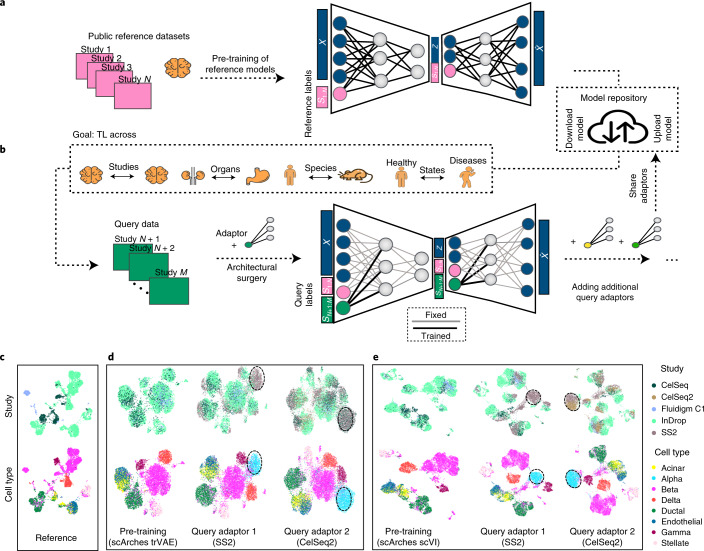
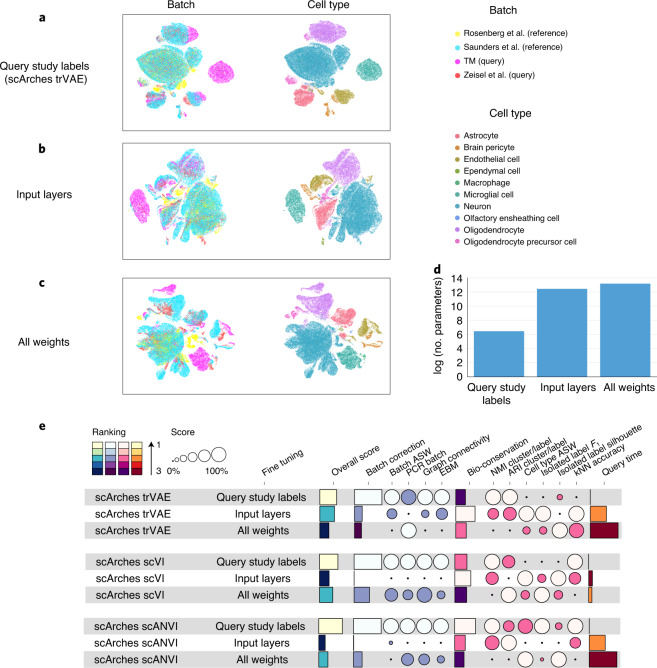
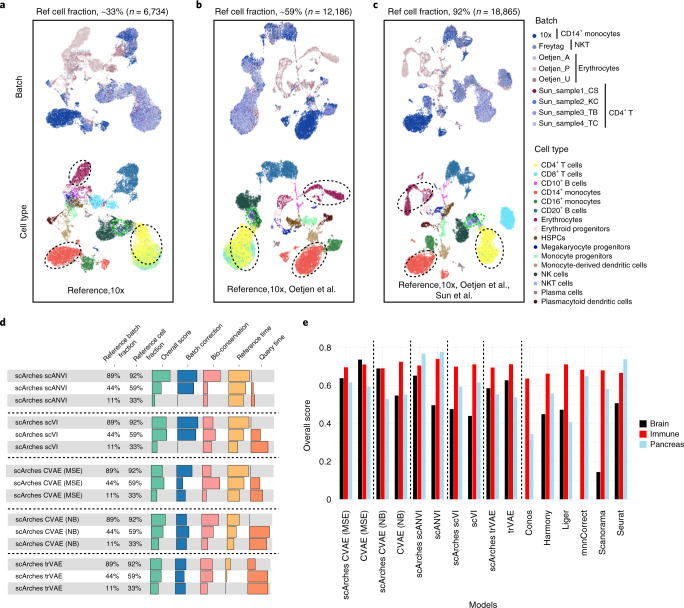
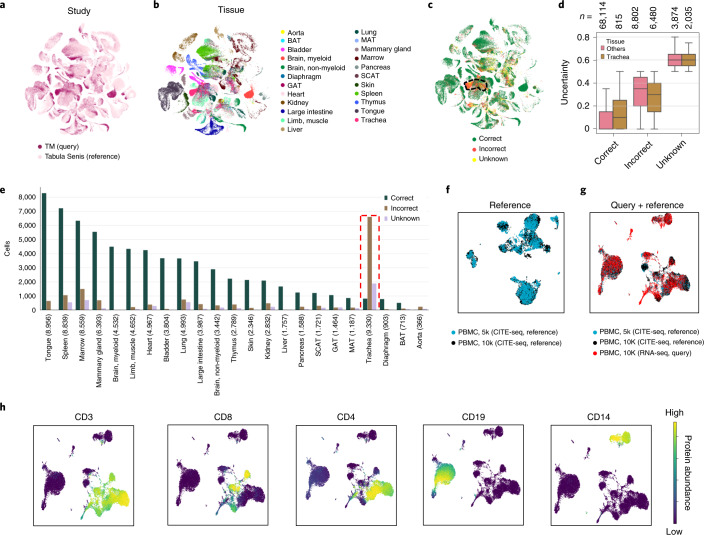
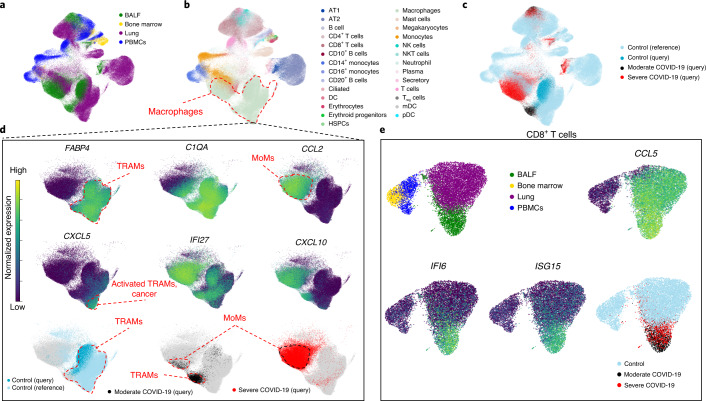
Large single-cell atlases are now routinely generated to serve as references for analysis of smaller-scale studies. Yet learning from reference data is complicated by batch effects between datasets, limited availability of computational resources and sharing restrictions on raw data. Here we introduce a deep learning strategy for mapping query datasets on top of a reference called single-cell architectural surgery (scArches). scArches uses transfer learning and parameter optimization to enable efficient, decentralized, iterative reference building and contextualization of new datasets with existing references without sharing raw data. Using examples from mouse brain, pancreas, immune and whole-organism atlases, we show that scArches preserves biological state information while removing batch effects, despite using four orders of magnitude fewer parameters than de novo integration. scArches generalizes to multimodal reference mapping, allowing imputation of missing modalities. Finally, scArches retains coronavirus disease 2019 (COVID-19) disease variation when mapping to a healthy reference, enabling the discovery of disease-specific cell states. scArches will facilitate collaborative projects by enabling iterative construction, updating, sharing and efficient use of reference atlases.
Overview
The claims and statistics of this paper haven’t been checked yet.
Free: it reads the open-access text and checks the first 5 claims that cite a source we can check. Create a free account to check every claim.
Integrity signals
Registry
Cites
Statistics
Figures
Verification
Claims the paper makes
The claims and statistics of this paper haven’t been checked yet.
Free: it reads the open-access text and checks the first 5 claims that cite a source we can check. Create a free account to check every claim.
Claims other papers make about this one
Each is checked against this paper’s own text: does it say what the citing paper says it does?
The cited source says what the claim attributes to it.
In the citing paper
“Lotfollahi et al. applied transfer learning for mapping query single cells with a decentralized and iterative updating reference model [12].”
From Challenges in AI-driven Biomedical Multimodal Data Fusion and Analysis (2025) · cites this paper as [12]
Self-check
Percentages, sums and reported differences re-computed from the paper’s own numbers.
The self-check needs the paper’s full text.
Citations
Cites
ImageNet classification with deep convolutional neural networks
Krizhevsky, A., Sutskever, I., & Hinton, G. E. (2017) · Communications of the ACM · doi:10.1145/3065386 · Cited by 112,155 · cited 1×
“These references help to understand the cellular heterogeneity that constitutes natural and inter-individual variation, aging, environmental influences and disease.”
BackgroundBERT: Pre-training of Deep Bidirectional Transformers for Language Understanding
Devlin, J., Chang, M.-W., Lee, K., & Toutanova, K. (2018) · arXiv · doi:10.48550/arxiv.1810.04805 · Cited by 73,173
Scikit-learn: Machine Learning in Python
Pedregosa, F., Varoquaux, G., Gramfort, A., Michel, V., Thirion, B., Grisel, O., Blondel, M., Müller, A., Nothman, J., Louppe, G., et al. (2012) · arXiv · doi:10.48550/arxiv.1201.0490 · Cited by 71,016 · cited 2×
“22 ) and logistic regression classifiers 50 (Supplementary Fig.”
BackgroundMethodBERT: Pre-training of Deep Bidirectional Transformers for Language Understanding
Devlin, J., Chang, M.-W., Lee, K., & Toutanova, K. (2019) · Proceedings of the 2019 Conference of the North American Chapter of the Association for Computational Linguistics: Human Language Technologies, Volume 1 (Long and Short Papers) · doi:10.18653/v1/n19-1423 · Cited by 54,325
Auto-Encoding Variational Bayes
Kingma, D. P., & Welling, M. (2013) · arXiv · doi:10.48550/arxiv.1312.6114 · Cited by 20,067
Integrated analysis of multimodal single-cell data
Hao, Y., Hao, S., Andersen-Nissen, E., Mauck, W. M., Zheng, S., Butler, A., Lee, M. J., Wilk, A. J., Darby, C., Zagar, M., et al. (2020) · doi:10.1101/2020.10.12.335331 · Cited by 15,508
Comprehensive Integration of Single-Cell Data
Stuart, T., Butler, A., Hoffman, P., Hafemeister, C., Papalexi, E., Mauck, W. M., Hao, Y., Stoeckius, M., Smibert, P., & Satija, R. (2019) · Cell · doi:10.1016/j.cell.2019.05.031 · Cited by 15,453
Fast, sensitive and accurate integration of single-cell data with Harmony
Korsunsky, I., Millard, N., Fan, J., Slowikowski, K., Zhang, F., Wei, K., Baglaenko, Y., Brenner, M., Loh, P.-R., & Raychaudhuri, S. (2019) · Nature Methods · doi:10.1038/s41592-019-0619-0 · Cited by 10,488
SCANPY: large-scale single-cell gene expression data analysis
Wolf, F. A., Angerer, P., & Theis, F. J. (2018) · Genome Biology · doi:10.1186/s13059-017-1382-0 · Cited by 8,881
Self-citationConditional Generative Adversarial Nets
Mirza, M., & Osindero, S. (2014) · arXiv · doi:10.48550/arxiv.1411.1784 · Cited by 8,863
Research works printed but not linked: 2
- Stuart T Comprehensive integration of single cell data Cell 2019 177 1888 1902 31178118 PMC6687398 · DOI · Paper page
- Sohn, K., Lee, H. & Yan, X. Learning structured output representation using deep conditional generative models. in Advances in Neural Information Processing Systems (eds. Cortes, C. et al.) 28, 3483–3491 (Curran Associates, 2015).
Cited by
Dictionary learning for integrative, multimodal and scalable single-cell analysis
Hao, Y., Stuart, T., Kowalski, M. H., Choudhary, S., Hoffman, P., Hartman, A., Srivastava, A., Molla, G., Madad, S., Fernandez-Granda, C., et al. (2024) · Nature Biotechnology · doi:10.1038/s41587-023-01767-y · Cited by 5,631
“This strategy is enabled by the curation and public release of reference datasets as well as the development of new computational tools, including statistical learning 4–7 and deep learning-based approaches 8,9 , that have been successfully applied toward this goal.”
scGPT: Towards Building a Foundation Model for Single-Cell Multi-omics Using Generative AI
Cui, H., Wang, C., Maan, H., Pang, K., Luo, F., & Wang, B. (2023) · doi:10.1101/2023.04.30.538439 · Cited by 1,694
Cross-tissue immune cell analysis reveals tissue-specific features in humans
Domínguez Conde, C., Xu, C., Jarvis, L. B., Rainbow, D. B., Wells, S. B., Gomes, T., Howlett, S. K., Suchanek, O., Polanski, K., King, H. W., et al. (2022) · Science · doi:10.1126/science.abl5197 · Cited by 1,159
Self-citationBest practices for single-cell analysis across modalities
Heumos, L., Schaar, A. C., Lance, C., Litinetskaya, A., Drost, F., Zappia, L., Lücken, M. D., Strobl, D. C., Henao, J., Curion, F., et al. (2023) · Nature Reviews Genetics · doi:10.1038/s41576-023-00586-w · Cited by 1,051
“Failing to account for multiple sources of biological variability for experiments will inflate the FDR 90,91 .”
BackgroundSelf-citationAlzubaidi, L., Bai, J., Al-Sabaawi, A., Santamaría, J., Albahri, A. S., Al-dabbagh, B. S. N., Fadhel, M. A., Manoufali, M., Zhang, J., Al-Timemy, A. H., et al. (2023) · Journal of Big Data · doi:10.1186/s40537-023-00727-2 · Cited by 907
“High-level generalization is needed for the initially trained model, so new data can be adapted [128, 129, 219].”
BackgroundAn integrated cell atlas of the lung in health and disease
Sikkema, L., Ramírez-Suástegui, C., Strobl, D. C., Gillett, T. E., Zappia, L., Madissoon, E., Markov, N. S., Zaragosi, L.-E., Ji, Y., Ansari, M., et al. (2023) · Nature Medicine · doi:10.1038/s41591-023-02327-2 · Cited by 854
“= c , N c ) is the weighted (by edge weights) proportion of N c with label y , as previously described 113 .”
Self-citationA Python library for probabilistic analysis of single-cell omics data
Gayoso, A., Lopez, R., Xing, G., Boyeau, P., Valiollah Pour Amiri, V., Hong, J., Wu, K., Jayasuriya, M., Mehlman, E., Langevin, M., et al. (2022) · Nature Biotechnology · doi:10.1038/s41587-021-01206-w · Cited by 789
Self-citationSalcher, S., Sturm, G., Horvath, L., Untergasser, G., Kuempers, C., Fotakis, G., Panizzolo, E., Martowicz, A., Trebo, M., Pall, G., et al. (2022) · Cancer Cell · doi:10.1016/j.ccell.2022.10.008 · Cited by 477
Spatially resolved multiomics of human cardiac niches
Kanemaru, K., Cranley, J., Muraro, D., Miranda, A. M. A., Ho, S. Y., Wilbrey-Clark, A., Patrick Pett, J., Polanski, K., Richardson, L., Litvinukova, M., et al. (2023) · Nature · doi:10.1038/s41586-023-06311-1 · Cited by 425
Zeng, A. G. X., Bansal, S., Jin, L., Mitchell, A., Chen, W. C., Abbas, H. A., Chan-Seng-Yue, M., Voisin, V., van Galen, P., Tierens, A., et al. (2022) · Nature Medicine · doi:10.1038/s41591-022-01819-x · Cited by 332
Mapping the developing human immune system across organs
Suo, C., Dann, E., Goh, I., Jardine, L., Kleshchevnikov, V., Park, J.-E., Botting, R. A., Stephenson, E., Engelbert, J., Tuong, Z. K., et al. (2022) · Science · doi:10.1126/science.abo0510 · Cited by 340
“To facilitate the rapid reuse of our atlas for the analysis of newly collected samples, we made the weights from trained scVI models available to enable mapping of external scRNA-seq datasets using transfer learning with single-cell architectural surgery (scArches) (15).”
BackgroundMethodInfluentialProfiling cell identity and tissue architecture with single-cell and spatial transcriptomics
Gulati, G. S., D’Silva, J. P., Liu, Y., Wang, L., & Newman, A. M. (2025) · Nature Reviews Molecular Cell Biology · doi:10.1038/s41580-024-00768-2 · Cited by 293
Predicting cellular responses to complex perturbations in high‐throughput screens
Lotfollahi, M., Klimovskaia Susmelj, A., De Donno, C., Hetzel, L., Ji, Y., Ibarra, I. L., Srivatsan, S. R., Naghipourfar, M., Daza, R. M., Martin, B., et al. (2023) · Molecular Systems Biology · doi:10.15252/msb.202211517 · Cited by 307
Self-citationSingle-cell analysis of shared signatures and transcriptional diversity during zebrafish development
Sur, A., Wang, Y., Capar, P., Margolin, G., Prochaska, M. K., & Farrell, J. A. (2023) · Developmental Cell · doi:10.1016/j.devcel.2023.11.001 · Cited by 265
HypoMap—a unified single-cell gene expression atlas of the murine hypothalamus
Steuernagel, L., Lam, B. Y. H., Klemm, P., Dowsett, G. K. C., Bauder, C. A., Tadross, J. A., Hitschfeld, T. S., del Rio Martin, A., Chen, W., de Solis, A. J., et al. (2022) · Nature Metabolism · doi:10.1038/s42255-022-00657-y · Cited by 267
Machine Learning for Lung Cancer Diagnosis, Treatment, and Prognosis
Li, Y., Wu, X., Yang, P., Jiang, G., & Luo, Y. (2022) · Genomics, Proteomics & Bioinformatics · doi:10.1016/j.gpb.2022.11.003 · Cited by 263
“For sequencing datasets, transfer learning has also been used in deep NNs to provide a generalizability approach [193], which could be a good example of building a general and robust model for lung cancer sequencing data analysis.”
MethodHerring, C. A., Simmons, R. K., Freytag, S., Poppe, D., Moffet, J. J. D., Pflueger, J., Buckberry, S., Vargas-Landin, D. B., Clément, O., Echeverría, E. G., et al. (2022) · Cell · doi:10.1016/j.cell.2022.09.039 · Cited by 238
“A reference for cell developmental analysis in health, disease, and organoid models of maturation We also leveraged our atlas to enhance interpretation of additional snRNA-seq analyses of the PFC and its in vitro models, modifying a transfer learning strategy (Lotfollahi et al., 2022) to stably integrate additional sn…”
Efficient and precise single-cell reference atlas mapping with Symphony
Kang, J. B., Nathan, A., Weinand, K., Zhang, F., Millard, N., Rumker, L., Moody, D. B., Korsunsky, I., & Raychaudhuri, S. (2021) · Nature Communications · doi:10.1038/s41467-021-25957-x · Cited by 231
Baião, A. R., Cai, Z., Poulos, R. C., Robinson, P. J., Reddel, R. R., Zhong, Q., Vinga, S., & Gonçalves, E. (2025) · Briefings in Bioinformatics · doi:10.1093/bib/bbaf355 · Cited by 211
“Multigrate allows multimodal reference building, query data mapping into a reference atlas using transfer learning [143], and missing modalities imputation.”
CellCharter reveals spatial cell niches associated with tissue remodeling and cell plasticity
Varrone, M., Tavernari, D., Santamaria-Martínez, A., Walsh, L. A., & Ciriello, G. (2024) · Nature Genetics · doi:10.1038/s41588-023-01588-4 · Cited by 210
“Dimensionality reduction and batch effect correction are then performed using variational autoencoders (VAEs) 42–44 , which are neural networks mapping the input features into embeddings in a latent space.”
Single-cell and spatial transcriptomics analysis of non-small cell lung cancer
De Zuani, M., Xue, H., Park, J. S., Dentro, S. C., Seferbekova, Z., Tessier, J., Curras-Alonso, S., Hadjipanayis, A., Athanasiadis, E. I., Gerstung, M., et al. (2024) · Nature Communications · doi:10.1038/s41467-024-48700-8 · Cited by 209
“1A, B and Supplementary Data 1).”
InfluentialComparative transcriptomics reveals human-specific cortical features
Jorstad, N. L., Song, J. H. T., Exposito-Alonso, D., Suresh, H., Castro-Pacheco, N., Krienen, F. M., Yanny, A. M., Close, J., Gelfand, E., Long, B., et al. (2023) · Science · doi:10.1126/science.ade9516 · Cited by 208
“For each of the five cell-type neighborhoods(non-neuronal,MGE-andCGE-derivedinterneurons,andIT-andnon-IT-projectingexcitatoryneurons),webuilta referencewithfourprimatedatasetsandused thefifthprimatedatasetasqueryforcelltype annotationusingscArches( 40 ).”
BackgroundSpatially organized cellular communities form the developing human heart
Farah, E. N., Hu, R. K., Kern, C., Zhang, Q., Lu, T.-Y., Ma, Q., Tran, S., Zhang, B., Carlin, D., Monell, A., et al. (2024) · Nature · doi:10.1038/s41586-024-07171-z · Cited by 200
An atlas of cells in the human tonsil
Massoni-Badosa, R., Aguilar-Fernández, S., Nieto, J. C., Soler-Vila, P., Elosua-Bayes, M., Marchese, D., Kulis, M., Vilas-Zornoza, A., Bühler, M. M., Rashmi, S., et al. (2024) · Immunity · doi:10.1016/j.immuni.2024.01.006 · Cited by 183
“, 2017), these taxonomies identified previously uncharacterized cell types and provided a reference to annotate cell types and states by training classifiers (Kang et al., 2021; Lotfollahi et al., 2022) and through curated cell ontologies (Osumi-Sutherland et al.”
BackgroundAn integrated single-cell reference atlas of the human endometrium
Marečková, M., Garcia-Alonso, L., Moullet, M., Lorenzi, V., Petryszak, R., Sancho-Serra, C., Oszlanczi, A., Icoresi Mazzeo, C., Wong, F. C. K., Kelava, I., et al. (2024) · Nature Genetics · doi:10.1038/s41588-024-01873-w · Cited by 179
“We used the scArches model surgery framework 99 to project new samples profiling human cervix from control donors onto the same latent space as single-cell HECA.”
MethodSelf-citationTransformers in single-cell omics: a review and new perspectives
Szałata, A., Hrovatin, K., Becker, S., Tejada-Lapuerta, A., Cui, H., Wang, B., & Theis, F. J. (2024) · Nature Methods · doi:10.1038/s41592-024-02353-z · Cited by 171
“In contrast to popular models based on variational autoencoders (VAEs) 56 such as scVI 13 and scArches 57 or recently proposed SCimilarity 14 that explicitly learn low-dimensional embed-dings, transformers do not produce low-dimensional cell embeddings through the commonly used pretraining tasks…”
Self-citationThe Human Cell Atlas from a cell census to a unified foundation model
Rood, J. E., Wynne, S., Robson, L., Hupalowska, A., Randell, J., Teichmann, S. A., & Regev, A. (2025) · Nature · doi:10.1038/s41586-024-08338-4 · Cited by 161
“The HCA community has now developed a cohort of computational methods to generate references (for example, Azimuth 35 ), integrate them with new data (for example, SCArches 32 ), annotate them (for example, CellTypist, CellHint 36 ) query them (for example, SCimilar-ity 22 ) and more (for example, SEACells 37 , CellRa…”
Universal Cell Embeddings: A Foundation Model for Cell Biology
Rosen, Y., Roohani, Y., Agrawal, A., Samotorcan, L., Consortium, T. S., Quake, S. R., & Leskovec, J. (2023) · bioRxiv (Cold Spring Harbor Laboratory) · doi:10.1101/2023.11.28.568918 · Cited by 162
“Notably, UCE even performs slightly better than non-zero-shot methods that require dataset-specific training: scVI [15] and scArches [18].”
An integrated transcriptomic cell atlas of human neural organoids
He, Z., Dony, L., Fleck, J. S., Szałata, A., Li, K. X., Slišković, I., Lin, H., Santel, M., Atamian, A., Quadrato, G., et al. (2024) · Nature · doi:10.1038/s41586-024-08172-8 · Cited by 209
Self-citationA cell atlas foundation model for scalable search of similar human cells
Heimberg, G., Kuo, T., DePianto, D. J., Salem, O., Heigl, T., Diamant, N., Scalia, G., Biancalani, T., Turley, S. J., Rock, J. R., et al. (2025) · Nature · doi:10.1038/s41586-024-08411-y · Cited by 136
Deep learning applications in single-cell genomics and transcriptomics data analysis
Erfanian, N., Heydari, A. A., Feriz, A. M., Iañez, P., Derakhshani, A., Ghasemigol, M., Farahpour, M., Razavi, S. M., Nasseri, S., Safarpour, H., et al. (2023) · Biomedicine & Pharmacotherapy · doi:10.1016/j.biopha.2023.115077 · Cited by 140
“Moreover, these studies scArches Facilitates the integration of query datasets onto a reference dataset through data integration Not reported [88] ExpiMap Enables the interpretable mapping of SC transcriptome data sets across cohorts, disease states and other perturbations.”
scBasset: sequence-based modeling of single-cell ATAC-seq using convolutional neural networks
Yuan, H., & Kelley, D. R. (2022) · Nature Methods · doi:10.1038/s41592-022-01562-8 · Cited by 147
“…cell-type labels using the adjusted rand index (ARI), adjusted mutual information (AMI) and homogeneity 6 or by directly evaluating the distance between cells of the same label by cell type average silhouette width (ASW) 18 . scBas-set outperforms the other methods across these metrics (Fig.”
MethodInfluentialscBasset: Sequence-based modeling of single cell ATAC-seq using convolutional neural networks
Yuan, H., & Kelley, D. R. (2021) · doi:10.1101/2021.09.08.459495 · Cited by 138
Browaeys, R., Gilis, J., Sang-Aram, C., De Bleser, P., Hoste, L., Tavernier, S., Lambrechts, D., Seurinck, R., & Saeys, Y. (2023) · bioRxiv (Cold Spring Harbor Laboratory) · doi:10.1101/2023.06.13.544751 · Cited by 133
SPACEL: deep learning-based characterization of spatial transcriptome architectures
Xu, H., Wang, S., Fang, M., Luo, S., Chen, C., Wan, S., Wang, R., Tang, M., Xue, T., Li, B., et al. (2023) · Nature Communications · doi:10.1038/s41467-023-43220-3 · Cited by 127
“We anticipate that transfer learning models and algorithms (e.g., ImageNet 61 and BERT 62 ), which have been used in bioinformatics tasks such as cell type classi fi cation for large-scale single-cell data 63 – 66 , can help us to overcome this limitation.”
Population-level integration of single-cell datasets enables multi-scale analysis across samples
Donno, C. D., Hediyeh-zadeh, S., Moinfar, A. A., Wagenstetter, M., Zappia, L., Lotfollahi, M., & Theis, F. J. (2023) · Nature Methods · doi:10.1038/s41592-023-02035-2 · Cited by 152
“Algorithms for efficient use of reference atlases are known as reference mapping methods 19–21 , which build upon data integration algorithms to update an existing atlas by integrating a query dataset.”
MethodSelf-citationTowards multimodal foundation models in molecular cell biology
Cui, H., Tejada-Lapuerta, A., Brbić, M., Sáez-Rodríguez, J., Cristea, S., Goodarzi, H., Lotfollahi, M., Theis, F. J., & Wang, B. (2025) · Nature · doi:10.1038/s41586-025-08710-y · Cited by 183
“Reference mapping has been pioneered in studies of Seurat (v4) 58 and scArches 59 , in which cell types and other meta information can be propagated from a rich context of cell atlases to new cells of interest.”
Self-citationComputational solutions for spatial transcriptomics
Kleino, I., Frolovaitė, P., Suomi, T., & Elo, L. L. (2022) · Computational and Structural Biotechnology Journal · doi:10.1016/j.csbj.2022.08.043 · Cited by 130
“For instance, scvi-tools has two automated cell type annotation meth-ods, and the option to use the scArches [120] transfer learning models, in addition to dataset integration, to annotate new data-sets even with different modality reference data.”
MethodCD201+ fascia progenitors choreograph injury repair
Correa‐Gallegos, D., Ye, H., Dasgupta, B., Sardogan, A., Kadri, S., Kandi, R., Dai, R., Lin, Y., Kopplin, R., Shenai, D. S., et al. (2023) · Nature · doi:10.1038/s41586-023-06725-x · Cited by 137
“Annotation of human fibroblast clusters was performed using scArches 54 .”
MethodSingle-cell transcriptomics for the assessment of cardiac disease
Miranda, A. M. A., Janbandhu, V., Maatz, H., Kanemaru, K., Cranley, J., Teichmann, S. A., Hübner, N., Schneider, M. D., Harvey, R. P., & Noseda, M. (2023) · Nature Reviews Cardiology · doi:10.1038/s41569-022-00805-7 · Cited by 117
Single-cell integration reveals metaplasia in inflammatory gut diseases
Oliver, A. J., Huang, N., Bartolomé-Casado, R., Li, R., Koplev, S., Nilsen, H. R., Moy, M. R., Çakır, B., Polański, K., Gudiño, V., et al. (2024) · Nature · doi:10.1038/s41586-024-07571-1 · Cited by 142
Miyoshi, E., Morabito, S., Henningfield, C. M., Das, S., Rahimzadeh, N., Shabestari, S. K., Michael, N., Emerson, N., Reese, F., Shi, Z., et al. (2024) · Nature Genetics · doi:10.1038/s41588-024-01961-x · Cited by 115
“Using our new snRNA-seq dataset as the reference, we projected the three published datasets into the reference latent space using scANVI 25 , and we performed transfer learning to predict cell identities using scArches 68 .”
Automating the design-build-test-learn cycle towards next-generation bacterial cell factories
Gurdo, N., Volke, D. C., McCloskey, D., & Nikel, P. I. (2023) · New Biotechnology · doi:10.1016/j.nbt.2023.01.002 · Cited by 112
A reference cell tree will serve science better than a reference cell atlas
Domcke, S., & Shendure, J. (2023) · Cell · doi:10.1016/j.cell.2023.02.016 · Cited by 122
Pei, S., Shelton, I. T., Gillen, A. E., Stevens, B. M., Gasparetto, M., Wang, Y., Liu, L., Liu, J., Brunetti, T. M., Engel, K. L., et al. (2023) · Cancer Discovery · doi:10.1158/2159-8290.cd-22-1297 · Cited by 123
A brain cell atlas integrating single-cell transcriptomes across human brain regions
Chen, X., Huang, Y., Huang, L., Huang, Z., Hao, Z.-Z., Xu, L., Xu, N., Li, Z., Mou, Y., Ye, M., et al. (2024) · Nature Medicine · doi:10.1038/s41591-024-03150-z · Cited by 134
“5.5) 65 , CHETAH (v1.”
InfluentialZhang, J., Ubas, A. A., de Borja, R., Svensson, V., Thomas, N., Thakar, N., Lai, I., Winters, A., Khan, U., Jones, M. G., et al. (2025) · bioRxiv (Cold Spring Harbor Laboratory) · doi:10.1101/2025.02.20.639398 · Cited by 106
PeakVI: A deep generative model for single-cell chromatin accessibility analysis
Ashuach, T., Reidenbach, D. A., Gayoso, A., & Yosef, N. (2022) · Cell Reports Methods · doi:10.1016/j.crmeth.2022.100182 · Cited by 106
Self-citationA unified computational framework for single-cell data integration with optimal transport
Cao, K., Gong, Q., Hong, Y., & Wan, L. (2022) · Nature Communications · doi:10.1038/s41467-022-35094-8 · Cited by 102
An Integrated Map of Cell Type–Specific Gene Expression in Pancreatic Islets
Elgamal, R. M., Kudtarkar, P., Melton, R. L., Mummey, H. M., Benaglio, P., Okino, M.-L., & Gaulton, K. J. (2023) · Diabetes · doi:10.2337/db23-0130 · Cited by 116
“Raw count values for each sample were corrected using the SoupX contamination estimates and the round-to-integer feature, ensuring resulting counts remain integers for use in down-stream analyses (19).”
MethodHarmonized single-cell landscape, intercellular crosstalk and tumor architecture of glioblastoma
Ruiz-Moreno, C., Salas, S. M., Samuelsson, E., Brandner, S., Kranendonk, M. E. G., Nilsson, M., & Stunnenberg, H. G. (2022) · bioRxiv (Cold Spring Harbor Laboratory) · doi:10.1101/2022.08.27.505439 · Cited by 103
“…employed a semi-supervised neural network model (scANVI) (Xu et al., 2021) implemented in the transfer-learning framework of the scArches algorithm (Lotfollahi et al., 2021), which takes advantage of the uniform prior cell type labeling to harmonize the datasets while preserving cell biodiversity.”
BackgroundMethodInfluentialSingle-cell profiling to explore pancreatic cancer heterogeneity, plasticity and response to therapy
Bärthel, S., Falcomatà, C., Rad, R., Theis, F. J., & Saur, D. (2023) · Nature Cancer · doi:10.1038/s43018-023-00526-x · Cited by 119
Self-citationNetskar, H., Pfefferle, A., Goodridge, J. P., Sohlberg, E., Dufva, O., Teichmann, S. A., Brownlie, D., Michaëlsson, J., Marquardt, N., Clancy, T., et al. (2024) · Nature Immunology · doi:10.1038/s41590-024-01884-z · Cited by 137
“Then, scArches 44 as implemented in scvi-tools 19 was used to map these new data on to the established reference.”
A spatial human thymus cell atlas mapped to a continuous tissue axis
Yayon, N., Kedlian, V. R., Boehme, L., Suo, C., Wachter, B. T., Beuschel, R. T., Amsalem, O., Polański, K., Koplev, S., Tuck, E. J., et al. (2024) · Nature · doi:10.1038/s41586-024-07944-6 · Cited by 142
“…(i) based on KNN graph majority voting of neighbouring cells with annotations from previous studies by adaptation of the weighted KNN transfer solution from scArches 45 , or (ii) automatic label transfer using CellTypist 46 v.1.6.2 with the Developing_Human_ Thymus or Pan_Fetal_Human models.”
InfluentialBiologically informed deep learning to query gene programs in single-cell atlases
Lotfollahi, M., Rybakov, S., Hrovatin, K., Hediyeh-zadeh, S., Talavera-López, C., Misharin, A. V., & Theis, F. J. (2023) · Nature Cell Biology · doi:10.1038/s41556-022-01072-x · Cited by 100
Self-citationNicheformer: a foundation model for single-cell and spatial omics
Tejada-Lapuerta, A., Schaar, A. C., Gutgesell, R., Palla, G., Halle, L., Minaeva, M., Vornholz, L., Dony, L., Drummer, F., Richter, T., et al. (2025) · Nature Methods · doi:10.1038/s41592-025-02814-z · Cited by 100
“The field of single-cell biology has taken up deep learning-based representation learning for some time, leveraging autoencoders 16,17 for analysis tasks like data integration 18 , atlas mapping 19 and perturbation prediction 20 .”
Self-citationApplication of Deep Learning on Single-Cell RNA Sequencing Data Analysis: A Review
Brendel, M., Su, C., Bai, Z., Zhang, H., Elemento, O., & Wang, F. (2022) · Genomics Proteomics & Bioinformatics · doi:10.1016/j.gpb.2022.11.011 · Cited by 122
“…space. scAdapt has shown significance in cell annotation in simulated, cross-platforms, cross-species, and spatial transcriptomic datasets. scArches [134] used an architecture by concate-nating nodes for new batches or datasets to existing autoencoder frameworks, to leverage information from other…”
BackgroundSingle-cell analysis of chromatin accessibility in the adult mouse brain
Zu, S., Li, Y. E., Wang, K., Armand, E. J., Mamde, S., Amaral, M. L., Wang, Y., Chu, A., Xie, Y., Miller, M., et al. (2023) · Nature · doi:10.1038/s41586-023-06824-9 · Cited by 116
Spatially restricted and ontogenically distinct hepatic macrophages are required for tissue repair
De Ponti, F. F., Bujko, A., Liu, Z., Collins, P. J., Schuermans, S., Maueroder, C., Amstelveen, S., Thoné, T., Martens, L., McKendrick, J. G., et al. (2025) · Immunity · doi:10.1016/j.immuni.2025.01.002 · Cited by 94
Quantitative characterization of cell niches in spatially resolved omics data
Birk, S., Bonafonte-Pardàs, I., Feriz, A. M., Boxall, A. R., Agirre, E., Memi, F., Maguza, A., Yadav, A., Armingol, E., Fan, R., et al. (2025) · Nature Genetics · doi:10.1038/s41588-025-02120-6 · Cited by 142
“To map unseen query datasets onto spatial reference atlases, we use weight-restricted fine-tuning inspired by architectural surgery 95 .”
Self-citationLi, Q. (2023) · Genome biology · doi:10.1186/s13059-023-02988-9 · Cited by 118
“To evaluate the degree of batch correction and biological signal conservation, three metrics from scArches [80] and scIB [81] were used.”
MethodDelineating mouse β-cell identity during lifetime and in diabetes with a single cell atlas
Hrovatin, K., Bastidas-Ponce, A., Bakhti, M., Zappia, L., Büttner, M., Salinno, C., Sterr, M., Böttcher, A., Migliorini, A., Lickert, H., et al. (2023) · Nature Metabolism · doi:10.1038/s42255-023-00876-x · Cited by 86
Self-citationLang, N. J., Gote-Schniering, J., Porras-Gonzalez, D., Yang, L., Sadeleer, L. D., Jentzsch, R. C., Shitov, V. A., Zhou, S., Ansari, M., Agami, A., et al. (2023) · Science Translational Medicine · doi:10.1126/scitranslmed.adh0908 · Cited by 104
“1H) ( 25 ) to map both the ex vivo hPCLS data and the in vivo PF scRNA-seq data to the healthy integrated Human Lung Cell Atlas (HLCA) (fig.”
BackgroundMethodSelf-citationMosaic integration and knowledge transfer of single-cell multimodal data with MIDAS
He, Z., Hu, S., Chen, Y., An, S., Zhou, J., Liu, R., Shi, J., Wang, J., Dong, G., Shi, J., et al. (2024) · Nature Biotechnology · doi:10.1038/s41587-023-02040-y · Cited by 84
“…the reference data to infer the biological states for the query data 50,51 ) and (2) mapping the reference data onto the query space (that is, applying the model fine-tuned on the query data (see ‘Model transfer via transfer learning’) to infer the biological states for the reference data 14,52 ).”
Ge, S., Sun, S., Xu, H., Cheng, Q. S., & Ren, Z. (2025) · Briefings in Bioinformatics · doi:10.1093/bib/bbaf136 · Cited by 107
“We have collected 17 methods, including BABEL [167], CMAE [168], LIGER [117], Seurat [126], cTP-net [169], scArches [170], scMoGNN [171], scVAEIT [172], sciPENN [173], totalVI [157], Generalized Linear Model (GLM), MCIA [174], MOFA [175], CGVAE [161], ccVAE [164], PoE [159], MoE [160], to…”
Steele, L., Olabi, B., Roberts, K., Mazin, P., Koplev, S., Tudor, C. L., Rumney, B. M., Admane, C., Jiang, T., Correa‐Gallegos, D., et al. (2025) · Nature Immunology · doi:10.1038/s41590-025-02267-8 · Cited by 111
Self-citationPrecise identification of cell states altered in disease using healthy single-cell references
Dann, E., Cujba, A.-M., Oliver, A. J., Meyer, K. B., Teichmann, S. A., & Marioni, J. C. (2023) · Nature Genetics · doi:10.1038/s41588-023-01523-7 · Cited by 95
“For each simulated atlas, control and disease dataset assignment, we embedded the reference and query datasets into a common latent space using transfer learning with scArches 9 on scVI models 9,26 , using the implementation in the Python package scvi-tools v.0.17.4 (ref.”
BackgroundMethodInfluentialA time- and single-cell-resolved model of murine bone marrow hematopoiesis
Kuciński, I., Campos, J., Barile, M., Severi, F., Bohin, N., Moreira, P. N., Allen, L., Lawson, H., Haltalli, M. L. R., Kinston, S., et al. (2024) · Cell stem cell · doi:10.1016/j.stem.2023.12.001 · Cited by 93
The future of rapid and automated single-cell data analysis using reference mapping
Lotfollahi, M., Hao, Y., Theis, F. J., & Satija, R. (2024) · Cell · doi:10.1016/j.cell.2024.03.009 · Cited by 86
Self-citationBenchmarking algorithms for single-cell multi-omics prediction and integration
Hu, Y., Wan, S., Luo, Y., Li, Y., Wu, T., Deng, W., Jiang, C., Jiang, S., Zhang, Y., Liu, N., et al. (2024) · Nature Methods · doi:10.1038/s41592-024-02429-w · Cited by 95
“20 and 21).”
Challenges in AI-driven Biomedical Multimodal Data Fusion and Analysis
Liu, J., Cen, X., Yi, C., Wang, F.-A., Ding, J., Cheng, J., Wu, Q., Gai, B., Zhou, Y., He, R., et al. (2025) · Genomics, Proteomics & Bioinformatics · doi:10.1093/gpbjnl/qzaf011 · Cited by 75
Semi-supervised integration of single-cell transcriptomics data
Andreatta, M., Hérault, L., Gueguen, P., Gfeller, D., Berenstein, A. J., & Carmona, S. J. (2024) · Nature Communications · doi:10.1038/s41467-024-45240-z · Cited by 78
A guide to systems-level immunomics
Bonaguro, L., Schulte-Schrepping, J., Ulas, T., Aschenbrenner, A. C., Beyer, M., & Schultze, J. L. (2022) · Nature Immunology · doi:10.1038/s41590-022-01309-9 · Cited by 86
He, S., Jin, Y., Nazaret, A., Shi, L., Chen, X., Rampersaud, S., Dhillon, B. S., Valdez, I. K., Friend, L. E., Fan, J. L., et al. (2024) · Nature Biotechnology · doi:10.1038/s41587-024-02173-8 · Cited by 100
“Inspired by successful implementations of deep generative models in single-cell omics analysis (scvi-tools 19 , scVI 20 , totalVI 21 , scArches 22 , trVAE 23 , scANVI 24 , MrVI 25 ), Starfysh jointly models ST and histology as data observed from a shared low-dimensional latent mixing of signals…”
Bailey, J. I., Puritz, C. H., Senkow, K. J., Markov, N. S., Diaz, E., Jonasson, E., Yu, Z., Swaminathan, S., Lu, Z., Fenske, S. W., et al. (2024) · Nature Immunology · doi:10.1038/s41590-024-01975-x · Cited by 85
“…data to a more recent version of the reference genome (GRCh38 build 93 supplemented with SARS-CoV-2 genome, which was used to align data from the present study and that of Bharat et al. 19 ) and used scArches 60 to transfer cell-type labels from the build 84 object on to the build 93 object.”
MethodSelf-citationThe covariance environment defines cellular niches for spatial inference
Haviv, D., Remšík, J., Gatie, M. I., Snopkowski, C., Takizawa, M., Pereira, N., Bashkin, J., Jovanovich, S. B., Nawy, T., Chaligné, R., et al. (2024) · Nature Biotechnology · doi:10.1038/s41587-024-02193-4 · Cited by 104
Contrastive learning enables rapid mapping to multimodal single-cell atlas of multimillion scale
Yang, M., Yang, Y., Xie, C., Ni, M., Liu, J., Yang, H., Mu, F., & Wang, J. (2022) · Nature Machine Intelligence · doi:10.1038/s42256-022-00518-z · Cited by 80
“Finally, query-to-reference mapping has become popular to enable quick interpretation of newly generated datasets without laborious de novo clustering or manual annotation 18 .”
BackgroundMethodInfluentialIntegrated single-cell atlas of human atherosclerotic plaques
Traeuble, K., Munz, M., Pauli, J., Sachs, N., Vafadarnejad, E., Carrillo‐Roa, T., Mäegdefessel, L., Kastner, P., & Heinig, M. (2025) · Nature Communications · doi:10.1038/s41467-025-63202-x · Cited by 89
“We then proceeded with the atlas building step by transferring level 1 cell type annotations to the remaining unlabeled cells using the scArches 38 method.”
Isolating salient variations of interest in single-cell data with contrastiveVI
Weinberger, E., Lin, C., & Lee, S.-I. (2023) · Nature Methods · doi:10.1038/s41592-023-01955-3 · Cited by 66
“Many recent studies proposed probabilistic latent variable models for analyzing single37 cell data [11, 12, 13].”
BackgroundNicheformer: A Foundation Model for Single-Cell and Spatial OmicsPreprint
Schaar, A. C., Tejada-Lapuerta, A., Palla, G., Gutgesell, R. M., Halle, L., Minaeva, M., Vornholz, L., Dony, L., Drummer, F., Bahrami, M., et al. (2024) · bioRxiv (Cold Spring Harbor Laboratory) · doi:10.1101/2024.04.15.589472 · Cited by 66
Self-citationConsiderations for building and using integrated single-cell atlases
Hrovatin, K., Sikkema, L., Shitov, V. A., Heimberg, G., Shulman, M., Oliver, A. J., Mueller, M. F., Ibarra, I. L., Wang, H., Ramírez-Suástegui, C., et al. (2024) · Nature Methods · doi:10.1038/s41592-024-02532-y · Cited by 76
“Cells can also be automatically annotated using marker genes 12,24 or via label transfer 10,83,85 .”
InfluentialSelf-citationIntegration and Querying of Multimodal Single-Cell Data with PoE-VAE
Litinetskaya, A., Shulman, M., Curion, F., Szałata, A., Omidi, A., Lotfollahi, M., & Theis, F. J. (2025) · Lecture notes in computer science · doi:10.1007/978-3-031-90252-9_36 · Cited by 66
Self-citationDeep learning in spatially resolved transcriptomics: a comprehensive technical view
Zahedi, R., Ghamsari, M. R. E., Argha, A., MacPhillamy, C., Beheshti, A., Alizadehsani, R., Lovell, N. H., Lotfollahi, M., & Alinejad‐Rokny, H. (2024) · Briefings in Bioinformatics · doi:10.1093/bib/bbae082 · Cited by 94
“Results: StLearn examined twelve human and mouse brain datasets and achieved a greater Adjusted Rand Index (ARI) value compared to the SpatialLIBD (a graph-based clustering method) [4] and detected two more tissue layers than Seurat.”
Self-citationSchäfer, P. S. L., Dimitrov, D., Villablanca, E. J., & Sáez-Rodríguez, J. (2024) · Nature Immunology · doi:10.1038/s41590-024-01768-2 · Cited by 80
“Complementary, different algorithms have been proposed to automatically annotate single-cell data 10,130–132 based on the plethora of high-quality datasets that have been annotated by experts 9,11 .”
Generative pretraining from large-scale transcriptomes for single-cell deciphering
Shen, H., Liu, J., Hu, J., Shen, X., Zhang, C., Wu, D., Feng, M., Yang, M., Li, Y., Yang, Y., et al. (2023) · iScience · doi:10.1016/j.isci.2023.106536 · Cited by 95
scTab: Scaling cross-tissue single-cell annotation models
Fischer, F., Fischer, D. S., Mukhin, R., Isaev, A., Biederstedt, E., Villani, A.-C., & Theis, F. J. (2024) · Nature Communications · doi:10.1038/s41467-024-51059-5 · Cited by 59
“Nevertheless, a dominant paradigm of the cell type annotation task has been annotation transfer 16 , speci fi cally the approach of projecting entire samples of cells on an annotated reference atlas to transfer cell type labels 1,17,18 .”
Self-citationPerturbNet predicts single-cell responses to unseen chemical and genetic perturbations
Yu, H., Qian, W., Song, Y., & Welch, J. D. (2025) · Molecular Systems Biology · doi:10.1038/s44320-025-00131-3 · Cited by 57
Single cell dual-omic atlas of the human developing retina
Zuo, Z. C., Cheng, X., Ferdous, S., Shao, J., Li, J., Bao, Y., Li, J., Lu, J., Lopez, A. J., Wohlschlegel, J., et al. (2024) · Nature Communications · doi:10.1038/s41467-024-50853-5 · Cited by 66
Qian, J., Shao, X., Bao, H., Yin, F., Guo, W., Li, C., Li, A., Hua, H., & Fan, X. (2025) · Nature Communications · doi:10.1038/s41467-025-57029-9 · Cited by 67
Liu, X., Shen, Q., & Zhang, S. (2022) · Genome Research · doi:10.1101/gr.276868.122 · Cited by 70
Dopp, J., Ortega, A., Davie, K., Poovathingal, S. K., Baz, E., & Liu, S. (2024) · Nature Neuroscience · doi:10.1038/s41593-023-01549-4 · Cited by 59
New horizons at the interface of artificial intelligence and translational cancer research
Yates, J., & Allen, E. M. V. (2025) · Cancer Cell · doi:10.1016/j.ccell.2025.03.018 · Cited by 63
Deep generative modeling of sample-level heterogeneity in single-cell genomics
Boyeau, P., Hong, J., Gayoso, A., Kim, M., McFaline-Figueroa, J. L., Jordan, M. I., Azizi, E., Ergen, C., & Yosef, N. (2025) · Nature Methods · doi:10.1038/s41592-025-02808-x · Cited by 55
“As another extension, adapting existing transfer learning protocols to MrVI [56] could enable the analysis of smaller datasets.”
Self-citationSingle-cell RNA-seq methods to interrogate virus-host interactions
Ratnasiri, K., Wilk, A. J., Lee, M. J., Khatri, P., & Blish, C. A. (2022) · Seminars in Immunopathology · doi:10.1007/s00281-022-00972-2 · Cited by 57
Methods and Insights from Single-Cell Expression Quantitative Trait Loci
Kang, J. B., Raveane, A., Nathan, A., Soranzo, N., & Raychaudhuri, S. (2023) · Annual Review of Genomics and Human Genetics · doi:10.1146/annurev-genom-101422-100437 · Cited by 65
“Another approach is to use single-cell reference mapping (71, 90, 138) to project cells from query datasets into continuous cell states defined using existing reference datasets.”
MethodDrost, F., An, Y., Bonafonte-Pardàs, I., Dratva, L. M., Lindeboom, R. G. H., Haniffa, M. A., Teichmann, S. A., Theis, F. J., Lotfollahi, M., & Schubert, B. (2024) · Nature Communications · doi:10.1038/s41467-024-49806-9 · Cited by 64
“Within the domain of single-cell analysis, leveraging reference-based techniques has enhanced the ef fi ciency of rapidly analyzing newly generated datasets 52,53 .”
InfluentialSelf-citationZhang, G., Song, C., Yin, M., Liu, L., Zhang, Y., Li, Y., Zhang, J., Guo, M., & Li, C. (2025) · Nature Communications · doi:10.1038/s41467-025-58921-0 · Cited by 58
“Deep learning algorithms have achieved considerable success in solving these speci fi c biological problems 13,14 .”
Gutgesell, R. M., Khalil, A., Liśkiewicz, A., Maity‐Kumar, G., Novikoff, A., Grandl, G., Liśkiewicz, D., Coupland, C., Karaoglu, E., Akindehin, S., et al. (2025) · Nature Metabolism · doi:10.1038/s42255-025-01294-x · Cited by 62
“We mapped our own data with the Hes 53 and Ludwig 54 datasets into a joint latent space using scArches 75 , and then mapped the parameters for hierarchical progressive learning from scHPL v1.”
Self-citationscMAE: a masked autoencoder for single-cell RNA-seq clustering
Fang, Z., Zheng, R., & Li, M. (2024) · Bioinformatics · doi:10.1093/bioinformatics/btae020 · Cited by 61
“Following Lotfollahi (Lotfollahi et al. 2022), we scale the ASW scores to a range between 0 and 1 using the formula: Larger values correspond to denser clusters.”
MethodFröhlich, A. S., Gerstner, N., Gagliardi, M., Ködel, M., Yusupov, N., Matosin, N., Czamara, D., Sauer, S., Roeh, S., Murek, V., et al. (2024) · Nature Neuroscience · doi:10.1038/s41593-024-01742-z · Cited by 66
Metadata
- Authors
- Lotfollahi, M., Naghipourfar, M., Luecken, M. D., Khajavi, M., Büttner, M., Wagenstetter, M., Avsec, Ž., Gayoso, A., Yosef, N., Interlandi, M., Rybakov, S., Misharin, A. V., & Theis, F. J.
- Affiliations
- Helmholtz Munich (DE)
- Technical University of Munich (DE)
- University of California, Berkeley (US)
- Ragon Institute of MGH, MIT and Harvard (US)
- University of Münster (DE)
- Northwestern University (US)
- Corresponding author
- Theis, Fabian J.
- ORCID
- Venue
- Nature Biotechnology
- Published
- 2021-08-30
- Volume
- 40
- Issue
- 1
- Pages
- 121-130
- ISSN
- 0733-222X (ISSN-L)
- 1087-0156
- 1546-1696
- PMC
- PMC8763644
- OpenAlex
- W3196650609
- Cited by
- 602
- References
- 76
- Citations by year
- 2026: 130 · 2025: 144 · 2024: 146 · 2023: 116 · 2022: 57 · 2021: 7
- FWCI
- 26.29
- Type
- journal article
- Language
- en
- Open access
- hybrid
- doi.org
- Licence
- cc-by
- creativecommons.org/licenses/by/4.0 (tdm)
- creativecommons.org/licenses/by/4.0 (vor)
- Locations
- Nature Biotechnology (publishedVersion, cc-by)
- PubMed Central (publishedVersion, cc-by)
- PubMed (publishedVersion)
- PuSH - Publication Server of Helmholtz Zentrum München (submittedVersion, cc-by)
- eScholarship (California Digital Library) (submittedVersion)
- mediaTUM (Technical University of Munich) (submittedVersion, other-oa)
- Site cant be reached (submittedVersion, cc-by)
- Funders
- Deutsche Forschungsgemeinschaft (ZT-I-0007)
- Topics
- Life Sciences › Biochemistry, Genetics and Molecular Biology › Molecular Biology › Single-cell and spatial transcriptomics
- Life Sciences › Biochemistry, Genetics and Molecular Biology › Molecular Biology › Gene Regulatory Network Analysis
- Life Sciences › Biochemistry, Genetics and Molecular Biology › Molecular Biology › Bioinformatics and Genomic Networks
- Keywords
- transfer learning, single-cell data integration, batch effect correction, mouse brain atlas
- MeSH terms
- Deep Learning, COVID-19, SARS-CoV-2, Animals, Humans, Organ Specificity, Reference Standards, Mice, Single-Cell Analysis, Datasets as Topic
About these checks
Registry, retraction, Cites and statistics results are computed, not judged, with one exception: a printed reference that no index lists is read once by a model before it counts as a citation error. Claims are extracted by a model and kept only when their quote appears verbatim in the text; each cited source is then checked, with a model’s help, for whether it says what the claim relies on. Those verdicts can be wrong — read the claim’s quote and the cited source before relying on one.
Statistics and arithmetic are recomputed, not judged.
Confidence bands are shown only for fields calibrated on our annotated test set. None is calibrated yet, so no band is shown.
What counts as a claim ›How we measure confidence ›How we check this ›
Are you an author, or do you see a problem with this page? Request a review
Data sources
Bibliographic data: Semantic Scholar, OpenAlex, Crossref.
Contains information from the Semantic Scholar Academic Graph Datasets, made available under the ODC Attribution License (ODC-BY 1.0).
Semantic Scholar’s data is described in: Kinney, R., et al. (2023). The Semantic Scholar Open Data Platform. arXiv:2301.10140.
