

Predicting transcriptional outcomes of novel multigene perturbations with GEARS
Open accessThe DOI matches its Crossref record; 51 of the 51 references it cites were found in a registry or an index.
Abstract
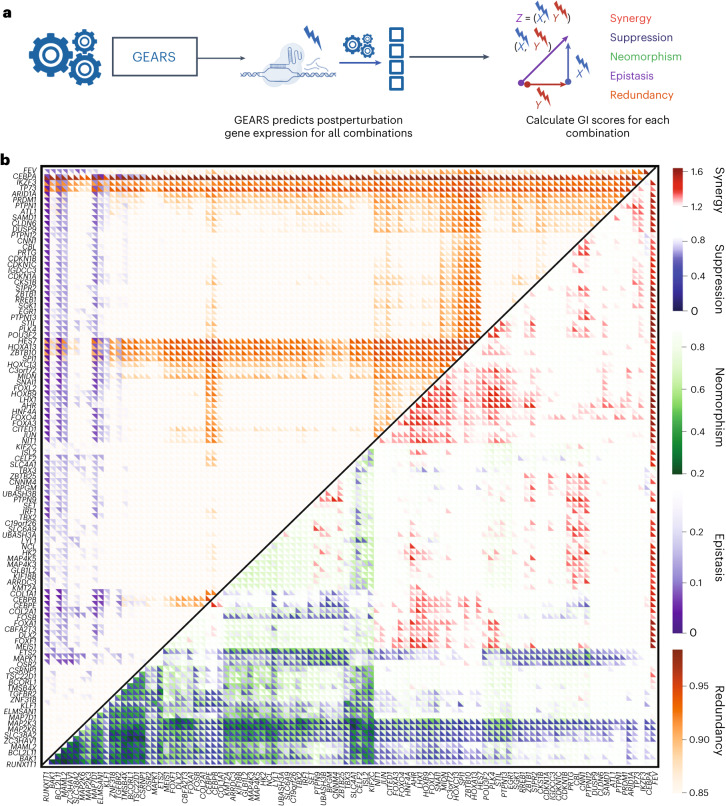
Understanding cellular responses to genetic perturbation is central to numerous biomedical applications, from identifying genetic interactions involved in cancer to developing methods for regenerative medicine. However, the combinatorial explosion in the number of possible multigene perturbations severely limits experimental interrogation. Here, we present graph-enhanced gene activation and repression simulator (GEARS), a method that integrates deep learning with a knowledge graph of gene–gene relationships to predict transcriptional responses to both single and multigene perturbations using single-cell RNA-sequencing data from perturbational screens. GEARS is able to predict outcomes of perturbing combinations consisting of genes that were never experimentally perturbed. GEARS exhibited 40% higher precision than existing approaches in predicting four distinct genetic interaction subtypes in a combinatorial perturbation screen and identified the strongest interactions twice as well as prior approaches. Overall, GEARS can predict phenotypically distinct effects of multigene perturbations and thus guide the design of perturbational experiments.
Overview
The claims and statistics of this paper haven’t been checked yet.
Free: it reads the open-access text and checks the first 5 claims that cite a source we can check. Create a free account to check every claim.
Integrity signals
Registry
Cites
Statistics
Figures
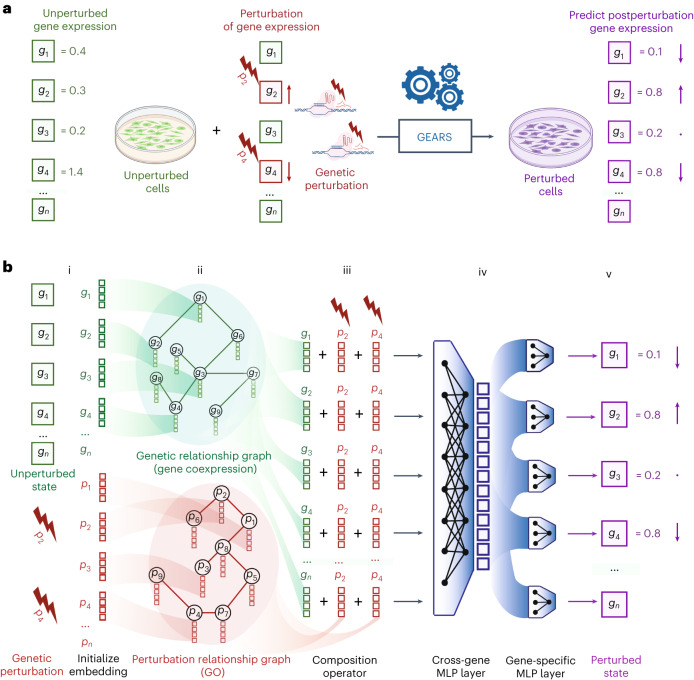
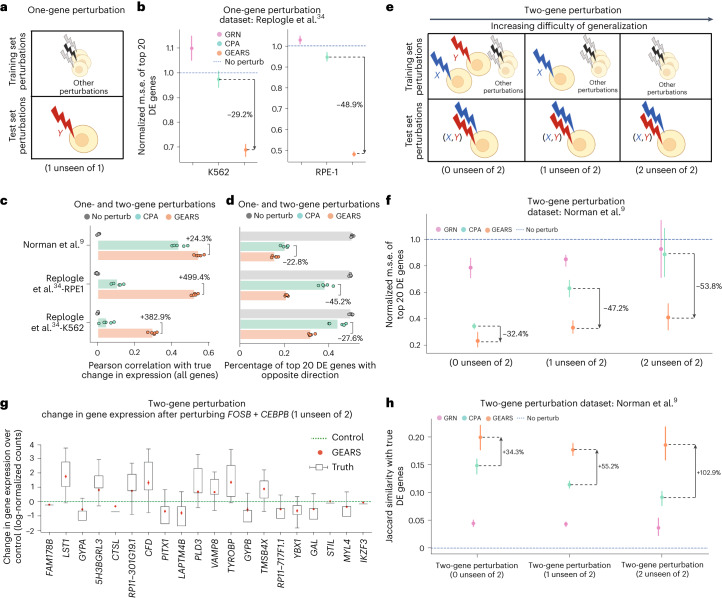
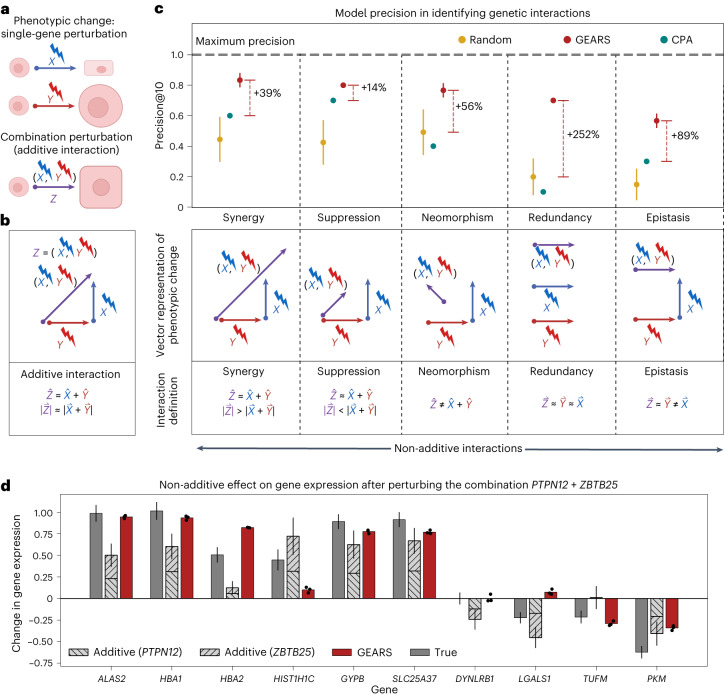
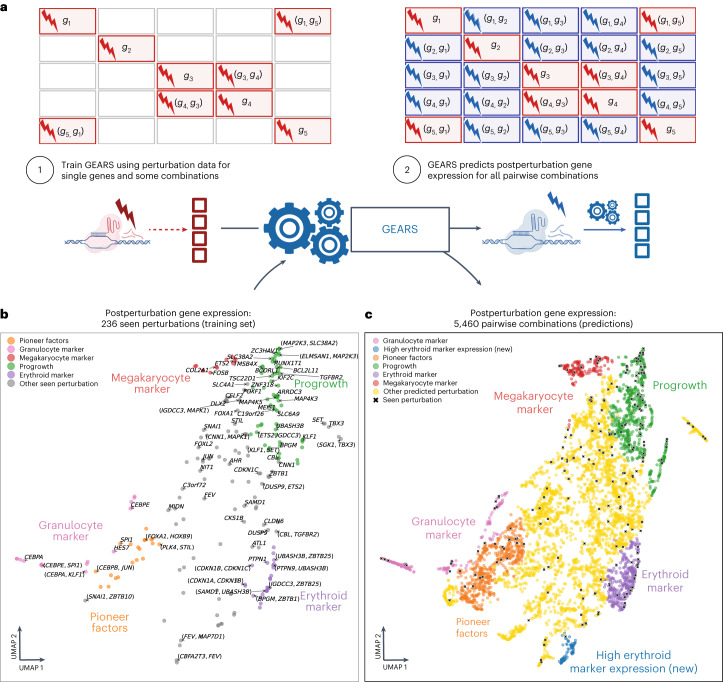
Verification
Claims the paper makes
The claims and statistics of this paper haven’t been checked yet.
Free: it reads the open-access text and checks the first 5 claims that cite a source we can check. Create a free account to check every claim.
Claims other papers make about this one
Each is checked against this paper’s own text: does it say what the citing paper says it does?
The source backs part of the claim, not all of it — or backs it for a different population, condition or comparison.
In the citing paper
“All benchmark datasets were split into train, validation and test sets according to the GEARS publication - corresponding to Perturbation Exclusive split, where new, unseen perturbations (or perturbation combinations) were present in the test set (Supplementary Table 1).”
From Benchmarking foundation cell models for post-perturbation RNA-seq prediction (2025) · cites this paper as [5]
Experimental — accuracy not yet measuredThe source backs part of the claim, not all of it — or backs it for a different population, condition or comparison.
In the citing paper
“Recent advances have incorporated graph-based methods and foundational models that take advantage of prior knowledge of gene expression relationships, resulting in improved generalizability (14–17).”
From A systematic comparison of single-cell perturbation response prediction models (2026) · cites this paper as [14]
Experimental — accuracy not yet measuredThe cited source says what the claim attributes to it.
In the citing paper
“Single-cell foundation models and perturbation predictors support cellular-response forecasting [48-51].”
From RSI-Anything: Unlocking Recursive Self-Improvement with World Models (2026) · cites this paper as [50]
The check wasn’t confident either way, so it gives no verdict — never disputed.
In the citing paper
“This filtering criterion is more permissive than that employed in prior work, retaining more perturbations with smaller effect sizes.11”
From Predicting cellular responses to perturbation across diverse contexts with State (2026) · cites this paper as [11]
Experimental — accuracy not yet measured
Self-check
Percentages, sums and reported differences re-computed from the paper’s own numbers.
The self-check needs the paper’s full text.
Citations
Cites
Szklarczyk, D., Gable, A. L., Lyon, D., Junge, A., Wyder, S., Huerta-Cepas, J., Simonovic, M., Doncheva, N. T., Morris, J. H., Bork, P., et al. (2019) · Nucleic Acids Research · doi:10.1093/nar/gky1131 · Cited by 17,749 · cited 1×
“GEARS functionalizes this graph-based inductive bias using a graph neural network (GNN) architecture 33 .”
KEGG for linking genomes to life and the environment
Kanehisa, M., Araki, M., Goto, S., Hattori, M., Hirakawa, M., Itoh, M., Katayama, T., Kawashima, S., Okuda, S., Tokimatsu, T., et al. (2007) · Nucleic Acids Research · doi:10.1093/nar/gkm882 · Cited by 6,782
Hallmarks of aging: An expanding universe
López-Otín, C., Blasco, M. A., Partridge, L., Serrano, M., & Kroemer, G. (2023) · Cell · doi:10.1016/j.cell.2022.11.001 · Cited by 6,549
Scenic: single-cell regulatory network inference and clustering.
Aibar, S., González-Blas, C. B., Moerman, T., Huynh-Thu, V. A., Imrichova, H., Hulselmans, G., Rambow, F., Marine, J.-C., Geurts, P., Aerts, J., et al. (2017) · Nature Methods · doi:10.1038/nmeth.4463 · Cited by 6,520 · cited 2×
“GEARS functionalizes this graph-based inductive bias using a graph neural network (GNN) architecture 33 .”
InfluentialTisagenlecleucel in children and young adults with B-cell lymphoblastic leukemia
Maude, S. L., Laetsch, T. W., Buechner, J., Rives, S., Boyer, M., Bittencourt, H., Bader, P., Verneris, M. R., Stefanski, H. E., Myers, G. D., et al. (2018) · New England Journal of Medicine · doi:10.1056/nejmoa1709866 · Cited by 5,735 · cited 2×
“Moreover, the precision–recall curves for all observed https://doi.org/10.1038/s41587-023-01905-6 genetic interaction subtypes exhibited a higher area under the curve than other methods (Supplementary Fig.”
InfluentialThe Reactome pathway Knowledgebase
Fabregat, A., Sidiropoulos, K., Garapati, P., Gillespie, M., Hausmann, K., Haw, R., Jassal, B., Jupe, S., Korninger, F., McKay, S., et al. (2016) · Nucleic Acids Research · doi:10.1093/nar/gkv1351 · Cited by 5,605
The Gene Ontology (GO) database and informatics resource
Gene Ontology Consortium (2004) · Nucleic Acids Research · doi:10.1093/nar/gkh036 · Cited by 4,579
Systems biology: a brief overview
Kitano, H. (2002) · Science · doi:10.1126/science.1069492 · Cited by 4,265
Using Bayesian Networks to Analyze Expression Data
Friedman, N., Linial, M., Nachman, I., & Pe'er, D. (2000) · Journal of Computational Biology · doi:10.1089/106652700750050961 · Cited by 3,266 · cited 1×
“GEARS functionalizes this graph-based inductive bias using a graph neural network (GNN) architecture 33 .”
The Reactome Pathway Knowledgebase
Fabregat, A., Jupe, S., Matthews, L., Sidiropoulos, K., Gillespie, M., Garapati, P., Haw, R., Jassal, B., Korninger, F., May, B., et al. (2018) · Nucleic Acids Research · doi:10.1093/nar/gkx1132 · Cited by 2,855 · cited 1×
“GEARS functionalizes this graph-based inductive bias using a graph neural network (GNN) architecture 33 .”
Research works printed but not linked: 3
- Wang, Y., Solus, L., Yang, K. & Uhler, C. Permutation-based causal inference algorithms with interventions. In Proc. 31st International Conference on Neural Information Processing Systems (Ed. von Luxburg, U. & Guyon, I.) 5824–5833 (Association for Computing Machinery, 2017).
- Hamilton, W., Ying, Z. & Leskovec, J. Inductive representation learning on large graphs. In Proc. 31st International Conference on Neural Information Processing Systems (Ed. von Luxburg, U. & Guyon, I.) 1025–1035 (Association for Computing Machinery, 2017).
- Kendall, A. & Gal, Y. What uncertainties do we need in Bayesian deep learning for computer vision? In Proc. 31st International Conference on Neural Information Processing Systems (Ed. von Luxburg, U. & Guyon, I.) 5580–5590 (Association for Computing Machinery, 2017).
Cited by
scGPT: Towards Building a Foundation Model for Single-Cell Multi-omics Using Generative AI
Cui, H., Wang, C., Maan, H., Pang, K., Luo, F., & Wang, B. (2023) · doi:10.1101/2023.04.30.538439 · Cited by 1,694
Large-scale foundation model on single-cell transcriptomics
Hao, M., Gong, J., Zeng, X., Liu, C., Guo, Y., Cheng, X., Wang, T., Ma, J., Zhang, X., & Song, L. (2024) · Nature Methods · doi:10.1038/s41592-024-02305-7 · Cited by 988
“Then, we trained the GEARS baseline model by setting epoch to 15 and batch size to 30.”
InfluentialHow to build the virtual cell with artificial intelligence: Priorities and opportunities
Bunne, C., Roohani, Y., Rosen, Y., Gupta, A., Zhang, X., Roed, M., Alexandrov, T., AlQuraishi, M., Brennan, P., Burkhardt, D. B., et al. (2024) · Cell · doi:10.1016/j.cell.2024.11.015 · Cited by 393
“40–44 AIVCs will usher in a new pradigm of how computational systems are probed during the design of new biological experiments.”
Self-citationProfiling cell identity and tissue architecture with single-cell and spatial transcriptomics
Gulati, G. S., D’Silva, J. P., Liu, Y., Wang, L., & Newman, A. M. (2025) · Nature Reviews Molecular Cell Biology · doi:10.1038/s41580-024-00768-2 · Cited by 293
“We also foresee the development of spatially resolved perturbation models as an extension of existing single-cell perturbation models 269 .”
Ahlmann-Eltze, C., Huber, W., & Anders, S. (2024) · doi:10.1101/2024.09.16.613342 · Cited by 268
Generative artificial intelligence empowers digital twins in drug discovery and clinical trials
Bordukova, M., Makarov, N., Rodriguez-Esteban, R., Schmich, F., & Menden, M. P. (2024) · Expert Opinion on Drug Discovery · doi:10.1080/17460441.2023.2273839 · Cited by 235
“Further cell DTs simulating cell state from various angles have been proposed using discriminative ML models [44,45].”
MethodWu, Y., & Xie, L. (2025) · Computational and Structural Biotechnology Journal · doi:10.1016/j.csbj.2024.12.030 · Cited by 178
Transformers in single-cell omics: a review and new perspectives
Szałata, A., Hrovatin, K., Becker, S., Tejada-Lapuerta, A., Cui, H., Wang, B., & Theis, F. J. (2024) · Nature Methods · doi:10.1038/s41592-024-02353-z · Cited by 171
“Embeddings generated by transformers can also be used to inform other models that rely on predefined gene embeddings 26,39,45 , such as the perturbation response prediction model GEARS 46 .”
Ahlmann-Eltze, C., Huber, W., & Anders, S. (2025) · Nature Methods · doi:10.1038/s41592-025-02772-6 · Cited by 238
Yang, X., Liu, G., Feng, G., Bu, D., Wang, P., Jiang, J., Chen, S., Yang, Q., Zhang, Y., Man, Z., et al. (2023) · doi:10.1101/2023.09.26.559542 · Cited by 148
Yang, X., Liu, G., Feng, G., Bu, D., Wang, P., Jiang, J., Chen, S., Yang, Q., Miao, H., Zhang, Y., et al. (2024) · Cell Research · doi:10.1038/s41422-024-01034-y · Cited by 148
Rood, J. E., Hupalowska, A., & Regev, A. (2024) · Cell · doi:10.1016/j.cell.2024.07.035 · Cited by 139
Towards multimodal foundation models in molecular cell biology
Cui, H., Tejada-Lapuerta, A., Brbić, M., Sáez-Rodríguez, J., Cristea, S., Goodarzi, H., Lotfollahi, M., Theis, F. J., & Wang, B. (2025) · Nature · doi:10.1038/s41586-025-08710-y · Cited by 186
“…fine-tuning and in-context learning (Supplementary Note 1), then specialize these molecular embeddings to apply to diverse prediction tasks, enabling applications such as temporal cell-state mapping 34 , novel cell-type characterization 35,36 and perturbation response prediction 37–39 (Fig.”
Epigenome editing technologies for discovery and medicine
McCutcheon, S. R., Rohm, D., Iglesias, N., & Gersbach, C. A. (2024) · Nature Biotechnology · doi:10.1038/s41587-024-02320-1 · Cited by 143
“In fact, an algorithm has been developed to predict the transcriptional response of combinatorial perturbations based on single-perturbation scRNA-seq data 203 .”
Large Scale Foundation Model on Single-cell Transcriptomics
Hao, M., Gong, J., Zeng, X., Liu, C., Guo, Y., Cheng, X., Wang, T., Ma, J., Song, L., & Zhang, X. (2023) · doi:10.1101/2023.05.29.542705 · Cited by 639
Yeh, C. Y., Aguirre, K., Laveroni, O., Kim, S., Wang, A., Liang, B., Zhang, X., Han, L. M., Valbuena, R., Bassik, M. C., et al. (2024) · Nature Immunology · doi:10.1038/s41590-024-01943-5 · Cited by 103
“…and conditions, it will be possible to use Perturb-seq data more effectively to extrapolate from one context to another with increasing accuracy 70,71 and, in the case of malignant cell states, using CNA-to-RNA and CNA-to-cell-state associations to further guide Perturb-seq experimental design.”
CellFM: a large-scale foundation model pre-trained on transcriptomics of 100 million human cells
Zeng, Y., Xie, J., Shangguan, N., Wei, Z., Li, W., Su, Y., Yang, S., Zhang, C., Zhang, J., Fang, N., et al. (2025) · Nature Communications · doi:10.1038/s41467-025-59926-5 · Cited by 156
Predicting cellular responses to perturbation across diverse contexts with State
Adduri, A. K., Gautam, D., Bevilacqua, B., Naghipourfar, M., Imran, A., Shah, R., Teyssier, N., Verma, R., Carpenter, C., Eraslan, B., et al. (2026) · Cell · doi:10.1016/j.cell.2026.07.052 · Cited by 100
Self-citationQi, X., Zhao, L., Tian, C., Li, Y., Chen, Z.-L., Huo, P., Chen, R., Liu, X., Wan, B., Yang, S., et al. (2024) · Nature Communications · doi:10.1038/s41467-024-53457-1 · Cited by 131
Single-cell omics: experimental workflow, data analyses and applications
Sun, F., Li, H., Sun, D., Fu, S., Gu, L., Shao, X., Wang, Q., Dong, X., Duan, B., Xing, F., et al. (2024) · Science China Life Sciences · doi:10.1007/s11427-023-2561-0 · Cited by 102
Digital twins in healthcare: a comprehensive review and future directions
Rudsari, H. K., Tseng, B., Zhu, H., Song, L., Gu, C., Roy, A., Irajizad, E., Butner, J. D., Long, J. P., & Do, K.-A. (2025) · Frontiers in Digital Health · doi:10.3389/fdgth.2025.1633539 · Cited by 152
Disentanglement of single-cell data with biolord
Piran, Z., Cohen, N., Hoshen, Y., & Nitzan, M. (2024) · Nature Biotechnology · doi:10.1038/s41587-023-02079-x · Cited by 75
The future of rapid and automated single-cell data analysis using reference mapping
Lotfollahi, M., Hao, Y., Theis, F. J., & Satija, R. (2024) · Cell · doi:10.1016/j.cell.2024.03.009 · Cited by 91
Optimal transport for single-cell and spatial omics
Bunne, C., Schiebinger, G., Krause, A., Regev, A., & Cuturi, M. (2024) · Nature Reviews Methods Primers · doi:10.1038/s43586-024-00334-2 · Cited by 71
Advances and applications in single-cell and spatial genomics
Wang, J., Ye, F., Chai, H., Jiang, Y., Wang, T., Ran, X., Xia, Q., Xu, Z., Fu, Y., Zhang, G., et al. (2024) · Science China Life Sciences · doi:10.1007/s11427-024-2770-x · Cited by 79
Nicheformer: A Foundation Model for Single-Cell and Spatial OmicsPreprint
Schaar, A. C., Tejada-Lapuerta, A., Palla, G., Gutgesell, R. M., Halle, L., Minaeva, M., Vornholz, L., Dony, L., Drummer, F., Bahrami, M., et al. (2024) · bioRxiv (Cold Spring Harbor Laboratory) · doi:10.1101/2024.04.15.589472 · Cited by 66
Evaluating the Utilities of Foundation Models in Single-cell Data Analysis
Liu, T., Li, K., Wang, Y., Li, H., & Zhao, H. (2023) · doi:10.1101/2023.09.08.555192 · Cited by 62
“We considered scGPT, scFoundation and GEARS [52] for this task.”
InfluentialBig data and deep learning for RNA biology
Hwang, H., Jeon, H., Yeo, N., & Baek, D. (2024) · Experimental & Molecular Medicine · doi:10.1038/s12276-024-01243-w · Cited by 74
“GEARS is another DL model for learning gene – gene interactions 193 .”
MethodEvaluating the Utilities of Foundation Models in Single‐Cell Data Analysis
Liu, T., Li, K., Wang, Y., Li, H., & Zhao, H. (2026) · Advanced Science · doi:10.1002/advs.202514490 · Cited by 61
Saunders, R. A., Allen, W. E., Pan, X., Sandhu, J., Lu, J., Lau, T. K., Smolyar, K., Sullivan, Z. A., Dulac, C. G., Weissman, J. S., et al. (2025) · Cell · doi:10.1016/j.cell.2025.05.022 · Cited by 99
Viñas Torné, R., Wiatrak, M., Piran, Z., Fan, S., Jiang, L., Teichmann, S. A., Nitzan, M., & Brbić, M. (2026) · Nature Biotechnology · doi:10.1038/s41587-025-02777-8 · Cited by 58
“To evaluate performance, we employed different metrics previously considered in the literature 1,2 , including the Pearson correlation between ground truth and predicted expression changes, using all genes (Pearson Δ ) and the top 20 differentially expressed genes (Pearson Δ 20 ) (Methods).”
PerturbNet predicts single-cell responses to unseen chemical and genetic perturbations
Yu, H., Qian, W., Song, Y., & Welch, J. D. (2025) · Molecular Systems Biology · doi:10.1038/s44320-025-00131-3 · Cited by 57
“Most recent approaches, like GEARS, are typically designed for a speci fi c type of perturbation, limiting their generalizability to other perturbation types such as variants introduced to the genome.”
InfluentialNew horizons at the interface of artificial intelligence and translational cancer research
Yates, J., & Allen, E. M. V. (2025) · Cancer Cell · doi:10.1016/j.ccell.2025.03.018 · Cited by 63
A mini-review on perturbation modelling across single-cell omic modalities
Gavriilidis, G. I., Vasileiou, V., Orfanou, A., Ishaque, N., & Psomopoulos, F. (2024) · Computational and Structural Biotechnology Journal · doi:10.1016/j.csbj.2024.04.058 · Cited by 54
“…is apt for reconstructing potential cell fate trajectories after simulating digital KOs (singular or combinatorial) of crucial TFs. GEARS [63] (graph-enhanced gene activation and repression simulator) uses biological priors in the form of knowledge graphs and DL algorithms to predict…”
BackgroundscPRINT: pre-training on 50 million cells allows robust gene network predictions
Kalfon, J., Samaran, J., Peyré, G., & Cantini, L. (2025) · Nature Communications · doi:10.1038/s41467-025-58699-1 · Cited by 100
Benchmarking foundation cell models for post-perturbation RNA-seq prediction
Csendes, G., Sanz, G., Szalay, K. Z., & Szalai, B. (2025) · BMC Genomics · doi:10.1186/s12864-025-11600-2 · Cited by 47
“Lastly, two subsets [5] of the Replogle [16] dataset containing 162,751 and 162,733 single cells (K562 and RPE1 cell lines, respectively) from a genome-wide single perturbation CRISPRi screen were used.”
InfluentialMa, C., Zhang, H., Rao, Y., Jiang, X., Liu, B., Sun, Z., Song, Z., Gao, Y., Cui, Y., Liu, X., et al. (2025) · npj Digital Medicine · doi:10.1038/s41746-025-02198-6 · Cited by 76
“Meanwhile, models that target complex genetic perturbations: GEARS 57 and the Arc Institute ’ s State model 58 , exhibit measurable generalization across cell types.”
Gene regulatory networks in disease and ageing
Avila, P. U., Padvitski, T., Leote, A. C., Chen, H., Sáez-Rodríguez, J., Kann, M., & Beyer, A. (2024) · Nature Reviews Nephrology · doi:10.1038/s41581-024-00849-7 · Cited by 57
“This concept has been exploited to predict cellular responses to complex, combinatorial drug treatments based on known gene coexpression relationships 126,127 .”
CellFlow enables generative single-cell phenotype modeling with flow matchingPreprint
Klein, D., Fleck, J. S., Bobrovskiy, D. M., Zimmermann, L., Becker, S., Palma, A., Dony, L., Tejada-Lapuerta, A., Huguet, G., Lin, H., et al. (2025) · bioRxiv (Cold Spring Harbor Laboratory) · doi:10.1101/2025.04.11.648220 · Cited by 90
Graph neural networks for single-cell omics data: a review of approaches and applications
Li, S., Hua, H., & Chen, S. (2025) · Briefings in Bioinformatics · doi:10.1093/bib/bbaf109 · Cited by 43
Benchmarking algorithms for generalizable single-cell perturbation response prediction
Wei, Z., Wang, Y., Gao, Y., Wang, S., Li, P., Si, D., Gao, Y., Wu, S., Li, D., Dong, K., et al. (2026) · Nature Methods · doi:10.1038/s41592-025-02980-0 · Cited by 42
“…metrics to comprehensively assess prediction accuracy, including the mean squared error (MSE), Pearson correlation coefficient delta (PCC-delta) 5 , E-distance 13 , Wasserstein distance 14 , Kullback–Leibler divergence (KL-divergence) and common differentially expressed genes (Common-DEGs) 15…”
InfluentialSquidiff: predicting cellular development and responses to perturbations using a diffusion model
He, S., Zhu, Y., Tavakol, D. N., Ye, H., Lao, Y.-H., Zhu, Z., Xu, C., Chauhan, S., Garty, G., Tomer, R., et al. (2026) · Nature Methods · doi:10.1038/s41592-025-02877-y · Cited by 38
“We then performed interpolation for days 1, 3, 5, 7, 9, 13, 15 and 17 using Squidiff.”
Perturbomics: CRISPR–Cas screening-based functional genomics approach for drug target discovery
Park, B.-S., Lee, M., Kim, J. Y., & Kim, T. (2025) · Experimental & Molecular Medicine · doi:10.1038/s12276-025-01487-0 · Cited by 49
“Leskovec and colleagues, for instance, developed the graph-enhanced gene activation and repression simulator (GEARS), which integrates CRISPRa screening data with previously published Perturb-seq datasets to predict combinatorial perturbation effects on gene interactions 100 .”
PertEval-scFM: Benchmarking Single-Cell Foundation Models for Perturbation Effect Prediction
Wenteler, A., Occhetta, M., Branson, N., Curean, V., Huebner, M., Dee, W., Connell, W., Chung, S. P., Hawkins-Hooker, A., Ektefaie, Y., et al. (2024) · doi:10.1101/2024.10.02.616248 · Cited by 37
“This backbone approach can then be built upon additional architectures which are specialized for specific tasks - i.e., GEARS (Roohani et al., 2023) for perturbation response prediction. scFoundation is pre-trained using read-depth-aware (RDA) modeling, an extension of masked language modeling…”
InfluentialGene regulation technologies for gene and cell therapy
Butterfield, G. L., Reisman, S. J., Iglesias, N., & Gersbach, C. A. (2025) · Molecular Therapy · doi:10.1016/j.ymthe.2025.04.004 · Cited by 48
“186–192 Taken together, these technologies aim to further our understanding of GRNs and map genetic and epigenetic interactions more efficiently.”
Combinatorial prediction of therapeutic perturbations using causally inspired neural networks
Gonzalez, G., Lin, X., Herath, I. S., Veselkov, K., Bronstein, M. M., & Žitnik, M. (2025) · Nature Biomedical Engineering · doi:10.1038/s41551-025-01481-x · Cited by 60
“We followed the official tutorial from the GEARS GitHub repository (https://github.com/snap-stanford/ GEARS), using the recommended parameters.”
InfluentialZheng, Y., Schupp, J. C., Adams, T. S., Clair, G., Justet, A., Ahangari, F., Yan, X., Hansen, P., Carlon, M. S., Cortesi, E. E., et al. (2025) · Nature Biomedical Engineering · doi:10.1038/s41551-025-01423-7 · Cited by 49
“We excluded GEARS in the benchmarking, because it fell short compared with scGPT and it lacks the ability to produce cell embeddings for in silico drug screening 31 .”
Harnessing artificial intelligence to advance CRISPR-based genome editing technologies
Thomson, T., Li, G. L., Strilchuk, A. W., Cui, H., Wang, B., & Li, B. (2025) · Nature Reviews Genetics · doi:10.1038/s41576-025-00907-1 · Cited by 45
“For example, GEARS (graph-enhanced gene activation and repression simulator) is a graph-based model that integrates gene interaction networks to predict responses to unseen single-gene and multigene perturbations 182 .”
Advancing bioinformatics with language models: components, applications, and perspectives
Liu, J., Yang, M., Yu, Y., Xu, H., Wang, T., Li, K., & Zhou, X. (2026) · Briefings in Bioinformatics · doi:10.1093/bib/bbag367 · Cited by 72
CRISPR Tools for Engineering Prokaryotic Systems: Recent Advances and New Applications
Burbano, D. A., Kiattisewee, C., Karanjia, A. V., Cardiff, R. A. L., Faulkner, I., Sugianto, W., & Carothers, J. M. (2024) · Annual Review of Chemical and Biomolecular Engineering · doi:10.1146/annurev-chembioeng-100522-114706 · Cited by 36
Embeddings from language models are good learners for single-cell data analysis
Liu, T., Chen, T., Zheng, W., Luo, X., Chen, Y. T., & Zhao, H. (2026) · Patterns · doi:10.1016/j.patter.2025.101431 · Cited by 44
“For tasks of perturbation analysis, we consider CINEMA-OT, 55 CPA, 56 and GEARS 57 for modification and evaluation.”
InfluentialȘerban, M., Toader, C., & Covache-Busuioc, R.-A. (2025) · International Journal of Molecular Sciences · doi:10.3390/ijms26199409 · Cited by 41
Deep Learning in Single-cell Analysis
Molho, D., Ding, J., Tang, W., Li, Z., Wen, H., Wang, Y., Venegas, J., Jin, W., Liu, R., Su, R., et al. (2024) · ACM Transactions on Intelligent Systems and Technology · doi:10.1145/3641284 · Cited by 51
Wong, D. R., Hill, A. S., & Moccia, R. (2025) · Bioinformatics · doi:10.1093/bioinformatics/btaf317 · Cited by 27
“For evaluating prediction of the transcriptome for held-out perturbations, Roohani et al. 44 proposed measuring the Pearson correlation between the actual and predicted expression.”
InfluentialTherapeutic target database 2026: facilitating targeted therapies and precision medicine
Zhang, Y., Zhou, Y., Xu, H., Jiang, W., Li, B., Lai, D., Wan, C., Wang, S., Zhao, M., Tan, Y. C., et al. (2025) · Nucleic Acids Research · doi:10.1093/nar/gkaf1154 · Cited by 49
“By capturing genome-wide transcriptional changes, these profiles can reveal the biological roles of genes, the pathways they regulate, their involvement in diseases, and the potential effects of their perturbation [ 3 ].”
A Systematic Comparison of Single-Cell Perturbation Response Prediction Models
Li, L., You, Y., Fu, Y., Liao, W., Fan, X., Lu, S., Cao, Y., Li, B., Ren, W., Kong, J., et al. (2024) · bioRxiv (Cold Spring Harbor Laboratory) · doi:10.1101/2024.12.23.630036 · Cited by 25
“Recent advances have incorporated graph-based methods and foundational models that take advantage of prior knowledge of gene expression relationships, achieving significant improvements in generalizability ( 14–17 ).”
EpiAgent: foundation model for single-cell epigenomics
Chen, X., Li, K., Cui, X., Wang, Z., Jiang, Q., Lin, J., Li, Z., Gao, Z., Lv, H., & Jiang, R. (2025) · Nature Methods · doi:10.1038/s41592-025-02822-z · Cited by 46
Kendiukhov, I. (2026) · Computational Biology and Chemistry · doi:10.1016/j.compbiolchem.2026.109079 · Cited by 29
Benchmarking AI Models for In Silico Gene Perturbation of Cells
Li, C., Gao, H., She, Y., Bian, H., Chen, Q., Liu, K., Wei, L., & Zhang, X. (2024) · doi:10.1101/2024.12.20.629581 · Cited by 24
Molecular causality in the advent of foundation models
Lobentanzer, S., Rodríguez-Mier, P., Bauer, S., & Sáez-Rodríguez, J. (2024) · Molecular Systems Biology · doi:10.1038/s44320-024-00041-w · Cited by 30
“…make a tradeoff between those extremes, which is why they have been found to be useful in systems biology, where data are currently scarce (AlQuraishi and Sorger, 2021; Nilsson et al, 2022; Faure et al, 2023; Roohani et al, 2023; Fortelny and Bock, 2020; Lotfollahi et al, 2023; Yuan et al, 2021).”
BackgroundJiang, J., Chen, S., Tsou, T., McGinnis, C. S., Khazaei, T., Zhu, Q., Park, J. H., Strazhnik, I.-M., Vielmetter, J., Gong, Y., et al. (2023) · doi:10.1101/2023.04.19.537364 · Cited by 21
General-purpose pre-trained large cellular models for single-cell transcriptomics
Bian, H., Chen, Y., Luo, E., Wu, X., Hao, M., Wei, L., & Zhang, X. (2024) · National Science Review · doi:10.1093/nsr/nwae340 · Cited by 32
AttentionPert: accurately modeling multiplexed genetic perturbations with multi-scale effects
Bai, D., Ellington, C. N., Mo, S., Song, L., & Xing, E. P. (2024) · Bioinformatics · doi:10.1093/bioinformatics/btae244 · Cited by 33
“The GO graph J is constructed through Gene Ontology following the SOTA method GEARS (Roohani et al. 2023), where the edge weight of two genes is the fraction of their shared Gene Ontology terms.”
BackgroundMethodInfluentialScvi-hub: an actionable repository for model-driven single-cell analysis
Ergen, C., Amiri, V. V. P., Kim, M., Kronfeld, O., Streets, A., Gayoso, A., & Yosef, N. (2025) · Nature Methods · doi:10.1038/s41592-025-02799-9 · Cited by 30
“…moving forward, additional applications will become more prevalent, such as interpretation of spatial data 7 prediction of perturbation outcome 8 , prediction of multi-modal information from single-modality data 9 , detection of anomalous cellular subsets 10 or analysis of differential…”
Sequential Optimal Experimental Design of Perturbation Screens Guided by Multi-modal Priors
Huang, K., Lopez, R., Hütter, J.-C., Kudo, T., Rios, A., & Regev, A. (2024) · Lecture notes in computer science · doi:10.1007/978-1-0716-3989-4_2 · Cited by 39
Self-citationGenePert: Leveraging GenePT Embeddings for Gene Perturbation PredictionPreprint
Chen, Y. T., & Zou, J. (2024) · bioRxiv (Cold Spring Harbor Laboratory) · doi:10.1101/2024.10.27.620513 · Cited by 31
“In particular, recent advances in computational models, such as large-scale deep learning models [Theodoris et al., 2023, Cui et al., 2024, Hao et al., 2024, Roohani et al., 2024], have shown promise in predicting perturbations and their combinations at scale, especially for unseen perturbations.”
BackgroundMethodResultInfluentialDeep Learning of radiology-genomics integration for computational oncology: A mini review
Wang, F., Li, Y., & Zeng, T. (2024) · Computational and Structural Biotechnology Journal · doi:10.1016/j.csbj.2024.06.019 · Cited by 27
Menon, A. V., Song, B., Chao, L., Sriram, D., Chansky, P. A., Bakshi, I., Ulianova, J., & Li, W. (2025) · Frontiers in Genome Editing · doi:10.3389/fgeed.2025.1565387 · Cited by 30
In silico biological discovery with large perturbation models
Miladinovic, D., Höppe, T., Chevalley, M., Georgiou, A., Stuart, L., Mehrjou, A., Bantscheff, M., Schölkopf, B., & Schwab, P. (2025) · Nature Computational Science · doi:10.1038/s43588-025-00870-1 · Cited by 36
“Additionally, we included the “NoPerturb” baseline [11] that assumes that the perturbation does not induce a change in expression.”
InfluentialDeep learning perturbation models can outperform baselines on calibrated metrics
Miller, H. E., Mejia, G. M., Leblanc, F. J. A., Swain, B., Wang, B., & de Lima Camillo, L. P. (2026) · Nature Biotechnology · doi:10.1038/s41587-026-03307-w · Cited by 18
Building hybrid AI models in chemical engineering: A tutorial review
Chakraborty, A., Taskiran, N. P., Kottooru, R., Mann, V., & Venkatasubramanian, V. (2025) · Computers & Chemical Engineering · doi:10.1016/j.compchemeng.2025.109236 · Cited by 23
Single-cell technologies: current and near future
Wang, C., Liu, Q., Fan, X., & Shi, T. (2024) · Science China Life Sciences · doi:10.1007/s11427-024-2813-y · Cited by 19
Signals in the Cells: Multimodal and Contextualized Machine Learning Foundations for TherapeuticsPreprint
Velez-Arce, A., Lin, X., Li, M. M., Huang, K., Gao, W., Fu, T., Pentelute, B. L., Kellis, M., & Žitnik, M. (2024) · bioRxiv (Cold Spring Harbor Laboratory) · doi:10.1101/2024.06.12.598655 · Cited by 30
“In single-cell analysis, a standard procedure is to normalize the counts within each cell so that they sum to a specific value (usually the median sum across all cells in the dataset) and then to log transform the values using the natural logarithm [26].”
InfluentialSelf-citationModeling and predicting single-cell multi-gene perturbation responses with scLAMBDAPreprint
Wang, G., Liu, T., Zhao, J., Cheng, Y., & Zhao, H. (2024) · bioRxiv (Cold Spring Harbor Laboratory) · doi:10.1101/2024.12.04.626878 · Cited by 46
“Recently, several methods including GEARS [16], GenePert [17], and single-cell foundation models such as scGPT [18] have been developed for predicting the perturbation effects of novel unseen genes.”
Attribute-guided prototype network for few-shot molecular property prediction
Hou, L., Xiang, H., Zeng, X., Cao, D., Zeng, L., & Song, B. (2024) · Briefings in Bioinformatics · doi:10.1093/bib/bbae394 · Cited by 21
Gao, Y., Wei, Z., Dong, K., Chen, K., Yang, J., Chuai, G., & Liu, Q. (2024) · Nature Computational Science · doi:10.1038/s43588-024-00698-1 · Cited by 21
“(2) Learning genetic perturbation embeddings 8,9,19,20 : methods in this category are designed to map genetic perturbations onto a latent embedding space or incorporate biological priors into deep learning frameworks to elucidate the potential genetic interactions (GIs) in a specific cell line, thereby enabling the pr…”
InfluentialMachine learning to dissect perturbations in complex cellular systems
Monfort‐Lanzas, P., Rungger, K., Madersbacher, L., & Hackl, H. (2025) · Computational and Structural Biotechnology Journal · doi:10.1016/j.csbj.2025.02.028 · Cited by 24
“Graph-enhanced gene activation and repression simulator uses unper-turbed single-cell gene expression data and a specified perturbation set to predict transcriptional responses to gene perturbations [23].”
AI-driven exploration of microbial resources in fermented foods
Shi, P., Liu, S., Mao, J., Liu, X., Tu, R., Qin, H., Sun, A., Zhang, D., & Mao, J. (2025) · Trends in Food Science & Technology · doi:10.1016/j.tifs.2025.105450 · Cited by 23
Discovery of predictive biomarkers for cancer therapy through computational approaches
Wang, X., Nguyen, J., Nader, K. M., Miihkinen, M., Wall, P., Singhal, A., Bedard, P. L., Ideker, T., Aittokallio, T. A., & Haibe‐Kains, B. (2026) · Nature Reviews Clinical Oncology · doi:10.1038/s41571-025-01109-8 · Cited by 31
Bai, D., Mo, S., Zhang, R., Luo, Y., Gao, J., Yang, J. P., Wu, Q., Rahmani, H., Amariuta, T., Grotjahn, D., et al. (2026) · Nature Communications · doi:10.1038/s41467-026-69102-y · Cited by 15
“14, where each node represents a gene.”
InfluentialCheng, J., Pan, X., Fang, Y., Yang, K., Xue, Y., Yan, Q., & Yuan, Y. (2024) · Briefings in Bioinformatics · doi:10.1093/bib/bbae525 · Cited by 27
A systematic comparison of computational methods for expression forecasting
Kernfeld, E., Yang, Y., Weinstock, J. S., Battle, A., & Cahan, P. (2023) · doi:10.1101/2023.07.28.551039 · Cited by 15
Scaling Dense Representations for Single Cell with Transcriptome-Scale ContextPreprint
Ho, N., Ellington, C. N., Hou, J., Addagudi, S., Mo, S., Tao, T., Li, D., Zhuang, Y., Wang, H., Cheng, X., et al. (2024) · bioRxiv (Cold Spring Harbor Laboratory) · doi:10.1101/2024.11.28.625303 · Cited by 26
Predicting single-cell cellular responses to perturbations using cycle consistency learning
Huang, W., & Liu, H. (2024) · Bioinformatics · doi:10.1093/bioinformatics/btae248 · Cited by 17
“Notably, our model demonstrated superior performance across all genes and DEGs compared to the baseline and GEARS.”
Knowledge-augmented Graph Machine Learning for Drug Discovery: A Survey
Zhong, Z., Barkova, A., & Mottin, D. (2025) · ACM Computing Surveys · doi:10.1145/3744237 · Cited by 25
A comparison of computational methods for expression forecasting
Kernfeld, E. M., Yang, Y., Weinstock, J. S., Battle, A. J., & Cahan, P. (2025) · Genome biology · doi:10.1186/s13059-025-03840-y · Cited by 51
A platform for multimodal in vivo pooled genetic screens reveals regulators of liver functionPreprint
Saunders, R. A., Allen, W. E., Pan, X., Sandhu, J., Lu, J., Lau, T. K., Smolyar, K., Sullivan, Z. A., Dulac, C. G., Weissman, J. S., et al. (2024) · bioRxiv (Cold Spring Harbor Laboratory) · doi:10.1101/2024.11.18.624217 · Cited by 13
Wang, C., Karimzadeh, M., Ravindra, N. G., Bounds, L. R., Alerasool, N., Huang, A., Ma, S., Gulbranson, D. R., Cui, H., Lee, Y., et al. (2026) · bioRxiv (Cold Spring Harbor Laboratory) · doi:10.64898/2026.03.18.712807 · Cited by 28
Redefining cellular reprogramming with advanced genomic technologies
Morris, S. A. (2025) · Nature Reviews Genetics · doi:10.1038/s41576-025-00899-y · Cited by 16
“For example, graph-enhanced gene activation and repression simulator (GEARS) uses a graph neural network integrated with a knowledge graph of gene relationships to model complex interactions and predict transcriptional outcomes 169 (Fig.”
Interpretation, extrapolation and perturbation of single cells
Dimitrov, D., Schrod, S., Rohbeck, M., & Stegle, O. (2026) · Nature Reviews Genetics · doi:10.1038/s41576-025-00920-4 · Cited by 39
Imputing spatial transcriptomics through gene network constructed from protein language model
Zeng, Y., Song, Y., Zhang, C., Li, H., Zhao, Y., Yu, W., Zhang, S., Zhang, H., Dai, Z., & Yang, Y. (2024) · Communications Biology · doi:10.1038/s42003-024-06964-2 · Cited by 14
“Most importantly, TransImpLR ignores gene-to-gene relationships in gene prediction, which have shown improved performance in previous work 15,16 .”
Current opinions on large cellular models
Hao, M., Wei, L., Yang, F., Yao, J., Theodoris, C. V., Wang, B., Li, X., Yang, G., & Zhang, X. (2024) · Quantitative Biology · doi:10.1002/qub2.65 · Cited by 13
“For instance, these context embeddings can serve as inputs to perturbation prediction models such as GEARS [19], enhancing the accuracy of their predictions.”
Emerging trends and converging evidence in tumor evolution: A comprehensive review
Jin, C., Li, W., Liu, B., Cao, L.-Q., Stefan, S. M., Yuan, L., Yu, X., Shi, L., & Yu, H. (2026) · Drug Resistance Updates · doi:10.1016/j.drup.2026.101380 · Cited by 14
Tan, Y., Xie, L., Yang, H. T., Zhang, Q., Luo, J., & Zhang, Y. (2024) · Briefings in Bioinformatics · doi:10.1093/bib/bbae617 · Cited by 14
The new frontier in understanding human and mammalian brain development
Nowakowski, T. J., Nano, P. R., Matho, K. S., Chen, X., Corrigan, E. K., Ding, W., Gao, Y., Heffel, M. G., Jayakumar, J., Kaplan, H. S., et al. (2025) · Nature · doi:10.1038/s41586-025-09652-1 · Cited by 20
“…data generated in these studies in the broader context of disease reference atlases such as those generated by PsychENCODE 22,29 has already identified disease-relevant genes and CREs 26,30,60,87 and helped model stage-specific effects of diseases using in silico perturbation approaches 88,89 .”
Zhu, O., & Li, J. (2025) · Nature Computational Science · doi:10.1038/s43588-025-00912-8 · Cited by 17
“19 and 20, respectively).”
CODEX: COunterfactual Deep learning for the in silico EXploration of cancer cell line perturbations
Schrod, S., Zacharias, H. U., Beißbarth, T., Hauschild, A.-C., & Altenbuchinger, M. (2024) · Bioinformatics · doi:10.1093/bioinformatics/btae261 · Cited by 10
“…different perturbations via distinct model representations, while most state-of-the-art approaches include perturbations as distinct variables (Lotfollahi et al. 2023, Roohani et al. 2023) or represent them using chemical embeddings (Preuer et al. 2018, Kuru et al. 2022, El Khili et al. 2023).”
BackgroundMethodInfluentialAdvancing active compound discovery for novel drug targets: insights from AI-driven approaches
Wang, X.-Y., Chen, Y., Li, Y.-F., Wei, C., Liu, M.-Y., Yuan, C.-X., Zheng, Y.-Y., Qin, M.-H., Sheng, Y.-F., Tong, X., et al. (2025) · Acta Pharmacologica Sinica · doi:10.1038/s41401-025-01591-x · Cited by 18
“Models like the Compound Perturbation Autoencoder (CPA) [79], Graph Enhanced Gene Activation and Inhibition Simulator (GEARS) [80], and variational autoencoder (VAE)-based methods such as TranSiGen [81] exemplify this approach.”
Alsulami, R., Lehmann, R., Khan, S. A., Lagani, V., Maillo, A., Gómez-Cabrero, D., Kiani, N. A., & Tegner, J. N. (2026) · Nature Machine Intelligence · doi:10.1038/s42256-026-01202-2 · Cited by 16
Autophagy and machine learning: Unanswered questions
Yang, Y., Pan, Z., Sun, J., Welch, J. D., & Klionsky, D. J. (2024) · Biochimica et Biophysica Acta (BBA) - Molecular Basis of Disease · doi:10.1016/j.bbadis.2024.167263 · Cited by 15
Metadata
- Authors
- Roohani, Y., Huang, K., & Leskovec, J.
- Affiliations
- Stanford University (US)
- Corresponding author
- Leskovec, Jure
- Venue
- Nature Biotechnology
- Published
- 2023-08-17
- Volume
- 42
- Issue
- 6
- Pages
- 927-935
- ISSN
- 0733-222X (ISSN-L)
- 1087-0156
- 1546-1696
- PMC
- PMC11180609
- OpenAlex
- W4385955324
- Semantic Scholar
- 85906593661911c9a076cbb96391b9bb61a996bc
- Cited by
- 355
- References
- 51
- Citations by year
- 2026: 153 · 2025: 118 · 2024: 77 · 2023: 7
- FWCI
- 31.63
- Type
- journal article
- Language
- en
- Open access
- hybrid
- doi.org
- Licence
- cc-by
- creativecommons.org/licenses/by/4.0 (tdm)
- creativecommons.org/licenses/by/4.0 (vor)
- Locations
- Nature Biotechnology (publishedVersion, cc-by)
- PubMed Central (publishedVersion, cc-by)
- PubMed (publishedVersion)
- Funders
- U.S. Department of Health & Human Services | NIH | Center for Information Technology (3U54HG010426-04S1)
- GlaxoSmithKline
- Topics
- Life Sciences › Biochemistry, Genetics and Molecular Biology › Molecular Biology › Gene Regulatory Network Analysis
- Life Sciences › Biochemistry, Genetics and Molecular Biology › Molecular Biology › Single-cell and spatial transcriptomics
- Life Sciences › Biochemistry, Genetics and Molecular Biology › Molecular Biology › Bioinformatics and Genomic Networks
- Keywords
- gene-gene interaction, genetic interactions, knowledge graphs, deep learning, single-cell RNA sequencing, gene activation and repression, gears
- MeSH terms
- Deep Learning, Computer Simulation, Humans, Transcription, Genetic, Sequence Analysis, RNA, Computational Biology, Gene Regulatory Networks, Single-Cell Analysis
About these checks
Registry, retraction, Cites and statistics results are computed, not judged, with one exception: a printed reference that no index lists is read once by a model before it counts as a citation error. Claims are extracted by a model and kept only when their quote appears verbatim in the text; each cited source is then checked, with a model’s help, for whether it says what the claim relies on. Those verdicts can be wrong — read the claim’s quote and the cited source before relying on one.
Statistics and arithmetic are recomputed, not judged.
Confidence bands are shown only for fields calibrated on our annotated test set. None is calibrated yet, so no band is shown.
What counts as a claim ›How we measure confidence ›How we check this ›
Are you an author, or do you see a problem with this page? Request a review
Data sources
Bibliographic data: Semantic Scholar, OpenAlex, Crossref.
Contains information from the Semantic Scholar Academic Graph Datasets, made available under the ODC Attribution License (ODC-BY 1.0).
Semantic Scholar’s data is described in: Kinney, R., et al. (2023). The Semantic Scholar Open Data Platform. arXiv:2301.10140.
