

The DOI matches its Crossref record; 96 of the 100 references it cites were found in a registry or an index; 26 of the 48 sources its claims cite were checked for support.
Inferring gene regulatory networks from single-cell multiome data using atlas-scale external data
Open accessPublished version of a preprint
Abstract
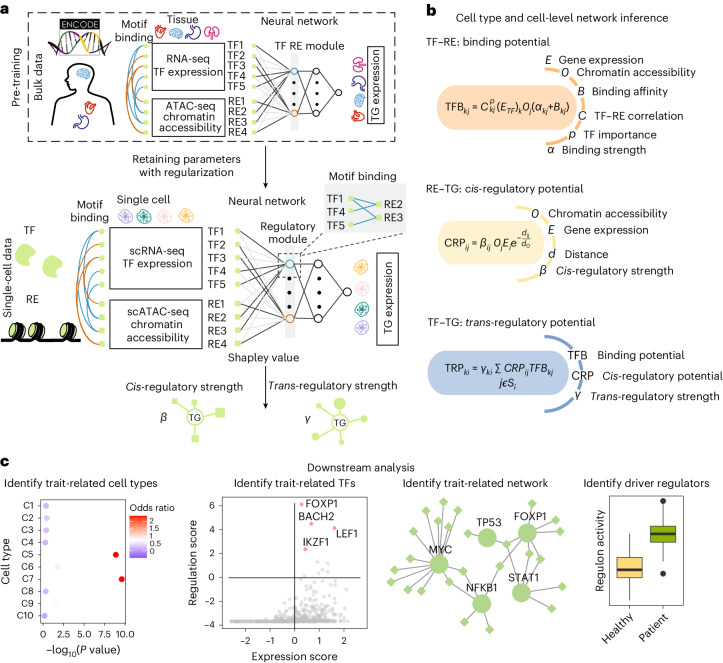
Existing methods for gene regulatory network (GRN) inference rely on gene expression data alone or on lower resolution bulk data. Despite the recent integration of chromatin accessibility and RNA sequencing data, learning complex mechanisms from limited independent data points still presents a daunting challenge. Here we present LINGER (Lifelong neural network for gene regulation), a machine-learning method to infer GRNs from single-cell paired gene expression and chromatin accessibility data. LINGER incorporates atlas-scale external bulk data across diverse cellular contexts and prior knowledge of transcription factor motifs as a manifold regularization. LINGER achieves a fourfold to sevenfold relative increase in accuracy over existing methods and reveals a complex regulatory landscape of genome-wide association studies, enabling enhanced interpretation of disease-associated variants and genes. Following the GRN inference from reference single-cell multiome data, LINGER enables the estimation of transcription factor activity solely from bulk or single-cell gene expression data, leveraging the abundance of available gene expression data to identify driver regulators from case-control studies.
Overview
AI snapshot
Written from the paper’s full text.
TL;DR
LINGER infers gene regulatory networks from paired single-cell gene expression and chromatin accessibility data by pretraining on atlas-scale bulk ENCODE data and incorporating TF–motif prior knowledge as manifold regularization. It reports a fourfold to sevenfold relative increase in accuracy over existing methods and enables GWAS interpretation and TF activity estimation from expression data alone.
Key findings
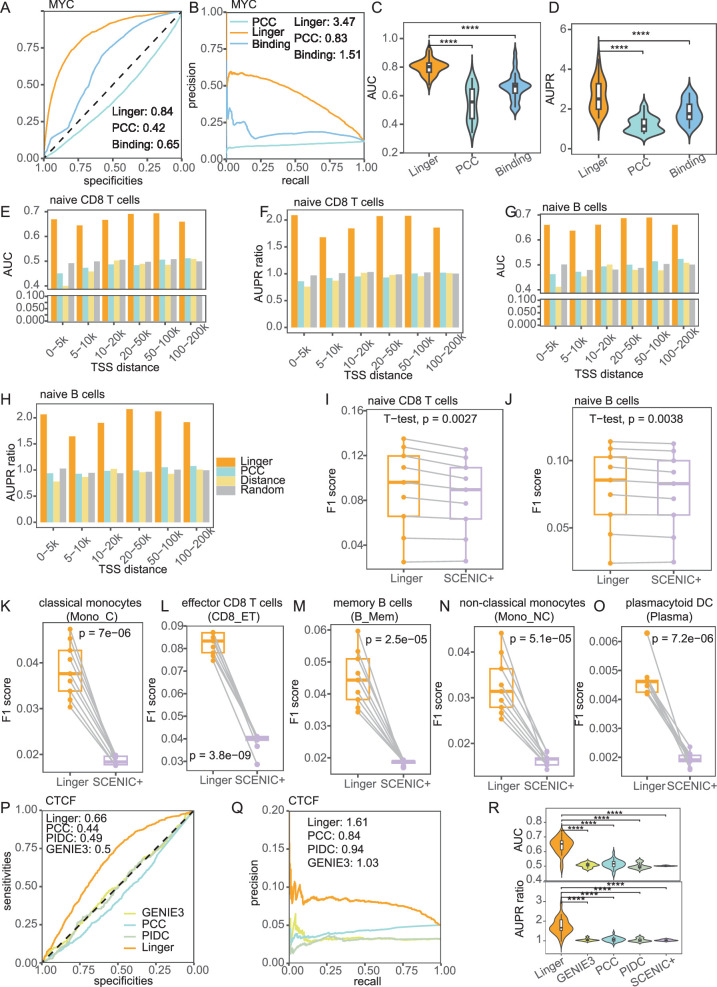
- LINGER improved population-level GRN inference over scNN, BulkNN and PCC across 20 blood ChIP–seq ground-truth datasets, with significantly higher AUC and AUPR ratio; for trans-regulatory potential, other methods averaged AUPR ratios of 1.17–1.29, 0.17–0.29 units above random, whereas LINGER achieved 1.25 units above random, described as a fourfold to sevenfold relative increase.
- For cell type-specific TF–RE binding in naive CD4 T cells, LINGER reached AUC 0.92 and AUPR ratio 5.17 for ETS1, versus PCC (AUC 0.78; AUPR ratio 2.71) and motif binding affinity (AUC 0.70; AUPR ratio 1.92); for cis-regulatory potential in naive CD4 T cells, LINGER achieved AUC 0.66–0.70 and AUPR ratio 1.81–2.16 across distance groups, while other methods were close to random.
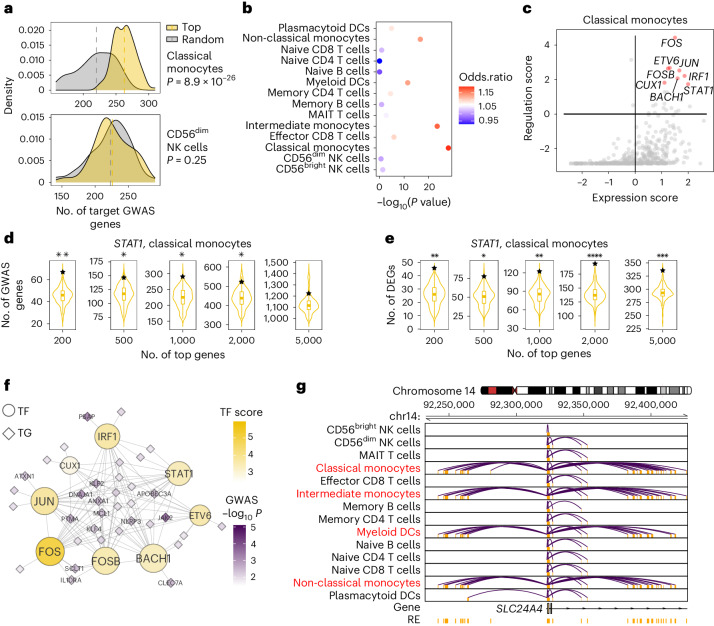
- In IBD GWAS analysis using risk loci from about 330,000 individuals, classical monocytes showed significantly higher trait regulation scores for top-expressed TFs than random TFs (P = 8.9 × 10⁻²⁹); among the top 200 STAT1 target genes in classical monocytes, 67 overlapped GWAS genes (P < 0.01), and the SLC24A4 cis-regulatory network was dense near risk SNP rs11626366 (P = 7.4 × 10⁻³).
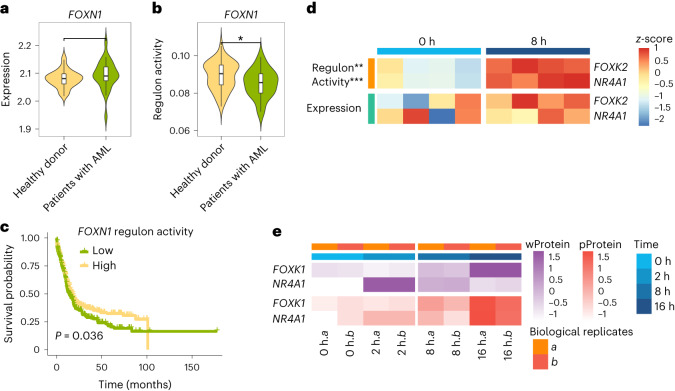
- LINGER estimated TF activity from expression alone: FOXN1 activity was lower in AML patients than healthy donors (P = 0.035) despite no significant expression difference, and high FOXN1 activity was associated with higher survival; upon TCR stimulation, FOXK2 and NR4A1 regulon activity increased at 8 h (P = 0.0057 and P = 0.00081, respectively) without significant expression changes.
Methods
- LINGER uses a neural network to predict target-gene expression from TF expression and regulatory-element accessibility, pretraining on 201 ENCODE bulk samples across diverse cellular contexts, then refining on single-cell multiome data with elastic weight consolidation and manifold regularization based on TF–RE motif matching; Shapley values infer TF–TG and RE–TG regulatory strengths.
- Data included 10x Genomics PBMC multiome data (11,909 cells; after filtering, 9,543 cells; metacells used for training), an in silico mixture of H1, BJ, GM12878 and K562 from SNARE-seq, and ground truth from ChIP–seq, eQTLGen/GTEx, promoter-capture Hi-C, single-cell eQTL, KnockTF perturbation data and GWAS summary statistics.
- Performance was assessed mainly by AUC, AUPR ratio, F1 score and paired t-tests, with comparisons to scNN, BulkNN, PCC, motif binding affinity, GENIE3, PIDC, SCENIC+ and CellOracle.
Limitations
- The paper states that TF self-regulation is not considered because it is challenging to model without additional data.
- The paper states that lifelong learning involves a tradeoff between retaining bulk prior knowledge and fitting new single-cell data, and that the flexibility of variation in prior knowledge is not constrained when fitting new data.
- Evident from the text: benchmarking is largely limited to blood/PBMC and the H1 cell line, with ground truth restricted to available ChIP–seq, eQTL, Hi-C and perturbation datasets; generalization to other tissues or cell types is not established here.
Model-written summary. Check it against the paper before relying on it.
Integrity signals
Registry
Cites
Statistics
Figures
Verification
Claims the paper makes
51 Own result · 18 Own interpretation · 10 No basis given · 9 Supported · 7 Partly supported · 4 No full text of the sources · 3 Sources not found · 2 Supported so far · 2 Own method · accuracy not yet measured
Every source the paper cites for this claim was checked and supports it.
In the paper
“Despite extensive efforts, GRN inference accuracy has remained disappointingly low, marginally exceeding random predictions39.”
- Also stated in: § Main · plain
“Third, inferred GRN accuracy assessed by experimental data is only marginally better than random prediction39.”
§ Inferring gene regulatory networks from single-cell multiome data using atlas-scale external data > Main
What the sources say
- Supportedcites [39] Pratapa, A., Jalihal, A. P., Law, J. N., Bharadwaj, A. & Murali, T. M. Benchmarking algorithms for gene regulatory network inference from single-cell transcriptomic data. Nat. Methods 17, 147–154 (2020). source
The Discussion says reported GRN algorithm performance was often close to that of a random predictor, “as we also observed.” The Results for curated models likewise report that many algorithms had early-precision ratios close to one, similar to random prediction. These passages support the paraphrase in the context of single-cell GRN inference. (LLM, conf=0.92)
plain- Asserted: passes — The authors put it forward as true.
- Checkable: passes — It can be checked against evidence.
- Load-bearing: passes — The paper’s conclusions depend on it.
- Based: passes — The paper gives a reason why it holds.
- Also stated in: § Main · plain
The cited sources support only part of this claim — read each source’s verdict below.
In the paper
“Single-cell RNA sequencing (scRNA-seq) data enables cell type-specific trans-regulation inference through co-expression analysis such as PIDC and SCENIC21–30.”
§ Inferring gene regulatory networks from single-cell multiome data using atlas-scale external data > Main
What the sources say
- Partly supportedcites [21] Chan, T. E., Stumpf, M. P. H. & Babtie, A. C. Gene regulatory network inference from single-cell data using multivariate information measures. Cell Syst. 5, 251–267.e3 (2017). sourceExperimental — accuracy not yet measured
The Introduction describes using statistical relationships among single-cell gene-expression profiles to infer putative regulatory relationships, and the Results show PIDC identifying relationships specific to cell subpopulations. But the paper’s experimental applications use single-cell qPCR data, not scRNA-seq, and its inferred relationships do not establish specific trans-regulatory interactions. (LLM, conf=0.83)
- Supportedcites [22] Aibar, S. et al. SCENIC: single-cell regulatory network inference and clustering. Nat. Methods 14, 1083–1086 (2017). source
The SCENIC workflow passage describes inferring transcription-factor-associated gene modules from single-cell co-expression, then refining them with cis-regulatory motif analysis. The paper also reports identifying cell types and potential regulators per cell type. SCENIC is therefore an example of the approach cited, though co-expression is not its only step. (LLM, conf=0.91)
- Supportedcites [23] Matsumoto, H. et al. SCODE: an efficient regulatory network inference algorithm from single-cell RNA-seq during differentiation. Bioinformatics 33, 2314–2321 (2017). source
The Introduction states that scRNA-seq permits accurate gene-expression correlations without mixing cell types, and that each cell type’s co-expression pattern can reveal regulatory factors. This supports the attributed claim that single-cell data enable cell-type-specific regulatory inference through co-expression; the citation does not require SCODE itself to be a co-expression method. (LLM, conf=0.88)
- Partly supportedcites [24] Papili Gao, N., Ud-Dean, S. M. M., Gandrillon, O. & Gunawan, R. SINCERITIES: inferring gene regulatory networks from time-stamped single cell transcriptional expression profiles. Bioinformatics 34, 258–266 (2018). sourceExperimental — accuracy not yet measured
The Introduction and Discussion say that single-cell expression data can be used to infer gene regulatory networks while revealing cellular heterogeneity. But the Discussion describes SINCERITIES as inferring networks from time-stamped changes in expression distributions, not co-expression analysis; the paper does not establish the claim specifically for cell type-specific trans-regulation or identify PIDC and SCENIC as examples. (LLM, conf=0.84)
- Not checked — no full text of the sourcecites [25] Sanchez-Castillo, M., Blanco, D., Tienda-Luna, I. M., Carrion, M. C. & Huang, Y. A Bayesian framework for the inference of gene regulatory networks from time and pseudo-time series data. Bioinformatics 34, 964–970 (2018). source
- Partly supportedcites [26] Hu, Y., Peng, T., Gao, L. & Tan, K. CytoTalk: de novo construction of signal transduction networks using single-cell transcriptomic data. Sci. Adv. 7, eabf1356 (2021). sourceExperimental — accuracy not yet measured
The Materials and Methods section (“Construction of intracellular functional gene interaction network”; page unavailable) says CytoTalk builds a coexpression network for each cell type from single-cell data. But the paper uses those networks to infer signal-transduction pathways between cell types; the cited passages do not establish cell type-specific trans-regulatory inference or describe PIDC or SCENIC. (LLM, conf=0.83)
- Partly supportedcites [27] Frankowski, P. C. A. & Vert, J. P. Gene regulation inference from single-cell RNA-seq data with linear differential equations and velocity inference. Bioinformatics 36, 4774–4780 (2020). sourceExperimental — accuracy not yet measured
The Abstract says scRNA-seq offers possibilities for inferring gene regulatory networks, supporting the general inference claim. It describes the paper’s approach as velocity inference and differential-equation modeling, but does not support the more specific claim of cell type-specific inference through co-expression analysis such as PIDC or SCENIC. (LLM, conf=0.85)
- Partly supportedcites [28] Specht, A. T. & Li, J. LEAP: constructing gene co-expression networks for single-cell RNA-sequencing data using pseudotime ordering. Bioinformatics 33, 764–766 (2017). sourceExperimental — accuracy not yet measured
The Methods and Conclusion describe using scRNA-seq co-expression to identify directional associations that may reflect gene regulation. The Results apply LEAP to dendritic cells, but the paper does not establish cell type-specific trans-regulation inference; it characterizes the inferred associations as likely regulatory rather than confirmed regulation. (LLM, conf=0.84)
- Not checked — no full text of the sourcecites [29] Moerman, T. et al. GRNBoost2 and Arboreto: efficient and scalable inference of gene regulatory networks. Bioinformatics 35, 2159–2161 (2019). source
- Not matchedcites [30] Zhang, S. et al. Inference of cell type-specific gene regulatory networks on cell lineages from single cell omic datasets. Nat. Commun. 14, 3064 (2023).
Couldn’t be matched to a paper in Crossref, so it can’t be checked.
plaindirect- Asserted: passes — The authors put it forward as true.
- Checkable: passes — It can be checked against evidence.
- Load-bearing: passes — The paper’s conclusions depend on it.
- Based: passes — The paper gives a reason why it holds.
- Partly supported
The cited sources support only part of this claim — read each source’s verdict below.
In the paper
“These TFs have been previously reported to be associated with IBD in the literature.”
§ Inferring gene regulatory networks from single-cell multiome data using atlas-scale external data > Results > LINGER reveals the regulatory landscape of GWAS traits
What the sources say
- Partly supportedcites [66] Wang, X., Guo, R., Lv, Y. & Fu, R. The regulatory role of Fos related antigen-1 in inflammatory bowel disease. Mol. Med. Rep. 17, 1979–1985 (2018). sourceExperimental — accuracy not yet measured
The Introduction reports an association between Fra-1 expression in intestinal epithelial cells and IBD activity, and the Discussion reports elevated STAT1, STAT6 and CREB signaling in IBD patients. The citing sentence does not identify which transcription factors “these TFs” refers to, so this paper cannot verify the claim for the entire unspecified group. (LLM, conf=0.78)
- Supportedcites [67] Nowak, J. K. et al. Characterisation of the circulating transcriptomic landscape in inflammatory bowel disease provides evidence for dysregulation of multiple transcription factors including NFE2, SPI1, CEBPB, and IRF2. J. Crohns Colitis 16, 1255–1268 (2022). source
Results §3.9 identifies NFE2, SPI1, CEBPB, and IRF2 in IBD analyses and reports increased predicted activity for all four. The Conclusion (§4.8) likewise implicates these TFs in IBD inflammation, supporting the claim that they had been reported as associated with IBD. (LLM, conf=0.91)
- Not checked — no full text of the sourcecites [68] Broom, O. J., Widjaya, B., Troelsen, J., Olsen, J. & Nielsen, O. H. Mitogen activated protein kinases: A role in inflammatory bowel disease? Clin. Exp. Immunol. 158, 272–280 (2009). source
plaincorrelational- Asserted: passes — The authors put it forward as true.
- Checkable: passes — It can be checked against evidence.
- Load-bearing: unclear — It is unclear whether the paper’s conclusions depend on it.
- Based: passes — The paper gives a reason why it holds.
- Partly supported
The cited sources support only part of this claim — read each source’s verdict below.
In the paper
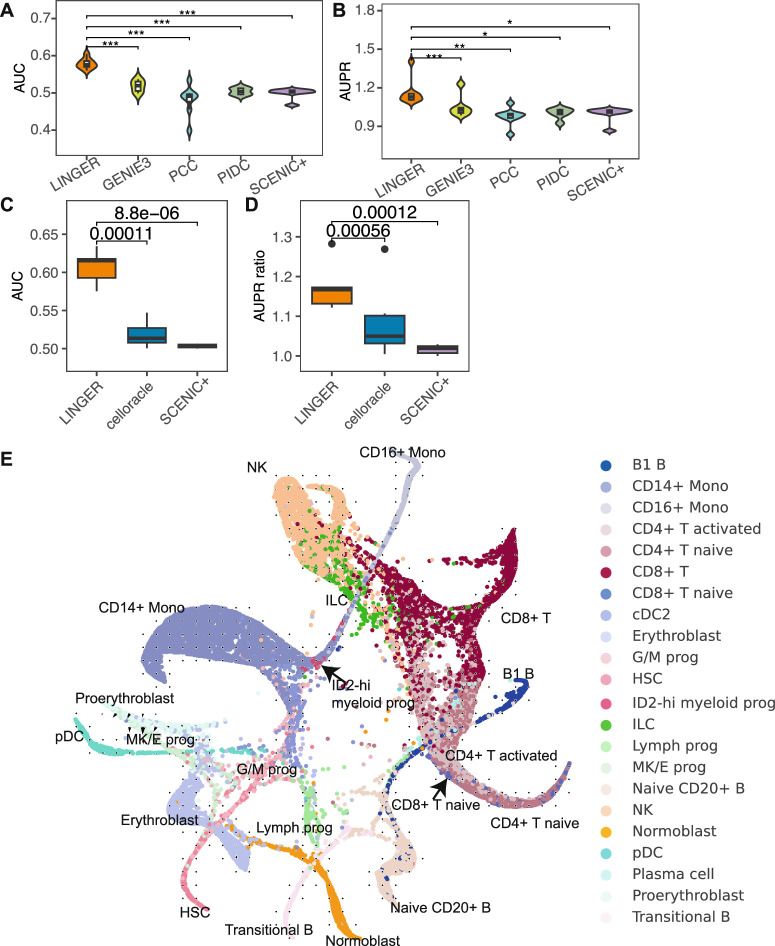
“Extended Data Fig. 4a,b shows that LINGER outperforms all other methods (P ≤ 3.72 × 10⁻⁴).”
§ Inferring gene regulatory networks from single-cell multiome data using atlas-scale external data > Results > LINGER improves the cell type-specific GRN inference
What the sources say
- Partly supportedcites [59] Feng, C. et al. KnockTF: a comprehensive human gene expression profile database with knockdown/knockout of transcription factors. Nucleic Acids Res. 48, D93–D100 (2020). sourceExperimental — accuracy not yet measured
The Introduction identifies KnockTF as a database of human TF knockdown/knockout expression datasets, and Data Source and Processing describes its differentially expressed gene analyses. This supports citing KnockTF as a data source, but our copy does not report eight PBMC datasets or compare LINGER with other methods; it does not support the stated performance result or P-value. (LLM, conf=0.86)
plaindirect- Asserted: passes — The authors put it forward as true.
- Checkable: passes — It can be checked against evidence.
- Load-bearing: passes — The paper’s conclusions depend on it.
- Based: passes — The paper gives a reason why it holds.
- Rests on an assumption: Perturbation experiment data from KnockTF are valid ground truth for direct DEGs under TF perturbation.
- Partly supported
The sources with a verdict support this claim; the rest weren’t checked yet, have no full text we could read, or their verdicts aren’t rated yet.
In the paper
“Other studies have also shown that FOXK2 affects the activation of T lymphocytes77,78 and revealed the essential roles of NR4A1 in regulatory T cell differentiation79,80, suggesting that the identified TFs have important roles in naive CD4+ T cell response upon TCR stimulation.”
§ Inferring gene regulatory networks from single-cell multiome data using atlas-scale external data > Results > Identify driver regulators based on transcription profiles
What the sources say
- Not checked — no full text of the sourcecites [77] Blanchett, S., Boal-Carvalho, I., Layzell, S. & Seddon, B. NF-κB and extrinsic cell death pathways—entwined do-or-die decisions for T cells. Trends Immunol. 42, 76–88 (2021). source
- Could not verifycites [78] Oh, H. & Ghosh, S. NF-κB: roles and regulation in different CD4+ T-cell subsets. Immunol. Rev. 252, 41–51 (2013). sourceExperimental — accuracy not yet measured
The Introduction discusses TCR-stimulated T-cell activation, and the section on natural regulatory T-cell development discusses NF-κB and FoxP3. Searches for NR4A1 and FOXK2 returned no passages linking either factor to regulatory T-cell differentiation or naive CD4+ T-cell responses. Our copy therefore does not address the claim about these two factors. (LLM, conf=0.76)
- Not checked — no full text of the sourcecites [79] Sekiya, T. et al. Essential roles of the transcription factor NR4A1 in regulatory T cell differentiation under the influence of immunosuppressants. J. Immunol. 208, 2122–2130 (2022). source
- Supportedcites [80] Fassett, M. S., Jiang, W., D’Alise, A. M., Mathis, D. & Benoist, C. Nuclear receptor Nr4a1 modulates both regulatory T-cell (Treg) differentiation and clonal deletion. Proc. Natl Acad. Sci. USA 109, 3891–3896 (2012). source
The Nr4a1 section reports that Nr4a1 dampens selection into the thymic Treg lineage at an early stage driven by TCR signals. This supports the cited point about NR4A1's role in regulatory T-cell differentiation; the broader statement about naive CD4+ T-cell responses is the citing authors’ inference, not a finding attributed specifically to this paper. (LLM, conf=0.92)
hedgedcorrelational- Asserted: passes — The authors put it forward as true.
- Checkable: passes — It can be checked against evidence.
- Load-bearing: passes — The paper’s conclusions depend on it.
- Based: passes — The paper gives a reason why it holds.
Every source the paper cites for this claim was checked and supports it.
In the paper
“Apart from GWAS-relevant genes, we collected the DEGs between inflamed biopsies and non-inflamed biopsies71 and we found that these DEGs significantly overlapped with the top-ranked TGs of STAT1 (one-sided bootstrap hypothesis testing; Fig. 5e).”
§ Inferring gene regulatory networks from single-cell multiome data using atlas-scale external data > Results > LINGER reveals the regulatory landscape of GWAS traits
What the sources say
- Supportedcites [71] Hu, S. et al. Inflammation status modulates the effect of host genetic variation on intestinal gene expression in inflammatory bowel disease. Nat. Commun. 12, 1122 (2021). source
The citation is attached to the DEGs collected from inflamed versus non-inflamed biopsies, not to the citing authors’ subsequent STAT1 overlap test. The Results section reports 1,131 differentially expressed genes from that comparison. The one-sided bootstrap result is presented as the citing authors’ own finding. (LLM, conf=0.94)
plaincorrelational- Asserted: passes — The authors put it forward as true.
- Checkable: passes — It can be checked against evidence.
- Load-bearing: passes — The paper’s conclusions depend on it.
- Based: passes — The paper gives a reason why it holds.
- Supported
A result the paper reports from its own data — it cites no other source for it, so there is none to check. The quote shows it is in the paper.
In the paper
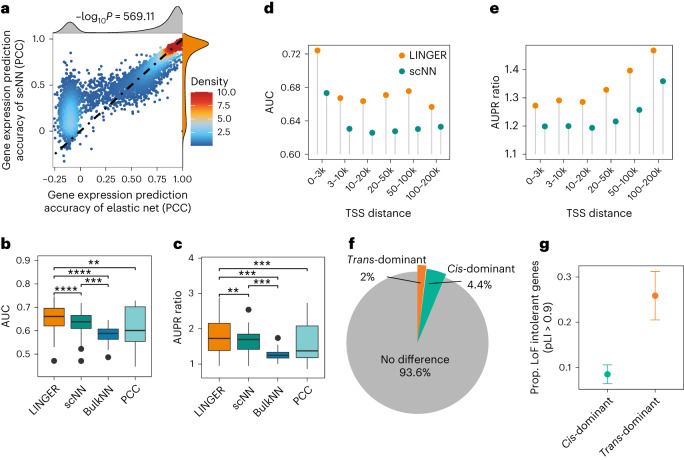
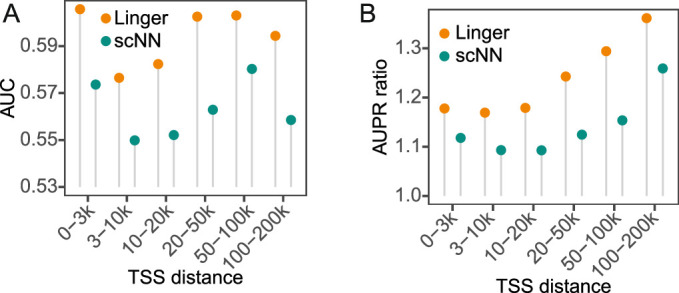
“LINGER achieved a higher AUC and AUPR ratio than scNN in all different distance groups in eQTLGen (Fig. 2d,e) as well as GTEx (Extended Data Fig. 1a,b).”
§ Inferring gene regulatory networks from single-cell multiome data using atlas-scale external data > Results > LINGER improves the cellular population GRN inference
plaincorrelational- Asserted: passes — The authors put it forward as true.
- Checkable: passes — It can be checked against evidence.
- Load-bearing: passes — The paper’s conclusions depend on it.
- Based: passes — The paper gives a reason why it holds.
A result the paper reports from its own data — it cites no other source for it, so there is none to check. The quote shows it is in the paper.
In the paper
“Specifically, 4.37% of genes are cis-regulation dominant, while 2.00% are trans-regulation dominant (Fig. 2f).”
§ Inferring gene regulatory networks from single-cell multiome data using atlas-scale external data > Results > LINGER improves the cellular population GRN inference
plain- Asserted: passes — The authors put it forward as true.
- Checkable: passes — It can be checked against evidence.
- Load-bearing: unclear — It is unclear whether the paper’s conclusions depend on it.
- Based: passes — The paper gives a reason why it holds.
A result the paper reports from its own data — it cites no other source for it, so there is none to check. The quote shows it is in the paper.
In the paper
“Results show that scNN performs better than PCC and BulkNN.”
§ Inferring gene regulatory networks from single-cell multiome data using atlas-scale external data > Results > LINGER improves the cellular population GRN inference
plaincorrelational- Asserted: passes — The authors put it forward as true.
- Checkable: passes — It can be checked against evidence.
- Load-bearing: unclear — It is unclear whether the paper’s conclusions depend on it.
- Based: passes — The paper gives a reason why it holds.
The paper states this without a source or data behind it here, so there is nothing to check it against. The quote shows it is in the paper.
In the paper
“LINGER achieves a fourfold to sevenfold relative increase in accuracy over existing methods”
- Also stated in: § Main · plain
“Third, the accuracy of LINGER represents a fourfold to sevenfold relative increase.”
§ Inferring gene regulatory networks from single-cell multiome data using atlas-scale external data > Abstract
plaindirect- Asserted: passes — The authors put it forward as true.
- Checkable: passes — It can be checked against evidence.
- Load-bearing: passes — The paper’s conclusions depend on it.
- Based: passes — The paper gives a reason why it holds.
- Rests on an assumption: Shapley value estimates the contribution of each feature for each gene.
- Rests on an assumption: The correlation of TF and RE parameters learned in the second layer reflects TF–RE binding strength.
- Also stated in: § Main · plain
- Probably not a substantial claim. 24
- It may state two separate claims as one. 30
- The quote only partly states this claim. 2
Every source the paper cites for this claim was checked and supports it.
In the paper
“EWC regularization encourages the posterior to remain close to the prior, retaining knowledge while adapting, preventing excessive changes and ensuring a more stable learning process47.”
§ Inferring gene regulatory networks from single-cell multiome data using atlas-scale external data > Results > LINGER: using bulk data to infer GRNs from single-cell multiome data
What the sources say
- Supportedcites [47] Kirkpatrick, J. et al. Overcoming catastrophic forgetting in neural networks. Proc. Natl Acad. Sci. USA 114, 3521–3526 (2017). source
The Discussion (p. 6) says EWC protects knowledge during new learning by pulling important weights toward their old values. It also describes the posterior from previous tasks as the prior for a new task, supporting the claim’s Bayesian paraphrase. The results in §2.1 (p. 3) show learning a new task without forgetting the old one. (LLM, conf=0.90)
plaindirect- Asserted: passes — The authors put it forward as true.
- Checkable: passes — It can be checked against evidence.
- Load-bearing: passes — The paper’s conclusions depend on it.
- Based: passes — The paper gives a reason why it holds.
Probably not a substantial claim. It may state two separate claims as one.
- Supported
The cited sources support only part of this claim — read each source’s verdict below.
In the paper
“Lifelong learning has been proven to leverage the knowledge learned in previous tasks to learn the new task better45.”
§ Inferring gene regulatory networks from single-cell multiome data using atlas-scale external data > Results > LINGER: using bulk data to infer GRNs from single-cell multiome data
What the sources say
- Partly supportedcites [45] Parisi, G. I., Kemker, R., Part, J. L., Kanan, C. & Wermter, S. Continual lifelong learning with neural networks: a review. Neural Netw. 113, 54–71 (2019). sourceExperimental — accuracy not yet measured
Section 3.5 defines positive forward transfer as prior learning improving performance on a later task, and Section 4.3 describes approaches that reuse knowledge across tasks. But Section 4.3 calls transfer learning an open challenge, while Section 3.5 also recognizes negative transfer. The review therefore supports that lifelong-learning approaches can improve later-task learning, not that lifelong learning has generally been proven to do so. Page numbers were not provided in the passages. (LLM, conf=0.87)
boosteddirect- Asserted: passes — The authors put it forward as true.
- Checkable: passes — It can be checked against evidence.
- Load-bearing: passes — The paper’s conclusions depend on it.
- Based: passes — The paper gives a reason why it holds.
Probably not a substantial claim.
- Partly supported
The cited sources support only part of this claim — read each source’s verdict below.
In the paper
“Genome-wide measurements of chromatin accessibility, such as DNase-seq17 and assay for transposase-accessible chromatin sequencing (ATAC-seq)18, locate REs, enabling TF–RE connections by motif matching and connecting REs to their nearby TGs19.”
§ Inferring gene regulatory networks from single-cell multiome data using atlas-scale external data > Main
What the sources say
- Not matchedcites DNase-seq17
Couldn’t be matched to a paper in Crossref, so it can’t be checked.
- Not matchedcites ATAC-seq18
Couldn’t be matched to a paper in Crossref, so it can’t be checked.
- Partly supportedcites [19] Neph, S. et al. Circuitry and dynamics of human transcription factor regulatory networks. Cell 150, 1274–1286 (2012). sourceExperimental — accuracy not yet measured
The Experimental Procedures (Regulatory network construction; page unavailable) describe matching TF motifs to DNaseI footprints and linking those footprints to genes whose transcription start sites are within 5,000 nucleotides. This supports the proposed connection method, but the study constructed networks for TF genes specifically, not target genes generally; the Discussion also cautions that proximity does not reliably assign distal regulatory elements to their target genes. (LLM, conf=0.85)
plaindirect- Asserted: passes — The authors put it forward as true.
- Checkable: passes — It can be checked against evidence.
- Load-bearing: passes — The paper’s conclusions depend on it.
- Based: passes — The paper gives a reason why it holds.
It may state two separate claims as one.
- Not matched
Every source the paper cites for this claim was checked and supports it.
In the paper
“Recently, scJoint38 was developed to transfer labels from scRNA-seq to scATAC-seq data, which may enable improved cell GRN inference.”
§ Inferring gene regulatory networks from single-cell multiome data using atlas-scale external data > Main
What the sources say
- Supportedcites [38] Lin, Y. et al. scJoint integrates atlas-scale single-cell RNA-seq and ATAC-seq data with transfer learning. Nat. Biotechnol. 40, 703–710 (2022). source
The Discussion describes scJoint as a transfer-learning method that cotrains labeled scRNA-seq data and unlabeled scATAC-seq data, and the Results describe its transfer of cell-type labels to ATAC cells. The suggestion that this may improve cell GRN inference is the citing authors’ prospective inference, not a result attributed to scJoint. (LLM, conf=0.90)
hedgedconditional- Asserted: passes — The authors put it forward as true.
- Checkable: passes — It can be checked against evidence.
- Load-bearing: fails — The paper’s conclusions may not depend on it.
- Based: passes — The paper gives a reason why it holds.
Probably not a substantial claim. The paper’s conclusions may not depend on it. It may state two separate claims as one.
- Supported
The cited sources support only part of this claim — read each source’s verdict below.
In the paper
“FOXK2 and NR4A1 are activated at 8 h based on regulon activity (Fig. 6d), which is consistent with the whole proteomics and phosphoproteomics data (Fig. 6e)76.”
§ Inferring gene regulatory networks from single-cell multiome data using atlas-scale external data > Results > Identify driver regulators based on transcription profiles
What the sources say
- Partly supportedcites [76] Tan, H. et al. Integrative proteomics and phosphoproteomics profiling reveals dynamic signaling networks and bioenergetics pathways underlying T cell activation. Immunity 46, 488–503 (2017). sourceExperimental — accuracy not yet measured
The Results section on TCR-stimulated proteome changes places NR4A1 in a whole-proteome cluster that rises at 2 h and then gradually declines. The cited paper does not establish FOXK2 or NR4A1 activation at 8 h based on regulon activity, nor does the retrieved phosphoproteomics discussion show matching changes for those factors. Its NR4A1 finding therefore supports only part of the claimed consistency. (LLM, conf=0.84)
plaincorrelational- Asserted: passes — The authors put it forward as true.
- Checkable: passes — It can be checked against evidence.
- Load-bearing: unclear — It is unclear whether the paper’s conclusions depend on it.
- Based: passes — The paper gives a reason why it holds.
It may state two separate claims as one.
- Partly supported
Every source the paper cites for this claim was checked and supports it.
In the paper
“GWASs have identified thousands of disease variants, but the active cells and functions involving variant-regulated genes remain largely unknown61.”
§ Inferring gene regulatory networks from single-cell multiome data using atlas-scale external data > Results > LINGER reveals the regulatory landscape of GWAS traits
What the sources say
- Supportedcites [61] Jagadeesh, K. A. et al. Identifying disease-critical cell types and cellular processes by integrating single-cell RNA-sequencing and human genetics. Nat. Genet. 54, 1479–1492 (2022). source
The Introduction states that GWAS have identified thousands of disease-associated variants, while the cellular mechanisms through which they act remain largely unknown. It specifically points to limited knowledge of the cells and functional programs in which the genes regulated by those variants are active. (LLM, conf=0.94)
plain- Asserted: passes — The authors put it forward as true.
- Checkable: passes — It can be checked against evidence.
- Load-bearing: passes — The paper’s conclusions depend on it.
- Based: passes — The paper gives a reason why it holds.
Probably not a substantial claim. It may state two separate claims as one.
- Supported
The cited sources support only part of this claim — read each source’s verdict below.
In the paper
“EWC constrains the parameters of the first layer to stay in a region of , which is previously learned from the bulk data45.”
§ Inferring gene regulatory networks from single-cell multiome data using atlas-scale external data > Methods > GRN inference by lifelong learning
What the sources say
- Partly supportedcites [45] Parisi, G. I., Kemker, R., Part, J. L., Kanan, C. & Wermter, S. Continual lifelong learning with neural networks: a review. Neural Netw. 113, 54–71 (2019). sourceExperimental — accuracy not yet measured
Section 3.2 (page unavailable) describes EWC as penalizing changes to task-relevant parameters relative to values learned on a previous task. It does not restrict this constraint to the first layer or describe the previous training data as “bulk data.” (LLM, conf=0.88)
plaindirect- Asserted: passes — The authors put it forward as true.
- Checkable: passes — It can be checked against evidence.
- Load-bearing: passes — The paper’s conclusions depend on it.
- Based: passes — The paper gives a reason why it holds.
Probably not a substantial claim.
- Partly supported
The sources with a verdict support this claim; the rest weren’t checked yet, have no full text we could read, or their verdicts aren’t rated yet.
In the paper
“These findings align with previous studies linking monocytes to the pathogenesis of IBD64,65.”
§ Inferring gene regulatory networks from single-cell multiome data using atlas-scale external data > Results > LINGER reveals the regulatory landscape of GWAS traits
What the sources say
- Not checked — no full text of the sourcecites [64] Anderson, A. et al. Monocytosis is a biomarker of severity in inflammatory bowel disease: analysis of a 6-year prospective natural history registry. Inflamm. Bowel Dis. 28, 70–78 (2022). source
- Supportedcites [65] Aschenbrenner, D. et al. Deconvolution of monocyte responses in inflammatory bowel disease reveals an IL-1 cytokine network that regulates IL-23 in genetic and acquired IL-10 resistance. Gut 70, 1023–1036 (2021). source
The Discussion links inflammatory monocytes in patients with ulcerative colitis and Crohn’s disease to intestinal inflammation and suggests they are major sources of IL-23 in the inflamed intestine. The Results also report that inflammatory-monocyte gene expression predicted disease activity in a Crohn’s disease cohort. These passages support the broad claim that monocytes are linked to IBD pathogenesis. (LLM, conf=0.92)
plaincorrelational- Asserted: passes — The authors put it forward as true.
- Checkable: passes — It can be checked against evidence.
- Load-bearing: fails — The paper’s conclusions may not depend on it.
- Based: passes — The paper gives a reason why it holds.
Probably not a substantial claim. The paper’s conclusions may not depend on it.
Every source the paper cites for this claim was checked and supports it.
In the paper
“we calculated the TF activity of the transcriptome profile (bulk RNA-seq data) of 671 individuals with AML73 and performed survival analysis, which indicated that individuals with high FOXN1 activity level tend to have a higher survival probability (Fig. 6c).”
§ Inferring gene regulatory networks from single-cell multiome data using atlas-scale external data > Results > Identify driver regulators based on transcription profiles
What the sources say
- Supportedcites [73] Bottomly, D. et al. Integrative analysis of drug response and clinical outcome in acute myeloid leukemia. Cancer Cell 40, 850–864.e9 (2022). source
The citation is attached to the AML RNA-seq cohort, not to the citing authors’ FOXN1 survival result. The Results describe an AML cohort with harmonized RNA-seq data, and STAR Methods (RNA Sequencing; page unavailable) describes its gene-level counts. The FOXN1 analysis is presented as the citing authors’ own work. (LLM, conf=0.87)
hedgedcorrelationaln = 671- Asserted: passes — The authors put it forward as true.
- Checkable: passes — It can be checked against evidence.
- Load-bearing: passes — The paper’s conclusions depend on it.
- Based: passes — The paper gives a reason why it holds.
The quote only partly states this claim.
- Rests on an assumption: TF activity, focusing on the DNA-binding component of TF proteins, is a more reliable metric than mRNA for identifying driver regulators.
- Rests on an assumption: Estimating TF activity based on the expression patterns of downstream TGs requires an accurate GRN.
- The authors state this as an assumption: The GRN structure is consistent for the same cell type across individuals.
- Supported
Every source the paper cites for this claim was checked and supports it.
In the paper
“The Shapley value measures the contribution of features in a machine-learning model and is widely used in algorithms such as deep learning, graphical models and reinforcement learning85.”
§ Inferring gene regulatory networks from single-cell multiome data using atlas-scale external data > Methods > GRN inference by Shapley value
What the sources say
- Supportedcites [85] Rozemberczki, B. et al. The Shapley value in machine learning. Preprint at https://doi.org/10.48550/arXiv.2202.05594 (2022). source
Section 4.4 (Explainable Machine Learning) says Shapley values measure input features’ contributions to model outputs and describes approaches for deep learning and graphical models. Section 4.5 (Multi-Agent Reinforcement Learning) describes their use to attribute agents’ contributions to a global reward. Together, these passages support the cited sentence’s broad account of the Shapley value’s uses. (LLM, conf=0.90)
plain- Asserted: passes — The authors put it forward as true.
- Checkable: passes — It can be checked against evidence.
- Load-bearing: fails — The paper’s conclusions may not depend on it.
- Based: passes — The paper gives a reason why it holds.
Probably not a substantial claim. The paper’s conclusions may not depend on it. It may state two separate claims as one.
- Supported
Every source the paper cites for this claim was checked and supports it.
In the paper
“which aligns with the conclusion that chromatin accessibility alterations occur in age-related macular degeneration54.”
§ Inferring gene regulatory networks from single-cell multiome data using atlas-scale external data > Results > LINGER improves the cellular population GRN inference
What the sources say
- Supportedcites [54] Wang, J. et al. ATAC-seq analysis reveals a widespread decrease of chromatin accessibility in age-related macular degeneration. Nat. Commun. 9, 1364 (2018). source
The Discussion states that the authors profiled changes in chromatin accessibility during AMD progression in the retinal pigment epithelium and retina. The Results report broadly decreased accessibility in AMD samples compared with healthy samples, directly supporting the cited conclusion. (LLM, conf=0.94)
plain- Asserted: passes — The authors put it forward as true.
- Checkable: passes — It can be checked against evidence.
- Load-bearing: fails — The paper’s conclusions may not depend on it.
- Based: passes — The paper gives a reason why it holds.
Probably not a substantial claim. The paper’s conclusions may not depend on it.
- Supported
Every source the paper cites for this claim was checked and supports it.
In the paper
“A previous study found that disease-associated genes from GWAS were enriched in selectively constrained genes, while eQTL genes were depleted in selectively constrained genes52.”
§ Inferring gene regulatory networks from single-cell multiome data using atlas-scale external data > Results > LINGER improves the cellular population GRN inference
What the sources say
- Supportedcites [52] Mostafavi, H., Spence, J. P., Naqvi, S. & Pritchard, J. K. Systematic differences in discovery of genetic effects on gene expression and complex traits. Nat. Genet. 55, 1866–1875 (2023). source
The Results section, “Constrained genes are enriched in GWAS genes but depleted in eQTL genes,” reports enrichment of high-pLI genes among GWAS genes and depletion among eQTL genes, each compared with control SNP-linked genes. It describes high pLI as a proxy for selective constraint. (LLM, conf=0.92)
plaincorrelational- Asserted: passes — The authors put it forward as true.
- Checkable: passes — It can be checked against evidence.
- Load-bearing: passes — The paper’s conclusions depend on it.
- Based: passes — The paper gives a reason why it holds.
Probably not a substantial claim. It may state two separate claims as one.
- Supported
A result the paper reports from its own data — it cites no other source for it, so there is none to check. The quote shows it is in the paper.
In the paper
“Points show estimated success probability from binomial distribution, at 0.26 and 0.09 for trans-dominant and cis-dominant, respectively.”
§ Inferring gene regulatory networks from single-cell multiome data using atlas-scale external data > Results > LINGER improves the cellular population GRN inference
hedgedn = 317- Asserted: passes — The authors put it forward as true.
- Checkable: passes — It can be checked against evidence.
- Load-bearing: unclear — It is unclear whether the paper’s conclusions depend on it.
- Based: passes — The paper gives a reason why it holds.
It may state two separate claims as one.
The paper states this without a source or data behind it here, so there is nothing to check it against. The quote shows it is in the paper.
In the paper
“TFs contribute more to predicting the expression of trans-dominant genes, while REs contribute more to cis-dominant genes.”
§ Inferring gene regulatory networks from single-cell multiome data using atlas-scale external data > Results > LINGER improves the cellular population GRN inference
plaincorrelational- Asserted: passes — The authors put it forward as true.
- Checkable: passes — It can be checked against evidence.
- Load-bearing: unclear — It is unclear whether the paper’s conclusions depend on it.
- Based: passes — The paper gives a reason why it holds.
It may state two separate claims as one.
A result the paper reports from its own data — it cites no other source for it, so there is none to check. The quote shows it is in the paper.
In the paper
“reveals a complex regulatory landscape of genome-wide association studies, enabling enhanced interpretation of disease-associated variants and genes.”
§ Inferring gene regulatory networks from single-cell multiome data using atlas-scale external data > Abstract
plaindirect- Asserted: passes — The authors put it forward as true.
- Checkable: passes — It can be checked against evidence.
- Load-bearing: passes — The paper’s conclusions depend on it.
- Based: passes — The paper gives a reason why it holds.
It may state two separate claims as one.
- Rests on an assumption: Shapley value estimates the contribution of each feature for each gene.
- Rests on an assumption: The correlation of TF and RE parameters learned in the second layer reflects TF–RE binding strength.
A result the paper reports from its own data — it cites no other source for it, so there is none to check. The quote shows it is in the paper.
In the paper
“We found that scNN modeled gene expression better than elastic net, with −log10P = 572.09, especially for those substantial proportions of genes that show negative Pearson’s correlation coefficient (PCC) in elastic net predictions (−log10P = 1,060.17; Fig. 2a).”
- Also stated in: § LINGER improves the cellular population GRN inference · boosted
“This demonstrates that the three-layer neural network model scNN outperforms the elastic net model in predicting gene expression.”
§ Inferring gene regulatory networks from single-cell multiome data using atlas-scale external data > Results > LINGER improves the cellular population GRN inference
boostedcorrelational- Asserted: passes — The authors put it forward as true.
- Checkable: passes — It can be checked against evidence.
- Load-bearing: passes — The paper’s conclusions depend on it.
- Based: passes — The paper gives a reason why it holds.
It may state two separate claims as one.
- Also stated in: § LINGER improves the cellular population GRN inference · boosted
A result the paper reports from its own data — it cites no other source for it, so there is none to check. The quote shows it is in the paper.
In the paper
“Compared to other methods, LINGER performs better, with a significantly higher AUC (Fig. 2b) and AUPR ratio (Fig. 2c) across all ground truth data.”
§ Inferring gene regulatory networks from single-cell multiome data using atlas-scale external data > Results > LINGER improves the cellular population GRN inference
plaincorrelational- Asserted: passes — The authors put it forward as true.
- Checkable: passes — It can be checked against evidence.
- Load-bearing: passes — The paper’s conclusions depend on it.
- Based: passes — The paper gives a reason why it holds.
It may state two separate claims as one.
The paper states this without a source or data behind it here, so there is nothing to check it against. The quote shows it is in the paper.
In the paper
“Following the GRN inference from reference single-cell multiome data, LINGER enables the estimation of transcription factor activity solely from bulk or single-cell gene expression data, leveraging the abundance of available gene expression data to identify driver regulators from case-control studies.”
- Also stated in: § Main · plain
“Fourth, LINGER enables the estimation of TF activity solely from gene expression data, identifying driver regulators.”
§ Inferring gene regulatory networks from single-cell multiome data using atlas-scale external data > Abstract
plaindirect- Asserted: passes — The authors put it forward as true.
- Checkable: passes — It can be checked against evidence.
- Load-bearing: passes — The paper’s conclusions depend on it.
- Based: passes — The paper gives a reason why it holds.
It may state two separate claims as one.
- Rests on an assumption: Shapley value estimates the contribution of each feature for each gene.
- Rests on an assumption: The correlation of TF and RE parameters learned in the second layer reflects TF–RE binding strength.
- Also stated in: § Main · plain
A result the paper reports from its own data — it cites no other source for it, so there is none to check. The quote shows it is in the paper.
In the paper
“LINGER improves the cellular population GRN inference”
§ Inferring gene regulatory networks from single-cell multiome data using atlas-scale external data > Results > LINGER improves the cellular population GRN inference
plaindirect- Asserted: passes — The authors put it forward as true.
- Checkable: passes — It can be checked against evidence.
- Load-bearing: passes — The paper’s conclusions depend on it.
- Based: unclear — It is unclear why the paper says it holds.
The quote only partly states this claim.
- Rests on an assumption: Shapley value estimates the contribution of each feature for each gene.
- Rests on an assumption: The correlation of TF and RE parameters learned in the second layer reflects TF–RE binding strength.
A result the paper reports from its own data — it cites no other source for it, so there is none to check. The quote shows it is in the paper.
In the paper
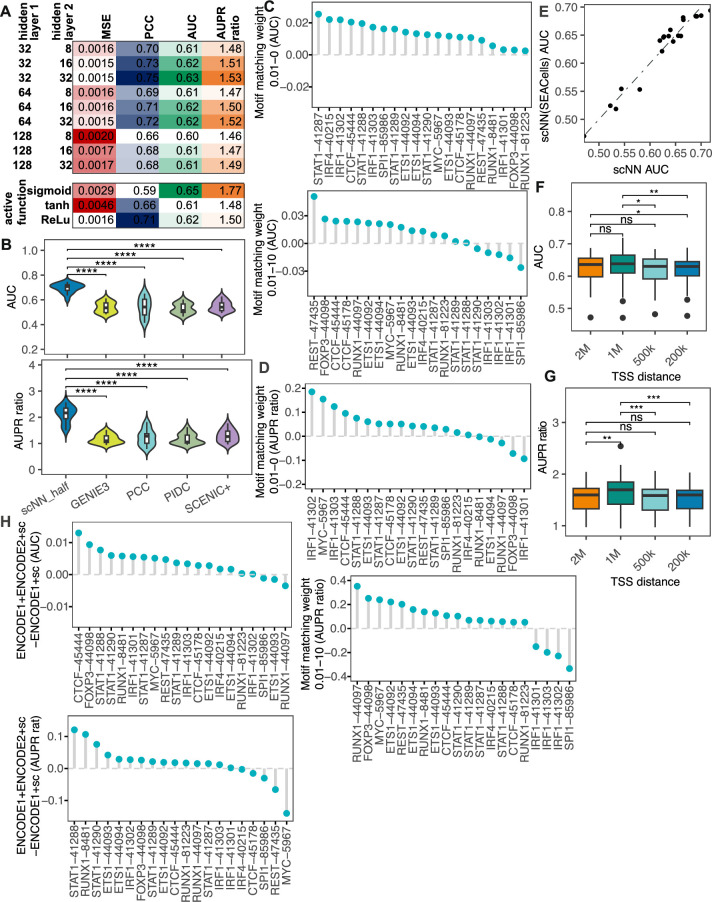
“Note that the sigmoid activation function would not improve the gene expression prediction but would improve the GRN inference (Extended Data Fig. 2a).”
§ Inferring gene regulatory networks from single-cell multiome data using atlas-scale external data > Results > LINGER improves the cellular population GRN inference
hedgeddirect- Asserted: passes — The authors put it forward as true.
- Checkable: passes — It can be checked against evidence.
- Load-bearing: unclear — It is unclear whether the paper’s conclusions depend on it.
- Based: passes — The paper gives a reason why it holds.
It may state two separate claims as one.
A result the paper reports from its own data — it cites no other source for it, so there is none to check. The quote shows it is in the paper.
In the paper
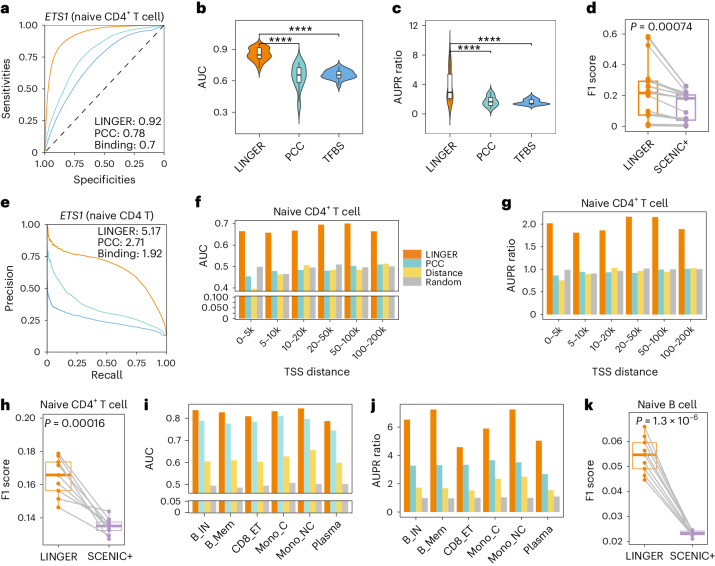
“In naive CD4 T cells, LINGER achieves AUC ranging from 0.66 to 0.70 (Fig. 3f) and AUPR ratio ranging from 1.81 to 2.16 (Fig. 3g) across all distance groups, while other methods are close to random.”
§ Inferring gene regulatory networks from single-cell multiome data using atlas-scale external data > Results > LINGER improves the cell type-specific GRN inference
plaincorrelational- Asserted: passes — The authors put it forward as true.
- Checkable: passes — It can be checked against evidence.
- Load-bearing: passes — The paper’s conclusions depend on it.
- Based: passes — The paper gives a reason why it holds.
It may state two separate claims as one.
A result the paper reports from its own data — it cites no other source for it, so there is none to check. The quote shows it is in the paper.
In the paper
“For example, in naive CD4 T cells, LINGER achieves an AUC of 0.92 and an AUPR ratio of 5.17 for ETS1, which is an improvement over PCC (AUC, 0.78; AUPR ratio, 2.71) and motif binding affinity (AUC, 0.70; AUPR ratio, 1.92) (Fig. 3a,e).”
§ Inferring gene regulatory networks from single-cell multiome data using atlas-scale external data > Results > LINGER improves the cell type-specific GRN inference
plaincorrelational- Asserted: passes — The authors put it forward as true.
- Checkable: passes — It can be checked against evidence.
- Load-bearing: passes — The paper’s conclusions depend on it.
- Based: passes — The paper gives a reason why it holds.
It may state two separate claims as one.
The paper states this without a source or data behind it here, so there is nothing to check it against. The quote shows it is in the paper.
In the paper
“However, the use of lifelong learning to leverage external data does not lead to improved gene expression prediction but does improve the GRN inference.”
§ Inferring gene regulatory networks from single-cell multiome data using atlas-scale external data > Conclusions and discussions
plaindirect- Asserted: passes — The authors put it forward as true.
- Checkable: passes — It can be checked against evidence.
- Load-bearing: passes — The paper’s conclusions depend on it.
- Based: passes — The paper gives a reason why it holds.
It may state two separate claims as one.
A result the paper reports from its own data — it cites no other source for it, so there is none to check. The quote shows it is in the paper.
In the paper
“Among the top 200 TGs regulated by STAT1 in classical monocytes, 67 of them overlap with the GWAS genes, which is statistically significant with a P value of less than 0.01 based on a background distribution from a random selection of TFs (one-sided bootstrap hypothesis testing).”
§ Inferring gene regulatory networks from single-cell multiome data using atlas-scale external data > Results > LINGER reveals the regulatory landscape of GWAS traits
plaincorrelational- Asserted: passes — The authors put it forward as true.
- Checkable: passes — It can be checked against evidence.
- Load-bearing: passes — The paper’s conclusions depend on it.
- Based: passes — The paper gives a reason why it holds.
It may state two separate claims as one.
A result the paper reports from its own data — it cites no other source for it, so there is none to check. The quote shows it is in the paper.
In the paper
“CellOracle predictions based on the LINGER GRN showed that GATA1 knockout shifted proerythroblasts to a megakaryocytic or erythroid progenitor state (Extended Data Fig. 4e), consistent with the functional role of GATA1 in inhibiting erythroblast maturation.”
§ Inferring gene regulatory networks from single-cell multiome data using atlas-scale external data > Results > In silico perturbation
plaindirect- Asserted: passes — The authors put it forward as true.
- Checkable: passes — It can be checked against evidence.
- Load-bearing: passes — The paper’s conclusions depend on it.
- Based: passes — The paper gives a reason why it holds.
It may state two separate claims as one.
A result the paper reports from its own data — it cites no other source for it, so there is none to check. The quote shows it is in the paper.
In the paper
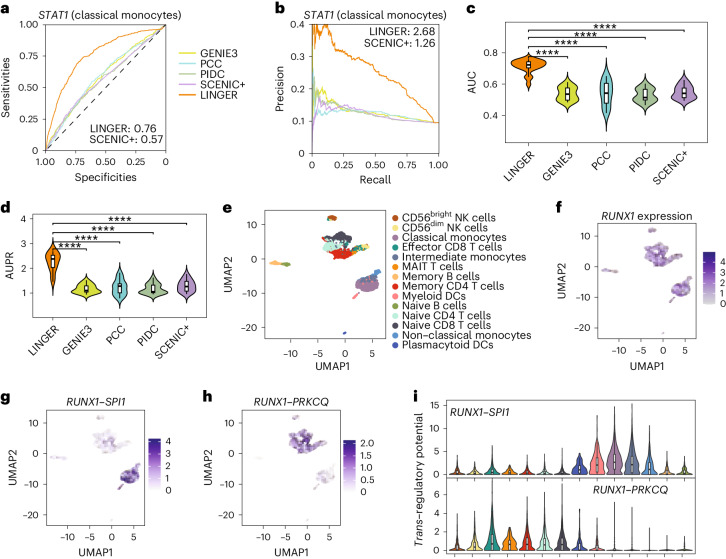
“Overall, LINGER consistently performs better than other methods for all 20 TFs in PBMCs, with a significantly higher AUC and AUPR ratio (P ≤ 9.49 × 10⁻⁹; Fig. 4c,d and Supplementary Table 7).”
§ Inferring gene regulatory networks from single-cell multiome data using atlas-scale external data > Results > LINGER improves the cell type-specific GRN inference
plaincorrelational- Asserted: passes — The authors put it forward as true.
- Checkable: passes — It can be checked against evidence.
- Load-bearing: passes — The paper’s conclusions depend on it.
- Based: passes — The paper gives a reason why it holds.
It may state two separate claims as one.
- Rests on an assumption: ChIP-seq putative targets are valid ground truth for trans-regulatory potential.
A result the paper reports from its own data — it cites no other source for it, so there is none to check. The quote shows it is in the paper.
In the paper
“Figure 5c lists the top eight candidate TFs in classical monocytes.”
§ Inferring gene regulatory networks from single-cell multiome data using atlas-scale external data > Results > LINGER reveals the regulatory landscape of GWAS traits
plain- Asserted: passes — The authors put it forward as true.
- Checkable: passes — It can be checked against evidence.
- Load-bearing: fails — The paper’s conclusions may not depend on it.
- Based: passes — The paper gives a reason why it holds.
Probably not a substantial claim. The paper’s conclusions may not depend on it.
A result the paper reports from its own data — it cites no other source for it, so there is none to check. The quote shows it is in the paper.
In the paper
“For all 20 TFs in PBMCs, LINGER consistently exhibits the highest AUC and AUPR ratios, and the overall distributions are significantly higher than others in PBMCs (P ≤ 8.72 × 10⁻⁵; Fig. 3b,c and Supplementary Table 6).”
§ Inferring gene regulatory networks from single-cell multiome data using atlas-scale external data > Results > LINGER improves the cell type-specific GRN inference
plaincorrelational- Asserted: passes — The authors put it forward as true.
- Checkable: passes — It can be checked against evidence.
- Load-bearing: passes — The paper’s conclusions depend on it.
- Based: passes — The paper gives a reason why it holds.
It may state two separate claims as one.
A result the paper reports from its own data — it cites no other source for it, so there is none to check. The quote shows it is in the paper.
In the paper
“The numbers of overlapped TGs are all significant for the top 500, 1,000, 2,000 and 5,000 TGs (Fig. 5d).”
§ Inferring gene regulatory networks from single-cell multiome data using atlas-scale external data > Results > LINGER reveals the regulatory landscape of GWAS traits
plaincorrelational- Asserted: passes — The authors put it forward as true.
- Checkable: passes — It can be checked against evidence.
- Load-bearing: passes — The paper’s conclusions depend on it.
- Based: passes — The paper gives a reason why it holds.
It may state two separate claims as one.
A result the paper reports from its own data — it cites no other source for it, so there is none to check. The quote shows it is in the paper.
In the paper
“The average AUPR ratio across ground truth datasets for other methods was 1.17–1.29, 0.17–0.29 units above random prediction, whereas LINGER achieves 1.25 units above random prediction, indicating a fourfold to sevenfold relative increase (Fig. 4d).”
§ Inferring gene regulatory networks from single-cell multiome data using atlas-scale external data > Results > LINGER improves the cell type-specific GRN inference
hedgeddirect- Asserted: passes — The authors put it forward as true.
- Checkable: passes — It can be checked against evidence.
- Load-bearing: passes — The paper’s conclusions depend on it.
- Based: passes — The paper gives a reason why it holds.
It may state two separate claims as one.
- Rests on an assumption: ChIP-seq putative targets are valid ground truth for trans-regulatory potential.
A result the paper reports from its own data — it cites no other source for it, so there is none to check. The quote shows it is in the paper.
In the paper
“Compared to 0, weight 0.01 improved the performance on 100% (Extended Data Fig. 2c) and 80% (Extended Data Fig. 2d) of ground truth data based on the AUC and AUPR ratio, respectively.”
§ Inferring gene regulatory networks from single-cell multiome data using atlas-scale external data > Results > LINGER improves the cellular population GRN inference
plaindirect- Asserted: passes — The authors put it forward as true.
- Checkable: passes — It can be checked against evidence.
- Load-bearing: passes — The paper’s conclusions depend on it.
- Based: passes — The paper gives a reason why it holds.
It may state two separate claims as one.
A result the paper reports from its own data — it cites no other source for it, so there is none to check. The quote shows it is in the paper.
In the paper
“Taking eQTL as ground truth, the F1 score of LINGER is significantly higher than SCENIC+ (Fig. 3k) and other cell types (Extended Data Fig. 3k–o).”
§ Inferring gene regulatory networks from single-cell multiome data using atlas-scale external data > Results > LINGER improves the cell type-specific GRN inference
plaincorrelational- Asserted: passes — The authors put it forward as true.
- Checkable: passes — It can be checked against evidence.
- Load-bearing: passes — The paper’s conclusions depend on it.
- Based: passes — The paper gives a reason why it holds.
It may state two separate claims as one.
None of the sources cited for this claim could be matched to a paper in Crossref, so there is nothing to check it against.
In the paper
“Those methods, including IReNA32, SOMatic33, UnpairReg34, CoupledNMF35,36, DC3 (ref. 36) and others37 link TFs to REs by motif matching and link REs to TGs using the covariation of RE–TG or physical base pair distance.”
§ Inferring gene regulatory networks from single-cell multiome data using atlas-scale external data > Main
What the sources say
- Not matchedcites IReNA32
Couldn’t be matched to a paper in Crossref, so it can’t be checked.
- Not matchedcites SOMatic33
Couldn’t be matched to a paper in Crossref, so it can’t be checked.
- Not matchedcites UnpairReg34
Couldn’t be matched to a paper in Crossref, so it can’t be checked.
plaincorrelational- Asserted: passes — The authors put it forward as true.
- Checkable: passes — It can be checked against evidence.
- Load-bearing: unclear — It is unclear whether the paper’s conclusions depend on it.
- Based: passes — The paper gives a reason why it holds.
It may state two separate claims as one.
- Not matched
In the paper
“Single-cell sequencing assay for transposase-accessible chromatin (scATAC-seq) can be used to infer trans-regulation, as in DeepTFni31.”
§ Inferring gene regulatory networks from single-cell multiome data using atlas-scale external data > Main
What the sources say
- Not checked — no full text of the sourcecites [31] Li, H. et al. Inferring transcription factor regulatory networks from single-cell ATAC-seq data based on graph neural networks. Nat. Mach. Intell. 4, 389–400 (2022). source
plaindirect- Asserted: passes — The authors put it forward as true.
- Checkable: passes — It can be checked against evidence.
- Load-bearing: fails — The paper’s conclusions may not depend on it.
- Based: passes — The paper gives a reason why it holds.
Probably not a substantial claim. The paper’s conclusions may not depend on it.
In the paper
“Moreover, co-expressions are interpreted as correlations rather than causal regulations16.”
§ Inferring gene regulatory networks from single-cell multiome data using atlas-scale external data > Main
What the sources say
- Not checked — no full text of the sourcecites [16] Wang, Y. X. R. & Huang, H. Review on statistical methods for gene network reconstruction using expression data. J. Theor. Biol. 362, 53–61 (2014). source
plaincorrelational- Asserted: passes — The authors put it forward as true.
- Checkable: passes — It can be checked against evidence.
- Load-bearing: passes — The paper’s conclusions depend on it.
- Based: passes — The paper gives a reason why it holds.
Probably not a substantial claim.
None of the sources cited for this claim could be matched to a paper in Crossref, so there is nothing to check it against.
In the paper
“Co-expression-based methods such as WGCNA14, ARACNe9 and GENIE3 (ref. 15) infer the TF–TG trans-regulation from gene expression by capturing the TF–TG covariation.”
§ Inferring gene regulatory networks from single-cell multiome data using atlas-scale external data > Main
What the sources say
- Not matchedcites WGCNA14
Couldn’t be matched to a paper in Crossref, so it can’t be checked.
- Not matchedcites ARACNe9
Couldn’t be matched to a paper in Crossref, so it can’t be checked.
- Not matchedcites GENIE3 (ref. 15)
Couldn’t be matched to a paper in Crossref, so it can’t be checked.
plaindirect- Asserted: passes — The authors put it forward as true.
- Checkable: passes — It can be checked against evidence.
- Load-bearing: passes — The paper’s conclusions depend on it.
- Based: passes — The paper gives a reason why it holds.
Probably not a substantial claim.
- Not matched
What the paper did — it cites no source for this, so there is none to check. The quote shows it is in the paper.
In the paper
“We assessed the gene expression prediction ability of the two models using fivefold cross-validation.”
§ Inferring gene regulatory networks from single-cell multiome data using atlas-scale external data > Results > LINGER improves the cellular population GRN inference
plain- Asserted: passes — The authors put it forward as true.
- Checkable: passes — It can be checked against evidence.
- Load-bearing: passes — The paper’s conclusions depend on it.
- Based: passes — The paper gives a reason why it holds.
Probably not a substantial claim.
The paper states this without a source or data behind it here, so there is nothing to check it against. The quote shows it is in the paper.
In the paper
“Many methods integrate unpaired scRNA-seq and scATAC-seq data to infer trans-regulation.”
§ Inferring gene regulatory networks from single-cell multiome data using atlas-scale external data > Main
plaincorrelational- Asserted: passes — The authors put it forward as true.
- Checkable: passes — It can be checked against evidence.
- Load-bearing: fails — The paper’s conclusions may not depend on it.
- Based: passes — The paper gives a reason why it holds.
Probably not a substantial claim. The paper’s conclusions may not depend on it.
A conclusion the paper draws from its own results — it cites no other source for it, so there is none to check. The quote shows it is in the paper.
In the paper
“The extent to which the final result deviates from the prior knowledge depends on the loss incurred in fitting the new data.”
§ Inferring gene regulatory networks from single-cell multiome data using atlas-scale external data > Conclusions and discussions
plaindirect- Asserted: passes — The authors put it forward as true.
- Checkable: passes — It can be checked against evidence.
- Load-bearing: passes — The paper’s conclusions depend on it.
- Based: fails — The paper may give no reason why it holds.
Probably not a substantial claim. The paper may give no reason why it holds.
A conclusion the paper draws from its own results — it cites no other source for it, so there is none to check. The quote shows it is in the paper.
In the paper
“The lack of significant overlap between DEGs and GWAS genes (P = 0.15, two-sided Fisher’s exact test) but the significant overlap of both DEGs and GWAS with the top-ranked TGs of STAT1 indicates the robustness and unbiased nature of our method.”
§ Inferring gene regulatory networks from single-cell multiome data using atlas-scale external data > Results > LINGER reveals the regulatory landscape of GWAS traits
hedgedcorrelational- Asserted: passes — The authors put it forward as true.
- Checkable: passes — It can be checked against evidence.
- Load-bearing: passes — The paper’s conclusions depend on it.
- Based: passes — The paper gives a reason why it holds.
It may state two separate claims as one.
A conclusion the paper draws from its own results — it cites no other source for it, so there is none to check. The quote shows it is in the paper.
In the paper
“These results demonstrate that LINGER can not only predict gene expression under perturbation but also enable downstream characterizations of differentiation trajectories through integration with complementary analytical frameworks like CellOracle.”
§ Inferring gene regulatory networks from single-cell multiome data using atlas-scale external data > Results > In silico perturbation
boosteddirectSingle case- Asserted: passes — The authors put it forward as true.
- Checkable: passes — It can be checked against evidence.
- Load-bearing: passes — The paper’s conclusions depend on it.
- Based: passes — The paper gives a reason why it holds.
It may state two separate claims as one.
A conclusion the paper draws from its own results — it cites no other source for it, so there is none to check. The quote shows it is in the paper.
In the paper
“The flexibility of the variation in prior knowledge is not constrained when fitting the new data.”
§ Inferring gene regulatory networks from single-cell multiome data using atlas-scale external data > Conclusions and discussions
plain- Asserted: passes — The authors put it forward as true.
- Checkable: passes — It can be checked against evidence.
- Load-bearing: passes — The paper’s conclusions depend on it.
- Based: fails — The paper may give no reason why it holds.
Probably not a substantial claim. The paper may give no reason why it holds.
A conclusion the paper draws from its own results — it cites no other source for it, so there is none to check. The quote shows it is in the paper.
In the paper
“LINGER’s lifelong learning approach has the advantage of pre-training on bulk collections, allowing users to easily retrain the model for their own studies while capitalizing on publicly available resources without direct access.”
§ Inferring gene regulatory networks from single-cell multiome data using atlas-scale external data > Conclusions and discussions
plaindirect- Asserted: passes — The authors put it forward as true.
- Checkable: passes — It can be checked against evidence.
- Load-bearing: passes — The paper’s conclusions depend on it.
- Based: fails — The paper may give no reason why it holds.
Probably not a substantial claim. The paper may give no reason why it holds. It may state two separate claims as one.
A conclusion the paper draws from its own results — it cites no other source for it, so there is none to check. The quote shows it is in the paper.
In the paper
“The first hidden layer has 64 neurons with rectified linear unit activation that can capture regulatory modules, each of which contains multiple TFs and REs.”
§ Inferring gene regulatory networks from single-cell multiome data using atlas-scale external data > Methods > GRN inference by lifelong learning
plaindirect- Asserted: passes — The authors put it forward as true.
- Checkable: passes — It can be checked against evidence.
- Load-bearing: fails — The paper’s conclusions may not depend on it.
- Based: passes — The paper gives a reason why it holds.
Probably not a substantial claim. The paper’s conclusions may not depend on it. It may state two separate claims as one.
The paper states this without a source or data behind it here, so there is nothing to check it against. The quote shows it is in the paper.
In the paper
“For a random predictor, the AUPR equals the fraction of positive samples in the dataset.”
§ Inferring gene regulatory networks from single-cell multiome data using atlas-scale external data > Methods > AUPR ratio
plain- Asserted: passes — The authors put it forward as true.
- Checkable: passes — It can be checked against evidence.
- Load-bearing: fails — The paper’s conclusions may not depend on it.
- Based: fails — The paper may give no reason why it holds.
Probably not a substantial claim. The paper’s conclusions may not depend on it. The paper may give no reason why it holds.
A conclusion the paper draws from its own results — it cites no other source for it, so there is none to check. The quote shows it is in the paper.
In the paper
“These regulatory modules are characterized by enriched motifs of the TFs on the corresponding REs.”
§ Inferring gene regulatory networks from single-cell multiome data using atlas-scale external data > Methods > GRN inference by lifelong learning
plaincorrelational- Asserted: passes — The authors put it forward as true.
- Checkable: passes — It can be checked against evidence.
- Load-bearing: fails — The paper’s conclusions may not depend on it.
- Based: fails — The paper may give no reason why it holds.
Probably not a substantial claim. The paper’s conclusions may not depend on it. The paper may give no reason why it holds.
A conclusion the paper draws from its own results — it cites no other source for it, so there is none to check. The quote shows it is in the paper.
In the paper
“The lifelong learning mechanism will encourage the model to retain prior knowledge from the bulk data when adapting to the new single-cell data.”
§ Inferring gene regulatory networks from single-cell multiome data using atlas-scale external data > Conclusions and discussions
hedgeddirect- Asserted: passes — The authors put it forward as true.
- Checkable: passes — It can be checked against evidence.
- Load-bearing: passes — The paper’s conclusions depend on it.
- Based: fails — The paper may give no reason why it holds.
Probably not a substantial claim. The paper may give no reason why it holds.
A conclusion the paper draws from its own results — it cites no other source for it, so there is none to check. The quote shows it is in the paper.
In the paper
“LINGER will learn this tradeoff automatically to obtain a maximized usage of the information from both datasets.”
§ Inferring gene regulatory networks from single-cell multiome data using atlas-scale external data > Conclusions and discussions
plaindirect- Asserted: passes — The authors put it forward as true.
- Checkable: passes — It can be checked against evidence.
- Load-bearing: passes — The paper’s conclusions depend on it.
- Based: fails — The paper may give no reason why it holds.
Probably not a substantial claim. The paper may give no reason why it holds.
A conclusion the paper draws from its own results — it cites no other source for it, so there is none to check. The quote shows it is in the paper.
In the paper
“It is a tradeoff between retaining prior knowledge and fitting new data.”
§ Inferring gene regulatory networks from single-cell multiome data using atlas-scale external data > Conclusions and discussions
plaincorrelational- Asserted: passes — The authors put it forward as true.
- Checkable: passes — It can be checked against evidence.
- Load-bearing: passes — The paper’s conclusions depend on it.
- Based: passes — The paper gives a reason why it holds.
Probably not a substantial claim.
The paper relies on this without support.
Most single-cell data points are not independent.
“Although single-cell data offers a large number of cells, most of them are not independent.”
The paper relies on this without support.
Incorporating prior knowledge such as motif matching into non-linear models is challenging.
“Second, incorporating prior knowledge such as motif matching into non-linear models is challenging.”
The paper relies on this without support.
Learning a complex mechanism like GRN from limited data points remains a challenge.
“First, learning such a complex mechanism from limited data points remains a challenge.”
The paper relies on this without support.
Shapley value estimates the contribution of each feature for each gene.
“we infer the regulatory strength of TF–TG and RE–TG interactions using the Shapley value, which estimates the contribution of each feature for each gene.”
The paper relies on this without support.
The correlation of TF and RE parameters learned in the second layer reflects TF–RE binding strength.
“The TF–RE binding strength is generated by the correlation of TF and RE parameters learned in the second layer (Fig. 1a).”
The paper relies on this without support.
ChIP-seq putative targets are valid ground truth for trans-regulatory potential.
“The ground truth data in a–d are putative targets of TFs from ChIP–seq data for the corresponding cell types in PBMCs.”
The paper relies on this without support.
Perturbation experiment data from KnockTF are valid ground truth for direct DEGs under TF perturbation.
“using perturbation experiment data as ground truth”
The paper relies on this without support.
The underlying regulatory drivers of disease remain elusive despite researchers often identifying DEGs between cases and controls using bulk or single-cell expression data.
“Researchers often identify DEGs between cases and controls using bulk or single-cell expression data, but the underlying regulatory drivers remain elusive.”
The paper relies on this without support.
TF activity, focusing on the DNA-binding component of TF proteins, is a more reliable metric than mRNA for identifying driver regulators.
“TF activity, focusing on the DNA-binding component of TF proteins, is a more reliable metric than mRNA for identifying driver regulators.”
The paper relies on this without support.
Estimating TF activity based on the expression patterns of downstream TGs requires an accurate GRN.
“One feasible approach is to estimate TF activity based on the expression patterns of downstream TGs, which necessitates the availability of an accurate GRN.”
The authors state this as an assumption.
The GRN structure is consistent for the same cell type across individuals.
“Assuming that the GRN structure is consistent for the same cell type across individuals”
The paper relies on this without support.
Traditionally, GRN inference performance is assessed by gene expression prediction.
“Traditionally, GRN inference performance is assessed by gene expression prediction.”
Self-check
Percentages, sums and reported differences re-computed from the paper’s own numbers.
Each contradiction between two passages listed here was confirmed by an independent check.
Rated major: it would touch a result — a value a result rests on, reported and recomputed p-values on opposite sides of the significance level, two passages that conflict with no sign which is right, or a cited work retracted before this paper was published.
In the paper
§ Inferring gene regulatory networks from single-cell multiome data using atlas-scale external data > Results > Identify driver regulators based on transcription profiles
“FOXK2 and NR4A1 are activated at 8 h based on regulon activity (Fig. 6d), which is consistent with the whole proteomics and phosphoproteomics data (Fig. 6e)76.”
§ Inferring gene regulatory networks from single-cell multiome data using atlas-scale external data > Results > Identify driver regulators based on transcription profiles
“Two-sided unpaired t-test for the difference in regulon activity, P = 0.0057 and P = 0.00081 for FOXK1 and NR4A1, respectively; the P value for gene expression is >0.05.”
Rated minor: it would not touch a result — a value no result rests on, a p-value that stays on the same side of the significance level, or a conflict that is clerical, resolved elsewhere in the paper, or outside its own findings.
In the paper
§ Inferring gene regulatory networks from single-cell multiome data using atlas-scale external data > Results > LINGER improves the cell type-specific GRN inference
“For c, −log10(P values) are 11.12, 7.72, 11,13 and 10.17 for GENIE3, PCC, PIDC and SCENIC+, respectively.”
§ Inferring gene regulatory networks from single-cell multiome data using atlas-scale external data > Results > LINGER improves the cell type-specific GRN inference
“Overall, LINGER consistently performs better than other methods for all 20 TFs in PBMCs, with a significantly higher AUC and AUPR ratio (P ≤ 9.49 × 10⁻⁹; Fig. 4c,d and Supplementary Table 7).”
Citations
Cites
An integrated encyclopedia of DNA elements in the human genome
The ENCODE Project Consortium (2012) · Nature · doi:10.1038/nature11247 · Cited by 18,072
Integrated analysis of multimodal single-cell data
Hao, Y., Hao, S., Andersen-Nissen, E., Mauck, W. M., Zheng, S., Butler, A., Lee, M. J., Wilk, A. J., Darby, C., Zagar, M., et al. (2020) · doi:10.1101/2020.10.12.335331 · Cited by 15,508
Heinz, S., Benner, C., Spann, N., Bertolino, E., Lin, Y. C., Laslo, P., Cheng, J. X., Murre, C., Singh, H., & Glass, C. K. (2010) · Molecular Cell · doi:10.1016/j.molcel.2010.05.004 · Cited by 13,382 · cited 1×
“We perform the motif enrichment analysis 86 to identify the motifs significantly enriched in the binding sites of the top 5,000 cell type-specific REs.”
Enrichr: a comprehensive gene set enrichment analysis web server 2016 update
Kuleshov, M. V., Jones, M. R., Rouillard, A. D., Fernandez, N. F., Duan, Q., Wang, Z., Koplev, S., Jenkins, S. L., Jagodnik, K. M., Lachmann, A., et al. (2016) · Nucleic Acids Research · doi:10.1093/nar/gkw377 · Cited by 10,799 · cited 1×
“Functional enrichment analysis 53 shows that the cis -regulatory dominant genes were significantly enriched in 38 GTEx aging signatures (Supplementary Table 3), which aligns with the conclusion that chromatin accessibility alterations occur in age-related macular degeneration 54 .”
Analysis of protein-coding genetic variation in 60,706 humans
Exome Aggregation Consortium, Lek, M., Karczewski, K. J., Minikel, E. V., Samocha, K. E., Banks, E., Fennell, T., O’Donnell-Luria, A. H., Ware, J. S., Hill, A. J., et al. (2016) · Nature · doi:10.1038/nature19057 · Cited by 9,587 · cited 1×
“To discern evolutionary distinctions between trans -dominant and cis -dominant genes, we compared their strength of selection using pLI, which is an estimate of the ‘probability of being loss of function intolerant’ 51 .”
Overcoming catastrophic forgetting in neural networks
Kirkpatrick, J., Pascanu, R., Rabinowitz, N., Veness, J., Desjardins, G., Rusu, A. A., Milan, K., Quan, J., Ramalho, T., Grabska-Barwinska, A., et al. (2017) · Proceedings of the National Academy of Sciences · doi:10.1073/pnas.1611835114 · Cited by 7,899 · cited 1×
“EWC regularization encourages the posterior to remain close to the prior, retaining knowledge while adapting, preventing excessive changes and ensuring a more stable learning process 47 .”
Scenic: single-cell regulatory network inference and clustering.
Aibar, S., González-Blas, C. B., Moerman, T., Huynh-Thu, V. A., Imrichova, H., Hulselmans, G., Rambow, F., Marine, J.-C., Geurts, P., Aerts, J., et al. (2017) · Nature Methods · doi:10.1038/nmeth.4463 · Cited by 6,520
Buenrostro, J. D., Giresi, P. G., Zaba, L. C., Chang, H. Y., & Greenleaf, W. J. (2013) · Nature Methods · doi:10.1038/nmeth.2688 · Cited by 6,422 · cited 1×
“Genome-wide measurements of chromatin accessibility, such as DNase-seq 17 and assay for transposase-accessible chromatin sequencing (ATAC-seq) 18 , locate REs, enabling TF–”
Continual lifelong learning with neural networks: A review
Parisi, G. I., Kemker, R., Part, J. L., Kanan, C., & Wermter, S. (2019) · Neural Networks · doi:10.1016/j.neunet.2019.01.012 · Cited by 3,117
Võsa, U., Claringbould, A., Westra, H.-J., Bonder, M. J., Deelen, P., Zeng, B., Kirsten, H., Saha, A., Kreuzhuber, R., Yazar, S., et al. (2021) · Nature Genetics · doi:10.1038/s41588-021-00913-z · Cited by 2,607
Research works printed but not linked: 1
- Chaudhri, Z. & Liu, B. Lifelong Machine Learning (Springer International Publishing, 2022).
Cited by
Sorted by citations
New horizons at the interface of artificial intelligence and translational cancer research
Yates, J., & Allen, E. M. V. (2025) · Cancer Cell · doi:10.1016/j.ccell.2025.03.018 · Cited by 58
Kundu, B. S., & Tanti, B. (2025) · Plant Communications · doi:10.1016/j.xplc.2025.101668 · Cited by 57
“Recent advances in single-cell and spatial omics address these constraints, establishing systems-level frameworks that link molecular dynamics to whole-plant physiology and, ultimately, field performance (Loers and Vermeirssen, 2024; Yuan and Duren, 2025).”
Unlocking gene regulatory networks for crop resilience and sustainable agriculture
Leong, R., He, X., Beijen, B. S., Sakai, T., Gonçalves, J. M., & Ding, P. (2025) · Nature Biotechnology · doi:10.1038/s41587-025-02727-4 · Cited by 35
“This progression has been further accelerated by technological innovations, including multiomic integration 16,17 and the advent of single-cell datasets 18,19 .”
Recent advances in exploring transcriptional regulatory landscape of crops
Huo, Q., Song, R., & Ma, Z. (2024) · Frontiers in Plant Science · doi:10.3389/fpls.2024.1421503 · Cited by 33
“Additionally, many innovative approaches have emerged to utilize the matched scRNA-seq and scATAC-seq data (Ma et al., 2023a; Yuan and Duren, 2024).”
MethodLoers, J. U., & Vermeirssen, V. (2024) · Briefings in Bioinformatics · doi:10.1093/bib/bbae382 · Cited by 39
“Deep learning approaches such as LINGER first learn weights of a neural network for different tissues from bulk data, and in a second run refine the learned weights with single-cell data [140].”
MethodRegVelo: Gene-regulatory-informed dynamics of single cells
Wang, W., Hu, Z., Weiler, P., Mayes, S., Lange, M., Fountain, D. M., Haug, J. O., Wang, J., Xue, Z., Sauka‐Spengler, T., et al. (2026) · Cell · doi:10.1016/j.cell.2026.04.022 · Cited by 33
Unravelling tumour spatiotemporal heterogeneity using spatial multimodal data
Zuo, C., Zhu, J., Zou, J., & Chen, L. (2025) · Clinical and Translational Medicine · doi:10.1002/ctm2.70331 · Cited by 24
Catta-Preta, R., Lindtner, S., Ypsilanti, A. R., Seban, N., Price, J. D., Abnousi, A., Su-Feher, L., Wang, Y., Cichewicz, K., Boerma, S. A., et al. (2024) · Developmental Cell · doi:10.1016/j.devcel.2024.10.004 · Cited by 21
Single-cell and spatial multiomic inference of gene regulatory networks using SCRIPro
Chang, Z., Xu, Y., Dong, X., Gao, Y., & Wang, C. (2024) · Bioinformatics · doi:10.1093/bioinformatics/btae466 · Cited by 18
“Additionally, SCRIPro considers spatial adjacency when generating SuperCells, providing a robust and flexible solution for GRN inference (Yuan and Duren 2024) across different single-cell modalities.”
MethodInterpretable AI for inference of causal molecular relationships from omics data
Dibaeinia, P., Ojha, A., & Sinha, S. (2025) · Science Advances · doi:10.1126/sciadv.adk0837 · Cited by 22
Pan, Q., Ding, L., Hladyshau, S., Yao, X., Zhou, J., Yan, L., Dhungana, Y., Shi, H., Qian, C., Dong, X., et al. (2025) · Nature Communications · doi:10.1038/s41467-025-59620-6 · Cited by 24
Building and analyzing metacells in single-cell genomics data
Bilous, M., Hérault, L., Gabriel, A. A., Teleman, M., & Gfeller, D. (2024) · Molecular Systems Biology · doi:10.1038/s44320-024-00045-6 · Cited by 18
“Subsequently, the increase in intra and inter-modality feature correlations using metacells motivated the development of new enhancer-driven GRN inference approaches leveraging single-cell mutiomics data aggregated at a metacell level (Persad et al, 2023; Yuan and Duren, 2024).”
Multi-omic network inference from time-series data
Garcia, M. M., Aalto, A., Montanari, A. N., Skupin, A., & Gonçalves, J. (2025) · npj Systems Biology and Applications · doi:10.1038/s41540-025-00591-1 · Cited by 18
Xi, X., Li, J., Jia, J., Meng, Q., Li, C., Wang, X., Wei, L., & Zhang, X. (2025) · Nature Communications · doi:10.1038/s41467-025-56475-9 · Cited by 15
“There are already some methods for identifying key TFs of a certain cell type or condition (e.g., disease) 18,19,59 , but our major goal is to identify potentialdriver TFs that direct cellular transitions from one state to another.”
Mapping the tumor immune landscape: single-cell RNA sequencing in cancer immunotherapy
Huang, Y., Zhang, M., & Gao, Q. (2025) · Cancer Letters · doi:10.1016/j.canlet.2025.218012 · Cited by 12
Chen, L., Dautle, M., Gao, R., Zhang, S., & Chen, Y. (2025) · Briefings in Bioinformatics · doi:10.1093/bib/bbaf089 · Cited by 16
Dissecting crosstalk induced by cell-cell communication using single-cell transcriptomic data
Hou, J., Zhao, W., & Nie, Q. H. (2025) · Nature Communications · doi:10.1038/s41467-025-61149-7 · Cited by 13
“Recent studies have found that incorporation of scATAC-seq data may help in identifying activated TF-TG pairs and constructing more accurate and robust gene regulatory networks 77,99,100 .”
Green, N., Gao, H., Chu, X., Yuan, Q., McGuire, P. C., Lai, D., Jiang, G., Xuei, X., Reiter, J. L., Stevens, J., et al. (2025) · Nature Communications · doi:10.1038/s41467-025-64136-0 · Cited by 14
“7d), which has been previously shown to regulate energy homeostasis in neurons 41 and was linked to depression in recent studies 42,43 . bZIP transcription factors are implicated in increased astrocyte reactivity in AUD In astrocytes, LINGER identi fi ed six transcription factors implicated in regulating AUD-associated…”
InfluentialSelf-citationWang, F., Yi, C., Chen, J., He, R., Liu, J., & Li, Y. (2025) · Nature Communications · doi:10.1038/s41467-025-64227-y · Cited by 14
Artificial Intelligence Revolution in Transcriptomics: From Single Cells to Spatial Atlases
Li, S., Xiao, T., Lan, Y., Wu, C., Li, Z., Liu, R., Fang, Q., & Zhang, C. (2025) · Advanced Science · doi:10.1002/advs.202518949 · Cited by 12
Computational Analyses and Challenges of Single-cell ATAC-seq
Wang, C., Zhou, J., Zhang, H., Zhuang, Z., Bai, G., Tang, M., Liu, S., & Liu, T. (2025) · Genomics Proteomics & Bioinformatics · doi:10.1093/gpbjnl/qzaf115 · Cited by 13
“LINGER introduces a continuous-learning neural framework that integrates atlas-scale external data and TF motif knowledge to infer context-specific gene regulatory networks from paired scATAC-seq and scRNA-seq data [118].”
Interpretation, extrapolation and perturbation of single cells
Dimitrov, D., Schrod, S., Rohbeck, M., & Stegle, O. (2026) · Nature Reviews Genetics · doi:10.1038/s41576-025-00920-4 · Cited by 26
Su, C., Lee, D., Jin, P., & Zhang, J. (2025) · Nature Communications · doi:10.1038/s41467-025-59306-z · Cited by 10
MetaNet: a scalable and integrated tool for reproducible omics network analysis
Chen, P., Jiang, L., Huang, Z., Wei, X., Zhu, X., Liu, Z., Chen, Q., Shen, X., Gao, P., & Jiang, C. (2026) · Bioinformatics · doi:10.1093/bioinformatics/btag321 · Cited by 8
Wang, T., Pan, Y., Ju, F., Zheng, S., Liu, C., Min, Y., Jiang, Q., Liu, X., Xia, H., Liu, G., et al. (2025) · Nature Cell Biology · doi:10.1038/s41556-025-01755-1 · Cited by 9
“Traditionally, efforts to pinpoint critical driver genes have primarily relied on network-based methodologies, with a particular focus on gene regulatory networks (GRNs) 4–8 .”
Exploring specialized metabolic pathways in medicinal plants with single-cell and spatial omics
Guo, L., Cai, M., Liao, X., Ma, G., & Fan, X. (2025) · Acta Pharmaceutica Sinica B · doi:10.1016/j.apsb.2025.12.023 · Cited by 10
“These tools have been extensively applied in the context of abiotic stress response in both model plants and crops, and a suite of computational pipelines has been developed to infer GRNs from plant single-cell data, such as SCENIC 90 , and LINGER 91 .”
KEGNI: knowledge graph enhanced framework for gene regulatory network inference
Li, P., Li, L., Nan, J., Chen, J., Sun, J., & Cao, Y. (2025) · Genome biology · doi:10.1186/s13059-025-03780-7 · Cited by 7
“As described in the LINGER [22], we used public peripheral blood mononuclear cells (PBMCs) from 10 × Genomics as inputs and employed putative targets of TFs from 20 blood cell chromatin immunoprecipitation followed by sequencing (ChIP-seq) datasets as ground truths.”
InfluentialMa, Y., Yao, Y., Zhou, Y., Dai, W., Li, J., Gui, Y., Sun, H., Zhu, Z., Jiang, D., Cheng Ann, C. H. E. N., et al. (2025) · Nature Aging · doi:10.1038/s43587-025-01027-5 · Cited by 8
“…datasets to investigate cellular diversification and the regulatory networks underlying key developmental transitions and disease-relevant features 21,121 . scHOB offers an easy-to-use interface to browse single-cell transcriptomic and chromatin accessibility profiles, and run comparisons with…”
InfluentialZhang, D., Gao, S., Liu, Z., & Gao, R. (2024) · Briefings in Bioinformatics · doi:10.1093/bib/bbae286 · Cited by 7
“Integrating other omics data, such as ChIP-seq, or ATAC-seq, is expected to narrow down the Boolean function families and uncertainties in network inference [48].”
MethodApproaches for Benchmarking Single-Cell Gene Regulatory Network Methods
Karamveer, K., & Uzun, Y. (2024) · Bioinformatics and Biology Insights · doi:10.1177/11779322241287120 · Cited by 9
“113,115,116 In this context, the fitness function in the SA method measures how distinct the test set is from the training set.”
Carriel, C. C., Halberg, S., Kotvanova, M., Pyne, S., Park, S. C., Seo, H., Schmidt, A., Calise, D. G., Ané, J., Keller, N. P., et al. (2026) · Nucleic Acids Research · doi:10.1093/nar/gkaf1439 · Cited by 8
“Another direction of expanding GRAsp is to leverage lifelong learning, recently used for single-cell data [ 113 ], or online learning [ 114 ], which would enable the underlying GRN to be updated based on availability of new data rather than relearning from scratch.”
Chen, M. (2025) · Cell Genomics · doi:10.1016/j.xgen.2025.100806 · Cited by 6
Li, X., Rao, K., Chen, C., Zhang, Y., Zhou, J., Xu, M. J., Hua, Y., Li, J., & Chen, H. (2025) · npj Systems Biology and Applications · doi:10.1038/s41540-025-00564-4 · Cited by 7
“…proposed a GRN construction method based on multi-omics data such as transcriptome and epigenomics data 16 ; LINGER uses a neural network to infer GRN based multiome data data,whcihincorporatesatlas-scaleexternalbulkdataacrossdiversecellular contextsandpriorknowledgeoftranscriptionfactormotifs 17 .”
Zhang, W., & Guo, Z. (2025) · Expert Systems with Applications · doi:10.1016/j.eswa.2025.129827 · Cited by 6
Sadria, M., & Swaroop, V. (2025) · NAR Genomics and Bioinformatics · doi:10.1093/nargab/lqaf048 · Cited by 6
“Most of the traditional GRN inference approaches produce static representations [ 40–42 ], while CLERA’s PPR-based network rewiring identifies relationships, offering dynamic interaction networks that highlight central genes and active gene programs.”
Inferring causal trajectories from spatial transcriptomics using CASCAT
Yu, Y., Nie, W., Zhang, Q., & Li, S. C. (2025) · Nucleic Acids Research · doi:10.1093/nar/gkaf791 · Cited by 7
Liu, Q., Lv, Z., Zou, C., et al. (2025) · Computers in Biology and Medicine · doi:10.1016/j.compbiomed.2025.110585 · Cited by 4
Hierarchical Graph Transformer With Contrastive Learning for Gene Regulatory Network Inference
Cui, W., Long, Q., Liu, W., Chen, F., Wang, X., Wang, P., & Zhou, Y. (2024) · IEEE Journal of Biomedical and Health Informatics · doi:10.1109/jbhi.2024.3476490 · Cited by 7
“LINGER [10] infers genereg-ulatory networks from single-cell data using external bulk data and transcription factor motifs, achieving higher accuracy and improving disease variant interpretation.”
Nuanpirom, J., & Charoensawan, V. (2026) · Briefings in Bioinformatics · doi:10.1093/bib/bbag152 · Cited by 3
“…through pre-training or fine-tuning, which then support other diverse downstream tasks, including cell type-specific GRN, feature embedding and cell type annotation, TFA estimation, in silico treatment and perturbation, gene dosage sensitivity, chromatin and network dynamics predictions [155–157].”
Deep Learning Applications in Single-Cell Multi-Omics Analysis: A Review
Taha, M. H., El-Hadidi, M. S., & Fawzi, S. A. (2024) · Novel Intelligent and Leading Emerging Sciences Conference (NILES) · doi:10.1109/niles63360.2024.10753202 · Cited by 3
Data Assimilation for Sign-indefinite Priors: A generalization of Sinkhorn’s algorithm
Dong, A., Georgiou, T. T., & Tannenbaum, A. (2025) · Automatica · doi:10.1016/j.automatica.2025.112283 · Cited by 3
ScReNI: Single-cell Regulatory Network Inference Through Integrating scRNA-seq and scATAC-seq Data
Xu, X., Liang, Y., Tang, M., Wang, J., Wang, X., Li, Y., & Wang, J. (2025) · Genomics Proteomics & Bioinformatics · doi:10.1093/gpbjnl/qzaf060 · Cited by 4
“The lifelong neural network for gene regulation (LINGER) infers cell-specific gene regulatory networks from paired scRNA-seq and scATAC-seq data by using external atlas-scale data [21].”
InfluentialDualNetM: an adaptive dual network framework for inferring functional-oriented markers
Dai, B., Li, H., Wang, P., Hu, P., Xing, J., Hu, Y., Xi, Q., & Zuo, Y. (2025) · BMC Biology · doi:10.1186/s12915-025-02367-9 · Cited by 2
“For GRN inference, the traditional co-expression-based approaches, such as WGCNA [7] and GENIE3 [8], infer relationships between TFs and their target genes by capturing covariation in gene expression [2].”
Reverse network diffusion to remove indirect noise for better inference of gene regulatory networks
Yu, J., Leng, J., Yuan, F., Sun, D., & Wu, L. (2024) · Bioinformatics · doi:10.1093/bioinformatics/btae435 · Cited by 3
“GRNs are composed of complex interactions among genes, transcription factors (TFs), and various regulatory elements (Li et al. 2024, Yuan and Duren 2024).”
BackgroundComputing hematopoiesis plasticity in response to genetic mutations and environmental stimulations
Wen, Y., He, H., Ma, Y., Bao, D., Cai, L. C., Wang, H., Li, Y., Zhao, B., & Cai, Z. (2024) · Life Science Alliance · doi:10.26508/lsa.202402971 · Cited by 3
Multi-Omics Meets Premalignancy: Paving the Way for Early Prevention of Cancer
Zhang, F., Zhou, Z., Zhang, P., & Li, S. (2025) · Research · doi:10.34133/research.0930 · Cited by 4
GRiNS: a python library for simulating gene regulatory network dynamics
Harlapur, P., Harshavardhan, B. V., & Jolly, M. K. (2025) · BMC Bioinformatics · doi:10.1186/s12859-025-06268-0 · Cited by 2
“Various algorithms have been developed that utilize and integrate data from different single-cell molecular profiling techniques to infer gene regulatory networks [1, 2, 3, 10].”
Single‐cell insights into plant growth, adaptation, and evolution
Wang, F., Wang, F., Wu, Y., Pu, L., & Le, L. (2026) · Journal of Integrative Plant Biology · doi:10.1111/jipb.70272 · Cited by 3
Determining interaction directionality in complex biochemical networks from stationary measurements
Leibovich, N. (2025) · Scientific Reports · doi:10.1038/s41598-025-86332-0 · Cited by 2
Zhang, Y., Zhou, Z., Wang, M., Mao, X., Wang, Z., & Zou, Q. (2025) · IEEE Transactions on Computational Biology and Bioinformatics · doi:10.1109/tcbbio.2025.3548953 · Cited by 2
“The LINGER [48] is a neural network-based method that integrates single-cell multi-omics data and bulk datasets with TF–”
Wang, Y., Lu, Y., Lu, Y., Zhang, Z., Clarke, R., Parker, S. J., Herrington, D. M., Yu, G., & Wang, Y. (2024) · Bioinformatics Advances · doi:10.1093/bioadv/vbaf086 · Cited by 2
“These novel functions make iDDN potentially superior to existing GRN inference meth-ods (Huynh-Thu et al. 2010, Yuan and Duren 2025) and generic network inference approaches (Langfelder and Horvath 2008).”
Alsaggaf, I., Buchan, D. W. A., & Wan, C. (2025) · Bioinformatics · doi:10.1093/bioinformatics/btaf437 · Cited by 2
Dong, W., Zhou, M., Wang, F., & Li, Y. (2025) · bioRxiv (Cold Spring Harbor Laboratory) · doi:10.1101/2025.01.24.634773 · Cited by 3
Let There Be Multifunctionality: Uncovering the Criticality Zoo of the AC-DC Genetic CircuitPreprint
Maretvadakethope, S., Aor, I., Fischer, M. M., Pedrosa, À. P., Schaerli, Y., & Perez‐Carrasco, R. (2025) · bioRxiv (Cold Spring Harbor Laboratory) · doi:10.1101/2025.08.22.671785 · Cited by 2
“Fully uncovering this dynamic repertoire is not only crucial for understanding the capabilities of small GRNs but also represents a necessary step toward achieving a mechanistic understanding of larger, genome-scale networks, which are now routinely explored through omics approaches [12–14].”
Leveraging transcription factor physical proximity for enhancing gene regulation inference
Huang, X., Hullur, A. R., Jafari, E., Shridhar, K., Zhou, M., Mackie, K., Huang, K., & Wang, Y. (2025) · Bioinformatics · doi:10.1093/bioinformatics/btaf186 · Cited by 2
“As described in a previous study (Yuan and Duren 2024), the gene expression of a TG can be predicted by the gene expression of its underlying TFs.”
Zhang, Y., Wen, B., Jiao, Y., Liu, Y., Guo, X., Wu, Y., Li, J., Han, L., Xu, Y., Gao, X., et al. (2025) · Advanced Science · doi:10.1002/advs.202505021 · Cited by 1
“Current tools, such as SCARLink 12 and LINGER 13 , still face critical challenges.”
Xu, S., Yu, N., Zhang, D., & Wang, C. (2025) · Genes · doi:10.3390/genes16111255 · Cited by 1
“Recent frameworks, including DeepMAPS [13], CellOracle [14], Dictys [15], and LINGER [16], integrate epigenomic features to improve prediction reliability and biological interpretability.”
Leveraging AI for cell biology discovery
Simizo, A., de Morais, M., Vesco, M. F. [., & Nakaya, H. I. (2026) · Biochemical Society Transactions · doi:10.1042/bst20253023 · Cited by 1
“In these domains, AI approaches can reveal biological interactions across molecular and cellular scales, from genomic regulation to protein function [17–19].”
Huang, Y., Liu, C., Yang, Z., Liu, B., Zhai, X., Zheng, J., Xiao, J., & Song, T. (2025) · Briefings in Bioinformatics · doi:10.1093/bib/bbaf664 · Cited by 1
“To simulate driver signals propagate more accurately, recent deep learning models like regX and LINGER h ave integrated protein–protein interaction (PPI) networks [22, 23].”
SPSID: A Single-Parameter Shrinkage Inverse-Diffusion for Denoising Gene-Regulatory Networks
Chen, H., Han, G., Ding, W., & Grazian, C. (2026) · IEEE Journal of Biomedical and Health Informatics · doi:10.1109/jbhi.2026.3674779 · Cited by 4
“In high-dimensional biological data, such as gene expression profiles [1], protein residue interactions [2], [3], [4], and other molecular features [5], transitive effects are ubiquitous and can lead to indirect relationships that obscure the underlying direct causal connections [6].”
Gene regulatory and biomolecular networks and their multifaceted biotechnological applications
Kar, S., Barua, M., Chot, E., Azad, R. K., & Shukla, P. (2026) · World Journal of Microbiology and Biotechnology · doi:10.1007/s11274-026-04891-4 · Cited by 1
“It is well known that systems biol - ogy that examines the intricate relationships existing within biological systems, is centred on gene networks (Yuan and Duren 2025 ).”
Boolean logic links chromatin accessibility states to gene expression variability across cell types
Malekpour, S. A., Jafari, M., & Sadeghi, M. (2026) · Nucleic Acids Research · doi:10.1093/nar/gkag230 · Cited by 1
Benchmarking component choices for unpaired single cell RNA and epigenomic integration
Naqing, F., Yuan, Q., & Duren, Z. (2026) · Genome biology · doi:10.1186/s13059-026-04071-5 · Cited by 1
“To gain a more comprehensive understanding of the biological state of cells, it is essential to integrate data obtained from these distinct technologies [3–6].”
Self-citationAI-aided early sensing, decoding, and lab-to-field breeding for drought-resilient crops
Mushtaq, M. A., Tian, X., Dai, C., Zhang, J., & Ma, C. (2026) · Tropical Plants · doi:10.48130/tp-0026-0011 · Cited by 1
Mao, S., Yang, C., Zhen, C., He, Z., Luo, Y., & Zhang, L. (2026) · Communications Biology · doi:10.1038/s42003-026-10462-y
“Toincorporatespatialinformation,weusedthe spatialneighborgraphtofurtherconstraintheparametersviathefollowing Laplacianloss 45 , ensuring that spatially adjacent spots remain close in the embedding space. where D denotes degree matrix.”
Nazeen, S., Wang, X., Morrow, A. R., Strom, R., Ethier, E., Ritter, D., Henderson, A. B. H., Afroz, J., Cassa, C. A., Stitziel, N. O., et al. (2026) · Cell Genomics · doi:10.1016/j.xgen.2026.101284 · Cited by 2
“7 Some networks represent metabolic or signaling pathways, while others capture regulatory interactions, physical protein-protein interactions (PPIs), or protein-DNA associations.”
Alkhateeb, N. J., & Awad, M. (2026) · Frontiers in Bioinformatics · doi:10.3389/fbinf.2026.1883130 · Cited by 2
“In addition, LINGER prioritized transfer of regulatory knowledge across broad cellular contexts, whereas MultiCausGRN prioritizes robust prior knowledge regularization within the target graph itself, which is more lightweight and potentially easier to apply when large external reference compendia are unavailable.”
InfluentialPrater, K. E., & Lin, K. (2024) · Glia · doi:10.1002/glia.24633 · Cited by 3
“This could include inferring gene regulatory networks (Aibar et al., 2017; Badia-i-Mompel et al., 2023; Yuan & Duren, 2024).”
Green, N., Gao, H., Chu, X., Yuan, Q., McGuire, P. C., Lai, D., Jiang, G., Xuei, X., Reiter, J. L., Stevens, J., et al. (2024) · bioRxiv (Cold Spring Harbor Laboratory) · doi:10.1101/2024.08.02.606355 · Cited by 1
“To determine which transcription factors (TFs) and their target genes (TGs) become more or less active in AUD, we used LINGER, 27 a recently developed tool for gene regulatory network inference from paired single-cell expression and chromatin accessibility data (see Online Methods).”
Self-citationPeng, R., Gao, Y., Chen, Y., & Wang, J. (2025) · bioRxiv (Cold Spring Harbor Laboratory) · doi:10.1101/2025.02.05.636766 · Cited by 1
Cell-type-specific mapping of enhancers and target genes from single-cell multimodal dataPreprint
Su, C., Lee, D., Jin, P. K., & Zhang, J. (2024) · bioRxiv (Cold Spring Harbor Laboratory) · doi:10.1101/2024.09.24.614814
“While scMultiMap is designed to quantify pairwise associations between peaks and genes, it can also serve a tool for constructing gene regulatory networks [56, 57, 58].”
MethodTransfer learning and DNA language models enhance transcription factor binding predictionsPreprint
Aksu, E. D., & Vingron, M. (2024) · bioRxiv (Cold Spring Harbor Laboratory) · doi:10.1101/2024.11.08.622635
A gene regulatory network method based on single-cell multi-omics data
Li, X., Zhao, J., Zhang, L., & Zhou, J. (2024) · International Conference on Robotics, Intelligent Control and Artificial Intelligence (RICAI) · doi:10.1109/ricai64321.2024.10911259
“We constructed GRNs in mouse hematopoietic cells, in which scRNA-seq data were used in mouse hematopoietic cells [4] and scATACA-seq data were used in mouse peripheral blood (PBMC) data [10].”
Unraveling the COVID-19 Severity Hubs and Interplays in Inflammatory-Related RNA–Protein Networks
Park, H., Wang, Q. S., Hasegawa, T., et al. (2025) · International Journal of Molecular Sciences · doi:10.3390/ijms26094412
“ELA is a widely used statistical approach for estimating gene networks in biomedical studies [39,40] because the elastic net can simultaneously perform edge selection and edge weight estimation.”
A fast validation test of gene regulatory network models via the Fokker-Planck equation
López-Paleta, N., Moreno-Barbosa, E., & Velázquez-Castro, J. (2025) · Journal of Biological Physics · doi:10.1007/s10867-025-09681-x · Cited by 1
Developmental rewiring of the NGAL/CUC/KLU network associated with pleiotropic roles of NGAL genes
Nicolas, A., Papadopoulos, P., Caroulle, M., Adroher, B., Chelysheva, L. A., Goussot, M., Sarthou, A., Arnaud, N., Maugarny-Calès, A., & Laufs, P. (2025) · The Plant Journal · doi:10.1111/tpj.70321
“Alternative methods can be used to establish GRNs at the molecular level with different spatial resolutions (Li et al., 2023; O’Malley et al., 2016; Qian & Huang, 2020; Tripathi & Wilkins, 2021; Yin et al., 2023; Yuan & Duren, 2024).”
Disentangling the multi-omics layers of complex traits: Celiac disease as a model
Cerqueira, J. X. D. M. (2025) · Advances in genetics · doi:10.1016/bs.adgen.2025.07.001
scPOEM: robust co-embedding of peaks and genes revealing peak–gene regulation
Zhong, Y., Hou, Y., Yang, Y., Zheng, X., & Cai, J. J. (2025) · Bioinformatics · doi:10.1093/bioinformatics/btaf483
“…and chromatin accessibility through the lens of transcription factor (TF) motif analysis, aiming to construct more accurate gene regulatory networks by integrating both data types (Li et al. 2022, Bravo Gonz � alez-Blas et al. 2023, Loers and Vermeirssen 2024, Xu et al. 2025, Yuan and Duren 2025).”
DynPerturb:Dynamic Perturbation Modeling for Spatiotemporal Single-Cell SystemsPreprint
Qin, H., Zhang, Y., Guo, Z., Hu, L., Li, Q., Cao, L., Xia, T., Deng, Z., Zhang, Y., Li, Y. P., et al. (2025) · bioRxiv (Cold Spring Harbor Laboratory) · doi:10.1101/2025.09.15.676236
Alsaggaf, I., Buchan, D. W. A., & Wan, C. (2025) · bioRxiv (Cold Spring Harbor Laboratory) · doi:10.1101/2025.09.15.675691
Artificial intelligence for drug target identification
Li, Y., Huang, J., Sheng, Y., Wei, C., Liu, M., Wang, X., Chen, Y., Li, X., & Zheng, M. (2025) · Annual reports in medicinal chemistry · doi:10.1016/bs.armc.2025.08.002 · Cited by 2
Robust footprinting with sample-specific Tn5 bias correction for bulk and single cell ATAC-seq
Lin, Y., Wang, H., Wilson, P. C., & Zhang, N. R. (2026) · Nature Communications · doi:10.1038/s41467-026-73164-3
GRNITE: Gene Regulatory Network Inference with Text EmbeddingsPreprint
Azizpour, A., Rao, N., Segarra, S., Nakhleh, L. K., & Sapoval, N. (2025) · bioRxiv (Cold Spring Harbor Laboratory) · doi:10.1101/2025.11.25.690454
“…encouraged the development of methods that can explicitly account for the noisy nature of data, as well as the development of multi-omic methods that aim to leverage multiple data modalities (e.g., scRNA-seq + scATAC-seq) to improve the resolution and robustness of GRN inference [31,19,21].”
MAGIC: A Multimodal Adaptive GRN Inference Constructor
Yao, D., Zhang, B., Zhan, X., & Wang, W. (2025) · Journal of Chemical Information and Modeling · doi:10.1021/acs.jcim.5c02370
YOU, Y., Caranica, C., Dai, G., & Lu, M. (2025) · bioRxiv (Cold Spring Harbor Laboratory) · doi:10.64898/2025.12.08.693064 · Cited by 1
Purkinje cell diversification: A blueprint for cerebellar development, patterning, and evolution
Li, J. Y. H., Khouri‐Farah, N., & Miranda, M. Y. M. (2025) · Current topics in developmental biology/Current Topics in Developmental Biology · doi:10.1016/bs.ctdb.2025.11.001
Ge, Z., Han, J., Takaesu, F., Mishra, R., Sharma, S., Chen, L., Fu, X., Filipp, M. E., Wai, C. M., Shao, N., et al. (2026) · bioRxiv (Cold Spring Harbor Laboratory) · doi:10.64898/2026.01.29.702616
“Compared to traditional approaches such as transcriptome-wide association study 77,78 or gene regulatory network inference 79 , VIPcell adopts a multiscale, directionally resolved strategy for mechanistic gene prioritization.”
Decomposing multi-scale dynamic regulation from single-cell multiomics with scMagnifyPreprint
Chen, X., Yan, X., Shen, B., Wang, H., Tang, Z., Zang, Y., Lin, P., Zhang, H., Li, Y., & Li, H. (2026) · bioRxiv (Cold Spring Harbor Laboratory) · doi:10.64898/2026.02.03.703669
Lu, C., Kluger, Y., & Ma, R. (2026) · bioRxiv (Cold Spring Harbor Laboratory) · doi:10.64898/2026.02.10.705077
“Conversely, feature-centric frameworks have been developed to explicitly model the rich structure of cross-modal feature interactions [22–25].”
Deep learning for psychiatric genomics: from tools to applications
Liu, J., Xu, S., Sun, D., Wang, C., & Zhang, J. (2026) · Current Opinion in Genetics & Development · doi:10.1016/j.gde.2026.102442
SuperCell2.0 enables semi-supervised construction of multimodal metacell atlasesPreprint
Hérault, L., Gabriel, A. A., Duc, B., Dolfi, B., Shah, A., Joyce, J. A., & Gfeller, D. (2026) · bioRxiv (Cold Spring Harbor Laboratory) · doi:10.64898/2026.02.19.706848
SC-MO-GRN-DB: A comprehensive repository for single-cell multiomic gene regulatory networks
Valensi, H., Karamveer, K., Moeller, E., Ozdogan, S. E., Edwards, R. M., & Uzun, Y. (2026) · iScience · doi:10.1016/j.isci.2026.115323
Modeling of gene regulatory networks: an annotated glossary
Yadav, A. S., Russell, N. J., Hernández, A. I., et al. (2026) · Trends in Plant Science · doi:10.1016/j.tplants.2026.02.003
Rotkevich, M., Merino, M. F., & Cosma, M. P. (2026) · Current Opinion in Systems Biology · doi:10.1016/j.coisb.2026.100590
IMAS resolves perturbation-sensitive regulatory architectures from matched tumour multiomicsPreprint
Deyang, W., Yamashiro, T., & Inubushi, T. (2026) · bioRxiv (Cold Spring Harbor Laboratory) · doi:10.64898/2026.04.09.717444
Modeling Dynamics, Cell Type Specificity, and Perturbations in Gene Regulatory Networks
Shin, J., Halberg, S., Liu, Y., Hazra, S., Lee, E. D.-I., & Roy, S. (2026) · Annual Review of Genomics and Human Genetics · doi:10.1146/annurev-genom-120922-103729
“Among the first cis-and trans-GRN inference methods are SCENIC+ [18] and LINGER [135].”
Gupta, N., Dautle, M., Zhang, S., & Chen, Y. (2026) · Advanced Intelligent Discovery · doi:10.1002/aidi.202500247
Genomic Prediction for Developing Salinity-Resilient and Drought-Tolerant Crops
Roychoudhury, A., Chattopadhyay, D., Mahajan, A. A., & Beedubail, S. P. S. (2026) · CABI eBooks · doi:10.1079/9781836991328.0013
Modeling strategies for in vivo transcription factor binding predictions
Aksu, E. D., & Vingron, M. (2026) · Bioinformatics Advances · doi:10.1093/bioadv/vbag123
“2023; Yuan and Duren 2025).”
Temporal network analysis in systems biology: concepts, inference, and validation
Khazaal, A., & Vafaee, F. (2026) · Frontiers in Bioinformatics · doi:10.3389/fbinf.2026.1822526 · Cited by 1
“This is especially relevant for GRN inference from time-series transcriptomics and integrated multi-omics data (Li et al., 2024; Yuan and Duren, 2025).”
Metadata
- Authors
- Yuan, Q., & Duren, Z.
- Affiliations
- Clemson University (US)
- Corresponding author
- Duren, Zhana
- Venue
- Nature Biotechnology
- Published
- 2024-04-12
- Volume
- 43
- Issue
- 2
- Pages
- 247-257
- ISSN
- 0733-222X (ISSN-L)
- 1087-0156
- 1546-1696
- PMC
- PMC11825371
- OpenAlex
- W4394764901
- Semantic Scholar
- 93e99767340c76e0af7f776ed66f5a1299b84479
- Cited by
- 118
- References
- 100
- Citations by year
- 2026: 48 · 2025: 53 · 2024: 17
- FWCI
- 13.74
- Type
- journal article
- Language
- en
- Open access
- hybrid
- doi.org
- Locations
- Nature Biotechnology (publishedVersion, cc-by)
- Research Square (acceptedVersion, cc-by)
- PubMed (publishedVersion)
- PubMed Central (submittedVersion, cc-by)
- Funders
- U.S. Department of Health & Human Services | NIH | National Institute of General Medical Sciences (P20 GM139769, R35 GM150513)
- Topics
- Life Sciences › Biochemistry, Genetics and Molecular Biology › Molecular Biology › Gene Regulatory Network Analysis
- Life Sciences › Biochemistry, Genetics and Molecular Biology › Molecular Biology › Genomics and Chromatin Dynamics
- Life Sciences › Biochemistry, Genetics and Molecular Biology › Molecular Biology › Single-cell and spatial transcriptomics
- Keywords
- gene regulatory network inference, chromatin accessibility, gene expression, manifold regularization, transcription factor binding motifs, case-control study, disease-associated variants, genome-wide association study
- MeSH terms
- Machine Learning, Chromatin, Gene Expression Regulation, Humans, Transcription Factors, Neural Networks, Computer, Computational Biology, Gene Expression Profiling, Gene Regulatory Networks, Genome-Wide Association Study, Single-Cell Analysis
About these checks
Registry, retraction, Cites and statistics results are computed, not judged, with one exception: a printed reference that no index lists is read once by a model before it counts as a citation error. Claims are extracted by a model and kept only when their quote appears verbatim in the text; each cited source is then checked, with a model’s help, for whether it says what the claim relies on. Those verdicts can be wrong — read the claim’s quote and the cited source before relying on one.
A language model drew the claims from the paper on 2026-10-14, under version 3 of the claim definition (model deepseek-v4.1-flash, prompt extract-v3).
A second model labelled each claim on 2026-10-14 (model jev-1.13-20260917, definition revision gold-guideline-v0.2).
Cited sources are checked with a language model’s help (gpt-6-sol).
Statistics and arithmetic are recomputed, not judged.
Confidence bands are shown only for fields calibrated on our annotated test set. None is calibrated yet, so no band is shown.
What counts as a claim ›How we measure confidence ›How we check this ›
Are you an author, or do you see a problem with this page? Request a review
