

Benchmarking atlas-level data integration in single-cell genomics
Open accessPublished version of a preprint
The DOI matches its Crossref record; 90 of the 90 references it cites were found in a registry or an index.
Abstract
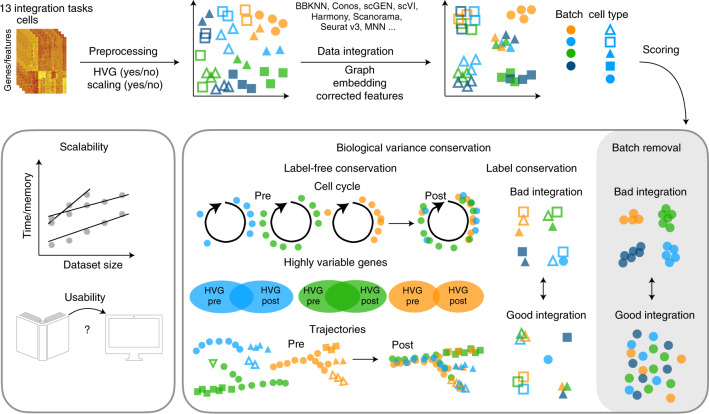
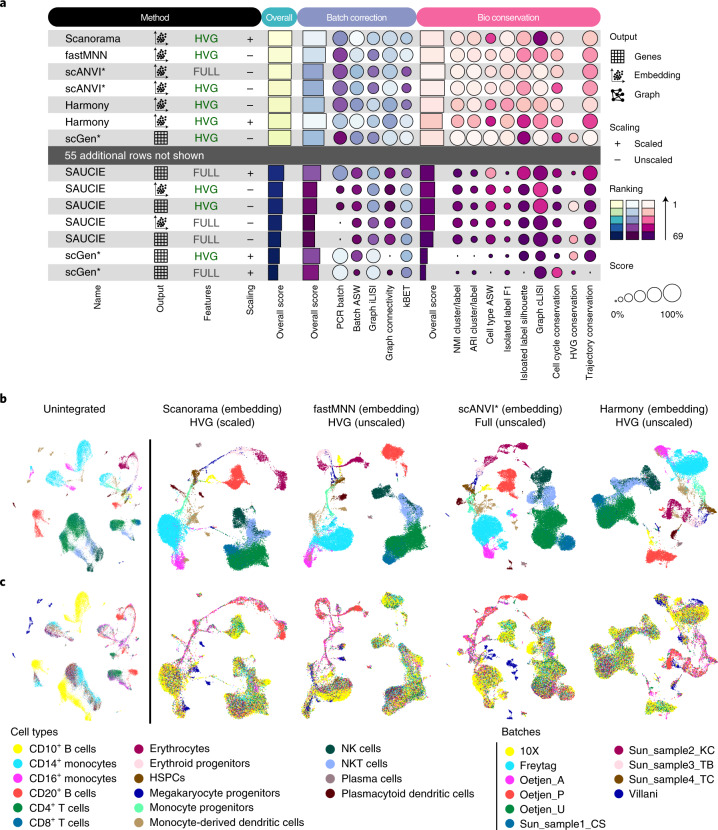
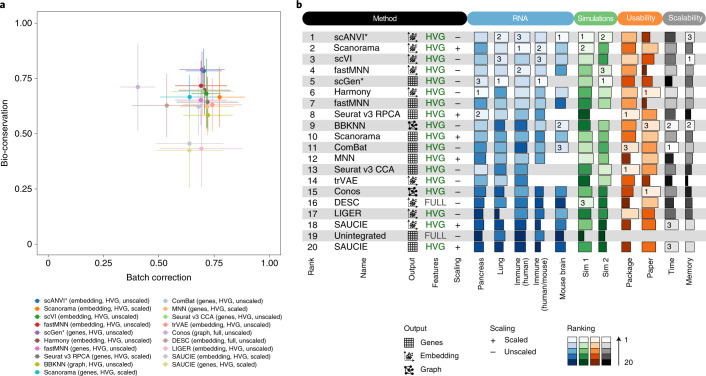
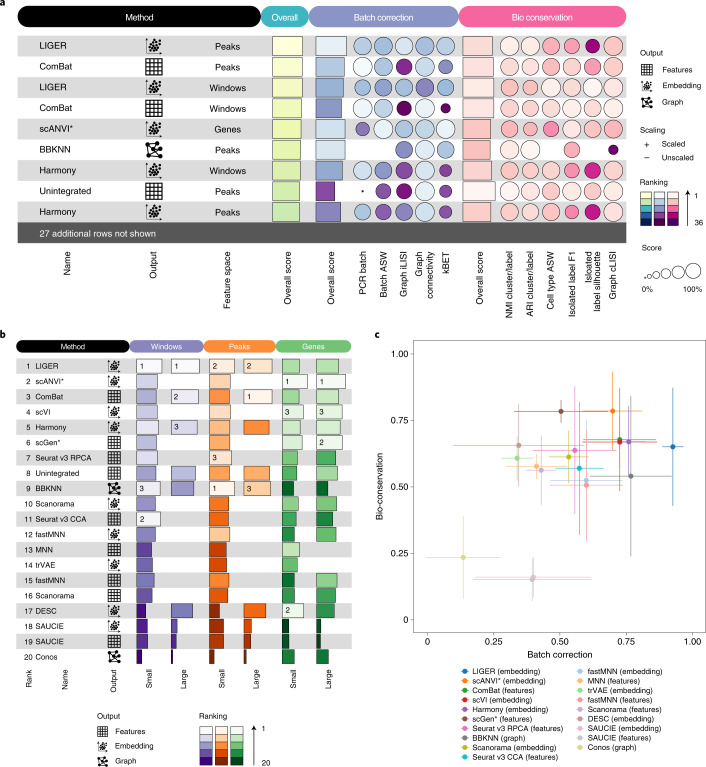
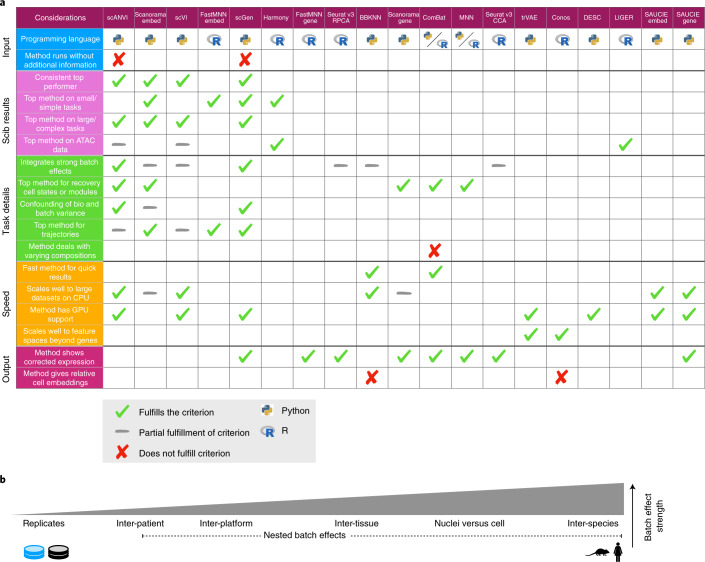
Single-cell atlases often include samples that span locations, laboratories and conditions, leading to complex, nested batch effects in data. Thus, joint analysis of atlas datasets requires reliable data integration. To guide integration method choice, we benchmarked 68 method and preprocessing combinations on 85 batches of gene expression, chromatin accessibility and simulation data from 23 publications, altogether representing >1.2 million cells distributed in 13 atlas-level integration tasks. We evaluated methods according to scalability, usability and their ability to remove batch effects while retaining biological variation using 14 evaluation metrics. We show that highly variable gene selection improves the performance of data integration methods, whereas scaling pushes methods to prioritize batch removal over conservation of biological variation. Overall, scANVI, Scanorama, scVI and scGen perform well, particularly on complex integration tasks, while single-cell ATAC-sequencing integration performance is strongly affected by choice of feature space. Our freely available Python module and benchmarking pipeline can identify optimal data integration methods for new data, benchmark new methods and improve method development.
Overview
The claims and statistics of this paper haven’t been checked yet.
Free: it reads the open-access text and checks the first 5 claims that cite a source we can check. Create a free account to check every claim.
Integrity signals
Registry
Cites
Statistics
Figures
Verification
Claims the paper makes
The claims and statistics of this paper haven’t been checked yet.
Free: it reads the open-access text and checks the first 5 claims that cite a source we can check. Create a free account to check every claim.
Claims other papers make about this one
Each is checked against this paper’s own text: does it say what the citing paper says it does?
The source backs part of the claim, not all of it — or backs it for a different population, condition or comparison.
In the citing paper
“Such integrative analysis is complicated by batch effects and biological differences between primary tissue and cell culture26,27.”
From scPerturb: harmonized single-cell perturbation data (2024) · cites this paper as [27]
Experimental — accuracy not yet measuredThe source backs part of the claim, not all of it — or backs it for a different population, condition or comparison.
In the citing paper
“Furthermore, 8 evaluation metrics (3 for batch effect removal and 5 for biological variation retention) are computed to verify the integration ability by scIB47, which ranks TOSICA the first out of all 13 applicable methods evaluated on combined effectiveness in batch effect removal and biological variation retention (Fig. 5b).”
From Transformer for one stop interpretable cell type annotation (2023) · cites this paper as [47]
Experimental — accuracy not yet measuredThe source backs part of the claim, not all of it — or backs it for a different population, condition or comparison.
In the citing paper
“In particular, Harmony22 is an algorithm well suited for correcting batch effects that may be present in a dimensionality-reduced single-cell expression dataset,79”
From hdWGCNA identifies co-expression networks in high-dimensional transcriptomics data (2023) · cites this paper as [79]
Experimental — accuracy not yet measuredThe cited source says what the claim attributes to it.
In the citing paper
“Although this work simplifies dataset access, joint analysis is limited by the complexity of data integration27.”
From scPerturb: harmonized single-cell perturbation data (2024) · cites this paper as [27]
The cited source says what the claim attributes to it.
In the citing paper
“Depending on the complexity of the integration tasks, such as atlas integration, deep-learning approaches such as scANVI40, scVI41 and scGen42 as well as linear-embedding models such as Scanorama43 performed best”
From Best practices for single-cell analysis across modalities (2023) · cites this paper as [35]
10 more claims about this paper
Create a free account to see every claim other papers make about this one.
Self-check
Percentages, sums and reported differences re-computed from the paper’s own numbers.
The self-check needs the paper’s full text.
Citations
Cites
Scikit-learn: Machine Learning in Python
Pedregosa, F., Varoquaux, G., Gramfort, A., Michel, V., Thirion, B., Grisel, O., Blondel, M., Müller, A., Nothman, J., Louppe, G., et al. (2012) · arXiv · doi:10.48550/arxiv.1201.0490 · Cited by 71,016 · cited 12×
“Similar to NMI, we compared the cell-type labels with the NMI-optimized Louvain clustering computed on the integrated dataset.”
BackgroundInfluentialSciPy 1.0: fundamental algorithms for scientific computing in Python
Virtanen, P., Gommers, R., Oliphant, T. E., Haberland, M., Reddy, T., Cournapeau, D., Burovski, E., Peterson, P., Weckesser, W., Bright, J., et al. (2020) · Nature Methods · doi:10.1038/s41592-019-0686-2 · Cited by 38,430
A note on two problems in connexion with graphs
Dijkstra, E. W. (1959) · Numerische Mathematik · doi:10.1007/bf01386390 · Cited by 29,065
Silhouettes: A graphical aid to the interpretation and validation of cluster analysis
Rousseeuw, P. J. (1987) · Journal of Computational and Applied Mathematics · doi:10.1016/0377-0427(87)90125-7 · Cited by 21,392
Comprehensive Integration of Single-Cell Data
Stuart, T., Butler, A., Hoffman, P., Hafemeister, C., Papalexi, E., Mauck, W. M., Hao, Y., Stoeckius, M., Smibert, P., & Satija, R. (2019) · Cell · doi:10.1016/j.cell.2019.05.031 · Cited by 15,453
ggplot2: Elegant Graphics for Data Analysis
Wickham, H. (2009) · doi:10.1007/978-0-387-98141-3 · Cited by 14,447
Fast, sensitive and accurate integration of single-cell data with Harmony
Korsunsky, I., Millard, N., Fan, J., Slowikowski, K., Zhang, F., Wei, K., Baglaenko, Y., Brenner, M., Loh, P.-R., & Raychaudhuri, S. (2019) · Nature Methods · doi:10.1038/s41592-019-0619-0 · Cited by 10,488
SciPy 1.0: fundamental algorithms for scientific computing in Python
Virtanen, P., Gommers, R., Oliphant, T. E., Haberland, M., Reddy, T., Cournapeau, D., Burovski, E., Peterson, P., Weckesser, W., Bright, J., et al. (2019) · Apollo - University of Cambridge Repository · doi:10.17863/cam.64134 · Cited by 10,460
UMAP: Uniform Manifold Approximation and Projection
McInnes, L., Healy, J., Saul, N., & Großberger, L. (2018) · Journal of Open Source Software · doi:10.21105/joss.00861 · Cited by 9,826
SCANPY: large-scale single-cell gene expression data analysis
Wolf, F. A., Angerer, P., & Theis, F. J. (2018) · Genome Biology · doi:10.1186/s13059-017-1382-0 · Cited by 8,881 · cited 1×
“Metrics were run on the integrated and unintegrated AnnData 47 objects.”
MethodSelf-citation
Cited by
Items 901–1,000 of 1,008
Inference of heterogeneous effects in single-cell genetic perturbation screensPreprint
Fu, Z., & Hou, L. (2024) · bioRxiv (Cold Spring Harbor Laboratory) · doi:10.1101/2024.05.28.596224 · Cited by 2
Contrastive Learning for Robust Cell Annotation and Representation from Single-Cell TranscriptomicsPreprint
Andrekson, L., & Mercado, R. (2024) · bioRxiv (Cold Spring Harbor Laboratory) · doi:10.1101/2024.06.20.599868 · Cited by 3
“Many methods have been developed for this purpose, such as scANVI (13) and scGen (9), which have been benchmarked in a recent study (14).”
Learning sequence-based regulatory dynamics in single-cell genomicsPreprint
Ibarra, I. L., Schneeberger, J., Erdogan, E., Redl, L., Martens, L. D., Klein, D., Aliee, H., & Theis, F. J. (2024) · bioRxiv (Cold Spring Harbor Laboratory) · doi:10.1101/2024.08.07.605876 · Cited by 2
“Benchmarking biological sequence representations and their role in batch correction has not been fully evaluated compared to scRNA-seq 49 using genes as tokens.”
MethodSelf-citationСергеевна, Ч. Е., Va, T., & Chechekhin, V. I. (2024) · bioRxiv (Cold Spring Harbor Laboratory) · doi:10.1101/2024.09.23.614509 · Cited by 3
Collin, A., Pelletier, S., Fierville, M., Droit, A., Precioso, F., Bécavin, C., & Barbry, P. (2024) · bioRxiv (Cold Spring Harbor Laboratory) · doi:10.1101/2024.12.15.628538 · Cited by 2
Mann‐Krzisnik, D., Chawla, A., Turecki, G., Nagy, C., & Li, Y. (2025) · bioRxiv (Cold Spring Harbor Laboratory) · doi:10.1101/2025.01.24.634799 · Cited by 2
“We provide an overview of these metrics here, although the interested reader can find more details in Luecken et al. (2022); Cao and Gao (2022).”
Weinand, K., Langan, E. M., Curtis, M. L., & Raychaudhuri, S. (2025) · bioRxiv (Cold Spring Harbor Laboratory) · doi:10.1101/2025.04.02.646871 · Cited by 3
scContrast: A contrastive learning based approach for encoding single-cell gene expression dataPreprint
Li, W., Murtaza, G., & Singh, R. (2025) · bioRxiv (Cold Spring Harbor Laboratory) · doi:10.1101/2025.04.07.647292 · Cited by 4
“We evaluate the quality of cell encodings across bio-conservation and batch integration metrics defined by the scib-metrics package (Luecken et al., 2021), which is commonly used for benchmarking scRNA-seq models.”
On the illusion of scRNA-seq batch effect correctionPreprint
Codicè, F., Fariselli, P., & Raimondi, D. (2025) · bioRxiv (Cold Spring Harbor Laboratory) · doi:10.1101/2025.05.12.653389 · Cited by 2
Sikkema, L., Lkandushi, M., Scarcella, D., Moinfar, A. A., Engelmann, J. P., & Theis, F. J. (2025) · bioRxiv (Cold Spring Harbor Laboratory) · doi:10.1101/2025.05.23.655749 · Cited by 2
“…for each cell as: The final cluster preservation score per cell was then calculated by setting the score to the maximum value of 5 if the entropy was lower in the new than in the original embedding (i.e. δ H 0), or re-scaling otherwise: The kBET score was calculated as previously described[13].”
Self-citationOtto, D. J., Arriaga-Gomez, E. A., Thieme, E., Yang, R., Lee, S. C.-W., & Setty, M. N. (2025) · bioRxiv (Cold Spring Harbor Laboratory) · doi:10.1101/2025.06.03.657769 · Cited by 2
“This latent representation can incorporate batch effect correction [9, 10] to ensure that cell states considered equivalent between conditions share similar locations in the latent space ( Fig.”
Hamraoui, A., Onfroy, A., Sénamaud‐Beaufort, C., Coulpier, F., Lemoine, S., Jourdren, L., & Thomas‐Chollier, M. (2025) · bioRxiv (Cold Spring Harbor Laboratory) · doi:10.1101/2025.07.21.665920 · Cited by 2
Li, X., Huang, Y., Wang, S., Li, Y., Jiang, F., Gao, J., Yang, Y., Wu, Q., Ge, W., & Duan, L. (2025) · bioRxiv (Cold Spring Harbor Laboratory) · doi:10.1101/2025.08.19.671030 · Cited by 2
Unify: Learning Cellular Evolution with Universal Multimodal EmbeddingsPreprint
Zhong, H., Han, W., Cui, G., Gómez-Cabrero, D., Tegner, J. N., Gao, X., & Aranda, M. (2025) · bioRxiv (Cold Spring Harbor Laboratory) · doi:10.1101/2025.09.07.674681 · Cited by 2
Dubensky, T. B., Zhu, Y., Gallagher, M., Kumashie, K. G., Lu, T., Tedesco, J., Luna, N. D., Premo, K. R., Qi, Y., Rachimi, S., et al. (2025) · bioRxiv (Cold Spring Harbor Laboratory) · doi:10.64898/2025.12.10.693235 · Cited by 2
scPRINT-2: Towards the next-generation of cell foundation models and benchmarksPreprint
Kalfon, J., Peyré, G., & Cantini, L. (2025) · bioRxiv (Cold Spring Harbor Laboratory) · doi:10.64898/2025.12.11.693702 · Cited by 5
Pang, J., Qiu, P. S., He, Y., Deng, Y., Tang, W., Huang, Z., Yan, J., Li, B., Lin, A., Cao, L., et al. (2025) · bioRxiv (Cold Spring Harbor Laboratory) · doi:10.64898/2025.12.29.696804 · Cited by 3
“Batch-correction performance was evalu-644 ated with the scIB benchmarking framework 77 .”
Germino, J., Liu, X., Wang, Y., Balolong, J., Tang, V., Sun, I., Nie, Y., Tsyporin, J., Proekt, I., Rattay, K., et al. (2026) · bioRxiv (Cold Spring Harbor Laboratory) · doi:10.64898/2025.12.31.697099 · Cited by 3
Cancer-myeloid cell invasive program in pediatric-type diffuse high-grade gliomaPreprint
Ruiz-Moreno, C., Collot, R. V. U., van den Broek, T. J. M., Wehrens, E. J., Bessler, N., Dharmadhikari, G., Pas, B. M. T., Ibarra, I. L., Metselaar, D. S., Kranendonk, M. E. G., et al. (2026) · bioRxiv (Cold Spring Harbor Laboratory) · doi:10.64898/2026.01.23.701142 · Cited by 3
Self-citationimmgenT: A Comprehensive Reference of Convergent T-cell States in the MousePreprint
Magill, I., Casey, O., Mallah, D., Panigrahi, S. S., Zhou, L. L., del Río, O. B., Bangs, D. J., Bee, G. C. W., Borys, S. M., Choi, J., et al. (2026) · bioRxiv (Cold Spring Harbor Laboratory) · doi:10.64898/2026.01.30.702892 · Cited by 5
Pan, X., Saunders, R. A., Replogle, J. M., Weissman, J. S., & Zhuang, X. (2026) · bioRxiv (Cold Spring Harbor Laboratory) · doi:10.64898/2026.05.16.725005 · Cited by 5
Progress and new challenges in image-based profiling
Serrano, E., Peters, J., Wagner, J., Graham, R. E., Chen, Z.-H., Feng, B. Y., Miranda, G., Kalinin, A. A., Vulliard, L., Tomkinson, J., et al. (2026) · Molecular Systems Biology · doi:10.1038/s44320-026-00197-7 · Cited by 7
Digital Twins : High Resolution Disease Models for Optimized Diagnosis and Treatment
Lilja, S. (2022) · Linköping University medical dissertations · doi:10.3384/9789179292157 · Cited by 1
LIBRA: an adaptative integrative tool for paired single‐cell multi‐omics data
Martinez‐de‐Morentin, X., Khan, S. A., Lehmann, R., Qu, S., Maillo, A., Kiani, N. A., Prósper, F., Tegner, J. N., & Gómez-Cabrero, D. (2023) · Quantitative Biology · doi:10.15302/j-qb-022-0318 · Cited by 4
A cellular reference atlas of the human lung
Sikkema, L., & Luecken, M. (2023) · Nature Medicine · doi:10.1038/s41591-023-02329-0 · Cited by 1
Self-citationZhou, M., Zhang, H., Bai, Z., Mann‐Krzisnik, D., Wang, F., & Li, Y. (2024) · STAR Protocols · doi:10.1016/j.xpro.2024.103066 · Cited by 1
scCross: efficient search for rare subpopulations across multiple single-cell samples
Gerniers, A., Nijssen, S., & Dupont, P. (2024) · Bioinformatics · doi:10.1093/bioinformatics/btae371 · Cited by 2
“However, aggregating several single-cell samples comes with pitfalls: batch effects may appear due to the presence of technical variability (differences in sequencing technologies, experimental conditions, etc.) as well as biological variance between donors (Luecken et al. 2022).”
Detecting novel cell type in single-cell chromatin accessibility data via open-set domain adaptation
Lin, Y., Pan, Z., Zeng, Y., Yang, Y., & Dai, Z. (2024) · Briefings in Bioinformatics · doi:10.1093/bib/bbae370 · Cited by 1
Connectivity Network Feature Sharing in Single-Cell RNA Sequencing Data Identifies Rare Cells
Wang, S., Li, H., Liu, Y., Pang, S., Qiao, S., Su, J., Wang, S., & Zhang, Y. (2024) · Journal of Chemical Information and Modeling · doi:10.1021/acs.jcim.4c00796 · Cited by 1
Kong, T., Yu, T., Zhao, J., Hu, Z., Xiong, N. N., Wan, J., Dong, X., Pan, Y. F., Zheng, H., & Zhang, L. (2024) · Scientific Reports · doi:10.1038/s41598-024-73356-1 · Cited by 1
HepScope: CNN-based single-cell discrimination of malignant hepatocytes
Go, Y., Ng, J. T., Lim, W., & Lim, S. B. (2024) · Journal Of Big Data · doi:10.1186/s40537-024-01024-2 · Cited by 1
“Most existing AI models that provide annotation capabilities are largely focused on the clustering methods with simple general annotations [10, 16, 23, 44, 80].”
Li, E., Gao, L., & Ye, Y. (2024) · IEEE International Conference on Bioinformatics and Biomedicine (BIBM) · doi:10.1109/bibm62325.2024.10821837 · Cited by 2
“We combined BIO and Omics to compute the Overall score following the study [26]: I. Evaluation Metrics of the Co-Embedding of Different Omics Cells and Different Types of Features • ScaleRNA.”
InfluentialAnnotation of single-cell clusters using marker genes within and across species
Kundu, S., Chau, T., Maroof, D. S., & Li, S. (2025) · Elsevier eBooks · doi:10.1016/b978-0-443-23736-2.00015-0 · Cited by 1
Single-cell technology for plant systems biology
Amini, S., Thibivilliers, S., Farmer, A. A., Martin, O., & Libault, M. (2025) · Elsevier eBooks · doi:10.1016/b978-0-443-23736-2.00008-3 · Cited by 1
Zhou, W., Fan, X., Li, L., Zheng, J., Liu, X., Jin, W., & Tian, L. (2026) · Briefings in Bioinformatics · doi:10.1093/bib/bbag432 · Cited by 3
“To ensure consistent interpretation of results, we applied linear transformations [ 77] so that higher cLISI values represent improved performance.”
Hybrid Data Fusion for Elegant Emotion Recognition in Cloud-Based Big Data Systems
Jin, H., Sun, X., Jin, Z., & Kim, Y.-G. (2025) · International Conference on Multi-Agent Systems for Collaborative Intelligence (ICMSCI) · doi:10.1109/icmsci62561.2025.10894446 · Cited by 1
“In the data fusion [18]-[22] process, the core issue of data correlation is to overcome inaccuracy of sensor measurement and the ambiguity caused by interference in order to maintain data consistency.”
Unjitwattana, T., Huang, Q., Yang, Y., Tao, L., Yang, Y., Zhou, M., Du, Y., & Garmire, L. X. (2025) · Genome biology · doi:10.1186/s13059-025-03495-9 · Cited by 1
“S1), using Harmony [10] which showed good performance for this task previously [11].”
Unveiling gene modules at Atlas scale through hierarchical clustering of single-cell data
Tang, F., Zhang, Z., Zhou, W., Li, G., Xu, Y., & Tian, L. (2026) · Nature Communications · doi:10.1038/s41467-026-73054-8 · Cited by 1
TarDis: Achieving Robust and Structured Disentanglement of Multiple Covariates
İnecik, K., Kara, A., Rose, A., Haniffa, M. A., & Theis, F. J. (2025) · Lecture notes in computer science · doi:10.1007/978-3-031-90252-9_23 · Cited by 1
Self-citationSingle-cell analysis reveals significant transcriptomic alterations in preclinical Crohn’s disease
Kioroglou, D., Egia‐Mendikute, L., Palazón, A., Acosta, M. B.-D., Rodríguez–Lago, I., & Marigorta, U. M. (2025) · Frontiers in Immunology · doi:10.3389/fimmu.2025.1539830 · Cited by 1
“We did not observe formation of separate clusters between the samples for the same cell-types Figure 1 right panel), indicating successful batch correction concerning integration from different studies Luecken et al. (17).”
Sketching T cell atlases in the single‐cell era: challenges and recommendations
Bojović, I., Sousa, A. G. G., Junttila, S., & Elo, L. L. (2025) · Immunology and Cell Biology · doi:10.1111/imcb.70040 · Cited by 1
“Finally, metrics quantifying biological conservation and batch correction, such as the cell-specific mixing score from the CellMixS Bioconductor package 54 or those implemented in the scib python package, 55 provide objective measures of the effectiveness of integration.”
Wang, X., Xiao, H., Wu, J., Lin, Y., Ao, Y., Ye, Z., Tan, X., Kong, F., Chen, X., Chai, R., et al. (2025) · Cell Proliferation · doi:10.1111/cpr.70081 · Cited by 1
“To optimise the balance between biological variance preservation and batch effect removal, we evaluated multiple integration methods using the single-cell integration benchmarking (scIB) approach [54].”
scVDM: A Diffusion Model Integrated With Conditional VAE for Generative Single-Cell Tasks
Peng, D., Xie, L., Yang, H. T., & Zhang, Y. (2025) · IEEE Journal of Biomedical and Health Informatics · doi:10.1109/jbhi.2025.3585960 · Cited by 1
Protocol for conducting a single-cell sequencing assay for transposase-accessible chromatin analysis
Ma, W., Ma, P., Yuan, Y., Hu, D., Li, K., Cai, P., & Liu, C. (2025) · STAR Protocols · doi:10.1016/j.xpro.2025.103960 · Cited by 1
“23 In this example, there is no biological variance between the three PBMC replicates; therefore, it is appropriate that the visualization of the embedding colored by samples shows no batch effect (Figure 1D).”
Mouse, Pig, and Human Atherosclerotic Lesions Have Common and Distinct Mesenchymal Cell Populations
Sharysh, D., Nogales, P., Morales‐Cano, D., Markov, A., Izquierdo-Serrano, R., Carramolino, L., Albarrán-Juárez, J., & Bentzon, J. F. (2026) · Arteriosclerosis Thrombosis and Vascular Biology · doi:10.1161/atvbaha.125.323640 · Cited by 1
Ding, X., & Ma, R. (2025) · Journal of the American Statistical Association · doi:10.1080/01621459.2025.2539539 · Cited by 8
“…shared across different biological samples, tissues, or organs, combining multiple datasets has been found helpful to better reveal the biological signals underlying individual datasets (Xiong et al. 2022; Luecken et al. 2022; Ma et al. 2024; Sun et al. 2024); see Figure 1 for an illustration.”
Smmit: A pipeline for integrating multiple single-cell multi-omics samples
Wan, C., & Ji, Z. (2025) · Computational and Structural Biotechnology Journal · doi:10.1016/j.csbj.2025.08.020 · Cited by 2
“We selected Harmony as the integration method due to its strong performance reported in recent benchmarking studies [17,18], its scalability, and its compatibility with the Seurat pipeline.”
Myasthenia thymus reprograms class-switched B cells into BAFF-dependent survivors
Yan, Y., Patino, D. M. A., Zhao, Y., Wu, X., Budinger, G. R. S., & Bharat, A. (2026) · Science Advances · doi:10.1126/sciadv.aec3842 · Cited by 2
Lü, Z., Kong, F., Sun, J., Ge, J., Wu, J., & Wang, K. (2025) · Hereditas · doi:10.1186/s41065-025-00563-9 · Cited by 3
“Benchmarking test for single-cell integration were performed using “scib” python packages [33].”
Joodaki, M., Shaigan, M., Samiei, S., Nagai, J. S., Maié, T., Kuppe, C., & Costa, I. G. (2025) · Briefings in Bioinformatics · doi:10.1093/bib/bbaf547 · Cited by 4
“The computational analysis of disease atlases is challenging due to the presence of experimental artifacts such as batch effects [10], which are potentially worsened by the inherently lower quality of disease tissues compared with healthy tissue.”
Yang, Y., Xie, C., He, Q., & Yang, M. (2025) · GigaScience · doi:10.1093/gigascience/giaf053 · Cited by 1
“Batch ASW evaluates the integration among multimodalities by computing cell modality labels, also scaled between 0 and 1 [ 18 ].”
InfluentialDeep-Learning Tool ScVital Enables Species-Agnostic Integration of Cancer Cell States
Rub, J., Chan, J. E., Sussman, C., Guzman, G., Tap, W. D., Antonescu, C. R., Singer, S., Tammela, T., & Betel, D. (2025) · Cancer Research · doi:10.1158/0008-5472.can-24-4889 · Cited by 3
“These methods have been benchmarked (28).”
Barkmann, F., Yates, J., Czyż, P., Kraft, A., Glettig, M. C., Beerenwinkel, N., & Boeva, V. (2025) · Cancer Research · doi:10.1158/0008-5472.can-25-0940 · Cited by 6
“Integration performance was assessed using two main scoring categories from the scIB benchmark (35): a batch correction score (batch-corr) and a biological conservation score (bio-cons).”
InfluentialWang, H., Dong, H., & Du, P.-F. (2025) · Briefings in Bioinformatics · doi:10.1093/bib/bbaf597 · Cited by 1
“Since clustering based methods rely heavily on the knowledge of cell type-related markers, they represent a tedious and complex process that is difficult to generate objective and consistent results [10].”
Wang, T., Hu, Y., Guo, W., Li, H., Wang, M., Chen, B., Bao, H., Gao, M., Li, X., Chen, Q., et al. (2025) · Acta Pharmaceutica Sinica B · doi:10.1016/j.apsb.2025.11.020 · Cited by 1
scSpecies: enhancement of network architecture alignment in comparative single-cell studies
Schächter, C., Treppner, M., Hackenberg, M., Raum, H., Boedecker, J., & Binder, H. (2025) · Genome biology · doi:10.1186/s13059-025-03866-2 · Cited by 2
“Alignment quality was assessed using a set of metrics established by [26, 27].”
Jiang, G., Song, K., Fonseca, G. J., Wagner, D. E., Clark, I. C., Wang, H., & Ding, J. (2025) · Nature Communications · doi:10.1038/s41467-025-66644-5 · Cited by 1
“…we evaluated Seurat (unsupervised), INSCT (supervised and unsupervised modes) 44 , scDML (unsupervised) 11 , Scanorama (unsupervised) 10 , iMAP (unsupervised) 53 , and STACAS (semi-supervised) 20 using the Mouse Brain ATAC (Gene) dataset of 11,270 cells from the scIB benchmark suite 49 .”
InfluentialLiu, Y., Zhang, Z., Qui, M., Wang, S., Salim, F. D., Shen, J., Chen, T., Razzak, I., Li, F., & Bian, J. (2026) · Briefings in Bioinformatics · doi:10.1093/bib/bbag330 · Cited by 1
Biosafety assessment of engineered CCL20 locked dimers in vivo
Drouillard, D., Poimenidou, M., Davies, M., McAllister, D. M., Clarke, W. R., Hwang, S. T., Peterson, F. C., Volkman, B. F., & Dwinell, M. B. (2025) · Cell Biology and Toxicology · doi:10.1007/s10565-025-10131-6 · Cited by 1
Lorenzo, M. C. C., Braghini, J. Q., Cordini, G., Lombardo, T., Kornblihtt, L. I., & Blanco, G. A. C. (2026) · Cytometry Part A · doi:10.1002/cytoa.70010 · Cited by 1
Ma, W., Yu, X., Lu, J., Zhang, J., Zhou, X., & Wang, X. (2025) · IEEE International Conference on Bioinformatics and Biomedicine (BIBM) · doi:10.1109/bibm66473.2025.11356354 · Cited by 2
“Quantitatively, SC P AN KD achieved comparable cLISI (0.762 vs. 0.765) but substantially higher iLISI (0.303 vs. 0.023), indicating better cancer-type mixing [33].”
InfluentialAssumption-lean post-integrated inference with surrogate-control outcomes
Du, J., Roeder, K., & Wasserman, L. (2026) · Biometrika · doi:10.1093/biomet/asag004 · Cited by 1
Bridging unpaired single-cell multimodal data for integrative analyses with SuperMap
Deng, C. B., Ma, X., Lü, H., Zhao, H., Ming, J., & Wang, T. (2026) · Proceedings of the National Academy of Sciences · doi:10.1073/pnas.2505182123 · Cited by 2
Integration of unpaired and heterogeneous clinical flow cytometry data
Phuycharoen, M., Kästele, V., Williams, T., Lin, L., Hussell, T., Grainger, J. R., & Rattray, M. (2026) · iScience · doi:10.1016/j.isci.2026.114937 · Cited by 2
“Methods for batch effect correction 1 and unpaired data integration 2 have been developed to address these issues.”
Systems-level understanding of plant immune networks through single-cell and spatial omics
Thingujam, D., Tan, Z., Wang, Y., Phukan, U. J., & Mukhtar, M. S. (2026) · Current Opinion in Plant Biology · doi:10.1016/j.pbi.2026.102870 · Cited by 2
Wang, Z., Sun, T., Zhang, Y., Li, Y., Zhang, C., Dou, X., Deng, X., Li, Z., Zhu, J., Hong, M., et al. (2026) · Genome Medicine · doi:10.1186/s13073-026-01613-1 · Cited by 1
“Of note, RPCA is superior in multiple sample integration compared to other integration approaches to correct batch effects among different samples of different models [33, 45].”
Soelter, T. M., Jones, E. F., Howton, T. C., Crumley, A. B., Wilk, E. J., & Lasseigne, B. N. (2026) · Disease Models & Mechanisms · doi:10.1242/dmm.052402 · Cited by 1
“Then, using default parameters, we performed batch correction using Harmony version 1.1.0 (Korsunsky et al., 2019) to preserve biological variation while reducing variation due to technical noise (Luecken et al., 2022).”
InfluentialImmune Ageing Clocks: A Methods-Oriented Review of Tasks, Modalities, Models, and Recalibration
Yu, G., Shao, Z., Zhuo, J., & Chen, Z. (2026) · Cells · doi:10.3390/cells15050421 · Cited by 3
Integrative Learning of Disentangled Representations from Single-Cell RNA-Sequencing Datasets
Novella-Rausell, C., Peters, D. J. M., & Mahfouz, A. E. (2026) · Computational and Structural Biotechnology Journal · doi:10.34133/csbj.0015 · Cited by 2
“To quantitatively compare the quality of the embeddings, we computed cell-type mixing (i.e., shared variation) and gene program (i.e., private variation) separation metrics using scib-metrics [ 34 ] Benchmark module.”
InfluentialPAIR: Reconstructing Single‐Cell Open‐Chromatin Landscapes for Transcription Factor Regulome Mapping
Su, Y., Qi, Q., Fan, Y., Wang, Y., Hao, G., Wong, K., Wang, Y., & Wang, L. (2026) · Advanced Science · doi:10.1002/advs.202524392 · Cited by 1
A benchmark of semi-supervised scRNA-seq integration methods in real-world scenarios
Shen, X., He, C., & Guan, L. (2026) · PLoS Computational Biology · doi:10.1371/journal.pcbi.1014008 · Cited by 1
scDenorm: a denormalization tool for integrating single-cell transcriptomics data
Huang, Y., Pournara, A. V., Ao, Y., Huang, Z., Zhang, H. Y., Zhang, Y., Liu, S., Brāzma, A., Papatheodorou, I., Yang, X., et al. (2026) · GigaScience · doi:10.1093/gigascience/giag032 · Cited by 2
Fan, Y., Ning, J., Wang, L., Yang, S., & Sun, S. (2026) · Genomics · doi:10.1016/j.ygeno.2026.111243 · Cited by 1
Multi-Omics Graph Attention Network for Key Gene Prediction in Triple-Negative Breast Cancer
Jiang, Z., Cao, K., Ge, F., & Huang, Z. (2026) · IEEE Transactions on Computational Biology and Bioinformatics · doi:10.1109/tcbbio.2026.3682485 · Cited by 2
Benchmarking component choices for unpaired single cell RNA and epigenomic integration
Naqing, F., Yuan, Q., & Duren, Z. (2026) · Genome biology · doi:10.1186/s13059-026-04071-5 · Cited by 1
“The SCM-MIB project on broad multimodal integration settings [63], the Nature Methods study assessing prediction and integration across technologies by hu et al. [64], and the scIB benchmark for single-omics batch integration that helped establish many commonly used evaluation principles [14].”
Cross-species insights into placental evolution and diseases at the single-cell resolution
Tan, G., Zhang, A., Cao, X., Yang, J., Cui, Y., Wang, F., Shi, T., Li, H., Wang, H., Shan, H., et al. (2026) · Nature Communications · doi:10.1038/s41467-026-72652-w · Cited by 3
Kövér, B., Willis, T. L., Sherwin, O., Kaufman-Cook, J., Kemkem, Y., Segoviano, M. V., Lodge, E. J., Zamojski, M., Mendelev, N., Zhang, Z., et al. (2026) · Yearbook of pediatric endocrinology · doi:10.1016/j.celrep.2026.117407 · Cited by 4
Batch correction for large-scale mass spectrometry imaging experiments
Sparre, A. A., & Jensen, O. N. (2026) · Bioinformatics · doi:10.1093/bioinformatics/btag360 · Cited by 2
“All metrics were scaled to the interval 0–1, where 1 indicates highest batch mixing or conservation of biological variation similarly to Luecken et al .”
Quantitative benchmarking of batch effects correction methods for single-cell metabolomics
Wu, F., Hao, X., Chen, A., & Wen, L. (2026) · Microchemical Journal · doi:10.1016/j.microc.2026.118654 · Cited by 1
Single-Cell Studies Advance Understanding of the Genetic and Molecular Basis of Atherosclerosis
Li, D. Y., Monteiro, J. P., Zhao, Q., Stitziel, N. O., & Quertermous, T. (2026) · Circulation Research · doi:10.1161/circresaha.125.327472 · Cited by 5
He, Y., Wei, Y., Zhi, J., Huang, C. J., Han, L., Liu, S., & Wang, L. (2026) · GigaScience · doi:10.1093/gigascience/giag075 · Cited by 1
“Finally, mapping diseased cells onto healthy reference atlases introduces substantial uncertainty [ 115 , 120 ].”
Spatial and Multiple Omics in Horticultural Plants: Advances and Prospects
Mohanty, G. R., Mohanty, S. R., Debnath, S., Chakraborty, N. R., Kole, A., Paikray, S., Das, S. K., Mohanty, S. K., & Deb, P. (2026) · CABI biotechnology series. · doi:10.1079/9781836994572.0011 · Cited by 1
Beyond static biomarkers: systems biology and AI for decoding cancer dynamics
Dutta, S., & Goli, A. (2026) · Frontiers in Systems Biology · doi:10.3389/fsysb.2026.1855016 · Cited by 2
“…models such as scVI and trajectory-inference tools such as CellRank have been rigorously benchmarked on curated datasets, though their performance under treatment-perturbed, longitudinally sampled cancer data remains less well characterized (Luecken et al., 2022; Lange et al., 2022).”
Trivedi, M. R., Shah, J., Su, Y., Reiman, E. M., Wu, T., & Wang, Q. (2026) · AI in neuroscience. · doi:10.1177/2997979x261472562 · Cited by 1
Multi-organelle signatures map cell-state diversity and metabolic adaptation in tissues
Adhikari, R., Hillsley, A. V., Johnson, A. D., Gao, S. M., Espinosa-Medina, I., Funke, J., & Feliciano, D. (2026) · Science · doi:10.1126/science.ady6372 · Cited by 7
CytoVI: deep generative modeling of antibody-based single cell data
Ingelfinger, F., Levy, N., Ergen, C., Bakulin, A., Becker, A., Boyeau, P., Kim, M., Ditz, D., Dirks, J., Maaskola, J., et al. (2026) · Nature Methods · doi:10.1038/s41592-026-03224-5 · Cited by 10
“We first harmonized the cell type annotations provided by the original studies and then benchmarked CytoVI’s integration performance against competitor methods using the scIB framework employed before 24 .”
InfluentialKünstliche Intelligenz und maschinelles Lernen in der Diabetesforschung
Nguyen, P., Ohnmacht, A. J., Galhoz, A., Büttner, M., Theis, F. J., & Menden, M. P. (2021) · Der Diabetologe · doi:10.1007/s11428-021-00817-w · Cited by 1
Self-citationReview of Machine Learning Advancements for Single-Cell Analysis
Nasir, N., Al-Shabi, M. A., Al‐Yateem, N., Rahman, S. A., Subu, M. A., Hijazi, H. H. A., Ahmed, F. R., Dias, J. M., Marzouqi, A. M. A., Alkawaldeh, M. Y., et al. (2023) · IEEE Annual International Computer Software and Applications Conference (COMPSAC) · doi:10.1109/compsac57700.2023.00210 · Cited by 2
“The ”problem of spatial information” has been one of the shortcomings of single-cell analysis; however, this problem is now being solved with the release of Visium, a kit for spatial transcriptome analysis that was developed by 10x Genomics following a study [34], [35].”
MethodLiu, W., Li, W., & Zhao, Z. (2023) · Molecular Cancer Research · doi:10.1158/1541-7786.mcr-23-0692 · Cited by 2
Cross-Source Data Fusion in Industrial Automation
Yang, T., Chen, L., Liang, J., Wang, Q., & Zhang, W. (2023) · International Conference on Mobile Networks and Wireless Communications (ICMNWC) · doi:10.1109/icmnwc60182.2023.10435824 · Cited by 1
Imbalanced single-cell data integration leads to loss of biological information
(2024) · Nature Biotechnology · doi:10.1038/s41587-023-02114-x · Cited by 1
Single-cell multiomics to advance cell therapy
Goss, K. L., & Horwitz, E. M. (2024) · Cytotherapy · doi:10.1016/j.jcyt.2024.10.009 · Cited by 1
SCBC: A Supervised Single-Cell Classification Method Based on Batch Correction for ATAC-Seq Data
Hai, J., Xie, Z., Liu, N., & Yuan, Y. (2024) · Lecture notes in computer science · doi:10.1007/978-981-96-0119-6_6 · Cited by 1
scMonica: Single-cell Mosaic Omics Nonlinear Integration and Clustering Analysis
Li, X., Zhang, R., Aslam, S., Li, H., Chen, Y., Zhang, Z., Huang, R. S., & Wu, H. (2024) · IEEE International Conference on Bioinformatics and Biomedicine (BIBM) · doi:10.1109/bibm62325.2024.10822866 · Cited by 1
“To quantitatively evaluate scMonica on mosaic integration, the metrics we utilized were inspired by scIB [20], the benchmark methods encompassing Normalized Mutual Information (NMI), Adjusted Rand Index (ARI) to assess the biological conservation score.”
Optimized upstream analytical workflow for single-nucleus transcriptomics in main metabolic tissues
Dong, P., Ding, S., & Wang, G. (2025) · Life Metabolism · doi:10.1093/lifemeta/loaf010 · Cited by 2
“We incorporated multiple integration strategies, including Seurat CCA, Harmony, rPCA, scVI, and scANVI, followed by systematic benchmarking framework, the single cell integration benchmarking (scIB) [13], to help users decide the most appropriate integration method.”
Tu, W., & Zhang, L. (2025) · PLoS Computational Biology · doi:10.1371/journal.pcbi.1012948 · Cited by 2
Filamin A editing in myeloid cells reduces intestinal inflammation and protects from colitis
Gawish, R., Varada, R., Deckert, F., Hladik, A., Steinbichl, L., Cimatti, L., Milanovic, K., Jain, M. K., Torgasheva, N., Tanzer, A., et al. (2025) · The Journal of Experimental Medicine · doi:10.1084/jem.20240109 · Cited by 3
The State of Single-Cell Atlas Data Visualization in the Biological Literature
Keller, M. S., Mörth, E., Smits, T. C., Warchol, S., Guo, G., Wang, Q., Krueger, R., Pfister, H., & Gehlenborg, N. (2025) · IEEE Computer Graphics and Applications · doi:10.1109/mcg.2025.3583979 · Cited by 4
“These fi les are challenging to merge and catalog not only due to differences in the sets of measured features and presence of experimental variations, 4 but also due to the lack of a global coordinate system for alignment.”
Twelve Tips for Reproducible Analysis of Single-Cell Transcriptomics Data
Onfroy, A., Topilko, P., Hüe, S., & Thieffry, D. (2025) · ACM Conference on Reproducibility and Replicability (ACM REP) · doi:10.1145/3736731.3746138 · Cited by 1
Liu, T., Lin, Y., Luo, X., Sun, Y., & Zhao, H. (2026) · Communications Biology · doi:10.1038/s42003-025-09479-6 · Cited by 4
“We computed the Normalized Mutual Information (NMI), Adjusted Rand Index (ARI) and Average Silhouette Width (ASW) scores 44 based on the clustering after imputation and the original cell-type labels.”
Metadata
- Authors
- Luecken, M. D., Büttner, M., Chaichoompu, K., Danese, A., Interlandi, M., Mueller, M. F., Strobl, D. C., Zappia, L., Dugas, M., Colomé-Tatché, M., & Theis, F. J.
- Affiliations
- Helmholtz Munich (DE)
- University of Münster (DE)
- University Hospital Heidelberg (DE)
- Corresponding author
- Theis, Fabian J.
- ORCID
- Venue
- Nature Methods
- Published
- 2021-12-23
- Volume
- 19
- Issue
- 1
- Pages
- 41-50
- ISSN
- 1548-7091 (ISSN-L)
- 1548-7105
- PMC
- PMC8748196
- OpenAlex
- W4225598893
- Cited by
- 1,438
- References
- 87
- Citations by year
- 2026: 380 · 2025: 358 · 2024: 304 · 2023: 210 · 2022: 115 · 2021: 53
- FWCI
- 55.88
- Type
- journal article
- Language
- en
- Open access
- hybrid
- doi.org
- Licence
- cc-by
- creativecommons.org/licenses/by/4.0 (tdm)
- creativecommons.org/licenses/by/4.0 (vor)
- Locations
- Nature Methods (publishedVersion, cc-by)
- bioRxiv (Cold Spring Harbor Laboratory) (acceptedVersion, cc-by)
- PubMed Central (publishedVersion, cc-by)
- PubMed (publishedVersion)
- Site cant be reached (submittedVersion, cc-by)
- Funders
- Silicon Valley Community Foundation (182835)
- Wellcome Trust (108413 /A/15/D)
- Chan Zuckerberg Initiative (182835)
- European Commission (874656, 2020 ‘, HORIZON2020)
- Helmholtz Zentrum München
- Topics
- Life Sciences › Biochemistry, Genetics and Molecular Biology › Molecular Biology › Single-cell and spatial transcriptomics
- Life Sciences › Biochemistry, Genetics and Molecular Biology › Molecular Biology › Gene expression and cancer classification
- Life Sciences › Biochemistry, Genetics and Molecular Biology › Molecular Biology › Bioinformatics and Genomic Networks
- Keywords
- single-cell data integration, batch effects, benchmarking, single-cell atlas, scANVI, scVI, single-cell ATAC-seq, chromatin accessibility, gene expression, feature space selection, scalability
- MeSH terms
- Animals, Humans, Immune System, Software, Sequence Analysis, RNA, Computational Biology, Benchmarking, Genomics, Databases, Genetic, Mice, Single-Cell Analysis
About these checks
Registry, retraction, Cites and statistics results are computed, not judged, with one exception: a printed reference that no index lists is read once by a model before it counts as a citation error. Claims are extracted by a model and kept only when their quote appears verbatim in the text; each cited source is then checked, with a model’s help, for whether it says what the claim relies on. Those verdicts can be wrong — read the claim’s quote and the cited source before relying on one.
Statistics and arithmetic are recomputed, not judged.
Confidence bands are shown only for fields calibrated on our annotated test set. None is calibrated yet, so no band is shown.
What counts as a claim ›How we measure confidence ›How we check this ›
Are you an author, or do you see a problem with this page? Request a review
Data sources
Bibliographic data: Semantic Scholar, OpenAlex, Crossref.
Contains information from the Semantic Scholar Academic Graph Datasets, made available under the ODC Attribution License (ODC-BY 1.0).
Semantic Scholar’s data is described in: Kinney, R., et al. (2023). The Semantic Scholar Open Data Platform. arXiv:2301.10140.
