

Benchmarking atlas-level data integration in single-cell genomics
Open accessPublished version of a preprint
The DOI matches its Crossref record; 90 of the 90 references it cites were found in a registry or an index.
Abstract
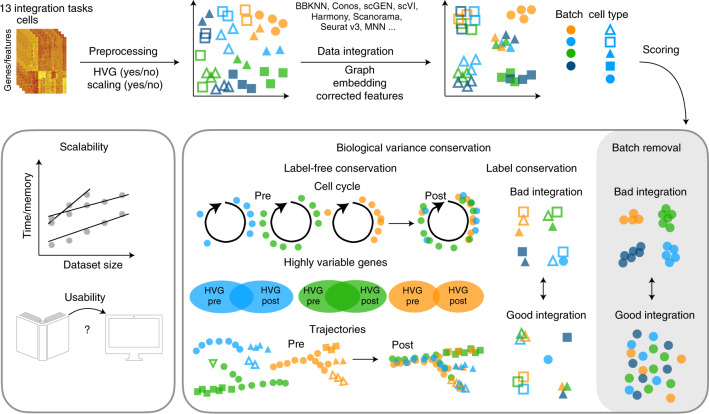
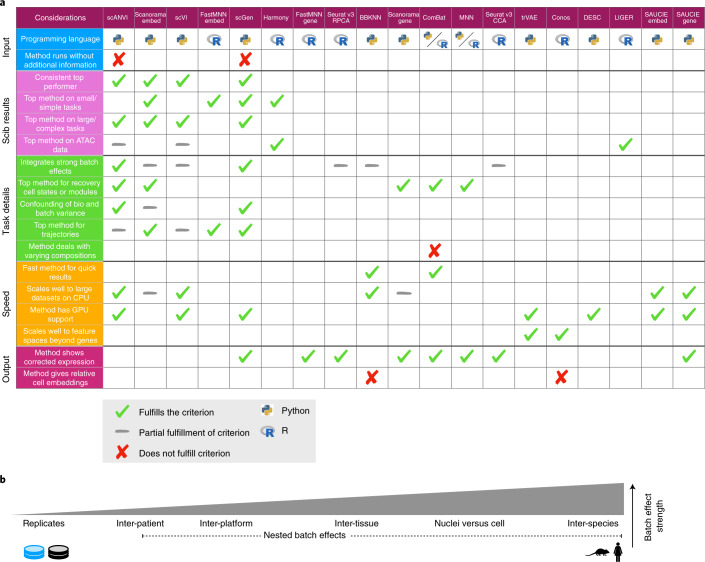
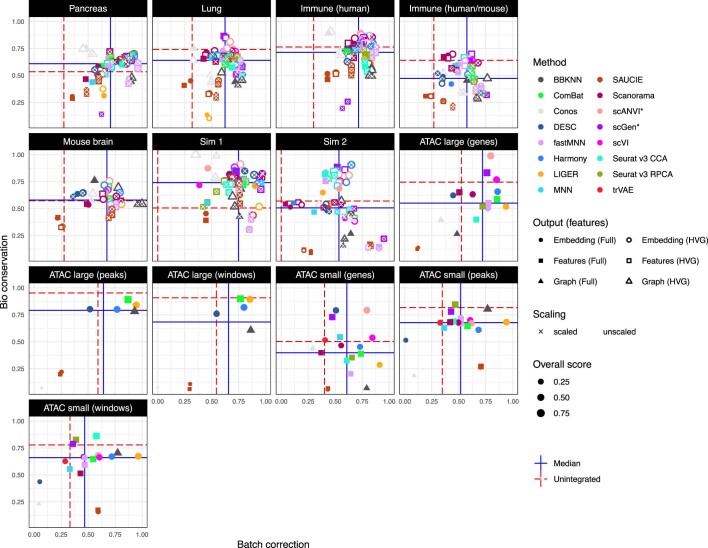
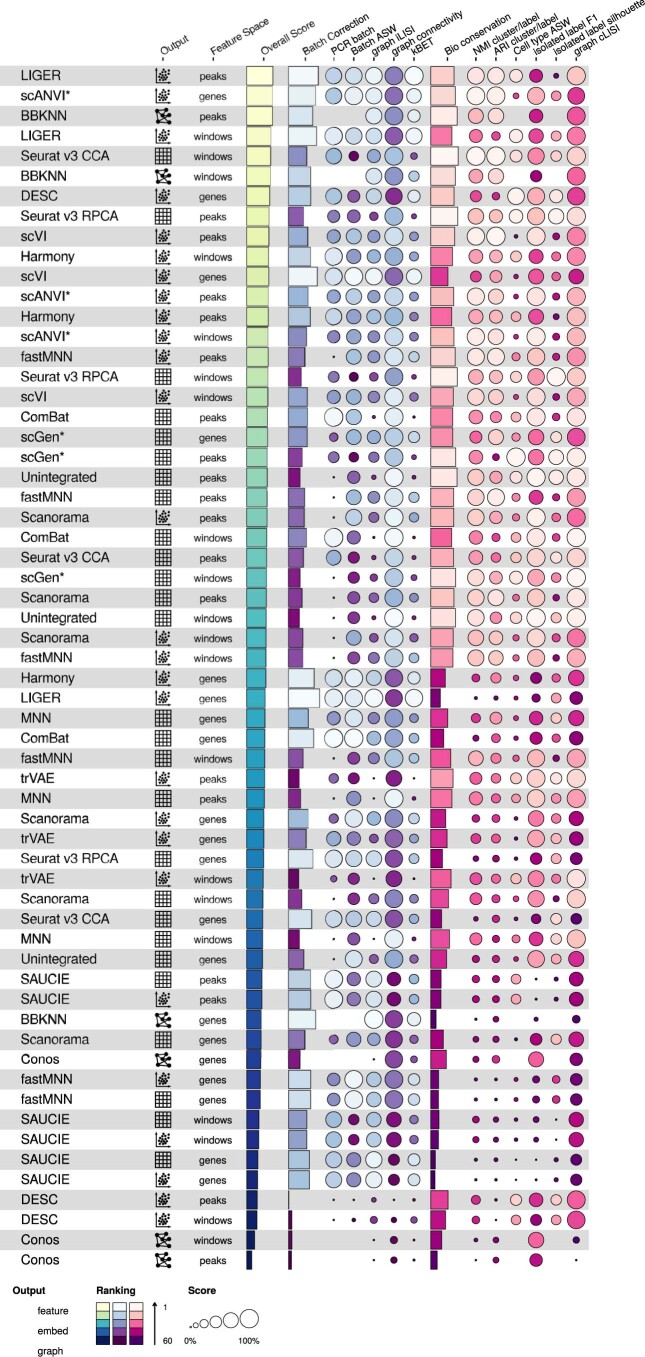
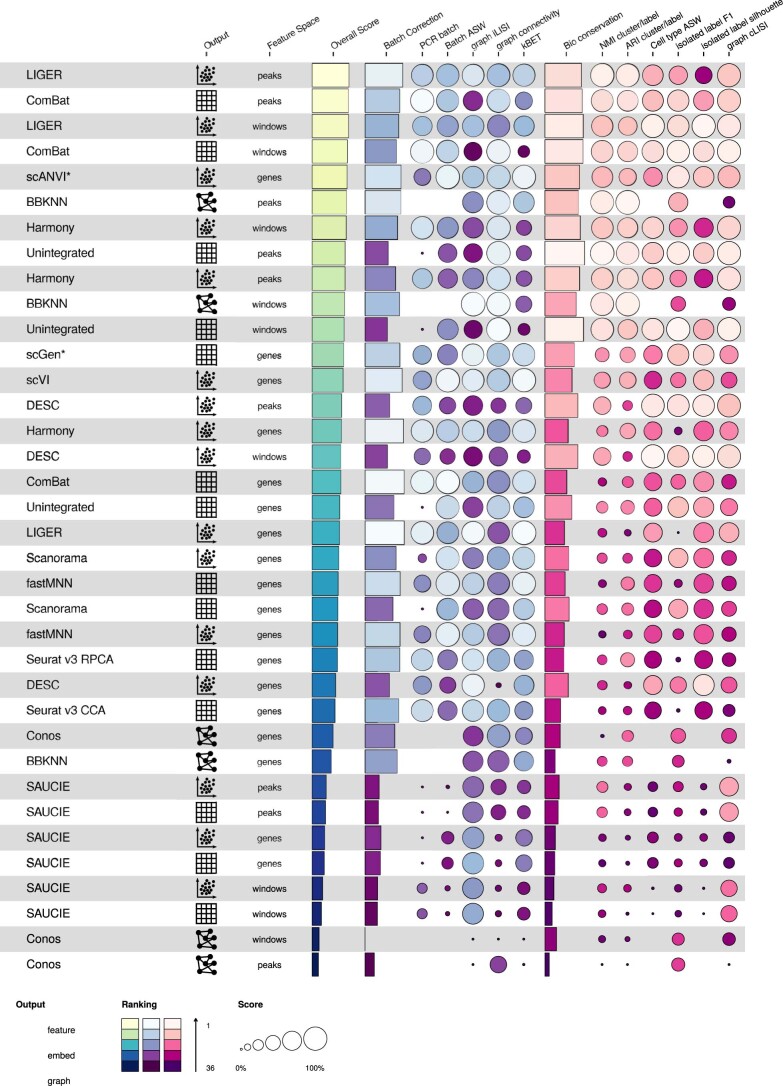
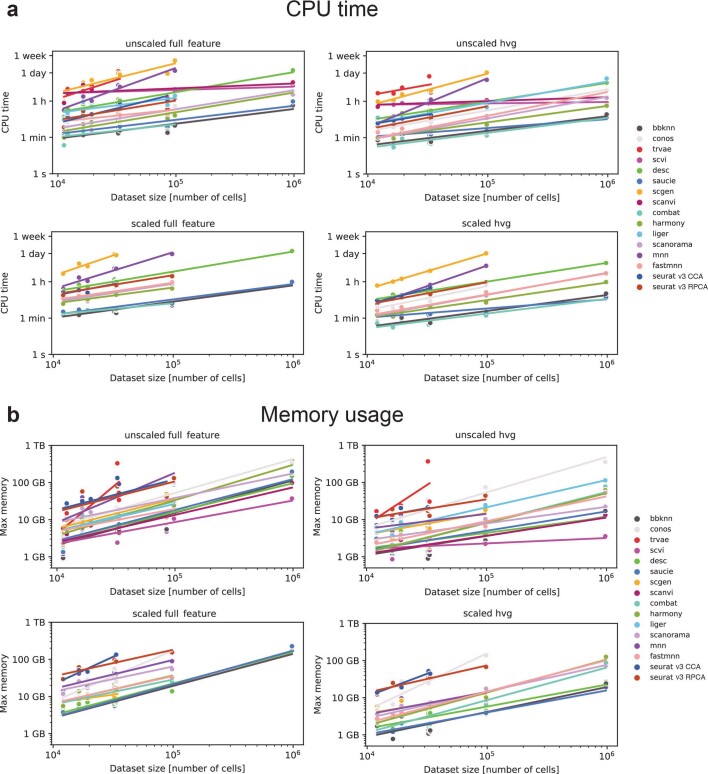
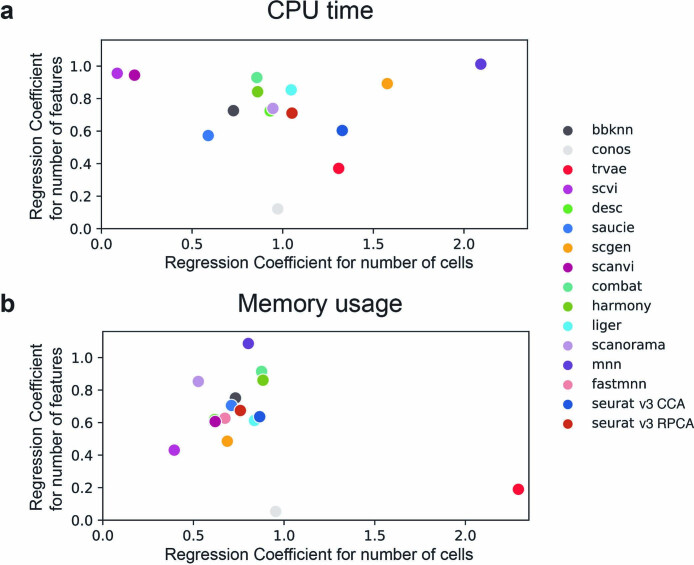
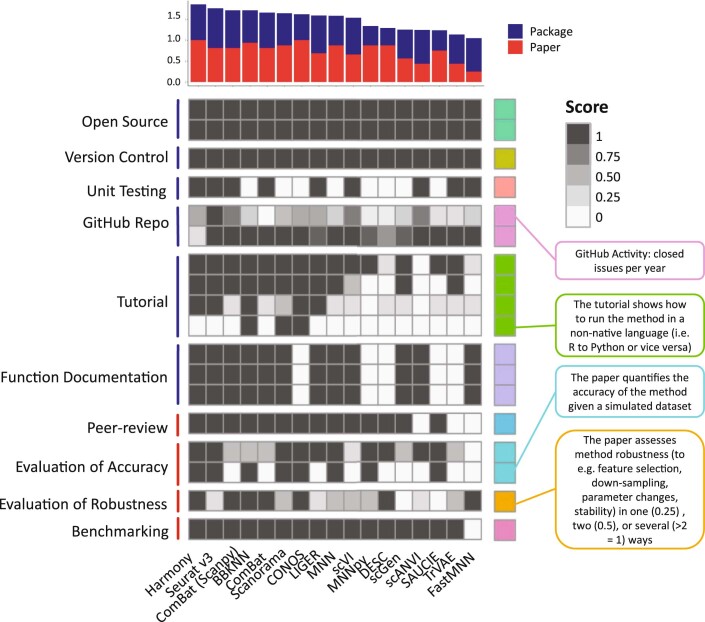
Single-cell atlases often include samples that span locations, laboratories and conditions, leading to complex, nested batch effects in data. Thus, joint analysis of atlas datasets requires reliable data integration. To guide integration method choice, we benchmarked 68 method and preprocessing combinations on 85 batches of gene expression, chromatin accessibility and simulation data from 23 publications, altogether representing >1.2 million cells distributed in 13 atlas-level integration tasks. We evaluated methods according to scalability, usability and their ability to remove batch effects while retaining biological variation using 14 evaluation metrics. We show that highly variable gene selection improves the performance of data integration methods, whereas scaling pushes methods to prioritize batch removal over conservation of biological variation. Overall, scANVI, Scanorama, scVI and scGen perform well, particularly on complex integration tasks, while single-cell ATAC-sequencing integration performance is strongly affected by choice of feature space. Our freely available Python module and benchmarking pipeline can identify optimal data integration methods for new data, benchmark new methods and improve method development.
Overview
The claims and statistics of this paper haven’t been checked yet.
Free: it reads the open-access text and checks the first 5 claims that cite a source we can check. Create a free account to check every claim.
Integrity signals
Registry
Cites
Statistics
Figures
Verification
Claims the paper makes
The claims and statistics of this paper haven’t been checked yet.
Free: it reads the open-access text and checks the first 5 claims that cite a source we can check. Create a free account to check every claim.
Claims other papers make about this one
Each is checked against this paper’s own text: does it say what the citing paper says it does?
The source backs part of the claim, not all of it — or backs it for a different population, condition or comparison.
In the citing paper
“Such integrative analysis is complicated by batch effects and biological differences between primary tissue and cell culture26,27.”
From scPerturb: harmonized single-cell perturbation data (2024) · cites this paper as [27]
Experimental — accuracy not yet measuredThe source backs part of the claim, not all of it — or backs it for a different population, condition or comparison.
In the citing paper
“Furthermore, 8 evaluation metrics (3 for batch effect removal and 5 for biological variation retention) are computed to verify the integration ability by scIB47, which ranks TOSICA the first out of all 13 applicable methods evaluated on combined effectiveness in batch effect removal and biological variation retention (Fig. 5b).”
From Transformer for one stop interpretable cell type annotation (2023) · cites this paper as [47]
Experimental — accuracy not yet measuredThe source backs part of the claim, not all of it — or backs it for a different population, condition or comparison.
In the citing paper
“In particular, Harmony22 is an algorithm well suited for correcting batch effects that may be present in a dimensionality-reduced single-cell expression dataset,79”
From hdWGCNA identifies co-expression networks in high-dimensional transcriptomics data (2023) · cites this paper as [79]
Experimental — accuracy not yet measuredThe cited source says what the claim attributes to it.
In the citing paper
“Although this work simplifies dataset access, joint analysis is limited by the complexity of data integration27.”
From scPerturb: harmonized single-cell perturbation data (2024) · cites this paper as [27]
The cited source says what the claim attributes to it.
In the citing paper
“Depending on the complexity of the integration tasks, such as atlas integration, deep-learning approaches such as scANVI40, scVI41 and scGen42 as well as linear-embedding models such as Scanorama43 performed best”
From Best practices for single-cell analysis across modalities (2023) · cites this paper as [35]
10 more claims about this paper
Create a free account to see every claim other papers make about this one.
Self-check
Percentages, sums and reported differences re-computed from the paper’s own numbers.
The self-check needs the paper’s full text.
Citations
Cites
Scikit-learn: Machine Learning in Python
Pedregosa, F., Varoquaux, G., Gramfort, A., Michel, V., Thirion, B., Grisel, O., Blondel, M., Müller, A., Nothman, J., Louppe, G., et al. (2012) · arXiv · doi:10.48550/arxiv.1201.0490 · Cited by 71,016 · cited 12×
“Similar to NMI, we compared the cell-type labels with the NMI-optimized Louvain clustering computed on the integrated dataset.”
BackgroundInfluentialSciPy 1.0: fundamental algorithms for scientific computing in Python
Virtanen, P., Gommers, R., Oliphant, T. E., Haberland, M., Reddy, T., Cournapeau, D., Burovski, E., Peterson, P., Weckesser, W., Bright, J., et al. (2020) · Nature Methods · doi:10.1038/s41592-019-0686-2 · Cited by 38,430
A note on two problems in connexion with graphs
Dijkstra, E. W. (1959) · Numerische Mathematik · doi:10.1007/bf01386390 · Cited by 29,065
Silhouettes: A graphical aid to the interpretation and validation of cluster analysis
Rousseeuw, P. J. (1987) · Journal of Computational and Applied Mathematics · doi:10.1016/0377-0427(87)90125-7 · Cited by 21,392
Comprehensive Integration of Single-Cell Data
Stuart, T., Butler, A., Hoffman, P., Hafemeister, C., Papalexi, E., Mauck, W. M., Hao, Y., Stoeckius, M., Smibert, P., & Satija, R. (2019) · Cell · doi:10.1016/j.cell.2019.05.031 · Cited by 15,453
ggplot2: Elegant Graphics for Data Analysis
Wickham, H. (2009) · doi:10.1007/978-0-387-98141-3 · Cited by 14,447
Fast, sensitive and accurate integration of single-cell data with Harmony
Korsunsky, I., Millard, N., Fan, J., Slowikowski, K., Zhang, F., Wei, K., Baglaenko, Y., Brenner, M., Loh, P.-R., & Raychaudhuri, S. (2019) · Nature Methods · doi:10.1038/s41592-019-0619-0 · Cited by 10,488
SciPy 1.0: fundamental algorithms for scientific computing in Python
Virtanen, P., Gommers, R., Oliphant, T. E., Haberland, M., Reddy, T., Cournapeau, D., Burovski, E., Peterson, P., Weckesser, W., Bright, J., et al. (2019) · Apollo - University of Cambridge Repository · doi:10.17863/cam.64134 · Cited by 10,460
UMAP: Uniform Manifold Approximation and Projection
McInnes, L., Healy, J., Saul, N., & Großberger, L. (2018) · Journal of Open Source Software · doi:10.21105/joss.00861 · Cited by 9,826
SCANPY: large-scale single-cell gene expression data analysis
Wolf, F. A., Angerer, P., & Theis, F. J. (2018) · Genome Biology · doi:10.1186/s13059-017-1382-0 · Cited by 8,881 · cited 1×
“Metrics were run on the integrated and unintegrated AnnData 47 objects.”
MethodSelf-citation
Cited by
Items 501–600 of 1,008
Zhang, S., Fang, X., Chang, M., Zheng, M., Guo, L., Xu, Y., Shu, J., Nie, Q., & Li, Z. (2024) · BMC Genomics · doi:10.1186/s12864-024-11030-6 · Cited by 14
“We conducted a comprehensive evaluation using the scIB framework [18] to assess the performance of 12 single-cell data integration tools: MNN [19], scVI [20], scANVI [21], Scanorama [22], BBKNN [23], SAU-CIE [24], Harmony [25], ComBat [26], DESC [27], trVAE [28], trVAEP [28] and scGen [29].”
Single-cell sequencing reveals the mechanisms of multiple myeloma progression: clarity or confusion?
Xiang, Y., Sun, G., Tian, L., Xiang, P., & Xie, C. (2025) · Annals of Hematology · doi:10.1007/s00277-025-06241-0 · Cited by 13
Arbatsky, M. S., Vasilyeva, E., Sysoeva, V., Semina, E. V., Saveliev, V. I., & Rubina, K. A. (2025) · Frontiers in Bioinformatics · doi:10.3389/fbinf.2025.1519468 · Cited by 11
“In Seurat (Kujawa et al., 2022), this can be achieved using canonical correlation analysis (CCA), reciprocal PCA, or reciprocal LSI (latent semantic indexing), as chosen by the user (Table 6) (Luecken et al., 2022).”
Lai, W., Li, Y., & Luo, O. J. (2025) · Science Advances · doi:10.1126/sciadv.adr7134 · Cited by 11
HALO: hierarchical causal modeling for single cell multi-omics data
Mao, H. H., Jia, M., Di, M. E., Valenzi, E., Cai, X. T., Singh, H., Lafyatis, R., Zhang, K., & Benos, P. V. (2025) · Nature Communications · doi:10.1038/s41467-025-63921-1 · Cited by 16
“In particular, by adding more simulations, the impact of multiple factors on the performance of the method was answered, making the application boundaries of the new method clearer.”
Wan, H. S., Chen, L., & Deng, M. (2022) · Genomics Proteomics & Bioinformatics · doi:10.1016/j.gpb.2022.12.008 · Cited by 11
“We additionally conducted a series of experiments on two atlas-level scRNA-seq datasets which can be regarded as benchmarking [24].”
MethodInfluentialYan, X., Zheng, R., Wu, F., & Li, M. (2023) · Bioinformatics · doi:10.1093/bioinformatics/btad099 · Cited by 11
Roda, N., Cossa, A., Hillje, R., Tirelli, A., Ruscitto, F., Cheloni, S., Priami, C., Dalmasso, A., Gambino, V., Blandano, G., et al. (2023) · Cancer Research · doi:10.1158/0008-5472.can-22-2717 · Cited by 13
simCAS: an embedding-based method for simulating single-cell chromatin accessibility sequencing data
Li, C., Chen, X., Chen, S., Jiang, R., & Zhang, X. (2023) · Bioinformatics · doi:10.1093/bioinformatics/btad453 · Cited by 9
“Whereas, due to the challenges for distinguishing batch effects from indicative biological variances (Luecken et al. 2022), it can be difficult to evaluate the methods of batch effect correction or data integration objectively. simCAS provides an opportunity to benchmark methods for this task by…”
Decoding Human Biology and Disease Using Single-Cell Omics Technologies
Shi, Q., Chen, X., & Zhang, Z. (2023) · Genomics Proteomics & Bioinformatics · doi:10.1016/j.gpb.2023.06.003 · Cited by 13
“Batch effects, which represent technical variation arising from experimental procedures and sometimes include biological factors such as tissues or species [176], can potentially over-shadow relevant biological signals.”
BackgroundAutomated single-cell omics end-to-end framework with data-driven batch inference
Wang, Y., Thistlethwaite, W., Tadych, A., Ruf-Zamojski, F. M., Bernard, D. J., Cappuccio, A., Zaslavsky, E., Chen, X., Sealfon, S. C., & Troyanskaya, O. G. (2024) · Cell Systems · doi:10.1016/j.cels.2024.09.003 · Cited by 10
Breaking the Immune Complexity of the Tumor Microenvironment Using Single-Cell Technologies
Caligola, S., Sanctis, F. D., Canè, S., & Ugel, S. (2022) · Frontiers in Genetics · doi:10.3389/fgene.2022.867880 · Cited by 11
Signal recovery in single cell batch integrationPreprint
Zhang, Z., Mathew, D., Lim, T., Mason, K., Martinez, C. M., Huang, S., Wherry, E. J., Suszták, K., Minn, A. J., Ma, Z., et al. (2023) · bioRxiv (Cold Spring Harbor Laboratory) · doi:10.1101/2023.05.05.539614 · Cited by 10
“3) Exist77 ing benchmarks have focused mostly on how well cell type 78 and cell trajectory patterns are preserved during integration 79 (21, 22).”
BackgroundInfluentialMulti-omic analyses in immune cell development with lessons learned from T cell development
Cordes, M., Pike-Overzet, K., Van Den Akker, E. B., Staal, F. J. T., & Canté-Barrett, K. (2023) · Frontiers in Cell and Developmental Biology · doi:10.3389/fcell.2023.1163529 · Cited by 9
“With the rise of scRNAseq datasets methods for integration also have been developed widely as described in this benchmarking study by (Luecken et al., 2022).”
MethodShahir, J. A., Stanley, N., & Purvis, J. E. (2024) · BMC Bioinformatics · doi:10.1186/s12859-024-05641-9 · Cited by 11
“Resolution parameters for the most optimal number of clusters in the Leiden and Louvain were chosen such based on the scib software [31] for more rigorous comparison (Table 2).”
MethodscCorrector: a robust method for integrating multi-study single-cell data
Guo, Z., Wang, Y., Wang, S., Zhang, Q., & Huang, D.-S. (2024) · Briefings in Bioinformatics · doi:10.1093/bib/bbad525 · Cited by 10
“The Human Pancreas Dataset is a collection of six scRNA-seq studies that were previously published in the literature [ 19, 21].”
MethodRivera, A. D., Normanton, J. R., Butt, A. M., & Azim, K. (2024) · International Journal of Molecular Sciences · doi:10.3390/ijms25084452 · Cited by 11
“Initially, all datasets from various published studies were merged, and integration was carried out using the Single Cell Variational Inference (scVI) package in the python programming language in python [70].”
MethodDuo, H., Li, Y., Yang, L., Tao, J., Yang, Q., Xiao, Y., Sun, J., Li, L., Nie, X., Zhang, X., et al. (2024) · Genome biology · doi:10.1186/s13059-024-03290-y · Cited by 10
“…the utilization of real data produced by experiments, simulated data have been extensively used as an important reference in benchmark studies [7–9, In recent years, a plethora of tools have been developed to simulate scRNA-seq data [6] and methods tailored to simulate SRT data have emerged…”
MethodChallenges and progress in RNA velocity: Comparative analysis across multiple biological contexts
Ancheta, S., Dorman, L. C., Treut, G. L., Gurung, A., Huber, G., Royer, L. A., Granados, A. A., & Lange, M. (2026) · PLoS Computational Biology · doi:10.1371/journal.pcbi.1014303 · Cited by 10
Gawusu, S., Mvile, B. N., Abu, M., & Kalimenze, J. D. (2024) · Ore and Energy Resource Geology · doi:10.1016/j.oreoa.2024.100065 · Cited by 11
Meng, D., Feng, Y., Yuan, K., Yu, Z., Cao, Q., Cheng, L., & Zheng, X. (2024) · Briefings in Bioinformatics · doi:10.1093/bib/bbaf010 · Cited by 15
“In addition to the qualitative analysis above,we also conducted a quantitative evaluation of the model’s performance,using batch average silhouette width (Batch-ASW) and graph connectivity (GC) to assess its effectiveness in batch effect removal [36].”
Semisynthetic simulation for microbiome data analysis
Sankaran, K., Kodikara, S., Li, J. J., & Cao, K. L. (2024) · Briefings in Bioinformatics · doi:10.1093/bib/bbaf051 · Cited by 11
“In large microbiome studies, it is often difficult to guarantee uniform data collection and processing for all samples, leading to systematic differences across experimental groups, often referred to as batch effects [96, 97].”
Dissection of tumoral niches using spatial transcriptomics and deep learning
Paniagua, K., Jin, Y.-F., Chen, Y., Gao, S., Huang, Y., & Flores, M. A. (2025) · iScience · doi:10.1016/j.isci.2025.112214 · Cited by 12
“43 An ASW score of 1 indicates perfect batch mixing, whereas a score of 0 reflects strongly separated batches.”
Identifying similar populations across independent single cell studies without data integration
González-Velasco, Ó., Simon, M., Yilmaz, R., Parlato, R., Weishaupt, J. H., Imbusch, C. D., & Brors, B. (2025) · NAR Genomics and Bioinformatics · doi:10.1093/nargab/lqaf042 · Cited by 10
“Overall, integrative methods exhibit considerable performance variability and are highly susceptible to dataset peculiarities [ 17 ].”
Single-cell differential expression analysis between conditions within nested settings
Hafner, L., Sturm, G., Lumpp, S., Drton, M., & List, M. (2025) · Briefings in Bioinformatics · doi:10.1093/bib/bbaf397 · Cited by 14
“It has excelled in a benchmark assessing batch-effect removal [25] and has been successfully used to build tissue and disease atlases with > 1 million cells from heterogenous datasets [26, 27].”
A multimodal cell-free RNA language model for liquid biopsy applications
Karimzadeh, M., Sababi, A. M., Momen-Roknabadi, A., Chen, N.-C., Cavazos, T. B., Sekhon, S., Wang, J., Hanna, R., Huang, A., Nguyen, D. L. T., et al. (2025) · Nature Machine Intelligence · doi:10.1038/s42256-025-01148-x · Cited by 15
“46, we used batch removal based on the (average) silhouette and principal component regression comparison 47 to evaluate batch effect removal based on the assay version.”
Computational strategies for cross-species knowledge transfer
Yuan, H., Mancuso, C. A., Johnson, K. A., Braasch, I., & Krishnan, A. (2025) · Nature Methods · doi:10.1038/s41592-025-02931-9 · Cited by 12
“However, cells of a particular type in a species are more alike than those of corresponding cell types across different species 106,107 .”
A high-resolution atlas of the brain predicts lineage and birth order underlying neuronal identity
Allen, A. M., Neville, M. C., Nojima, T., Alejevski, F., Agarwal, D., Sims, D., & Goodwin, S. F. (2025) · Cell Genomics · doi:10.1016/j.xgen.2025.101103 · Cited by 17
Revealing a coherent cell-state landscape across single-cell datasets with CONCORD
Zhu, Q., Jiang, Z., Zuckerman, B., Weinberger, L. S., Thomson, M. W., & Gartner, Z. J. (2026) · Nature Biotechnology · doi:10.1038/s41587-025-02950-z · Cited by 16
Jalkanen, J., Zhong, J., Nankam, P. A. N., Bhalla, N., Elmastas, M., Luo, J., Weinbrenner, S., Frendo‐Cumbo, S., Pesti, B., GOURASH, W. F., et al. (2026) · Cell Metabolism · doi:10.1016/j.cmet.2025.12.008 · Cited by 11
“11,12 As presented in Figures 1C and S1B, manual annotation of the major snRNA-seq clusters revealed six classes encompassing (1) ASPCs, (2) mesothelial cells, (3) vascular cells, (4) immune cells (myeloid and lymphoid), (5) adipocytes, and (6) Schwann cells (a small group of glial cells).”
scJVAE: A novel method for integrative analysis of multimodal single-cell data
Wani, S. A., Khan, S. A., & Quadri, S. M. K. (2023) · Computers in Biology and Medicine · doi:10.1016/j.compbiomed.2023.106865 · Cited by 10
Practical Compass of Single-Cell RNA-Seq Analysis
Okada, H., Chung, U., & Hojo, H. (2023) · Current Osteoporosis Reports · doi:10.1007/s11914-023-00840-4 · Cited by 10
Su, Y., Yu, Z., Yang, Y., Wong, K., & Li, X. (2024) · Advanced Science · doi:10.1002/advs.202307280 · Cited by 10
Performance Analysis of Random Forest on Quartile Classification Journal
Sucahyo, C. B., Rizqini, F. Q., Naufal, A., Yandratama, H., Shiddiqy, J. A., Utama, A. B. P., Putri, N. S. F., & Wibawa, A. P. (2024) · Applied Engineering and Technology · doi:10.31763/aet.v3i1.1189 · Cited by 11
“Within the realm of preprocessing, we wield four potent methods, each a distinct tool in our arsenal: data cleaning [40], data transformation [41], data reduction [42], and data integration [43].”
MethodSmall data methods in omics: the power of one
Johnston, K. G., Grieco, S. F., Nie, Q. H., Theis, F. J., & Xu, X. (2024) · Nature Methods · doi:10.1038/s41592-024-02390-8 · Cited by 9
“New integration methods explicitly model both technical and biological variation 22,23 , and recent benchmarks indicate that top-of-the-line integration algorithms can accurately account for technical variation while retaining biological variation 18 .”
Self-citationCosGeneGate selects multi-functional and credible biomarkers for single-cell analysis
Liu, T., Long, W., Cao, Z., Wang, Y., He, C. H., Zhang, L., Strittmatter, S. M., & Zhao, H. (2024) · Briefings in Bioinformatics · doi:10.1093/bib/bbae626 · Cited by 8
Propensity score matching enables batch-effect-corrected imputation in single-cell RNA-seq analysis
Xu, X., Yu, X., Hu, G., Wang, K., Zhang, J., & Li, X. (2022) · Briefings in Bioinformatics · doi:10.1093/bib/bbac275 · Cited by 10
Standardization and Interpretation of RNA-sequencing for Transplantation
Thareja, G., Suryawanshi, H., Luo, X., & Muthukumar, T. (2023) · Transplantation · doi:10.1097/tp.0000000000004558 · Cited by 12
“67,68 In addition, computational tools have been developed to integrate scRNA-seq data with the single-cell DNA methylation landscape, chromatin accessibility, and immunophenotype data.”
MethodCeglia, N., Sethna, Z. M., Freeman, S. S., Uhlitz, F., Bojilova, V., Rusk, N., Burman, B., Chow, A. T., Salehi, S., Kabeer, F., et al. (2023) · Nature Communications · doi:10.1038/s41467-023-39985-2 · Cited by 12
“Using both the full PBMC dataset and simulated mixtures of CD14+ monocytes and CD4 T cells, we systematically evaluated the quality of batch correction using a series of benchmarking metrics (ARI, kBET, cLISI, and silhouette score) 49,50 (Supplementary Fig.”
Removing Inter-Experimental Variability from Functional Data in Systems NeurosciencePreprint
Gonschorek, D., Höfling, L., Szatko, K. P., Franke, K., Schubert, T., Dunn, B. A., Berens, P., Klindt, D. A., & Euler, T. (2021) · bioRxiv (Cold Spring Harbor Laboratory) · doi:10.1101/2021.10.29.466492 · Cited by 16
“In this paper, we compare our approach against these methods as they have been found to perform particularly well in two benchmarking studies [27, 28].”
MethodscFormer: A Universal Representation Learning Approach for Single-Cell Data Using TransformersPreprint
Cui, H., Wang, C., Maan, H., Duan, N., & Wang, B. (2022) · bioRxiv (Cold Spring Harbor Laboratory) · doi:10.1101/2022.11.20.517285 · Cited by 13
“…The aggregated metric AvgBAT CH computes the mean of the two metrics for batch mixing: AvgBATCH = ( ASW batch + GraphConn ) / 2 Following the convention in (Luecken et al., 2022), an Overall metric for integration tasks is computed as the weighted average of AvgBIO and AvgBAT CH : AvgBATCH = 0 .”
BackgroundMethodResultInfluentialToward mastering the cell language by learning to generatePreprint
Chen, Y., Bian, H., Wei, L., Jia, J., Dong, X., Li, Y., Zhao, Y., Wu, X., Li, C., Luo, E., et al. (2024) · bioRxiv (Cold Spring Harbor Laboratory) · doi:10.1101/2024.01.25.577152 · Cited by 13
Towards a universal spatial molecular atlas of the mouse brainPreprint
He, Y., Sheng, H., Shi, H., Wang, W. X., Tang, Z., Liu, J., & Wang, X. (2024) · bioRxiv (Cold Spring Harbor Laboratory) · doi:10.1101/2024.05.27.594872 · Cited by 10
Theus, A., Barkmann, F., Wissel, D., & Boeva, V. (2024) · bioRxiv (Cold Spring Harbor Laboratory) · doi:10.1101/2024.11.01.621087 · Cited by 13
“We assessed these models using the framework from Luecken et al. (2022).”
MethodZhao, F., Zeng, J., Chen, C., Zhao, X., Zhang, T., THOMAS, G. V., Sears, R. C., Alumkal, J. J., Moran, A. E., Mills, G. B., et al. (2024) · bioRxiv (Cold Spring Harbor Laboratory) · doi:10.1101/2024.12.18.629070 · Cited by 13
Ding, J., Lin, J., Jiang, S., Wang, Y., Miao, Z., Fang, Z., Tang, J., Li, M., & Qiu, X. (2025) · bioRxiv (Cold Spring Harbor Laboratory) · doi:10.1101/2025.01.06.631427 · Cited by 13
Khouri‐Farah, N., Winchester, E. W., Schilder, B. M., Robinson, K. R., Curtis, S. W., Skene, N., Leslie, E. J., & Cotney, J. L. (2025) · bioRxiv (Cold Spring Harbor Laboratory) · doi:10.1101/2025.01.18.633396 · Cited by 12
A unified model for interpretable latent embedding of multi-sample, multi-condition single-cell data
Madrigal, A., Lu, T., Soto, L. M., & Najafabadi, H. S. (2024) · Nature Communications · doi:10.1038/s41467-024-50963-0 · Cited by 9
“16, our simulation results underline the unique ability of GEDI to impute the ratios of paired observations (such as spliced vs. unspliced mRNA abundances), but it remains to be tested whether GEDI ’ s imputations for gene-level expression values are also competitive with existing single-cell…”
InfluentialMarsh‐Wakefield, F., Santhakumar, C., Ferguson, A. L., Ashhurst, T. M., Shin, J., Guan, F. H. X., Shields, N. J., Platt, B. J., Putri, G., Gupta, R., et al. (2024) · Hepatology Communications · doi:10.1097/hc9.0000000000000540 · Cited by 12
“[41] Cluster annotations from the first cohort were transferred to the second cohort using “ scANVI ” ( “ scvi-tools, ” version 1.0.4) [42,43] ( Supple-mental Figure S5, http://links.lww.com/HC9/B51).”
InfluentialChen, X., Li, K., Wu, X., Li, Z., Jiang, Q., Cui, X., Gao, Z., Wu, Y., & Jiang, R. (2024) · Genome biology · doi:10.1186/s13059-024-03458-6 · Cited by 8
“Drawing from scIB [32] and our previous work [27], we assessed different methods from two perspectives: the ability to facilitate clustering performance and capture domain-specific signals.”
Diffusive topology preserving manifold distances for single-cell data analysis
Wei, J., Zhang, B., Wang, Q., Zhou, T., Tian, T., & Chen, L. (2025) · Proceedings of the National Academy of Sciences · doi:10.1073/pnas.2404860121 · Cited by 13
Wang, X., Li, W. V., & Li, H. (2025) · Genome biology · doi:10.1186/s13059-025-03636-0 · Cited by 10
“This evaluation used the scIB method [46], which calculates two summary scores for each method on each dataset. bio-conservation score measures a method’s to preserve biological variation from the original data, combining metrics such ARI, NMI, and the average silhouette width relative to annotated…”
Ediriwickrema, A., Nakauchi, Y., Fan, A. C., Köhnke, T., Hu, X., Luca, B. A., Kim, Y., Ramakrishnan, S., Nakamoto, M. A., Karigane, D., et al. (2025) · Cell Reports · doi:10.1016/j.celrep.2025.116236 · Cited by 10
Chu, C., Li, F., Zhang, Z., Zhu, Q., Hong, Y., Cheng, M., Wang, H., Cheng, L., Zhang, Z., Yu, X., et al. (2025) · Advanced Science · doi:10.1002/advs.202511856 · Cited by 13
Yu, P., Xie, Q., Cai, X., Zhong, Z., Wei, R., He, H., Liu, S., Zhang, Z., Xu, L., Chen, Z., et al. (2025) · Advanced Science · doi:10.1002/advs.202507882 · Cited by 11
Decoding tumor heterogeneity: A spatially informed pan-cancer analysis of the tumor microenvironment
Lodi, F., Vanmassenhove, S., Chen, D., Boeckx, B., Maciel, L. F., Peeters, F., Donders, E., Song, H., Harbers, L., Poźniak, J., et al. (2025) · Cell Reports Medicine · doi:10.1016/j.xcrm.2025.102416 · Cited by 13
“73 We computed the LISI scores using the LISI (v1.”
Wei, Y., Hong, F., Xie, S., Luo, X., Li, X., Dao, F., Deng, K., Lin, H., & Lv, H. (2025) · International Journal of Molecular Sciences · doi:10.3390/ijms262211005 · Cited by 9
“Data integration is an indispensable step in single-cell multi-omics studies, with the primary goal of effectively combining data from different sources or modalities [73].”
Lyubetskaya, A., Rabe, B. A., Kavran, A. J., Bai, Y., Fisher, A., Font‐Tello, A., Lewin, A. C., Pliner, H. A., Fan, Y., Giampapa, L., et al. (2026) · Cell Reports · doi:10.1016/j.celrep.2025.116827 · Cited by 11
A highly resolved integrated single-cell atlas of human breast cancers
Chen, A., Kroehling, L., Ennis, C. S., Denis, G. V., & Monti, S. (2026) · NAR Genomics and Bioinformatics · doi:10.1093/nargab/lqaf217 · Cited by 17
“Six different integration approaches were applied, and the best-performing method, as determined by atlas integration batch correction metrics [ 58 ], was Seurat’s reciprocal PCA method (RPCA) (Fig.”
Mahmud, M. I., & Banerjee, T. (2026) · Briefings in Bioinformatics · doi:10.1093/bib/bbag229 · Cited by 16
“In single-cell genomics, the scIB (Single-cell Integration Benchmark) suite metrics are essential for assessing batch-correction efficacy [192].”
Nie, R.-C., Hu, G., Cao, S.-Q., Wang, A., Wang, D.-C., & Liu, W. (2026) · Cell Discovery · doi:10.1038/s41421-026-00888-3 · Cited by 11
“Healthy tissue data from the same anatomical sites were matched to the corresponding cancer datasets.”
SSBER: removing batch effect for single-cell RNA sequencing data
Zhang⋆, Y., & Wang, F. (2021) · BMC Bioinformatics · doi:10.1186/s12859-021-04165-w · Cited by 7
“Evaluation metrics Evaluation metrics are composed of two categories, removal of batch effects and conversation of biological variance [18].”
BackgroundMethodInfluentialscRNASequest: an ecosystem of scRNA-seq analysis, visualization, and publishing
Li, K., Sun, Y. H., Ouyang, Z., Negi, S., Gao, Z., Zhu, J., Wang, W., Chen, Y., Piya, S., Hu, W., et al. (2023) · BMC Genomics · doi:10.1186/s12864-023-09332-2 · Cited by 9
“The scRNASequest pipeline takes filtered UMI count matrices from different samples or batches to create an integrated data object through predefined state-of-the-art methods [52, 53], including Seurat [32], Seurat RPCA [33], Harmony [35], and LIGER [36].”
MethodGray, G. K., Girnius, N., Kuiken, H. J., Henstridge, A. Z., & Brugge, J. S. (2023) · Cell Reports · doi:10.1016/j.celrep.2023.113293 · Cited by 12
Akhtyamov, P., Shaheen, L., Raevskiy, M., Stupnikov, A., & Medvedeva, Y. A. (2023) · Briefings in Bioinformatics · doi:10.1093/bib/bbad447 · Cited by 8
“Still, the most recent papers [15, 16] employ imputation frameworks as a preprocessing step for general scATAC-seq pipeline evaluation (gene scoring [15], single-cell integration [16]) with no focus on the impact of the different imputation strategies.”
BackgroundChen, H., Lu, Y., Dai, Z., Yang, Y., Li, Q., & Rao, Y. (2024) · Briefings in Bioinformatics · doi:10.1093/bib/bbae314 · Cited by 10
“Furthermore, to better assess the clustering performance of cell embeddings, following previous methods [60], we experimented with multiple resolution values and reported the results with the highest ARI of each method.”
MethodInvestigating biological nitrogen fixation via single-cell transcriptomics
Pereira, W. J., Conde, D., Perron, N., Schmidt, H. W., Dervinis, C., Venado, R. E., Ané, J., & Kirst, M. (2024) · Journal of Experimental Botany · doi:10.1093/jxb/erae454 · Cited by 11
Single Cell Transcriptomics to Understand HSC Heterogeneity and Its Evolution upon Aging
Hérault, L., Poplineau, M., Rémy, É., & Duprez, E. (2022) · Cells · doi:10.3390/cells11193125 · Cited by 10
“For this purpose, several methods have been proposed based on the identification of cell state subsets shared between the different datasets, benchmarked in [68].”
MethodKujawa, T., Marczyk, M., & Polańska, J. (2022) · Frontiers in Genetics · doi:10.3389/fgene.2022.1009316 · Cited by 10
“The most recent and comprehensive evaluation of scRNAseq integration methods was performed in (Luecken et al., 2022).”
MethoduniLIVER: a human liver cell atlas for data-driven cellular state mapping
Wu, Y., Fan, Y., Miao, Y., Li, Y., Du, G., Chen, Z., Diao, J., Chen, Y.-A., Ye, M., You, R., et al. (2025) · Journal of genetics and genomics/Journal of Genetics and Genomics · doi:10.1016/j.jgg.2025.01.017 · Cited by 8
Lakkis, J., Wang, D., Zhang, Y., Hu, G., Wang, K., Pan, H., Ungar, L., Reilly, M. P., Li, X., & Li, M. (2020) · bioRxiv (Cold Spring Harbor Laboratory) · doi:10.1101/2020.09.23.310003 · Cited by 8
Joint Trajectory Inference for Single-cell Genomics Using Deep Learning with a Mixture PriorPreprint
Du, J., Chen, T., Gao, M., & Wang, J. (2020) · bioRxiv (Cold Spring Harbor Laboratory) · doi:10.1101/2020.12.26.424452 · Cited by 8
A General Single-Cell Analysis Framework via Conditional Diffusion Generative ModelsPreprint
Tang, W., Liu, R., Wen, H., Dai, X., Ding, J., Li, H., Fan, W., Xie, Y., & Tang, J. (2023) · bioRxiv (Cold Spring Harbor Laboratory) · doi:10.1101/2023.10.13.562243 · Cited by 13
“Particularly, representation learning plays a crucial role in several single-cell tasks, such as single-cell integration (Luecken et al., 2022).”
BackgroundMethodstFormer: a foundation model for spatial transcriptomicsPreprint
Cao, S., Yang, K., Cheng, J., Li, J., Shen, H., Pan, X., & Yuan, Y. (2024) · bioRxiv (Cold Spring Harbor Laboratory) · doi:10.1101/2024.09.27.615337 · Cited by 8
Astrocyte Regional Specialization is Shaped by Postnatal DevelopmentPreprint
Schroeder, M. E., McCormack, D. M., Metzner, L. R., Kang, J., Li, K. X., Yu, E., Melamed, L., Levandowski, K. M., Zaniewski, H., Zhang, Q., et al. (2024) · SSRN Electronic Journal · doi:10.1101/2024.10.11.617802 · Cited by 10
“Quantitative measures of integration quality 38,39 suggest our integration is well-mixed across biological replicates while preserving true biological variability (donor mixing = 0.8981 for mouse and 0.9155 for marmoset; neighbor consistency= 0.6680 for mouse and 0.4694 for marmoset; and average…”
InfluentialAliee, H., Kapl, F., Pham, D., Çakır, B., Jimba, T., Cranley, J. J., Teichmann, S. A., Meyer, K. B., Vento‐Tormo, R., & Theis, F. J. (2024) · bioRxiv (Cold Spring Harbor Laboratory) · doi:10.1101/2024.12.06.627196 · Cited by 11
Self-citationEpiFoundation: A Foundation Model for Single-Cell ATAC-seq via Peak-to-Gene AlignmentPreprint
Wu, J.-C., Wan, C., Ji, Z., Zhou, Y., & Hou, W. (2025) · bioRxiv (Cold Spring Harbor Laboratory) · doi:10.1101/2025.02.05.636688 · Cited by 16
“• ISO : Isolated Label Score (ISO) is a metric to quantify the capability of the integration method to retain meaningful biological structure across batches.”
InfluentialgeneRNIB: a living benchmark for gene regulatory network inferencePreprint
Nourisa, J., Passemiers, A., Kalfon, J., Stock, M., Zeller‐Plumhoff, B., Cannoodt, R., Arnold, C., Tong, A., Hartford, J., Netea, M. G., et al. (2025) · bioRxiv (Cold Spring Harbor Laboratory) · doi:10.1101/2025.02.25.640181 · Cited by 13
Self-citationIntegration of large, complex single-cell datasets with Harmony2Preprint
Patikas, N., Yao, H., Madhu, R., Raychaudhuri, S., Hemberg, M., & Korsunsky, I. (2026) · bioRxiv (Cold Spring Harbor Laboratory) · doi:10.64898/2026.03.16.711825 · Cited by 14
“Harmony 8 has been widely adopted for its speed and accuracy 9–11 .”
Cao, S., Zhao, X. F., Li, Z., Yu, R., Li, Y., Zhou, X., Yan, W., Chen, D., & He, C. (2024) · Acta Botanica Yunnanica · doi:10.1016/j.pld.2024.03.008 · Cited by 9
Understanding the Foreign Body Response via Single-Cell Meta-Analysis
Liang, N. E., Parker, J. B. L., Lu, J. M., Januszyk, M., Wan, D. C., Griffin, M., & Longaker, M. T. (2024) · Biology · doi:10.3390/biology13070540 · Cited by 8
“The 4 layers in the combined object were then joined using the JoinLayers function, and the resulting object was integrated using the Harmony integration method [11].”
MethodDepth-corrected multi-factor dissection of chromatin accessibility for scATAC-seq data with PACS
Miao, Z., Wang, J., Park, K., Kuang, D., & Kim, J. (2025) · Nature Communications · doi:10.1038/s41467-024-55580-5 · Cited by 8
“As noted by other studies 40 – 42 , there is always a tradeoff between batch correction and conservation of biological effects.”
Rodov, A., Baniadam, H., Zeiser, R., Amit, I., Yosef, N., Wertheimer, T., & Ingelfinger, F. (2025) · European Journal of Immunology · doi:10.1002/eji.202451234 · Cited by 10
Liu, J., Fan, X., Gu, C., Yang, Y., Wu, B., Chen, G., Hsieh, C., & Heng, P. (2025) · Advanced Science · doi:10.1002/advs.202412095 · Cited by 7
SeuratIntegrate: an R package to facilitate the use of integration methods with Seurat
Specque, F., Barré, A., Nikolski, M., & Chalopin, D. (2025) · Bioinformatics · doi:10.1093/bioinformatics/btaf358 · Cited by 9
Xia, C., Cao, Z., & Gao, G. (2025) · Nature Communications · doi:10.1038/s41467-025-63140-8 · Cited by 14
“The ‘ overall score ’ was the average of each metric included in the current benchmark panel 51 .”
Toward universal immunofluorescence normalization for multiplex tissue imaging with UniFORM
Wang, K., Ait-Ahmad, K., Kupp, S., Sims, Z., Cramer, E. M., Sayar, Z., Yu, J. X., Wong, M. H., Mills, G. B., Eksi, S. E., et al. (2025) · Cell Reports Methods · doi:10.1016/j.crmeth.2025.101172 · Cited by 12
Deep learning methods and applications in single-cell multimodal data integration
Nunes, F. V. M., Behrens, L. M. P., Weimer, R. D., Gonçalves, G. F., Fernandes, G. D. S., & Dorn, M. (2025) · Molecular Omics · doi:10.1039/d5mo00062a · Cited by 10
Dong, K., Gao, Y., Zou, Q., Cui, Y., Han, C., Lin, S., Wang, Z., Tang, C., Cheng, X., Meng, F., et al. (2025) · Genome biology · doi:10.1186/s13059-025-03796-z · Cited by 12
“Drawing on previous studies evaluating single-cell transcriptome integration methods [34], we employed bASW, iLISI and GC to evaluate the effectiveness of the methods in removing batch effects.”
Joshi, R., Tang, S. Y., Das, U. S., Boehmler, D. J., Mrčela, A., Lordan, R., Petersson, E. J., Weljie, A. M., & FitzGerald, G. A. (2025) · Analytica Chimica Acta · doi:10.1016/j.aca.2025.344723 · Cited by 9
“Benchmarking efforts [158,159] are encouraged to incorporate lipidomics and metabolomics data from MSI and offer guidance to researchers in selecting appropriate technologies and integration strategies, although it is important to recognize that obtaining ground truth data-essential for both…”
A unified single-cell atlas of human lung provides insights into pulmonary diseases
Wu, F., Cai, W., Tang, H. C., Zheng, S., Zhang, H., Chen, Y., Han, Y., Zhou, D., Wang, R., Ye, M., et al. (2025) · EBioMedicine · doi:10.1016/j.ebiom.2025.106025 · Cited by 9
“We benchmarked these strategies using scIB 43 with eight metrics assessing batch correction and biological conservation (Supplementary Figure S5a).”
Park, J., Kim, S., Kim, J., Lee, D., Bae, S., Shin, H., Lee, D., & Choi, H. (2025) · Advanced Science · doi:10.1002/advs.202513210 · Cited by 27
“For example, our results demonstrate that CELLama, when fine-tuned with generated sentence pairs from COVID-19 cellular data as a reference, surpasses other foundational models like scGPT in terms of accuracy, precision, and recall, especially when metadata is included.”
InfluentialИванович, Г. И., Podshivalova, E. S., Chechekhin, V. I., Zubritskiy, A. V., Matrosova, A. A., Sergeev, N. A., Samsonova, M. D., Dvoryanchikov, Y. V., Nikonova, T. V., Bondarenko, E. V., et al. (2025) · JCI Insight · doi:10.1172/jci.insight.199050 · Cited by 8
Leveraging Single-Cell Technologies to Advance Understanding of Myocardial Disease
Gardner, R. S., Tucker, N. R., & Amancherla, K. V. (2026) · Circulation Research · doi:10.1161/circresaha.125.326002 · Cited by 10
Tang, J., Chen, Z., Qian, K., Huang, S., He, Y., Yin, S., He, X., Ye, B., ZHUANG, Y., Meng, H., et al. (2026) · Nature Cell Biology · doi:10.1038/s41556-025-01838-z · Cited by 11
“We quantified the performance of batch effect removal using normalized kBET 69 and iLISI 70 scores in the scIB package 71 .”
Coullomb, A., Foulon, C., Haastrecht, B. V., Monsarrat, P., & Pancaldi, V. (2026) · Molecular & Cellular Proteomics · doi:10.1016/j.mcpro.2026.101536 · Cited by 7
SMART: spatial multi-omic aggregation using graph neural networks and metric learning
Du, Z., Chen, Q., Huang, W., Chen, J., & Zheng, X. (2026) · Nature Communications · doi:10.1038/s41467-026-70821-5 · Cited by 13
Bridging population and cell: modelling complex diseases with human induced pluripotent stem cells
van Zanten, E., Loehrer, E. A., van Meurs, J. B. J., Narcisi, R., Gribnau, J. H., Poot, R. A., & Adams, H. H. H. (2026) · European Journal of Human Genetics · doi:10.1038/s41431-026-02071-4 · Cited by 8
“Ongoing efforts towards protocol standardisation [32], automated cell culturing [33, 34], and benchmarking against single-cell reference atlases [35], can greatly improve the reproducibility and validity of iPSC-based models, paving the way for a next generation of iPSC research.”
Wang, Y., Fan, Y., Wang, X., Yu, T., Zong, Y., Liu, X., Zhong, G., Liu, M., Li, Q., Lee, K. H., et al. (2026) · Nature Communications · doi:10.1038/s41467-026-72570-x · Cited by 12
“Analysis of batch correction-related scores alongside integration accuracy-related scores reveals a fundamental trade-off in multi-omics integration 12,61 .”
iSC.MEB: an R package for multi-sample spatial clustering analysis of spatial transcriptomics data
Zhang, X., Liu, W., Song, F., & Liu, J. (2023) · Bioinformatics Advances · doi:10.1093/bioadv/vbad019 · Cited by 6
Metadata
- Authors
- Luecken, M. D., Büttner, M., Chaichoompu, K., Danese, A., Interlandi, M., Mueller, M. F., Strobl, D. C., Zappia, L., Dugas, M., Colomé-Tatché, M., & Theis, F. J.
- Affiliations
- Helmholtz Munich (DE)
- University of Münster (DE)
- University Hospital Heidelberg (DE)
- Corresponding author
- Theis, Fabian J.
- ORCID
- Venue
- Nature Methods
- Published
- 2021-12-23
- Volume
- 19
- Issue
- 1
- Pages
- 41-50
- ISSN
- 1548-7091 (ISSN-L)
- 1548-7105
- PMC
- PMC8748196
- OpenAlex
- W4225598893
- Cited by
- 1,438
- References
- 87
- Citations by year
- 2026: 380 · 2025: 358 · 2024: 304 · 2023: 210 · 2022: 115 · 2021: 53
- FWCI
- 55.88
- Type
- journal article
- Language
- en
- Open access
- hybrid
- doi.org
- Licence
- cc-by
- creativecommons.org/licenses/by/4.0 (tdm)
- creativecommons.org/licenses/by/4.0 (vor)
- Locations
- Nature Methods (publishedVersion, cc-by)
- bioRxiv (Cold Spring Harbor Laboratory) (acceptedVersion, cc-by)
- PubMed Central (publishedVersion, cc-by)
- PubMed (publishedVersion)
- Site cant be reached (submittedVersion, cc-by)
- Funders
- Silicon Valley Community Foundation (182835)
- Wellcome Trust (108413 /A/15/D)
- Chan Zuckerberg Initiative (182835)
- European Commission (874656, 2020 ‘, HORIZON2020)
- Helmholtz Zentrum München
- Topics
- Life Sciences › Biochemistry, Genetics and Molecular Biology › Molecular Biology › Single-cell and spatial transcriptomics
- Life Sciences › Biochemistry, Genetics and Molecular Biology › Molecular Biology › Gene expression and cancer classification
- Life Sciences › Biochemistry, Genetics and Molecular Biology › Molecular Biology › Bioinformatics and Genomic Networks
- Keywords
- single-cell data integration, batch effects, benchmarking, single-cell atlas, scANVI, scVI, single-cell ATAC-seq, chromatin accessibility, gene expression, feature space selection, scalability
- MeSH terms
- Animals, Humans, Immune System, Software, Sequence Analysis, RNA, Computational Biology, Benchmarking, Genomics, Databases, Genetic, Mice, Single-Cell Analysis
About these checks
Registry, retraction, Cites and statistics results are computed, not judged, with one exception: a printed reference that no index lists is read once by a model before it counts as a citation error. Claims are extracted by a model and kept only when their quote appears verbatim in the text; each cited source is then checked, with a model’s help, for whether it says what the claim relies on. Those verdicts can be wrong — read the claim’s quote and the cited source before relying on one.
Statistics and arithmetic are recomputed, not judged.
Confidence bands are shown only for fields calibrated on our annotated test set. None is calibrated yet, so no band is shown.
What counts as a claim ›How we measure confidence ›How we check this ›
Are you an author, or do you see a problem with this page? Request a review
Data sources
Bibliographic data: Semantic Scholar, OpenAlex, Crossref.
Contains information from the Semantic Scholar Academic Graph Datasets, made available under the ODC Attribution License (ODC-BY 1.0).
Semantic Scholar’s data is described in: Kinney, R., et al. (2023). The Semantic Scholar Open Data Platform. arXiv:2301.10140.
