

Benchmarking atlas-level data integration in single-cell genomics
Open accessPublished version of a preprint
The DOI matches its Crossref record; 90 of the 90 references it cites were found in a registry or an index.
Abstract
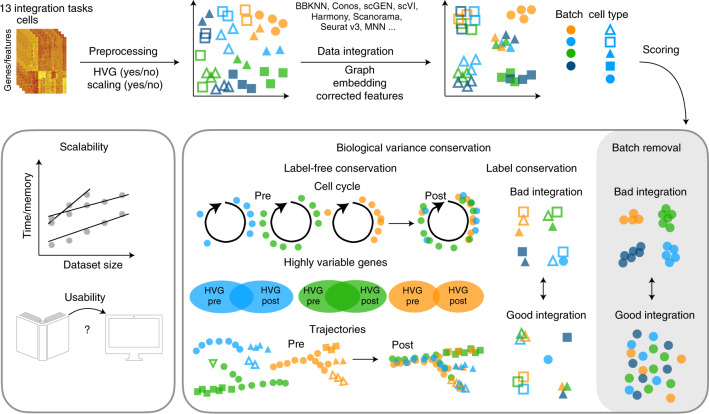
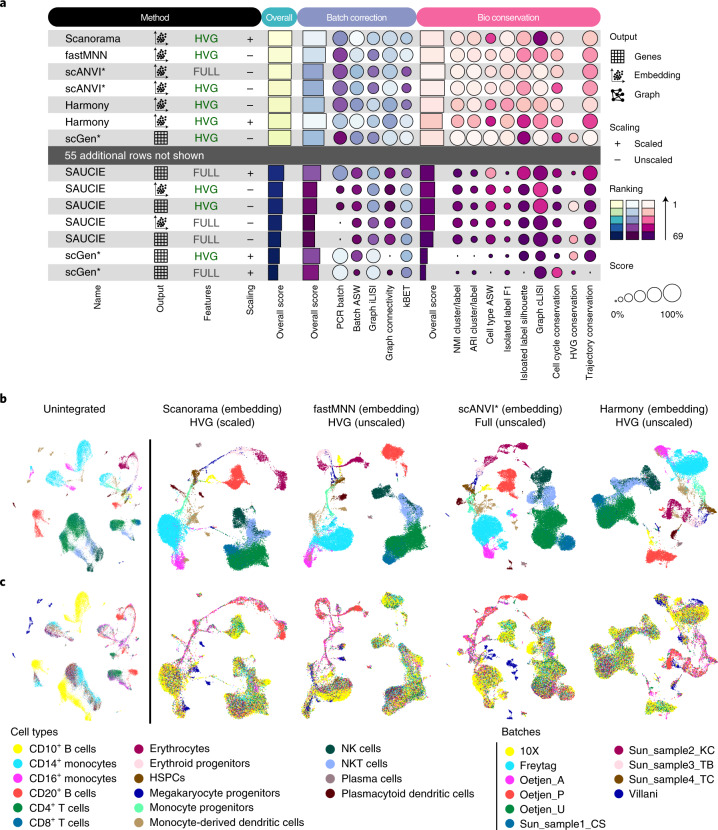
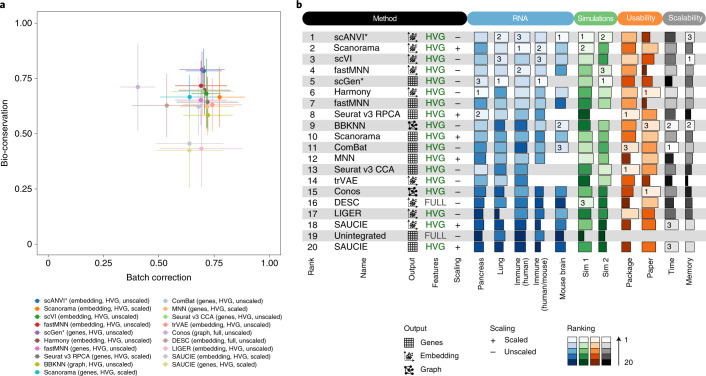
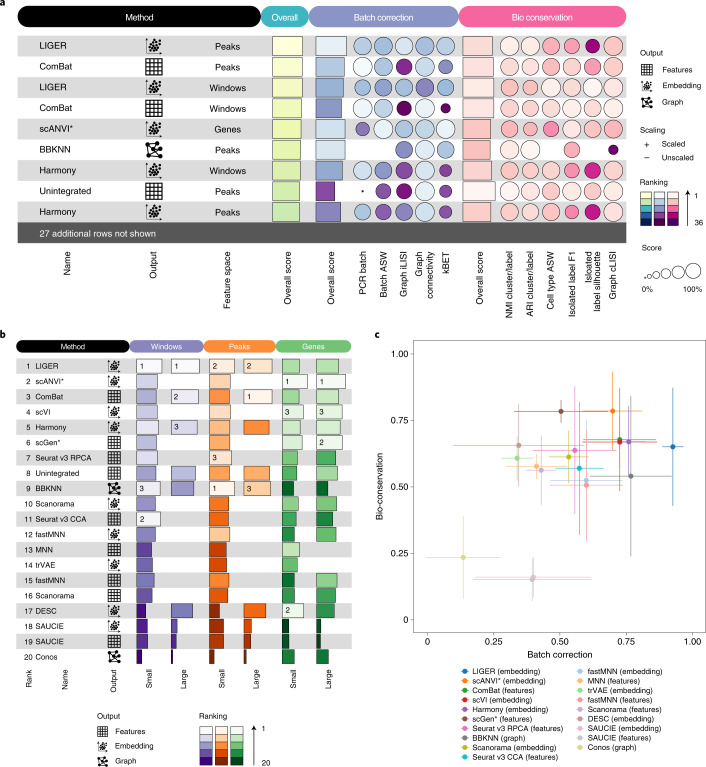
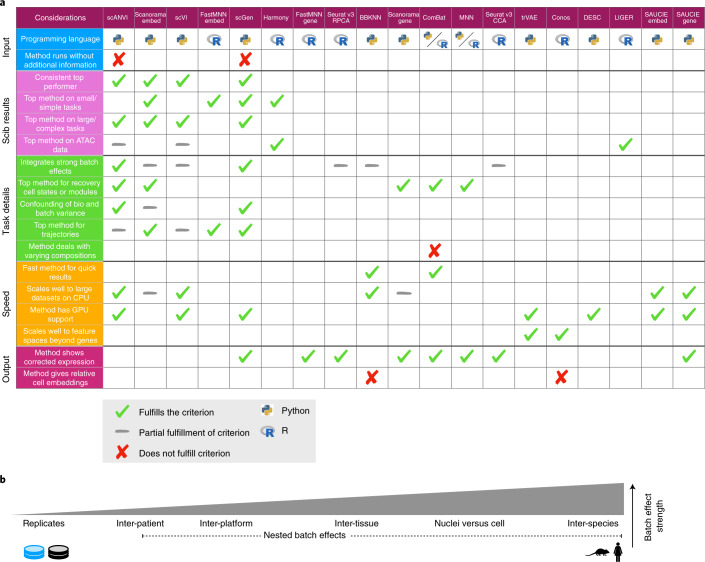
Single-cell atlases often include samples that span locations, laboratories and conditions, leading to complex, nested batch effects in data. Thus, joint analysis of atlas datasets requires reliable data integration. To guide integration method choice, we benchmarked 68 method and preprocessing combinations on 85 batches of gene expression, chromatin accessibility and simulation data from 23 publications, altogether representing >1.2 million cells distributed in 13 atlas-level integration tasks. We evaluated methods according to scalability, usability and their ability to remove batch effects while retaining biological variation using 14 evaluation metrics. We show that highly variable gene selection improves the performance of data integration methods, whereas scaling pushes methods to prioritize batch removal over conservation of biological variation. Overall, scANVI, Scanorama, scVI and scGen perform well, particularly on complex integration tasks, while single-cell ATAC-sequencing integration performance is strongly affected by choice of feature space. Our freely available Python module and benchmarking pipeline can identify optimal data integration methods for new data, benchmark new methods and improve method development.
Overview
The claims and statistics of this paper haven’t been checked yet.
Free: it reads the open-access text and checks the first 5 claims that cite a source we can check. Create a free account to check every claim.
Integrity signals
Registry
Cites
Statistics
Figures
Verification
Claims the paper makes
The claims and statistics of this paper haven’t been checked yet.
Free: it reads the open-access text and checks the first 5 claims that cite a source we can check. Create a free account to check every claim.
Claims other papers make about this one
Each is checked against this paper’s own text: does it say what the citing paper says it does?
The source backs part of the claim, not all of it — or backs it for a different population, condition or comparison.
In the citing paper
“Such integrative analysis is complicated by batch effects and biological differences between primary tissue and cell culture26,27.”
From scPerturb: harmonized single-cell perturbation data (2024) · cites this paper as [27]
Experimental — accuracy not yet measuredThe source backs part of the claim, not all of it — or backs it for a different population, condition or comparison.
In the citing paper
“Furthermore, 8 evaluation metrics (3 for batch effect removal and 5 for biological variation retention) are computed to verify the integration ability by scIB47, which ranks TOSICA the first out of all 13 applicable methods evaluated on combined effectiveness in batch effect removal and biological variation retention (Fig. 5b).”
From Transformer for one stop interpretable cell type annotation (2023) · cites this paper as [47]
Experimental — accuracy not yet measuredThe source backs part of the claim, not all of it — or backs it for a different population, condition or comparison.
In the citing paper
“In particular, Harmony22 is an algorithm well suited for correcting batch effects that may be present in a dimensionality-reduced single-cell expression dataset,79”
From hdWGCNA identifies co-expression networks in high-dimensional transcriptomics data (2023) · cites this paper as [79]
Experimental — accuracy not yet measuredThe cited source says what the claim attributes to it.
In the citing paper
“Although this work simplifies dataset access, joint analysis is limited by the complexity of data integration27.”
From scPerturb: harmonized single-cell perturbation data (2024) · cites this paper as [27]
The cited source says what the claim attributes to it.
In the citing paper
“Depending on the complexity of the integration tasks, such as atlas integration, deep-learning approaches such as scANVI40, scVI41 and scGen42 as well as linear-embedding models such as Scanorama43 performed best”
From Best practices for single-cell analysis across modalities (2023) · cites this paper as [35]
10 more claims about this paper
Create a free account to see every claim other papers make about this one.
Self-check
Percentages, sums and reported differences re-computed from the paper’s own numbers.
The self-check needs the paper’s full text.
Citations
Cites
Scikit-learn: Machine Learning in Python
Pedregosa, F., Varoquaux, G., Gramfort, A., Michel, V., Thirion, B., Grisel, O., Blondel, M., Müller, A., Nothman, J., Louppe, G., et al. (2012) · arXiv · doi:10.48550/arxiv.1201.0490 · Cited by 71,016 · cited 12×
“Similar to NMI, we compared the cell-type labels with the NMI-optimized Louvain clustering computed on the integrated dataset.”
BackgroundInfluentialSciPy 1.0: fundamental algorithms for scientific computing in Python
Virtanen, P., Gommers, R., Oliphant, T. E., Haberland, M., Reddy, T., Cournapeau, D., Burovski, E., Peterson, P., Weckesser, W., Bright, J., et al. (2020) · Nature Methods · doi:10.1038/s41592-019-0686-2 · Cited by 38,430
A note on two problems in connexion with graphs
Dijkstra, E. W. (1959) · Numerische Mathematik · doi:10.1007/bf01386390 · Cited by 29,065
Silhouettes: A graphical aid to the interpretation and validation of cluster analysis
Rousseeuw, P. J. (1987) · Journal of Computational and Applied Mathematics · doi:10.1016/0377-0427(87)90125-7 · Cited by 21,392
Comprehensive Integration of Single-Cell Data
Stuart, T., Butler, A., Hoffman, P., Hafemeister, C., Papalexi, E., Mauck, W. M., Hao, Y., Stoeckius, M., Smibert, P., & Satija, R. (2019) · Cell · doi:10.1016/j.cell.2019.05.031 · Cited by 15,453
ggplot2: Elegant Graphics for Data Analysis
Wickham, H. (2009) · doi:10.1007/978-0-387-98141-3 · Cited by 14,447
Fast, sensitive and accurate integration of single-cell data with Harmony
Korsunsky, I., Millard, N., Fan, J., Slowikowski, K., Zhang, F., Wei, K., Baglaenko, Y., Brenner, M., Loh, P.-R., & Raychaudhuri, S. (2019) · Nature Methods · doi:10.1038/s41592-019-0619-0 · Cited by 10,488
SciPy 1.0: fundamental algorithms for scientific computing in Python
Virtanen, P., Gommers, R., Oliphant, T. E., Haberland, M., Reddy, T., Cournapeau, D., Burovski, E., Peterson, P., Weckesser, W., Bright, J., et al. (2019) · Apollo - University of Cambridge Repository · doi:10.17863/cam.64134 · Cited by 10,460
UMAP: Uniform Manifold Approximation and Projection
McInnes, L., Healy, J., Saul, N., & Großberger, L. (2018) · Journal of Open Source Software · doi:10.21105/joss.00861 · Cited by 9,826
SCANPY: large-scale single-cell gene expression data analysis
Wolf, F. A., Angerer, P., & Theis, F. J. (2018) · Genome Biology · doi:10.1186/s13059-017-1382-0 · Cited by 8,881 · cited 1×
“Metrics were run on the integrated and unintegrated AnnData 47 objects.”
MethodSelf-citation
Cited by
scGPT: Towards Building a Foundation Model for Single-Cell Multi-omics Using Generative AI
Cui, H., Wang, C., Maan, H., Pang, K., Luo, F., & Wang, B. (2023) · doi:10.1101/2023.04.30.538439 · Cited by 1,694
Methods and applications for single-cell and spatial multi-omics
Vandereyken, K., Sifrim, A., Thienpont, B., & Voet, T. (2023) · Nature Reviews Genetics · doi:10.1038/s41576-023-00580-2 · Cited by 1,244
A high-resolution transcriptomic and spatial atlas of cell types in the whole mouse brain
Yao, Z., van Velthoven, C. T. J., Kunst, M., Zhang, M., McMillen, D., Lee, C., Jung, W., Goldy, J., Abdelhak, A., Aitken, M., et al. (2023) · Nature · doi:10.1038/s41586-023-06812-z · Cited by 1,203
Best practices for single-cell analysis across modalities
Heumos, L., Schaar, A. C., Lance, C., Litinetskaya, A., Drost, F., Zappia, L., Lücken, M. D., Strobl, D. C., Henao, J., Curion, F., et al. (2023) · Nature Reviews Genetics · doi:10.1038/s41576-023-00586-w · Cited by 1,051
“Once TFs of interest have been identified, scATAC-seq data allow for additional validation of the TF impact through footprinting, which indicates whether the TF is binding in the given cell cluster.”
MethodInfluentialSelf-citationDifferential abundance testing on single-cell data using k-nearest neighbor graphs
Dann, E., Henderson, N. C., Teichmann, S. A., Morgan, M. D., & Marioni, J. C. (2022) · Nature Biotechnology · doi:10.1038/s41587-021-01033-z · Cited by 938
An integrated cell atlas of the lung in health and disease
Sikkema, L., Ramírez-Suástegui, C., Strobl, D. C., Gillett, T. E., Zappia, L., Madissoon, E., Markov, N. S., Zaragosi, L.-E., Ji, Y., Ansari, M., et al. (2023) · Nature Medicine · doi:10.1038/s41591-023-02327-2 · Cited by 854
Self-citationscMC learns biological variation through the alignment of multiple single-cell genomics datasets
Zhang, L., & Nie, Q. (2021) · Genome Biology · doi:10.1186/s13059-020-02238-2 · Cited by 845
“ance of integration analysis and reduce the computational cost [19].”
BackgroundMethodInfluentialA Python library for probabilistic analysis of single-cell omics data
Gayoso, A., Lopez, R., Xing, G., Boyeau, P., Valiollah Pour Amiri, V., Hong, J., Wu, K., Jayasuriya, M., Mehlman, E., Langevin, M., et al. (2022) · Nature Biotechnology · doi:10.1038/s41587-021-01206-w · Cited by 789
Self-citationhdWGCNA identifies co-expression networks in high-dimensional transcriptomics data
Morabito, S., Reese, F., Rahimzadeh, N., Miyoshi, E., & Swarup, V. (2023) · Cell Reports Methods · doi:10.1016/j.crmeth.2023.100498 · Cited by 1,027
An atlas of healthy and injured cell states and niches in the human kidney
Lake, B. B., Menon, R., Winfree, S., Hu, Q., Melo Ferreira, R., Kalhor, K., Barwinska, D., Otto, E. A., Ferkowicz, M., Diep, D., et al. (2023) · Nature · doi:10.1038/s41586-023-05769-3 · Cited by 743
“Finally, the average of k -nearest neighbour batch effect test (kBET) score per subclass, computed for all patients using the scib.metrics.kBET function of the scIB package, was 0.49 (out of 1), which is consistent with other integration efforts 65 .”
MethodInfluentialXu, C., Lopez, R., Mehlman, E., Regier, J., Jordan, M. I., & Yosef, N. (2021) · Molecular Systems Biology · doi:10.15252/msb.20209620 · Cited by 691
Large-scale foundation model on single-cell transcriptomics
Hao, M., Gong, J., Zeng, X., Liu, C., Guo, Y., Cheng, X., Wang, T., Ma, J., Zhang, X., & Song, L. (2024) · Nature Methods · doi:10.1038/s41592-024-02305-7 · Cited by 628
“Note that merely aligning the read depth would not eliminate the entire batch effect since batch effects can involve other variations such as donor gender, experiment treatment, cell cycle and so on 32 .”
Multi-omics single-cell data integration and regulatory inference with graph-linked embedding
Cao, Z.-J., & Gao, G. (2022) · Nature Biotechnology · doi:10.1038/s41587-022-01284-4 · Cited by 616
Mapping single-cell data to reference atlases by transfer learning
Lotfollahi, M., Naghipourfar, M., Luecken, M. D., Khajavi, M., Büttner, M., Wagenstetter, M., Avsec, Ž., Gayoso, A., Yosef, N., Interlandi, M., et al. (2022) · Nature Biotechnology · doi:10.1038/s41587-021-01001-7 · Cited by 602
“Reference mapping performance was assessed using ten metrics recently established to evaluate data-integration performance 7 in terms of removal of batch effects and preservation of biological variation.”
BackgroundMethodInfluentialSelf-citationSARS-CoV-2 infection triggers profibrotic macrophage responses and lung fibrosis
Wendisch, D., Dietrich, O., Mari, T., von Stillfried, S., Ibarra, I. L., Mittermaier, M., Mache, C., Chua, R. L., Knoll, R., Timm, S., et al. (2021) · Cell · doi:10.1016/j.cell.2021.11.033 · Cited by 528
“…sample identifiers in Morse (one or more per patient), and patient identifiers in (Bharat et al., 2020) (one per patient) as batch covariates, respectively. scVI was chosen for integration since it was a scalable top performer in a recent batch integration benchmark (Luecken et al., 2020).”
Self-citationSalcher, S., Sturm, G., Horvath, L., Untergasser, G., Kuempers, C., Fotakis, G., Panizzolo, E., Martowicz, A., Trebo, M., Pall, G., et al. (2022) · Cancer Cell · doi:10.1016/j.ccell.2022.10.008 · Cited by 477
“We integrated the datasets using the scANVI algorithm,(106,107) as it has been demonstrated to be one of the top-performing methods for atlas-level integration and to scale to >1M cells.(108) Since scANVI requires cell-type annotations for at least one of the input datasets, we manually annotated two ‘‘seed’’ datasets…”
Single-cell transcriptomics reveals cell-type-specific diversification in human heart failure
Koenig, A. L., Shchukina, I., Amrute, J., Andhey, P. S., Zaitsev, K., Lai, L., Bajpai, G., Bredemeyer, A., Smith, G., Jones, C., et al. (2022) · Nature Cardiovascular Research · doi:10.1038/s44161-022-00028-6 · Cited by 482
“Effectiveness of integration was evaluated by calculation of iLISI (integration local inverse Simpson’s index) scores using the R package, lisi 75,76 .”
Computational principles and challenges in single-cell data integration
Argelaguet, R., Cuomo, A. S. E., Stegle, O., & Marioni, J. C. (2021) · Nature Biotechnology · doi:10.1038/s41587-021-00895-7 · Cited by 472
“31 , where the researchers compared the performance of 38 methods using increasingly complex datasets and a range of metrics that included scalability, usability and ability to remove batch effects while retaining biological variation.”
BackgroundApplications of single-cell RNA sequencing in drug discovery and development
Van de Sande, B., Lee, J. S., Mutasa-Gottgens, E., Naughton, B., Bacon, W., Manning, J., Wang, Y., Pollard, J., Mendez, M., Hill, J., et al. (2023) · Nature Reviews Drug Discovery · doi:10.1038/s41573-023-00688-4 · Cited by 437
Single-nucleus cross-tissue molecular reference maps toward understanding disease gene function
Eraslan, G., Drokhlyansky, E., Anand, S., Fiskin, E., Subramanian, A., Slyper, M., Wang, J., Van Wittenberghe, N., Rouhana, J. M., Waldman, J., et al. (2022) · Science · doi:10.1126/science.abl4290 · Cited by 405
Program, C. C. S., Abdulla, S., Aevermann, B., Assis, P., Badajoz, S., Bell, S. M., Bezzi, E., Cakir, B., Chaffer, J., Chambers, S., et al. (2025) · Nucleic Acids Research · doi:10.1093/nar/gkae1142 · Cited by 399
MultiVI: deep generative model for the integration of multi-modal data
Ashuach, T., Gabitto, M. I., Jordan, M. I., & Yosef, N. (2021) · doi:10.1101/2021.08.20.457057 · Cited by 385
The scverse project provides a computational ecosystem for single-cell omics data analysis
Virshup, I., Bredikhin, D., Heumos, L., Palla, G., Sturm, G., Gayoso, A., Kats, I., Koutrouli, M., Community, S., Angerer, P., et al. (2023) · Nature Biotechnology · doi:10.1038/s41587-023-01733-8 · Cited by 341
Self-citationIntegrative Single-Cell RNA-Seq and ATAC-Seq Analysis of Human Developmental Hematopoiesis
Ranzoni, A. M., Tangherloni, A., Berest, I., Riva, S. G., Myers, B., Strzelecka, P. M., Xu, J., Panada, E., Mohorianu, I., Zaugg, J. B., et al. (2021) · Cell Stem Cell · doi:10.1016/j.stem.2020.11.015 · Cited by 331
The triumphs and limitations of computational methods for scRNA-seq
Kharchenko, P. V. (2021) · Nature Methods · doi:10.1038/s41592-021-01171-x · Cited by 321
“More elaborate graph-construction approaches have been developed to integrate multiple datasets, in order to overcome or correct for different types of batch effects in such designs 41 .”
BackgroundMethodSingle-cell and spatial transcriptomics: deciphering brain complexity in health and disease
Piwecka, M., Rajewsky, N., & Rybak-Wolf, A. (2023) · Nature Reviews Neurology · doi:10.1038/s41582-023-00809-y · Cited by 320
Mapping single-cell atlases throughout Metazoa unravels cell type evolution
Tarashansky, A. J., Musser, J. M., Khariton, M., Li, P., Arendt, D., Quake, S. R., & Wang, B. (2021) · eLife · doi:10.7554/elife.66747 · Cited by 311
Profiling cell identity and tissue architecture with single-cell and spatial transcriptomics
Gulati, G. S., D’Silva, J. P., Liu, Y., Wang, L., & Newman, A. M. (2025) · Nature Reviews Molecular Cell Biology · doi:10.1038/s41580-024-00768-2 · Cited by 293
Gao, Y., Li, J., Cheng, W., Diao, T., Liu, H., Bo, Y., Liu, C., Zhou, W., Chen, M., Zhang, Y., et al. (2024) · Cancer Cell · doi:10.1016/j.ccell.2024.08.020 · Cited by 285
Automatic cell-type harmonization and integration across Human Cell Atlas datasets
Xu, C., Prete, M., Webb, S., Jardine, L., Stewart, B. J., Hoo, R., He, P., Meyer, K. B., & Teichmann, S. A. (2023) · Cell · doi:10.1016/j.cell.2023.11.026 · Cited by 284
HypoMap—a unified single-cell gene expression atlas of the murine hypothalamus
Steuernagel, L., Lam, B. Y. H., Klemm, P., Dowsett, G. K. C., Bauder, C. A., Tadross, J. A., Hitschfeld, T. S., del Rio Martin, A., Chen, W., de Solis, A. J., et al. (2022) · Nature Metabolism · doi:10.1038/s42255-022-00657-y · Cited by 267
Korsunsky, I., Wei, K., Pohin, M., Kim, E. Y., Barone, F., Major, T., Taylor, E., Ravindran, R., Kemble, S., Watts, G. F. M., et al. (2022) · Med · doi:10.1016/j.medj.2022.05.002 · Cited by 247
Harmonized cross-species cell atlases of trigeminal and dorsal root ganglia
Bhuiyan, S. A., Xu, M., Yang, L., Semizoglou, E., Bhatia, P., Pantaleo, K. I., Tochitsky, I., Jain, A., Erdogan, B., Blair, S., et al. (2024) · Science Advances · doi:10.1126/sciadv.adj9173 · Cited by 235
“However, it is important to note that there are multiple strategies for harmo-nizing sc/snRNA-seq datasets across species that can affect cell type annotation ( 18 , 19 , 75 , 76 ).”
Ahlmann-Eltze, C., Huber, W., & Anders, S. (2025) · Nature Methods · doi:10.1038/s41592-025-02772-6 · Cited by 238
A Review of Single-Cell RNA-Seq Annotation, Integration, and Cell–Cell Communication
Cheng, C., Chen, W., Jin, H., & Chen, X. (2023) · Cells · doi:10.3390/cells12151970 · Cited by 224
“In a more recent study by Leucken et al. [153], 68 preprocessing-and-method combinations were evaluated on various single-cell data sets for atlas-level, single-cell integration.”
BackgroundMethodQuantifying the effect of experimental perturbations at single-cell resolution
Burkhardt, D. B., Stanley, J. S., Tong, A., Perdigoto, A. L., Gigante, S. A., Herold, K. C., Wolf, G., Giraldez, A. J., van Dijk, D., & Krishnaswamy, S. (2021) · Nature Biotechnology · doi:10.1038/s41587-020-00803-5 · Cited by 226
SEACells infers transcriptional and epigenomic cellular states from single-cell genomics data
Persad, S., Choo, Z.-N., Dien, C., Sohail, N., Masilionis, I., Chaligné, R., Nawy, T., Brown, C. C., Sharma, R., Pe’er, I., et al. (2023) · Nature Biotechnology · doi:10.1038/s41587-023-01716-9 · Cited by 222
“Despite enormous progress in data integration approaches 45–48 , biological variation between individuals is often impossible to distinguish from technical noise, due in large part to the sparsity of single-cell data.”
BackgroundCellCharter reveals spatial cell niches associated with tissue remodeling and cell plasticity
Varrone, M., Tavernari, D., Santamaria-Martínez, A., Walsh, L. A., & Ciriello, G. (2024) · Nature Genetics · doi:10.1038/s41588-023-01588-4 · Cited by 210
McKellar, D. W., Walter, L. D., Song, L. T., Mantri, M., Wang, M. F. Z., De Vlaminck, I., & Cosgrove, B. D. (2021) · Communications Biology · doi:10.1038/s42003-021-02810-x · Cited by 210
Abedini, A., Levinsohn, J., Klötzer, K. A., Dumoulin, B., Ma, Z., Frederick, J., Dhillon, P., Balzer, M. S., Shrestha, R., Liu, H., et al. (2024) · Nature Genetics · doi:10.1038/s41588-024-01802-x · Cited by 200
“https://doi.org/10.1038/s41588-024-01802-x disease states 29 .”
InfluentialChromatin accessibility profiling methods
Minnoye, L., Marinov, G. K., Krausgruber, T., Pan, L., Marand, A. P., Secchia, S., Greenleaf, W. J., Furlong, E. E. M., Zhao, K., Schmitz, R. J., et al. (2021) · Nature Reviews Methods Primers · doi:10.1038/s43586-020-00008-9 · Cited by 206
Understanding tumour endothelial cell heterogeneity and function from single-cell omics
Zeng, Q., Mousa, M., Nadukkandy, A. S., Franssens, L., Alnaqbi, H., Alshamsi, F. Y., Safar, H. A., & Carmeliet, P. (2023) · Nature Reviews Cancer · doi:10.1038/s41568-023-00591-5 · Cited by 194
Benchmarking spatial clustering methods with spatially resolved transcriptomics data
Yuan, Z., Zhao, F., Lin, S., Zhao, Y., Yao, J., Cui, Y., Zhang, X.-Y., & Zhao, Y. (2024) · Nature Methods · doi:10.1038/s41592-024-02215-8 · Cited by 194
“These metrics are frequently used in benchmark studies across various computational tasks, including single-cell data integration 57 , spatial transcriptomics data imputation or deconvolution 42 , and trajectory inference 58 .”
An integrated single cell and spatial transcriptomic map of human white adipose tissue
Massier, L., Jalkanen, J., Elmastas, M., Zhong, J., Wang, T., Nono Nankam, P. A., Frendo-Cumbo, S., Bäckdahl, J., Subramanian, N., Sekine, T., et al. (2023) · Nature Communications · doi:10.1038/s41467-023-36983-2 · Cited by 195
scPerturb: harmonized single-cell perturbation data
Peidli, S., Green, T. D., Shen, C., Gross, T., Min, J., Garda, S., Yuan, B., Schumacher, L. J., Taylor-King, J. P., Marks, D. S., et al. (2024) · Nature Methods · doi:10.1038/s41592-023-02144-y · Cited by 194
“Such integrative analysis is complicated by batch effects and biological differences between primary tissue and cell culture 26,27 .”
Transformer for one stop interpretable cell type annotation
Chen, J., Xu, H., Tao, W., Chen, Z., Zhao, Y., & Han, J.-D. J. (2023) · Nature Communications · doi:10.1038/s41467-023-35923-4 · Cited by 189
An atlas of cells in the human tonsil
Massoni-Badosa, R., Aguilar-Fernández, S., Nieto, J. C., Soler-Vila, P., Elosua-Bayes, M., Marchese, D., Kulis, M., Vilas-Zornoza, A., Bühler, M. M., Rashmi, S., et al. (2024) · Immunity · doi:10.1016/j.immuni.2024.01.006 · Cited by 183
“Harmony scales well to atlas-level dataset and ranks among the best-performing tools for both scRNA-seq and scATAC-seq (Chazarra-Gil et al., 2021; Luecken et al., 2022; Tran et al., 2020).”
MethodA fast, scalable and versatile tool for analysis of single-cell omics data
Zhang, K., Zemke, N. R., Armand, E. J., & Ren, B. (2024) · Nature Methods · doi:10.1038/s41592-023-02139-9 · Cited by 185
“To assess the bio-conservation quality of the cell embeddings generated by each method, we used a suite of metrics: the ARI, adjusted mutual information (AMI), cell-type average silhouette width (cell-type ASW) 43 and graph integration local inverse Simpson’s index (graph iLISI) 43 .”
InfluentialTransformers in single-cell omics: a review and new perspectives
Szałata, A., Hrovatin, K., Becker, S., Tejada-Lapuerta, A., Cui, H., Wang, B., & Theis, F. J. (2024) · Nature Methods · doi:10.1038/s41592-024-02353-z · Cited by 171
“Essential to this is the preservation of biological variations, such as cell type and cell state, while minimizing technical confounding, such as batch effects, between datasets 53 .”
Self-citationOver 1000 tools reveal trends in the single-cell RNA-seq analysis landscape
Zappia, L., & Theis, F. J. (2021) · Genome Biology · doi:10.1186/s13059-021-02519-4 · Cited by 174
Self-citationSingle-cell atlases: shared and tissue-specific cell types across human organs
Elmentaite, R., Domínguez Conde, C., Yang, L., & Teichmann, S. A. (2022) · Nature Reviews Genetics · doi:10.1038/s41576-022-00449-w · Cited by 169
Liu, Z., Kong, X., Long, Y., Liu, S., Zhang, H., Jia, J., Cui, W., Zhang, Z., Song, X., Qiu, L., et al. (2023) · Nature Plants · doi:10.1038/s41477-023-01387-z · Cited by 169
The Human Cell Atlas from a cell census to a unified foundation model
Rood, J. E., Wynne, S., Robson, L., Hupalowska, A., Randell, J., Teichmann, S. A., & Regev, A. (2025) · Nature · doi:10.1038/s41586-024-08338-4 · Cited by 161
“Systematically improving benchmarking frameworks is an active area of research in the HCA community 29,30 .”
Universal Cell Embeddings: A Foundation Model for Cell Biology
Rosen, Y., Roohani, Y., Agrawal, A., Samotorcan, L., Consortium, T. S., Quake, S. R., & Leskovec, J. (2023) · bioRxiv (Cold Spring Harbor Laboratory) · doi:10.1101/2023.11.28.568918 · Cited by 162
“The unified representations they produce are often unable to extend to new datasets due to species-specific constraints in their construction or the presence of dataset-specific artifacts (or batch effects) which can obscure the underlying biologi-49 cal signal [16, 17].”
An integrated transcriptomic cell atlas of human neural organoids
He, Z., Dony, L., Fleck, J. S., Szałata, A., Li, K. X., Slišković, I., Lin, H., Santel, M., Atamian, A., Quadrato, G., et al. (2024) · Nature · doi:10.1038/s41586-024-08172-8 · Cited by 210
“Evaluation of scPoli together with other integration approaches using the previously established benchmarking pipeline 37 showed that scPoli had the best performance for these data sets (Extended Data Fig.”
Self-citationTowards artificial intelligence-enabled extracellular vesicle precision drug delivery
Greenberg, Z., Graim, K. S., & He, M. (2023) · Advanced Drug Delivery Reviews · doi:10.1016/j.addr.2023.114974 · Cited by 174
A common framework of monocyte-derived macrophage activation
Sanin, D. E., Ge, Y., Marinković, E., Kabat, A. M., Castoldi, Â., Caputa, G., Grzes, K. M., Curtis, J. D., Thompson, E. A., Willenborg, S., et al. (2022) · Science Immunology · doi:10.1126/sciimmunol.abl7482 · Cited by 171
“This strategy is highly accurate for label transfer from a reference dataset (39) yet can overcorrect batch effects while sacrificing biological variability (40).”
BackgroundSingle-cell ATAC sequencing analysis: From data preprocessing to hypothesis generation
Baek, S., & Lee, I. (2020) · Computational and Structural Biotechnology Journal · doi:10.1016/j.csbj.2020.06.012 · Cited by 151
High-throughput single-сell sequencing in cancer research
Jia, Q., Chu, H., Jin, Z., Long, H., & Zhu, B. (2022) · Signal Transduction and Targeted Therapy · doi:10.1038/s41392-022-00990-4 · Cited by 178
A cell atlas foundation model for scalable search of similar human cells
Heimberg, G., Kuo, T., DePianto, D. J., Salem, O., Heigl, T., Diamant, N., Scalia, G., Biancalani, T., Turley, S. J., Rock, J. R., et al. (2025) · Nature · doi:10.1038/s41586-024-08411-y · Cited by 136
“ASW has been used to assess the performance of data integration tasks on multiple scRNA-seq studies 16 by quantifying how coherently each set of cells is grouped across studies after integration.”
EpiScanpy: integrated single-cell epigenomic analysis
Danese, A., Richter, M. L., Chaichoompu, K., Fischer, D. S., Theis, F. J., & Colomé-Tatché, M. (2021) · Nature Communications · doi:10.1038/s41467-021-25131-3 · Cited by 142
Self-citationDeep learning applications in single-cell genomics and transcriptomics data analysis
Erfanian, N., Heydari, A. A., Feriz, A. M., Iañez, P., Derakhshani, A., Ghasemigol, M., Farahpour, M., Razavi, S. M., Nasseri, S., Safarpour, H., et al. (2023) · Biomedicine & Pharmacotherapy · doi:10.1016/j.biopha.2023.115077 · Cited by 140
Program, C. S.-C. B., Abdulla, S., Aevermann, B., Assis, P., Badajoz, S., Bell, S. M., Bezzi, E., Cakir, B., Chaffer, J., Chambers, S., et al. (2023) · doi:10.1101/2023.10.30.563174 · Cited by 142
Zheng, Y., Liu, Y., Yang, J., Dong, L., Zhang, R., Tian, S., Yu, Y., Ren, L., Hou, W., Zhu, F., et al. (2023) · Nature Biotechnology · doi:10.1038/s41587-023-01934-1 · Cited by 178
scBasset: sequence-based modeling of single-cell ATAC-seq using convolutional neural networks
Yuan, H., & Kelley, D. R. (2022) · Nature Methods · doi:10.1038/s41592-022-01562-8 · Cited by 147
“We quantified the mixing performance using integration local inverse Simpson’s index (iLISI) and k -nearest-neighbor batch-effect test (kBET) acceptance rate (Methods) and quantified the conservation of biological variation using label score 19–21 .”
MethodscBasset: Sequence-based modeling of single cell ATAC-seq using convolutional neural networks
Yuan, H., & Kelley, D. R. (2021) · doi:10.1101/2021.09.08.459495 · Cited by 138
An organotypic atlas of human vascular cells
Barnett, S. N., Cujba, A.-M., Yang, L., Maceiras, A. R., Li, S., Kedlian, V. R., Pett, J. P., Polański, K., Miranda, A. M. A., Xu, C., et al. (2024) · Nature Medicine · doi:10.1038/s41591-024-03376-x · Cited by 155
“Although there is no accepted standard, multiple computational methods have been developed for complex dataset integration, with scVI being one of the top performers 108 .”
Cancer cell states: Lessons from ten years of single-cell RNA-sequencing of human tumors
Tirosh, I., & Suvà, M. L. (2024) · Cancer Cell · doi:10.1016/j.ccell.2024.08.005 · Cited by 165
SPACEL: deep learning-based characterization of spatial transcriptome architectures
Xu, H., Wang, S., Fang, M., Luo, S., Chen, C., Wan, S., Wang, R., Tang, M., Xue, T., Li, B., et al. (2023) · Nature Communications · doi:10.1038/s41467-023-43220-3 · Cited by 127
Rosen, Y., Brbić, M., Roohani, Y., Swanson, K., Li, Z., & Leskovec, J. (2024) · Nature Methods · doi:10.1038/s41592-024-02191-z · Cited by 127
“6), as well as data integration metrics 32 (Extended Data Fig.”
BackgroundPopulation-level integration of single-cell datasets enables multi-scale analysis across samples
Donno, C. D., Hediyeh-zadeh, S., Moinfar, A. A., Wagenstetter, M., Zappia, L., Lotfollahi, M., & Theis, F. J. (2023) · Nature Methods · doi:10.1038/s41592-023-02035-2 · Cited by 157
Self-citationTowards multimodal foundation models in molecular cell biology
Cui, H., Tejada-Lapuerta, A., Brbić, M., Sáez-Rodríguez, J., Cristea, S., Goodarzi, H., Lotfollahi, M., Theis, F. J., & Wang, B. (2025) · Nature · doi:10.1038/s41586-025-08710-y · Cited by 186
Self-citationMosquera, J. V., Auguste, G., Wong, D., Turner, A. W., Hodonsky, C. J., Alvarez-Yela, A. C., Song, Y., Cheng, Q., Lino Cardenas, C. L., Theofilatos, K., et al. (2023) · Cell Reports · doi:10.1016/j.celrep.2023.113380 · Cited by 123
Deep learning shapes single-cell data analysis
Ma, Q., & Xu, D. (2022) · Nature Reviews Molecular Cell Biology · doi:10.1038/s41580-022-00466-x · Cited by 123
“Furthermore, comprehensive single-cell DL benchmarking papers help users choose the best model 8,9 .”
BackgroundDisease diagnostics using machine learning of B cell and T cell receptor sequences
Zaslavsky, M., Craig, E., Michuda, J., Sehgal, N., Ram-Mohan, N., Lee, J.-Y., Nguyen, K. D., Hoh, R. A., Pham, T. D., Röltgen, K., et al. (2025) · Science · doi:10.1126/science.adp2407 · Cited by 136
Single-cell transcriptomics for the assessment of cardiac disease
Miranda, A. M. A., Janbandhu, V., Maatz, H., Kanemaru, K., Cranley, J., Teichmann, S. A., Hübner, N., Schneider, M. D., Harvey, R. P., & Noseda, M. (2023) · Nature Reviews Cardiology · doi:10.1038/s41569-022-00805-7 · Cited by 117
Single-cell integration reveals metaplasia in inflammatory gut diseases
Oliver, A. J., Huang, N., Bartolomé-Casado, R., Li, R., Koplev, S., Nilsen, H. R., Moy, M. R., Çakır, B., Polański, K., Gudiño, V., et al. (2024) · Nature · doi:10.1038/s41586-024-07571-1 · Cited by 142
Miyoshi, E., Morabito, S., Henningfield, C. M., Das, S., Rahimzadeh, N., Shabestari, S. K., Michael, N., Emerson, N., Reese, F., Shi, Z., et al. (2024) · Nature Genetics · doi:10.1038/s41588-024-01961-x · Cited by 115
“We used scANVI 25,26 for reference-based integration of this dataset with three previous AD studies 7–9 (FCX; total n = 27 cognitively healthy controls, n = 23 early-stage AD and n = 48 late-stage AD) for a total of 585,042 nuclei after quality control (Fig.”
Large Scale Foundation Model on Single-cell Transcriptomics
Hao, M., Gong, J., Zeng, X., Liu, C., Guo, Y., Cheng, X., Wang, T., Ma, J., Song, L., & Zhang, X. (2023) · doi:10.1101/2023.05.29.542705 · Cited by 639
Cell-type profiling in salamanders identifies innovations in vertebrate forebrain evolution
Woych, J., Gurrola, A. O., Deryckere, A., Jaeger, E. C. B., Gumnit, E., Merello, G., Gu, J., Joven, A., Leigh, N. D., Yun, M. H., et al. (2022) · Science · doi:10.1126/science.abp9186 · Cited by 114
Zero-shot evaluation reveals limitations of single-cell foundation models
Kedzierska, K. Z., Crawford, L., Amini, A. P., & Lu, A. X. (2025) · Genome Biology · doi:10.1186/s13059-025-03574-x · Cited by 109
Junttila, S., Smolander, J., & Elo, L. L. (2022) · Briefings in Bioinformatics · doi:10.1093/bib/bbac286 · Cited by 109
“Data integration methods can be used to automate the identification of the same cell types across the samples [3, 4].”
MethodBenchmarking strategies for cross-species integration of single-cell RNA sequencing data
Song, Y., Miao, Z., Brāzma, A., & Papatheodorou, I. (2023) · Nature Communications · doi:10.1038/s41467-023-41855-w · Cited by 121
“On one hand, species effects can be much stronger than average technical batch effects, so moderate methods frequently fail to integrate the data 17,19 .”
BackgroundMethodInfluentialZhang, J., Ubas, A. A., de Borja, R., Svensson, V., Thomas, N., Thakar, N., Lai, I., Winters, A., Khan, U., Jones, M. G., et al. (2025) · bioRxiv (Cold Spring Harbor Laboratory) · doi:10.1101/2025.02.20.639398 · Cited by 106
Integrated analysis of multimodal single-cell data with structural similarity
Cao, Y., Fu, L., Wu, J., Peng, Q., Nie, Q. H., Zhang, J., & Xie, X. S. (2022) · Nucleic Acids Research · doi:10.1093/nar/gkac781 · Cited by 122
GenePT: A Simple But Effective Foundation Model for Genes and Cells Built From ChatGPT
Chen, Y., & Zou, J. (2023) · bioRxiv (Cold Spring Harbor Laboratory) · doi:10.1101/2023.10.16.562533 · Cited by 105
“– Unsupervised Exploration of Gene Programs: To examine the interaction between genes, we constructed a similarity network of gene-gene interactions using GenePT embeddings from a dataset of human immune tissues [37].”
InfluentialHarmonized single-cell landscape, intercellular crosstalk and tumor architecture of glioblastoma
Ruiz-Moreno, C., Salas, S. M., Samuelsson, E., Brandner, S., Kranendonk, M. E. G., Nilsson, M., & Stunnenberg, H. G. (2022) · bioRxiv (Cold Spring Harbor Laboratory) · doi:10.1101/2022.08.27.505439 · Cited by 103
Netskar, H., Pfefferle, A., Goodridge, J. P., Sohlberg, E., Dufva, O., Teichmann, S. A., Brownlie, D., Michaëlsson, J., Marquardt, N., Clancy, T., et al. (2024) · Nature Immunology · doi:10.1038/s41590-024-01884-z · Cited by 137
“These meth-ods have been shown to perform well for integration of scRNA-seq data, especially when dealing with complex batch effects and integrating atlas-level data 84 .”
Hou, W., Ji, Z., Chen, Z., Wherry, E. J., Hicks, S. C., & Ji, H. (2023) · Nature Communications · doi:10.1038/s41467-023-42841-y · Cited by 125
Predicting cellular responses to perturbation across diverse contexts with State
Adduri, A. K., Gautam, D., Bevilacqua, B., Naghipourfar, M., Imran, A., Shah, R., Teyssier, N., Verma, R., Carpenter, C., Eraslan, B., et al. (2026) · Cell · doi:10.1016/j.cell.2026.07.052 · Cited by 100
Biologically informed deep learning to query gene programs in single-cell atlases
Lotfollahi, M., Rybakov, S., Hrovatin, K., Hediyeh-zadeh, S., Talavera-López, C., Misharin, A. V., & Theis, F. J. (2023) · Nature Cell Biology · doi:10.1038/s41556-022-01072-x · Cited by 100
Self-citationNicheformer: a foundation model for single-cell and spatial omics
Tejada-Lapuerta, A., Schaar, A. C., Gutgesell, R., Palla, G., Halle, L., Minaeva, M., Vornholz, L., Dony, L., Drummer, F., Richter, T., et al. (2025) · Nature Methods · doi:10.1038/s41592-025-02814-z · Cited by 100
“The field of single-cell biology has taken up deep learning-based representation learning for some time, leveraging autoencoders 16,17 for analysis tasks like data integration 18 , atlas mapping 19 and perturbation prediction 20 .”
Self-citationXiong, L., Tian, K., Li, Y., Ning, W., Gao, X., & Zhang, Q. C. (2022) · Nature Communications · doi:10.1038/s41467-022-33758-z · Cited by 117
Application of Deep Learning on Single-Cell RNA Sequencing Data Analysis: A Review
Brendel, M., Su, C., Bai, Z., Zhang, H., Elemento, O., & Wang, F. (2022) · Genomics Proteomics & Bioinformatics · doi:10.1016/j.gpb.2022.11.011 · Cited by 123
“The authors suggest that standard approaches for data integration, such as Harmony, work best when biological complexity is small, but are outperformed by deep learning approaches in more complex settings [151].”
BackgroundMethodJUMP Cell Painting dataset: morphological impact of 136,000 chemical and genetic perturbations
Chandrasekaran, S. N., Ackerman, J., Alix, E., Ando, D. M., Arevalo, J., Bennion, M., Boisseau, N., Borowa, A., Boyd, J. D., Brino, L., et al. (2023) · bioRxiv (Cold Spring Harbor Laboratory) · doi:10.1101/2023.03.23.534023 · Cited by 95
Beneyto-Calabuig, S., Merbach, A. K., Kniffka, J.-A., Antes, M., Szu-Tu, C., Rohde, C., Waclawiczek, A., Stelmach, P., Gräßle, S., Pervan, P., et al. (2023) · Cell Stem Cell · doi:10.1016/j.stem.2023.04.001 · Cited by 96
Self-supervised contrastive learning for integrative single cell RNA-seq data analysis
Han, W., Cheng, Y., Chen, J., Zhong, H., Hu, Z., Chen, S., Zong, L., Hong, L., Chan, T., King, I., et al. (2022) · Briefings in Bioinformatics · doi:10.1093/bib/bbac377 · Cited by 110
“In addition, we further check the influence of using highly variable genes, discovering that those low variable genes may reduce the signal ratio and harm the model performance, which is consistent with the previous study 24, 39 .”
ResultA panoramic view of cell population dynamics in mammalian aging
Zhang, Z., Schaefer, C., Jiang, W., Lu, Z., Lee, J., Sziraki, A., Abdulraouf, A., Wick, B., Haeussler, M., Li, Z., et al. (2025) · Science · doi:10.1126/science.adn3949 · Cited by 95
Stabilized mosaic single-cell data integration using unshared features
Ghazanfar, S., Guibentif, C., & Marioni, J. C. (2024) · Nature Biotechnology · doi:10.1038/s41587-023-01766-z · Cited by 93
“Consequently, data integration has emerged as a key challenge for consolidating and profiting from such rich resources 5 , with the task of integrating diverse molecular assays being known as ‘mosaic data integration’ 6 , as distinct from horizontal data integration where multiple sets of cells are…”
BackgroundCausal identification of single-cell experimental perturbation effects with CINEMA-OT
Dong, M., Wang, B., Wei, J., de O. Fonseca, A. H., Perry, C. J., Frey, A., Ouerghi, F., Foxman, E. F., Ishizuka, J. J., Dhodapkar, R. M., et al. (2023) · Nature Methods · doi:10.1038/s41592-023-02040-5 · Cited by 94
“These metrics are batch mixing metrics used to evaluate batch correction methods performance in the systematic benchmarking paper [55].”
Influential
Metadata
- Authors
- Luecken, M. D., Büttner, M., Chaichoompu, K., Danese, A., Interlandi, M., Mueller, M. F., Strobl, D. C., Zappia, L., Dugas, M., Colomé-Tatché, M., & Theis, F. J.
- Affiliations
- Helmholtz Munich (DE)
- University of Münster (DE)
- University Hospital Heidelberg (DE)
- Corresponding author
- Theis, Fabian J.
- ORCID
- Venue
- Nature Methods
- Published
- 2021-12-23
- Volume
- 19
- Issue
- 1
- Pages
- 41-50
- ISSN
- 1548-7091 (ISSN-L)
- 1548-7105
- PMC
- PMC8748196
- OpenAlex
- W4225598893
- Cited by
- 1,438
- References
- 87
- Citations by year
- 2026: 380 · 2025: 358 · 2024: 304 · 2023: 210 · 2022: 115 · 2021: 53
- FWCI
- 55.88
- Type
- journal article
- Language
- en
- Open access
- hybrid
- doi.org
- Licence
- cc-by
- creativecommons.org/licenses/by/4.0 (tdm)
- creativecommons.org/licenses/by/4.0 (vor)
- Locations
- Nature Methods (publishedVersion, cc-by)
- bioRxiv (Cold Spring Harbor Laboratory) (acceptedVersion, cc-by)
- PubMed Central (publishedVersion, cc-by)
- PubMed (publishedVersion)
- Site cant be reached (submittedVersion, cc-by)
- Funders
- Silicon Valley Community Foundation (182835)
- Wellcome Trust (108413 /A/15/D)
- Chan Zuckerberg Initiative (182835)
- European Commission (874656, 2020 ‘, HORIZON2020)
- Helmholtz Zentrum München
- Topics
- Life Sciences › Biochemistry, Genetics and Molecular Biology › Molecular Biology › Single-cell and spatial transcriptomics
- Life Sciences › Biochemistry, Genetics and Molecular Biology › Molecular Biology › Gene expression and cancer classification
- Life Sciences › Biochemistry, Genetics and Molecular Biology › Molecular Biology › Bioinformatics and Genomic Networks
- Keywords
- single-cell data integration, batch effects, benchmarking, single-cell atlas, scANVI, scVI, single-cell ATAC-seq, chromatin accessibility, gene expression, feature space selection, scalability
- MeSH terms
- Animals, Humans, Immune System, Software, Sequence Analysis, RNA, Computational Biology, Benchmarking, Genomics, Databases, Genetic, Mice, Single-Cell Analysis
About these checks
Registry, retraction, Cites and statistics results are computed, not judged, with one exception: a printed reference that no index lists is read once by a model before it counts as a citation error. Claims are extracted by a model and kept only when their quote appears verbatim in the text; each cited source is then checked, with a model’s help, for whether it says what the claim relies on. Those verdicts can be wrong — read the claim’s quote and the cited source before relying on one.
Statistics and arithmetic are recomputed, not judged.
Confidence bands are shown only for fields calibrated on our annotated test set. None is calibrated yet, so no band is shown.
What counts as a claim ›How we measure confidence ›How we check this ›
Are you an author, or do you see a problem with this page? Request a review
Data sources
Bibliographic data: Semantic Scholar, OpenAlex, Crossref.
Contains information from the Semantic Scholar Academic Graph Datasets, made available under the ODC Attribution License (ODC-BY 1.0).
Semantic Scholar’s data is described in: Kinney, R., et al. (2023). The Semantic Scholar Open Data Platform. arXiv:2301.10140.
