

Benchmarking atlas-level data integration in single-cell genomics
Open accessPublished version of a preprint
The DOI matches its Crossref record; 90 of the 90 references it cites were found in a registry or an index.
Abstract
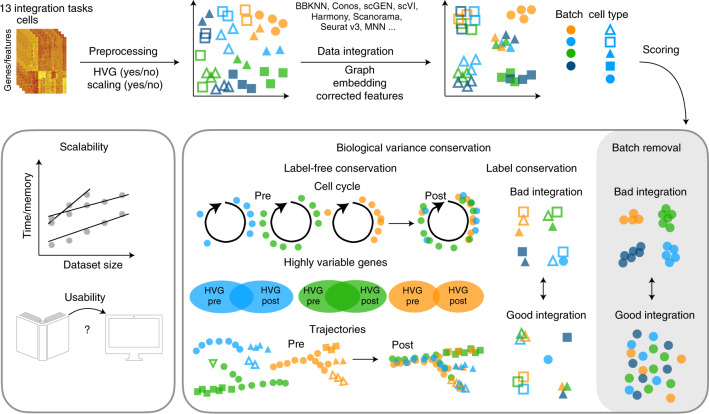
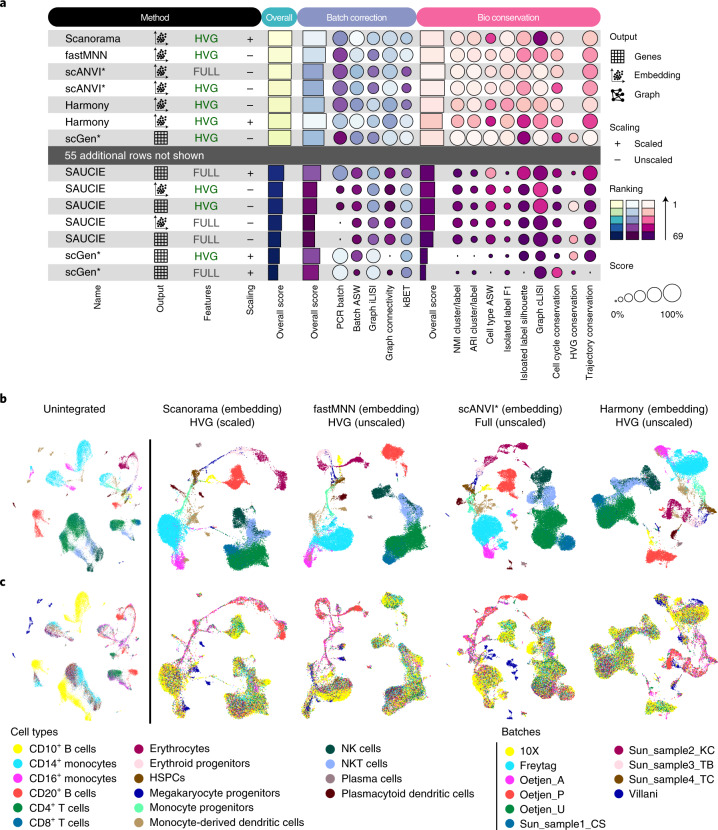
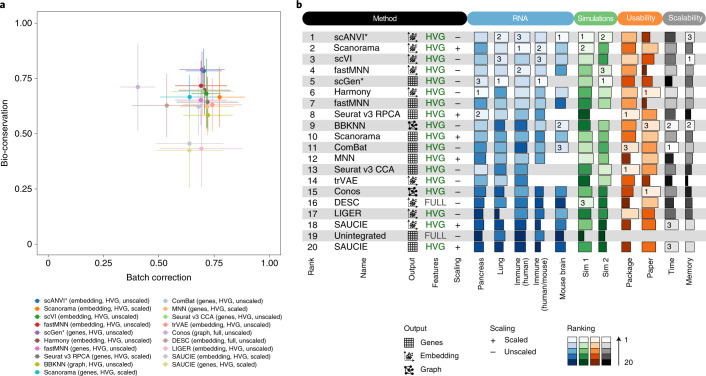
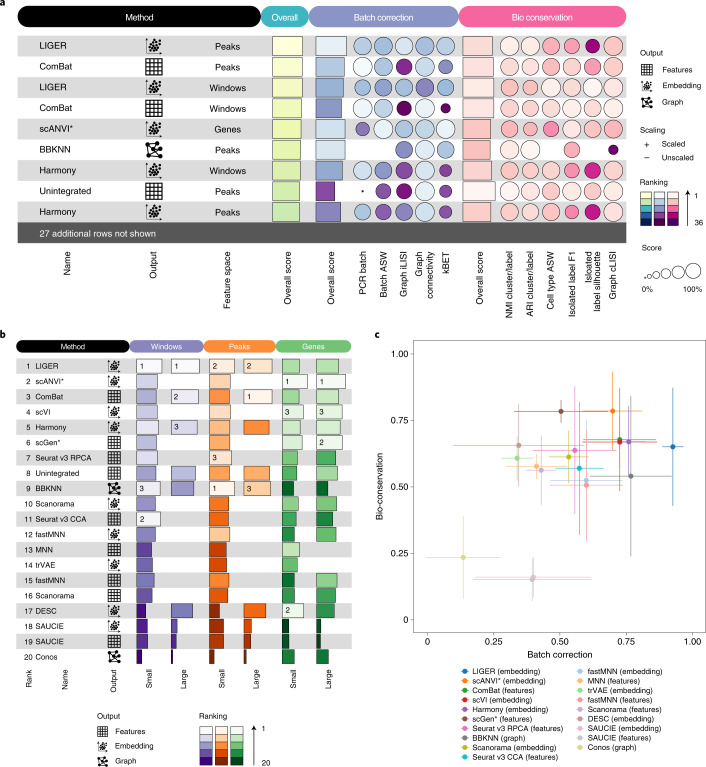
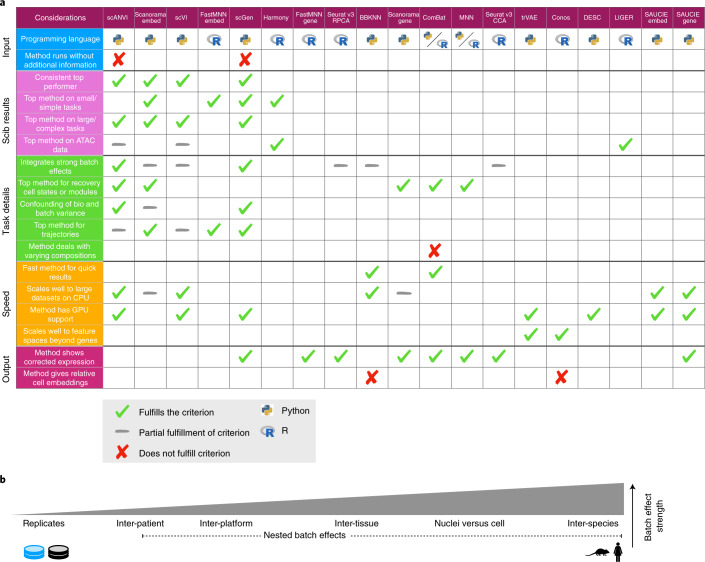
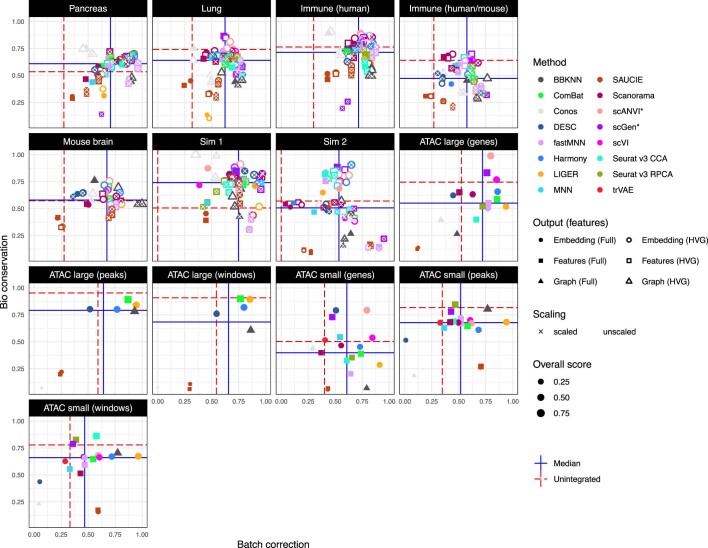
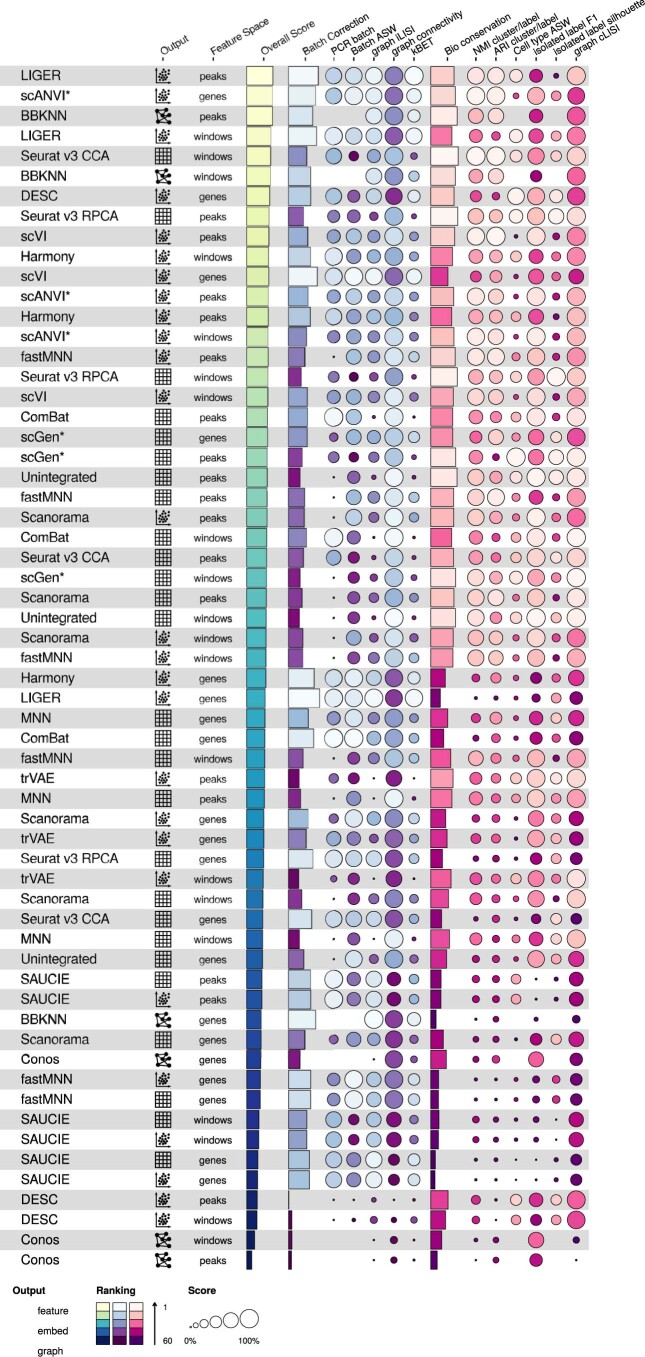
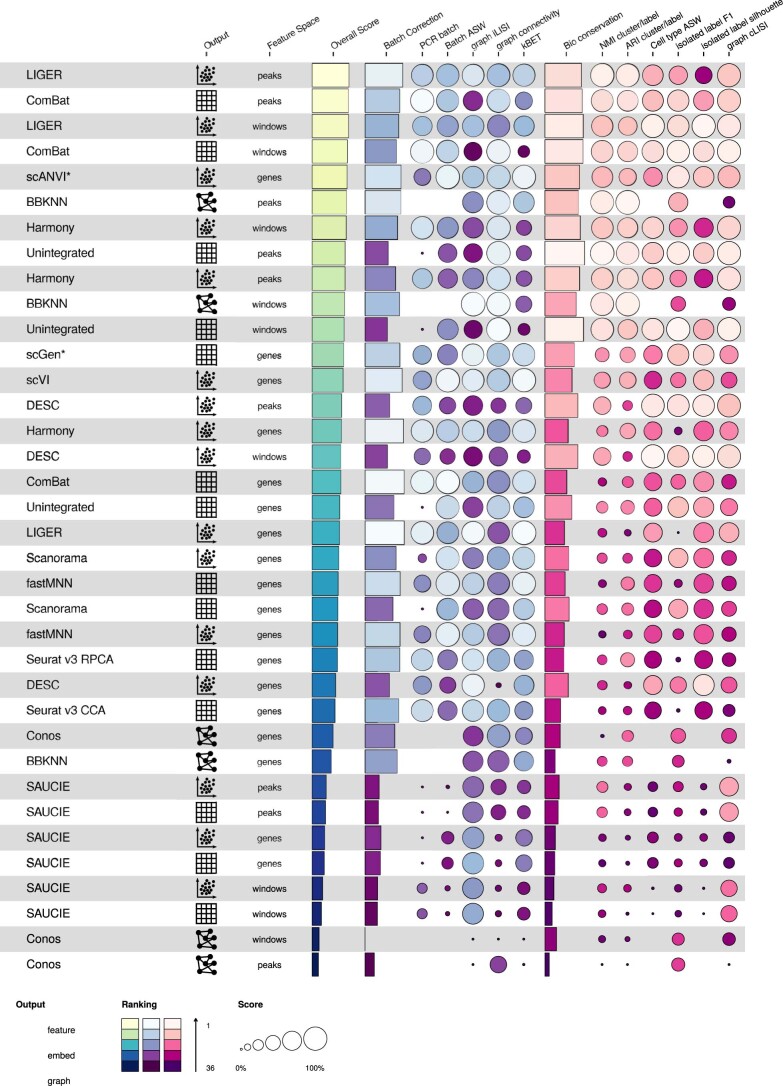
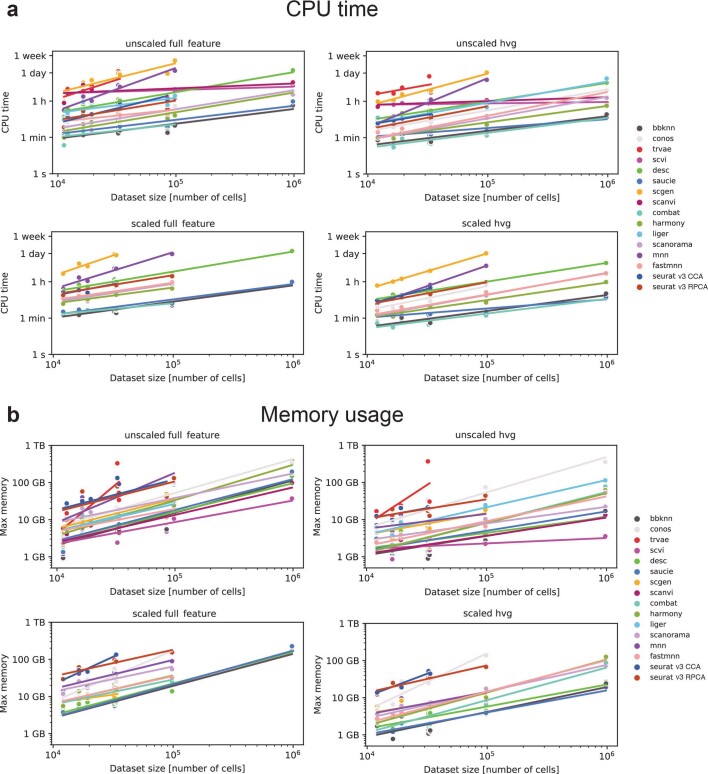
Single-cell atlases often include samples that span locations, laboratories and conditions, leading to complex, nested batch effects in data. Thus, joint analysis of atlas datasets requires reliable data integration. To guide integration method choice, we benchmarked 68 method and preprocessing combinations on 85 batches of gene expression, chromatin accessibility and simulation data from 23 publications, altogether representing >1.2 million cells distributed in 13 atlas-level integration tasks. We evaluated methods according to scalability, usability and their ability to remove batch effects while retaining biological variation using 14 evaluation metrics. We show that highly variable gene selection improves the performance of data integration methods, whereas scaling pushes methods to prioritize batch removal over conservation of biological variation. Overall, scANVI, Scanorama, scVI and scGen perform well, particularly on complex integration tasks, while single-cell ATAC-sequencing integration performance is strongly affected by choice of feature space. Our freely available Python module and benchmarking pipeline can identify optimal data integration methods for new data, benchmark new methods and improve method development.
Overview
The claims and statistics of this paper haven’t been checked yet.
Free: it reads the open-access text and checks the first 5 claims that cite a source we can check. Create a free account to check every claim.
Integrity signals
Registry
Cites
Statistics
Figures
Verification
Claims the paper makes
The claims and statistics of this paper haven’t been checked yet.
Free: it reads the open-access text and checks the first 5 claims that cite a source we can check. Create a free account to check every claim.
Claims other papers make about this one
Each is checked against this paper’s own text: does it say what the citing paper says it does?
The source backs part of the claim, not all of it — or backs it for a different population, condition or comparison.
In the citing paper
“Such integrative analysis is complicated by batch effects and biological differences between primary tissue and cell culture26,27.”
From scPerturb: harmonized single-cell perturbation data (2024) · cites this paper as [27]
Experimental — accuracy not yet measuredThe source backs part of the claim, not all of it — or backs it for a different population, condition or comparison.
In the citing paper
“Furthermore, 8 evaluation metrics (3 for batch effect removal and 5 for biological variation retention) are computed to verify the integration ability by scIB47, which ranks TOSICA the first out of all 13 applicable methods evaluated on combined effectiveness in batch effect removal and biological variation retention (Fig. 5b).”
From Transformer for one stop interpretable cell type annotation (2023) · cites this paper as [47]
Experimental — accuracy not yet measuredThe source backs part of the claim, not all of it — or backs it for a different population, condition or comparison.
In the citing paper
“In particular, Harmony22 is an algorithm well suited for correcting batch effects that may be present in a dimensionality-reduced single-cell expression dataset,79”
From hdWGCNA identifies co-expression networks in high-dimensional transcriptomics data (2023) · cites this paper as [79]
Experimental — accuracy not yet measuredThe cited source says what the claim attributes to it.
In the citing paper
“Although this work simplifies dataset access, joint analysis is limited by the complexity of data integration27.”
From scPerturb: harmonized single-cell perturbation data (2024) · cites this paper as [27]
The cited source says what the claim attributes to it.
In the citing paper
“Depending on the complexity of the integration tasks, such as atlas integration, deep-learning approaches such as scANVI40, scVI41 and scGen42 as well as linear-embedding models such as Scanorama43 performed best”
From Best practices for single-cell analysis across modalities (2023) · cites this paper as [35]
10 more claims about this paper
Create a free account to see every claim other papers make about this one.
Self-check
Percentages, sums and reported differences re-computed from the paper’s own numbers.
The self-check needs the paper’s full text.
Citations
Cites
Scikit-learn: Machine Learning in Python
Pedregosa, F., Varoquaux, G., Gramfort, A., Michel, V., Thirion, B., Grisel, O., Blondel, M., Müller, A., Nothman, J., Louppe, G., et al. (2012) · arXiv · doi:10.48550/arxiv.1201.0490 · Cited by 71,016 · cited 12×
“Similar to NMI, we compared the cell-type labels with the NMI-optimized Louvain clustering computed on the integrated dataset.”
BackgroundInfluentialSciPy 1.0: fundamental algorithms for scientific computing in Python
Virtanen, P., Gommers, R., Oliphant, T. E., Haberland, M., Reddy, T., Cournapeau, D., Burovski, E., Peterson, P., Weckesser, W., Bright, J., et al. (2020) · Nature Methods · doi:10.1038/s41592-019-0686-2 · Cited by 38,430
A note on two problems in connexion with graphs
Dijkstra, E. W. (1959) · Numerische Mathematik · doi:10.1007/bf01386390 · Cited by 29,065
Silhouettes: A graphical aid to the interpretation and validation of cluster analysis
Rousseeuw, P. J. (1987) · Journal of Computational and Applied Mathematics · doi:10.1016/0377-0427(87)90125-7 · Cited by 21,392
Comprehensive Integration of Single-Cell Data
Stuart, T., Butler, A., Hoffman, P., Hafemeister, C., Papalexi, E., Mauck, W. M., Hao, Y., Stoeckius, M., Smibert, P., & Satija, R. (2019) · Cell · doi:10.1016/j.cell.2019.05.031 · Cited by 15,453
ggplot2: Elegant Graphics for Data Analysis
Wickham, H. (2009) · doi:10.1007/978-0-387-98141-3 · Cited by 14,447
Fast, sensitive and accurate integration of single-cell data with Harmony
Korsunsky, I., Millard, N., Fan, J., Slowikowski, K., Zhang, F., Wei, K., Baglaenko, Y., Brenner, M., Loh, P.-R., & Raychaudhuri, S. (2019) · Nature Methods · doi:10.1038/s41592-019-0619-0 · Cited by 10,488
SciPy 1.0: fundamental algorithms for scientific computing in Python
Virtanen, P., Gommers, R., Oliphant, T. E., Haberland, M., Reddy, T., Cournapeau, D., Burovski, E., Peterson, P., Weckesser, W., Bright, J., et al. (2019) · Apollo - University of Cambridge Repository · doi:10.17863/cam.64134 · Cited by 10,460
UMAP: Uniform Manifold Approximation and Projection
McInnes, L., Healy, J., Saul, N., & Großberger, L. (2018) · Journal of Open Source Software · doi:10.21105/joss.00861 · Cited by 9,826
SCANPY: large-scale single-cell gene expression data analysis
Wolf, F. A., Angerer, P., & Theis, F. J. (2018) · Genome Biology · doi:10.1186/s13059-017-1382-0 · Cited by 8,881 · cited 1×
“Metrics were run on the integrated and unintegrated AnnData 47 objects.”
MethodSelf-citation
Cited by
Items 701–800 of 1,008
A deep single cell mass cytometry approach to capture canonical and noncanonical cell cycle states
Amouzgar, M., Favaro, P. M. B., Ho, D., Bruce, T., & Bendall, S. C. (2025) · Nature Communications · doi:10.1038/s41467-025-63883-4 · Cited by 6
“Single-cell data integration methods like Harmony are often used to correct batch or biological confounders, yet these approaches come at a tradeoff between batch removal and bio-conservation 36,37 .”
Ngassam, B. T., Niu, H., Pang, S., Shydlouskaya, V., & Andrews, T. S. (2026) · Frontiers in Bioinformatics · doi:10.3389/fbinf.2025.1715821 · Cited by 5
Xue, B., Liu, Y., Zhou, C., Dossybayev, K., Baatar, N., Yudin, N. S., Zhang, L., Yang, J., MengHua, L. I., & Xu, S. (2026) · Journal of Animal Science and Biotechnology/Journal of animal science and biotechnology · doi:10.1186/s40104-026-01383-1 · Cited by 6
“To identify the optimal integration method for our datasets, we benchmarked three widely used methods including CCA, Reciprocal principal component analysis (RPCA), and Harmony using scIB (v.1.1.7) [26].”
InfluentialMcLean, A. K., Reynolds, G., & Pratt, A. G. (2024) · Biomedicines · doi:10.3390/biomedicines12061297 · Cited by 4
“…of a k-nearest neighbourhood of a cell and the expected (global) label composition [42] Graph connectivity Cell type Determines how well the kNN graph of the integrated data connects cells of the same label [27] ASW batch Cell Relationship between within-batch and between batch distances of a cell.”
BackgroundMethodInfluentialHyperCell: Advancing Cell Type Classification with Hyperdimensional Computing
Mohammadi, H., Baranpouyan, M., Thirunarayan, K., & Chen, L. (2024) · Annual International Conference of the IEEE Engineering in Medicine and Biology Society (EMBC) · doi:10.1109/embc53108.2024.10782122 · Cited by 4
Machine learning predictions surpass individual mRNAs as a proxy of single-cell protein expression
Fisher, J., Wood, O., Bullers, S. J., Murray, L., Li, L., & Jackson, M. A. (2026) · Genome biology · doi:10.1186/s13059-026-04083-1 · Cited by 4
“We measured usability with an adapted version of a framework previously applied to benchmark methods for single-cell integration and pseudotime trajectory inference [34, 35].”
CellMemory: hierarchical interpretation of out-of-distribution cells using bottlenecked transformer
Wang, Q., Zhu, H., Hu, Y., Chen, Y., Wang, Y., Li, G., Li, Y., Chen, J., Zhang, X., Zou, J., et al. (2025) · Genome biology · doi:10.1186/s13059-025-03638-y · Cited by 8
“In benchmark integration tasks, aside from scGPT and scPoli, all other integration meth-ods were performed using scIB [37]. scIB is an integration tool that consolidates many advanced integration methods and incorporates a comprehensive set of evaluation metrics.”
A single-cell atlas of the murine limb skeleton integrating the developmental and adult stages
Herpelinck, T., Ory, L., Verbraeken, T., Nasello, G., Barzegari, M., Bolander, J., Luyten, F. P., Tylżanowski, P., & Geris, L. (2025) · Scientific Reports · doi:10.1038/s41598-025-05277-6 · Cited by 18
“Next, we selected four top-performing methods from the benchmarking study by Luecken et al. to determine the most suitable integration approach for our data 24 .”
InfluentialTriple-effect correction for Cell Painting data with contrastive and domain-adversarial learning
Yan, C., Zhang, Y., Feng, J., Hua, H., Ruan, Z., Li, Z., Li, S., Yan, C., Li, P., Liu, J., et al. (2025) · Nature Communications · doi:10.1038/s41467-025-62193-z · Cited by 12
“Metrics such as average silhouette width (ASW) 29 , technic average silhouette width (tASW) 30 and graph connectivity 30 are used to measure the model ’ s ability to remove technical effects, while perturbation average silhouette width (pASW) 30 , normalized mutual information (NMI) 30 , phenotypic…”
InfluentialWang, Y., Teng, P., Wu, Z., Zhang, Y., Shen, Z., Zhang, Q., & Huang, D.-S. (2025) · Briefings in Bioinformatics · doi:10.1093/bib/bbaf378 · Cited by 4
“…complementary metrics that assess both clustering accuracy and batch effect removal capabilities: Normalized Mutual Information (NMI [27]) and Adjusted Rand Index (ARI [28]) for clustering accuracy, and modified average silhouette width of batch (batch-ASW [29]) for batch effect assessment.”
Harmony-based data integration for distributed single-cell multi-omics data
Yuan, R., Rong, Z., Hu, H., Liu, T., Tao, S., Chen, W., & Tang, L. (2025) · PLoS Computational Biology · doi:10.1371/journal.pcbi.1013526 · Cited by 5
“In addition, Harmony has also been proven as one of the best performing and most commonly used data integration methods in single-cell data analysis [22,23].”
Towards a reference cell atlas of liver diversity over the human lifespan
Taylor, S. A., Bader, G. D., MacParland, S. A., Mullen, A. C., Andrews, T. S., Cuenca, A. G., DasGupta, R., Gehring, A. J., Grün, D., Guilliams, M., et al. (2025) · Nature Reviews Gastroenterology & Hepatology · doi:10.1038/s41575-025-01114-3 · Cited by 5
“Computational integration of single-cell datasets remains a challenge despite the large number of algorithms available 89 .”
Li, C., Gu, Y., Virgilio, M., Lee, K. H., Collins, K. L., & Welch, J. D. (2025) · Nature Communications · doi:10.1038/s41467-025-66287-6 · Cited by 9
“Velocity vectors are computed from batch-corrected expression values after training, and the cosine similarity of cell-to-cell transition 5 in this case is given by We used metrics provided in scIB 19 to benchmark with other methods.”
Interpretable data integration for single-cell and spatial multi-omics
Yang, C., He, Z., Nie, Q. H., & Zhang, L. (2026) · Cell Systems · doi:10.1016/j.cels.2025.101479 · Cited by 5
Multi-species integration, alignment and annotation of single-cell RNA-seq data with CAMEX
Guo, Z.-H., Huang, D.-S., & Zhang, S. (2026) · Nature Communications · doi:10.1038/s41467-026-69696-3 · Cited by 9
Multimodal spatial omics: From data acquisition to computational integration
Işık, E. B., Usta, Y. H., Riazi, M., Liu, H., Roach, W., Zhou, H., Nicolaou, A., Rattray, M., & Georgaka, S. (2026) · Patterns · doi:10.1016/j.patter.2026.101592 · Cited by 8
Evaluation of Motion Planning Algorithms for Underground Mobile Robots
Zhu, D., Zhang, Y., Wang, J., Ren, K., & Yang, K. (2022) · Communications in computer and information science · doi:10.1007/978-981-19-8915-5_32 · Cited by 4
MASI enables fast model-free standardization and integration of single-cell transcriptomics data
Xu, Y., Kramann, R., McCord, R. P., & Hayat, S. (2023) · Communications Biology · doi:10.1038/s42003-023-04820-3 · Cited by 5
“This is similar to the weighted averaging in the benchmark study by Luecken et al. 79 .”
MSdb: An integrated expression atlas of human musculoskeletal system
Tian, R., Xue, Z., Ruan, D., Chen, P., Xu, Y., Dai, C., Shen, W., Ouyang, H., Liu, W., & Lin, J. (2023) · iScience · doi:10.1016/j.isci.2023.106933 · Cited by 5
“In line with a recent study, our analysis demonstrated that the scVAE method produced better integration and cell clustering results while using Harmony for data integration led to the inter-sample heterogeneity being skewed by over-integration (Figures 2 and S8), indicating the advantages of variational autoencoder-b…”
ResultA Commentary on Multi-omics Data Integration in Systems Vaccinology
Shannon, C. P., Lee, A. H., Tebbutt, S. J., & Singh, A. (2024) · Journal of Molecular Biology · doi:10.1016/j.jmb.2024.168522 · Cited by 4
Fang, C., Selega, A., & Campbell, K. R. (2024) · Genome biology · doi:10.1186/s13059-024-03304-9 · Cited by 7
“While the optimization of such metrics has previously been successfully used to benchmark single-cell pipelines [23], they are surrogate objectives that do not necessarily favor pipelines that return more meaningful cellular populations.”
BackgroundTarDis: Achieving robust and structured disentanglement of multiple covariates
İnecik, K., Kara, A., Rose, A., Haniffa, M. A., & Theis, F. J. (2026) · Cell Systems · doi:10.1016/j.cels.2026.101573 · Cited by 8
Self-citationscParser: sparse representation learning for scalable single-cell RNA sequencing data analysis
Zhao, K., So, H., & Lin, Z. (2024) · Genome biology · doi:10.1186/s13059-024-03345-0 · Cited by 6
“Hence, for each evaluation metric above, we followed the idea from the previous study [84] to calculate the averaged ranking for each method across the five datasets as its overall performance (Additional file 1: section S3).”
MethodWang, L.-X., Zhao, Z.-M., Shu, K., & Ma, M.-Y. (2024) · International Journal of Molecular Sciences · doi:10.3390/ijms26010118 · Cited by 5
“But, in the integrated use of scRNA-seq data and RNA-seq data, problems such as differences in data sources, batch effects, and technical bias are often encountered [33,34].”
Unified Integration of Spatial Transcriptomics Across Platforms
Haber, E., Deshpande, A., Ma, J., & Krieger, S. (2025) · Genome Research · doi:10.1007/978-3-031-90252-9_42 · Cited by 10
Zhao, J., Zhang, X., Wang, G., Lin, Y., Liu, T., Chang, R. B., & Zhao, H. (2026) · Nature Genetics · doi:10.1038/s41588-026-02579-x · Cited by 10
“This difficulty is further amplified when certain datasets contain unique, biologically meaningful spatial factors 38 .”
Binned multinomial logistic regression for integrative cell-type annotation
Motwani, K., Bacher, R. L., & Molstad, A. J. (2023) · The Annals of Applied Statistics · doi:10.1214/23-aoas1769 · Cited by 4
Piochi, L. F., Gaspar, A. T., Rosário‐Ferreira, N., Preto, A. J., & Moreira, I. S. (2022) · Advances in protein chemistry and structural biology · doi:10.1016/bs.apcsb.2022.05.006 · Cited by 3
Scalable Batch-Correction Method for Integrating Large-Scale Single-Cell Transcriptomes
Shen, X., Shen, H., Wu, D., Feng, M., Hu, J., Liu, J., Yang, Y., Yang, M., Li, Y., Shi, L., et al. (2022) · Briefings in Bioinformatics · doi:10.1093/bib/bbac327 · Cited by 4
Evaluation of Computational Methods for Single Cell Multi-Omics Integration
Wani, S. A., & Quadri, S. M. K. (2023) · Procedia Computer Science · doi:10.1016/j.procs.2023.01.246 · Cited by 5
Analyzing genomic and epigenetic profiles in single cells by hybrid transposase (scGET-seq)
Cittaro, D., Lazarević, D., Tonon, G., & Giannese, F. (2023) · STAR Protocols · doi:10.1016/j.xpro.2023.102176 · Cited by 5
Cao, Y., Ghazanfar, S., Yang, P., & Yang, J. Y. H. (2023) · Briefings in Bioinformatics · doi:10.1093/bib/bbad159 · Cited by 4
“With the extensive, and potentially prohibitive, computational resources required for such cell-level integration [20], such gain in model accuracy may not be worth the trade-off in computational resources.”
BackgroundZhang, B., Wu, H., Wang, Y., Xuan, C., & Gao, J. (2023) · IEEE Journal of Biomedical and Health Informatics · doi:10.1109/jbhi.2023.3311340 · Cited by 4
SuperCellCyto: enabling efficient analysis of large scale cytometry datasets
Putri, G., Howitt, G., Marsh‐Wakefield, F., Ashhurst, T. M., & Phipson, B. (2024) · Genome biology · doi:10.1186/s13059-024-03229-3 · Cited by 6
“We used scib’s implementation [44] of ASW_label which scales its values to between 0 (worst) and 1 (best).”
MethodPredicting the Key Regulators of Cell Identity in Human Adult PancreasPreprint
Vanheer, L., Fantuzzi, F., To, S.-K., Schiavo, A., Haele, M. V., Haesen, T., Yi, X., Janiszewski, A., Chappell, J., Rihoux, A., et al. (2020) · bioRxiv · doi:10.1101/2020.09.23.310094 · Cited by 2
“The development of integration methods provides an opportunity to analyze multiple scRNA-seq studies from multiple laboratories and patients (Butler et al. 2018; Luecken et al., 2022).”
BackgroundReshef, Y., Rumker, L., Kang, J. B., Nathan, A., Korsunsky, I., Asgari, S., Murray, M. B., Moody, D. B., & Raychaudhuri, S. (2021) · bioRxiv (Cold Spring Harbor Laboratory) · doi:10.1101/2021.04.19.440534 · Cited by 4
“To assess whether NAM-PCs can detect nuanced transcriptional shifts that span a broad range of cell types, we re-computed NAM-PCs for this dataset without the upstream batch correction from the published analysis, which has the potential to eliminate subtle biologic variation[17, 18].”
MethodSonrel, A., Luetge, A., Soneson, C., Mallona, I., Germain, P., Knyazev, S., Gilis, J., Gerber, R., Seurinck, R., Paul, D., et al. (2022) · bioRxiv (Cold Spring Harbor Laboratory) · doi:10.1101/2022.09.22.508982 · Cited by 4
scARE: Attribution Regularization for Single Cell Representation LearningPreprint
İnecik, K., & Theis, F. J. (2023) · bioRxiv (Cold Spring Harbor Laboratory) · doi:10.1101/2023.07.05.547784 · Cited by 4
Self-citationuniHEART: An Ensemble Atlas of Cardiac Cells Provides Multifaceted Portraits of the Human HeartPreprint
Zhang, X., Chen, Y., Hua, K., Xu, S. J., You, R., Hao, M., Li, W., Wei, L., Jia, J., Xi, X., et al. (2023) · Research Square · doi:10.21203/rs.3.rs-3215038/v1 · Cited by 4
Consensus prediction of cell type labels with popVPreprint
Ergen, C., Xing, G. K., Xu, C. A., Jayasuriya, M., McGeever, A., Pisco, A. O., Streets, A., & Yosef, N. (2023) · bioRxiv (Cold Spring Harbor Laboratory) · doi:10.1101/2023.08.18.553912 · Cited by 4
SIMVI reveals intrinsic and spatial-induced states in spatial omics dataPreprint
Dong, M., Su, D. G., Kluger, H. M., Fan, R., & Kluger, Y. (2023) · bioRxiv (Cold Spring Harbor Laboratory) · doi:10.1101/2023.08.28.554970 · Cited by 4
“All the metrics were implemented by the scib-metrics Python package [73].”
Xu, Z., Liu, F., Ding, Y., Pan, T., Wu, Y.-H., Liu, J., Bado, I., Zhang, W., Wu, L., Gao, Y., et al. (2024) · SSRN Electronic Journal · doi:10.2139/ssrn.4846389 · Cited by 4
Multi-task benchmarking of single-cell multimodal omics integration methodsPreprint
Liu, C., Ding, S., Kim, H. J., Long, S., Xiao, D., Ghazanfar, S., & Yang, P. (2024) · bioRxiv (Cold Spring Harbor Laboratory) · doi:10.1101/2024.09.15.613149 · Cited by 4
Hierarchical Interpretation of Out-of-Distribution Cells Using Bottlenecked TransformerPreprint
Wang, Q., Zhu, H., Hu, Y., Chen, Y., Wang, Y., Zhang, X., Zou, J., Kellis, M., Li, Y., Liu, D., et al. (2024) · bioRxiv (Cold Spring Harbor Laboratory) · doi:10.1101/2024.12.17.628533 · Cited by 4
Multi-Modal Disentanglement of Spatial Transcriptomics and Histopathology ImagingPreprint
Maan, H., Ji, Z., Sicheri, E., Tan, T. J., Selega, A., Gonzalez, R., Krishnan, R. G., Wang, B., & Campbell, K. R. (2025) · bioRxiv (Cold Spring Harbor Laboratory) · doi:10.1101/2025.02.19.638201 · Cited by 7
“We used the the scib-metrics package for benchmarking batch correction (Luecken et al., 2022).”
InfluentialMateos, M. A., Adiconis, X., Li, J.-K., Marchese, D., Caratù, G., Hon, C.-C., Tiwari, P., Kojima, M., Vieth, B., Murphy, M. A., et al. (2025) · bioRxiv (Cold Spring Harbor Laboratory) · doi:10.1101/2025.03.06.637075 · Cited by 4
Megas, S., Amani, A., Rose, A., Dufva, O., Shamsaie, K., Asadollahzadeh, H., Polański, K., Haniffa, M. A., Teichmann, S. A., & Lotfollahi, M. (2025) · bioRxiv (Cold Spring Harbor Laboratory) · doi:10.1101/2025.06.03.657578 · Cited by 5
CytoVI: Deep generative modeling of antibody-based single cell technologiesPreprint
Ingelfinger, F., Levy, N., Ergen, C., Bakulin, A., Becker, A., Boyeau, P., Kim, M., Ditz, D., Dirks, J., Maaskola, J., et al. (2025) · bioRxiv (Cold Spring Harbor Laboratory) · doi:10.1101/2025.09.07.674699 · Cited by 4
Nephrobase Cell+: Multimodal Single-Cell Foundation Model for Decoding Kidney BiologyPreprint
Li, C., Ziyadeh, E. M., Sharma, Y., Dumoulin, B., Levinsohn, J. L., Ha, E., Pan, S., Rao, V., Subramaniyam, M., Szegedy, M., et al. (2025) · bioRxiv (Cold Spring Harbor Laboratory) · doi:10.1101/2025.09.30.679471 · Cited by 8
“These qualitative observations are supported by quantitative clustering metrics 19 : In human data, both Nephrobase Cell+ variants achieved the highest cell-type isolation scores: KMeans ARI is 0.82 for the 1B model (versus 0.40 for scGPT, 0.55 for autoencoder, and only 0.22 for Geneformer), and…”
InfluentialIntegrated cell atlas and tumoroids chart pancreatic cancer therapeutic targetsPreprint
Xu, Q., Okuda, R., Gjeta, B., Harmel, C., Signer, M., Lucioli, M., Santel, M., Seimiya, M., Esposito, C., Guja-Jarosz, K., et al. (2025) · bioRxiv (Cold Spring Harbor Laboratory) · doi:10.1101/2025.09.30.679518 · Cited by 4
Bocchi, V. D., To, K., Weber, L., Zumbo, P., Kim, L., Shida, I. Y., Yang, D., Storm, P., Fiorenzano, A., Sozzi, E., et al. (2026) · bioRxiv (Cold Spring Harbor Laboratory) · doi:10.64898/2026.06.19.733041 · Cited by 5
Xie, Y., Yang, J., Ouyang, J. F., & Petretto, E. G. (2024) · Briefings in Bioinformatics · doi:10.1093/bib/bbae482 · Cited by 6
“Among the various methods capable of producing corrected GEX as shown in recent benchmarking studies [60, 61], Seurat3 CCA and Seurat3 RPCA are the only two methods that can correct the testing data without modifying the training data.”
SCEMENT: scalable and memory efficient integration of large-scale single-cell RNA-sequencing data
Chockalingam, S. P., Aluru, M. R., & Aluru, S. (2025) · Bioinformatics · doi:10.1093/bioinformatics/btaf057 · Cited by 3
“…al. 2018, Korsunsky et al. 2019), (iii) use only a representative subset of datasets/genes (such as a reference dataset or a few highly variable genes) (Dhapola et al. 2022, Hao et al. 2024), and (iv) use unscaled data instead of scaled data to avoid generating a dense matrix (Luecken et al. 2022).”
InfluentialRamirez, A., Orcutt-Jahns, B. T., Pascoe, S., Abraham, A. A., Remigio, B., Thomas, N., & Meyer, A. S. (2025) · Cell Systems · doi:10.1016/j.cels.2025.101294 · Cited by 5
Discovering DISCO: application value of a large-scale repository for diverse single-cell omics data
Tao, W., Li, H., Zhang, J., Yin, Y., Fu, X., Chen, Y., Wang, Y., Zhou, Y., Gao, Z., Luo, H., et al. (2025) · Advanced technology in neuroscience . · doi:10.4103/atn.atn-d-24-00035 · Cited by 4
Arts, J. A., Fallo, S., Florencio, M. S., Smits, J. G. A., Cunha, D. L., Roubroeks, J. A. Y., Dickman, M. M., LaPointe, V. L. S., Yu, R., & Zhou, H. (2025) · PNAS Nexus · doi:10.1093/pnasnexus/pgaf235 · Cited by 5
GNODEVAE: a graph-based ODE-VAE enhances clustering for single-cell data
Fu, Z., Chen, C., Wang, S., Wang, J., & Chen, S. (2025) · BMC Genomics · doi:10.1186/s12864-025-11946-7 · Cited by 3
“We report a scaled score where 1 represents perfect mixing and 0 represents no mixing [51].”
Xiao, M., Zhang, W., Huang, X., Zhu, H., Wu, M., Li, X., & Zhou, Y. (2025) · IEEE Transactions on Computational Biology and Bioinformatics · doi:10.1109/tcbbio.2025.3609721 · Cited by 10
SC-framework: A robust and FAIR semi-interactive environment for single-cell resolution datasets
Schultheis, H., Detleffsen, J., Wiegandt, R., Bentsen, M. S., Alayoubi, Y., Valente, G. T., Keßler, M. F., Bruns, B., Mirza, D., Usanayo, A., et al. (2026) · iScience · doi:10.1016/j.isci.2026.116631 · Cited by 5
“As such, workflows 54,55 were developed to ensure selection of the optimal batch correction tool for an individual dataset by assessing correction performance.”
scGeneBank: cross-species screening of functional gene sets at single-cell resolution
Qin, S., Yang, Y., Peng, L., Xu, L., Deng, Y., Wang, H., Qiu, X., He, Y., Wang, X., Ma, Y., et al. (2025) · Nucleic Acids Research · doi:10.1093/nar/gkaf1137 · Cited by 4
Revealing the Best Strategies for Rare Cell Type Detection in Multi-Sample Single-Cell Datasets
Ye, Z., Yan, Y., Yu, Y., & Wu, H. S. (2025) · Genes · doi:10.3390/genes17010031 · Cited by 4
“For multi-sample scRNA-seq data, if a cell type is flagged as “rare” but appears in only a very small number of subjects, then it is reasonable to suspect that such a cell population may reflect technical artifacts or sample-specific events [25,26].”
Mathieu, R., Draia-Nicolau, T., Corbières, L., Govindan, A. D., Bensa, V., Pallesi‐Pocachard, E., Silvagnoli, L., Represa, A., Cardoso, C., Telley, L., et al. (2026) · Nature Communications · doi:10.1038/s41467-025-68059-8 · Cited by 6
Gindra, R. H., Palla, G., Nguyen, M., Wagner, S., Tran, M., Theis, F. J., Saur, D., Crawford, L., & Peng, T. (2025) · 2025 IEEE/CVF International Conference on Computer Vision Workshops (ICCVW) · doi:10.1109/iccvw69036.2025.00128 · Cited by 14
“8.3, leveraging the Silhouette Batch score from scib [31].”
InfluentialSelf-citationKim, J., Kim, N., Cha, J. H., Ma, J., & Lee, I. (2026) · Nature Communications · doi:10.1038/s41467-026-71521-w · Cited by 4
“To rank the binning tools, we constructed a benchmark summary fi g-ure that aggregates key performance metrics across various datasets using a heatmap visualization 41 .”
Benchmarking plant single cell RNA-sequencing sample processing strategies
Eekhout, T., Veirman, L. D., Block, J. D., Persyn, F., Goossens, V., Audenaert, D., Isterdael, G. V., Rybel, B. D., & Seyfferth, C. (2026) · The EMBO Journal · doi:10.1038/s44318-026-00800-5 · Cited by 4
Integrated Single-Cell Atlas Reveals Cross-Subtype Heterogeneity in Human Pulmonary Hypertension
Feng, H., Lai, J., Yang, X., Cui, X., Mo, S., Feng, Y., Chen, Q., Zhong, B., Lu, W., Chen, Y., et al. (2026) · Arteriosclerosis Thrombosis and Vascular Biology · doi:10.1161/atvbaha.126.324594 · Cited by 6
Interpretable modality-aware mapping of gene regulation in single-cell multiomics with scMAGCA
Wang, Y., Zhou, Liu, W., Zhang, P., Cheng, Y., Su, Y., Wang, F., Wong, K., & Li, X. (2026) · Nature Communications · doi:10.1038/s41467-026-73055-7 · Cited by 6
“…conservation metrics: Isolated labels score 94 , KMeans NMI, KMeans ARI, Silhouette label, and Conditional Local Inverse Simpson ’ s Index (cLISI) 95 , batch correction metrics: Sil-houette batch, Inverse Simpson ’ s Index of Integration (iLISI) 95 , KBET score 51 , and Graph connectivity (GC) 37 .”
Dissecting epigenetic heterogeneity in single-cell DNA methylomes with a unified framework
Tang, S., Li, S., Zhang, G., Lyu, A., Li, H., & Chen, S. (2026) · Nature Communications · doi:10.1038/s41467-026-73171-4 · Cited by 5
“For batch integration performance evaluation, following previous work 29 , we used batch correction metrics and biological conservation metrics to evaluate batch integration performance.”
An integrated cell atlas of 2.4 million cardiac cells across 209 individuals in health and disease
Datar, Y., Chaffin, M. D., Simonson, B., Mandia, A., & Ellinor, P. T. (2026) · Nature Cardiovascular Research · doi:10.1038/s44161-026-00831-5 · Cited by 9
“We limited our study to include only nuclei to avoid transcriptomic differences that exist between cell and nuclei-level data 17 .”
InfluentialSpatial atlas of the human brain vasculature reveals specialized cell ensembles
Wang, J. C., Sanchez, D., Arul, S., Gülsuyu, B., Gopinadhan, A., Mukhtar, T., Kim, J., Andrews, J. P., Williams, M. A. C., Jung, Y., et al. (2026) · Cell · doi:10.1016/j.cell.2026.07.007 · Cited by 4
Linville, R. M., James, B. T., Galani, K., Ho, L., Shin, J. H., Oliver, E., Fass, S. B., Cameron, J. C., Fitzwalter, B. E., Bock, R., et al. (2026) · Cell · doi:10.1016/j.cell.2026.08.006 · Cited by 5
scBaseCount: An AI agent-curated, standardized, auto-updated single-cell data repository
Youngblut, N. D., Carpenter, C., Nayebnazar, A., Adduri, A., Shah, R., Ricci-Tam, C., Prashar, J., Ilango, R., Teyssier, N., Konermann, S., et al. (2026) · Cell · doi:10.1016/j.cell.2026.08.025 · Cited by 56
Integration of spatial and single-cell data across modalities with weakly linked features
Chen, S., Zhu, B., Huang, S., Hickey, J. W., Lin, K., Snyder, M. P., Greenleaf, W. J., Nolan, G. P., Zhang, N. R., & Ma, Z. (2023) · Nature Biotechnology · doi:10.1038/s41587-023-01943-0 · Cited by 137
Dex-Benchmark: datasets and code to evaluate algorithms for transcriptomics data analysis
Xie, Z., Chen, C. C., & Ma’ayan, A. (2023) · PeerJ · doi:10.7717/peerj.16351 · Cited by 3
Gene-Level Representation Learning via Interventional Style Transfer in Optical Pooled Screening
Bigverdi, M., Höckendorf, B., Yao, H., Hanslovsky, P., Lopez, R., & Richmond, D. (2024) · IEEE/CVF Conference on Computer Vision and Pattern Recognition Workshops (CVPRW) · doi:10.1109/cvprw63382.2024.00790 · Cited by 4
“The second set of metrics are based on clustering and draw inspiration from [27, 37].”
Han, L., Ji, Y., Yu, Y., Ni, Y., Zeng, H., Zhang, X., Liu, H., & Zhang, Y. (2024) · PLoS Genetics · doi:10.1371/journal.pgen.1011319 · Cited by 4
Mapping the gene space at single-cell resolution with gene signal pattern analysis
Venkat, A., Leone, S., Youlten, S. E., Fagerberg, E., Attanasio, J., Joshi, N. S., Perlmutter, M., & Krishnaswamy, S. (2024) · Nature Computational Science · doi:10.1038/s43588-024-00734-0 · Cited by 8
ORDNA : Deep‐learning‐based ordination for raw environmental DNA samples
Sanchez, T., Stalder, S., Lamperti, L., Brosse, S., Frossard, A., Leugger, F., Rozanski, R., Zong, S., Manel, S., Medici, L., et al. (2025) · Methods in Ecology and Evolution · doi:10.1111/2041-210x.70033 · Cited by 4
Zhang, Z., Wang, H., Xu, Z.-X., Luan, W.-Y., Lin, S.-X., & Miao, Y. (2025) · World Journal of Gastrointestinal Oncology · doi:10.4251/wjgo.v17.i6.107382 · Cited by 3
“Secondly, fragmentation of the analytical process and manual parameter dependency fluctuate false-negative rates for key biomarkers by more than 30%, threatening the reliability of clinical decision-making[183].”
Pratama, R., Hilton, J. A., Cherry, J. M., & Song, G. (2025) · Bioinformatics · doi:10.1093/bioinformatics/btaf350 · Cited by 4
“1.2.5 Isolated label scores SCIB benchmark tools (Luecken et al. , 2022) determine the isolated cell labels as the labels present in the least number of batches in the integration.”
InfluentialA perspective on developing foundation models for analyzing spatial transcriptomic data
Liu, T., Hao, M., Liu, X., & Zhao, H. (2025) · Quantitative Biology · doi:10.1002/qub2.70010 · Cited by 4
“In the spatial niche clustering task, FM could generate embeddings for niches and improve the adjusted mutual information (AMI) score or PERSPECTIVES IN SPATIAL TRANSCRIPTOMIC FOUNDATION MODEL - 3 of 6 average silhouette width (ASW) [43].”
Lee, C., Yu, Z., Kuo, C. J., Tejwani, L., Grijalva, R. M., Bae, E., Zhao, H. T., Lim, J., & Lieberman, A. P. (2025) · Journal of Clinical Investigation · doi:10.1172/jci182955 · Cited by 6
Yuan, J., Yu, J., Yi, Q., Ye, Z., Peng, X., & Liu, W. (2025) · Journal of Translational Medicine · doi:10.1186/s12967-025-07245-0 · Cited by 6
“The values ranked first and second are marked with solid and dashed boxes, respectively mixing [39, 40].”
Decoding cell fate: integrated experimental and computational analysis at the single-cell level
Zhou, Y., Hou, S., Miao, X., Zhang, G., Li, Z., Zhang, D., Lin, Y., & Lin, Y. (2025) · Bioinformatics · doi:10.1093/bioinformatics/btaf603 · Cited by 4
“…modality, biological interpretation is complicated by batch effects (i.e. from different samples, labs, platforms), and benchmark studies have shown a trade-off between removing batch effects and preserving true biological variation (Korsunsky et al. 2019, Tran et al. 2020, Luecken et al. 2022).”
Beta cell-derived cholecystokinin drives obesity-associated pancreatic adenocarcinoma development
Garcia, C. C., Venkat, A., McQuaid, D. C., Agabiti, S. S., Tong, A., Mathew, B., CARDONE, R. L., Starble, R. M., Ruiz, C. F., Zheng, C., et al. (2026) · Nature Communications · doi:10.1038/s41467-026-69821-2 · Cited by 5
“First, we computed the modi fi ed average silhouette width (ASW) of the batch, as previously implemented 115 .”
Kupczyk, E., Schorpp, K., Hadian, K., Lin, S., Tziotis, D., Schmitt‐Kopplin, P., & Mueller, C. (2022) · Computational and Structural Biotechnology Journal · doi:10.1016/j.csbj.2022.09.023 · Cited by 5
“For biological data, batch problems are common [60].”
BackgroundSingle-Cell Analysis to Better Understand the Mechanisms Involved in MS
Dugast, E., Shah, S. P., & Laplaud, D. A. (2022) · International Journal of Molecular Sciences · doi:10.3390/ijms232012142 · Cited by 4
“It can be difficult to choose the right tool or integration method, as many are very recent and the standards evolve quickly [54].”
BackgroundXu, X., & Li, X. (2023) · Briefings in Bioinformatics · doi:10.1093/bib/bbac608 · Cited by 3
Transmorph: a unifying computational framework for modular single-cell RNA-seq data integration
Fouché, A., Chadoutaud, L., Delattre, O., & Zinovyev, A. Y. (2023) · NAR Genomics and Bioinformatics · doi:10.1093/nargab/lqad069 · Cited by 3
Braband, K. L., Nedwed, A. S., Helbich, S. S., Simon, M., Beumer, N., Brors, B., Marini, F., & Delacher, M. (2023) · Frontiers in Immunology · doi:10.3389/fimmu.2023.1232511 · Cited by 3
Single-cell genomics-based immune and disease monitoring in blood malignancies
Rathgeber, A. C., Ludwig, L. S., & Penter, L. (2024) · Clinical Hematology International · doi:10.46989/001c.117961 · Cited by 5
Palit, S., Shrestha, A. K., Thapa, S., Grimm, S. L., Coarfa, C., Theis, F., Simon, L. M., & Shivanna, B. (2024) · Genes · doi:10.3390/genes15060806 · Cited by 3
“…cellular heterogeneity at single-cell resolution, identify rare cell populations, and elucidate gene expression dynamics at an extremely high level of detail, thus laying the groundwork for developing novel therapeutic strategies and personalized medicine approaches in respiratory diseases [98].”
BackgroundSelf-citationLyu, Y., Lin, S. H., Wu, H., & Li, Z. (2024) · Bioinformatics · doi:10.1093/bioinformatics/btae537 · Cited by 3
“As shown in a comprehensive review of 68 scRNA-seq integration methods by Luecken et al. (2022), there is no single, best integration method.”
BackgroundResultMattessich, M., Reyna, J., Aron, E., Ay, F., Kilmer, M. E., Kleinstein, S. H., & Konstorum, A. (2024) · Bioinformatics · doi:10.1093/bioinformatics/btaf015 · Cited by 3
George, S., & Johdi, N. A. (2025) · Current Molecular Medicine · doi:10.2174/0115665240355043250130110501 · Cited by 5
Dunkenberger, L., Li, D. Y., Karakikes, I., & Quertermous, T. (2025) · Trends in Cell Biology · doi:10.1016/j.tcb.2025.05.001 · Cited by 4
Spatial mutual nearest neighbors for spatial transcriptomics data
Zhou, H., Panwar, P., Guo, B., Hallinan, C., Ghazanfar, S., & Hicks, S. C. (2025) · Bioinformatics · doi:10.1093/bioinformatics/btaf403 · Cited by 4
“…(MNN) (Haghverdi et al. 2018), which is used by many computational tools (Korsunsky et al. 2018, Butler et al. 2018, Lin et al. 2019) and has consistently been recognized for its high performance in both accuracy and scalability in terms of memory efficiency and speed (Luecken et al. 2022).”
Chen, S., Regev, A., Condon, A., & Ding, J. (2025) · Cell Genomics · doi:10.1016/j.xgen.2025.101073 · Cited by 7
Learning single-cell chromatin accessibility profiles using meta-analytic marker genes
Kawaguchi, R. K., Tang, Z., Fischer, S., Rajesh, C., Tripathy, R. K., Koo, P. K., & Gillis, J. (2022) · Briefings in Bioinformatics · doi:10.1093/bib/bbac541 · Cited by 3
“We chose Seurat [22] and BBKNN [23] for a comparison referring to the results of the previous study of an integrated analysis of singlecell atlases [13].”
BackgroundResultCanSig: a tool for benchmarking malignant state discovery in single-cell RNA-Seq dataPreprint
Barkmann, F., Yates, J., Czyż, P., Kraft, A., Glettig, M., Beerenwinkel, N., & Boeva, V. (2022) · bioRxiv (Cold Spring Harbor Laboratory) · doi:10.1101/2022.04.14.488324 · Cited by 3
Metadata
- Authors
- Luecken, M. D., Büttner, M., Chaichoompu, K., Danese, A., Interlandi, M., Mueller, M. F., Strobl, D. C., Zappia, L., Dugas, M., Colomé-Tatché, M., & Theis, F. J.
- Affiliations
- Helmholtz Munich (DE)
- University of Münster (DE)
- University Hospital Heidelberg (DE)
- Corresponding author
- Theis, Fabian J.
- ORCID
- Venue
- Nature Methods
- Published
- 2021-12-23
- Volume
- 19
- Issue
- 1
- Pages
- 41-50
- ISSN
- 1548-7091 (ISSN-L)
- 1548-7105
- PMC
- PMC8748196
- OpenAlex
- W4225598893
- Cited by
- 1,438
- References
- 87
- Citations by year
- 2026: 380 · 2025: 358 · 2024: 304 · 2023: 210 · 2022: 115 · 2021: 53
- FWCI
- 55.88
- Type
- journal article
- Language
- en
- Open access
- hybrid
- doi.org
- Licence
- cc-by
- creativecommons.org/licenses/by/4.0 (tdm)
- creativecommons.org/licenses/by/4.0 (vor)
- Locations
- Nature Methods (publishedVersion, cc-by)
- bioRxiv (Cold Spring Harbor Laboratory) (acceptedVersion, cc-by)
- PubMed Central (publishedVersion, cc-by)
- PubMed (publishedVersion)
- Site cant be reached (submittedVersion, cc-by)
- Funders
- Silicon Valley Community Foundation (182835)
- Wellcome Trust (108413 /A/15/D)
- Chan Zuckerberg Initiative (182835)
- European Commission (874656, 2020 ‘, HORIZON2020)
- Helmholtz Zentrum München
- Topics
- Life Sciences › Biochemistry, Genetics and Molecular Biology › Molecular Biology › Single-cell and spatial transcriptomics
- Life Sciences › Biochemistry, Genetics and Molecular Biology › Molecular Biology › Gene expression and cancer classification
- Life Sciences › Biochemistry, Genetics and Molecular Biology › Molecular Biology › Bioinformatics and Genomic Networks
- Keywords
- single-cell data integration, batch effects, benchmarking, single-cell atlas, scANVI, scVI, single-cell ATAC-seq, chromatin accessibility, gene expression, feature space selection, scalability
- MeSH terms
- Animals, Humans, Immune System, Software, Sequence Analysis, RNA, Computational Biology, Benchmarking, Genomics, Databases, Genetic, Mice, Single-Cell Analysis
About these checks
Registry, retraction, Cites and statistics results are computed, not judged, with one exception: a printed reference that no index lists is read once by a model before it counts as a citation error. Claims are extracted by a model and kept only when their quote appears verbatim in the text; each cited source is then checked, with a model’s help, for whether it says what the claim relies on. Those verdicts can be wrong — read the claim’s quote and the cited source before relying on one.
Statistics and arithmetic are recomputed, not judged.
Confidence bands are shown only for fields calibrated on our annotated test set. None is calibrated yet, so no band is shown.
What counts as a claim ›How we measure confidence ›How we check this ›
Are you an author, or do you see a problem with this page? Request a review
Data sources
Bibliographic data: Semantic Scholar, OpenAlex, Crossref.
Contains information from the Semantic Scholar Academic Graph Datasets, made available under the ODC Attribution License (ODC-BY 1.0).
Semantic Scholar’s data is described in: Kinney, R., et al. (2023). The Semantic Scholar Open Data Platform. arXiv:2301.10140.
