

Benchmarking atlas-level data integration in single-cell genomics
Open accessPublished version of a preprint
The DOI matches its Crossref record; 90 of the 90 references it cites were found in a registry or an index.
Abstract
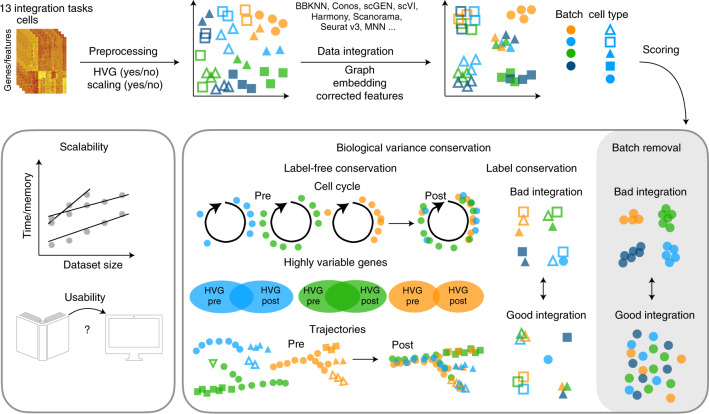
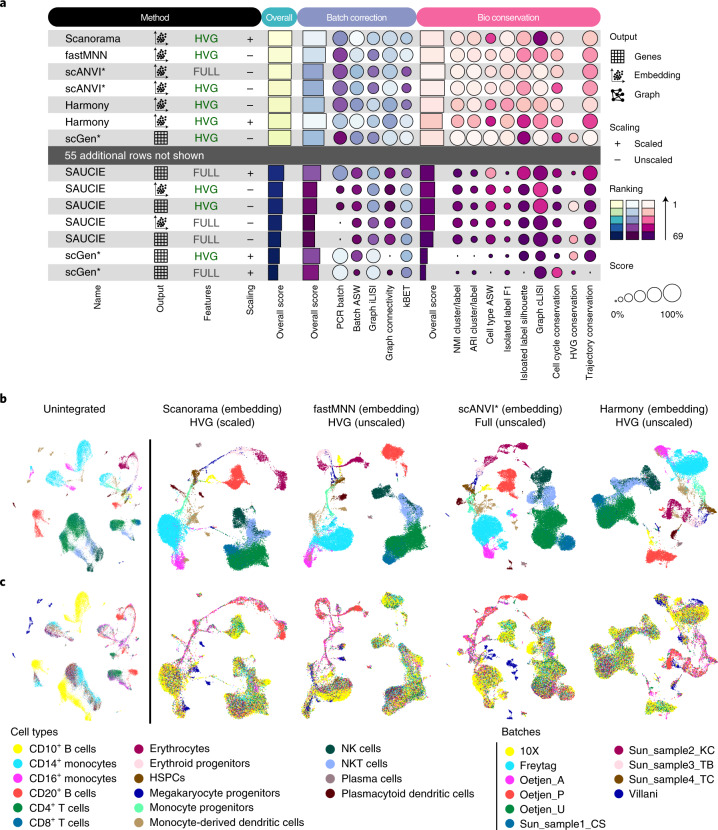
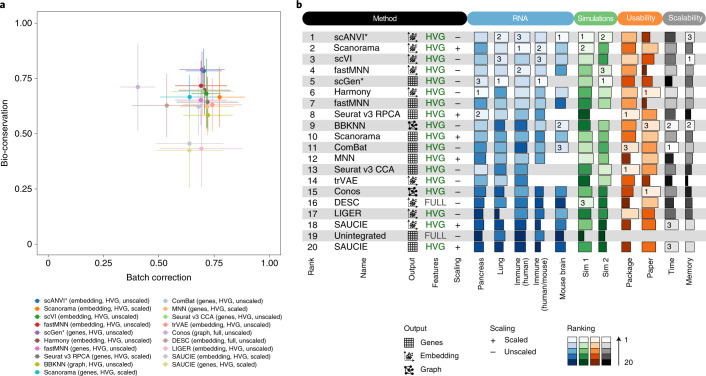
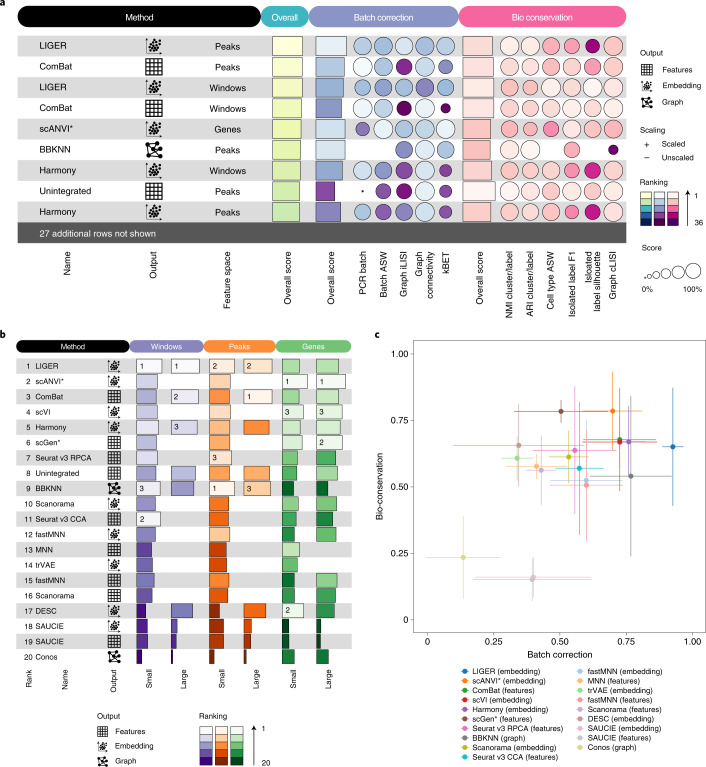
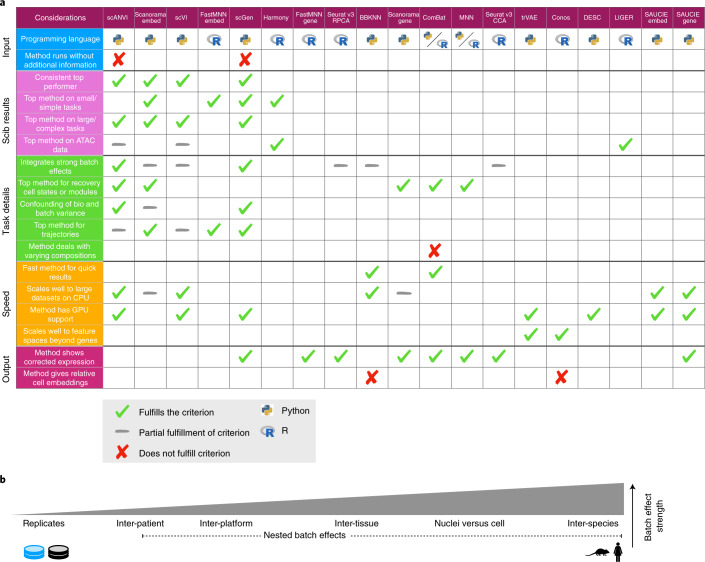
Single-cell atlases often include samples that span locations, laboratories and conditions, leading to complex, nested batch effects in data. Thus, joint analysis of atlas datasets requires reliable data integration. To guide integration method choice, we benchmarked 68 method and preprocessing combinations on 85 batches of gene expression, chromatin accessibility and simulation data from 23 publications, altogether representing >1.2 million cells distributed in 13 atlas-level integration tasks. We evaluated methods according to scalability, usability and their ability to remove batch effects while retaining biological variation using 14 evaluation metrics. We show that highly variable gene selection improves the performance of data integration methods, whereas scaling pushes methods to prioritize batch removal over conservation of biological variation. Overall, scANVI, Scanorama, scVI and scGen perform well, particularly on complex integration tasks, while single-cell ATAC-sequencing integration performance is strongly affected by choice of feature space. Our freely available Python module and benchmarking pipeline can identify optimal data integration methods for new data, benchmark new methods and improve method development.
Overview
The claims and statistics of this paper haven’t been checked yet.
Free: it reads the open-access text and checks the first 5 claims that cite a source we can check. Create a free account to check every claim.
Integrity signals
Registry
Cites
Statistics
Figures
Verification
Claims the paper makes
The claims and statistics of this paper haven’t been checked yet.
Free: it reads the open-access text and checks the first 5 claims that cite a source we can check. Create a free account to check every claim.
Claims other papers make about this one
Each is checked against this paper’s own text: does it say what the citing paper says it does?
The source backs part of the claim, not all of it — or backs it for a different population, condition or comparison.
In the citing paper
“Such integrative analysis is complicated by batch effects and biological differences between primary tissue and cell culture26,27.”
From scPerturb: harmonized single-cell perturbation data (2024) · cites this paper as [27]
Experimental — accuracy not yet measuredThe source backs part of the claim, not all of it — or backs it for a different population, condition or comparison.
In the citing paper
“Furthermore, 8 evaluation metrics (3 for batch effect removal and 5 for biological variation retention) are computed to verify the integration ability by scIB47, which ranks TOSICA the first out of all 13 applicable methods evaluated on combined effectiveness in batch effect removal and biological variation retention (Fig. 5b).”
From Transformer for one stop interpretable cell type annotation (2023) · cites this paper as [47]
Experimental — accuracy not yet measuredThe source backs part of the claim, not all of it — or backs it for a different population, condition or comparison.
In the citing paper
“In particular, Harmony22 is an algorithm well suited for correcting batch effects that may be present in a dimensionality-reduced single-cell expression dataset,79”
From hdWGCNA identifies co-expression networks in high-dimensional transcriptomics data (2023) · cites this paper as [79]
Experimental — accuracy not yet measuredThe cited source says what the claim attributes to it.
In the citing paper
“Although this work simplifies dataset access, joint analysis is limited by the complexity of data integration27.”
From scPerturb: harmonized single-cell perturbation data (2024) · cites this paper as [27]
The cited source says what the claim attributes to it.
In the citing paper
“Depending on the complexity of the integration tasks, such as atlas integration, deep-learning approaches such as scANVI40, scVI41 and scGen42 as well as linear-embedding models such as Scanorama43 performed best”
From Best practices for single-cell analysis across modalities (2023) · cites this paper as [35]
10 more claims about this paper
Create a free account to see every claim other papers make about this one.
Self-check
Percentages, sums and reported differences re-computed from the paper’s own numbers.
The self-check needs the paper’s full text.
Citations
Cites
Scikit-learn: Machine Learning in Python
Pedregosa, F., Varoquaux, G., Gramfort, A., Michel, V., Thirion, B., Grisel, O., Blondel, M., Müller, A., Nothman, J., Louppe, G., et al. (2012) · arXiv · doi:10.48550/arxiv.1201.0490 · Cited by 71,016 · cited 12×
“Similar to NMI, we compared the cell-type labels with the NMI-optimized Louvain clustering computed on the integrated dataset.”
BackgroundInfluentialSciPy 1.0: fundamental algorithms for scientific computing in Python
Virtanen, P., Gommers, R., Oliphant, T. E., Haberland, M., Reddy, T., Cournapeau, D., Burovski, E., Peterson, P., Weckesser, W., Bright, J., et al. (2020) · Nature Methods · doi:10.1038/s41592-019-0686-2 · Cited by 38,430
A note on two problems in connexion with graphs
Dijkstra, E. W. (1959) · Numerische Mathematik · doi:10.1007/bf01386390 · Cited by 29,065
Silhouettes: A graphical aid to the interpretation and validation of cluster analysis
Rousseeuw, P. J. (1987) · Journal of Computational and Applied Mathematics · doi:10.1016/0377-0427(87)90125-7 · Cited by 21,392
Comprehensive Integration of Single-Cell Data
Stuart, T., Butler, A., Hoffman, P., Hafemeister, C., Papalexi, E., Mauck, W. M., Hao, Y., Stoeckius, M., Smibert, P., & Satija, R. (2019) · Cell · doi:10.1016/j.cell.2019.05.031 · Cited by 15,453
ggplot2: Elegant Graphics for Data Analysis
Wickham, H. (2009) · doi:10.1007/978-0-387-98141-3 · Cited by 14,447
Fast, sensitive and accurate integration of single-cell data with Harmony
Korsunsky, I., Millard, N., Fan, J., Slowikowski, K., Zhang, F., Wei, K., Baglaenko, Y., Brenner, M., Loh, P.-R., & Raychaudhuri, S. (2019) · Nature Methods · doi:10.1038/s41592-019-0619-0 · Cited by 10,488
SciPy 1.0: fundamental algorithms for scientific computing in Python
Virtanen, P., Gommers, R., Oliphant, T. E., Haberland, M., Reddy, T., Cournapeau, D., Burovski, E., Peterson, P., Weckesser, W., Bright, J., et al. (2019) · Apollo - University of Cambridge Repository · doi:10.17863/cam.64134 · Cited by 10,460
UMAP: Uniform Manifold Approximation and Projection
McInnes, L., Healy, J., Saul, N., & Großberger, L. (2018) · Journal of Open Source Software · doi:10.21105/joss.00861 · Cited by 9,826
SCANPY: large-scale single-cell gene expression data analysis
Wolf, F. A., Angerer, P., & Theis, F. J. (2018) · Genome Biology · doi:10.1186/s13059-017-1382-0 · Cited by 8,881 · cited 1×
“Metrics were run on the integrated and unintegrated AnnData 47 objects.”
MethodSelf-citation
Cited by
Items 801–900 of 1,008
Chen, J., Li, M., Zhang, X., & Ang, K. S. (2022) · Research Square · doi:10.21203/rs.3.rs-1643794/v1 · Cited by 3
Li, M., Zhang, X., Ang, K. S., & Chen, J. (2022) · bioRxiv (Cold Spring Harbor Laboratory) · doi:10.1101/2022.05.10.491296 · Cited by 5
Mishra, S. V., Pandey, N., Chawla, S., Sharma, M., Chandra, O., Jha, I. P., Sengupta, D., Natarajan, K. N., & Kumar, V. (2023) · Genome Research · doi:10.1101/gr.277015.122 · Cited by 3
ProjectSVR: Mapping single-cell RNA-seq data to reference atlases by supported vector regressionPreprint
Gao, J., Guo, S., & Zhang, Y.-W. (2023) · bioRxiv · doi:10.1101/2023.07.31.551202 · Cited by 6
Single-cell multi-omics map of human foetal blood in Down’s SyndromePreprint
Marderstein, A. R., Zuani, M. D., Xue, H., Bezney, J., Wong, S., Coorens, T. H. H., Montgomery, S. B., & Cvejic, A. (2023) · bioRxiv (Cold Spring Harbor Laboratory) · doi:10.1101/2023.09.25.559431 · Cited by 3
flowVI: Flow Cytometry Variational InferencePreprint
İnecik, K., Meric, A., König, L. M., & Theis, F. J. (2023) · bioRxiv (Cold Spring Harbor Laboratory) · doi:10.1101/2023.11.10.566661 · Cited by 3
Self-citationScaling deep identifiable models enables zero-shot characterization of single-cell biological statesPreprint
Dong, M., Agrawal, K., Fan, R., Sefik, E., Flavell, R. A., & Kluger, Y. (2023) · bioRxiv (Cold Spring Harbor Laboratory) · doi:10.1101/2023.11.11.566161 · Cited by 3
“These objectives are well covered by batch integration metrics implemented in the scIB benchmarking framework [19].”
InfluentialDecoding cell identity with multi-scale explainable deep learningPreprint
Zhu, J., Zhang, Z., Xiang, Y., Xie, B., Dong, X., Xie, L., Zhou, P., Yao, R., Wang, X., Li, Y., et al. (2024) · bioRxiv (Cold Spring Harbor Laboratory) · doi:10.1101/2024.02.05.578922 · Cited by 3
“We evaluated the multi-scale data integration capability of Cell Decoder on the human immune cell dataset 35-39 with 10 different batches provided by scIB 40 in comparison with Harmony 41 , Scanorama (embedding) 42 , and scVI 43 .”
MethodStepwise developmental mimicry generates proximal-biased kidney organoidsPreprint
Schnell, J., Miao, Z., Achieng, M. A., Fausto, C. C., Wang, V., Kuyper, F. D., Thornton, M. E., Grubbs, B. H., Kim, J., & Lindström, N. O. (2024) · bioRxiv (Cold Spring Harbor Laboratory) · doi:10.1101/2024.06.28.601028 · Cited by 3
Furtwängler, B., Üresin, N., Richter, S., Schuster, M. B., Barmpouri, D., Holze, H., Wenzel, A., Grønbæk, K., Theilgaard‐Mönch, K., Theis, F. J., et al. (2024) · bioRxiv (Cold Spring Harbor Laboratory) · doi:10.1101/2024.07.05.602277 · Cited by 3
Self-citationArchMap: A web-based platform for reference-based analysis of single-cell datasetsPreprint
Lotfollahi, M., Bright, C. A., Skorobogat, R., Dehkordi, M. N., George, X., Richter, S., Shitov, V. A., Melcher, H., Nussbaumer, N., Fomm, A., et al. (2024) · bioRxiv (Cold Spring Harbor Laboratory) · doi:10.1101/2024.09.19.613883 · Cited by 3
“Current compatible integration methods include scVI 6 , scANVI 9 , and scPoli 5 , with scVI and scANVI being consistent top performing integration methods 4 .”
Self-citationSC-MAMBA2: Leveraging State-Space Models for Efficient Single-Cell Ultra-Long Transcriptome ModelingPreprint
Zhao, Y., Zhao, B., Zhang, F., He, C., Wu, W., & Lai, L. (2024) · bioRxiv (Cold Spring Harbor Laboratory) · doi:10.1101/2024.09.30.615775 · Cited by 7
“We used scib[33] to evaluate the integration performance, where AvgBio represents the average of ARI, NMI, and ASW cell scores.”
MethodInfluentialscPlantFormer: A Lightweight Foundation Model for Plant Single-Cell Omics AnalysisPreprint
Zhang, X., Xu, J., Chen, D., & Chen, L. (2024) · Research Square · doi:10.21203/rs.3.rs-5219487/v1 · Cited by 7
Hu, H., Zhang, S., Choi, Y., Malladi, V. S., & Quon, G. (2025) · bioRxiv (Cold Spring Harbor Laboratory) · doi:10.1101/2025.01.28.635153 · Cited by 6
Sarafinovska, S., Koester, S. K., Fang, L. Z., Thorpe, J. W., Chaturvedi, S. M., Ji, J.-S., Jones, E. F., Selmanovic, D., Kornbluth, D. J., Barrett, M. R., et al. (2025) · bioRxiv (Cold Spring Harbor Laboratory) · doi:10.1101/2025.03.10.642464 · Cited by 3
“Inset: Histogram showing the LISI score with a median of 1.97, indicating that the genotypes are well mixed and integrated.”
InfluentialBiologically Informed Variational Inference Enables Interpretable Cell Phenotyping and DiscoveryPreprint
Arnoldt, L., zu Belzen, J. U., Herrmann, L., Nguyen, K., Ishaque, N., Theis, F. J., Wild, B., & Eils, R. (2025) · bioRxiv (Cold Spring Harbor Laboratory) · doi:10.1101/2025.06.10.657924 · Cited by 4
“For integration, we quantified performance using the scib score, which captures how well a method preserves biological signal, aligns data across modalities, and corrects for batch effects ((Luecken et al. 2022); see Methods).”
Self-citationMonoaminergic neurons share transcriptional identity across Bilaterian animalsPreprint
Goulty, M., Lewis, C., Nicolini, F., Khalid, R., Syed, H., Oliveri, P., Thomas, M. G., Rosato, E., & Feuda, R. (2025) · bioRxiv (Cold Spring Harbor Laboratory) · doi:10.1101/2025.10.10.679534 · Cited by 3
Bahrami, M., Tejada-Lapuerta, A., Becker, S., G., F. S. H., & Theis, F. J. (2025) · bioRxiv (Cold Spring Harbor Laboratory) · doi:10.1101/2025.10.14.682419 · Cited by 17
Self-citationInterpretable phenotype decoding from multicondition sequencing data with ALPINE
Lee, W.-H., Li, L., Dannenfelser, R., & Yao, V. (2025) · Genome Research · doi:10.1101/gr.280566.125 · Cited by 3
“…unwanted technical variation (e.g.,single-cellplatform,experimentallaboratory) has drivensub-stantial method development efforts (Tran et al. 2020; Luecken et al. 2022), which typically aim to project cells from different data sets or samples into an integrated space (Eisenstein 2020; Argelaguet…”
InfluentialLanguage may be all omics needs: Harmonizing multimodal data for omics understanding with CellHermesPreprint
Gao, Y., Wang, W., Zhao, Y., Dong, K., Shan, C., Zheng, W., Richter, T., Li, Z., Chen, S., Theis, F. J., et al. (2025) · bioRxiv (Cold Spring Harbor Laboratory) · doi:10.1101/2025.11.07.687322 · Cited by 7
“Using a human immune dataset 21,61 as an example, we assessed the ability of these embeddings to recover functional groupings for each cell type.”
Self-citationAponte-Santiago, N. A., Su, Y., & Wagner, D. E. (2026) · bioRxiv (Cold Spring Harbor Laboratory) · doi:10.64898/2026.03.23.713599 · Cited by 8
TopoMetry systematically learns and evaluates the latent geometry of single-cell data
Sidarta-Oliveira, D., Domingos, A. I., & Velloso, L. A. (2026) · eLife · doi:10.1101/2022.03.14.484134 · Cited by 5
“While benchmarking studies have compared clustering or integration algorithms 7,8 , none have assessed whether the obtained representations preserve the original manifold structure that encodes cellular identities.”
Branda, F., Ahmed, M. M., Ciccozzi, M., Guzzi, P. H., & Scarpa, F. (2026) · Briefings in Bioinformatics · doi:10.1093/bib/bbag245 · Cited by 2
“Performance degradation under cross-platform transfer documented for scGPT [20], Nicheformer [21], EpiAgent [22, 23]; zero-shot limitations [22]; cross-site benchmarking studies [24, 25].”
Xue, J., Zhou, X., Yang, J., & Niu, A. (2024) · PLoS ONE · doi:10.1371/journal.pone.0299358 · Cited by 2
“Among all these methods, Luecken et al. (2022) present a benchmarking study of data integration methods in complex integration tasks, which can help identify optimal data integration methods for new data [51].”
MethodSingle-cell mosaic integration and cell state transfer with auto-scaling self-attention mechanism
Rong, Z., Song, J., Yu, Y., Mi, L., Qiu, M., Song, Y., & Hou, Y. (2024) · Briefings in Bioinformatics · doi:10.1093/bib/bbae540 · Cited by 2
“Data integration has been an effective means of consolidating and utilizing these rich resources [7].”
BackgroundStructure-preserved integration of scRNA-seq data using heterogeneous graph neural network
Zhang, X., Qian, K., & Li, H. (2024) · Briefings in Bioinformatics · doi:10.1093/bib/bbae538 · Cited by 3
“In contrast, Cell BLAST employs a neural network-based generative model that utilizes adversarial strategies to align cells across different batches.”
GEEES: inferring cell-specific gene–enhancer interactions from multi-modal single-cell data
Chen, S., & Keleş, S. (2024) · Bioinformatics · doi:10.1093/bioinformatics/btae638 · Cited by 2
“…for identifying gene– enhancer interactions from multi-modal single-cell data can be divided into two classes depending on whether or not they originate from integrative pipelines of multi-modal single-cell data [e.g. methods benchmarked in scIB (Luecken et al. 2022) for scRNA-seq and scATAC-seq].”
scCCTR: An iterative selection-based semi-supervised clustering model for single-cell RNA-seq data
Chen, J., Sun, Q., Wang, C., & Gao, C. (2025) · Computational and Structural Biotechnology Journal · doi:10.1016/j.csbj.2025.03.018 · Cited by 4
“To objectively assess the clustering performance, we employed six metrics: Adjusted Rand Index (ARI) [54], Normalized Mutual Information (NMI) [55], Accuracy (ACC) [56], Fowlkes-Mallows Index (FMI) [57], Davies-Bouldin Index (DBI) [58], and Graph cLISI [59].”
Tensor-Based Approaches for Omics Data Analysis: Applications, Challenges, and Future Directions
Khoshnam, A., Chafamo, D., & Tokcan, N. (2025) · La Matematica · doi:10.1007/s44007-025-00149-x · Cited by 3
SCITUNA: single-cell data integration tool using network alignment
Houdjedj, A., Marouf, Y., Myradov, M., Doğan, S. O., Erten, B. O., Taştan, Ö., Erten, C., & Kazan, H. (2025) · BMC Bioinformatics · doi:10.1186/s12859-025-06087-3 · Cited by 2
“The next step is to identify highly variable genes (HVGs) using scIB’s “hvg_batch” function [21, 35].”
InfluentialIntegrating single-cell data with biological variables
Zhou, Y., Sheng, Q., & Jin, S. (2025) · Proceedings of the National Academy of Sciences · doi:10.1073/pnas.2416516122 · Cited by 5
“A recent benchmark study ( 4 ) has demonstrated that integration methods incorporating cell type labels outperform fully unsupervised approaches, highlighting the critical role of metadata in data integration.”
Thomas, M., Brabenec, R., Gregor, L., Andreu-Sanz, D., Carlini, E., Müller, P. J., Gottschlich, A., Simnica, D., Kobold, S., & Marr, C. (2025) · Computers in Biology and Medicine · doi:10.1016/j.compbiomed.2025.110332 · Cited by 2
Transcriptional landscape of aniridia-associated keratopathy through single-cell RNA sequencing
Yoshihara, M., Kamuro, R., Hara, S., Nishida, N., Ohmoto, K., Sasamoto, Y., Kawasaki, S., Oie, Y., & Nishida, K. (2025) · The Ocular Surface · doi:10.1016/j.jtos.2025.05.008 · Cited by 2
Polzer, O., Kinloch, E., Lucassen, P. J., Salta, E., & Fitzsimons, C. P. (2025) · Aging Cell · doi:10.1111/acel.70106 · Cited by 3
Securing diagonal integration of multimodal single-cell data against ambiguous mapping
Zhou, H., Cao, K., & Lu, Y. Y. (2025) · Bioinformatics · doi:10.1093/bioinformatics/btaf345 · Cited by 2
“While this iterative self-alignment process enhances robustness, it inevitably introduces computational inefficiency.”
Greenberg, Z., Oshins, R. A., Serban, K. A., Bazargani, S. F., Garrett, T. J., Casanova, N. G., Garcia, J. G. N., He, M., & Khodayari, N. (2025) · Extracellular Vesicle · doi:10.1016/j.vesic.2025.100093 · Cited by 3
“53 These EV can amplify inflammatory signaling and promote disease progression.”
RETRACTED: Integration of single cell multiomics data by deep transfer hypergraph neural network
Kan, Y., Zhang, Z., Wang, Y., Qi, Y., Chang, H., Wang, W., Zhang, Z., Liu, Q., & Shi, X. (2025) · Briefings in Functional Genomics · doi:10.1093/bfgp/elaf009 · Cited by 2
RetractedSuperGLUE facilitates an explainable training framework for multi-modal data analysis
Liu, T., Zhao, J., & Zhao, H. (2025) · Cell Reports Methods · doi:10.1016/j.crmeth.2025.101167 · Cited by 4
“To evaluate S tech , we considered metrics from single-cell integration benchmark (scIB), 35 including technique-level average of the absolute silhouette (tASW), integration LISI (iLISI), k-nearest neighbor batch effect test (kBET), and graph connectivity (GC).”
Wan, L., Zhou, Y., Wang, X., Qi, J., & Jin, S. (2025) · Briefings in Bioinformatics · doi:10.1093/bib/bbaf503 · Cited by 2
“A recent benchmarking study [21] also highlighted the limitations of these methods in complex integration tasks, underscoring the need for improved strategies that balance batch correction and biological variation conservation.”
Disrupted developmental signaling induces novel transcriptional states
Patel, A. L., Gonzalez, V., Menon, T., Shvartsman, S. Y., Burdine, R. D., & Avdeeva, M. (2025) · Proceedings of the National Academy of Sciences · doi:10.1073/pnas.2418351122 · Cited by 2
Mullan, K. A., Valkiers, S., de Vrij, N., Li, C., Verbandt, S., Pu, T., & Meysman, P. (2025) · ImmunoInformatics · doi:10.1016/j.immuno.2025.100063 · Cited by 3
A novel paradigm for single-cell annotation in stem cell research
Atkeson, T., Wilson, S. B., Ruiz-Morales, E. R., Little, M. H., Vento‐Tormo, R., Neavin, D. R., & Powell, J. E. (2025) · Stem Cell Reports · doi:10.1016/j.stemcr.2025.102707 · Cited by 3
“These methods must extend beyond cell types to integrate pseudotime metrics (Sugihara et al., 2022) and cell cycle variation, and must be both scalable and practical (Luecken et al., 2022) to implement.”
InfluentialProjectSVR: mapping single-cell RNA-seq data to reference atlases by supported vector regression
Gao, J., Fang, J., Zhu, Q., Li, G., Bi, Z., Hu, Y., Hong, B., Zhang, Y., Guo, S., & Wang, H. (2025) · Briefings in Bioinformatics · doi:10.1093/bib/bbaf586 · Cited by 8
“Recently developed integration algorithms have enabled the construction of organ-scale atlases [1], offering biological context for consistent annotation [2–4], yet mapping novel data onto these references remains difficult.”
JADE: Joint Alignment and Deep Embedding for Multi-Slice Spatial Transcriptomics
Guo, Y., Liu, J. S., Cheng, H., & Ma, Y. (2025) · neural information processing systems · doi:10.52202/085713-0867 · Cited by 3
“…need for joint analysis across samples, integration methods originally developed for single-cell RNA sequencing data [71, 18], including Harmony [32], Seurat [56], and scVI [39], do not account for spatial context and assume shared coordinate systems across samples, assumptions that rarely hold in…”
Brain-derived neurotrophic factor supports pericyte and vascular homeostasis in the aging brain
Luo, Q., Quan, W., Cao, Q., Scheffel, C., Hao, W., Yang, J., Furihata, T., Peng, G., Tang, Z., & Liu, Y. (2025) · Acta Neuropathologica Communications · doi:10.1186/s40478-025-02181-y · Cited by 4
“The non-parametric approach was chosen for its robustness to zero-inflated single-cell data distributions [30].”
Song, Z., Klyuchnikov, E., Badbaran, A., Tan, L., Dress, R. J., Czajkowski, E., Weßler, S., Massoud, R., Wolschke, C., Schimrock, A., et al. (2025) · Biomarker Research · doi:10.1186/s40364-025-00868-x · Cited by 2
Shu, H., Jing, C., Hu, J., Zhang, R., Wang, Y., Peng, J., Xu, D., Shang, X., Yuan, Z., & Wang, T. (2025) · The Innovation · doi:10.1016/j.xinn.2025.101220 · Cited by 7
“47 To ensure a more objective evaluation of biological variance conservation, we also included clustering assessment for clustering us-ing mclust.”
Liu, Y., Xia, Y., Yan, H., Shen, L.-C., Zhu, Y., Qiang, J.-P., & Wei, G. (2026) · PLoS Computational Biology · doi:10.1371/journal.pcbi.1013824 · Cited by 3
“We then transformed the three mouse brain datasets into GAMs and window forms [38] for cell type transfer.”
Unraveling Cardiovascular Development and Function: Insights From Single-Cell Omics
Harper, R. L., Lelliott, P. M., Bender, S. B., & Pinto, A. R. (2026) · Circulation Research · doi:10.1161/circresaha.125.325793 · Cited by 4
Denoising spatial epigenomic data via deep matrix factorization
Wang, S. S., Xu, H., Wang, J., Xiao, Y., Dai, S., Lu, J., Cao, R., Chen, X., & Qu, K. (2026) · Nature Computational Science · doi:10.1038/s43588-025-00941-3 · Cited by 2
“The SW is computed as The score is then scaled between 0 and 1, following the approach used in scib 49 .”
Cong, Y., Osada, N., & Endo, T. (2026) · OMICS A Journal of Integrative Biology · doi:10.1177/15578100251413812 · Cited by 3
Morchio, M., Sankaranarayanan, I., Tavares‐Ferreira, D., Wong, N., Atkins, S., Sher, E., Price, T. J., Lambert, D., & Boissonade, F. M. (2026) · Pain · doi:10.1097/j.pain.0000000000003907 · Cited by 4
“60 The rPCA workflow involved selecting 3000 integration features on the single cell transform (SCT) transformed objects, which are used as anchors to prepare the SCT integration.”
Model Synthesizer: Synthesizing Disparate Models to Enhance Single-Cell Transcriptomics Models
Chen, S., Cao, Z., Qin, X. Y., & Yang, X. W. (2025) · IEEE International Conference on Bioinformatics and Biomedicine (BIBM) · doi:10.1109/bibm66473.2025.11356145 · Cited by 3
“(2) Human pancreas : The human pancreas consists of six publications using 9 batches which is published by [24], resulting in 16,382 cells from 14 cell-types.”
Single-cell atlas of AML reveals age-related gene regulatory networks in t(8;21) AML
Whittle, J. R. S., Meyer, S., Lacaud, G., Baker, S. M., & Iqbal, M. (2025) · eLife · doi:10.7554/elife.104978.3 · Cited by 5
Heterogeneity and Clinical Relevance of Human Adipose Stromal and Progenitor Cells
Albert, M., Nalir, K., Zhong, J., & Massier, L. (2026) · Diabetes & Metabolism Journal · doi:10.4093/dmj.2025.1182 · Cited by 2
Family single-cell atlases reveal pig pregnancy and fetal growth restriction critical cell types
Cai, L., Zhang, Q., Yao, T., Zou, X., Xie, L., Yang, S., Xiao, Y., Huang, F., Peng, Z., Yang, J., et al. (2026) · Science · doi:10.1126/science.adu7265 · Cited by 8
Probabilistic modelling of single-cell bisulfite sequencing data with MethylVI
Weinberger, E., Qiu, W., Tian, W., Zeng, Q., Ergen, C., Kronfeld, O., Kim, M., Yosef, N., Ecker, J. R., & Lee, S. (2026) · Nature Machine Intelligence · doi:10.1038/s42256-026-01225-9 · Cited by 2
“44, which computes LISI values using a nearest-neighbour graph as input.”
InfluentialUnbiased niche labeling maps immune-excluded niche in bone metastasis
Xu, Z., Liu, F., Ding, Y., Pan, T., Wu, Y.-H., Han, Y., Liu, J., Bado, I., Zhang, W., Wu, L., et al. (2026) · Cell · doi:10.1016/j.cell.2026.04.009 · Cited by 8
Lakra, A., Singh, N., Vashishth, S., Ambasta, R. K., & Kumar, P. (2026) · Ageing Research Reviews · doi:10.1016/j.arr.2026.103189 · Cited by 4
Li, Z., Zhang, Y. H., Yang, K., Zheng, D., Chen, Y., Zhang, Y., Pan, X., Yan, P., Rosas, I. O., Yu, G., et al. (2026) · Research · doi:10.34133/research.1341 · Cited by 3
Imaging-Based Spatial Transcriptomics: Data Interpretation Methods and Biomedical Applications
Li, W., & Zhou, Y. (2026) · Biology · doi:10.3390/biology15120900 · Cited by 2
“Therefore, transferred labels should ideally be evaluated together with marker expression, spatial localization, confidence scores, and unsupervised or de novo analyses [74].”
Hamraoui, A., Onfroy, A., Sénamaud‐Beaufort, C., Coulpier, F., Lemoine, S., Jourdren, L., & Thomas‐Chollier, M. (2026) · NAR Genomics and Bioinformatics · doi:10.1093/nargab/lqag070 · Cited by 4
The clinical promise of mass spectrometry-based single-cell proteomics: from bedside to bench
Prado, H. M. D. A., Miyamoto, J. G., Busso-Lopes, A. F., Tofani, L. B., Coimbra, N. D. R., Patroni, F. M. D. S., de Figueiredo, D., Rocha, G. F., Pauletti, B. A., Carnielli, C. M., et al. (2026) · Expert Review of Proteomics · doi:10.1080/14789450.2026.2701811 · Cited by 3
“These limitations resemble those in scRNA-seq and have driven the adoption of computational strategies originally developed for scRNA-seq data analysis [168,169].”
Severino, M., Inchingolo, A. D., Calò, F., Ciocia, C., Inchingolo, F., Marinelli, G., Viarchi, A., Truppa, C. T., Palermo, A., Bordea, I. R., et al. (2026) · International Journal of Molecular Sciences · doi:10.3390/ijms27146495 · Cited by 2
Comprehensive benchmarking of RNA velocity methods across single-cell datasets
Wu, Y., Kong, C., Liao, X., Lin, Z., Sun, X., & Liu, J. H. (2026) · Genome biology · doi:10.1186/s13059-026-04182-z · Cited by 2
“LatentVelo (std) and all scTour variants were the only methods whose original studies claimed batch-effect mitigation during dynamic inference [30, 33, 43, 44] (Additional file 3: Note S3; Additional file 2: Fig.”
Benchmarking biomedical foundation models
Sáez-Rodríguez, J., Schäfer, P. S. L., Kalavros, N., & Stolovitzky, G. A. (2026) · Nature Methods · doi:10.1038/s41592-026-03182-y · Cited by 7
“For example, a key shortcoming of the commonly used single-cell integration benchmark metrics 73 is that they do not assess whether embeddings preserve higher-order relationships between cell types or states, meaning that embeddings may appear well integrated even when global biological structure…”
Deep learning analysis of single‐cell data in empowering clinical implementation
Ma, A., Wang, J., Xu, D. H., & Ma, Q. (2022) · Clinical and Translational Medicine · doi:10.1002/ctm2.950 · Cited by 3
Confident multimodal analysis of single cells across platforms and species
(2023) · Nature Methods · doi:10.1038/s41592-022-01713-x · Cited by 2
Spatial Omics DataBase (SODB): increasing accessibility to spatial omics data
(2023) · Nature Methods · doi:10.1038/s41592-023-01772-8 · Cited by 3
Matrix prior for data transfer between single cell data types in latent Dirichlet allocation
Min, A., Durham, T., Gevirtzman, L., & Noble, W. S. (2023) · PLoS Computational Biology · doi:10.1371/journal.pcbi.1011049 · Cited by 2
Cofea: correlation-based feature selection for single-cell chromatin accessibility data
Li, K., Chen, X., Song, S., Hou, L., Chen, S., & Jiang, R. (2023) · Briefings in Bioinformatics · doi:10.1093/bib/bbad458 · Cited by 1
“We adopted four widely used metrics for assessing the clustering results as recommended in previous studies [24, 27, 28], namely NMI, AMI, ARI and Homo.”
Harle, S. M. (2024) · Current Materials Science · doi:10.2174/0126661454279515231225151023 · Cited by 3
Liang, S., Dou, J., Iqbal, R., & Chen, K. (2024) · Communications Biology · doi:10.1038/s42003-024-05988-y · Cited by 3
“WeusedtheScib-metric implementationofthesemetrics 25 .”
Systematic benchmarking of omics computational tools
Kumar, S., Singh, M., Sharma, R. K., & Gupta, M. (2024) · Elsevier eBooks · doi:10.1016/b978-0-443-16092-9.00004-7 · Cited by 1
Verstappe, B., & Scott, C. L. (2024) · Clinical & Experimental Immunology · doi:10.1093/cei/uxae077 · Cited by 3
“Some widely used examples are Harmony [68], which excels with smaller datasets and scVI [69], which is more appropriate for complex integration tasks [70, 71].”
MethodA primer on single‐cell RNA ‐seq analysis using dendritic cells as a case study
Protti, G., & Spreafico, R. (2024) · FEBS Letters · doi:10.1002/1873-3468.15009 · Cited by 2
Prater, K. E., & Lin, K. (2024) · Glia · doi:10.1002/glia.24633 · Cited by 2
“We should note that it is possible that different batch correction methods may perform differently on different tissue types (Luecken et al., 2022).”
Cao, L., Zhang, W., Yang, F., Chen, S., Huang, X., Zeng, F., & Wang, Y. (2024) · Briefings in Bioinformatics · doi:10.1093/bib/bbaf013 · Cited by 2
Cardoen, B., Yedder, H. B., Nabi, I. R., & Hamarneh, G. (2025) · Patterns · doi:10.1016/j.patter.2025.101181 · Cited by 2
“Methods from single-cell genomics 120 to mitigate the similar batch-based effects can be ported to enable replicate consistent SRM interaction analysis.”
A systematic assessment of single-cell language model configurations
Waele, G. D., Menschaert, G., & Waegeman, W. (2026) · NAR Genomics and Bioinformatics · doi:10.1093/nargab/lqag095 · Cited by 5
Parker, M. T., Amar, S., Campoy, J. A., Krause, K., Tusso, S., Marek, M., Hüettel, B., & Schneeberger, K. (2025) · PLoS Biology · doi:10.1371/journal.pbio.3003085 · Cited by 3
Tang, M., Haese-Hill, W. A., Morton, F. R., Goodyear, C. S., Porter, D. R., Siebert, S., & Otto, T. D. (2025) · BMC Medical Genomics · doi:10.1186/s12920-025-02162-z · Cited by 2
“In general, it is unclear a priori which integration will generate the best data, and this will vary for different datasets, the user has different options for this in RNAcare [31].”
Hao, W., Dong, X., Wang, Z., Wen, T., Liu, L., Gu, T., & Ma, H. (2025) · Cellular Signalling · doi:10.1016/j.cellsig.2025.111927 · Cited by 5
A Deep Learning Approach to Assessing Cell Identity in Stem Cell–Based Embryo Models
Salehin, N., Proks, M., & Brickman, J. M. (2025) · Methods in molecular biology · doi:10.1007/7651_2025_654 · Cited by 2
Sousa, A. G. G., Smolander, J., Junttila, S., & Elo, L. L. (2025) · Nucleic Acids Research · doi:10.1093/nar/gkaf1128 · Cited by 2
Gao, W., Hu, P., Wick, B. D., Qiu, Q., Zhang, H., Li, Y., Kang, X., Bedi, K. C., Haeussler, M., Sasaki, K., et al. (2026) · Genome biology · doi:10.1186/s13059-026-04061-7 · Cited by 4
“Using the scIB integration benchmarking framework [13, 26], we confirmed that scVI [27] achieved the best performance across metrics measuring batch effect correction while preserving true biological heterogeneity (Additional file 1: Fig.”
InfluentialTowards foundation models that learn across biological scales
Kalfon, J., Cantini, L., & Peyré, G. (2026) · Machine Learning Health · doi:10.1088/3049-477x/aea764 · Cited by 5
ArchMap is a web-based platform for reference-based analysis of single-cell datasets
Lotfollahi, M., Bright, C. A., Skorobogat, R., Dehkordi, M. M., George, X., Richter, S., Shitov, V. A., Melcher, H., Nussbaumer, N., Fomm, A., et al. (2026) · Nature Genetics · doi:10.1038/s41588-026-02756-y · Cited by 5
“Large-scale integrated single-cell reference atlases have become key for understanding intercellular variation and achieving consensus on cell-type nomenclature 1–4 .”
Self-citationSingle Cell Multiomic Approaches to Disentangle T Cell Heterogeneity
Abondio, P., Intinis, C. D., Júnior, J. L. D. S. G. V., & Pace, L. (2022) · Immunology Letters · doi:10.1016/j.imlet.2022.04.008 · Cited by 2
Wang, L., Nie, R., Zhang, Z., Gu, W., Wang, S., Wang, A., Zhang, J., & Cai, J. (2023) · Cell Reports Methods · doi:10.1016/j.crmeth.2023.100558 · Cited by 3
Chen, A. A., Clark, K. A., Dewey, B. E., DuVal, A. L., Pellegrini, N., Nair, G., Jalkh, Y., Khalil, S., Zurawski, J., Calabresi, P. A., et al. (2024) · PLoS Computational Biology · doi:10.1371/journal.pcbi.1012241 · Cited by 4
“Recent work has demonstrated that these metrics can effectively evaluate performance of modern batch correction methods [29, 30].”
BackgroundAnalysis of single-cell RNA sequencing data based on autoencodersPreprint
Tangherloni, A., Ricciuti, F., Besozzi, D., Lió, P., & Cvejic, A. (2019) · bioRxiv (Cold Spring Harbor Laboratory) · doi:10.1101/727867 · Cited by 2
Unbiased integration of single cell transcriptome replicatesPreprint
Loza, M., Teraguchi, S., Standley, D. M., & Díez, D. (2021) · bioRxiv (Cold Spring Harbor Laboratory) · doi:10.1101/2021.05.05.442380 · Cited by 2
Okada, H., Terui, Y., Seki, M., Terashima, A., Tani, S., Motooka, D., Kanazawa, S., Hosonuma, M., Miyahara, J., Makabe, K., et al. (2022) · bioRxiv (Cold Spring Harbor Laboratory) · doi:10.1101/2022.09.05.506360 · Cited by 3
Ferreira, P., Kuipers, J., & Beerenwinkel, N. (2022) · bioRxiv (Cold Spring Harbor Laboratory) · doi:10.1101/2022.10.15.512383 · Cited by 4
“…marker gene identification method based on Leiden clustering followed by differential expression analysis, two other matrix factorization methods, NMF and scHPF, and three of the top-performing batch integration methods according to a recent benchmarking study [16]: scVI, Harmony, and scanorama.”
MethodCross-species single-cell annotation with orthologous marker gene groupsPreprint
Li, S., Chau, T., Timilsena, P. R., Bathala, S. P., & Bargmann, B. O. R. (2023) · Research Square · doi:10.21203/rs.3.rs-3079082/v1 · Cited by 2
BIOFORMERS: A SCALABLE FRAMEWORK FOR EXPLORING BIOSTATES USING TRANSFORMERSPreprint
Amara-Belgadi, S., Li, O., Zhang, D. Y., & Gopinath, A. (2023) · bioRxiv (Cold Spring Harbor Laboratory) · doi:10.1101/2023.11.29.569320 · Cited by 3
“The output metrics were calculated using the implementation provided in Luecken et al. [22].”
MethodFriedrich, V. D., Pennitz, P., Wyler, E., Adler, J. M., Postmus, D., Alves, L. G. T., Prigann, J., Pott, F., Vladimirova, D., Hoefler, T., et al. (2024) · bioRxiv (Cold Spring Harbor Laboratory) · doi:10.1101/2024.01.11.574849 · Cited by 2
Deep Learning Based Models for Preimplantation Mouse and Human DevelopmentPreprint
Proks, M., Salehin, N., & Brickman, J. M. (2024) · bioRxiv (Cold Spring Harbor Laboratory) · doi:10.1101/2024.02.16.580649 · Cited by 2
“4.1) (YosefLab/scib-metrics, 2023) to compute the evaluation metrics defined in (Luecken et al., 2022).”
BackgroundMethodInfluentialscELMo: Embeddings from Language Models are Good Learners for Single-cell Data AnalysisPreprint
Zhao, H., Liu, T., Chen, T., Zheng, W., & Luo, X. (2024) · Research Square · doi:10.21203/rs.3.rs-4014784/v1 · Cited by 2
Metadata
- Authors
- Luecken, M. D., Büttner, M., Chaichoompu, K., Danese, A., Interlandi, M., Mueller, M. F., Strobl, D. C., Zappia, L., Dugas, M., Colomé-Tatché, M., & Theis, F. J.
- Affiliations
- Helmholtz Munich (DE)
- University of Münster (DE)
- University Hospital Heidelberg (DE)
- Corresponding author
- Theis, Fabian J.
- ORCID
- Venue
- Nature Methods
- Published
- 2021-12-23
- Volume
- 19
- Issue
- 1
- Pages
- 41-50
- ISSN
- 1548-7091 (ISSN-L)
- 1548-7105
- PMC
- PMC8748196
- OpenAlex
- W4225598893
- Cited by
- 1,438
- References
- 87
- Citations by year
- 2026: 380 · 2025: 358 · 2024: 304 · 2023: 210 · 2022: 115 · 2021: 53
- FWCI
- 55.88
- Type
- journal article
- Language
- en
- Open access
- hybrid
- doi.org
- Licence
- cc-by
- creativecommons.org/licenses/by/4.0 (tdm)
- creativecommons.org/licenses/by/4.0 (vor)
- Locations
- Nature Methods (publishedVersion, cc-by)
- bioRxiv (Cold Spring Harbor Laboratory) (acceptedVersion, cc-by)
- PubMed Central (publishedVersion, cc-by)
- PubMed (publishedVersion)
- Site cant be reached (submittedVersion, cc-by)
- Funders
- Silicon Valley Community Foundation (182835)
- Wellcome Trust (108413 /A/15/D)
- Chan Zuckerberg Initiative (182835)
- European Commission (874656, 2020 ‘, HORIZON2020)
- Helmholtz Zentrum München
- Topics
- Life Sciences › Biochemistry, Genetics and Molecular Biology › Molecular Biology › Single-cell and spatial transcriptomics
- Life Sciences › Biochemistry, Genetics and Molecular Biology › Molecular Biology › Gene expression and cancer classification
- Life Sciences › Biochemistry, Genetics and Molecular Biology › Molecular Biology › Bioinformatics and Genomic Networks
- Keywords
- single-cell data integration, batch effects, benchmarking, single-cell atlas, scANVI, scVI, single-cell ATAC-seq, chromatin accessibility, gene expression, feature space selection, scalability
- MeSH terms
- Animals, Humans, Immune System, Software, Sequence Analysis, RNA, Computational Biology, Benchmarking, Genomics, Databases, Genetic, Mice, Single-Cell Analysis
About these checks
Registry, retraction, Cites and statistics results are computed, not judged, with one exception: a printed reference that no index lists is read once by a model before it counts as a citation error. Claims are extracted by a model and kept only when their quote appears verbatim in the text; each cited source is then checked, with a model’s help, for whether it says what the claim relies on. Those verdicts can be wrong — read the claim’s quote and the cited source before relying on one.
Statistics and arithmetic are recomputed, not judged.
Confidence bands are shown only for fields calibrated on our annotated test set. None is calibrated yet, so no band is shown.
What counts as a claim ›How we measure confidence ›How we check this ›
Are you an author, or do you see a problem with this page? Request a review
Data sources
Bibliographic data: Semantic Scholar, OpenAlex, Crossref.
Contains information from the Semantic Scholar Academic Graph Datasets, made available under the ODC Attribution License (ODC-BY 1.0).
Semantic Scholar’s data is described in: Kinney, R., et al. (2023). The Semantic Scholar Open Data Platform. arXiv:2301.10140.
