

Benchmarking atlas-level data integration in single-cell genomics
Open accessPublished version of a preprint
The DOI matches its Crossref record; 90 of the 90 references it cites were found in a registry or an index.
Abstract
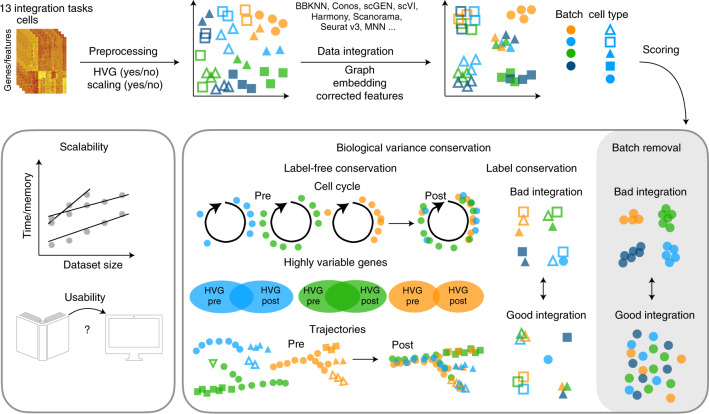
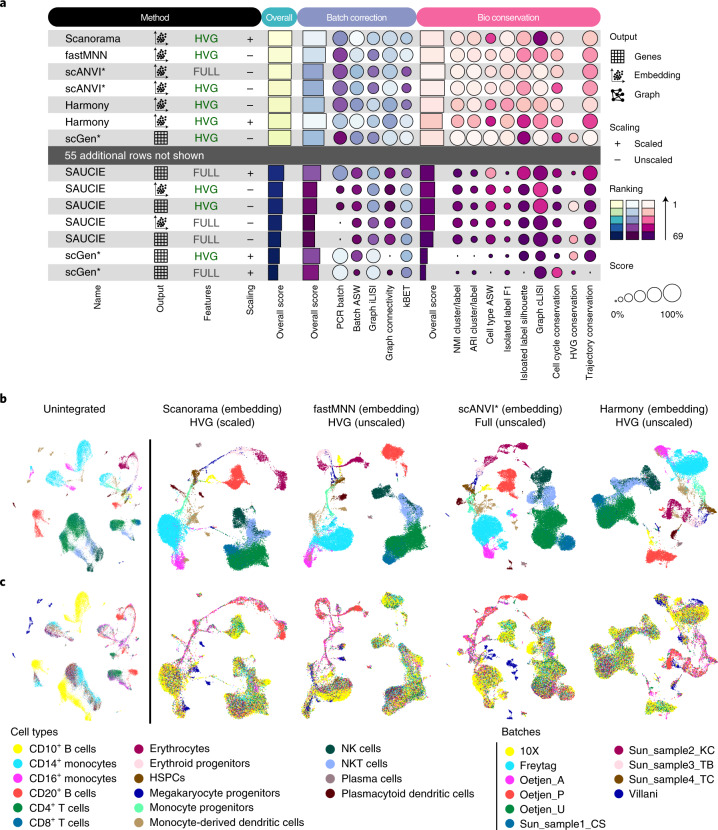
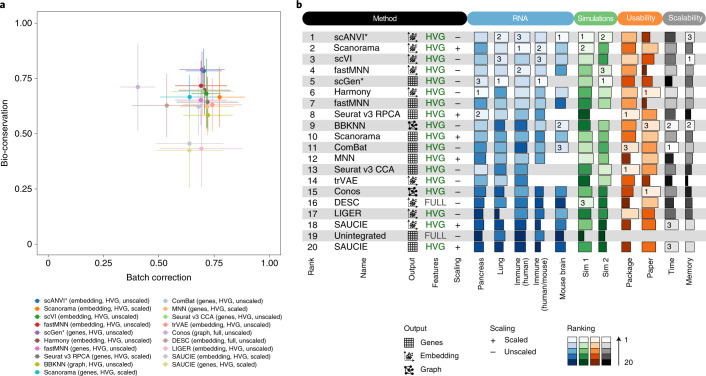
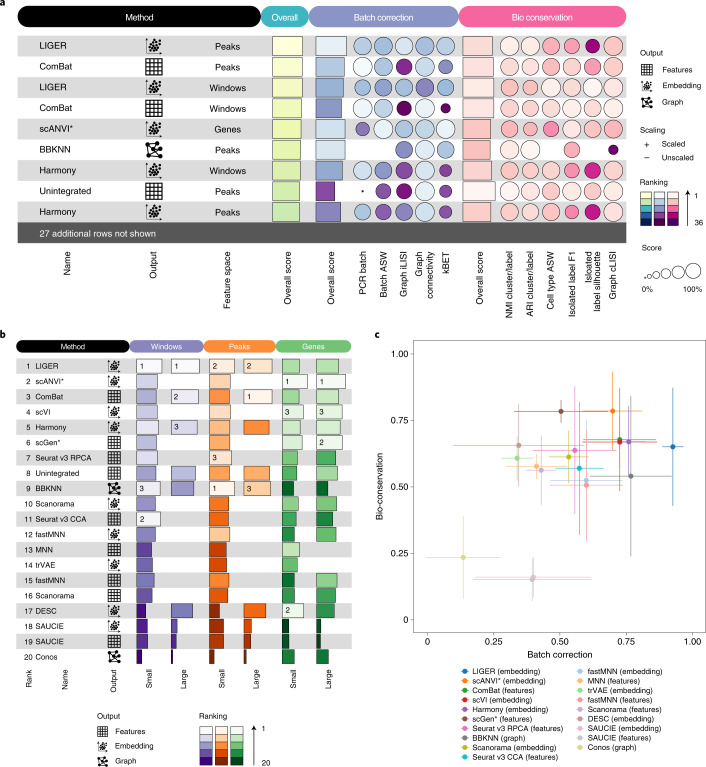
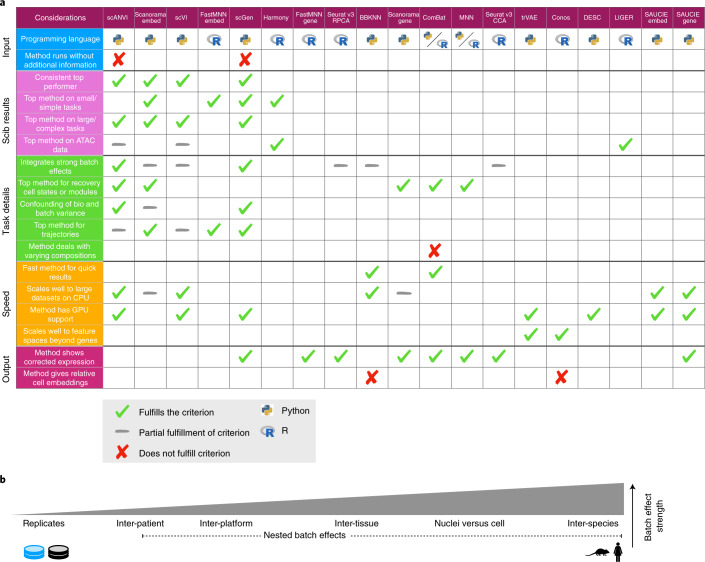
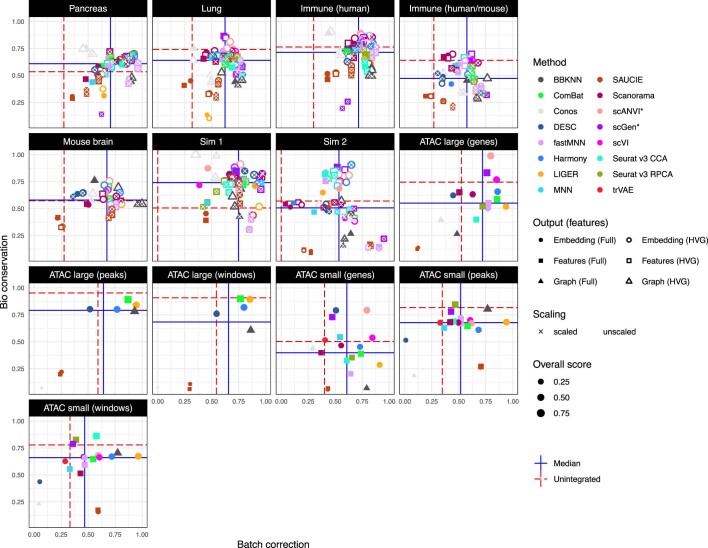
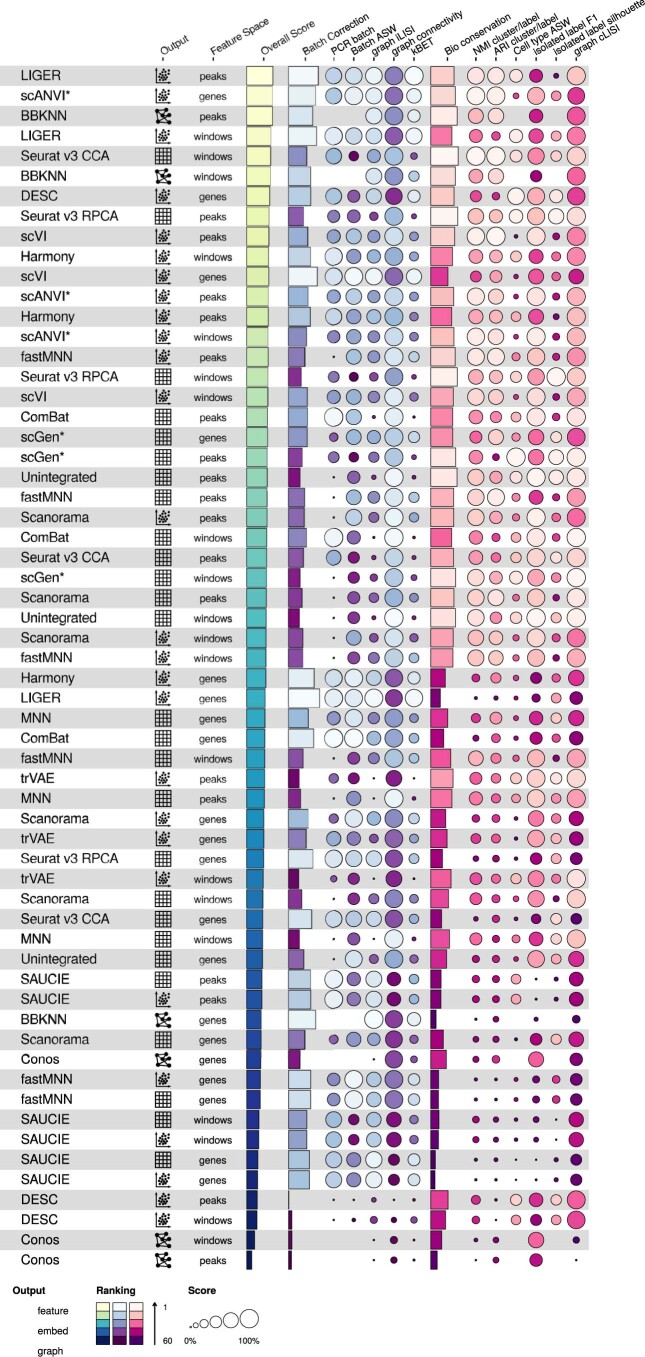
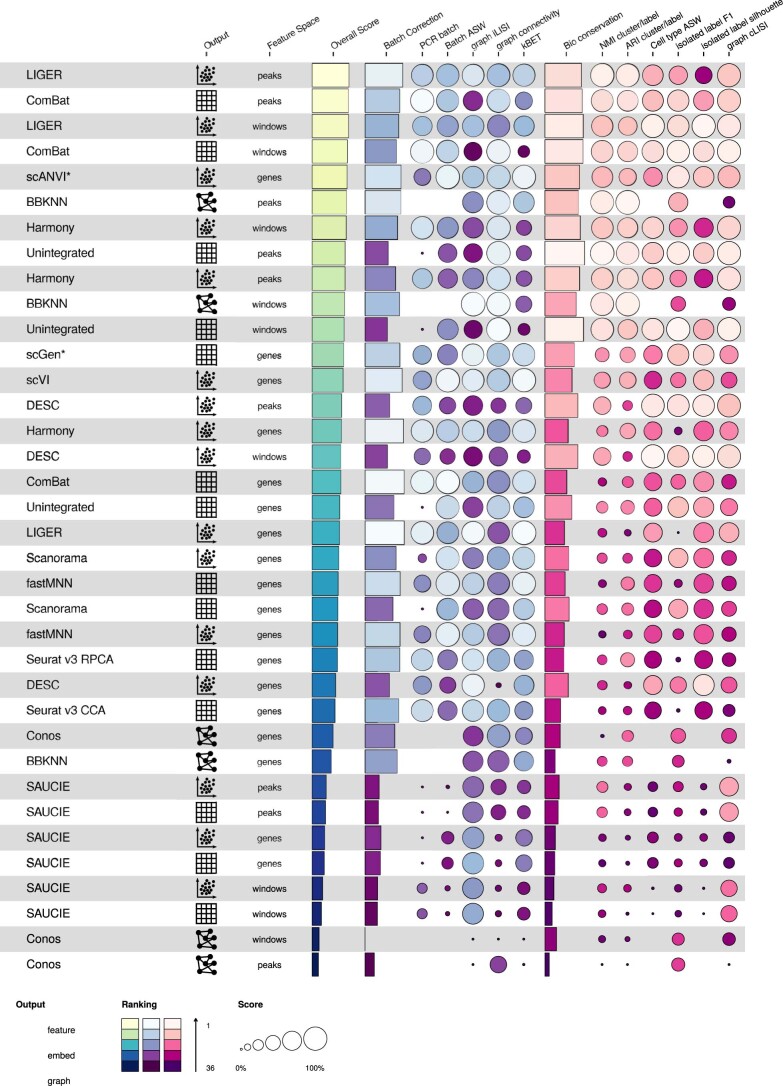
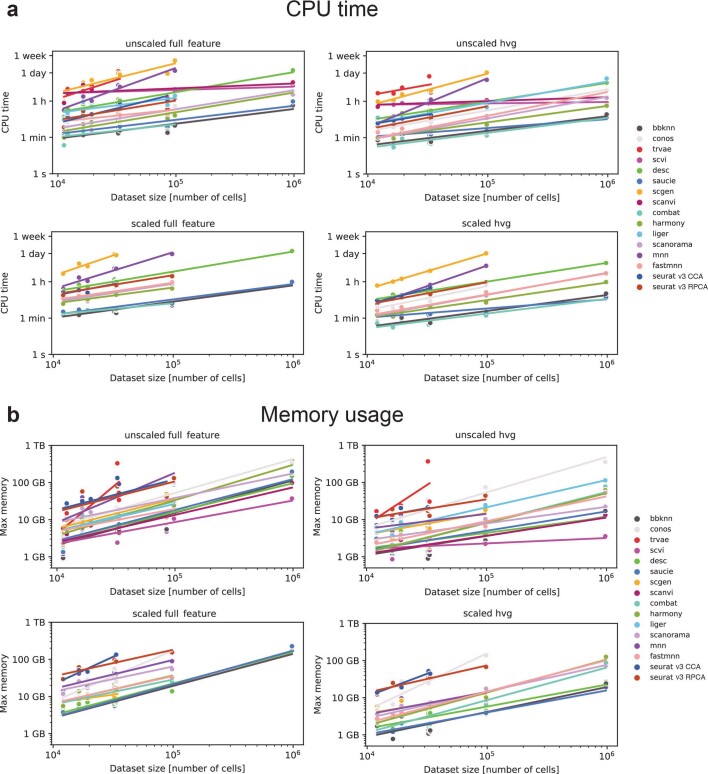
Single-cell atlases often include samples that span locations, laboratories and conditions, leading to complex, nested batch effects in data. Thus, joint analysis of atlas datasets requires reliable data integration. To guide integration method choice, we benchmarked 68 method and preprocessing combinations on 85 batches of gene expression, chromatin accessibility and simulation data from 23 publications, altogether representing >1.2 million cells distributed in 13 atlas-level integration tasks. We evaluated methods according to scalability, usability and their ability to remove batch effects while retaining biological variation using 14 evaluation metrics. We show that highly variable gene selection improves the performance of data integration methods, whereas scaling pushes methods to prioritize batch removal over conservation of biological variation. Overall, scANVI, Scanorama, scVI and scGen perform well, particularly on complex integration tasks, while single-cell ATAC-sequencing integration performance is strongly affected by choice of feature space. Our freely available Python module and benchmarking pipeline can identify optimal data integration methods for new data, benchmark new methods and improve method development.
Overview
The claims and statistics of this paper haven’t been checked yet.
Free: it reads the open-access text and checks the first 5 claims that cite a source we can check. Create a free account to check every claim.
Integrity signals
Registry
Cites
Statistics
Figures
Verification
Claims the paper makes
The claims and statistics of this paper haven’t been checked yet.
Free: it reads the open-access text and checks the first 5 claims that cite a source we can check. Create a free account to check every claim.
Claims other papers make about this one
Each is checked against this paper’s own text: does it say what the citing paper says it does?
The source backs part of the claim, not all of it — or backs it for a different population, condition or comparison.
In the citing paper
“Such integrative analysis is complicated by batch effects and biological differences between primary tissue and cell culture26,27.”
From scPerturb: harmonized single-cell perturbation data (2024) · cites this paper as [27]
Experimental — accuracy not yet measuredThe source backs part of the claim, not all of it — or backs it for a different population, condition or comparison.
In the citing paper
“Furthermore, 8 evaluation metrics (3 for batch effect removal and 5 for biological variation retention) are computed to verify the integration ability by scIB47, which ranks TOSICA the first out of all 13 applicable methods evaluated on combined effectiveness in batch effect removal and biological variation retention (Fig. 5b).”
From Transformer for one stop interpretable cell type annotation (2023) · cites this paper as [47]
Experimental — accuracy not yet measuredThe source backs part of the claim, not all of it — or backs it for a different population, condition or comparison.
In the citing paper
“In particular, Harmony22 is an algorithm well suited for correcting batch effects that may be present in a dimensionality-reduced single-cell expression dataset,79”
From hdWGCNA identifies co-expression networks in high-dimensional transcriptomics data (2023) · cites this paper as [79]
Experimental — accuracy not yet measuredThe cited source says what the claim attributes to it.
In the citing paper
“Although this work simplifies dataset access, joint analysis is limited by the complexity of data integration27.”
From scPerturb: harmonized single-cell perturbation data (2024) · cites this paper as [27]
The cited source says what the claim attributes to it.
In the citing paper
“Depending on the complexity of the integration tasks, such as atlas integration, deep-learning approaches such as scANVI40, scVI41 and scGen42 as well as linear-embedding models such as Scanorama43 performed best”
From Best practices for single-cell analysis across modalities (2023) · cites this paper as [35]
10 more claims about this paper
Create a free account to see every claim other papers make about this one.
Self-check
Percentages, sums and reported differences re-computed from the paper’s own numbers.
The self-check needs the paper’s full text.
Citations
Cites
Scikit-learn: Machine Learning in Python
Pedregosa, F., Varoquaux, G., Gramfort, A., Michel, V., Thirion, B., Grisel, O., Blondel, M., Müller, A., Nothman, J., Louppe, G., et al. (2012) · arXiv · doi:10.48550/arxiv.1201.0490 · Cited by 71,016 · cited 12×
“Similar to NMI, we compared the cell-type labels with the NMI-optimized Louvain clustering computed on the integrated dataset.”
BackgroundInfluentialSciPy 1.0: fundamental algorithms for scientific computing in Python
Virtanen, P., Gommers, R., Oliphant, T. E., Haberland, M., Reddy, T., Cournapeau, D., Burovski, E., Peterson, P., Weckesser, W., Bright, J., et al. (2020) · Nature Methods · doi:10.1038/s41592-019-0686-2 · Cited by 38,430
A note on two problems in connexion with graphs
Dijkstra, E. W. (1959) · Numerische Mathematik · doi:10.1007/bf01386390 · Cited by 29,065
Silhouettes: A graphical aid to the interpretation and validation of cluster analysis
Rousseeuw, P. J. (1987) · Journal of Computational and Applied Mathematics · doi:10.1016/0377-0427(87)90125-7 · Cited by 21,392
Comprehensive Integration of Single-Cell Data
Stuart, T., Butler, A., Hoffman, P., Hafemeister, C., Papalexi, E., Mauck, W. M., Hao, Y., Stoeckius, M., Smibert, P., & Satija, R. (2019) · Cell · doi:10.1016/j.cell.2019.05.031 · Cited by 15,453
ggplot2: Elegant Graphics for Data Analysis
Wickham, H. (2009) · doi:10.1007/978-0-387-98141-3 · Cited by 14,447
Fast, sensitive and accurate integration of single-cell data with Harmony
Korsunsky, I., Millard, N., Fan, J., Slowikowski, K., Zhang, F., Wei, K., Baglaenko, Y., Brenner, M., Loh, P.-R., & Raychaudhuri, S. (2019) · Nature Methods · doi:10.1038/s41592-019-0619-0 · Cited by 10,488
SciPy 1.0: fundamental algorithms for scientific computing in Python
Virtanen, P., Gommers, R., Oliphant, T. E., Haberland, M., Reddy, T., Cournapeau, D., Burovski, E., Peterson, P., Weckesser, W., Bright, J., et al. (2019) · Apollo - University of Cambridge Repository · doi:10.17863/cam.64134 · Cited by 10,460
UMAP: Uniform Manifold Approximation and Projection
McInnes, L., Healy, J., Saul, N., & Großberger, L. (2018) · Journal of Open Source Software · doi:10.21105/joss.00861 · Cited by 9,826
SCANPY: large-scale single-cell gene expression data analysis
Wolf, F. A., Angerer, P., & Theis, F. J. (2018) · Genome Biology · doi:10.1186/s13059-017-1382-0 · Cited by 8,881 · cited 1×
“Metrics were run on the integrated and unintegrated AnnData 47 objects.”
MethodSelf-citation
Cited by
Items 301–400 of 1,008
Proks, M., Salehin, N., & Brickman, J. M. (2024) · Nature Methods · doi:10.1038/s41592-024-02511-3 · Cited by 33
“Based on benchmarking integration strategies for scRNA-seq datasets 37,55 , we used single-cell variational inference (scVI) 39 and scGen 56 to integrate existing datasets.”
InfluentialLiu, F., Ding, Y., Xu, Z., Hao, X., Pan, T., Miles, G. E., Wang, S., Wu, Y.-H., Liu, J., Bado, I., et al. (2025) · Cell Genomics · doi:10.1016/j.xgen.2025.100888 · Cited by 46
“No new unique reagents were generated in this study.”
A clinical road map for single-cell omics
Skinnider, M. A., Courtine, G., Bloch, J., & Squair, J. W. (2025) · Cell · doi:10.1016/j.cell.2025.06.009 · Cited by 33
Auerbach, B. J., Hu, J., Reilly, M. P., & Li, M. (2021) · Genome Research · doi:10.1101/gr.275430.121 · Cited by 33
“However, this task ismuchmore challenging than batch effect correction in the embedding space (Lucken et al. 2020).”
BackgroundMarques, C., Friedrich, F., Liu, L., Castoldi, F., Pietrocola, F., & Lanekoff, I. (2023) · Journal of the American Society for Mass Spectrometry · doi:10.1021/jasms.3c00239 · Cited by 29
A systematic overview of single-cell transcriptomics databases, their use cases, and limitations
Gondal, M. N., Shah, S. U. R., Chinnaiyan, A. M., & Cieslik, M. P. (2024) · Frontiers in Bioinformatics · doi:10.3389/fbinf.2024.1417428 · Cited by 43
Cui, X., Chen, X., Li, Z., Gao, Z., Chen, S., & Jiang, R. (2024) · Nature Computational Science · doi:10.1038/s43588-024-00625-4 · Cited by 32
“We computed kBET score using the ‘scib’ package described in the review 29 , where higher kBET scores indicate better correction of batch effect.”
Advancing skeletal health and disease research with single-cell RNA sequencing
Lin, P., Gan, Y., He, J., Lin, S., Xu, J., Chang, L., Zhao, L., Zhu, J. J., Zhang, L., Huang, S., et al. (2024) · Military Medical Research · doi:10.1186/s40779-024-00538-3 · Cited by 34
“More than 50 integration strategies have been reported for benchmarking scRNA-seq datasets [72, 73].”
BackgroundCantoni, C., Smirnov, R. A., Firulyova, M. M., Andhey, P. S., Bradstreet, T. R., Esaulova, E., Terekhova, M., Schwarzkopf, E. A., Abdalla, N. M., Kleverov, M., et al. (2025) · Journal of Clinical Investigation · doi:10.1172/jci177793 · Cited by 31
“Based on benchmarking of single-cell, atlas-level data integration, Harmony was shown to be highly accurate in terms of batch correction while conserving the majority of biological variation (70).”
An overview of computational methods in single-cell transcriptomic cell type annotation
Li, T., Wang, Z., Liu, Y., He, S., Zou, Q., & Zhang, Y. (2025) · Briefings in Bioinformatics · doi:10.1093/bib/bbaf207 · Cited by 39
“The Seurat [56] integration tool utilizes canonical correlation analysis (CCA) to identify dataset-wide anchors and employs a shared nearest neighbor (SNN) graph to achieve robust integration of high-dimensional sparse data [57].”
Shortcomings of silhouette in single-cell integration benchmarking
Rautenstrauch, P., & Ohler, U. (2025) · Nature Biotechnology · doi:10.1038/s41587-025-02743-4 · Cited by 54
“In particular, Luecken et al. 17 profiled bone marrow mono-nuclear cells from multiple donors across distinct sites, with intersite batch effects being larger than intrasite batch effects between samples from distinct donors.”
EpiAgent: foundation model for single-cell epigenomics
Chen, X., Li, K., Cui, X., Wang, Z., Jiang, Q., Lin, J., Li, Z., Gao, Z., Lv, H., & Jiang, R. (2025) · Nature Methods · doi:10.1038/s41592-025-02822-z · Cited by 46
ResolVI: addressing noise and bias in spatial transcriptomics
Ergen, C., & Yosef, N. (2026) · Nature Methods · doi:10.1038/s41592-026-03212-9 · Cited by 40
“12) and then transferred these labels to all other segmentations (Methods; Supplementary Fig.”
Analysis of single-cell RNA sequencing data based on autoencoders
Tangherloni, A., Ricciuti, F., Besozzi, D., Lió, P., & Cvejic, A. (2021) · BMC Bioinformatics · doi:10.1186/s12859-021-04150-3 · Cited by 31
BAMboozle removes genetic variation from human sequence data for open data sharing
Ziegenhain, C., & Sandberg, R. (2021) · Nature Communications · doi:10.1038/s41467-021-26152-8 · Cited by 31
Besca, a single-cell transcriptomics analysis toolkit to accelerate translational research
Mädler, S. C., Julien-Laferrière, A., Wyss, L., Phan, M., Sonrel, A., Kang, A. S. W., Ulrich, E., Schmucki, R., Zhang, J. D., Ebeling, M., et al. (2021) · NAR Genomics and Bioinformatics · doi:10.1093/nargab/lqab102 · Cited by 30
“Scanorama is one of the most robust tools for the integration task and performs well on complex real data (44,45), especially on data from the 10X Genomics platform (13).”
MethodCombining LIANA and Tensor-cell2cell to decipher cell-cell communication across multiple samples
Baghdassarian, H., Dimitrov, D., Armingol, E., Sáez-Rodríguez, J., & Lewis, N. E. (2024) · Cell Reports Methods · doi:10.1016/j.crmeth.2024.100758 · Cited by 26
“…for batch correction benchmarking, each counts matrix was quantified for its level of batch severity using two previously applied metrics 50,56 : (1) kBET, 57 is an inverse measure of ‘‘mixability’’, or the extent to which batch effects are removed, and (2) normalized mutual information…”
Spatial analysis and predictive modeling of energy poverty: insights for policy implementation
Gawusu, S., Jamatutu, S. A., Zhang, X.-B., Moomin, S. T., Ahmed, A., Mensah, R. A., Das, O., & Ackah, I. (2024) · Environment Development and Sustainability · doi:10.1007/s10668-024-05015-4 · Cited by 31
“This normalization aligns with best practices for preprocessing data when utilizing machine learning algorithms (Kurani et al., 2023; Luecken et al., 2022; Park & Lek, 2016; Rafiq et al., 2001).”
Single-cell transcriptomics in tissue engineering and regenerative medicine
Ruta, A., Krishnan, K., & Elisseeff, J. H. (2023) · Nature Reviews Bioengineering · doi:10.1038/s44222-023-00132-7 · Cited by 29
“Run time, cell identity and purity, among other factors, can be used to identify a suitable computational method for a given data set 27,28 .”
txci-ATAC-seq: a massive-scale single-cell technique to profile chromatin accessibility
Zhang, H., Mulqueen, R. M., Iannuzo, N., Farrera, D. O., Polverino, F., Galligan, J. J., Ledford, J. G., Adey, A., & Cusanovich, D. A. (2024) · Genome biology · doi:10.1186/s13059-023-03150-1 · Cited by 28
Single-cell analysis in rheumatic and allergic diseases: insights for clinical practice
Nishide, M., Shimagami, H., & Kumanogoh, A. (2024) · Nature reviews. Immunology · doi:10.1038/s41577-024-01043-3 · Cited by 27
“Attempts are being made to combine single-cell omics with statistical methods to identify dynamic effects of genetic variation across cell contexts 134,135 and methods to efficiently remove batch effects for integrated analysis of genomes at single-cell resolution 136 .”
scDFN: enhancing single-cell RNA-seq clustering with deep fusion networks
Liu, T., Jia, C., Bi, Y., Guo, X., Zou, Q., & Li, F. (2024) · Briefings in Bioinformatics · doi:10.1093/bib/bbae486 · Cited by 29
“Compared to five state-of-the-art scRNA-seq clustering methods, scDFN achieved better NMI [29], ARI [30], local inverse Simpson’s index (LISI), and average silhouette width (ASW) [31] on multiple datasets.”
MethodThinking points for effective batch correction on biomedical data
Hui, H. W. H., Kong, W., & Goh, W. W. B. (2024) · Briefings in Bioinformatics · doi:10.1093/bib/bbae515 · Cited by 31
“Otherwise, Scanorama [68] has been shown to result in a more balanced correction that achieves both batch correction and bio-conservation [57].”
BackgroundAtlas-scale single-cell multi-sample multi-condition data integration using scMerge2
Lin, Y., Cao, Y., Willie, E., Patrick, E., & Yang, J. Y. H. (2023) · Nature Communications · doi:10.1038/s41467-023-39923-2 · Cited by 27
“49 50 Last year, benchmarking studies [12] began to investigate atlas-scale integration.”
Whole genome deconvolution unveils Alzheimer’s resilient epigenetic signature
Berson, E., Sreenivas, A., Phongpreecha, T., Perna, A., Grandi, F. C., Xue, L., Ravindra, N. G., Payrovnaziri, S. N., Mataraso, S. J., Kim, Y., et al. (2023) · Nature Communications · doi:10.1038/s41467-023-40611-4 · Cited by 26
“No batch normalization was further applied on the input of the model, since additional analysis suggests that Cell-former removes batch effects while preserving biological variations, i.e., kBet =0.79±0.14, NMI= 0, ARI= − 0.02± 0.001, cLISI= 1, iLISI= 0.58 ±0.02 across the brain regions 77 .”
MethodInfluentialLimitations of cell embedding metrics assessed using drifting islands
Wang, H., Leskovec, J., & Regev, A. (2025) · Nature Biotechnology · doi:10.1038/s41587-025-02702-z · Cited by 36
“Across all datasets, Islander consistently outperformed all baseline strategies across all 12 metrics 11 (Fig.”
InfluentialBiology-driven insights into the power of single-cell foundation models
Wu, J., Ye, Q., Wang, Y., Hu, R., Zhu, Y., Yin, M., Wang, T., Wang, J., Hsieh, C., & Hou, T. (2025) · Genome biology · doi:10.1186/s13059-025-03781-6 · Cited by 50
“Following the experimental settings in scGPT, the evaluation of batch integration is based on 3 biological conservation metrics (NMI cell ASW cell, ARI cell ) and 2 batch correction metrics (ASW batch , Graph connectivity) from scIB [36] (Methods).”
InfluentialA transcriptomic atlas of astrocyte heterogeneity across space and time in mouse and marmoset
Schroeder, M. E., McCormack, D. M., Metzner, L. R., Kang, J., Li, K. X., Yu, E., Melamed, L., Levandowski, K. M., Zaniewski, H., Zhang, Q., et al. (2025) · Neuron · doi:10.1016/j.neuron.2025.09.011 · Cited by 33
The discovAIR project: a roadmap towards the Human Lung Cell Atlas
Luecken, M. D., Zaragosi, L., Madissoon, E., Sikkema, L., Firsova, A. B., Domenico, E. D., Kuemmerle, L. B., Saglam, A., Berg, M., Gay, A. C. A., et al. (2022) · European Respiratory Journal · doi:10.1183/13993003.02057-2021 · Cited by 22
“One approach to establish such a reference atlas is to leverage recent advances in computational data integration techniques [15 – 19] to integrate the currently available scRNA-seq datasets into a single embedding, thereby establishing an integrated Human Lung Cell Atlas that captures most of the…”
Self-citationTranscriptional Heterogeneity of Cellular Senescence in Cancer
Junaid, M., Lee, A., Kim, J., Park, T. J., & Lim, S. B. (2022) · Molecules and Cells · doi:10.14348/molcells.2022.0036 · Cited by 28
“Benchmarking studies comparing experimental and computational/analytical tools specifically designed for scRNA-seq data are available elsewhere (Luecken et al., 2022; Mereu et al., 2020; Zhang et al., 2020).”
BackgroundZhou, M., Zhang, H., Bai, Z., Mann‐Krzisnik, D., Wang, F., & Li, Y. (2023) · Cell Reports Methods · doi:10.1016/j.crmeth.2023.100563 · Cited by 27
“GCmeasures whether cells of the same type from different batches are close to one another by computing a K nearest-neighbour graph based on the distance between cells in the embedding space.(20)”
MethodIntegrating single-cell RNA-seq datasets with substantial batch effectsPreprint
Hrovatin, K., Moinfar, A. A., Zappia, L., Tejada-Lapuerta, A., Lengerich, B. J., Kellis, M., & Theis, F. J. (2023) · bioRxiv (Cold Spring Harbor Laboratory) · doi:10.1101/2023.11.03.565463 · Cited by 24
“Among the most popular and best-performing methods are conditional variational autoencoder (cVAE) based models, which can correct non-linear batch effects, are flexible in the choice of batch covariates, and are scalable to large datasets 17,19 .”
InfluentialSelf-citationWen, Z., Wang, L., Ma, H., Li, L., Wan, L., Shi, L., Li, H., Chen, H., Hao, W., Song, S., et al. (2024) · Journal of Infection · doi:10.1016/j.jinf.2024.106158 · Cited by 24
Adameyko, I. I., Bakken, T. E., Bhaduri, A., Chhatbar, C., Filbin, M. G., Gate, D., Hochgerner, H., Kim, C. N., Krull, J. E., Manno, G. L., et al. (2024) · Nature Neuroscience · doi:10.1038/s41593-024-01827-9 · Cited by 27
“Benchmarking studies on batch correction and other analyses are critical 77,78 and should include impartial computational metrics and thorough biological validation.”
DenAdel, A., Hughes, M., Thoutam, A., Gupta, A., Navia, A. W., Fusi, N., Raghavan, S., Winter, P. S., Amini, A. P., & Crawford, L. A. (2026) · Nature Methods · doi:10.1038/s41592-026-03120-y · Cited by 52
“Here, we use the following metrics: NMI (cluster/label), ARI (cluster/label), ASW (label), ASW (batch) and AvgBIO as implemented by Luecken et al. 39 in the scib package.”
Qin, Y., Liu, Z., Gao, S., Martínez-Vasallo, C., Long, Y., Zhu, X., Liu, B., Gao, Y., Xu, X., Nohales, M. A., et al. (2025) · Nature Communications · doi:10.1038/s41467-025-59424-8 · Cited by 32
“We also evaluated the effectiveness of batch effect removal using the kBET 38 method provided in scIB 89 .”
Ma, Y., Chen, J., Wang, T., Zhang, L., Xu, X., Qiu, Y., Xiang, A. P., & Huang, W. (2022) · Frontiers in Immunology · doi:10.3389/fimmu.2022.870531 · Cited by 27
“Compared with other integration tools (e.g., BBKNN and LIGER), RPCA could conserve more distinct cell identities when removing batch effect, particularly for the data of immune cells (30).”
MethodTang, S., Cui, X., Wang, R., Li, S., Li, S., Huang, X., & Chen, S. (2024) · Nature Communications · doi:10.1038/s41467-024-46045-w · Cited by 27
“S21a) 57,58 .”
An integrated transcriptomic cell atlas of human neural organoidsPreprint
He, Z., Dony, L., Fleck, J. S., Szałata, A., Li, K. X., Slišković, I., Lin, H., Santel, M., Atamian, A., Quadrato, G., et al. (2023) · bioRxiv (Cold Spring Harbor Laboratory) · doi:10.1101/2023.10.05.561097 · Cited by 23
Self-citationMissarova, A., Rosen, L. U., Dann, E., Satija, R., & Marioni, J. C. (2024) · Genome biology · doi:10.1186/s13059-024-03334-3 · Cited by 33
Samaran, J., Peyré, G., & Cantini, L. (2024) · Nature Communications · doi:10.1038/s41467-024-51382-x · Cited by 30
“31,38,46 as explained in “ Methods ” section), to evaluate the closeness of paired cells, connectivity 47 , to assess whether cells from the same cell type are close to each other independently of their modality of origin, and transfer accuracy 48 , to measure the proximity between corresponding…”
Feature selection methods affect the performance of scRNA-seq data integration and querying
Zappia, L., Richter, S., Ramírez-Suástegui, C., Kfuri‐Rubens, R., Vornholz, L., Wang, W., Dietrich, O., Frishberg, A., Luecken, M. D., & Theis, F. J. (2025) · Nature Methods · doi:10.1038/s41592-025-02624-3 · Cited by 38
“Please refer to the supplementary methods, pipeline code, original publications and package documentation for further information.”
Self-citationCurrent insights in mouse iNKT and MAIT cell development using single cell transcriptomics data
Krovi, S. H., Loh, L., Spengler, A., Brunetti, T. M., & Gapin, L. (2022) · Seminars in Immunology · doi:10.1016/j.smim.2022.101658 · Cited by 23
Alignment of single-cell trajectory trees with CAPITAL
Sugihara, R., Kato, Y., Mori, T., & Kawahara, Y. (2022) · Nature Communications · doi:10.1038/s41467-022-33681-3 · Cited by 27
“We will show the superiority of one method over its competitors from two viewpoints: biological variance conservation and batch removal before and after alignment/ integration 16 .”
InfluentialMOSim: bulk and single-cell multilayer regulatory network simulator
Monzó, C., Aguerralde‐Martin, M., Martínez-Mira, C., Arzalluz-Luque, Á., Conesa, A., & Tarazona, S. (2025) · Briefings in Bioinformatics · doi:10.1093/bib/bbaf110 · Cited by 23
“However, benchmarking studies of bioinformatic tools designed to elucidate multilayered GRNs by integrating multi-omics datasets have exposed notable discrepancies in library preparation strategies and analysis methods [27].”
Li, H., Zhang, Z., Squires, M., Chen, X. X., & Zhang, X. (2022) · bioRxiv (Cold Spring Harbor Laboratory) · doi:10.1101/2022.10.15.512320 · Cited by 22
Hsu, L. L., & Culhane, A. C. (2023) · Scientific Reports · doi:10.1038/s41598-022-26434-1 · Cited by 32
Batch correction methods used in single-cell RNA sequencing analyses are often poorly calibrated
Antonsson, S. E., & Melsted, P. (2025) · Genome Research · doi:10.1101/gr.279886.124 · Cited by 41
Batch correction of single-cell sequencing data via an autoencoder architecture
Danino, R., Nachman, I., & Sharan, R. (2023) · Bioinformatics Advances · doi:10.1093/bioadv/vbad186 · Cited by 20
“All evaluations were performed according to a recently published integration benchmarking pipeline and using the package they developed (Luecken et al. 2022).”
BackgroundMethodInfluentialPrincipled and interpretable alignability testing and integration of single-cell data
Ma, R., Sun, E., Donoho, D. L., & Zou, J. (2024) · Proceedings of the National Academy of Sciences · doi:10.1073/pnas.2313719121 · Cited by 38
STimage-1K4M: A histopathology image-gene expression dataset for spatial transcriptomics
Chen, J., Zhou, M., Wu, W., Zhang, J., Li, Y., & Li, D. (2024) · neural information processing systems · doi:10.52202/079017-1129 · Cited by 71
Mosaic integration of spatial multi-omics with SpaMosaic
Yan, X., Fang, Z., Ang, K. S., van Olst, L., Edwards, A., Watson, T., Zheng, R., Zhang, D., Fan, R., Li, M., et al. (2026) · Nature Genetics · doi:10.1038/s41588-026-02573-3 · Cited by 33
Adapting systems biology to address the complexity of human disease in the single-cell era
Fischer, D. S., Villanueva, M. A., Winter, P. S., & Shalek, A. K. (2025) · Nature Reviews Genetics · doi:10.1038/s41576-025-00821-6 · Cited by 35
“Here, the field generally relies on integration strategies that account for noisy and sparse measurements 80 , as well as those that attempt to”
InfluentialXu, Y., Lou, D., Chen, P., Li, G., Usoskin, D., Pan, J., Li, F., Huang, S., Hess, C., Tang, R., et al. (2025) · Developmental Cell · doi:10.1016/j.devcel.2025.04.013 · Cited by 26
Hausmann, F., Ergen, C., Khatri, R., Marouf, M., Hänzelmann, S., Gagliani, N., Huber, S., Machart, P., & Bonn, S. (2023) · Genome biology · doi:10.1186/s13059-023-03049-x · Cited by 23
“This is true for data integration [59, 60] as well as for expression reconstruction algorithms and we would highlight guiding principles for optimal results.”
Realize Generative Yet Complete Latent Representation for Incomplete Multi-View Learning
Cai, H., Huang, W., Yang, S., Ding, S., Zhang, Y., Hu, B., Zhang, F., & Cheung, Y. (2023) · IEEE Transactions on Pattern Analysis and Machine Intelligence · doi:10.1109/tpami.2023.3346869 · Cited by 29
Single-cell multiomics guided mechanistic understanding of Fontan-associated liver disease
Hu, P., Rychik, J. R., Zhao, J., Bai, H., Bauer, A., Yu, W., Rand, E. B., Dodds, K. M., Goldberg, D., Tan, K., et al. (2024) · Science Translational Medicine · doi:10.1126/scitranslmed.adk6213 · Cited by 29
AI analysis of super-resolution microscopy: Biological discovery in the absence of ground truth
Nabi, I. R., Cardoen, B., Khater, I. M., Gao, G., Wong, T. H., & Hamarneh, G. (2024) · The Journal of Cell Biology · doi:10.1083/jcb.202311073 · Cited by 26
Erasure of Biologically Meaningful Signal by Unsupervised scRNAseq Batch-correction MethodsPreprint
Tyler, S. R., Guccione, E., & Schadt, E. E. (2021) · bioRxiv (Cold Spring Harbor Laboratory) · doi:10.1101/2021.11.15.468733 · Cited by 22
Universal cell embedding provides a foundation model for cell biology
Rosen, Y., Roohani, Y., Agrawal, A., Samotorcan, L., Quake, S. R., & Leskovec, J. (2026) · Nature · doi:10.1038/s41586-026-10689-z · Cited by 287
“UCE was trained across more than 300 datasets that are largely collected from the CellXGene corpus 35 comprising over 36 million cells, for 40 days across 24 A100 80 GB GPUs (Methods and Supplementary Tables 2 and 16).”
New horizons in the stormy sea of multimodal single-cell data integration
Jackson, C. A., & Vogel, C. (2022) · Molecular Cell · doi:10.1016/j.molcel.2021.12.012 · Cited by 26
Nano-CUT&Tag for multimodal chromatin profiling at single-cell resolution
Barcenas-Walls, J. R., Ansaloni, F., Hervé, B., Strandback, E., Nyman, T., Castelo‐Branco, G., & Bartošovič, M. (2023) · Nature Protocols · doi:10.1038/s41596-023-00932-6 · Cited by 29
Schäfer, S., Smelik, M., Sysoev, O., Zhao, Y., Eklund, D., Lilja, S., Gustafsson, M., Heyn, H., Julià, A., Kovács, I. A., et al. (2024) · Genome Medicine · doi:10.1186/s13073-024-01314-7 · Cited by 23
“These anchors were later used by IntegrateData() [41] to integrate the data from individuals to correct for patient-specific differences as suggested in [42].”
MethodAcinar to β-like cell conversion through inhibition of focal adhesion kinase
Dahiya, S., Saleh, M. W., Rodriguez, U. A., Rajasundaram, D., Arbujas, J. R., Hajihassani, A., Yang, K., Sehrawat, A., Kalsi, R. S., Yoshida, S., et al. (2024) · Nature Communications · doi:10.1038/s41467-024-47972-4 · Cited by 23
Sethi, R., Ang, K. S., Li, M., Long, Y., Ling, J., & Chen, J. (2024) · Nature Communications · doi:10.1038/s41467-024-48188-2 · Cited by 23
“4), which were identi fi ed in previous benchmarking studies 27,34 .”
Northstar enables automatic classification of known and novel cell types from tumor samples
Zanini, F., Berghuis, B. A., Jones, R. C., di Robilant, B. N., Nong, R. Y., Norton, J. A., Clarke, M. F., & Quake, S. R. (2020) · Scientific Reports · doi:10.1038/s41598-020-71805-1 · Cited by 16
Weakly supervised learning uncovers phenotypic signatures in single-cell dataPreprint
Litinetskaya, A., Hediyeh-zadeh, S., Moinfar, A. A., Lotfollahi, M., & Theis, F. J. (2024) · bioRxiv (Cold Spring Harbor Laboratory) · doi:10.1101/2024.07.29.605625 · Cited by 20
Self-citationSingle-Cell Sequencing Unveils the Heterogeneity of Nonimmune Cells in Chronic Apical Periodontitis
Lin, X., Chi, D., Meng, Q., Gong, Q., & Tong, Z. (2022) · Frontiers in Cell and Developmental Biology · doi:10.3389/fcell.2021.820274 · Cited by 19
An introduction to representation learning for single-cell data analysis
Gunawan, I., Vafaee, F., Meijering, E. H. W., & Lock, J. G. (2023) · Cell Reports Methods · doi:10.1016/j.crmeth.2023.100547 · Cited by 29
“Finally, we highlight multi-modal data integration as a key research opportunity as well as a data preparation/pre-processing challenge, with several integration methods inherently using representation learning approaches to output joint embeddings.(54) Undoubtedly, optimized methods for computational data integration…”
MethodComputational methods for alignment and integration of spatially resolved transcriptomics data
Liu, Y., & Yang, C. (2024) · Computational and Structural Biotechnology Journal · doi:10.1016/j.csbj.2024.03.002 · Cited by 21
Panpipes: a pipeline for multiomic single-cell and spatial transcriptomic data analysis
Curion, F., Rich‐Griffin, C., Agarwal, D., Ouologuem, S., Rue-Albrecht, K., May, L., Garcia, G. E. L., Heumos, L., Thomas, T. R., Lason, W., et al. (2024) · Genome biology · doi:10.1186/s13059-024-03322-7 · Cited by 30
“The batch correction methods offered for the different modalities have been selected based on underlying statistical assumptions and published benchmarks [20].”
MethodInfluentialSelf-citationSIMVI disentangles intrinsic and spatial-induced cellular states in spatial omics data
Dong, M., Su, D. G., Kluger, H. M., Fan, R., & Kluger, Y. (2025) · Nature Communications · doi:10.1038/s41467-025-58089-7 · Cited by 28
Interpretable inflammation landscape of circulating immune cells
Jiménez-Gracia, L., Maspero, D., Aguilar-Fernández, S., Craighero, F., Boulougouri, M., Ruiz, M., Marchese, D., Caratù, G., Liñares-Blanco, J., Berasategi, M., et al. (2026) · Nature Medicine · doi:10.1038/s41591-025-04126-3 · Cited by 29
“Generative probabilistic models proved superior performances in integrating complex datasets compared to other approaches 16 , particularly if cell annotations are available (Extended Data Fig.”
Single-cell spatial transcriptomic analysis of human skin anatomy
Restrepo, P., Wilder, A., Houser, A. E., Sandhu, H. S., Jimenez, A. V. R., Hren, M. G., Gill, R., Kazmi, A., Chen, L., Nigro, A. R., et al. (2026) · Nature Genetics · doi:10.1038/s41588-026-02552-8 · Cited by 34
Understanding the Adult Mammalian Heart at Single-Cell RNA-Seq Resolution
Marín‐Sedeño, E., de Morentin, X. M., Pérez-Pomares, J. M., Gómez-Cabrero, D., & Ruiz‐Villalba, A. (2021) · Frontiers in Cell and Developmental Biology · doi:10.3389/fcell.2021.645276 · Cited by 19
“…et al., 2017; Huang et al., 2018; van Dijk et al., 2018; Eraslan et al., 2019b); (v) integration of multiple (and possible massive) data-sets (Luecken et al., 2020); and (vi) the implementation of multi-omic (e.g., scRNASeq, Baek and Lee, 2020) and scATAC-Seq analysis (Chen H. et al., 2019;…”
BackgroundMethodIntegration of single-cell multi-omics data by regression analysis on unpaired observations
Yuan, Q., & Duren, Z. (2022) · Genome biology · doi:10.1186/s13059-022-02726-7 · Cited by 22
“We first assess the performance of co-embedding at removing batch variation (RNA-seq and ATAC-seq) by graph connectivity (GC) [31] score, which ranges from 0 to 1 (see the “Methods” section for detail).”
BackgroundIntegration of scATAC-Seq with scRNA-Seq Data
Berest, I., & Tangherloni, A. (2022) · Methods in molecular biology · doi:10.1007/978-1-0716-2756-3_15 · Cited by 21
Guo, X., Ning, J., Chen, Y., Liu, G., Zhao, L., Fan, Y., & Sun, S. (2023) · Briefings in Functional Genomics · doi:10.1093/bfgp/elad011 · Cited by 20
Lee, H., Kim, S. Y., Kwon, N., Jo, S. J., Kwon, O., & Kim, J. (2023) · Journal of Investigative Dermatology · doi:10.1016/j.jid.2023.11.008 · Cited by 22
Fan, Y., Li, L., & Sun, S. (2024) · Genome biology · doi:10.1186/s13059-024-03237-3 · Cited by 24
Scalable and unbiased sequence-informed embedding of single-cell ATAC-seq data with CellSpace
Tayyebi, Z., Pine, A. R., & Leslie, C. S. (2024) · Nature Methods · doi:10.1038/s41592-024-02274-x · Cited by 21
“…we assessed the batch effect using published metrics ( k -NN batch-effect test (kBET), batch average silhouette width (ASW) and graph connectivity) 15 , as well as a mutual information-based metric (batch-normalized mutual information (NMI)), and also evaluated clustering quality metrics…”
MethodInfluentialSpatial Transcriptomics of the Respiratory System
Megas, S., Wilbrey-Clark, A., Maartens, A. P., Teichmann, S. A., & Meyer, K. B. (2024) · Annual Review of Physiology · doi:10.1146/annurev-physiol-022724-105144 · Cited by 20
Recovery of biological signals lost in single-cell batch integration with CellANOVA
Zhang, Z., Mathew, D., Lim, T., Mason, K., Martinez, C. M., Huang, S., Wherry, E. J., Suszták, K., Minn, A. J., Ma, Z., et al. (2024) · Nature Biotechnology · doi:10.1038/s41587-024-02463-1 · Cited by 41
Optimal distance metrics for single-cell RNA-seq populations
Ji, Y., Green, T. D., Peidli, S., Bahrami, M., Liu, M., Zappia, L., Hrovatin, K., Sander, C., & Theis, F. J. (2023) · bioRxiv (Cold Spring Harbor Laboratory) · doi:10.1101/2023.12.26.572833 · Cited by 18
“We compared this latent representation with one from a standard scVI model, using Local Inverse Simpson's Index (LISI) 33,34 to identify CRISPRa treatments that clustered (Supplementary Methods).”
MethodSelf-citationPolyphony: an Interactive Transfer Learning Framework for Single-Cell Data Analysis
Cheng, F., Keller, M. S., Qu, H., Gehlenborg, N., & Wang, Q. (2022) · IEEE Transactions on Visualization and Computer Graphics · doi:10.1109/tvcg.2022.3209408 · Cited by 24
“commonly-used and well-performing single-cell data integration and representation learning method [39].”
BackgroundMethodKomatsu, J., Cico, A., Poncin, R., Bohec, M. L., Morf, J., Lipin, S., Graindorge, A., Eckert, H., Saffarian, A., Cathaly, L., et al. (2023) · Scientific Reports · doi:10.1038/s41598-023-31915-y · Cited by 22
CellBiAge: Improved single-cell age classification using data binarization
Yu, D., Li, M., Linghu, G., Hu, Y., Hajdarovic, K. H., Wang, A., Singh, R., & Webb, A. E. (2023) · Cell Reports · doi:10.1016/j.celrep.2023.113500 · Cited by 21
“52 To confirm that our method is robust to batch correction, we selected animals from the two batches in the training and test (Figures S4C–S4G).”
Sehanobish, A., Ravindra, N. G., & van Dijk, D. (2021) · Proceedings of the AAAI Conference on Artificial Intelligence · doi:10.1609/aaai.v35i6.16619 · Cited by 21
Vicidomini, R., Nguyen, T. H., Choudhury, S. D., Brody, T., & Serpe, M. (2021) · Current Protocols · doi:10.1002/cpz1.37 · Cited by 13
Swarm immunology: harnessing blockchain technology and artificial intelligence in human immunology
Schultze, J. L., Büttner, M., & Becker, M. (2022) · Nature reviews. Immunology · doi:10.1038/s41577-022-00740-1 · Cited by 18
“Deep learning models, especially variational autoencoders, have shown superior performance when handling high-throughput, high-dimensional single-cell data, for instance, in data integration tasks 8 .”
BackgroundSelf-citationMoinfar, A. A., & Theis, F. J. (2024) · bioRxiv (Cold Spring Harbor Laboratory) · doi:10.1101/2024.11.06.622266 · Cited by 24
Self-citationStabMap: Mosaic single cell data integration using non-overlapping features
Ghazanfar, S., Guibentif, C., & Marioni, J. C. (2022) · doi:10.1101/2022.02.24.481823 · Cited by 16
“Consequently, data integration has emerged as a key challenge for consolidating and profiting from such rich resources 5 , with the task of integrating diverse molecular assays being known as ‘mosaic data integration’ 6 .”
BackgroundHu, X., Li, H., Chen, M., Qian, J., & Jiang, H. (2025) · Communications Biology · doi:10.1038/s42003-025-07947-7 · Cited by 16
“Here,weevaluatedascATAC-seqintegration task,usingtwobatchesofgeneactivitydataformousebrainderivedfrom scATAC-seqpeakcalling 37 .”
Shuai, P., Hsieh, J. A., Kao, C., Hu, C.-W., Wang, R., Kuo, S., Yen, M., Liou, P., Ho, Y.-C., Chu, C.-C., et al. (2025) · The Plant Cell · doi:10.1093/plcell/koaf253 · Cited by 21
Integrating single-cell RNA-seq datasets with substantial batch effects
Hrovatin, K., Moinfar, A. A., Zappia, L., Parikh, S., Tejada-Lapuerta, A., Lengerich, B. J., Kellis, M., & Theis, F. J. (2025) · BMC Genomics · doi:10.1186/s12864-025-12126-3 · Cited by 52
“Thus, there is a need for methods that enable sufficient batch correction, even for datasets with substantial batch effects, while preserving both cell type and within-cell-type biological variation [20].”
InfluentialSelf-citationBase barrier cells provide compartmentalization of choroid plexus, brain and CSF
Verhaege, D., Nolf, C. D., Acker, L. V., Claeys, W., Castelein, J., Wonterghem, E. V., Imschoot, G. V., Dujardin, P., Spiegelaere, W. D., Hoste, E., et al. (2026) · Nature Neuroscience · doi:10.1038/s41593-025-02188-7 · Cited by 29
Shen, H., Shen, X., Feng, M., Wu, D., Zhang, C., Yang, Y., Yang, M., Hu, J., Liu, J., Wang, W., et al. (2022) · Briefings in Bioinformatics · doi:10.1093/bib/bbab573 · Cited by 20
Decoding exceptional plant traits by comparative single-cell genomics
Conde, D., & Kirst, M. (2022) · Trends in Plant Science · doi:10.1016/j.tplants.2022.08.006 · Cited by 16
Sonrel, A., Luetge, A., Soneson, C., Mallona, I., Germain, P., Knyazev, S., Gilis, J., Gerber, R., Seurinck, R., Paul, D., et al. (2023) · Genome biology · doi:10.1186/s13059-023-02962-5 · Cited by 18
“This lack of standards can, for example, lead to different rankings of the same methods for the same task (Luecken, Büttner, et al. 2022; Chazarra-Gil et al. 2021; Tran et al. 2020).”
MethodSiFT: uncovering hidden biological processes by probabilistic filtering of single-cell data
Piran, Z., & Nitzan, M. (2024) · Nature Communications · doi:10.1038/s41467-024-44757-7 · Cited by 18
“To quantify the performance and assess the separability of the sub-clonesalongwiththemixingofthecellcyclestages,weuseasetof metrics for integration accuracy 24 .”
Metadata
- Authors
- Luecken, M. D., Büttner, M., Chaichoompu, K., Danese, A., Interlandi, M., Mueller, M. F., Strobl, D. C., Zappia, L., Dugas, M., Colomé-Tatché, M., & Theis, F. J.
- Affiliations
- Helmholtz Munich (DE)
- University of Münster (DE)
- University Hospital Heidelberg (DE)
- Corresponding author
- Theis, Fabian J.
- ORCID
- Venue
- Nature Methods
- Published
- 2021-12-23
- Volume
- 19
- Issue
- 1
- Pages
- 41-50
- ISSN
- 1548-7091 (ISSN-L)
- 1548-7105
- PMC
- PMC8748196
- OpenAlex
- W4225598893
- Cited by
- 1,438
- References
- 87
- Citations by year
- 2026: 380 · 2025: 358 · 2024: 304 · 2023: 210 · 2022: 115 · 2021: 53
- FWCI
- 55.88
- Type
- journal article
- Language
- en
- Open access
- hybrid
- doi.org
- Licence
- cc-by
- creativecommons.org/licenses/by/4.0 (tdm)
- creativecommons.org/licenses/by/4.0 (vor)
- Locations
- Nature Methods (publishedVersion, cc-by)
- bioRxiv (Cold Spring Harbor Laboratory) (acceptedVersion, cc-by)
- PubMed Central (publishedVersion, cc-by)
- PubMed (publishedVersion)
- Site cant be reached (submittedVersion, cc-by)
- Funders
- Silicon Valley Community Foundation (182835)
- Wellcome Trust (108413 /A/15/D)
- Chan Zuckerberg Initiative (182835)
- European Commission (874656, 2020 ‘, HORIZON2020)
- Helmholtz Zentrum München
- Topics
- Life Sciences › Biochemistry, Genetics and Molecular Biology › Molecular Biology › Single-cell and spatial transcriptomics
- Life Sciences › Biochemistry, Genetics and Molecular Biology › Molecular Biology › Gene expression and cancer classification
- Life Sciences › Biochemistry, Genetics and Molecular Biology › Molecular Biology › Bioinformatics and Genomic Networks
- Keywords
- single-cell data integration, batch effects, benchmarking, single-cell atlas, scANVI, scVI, single-cell ATAC-seq, chromatin accessibility, gene expression, feature space selection, scalability
- MeSH terms
- Animals, Humans, Immune System, Software, Sequence Analysis, RNA, Computational Biology, Benchmarking, Genomics, Databases, Genetic, Mice, Single-Cell Analysis
About these checks
Registry, retraction, Cites and statistics results are computed, not judged, with one exception: a printed reference that no index lists is read once by a model before it counts as a citation error. Claims are extracted by a model and kept only when their quote appears verbatim in the text; each cited source is then checked, with a model’s help, for whether it says what the claim relies on. Those verdicts can be wrong — read the claim’s quote and the cited source before relying on one.
Statistics and arithmetic are recomputed, not judged.
Confidence bands are shown only for fields calibrated on our annotated test set. None is calibrated yet, so no band is shown.
What counts as a claim ›How we measure confidence ›How we check this ›
Are you an author, or do you see a problem with this page? Request a review
Data sources
Bibliographic data: Semantic Scholar, OpenAlex, Crossref.
Contains information from the Semantic Scholar Academic Graph Datasets, made available under the ODC Attribution License (ODC-BY 1.0).
Semantic Scholar’s data is described in: Kinney, R., et al. (2023). The Semantic Scholar Open Data Platform. arXiv:2301.10140.
