

SCENIC+: single-cell multiomic inference of enhancers and gene regulatory networks
Open accessPublished version of a preprint
The DOI matches its Crossref record; 175 of the 175 references it cites were found in a registry or an index.
Abstract
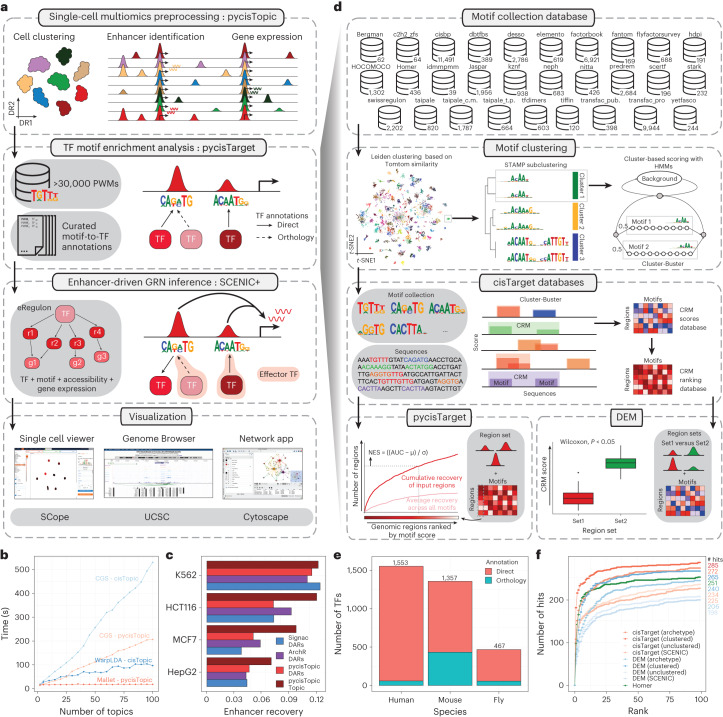
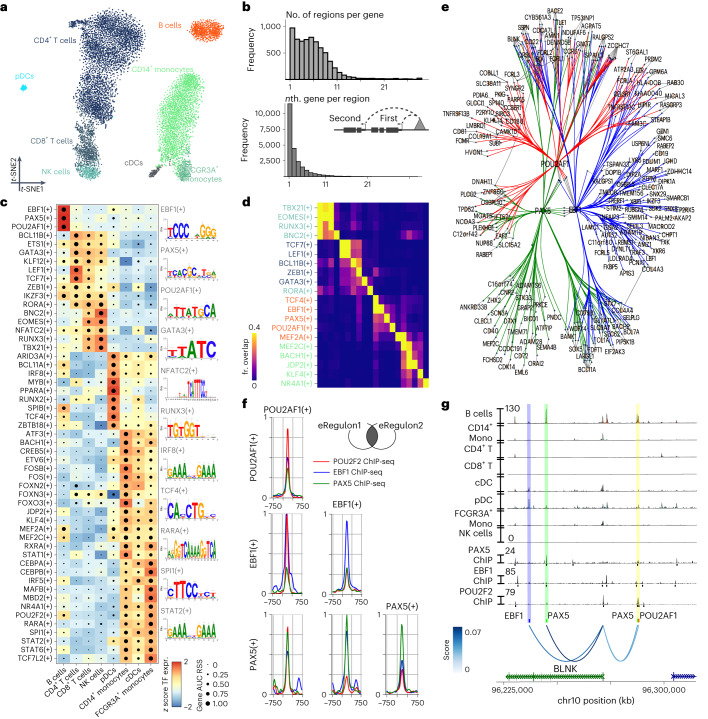
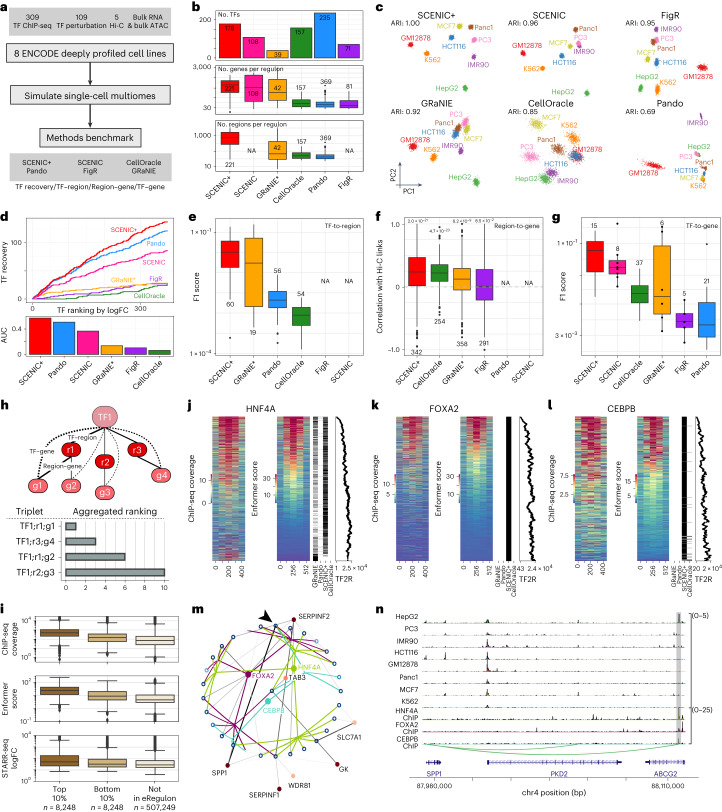
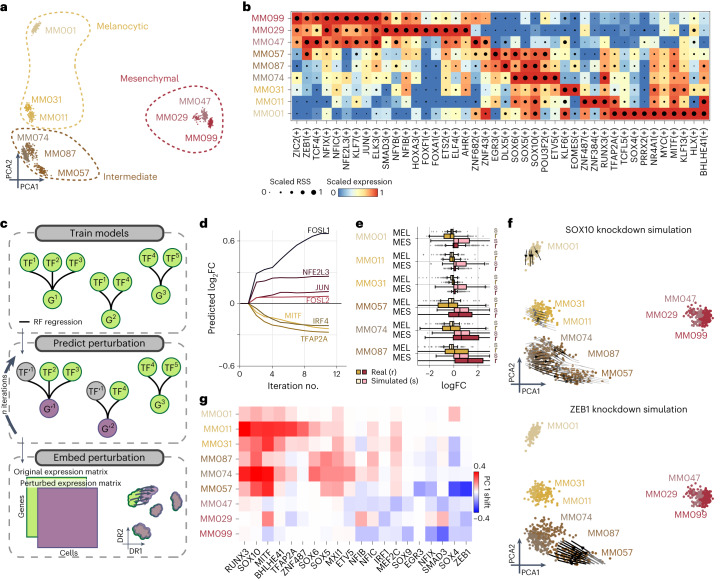
Joint profiling of chromatin accessibility and gene expression in individual cells provides an opportunity to decipher enhancer-driven gene regulatory networks (GRNs). Here we present a method for the inference of enhancer-driven GRNs, called SCENIC+. SCENIC+ predicts genomic enhancers along with candidate upstream transcription factors (TFs) and links these enhancers to candidate target genes. To improve both recall and precision of TF identification, we curated and clustered a motif collection with more than 30,000 motifs. We benchmarked SCENIC+ on diverse datasets from different species, including human peripheral blood mononuclear cells, ENCODE cell lines, melanoma cell states and Drosophila retinal development. Next, we exploit SCENIC+ predictions to study conserved TFs, enhancers and GRNs between human and mouse cell types in the cerebral cortex. Finally, we use SCENIC+ to study the dynamics of gene regulation along differentiation trajectories and the effect of TF perturbations on cell state. SCENIC+ is available at scenicplus.readthedocs.io .
Overview
The claims and statistics of this paper haven’t been checked yet.
Free: it reads the open-access text and checks the first 5 claims that cite a source we can check. Create a free account to check every claim.
Integrity signals
Registry
Cites
Statistics
Figures
Verification
Claims the paper makes
The claims and statistics of this paper haven’t been checked yet.
Free: it reads the open-access text and checks the first 5 claims that cite a source we can check. Create a free account to check every claim.
Claims other papers make about this one
Each is checked against this paper’s own text: does it say what the citing paper says it does?
The source backs part of the claim, not all of it — or backs it for a different population, condition or comparison.
In the citing paper
“SCENIC+ demonstrated superior performance compared to its original version, as well as ppcor, GRNBOOST2, PIDC, GRaNIE, FigR, and Pando, as evidenced by the AUC and F1 score metrics [48].”
From A mini-review on perturbation modelling across single-cell omic modalities (2024) · cites this paper as [48]
Experimental — accuracy not yet measuredThe source backs part of the claim, not all of it — or backs it for a different population, condition or comparison.
In the citing paper
“pycisTarget (v.1.0.1.dev42+gb6707ee) was run using a custom database with the consensus regions on DARs, binarized topics (with Otsu thresholding), curated DARs and topics and MACS2 (v.2.2.7.1) bdgdiff regions, with and without promoters, and using pycisTarget and DEM7.”
From Single-cell spatial multi-omics and deep learning dissect enhancer-driven gene regulatory networks in liver zonation (2024) · cites this paper as [7]
Experimental — accuracy not yet measuredThe cited source says what the claim attributes to it.
In the citing paper
“Notably, SCENIC+ anticipates genomic enhancers and identifies potential upstream transcription factors (TFs) and establishes connections between these enhancers and their relevant target genes.”
From A mini-review on perturbation modelling across single-cell omic modalities (2024) · cites this paper as [48]
The cited source says what the claim attributes to it.
In the citing paper
“Cell-cell similarity graphs in single cell omics [ 47 ], gene regulatory networks [ 48 ] and protein-protein interaction networks [ 49 ] are fundamental tools to rationalize the complexity of biological systems such as the human body.”
From igraph 1.0 enables fast and robust network analysis across programming languages (2026) · cites this paper as [48]
The cited source says what the claim attributes to it.
In the citing paper
“SCENIC+ was run with the default parameters on the complete dataset and using only hepatocytes, using http://nov2020.archive.ensembl.org/ as Biomart host.”
From Single-cell spatial multi-omics and deep learning dissect enhancer-driven gene regulatory networks in liver zonation (2024) · cites this paper as [7]
1 more claim about this paper
Create a free account to see every claim other papers make about this one.
Self-check
Percentages, sums and reported differences re-computed from the paper’s own numbers.
The self-check needs the paper’s full text.
Citations
Cites
Moderated estimation of fold change and dispersion for RNA-seq data with DESeq2
Love, M. I., Huber, W., & Anders, S. (2014) · Genome Biology · doi:10.1186/s13059-014-0550-8 · Cited by 95,106
A Threshold Selection Method from Gray-Level Histograms
Otsu, N. (1979) · IEEE Transactions on Systems, Man, and Cybernetics · doi:10.1109/tsmc.1979.4310076 · Cited by 43,398 · cited 1×
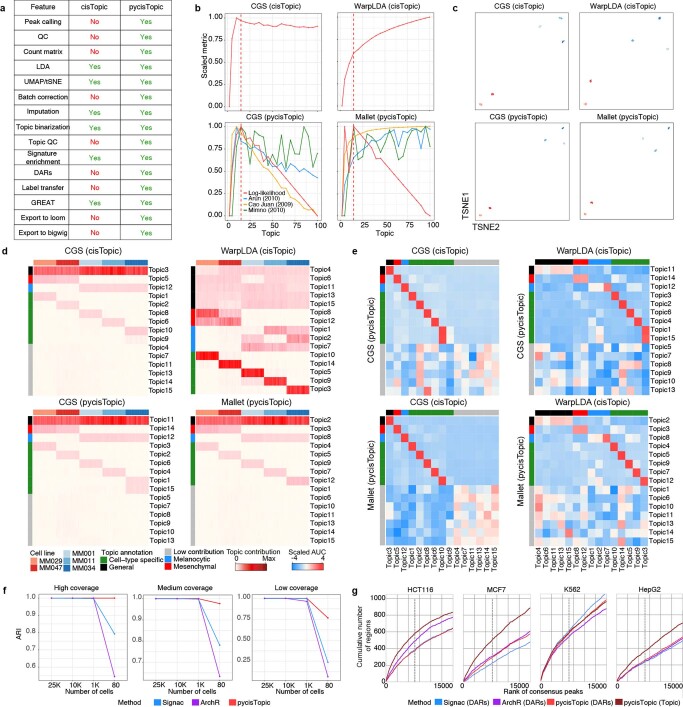
“We have included several binarization methods (applicable for topic-region and cell-topic distributions): ’otsu’ (Otsu, 1979)107, ’yen’ (Yen et al., 1995)108, ’li’ (Li & Lee, 1993)109, ’aucell’ (Van de Sande et al., 2020)20 or ’ntop’ (Taking the top n regions per topic).”
MethodModel-based Analysis of ChIP-Seq (MACS)
Zhang, Y., Liu, T., Meyer, C. A., Eeckhoute, J., Johnson, D. S., Bernstein, B. E., Nusbaum, C., Myers, R. M., Brown, M., Li, W., et al. (2008) · Genome Biology · doi:10.1186/gb-2008-9-9-r137 · Cited by 18,386
An integrated encyclopedia of DNA elements in the human genome
The ENCODE Project Consortium (2012) · Nature · doi:10.1038/nature11247 · Cited by 18,072
Comprehensive Integration of Single-Cell Data
Stuart, T., Butler, A., Hoffman, P., Hafemeister, C., Papalexi, E., Mauck, W. M., Hao, Y., Stoeckius, M., Smibert, P., & Satija, R. (2019) · Cell · doi:10.1016/j.cell.2019.05.031 · Cited by 15,453
Heinz, S., Benner, C., Spann, N., Bertolino, E., Lin, Y. C., Laslo, P., Cheng, J. X., Murre, C., Singh, H., & Glass, C. K. (2010) · Molecular Cell · doi:10.1016/j.molcel.2010.05.004 · Cited by 13,382
Fast, sensitive and accurate integration of single-cell data with Harmony
Korsunsky, I., Millard, N., Fan, J., Slowikowski, K., Zhang, F., Wei, K., Baglaenko, Y., Brenner, M., Loh, P.-R., & Raychaudhuri, S. (2019) · Nature Methods · doi:10.1038/s41592-019-0619-0 · Cited by 10,488
SCANPY: large-scale single-cell gene expression data analysis
Wolf, F. A., Angerer, P., & Theis, F. J. (2018) · Genome Biology · doi:10.1186/s13059-017-1382-0 · Cited by 8,881
Scenic: single-cell regulatory network inference and clustering.
Aibar, S., González-Blas, C. B., Moerman, T., Huynh-Thu, V. A., Imrichova, H., Hulselmans, G., Rambow, F., Marine, J.-C., Geurts, P., Aerts, J., et al. (2017) · Nature Methods · doi:10.1038/nmeth.4463 · Cited by 6,520
Self-citationGriffiths, T. L., & Steyvers, M. (2004) · Proceedings of the National Academy of Sciences · doi:10.1073/pnas.0307752101 · Cited by 6,049 · cited 1×
“- Log-likelihood: Uses the log-likelihood in the last iteration as calculated by Griffiths and Steyvers (2004)104, as used in cisTopic.”
Method
Research works printed but not linked: 1
- Mimno, D., Wallach, H. M., Talley, E., Leenders, M. & McCallum, A. Optimizing semantic coherence in topic models. In Proc. 2011 Conference on Empirical Methods in Natural Language Processing 262–272 (Association for Computational Linguistics, 2011).
Cited by
Best practices for single-cell analysis across modalities
Heumos, L., Schaar, A. C., Lance, C., Litinetskaya, A., Drost, F., Zappia, L., Lücken, M. D., Strobl, D. C., Henao, J., Curion, F., et al. (2023) · Nature Reviews Genetics · doi:10.1038/s41576-023-00586-w · Cited by 1,051
The technological landscape and applications of single-cell multi-omics
Baysoy, A., Bai, Z., Satija, R., & Fan, R. (2023) · Nature Reviews Molecular Cell Biology · doi:10.1038/s41580-023-00615-w · Cited by 1,037
“include SCENIC+ 176 , functional inference of gene regulation (FigR) 177 , and probabilistic multimodal models for integrated regulatory analysis (MIRA) 178 , which model joint variation across paired transcriptomic and scATAC-seq measurements to link enhancers to genes and to identify…”
BackgroundDissecting cell identity via network inference and in silico gene perturbation
Kamimoto, K., Stringa, B., Hoffmann, C. M., Jindal, K., Solnica-Krezel, L., & Morris, S. A. (2023) · Nature · doi:10.1038/s41586-022-05688-9 · Cited by 677
Gene regulatory network inference in the era of single-cell multi-omics
Badia-i-Mompel, P., Wessels, L., Müller-Dott, S., Trimbour, R., Ramirez Flores, R. O., Argelaguet, R., & Saez-Rodriguez, J. (2023) · Nature Reviews Genetics · doi:10.1038/s41576-023-00618-5 · Cited by 469
“ANANSE 84 , sc-compReg 85 and SCENIC+ 67 build Box 1”
MethodInfluentialSingle-cell analysis of prenatal and postnatal human cortical development
Velmeshev, D., Perez, Y., Yan, Z., Valencia, J. E., Castaneda-Castellanos, D. R., Wang, L., Schirmer, L., Mayer, S., Wick, B., Wang, S., et al. (2023) · Science · doi:10.1126/science.adf0834 · Cited by 204
An atlas of cells in the human tonsil
Massoni-Badosa, R., Aguilar-Fernández, S., Nieto, J. C., Soler-Vila, P., Elosua-Bayes, M., Marchese, D., Kulis, M., Vilas-Zornoza, A., Bühler, M. M., Rashmi, S., et al. (2024) · Immunity · doi:10.1016/j.immuni.2024.01.006 · Cited by 183
“23 We classified the remaining CD4 T cell clusters into Tfh or non-Tfh cells, based on the activity of BCL6 and PRDM1 (Figures 2A and S2B; Table S4), 24,25 their respective master regulators.”
BackgroundA fast, scalable and versatile tool for analysis of single-cell omics data
Zhang, K., Zemke, N. R., Armand, E. J., & Ren, B. (2024) · Nature Methods · doi:10.1038/s41592-023-02139-9 · Cited by 185
Cell-type-directed design of synthetic enhancers
Taskiran, I. I., Spanier, K. I., Dickmänken, H., Kempynck, N., Pančíková, A., Ekşi, E. C., Hulselmans, G., Ismail, J. N., Theunis, K., Vandepoel, R., et al. (2024) · Nature · doi:10.1038/s41586-023-06936-2 · Cited by 175
“Identification of TF binding sites similar to TF-Modisco patterns was performed using Tomtom (RRID: SCR_024809) 70 using the cisTarget motif collection (RRID: SCR_024808) 71 .”
MethodSelf-citationCellPhoneDB v5: inferring cell–cell communication from single-cell multiomics data
Troulé, K., Petryszak, R., Cakir, B., Cranley, J., Harasty, A., Prete, M., Tuong, Z. K., Teichmann, S. A., Garcia-Alonso, L., & Vento-Tormo, R. (2025) · Nature Protocols · doi:10.1038/s41596-024-01137-1 · Cited by 167
“TF activity can be inferred from various sources, such as scATAC-seq data (by looking at the overall chromatin accessibility of the TF binding sites) 50 , scRNA-seq data (by looking at the overall expression of TF target genes) 52,54 or by combining both measurements 92,93 .”
Molecular and cellular dynamics of the developing human neocortex
Wang, L., Wang, C., Moriano, J. A., Chen, S., Zuo, G., Cebrián-Silla, A., Zhang, S., Mukhtar, T., Wang, S., Song, M., et al. (2025) · Nature · doi:10.1038/s41586-024-08351-7 · Cited by 167
“1.dev448+g2c0bafd) workflow 15 to build GRNs of the developing human neocortex based on the snMulti-ome data.”
Epigenetic regulation of early human embryo development
Wilkinson, A. L., Zorzan, I., & Rugg‐Gunn, P. J. (2023) · Cell stem cell · doi:10.1016/j.stem.2023.09.010 · Cited by 179
Mapping cells through time and space with moscot
Klein, D., Palla, G., Lange, M., Klein, M., Piran, Z., Gander, M., Meng-Papaxanthos, L., Sterr, M., Saber, L., Jing, C., et al. (2025) · Nature · doi:10.1038/s41586-024-08453-2 · Cited by 279
Single-cell DNA methylome and 3D multi-omic atlas of the adult mouse brain
Liu, H., Zeng, Q., Zhou, J., Bartlett, A., Wang, B.-A., Berube, P., Tian, W., Kenworthy, M., Altshul, J., Nery, J. R., et al. (2023) · Nature · doi:10.1038/s41586-023-06805-y · Cited by 139
“To perform motif enrichment analysis in the TF–DMR edge analysis, we used the recovery-curve-based cisTarget algorithm 43,58 .”
InfluentialAn exhausted-like microglial population accumulates in aged and APOE4 genotype Alzheimer’s brains
Millet, A., Ledo, J. H., & Tavazoie, S. F. (2024) · Immunity · doi:10.1016/j.immuni.2023.12.001 · Cited by 132
GET: a foundation model of transcription across human cell types
Fu, X., Mo, S., Buendia, A., Laurent, A., Shao, A., Alvares-Torres, M. D. M., Yu, T., Tan, J., Su, J., Sagatelian, R., et al. (2023) · doi:10.1101/2023.09.24.559168 · Cited by 130
Gene function and cell surface protein association analysis based on single-cell multiomics data
Hu, H., Feng, Z., Lin, H., Cheng, J., Lyu, J., Zhang, Y., Zhao, J., Xu, F., Lin, T., Zhao, Q., et al. (2023) · Computers in Biology and Medicine · doi:10.1016/j.compbiomed.2023.106733 · Cited by 136
A foundation model of transcription across human cell types
(2025) · doi:10.1038/s41586-024-08391-z · Cited by 130
Inferring gene regulatory networks from single-cell multiome data using atlas-scale external data
Yuan, Q., & Duren, Z. (2025) · Nature Biotechnology · doi:10.1038/s41587-024-02182-7 · Cited by 165
A multi-omic atlas of human embryonic skeletal development
To, K., Fei, L., Pett, J. P., Roberts, K., Blain, R., Polański, K., Li, T., Yayon, N., He, P., Xu, C., et al. (2024) · Nature · doi:10.1038/s41586-024-08189-z · Cited by 138
Spatial multi-omics: novel tools to study the complexity of cardiovascular diseases
Kießling, P., & Kuppe, C. (2024) · Genome Medicine · doi:10.1186/s13073-024-01282-y · Cited by 122
“…and transcriptome reveals clear links between gene expression and transcription factor binding and enables the construction of gene regulatory networks, e.g. the recently develop SCENIC + tool [144], across spatial domains like the border zone of myocardial infarction [4] or pacemaker cells [22].”
BackgroundGene regulatory network reconstruction: harnessing the power of single-cell multi-omic data
Kim, D. J., Tran, A., Kim, H. J., Lin, Y., Yang, J. Y. H., & Yang, P. (2023) · npj Systems Biology and Applications · doi:10.1038/s41540-023-00312-6 · Cited by 131
Supervised discovery of interpretable gene programs from single-cell data
Kunes, R., Walle, T., Land, M., Nawy, T., & Pe’er, D. (2023) · Nature Biotechnology · doi:10.1038/s41587-023-01940-3 · Cited by 116
“[2012], González-Blas et al. [2022]) we use coherence, co-occurrence of factor genes in held-out data, to evaluate the quality of the inferred factors.”
Spatial-linked alignment tool (SLAT) for aligning heterogenous slices
Xia, C., Cao, Z., Tu, X., & Gao, G. (2023) · Nature Communications · doi:10.1038/s41467-023-43105-5 · Cited by 111
“Based on the outputted alignment, we transferred cell type labels from Stereo-seq to spatial-ATAC-seq which was not annotated, and then applied SCENIC+ 47 for joint regulatory inference.”
MethodCausal identification of single-cell experimental perturbation effects with CINEMA-OT
Dong, M., Wang, B., Wei, J., de O. Fonseca, A. H., Perry, C. J., Frey, A., Ouerghi, F., Foxman, E. F., Ishizuka, J. J., Dhodapkar, R. M., et al. (2023) · Nature Methods · doi:10.1038/s41592-023-02040-5 · Cited by 94
Wang, M., Liu, Y., Sun, R., Liu, F.-T., Li, J., Long, Y., Zhang, J., Xie, X., Li, D., Wang, Y., et al. (2024) · Nature Genetics · doi:10.1038/s41588-023-01647-w · Cited by 110
Bravo González-Blas, C., Matetovici, I., Hillen, H., Taskiran, I. I., Vandepoel, R., Christiaens, V., Sansores-García, L., Verboven, E., Hulselmans, G., Poovathingal, S., et al. (2024) · Nature Cell Biology · doi:10.1038/s41556-023-01316-4 · Cited by 109
“TBX3 and TCF7L1 computational perturbations were performed using SCENIC+ (v 0.1.dev411+gf4bcae5.d20220810) 7 .”
InfluentialSelf-citationThe future of rapid and automated single-cell data analysis using reference mapping
Lotfollahi, M., Hao, Y., Theis, F. J., & Satija, R. (2024) · Cell · doi:10.1016/j.cell.2024.03.009 · Cited by 86
Modeling fragment counts improves single-cell ATAC-seq analysis
Martens, L. D., Fischer, D. S., Yépez, V. A., Theis, F. J., & Gagneur, J. (2023) · Nature Methods · doi:10.1038/s41592-023-02112-6 · Cited by 75
Ledru, N., Wilson, P. C., Muto, Y., Yoshimura, Y., Wu, H., Li, D., Asthana, A., Tullius, S. G., Waikar, S. S., Orlando, G., et al. (2024) · Nature Communications · doi:10.1038/s41467-024-45706-0 · Cited by 83
“Several excellent tools have been developed to accomplish similar tasks 24 – 29 , however we chose to tailor our method to prioritize ranking of regulatory elements for further investigation by applying a parametric adaptive elastic-net estimator for gene regulatory network model training to…”
InfluentialThe human and non-human primate developmental GTEx projects
Coorens, T. H. H., Guillaumet-Adkins, A., Kovner, R., Linn, R. L., Roberts, V. H. J., Sule, A. D., Hoose, P. M. V., Bell, T., Blanchard, T., Hernandez, R., et al. (2025) · Nature · doi:10.1038/s41586-024-08244-9 · Cited by 83
“Joint analysis of chromatin accessibility and gene expression enables better annotation of cell identities 46 , the inference of regulatory regions that interact such as enhancers and promoters, and the comparison of expression with accessibility to transcription factors 47 .”
Mitra, S., Malik, R., Wong, W., Rahman, A., Hartemink, A. J., Pritykin, Y., Dey, K. K., & Leslie, C. S. (2024) · Nature Genetics · doi:10.1038/s41588-024-01689-8 · Cited by 78
Chang, L., Xie, Y., Taylor, B., Wang, Z., Sun, J., Armand, E. J., Mishra, S. V., Xu, J., Tastemel, M., Lie, A., et al. (2024) · Nature Biotechnology · doi:10.1038/s41587-024-02447-1 · Cited by 87
Zaidi, S., Park, J., Chan, J. M., Roudier, M. P., Zhao, J. L., Gopalan, A., Wadosky, K. M., Patel, R. A., Sayar, E., Karthaus, W. R., et al. (2024) · Proceedings of the National Academy of Sciences · doi:10.1073/pnas.2322203121 · Cited by 77
GRaNIE and GRaNPA : inference and evaluation of enhancer‐mediated gene regulatory networks
Kamal, A., Arnold, C., Claringbould, A., Moussa, R., Servaas, N. H., Kholmatov, M., Daga, N., Nogina, D., Mueller‐Dott, S., Reyes‐Palomares, A., et al. (2023) · Molecular Systems Biology · doi:10.15252/msb.202311627 · Cited by 63
“The modularity of the eGRN also showed that NFKB1, NFKB2, RELB and IRF8, the TFs important for predicting the macrophage response to IFN-γ priming, and their connected regulatory elements and genes were specifically enriched for heritability of GWAS traits that are commonly linked to IFN-γ signalling.”
BackgroundSchäfer, P. S. L., Dimitrov, D., Villablanca, E. J., & Sáez-Rodríguez, J. (2024) · Nature Immunology · doi:10.1038/s41590-024-01768-2 · Cited by 80
“The most comprehensive database is the SCENIC+ motif collection, created by pooling information from 29 other databases 45 .”
The evolution of developmental biology through conceptual and technological revolutions
Liberali, P., & Schier, A. F. (2024) · Cell · doi:10.1016/j.cell.2024.05.053 · Cited by 74
“There are already numerous practical applications for AI in image analysis (Box 5), genomics, 186,190,191 and engineering.”
BackgroundSystematic benchmarking of single-cell ATAC-sequencing protocols
Rop, F. V. D., Hulselmans, G. J., Flerin, C., Soler-Vila, P., Rafels, A., Christiaens, V., González‐Blas, C. B., Marchese, D., Caratù, G., Poovathingal, S. K., et al. (2023) · Nature Biotechnology · doi:10.1038/s41587-023-01881-x · Cited by 75
“To evaluate the biological relevance of the DARs identified by each protocol, we performed a motif enrichment analysis on each cell type’s top 2,000 strongest DARs by using pyCisTarget 24–26 .”
Self-citationReck, M., Baird, D., Veizades, S. A., Sutherland, C., Bell, R. M. B., Hur, H., Cairns, C., Janas, P. P., Campbell, R., Nam, A., et al. (2025) · Nature Communications · doi:10.1038/s41467-025-59997-4 · Cited by 79
“0.0) package 56 for gene regulatory network inference and TF analysis.”
InfluentialBrain-wide correspondence of neuronal epigenomics and distant projections
Zhou, J., Zhang, Z., Wu, M., Liu, H., Pang, Y., Bartlett, A., Peng, Z., Ding, W., Rivkin, A. C., Lagos, W. N., et al. (2023) · Nature · doi:10.1038/s41586-023-06823-w · Cited by 59
New horizons at the interface of artificial intelligence and translational cancer research
Yates, J., & Allen, E. M. V. (2025) · Cancer Cell · doi:10.1016/j.ccell.2025.03.018 · Cited by 63
A mini-review on perturbation modelling across single-cell omic modalities
Gavriilidis, G. I., Vasileiou, V., Orfanou, A., Ishaque, N., & Psomopoulos, F. (2024) · Computational and Structural Biotechnology Journal · doi:10.1016/j.csbj.2024.04.058 · Cited by 54
Interpretable spatially aware dimension reduction of spatial transcriptomics with STAMP
Zhong, C., Ang, K. S., & Chen, J. (2024) · Nature Methods · doi:10.1038/s41592-024-02463-8 · Cited by 70
Li, Y., Huang, Z., Xu, L., Fan, Y., Ping, J., Li, G., Chen, Y., Yu, C., Wang, Q., Song, T., et al. (2025) · Nature Methods · doi:10.1038/s41592-024-02586-y · Cited by 70
“In our analysis using SCENIC+, we effectively examined the eRegulon of EC-GC subpopulations associated with renal impairment (Fig.”
InfluentialscPRINT: pre-training on 50 million cells allows robust gene network predictions
Kalfon, J., Samaran, J., Peyré, G., & Cantini, L. (2025) · Nature Communications · doi:10.1038/s41467-025-58699-1 · Cited by 100
Myeloid progenitor dysregulation fuels immunosuppressive macrophages in tumours
Hegde, S., Giotti, B., Soong, B. Y., Halász, L., Bérichel, J. L., Schaefer, M. M., Kloeckner, B., Mattiuz, R., Park, M. D., Magen, A., et al. (2025) · Nature · doi:10.1038/s41586-025-09493-y · Cited by 66
“82 ) to export pseudobulk fragments files based on RNA cell-type annotations, call peaks (shift = 73, ext_size = 146, q_value = 0.05), generate a consensus peak set (peak_half_width = 250), run cisTopic using collapsed Gibbs sampling (n_topics = 40) and visualize topic contributions to identify…”
Influentialigraph 1.0 enables fast and robust network analysis across programming languages
Antonov, M., Csárdi, G., Horvát, S., Müller, K., Nepusz, T., Noom, D., Salmon, M., Traag, V., Welles, B. F., & Zanini, F. (2026) · PLOS One · doi:10.1371/journal.pone.0355108 · Cited by 56
“Cell-cell similarity graphs in single cell omics [47], gene regulatory networks [48] and protein-protein interaction networks [49] are fundamental tools to rationalize the complexity of biological systems such as the human body.”
Mapping cells through time and space with moscotPreprint
Klein, D., Palla, G., Lange, M., Klein, M., Piran, Z., Gander, M., Meng-Papaxanthos, L., Sterr, M., Bastidas-Ponce, A., Tarquis-Medina, M., et al. (2023) · bioRxiv (Cold Spring Harbor Laboratory) · doi:10.1101/2023.05.11.540374 · Cited by 49
Martins‐Costa, C., Wiegers, A., Pham, V. A., Sidhaye, J., Doleschall, B., Novatchkova, M., Lendl, T., Piber, M., Peer, A. M., Möseneder, P., et al. (2024) · Cell stem cell · doi:10.1016/j.stem.2024.04.014 · Cited by 59
Deep learning-based cell-specific gene regulatory networks inferred from single-cell multiome data
Xu, J., Lu, C., Jin, S., Meng, Y., Fu, X., Zeng, X., Nussinov, R., & Cheng, F. (2025) · Nucleic Acids Research · doi:10.1093/nar/gkaf138 · Cited by 61
“GRNs provide a comprehensive view of how genetic and genomic information is transferred in living systems and are a critical component in understanding gene expression processes [ 14 , 15 ].”
Causal machine learning for single-cell genomics
Tejada-Lapuerta, A., Bertin, P., Bauer, S., Aliee, H., Bengio, Y., & Theis, F. J. (2025) · Nature Genetics · doi:10.1038/s41588-025-02124-2 · Cited by 104
“Using the same estimated number of proteoforms as above ( N ≈ 1,000,000), we estimate that the number of triple proteoform interactions is on the order of 10 17 .”
Human hippocampal neurogenesis in adulthood, ageing and Alzheimer’s disease
Disouky, A., Sanborn, M. A., Sabitha, K. R., MOSTAFA, M., Ayala, I. A., Bennett, D. A. A., Lu, Y., Zhou, Y. F., Keene, C. D., Weıntraub, S., et al. (2026) · Nature · doi:10.1038/s41586-026-10169-4 · Cited by 83
“Using SCENIC+, which combines single-cell chromatin accessibility and gene expression data with motif discovery to infer enhancer-driven GRNs (eGRNs) 40 , we determined the eRegulons of these processes. eRegulon-based UMAP visualization revealed that NSCs constituted a distinct cluster (Fig.”
The chromatin landscape of pathogenic transcriptional cell states in rheumatoid arthritis
Weinand, K., Sakaue, S., Nathan, A., Jonsson, A. H., Zhang, F., Watts, G. F. M., Suqri, M. A., Zhu, Z., Accelerating Medicines Partnership Program: Rheumatoid Arthritis and Systemic Lupus Erythematosus (AMP RA/SLE) Network, Albrecht, J., et al. (2024) · Nature Communications · doi:10.1038/s41467-024-48620-7 · Cited by 57
“At a large scale, these TF-gene interactions can be linked together to form gene regulatory networks in silico 117,118 to interrogate the more widespread effects of disrupting signaling cascades.”
BackgroundGene regulatory networks in disease and ageing
Avila, P. U., Padvitski, T., Leote, A. C., Chen, H., Sáez-Rodríguez, J., Kann, M., & Beyer, A. (2024) · Nature Reviews Nephrology · doi:10.1038/s41581-024-00849-7 · Cited by 57
“Thus, the genome-wide reconstruction of TRNs requires the computational integration of data from orthogonal assays that in combination cover both DNA binding events and target prediction, with both types of data ideally available for the specific cell type in question.”
InfluentialEnhancer-driven cell type comparison reveals similarities between the mammalian and bird pallium
Hecker, N., Kempynck, N., Mauduit, D., Abaffyová, D., Vandepoel, R., Dieltiens, S., Borm, L. E., Sarropoulos, I., González‐Blas, C. B., Man, J. D., et al. (2025) · Science · doi:10.1126/science.adp3957 · Cited by 54
Self-citationNarasimhan, H., Richter, M. L., Shakiba, R., Papaioannou, N. E., Stehle, C., Rengarajan, K. R., Ulmert, I., Kendirli, A., del Val, C. D. L. R., Kuo, P., et al. (2025) · Proceedings of the National Academy of Sciences · doi:10.1073/pnas.2417308122 · Cited by 55
Cesaro, G., Nagai, J. S., Nicolò, G., Chiodi, A., Tussardi, G., Klöker, V., Musumarra, C. V., Mosca, E., Costa, I. G., Camillo, B. D., et al. (2025) · Briefings in Bioinformatics · doi:10.1093/bib/bbaf280 · Cited by 60
Advancing biological understanding of cellular senescence with computational multiomics
Li, S., Agudelo Garcia, P. A., Aliferis, C., Becich, M. J., Calyeca, J., Cosgrove, B. D., Elisseeff, J., Farzad, N., Fertig, E. J., Glass, C., et al. (2025) · Nature Genetics · doi:10.1038/s41588-025-02314-y · Cited by 40
Xu, J. Z., Chen, C., Sussman, J., Yoshimura, S., Vincent, T. L., Pölönen, P., Hu, J., Bandyopadhyay, S., Elghawy, O., Yu, W., et al. (2024) · Nature Cancer · doi:10.1038/s43018-024-00863-5 · Cited by 50
“44), which nominated MEF2C as the top activator of the BMP-like state.”
Mechano-osmotic signals control chromatin state and fate transitions in pluripotent stem cells
McCreery, K. P., Stubb, A., Stephens, R. K., Fursova, N. A., Cook, A., Kruse, K., Michelbach, A., Biggs, L. C., Keikhosravi, A., Nykänen, S., et al. (2025) · Nature Cell Biology · doi:10.1038/s41556-025-01767-x · Cited by 53
Bonev, B., Castelo‐Branco, G., Chen, F., Codeluppi, S., Corces, M. R., Fan, J., Heiman, M., Harris, K., Inoue, F., Kellis, M., et al. (2024) · Nature Neuroscience · doi:10.1038/s41593-024-01806-0 · Cited by 47
“These developments provide exciting avenues to marry ST with functional studies of neural circuits.”
Large B cell lymphoma microenvironment archetype profiles
Li, X., Singhal, K., Deng, Q., Chihara, D., Russler‐Germain, D. A., Harkins, R. A., Henderson, J. M., Arita, K., Kizhakeyil, A., Sun, R., et al. (2025) · Cancer Cell · doi:10.1016/j.ccell.2025.06.002 · Cited by 61
Zinati, Y., Takiddeen, A., & Emad, A. (2023) · doi:10.1101/2023.07.25.550225 · Cited by 36
Zinati, Y., Takiddeen, A., & Emad, A. (2024) · Nature Communications · doi:10.1038/s41467-024-48516-6 · Cited by 56
Xia, P., Zhou, J., Shen, R., & Wang, D. (2025) · npj Precision Oncology · doi:10.1038/s41698-025-00948-z · Cited by 47
“The pySCENIC 50,51 (v0.”
Gene networks and systems biology in Alzheimer's disease: Insights from multi‐omics approaches
Rahimzadeh, N., Srinivasan, S. S., Zhang, J., & Swarup, V. (2024) · Alzheimer s & Dementia · doi:10.1002/alz.13790 · Cited by 44
“109–111 Inunmatcheddatasets,therearenoanchorsto link either the cells or features in the high-dimensional space, making diagonal integration more difficult to validate and interpret.”
BackgroundYang, Y., Jin, X., Xie, Y., Ning, C., Ai, Y., Wei, H., Xu, X., Ge, X., Yi, T., Huang, Q., et al. (2024) · Theranostics · doi:10.7150/thno.93473 · Cited by 39
Single-cell atlas of the transcriptome and chromatin accessibility in the human retina
Li, J., Wang, J., Ibarra, I. L., Cheng, X., Luecken, M. D., Lu, J., Monavarfeshani, A., Yan, W., Zheng, Y., Zuo, Z., et al. (2026) · Nature Genetics · doi:10.1038/s41588-025-02454-1 · Cited by 79
“Regulons were identified for each of major cell classes, subclasses and cell types, using SCENIC+ (version 1.0.0) 38 .”
InfluentialContinuous cell-type diversification in mouse visual cortex development
Gao, Y., van Velthoven, C. T. J., Lee, C., Thomas, E. D., Mathieu, R., Ayala, A. P., Barta, S., Bertagnolli, D., Campos, J., Cardenas, T., et al. (2025) · Nature · doi:10.1038/s41586-025-09644-1 · Cited by 64
Neurodevelopmental hijacking of oligodendrocyte lineage programs drives glioblastoma infiltration
Wu, Y., Wu, B. Z., Ellenbogen, Y., Kant, J. A., Yu, P., Li, X., Caloren, L. C., Sotov, V., Tran, C. N., Restrepo, M., et al. (2025) · Developmental Cell · doi:10.1016/j.devcel.2025.04.022 · Cited by 39
Green, W. D., Gomez, A., Plotkin, A. L., Pratt, B. M., Merritt, E. F., Mullins, G. N., Kren, N. P., Modliszewski, J. L., Zhabotynsky, V., Woodcock, M. G., et al. (2025) · Immunity · doi:10.1016/j.immuni.2025.04.030 · Cited by 39
Phenotypic heterogeneity and plasticity in colorectal cancer metastasis
Ogden, S., Metic, N., Leylek, O., Smith, E. A., Berner, A., Baker, A., Uddin, I., Buzzetti, M., Gerlinger, M., Graham, T. A., et al. (2025) · Cell Genomics · doi:10.1016/j.xgen.2025.100881 · Cited by 42
Integrated multi-omics single cell atlas of the human retinaPreprint
Li, J., Wang, J., Ibarra, I. L., Cheng, X., Luecken, M. D., Lu, J., Monavarfeshani, A., Yan, W., Zheng, Y., Zuo, Z. C., et al. (2023) · bioRxiv (Cold Spring Harbor Laboratory) · doi:10.1101/2023.11.07.566105 · Cited by 30
Levantovsky, R. M., Tastad, C., Zhang, J., Gettler, K., Sabic, K., Werner, R., Chasteau, C., Korie, U. M., Paguay, D., Bao, M., et al. (2024) · Med · doi:10.1016/j.medj.2024.03.021 · Cited by 33
Recent advances in exploring transcriptional regulatory landscape of crops
Huo, Q., Song, R., & Ma, Z. (2024) · Frontiers in Plant Science · doi:10.3389/fpls.2024.1421503 · Cited by 37
Loers, J. U., & Vermeirssen, V. (2024) · Briefings in Bioinformatics · doi:10.1093/bib/bbae382 · Cited by 45
“Reads are first pseudobulked either on all cells or preferentially per annotated cell type, and subsequent peak calling returns a set of regions serving as set of potential REs [9,35,76].”
BackgroundMethodInfluentialMapping enhancer–gene regulatory interactions from single-cell data
Sheth, M. U., Qiu, W., Ma, X. R., Gschwind, A. R., Jagoda, E., Tan, A. S., Galante, J., Ray, J., Amgalan, D., Einarsson, H., et al. (2026) · Nature Genetics · doi:10.1038/s41588-026-02695-8 · Cited by 46
“When binarizing predictions by their suggested thresholds, scE2G achieved the highest recall and strong enrichment (13.9% recall and 14.9-fold enrichment for scE2G Multiome ), far outperforming the next-best non-ABC model, SCENIC+ (1.4% recall and 10.3-fold enrichment) and comparable to previous benchmarks of models u…”
InfluentialLeveraging prior knowledge to infer gene regulatory networks from single-cell RNA-sequencing data
Stock, M., Losert, C., Zambon, M., Popp, N., Lubatti, G., Hörmanseder, E., Heinig, M., & Scialdone, A. (2025) · Molecular Systems Biology · doi:10.1038/s44320-025-00088-3 · Cited by 37
“Recently, extended versions of GRNs that include regulatory elements (RE) as nodes have been constructed (Bravo González-Blas et al, 2023; Kamal et al, 2023).”
InfluentialJin, H., Chen, Y., Zhang, D., Lin, J., Huang, S., Wu, X., Deng, W., Huang, J., & Yao, Y. (2024) · iScience · doi:10.1016/j.isci.2024.109902 · Cited by 34
Hybridization and gene expression: Beyond differentially expressed genes
Runemark, A., Moore, E. C., & Larson, E. L. (2024) · Molecular Ecology · doi:10.1111/mec.17303 · Cited by 40
“…and expand gene expression in hybrids, methods that overlay single-cell sequencing with surveys of regulatory architecture in the genome are needed (Bravo González-Blas et al., 2023). instance, the herbaceous weed Capsella bursa pastoris has a floral tissue gene expression similar to the parent…”
Chinese Immune Multi-Omics Atlas
Yin, J., Zheng, Y., Huang, Z., Zhou, W., Yuan, Y., Cai, P., Bai, Y., Yang, S., Gao, Y., Duan, S., et al. (2026) · Science · doi:10.1126/science.adt3130 · Cited by 54
scGRN: a comprehensive single-cell gene regulatory network platform of human and mouse
Huang, X., Song, C., Zhang, G., Li, Y., Zhao, Y., Zhang, Q., Zhang, Y., Fan, S., Zhao, J., Xie, L., et al. (2023) · Nucleic Acids Research · doi:10.1093/nar/gkad885 · Cited by 30
Carbonetto, P. S., Luo, K., Sarkar, A., Hung, A., Tayeb, K., Pott, S., & Stephens, M. (2023) · Genome biology · doi:10.1186/s13059-023-03067-9 · Cited by 30
Single-cell multiomics decodes regulatory programs for mouse secondary palate development
Yan, F., Suzuki, A., Iwaya, C., Pei, G., Chen, X., Yoshioka, H., Yu, M., Simon, L. M., Iwata, J., & Zhao, Z. (2024) · Nature Communications · doi:10.1038/s41467-024-45199-x · Cited by 28
“To further con fi rm the relevance of Shox2 and Meox2 in secondary palate development, we applied an additional computational algorithm, SCENIC+ 34 , to infer major regulators of the developmental trajectory(SupplementaryFig.15).”
Chen, C., Wang, Z., Lin, Q., Li, M., Xu, L., Fu, Y. S., Zhao, X., Ma, Z., Xu, J., Zhou, S., et al. (2025) · Advanced Science · doi:10.1002/advs.202410263 · Cited by 42
A large-scale benchmark for network inference from single-cell perturbation data
Chevalley, M., Roohani, Y. H., Mehrjou, A., Leskovec, J., & Schwab, P. (2025) · Communications Biology · doi:10.1038/s42003-025-07764-y · Cited by 26
Computational tools for inferring transcription factor activity
Hecker, D., Lauber, M., Ardakani, F. B., Ashrafiyan, S., Manz, Q., Kersting, J., Hoffmann, M., Schulz, M. H., & List, M. (2023) · PROTEOMICS · doi:10.1002/pmic.202200462 · Cited by 33
“In its latest version, named SCENIC + , the method tries to leverage epigenome data by taking both scRNA-seq and scATAC-seq data as input [68].”
MethodThe evolution of hominin bipedalism in two steps
Senevirathne, G., Fernandopulle, S. C., Richard, D. J., Baumgart, S. L., Christensen, A. L., Fabbri, M., Höppner, J., Jüppner, H., Li, P., Bothe, V., et al. (2025) · Nature · doi:10.1038/s41586-025-09399-9 · Cited by 42
Identification of a human hematopoietic stem cell subset that retains memory of inflammatory stressPreprint
Zeng, A. G. X., Nagree, M. S., Jakobsen, N. A., Shah, S., Murison, A., Cheong, J.-G., Turkalj, S., Lim, I., Jin, L.-Q., Araújo, J., et al. (2023) · bioRxiv · doi:10.1101/2023.09.11.557271 · Cited by 15
Henon, C., Vibert, J., Eychenne, T., Gruel, N., Daage, L. C., Ngo, C., Garrido, M., Dorvault, N., Costa, M. E. M. D., Marty, V., et al. (2024) · Cell Reports Medicine · doi:10.1016/j.xcrm.2024.101582 · Cited by 34
Adameyko, I. I., Bakken, T. E., Bhaduri, A., Chhatbar, C., Filbin, M. G., Gate, D., Hochgerner, H., Kim, C. N., Krull, J. E., Manno, G. L., et al. (2024) · Nature Neuroscience · doi:10.1038/s41593-024-01827-9 · Cited by 27
“It can identify novel driver genes and gene regulatory network elements, especially with multiomics (scRNA-seq, snRNA-seq and scATAC-seq) 91,93,94 .”
RegVelo: Gene-regulatory-informed dynamics of single cells
Wang, W., Hu, Z., Weiler, P., Mayes, S., Lange, M., Fountain, D. M., Haug, J. O., Wang, J., Xue, Z., Sauka‐Spengler, T., et al. (2026) · Cell · doi:10.1016/j.cell.2026.04.022 · Cited by 38
Direct specification of lymphatic endothelium from mesenchymal progenitors
Lupu, I.-E., Grainger, D. E., Kirschnick, N., Weischer, S., Zhao, E., Martínez‐Corral, I., Schoofs, H., Vanhollebeke, M., Jones, G., Godwin, J., et al. (2025) · Nature Cardiovascular Research · doi:10.1038/s44161-024-00570-5 · Cited by 28
Decoding gene networks controlling hypothalamic and prethalamic neuron development
Kim, D. W., Duncan, L. H., Xu, Z., Chang, M., Sejer, S., Terrillion, C. E., Kanold, P. O., Place, E., & Blackshaw, S. (2025) · Cell Reports · doi:10.1016/j.celrep.2025.115858 · Cited by 25
“To identify GRNs controlling hypothalamic regionalization and neurogenesis, we applied SCENIC+ analysis, 27 which integrates gene expression and chromatin accessibility to infer patterns of TF activity.”
Hepatic adaptation to chronic metabolic stress primes tumorigenesis
Tzouanas, C. N., Shay, J. E. S., Sherman, M. S., Rubin, A. J., Mead, B. E., Dao, T. T., Tao, J., Lehrich, B. M., Eng, G. M., Patterson-Fortin, J., et al. (2025) · Cell · doi:10.1016/j.cell.2025.11.031 · Cited by 39
Transcriptome data are insufficient to control false discoveries in regulatory network inference
Kernfeld, E. M., Keener, R., Cahan, P., & Battle, A. J. (2024) · Cell Systems · doi:10.1016/j.cels.2024.07.006 · Cited by 31
Jiang, J., Chen, S., Tsou, T., McGinnis, C. S., Khazaei, T., Zhu, Q., Park, J. H., Strazhnik, I.-M., Vielmetter, J., Gong, Y., et al. (2023) · doi:10.1101/2023.04.19.537364 · Cited by 21
Modelling and design of transcriptional enhancers
Winter, S. D., Konstantakos, V., & Aerts, S. (2025) · Nature Reviews Bioengineering · doi:10.1038/s44222-025-00280-y · Cited by 25
“Regarding the training data, DeepTopic models do not learn directly from raw single-cell ATAC sequencing data but rather from a latent representation that is learned beforehand using topic modelling 78,79 .”
Self-citationXu, Y., Lou, D., Chen, P., Li, G., Usoskin, D., Pan, J., Li, F., Huang, S., Hess, C., Tang, R., et al. (2025) · Developmental Cell · doi:10.1016/j.devcel.2025.04.013 · Cited by 26
Chromatin-based memory as a self-stabilizing influence on cell identity
Bell, C. C., Faulkner, G. J., & Gilan, O. (2024) · Genome biology · doi:10.1186/s13059-024-03461-x · Cited by 25
Li, Y., Liu, X., Guo, L., Han, K., Fang, S., Wan, X., Wang, D., Xu, X., Jiang, L., Fan, G., et al. (2025) · Cell Systems · doi:10.1016/j.cels.2025.101243 · Cited by 21
Metadata
- Authors
- Bravo González-Blas, C., De Winter, S., Hulselmans, G., Hecker, N., Matetovici, I., Christiaens, V., Poovathingal, S., Wouters, J., Aibar, S., & Aerts, S.
- Affiliations
- VIB-KU Leuven Center for Brain & Disease Research (BE)
- Vlaams Instituut voor Biotechnologie (BE)
- Corresponding author
- Aerts, Stein
- ORCID
- Venue
- Nature Methods
- Published
- 2023-07-13
- Volume
- 20
- Issue
- 9
- Pages
- 1355-1367
- ISSN
- 1548-7091 (ISSN-L)
- 1548-7105
- PMC
- PMC10482700
- OpenAlex
- W4384198561
- Semantic Scholar
- abe9998e249e33005981b23b97929dddb246b288
- Cited by
- 778
- References
- 169
- Citations by year
- 2026: 279 · 2025: 280 · 2024: 153 · 2023: 59
- FWCI
- 68.58
- Type
- journal article
- Language
- en
- Open access
- hybrid
- doi.org
- Licence
- cc-by
- creativecommons.org/licenses/by/4.0 (tdm)
- creativecommons.org/licenses/by/4.0 (vor)
- Locations
- Nature Methods (publishedVersion, cc-by)
- bioRxiv (Cold Spring Harbor Laboratory) (acceptedVersion)
- PubMed Central (publishedVersion, cc-by)
- PubMed (publishedVersion)
- Lirias (submittedVersion, cc-by)
- Funders
- Fonds Wetenschappelijk Onderzoek (G094121N, 11F1519N)
- KU Leuven
- Fondation contre le Cancer
- Bijzonder Onderzoeksfonds UGent
- Topics
- Life Sciences › Biochemistry, Genetics and Molecular Biology › Molecular Biology › Genomics and Chromatin Dynamics
- Life Sciences › Biochemistry, Genetics and Molecular Biology › Molecular Biology › Single-cell and spatial transcriptomics
- Life Sciences › Biochemistry, Genetics and Molecular Biology › Molecular Biology › Gene Regulatory Network Analysis
- Keywords
- SCENIC, gene regulatory networks, chromatin accessibility, single-cell multi-omics, transcription factor identification, transcription factor binding motifs, cross-species conservation, differentiation trajectories, transcription factor perturbation
- MeSH terms
- Multiomics, Animals, Chromatin, Drosophila, Enhancer Elements, Genetic, Gene Expression Regulation, Humans, Leukocytes, Mononuclear, Mice, Gene Regulatory Networks
About these checks
Registry, retraction, Cites and statistics results are computed, not judged, with one exception: a printed reference that no index lists is read once by a model before it counts as a citation error. Claims are extracted by a model and kept only when their quote appears verbatim in the text; each cited source is then checked, with a model’s help, for whether it says what the claim relies on. Those verdicts can be wrong — read the claim’s quote and the cited source before relying on one.
Statistics and arithmetic are recomputed, not judged.
Confidence bands are shown only for fields calibrated on our annotated test set. None is calibrated yet, so no band is shown.
What counts as a claim ›How we measure confidence ›How we check this ›
Are you an author, or do you see a problem with this page? Request a review
Data sources
Bibliographic data: Semantic Scholar, OpenAlex, Crossref.
Contains information from the Semantic Scholar Academic Graph Datasets, made available under the ODC Attribution License (ODC-BY 1.0).
Semantic Scholar’s data is described in: Kinney, R., et al. (2023). The Semantic Scholar Open Data Platform. arXiv:2301.10140.
