

SCENIC+: single-cell multiomic inference of enhancers and gene regulatory networks
Open accessPublished version of a preprint
The DOI matches its Crossref record; 175 of the 175 references it cites were found in a registry or an index.
Abstract
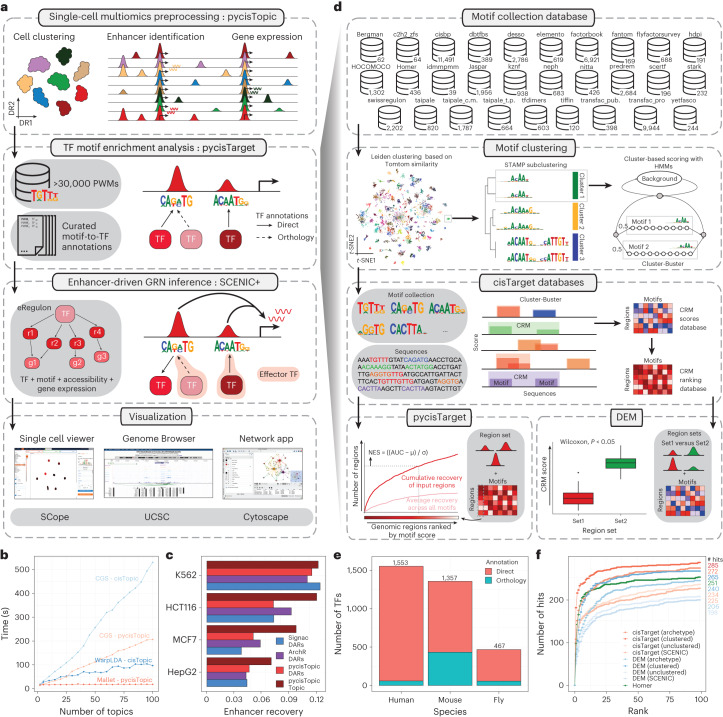
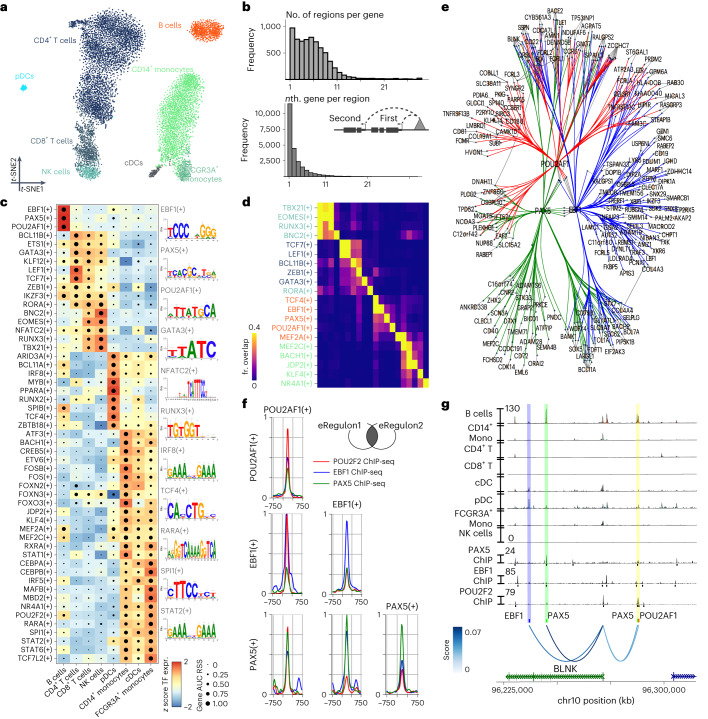
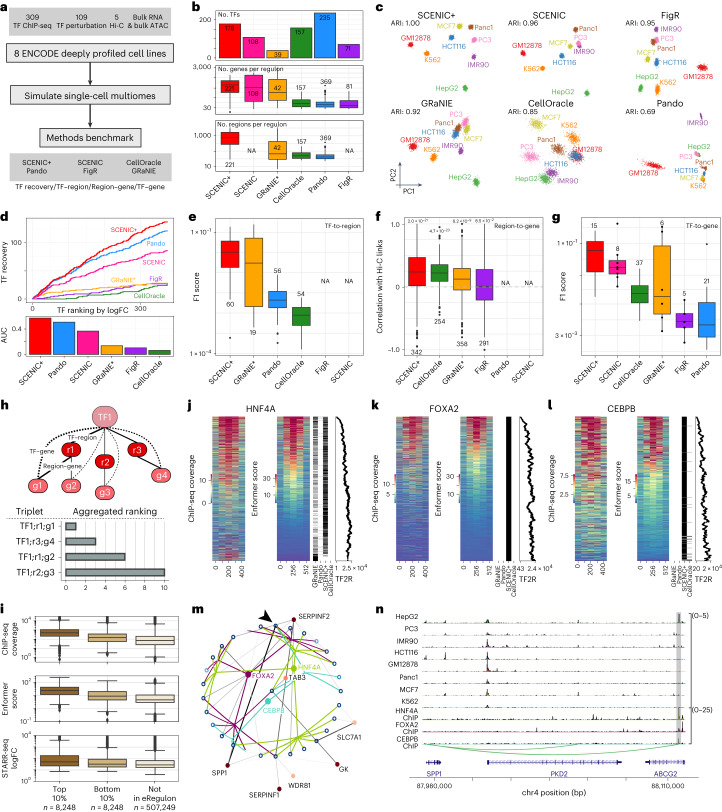
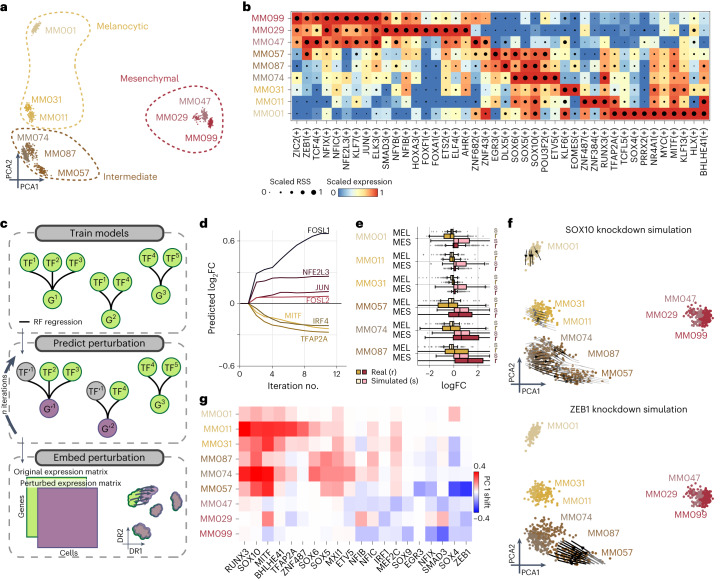
Joint profiling of chromatin accessibility and gene expression in individual cells provides an opportunity to decipher enhancer-driven gene regulatory networks (GRNs). Here we present a method for the inference of enhancer-driven GRNs, called SCENIC+. SCENIC+ predicts genomic enhancers along with candidate upstream transcription factors (TFs) and links these enhancers to candidate target genes. To improve both recall and precision of TF identification, we curated and clustered a motif collection with more than 30,000 motifs. We benchmarked SCENIC+ on diverse datasets from different species, including human peripheral blood mononuclear cells, ENCODE cell lines, melanoma cell states and Drosophila retinal development. Next, we exploit SCENIC+ predictions to study conserved TFs, enhancers and GRNs between human and mouse cell types in the cerebral cortex. Finally, we use SCENIC+ to study the dynamics of gene regulation along differentiation trajectories and the effect of TF perturbations on cell state. SCENIC+ is available at scenicplus.readthedocs.io .
Overview
The claims and statistics of this paper haven’t been checked yet.
Free: it reads the open-access text and checks the first 5 claims that cite a source we can check. Create a free account to check every claim.
Integrity signals
Registry
Cites
Statistics
Figures
Verification
Claims the paper makes
The claims and statistics of this paper haven’t been checked yet.
Free: it reads the open-access text and checks the first 5 claims that cite a source we can check. Create a free account to check every claim.
Claims other papers make about this one
Each is checked against this paper’s own text: does it say what the citing paper says it does?
The source backs part of the claim, not all of it — or backs it for a different population, condition or comparison.
In the citing paper
“SCENIC+ demonstrated superior performance compared to its original version, as well as ppcor, GRNBOOST2, PIDC, GRaNIE, FigR, and Pando, as evidenced by the AUC and F1 score metrics [48].”
From A mini-review on perturbation modelling across single-cell omic modalities (2024) · cites this paper as [48]
Experimental — accuracy not yet measuredThe source backs part of the claim, not all of it — or backs it for a different population, condition or comparison.
In the citing paper
“pycisTarget (v.1.0.1.dev42+gb6707ee) was run using a custom database with the consensus regions on DARs, binarized topics (with Otsu thresholding), curated DARs and topics and MACS2 (v.2.2.7.1) bdgdiff regions, with and without promoters, and using pycisTarget and DEM7.”
From Single-cell spatial multi-omics and deep learning dissect enhancer-driven gene regulatory networks in liver zonation (2024) · cites this paper as [7]
Experimental — accuracy not yet measuredThe cited source says what the claim attributes to it.
In the citing paper
“Notably, SCENIC+ anticipates genomic enhancers and identifies potential upstream transcription factors (TFs) and establishes connections between these enhancers and their relevant target genes.”
From A mini-review on perturbation modelling across single-cell omic modalities (2024) · cites this paper as [48]
The cited source says what the claim attributes to it.
In the citing paper
“Cell-cell similarity graphs in single cell omics [ 47 ], gene regulatory networks [ 48 ] and protein-protein interaction networks [ 49 ] are fundamental tools to rationalize the complexity of biological systems such as the human body.”
From igraph 1.0 enables fast and robust network analysis across programming languages (2026) · cites this paper as [48]
The cited source says what the claim attributes to it.
In the citing paper
“SCENIC+ was run with the default parameters on the complete dataset and using only hepatocytes, using http://nov2020.archive.ensembl.org/ as Biomart host.”
From Single-cell spatial multi-omics and deep learning dissect enhancer-driven gene regulatory networks in liver zonation (2024) · cites this paper as [7]
1 more claim about this paper
Create a free account to see every claim other papers make about this one.
Self-check
Percentages, sums and reported differences re-computed from the paper’s own numbers.
The self-check needs the paper’s full text.
Citations
Cites
Moderated estimation of fold change and dispersion for RNA-seq data with DESeq2
Love, M. I., Huber, W., & Anders, S. (2014) · Genome Biology · doi:10.1186/s13059-014-0550-8 · Cited by 95,106
A Threshold Selection Method from Gray-Level Histograms
Otsu, N. (1979) · IEEE Transactions on Systems, Man, and Cybernetics · doi:10.1109/tsmc.1979.4310076 · Cited by 43,398 · cited 1×
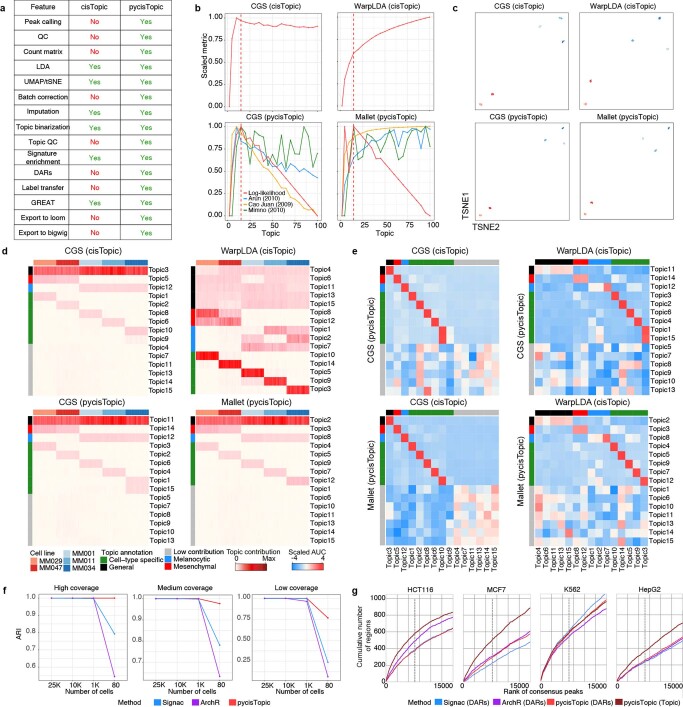
“We have included several binarization methods (applicable for topic-region and cell-topic distributions): ’otsu’ (Otsu, 1979)107, ’yen’ (Yen et al., 1995)108, ’li’ (Li & Lee, 1993)109, ’aucell’ (Van de Sande et al., 2020)20 or ’ntop’ (Taking the top n regions per topic).”
MethodModel-based Analysis of ChIP-Seq (MACS)
Zhang, Y., Liu, T., Meyer, C. A., Eeckhoute, J., Johnson, D. S., Bernstein, B. E., Nusbaum, C., Myers, R. M., Brown, M., Li, W., et al. (2008) · Genome Biology · doi:10.1186/gb-2008-9-9-r137 · Cited by 18,386
An integrated encyclopedia of DNA elements in the human genome
The ENCODE Project Consortium (2012) · Nature · doi:10.1038/nature11247 · Cited by 18,072
Comprehensive Integration of Single-Cell Data
Stuart, T., Butler, A., Hoffman, P., Hafemeister, C., Papalexi, E., Mauck, W. M., Hao, Y., Stoeckius, M., Smibert, P., & Satija, R. (2019) · Cell · doi:10.1016/j.cell.2019.05.031 · Cited by 15,453
Heinz, S., Benner, C., Spann, N., Bertolino, E., Lin, Y. C., Laslo, P., Cheng, J. X., Murre, C., Singh, H., & Glass, C. K. (2010) · Molecular Cell · doi:10.1016/j.molcel.2010.05.004 · Cited by 13,382
Fast, sensitive and accurate integration of single-cell data with Harmony
Korsunsky, I., Millard, N., Fan, J., Slowikowski, K., Zhang, F., Wei, K., Baglaenko, Y., Brenner, M., Loh, P.-R., & Raychaudhuri, S. (2019) · Nature Methods · doi:10.1038/s41592-019-0619-0 · Cited by 10,488
SCANPY: large-scale single-cell gene expression data analysis
Wolf, F. A., Angerer, P., & Theis, F. J. (2018) · Genome Biology · doi:10.1186/s13059-017-1382-0 · Cited by 8,881
Scenic: single-cell regulatory network inference and clustering.
Aibar, S., González-Blas, C. B., Moerman, T., Huynh-Thu, V. A., Imrichova, H., Hulselmans, G., Rambow, F., Marine, J.-C., Geurts, P., Aerts, J., et al. (2017) · Nature Methods · doi:10.1038/nmeth.4463 · Cited by 6,520
Self-citationGriffiths, T. L., & Steyvers, M. (2004) · Proceedings of the National Academy of Sciences · doi:10.1073/pnas.0307752101 · Cited by 6,049 · cited 1×
“- Log-likelihood: Uses the log-likelihood in the last iteration as calculated by Griffiths and Steyvers (2004)104, as used in cisTopic.”
Method
Research works printed but not linked: 1
- Mimno, D., Wallach, H. M., Talley, E., Leenders, M. & McCallum, A. Optimizing semantic coherence in topic models. In Proc. 2011 Conference on Empirical Methods in Natural Language Processing 262–272 (Association for Computational Linguistics, 2011).
Cited by
Items 301–400 of 780
Data-driven modeling of core gene regulatory network underlying leukemogenesis in IDH mutant AML
Katebi, A., Chen, X., Ramirez, D., Li, S., & Lu, M. (2024) · npj Systems Biology and Applications · doi:10.1038/s41540-024-00366-0 · Cited by 6
Yang, C., Jin, Y., & Yin, Y. (2024) · Life Medicine · doi:10.1093/lifemedi/lnae015 · Cited by 5
Guo, X., Jin, W., Wen, Y., Wang, Z., Ren, X., Liu, Z., Fu, R., Cai, Z., & Li, L. (2024) · Journal of Translational Medicine · doi:10.1186/s12967-024-05496-x · Cited by 7
“The SCENIC computation pipeline was executed using the Python package pySCENIC [2, 6], and Van [39].”
MethodWENDY: Covariance dynamics based gene regulatory network inference
Wang, Y., Zheng, P., Cheng, Y., Wang, Z., & Aravkin, A. Y. (2024) · Mathematical Biosciences · doi:10.1016/j.mbs.2024.109284 · Cited by 5
McLamb, F., Feng, Z., Vu, J. P., Griffin, L., Vasquez, M. F., & Bozinovic, G. (2024) · Molecular Neurobiology · doi:10.1007/s12035-024-04427-7 · Cited by 3
Computing hematopoiesis plasticity in response to genetic mutations and environmental stimulations
Wen, Y., He, H., Ma, Y., Bao, D., Cai, L. C., Wang, H., Li, Y., Zhao, B., & Cai, Z. (2024) · Life Science Alliance · doi:10.26508/lsa.202402971 · Cited by 3
Spatially aligned graph transfer learning for characterizing spatial regulatory heterogeneity
Huang, W., Hu, Y., Wang, L., Wu, G., Zhang, C., & Shi, Q. (2024) · Briefings in Bioinformatics · doi:10.1093/bib/bbaf021 · Cited by 4
“…inference methods have incorporated TF perturbation analysis [16], fine-tuning on the large-volume foundation [17], or refinement by integrating TF binding sequence information (e.g., scATAC-seq data) [18, 19] to improve the inference accuracy or cell-identity specificity of regulatory networks.”
zhao, M., Jankovic, D. L., Link, V. M., Souza, C. O. S., Hornick, K. M., Oyesola, O. O., Belkaid, Y., Lack, J., & Loke, P. (2025) · Nature Communications · doi:10.1038/s41467-025-56379-8 · Cited by 6
“Integrating analyses of chromatin accessibility and gene expression of individual cells can be used to infer gene regulatory networks (GRNs) through SCENIC+ 36 .”
InfluentialLu, L., McLinden, A. P., Walker, N. M., Vittal, R., Wang, Y., Fattahi, F., Russell, S. T., Combs, M. P., Welch, J. D., & Lama, V. N. (2026) · JCI Insight · doi:10.1172/jci.insight.196651 · Cited by 4
AtlasXplore: a web platform for visualizing and sharing spatial epigenome data
Barnett, J., Sotudeh, N., Rao, P., Silverman, J., Jafar, T., & Wang, L. (2023) · Bioinformatics · doi:10.1093/bioinformatics/btad447 · Cited by 3
Predicting the Key Regulators of Cell Identity in Human Adult PancreasPreprint
Vanheer, L., Fantuzzi, F., To, S.-K., Schiavo, A., Haele, M. V., Haesen, T., Yi, X., Janiszewski, A., Chappell, J., Rihoux, A., et al. (2020) · bioRxiv · doi:10.1101/2020.09.23.310094 · Cited by 2
“Recently developed computational tools including SCENIC+ and CellOracle could help towards this goal (González-Blas et al. 2022; Kamimoto, Hoffmann, and Morris 2020).”
BackgroundMethodPrioritizing transcription factor perturbations from single-cell transcriptomicsPreprint
Singh, R., Li, J. S. S., Tattikota, S. G., Liu, Y., Xu, J. Q., Hu, Y., Perrimon, N., & Berger, B. (2022) · bioRxiv (Cold Spring Harbor Laboratory) · doi:10.1101/2022.06.27.497786 · Cited by 5
Mitra, S., Malik, R., Wong, W., Rahman, A., Hartemink, A. J., Pritykin, Y., Dey, K. K., & Leslie, C. S. (2023) · bioRxiv (Cold Spring Harbor Laboratory) · doi:10.1101/2023.06.13.544851 · Cited by 4
Park, B., Nicaise, A., Tsitsipatis, D., Pirvan, L., Prasad, P., Novales, M. L. L. D., Whitten, J., Culig, L., Llewellyn, J., Ionescu, R.-B., et al. (2024) · bioRxiv · doi:10.1101/2024.02.09.579648 · Cited by 4
Li, Z., Xu, Z., Zhu, L., Qin, T., Ma, J., Feng, Z., Yue, H., Guan, Q., Zhou, B., Han, G., et al. (2024) · Genome Research · doi:10.1101/gr.279448.124 · Cited by 5
Mateos, M. A., Adiconis, X., Li, J.-K., Marchese, D., Caratù, G., Hon, C.-C., Tiwari, P., Kojima, M., Vieth, B., Murphy, M. A., et al. (2025) · bioRxiv (Cold Spring Harbor Laboratory) · doi:10.1101/2025.03.06.637075 · Cited by 4
Testing the plasticity-first theory of tumor evolution with spatiotemporal lineage tracingPreprint
Yang, J., Hou, L., Wang, X., Zhang, N., Bian, Y., Lu, Z., Chen, Y., Xie, D., Fang, Y., Wang, K., et al. (2025) · bioRxiv (Cold Spring Harbor Laboratory) · doi:10.1101/2025.08.06.668639 · Cited by 6
annATAC: automatic cell type annotation for scATAC-seq data based on language model
Cui, L., Wang, F., Li, H., Liu, Q., Zhou, M., & Wang, G. (2025) · BMC Biology · doi:10.1186/s12915-025-02244-5 · Cited by 3
da Silva, J. E. H., Bernardino, H. S., de Oliveira, I. L., & Camata, J. J. (2025) · Biosystems · doi:10.1016/j.biosystems.2025.105464 · Cited by 6
Context-aware sequence-to-function model of human gene regulation
Aksu, E. D., & Vingron, M. (2026) · Nature Communications · doi:10.1038/s41467-026-75527-2 · Cited by 10
“We used the list of TFs as compiled by the Aerts Lab 38 , which includes 1892 TF genes in the human reference genome hg38 39 .”
scSAGRN: Inferring gene regulatory networks from single-cell multi-omics using spatial association
Ren, Q., Nan, M., Fu, Y., Chen, X., Ma, Y., Shi, Y., & Gao, J. (2025) · Biosystems · doi:10.1016/j.biosystems.2025.105531 · Cited by 3
Leclercq, J., & Maurange, C. (2025) · Advances in experimental medicine and biology · doi:10.1007/978-3-031-97035-1_10 · Cited by 3
Zhou, L., Wang, M., Liu, S., Gu, L., Liu, S., Du, Q., Zhang, T., Ma, Y., Zhao, L., Wang, J., et al. (2025) · Advanced Science · doi:10.1002/advs.202507063 · Cited by 7
Han, J., Ma, S., Wei, Q., Zhao, Z., Zhao, Y., Pu, Y., Zhao, Q., He, X., Ma, Y., MacHugh, D. E., et al. (2025) · iScience · doi:10.1016/j.isci.2025.113496 · Cited by 4
Rommelfanger, M. K., Behrends, M., Chen, Y.-L., Martinez, J., Kurella, N., Geisler, N., Guturu, D., Bens, M., Xiong, L., Xiang, Z., et al. (2025) · iScience · doi:10.1016/j.isci.2025.114010 · Cited by 8
Lee, S. H., Ahn, J. W., Choi, W., Kim, J., Hwang, J. Y., Kim, J.-H., Kim, H., & Kwak, W. (2025) · Cancers · doi:10.3390/cancers17233787 · Cited by 4
Sun, S., Jiang, Y., Huang, F., Wei, W., Hochgerner, M., Xu, T., Wang, X., Lin, K., Zhang, X., Wang, Y., et al. (2025) · Nature Communications · doi:10.1038/s41467-025-65757-1 · Cited by 4
“The following aspects need to be addressed.”
Pan, B., Yu, H., Lin, Z., Liu, M., Liu, J., Xu, Y., Wu, L., Zhang, Q., & Wang, Z. (2025) · Cell Death and Disease · doi:10.1038/s41419-025-08305-5 · Cited by 3
“Using Single-Cell Regulatory Network Inference and Clustering (SCENIC) [16], we identi fi ed RNASEH2C as the speci fi c transcription factor for this non-classical macrophage subpopulation (Fig.”
Li, H., Wang, J., Liu, Q., Zou, Q., & Luo, X. (2025) · Briefings in Bioinformatics · doi:10.1093/bib/bbaf669 · Cited by 3
“SCENIC + is a specialized bioinformatics tool for constructing single-cell regulatory networks based on single-cell transcrip-tomics and CA [74].”
Fibroblast specialization across microanatomy in a single-cell atlas of human Achilles tendon
Cohen, C., Mimpen, J. Y., Kurjan, A., Paul, C., Sharma, S., Ramos‐Mucci, L., Ikwuanusi, C. T., Aksu, A. C., Serebour, T. B., Nikolic, M., et al. (2026) · American Journal of Physiology-Cell Physiology · doi:10.1152/ajpcell.00838.2025 · Cited by 6
From binding to networks: methods for identifying transcription factor targets in plant systems
Sumner, A. T., Bargmann, B. O. R., & Haak, D. C. (2026) · Frontiers in Plant Science · doi:10.3389/fpls.2026.1760251 · Cited by 5
Nuanpirom, J., & Charoensawan, V. (2026) · Briefings in Bioinformatics · doi:10.1093/bib/bbag152 · Cited by 4
“Chromatinaccessibility profiling via scATAC-seq has been widely adopted with scRNA-seq for inferring causal GRNs through both experimental and computational approaches [145, 153, 154].”
Single-cell multiomics and chromatin structure reveal gene-regulatory dynamics in heart failure
Xie, Y., Tucciarone, L., Farah, E. N., Chang, L., Yang, Q., Shankar, T. S., Elison, W. S., Tran, S., Djulamsah, J., Lie, A., et al. (2026) · Science · doi:10.1126/science.ady6893 · Cited by 14
Genetic variants shape single-cell chromatin accessibility and disease risk
Xue, A., Fan, J., Dong, O. A., Huang, H. L., Chen, L., Allen, P. C., Spenceley, E., Sagi-Zsigmond, E., Bowen, B., Henry, A., et al. (2026) · Nature · doi:10.1038/s41586-026-11173-4 · Cited by 3
HyGAnno: hybrid graph neural network–based cell type annotation for single-cell ATAC sequencing data
Zhang, W., Cui, Y., Liu, B., Loza, M., Park, S., & Nakai, K. (2024) · Briefings in Bioinformatics · doi:10.1093/bib/bbae152 · Cited by 6
“Single-cell sequencing technologies have become increasingly popular in contemporary biology and promoted the understanding of the molecular mechanisms underlying the formation of heterogeneous cell populations [1–3].”
BackgroundMoeckel, C. M., Mouratidis, I., Chantzi, N., Uzun, Y., & Georgakopoulos‐Soares, I. (2024) · BioEssays · doi:10.1002/bies.202300210 · Cited by 4
Integration of multiomic data identifies core-module of inherited-retinal diseases
Singh, A. B., & Ratnapriya, R. (2025) · Human Molecular Genetics · doi:10.1093/hmg/ddaf001 · Cited by 3
Ge, D., Xu, X., Fang, L., & Tao, H. (2025) · Discover Oncology · doi:10.1007/s12672-025-01844-5 · Cited by 4
Davenport, K. M., Lowke, M. T., Ortega, M. S., Kelleher, A. M., Warren, W. C., & Spencer, T. E. (2025) · Biology of Reproduction · doi:10.1093/biolre/ioaf036 · Cited by 3
“A GRN for each time point was constructed with SCENIC implemented in Signac [33–36] and identifying transcription factor binding sites significantly (FDR 0.01) enriched in DARs near DEGs between different populations of trophoblasts with TFBSTools FindMotifs and the JASPAR database.”
InfluentialAmmons, D. T., Contursi, C., Olsen, M., Yoshimoto, J. A., Owens, E., Harris, M., Gillen, A. E., Dow, S., Avery, A. C., & Harris, R. A. (2026) · Scientific Reports · doi:10.1038/s41598-026-69222-x · Cited by 4
Evolution of gene regulatory networks in insects
Karasawa, T., & Koshikawa, S. (2025) · Current Opinion in Insect Science · doi:10.1016/j.cois.2025.101365 · Cited by 6
Non-coding variation in dementias: mechanisms, insights, and challenges
Rogers, B. B., & Cochran, J. N. (2025) · npj Dementia · doi:10.1038/s44400-025-00012-4 · Cited by 4
“SCENIC + also utilizes gradient-boosting machine regression, GRNBoost2 107 ,toestimatetheimportanceofcandidateenhancersfortarget gene expression, categorizing the results into positive and negative correlations 108 .”
Long, C., Ma, B., Zhong, X., Zou, M., Li, K., & Liu, S. (2025) · PLoS ONE · doi:10.1371/journal.pone.0326872 · Cited by 3
“In this study, we performed the analysis in the PySCENIC Conda environment to ensure consistency with its dependencies and software versions, adhering to the default parameter settings throughout [24].”
Planell, N., Martinez‐de‐Morentin, X., Mouzo, D., Lara‐Astiaso, D., Vilas‐Zornoza, A., Martín‐Úriz, P. S., Alignani, D., Paiva, B., Maillo, A., Kurowska, A., et al. (2025) · Science Advances · doi:10.1126/sciadv.adw3110 · Cited by 7
“More recent advances in multiomics single-cell approaches have allowed GRN inference, applied to study human peripheral blood mononuclear cells ( 17 ) and plasma cell differentiation in the human tonsil ( 21 ).”
InfluentialA dynamic gene regulatory code drives synaptic development of hippocampal granule cells
Lorente-Echeverría, B., Daaboul, D., Vandensteen, J., Marcassa, G., Naert, W., Vandenbempt, J., Leysen, E., Reverendo, M., Vlaeminck, I., Vervloessem, L., et al. (2025) · Science Advances · doi:10.1126/sciadv.adx5140 · Cited by 7
Self-citationDecoding cell fate: integrated experimental and computational analysis at the single-cell level
Zhou, Y., Hou, S., Miao, X., Zhang, G., Li, Z., Zhang, D., Lin, Y., & Lin, Y. (2025) · Bioinformatics · doi:10.1093/bioinformatics/btaf603 · Cited by 4
Funk, M. W., Wang, Y., & Wang, L. (2025) · Nature Communications · doi:10.1038/s41467-025-66214-9 · Cited by 5
“The high level of cell state speci fi city we observed, consistent with other studies 1 – 4 , underscores both the biological importance of context-speci fi c cGRN inference and the unique value of population-scale scRNA-seq for studying primary human cells under natural genetic variations —…”
InfluentialSingle-cell multiomic human brain atlas reveals regulatory drivers of cortical regionality
Palmer, C. R., Song, J., Yang, B., Chen, C.-J., Diep, D. H., Conklin, K. Y., Plongthongkum, N., Indralingam, H. S., Liu, C. S., Kurtz, J. S., et al. (2026) · Nature Communications · doi:10.1038/s41467-026-69368-2 · Cited by 4
Liu, X., Chen, Z., & Zhang, L. (2024) · Heliyon · doi:10.1016/j.heliyon.2024.e27790 · Cited by 3
Akimov, V. E., Tychinin, D. I., Antonova, O. A., Shaymardanov, A. M., Voronina, M. D., Deinichenko, K. A., Fateev, O. D., Yudin, V. S., Yudin, S. M., Mukhin, V. E., et al. (2024) · Frontiers in Immunology · doi:10.3389/fimmu.2024.1415317 · Cited by 3
Deciphering seed development and germination in the single-cell era
Schouveiler, P., Liew, L. C., Corso, M., Rajjou, L., Zinsmeister, J., & Lewsey, M. G. (2025) · Seed Science Research · doi:10.1017/s0960258524000199 · Cited by 3
“Other tools can also be used to infer cell-type-specific gene co-expressions and regulatory networks from single-cell transcriptomics (Bravo González-Blas et al., 2023; Su et al., 2023).”
Shared and distinct peripheral blood immune cell landscape in MCTD, SLE, and pSS
Cui, Y., Zhang, H., Deng, Y., Fan, O. R., Wang, J., Xing, Z., Tang, J., Zhu, W., Gong, B., & Sun, Y. E. (2025) · Cell & Bioscience · doi:10.1186/s13578-025-01374-1 · Cited by 3
Dunkenberger, L., Li, D. Y., Karakikes, I., & Quertermous, T. (2025) · Trends in Cell Biology · doi:10.1016/j.tcb.2025.05.001 · Cited by 4
Jackson, C. A., Beheler-Amass, M., Tjärnberg, A., Suresh, I., Hickey, A. S.-M., Bonneau, R., & Gresham, D. (2023) · bioRxiv (Cold Spring Harbor Laboratory) · doi:10.1101/2023.09.21.558277 · Cited by 5
Scaling deep identifiable models enables zero-shot characterization of single-cell biological statesPreprint
Dong, M., Agrawal, K., Fan, R., Sefik, E., Flavell, R. A., & Kluger, Y. (2023) · bioRxiv (Cold Spring Harbor Laboratory) · doi:10.1101/2023.11.11.566161 · Cited by 3
“Integrating epigenomic or prioritizing gene regulatory information may help guide the model for better transfer learning [21, 63, 64].”
Tay, T., Bommakanti, G., Jaensch, E. S., Gorthi, A., Reddy, I. K., Hu, Y., Zhang, R., Doshi, A. S., Tan, S. L., Brucklacher-Waldert, V., et al. (2024) · bioRxiv (Cold Spring Harbor Laboratory) · doi:10.1101/2024.02.22.581548 · Cited by 3
Inferring gene regulatory networks by hypergraph variational autoencoderPreprint
Su, G., Wang, H., Zhang, Y., Coster, A. C. F., Wilkins, M. R., Cañete, P. F., Yu, D., Yang, Y., & Zhang, W. (2024) · bioRxiv (Cold Spring Harbor Laboratory) · doi:10.1101/2024.04.01.586509 · Cited by 3
Leveraging single cell multiomic analyses to identify factors that drive human chondrocyte cell fatePreprint
Venkatasubramanian, D., Senevirathne, G., Capellini, T. D., & Craft, A. M. (2024) · bioRxiv (Cold Spring Harbor Laboratory) · doi:10.1101/2024.06.12.598666 · Cited by 2
“Having defined cell types based upon their transcriptomes and open chromatin, we next sought to identify enhancer-based gene regulatory networks (eRegulons) by combining TF expression, TF motif enrichment, target gene region accessibility, and target gene expression using the SCENIC+ algorithm 32 .”
BackgroundMethodInfluentialChoi, J. J., Svaren, J. P., & Wang, D. (2024) · bioRxiv (Cold Spring Harbor Laboratory) · doi:10.1101/2024.06.19.599799 · Cited by 3
“Moreover, additional bioinformatic tools such as SCENIC 18 , Signac 19 , and scGRNom 20 predict cell type gene regulatory networks to explain potential TF-TG relationships.”
MethodZhao, Z., Liu, A., Citu, C., Enduru, N., Chen, X., Manuel, A. M., Sinha, T., Gorski, D., Fernandes, B. S., Yu, M., et al. (2024) · Research Square · doi:10.21203/rs.3.rs-4622123/v1 · Cited by 3
“Using SCENIC + algorithm, we inferred enhancer-driven regulons for each brain region, which comprising candidate TFs, open chromatin regions with enriched TF-binding motifs, and target genes across cellular states 42 .”
MethodPark, R. J.-H., Parikh, M., Pappas, L., Sade-Feldman, M., Kulkarni, A. S., Bi, L., LaSalle, T. J., Galway, A., Kuhlman, C., Blaszkowsky, L. S., et al. (2024) · medRxiv · doi:10.1101/2024.10.08.24315092 · Cited by 4
Nourisa, J., Passemiers, A., & Tomforde, S. (2024) · bioRxiv (Cold Spring Harbor Laboratory) · doi:10.1101/2024.10.16.618746 · Cited by 3
“For comparison, we also ran the pipeline of Scenic+ [2] and FigR [3] for the same data.”
MethodInfluentialSpatiotemporal map of the developing human reproductive tract at single-cell resolutionPreprint
Lorenzi, V., Icoresi-Mazzeo, C., Yayon, N., Ruiz-Morales, E. R., Sancho‐Serra, C., Wong, F. C. K., Marečková, M., Tuck, E. J., Roberts, K., Li, T., et al. (2024) · bioRxiv (Cold Spring Harbor Laboratory) · doi:10.1101/2024.10.30.621114 · Cited by 3
O’Leary, T. S., Mikucki, E. E., Tangwancharoen, S., Boyd, J. R., Cahan, S. H., Frietze, S. E., & Lockwood, B. L. (2025) · bioRxiv (Cold Spring Harbor Laboratory) · doi:10.1101/2025.01.08.631745 · Cited by 3
Yin, J., Zheng, Y., Huang, Z., Zhou, W., Yuan, Y., Cai, P., Bai, Y., Yang, S., Gao, Y., Duan, S., et al. (2025) · bioRxiv (Cold Spring Harbor Laboratory) · doi:10.1101/2025.01.26.634963 · Cited by 3
Williams, E. C., Franzén, L., Lindvall, M. O., Hamm, G. R., Oag, S., Majumder, M. M., Denholm, J., Hamidinekoo, A., Morlanes, J. E., Vicari, M., et al. (2025) · bioRxiv (Cold Spring Harbor Laboratory) · doi:10.1101/2025.02.26.640381 · Cited by 3
Hu, L., Zhang, S., Zhang, X., Luo, Y., Gu, H., Liu, P., Mao, S., Chen, L., Xia, Y., Yang, M., et al. (2025) · bioRxiv (Cold Spring Harbor Laboratory) · doi:10.1101/2025.08.21.671434 · Cited by 4
Vilarrasa‐Blasi, R., Kim, S., Pett, J. P., Korzhenevich, J., Svatoň, M., Suo, C., Wong, F. C. K., Nashchekina, O., Zhou, D., Colligan, R. M., et al. (2025) · bioRxiv (Cold Spring Harbor Laboratory) · doi:10.1101/2025.08.31.672613 · Cited by 4
Liu, D., Song, B., Li, Z., Zhang, S., Fabiha, T., Zhao, J., Inoki, A., Piccand, J., Soh, C.-L., Dixon, G., et al. (2025) · bioRxiv (Cold Spring Harbor Laboratory) · doi:10.64898/2025.12.23.696311 · Cited by 4
Dynamic Gene Regulatory Network Inference with Interpretable, Biophysically-Motivated Neural ODEsPreprint
Beheler-Amass, M., Jackson, C. A., Gresham, D., & Bonneau, R. (2025) · bioRxiv (Cold Spring Harbor Laboratory) · doi:10.1101/2025.09.19.676870 · Cited by 5
“The goal of transcriptional GRN inference (GRNi) is to determine a network which represents how transcriptional activators and repressors control RNA transcription, to create a systems-level understanding of cellular regulation (6; 7; 8; 9; 10).”
Single-cell analysis of chromatin state and transcriptome in the human basal ganglia
Chang, L., Li, K., Xie, Y., Zhong, G., Rink, J. A., Báez-Becerra, C. T., Lie, A., Indralingam, H. S., Loe, T., Dong, K., et al. (2026) · Cell · doi:10.64898/2026.02.03.703645 · Cited by 11
Transcription factor collaboration enables precise T cell state engineeringPreprint
Savage, R. E., Amador, C. D. M., Hock, C., Zhang, R., Kuo, H., Gao, A., Horlbeck, M. A., Gersbach, C. A., & Buenrostro, J. D. (2026) · bioRxiv (Cold Spring Harbor Laboratory) · doi:10.64898/2026.04.20.718569 · Cited by 5
“3C, 5 ).”
Cheng, H., Liang, M., Gao, Y., Zhao, W., & Guo, W.-F. (2025) · Genes · doi:10.3390/genes16030244 · Cited by 2
“Some strategies assume linear relationships between TFs, CRE, and genes (including FigR [36] and GRaNIE [37]), while others assume non-linear relationships (including SCENIC+ [38], CellOracle [39], and Dictys [40]).”
Xu, T., Zhang, W., Gong, S., Jiang, B., Fu, Z., Song, F., Zhang, Y., & Huang, P. (2025) · The FASEB Journal · doi:10.1096/fj.202402855r · Cited by 2
Pouncey, L., & Mok, G. F. (2025) · Developmental Biology · doi:10.1016/j.ydbio.2025.04.008 · Cited by 3
Morin, A. M., Chu, C. P., & Pavlidis, P. (2025) · PLoS Computational Biology · doi:10.1371/journal.pcbi.1012962 · Cited by 2
Yi, Z., Ma, N., & Ao, Y. (2025) · Biology · doi:10.1101/2025.06.11.658833 · Cited by 3
A practical guide to sequencing in neuropsychiatric research
Minerva, A. R., DeBerardine, M., Lin, R., Kim, H. J. J., Rogers, F. D., Rashford, R. L., & Peña, C. J. (2025) · NPP—Digital Psychiatry and Neuroscience · doi:10.1038/s44277-025-00041-0 · Cited by 2
A systems approach for elucidating the role of the microbiome in epigenetic cellular memory
Pederson, J. W., & Nita‐Lazar, A. (2025) · mSystems · doi:10.1128/msystems.00185-25 · Cited by 2
Wang, X., Mei, Y., Wang, X., Wu, H., Wang, R., Zhang, P., Zhang, G., Li, J., Jiang, M., Fang, X., et al. (2025) · Clinical and Translational Medicine · doi:10.1002/ctm2.70461 · Cited by 3
SuperGLUE facilitates an explainable training framework for multi-modal data analysis
Liu, T., Zhao, J., & Zhao, H. (2025) · Cell Reports Methods · doi:10.1016/j.crmeth.2025.101167 · Cited by 4
“By utilizing the function of GRN inference in SCENIC/SCENIC+, 15,72 we can also make inferences about GRNs based on the selected significant gene-peak interactions for this dataset.”
Ruan, L.-J., Weng, K.-Q., Zhang, W., Zhuang, Y.-N., Li, J., Lin, L., Chen, Y., & Zeng, Y. (2025) · Frontiers in Immunology · doi:10.3389/fimmu.2025.1651270 · Cited by 3
Multimodal single cell analyses reveal gene networks of planarian stem cell differentiation
Pérez-Posada, A., García-Castro, H., Emili, E., Guixeras-Fontana, A., Vanni, V., Salamanca-Díaz, D. A., Arias-Baldrich, C., Frölich, S., van Heeringen, S. J., Cebrià, F., et al. (2025) · Nature Communications · doi:10.1038/s41467-025-65712-0 · Cited by 6
“Recent single-cell technologies predict TF/target gene interactions across various contexts 31,32 but often lack experimental validation, and it is unclear if these methods can scale beyond individual tissues to whole complex organisms.”
Endothelial-specific genes TMTC1, RPS6KA2, and F8 are downregulated in hypertrophic cardiomyopathy
Tian, P., Xu, L., Zou, F., Jia, Q., Liu, Y., Chen, J., & Wang, P. (2025) · European journal of medical research · doi:10.1186/s40001-025-03670-5 · Cited by 2
Zhang, H., Hou, J., Zhang, L., Luo, P., Zhang, H., Jiang, A., Ren, X., & Wu, C. (2025) · Translational Oncology · doi:10.1016/j.tranon.2025.102650 · Cited by 2
Dufour, A., Rossignol, M. N., Manceau, P., Bailly, Y., Ferchaud, S., Mercat, M.-J., Turhan, A. G., Djebali, S., Foissac, S., Artus, J., et al. (2025) · iScience · doi:10.1016/j.isci.2025.114519 · Cited by 2
“For each cell population, we then inferred GRNs based on enhancer-driven gene regulation modules (eRegu-lons) 10 and validated them through motif occupancy visualization.”
Unraveling Cardiovascular Development and Function: Insights From Single-Cell Omics
Harper, R. L., Lelliott, P. M., Bender, S. B., & Pinto, A. R. (2026) · Circulation Research · doi:10.1161/circresaha.125.325793 · Cited by 4
Wang, T., Wu, L., Gao, Y., Chen, H., Dai, Z., Chen, T., Deng, X., & Hou, J. (2026) · Intelligent Oncology · doi:10.1016/j.intonc.2025.12.001 · Cited by 2
Jachim, S. K., Venkatasubramanian, D., Senevirathne, G., Zhu, A. S., Vitale, C., Melendez, D. L., Zhang, C., Lassar, A. B., Capellini, T. D., & Craft, A. M. (2026) · Osteoarthritis and Cartilage · doi:10.1016/j.joca.2025.12.025 · Cited by 7
Evaluating single-cell ATAC-seq atlasing technologies using sequence-to-function modeling
Dickmänken, H., Wojno, M., Mahieu, L., Theunis, K., Ekşi, E. C., Christiaens, V., Kempynck, N., Rop, F. V. D., Roels, N., Spanier, K. I., et al. (2026) · Nature Communications · doi:10.1038/s41467-026-68742-4 · Cited by 3
“Applying motif enrichment analysis (pyCisTarget 7 ), the recovered motifs of HyDrop v2-and 10x-based data correlate highly on their normalized enrichment score (NES) per cell type in mouse ( r = 0.89, Fig.”
InfluentialSelf-citationLiu, Y., Luo, W., Xu, Y., Yao, X., Dai, L., Qiao, F., Wang, P., Yang, W., Feng, Y., Miao, H., et al. (2026) · BioMed Research International · doi:10.1155/bmri/9855803 · Cited by 2
Single-cell atlas of AML reveals age-related gene regulatory networks in t(8;21) AML
Whittle, J. R. S., Meyer, S., Lacaud, G., Baker, S. M., & Iqbal, M. (2025) · eLife · doi:10.7554/elife.104978.3 · Cited by 5
Developmental reprogramming in melanocortin neurons modulates diet-induced obesity in mice
Xu, B., LI, L., Chen, M., Wu, Z., Chen, X., Swati, Wan, R., Almeida, A. G., Wyler, S. C., & Liu, C. (2026) · Neuron · doi:10.1016/j.neuron.2025.12.022 · Cited by 3
Kang, F., Yuan, H., Samarkhazan, H. S., & Tavakoli, F. (2026) · Cell Communication and Signaling · doi:10.1186/s12964-026-02734-1 · Cited by 5
Mitchell, J. T., Stapleton, O., Krishnan, K., Nagaraj, S., Lvovs, D., Cherry, C., Poissonnier, A., Horton, W. R., Adey, A., Rao, V., et al. (2026) · Bioinformatics · doi:10.1093/bioinformatics/btag089 · Cited by 5
Zhang, H., Liu, Y., Zhang, W., Guo, Y., Lin, A., Jin, Y., Lü, P., Fang, Y., Zhang, H., Qu, L., et al. (2026) · Drug Resistance Updates · doi:10.1016/j.drup.2026.101388 · Cited by 4
Human-specific features of the cerebellum and ZP2-regulated synapse development
Kim, S., Cherskov, A., Sindhwani, A., Choi, S.-H., Kim, H., Li, M., Zhang, M., Mato-Blanco, X., Liu, Y., Micali, N., et al. (2026) · Cell · doi:10.1016/j.cell.2026.02.014 · Cited by 7
Borra, S., Yan, D., Welner, R. S., & Yue, Z. (2026) · Biology · doi:10.3390/biology15070588 · Cited by 2
Li, X., Guo, M., Wen, Y., & Long, B. (2026) · PLoS ONE · doi:10.1371/journal.pone.0347679 · Cited by 3
“Using the epithelial-cell expression matrix and corresponding metadata, we applied the standard SCENIC workflow to construct and evaluate transcription factor (TF) regulatory networks [24,25].”
The changing landscape of gene expression analysis
Zhao, Q., Shen, S., Shim, W. J., & Palpant, N. J. (2026) · Briefings in Bioinformatics · doi:10.1093/bib/bbag185 · Cited by 3
“…communication [92–94]; gene expression profiles can be integrated with histone modification maps to identify context-specific regulatory genes [95]; and joint analysis of scRNA-seq with single-cell chromatin accessibility can be used to infer enhancer activity and gene regulatory networks [10].”
Metadata
- Authors
- Bravo González-Blas, C., De Winter, S., Hulselmans, G., Hecker, N., Matetovici, I., Christiaens, V., Poovathingal, S., Wouters, J., Aibar, S., & Aerts, S.
- Affiliations
- VIB-KU Leuven Center for Brain & Disease Research (BE)
- Vlaams Instituut voor Biotechnologie (BE)
- Corresponding author
- Aerts, Stein
- ORCID
- Venue
- Nature Methods
- Published
- 2023-07-13
- Volume
- 20
- Issue
- 9
- Pages
- 1355-1367
- ISSN
- 1548-7091 (ISSN-L)
- 1548-7105
- PMC
- PMC10482700
- OpenAlex
- W4384198561
- Semantic Scholar
- abe9998e249e33005981b23b97929dddb246b288
- Cited by
- 778
- References
- 169
- Citations by year
- 2026: 279 · 2025: 280 · 2024: 153 · 2023: 59
- FWCI
- 68.58
- Type
- journal article
- Language
- en
- Open access
- hybrid
- doi.org
- Licence
- cc-by
- creativecommons.org/licenses/by/4.0 (tdm)
- creativecommons.org/licenses/by/4.0 (vor)
- Locations
- Nature Methods (publishedVersion, cc-by)
- bioRxiv (Cold Spring Harbor Laboratory) (acceptedVersion)
- PubMed Central (publishedVersion, cc-by)
- PubMed (publishedVersion)
- Lirias (submittedVersion, cc-by)
- Funders
- Fonds Wetenschappelijk Onderzoek (G094121N, 11F1519N)
- KU Leuven
- Fondation contre le Cancer
- Bijzonder Onderzoeksfonds UGent
- Topics
- Life Sciences › Biochemistry, Genetics and Molecular Biology › Molecular Biology › Genomics and Chromatin Dynamics
- Life Sciences › Biochemistry, Genetics and Molecular Biology › Molecular Biology › Single-cell and spatial transcriptomics
- Life Sciences › Biochemistry, Genetics and Molecular Biology › Molecular Biology › Gene Regulatory Network Analysis
- Keywords
- SCENIC, gene regulatory networks, chromatin accessibility, single-cell multi-omics, transcription factor identification, transcription factor binding motifs, cross-species conservation, differentiation trajectories, transcription factor perturbation
- MeSH terms
- Multiomics, Animals, Chromatin, Drosophila, Enhancer Elements, Genetic, Gene Expression Regulation, Humans, Leukocytes, Mononuclear, Mice, Gene Regulatory Networks
About these checks
Registry, retraction, Cites and statistics results are computed, not judged, with one exception: a printed reference that no index lists is read once by a model before it counts as a citation error. Claims are extracted by a model and kept only when their quote appears verbatim in the text; each cited source is then checked, with a model’s help, for whether it says what the claim relies on. Those verdicts can be wrong — read the claim’s quote and the cited source before relying on one.
Statistics and arithmetic are recomputed, not judged.
Confidence bands are shown only for fields calibrated on our annotated test set. None is calibrated yet, so no band is shown.
What counts as a claim ›How we measure confidence ›How we check this ›
Are you an author, or do you see a problem with this page? Request a review
Data sources
Bibliographic data: Semantic Scholar, OpenAlex, Crossref.
Contains information from the Semantic Scholar Academic Graph Datasets, made available under the ODC Attribution License (ODC-BY 1.0).
Semantic Scholar’s data is described in: Kinney, R., et al. (2023). The Semantic Scholar Open Data Platform. arXiv:2301.10140.
