

An implementation of integrated information theory in resting-state fMRI
Open accessThe DOI matches its Crossref record; 72 of the 73 references it cites were found in a registry or an index.
Abstract
Integrated Information Theory was developed to explain and quantify consciousness, arguing that conscious systems consist of elements that are integrated through their causal properties. This study presents an implementation of Integrated Information Theory 3.0, the latest version of this framework, to functional MRI data. Data were acquired from 17 healthy subjects who underwent sedation with propofol, a short-acting anaesthetic. Using the PyPhi software package, we systematically analyze how Φ max, a measure of integrated information, is modulated by the sedative in different resting-state networks. We compare Φ max to other proposed measures of conscious level, including the previous version of integrated information, Granger causality, and correlation-based functional connectivity. Our results indicate that Φ max presents a variety of sedative-induced behaviours for different networks. Notably, changes to Φ max closely reflect changes to subjects’ conscious level in the frontoparietal and dorsal attention networks, which are responsible for higher-order cognitive functions. In conclusion, our findings present important insight into different measures of conscious level that will be useful in future implementations to functional MRI and other forms of neuroimaging.
Overview
The claims and statistics of this paper haven’t been checked yet.
Free: it reads the open-access text and checks the first 5 claims that cite a source we can check. Create a free account to check every claim.
Integrity signals
Registry
Cites
Statistics
Figures
Verification
Claims the paper makes
The claims and statistics of this paper haven’t been checked yet.
Free: it reads the open-access text and checks the first 5 claims that cite a source we can check. Create a free account to check every claim.
Claims other papers make about this one
Each is checked against this paper’s own text: does it say what the citing paper says it does?
The source backs part of the claim, not all of it — or backs it for a different population, condition or comparison.
In the citing paper
“Consistent with Nemirovsky et al. (2023), we anticipate that this concatenation generates TPMs in which the dominant mechanisms contributing to Φ are those consistently present across multiple responses, thereby reflecting intrinsic properties of a specific RN.”
From Can "consciousness" be observed from large language model (LLM) internal states? Dissecting LLM representations obtained from Theory of Mind test with Integrated Information Theory and Span Representation analysis (2025) · cites this paper as Nemirovsky et al., 2023
Experimental — accuracy not yet measuredThe source backs part of the claim, not all of it — or backs it for a different population, condition or comparison.
In the citing paper
“in the study on resting-state fMRI (Nemirovsky et al., 2023), dimensionality reduction was implicitly performed by clustering regions into centroids, a process that assumes linear separability akin to PCA, supporting its applicability to network-based structures like the RN.”
From Can "consciousness" be observed from large language model (LLM) internal states? Dissecting LLM representations obtained from Theory of Mind test with Integrated Information Theory and Span Representation analysis (2025) · cites this paper as Nemirovsky et al., 2023
Experimental — accuracy not yet measuredThe source backs part of the claim, not all of it — or backs it for a different population, condition or comparison.
In the citing paper
“Nemirovsky et al. (2023) use resting-state fMRI to estimate Φ across brain networks, finding higher integration in conscious states compared to unconscious ones, such as during anesthesia.”
From Can "consciousness" be observed from large language model (LLM) internal states? Dissecting LLM representations obtained from Theory of Mind test with Integrated Information Theory and Span Representation analysis (2025) · cites this paper as Nemirovsky et al., 2023
Experimental — accuracy not yet measuredThe cited source says what the claim attributes to it.
In the citing paper
“In the the study on implementing IIT on resting-state fMRI (Nemirovsky et al., 2023), resting-state networks were reduced to five regions to balance spatial resolution and computational complexity.”
From Can "consciousness" be observed from large language model (LLM) internal states? Dissecting LLM representations obtained from Theory of Mind test with Integrated Information Theory and Span Representation analysis (2025) · cites this paper as Nemirovsky et al., 2023
The cited source says what the claim attributes to it.
In the citing paper
“This approach mirrors the methodology employed in the analysis of binarized human resting-state fMRI signals reported in Nemirovsky et al. (2023).”
From Can "consciousness" be observed from large language model (LLM) internal states? Dissecting LLM representations obtained from Theory of Mind test with Integrated Information Theory and Span Representation analysis (2025) · cites this paper as Nemirovsky et al., 2023
Self-check
Percentages, sums and reported differences re-computed from the paper’s own numbers.
The self-check needs the paper’s full text.
Citations
Cites
Controlling the False Discovery Rate: A Practical and Powerful Approach to Multiple Testing
Benjamini, Y., & Hochberg, Y. (1995) · Journal of the Royal Statistical Society Series B: Statistical Methodology · doi:10.1111/j.2517-6161.1995.tb02031.x · Cited by 109,482
Control of goal-directed and stimulus-driven attention in the brain
Corbetta, M., & Shulman, G. L. (2002) · Nature Reviews Neuroscience · doi:10.1038/nrn755 · Cited by 12,881
An Integrative Theory of Prefrontal Cortex Function
Miller, E. K., & Cohen, J. D. (2001) · Annual Review of Neuroscience · doi:10.1146/annurev.neuro.24.1.167 · Cited by 12,803
The human brain is intrinsically organized into dynamic, anticorrelated functional networks
Fox, M. D., Snyder, A. Z., Vincent, J. L., Corbetta, M., Van Essen, D. C., & Raichle, M. E. (2005) · Proceedings of the National Academy of Sciences · doi:10.1073/pnas.0504136102 · Cited by 8,553
Consistent resting-state networks across healthy subjects
Damoiseaux, J. S., Rombouts, S. A. R. B., Barkhof, F., Scheltens, P., Stam, C. J., Smith, S. M., & Beckmann, C. F. (2006) · Proceedings of the National Academy of Sciences · doi:10.1073/pnas.0601417103 · Cited by 4,326 · cited 2×
“5 8 Although fMRI studies were initially designed to have subjects perform speci fi c tasks, it has become increasingly common to measure spontaneous brain activity without overt stimulation.”
BackgroundThe brain's default mode network
Raichle, M. E. (2015) · Annual Review of Neuroscience · doi:10.1146/annurev-neuro-071013-014030 · Cited by 3,904
What we can do and what we cannot do with fMRI
Logothetis, N. K. (2008) · Nature · doi:10.1038/nature06976 · Cited by 3,612 · cited 13×
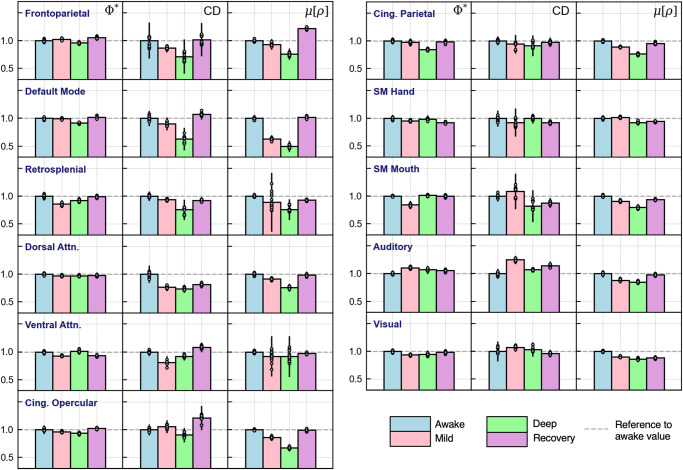
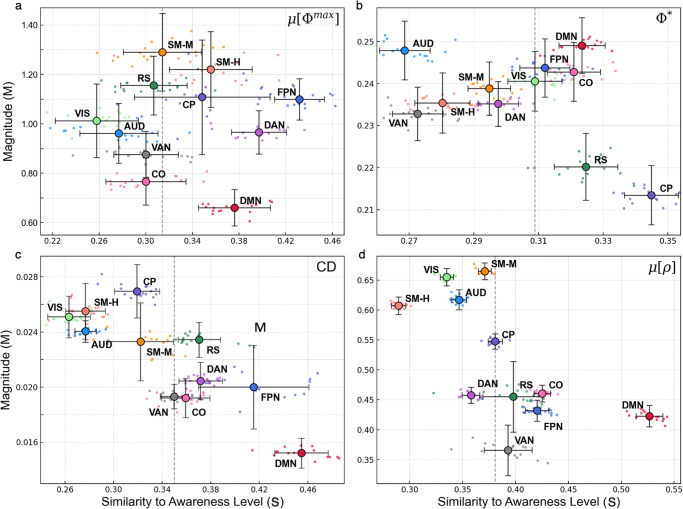
“For statistical information, see Supplementary Note 6, Supplementary Table 3. closely corresponded to awareness level in the two cingulate networks.”
BackgroundInfluentialControlled Sedation with Alphaxalone-Alphadolone
Ramsay, M. A. E., Savege, T. M., Simpson, B. R. J., & Goodwin, R. (1974) · BMJ · doi:10.1136/bmj.2.5920.656 · Cited by 2,861
Ruxton, G. D. (2006) · Behavioral Ecology · doi:10.1093/beheco/ark016 · Cited by 1,988
An information integration theory of consciousness
Tononi, G. (2004) · BMC Neuroscience · doi:10.1186/1471-2202-5-42 · Cited by 1,958 · cited 2×
“The initial framework (IIT 1.0) was limited to stationary systems 10 , while the second version (IIT 2.0) extended the theory to dynamic systems that evolve over time.”
BackgroundInfluentialEvidence for a Frontoparietal Control System Revealed by Intrinsic Functional Connectivity
Vincent, J. L., Kahn, I., Snyder, A. Z., Raichle, M. E., & Buckner, R. L. (2008) · Journal of Neurophysiology · doi:10.1152/jn.90355.2008 · Cited by 1,869 · cited 2×
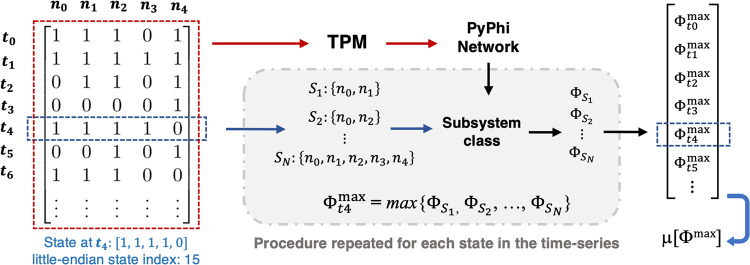
“Note that these are the states of the entire system and not individual nodes, meaning a, b, etc. are state with indices between 0 and 31.”
BackgroundIntegrated information theory: from consciousness to its physical substrate
Tononi, G., Boly, M., Massimini, M., & Koch, C. (2016) · Nature Reviews Neuroscience · doi:10.1038/nrn.2016.44 · Cited by 1,727
Niendam, T. A., Laird, A. R., Ray, K. L., Dean, Y. M., Glahn, D. C., & Carter, C. S. (2012) · Cognitive, Affective, & Behavioral Neuroscience · doi:10.3758/s13415-011-0083-5 · Cited by 1,700
Neural correlates of consciousness: progress and problems
Koch, C., Massimini, M., Boly, M., & Tononi, G. (2016) · Nature Reviews Neuroscience · doi:10.1038/nrn.2016.22 · Cited by 1,600 · cited 4×
“9,12 Even within the brain, there are sophisticated structures consisting of complex neuronal interactions that are not The results of the control procedure and the analysis of modulation in each measure are brie fl y summarized above.”
BackgroundResultInfluentialGeneration and evaluation of a cortical area parcellation from resting-state correlations
Gordon, E. M., Laumann, T. O., Adeyemo, B., Huckins, J. F., Kelley, W. M., & Petersen, S. E. (2016) · Cerebral Cortex · doi:10.1093/cercor/bhu239 · Cited by 1,463
Dorsal and Ventral Attention Systems: Distinct Neural Circuits but Collaborative Roles
Vossel, S., Geng, J. J., & Fink, G. R. (2014) · The Neuroscientist · doi:10.1177/1073858413494269 · Cited by 1,438 · cited 1×
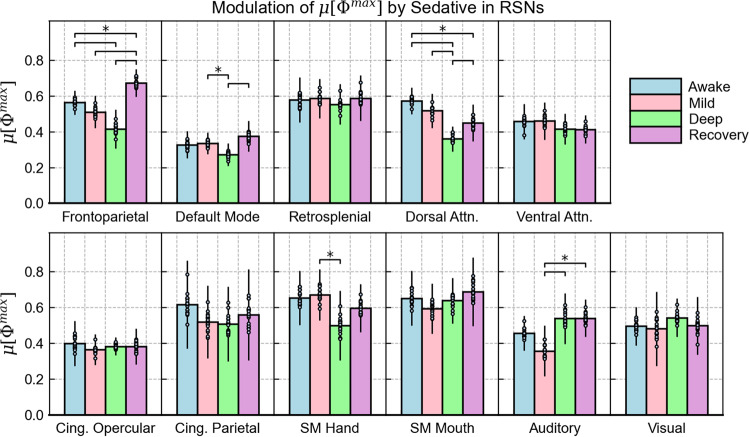
“32,33 Considering the related functions and noted interactions between the FPN and DAN 30 , their similar behaviors are a promising fi nding.”
BackgroundStatistical Inference about Markov Chains
Anderson, T. W., & Goodman, L. A. (1957) · The Annals of Mathematical Statistics · doi:10.1214/aoms/1177707039 · Cited by 1,395
PHARMACOKINETIC MODEL DRIVEN INFUSION OF PROPOFOL IN CHILDREN
MARSH, B., WHITE, M., MORTON, N., & KENNY, G. N. C. (1991) · British Journal of Anaesthesia · doi:10.1093/bja/67.1.41 · Cited by 1,168
From the phenomenology to the mechanisms of consciousness: integrated information theory 3.0
Oizumi, M., Albantakis, L., & Tononi, G. (2014) · PLoS Computational Biology · doi:10.1371/journal.pcbi.1003588 · Cited by 1,128 · cited 7×
“9,12 Even within the brain, there are sophisticated structures consisting of complex neuronal interactions that are not The results of the control procedure and the analysis of modulation in each measure are brie fl y summarized above.”
BackgroundMethodInfluentialOverview of Functional Magnetic Resonance Imaging
Glover, G. H. (2011) · Neurosurgery Clinics of North America · doi:10.1016/j.nec.2010.11.001 · Cited by 1,024 · cited 1×
“47 Computing causality for fMRI data is hence controversial, as its low sampling rate may preclude a meaningful evaluation of causal properties.”
BackgroundGranger causality analysis in neuroscience and neuroimaging
Seth, A. K., Barrett, A. B., & Barnett, L. (2015) · The Journal of Neuroscience · doi:10.1523/jneurosci.4399-14.2015 · Cited by 928 · cited 2×
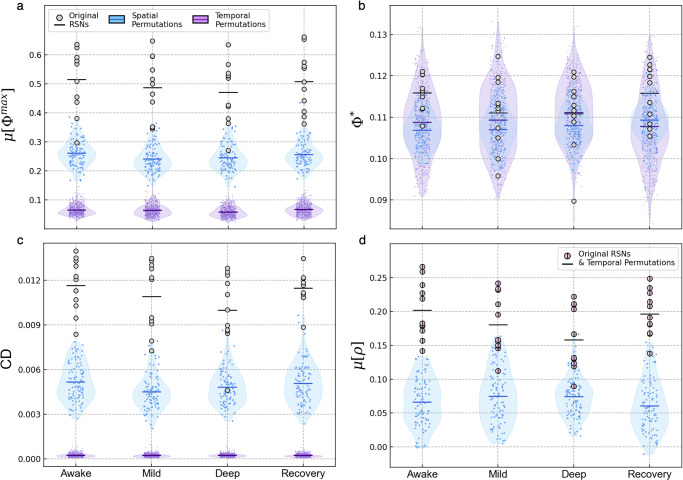
“…IIT 2.0 13,24 ; 2) Causal Density (CD), a measure proposed by Seth et al. to quantify the average Granger causality over a collection of time-series 25,26 ; and 3) μ [ ρ ], a networks ’ average Pearson correlation coef fi cient, a statistical measure of synchrony between the time-series of a…”
BackgroundInfluentialDisorders of consciousness after acquired brain injury: the state of the science
Giacino, J. T., Fins, J. J., Laureys, S., & Schiff, N. D. (2014) · Nature Reviews Neurology · doi:10.1038/nrneurol.2013.279 · Cited by 883
Self-citationStandard deviations and standard errors
Altman, D. G., & Bland, J. M. (2005) · BMJ · doi:10.1136/bmj.331.7521.903 · Cited by 878
Consciousness: here, there and everywhere?
Tononi, G., & Koch, C. (2015) · Philosophical Transactions of the Royal Society B: Biological Sciences · doi:10.1098/rstb.2014.0167 · Cited by 811
A MATLAB toolbox for Granger causal connectivity analysis
Seth, A. K. (2010) · Journal of Neuroscience Methods · doi:10.1016/j.jneumeth.2009.11.020 · Cited by 750
Smitha, K., Akhil Raja, K., Arun, K., Rajesh, P., Thomas, B., Kapilamoorthy, T., & Kesavadas, C. (2017) · The Neuroradiology Journal · doi:10.1177/1971400917697342 · Cited by 647
Dixon, M. L., De La Vega, A., Mills, C., Andrews-Hanna, J., Spreng, R. N., Cole, M. W., & Christoff, K. (2018) · Proceedings of the National Academy of Sciences · doi:10.1073/pnas.1715766115 · Cited by 595 · cited 12×
“Turning our attention to Φ * , the cingulate networks were the only ones to demonstrate a steady decrease moving towards deep sedation and an increase in recovery, while other networks typically associated with awareness, such as the FPN and DAN, did not demonstrate a meaningful modulation pattern.”
BackgroundInfluentialBoly, M., Massimini, M., Tsuchiya, N., Postle, B. R., Koch, C., & Tononi, G. (2017) · The Journal of Neuroscience · doi:10.1523/jneurosci.3218-16.2017 · Cited by 557 · cited 1×
“9,46 While this idea is not supported by our results, further research is needed to determine the extent to which these regions contribute to conscious processing.”
ResultStatistical Methods in Markov Chains
Billingsley, P. (1961) · The Annals of Mathematical Statistics · doi:10.1214/aoms/1177705136 · Cited by 555
Unresponsiveness ≠ unconsciousness
Sanders, R. D., Tononi, G., Laureys, S., Sleigh, J. W., & Warner, D. S. (2012) · Anesthesiology · doi:10.1097/aln.0b013e318249d0a7 · Cited by 474 · cited 3×
“2,45 Although our study focused on integrated information theory, further research should incorporate other theories that have been proposed to explain consciousness.”
BackgroundIntegrated information in discrete dynamical systems: motivation and theoretical framework
Balduzzi, D., & Tononi, G. (2008) · PLoS Computational Biology · doi:10.1371/journal.pcbi.1000091 · Cited by 419 · cited 2×
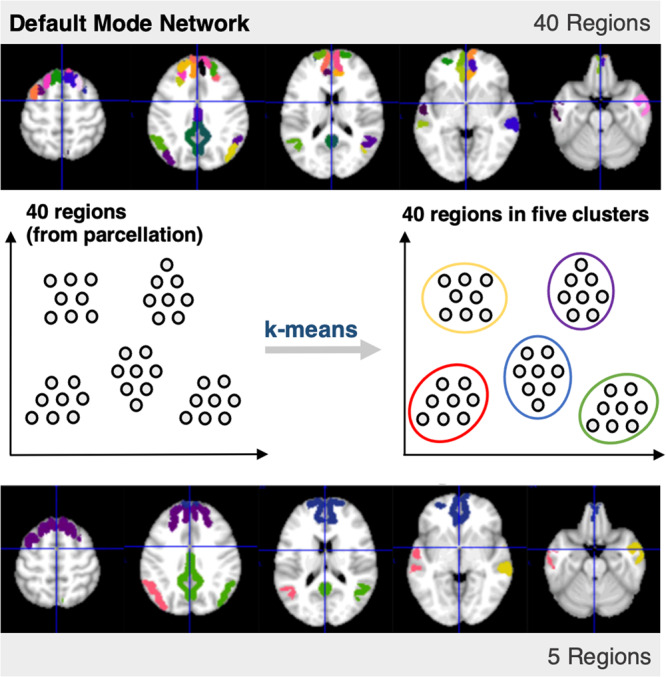
“11,18 In our case, the networks consisted of fi ve elements, so we evaluated all possible bipartitions into groups of 2 and 3 and recorded the minimum value obtained as Φ * .”
BackgroundMethodInfluentialIntegrated information theory of consciousness: an updated account.
(2012) · PubMed · doi:10.4449/aib.v149i5.1388 · Cited by 370
Zeman, A. (2001) · Brain · doi:10.1093/brain/124.7.1263 · Cited by 367
Nimmo, A. F., Absalom, A. R., Bagshaw, O., Biswas, A., Cook, T. M., Costello, A., Grimes, S., Mulvey, D., Shinde, S., Whitehouse, T., et al. (2019) · Anaesthesia · doi:10.1111/anae.14428 · Cited by 295
General Anesthesia and Human Brain Connectivity
Hudetz, A. G. (2012) · Brain Connectivity · doi:10.1089/brain.2012.0107 · Cited by 271
Practical Measures of Integrated Information for Time-Series Data
Barrett, A. B., & Seth, A. K. (2011) · PLoS Computational Biology · doi:10.1371/journal.pcbi.1001052 · Cited by 225 · cited 2×
“16,17 The theoretical and quantitative aspects proposed by IIT are promising, and some progress has been made to incorporate measures derived from IIT 2.0 to fMRI and EEG data.”
BackgroundInfluentialKu, S.-W., Lee, U., Noh, G.-J., Jun, I.-G., & Mashour, G. A. (2011) · PLoS ONE · doi:10.1371/journal.pone.0025155 · Cited by 214
Measuring Integrated Information from the Decoding Perspective
Oizumi, M., Amari, S.-I., Yanagawa, T., Fujii, N., & Tsuchiya, N. (2016) · PLOS Computational Biology · doi:10.1371/journal.pcbi.1004654 · Cited by 184
Default-mode network streams for coupling to language and control systems
Gordon, E. M., Laumann, T. O., Marek, S., Raut, R. V., Gratton, C., Newbold, D. J., Greene, D. J., Coalson, R. S., Snyder, A. Z., Schlaggar, B. L., et al. (2020) · Proceedings of the National Academy of Sciences · doi:10.1073/pnas.2005238117 · Cited by 172
Measuring integrated information: comparison of candidate measures in theory and simulation
Mediano, P., Seth, A., & Barrett, A. (2018) · Entropy · doi:10.3390/e21010017 · Cited by 145 · cited 3×
“13,17,24 The measure presented in the main manuscript was Φ * , or integrated information from the decoding perspective.”
BackgroundInfluentialAre there islands of awareness?
Bayne, T., Seth, A. K., & Massimini, M. (2020) · Trends in Neurosciences · doi:10.1016/j.tins.2019.11.003 · Cited by 145
The unfolding argument: Why IIT and other causal structure theories cannot explain consciousness
Doerig, A., Schurger, A., Hess, K., & Herzog, M. H. (2019) · Consciousness and Cognition · doi:10.1016/j.concog.2019.04.002 · Cited by 140 · cited 1×
“51,52 Another widely discussed framework is global workspace theory (GWT), which attributes conscious percepts to spotlights of attention that are mediated by executive control functions.”
BackgroundRethinking Measures of Functional Connectivity via Feature Extraction
Mohanty, R., Sethares, W. A., Nair, V. A., & Prabhakaran, V. (2020) · Scientific Reports · doi:10.1038/s41598-020-57915-w · Cited by 133
Safron, A. (2020) · Frontiers in Artificial Intelligence · doi:10.3389/frai.2020.00030 · Cited by 133 · cited 1×
“55,56 Such developments are a promising step, as certain aspects of consciousness may be better understood with one theory over another.”
BackgroundPyPhi: A toolbox for integrated information theory
Mayner, W. G. P., Marshall, W., Albantakis, L., Findlay, G., Marchman, R., & Tononi, G. (2018) · PLOS Computational Biology · doi:10.1371/journal.pcbi.1006343 · Cited by 118 · cited 3×
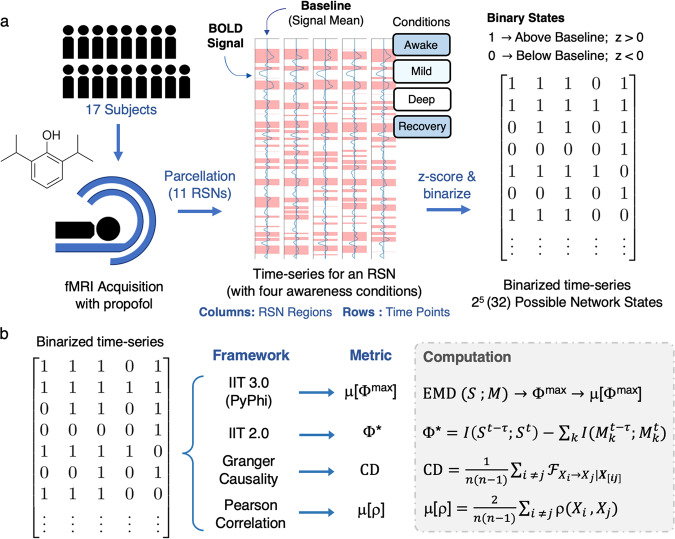
“12,21 Since Φ max is a state-dependent quantity that changes over time, we computed its weighted average over the time-series of each network, which we refer to as μ [ Φ max ].”
BackgroundMethodThe Problem with Phi: A Critique of Integrated Information Theory
Cerullo, M. A. (2015) · PLOS Computational Biology · doi:10.1371/journal.pcbi.1004286 · Cited by 114 · cited 1×
“51,52 Another widely discussed framework is global workspace theory (GWT), which attributes conscious percepts to spotlights of attention that are mediated by executive control functions.”
BackgroundMeasuring integrated information: comparison of \ncandidate measures in theory and simulation
Mediano, P. A. M., Seth, A. K., & Barrett, A. B. (2018) · Figshare · Cited by 114
Melloni, L., Mudrik, L., Pitts, M., Bendtz, K., Ferrante, O., Gorska, U., Hirschhorn, R., Khalaf, A., Kozma, C., Lepauvre, A., et al. (2023) · PLoS ONE · doi:10.1371/journal.pone.0268577 · Cited by 113 · cited 1×
“55,56 Such developments are a promising step, as certain aspects of consciousness may be better understood with one theory over another.”
BackgroundModulatory interactions between the default mode network and task positive networks in resting-state
Di, X., & Biswal, B. B. (2014) · PeerJ · doi:10.7717/peerj.367 · Cited by 98
Global Workspace Theory (GWT) and Prefrontal Cortex: Recent Developments
Baars, B. J., Geld, N., & Kozma, R. (2021) · Frontiers in Psychology · doi:10.3389/fpsyg.2021.749868 · Cited by 98
Golkowski, D., Larroque, S. K., Vanhaudenhuyse, A., Plenevaux, A., Boly, M., Di Perri, C., Ranft, A., Schneider, G., Laureys, S., Jordan, D., et al. (2019) · Anesthesiology · doi:10.1097/aln.0000000000002704 · Cited by 89
Kim, H., Hudetz, A. G., Lee, J., Mashour, G. A., Lee, U., & the ReCCognition Study Group (2018) · Frontiers in Human Neuroscience · doi:10.3389/fnhum.2018.00042 · Cited by 82 · cited 1×
“20 Despite these developments, existing literature on IIT remains largely theoretical, and more efforts are needed to develop procedures that can be used to extract empirical measures of Φ .”
BackgroundCostumero, V., Bueichekú, E., Adrián‐Ventura, J., & Ávila, C. (2020) · Scientific Reports · doi:10.1038/s41598-020-66100-y · Cited by 77
MRI in disorders of consciousness
Snider, S. B., & Edlow, B. L. (2020) · Current Opinion in Neurology · doi:10.1097/wco.0000000000000873 · Cited by 76
Mechanism Integrated Information
Barbosa, L. S., Marshall, W., Albantakis, L., & Tononi, G. (2021) · Entropy · doi:10.3390/e23030362 · Cited by 72 · cited 1×
“40,41 While the full calculation of Φ max involves computing the integration of all mechanisms with respect to one another, this alternative approach only considers the integrated information of individual mechanisms.”
BackgroundAnesthetic effects of propofol in the healthy human brain: functional imaging evidence
Song, X., & Yu, B. (2014) · Journal of Anesthesia · doi:10.1007/s00540-014-1889-4 · Cited by 66
Liu, X., Lauer, K. K., Ward, B. D., Roberts, C. J., Liu, S., Gollapudy, S., Rohloff, R., Gross, W. L., Chen, G., Xu, Z., et al. (2016) · NeuroImage · doi:10.1016/j.neuroimage.2016.12.043 · Cited by 65
Boly, M., Sasai, S., Gosseries, O., Oizumi, M., Casali, A., Massimini, M., & Tononi, G. (2015) · PLOS ONE · doi:10.1371/journal.pone.0125337 · Cited by 63
Owen, A. M. (2019) · Neuron · doi:10.1016/j.neuron.2019.03.024 · Cited by 61
Self-citationThe Global Workspace Theory of Consciousness: Predictions and Results
Baars, B. J. (2017) · The Blackwell Companion to Consciousness · doi:10.1002/9781119132363.ch16 · Cited by 46
Bastian, L., Samanta, A., de Paula, D. R., Weber, F. D., Schoenfeld, R., Dresler, M., & Genzel, L. (2022) · Human Brain Mapping · doi:10.1002/hbm.25893 · Cited by 46
Functional split brain in a driving/listening paradigm
Sasai, S., Boly, M., Mensen, A., & Tononi, G. (2016) · Proceedings of the National Academy of Sciences · doi:10.1073/pnas.1613200113 · Cited by 43 · cited 2×
“19 Finally, IIT was also applied in a study involving high-density EEG recordings in which the authors used parameters derived from Φ to differentiate different states of consciousness.”
BackgroundMethodQuality assurance of human functional magnetic resonance imaging: a literature review
Lu, W., Dong, K., Cui, D., Jiao, Q., & Qiu, J. (2019) · Quantitative Imaging in Medicine and Surgery · doi:10.21037/qims.2019.04.18 · Cited by 43
Kandeepan, S., Rudas, J., Gomez, F., Stojanoski, B. B., Valluri, S. R., Owen, A. M., Naçi, L., Nichols, E. S., & Soddu, A. (2020) · NeuroImage · doi:10.1016/j.neuroimage.2020.117367 · Cited by 40
Self-citationYoshikawa, A., Masaoka, Y., Yoshida, M., Koiwa, N., Honma, M., Watanabe, K., Kubota, S., Iizuka, N., Ida, M., & Izumizaki, M. (2020) · Frontiers in Neuroscience · doi:10.3389/fnins.2020.00631 · Cited by 36
Fast and exact search for the partition with minimal information loss
Hidaka, S., & Oizumi, M. (2018) · PLOS ONE · doi:10.1371/journal.pone.0201126 · Cited by 32
Chi-square tests for markov chain analysis
HISCOTT, R. N. (1981) · Mathematical Geology · doi:10.1007/bf01032010 · Cited by 30
Prefrontal neural dynamics in consciousness
León-Domínguez, U., & León‐Carrión, J. (2019) · Neuropsychologia · doi:10.1016/j.neuropsychologia.2019.05.018 · Cited by 27
Computing integrated information
Krohn, S., & Ostwald, D. (2017) · Neuroscience of Consciousness · doi:10.1093/nc/nix017 · Cited by 24
Computing Integrated Information (Φ) in Discrete Dynamical Systems with Multi-Valued Elements
Gomez, J. D., Mayner, W. G. P., Beheler-Amass, M., Tononi, G., & Albantakis, L. (2020) · Entropy · doi:10.3390/e23010006 · Cited by 14
Sukumar, V., Radhakrishnan, A., & Keshavan, V. (2018) · Indian Journal of Anaesthesia · doi:10.4103/ija.ija_670_17 · Cited by 13
An Implementation of Integrated Information Theory in Resting-State fMRI
Nemirovsky, I. E., Popiel, N. J. M., Rudas, J., Caius, M., Naçi, L., Schiff, N. D., Owen, A. M., & Soddu, A. (2023) · Scholarship@Western (Western University) · doi:10.5281/zenodo.8033892 · Cited by 2
Self-citation
Cited by
Jang, H., Mashour, G. A., Hudetz, A. G., & Huang, Z. (2024) · Nature Communications · doi:10.1038/s41467-024-53299-x · Cited by 70
Covert cortical processing: a diagnosis in search of a definition
Young, M. J., Fecchio, M., Bodien, Y. G., & Edlow, B. L. (2024) · Neuroscience of Consciousness · doi:10.1093/nc/niad026 · Cited by 29
Relational Quantum Dynamics (RQD): An Informational OntologyPreprint
Zaghi, A. E. (2024) · arXiv (Cornell University) · doi:10.48550/arxiv.2412.05979 · Cited by 13
Belloli, L. M. L., Mediano, P. A. M., Cofré, R., Slezak, D. F., & Herzog, R. A. (2026) · PLoS ONE · doi:10.1371/journal.pone.0348005 · Cited by 10
Information dynamics of in silico EEG Brain Waves: Insights into oscillations and functions
Menesse, G., & Torres, J. J. (2024) · PLoS Computational Biology · doi:10.1371/journal.pcbi.1012369 · Cited by 6
Metadata
- Authors
- Nemirovsky, I. E., Popiel, N. J. M., Rudas, J., Caius, M., Naci, L., Schiff, N. D., Owen, A. M., & Soddu, A.
- Affiliations
- Western University (CA)
- University of Cambridge (GB)
- Universidad Nacional de Colombia (CO)
- Weill Cornell Medicine (US)
- Corresponding author
- Nemirovsky, Idan E.
- ORCID
- Venue
- Communications Biology
- Published
- 2023-07-05
- Volume
- 6
- Issue
- 1
- Pages
- 692-692
- ISSN
- 2399-3642 (ISSN-L)
- PMC
- PMC10322831
- OpenAlex
- W4383263660
- Cited by
- 15
- References
- 73
- Citations by year
- 2026: 2 · 2025: 7 · 2024: 4 · 2023: 2
- FWCI
- 2.24
- Type
- journal article
- Language
- en
- Open access
- gold
- doi.org
- Licence
- cc-by
- creativecommons.org/licenses/by/4.0 (tdm)
- creativecommons.org/licenses/by/4.0 (vor)
- Locations
- Communications Biology (publishedVersion, cc-by)
- PubMed Central (publishedVersion, cc-by)
- PubMed (publishedVersion)
- DOAJ (DOAJ: Directory of Open Access Journals) (submittedVersion, cc-by-sa)
- Funders
- Gouvernement du Canada | Natural Sciences and Engineering Research Council of Canada
- Topics
- Life Sciences › Neuroscience › Cognitive Neuroscience › Functional Brain Connectivity Studies
- Social Sciences › Arts and Humanities › Philosophy › Philosophy and Theoretical Science
- Life Sciences › Neuroscience › Cognitive Neuroscience › Neural dynamics and brain function
- Keywords
- integrated information theory, consciousness, resting-state networks, propofol sedation, Granger causality, functional connectivity, frontoparietal network, dorsal attention network
- MeSH terms
- Consciousness, Humans, Hypnotics and Sedatives, Information Theory, Magnetic Resonance Imaging, Propofol
About these checks
Registry, retraction, Cites and statistics results are computed, not judged, with one exception: a printed reference that no index lists is read once by a model before it counts as a citation error. Claims are extracted by a model and kept only when their quote appears verbatim in the text; each cited source is then checked, with a model’s help, for whether it says what the claim relies on. Those verdicts can be wrong — read the claim’s quote and the cited source before relying on one.
Statistics and arithmetic are recomputed, not judged.
Confidence bands are shown only for fields calibrated on our annotated test set. None is calibrated yet, so no band is shown.
What counts as a claim ›How we measure confidence ›How we check this ›
Are you an author, or do you see a problem with this page? Request a review
Data sources
Bibliographic data: Semantic Scholar, OpenAlex, Crossref.
Contains information from the Semantic Scholar Academic Graph Datasets, made available under the ODC Attribution License (ODC-BY 1.0).
Semantic Scholar’s data is described in: Kinney, R., et al. (2023). The Semantic Scholar Open Data Platform. arXiv:2301.10140.
