

Augmenting large language models with chemistry tools
Open accessThe DOI matches its Crossref record; 94 of the 94 references it cites were found in a registry or an index.
Abstract
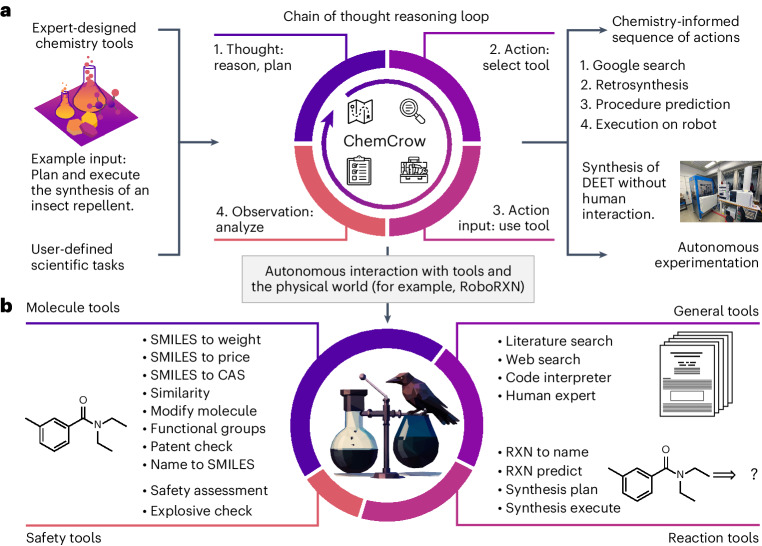
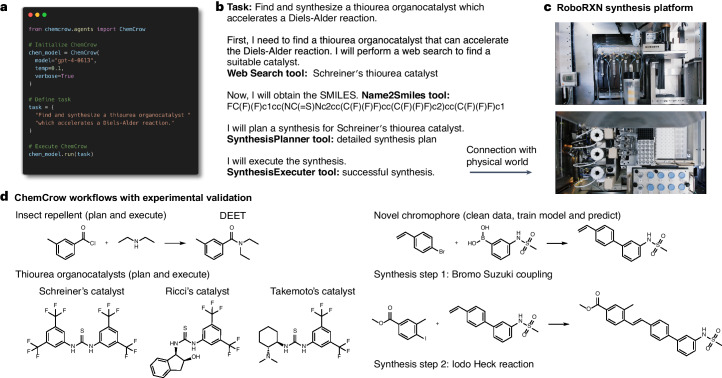
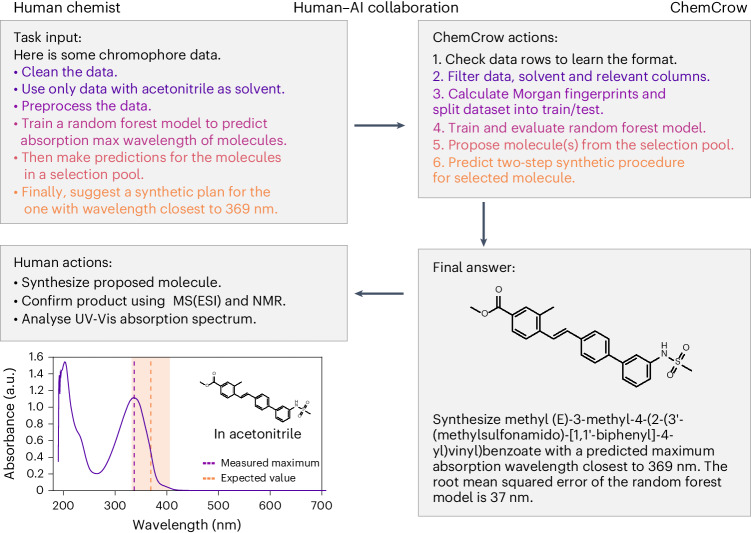
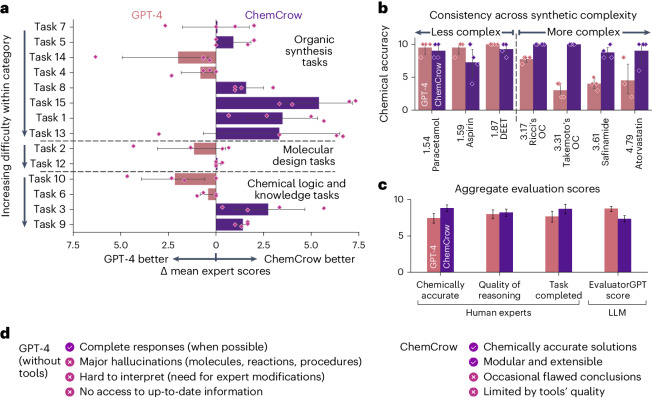
Large language models (LLMs) have shown strong performance in tasks across domains but struggle with chemistry-related problems. These models also lack access to external knowledge sources, limiting their usefulness in scientific applications. We introduce ChemCrow, an LLM chemistry agent designed to accomplish tasks across organic synthesis, drug discovery and materials design. By integrating 18 expert-designed tools and using GPT-4 as the LLM, ChemCrow augments the LLM performance in chemistry, and new capabilities emerge. Our agent autonomously planned and executed the syntheses of an insect repellent and three organocatalysts and guided the discovery of a novel chromophore. Our evaluation, including both LLM and expert assessments, demonstrates ChemCrow’s effectiveness in automating a diverse set of chemical tasks. Our work not only aids expert chemists and lowers barriers for non-experts but also fosters scientific advancement by bridging the gap between experimental and computational chemistry.
Overview
The claims and statistics of this paper haven’t been checked yet.
Free: it reads the open-access text and checks the first 5 claims that cite a source we can check. Create a free account to check every claim.
Integrity signals
Registry
Cites
Statistics
Figures
Verification
Claims the paper makes
The claims and statistics of this paper haven’t been checked yet.
Free: it reads the open-access text and checks the first 5 claims that cite a source we can check. Create a free account to check every claim.
Claims other papers make about this one
Each is checked against this paper’s own text: does it say what the citing paper says it does?
The source backs part of the claim, not all of it — or backs it for a different population, condition or comparison.
In the citing paper
“In parallel, chemistry-oriented reviews have shown that large language models can move beyond text generation toward tool use, retrieval, planning, code execution, and multi-agent coordination [5-10].”
From From Scientific Copilots to Tool-Grounded Autonomy: AI Agents in Simulation-Driven Materials Discovery (2026) · cites this paper as [7]
Experimental — accuracy not yet measuredThe source backs part of the claim, not all of it — or backs it for a different population, condition or comparison.
In the citing paper
“The broader literature on autonomous scientific systems has already argued for more rigorous evaluation protocols and transparent tool interfaces [3,5,7-12].”
From From Scientific Copilots to Tool-Grounded Autonomy: AI Agents in Simulation-Driven Materials Discovery (2026) · cites this paper as [7]
Experimental — accuracy not yet measuredThe source backs part of the claim, not all of it — or backs it for a different population, condition or comparison.
In the citing paper
“In scientific discovery, agents dynamically compose and execute hypothesis-testing pipelines spanning simulations, lab protocols, and data analysis [61, 62, 63, 64].”
From Code as Agent Harness (2026) · cites this paper as [61]
Experimental — accuracy not yet measuredThe source backs part of the claim, not all of it — or backs it for a different population, condition or comparison.
In the citing paper
“ChemCrow [61] similarly integrates RDKit, retrosynthesis engines, and reaction predictors so that an agent can 'execute' a candidate synthesis virtually before committing to a wet-lab run.”
From Code as Agent Harness (2026) · cites this paper as [61]
Experimental — accuracy not yet measuredThe source backs part of the claim, not all of it — or backs it for a different population, condition or comparison.
In the citing paper
“In chemistry, language-model tools, yield predictors, Bayesian optimization, and robotic laboratories provide complementary components for selecting and testing reactions [28, 42-46].”
From RSI-Anything: Unlocking Recursive Self-Improvement with World Models (2026) · cites this paper as [43]
Experimental — accuracy not yet measured
5 more claims about this paper
Create a free account to see every claim other papers make about this one.
Self-check
Percentages, sums and reported differences re-computed from the paper’s own numbers.
The self-check needs the paper’s full text.
Citations
Cites
Vaswani, A., Shazeer, N., Parmar, N., Uszkoreit, J., Jones, L., Gomez, A. N., Kaiser, L., & Polosukhin, I. (2017) · arXiv · doi:10.48550/arxiv.1706.03762 · Cited by 120,404 · cited 1×
“These specialized tools provide exact answers, thereby compensating for the inherent deficiencies of LLMs in specific domains and enhancing their overall performance and applicability.”
BackgroundLanguage Models are Few-Shot Learners
Brown, T. B., Mann, B., Ryder, N., Subbiah, M., Kaplan, J., Dhariwal, P., Neelakantan, A., Shyam, P., Sastry, G., Askell, A., et al. (2020) · arXiv · doi:10.48550/arxiv.2005.14165 · Cited by 23,372 · cited 1×
“…as a field, has been impacted through expert-designed artificial intelligence (AI) systems that tackle specific problems, such as reaction prediction 16–20 , retrosynthesis planning 21–27 , molecular property prediction 28–32 , de-novo molecular generation 33,34 , materials design 35,36 and,…”
BackgroundExtended-Connectivity Fingerprints
Rogers, D., & Hahn, M. (2010) · Journal of Chemical Information and Modeling · doi:10.1021/ci100050t · Cited by 7,524 · cited 1×
“Similarity The primary function of this tool is to evaluate the similarity between two molecules, utilizing the Tanimoto similarity measure 90 based on the ECFP2 molecular fingerprints 91 of the input molecules.”
MethodThe National Center for Biotechnology Information
Benson, D., Boguski, M., Lipman, D. J., & Ostell, J. (1990) · Genomics · doi:10.1016/0888-7543(90)90583-g · Cited by 5,126
LLaMA: Open and Efficient Foundation Language Models
Touvron, H., Lavril, T., Izacard, G., Martinet, X., Lachaux, M.-A., Lacroix, T., Rozière, B., Goyal, N., Hambro, E., Azhar, F., et al. (2023) · arXiv · doi:10.48550/arxiv.2302.13971 · Cited by 4,602 · cited 1×
“…is the lack of reproducibility of individual results under the current API-based approach to LLMs, as closed-source models provide limited control, see Appendix E. Recent open-source models 76–78 offer a potential solution to this issue, albeit with a possible trade-off in reasoning power.”
BackgroundChain-Of-Thought Prompting Elicits Reasoning in Large Language Models
Wei, J., Wang, X., Schuurmans, D., Bosma, M., Ichter, B., Xia, F., Chi, E., Le, Q. V., & Zhou, D. (2022) · Advances in Neural Information Processing Systems 35 · doi:10.52202/068431-1800 · Cited by 4,505
Chain-of-Thought Prompting Elicits Reasoning in Large Language Models
Wei, J., Wang, X., Schuurmans, D., Bosma, M., Ichter, B., Xia, F., Chi, E., Le, Q., & Zhou, D. (2022) · arXiv · doi:10.48550/arxiv.2201.11903 · Cited by 4,263 · cited 1×
“The tools used can be classified into general tools, molecular tools, and chemical reaction tools.”
MethodBillion-scale similarity search with GPUs
Johnson, J., Douze, M., & Jegou, H. (2021) · IEEE Transactions on Big Data · doi:10.1109/tbdata.2019.2921572 · Cited by 4,228
Training language models to follow instructions with human feedback
Ouyang, L., Wu, J., Jiang, X., Almeida, D., Wainwright, C. L., Mishkin, P., Zhang, C., Agarwal, S., Slama, K., Ray, A., et al. (2022) · arXiv · doi:10.48550/arxiv.2203.02155 · Cited by 4,208 · cited 2×
“5 13 cannot consistently and accurately multiply 12345*98765 or convert IUPAC names into the corresponding molecular graph 14 .”
BackgroundBillion-scale similarity search with GPUs
Johnson, J., Douze, M., & Jégou, H. (2017) · arXiv · doi:10.48550/arxiv.1702.08734 · Cited by 4,140 · cited 1×
“The CAS number serves as a precise and universally recognized chemical identifier, enabling researchers to access relevant data and resources with ease, and ensuring that they obtain accurate and consistent information about the target molecule 89 .”
Background
Research works printed but not linked: 4
- Devlin, J., Chang, M.-W., Lee, K. & Toutanova, K. Bert: pre-training of deep bidirectional transformers for language understanding. In Proc. Conference of the North American Chapter of the Association for Computational Linguistics: Human Language Technologies (eds Burstein, J. et al.) 4171–4186 (Association for Computational Linguistics, 2019).
- Li, R. et al. Starcoder: may the source be with you! Trans. Mach. Learn. Res. https://openreview.net/pdf?id=KoFOg41haE (2023).
- Zelikman E Wu Y Mu J Goodman N Star: bootstrapping reasoning with reasoning Adv. Neural Inf. Process. Syst. 2022 35 15476 15488
- Lowe, D. M. Extraction of Chemical Structures and Reactions from the Literature. PhD thesis, Univ. of Cambridge (2012).
Cited by
Items 901–1,000 of 1,026
Agentic AI systems for scientific discovery
Feng, B., Walther, P., Zhang, L.-L., Coyle, R., Kim, S., Mandal, A., Zhang, Z.-J., Papidocha, S. M., Kelmanson, A., Segura, D. M., et al. (2026) · Nature Reviews Methods Primers · doi:10.1038/s43586-026-00534-y · Cited by 1
“For example, ChemCrow 41 is supplied with a suite of tool names, functional descriptions and precise input and output specifications, thereby allowing the agent to expand its capabilities through the integration of new tools.”
InfluentialSelf-citationA focus on the use of real-world datasets for yield prediction
Bustillo, L., & Rodrigues, T. (2023) · Chemical Science · doi:10.1039/d3sc90069j · Cited by 3
Song, Y., Zhang, M., Chang, S., Chu, G., & Ji, H. (2025) · Molecules · doi:10.3390/molecules30081683 · Cited by 3
A perspective on developing foundation models for analyzing spatial transcriptomic data
Liu, T., Hao, M., Liu, X., & Zhao, H. (2025) · Quantitative Biology · doi:10.1002/qub2.70010 · Cited by 4
“For example, ChemCrow [46] introduced a new AI agent for augmenting the LLM performance in chemistry to help discover new molecules.”
AI in drug design: evolution or revolution?
Green, D. V. S. (2025) · Emerging Topics in Life Sciences · doi:10.1042/etls20240005 · Cited by 4
“ChemCrow [77] and Coscientist [78] are LLM-based systems which design, plan and execute complex experiments.”
Assay2Mol: Large Language Model-based Drug Design Using BioAssay Context
Deng, Y., Ericksen, S. S., & Gitter, A. (2025) · Conference on Empirical Methods in Natural Language Processing (EMNLP) · doi:10.18653/v1/2025.emnlp-main.1390 · Cited by 4
“…chemistry (Fifty et al., 2023; Jablonka et al., 2024; Nguyen and Grover, 2025; Moayed-pour et al., 2024; Schimunek et al., 2025), and LLM agents (M. Bran et al., 2024; McNaughton et al., 2024; Swanson et al., 2025; Gao et al., 2025; Liu et al., 2025; Wei et al., 2025) are at the frontier of…”
ChemAU: A collaborative framework for chemical reasoning via adaptive uncertainty estimation
Liu, X., Li, Y., Yang, W., Song, J., Ma, L., & Fei, B. (2026) · Expert Systems with Applications · doi:10.1016/j.eswa.2026.131399 · Cited by 3
Patel, R. A., Li, M., Chang, C.-F., de Lescure, L., Chauvin, P., Cherney, A., Moayedpour, S., Jäger, S., & Jangjou, Y. (2026) · Digital Discovery · doi:10.1039/d6dd00052e · Cited by 7
Zhang, A. (2026) · Journal of Cheminformatics · doi:10.1186/s13321-026-01222-5 · Cited by 3
“Yet their probabilistic nature introduces a validation gap: syntactically correct instructions can be chemically implausible or parametrically infeasible, leading to costly failed experiments [4, 5].”
Chen, Y., Zhang, X., Zhang, Y., Li, Y., Zou, H., Miao, C., Zhang, W., Liu, S., & Yu, P. S. (2025) · neural information processing systems · doi:10.52202/085713-4888 · Cited by 9
RRdE: A Decision Making Framework for Language Agents in Interactive Environments
Zhou, X., Li, L., & Zeng, D. D. (2024) · International Joint Conference on Neural Networks (IJCNN) · doi:10.1109/ijcnn60899.2024.10650094 · Cited by 4
“…science and neuroscience research [2], with the core idea of regarding LLMs as the brains of agents [3], and adding modules such as dialogue [4]–[7], memory management [1], [6], [8], reasoning and planning [9]–[13], and tooluse [14]–[17], to enable the model to obtain the ability to LLM Goal-1”
BackgroundConstructing material network representations for intelligent amorphous alloy design
Zhang, S., Tian, J., Liu, S., Zhang, H., Bai, H. Y., Hu, Y., & Wang, W. (2025) · National Science Review · doi:10.1093/nsr/nwaf398 · Cited by 3
“In particular, the advent of artificial intelligence (AI) in computer vision and natu-ral language processing greatly fostered the virtual screening of candidate materials in the large latent space [10 –12 ].”
Review of Low-cost Self-driving Laboratories: The "Frugal Twin" ConceptPreprint
Lo, S., Baird, S. G., Schrier, J., Blaiszik, B. J., Carson, N., Foster, I. T., Aguilar‐Granda, A., Kalinin, S. V., Maruyama, B., Politi, M., et al. (2023) · ChemRxiv · doi:10.26434/chemrxiv-2023-6z9mq-v2 · Cited by 4
Can LLMs evaluate items measuring collaborative problem-solving?Preprint
Anghel, E., Wang, Y., Gopalakrishnan, M., Mansukhani, P., & Bergner, Y. (2024) · EdArXiv (OSF Preprints) · doi:10.35542/osf.io/tuvks · Cited by 4
Kalmer, T. L., Ancajas, C. M. F., Cheng, Z., Oyedele, A. S., Davis, H. L., & Walker, A. S. (2024) · bioRxiv (Cold Spring Harbor Laboratory) · doi:10.1101/2024.08.01.606186 · Cited by 3
“41,42 LLMs have the potential to speed up the expansion of training datasets for natural product bioactivity prediction and other tasks in natural products research.”
BackgroundZheng, Z., Florit, F., Jin, B., Wu, H., Li, S., Nandiwale, K. Y., Salazar, C. A., Mustakis, J. G., Green, W. H., & Jensen, K. F. (2024) · ChemRxiv · doi:10.26434/chemrxiv-2024-pk105-v2 · Cited by 3
Xu, Q., Liu, X., Jiang, X., & Kim, Y. (2024) · medRxiv · doi:10.1101/2024.12.10.24318800 · Cited by 3
FlowAgent: A Modular Agent-Based System for Automated Workflow Management and Data InterpretationPreprint
Philpott, J., Kurjan, A., & Cribbs, A. P. (2025) · bioRxiv (Cold Spring Harbor Laboratory) · doi:10.1101/2025.03.06.641728 · Cited by 4
GeneWhisperer: Enhancing manual genome annotation with large language modelsPreprint
Li, X., Whan, A., McNeil, M., Andrew, S. C., Dai, X., Fechner, M., Paris, C. L., & Suchecki, R. (2025) · bioRxiv (Cold Spring Harbor Laboratory) · doi:10.1101/2025.03.30.646211 · Cited by 5
“GeneWhisperer enhances this process by providing annotators with synthesized, contextually relevant information from extensive biological databases and literature, thereby potentially reducing the manual effort required in data retrieval and integration tasks.”
Dale, S. G., Kazeev, N., Price, A. J. A., Posligua, V., Roche, S., von Lilienfeld, O. A., Novoselov, K. S., Bresson, X., Mengaldo, G., Chen, X., et al. (2025) · arXiv (Cornell University) · doi:10.48550/arxiv.2511.20976 · Cited by 3
AI-driven ionic liquid discovery with unified chemical intelligencePreprint
Yin, Y., Fu, Y., Wang, S., Huo, L., Sun, P., Wang, H., Wang, X., Pan, C., Li, Z., Liu, Z., et al. (2025) · arXiv (Cornell University) · doi:10.48550/arxiv.2511.11257 · Cited by 3
Types of AI and their use in Science
Awad, M. (2025) · doi:10.24948/2025.09 · Cited by 4
Yang, W., Liu, Z., Tan, T., Hu, X., Xie, H., Li, L. L. X., Han, J., Lian, D., & Ye, M. (2026) · arXiv (Cornell University) · doi:10.48550/arxiv.2602.18479 · Cited by 3
An Alternative Trajectory for Generative AIPreprint
Belova, M., Kansal, Y., Liang, Y., Xiao, J.-X., & Jha, N. (2026) · arXiv.org · doi:10.48550/arxiv.2603.14147 · Cited by 2
AutoMOOSE: An Agentic AI for Autonomous Phase-Field SimulationPreprint
Manna, S., Chan, H., & Sankaranarayanan, S. K. R. S. (2026) · arXiv (Cornell University) · doi:10.48550/arxiv.2603.20986 · Cited by 3
Evaluating the Progression of Large Language Model Capabilities for Small-Molecule Drug DesignPreprint
Chennakesavalu, S., Shmilovich, K., Weir, H., Grambow, C. A., Bradshaw, J., Suriana, P., Cheng, C., & Chuang, K. (2026) · arXiv (Cornell University) · doi:10.48550/arxiv.2604.16279 · Cited by 4
“…et al., 2024; Nascimento and Pimentel, 2023) , to more complex, often multi-turn jobs, including knowledge synthesis from scientific literature (Patel et al., 2025) and conducting or proposing wet-lab experiments (Xu et al., 2025; Bran et al., 2024; Gottweis et al., 2025; Boiko et al., 2023) .”
InfluentialChen, C., Xiao, J. S., Liu, S., Paolino, F. P., Handley, L. B., du Laz, T. J., Nilsson, R., Zou, A., Graham, M., & Mahabal, A. (2026) · arXiv (Cornell University) · doi:10.48550/arxiv.2605.05573 · Cited by 3
Somasekharan, N., Hassan, Y., Lin, S., Panapitiya, G., Emami, P., Acharya, A., Horawalavithana, S., & Pan, S. (2026) · arXiv (Cornell University) · doi:10.48550/arxiv.2605.18630 · Cited by 5
LAP: An Agent-to-Instrument Protocol for Autonomous SciencePreprint
Zhu, L., Gao, L., (4308), Y. C., Zhu, D., & Huang, J. (2026) · arXiv (Cornell University) · doi:10.48550/arxiv.2606.03755 · Cited by 3
“…in the loop [39]; GPT-4-driven systems such as Coscientist planned and ran chemical reactions on a cloud laboratory [5]; tool-augmented chemistry agents such as ChemCrow chained reasoning over many instruments [6]; and a mobile robotic chemist ran a multi-day optimization campaign autonomously [7].”
Upadhyay, N., & Reinhart, W. F. (2026) · arXiv (Cornell University) · doi:10.48550/arxiv.2606.10928 · Cited by 3
Ahmed, M. O., Amale, S. A., Bhavsar, R. D., Chopra, P., Jaimes, A., Kachhwah, A., Kalotra, C. D., Li, P., Li, X., Liao, Y., et al. (2026) · bioRxiv (Cold Spring Harbor Laboratory) · doi:10.64898/2026.06.24.734302 · Cited by 3
NISPO: Open-source IUPAC name generation toolPreprint
Runcie, N. T., Imrie, F., & Deane, C. M. (2026) · arXiv (Cornell University) · doi:10.48550/arxiv.2607.26113 · Cited by 3
“OPSIN is now widely used for name-to-structure conversion [15], including within LLM research [12, 16–18].”
K-Bench: measuring model performance on real scientific agent requestsPreprint
Brueckner, A., Patel, D., He, Y., & Kassis, T. (2026) · arXiv (Cornell University) · doi:10.48550/arxiv.2608.21601 · Cited by 3
“The third generation grades execution (M. Bran et al., 2024; Boiko et al., 2023; Lu et al., 2024).”
AutoXRD: Autonomous LLM Agents and Comprehensive Evaluation for Powder Diffraction AnalysisPreprint
Wu, Y., & Sun, M. (2026) · arXiv (Cornell University) · doi:10.48550/arxiv.2609.00070 · Cited by 4
Wölflein, G., Ferber, D., Truhn, D., Arandjelović, O., & Kather, J. N. (2025) · arXiv · doi:10.48550/arxiv.2502.11705 · Cited by 3
“…2024), Gemini (Gemini Team, 2024) and Llama (Llama Team, 2024), on their own, have shown strong potential in question answering and reasoning on problems in natural science related fields, like math (Shao et al., 2024), chemistry (Bran et al., 2024) and healthcare (Sing-hal et al., 2023).”
Branda, F., Ahmed, M. M., Ciccozzi, M., Guzzi, P. H., & Scarpa, F. (2026) · Briefings in Bioinformatics · doi:10.1093/bib/bbag245 · Cited by 2
Coevolution of large language models with physical models boosts advanced battery research
Li, J.-H., Hu, Y., Xia, G., Mo, W., Li, B., Jia, Y., Gao, Y., Xuan, F., Liu, H., & Lian, C. (2025) · Cell Reports Physical Science · doi:10.1016/j.xcrp.2025.102553 · Cited by 2
Agent S: An Open Agentic Framework that Uses Computers Like a Human
Agashe, S., Han, J., Gan, S., Yang, J., Li, A., & Wang, X. E. (2024) · arXiv · doi:10.48550/arxiv.2410.08164 · Cited by 2
Commercial LLM Agents Are Already Vulnerable to Simple Yet Dangerous Attacks
Li, A., Zhou, Y., Raghuram, V. C., Goldstein, T., & Goldblum, M. (2025) · arXiv · doi:10.48550/arxiv.2502.08586 · Cited by 2
Memory in LLM-Based Multi-agent Systems: Mechanisms, Challenges, and Collective Intelligence
Wu, S., & Shu, K. (2026) · Lecture Notes in Computer Science · doi:10.1007/978-981-92-1468-6_10 · Cited by 2
Interpretable machine learning-assisted development of catalytic science theory
Hu, J., Yang, J., Hu, S., Liu, J., & Li, W. (2025) · Scientia Sinica Chimica · doi:10.1360/ssc-2025-0066 · Cited by 2
HUANG, Y., Wanjun, X. I. A., Junmei, D., JIANG, Y., Xin, W. A. N. G., Yuanzheng, C. H. E. N., Hongyan, W. A. N. G., Jijun, Z., & Chunsheng, G. U. O. (2025) · Acta Physica Sinica · doi:10.7498/aps.74.20250497 · Cited by 2
Pan, Z., Zhao, Y., Wang, Z., & Huang, H.-Z. (2025) · Langmuir · doi:10.1021/acs.langmuir.5c02763 · Cited by 3
Shan, G., Ding, Z., Xi, L., Zhao, H., Zhang, J., & Xu, F. (2025) · Rare Metals · doi:10.1007/s12598-025-03617-z · Cited by 2
AIssistant: Human-AI Collaborative Review and Perspective Research Workflows in Data Science
Gaddipati, S. K., Keya, F., Rabby, G., & Auer, S. (2026) · Lecture notes in computer science · doi:10.1007/978-981-92-1468-6_35 · Cited by 2
“Later studies have explored such integration in mathematics [18], chemistry [19], material science [20] [21], biodiversity [22], and algorithm design [23].”
Leveraging large language models for enzymatic reaction prediction and characterization
Fruscia, L. D., & Weber, J. M. (2025) · Digital Discovery · doi:10.1039/d5dd00187k · Cited by 3
THE-Tree: Can Tracing Historical Evolution Enhance Scientific Verification and Reasoning?
Wang, X., Liu, J., Xiao, Y., Ning, J., Zhang, H., Liu, L., He, J., Shi, B., & Yu, K. (2026) · Findings of the Association for Computational Linguistics: EMNLP (Findings of EMNLP) · doi:10.18653/2026.findings-emnlp.1831 · Cited by 2
Opportunities of Large Language Models in the Development of Organic Electrosynthesis
Yu, Z., Yang, Q., & Mo, Y. (2025) · ACS electrochemistry. · doi:10.1021/acselectrochem.5c00377 · Cited by 3
Enhancing SAP Predictive Maintenance and Industrial Analytics with LLM-Driven Automation
Chandrakumaran, A. (2025) · IEEE Madhya Pradesh Section Conference (MPCON) · doi:10.1109/mpcon66082.2025.11256577 · Cited by 6
Expert systems: Grounding cross-disciplinary LLMs in reality
Zheng, P., & Xu, G. (2025) · Resources Chemicals and Materials · doi:10.1016/j.recm.2025.100164 · Cited by 2
Scalable Agentic Reasoning for Designing Biologics Targeting Intrinsically Disordered Proteins
Sinclair, M., Meigooni, M., Vasan, A. K., Gökdemir, O., Lian, X., Ma, H., Babuji, Y., Brace, A., Hossain, K., Siebenschuh, C., et al. (2026) · Platform for Advanced Scientific Computing Conference (PASC) · doi:10.1145/3815572.3815764 · Cited by 2
Large language models in drug delivery: A review of the current landscape and future perspectives
Sakkal, M., & Hajal, A. A. (2025) · Journal of Pharmaceutical Sciences · doi:10.1016/j.xphs.2025.104147 · Cited by 2
Application and progress of artificial intelligence agents in drug development
Zhao, D., & Hsieh, C. (2026) · Journal of Zhejiang University (Medical Sciences) · doi:10.3724/zdxbyxb-2025-0697 · Cited by 2
MOFReasoner: think like a scientist—a reasoning large language model via knowledge distillation
Bai, X., Zheng, Z., Zhang, X., Wang, H.-T., Yang, R., & Li, J. (2026) · Digital Discovery · doi:10.1039/d5dd00429b · Cited by 3
Adaptive Solving Method for Power System Operation Based on Knowledge-Driven LLM Agents
Li, B., Zhang, H., & Cao, Y. (2026) · Electronics · doi:10.3390/electronics15020478 · Cited by 2
An LLM-guided structural optimization method for aero-engine lubrication hydrocyclones
Shi, C., Yang, D., Jianping, L., Zhao, M., Yi, Y., Wang, H., & Jiang, X. (2026) · Separation and Purification Technology · doi:10.1016/j.seppur.2026.137096 · Cited by 2
TrustSciAgent: Towards Rigorous and Trustworthy Agents for Scientific Research
Li, Y., Wang, M., Zhang, M., Zhang, Z., Zhang, G., & Li, H. (2025) · IEEE International Conference on Trust, Security and Privacy in Computing and Communications (TrustCom) · doi:10.1109/trustcom66490.2025.00384 · Cited by 3
Artificial intelligence at scale in the chemical industry: from legacy to leadership
Chiang, L. H., Christiansen, D., Malloure, M., Briceno-Mena, L. A., & Kim, S. H. (2026) · Current Opinion in Chemical Engineering · doi:10.1016/j.coche.2026.101229 · Cited by 2
Chat-RFB: a flow battery chat system leveraging knowledge graphs and large language models
Wang, H., Bai, X., Zheng, Z., Zhang, X., Jin, R., An, H.-T., Xie, Z.-H., Lv, X., & Li, J.-R. (2026) · Digital Discovery · doi:10.1039/d5dd00494b · Cited by 5
A survey of LLMs in drug discovery and precision medicine
Hays, H., & Richardson, W. J. (2026) · Frontiers in Drug Discovery · doi:10.3389/fddsv.2026.1854899 · Cited by 2
Reasoning-Driven Design of Single-Atom Catalysts via a Multiagent Large Language Model Framework
Mok, D. H., Back, S., Fung, V., & Hu, G. (2026) · ACS Central Science · doi:10.1021/acscentsci.6c01260 · Cited by 3
“In chemistry and materials science, LLMs have begun to move beyond simple data mining toward roles involving experimental planning 30 , synthesis guidance 31 , simulation tool orchestration 32 and chemically informed decision-making tasks that were previously exclusive to human experts 33-36 .”
Ye, A., Wang, B.-Y., Cheng, Z., Dong, C., & Guo, F.-B. (2026) · Bioresource Technology · doi:10.1016/j.biortech.2026.134309 · Cited by 2
Amamoto, Y., & Ohnishi, T. (2026) · Materials Today Communications · doi:10.1016/j.mtcomm.2026.114945 · Cited by 2
Chauhan, R. S., Mottafegh, A., Rana, A., & Singh, A. K. (2026) · Chemical Engineering Journal · doi:10.1016/j.cej.2026.174829 · Cited by 2
GrapheneChat: A Large Language Model for Enhancing Graphene Research
Yang, D., Lu, C., Feng, Y., Mao, W., Wang, K., Sun, L., Wang, Y., Hu, B., Tan, J., Liu, Z., et al. (2026) · ACS Nano · doi:10.1021/acsnano.5c21335 · Cited by 2
Yin, C., Sun, X., Dai, A., Ye, X., Lu, Y., Wang, W., Chen, Y., Jiang, H., Yu, J., Chong, S., et al. (2026) · APL Bioengineering · doi:10.1063/5.0299327 · Cited by 2
Chen, Z., Du, M., Qian, C., & Yu, H. (2026) · Journal of Hazardous Materials · doi:10.1016/j.jhazmat.2026.141820 · Cited by 3
Automating Ecological and Fisheries Modelling With Agentic AI
Brown, C. J., Aitken, L. R., Takyi, R., & Tisseaux-Navarro, A. (2026) · Fish and Fisheries · doi:10.1111/faf.70079 · Cited by 3
DrugAgent: A multi-agent digital biosensor framework for interpretable virtual drug screening
Yang, Q., Ma, X.-T., Wang, T.-F., Dou, X., Zhao, M., & Yang, X.-W. (2026) · Journal of Molecular Graphics and Modelling · doi:10.1016/j.jmgm.2026.109396 · Cited by 2
Developing an AI Course for Synthetic Chemistry Students
Zheng, Z. (2026) · Journal of Chemical Education · doi:10.1021/acs.jchemed.5c01699 · Cited by 4
“48 51 Using precomputed embeddings from a CLIP‑style model, 52,53 students perform zero‑shot classification of simple crystal or materials images and retrieve images that match short text prompts describing microstructure or apparent morphology.”
Hu, X., Zhu, C., Hsia, S.-K., Ma, D., Jain, R., & Ramani, K. (2026) · CHI Conference on Human Factors in Computing Systems · doi:10.1145/3772318.3790715 · Cited by 2
Sustainable Materials Design With Multi‐Modal Artificial Intelligence
Xu, T., Wei, T., Ge, Y., Peng, B., Li, Y., Wang, M., Wen, P., Yang, C., & Wei, Y. (2026) · Advanced Science · doi:10.1002/advs.202524273 · Cited by 8
Xiang, J., Huang, Q., Zhang, X., Yang, T., Zhu, Z., Li, C., Cai, L., & Sun, Q. (2026) · Chemical Science · doi:10.1039/d6sc01168c · Cited by 3
Recent Advances in Artificial Intelligence in Organic Electronic Research
Zhang, Q., Su, Z., Zhang, H., Sun, Y. W., & Hu, W. (2026) · Advanced Materials · doi:10.1002/adma.73151 · Cited by 2
“…such as HITL verification, integration with external deterministic tools (such as computational calculators or structural validators like ChemCrow [75]), and the implementation of retrieval-augmented generation (RAG) are actively employed to anchor the reasoning of LLMs strictly to verified…”
InfluentialChatMat: a multi-agent chemist for autonomous material prediction and exploration
Lv, S., Peng, L., Jiao, S., Yao, Y., Wu, W., & Hu, W. (2026) · Digital Discovery · doi:10.1039/d5dd00582e · Cited by 3
AIMS: Cost-Efficient LLM-Based Agent Deployment in Hybrid Cloud-Edge Environments
Liu, S., Shen, H., Che, S., Ghandi, M., & Li, M. (2026) · European Conference on Computer Systems · doi:10.1145/3767295.3803622 · Cited by 2
Hu, Y., & Turlo, V. (2026) · npj Computational Materials · doi:10.1038/s41524-026-02377-3 · Cited by 2
Ashikhmina, M. S., Dutta, K., Normatov, S., Filozop, V. S., Volodarskiy, M. O., Volkova, O., Ulasevich, S. A., & Skorb, E. V. (2026) · ACS Omega · doi:10.1021/acsomega.5c05861 · Cited by 2
Han, R., Zhang, Y., Liu, X., Fu, L., Pan, T., Xu, J., Wang, X. Y., Zhang, P., Chen, X., Lei, J., et al. (2026) · Nature Machine Intelligence · doi:10.1038/s42256-026-01243-7 · Cited by 2
“Recently, large-language-model-based agent frameworks have emerged, which orchestrate external tools for scientific workflows 52 .”
Multiagent design assistant for the simulation of inertial fusion energy
Shachar, M., Fernández-Godino, M. G., Jekel, C. F., Menon, H., Sterbentz, D. M., Hao, Y., Korner, K., Rieben, R. N., White, D. A., Belof, J. L., et al. (2026) · Physical review. E · doi:10.1103/c6jc-fnkm · Cited by 2
Siadati, S. A., Ebrahimzadeh, M. A., & Dadras, A. (2026) · Scientiae Radices · doi:10.58332/scirad2026v5i2a03 · Cited by 3
Public perceptions of AI energy consumption: Awareness, responsibility attribution, and strategies
Klesel, M., & Messer, U. (2026) · Electronic Markets · doi:10.1007/s12525-026-00908-w · Cited by 2
Large language model-based multi-agent systems for financial markets simulation: a survey
Liu, Q., Yao, L., Wang, Z., Yang, Y., Tang, Y. J., Cheng, D., & Jiang, C. (2026) · Science China Information Sciences · doi:10.1007/s11432-026-4986-x · Cited by 4
VirtualLab_CC: An LLM-augmented virtual laboratory for automated computational chemistry research
Kieninger, M., Segovia, M. E., Vega-Teijido, M. A., Katz, A., Martínez, A. O., Vuan, E., Irving, K., & Ventura, O. N. (2026) · Artificial Intelligence Chemistry · doi:10.1016/j.aichem.2026.100129 · Cited by 2
Closed-loop agentic AI in drug discovery
Chhetri, P. (2026) · RSC Medicinal Chemistry · doi:10.1039/d6md00319b · Cited by 4
Execution-First Synthetic Tool-Use Trace Generation for LLM Agents
Ouajdi, H., Giannuzzo, F., Boukhary, A., Papotti, P., Conangla, G. P., & Elwood, A. (2026) · International Workshop on Agentic AI for Next-Generation Software Development · doi:10.1145/3843282.3844446 · Cited by 2
Dartsi, O., Walters, L. N., Trewartha, A., Torrisi, S. B., Volk, A. A., Joyce, L., Ceder, G., & Jain, A. (2026) · Advanced Science · doi:10.1002/advs.76450 · Cited by 2
Closed‐Loop Solid‐State Synthesis Planning for Materials Discovery With Large Language Models
Jeon, D. W., Kim, D. H., Jeon, T., Na, J. Y., Kim, H., Cho, H., Jung, D. S., Li, J., Park, J., & Cho, S. B. (2026) · Advanced Materials · doi:10.1002/adma.74502 · Cited by 3
“In chemical molecular synthesis, LLMs such as GPT-4 have been used for end-to-end automation of experimental planning, execution, and interpretation [23, 24], while in biology, they have been applied to protein structure prediction [25], inverse folding [26], and genome-based foundation models [27].”
Veiga, L. S., Zhang, D., Lu, T., Lu, Y., & Li, H. (2026) · Chemical Synthesis · doi:10.20517/cs.2026.35 · Cited by 3
CopilotJ: a conversational multi-agent system for intelligent and efficient bioimage analysis
Lu, Z., Yuan, Z., Chen, Y., Chen, Z., Qiu, Z., Ren, H., Sun, L., & Wang, Y. (2026) · Nature Methods · doi:10.1038/s41592-026-03290-9 · Cited by 2
Is Cancer Our Equal or Our Better? Artificial Intelligence in Cancer Drug Discovery
Sanmukh, S. G., Krzykawska-Serda, M., Dragan, P., Baron, S., Lobaccaro, J. A., & Latek, D. (2024) · Interdisciplinary cancer research · doi:10.1007/16833_2024_326 · Cited by 2
Leveraging Large Language Models in Multiagent System
saxena, P., & Lal, R. (2025) · Lecture notes in networks and systems · doi:10.1007/978-3-032-32483-2_16 · Cited by 2
ChatMolData: A Multimodal Agent for Automatic Molecular Data Processing
Yu, Y., Wang, H., Zong, L., Chen, B., Li, Y., & Yu, X. (2025) · Advanced Intelligent Systems · doi:10.1002/aisy.202401089 · Cited by 2
Autonomous Drug Discovery with Parallel Intelligence
Lin, F., Yang, J., Sun, D., Kovács, L., & Wang, F. (2025) · IEEE/CAA Journal of Automatica Sinica · doi:10.1109/jas.2025.125426 · Cited by 2
HPC-AI coupling methodology for scientific applications
Lu, Y., Huang, D., & Chen, P. (2025) · The International Journal of High Performance Computing Applications · doi:10.1177/10943420251399700 · Cited by 2
“For example, frameworks like LLaMP Chiang et al. (2024), ChatMOF Kang and Kim (2024), ChemCrow M. Bran et al. (2024) (an AI-driven pipeline for materials exploration) employ an agent-based approach.”
Uncertainty-Aware Adaptation of Large Language Models for Protein-Protein Interaction Analysis
Jantre, S. R., Wang, T., Park, G., Chopra, K., Jeon, N., Qian, X., Urban, N. M., & Yoon, B.-J. (2025) · Annual International Conference of the IEEE Engineering in Medicine and Biology Society (EMBC) · doi:10.1109/embc58623.2025.11253873 · Cited by 2
Zhang, J. (2025) · Perspectives of Earth and Space Scientists · doi:10.1029/2025cn000283 · Cited by 2
“Additionally, the current limitations in accessing external knowledge sources can restrict the utility of LLMs in scientific applications (Bran et al., 2024).”
Organic reaction development guided by large language models: the next stage of AI-driven chemistry
Takebe, H., & Matsubara, S. (2026) · Chemistry Letters · doi:10.1093/chemle/upag051 · Cited by 2
PRISM: protocol refinement through intelligent simulation modeling
Hsu, B., Setty, P. V., Butler, R. M., Lewis, R., Stone, C. R., Weinberg, R., Brettin, T. S., Stevens, R. L., Foster, I. T., & Ramanathan, A. (2026) · Digital Discovery · doi:10.1039/d6dd00004e · Cited by 3
Hong, Y., Yin, X., Wang, X., Guo, Y., Zhu, H., & Duan, S. (2026) · International Conference on Multimedia Retrieval · doi:10.1145/3805622.3810776 · Cited by 2
Metadata
- Authors
- M. Bran, A., Cox, S., Schilter, O., Baldassari, C., White, A. D., & Schwaller, P.
- Affiliations
- Future House, Inc. (US)
- IBM Research - Zurich (CH)
- NCCR Catalysis (CH)
- Corresponding author
- White, Andrew D.
- Schwaller, Philippe
- Venue
- Nature Machine Intelligence
- Published
- 2024-05-08
- Volume
- 6
- Issue
- 5
- Pages
- 525-535
- ISSN
- 2522-5839 (ISSN-L)
- PMC
- PMC11116106
- OpenAlex
- W4396723768
- Cited by
- 794
- References
- 76
- Citations by year
- 2026: 395 · 2025: 305 · 2024: 83
- FWCI
- 76.42
- Type
- journal article
- Language
- en
- Open access
- hybrid
- doi.org
- Licence
- cc-by
- creativecommons.org/licenses/by/4.0 (tdm)
- creativecommons.org/licenses/by/4.0 (vor)
- Locations
- Nature Machine Intelligence (publishedVersion, cc-by)
- PubMed Central (publishedVersion, cc-by-nd)
- PubMed (publishedVersion)
- Infoscience (Ecole Polytechnique Fédérale de Lausanne) (submittedVersion, cc-by-nc-nd)
- Funders
- Schweizerischer Nationalfonds zur Förderung der Wissenschaftlichen Forschung (180544)
- National Science Foundation (1751471)
- Topics
- Physical Sciences › Materials Science › Materials Chemistry › Machine Learning in Materials Science
- Life Sciences › Pharmacology, Toxicology and Pharmaceutics › Drug Discovery › Computational Drug Discovery Methods
- Physical Sciences › Computer Science › Artificial Intelligence › Artificial Intelligence Applications
- Keywords
- large language models, GPT-4, organic synthesis planning, drug discovery, materials design, organocatalysts
About these checks
Registry, retraction, Cites and statistics results are computed, not judged, with one exception: a printed reference that no index lists is read once by a model before it counts as a citation error. Claims are extracted by a model and kept only when their quote appears verbatim in the text; each cited source is then checked, with a model’s help, for whether it says what the claim relies on. Those verdicts can be wrong — read the claim’s quote and the cited source before relying on one.
Statistics and arithmetic are recomputed, not judged.
Confidence bands are shown only for fields calibrated on our annotated test set. None is calibrated yet, so no band is shown.
What counts as a claim ›How we measure confidence ›How we check this ›
Are you an author, or do you see a problem with this page? Request a review
Data sources
Bibliographic data: Semantic Scholar, OpenAlex, Crossref.
Contains information from the Semantic Scholar Academic Graph Datasets, made available under the ODC Attribution License (ODC-BY 1.0).
Semantic Scholar’s data is described in: Kinney, R., et al. (2023). The Semantic Scholar Open Data Platform. arXiv:2301.10140.
