

Augmenting large language models with chemistry tools
Open accessThe DOI matches its Crossref record; 94 of the 94 references it cites were found in a registry or an index.
Abstract
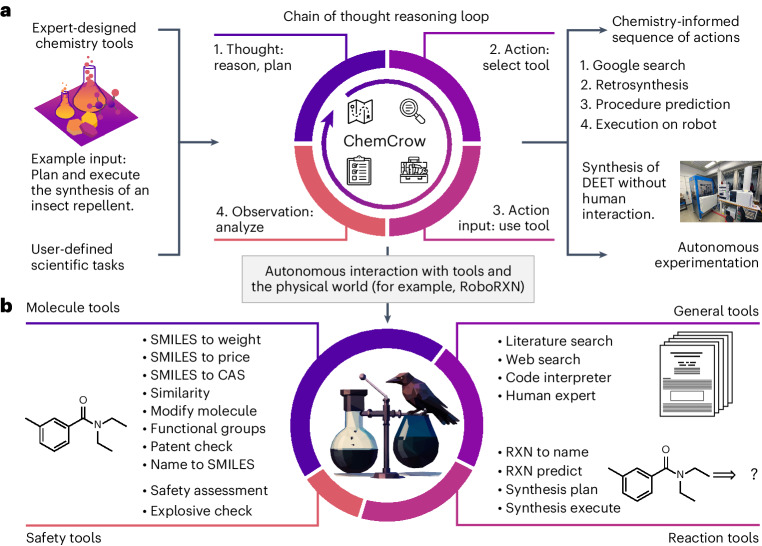
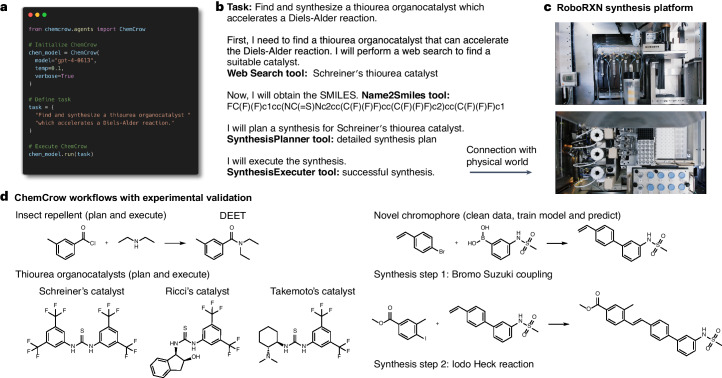
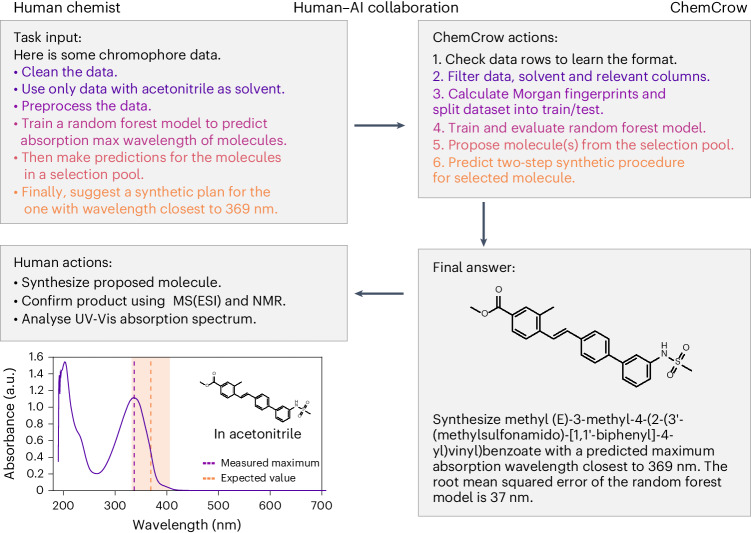
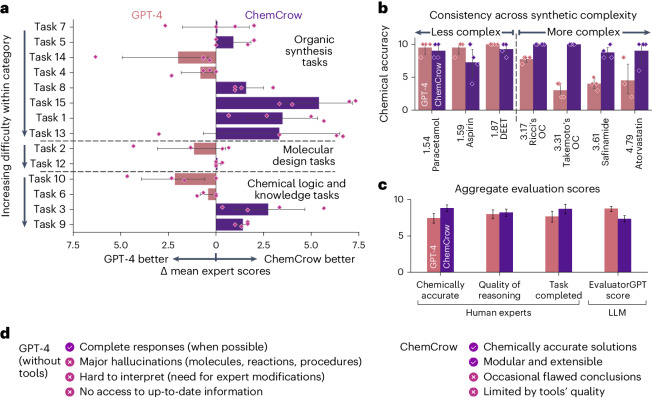
Large language models (LLMs) have shown strong performance in tasks across domains but struggle with chemistry-related problems. These models also lack access to external knowledge sources, limiting their usefulness in scientific applications. We introduce ChemCrow, an LLM chemistry agent designed to accomplish tasks across organic synthesis, drug discovery and materials design. By integrating 18 expert-designed tools and using GPT-4 as the LLM, ChemCrow augments the LLM performance in chemistry, and new capabilities emerge. Our agent autonomously planned and executed the syntheses of an insect repellent and three organocatalysts and guided the discovery of a novel chromophore. Our evaluation, including both LLM and expert assessments, demonstrates ChemCrow’s effectiveness in automating a diverse set of chemical tasks. Our work not only aids expert chemists and lowers barriers for non-experts but also fosters scientific advancement by bridging the gap between experimental and computational chemistry.
Overview
The claims and statistics of this paper haven’t been checked yet.
Free: it reads the open-access text and checks the first 5 claims that cite a source we can check. Create a free account to check every claim.
Integrity signals
Registry
Cites
Statistics
Figures
Verification
Claims the paper makes
The claims and statistics of this paper haven’t been checked yet.
Free: it reads the open-access text and checks the first 5 claims that cite a source we can check. Create a free account to check every claim.
Claims other papers make about this one
Each is checked against this paper’s own text: does it say what the citing paper says it does?
The source backs part of the claim, not all of it — or backs it for a different population, condition or comparison.
In the citing paper
“In parallel, chemistry-oriented reviews have shown that large language models can move beyond text generation toward tool use, retrieval, planning, code execution, and multi-agent coordination [5-10].”
From From Scientific Copilots to Tool-Grounded Autonomy: AI Agents in Simulation-Driven Materials Discovery (2026) · cites this paper as [7]
Experimental — accuracy not yet measuredThe source backs part of the claim, not all of it — or backs it for a different population, condition or comparison.
In the citing paper
“The broader literature on autonomous scientific systems has already argued for more rigorous evaluation protocols and transparent tool interfaces [3,5,7-12].”
From From Scientific Copilots to Tool-Grounded Autonomy: AI Agents in Simulation-Driven Materials Discovery (2026) · cites this paper as [7]
Experimental — accuracy not yet measuredThe source backs part of the claim, not all of it — or backs it for a different population, condition or comparison.
In the citing paper
“In scientific discovery, agents dynamically compose and execute hypothesis-testing pipelines spanning simulations, lab protocols, and data analysis [61, 62, 63, 64].”
From Code as Agent Harness (2026) · cites this paper as [61]
Experimental — accuracy not yet measuredThe source backs part of the claim, not all of it — or backs it for a different population, condition or comparison.
In the citing paper
“ChemCrow [61] similarly integrates RDKit, retrosynthesis engines, and reaction predictors so that an agent can 'execute' a candidate synthesis virtually before committing to a wet-lab run.”
From Code as Agent Harness (2026) · cites this paper as [61]
Experimental — accuracy not yet measuredThe source backs part of the claim, not all of it — or backs it for a different population, condition or comparison.
In the citing paper
“In chemistry, language-model tools, yield predictors, Bayesian optimization, and robotic laboratories provide complementary components for selecting and testing reactions [28, 42-46].”
From RSI-Anything: Unlocking Recursive Self-Improvement with World Models (2026) · cites this paper as [43]
Experimental — accuracy not yet measured
5 more claims about this paper
Create a free account to see every claim other papers make about this one.
Self-check
Percentages, sums and reported differences re-computed from the paper’s own numbers.
The self-check needs the paper’s full text.
Citations
Cites
Vaswani, A., Shazeer, N., Parmar, N., Uszkoreit, J., Jones, L., Gomez, A. N., Kaiser, L., & Polosukhin, I. (2017) · arXiv · doi:10.48550/arxiv.1706.03762 · Cited by 120,404 · cited 1×
“These specialized tools provide exact answers, thereby compensating for the inherent deficiencies of LLMs in specific domains and enhancing their overall performance and applicability.”
BackgroundLanguage Models are Few-Shot Learners
Brown, T. B., Mann, B., Ryder, N., Subbiah, M., Kaplan, J., Dhariwal, P., Neelakantan, A., Shyam, P., Sastry, G., Askell, A., et al. (2020) · arXiv · doi:10.48550/arxiv.2005.14165 · Cited by 23,372 · cited 1×
“…as a field, has been impacted through expert-designed artificial intelligence (AI) systems that tackle specific problems, such as reaction prediction 16–20 , retrosynthesis planning 21–27 , molecular property prediction 28–32 , de-novo molecular generation 33,34 , materials design 35,36 and,…”
BackgroundExtended-Connectivity Fingerprints
Rogers, D., & Hahn, M. (2010) · Journal of Chemical Information and Modeling · doi:10.1021/ci100050t · Cited by 7,524 · cited 1×
“Similarity The primary function of this tool is to evaluate the similarity between two molecules, utilizing the Tanimoto similarity measure 90 based on the ECFP2 molecular fingerprints 91 of the input molecules.”
MethodThe National Center for Biotechnology Information
Benson, D., Boguski, M., Lipman, D. J., & Ostell, J. (1990) · Genomics · doi:10.1016/0888-7543(90)90583-g · Cited by 5,126
LLaMA: Open and Efficient Foundation Language Models
Touvron, H., Lavril, T., Izacard, G., Martinet, X., Lachaux, M.-A., Lacroix, T., Rozière, B., Goyal, N., Hambro, E., Azhar, F., et al. (2023) · arXiv · doi:10.48550/arxiv.2302.13971 · Cited by 4,602 · cited 1×
“…is the lack of reproducibility of individual results under the current API-based approach to LLMs, as closed-source models provide limited control, see Appendix E. Recent open-source models 76–78 offer a potential solution to this issue, albeit with a possible trade-off in reasoning power.”
BackgroundChain-Of-Thought Prompting Elicits Reasoning in Large Language Models
Wei, J., Wang, X., Schuurmans, D., Bosma, M., Ichter, B., Xia, F., Chi, E., Le, Q. V., & Zhou, D. (2022) · Advances in Neural Information Processing Systems 35 · doi:10.52202/068431-1800 · Cited by 4,505
Chain-of-Thought Prompting Elicits Reasoning in Large Language Models
Wei, J., Wang, X., Schuurmans, D., Bosma, M., Ichter, B., Xia, F., Chi, E., Le, Q., & Zhou, D. (2022) · arXiv · doi:10.48550/arxiv.2201.11903 · Cited by 4,263 · cited 1×
“The tools used can be classified into general tools, molecular tools, and chemical reaction tools.”
MethodBillion-scale similarity search with GPUs
Johnson, J., Douze, M., & Jegou, H. (2021) · IEEE Transactions on Big Data · doi:10.1109/tbdata.2019.2921572 · Cited by 4,228
Training language models to follow instructions with human feedback
Ouyang, L., Wu, J., Jiang, X., Almeida, D., Wainwright, C. L., Mishkin, P., Zhang, C., Agarwal, S., Slama, K., Ray, A., et al. (2022) · arXiv · doi:10.48550/arxiv.2203.02155 · Cited by 4,208 · cited 2×
“5 13 cannot consistently and accurately multiply 12345*98765 or convert IUPAC names into the corresponding molecular graph 14 .”
BackgroundBillion-scale similarity search with GPUs
Johnson, J., Douze, M., & Jégou, H. (2017) · arXiv · doi:10.48550/arxiv.1702.08734 · Cited by 4,140 · cited 1×
“The CAS number serves as a precise and universally recognized chemical identifier, enabling researchers to access relevant data and resources with ease, and ensuring that they obtain accurate and consistent information about the target molecule 89 .”
Background
Research works printed but not linked: 4
- Devlin, J., Chang, M.-W., Lee, K. & Toutanova, K. Bert: pre-training of deep bidirectional transformers for language understanding. In Proc. Conference of the North American Chapter of the Association for Computational Linguistics: Human Language Technologies (eds Burstein, J. et al.) 4171–4186 (Association for Computational Linguistics, 2019).
- Li, R. et al. Starcoder: may the source be with you! Trans. Mach. Learn. Res. https://openreview.net/pdf?id=KoFOg41haE (2023).
- Zelikman E Wu Y Mu J Goodman N Star: bootstrapping reasoning with reasoning Adv. Neural Inf. Process. Syst. 2022 35 15476 15488
- Lowe, D. M. Extraction of Chemical Structures and Reactions from the Literature. PhD thesis, Univ. of Cambridge (2012).
Cited by
Items 501–600 of 1,026
Accelerating materials discovery through active learning: Methods, challenges and opportunities
Ma, Y., Gao, Y., Wang, L., Chen, M., Cui, W., Wang, B., & Du, Y. (2025) · The Innovation Informatics · doi:10.59717/j.xinn-inform.2025.100013 · Cited by 21
Hazards from Increasingly Accessible Fine-Tuning of Downloadable Foundation ModelsPreprint
Chan, A., Bucknall, B., Bradley, H., & Krueger, D. (2023) · arXiv (Cornell University) · doi:10.48550/arxiv.2312.14751 · Cited by 17
“…models that can do X is possible since tool-augmented foundation models are already somewhat capable of biological and chemical synthesis Sandbrink [2023], Boiko et al. [2023], Bran et al. [2023], Soice et al. [2023]; it seems likely that capabilities will improve with the next-generation models.”
BackgroundConnecting molecular properties with plain language
Hocky, G. M. (2024) · Nature Machine Intelligence · doi:10.1038/s42256-024-00812-y · Cited by 14
BioKGBench: A Knowledge Graph Checking Benchmark of AI Agent for Biomedical SciencePreprint
Lin, X., Ma, S., Shan, J., Zhang, X., Hu, S. X., Guo, T., Li, S. Z., & Yu, K. (2024) · arXiv (Cornell University) · doi:10.48550/arxiv.2407.00466 · Cited by 24
Neural Graph Matching Improves Retrieval Augmented Generation in Molecular Machine LearningPreprint
Wang, R., Wang, R.-X., Manjrekar, M., & Coley, C. W. (2025) · arXiv (Cornell University) · doi:10.48550/arxiv.2502.17874 · Cited by 20
“While originally developed to aid Large Language Model (LLM)-based AI agents, their applicability has readily extended to scientific tasks, spanning LLMs for material discovery (Buehler, 2024), drug design (Pal et al., 2023), and organic synthesis (M. Bran et al., 2024).”
ArgoLOOM: agentic AI for fundamental physics from quarks to cosmosPreprint
Bakshi, S. D., Barry, P. S., Bissolotti, C., Cloët, I. C., Corrodi, S., Djurcic, Z., Habib, S., Heitmann, K., Hobbs, T. J., Hopkins, W. H., et al. (2025) · arXiv (Cornell University) · doi:10.48550/arxiv.2510.02426 · Cited by 14
Synthelite: Chemist-aligned and feasibility-aware synthesis planning with LLMsPreprint
Xuan-Vu, N., Armstrong, D., Wehrbach, M., Bran, A. M., Jončev, Z., & Schwaller, P. (2025) · arXiv (Cornell University) · doi:10.48550/arxiv.2512.16424 · Cited by 15
Self-citationFROGENT: An End-to-End Full-process Drug Design Multi-Agent SystemPreprint
Pan, Q., Xu, D., Yang, Q., Yao, J. X., Yuan, S., Zhu, Z., Li, J., & Ji, J. (2025) · arXiv (Cornell University) · doi:10.48550/arxiv.2508.10760 · Cited by 15
“In the context of chemical synthesis, LLM-RDF employs six specialized LLM-based agents to guide the end-to-end synthesis development process [16], while ChemCrow combines chain-of-thought reasoning with expert-curated chemistry tools to automate organic catalyst synthesis [17].”
VASP Agent: An Agentic Framework for Autonomous First-principles CalculationsPreprint
Xia, Z., Ma, J., Zheng, C., Wang, Z., Zhang, S., Li, Y., Hu, P., Hu, P., Zhang, C., Gong, X., et al. (2025) · arXiv (Cornell University) · doi:10.48550/arxiv.2512.19458 · Cited by 14
AInsteinBench: Benchmarking Coding Agents on Scientific RepositoriesPreprint
Duston, T., Xin, S., Sun, Y., Zan, D., Li, A., Xin, S., Shen, K., Chen, Y., Sun, Q., Zhang, G., et al. (2025) · arXiv (Cornell University) · doi:10.48550/arxiv.2512.21373 · Cited by 18
El Agente Forjador: Task-Driven Agent Generation for Quantum SimulationPreprint
Zhang, Z., Yin, A., Baweja, A., Bai, J., Gustín, I., Bernales, V., & Aspuru‐Guzik, A. (2026) · arXiv (Cornell University) · doi:10.48550/arxiv.2604.14609 · Cited by 19
BiomniBench: Process-level Evaluation of LLM Agents for Real-world Biomedical ResearchPreprint
Qu, Y., Lu, Y., Tu, X., Zhang, S., She, T., Shaw, A. G., Shih, J., Zhao, B., Shen, M., Yang, H., et al. (2026) · bioRxiv (Cold Spring Harbor Laboratory) · doi:10.64898/2026.05.12.724604 · Cited by 14
“…autonomous chemistry workflows, support drug-discovery pipelines, and interpret clinical multi-omics — work that once required hours to days of expert effort [Huang et al., 2025, Qu et al., 2026, Roohani et al., 2025, Boiko et al., 2023, M. Bran et al., 2024, Liu et al., 2024, Wang et al., 2025].”
A Survey of Context Engineering for Large Language Models
Mei, L., Yao, J., Ge, Y., Wang, Y., Bi, B., Cai, Y., Liu, J., Li, M., Li, Z.-Z., Zhang, D., et al. (2025) · arXiv · doi:10.48550/arxiv.2507.13334 · Cited by 281
AI/ML-based computational models for toxicity prediction
Barua, S., Balaji, B., & Balaji, S. (2026) · Environmental Science and Pollution Research · doi:10.1007/s11356-025-37354-8 · Cited by 18
An LLM-based multi-agent system to assist early-stage product design and evaluation
Chen, P., Cai, Y., Zhou, Z., Yao, J., Li, J., You, W., & Sun, L. (2026) · Journal of Engineering Design · doi:10.1080/09544828.2026.2616583 · Cited by 17
“For example, Xia et al. (2023) developed an agent system to manage the industrial production workflow, while Bran et al. (2023) enhanced agents with chemistry knowledge to design and execute chemical experiments.”
Chemist-Guided Human–AI Workflow for Covalent Organic Framework Synthesis
Chen, L., Lu, Z., Chen, L., Hou, L., & Zhang, D. (2026) · Journal of the American Chemical Society · doi:10.1021/jacs.5c20068 · Cited by 13
Large language model agent for user-friendly chemical process simulations
Liang, J., Groll, N., & Sin, G. (2026) · Digital Chemical Engineering · doi:10.1016/j.dche.2026.100312 · Cited by 17
Bratovčić, A., & Tomašić, V. (2026) · Processes · doi:10.3390/pr14121866 · Cited by 13
Computationally Guided Synthesis of Battery Materials
Szymanski, N. J., & Bartel, C. J. (2024) · ACS Energy Letters · doi:10.1021/acsenergylett.4c00821 · Cited by 15
Generative AI Agents for Knowledge Work Augmentation in Finance
Ganesh, S., Ardon, L., Borrajo, D., Garg, D., Madhushani, U., Narayanan, A. L., Canonaco, G., & Veloso, M. (2024) · Annual Review of Control Robotics and Autonomous Systems · doi:10.1146/annurev-control-022823-033813 · Cited by 16
A vision of human–AI collaboration for enhanced biological collection curation and research
Stenhouse, A., Fisher, N., Lepschi, B. J., Schmidt‐Lebuhn, A. N., Rodríguez, J., Turco, F., Reeson, A. F., Paris, C. L., & Thrall, P. H. (2025) · BioScience · doi:10.1093/biosci/biaf021 · Cited by 15
Zhao, Y., Hansen, A., Dahlhaus, A., Brandt, N., Selzer, M. A., Koeppe, A., Nestler, B., Knapp, M., & Ehrenberg, H. (2025) · Materials Today Communications · doi:10.1016/j.mtcomm.2025.112380 · Cited by 16
Xie, L., Jin, Y.-D., Xu, L., Chang, S., & Xu, X. (2025) · Journal of Chemical Theory and Computation · doi:10.1021/acs.jctc.5c00605 · Cited by 17
Data-driven recommendation of agents, temperature, and equivalence ratios for organic synthesis
Sun, X., Liu, J., Mahjour, B. A., Jensen, K. F., & Coley, C. W. (2025) · Chemical Science · doi:10.1039/d5sc04957a · Cited by 15
Agentic Large Language Models for Conceptual Systems Engineering and Design
Massoudi, S., & Fuge, M. (2025) · ASME International Design Engineering Technical Conferences and Computers and Information in Engineering Conference (IDETC/CIE) · doi:10.1115/detc2025-168856 · Cited by 23
“Agent frameworks have been successfully applied in scientific discovery [34, 35], chemistry [36], biomedical research [37], and software engineering [38], where they autonomously generate hypotheses, execute experiments, and iterate on solutions in complex, knowledge-intensive domains.”
Reasoning BO: Enhancing Bayesian Optimization With the Reasoning Power of LLMs
Yang, Z., Wang, D., Ge, L., Wang, B., Fu, T., & Li, Y. (2026) · Materials Genome Engineering Advances · doi:10.1002/mgea.70086 · Cited by 15
A GPT‐4 Reticular Chemist for Guiding MOF Discovery**
Zheng, Z., Rong, Z., Rampal, N., Borgs, C., Chayes, J., & Yaghi, O. M. (2023) · Angewandte Chemie · doi:10.1002/ange.202311983 · Cited by 15
Concept Bottleneck Language Models For protein design
Ismail, A. A., Oikarinen, T., Wang, A., Adebayo, J., Stanton, S., Joren, T., Kleinhenz, J., Goodman, A., Bravo, H. C., Cho, K., et al. (2025) · International Conference on Learning Representations · doi:10.48550/arxiv.2411.06090 · Cited by 17
Spike sorting AI agentPreprint
Lin, Z., Marin‐Llobet, A., Baek, J., He, Y., Lee, J., Wang, W., Zhang, X., Lee, A. J., Liang, N., Du, J., et al. (2025) · bioRxiv (Cold Spring Harbor Laboratory) · doi:10.1101/2025.02.11.637754 · Cited by 19
“While LLM-based AI agents 19 has begun to emerge in fields such as chemistry 20, 21 and material science 22 , their application to neuroscience, especially for spike sorting, remains unexplored.”
Can Theoretical Physics Research Benefit from Language Agents?
Lu, S., Jin, Z., Zhang, T. J., Kos, P., Cirac, J. I., & Schölkopf, B. (2026) · International Conference on Machine Learning · doi:10.48550/arxiv.2506.06214 · Cited by 20
“These models are then subjected to analytical derivation , involving mathematical analysis, symbolic reasoning, and numerical calculations to extract predictions.”
Context-aware LLM-based AI Agents for Human-centered Energy Management Systems in Smart BuildingsPreprint
He, T., & Jazizadeh, F. (2025) · arXiv (Cornell University) · doi:10.48550/arxiv.2512.25055 · Cited by 18
MatClaw: An Autonomous Code-First LLM Agent for End-to-End Materials ExplorationPreprint
Zhang, C., & Yakobson, B. I. (2026) · arXiv (Cornell University) · doi:10.48550/arxiv.2604.02688 · Cited by 13
“For instance, ChemCrow [Bran et al., 2024] integrates 18 expert-designed tools to cover its target chemistry tasks; extending it to a new domain would require designing and validating additional tools.”
DynaMate: Leveraging AI-agents for customized research workflows
Mendible-Barreto, O. A., Díaz-Maldonado, M., Carmona Esteva, F. J., Torres, J. E., Córdova-Figueroa, U. M., & Colón, Y. J. (2025) · Molecular Systems Design & Engineering · doi:10.1039/d5me00062a · Cited by 12
AGILE: A Novel Reinforcement Learning Framework of LLM Agents
Feng, P., He, Y., Huang, G., Lin, Y., Zhang, H., Zhang, Y., & Li, H. (2024) · Advances in Neural Information Processing Systems 37 · doi:10.52202/079017-0170 · Cited by 12
Yager, K. G. (2024) · Digital Discovery · doi:10.1039/d4dd00178h · Cited by 12
Large Language Models and Biorisk
D’Alessandro, W., Lloyd, H. R., & Sharadin, N. (2023) · The American Journal of Bioethics · doi:10.1080/15265161.2023.2250333 · Cited by 13
“One class of biomedical ML systems integrates LLMs with other scientific research tools, such as Python code, expert-designed chemistry software, and even laboratory robots (Boiko, MacKnight, and Gomes 2023; Bran et al. 2023).”
MethodThe rise of data repositories in materials chemistry
Stracke, K., & Evans, J. D. (2024) · Communications Chemistry · doi:10.1038/s42004-024-01143-0 · Cited by 12
Competition-Level Problems are Effective LLM Evaluators
Huang, Y., Lin, Z., Liu, X., Gong, Y., Lu, S., Lei, F., Liang, Y., Shen, Y., Chen, L., Duan, N., et al. (2024) · Findings of the Association for Computational Linguistics: ACL (Findings of ACL) · doi:10.18653/v1/2024.findings-acl.803 · Cited by 24
Chemical Language Model Linker: Blending Text and Molecules with Modular Adapters
Deng, Y., Ericksen, S. S., & Gitter, A. (2025) · Journal of Chemical Information and Modeling · doi:10.1021/acs.jcim.5c00853 · Cited by 17
Natural language access point to digital metal–organic polyhedra chemistry in The World Avatar
Rihm, S. D., Tran, D. N., Kondinski, A., Pascazio, L., Saluz, F., Deng, X., Mosbach, S., Akroyd, J., & Kraft, M. (2025) · Data-Centric Engineering · doi:10.1017/dce.2025.12 · Cited by 12
Cinema Multiverse Lounge: Enhancing Film Appreciation via Multi-Agent Conversations
Ryu, J., Kim, K., Heo, D., Song, H., Oh, C., & Suh, B. (2025) · CHI Conference on Human Factors in Computing Systems · doi:10.1145/3706598.3713641 · Cited by 17
Autonomous Self‐Evolving Research on Biomedical Data: The DREAM Paradigm
Deng, L., Wu, Y., Ren, Y., & Lu, H. J. (2025) · Advanced Science · doi:10.1002/advs.202417066 · Cited by 14
Towards Agentic AI for Science: Hypothesis Generation, Comprehension, Quantification, and Validation
Huang, L., Koutra, D., Kulkarni, A., Prioleau, T., Wu, Q., Yan, Y., Yang, Y., Zou, J., & Zhou, D. (2025) · International World Wide Web Conference (WWW) · doi:10.1145/3701716.3717754 · Cited by 17
The Artificial Intelligence-Driven Intelligent Laboratory for Organic Chemistry Synthesis
Li, T., Song, W., Chen, N., Wang, Q., Gao, F., Xing, Y., Wu, S., Song, C. L., Li, J., Liu, Y., et al. (2025) · Applied Sciences · doi:10.3390/app15137387 · Cited by 14
Feyijimi, T. R., Aliu, J., Oke, A. E., & Aghimien, D. O. (2025) · Computers · doi:10.3390/computers14090366 · Cited by 13
Accelerating multimetallic catalyst discovery with robotics and agentic AI
Peng, J., Liu, C., Luo, Y., & Dandapat, K. (2025) · AI Agent · doi:10.20517/aiagent.2025.07 · Cited by 12
AI-driven design and applications of quantum dots
Soni, P. K., Satnami, M. L., Nagwanshi, R., Chawre, Y., Kujur, A. B., Sinha, A., Miri, P., Karbhal, I., & Ghosh, K. K. (2026) · Nano Today · doi:10.1016/j.nantod.2026.102974 · Cited by 17
Osprey: Production-ready agentic AI for safety-critical control systems
Hellert, T., Montenegro, J., & Sulc, A. (2025) · APL Machine Learning · doi:10.1063/5.0306302 · Cited by 12
DeepRetro discovers retrosynthetic pathways through iterative large language model reasoning
Sathyanarayana, S. V., Hiremath, S. D., Kirankumar, S. R., Panda, R., Jana, R., Singh, R., Irfan, R., Murali, A., & Ramsundar, B. (2026) · Scientific Reports · doi:10.1038/s41598-026-38821-z · Cited by 13
Song, Z.-Y., Guo, X., & Sun, Q. (2026) · Chemical Reviews · doi:10.1021/acs.chemrev.5c00992 · Cited by 12
Agentic Exploration of Physics Models
Nägele, M., & Marquardt, F. (2026) · Physical Review X · doi:10.1103/xnqc-q6nt · Cited by 18
“In chemistry, they combine web search, specialized simulation tools, and access to laboratory interfaces to, for example, optimize chemical reactions [18], and synthesize molecules [19, 20].”
Zhu, Y., Liu, L., Yu, J., & Zhang, D. (2026) · Future Internet · doi:10.3390/fi18060326 · Cited by 18
Capturing Formulation Design of Battery Electrolytes with Chemical Large Language ModelPreprint
Soares, E., Sharma, V., Brazil, E. V., Na, Y.-H., & Cerqueira, R. (2024) · Research Square · doi:10.21203/rs.3.rs-3593035/v1 · Cited by 17
AMGPT: a Large Language Model for Contextual Querying in Additive ManufacturingPreprint
Chandrasekhar, A., Chan, J. H., Ogoke, F., Ajenifujah, O., & Farimani, A. B. (2024) · arXiv (Cornell University) · doi:10.48550/arxiv.2406.00031 · Cited by 30
Large Language Models are Catalyzing Chemistry EducationPreprint
Du, Y., Duan, C., Bran, A. M., Sotnikova, A., Qu, Y., Kulik, H. J., Bosselut, A., Xu, J., & Schwaller, P. (2024) · ChemRxiv · doi:10.26434/chemrxiv-2024-h722v · Cited by 14
Self-citationPre-trained knowledge elevates large language models beyond traditional chemical reaction optimizersPreprint
MacKnight, R., Regio, J. E., Ethier, J. G., Baldwin, L. A., & Gomes, G. (2025) · arXiv (Cornell University) · doi:10.48550/arxiv.2509.00103 · Cited by 13
Ghafarollahi, A., & Buehler, M. J. (2025) · MRS Bulletin · doi:10.1557/s43577-025-00953-4 · Cited by 11
A Survey on Autonomy-Induced Security Risks in Large Model-Based Agents
Su, H., Luo, J., Liu, C., Yang, X., Zhang, Y., Dong, Y., & Zhu, J. (2026) · IEEE Transactions on Pattern Analysis and Machine Intelligence · doi:10.1109/tpami.2026.3688650 · Cited by 11
Exploring Autonomous Agents through the Lens of Large Language Models: A Review
Barua, S. (2024) · arXiv · doi:10.48550/arxiv.2404.04442 · Cited by 11
Das, A., Chen, S., Shyu, M., & Sadiq, S. B. (2023) · IEEE International Conference on Collaboration and Internet Computing (CIC) · doi:10.1109/cic58953.2023.00021 · Cited by 22
“The worker agents ( A ) would then carry out their assigned tasks, using their specialized skills and knowledge to solve their part of the problem [3].”
BackgroundAssessing the risk of takeover catastrophe from large language models
Baum, S. D. (2024) · Risk Analysis · doi:10.1111/risa.14353 · Cited by 11
Leveraging large language models for metabolic engineering design
Li, X., Guo, Z., Li, Y., Liang, Z., Liu, Z., Wu, K., Luo, J., Zhang, Y., Liu, L., Sun, M., et al. (2026) · Trends in biotechnology · doi:10.1016/j.tibtech.2026.03.026 · Cited by 13
Evolutionary attraction–repulsion algorithm embedded with LLM for UAV task allocation
Wu, B., & Xiao, R. (2025) · Advanced Engineering Informatics · doi:10.1016/j.aei.2025.103428 · Cited by 12
Li, A., Cui, P., Wang, X., Fisher, A. C., Li, L., & Cheng, D. (2025) · Frontiers of Chemical Science and Engineering · doi:10.1007/s11705-025-2560-3 · Cited by 11
An integrated AI system for multi-objective screening of MOF materials
Bai, X., Wang, H., Xie, L., Zhang, X., Xing, N., Zhang, J.-Y., Chen, D., Xie, Z.-H., Ding, L.-F., & Li, J. (2025) · Separation and Purification Technology · doi:10.1016/j.seppur.2025.133939 · Cited by 11
The future of reviews writing in the AI era
Zheng, Z. (2025) · Nature Reviews Chemistry · doi:10.1038/s41570-025-00738-y · Cited by 11
Choudhary, K. K. (2025) · Integrating materials and manufacturing innovation · doi:10.1007/s40192-025-00410-9 · Cited by 13
Liu, Y., Shen, R., Zhou, L., Xiao, Q., Yuan, J., & Li, Y. (2025) · Briefings in Bioinformatics · doi:10.1093/bib/bbaf312 · Cited by 13
Boosting the predictive power of protein representations with a corpus of text annotations
Duan, H., Skreta, M., Cotta, L., Rajaonson, E. M., Dhawan, N., Aspuru‐Guzik, A., & Maddison, C. J. (2025) · Nature Machine Intelligence · doi:10.1038/s42256-025-01088-6 · Cited by 16
Artificial intelligence in materials science and chemistry: Past, present and future trajectories
Osaro, E., Karpinski, N., Alornyo, S., & Ighalo, J. O. (2025) · Materials Today Chemistry · doi:10.1016/j.mtchem.2025.103115 · Cited by 19
Towards fully automated city operations: Integrating agentic AI with urban digital twins
Xu, H., Zlatanova, S., Li, X., Wachowicz, M., & Batty, M. (2026) · Computers Environment and Urban Systems · doi:10.1016/j.compenvurbsys.2026.102449 · Cited by 17
Umer, M. S., Nabeel, M., Athar, U., Lynch, I., Afantitis, A., Ullah, S., & Fraz, M. M. (2025) · Archives of Computational Methods in Engineering · doi:10.1007/s11831-025-10437-y · Cited by 15
Farris, B. R., & Leonard, K. C. (2025) · JACS Au · doi:10.1021/jacsau.5c01087 · Cited by 11
Agentic AI systems in electrical power systems engineering: current state-of-the-art and challenges
Ghosh, S., & Mittal, G. (2026) · Frontiers in Artificial Intelligence · doi:10.3389/frai.2026.1814651 · Cited by 13
Canales, C. S. C., Cazorla, J. I. M., Cazorla, R. M. M., dos Santos, A. M., Duarte, J. L., Nunes, L. O. C., Reis, T. C., Salvador, L. C., Santos‐Filho, N. A., Sábio, R. M., et al. (2026) · Advanced Healthcare Materials · doi:10.1002/adhm.202503964 · Cited by 11
“A practical way to improve verifiability is to couple language-model generation to external chemistry tools and structured execution, which increases traceability and reduces brittle reasoning errors [192].”
Augmenting Large Language Models for Automated Discovery of F-Element Extractants
Zhang, B. Y., Summers, T. J., Augustine, L. J., Taylor, M. G., Geist, A., Li, R., Batista, E. R., Pérez, D., Yang, P. X., & Schrier, J. (2026) · Journal of the American Chemical Society · doi:10.1021/jacs.5c19738 · Cited by 11
Machine-learning for capacitive energy storage polymer dielectrics: opportunities and challenges
Yang, M., Wan, C., Liu, R., Zhang, J., Shen, Z., Nan, C., & Shen, Y. (2026) · Progress in Materials Science · doi:10.1016/j.pmatsci.2026.101678 · Cited by 11
A Comprehensive Review of Generative Physical Artificial Intelligence
Gaba, S., Rana, K., Sai, S., Chamola, V., & Niyato, D. T. (2026) · IEEE Internet of Things Journal · doi:10.1109/jiot.2026.3671268 · Cited by 17
“In research domains such as material science, chemistry, and product design, GPAI’s generative capabilities accelerate discovery by enabling the creation of novel material structures, prototypes, and chemical compounds [115], [116].”
From Text to Simulation: A Multi-Agent LLM Workflow for Automated Chemical Process Design
Tian, X., Du, W., Yang, S., Hu, H., Xin, H., Qu, S., & Ye, K. (2026) · Proceedings of the AAAI Conference on Artificial Intelligence · doi:10.1609/aaai.v40i35.40215 · Cited by 13
Many AI analysts, one dataset: Navigating the agentic data science multiverse
Bertrán, M., Fogliato, R., & Wu, Z. S. (2026) · Proceedings of the National Academy of Sciences · doi:10.1073/pnas.2606495123 · Cited by 20
Assessing Logical Puzzle Solving in Large Language Models: Insights from a Minesweeper Case Study
Li, Y., Wang, H., & Zhang, C. (2024) · Conference of the North American Chapter of the Association for Computational Linguistics: Human Language Technologies (NAACL-HLT) · doi:10.18653/v1/2024.naacl-long.4 · Cited by 26
AstroMLab 2: AstroLLaMA-2-70B Model and Benchmarking Specialised LLMs for Astronomy
Pan, R., Nguyen, T. D., Arora, H., Accomazzi, A., Ghosal, T., & Ting, Y.-S. (2024) · International Conference for High Performance Computing, Networking, Storage and Analysis (SC) · doi:10.1109/scw63240.2024.00019 · Cited by 20
Enhancing Open-Domain Task-Solving Capability of LLMs via Autonomous Tool Integration from GitHub
Lyu, B., Cong, X., Yu, H.-Y., Yang, P., Qian, C., Wang, Z.-H., Qin, Y., Ye, Y., Lu, Y.-X., Qian, C., et al. (2023) · Annual Meeting of the Association for Computational Linguistics · doi:10.18653/v1/2025.acl-long.845 · Cited by 11
Doron, G., Genway, S., Roberts, M., & Jasti, S. (2023) · arXiv (Cornell University) · doi:10.48550/arxiv.2312.12482 · Cited by 14
“Generative AI techniques can allow latent representations of the data to be created, which enable the structure of subpopulations to be elucidated [19].”
BackgroundTowards Agentic Intelligence for Materials SciencePreprint
Zhang, H., Li, Y., Huang, W., Hou, Z., Song, Y., Liu, X., Effaty, F., Jiang, J., Wu, S., Ding, Q., et al. (2026) · arXiv (Cornell University) · doi:10.48550/arxiv.2602.00169 · Cited by 15
AI Agents for Variational Quantum Circuit DesignPreprint
Knipfer, M., Roman, A., Matchev, K. T., Matcheva, K., & Gleyzer, S. (2026) · arXiv (Cornell University) · doi:10.48550/arxiv.2602.19387 · Cited by 14
“For example, ChemCrow, an LLM chemistry agent [27], illustrates how large language models equipped with domain-specific chemistry tools can plan, execute, and interpret multistep experimental procedures.”
ToolRosella: Translating Code Repositories into Standardized Tools for Scientific AgentsPreprint
Di, S., Yuan, X., Guo, H., Ouyang, C., Liu, Y., Yue, L., Chen, Z., Zheng, L., Zhu, J., Pan, S., et al. (2026) · arXiv (Cornell University) · doi:10.48550/arxiv.2603.09290 · Cited by 11
“ChemCrow [11] demonstrates domain-specialized agents with crafted prompting templates for chemistry.”
Agentic Tool Use in Large Language ModelsPreprint
Hu, J., Zhong, M., Chen, K.-H., Bai, X.-F., & Zhang, M. (2026) · arXiv.org · doi:10.48550/arxiv.2604.00835 · Cited by 6
“ChemCrow [13] and MedAgent-Bench [57] further demonstrate that task-completion benchmarks now cover high-stakes workflows such as organic synthesis and clinical diagnosis, where the agent must combine reasoning, specialized tools, and domain knowledge to produce actionable solutions.”
Self-Driving Laboratory for Accelerated On-Surface Synthesis under Ultrahigh Vacuum
Li, Y., Huang, Q. Z., Yang, T., Zhu, Z., Yuan, S., Yang, Q., Zhang, X., & Sun, Q. (2025) · Nano Letters · doi:10.1021/acs.nanolett.5c02445 · Cited by 12
Nguyen, D.-N., Tong, R. K., & Dinh, N. (2025) · Digital Discovery · doi:10.1039/d5dd00306g · Cited by 12
Fuchs, S., Werth, A., Méndez, C., & Butcher, J. T. (2025) · Journal of Engineering Education · doi:10.1002/jee.70033 · Cited by 10
ChemAmp: Amplified Chemistry Tools via Composable Agents
Li, Z., Chang, P., Jin, X., Zhou, Z., He, Q., Liang, J., Cao, F., Yinghui, X., & Qi, Y. (2026) · Findings of the Association for Computational Linguistics: ACL (Findings of ACL) · doi:10.18653/v1/2026.findings-acl.52 · Cited by 10
MechRAG: a multimodal large language model for mechanical engineering
Li, S., & Corney, J. (2025) · Communications Engineering · doi:10.1038/s44172-025-00517-z · Cited by 15
Banerjee, A., Kar, S., Roy, K., Patlewicz, G. Y., Shah, I., Karamertzanis, P. G., Gini, G. C., & Benfenati, E. (2025) · Wiley Interdisciplinary Reviews Computational Molecular Science · doi:10.1002/wcms.70057 · Cited by 14
“Bran et al. [206] introduced ChemCrow, an LLM-driven chemistry agent designed for organic synthesis, drug discovery, and materials design.”
Application and Prospects of Large Language Models in Small-Molecule Drug Discovery
Ma, J., Liu, J., Xu, D., Song, X., & Zhang, Z. (2025) · Analytical Chemistry · doi:10.1021/acs.analchem.5c04083 · Cited by 11
Salehin, I., Sajib, M. T. A., Badhon, N. H., Rifat, M. S. H., Amin, N., & Moon, N. N. (2025) · Engineering Reports · doi:10.1002/eng2.70365 · Cited by 13
Mandiga, A., Yoon, J. H., Kasireddy, B., Olukosi, O. A., & Li, G. (2026) · Computers and Electronics in Agriculture · doi:10.1016/j.compag.2026.111564 · Cited by 12
Artificial Intelligence for Materials Science: Transforming Research Paradigms
Li, Y., Wang, S., Wang, J., Liu, Q., & Zhang, J. (2026) · Chemical Reviews · doi:10.1021/acs.chemrev.6c00012 · Cited by 14
Beyond petrochemicals: challenges and opportunities in industrial-scale biomanufacturing
Kim, J. Y., Yu, H. E., Kim, M. H., & Lee, S. Y. (2026) · Nature Communications · doi:10.1038/s41467-026-73835-1 · Cited by 11
“Multi-agent large language model systems have demonstrated autonomous design and execution of scienti fi c experiments 134,135 .”
Automating Computational Chemistry Workflows via OpenClaw and Domain-Specific Skills
Ding, M., Huang, C. J., Hu, Y., Li, Y., Lu, Z., Yu, X. H., Zhang, D., Zhai, W., Zhu, T., Gu, Q., et al. (2026) · Journal of Chemical Theory and Computation · doi:10.1021/acs.jctc.6c00622 · Cited by 12
“By 18–20 Recent agent studies related to computational chemistry automation, including ChemCrow 21 and CACTUS, 22 suggest that large language model based systems can support computational chemistry workflows by coordinating domain tools and scientific constraints during execution.”
Metadata
- Authors
- M. Bran, A., Cox, S., Schilter, O., Baldassari, C., White, A. D., & Schwaller, P.
- Affiliations
- Future House, Inc. (US)
- IBM Research - Zurich (CH)
- NCCR Catalysis (CH)
- Corresponding author
- White, Andrew D.
- Schwaller, Philippe
- Venue
- Nature Machine Intelligence
- Published
- 2024-05-08
- Volume
- 6
- Issue
- 5
- Pages
- 525-535
- ISSN
- 2522-5839 (ISSN-L)
- PMC
- PMC11116106
- OpenAlex
- W4396723768
- Cited by
- 794
- References
- 76
- Citations by year
- 2026: 395 · 2025: 305 · 2024: 83
- FWCI
- 76.42
- Type
- journal article
- Language
- en
- Open access
- hybrid
- doi.org
- Licence
- cc-by
- creativecommons.org/licenses/by/4.0 (tdm)
- creativecommons.org/licenses/by/4.0 (vor)
- Locations
- Nature Machine Intelligence (publishedVersion, cc-by)
- PubMed Central (publishedVersion, cc-by-nd)
- PubMed (publishedVersion)
- Infoscience (Ecole Polytechnique Fédérale de Lausanne) (submittedVersion, cc-by-nc-nd)
- Funders
- Schweizerischer Nationalfonds zur Förderung der Wissenschaftlichen Forschung (180544)
- National Science Foundation (1751471)
- Topics
- Physical Sciences › Materials Science › Materials Chemistry › Machine Learning in Materials Science
- Life Sciences › Pharmacology, Toxicology and Pharmaceutics › Drug Discovery › Computational Drug Discovery Methods
- Physical Sciences › Computer Science › Artificial Intelligence › Artificial Intelligence Applications
- Keywords
- large language models, GPT-4, organic synthesis planning, drug discovery, materials design, organocatalysts
About these checks
Registry, retraction, Cites and statistics results are computed, not judged, with one exception: a printed reference that no index lists is read once by a model before it counts as a citation error. Claims are extracted by a model and kept only when their quote appears verbatim in the text; each cited source is then checked, with a model’s help, for whether it says what the claim relies on. Those verdicts can be wrong — read the claim’s quote and the cited source before relying on one.
Statistics and arithmetic are recomputed, not judged.
Confidence bands are shown only for fields calibrated on our annotated test set. None is calibrated yet, so no band is shown.
What counts as a claim ›How we measure confidence ›How we check this ›
Are you an author, or do you see a problem with this page? Request a review
Data sources
Bibliographic data: Semantic Scholar, OpenAlex, Crossref.
Contains information from the Semantic Scholar Academic Graph Datasets, made available under the ODC Attribution License (ODC-BY 1.0).
Semantic Scholar’s data is described in: Kinney, R., et al. (2023). The Semantic Scholar Open Data Platform. arXiv:2301.10140.
