

Augmenting large language models with chemistry tools
Open accessThe DOI matches its Crossref record; 94 of the 94 references it cites were found in a registry or an index.
Abstract
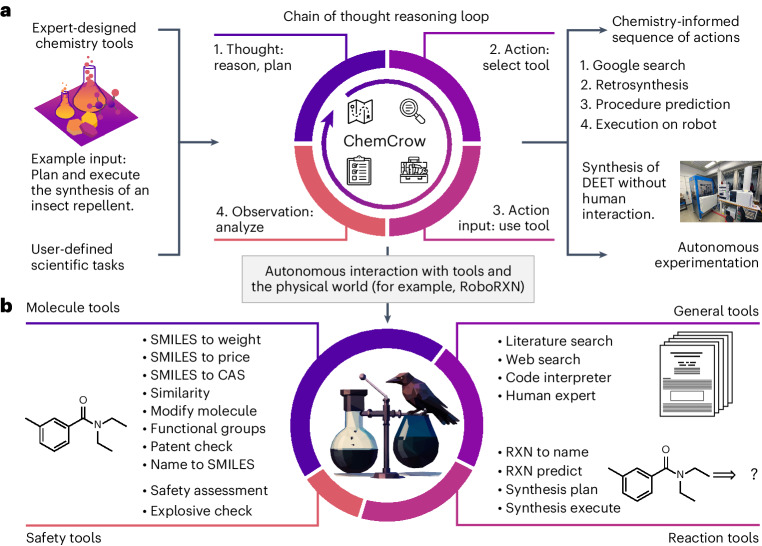
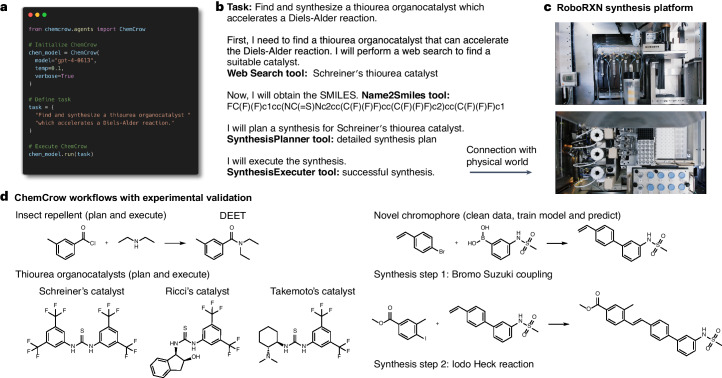
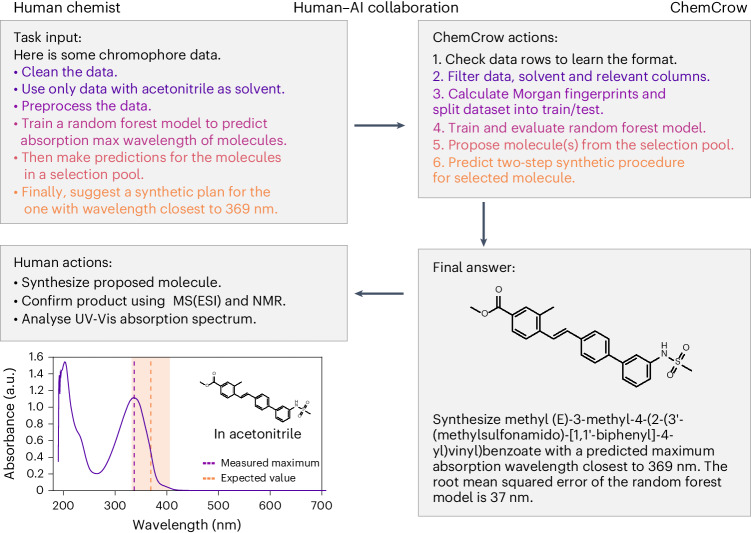
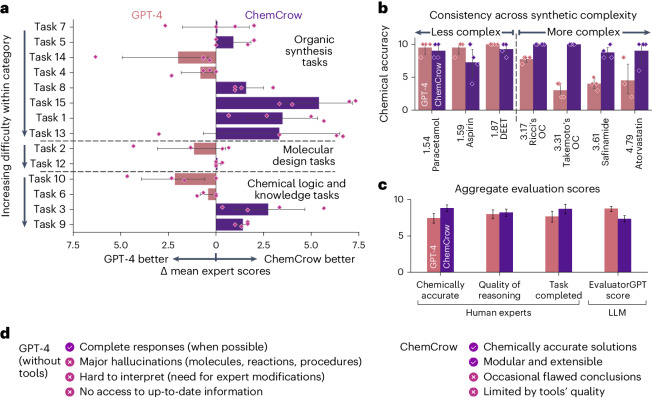
Large language models (LLMs) have shown strong performance in tasks across domains but struggle with chemistry-related problems. These models also lack access to external knowledge sources, limiting their usefulness in scientific applications. We introduce ChemCrow, an LLM chemistry agent designed to accomplish tasks across organic synthesis, drug discovery and materials design. By integrating 18 expert-designed tools and using GPT-4 as the LLM, ChemCrow augments the LLM performance in chemistry, and new capabilities emerge. Our agent autonomously planned and executed the syntheses of an insect repellent and three organocatalysts and guided the discovery of a novel chromophore. Our evaluation, including both LLM and expert assessments, demonstrates ChemCrow’s effectiveness in automating a diverse set of chemical tasks. Our work not only aids expert chemists and lowers barriers for non-experts but also fosters scientific advancement by bridging the gap between experimental and computational chemistry.
Overview
The claims and statistics of this paper haven’t been checked yet.
Free: it reads the open-access text and checks the first 5 claims that cite a source we can check. Create a free account to check every claim.
Integrity signals
Registry
Cites
Statistics
Figures
Verification
Claims the paper makes
The claims and statistics of this paper haven’t been checked yet.
Free: it reads the open-access text and checks the first 5 claims that cite a source we can check. Create a free account to check every claim.
Claims other papers make about this one
Each is checked against this paper’s own text: does it say what the citing paper says it does?
The source backs part of the claim, not all of it — or backs it for a different population, condition or comparison.
In the citing paper
“In parallel, chemistry-oriented reviews have shown that large language models can move beyond text generation toward tool use, retrieval, planning, code execution, and multi-agent coordination [5-10].”
From From Scientific Copilots to Tool-Grounded Autonomy: AI Agents in Simulation-Driven Materials Discovery (2026) · cites this paper as [7]
Experimental — accuracy not yet measuredThe source backs part of the claim, not all of it — or backs it for a different population, condition or comparison.
In the citing paper
“The broader literature on autonomous scientific systems has already argued for more rigorous evaluation protocols and transparent tool interfaces [3,5,7-12].”
From From Scientific Copilots to Tool-Grounded Autonomy: AI Agents in Simulation-Driven Materials Discovery (2026) · cites this paper as [7]
Experimental — accuracy not yet measuredThe source backs part of the claim, not all of it — or backs it for a different population, condition or comparison.
In the citing paper
“In scientific discovery, agents dynamically compose and execute hypothesis-testing pipelines spanning simulations, lab protocols, and data analysis [61, 62, 63, 64].”
From Code as Agent Harness (2026) · cites this paper as [61]
Experimental — accuracy not yet measuredThe source backs part of the claim, not all of it — or backs it for a different population, condition or comparison.
In the citing paper
“ChemCrow [61] similarly integrates RDKit, retrosynthesis engines, and reaction predictors so that an agent can 'execute' a candidate synthesis virtually before committing to a wet-lab run.”
From Code as Agent Harness (2026) · cites this paper as [61]
Experimental — accuracy not yet measuredThe source backs part of the claim, not all of it — or backs it for a different population, condition or comparison.
In the citing paper
“In chemistry, language-model tools, yield predictors, Bayesian optimization, and robotic laboratories provide complementary components for selecting and testing reactions [28, 42-46].”
From RSI-Anything: Unlocking Recursive Self-Improvement with World Models (2026) · cites this paper as [43]
Experimental — accuracy not yet measured
5 more claims about this paper
Create a free account to see every claim other papers make about this one.
Self-check
Percentages, sums and reported differences re-computed from the paper’s own numbers.
The self-check needs the paper’s full text.
Citations
Cites
Vaswani, A., Shazeer, N., Parmar, N., Uszkoreit, J., Jones, L., Gomez, A. N., Kaiser, L., & Polosukhin, I. (2017) · arXiv · doi:10.48550/arxiv.1706.03762 · Cited by 120,404 · cited 1×
“These specialized tools provide exact answers, thereby compensating for the inherent deficiencies of LLMs in specific domains and enhancing their overall performance and applicability.”
BackgroundLanguage Models are Few-Shot Learners
Brown, T. B., Mann, B., Ryder, N., Subbiah, M., Kaplan, J., Dhariwal, P., Neelakantan, A., Shyam, P., Sastry, G., Askell, A., et al. (2020) · arXiv · doi:10.48550/arxiv.2005.14165 · Cited by 23,372 · cited 1×
“…as a field, has been impacted through expert-designed artificial intelligence (AI) systems that tackle specific problems, such as reaction prediction 16–20 , retrosynthesis planning 21–27 , molecular property prediction 28–32 , de-novo molecular generation 33,34 , materials design 35,36 and,…”
BackgroundExtended-Connectivity Fingerprints
Rogers, D., & Hahn, M. (2010) · Journal of Chemical Information and Modeling · doi:10.1021/ci100050t · Cited by 7,524 · cited 1×
“Similarity The primary function of this tool is to evaluate the similarity between two molecules, utilizing the Tanimoto similarity measure 90 based on the ECFP2 molecular fingerprints 91 of the input molecules.”
MethodThe National Center for Biotechnology Information
Benson, D., Boguski, M., Lipman, D. J., & Ostell, J. (1990) · Genomics · doi:10.1016/0888-7543(90)90583-g · Cited by 5,126
LLaMA: Open and Efficient Foundation Language Models
Touvron, H., Lavril, T., Izacard, G., Martinet, X., Lachaux, M.-A., Lacroix, T., Rozière, B., Goyal, N., Hambro, E., Azhar, F., et al. (2023) · arXiv · doi:10.48550/arxiv.2302.13971 · Cited by 4,602 · cited 1×
“…is the lack of reproducibility of individual results under the current API-based approach to LLMs, as closed-source models provide limited control, see Appendix E. Recent open-source models 76–78 offer a potential solution to this issue, albeit with a possible trade-off in reasoning power.”
BackgroundChain-Of-Thought Prompting Elicits Reasoning in Large Language Models
Wei, J., Wang, X., Schuurmans, D., Bosma, M., Ichter, B., Xia, F., Chi, E., Le, Q. V., & Zhou, D. (2022) · Advances in Neural Information Processing Systems 35 · doi:10.52202/068431-1800 · Cited by 4,505
Chain-of-Thought Prompting Elicits Reasoning in Large Language Models
Wei, J., Wang, X., Schuurmans, D., Bosma, M., Ichter, B., Xia, F., Chi, E., Le, Q., & Zhou, D. (2022) · arXiv · doi:10.48550/arxiv.2201.11903 · Cited by 4,263 · cited 1×
“The tools used can be classified into general tools, molecular tools, and chemical reaction tools.”
MethodBillion-scale similarity search with GPUs
Johnson, J., Douze, M., & Jegou, H. (2021) · IEEE Transactions on Big Data · doi:10.1109/tbdata.2019.2921572 · Cited by 4,228
Training language models to follow instructions with human feedback
Ouyang, L., Wu, J., Jiang, X., Almeida, D., Wainwright, C. L., Mishkin, P., Zhang, C., Agarwal, S., Slama, K., Ray, A., et al. (2022) · arXiv · doi:10.48550/arxiv.2203.02155 · Cited by 4,208 · cited 2×
“5 13 cannot consistently and accurately multiply 12345*98765 or convert IUPAC names into the corresponding molecular graph 14 .”
BackgroundBillion-scale similarity search with GPUs
Johnson, J., Douze, M., & Jégou, H. (2017) · arXiv · doi:10.48550/arxiv.1702.08734 · Cited by 4,140 · cited 1×
“The CAS number serves as a precise and universally recognized chemical identifier, enabling researchers to access relevant data and resources with ease, and ensuring that they obtain accurate and consistent information about the target molecule 89 .”
Background
Research works printed but not linked: 4
- Devlin, J., Chang, M.-W., Lee, K. & Toutanova, K. Bert: pre-training of deep bidirectional transformers for language understanding. In Proc. Conference of the North American Chapter of the Association for Computational Linguistics: Human Language Technologies (eds Burstein, J. et al.) 4171–4186 (Association for Computational Linguistics, 2019).
- Li, R. et al. Starcoder: may the source be with you! Trans. Mach. Learn. Res. https://openreview.net/pdf?id=KoFOg41haE (2023).
- Zelikman E Wu Y Mu J Goodman N Star: bootstrapping reasoning with reasoning Adv. Neural Inf. Process. Syst. 2022 35 15476 15488
- Lowe, D. M. Extraction of Chemical Structures and Reactions from the Literature. PhD thesis, Univ. of Cambridge (2012).
Cited by
Items 701–800 of 1,026
Many-Shot In-Context Learning for Molecular Inverse DesignPreprint
Moayedpour, S., Corrochano-Navarro, A., Sahneh, F. D., Noroozizadeh, S., Kötter, A., Vymětal, J., Kogler-Anele, L., Mas, P., Jangjou, Y., Li, S., et al. (2024) · arXiv (Cornell University) · doi:10.48550/arxiv.2407.19089 · Cited by 7
“ChemCrow (Bran et al., 2023) is a recent agent-based method that introduces several innovations in AI-driven chemistry.”
MethodLyu, B., Cao, Y., Watson‐Parris, D., Bergen, L., Berg-Kirkpatrick, T., & Yu, R. (2024) · arXiv (Cornell University) · doi:10.48550/arxiv.2411.00412 · Cited by 12
Fleming: An AI Agent for Antibiotic Design for Mycobacterium tuberculosisPreprint
Wei, Z., Ektefaie, Y., Zhou, A., Negatu, D. A., Aldridge, B. B., Dick, T., Skarlinski, M., White, A., Rodriques, S. G., Hosseiniporgham, S., et al. (2025) · bioRxiv (Cold Spring Harbor Laboratory) · doi:10.1101/2025.04.01.646719 · Cited by 12
Self-citationDoc2Agent: Scalable Generation of Tool-Using Agents from API DocumentationPreprint
Ni, X., Jian, H., Wang, Q., Shah, V. C., & Hong, P. (2025) · arXiv (Cornell University) · doi:10.48550/arxiv.2506.19998 · Cited by 8
Agentic Mixture-of-Workflows for Multi-Modal Chemical SearchPreprint
Callahan, T. J., Park, N. H., & Capponi, S. (2025) · arXiv (Cornell University) · doi:10.48550/arxiv.2502.19629 · Cited by 7
Physics Steering: Causal Control of Cross-Domain Concepts in a Physics Foundation ModelPreprint
Fear, R. A., Mukhopadhyay, P., McCabe, M., Bietti, A., & Cranmer, M. (2025) · arXiv (Cornell University) · doi:10.48550/arxiv.2511.20798 · Cited by 8
An Evidence-Grounded Research Assistant for Functional Genomics and Drug Target AssessmentPreprint
Sokolova, K., Kosenkov, D., Nallamotu, K., Vedula, S., Sokolov, D., Sapiro, G., & Troyanskaya, O. G. (2025) · bioRxiv (Cold Spring Harbor Laboratory) · doi:10.64898/2025.12.30.697073 · Cited by 9
CaveAgent: Transforming LLMs into Stateful Runtime OperatorsPreprint
Ran, M., Wan, Z., Lin, C., Zhang, Y., Xin, H., Fan, H., Xu, Y., Luo, B., Zhou, Y., Zhao, W., et al. (2026) · arXiv (Cornell University) · doi:10.48550/arxiv.2601.01569 · Cited by 13
Can AI Conduct Autonomous Scientific Research? Case Studies on Two Real-World TasksPreprint
Agrawal, S., Anadkat, H., Athimoolam, K., Bhardwaj, H., Chowdhury, T., Gao, S., Kamat, P., Makwana, V., Shariff, M., Badkul, A., et al. (2026) · bioRxiv (Cold Spring Harbor Laboratory) · doi:10.64898/2026.01.05.697809 · Cited by 10
Zhang, L., Wang, L., Sun, X., Tang, W., Su, H., Qian, Y., Yang, Q., Li, Q., Tang, Z., Sun, H., et al. (2026) · bioRxiv (Cold Spring Harbor Laboratory) · doi:10.64898/2026.04.03.716272 · Cited by 10
“Chem-Crow [41] integrated 18 chemistry tools with GPT-4 for tasks including synthesis planning, property prediction, and materials design, demonstrating autonomous insect repellent synthesis.”
PrivacyPeek: Auditing What LLM-Based Agents Acquire, Not Just What They SayPreprint
Zhang, M., Han, J., Guo, D., Li, S., Wang, G., Zou, N., Liu, D., & Hu, X. (2026) · arXiv (Cornell University) · doi:10.48550/arxiv.2606.00152 · Cited by 8
Ning, J., Li, X., Zeng, J., Xiong, C., & Ke, G. (2026) · arXiv (Cornell University) · doi:10.48550/arxiv.2606.22731 · Cited by 9
“ChemCrow integrated chemistry tools for tasks spanning molecular lookup, synthesis planning, and lab-connected workflows [16]; Coscientist demonstrated autonomous planning and execution of chemical experiments through LLM tool use and laboratory APIs [17]; the Virtual Lab used a multi-agent…”
La Agente Óptima: Towards Agentic Self-Driving LaboratoriesPreprint
Müller, M., Bai, J., Gottstein, W., Mandal, A., Nazeri, M., Savino, E., Fang, Y., Das, S., Pablo‐García, S., Kang, Y., et al. (2026) · arXiv (Cornell University) · doi:10.48550/arxiv.2609.04564 · Cited by 7
Towards Scientific Intelligence: A Survey of LLM-based Scientific Agents
Ren, S., Xie, C., Jian, P., Ren, Z., Leng, C., & Zhang, J. (2025) · arXiv · doi:10.48550/arxiv.2503.24047 · Cited by 7
“This separation allows scientific agents to decouple high-level reasoning from raw numerical operations, enabling them to prioritize strategic planning and orchestrate complex tool usage.”
InfluentialFang, J., Peng, Y., Zhang, X., Wang, Y., Yi, X., Zhang, G., Xu, Y., Wu, B., Liu, S., Li, Z., et al. (2025) · arXiv · doi:10.48550/arxiv.2508.07407 · Cited by 315
Considering the ethics of large machine learning models in the chemical sciences
Spotte-Smith, E. W. C. (2025) · Machine Learning: Science and Technology · doi:10.1088/2632-2153/adec3c · Cited by 6
“As Boiko et al and Bran et al have shown [8, 109], LLMs can perform chemical procedures entirely without human intervention.”
Unified Deep Learning of Molecular and Protein Language Representations with T5ProtChem
Kelly, T., Xia, S., Lü, J., & Zhang, Y. (2025) · Journal of Chemical Information and Modeling · doi:10.1021/acs.jcim.5c00051 · Cited by 6
From data extraction to analysis: a comparative study of ELISE capabilities in scientific literature
Gobin, M., Gosnat, M., Touré, S., Faik, L., Belafa, J., de Torcy, A. V., & Armstrong, F. (2025) · Frontiers in Artificial Intelligence · doi:10.3389/frai.2025.1587244 · Cited by 6
Deep Learning for Computational Heterogeneous Catalysis: Fundamentals and Applications
Deshmukh, G., Ghanekar, P. G., & Greeley, J. (2025) · Journal of the Indian Institute of Science · doi:10.1007/s41745-025-00484-6 · Cited by 8
“LLM-based agents, such as ChemCrow 219 and CoScientist 220 , coupled with self-driving labs have shown the ability to perform numerous tasks, from planning to performing experiments autonomously.”
From Data‐Driven to Intelligence‐Driven: Innovating Research Paradigms of Perovskite Solar Cells
Li, A., & Yi, C. (2025) · Solar RRL · doi:10.1002/solr.202500681 · Cited by 7
Machine Learning for Green Solvents: Assessment, Selection and Substitution
Datta, R., Nistane, J., Sose, A. T., Sahu, H., & Ramprasad, R. (2025) · Advanced Science · doi:10.1002/advs.202516851 · Cited by 8
AI and Quantum Computing for Advanced Materials Design
Cho, H. H., Kim, T. H., Hwang, S. G., & Shin, H. (2025) · Journal of AI-Driven Communication Engineering · doi:10.31875/2979-1081.2025.01.02 · Cited by 6
“Tool-augmented AI systems like ChemCrow, a GPT-4 based agent with computational chemistry tools, completed multi-step synthesis tasks autonomously [26].”
AstroMLab 5: Structured Summaries and Concept Extraction for 400,000 Astrophysics Papers
Ting, Y.-S., Accomazzi, A., Ghosal, T., Nguyen, T. D., Pan, R., Sun, Z., & de Haan, T. (2025) · Workshop on Information Extraction from Scientific Publications (WIESP) · doi:10.18653/v1/2025.wasp-main.19 · Cited by 8
Busch, M., Tacke, M., Lamaka, S. V., Zheludkevich, M. L., Cyron, C. J., Feiler, C., & Aydin, R. C. (2026) · Journal of Chemical Information and Modeling · doi:10.1021/acs.jcim.6c00961 · Cited by 9
Kevlishvili, I., & Dorabawila, D. (2026) · Digital Discovery · doi:10.1039/d6dd00129g · Cited by 8
Performance of AI agents based on reasoning language models on ALD process optimization tasks
Yanguas-Gil, Á. (2026) · Journal of Vacuum Science & Technology A Vacuum Surfaces and Films · doi:10.1116/6.0005313 · Cited by 6
AI for Accelerated Materials Discovery: From Generative Design to Autonomous Realization
Choi, J., Kim, S., Park, J., Choi, J., An, S., & Jung, Y. (2026) · Chemical Reviews · doi:10.1021/acs.chemrev.6c00154 · Cited by 10
AI for science: Progress, challenges, and perspectives
Xu, Y., Shao, Z., Liu, X., Li, Y., An, Z., Fu, C., Huang, C., Zhang, L., Gao, F., Li, J., et al. (2026) · The Innovation · doi:10.1016/j.xinn.2026.101530 · Cited by 15
PeroMAS: A Multi-agent System of Perovskite Material Discovery
Wang, Y., Liu, W., Li, Y., Xu, S., Yuan, X., Li, R., Luo, Y., Zhu, J., Di, S., Zhang, M.-L., et al. (2026) · ACM SIGKDD Conference on Knowledge Discovery and Data Mining (KDD) · doi:10.1145/3770855.3818858 · Cited by 7
Boosting LLM Agents with Recursive Contemplation for Effective Deception Handling
Wang, S., Liu, C., Zheng, Z., Qi, S., Chen, S., Yang, Q., Zhao, A., Wang, C., Song, S., & Huang, G. M. (2024) · Findings of the Association for Computational Linguistics: ACL (Findings of ACL) · doi:10.18653/v1/2024.findings-acl.591 · Cited by 27
He, L., Cui, X., Dai, B., Chen, J., Su, P., Su, Z., Hu, H., Jiang, Y., & Wang, C. (2025) · ACS Central Science · doi:10.1021/acscentsci.5c00561 · Cited by 6
Automated extraction of materials system charts using a large language model framework
Liu, Q., Polak, M. P., Shuvo, M. A. A., Deodhar, H. S., Han, J., Morgan, D. D., & Oh, H. (2025) · Scripta Materialia · doi:10.1016/j.scriptamat.2025.116815 · Cited by 7
Agentic Assistant for Materials Scientists
Feng, R., Liang, Y., Yin, T., Gao, P., & Wang, W. (2025) · The Electrochemical Society Interface · doi:10.1149/2.f09252if · Cited by 7
AccFG: Accurate Functional Group Extraction and Molecular Structure Comparison
Liu, X., Swaminathan, S., Zubarev, D. Y., Ransom, B., Park, N. H., Schmidt, K., & Zhao, H. (2025) · Journal of Chemical Information and Modeling · doi:10.1021/acs.jcim.5c01317 · Cited by 6
AI agent-driven virtual in-situ calibration for intelligent building digital twins
Li, J., Koo, J., Lee, J., Wang, P., Zhao, T., & Yoon, S. (2025) · Energy · doi:10.1016/j.energy.2025.138968 · Cited by 13
Xiang, S., Zhang, T., & Chen, R. (2025) · Findings of the Association for Computational Linguistics: EMNLP (Findings of EMNLP) · doi:10.18653/v1/2025.findings-emnlp.1066 · Cited by 8
A virtual platform for automated hybrid organic-enzymatic synthesis planning
Wang, X., Yin, X., Zhang, X., Zhao, H., Gu, S., Wu, Z., Zhang, O., Qian, W., Huang, Y., Li, Y., et al. (2025) · Nature Communications · doi:10.1038/s41467-025-65898-3 · Cited by 7
“Additionally, by encapsulating the Request functionality, the Agent enables the invocation of ChemEnzyRe-troPlanner ’ s seven module tools, serving as a replacement for the paid IBM Chemistry synthesis planning tools used in ChemCrow.”
InfluentialDetailed Balance in Large-Language-Model-Driven Agents
Song, Z.-Y., Cao, Q.-H., Luo, M.-X., & Zhu, H. X. (2026) · PRX Intelligence · doi:10.1103/kwx6-clqd · Cited by 8
Zhu, X., Ma, J., Chen, W., & Tan, Y. (2026) · Journal of Construction Engineering and Management · doi:10.1061/jcemd4.coeng-17659 · Cited by 7
Knowledge Graph for Solubility Big Data: Construction and Applications
Haiyang, X., Ruomei, Y., Yan, W., Guan, L., & Li, M. (2024) · Wiley Interdisciplinary Reviews Data Mining and Knowledge Discovery · doi:10.1002/widm.1570 · Cited by 9
Nandy, A. (2025) · Journal of Catalysis · doi:10.1016/j.jcat.2025.116174 · Cited by 7
An automated evaluation agent for Q&A pairs and reticular synthesis conditions
Rampal, N., Fu, D. J., Zhao, C., Murayshid, H. S., Abaalkhail, A. A., Alhazmi, N. E., Alawad, M. O., Borgs, C., Chayes, J., & Yaghi, O. M. (2025) · Digital Discovery · doi:10.1039/d5dd00413f · Cited by 6
Multi-agent Application System in Office Collaboration ScenariosPreprint
Sun, S., Li, J., Dong, Y., Liu, H., Xu, C., Li, F., & Liu, Q. (2025) · arXiv (Cornell University) · doi:10.48550/arxiv.2503.19584 · Cited by 8
Co-intelligent Design of Catalysis Research with Large Language Models: Hype or Reality?
Balcells, D. (2025) · ACS Catalysis · doi:10.1021/acscatal.5c04238 · Cited by 7
A Genetic Algorithm for Navigating Synthesizable Molecular SpacesPreprint
Lo, A., Coley, C. W., & Matusik, W. (2025) · arXiv (Cornell University) · doi:10.48550/arxiv.2509.20719 · Cited by 6
“…(ML) has led to exciting advances for in silico design, with methods such as variational autoencoders (Gómez-Bombarelli et al., 2018), reinforcement learning (Olivecrona et al., 2017), GFlowNets (Bengio et al., 2021), and large language models (M. Bran et al., 2024) being proposed, to name a few.”
Building LLM Agents by Incorporating Insights from Computer SystemsPreprint
Mi, Y., Gao, Z., Ma, X., & Li, Q. (2025) · arXiv (Cornell University) · doi:10.48550/arxiv.2504.04485 · Cited by 7
AceWGS: An LLM-Aided Framework to Accelerate Catalyst Design for Water-Gas Shift ReactionsPreprint
Chattoraj, J., Hamadicharef, B., Chang, T. S., Zeng, Y., Poh, C. K., Chen, L., & Tan, T. L. (2025) · arXiv (Cornell University) · doi:10.48550/arxiv.2503.05607 · Cited by 7
Reference-guided Policy Optimization for Molecular Optimization via LLM Reasoning
Li, X., Zhou, Z., Li, Z., Yao, J., Rong, Y., Zhang, L., & Han, B. (2026) · International Conference on Learning Representations · doi:10.48550/arxiv.2603.05900 · Cited by 9
“More recently, LLM-based approaches integrate language models into optimization pipelines via prompting (Wang et al., 2025b), surrogate scoring (Nguyen & Grover, 2025), or tool augmentation (Bran et al., 2023; M. Bran et al., 2024).”
MolEvolve: LLM-Guided Evolutionary Search for Interpretable Molecular OptimizationPreprint
Chen, X., Wu, R., Lan, Y., Ma, T., & Liu, Y. (2026) · arXiv (Cornell University) · doi:10.48550/arxiv.2603.24382 · Cited by 7
A Scoping Review of Large Language Model-Based Pedagogical AgentsPreprint
Li, S., & Zheng, J. (2026) · arXiv (Cornell University) · doi:10.48550/arxiv.2604.12253 · Cited by 8
Benchmarking and behavioral characterization of LLM agents for protein designPreprint
Kim, J., & Romero, P. A. (2026) · bioRxiv (Cold Spring Harbor Laboratory) · doi:10.64898/2026.05.06.723381 · Cited by 9
“Early demonstrations in chemistry [1, 2], genomics [3], and biomedical research [4, 5] suggest that these agents can coordinate complex toolchains and begin to operate as general-purpose scientific assistants [6].”
Du, Z., Wang, Z., Zhou, D., Pan, M., Fei, H., Cao, X., Xiao, T., Wang, Q., Jin, H., Gu, J., et al. (2026) · arXiv (Cornell University) · doi:10.48550/arxiv.2605.07306 · Cited by 7
“Andres et al. proposed the ChemCrow agent, which augments LLMs with chemistry tools to improve their capabilities in synthesis planning and materials design [21].”
MDGYM: Benchmarking AI Agents on Molecular SimulationsPreprint
Kumar, V., Rajput, S., Mausam, & Krishnan, N. A. A. (2026) · arXiv.org · doi:10.48550/arxiv.2605.08941 · Cited by 7
“For instance, ChemCrow [Bran et al., 2024] integrated 18 expert-designed tools with GPT-4 to automate tasks across organic synthesis, drug discovery, and materials design, while Coscientist [Boiko et al., 2023] demonstrated autonomous chemical research in a laboratory setting.”
Wang, C., Xie, Q., He, W., Guo, J., Wang, S., & Xu, C. (2026) · arXiv (Cornell University) · doi:10.48550/arxiv.2605.22343 · Cited by 6
Zhou, Y., Zhao, S., Wang, J., Li, S., & Pan, G. (2026) · arXiv (Cornell University) · doi:10.48550/arxiv.2606.25400 · Cited by 7
“These systems are characterized by core competencies including autonomous planning (Shinn et al. 2023; Huang et al. 2024), tool utilization (Schick et al. 2023; M. Bran et al. 2024), and the ability to perceive and interact with external environments (Yao et al. 2022a; Wu et al. 2024b).”
When AI Co-Scientists Fail: SPOT-a Benchmark for Automated Verification of Scientific Research
Son, G., Hong, J., Fan, H., Nam, H., Ko, H., Lim, S., Song, J., Choi, J., Paulo, G., Yu, Y., et al. (2025) · arXiv · doi:10.48550/arxiv.2505.11855 · Cited by 5
“They have rediscovered established findings [12] and generated novel hypotheses worthy of investigation across diverse fields [13–15].”
Large Language Model Agent for Modular Task Execution in Drug Discovery
Ock, J., Meda, R. S., Badrinarayanan, S., Aluru, N. S., Chandrasekhar, A., & Barati Farimani, A. (2026) · Journal of Chemical Information and Modeling · doi:10.1021/acs.jcim.5c02454 · Cited by 5
Large Language Model Agent: A Survey on Methodology, Applications and Challenges
Luo, J., Zhang, W., Yuan, Y., Zhao, Y., Yang, J., Gu, Y., Wu, B., Chen, B., Qiao, Z., Long, Q., et al. (2025) · arXiv · doi:10.48550/arxiv.2503.21460 · Cited by 5
Large Language Models as Biomedical Hypothesis Generators: A Comprehensive Evaluation
Qi, B., Zhang, K., Tian, K., Li, H., Chen, Z.-R., Zeng, S., Hua, E., Jinfang, H., & Zhou, B. (2024) · arXiv · doi:10.48550/arxiv.2407.08940 · Cited by 70
Modern Automation in Organic Synthesis Laboratories
Miéville, P., & de Nanteuil, F. (2024) · Elsevier eBooks · doi:10.1016/b978-0-323-96025-0.00047-8 · Cited by 6
DeepSyn: Operable Chemical Retrosynthetic Design with the DeepSeek R1 Model
Lai, Z., Dai, G., Lu, Y., Xu, Y., Li, J., & Zhu, X. (2025) · The Journal of Physical Chemistry Letters · doi:10.1021/acs.jpclett.5c00804 · Cited by 6
Design of CO 2 -philic molecular units with large language models
Vogiatzis, K. D. (2025) · Chemical Communications · doi:10.1039/d5cc02652k · Cited by 5
Large language model driven multiple operating conditions identification and predictive control
Zhang, Z., Mao, M., Huang, K., Wu, D., & Yang, C. (2025) · Applied Soft Computing · doi:10.1016/j.asoc.2025.113674 · Cited by 6
Improving large language models for miRNA information extraction via prompt engineering
Wu, R., Zong, H., Wu, E., Li, J., Zhou, Y., Zhang, C., Zhang, Y., Wang, J., Tang, T., & Shen, B. (2025) · Computer Methods and Programs in Biomedicine · doi:10.1016/j.cmpb.2025.109033 · Cited by 7
The 2D-drone swarm, a safe open-source sample transfer system for fully automated laboratories
Mariano, E., Coderey, Y., Goumi, Y. E., Tan, J., Cavagna, T., Cousty, J.-C., Scamarcio, V., Hughes, J., & Miéville, P. (2025) · Digital Discovery · doi:10.1039/d5dd00342c · Cited by 5
Toward autonomous discovery: agentic AI and the future of ophthalmic research
Soetikno, B. T., Nielsen, C. S., Pollreisz, A., & Ting, D. S. W. (2025) · Current Opinion in Ophthalmology · doi:10.1097/icu.0000000000001179 · Cited by 5
Speak to a Protein: An Interactive Multimodal Co-Scientist for Protein Analysis
Navarro, C., Torrens, M., Thölke, P., Doerr, S., & Fabritiis, G. D. (2026) · Journal of Chemical Information and Modeling · doi:10.1021/acs.jcim.6c01738 · Cited by 5
“Speak to a Protein adopts the agentic paradigm for structural biology: it re-trieves literature/structures, executes analyses (e.g., pocket mapping, SAR tables), and grounds responses in synchronized 3D visualizations.”
Advancements in Large Language Models ( LLMs ): Empowering Drug Discovery
Song, B., Li, X., Chao, X., Wang, L. S., Liu, Y., Xia, Z., Cao, D., & Fu, X. (2025) · Wiley Interdisciplinary Reviews Computational Molecular Science · doi:10.1002/wcms.70054 · Cited by 7
Simple Heuristics for Advanced Sampling of Reactive Species on Surfaces
Fako, E., & De, S. (2026) · ACS Catalysis · doi:10.1021/acscatal.5c06553 · Cited by 7
Liu, X., Zhang, Y., Qiu, Q., Cheng, Y., Hu, W., & Zhuge, Q. (2026) · Journal of Optical Communications and Networking · doi:10.1364/jocn.575402 · Cited by 5
Enabling open and FAIR catalysis data with standardized data structures
Schumann, J., Näsström, H., Götte, M., Himanen, L., Moshantaf, A., Scheidgen, M., Márquez, J. A., Draxl, C., & Trunschke, A. (2026) · Nature Catalysis · doi:10.1038/s41929-026-01508-9 · Cited by 5
FermiLink: An Agent Harness for Multidomain Scientific Simulations
Meng, G., Vargas, A., Ji, X.-W., Garcia-Gaitan, F., Reyes-Osorio, F., Varela-Manjarres, J., Ren, Y.-F., Dinpajooh, M., Nikolić, B., & Li, T. E. (2026) · Journal of Chemical Theory and Computation · doi:10.1021/acs.jctc.6c01808 · Cited by 2
AI-Generated Hypotheses and the Emergence of Autonomous Scientific Discovery
Jacobsson, T. J. (2026) · ACS Materials Letters · doi:10.1021/acsmaterialslett.6c00224 · Cited by 8
Autonomous Chemistry and Materials Innovation Driven by Scientific Agents
Xie, Z., Luo, M., Ye, Z. P., Chen, L., Zhu, Z. G., & Jiang, J. (2026) · JACS Au · doi:10.1021/jacsau.6c00213 · Cited by 8
Jusko, N. M., Karekar, N., Cao, A., & Sun, D. (2026) · Acta Pharmaceutica Sinica B · doi:10.1016/j.apsb.2026.05.028 · Cited by 7
Liu, G., Ma, X., Zhang, L., Pascasio, J., Yang, J., Chen, Y., & Li, W.-L. (2026) · Digital Discovery · doi:10.1039/d6dd00273k · Cited by 7
Molecular Lead Optimization via Agentic Tool Planning
Li, L., Zhang, H., Fan, R., Chen, B., & Zhou, J. (2026) · ACM SIGKDD Conference on Knowledge Discovery and Data Mining (KDD) · doi:10.1145/3770855.3819017 · Cited by 5
“ChemCrow equips an LLM with chemistry-specific tools, enabling the model to access external knowledge and autonomously plan and execute multi-step workflows on drug discovery [13].”
Wang, X., Liu, Z., Lin, X., Hong, Y., Shen, L., & Zhao, L. (2025) · Journal of Industrial Information Integration · doi:10.1016/j.jii.2025.100796 · Cited by 7
Language Model Evolutionary Algorithms for Recommender Systems: Benchmarks and Algorithm Comparisons
Liu, J., Sun, Z., Feng, S., Chen, C., & Ong, Y.-S. (2025) · IEEE Transactions on Evolutionary Computation · doi:10.1109/tevc.2025.3609058 · Cited by 8
Ai, L., Muggleton, S., Liang, S.-S., & Baldwin, G. S. (2025) · Machine Learning · doi:10.1007/s10994-025-06868-0 · Cited by 5
“Recently, large language models (LLMs) have been explored to automate experimental design via user-provided prompt texts [11,12].”
InfluentialMedina, J., & White, A. D. (2023) · Journal of Cheminformatics · doi:10.1186/s13321-023-00765-1 · Cited by 7
“A real-life example can be found in ChemCrow[11], where bloom filters are used in the molecule recommendation setting, making sure recommended chemicals are purchasable without intensive memory requirement.”
MethodSelf-citationZhou, C., Gong, Q.-Y., Zhu, J., & Luan, H. (2023) · International Symposium on Artificial Intelligence for Medicine Sciences (ISAIMS) · doi:10.1145/3644116.3644226 · Cited by 5
Combining knowledge graphs and LLMs for hazardous chemical information management and reuse
Silveira, M. D., Deladiennée, L., Acem, K., & Freudenthal, O. (2024) · IEEE International Conference on Bioinformatics and Biomedicine (BIBM) · doi:10.1109/bibm62325.2024.10821991 · Cited by 5
“Approaches such as ChemCrow and Coscientist [22], [23] combine LLMs with domain tools to augment it capacity of observing and/or acting in the real world for accomplishing tasks that are out of reach of a LLM alone.”
Position Paper: Unlocking the Potential of AI Researchers in Scientific Discovery—What Is Missing?
Yu, H., Liu, S., Yang, H., Yan, Y., Qu, M., & Jin, Y. (2026) · International Joint Conference on Neural Networks (IJCNN) · doi:10.1109/ijcnn69854.2026.11729527 · Cited by 5
Multimodal Deep Learning for Scientific Imaging InterpretationPreprint
Alshehri, A. S., Lee, F. L., & Wang, S. (2023) · arXiv (Cornell University) · doi:10.48550/arxiv.2309.12460 · Cited by 5
Foundation Model Sherpas: Guiding Foundation Models through Knowledge and ReasoningPreprint
Bhattacharjya, D., Lee, J., Agravante, D. J., Ganesan, B., & Marinescu, R. (2024) · arXiv (Cornell University) · doi:10.48550/arxiv.2402.01602 · Cited by 6
“Bran et al. [2023] explore organic synthesis, drug discovery, and material design by combining domain expertise with FMs. User-specified scientific tasks are tackled by providing a sequence of prompts in a simple reasoning-based format to GPT-4, where one of 17 tools can be called upon; these could…”
BackgroundLLMs can Design Sustainable Concrete – a Systematic BenchmarkPreprint
Völker, C., Rug, T., Jablonka, K. M., & Kruschwitz, S. (2024) · Research Square · doi:10.21203/rs.3.rs-3913272/v1 · Cited by 6
Amgpt: A Large Language Model for Contextual Querying in Additive ManufacturingPreprint
Chandrasekhar, A., Chan, J., Ogoke, F., Ajenifujah, O., & Farimani, A. B. (2024) · SSRN Electronic Journal · doi:10.2139/ssrn.4870552 · Cited by 6
Jiang, H., Chase, J., Fu, L., Shivaram, S., & Sinitskiy, A. V. (2025) · bioRxiv (Cold Spring Harbor Laboratory) · doi:10.1101/2025.05.14.654152 · Cited by 5
AI openness: A primer for policymakers
OECD (2025) · OECD artificial intelligence papers · doi:10.1787/02f73362-en · Cited by 10
Sun, M., Yuan, W., Liu, G., Matusik, W., & Chen, J. (2025) · arXiv (Cornell University) · doi:10.48550/arxiv.2505.22948 · Cited by 6
HERA: Hybrid Edge-cloud Resource Allocation for Cost-Efficient AI AgentsPreprint
Liu, S., Shen, H., Che, S., Ghandi, M., & Li, M. (2025) · arXiv (Cornell University) · doi:10.48550/arxiv.2504.00434 · Cited by 10
Han, Y., Ceross, A., & Bergmann, J. (2025) · arXiv (Cornell University) · doi:10.48550/arxiv.2506.18511 · Cited by 5
A Review of LLM Agent Applications in Finance and BankingPreprint
Batra, D., Hamill, C. B., Hartley, J., Okhrati, R., Seddon, D., Miller, H., Khraishi, R., & Cowan, G. (2025) · SSRN Electronic Journal · doi:10.2139/ssrn.5381584 · Cited by 15
Retro-Expert: Collaborative Reasoning for Interpretable RetrosynthesisPreprint
Li, X., Wang, S., Lin, Y., & Wu, Y. (2025) · arXiv (Cornell University) · doi:10.48550/arxiv.2508.10967 · Cited by 7
“However, they are limited to directly adopting or scoring based on predefined metrics of specialized model predictions.”
Experience-Driven Multi-Agent Systems Are Training-free Context-aware Earth ObserversPreprint
Dai, P.-Y., Xuan, W., Wang, J.-J., Chen, H., Song, J., Ou, Y.-F., & Yokoya, N. (2026) · arXiv.org · doi:10.48550/arxiv.2602.02559 · Cited by 5
A Hierarchical Multi-Agent System for Autonomous Discovery in Geoscientific Data ArchivesPreprint
Pantiukhin, D., Kuznetsov, I., Shapkin, B., Jost, A., Jung, T., & Koldunov, N. (2026) · arXiv (Cornell University) · doi:10.48550/arxiv.2602.21351 · Cited by 5
“In laboratory settings, systems like Coscientist [Boiko et al., 2023b] and ChemCrow [Bran et al., 2024] have achieved autonomous planning in chemical synthesis.”
Roy, A., Shen, K., MacBride, A., Oladipupo, A. D., Taskeen, M., Treyde, W., Abakar, R., Abbas, A. D., Abdelfatah, E., Abdullahi, A. A., et al. (2026) · arXiv (Cornell University) · doi:10.48550/arxiv.2605.03205 · Cited by 5
Towards a Virtual Neuroscientist: Autonomous Neuroimaging Analysis via Multi-Agent CollaborationPreprint
Han, K., Zhao, S., Su, Y., Li, X., Yuan, Y., He, L., & Yang, C. (2026) · arXiv (Cornell University) · doi:10.48550/arxiv.2605.09366 · Cited by 6
Discovery Foundation Models: Toward Open-Ended Discovery IntelligencePreprint
Yang, L., Yin, Z., & Wu, Y. (2026) · arXiv (Cornell University) · doi:10.48550/arxiv.2609.15973 · Cited by 5
“Scientific agents connect these abilities to search, code, databases, simulators, and laboratory interfaces [4, 6, 14, 15, 40].”
Metadata
- Authors
- M. Bran, A., Cox, S., Schilter, O., Baldassari, C., White, A. D., & Schwaller, P.
- Affiliations
- Future House, Inc. (US)
- IBM Research - Zurich (CH)
- NCCR Catalysis (CH)
- Corresponding author
- White, Andrew D.
- Schwaller, Philippe
- Venue
- Nature Machine Intelligence
- Published
- 2024-05-08
- Volume
- 6
- Issue
- 5
- Pages
- 525-535
- ISSN
- 2522-5839 (ISSN-L)
- PMC
- PMC11116106
- OpenAlex
- W4396723768
- Cited by
- 794
- References
- 76
- Citations by year
- 2026: 395 · 2025: 305 · 2024: 83
- FWCI
- 76.42
- Type
- journal article
- Language
- en
- Open access
- hybrid
- doi.org
- Licence
- cc-by
- creativecommons.org/licenses/by/4.0 (tdm)
- creativecommons.org/licenses/by/4.0 (vor)
- Locations
- Nature Machine Intelligence (publishedVersion, cc-by)
- PubMed Central (publishedVersion, cc-by-nd)
- PubMed (publishedVersion)
- Infoscience (Ecole Polytechnique Fédérale de Lausanne) (submittedVersion, cc-by-nc-nd)
- Funders
- Schweizerischer Nationalfonds zur Förderung der Wissenschaftlichen Forschung (180544)
- National Science Foundation (1751471)
- Topics
- Physical Sciences › Materials Science › Materials Chemistry › Machine Learning in Materials Science
- Life Sciences › Pharmacology, Toxicology and Pharmaceutics › Drug Discovery › Computational Drug Discovery Methods
- Physical Sciences › Computer Science › Artificial Intelligence › Artificial Intelligence Applications
- Keywords
- large language models, GPT-4, organic synthesis planning, drug discovery, materials design, organocatalysts
About these checks
Registry, retraction, Cites and statistics results are computed, not judged, with one exception: a printed reference that no index lists is read once by a model before it counts as a citation error. Claims are extracted by a model and kept only when their quote appears verbatim in the text; each cited source is then checked, with a model’s help, for whether it says what the claim relies on. Those verdicts can be wrong — read the claim’s quote and the cited source before relying on one.
Statistics and arithmetic are recomputed, not judged.
Confidence bands are shown only for fields calibrated on our annotated test set. None is calibrated yet, so no band is shown.
What counts as a claim ›How we measure confidence ›How we check this ›
Are you an author, or do you see a problem with this page? Request a review
Data sources
Bibliographic data: Semantic Scholar, OpenAlex, Crossref.
Contains information from the Semantic Scholar Academic Graph Datasets, made available under the ODC Attribution License (ODC-BY 1.0).
Semantic Scholar’s data is described in: Kinney, R., et al. (2023). The Semantic Scholar Open Data Platform. arXiv:2301.10140.
