

Augmenting large language models with chemistry tools
Open accessThe DOI matches its Crossref record; 94 of the 94 references it cites were found in a registry or an index.
Abstract
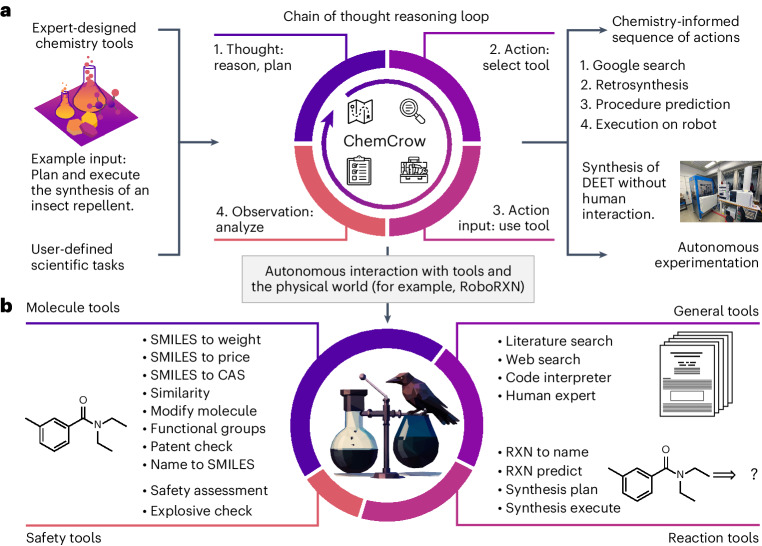
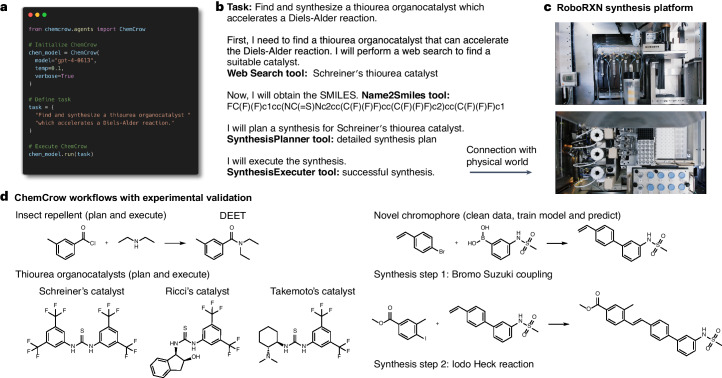
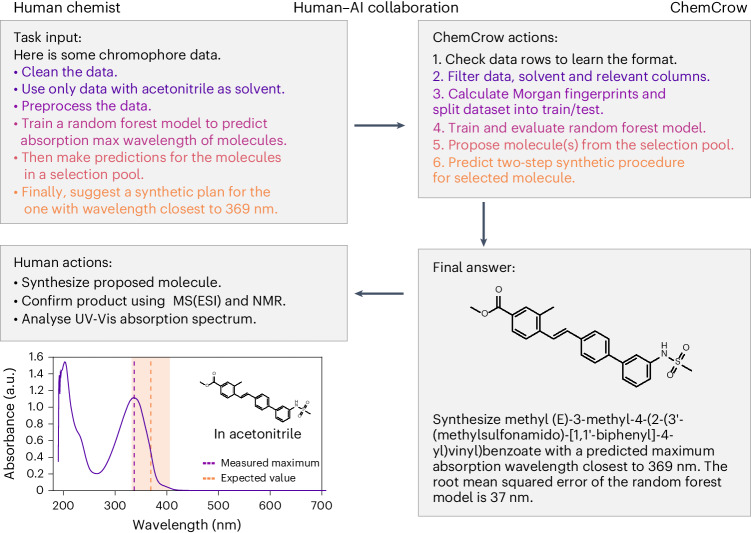
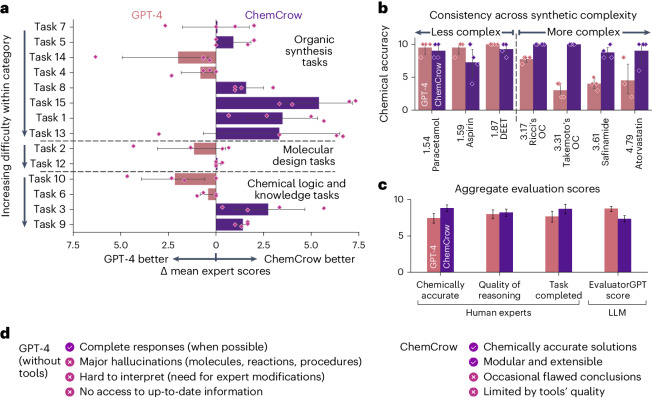
Large language models (LLMs) have shown strong performance in tasks across domains but struggle with chemistry-related problems. These models also lack access to external knowledge sources, limiting their usefulness in scientific applications. We introduce ChemCrow, an LLM chemistry agent designed to accomplish tasks across organic synthesis, drug discovery and materials design. By integrating 18 expert-designed tools and using GPT-4 as the LLM, ChemCrow augments the LLM performance in chemistry, and new capabilities emerge. Our agent autonomously planned and executed the syntheses of an insect repellent and three organocatalysts and guided the discovery of a novel chromophore. Our evaluation, including both LLM and expert assessments, demonstrates ChemCrow’s effectiveness in automating a diverse set of chemical tasks. Our work not only aids expert chemists and lowers barriers for non-experts but also fosters scientific advancement by bridging the gap between experimental and computational chemistry.
Overview
The claims and statistics of this paper haven’t been checked yet.
Free: it reads the open-access text and checks the first 5 claims that cite a source we can check. Create a free account to check every claim.
Integrity signals
Registry
Cites
Statistics
Figures
Verification
Claims the paper makes
The claims and statistics of this paper haven’t been checked yet.
Free: it reads the open-access text and checks the first 5 claims that cite a source we can check. Create a free account to check every claim.
Claims other papers make about this one
Each is checked against this paper’s own text: does it say what the citing paper says it does?
The source backs part of the claim, not all of it — or backs it for a different population, condition or comparison.
In the citing paper
“In parallel, chemistry-oriented reviews have shown that large language models can move beyond text generation toward tool use, retrieval, planning, code execution, and multi-agent coordination [5-10].”
From From Scientific Copilots to Tool-Grounded Autonomy: AI Agents in Simulation-Driven Materials Discovery (2026) · cites this paper as [7]
Experimental — accuracy not yet measuredThe source backs part of the claim, not all of it — or backs it for a different population, condition or comparison.
In the citing paper
“The broader literature on autonomous scientific systems has already argued for more rigorous evaluation protocols and transparent tool interfaces [3,5,7-12].”
From From Scientific Copilots to Tool-Grounded Autonomy: AI Agents in Simulation-Driven Materials Discovery (2026) · cites this paper as [7]
Experimental — accuracy not yet measuredThe source backs part of the claim, not all of it — or backs it for a different population, condition or comparison.
In the citing paper
“In scientific discovery, agents dynamically compose and execute hypothesis-testing pipelines spanning simulations, lab protocols, and data analysis [61, 62, 63, 64].”
From Code as Agent Harness (2026) · cites this paper as [61]
Experimental — accuracy not yet measuredThe source backs part of the claim, not all of it — or backs it for a different population, condition or comparison.
In the citing paper
“ChemCrow [61] similarly integrates RDKit, retrosynthesis engines, and reaction predictors so that an agent can 'execute' a candidate synthesis virtually before committing to a wet-lab run.”
From Code as Agent Harness (2026) · cites this paper as [61]
Experimental — accuracy not yet measuredThe source backs part of the claim, not all of it — or backs it for a different population, condition or comparison.
In the citing paper
“In chemistry, language-model tools, yield predictors, Bayesian optimization, and robotic laboratories provide complementary components for selecting and testing reactions [28, 42-46].”
From RSI-Anything: Unlocking Recursive Self-Improvement with World Models (2026) · cites this paper as [43]
Experimental — accuracy not yet measured
5 more claims about this paper
Create a free account to see every claim other papers make about this one.
Self-check
Percentages, sums and reported differences re-computed from the paper’s own numbers.
The self-check needs the paper’s full text.
Citations
Cites
Vaswani, A., Shazeer, N., Parmar, N., Uszkoreit, J., Jones, L., Gomez, A. N., Kaiser, L., & Polosukhin, I. (2017) · arXiv · doi:10.48550/arxiv.1706.03762 · Cited by 120,404 · cited 1×
“These specialized tools provide exact answers, thereby compensating for the inherent deficiencies of LLMs in specific domains and enhancing their overall performance and applicability.”
BackgroundLanguage Models are Few-Shot Learners
Brown, T. B., Mann, B., Ryder, N., Subbiah, M., Kaplan, J., Dhariwal, P., Neelakantan, A., Shyam, P., Sastry, G., Askell, A., et al. (2020) · arXiv · doi:10.48550/arxiv.2005.14165 · Cited by 23,372 · cited 1×
“…as a field, has been impacted through expert-designed artificial intelligence (AI) systems that tackle specific problems, such as reaction prediction 16–20 , retrosynthesis planning 21–27 , molecular property prediction 28–32 , de-novo molecular generation 33,34 , materials design 35,36 and,…”
BackgroundExtended-Connectivity Fingerprints
Rogers, D., & Hahn, M. (2010) · Journal of Chemical Information and Modeling · doi:10.1021/ci100050t · Cited by 7,524 · cited 1×
“Similarity The primary function of this tool is to evaluate the similarity between two molecules, utilizing the Tanimoto similarity measure 90 based on the ECFP2 molecular fingerprints 91 of the input molecules.”
MethodThe National Center for Biotechnology Information
Benson, D., Boguski, M., Lipman, D. J., & Ostell, J. (1990) · Genomics · doi:10.1016/0888-7543(90)90583-g · Cited by 5,126
LLaMA: Open and Efficient Foundation Language Models
Touvron, H., Lavril, T., Izacard, G., Martinet, X., Lachaux, M.-A., Lacroix, T., Rozière, B., Goyal, N., Hambro, E., Azhar, F., et al. (2023) · arXiv · doi:10.48550/arxiv.2302.13971 · Cited by 4,602 · cited 1×
“…is the lack of reproducibility of individual results under the current API-based approach to LLMs, as closed-source models provide limited control, see Appendix E. Recent open-source models 76–78 offer a potential solution to this issue, albeit with a possible trade-off in reasoning power.”
BackgroundChain-Of-Thought Prompting Elicits Reasoning in Large Language Models
Wei, J., Wang, X., Schuurmans, D., Bosma, M., Ichter, B., Xia, F., Chi, E., Le, Q. V., & Zhou, D. (2022) · Advances in Neural Information Processing Systems 35 · doi:10.52202/068431-1800 · Cited by 4,505
Chain-of-Thought Prompting Elicits Reasoning in Large Language Models
Wei, J., Wang, X., Schuurmans, D., Bosma, M., Ichter, B., Xia, F., Chi, E., Le, Q., & Zhou, D. (2022) · arXiv · doi:10.48550/arxiv.2201.11903 · Cited by 4,263 · cited 1×
“The tools used can be classified into general tools, molecular tools, and chemical reaction tools.”
MethodBillion-scale similarity search with GPUs
Johnson, J., Douze, M., & Jegou, H. (2021) · IEEE Transactions on Big Data · doi:10.1109/tbdata.2019.2921572 · Cited by 4,228
Training language models to follow instructions with human feedback
Ouyang, L., Wu, J., Jiang, X., Almeida, D., Wainwright, C. L., Mishkin, P., Zhang, C., Agarwal, S., Slama, K., Ray, A., et al. (2022) · arXiv · doi:10.48550/arxiv.2203.02155 · Cited by 4,208 · cited 2×
“5 13 cannot consistently and accurately multiply 12345*98765 or convert IUPAC names into the corresponding molecular graph 14 .”
BackgroundBillion-scale similarity search with GPUs
Johnson, J., Douze, M., & Jégou, H. (2017) · arXiv · doi:10.48550/arxiv.1702.08734 · Cited by 4,140 · cited 1×
“The CAS number serves as a precise and universally recognized chemical identifier, enabling researchers to access relevant data and resources with ease, and ensuring that they obtain accurate and consistent information about the target molecule 89 .”
Background
Research works printed but not linked: 4
- Devlin, J., Chang, M.-W., Lee, K. & Toutanova, K. Bert: pre-training of deep bidirectional transformers for language understanding. In Proc. Conference of the North American Chapter of the Association for Computational Linguistics: Human Language Technologies (eds Burstein, J. et al.) 4171–4186 (Association for Computational Linguistics, 2019).
- Li, R. et al. Starcoder: may the source be with you! Trans. Mach. Learn. Res. https://openreview.net/pdf?id=KoFOg41haE (2023).
- Zelikman E Wu Y Mu J Goodman N Star: bootstrapping reasoning with reasoning Adv. Neural Inf. Process. Syst. 2022 35 15476 15488
- Lowe, D. M. Extraction of Chemical Structures and Reactions from the Literature. PhD thesis, Univ. of Cambridge (2012).
Cited by
Items 601–700 of 1,026
Jeong, S., Choi, Y. H., Kim, J. W., & Jang, B. (2026) · IEEE Access · doi:10.1109/access.2026.3716053 · Cited by 11
Reaction Miner: An Integrated System for Chemical Reaction Extraction from Textual Data
Ming, Z., Ouyang, S., Jiao, Y., Kargupta, P., Luo, L., Shen, Y., Zhou, B., Zhong, X., Liu, X., Li, H., et al. (2023) · Conference on Empirical Methods in Natural Language Processing: System Demonstrations (EMNLP) · doi:10.18653/v1/2023.emnlp-demo.36 · Cited by 17
Safeguarding Mail-Order DNA Synthesis in the Age of Artificial Intelligence
Batalis, S., Schuerger, C., Grönvall, G. K., & Walsh, M. (2023) · Applied Biosafety · doi:10.1089/apb.2023.0020 · Cited by 11
Perspective on AI for accelerated materials design at the AI4Mat-2023 workshop at NeurIPS 2023
Miret, S., Krishnan, N. M. A., Sánchez-Lengeling, B., Skreta, M., Venugopal, V., & Wei, J. N. (2024) · Digital Discovery · doi:10.1039/d4dd90010c · Cited by 10
Instruction multi-constraint molecular generation using a teacher-student large language model
Zhou, P., Wang, J., Li, C., Wang, Z., Liu, Y., Sun, S., Lin, J., Wei, L., Lai, H., Lai, H., et al. (2025) · BMC Biology · doi:10.1186/s12915-025-02200-3 · Cited by 10
Censoring chemical data to mitigate dual use risk
Campbell, Q., Herington, J., & White, A. D. (2026) · Digital Discovery · doi:10.1039/d5dd00512d · Cited by 10
Self-citationBoosting AI with neuromorphic computing
(2025) · Nature Computational Science · doi:10.1038/s43588-025-00770-4 · Cited by 15
WisPaper: Your AI Scholar Search EnginePreprint
Ju, L., Zhao, J., Chai, M., Shen, Z., Wang, X., Geng, Y., Ma, C., Peng, H., Li, G., Li, T., et al. (2025) · arXiv (Cornell University) · doi:10.48550/arxiv.2512.06879 · Cited by 11
“Specialized systems like ChemCrow [5] and Coscientist [7] automate chemistry experimentation, while virtual laboratory frameworks [17] assist in wet-lab design.”
Structured Chemistry Reasoning with Large Language Models
Ouyang, S., Zhang, Z., Yan, B., Liu, X., Choi, Y., Han, J., & Qin, L. (2023) · arXiv · doi:10.48550/arxiv.2311.09656 · Cited by 9
“Specifically, ChemCrow (Bran et al., 2023) is a general model that integrates multiple existing tools with LLMs to solve various down-stream tasks.”
MethodBuilding Multi-Agent Copilot towards Autonomous Agricultural Data Management and Analysis
Pan, Y., Sun, J., Yu, H., Luck, J. D., Bai, G., Chamara, N., Ge, Y., & Awada, T. N. (2024) · IEEE International Conference on Big Data (BigData) · doi:10.1109/bigdata62323.2024.10826038 · Cited by 14
Application of LLMs/Transformer-Based Models for Metabolite Annotation in Metabolomics
Liu, Y., Zhang, F., Ge, Y., Liu, Q., He, S., & Shen, X. (2025) · Health and Metabolism · doi:10.53941/hm.2025.100014 · Cited by 10
SpeLL: An Agent for Natural Language-Driven Intelligent Spectral Modeling
Fu, J., Liu, X., Cai, W., Fu, H., & Shao, X. (2025) · Journal of Chemical Information and Modeling · doi:10.1021/acs.jcim.5c01236 · Cited by 10
Accelerating primer design for amplicon sequencing using large language model-powered agents
Wang, Y., Hou, Y., Yang, L., Li, S., Tang, W., Tang, H. R., He, Q., Lin, S., Zhang, Y., Li, X., et al. (2025) · Nature Biomedical Engineering · doi:10.1038/s41551-025-01455-z · Cited by 17
Foundation models for exploration geophysics
Liu, Q., Chen, Z., & Ma, J. (2025) · Geophysics · doi:10.1190/geo2024-0916.1 · Cited by 11
Predictive design of crystallographic chiral separation
Elijošius, R., King‐Smith, E., Faber, F. A., Bernier, L., Berritt, S., Farrell, W. P., Hou, X., Klug-McLeod, J. L., Mustakis, J. G., Sach, N. W., et al. (2025) · Nature Communications · doi:10.1038/s41467-025-62825-4 · Cited by 10
Autonomous Droplet Microfluidic Design Framework with Large Language Models
Nguyen, D.-N., Tong, R. K., & Dinh, N. (2025) · ACS Omega · doi:10.1021/acsomega.5c06253 · Cited by 9
Multi agent large language models for biomedical hypothesis generation in drug combination discovery
Xu, Q., Soto, C. A., Shahnawaz, M., Liu, X., Jiang, X., & Kim, Y. (2025) · iScience · doi:10.1016/j.isci.2025.113984 · Cited by 14
Artificial intelligence‐enabled digital biomedical engineering
Song, P., Tang, X., Lv, X., Reis, R. L., Chen, X., Bai, L., & Su, J. (2025) · BMEMat · doi:10.1002/bmm2.70049 · Cited by 10
AGAPI-Agents: An Open-Access Agentic AI Platform for Accelerated Materials Design on AtomGPT.org
Lee, J., Ely, J., Zhang, K., Ajith, A., Campbell, C. S., & Choudhary, K. K. (2026) · The Journal of Physical Chemistry Letters · doi:10.1021/acs.jpclett.6c00837 · Cited by 14
Perez, R. M., Shimogawa, M., Chang, Y., Li, X., Phan, H. A. T., Marmorstein, J. G., Yanagawa, E. S. K., & Petersson, E. J. (2026) · Computers and Education Artificial Intelligence · doi:10.1016/j.caeai.2026.100546 · Cited by 11
WeMol: A Cloud-Based and Zero-Code Platform for AI-Driven Molecular Design and Simulation
Liu, H., Yan, X., Fang, H., Ge, H., & Hou, X. (2026) · Journal of Chemical Information and Modeling · doi:10.1021/acs.jcim.6c00014 · Cited by 9
Self-driving laboratories in Korea: a new era of autonomous discovery
Hwang, J., Kim, S., Lim, S., Kim, J., Lee, S., Min, S., Song, J., Lim, J., Hong, S., Hwang, J.-H., et al. (2026) · Digital Discovery · doi:10.1039/d6dd00024j · Cited by 9
TabPFN Opens New Avenues for Small-Data Tabular Learning in Drug Discovery
Chen, W., Tian, Y., Liao, N., Deng, Y., Jiang, D., & Cao, D. (2026) · Journal of Chemical Information and Modeling · doi:10.1021/acs.jcim.5c02823 · Cited by 12
MultiPress: A Multi-Agent Framework for Interpretable Multimodal News Classification
Luo, T., Li, H., Fu, R., Jiang, X., Ding, H., Zhang, Y., Zhao, Z., Fong, S., Jin, G., & Ni, J. (2026) · International Joint Conference on Neural Networks (IJCNN) · doi:10.1109/ijcnn69854.2026.11728753 · Cited by 11
Munguia‐Galeano, F., Zhou, Z., Veeramani, S., Fakhruldeen, H., Longley, L., Clowes, R., & Cooper, A. I. (2026) · Digital Discovery · doi:10.1039/d6dd00062b · Cited by 11
Learning conditional policies for crystal design using offline reinforcement learning
Govindarajan, P., Miret, S., Rector-Brooks, J., Phielipp, M., Rajendran, J., & Chandar, S. (2024) · Digital Discovery · doi:10.1039/d4dd00024b · Cited by 15
“Recently, AI has shown favorable results in expediting the discovery of new chemical structural entities (e.g., small molecules, materials, and polymers) [15, 44, 2, 36].”
BackgroundZheng, Z., Florit, F., Jin, B., Wu, H., Li, S., Nandiwale, K. Y., Salazar, C. A., Mustakis, J. G., Green, W. H., & Jensen, K. F. (2024) · Angewandte Chemie · doi:10.1002/ange.202418074 · Cited by 9
Navigating chemical-linguistic sharing space with heterogeneous molecular encoding
Lv, L., Li, H., Wang, Y., Chen, Z., Yan, Z., Lin, Z., Liu, Y., Li, Y., & Tian, Y. (2026) · Nature Communications · doi:10.1038/s41467-026-74666-w · Cited by 11
Large language models for Alzheimer's disease drug discovery
Alkam, T., Tarshizi, E., & Benschoten, A. H. V. (2025) · Journal of Alzheimer s Disease · doi:10.1177/13872877251346890 · Cited by 11
“28 MolBERT.”
A multi-agent-driven robotic AI chemist enabling autonomous chemical research on demandPreprint
Song, T., Luo, M., Chen, L., Huang, Y. H., Zhu, Q. J., Liu, D., Zhang, B., Zou, G., Zhang, F., Shang, W., et al. (2024) · ChemRxiv · doi:10.26434/chemrxiv-2024-w953h-v2 · Cited by 10
Turón, G., Arora, D., & Duran‐Frigola, M. (2024) · ACS Infectious Diseases · doi:10.1021/acsinfecdis.4c00585 · Cited by 11
What is in your LLM-based framework?
(2024) · Nature Machine Intelligence · doi:10.1038/s42256-024-00896-6 · Cited by 9
Adibi, A., Cao, X., Ji, Z., Kaur, J. N., Chen, W., Healey, E., Nuwagira, B., Ye, W., Woollard, G., Xu, M., et al. (2025) · arXiv (Cornell University) · doi:10.48550/arxiv.2502.06693 · Cited by 11
“Generative AI and foundation models at the molecular and tissue scales are openly available (Takeda et al., 2023; Ingraham et al., 2023; Wohlwend et al., 2024; Chen et al., 2024; Hayes et al., 2024; Lu et al., 2024; M. Bran et al., 2024; Batatia et al., 2024).”
AutoMat: Enabling Automated Crystal Structure Reconstruction from Microscopy via Agentic Tool UsePreprint
Yang, Y., Tang, Y., Chen, Y., Chen, X., Qiu, J., Xiong, H., Yin, H., Luo, Z., Zhang, Y., Tao, S., et al. (2025) · arXiv (Cornell University) · doi:10.48550/arxiv.2505.12650 · Cited by 11
“…, Retrieve , Refine ); Verification V ( s ) : a physics-based critic (e.g., consistency checks via relaxation/simulation) that emits a failure signal when the current hypothesis is physically invalid; Policy π ( a | s ) : a controller that triggers rollback-and-retry upon failure, effectively…”
Gulati, A., Miranda, B., Chen, E., Xia, E., Fronsdal, K., Dumont, B., Obbad, E., & Koyejo, S. (2025) · arXiv (Cornell University) · doi:10.48550/arxiv.2508.08292 · Cited by 18
IR-Agent: Expert-Inspired LLM Agents for Structure Elucidation from Infrared Spectra
Noh, H., Lee, N., Na, G. S., Kim, K., & Park, C. (2026) · International Conference on Learning Representations · doi:10.48550/arxiv.2508.16112 · Cited by 9
Li, H., Cao, H., Peng, S., Liu, Z., Feng, B., Wang, Y., Yan, Z., Lv, L., Zhang, Y., Tian, Y., et al. (2026) · Research Square · doi:10.48550/arxiv.2601.17687 · Cited by 12
“Alternatively, Multi-Agent Systems (MAS) have attempted to mitigate this by offloading tasks to external tools via commercial LLM APIs 46,47,51,52 (e.g., GPT-4).”
AUTONUMERICS: AN AUTONOMOUS, PDE- AGNOSTIC MULTI-AGENT PIPELINE FOR SCIENTIFIC COMPUTINGPreprint
Du, J., Sun, Y., & Yang, H. (2026) · arXiv (Cornell University) · doi:10.13140/rg.2.2.10945.21608 · Cited by 9
Multi-agentic AI framework for end-to-end atomistic simulations
Vriza, A., Kornu, U., Koneru, A., Chan, H., & Sankaranarayanan, S. K. R. S. (2026) · Digital Discovery · doi:10.1039/d5dd00435g · Cited by 8
Shopfloor layout generation method based on large language models
Hu, Y., Sun, Y., Wen, X., Wang, S., & Bao, J. (2025) · International Journal of Computer Integrated Manufacturing · doi:10.1080/0951192x.2025.2482258 · Cited by 12
Du, W., & Yang, S. (2025) · Frontiers of Chemical Science and Engineering · doi:10.1007/s11705-025-2587-5 · Cited by 12
Artificial intelligence-driven autonomous laboratory for accelerating chemical discovery
Chen, J., & Xu, Q. (2025) · Chemical Synthesis · doi:10.20517/cs.2025.66 · Cited by 8
Accelerating compound synthesis in drug discovery: the role of digitalisation and automation
Nippa, D. F., Boddy, A. J., Atz, K., Grether, U., Binch, H., & Martin, R. E. (2025) · RSC Medicinal Chemistry · doi:10.1039/d5md00672d · Cited by 14
Xu, Y., Ma, Y., Xu, W., Yang, Z., & Ting, K. M. (2025) · Communications Chemistry · doi:10.1038/s42004-025-01708-7 · Cited by 12
Creation, evaluation and self-validation of simulation models with large language models
Möltner, T., Manzl, P., Pieber, M., & Gerstmayr, J. (2025) · Neurocomputing · doi:10.1016/j.neucom.2025.132030 · Cited by 12
Egersdoerfer, C., Carns, P., Snyder, S., Ross, R. B., & Dai, D. (2025) · International Conference for High Performance Computing, Networking, Storage and Analysis (SC) · doi:10.1145/3712285.3759887 · Cited by 8
The agentic age of predictive chemical kinetics
Dana, A. G. (2025) · Chemical Science · doi:10.1039/d5sc07692g · Cited by 9
Djidrovski, I., Pieters, R. H. H., Legler, J., & Teunis, M. (2025) · Computational Toxicology · doi:10.1016/j.comtox.2025.100395 · Cited by 9
AI-driven quantitative review of mobility–stability trade-off in oxide semiconductors
Hong, J. H., Lee, C. H., Kim, H. W., Jeon, D. W., Kang, J. H., Kim, Y., Bae, J., Heo, S., Lee, S. H., Na, J., et al. (2026) · Nano Convergence · doi:10.1186/s40580-026-00535-3 · Cited by 8
“…for metal–organic framework studies [35], and ChemCrow for broader chemical analyses further underscore the feasibility of automatically retrieving complex experimental parameters from scientific articles [36], thus highlighting new opportunities for data-driven approaches in materials science.”
Lee, J., Noh, J., Lee, H., Lee, Y., Im, J., & Seo, J. (2026) · InfoMat · doi:10.1002/inf2.70124 · Cited by 8
Reimagining pharmacology education
Guilding, C., Kelly-Laubscher, R. F., Cunningham, M., Dilles, T., Kennedy, D., Brinkman, D. J., Eid, A. H., Quesnelle, K. M., Engels, F., Maxwell, S., et al. (2026) · Pharmacological Reviews · doi:10.1016/j.pharmr.2026.100126 · Cited by 10
Multi-agent artificial intelligence designs novel catalysts for ultrafast water purification
Pan, Y., Guo, J., Huang, Y., Zhou, J., Niu, S., Yin, R., Ding, L., Xu, N., Fan, Y., Ren, X., et al. (2026) · Nature Water · doi:10.1038/s44221-026-00634-9 · Cited by 12
“ChemCrow, another LLM-driven chemistry agent, guided the discovery of a new chromophore for organic synthesis by integrating 18 expert-designed tools 18 .”
GraphRAG for engineering diagrams: ChatP & ID enables LLM interaction with P& IDs
Alimin, A. A., & Schweidtmann, A. M. (2026) · AIChE Journal · doi:10.1002/aic.70540 · Cited by 10
Ozawa, K., Suzuki, T., Tonogai, S., & Itakura, T. (2024) · Science and Technology of Advanced Materials Methods · doi:10.1080/27660400.2024.2406219 · Cited by 12
The rise of agents: Computational chemistry is ready for (R)evolution
Aspuru‐Guzik, A., & Bernales, V. (2025) · Polyhedron · doi:10.1016/j.poly.2025.117707 · Cited by 10
Kumar, R., Joshi, A., Khan, S. A., & Misra, S. (2024) · Digital Discovery · doi:10.1039/d4dd00051j · Cited by 11
Enhancing Large Language Models Through External Domain Knowledge
Welz, L., & Lanquillon, C. (2024) · Lecture notes in computer science · doi:10.1007/978-3-031-60615-1_9 · Cited by 18
LLM4DESIGN: An Automated Multi-Modal System for Architectural and Environmental DesignPreprint
Chen, R., Yao, X., & Jiang, X. (2024) · arXiv (Cornell University) · doi:10.48550/arxiv.2407.12025 · Cited by 8
On Path to Multimodal Historical Reasoning: HistBench and HistAgentPreprint
Qiu, J., Xiao, F., Wang, Y., Mao, Y., Chen, Y., Juan, X., Zhang, S., Wang, S. R., Qi, X., Zhang, T., et al. (2025) · arXiv (Cornell University) · doi:10.48550/arxiv.2505.20246 · Cited by 10
Position: Intelligent Science Laboratory Requires the Integration of Cognitive and Embodied AIPreprint
Zhang, S., Yang, S., Xie, T., Xue, X., Hu, Z., Li, R., Qu, W., Yin, Z., Fu, T., Hu, D., et al. (2025) · arXiv (Cornell University) · doi:10.48550/arxiv.2506.19613 · Cited by 10
Self-citationLarge Language Models Transform Organic Synthesis From Reaction Prediction to AutomationPreprint
Kumar, K., Kumar, R., & Lagun, N. (2025) · arXiv (Cornell University) · doi:10.48550/arxiv.2508.05427 · Cited by 8
“Laboratory resources required”
InfluentialSu, G., Wang, H., Wang, J., Zhang, W., Zhang, Y., & Pei, J. (2025) · arXiv (Cornell University) · doi:10.48550/arxiv.2510.21131 · Cited by 9
Agentic AI and Machine Learning for Accelerated Materials Discovery and ApplicationsPreprint
Chen, J., Christakopoulos, P., Chen, K. D., Ivanov, I. N., & Advíncula, R. C. (2026) · arXiv (Cornell University) · doi:10.48550/arxiv.2601.09027 · Cited by 8
When Single Answer Is Not Enough: Rethinking Single-Step Retrosynthesis Benchmarks for LLMsPreprint
Zagribelnyy, B. A., Ilin, I. S., Kuznetsov, M., Bondarev, N., Reymond, M., Schutski, R., MacDougall, T., Shayakhmetov, R., Miftahutdinov, Z., Mizera, M., et al. (2026) · arXiv (Cornell University) · doi:10.48550/arxiv.2602.03554 · Cited by 12
“Recent work spans (i) generalist or science foundation models, including NatureLM (Xia et al., 2025), nach0 (Livne et al., 2024), and ChemDFM (Zhao et al., 2025b), can be adapted to retrosynthesis; (ii) data-augmentation strategies that expand reaction supervision, including template-/rule-driven large-scale generatio…”
Molecular Representations for Large Language ModelsPreprint
Runcie, N. T., Imrie, F., & Deane, C. M. (2026) · arXiv (Cornell University) · doi:10.48550/arxiv.2605.01822 · Cited by 8
“Large Language Models (LLMs) are being adopted for a growing range of scientific tasks (Alampara et al., 2026; Mitchener et al., 2025; Bran et al., 2024; Gottweis et al., 2025; Boiko et al., 2023).”
Agentic Bayesian Optimization through Surrogate-Augmented AutoresearchPreprint
Brunzema, P., Tiao, L. C., Le, N., Angeli, K. D., Xuan, Y., & Gligorijevic, D. (2026) · arXiv (Cornell University) · doi:10.48550/arxiv.2608.00316 · Cited by 8
Apodex 1.1: Scaling Agentic Intelligence for Complex WorkPreprint
An, B., An, B., Wang, B., Wang, B. L., Zhang, B., Feng, C., Wei, C., Xue, C., Zhang, C., Zhang, C., et al. (2026) · arXiv (Cornell University) · doi:10.48550/arxiv.2608.23283 · Cited by 8
ScienceIDE: Turning World's Scientific Codebase into Agent Learnable EnvironmentsPreprint
Geng, H.-J., Huang, Z.-S., Li, H.-Y., Li, W.-B., Wu, K., Zhou, Z.-H., Pang, Y., Liu, W.-H., Xu, Z.-G., Li, Z.-P., et al. (2026) · arXiv.org · doi:10.48550/arxiv.2609.19134 · Cited by 7
Gautam, S., Chandra, M., De, A., Chakravorti, T., Malik, G., & De Choudhury, M. (2025) · arXiv · doi:10.48550/arxiv.2508.06849 · Cited by 7
“…the potential to transform the field of healthcare through increasing diagnosis efficiency (dia 2025; Williams et al. 2024; Kern, Wu, and Chao 2024), newer scientific discoveries (Theodoris et al. 2023; M. Bran et al. 2024), and democratizing access to medical information (Clusmann et al. 2023).”
From AI for Science to Agentic Science: A Survey on Autonomous Scientific Discovery
Wei, J., Yang, Y., Zhang, X., Chen, Y., Zhuang, X., Gao, Z., Zhou, D., Wang, G., Gao, Z., Cao, J., et al. (2025) · arXiv · doi:10.48550/arxiv.2508.14111 · Cited by 7
Zeng, D., Xu, X., Zhu, T., Li, Y., & Li, Q. (2026) · Frontiers in Psychology · doi:10.3389/fpsyg.2026.1743722 · Cited by 7
Large Language Model for Automating the Analysis of Cryoprotectants
Ashikhmina, M. S., Zenkin, A. M., Ivanova, A. O., Pavlishina, I. R., Orlova, O. Y., Pantiukhin, I. S., & Скорб, Е. В. (2024) · Journal of Chemical Information and Modeling · doi:10.1021/acs.jcim.4c02049 · Cited by 7
Fu, L., Zhou, Q., Jin, M., & Wu, W. (2025) · Environmental chemistry and safety · doi:10.26599/ecs.2025.9600002 · Cited by 7
An LLM-Enabled Multi-Agent Autonomous Mechatronics Design Framework
Wang, Z., Lo, F. P.-W., Chen, Q., Zhang, Y., Chen, L., Chen, X., Yu, Z., Thompson, A. J., Yeatman, E. M., & Lo, B. P. L. (2025) · IEEE/CVF Conference on Computer Vision and Pattern Recognition Workshops (CVPRW) · doi:10.1109/cvprw67362.2025.00404 · Cited by 11
Robust out-of-distribution prediction of Buchwald–Hartwig reactions
Neves, P., Hao, B., Aikonen, S., Diccianni, J. B., Wegner, J. K., Schwaller, P., & Strambeanu, I. I. (2026) · Nature Computational Science · doi:10.1038/s43588-026-01017-6 · Cited by 7
“…still required to tackle these industry-wide challenges; potentially in the future the use of knowledgeable chemistry artificial intelligence agents 38,39 will make possible a harmonization of the free-text protocol and tabular data, while noise detection techniques will be able to remove the most…”
Self-citationUAV Accident Forensics via HFACS-LLM Reasoning: Low-Altitude Safety Insights
Yan, Y., Li, B., & Lodewijks, G. (2025) · Drones · doi:10.3390/drones9100704 · Cited by 11
“Designing modular pipelines that co-ordinate specialized components while preserving interpretability and reliability is therefore a central hurdle [18].”
A PINN-based transformer model for heat transfer prediction in freeze-drying process
Cheng, Y., Chen, H., Zhou, X., Ye, H., & Pan, T. (2025) · International Communications in Heat and Mass Transfer · doi:10.1016/j.icheatmasstransfer.2025.109985 · Cited by 8
An AI-native experimental laboratory for autonomous biomolecular operations
Wu, M., Wang, Z., Wang, J., Dong, Z., Yang, J., Li, Q., Huang, T., Zhang, C., Song, P., Zhao, L., et al. (2026) · Nature · doi:10.1038/s41586-026-11228-6 · Cited by 7
Li, C., Ran, N., & Liu, J. (2026) · Journal of Materials Informatics · doi:10.20517/jmi.2025.87 · Cited by 9
Chen, Y., Guo, X., & Xue, W. (2026) · Drug Discovery Today · doi:10.1016/j.drudis.2026.104634 · Cited by 8
EpidemIQs: Prompt-to-Paper LLM Agents for Epidemic Modeling and Analysis
Samaei, M. H., Sahneh, F. D., Cohnstaedt, L. W., & Scoglio, C. (2026) · IEEE Transactions on Artificial Intelligence · doi:10.1109/tai.2026.3666830 · Cited by 9
“Examples include agent laboratory [27], virtual lab [28], ChemCrow [29], ResearchAgent [30], and the AI scientist [31].”
Chen, W., Xu, H., & Cheng, D. (2026) · AI Agent · doi:10.20517/aiagent.2026.06 · Cited by 7
From Trace to Line: An Empirical Study of What Drives LLM-Based OSS Vulnerability Localization
Xi, H., Shao, M., Dolan-Gavitt, B., Shafique, M., & Karri, R. (2026) · IEEE Access · doi:10.1109/access.2026.3721377 · Cited by 7
Exploring transition metal complexes with large language models
Liu, Y., Toney, J., Cavanagh, J., Sun, K., Smith, A. S., Yuan, C.-Y., Michel, R. G. S., Graggs, P., Toste, F. D., Kulik, H. J., et al. (2026) · Chemical Science · doi:10.1039/d6sc00436a · Cited by 7
Closing the Execution Gap in Generative AI for Chemicals and Materials: Freeways or Safeguards
Subramanian, A., Gao, W., Barzilay, R., Grossman, J. C., Jaakkola, T., Jegelka, S., Li, M., Li, J., Matusik, W., Olivetti, E., et al. (2024) · An MIT Exploration of Generative AI · doi:10.21428/e4baedd9.92e511e3 · Cited by 9
High Performance Binding Affinity Prediction with a Transformer-Based Surrogate Model
Vasan, A. K., Gökdemir, O., Brace, A., Ramanathan, A., Brettin, T. S., Stevens, R. L., & Vishwanath, V. (2024) · IEEE International Symposium on Parallel & Distributed Processing, Workshops and Phd Forum · doi:10.1109/ipdpsw63119.2024.00114 · Cited by 9
OperateLLM: Integrating Robot Operating System (ROS) Tools in Large Language Models
Raja, A. S., & Bhethanabotla, A. (2024) · IEEE International Conference on Communication Engineering and Emerging Technologies (ICoCET) · doi:10.1109/icocet63343.2024.10730448 · Cited by 10
“This has been done in the past, notably in the field of math with the Wolfram GPT plugin [6], using the specialized math tool WolframAlpha in traditional ChatGPT, and with ChemCrow [7], a tool that allows automating of many chemistry tasks.”
MethodAI in materials science: Charting the course to Nobel-worthy breakthroughs
Chen, C. (2024) · Matter · doi:10.1016/j.matt.2024.11.012 · Cited by 7
LLM-Driven Synthesis Planning for Quantum Dot Materials Development
Choi, S. E., Jang, M., Yoon, S., Yoo, S., Ahn, J., Kim, M., Kim, H.-G., Jung, Y., Park, S. S., Kim, Y. C., et al. (2025) · Journal of Chemical Information and Modeling · doi:10.1021/acs.jcim.4c01529 · Cited by 12
Lu, X., Zhao, Y. C., Zhang, Y., & Zong, C. (2025) · Studies in Informatics and Control · doi:10.24846/v34i1y202501 · Cited by 14
The Evolving Role of Programming and LLMs in the Development of Self-Driving Laboratories
Kitchin, J. (2025) · APL Machine Learning · doi:10.1063/5.0266757 · Cited by 9
A conceptual framework for human–AI collaborative genome annotation
Li, X., Whan, A., McNeil, M., Starns, D., Irons, J. L., Andrew, S. C., & Suchecki, R. (2025) · Briefings in Bioinformatics · doi:10.1093/bib/bbaf377 · Cited by 8
“There is a growing body of research on how humans and AI collaborate to drive advancements in fields such as medicine [15–17] and chemistry [18], particularly through the adoption of large language model (LLMs) (see LLM in the Glossary section).”
Data‐Driven Polyoxometalate Chemistry
Kondinski, A., Gumerova, N. I., Rompel, A., Falcaro, P., & Schreck, T. (2025) · Chemistry - A European Journal · doi:10.1002/chem.202501528 · Cited by 7
Application scenario-oriented molecule generation platform developed for drug discovery
Zheng, L., Shi, F., Peng, C., Xu, M., Fan, F., Li, Y., Zhang, L., Du, J., Wang, Z., Lin, Z., et al. (2024) · Methods · doi:10.1016/j.ymeth.2023.12.009 · Cited by 8
Large language models for biomolecular analysis: From methods to applications
Feng, R., Zhang, C., & Zhang, Y. (2024) · TrAC Trends in Analytical Chemistry · doi:10.1016/j.trac.2024.117540 · Cited by 7
Progress and prospects of quantum emission from perovskites
Chatterjee, A., Brasel, S., Bruncz, A., Wu, W., & Huang, S. (2024) · MRS Communications · doi:10.1557/s43579-024-00597-6 · Cited by 7
ChemLit-QA: a human evaluated dataset for chemistry RAG tasks
Wellawatte, G. P., Guo, H., Lederbauer, M., Borisova, A., Hart, M., Brucka, M., & Schwaller, P. (2025) · Machine Learning Science and Technology · doi:10.1088/2632-2153/adc2d6 · Cited by 18
“While LLMs perform well in general knowledge domains, they often fall short in specialized, knowledge-intensive scientific fields such as chemistry [5, 6].”
Self-citationArtificial intelligence in cardiology: Exciting but handle with caution
Dunn, P. J., & Cianflone, D. (2023) · International Journal of Cardiology · doi:10.1016/j.ijcard.2023.06.008 · Cited by 7
This GPT-powered robot chemist designs reactions and makes drugs — on its own
Sanderson, K. (2023) · Nature · doi:10.1038/d41586-023-04073-4 · Cited by 7
ByteComposer: a Human-like Melody Composition Method based on Language Model AgentPreprint
Liang, X., Du, X., Lin, J., Zou, P., Wan, Y., & Zhu, B. (2024) · arXiv (Cornell University) · doi:10.48550/arxiv.2402.17785 · Cited by 13
“In this paradigm, LMs can access knowledge that is not necessarily stored in its weights, such as a piece of factual knowledge for AI4Science (Bran et al., 2023).”
Background
Metadata
- Authors
- M. Bran, A., Cox, S., Schilter, O., Baldassari, C., White, A. D., & Schwaller, P.
- Affiliations
- Future House, Inc. (US)
- IBM Research - Zurich (CH)
- NCCR Catalysis (CH)
- Corresponding author
- White, Andrew D.
- Schwaller, Philippe
- Venue
- Nature Machine Intelligence
- Published
- 2024-05-08
- Volume
- 6
- Issue
- 5
- Pages
- 525-535
- ISSN
- 2522-5839 (ISSN-L)
- PMC
- PMC11116106
- OpenAlex
- W4396723768
- Cited by
- 794
- References
- 76
- Citations by year
- 2026: 395 · 2025: 305 · 2024: 83
- FWCI
- 76.42
- Type
- journal article
- Language
- en
- Open access
- hybrid
- doi.org
- Licence
- cc-by
- creativecommons.org/licenses/by/4.0 (tdm)
- creativecommons.org/licenses/by/4.0 (vor)
- Locations
- Nature Machine Intelligence (publishedVersion, cc-by)
- PubMed Central (publishedVersion, cc-by-nd)
- PubMed (publishedVersion)
- Infoscience (Ecole Polytechnique Fédérale de Lausanne) (submittedVersion, cc-by-nc-nd)
- Funders
- Schweizerischer Nationalfonds zur Förderung der Wissenschaftlichen Forschung (180544)
- National Science Foundation (1751471)
- Topics
- Physical Sciences › Materials Science › Materials Chemistry › Machine Learning in Materials Science
- Life Sciences › Pharmacology, Toxicology and Pharmaceutics › Drug Discovery › Computational Drug Discovery Methods
- Physical Sciences › Computer Science › Artificial Intelligence › Artificial Intelligence Applications
- Keywords
- large language models, GPT-4, organic synthesis planning, drug discovery, materials design, organocatalysts
About these checks
Registry, retraction, Cites and statistics results are computed, not judged, with one exception: a printed reference that no index lists is read once by a model before it counts as a citation error. Claims are extracted by a model and kept only when their quote appears verbatim in the text; each cited source is then checked, with a model’s help, for whether it says what the claim relies on. Those verdicts can be wrong — read the claim’s quote and the cited source before relying on one.
Statistics and arithmetic are recomputed, not judged.
Confidence bands are shown only for fields calibrated on our annotated test set. None is calibrated yet, so no band is shown.
What counts as a claim ›How we measure confidence ›How we check this ›
Are you an author, or do you see a problem with this page? Request a review
Data sources
Bibliographic data: Semantic Scholar, OpenAlex, Crossref.
Contains information from the Semantic Scholar Academic Graph Datasets, made available under the ODC Attribution License (ODC-BY 1.0).
Semantic Scholar’s data is described in: Kinney, R., et al. (2023). The Semantic Scholar Open Data Platform. arXiv:2301.10140.
