

Augmenting large language models with chemistry tools
Open accessThe DOI matches its Crossref record; 94 of the 94 references it cites were found in a registry or an index.
Abstract
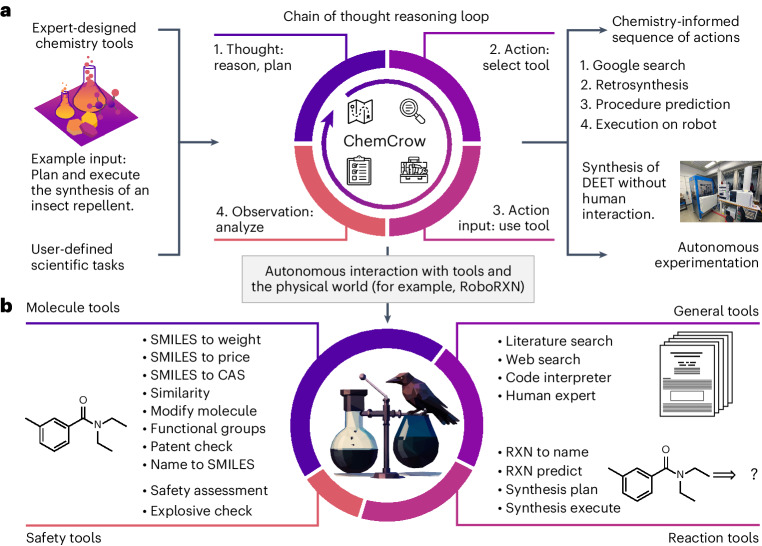
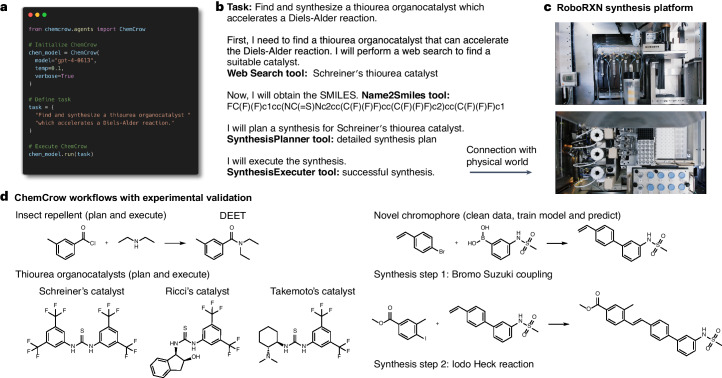
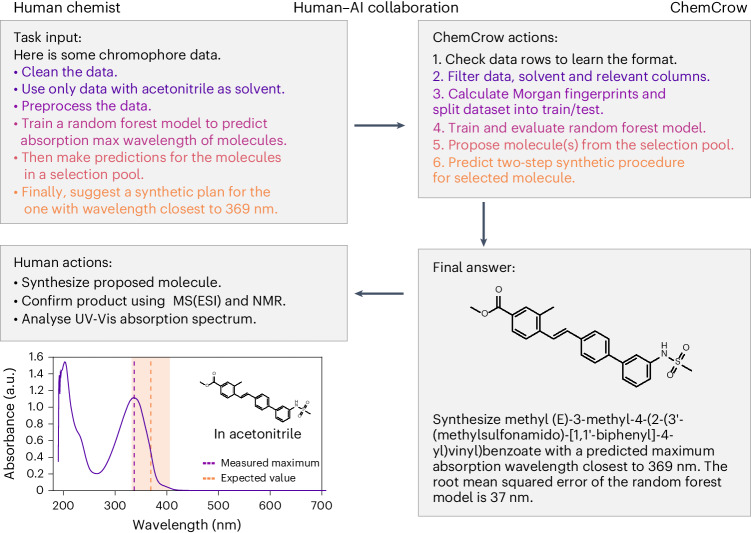
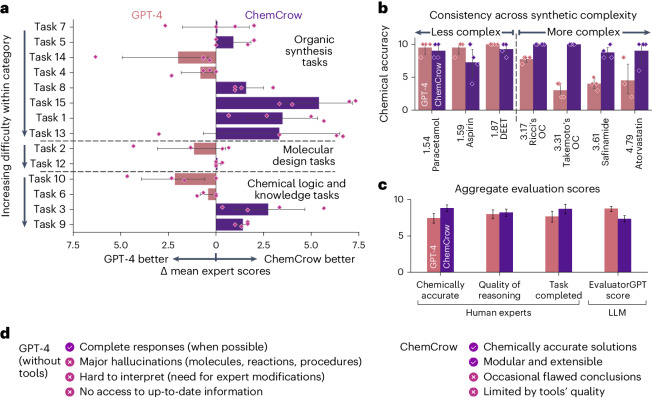
Large language models (LLMs) have shown strong performance in tasks across domains but struggle with chemistry-related problems. These models also lack access to external knowledge sources, limiting their usefulness in scientific applications. We introduce ChemCrow, an LLM chemistry agent designed to accomplish tasks across organic synthesis, drug discovery and materials design. By integrating 18 expert-designed tools and using GPT-4 as the LLM, ChemCrow augments the LLM performance in chemistry, and new capabilities emerge. Our agent autonomously planned and executed the syntheses of an insect repellent and three organocatalysts and guided the discovery of a novel chromophore. Our evaluation, including both LLM and expert assessments, demonstrates ChemCrow’s effectiveness in automating a diverse set of chemical tasks. Our work not only aids expert chemists and lowers barriers for non-experts but also fosters scientific advancement by bridging the gap between experimental and computational chemistry.
Overview
The claims and statistics of this paper haven’t been checked yet.
Free: it reads the open-access text and checks the first 5 claims that cite a source we can check. Create a free account to check every claim.
Integrity signals
Registry
Cites
Statistics
Figures
Verification
Claims the paper makes
The claims and statistics of this paper haven’t been checked yet.
Free: it reads the open-access text and checks the first 5 claims that cite a source we can check. Create a free account to check every claim.
Claims other papers make about this one
Each is checked against this paper’s own text: does it say what the citing paper says it does?
The source backs part of the claim, not all of it — or backs it for a different population, condition or comparison.
In the citing paper
“In parallel, chemistry-oriented reviews have shown that large language models can move beyond text generation toward tool use, retrieval, planning, code execution, and multi-agent coordination [5-10].”
From From Scientific Copilots to Tool-Grounded Autonomy: AI Agents in Simulation-Driven Materials Discovery (2026) · cites this paper as [7]
Experimental — accuracy not yet measuredThe source backs part of the claim, not all of it — or backs it for a different population, condition or comparison.
In the citing paper
“The broader literature on autonomous scientific systems has already argued for more rigorous evaluation protocols and transparent tool interfaces [3,5,7-12].”
From From Scientific Copilots to Tool-Grounded Autonomy: AI Agents in Simulation-Driven Materials Discovery (2026) · cites this paper as [7]
Experimental — accuracy not yet measuredThe source backs part of the claim, not all of it — or backs it for a different population, condition or comparison.
In the citing paper
“In scientific discovery, agents dynamically compose and execute hypothesis-testing pipelines spanning simulations, lab protocols, and data analysis [61, 62, 63, 64].”
From Code as Agent Harness (2026) · cites this paper as [61]
Experimental — accuracy not yet measuredThe source backs part of the claim, not all of it — or backs it for a different population, condition or comparison.
In the citing paper
“ChemCrow [61] similarly integrates RDKit, retrosynthesis engines, and reaction predictors so that an agent can 'execute' a candidate synthesis virtually before committing to a wet-lab run.”
From Code as Agent Harness (2026) · cites this paper as [61]
Experimental — accuracy not yet measuredThe source backs part of the claim, not all of it — or backs it for a different population, condition or comparison.
In the citing paper
“In chemistry, language-model tools, yield predictors, Bayesian optimization, and robotic laboratories provide complementary components for selecting and testing reactions [28, 42-46].”
From RSI-Anything: Unlocking Recursive Self-Improvement with World Models (2026) · cites this paper as [43]
Experimental — accuracy not yet measured
5 more claims about this paper
Create a free account to see every claim other papers make about this one.
Self-check
Percentages, sums and reported differences re-computed from the paper’s own numbers.
The self-check needs the paper’s full text.
Citations
Cites
Vaswani, A., Shazeer, N., Parmar, N., Uszkoreit, J., Jones, L., Gomez, A. N., Kaiser, L., & Polosukhin, I. (2017) · arXiv · doi:10.48550/arxiv.1706.03762 · Cited by 120,404 · cited 1×
“These specialized tools provide exact answers, thereby compensating for the inherent deficiencies of LLMs in specific domains and enhancing their overall performance and applicability.”
BackgroundLanguage Models are Few-Shot Learners
Brown, T. B., Mann, B., Ryder, N., Subbiah, M., Kaplan, J., Dhariwal, P., Neelakantan, A., Shyam, P., Sastry, G., Askell, A., et al. (2020) · arXiv · doi:10.48550/arxiv.2005.14165 · Cited by 23,372 · cited 1×
“…as a field, has been impacted through expert-designed artificial intelligence (AI) systems that tackle specific problems, such as reaction prediction 16–20 , retrosynthesis planning 21–27 , molecular property prediction 28–32 , de-novo molecular generation 33,34 , materials design 35,36 and,…”
BackgroundExtended-Connectivity Fingerprints
Rogers, D., & Hahn, M. (2010) · Journal of Chemical Information and Modeling · doi:10.1021/ci100050t · Cited by 7,524 · cited 1×
“Similarity The primary function of this tool is to evaluate the similarity between two molecules, utilizing the Tanimoto similarity measure 90 based on the ECFP2 molecular fingerprints 91 of the input molecules.”
MethodThe National Center for Biotechnology Information
Benson, D., Boguski, M., Lipman, D. J., & Ostell, J. (1990) · Genomics · doi:10.1016/0888-7543(90)90583-g · Cited by 5,126
LLaMA: Open and Efficient Foundation Language Models
Touvron, H., Lavril, T., Izacard, G., Martinet, X., Lachaux, M.-A., Lacroix, T., Rozière, B., Goyal, N., Hambro, E., Azhar, F., et al. (2023) · arXiv · doi:10.48550/arxiv.2302.13971 · Cited by 4,602 · cited 1×
“…is the lack of reproducibility of individual results under the current API-based approach to LLMs, as closed-source models provide limited control, see Appendix E. Recent open-source models 76–78 offer a potential solution to this issue, albeit with a possible trade-off in reasoning power.”
BackgroundChain-Of-Thought Prompting Elicits Reasoning in Large Language Models
Wei, J., Wang, X., Schuurmans, D., Bosma, M., Ichter, B., Xia, F., Chi, E., Le, Q. V., & Zhou, D. (2022) · Advances in Neural Information Processing Systems 35 · doi:10.52202/068431-1800 · Cited by 4,505
Chain-of-Thought Prompting Elicits Reasoning in Large Language Models
Wei, J., Wang, X., Schuurmans, D., Bosma, M., Ichter, B., Xia, F., Chi, E., Le, Q., & Zhou, D. (2022) · arXiv · doi:10.48550/arxiv.2201.11903 · Cited by 4,263 · cited 1×
“The tools used can be classified into general tools, molecular tools, and chemical reaction tools.”
MethodBillion-scale similarity search with GPUs
Johnson, J., Douze, M., & Jegou, H. (2021) · IEEE Transactions on Big Data · doi:10.1109/tbdata.2019.2921572 · Cited by 4,228
Training language models to follow instructions with human feedback
Ouyang, L., Wu, J., Jiang, X., Almeida, D., Wainwright, C. L., Mishkin, P., Zhang, C., Agarwal, S., Slama, K., Ray, A., et al. (2022) · arXiv · doi:10.48550/arxiv.2203.02155 · Cited by 4,208 · cited 2×
“5 13 cannot consistently and accurately multiply 12345*98765 or convert IUPAC names into the corresponding molecular graph 14 .”
BackgroundBillion-scale similarity search with GPUs
Johnson, J., Douze, M., & Jégou, H. (2017) · arXiv · doi:10.48550/arxiv.1702.08734 · Cited by 4,140 · cited 1×
“The CAS number serves as a precise and universally recognized chemical identifier, enabling researchers to access relevant data and resources with ease, and ensuring that they obtain accurate and consistent information about the target molecule 89 .”
Background
Research works printed but not linked: 4
- Devlin, J., Chang, M.-W., Lee, K. & Toutanova, K. Bert: pre-training of deep bidirectional transformers for language understanding. In Proc. Conference of the North American Chapter of the Association for Computational Linguistics: Human Language Technologies (eds Burstein, J. et al.) 4171–4186 (Association for Computational Linguistics, 2019).
- Li, R. et al. Starcoder: may the source be with you! Trans. Mach. Learn. Res. https://openreview.net/pdf?id=KoFOg41haE (2023).
- Zelikman E Wu Y Mu J Goodman N Star: bootstrapping reasoning with reasoning Adv. Neural Inf. Process. Syst. 2022 35 15476 15488
- Lowe, D. M. Extraction of Chemical Structures and Reactions from the Literature. PhD thesis, Univ. of Cambridge (2012).
Cited by
Items 201–300 of 1,026
Controlling risks of AI in chemical science with agents
He, J., Guan, H., Feng, W., Min, Y., Yi, J., Tang, K., Li, S. C., Zhang, J., Chen, K., Zhou, W., et al. (2025) · AI for Science · doi:10.1088/3050-287x/adfee5 · Cited by 49
MDverse, shedding light on the dark matter of molecular dynamics simulations
Tiemann, J. K. S., Szczuka, M., Bouarroudj, L., Oussaren, M., Garcia, S., Howard, R. J., Delemotte, L., Lindahl, E. R., Baaden, M., Lindorff‐Larsen, K., et al. (2023) · eLife · doi:10.7554/elife.90061 · Cited by 46
Griffin, D. J., Coley, C. W., Frank, S. A., Hawkins, J. M., & Jensen, K. F. (2023) · Organic Process Research & Development · doi:10.1021/acs.oprd.3c00229 · Cited by 52
Zhao, Y., Zhao, Y., Wang, J., & Wang, Z. (2025) · Industrial & Engineering Chemistry Research · doi:10.1021/acs.iecr.4c04636 · Cited by 50
Fundamental Capabilities and Applications of Large Language Models: A Survey
Li, J., Gao, Y., Yang, Y., Bai, Y., Zhou, X., Li, Y., Sun, H., Liu, Y., Si, X., Ye, Y., et al. (2025) · ACM Computing Surveys · doi:10.1145/3735632 · Cited by 86
A chemical autonomous robotic platform for end-to-end synthesis of nanoparticles
Gao, F., Li, H., Chen, Z., Yi, Y., Nie, S., Cheng, Z., Liu, Z., Guo, Y., Liu, S., Qin, Q., et al. (2025) · Nature Communications · doi:10.1038/s41467-025-62994-2 · Cited by 56
Accelerating Catalyst Materials Discovery With Large Artificial Intelligence Models
Zhang, D., Chen, Y., Liu, C., Liu, Y. H., Xin, H., Peng, J., Ou, P., & Li, H. C. (2026) · Angewandte Chemie International Edition · doi:10.1002/anie.202526150 · Cited by 48
“Another typical example is ChemCrow, which achieves multi-tasking synergy, including property prediction, molecular design, and synthetic route recommendation, by integrating GPT-4 with 18 chemistry tools, such as RDKit, the PubChem API, Thermo Tables, and ASKCOS (Figure 4c ) [ 118 ].”
Yue, L., Somasekharan, N., Zhang, T., Cao, Y., Chen, Z., Di, S., & Pan, S. (2026) · Computer Methods in Applied Mechanics and Engineering · doi:10.1016/j.cma.2026.119271 · Cited by 56
Sprueill, H. W., Edwards, C., Agarwal, K., Olarte, M. V., Sanyal, U., Johnston, C. S. N., Liu, H., Ji, H., & Choudhury, S. (2024) · arXiv (Cornell University) · doi:10.48550/arxiv.2402.10980 · Cited by 64
“On the other hand, general-domain LLMs such as GPT-4 (OpenAI, 2023) have been adopted in an agent-based approach to interface with chemistry-specific tools, allowing information gathering and hypothesis generation (Boiko et al., 2023; Bran et al., 2023).”
PharmAgents: Building a Virtual Pharma with Large Language Model AgentsPreprint
Gao, B., Huang, Y., Liu, Y., Xie, W., Ma, W.-Y., Zhang, Y.-Q., & Lan, Y. (2025) · arXiv (Cornell University) · doi:10.48550/arxiv.2503.22164 · Cited by 53
Lü, J., Song, Z., Zhao, Q., Du, Y., Cao, Y., Jia, H., & Duan, C. (2025) · Journal of the American Chemical Society · doi:10.1021/jacs.5c02097 · Cited by 48
A comprehensive taxonomy of prompt engineering techniques for large language models
Liu, Y.-Y., Zheng, Z., Zhang, F., Feng, J.-C., Fu, Y.-Y., Zhai, J.-D., He, B.-S., Zhang, X., & Du, X.-Y. (2026) · Frontiers of Computer Science · doi:10.1007/s11704-025-50058-z · Cited by 37
Abinit 2025: New capabilities for the predictive modeling of solids and nanomaterials
Verstraete, M. J., Abreu, J., Allemand, G. E., Amadon, B., Antonius, G., Azizi, M., Baguet, L., Barat, C., Bastogne, L., Béjaud, R., et al. (2025) · The Journal of Chemical Physics · doi:10.1063/5.0288278 · Cited by 55
LLMs4All: A Review of Large Language Models Across Academic DisciplinesPreprint
Ye, Y., Zhang, Z., Ma, T., Wang, Z., Li, Y., Hou, S., Sun, W., Shi, K., Ma, Y., Song, W., et al. (2025) · Preprints.org · doi:10.20944/preprints202510.1383.v1 · Cited by 51
SKILLFOUNDRY: Building Self-Evolving Agent Skill Libraries from Heterogeneous Scientific ResourcesPreprint
Shen, S., Cheng, W., Ma, M., Turcan, A., Zhang, M. J., & Ma, J. (2026) · arXiv (Cornell University) · doi:10.48550/arxiv.2604.03964 · Cited by 49
Empowering Generalist Material Intelligence with Large Language Models
Yuan, W., Chen, G., Wang, Z., & You, F. (2025) · Advanced Materials · doi:10.1002/adma.202502771 · Cited by 55
SheetCopilot: Bringing Software Productivity to the Next Level through Large Language Models
Li, H., Su, J., Chen, Y., Li, Q., & Zhang, Z.-X. (2023) · neural information processing systems · doi:10.52202/075280-0220 · Cited by 134
AI agents in drug discovery: applications and case studies
Huynh, D. L., Seal, S., Seal, S., Huynh, D. L., Chelbi, M., Patra, A., Khosravi, S., Kumar, A., Thieme, M., Wilks, I., et al. (2026) · Drug Discovery Today · doi:10.1016/j.drudis.2026.104650 · Cited by 48
Large Language Model Agent as a Mechanical DesignerPreprint
Jadhav, Y., & Farimani, A. B. (2024) · arXiv (Cornell University) · doi:10.48550/arxiv.2404.17525 · Cited by 57
CodePDE: An Inference Framework for LLM-driven PDE Solver Generation
Li, S., Marwah, T., Shen, J., Sun, W., Risteski, A., Yang, Y., & Talwalkar, A. (2026) · Transactions on machine learning research · doi:10.48550/arxiv.2505.08783 · Cited by 52
Memory Matters: The Need to Improve Long-Term Memory in LLM-Agents
Hatalis, K., Christou, D., Myers, J., Jones, S., Lambert, K., Amos-Binks, A., Dannenhauer, Z., & Dannenhauer, D. (2024) · Proceedings of the AAAI Symposium Series · doi:10.1609/aaaiss.v2i1.27688 · Cited by 42
“ChemCrow (Bran et al. 2023) is an example of a domain-specific LLM agent.”
BackgroundTransformers and Large Language Models for Chemistry and Drug Discovery
Bran, A. M., & Schwaller, P. (2024) · Springer eBooks · doi:10.1007/978-981-97-4828-0_8 · Cited by 56
Self-citationZheng, Z., Florit, F., Jin, B., Wu, H., Li, S., Nandiwale, K. Y., Salazar, C. A., Mustakis, J. G., Green, W. H., & Jensen, K. F. (2024) · Angewandte Chemie International Edition · doi:10.1002/anie.202418074 · Cited by 51
Barman, K. G., Caron, S., Sullivan, E., de Regt, H. W., de Austri, R. R., Boon, M., Färber, M., Fröse, S., Golling, T., Lopez, L. G., et al. (2025) · The European Physical Journal C · doi:10.1140/epjc/s10052-025-14707-8 · Cited by 47
Assessing the Chemical Intelligence of Large Language Models
Runcie, N. T., Deane, C. M., & Imrie, F. (2025) · Journal of Chemical Information and Modeling · doi:10.1021/acs.jcim.5c02145 · Cited by 42
“13,21,22 Researchers have primarily attempted to address this limitation through the development of “agentic systems” where LLMs are given access to external chemistry software to solve tasks that they can not directly perform.”
AI-coupled HPC Workflow Applications, Middleware and Performance
Brewer, W. H., Gainaru, A., Suter, F., Wang, F., Emani, M. K., & Jha, S. (2026) · ACM Computing Surveys · doi:10.1145/3844499 · Cited by 48
“This can be done either by having the AI produce new intermediate data on demand or by allowing the AI to integrate data from various resources to optimize existing ones in the HPC simulations that are executed concurrently.”
Generative AI: driving productivity and scientific breakthroughs in pharmaceutical R&D
Doron, G., Genway, S., Roberts, M., & Jasti, S. (2024) · Drug Discovery Today · doi:10.1016/j.drudis.2024.104272 · Cited by 49
Design of circularly polarized phosphorescence materials guided by transfer learning
Liu, X., Zhang, Y., Xie, Y., Wang, L., Gan, L., Li, J., Li, J., Zhang, H., Chen, L., Shang, W., et al. (2025) · Nature Communications · doi:10.1038/s41467-025-60310-6 · Cited by 44
A Survey of AI for Materials Science: Foundation Models, LLM Agents, Datasets, and Tools
Van, M.-H., Verma, P., Zhao, C., & Wu, X. (2026) · ACM Computing Surveys · doi:10.1145/3822503 · Cited by 7
Learning to Use Tools via Cooperative and Interactive AgentsPreprint
Shi, Z., Gao, S., Chen, X., Feng, Y., Yan, L., Shi, H., Yin, D., Ren, P., Verberne, S., & Ren, Z. (2024) · arXiv (Cornell University) · doi:10.48550/arxiv.2403.03031 · Cited by 46
Artificial Intelligence: Arguments for Catastrophic Risk
Bales, A., D’Alessandro, W., & Kirk‐Giannini, C. D. (2024) · Philosophy Compass · doi:10.1111/phc3.12964 · Cited by 53
Reproducibility in automated chemistry laboratories using computer science abstractions
Canty, R. B., & Abolhasani, M. (2024) · Nature Synthesis · doi:10.1038/s44160-024-00649-8 · Cited by 45
Computational tools for the prediction of site- and regioselectivity of organic reactions
Sigmund, L. M., Assante, M., Johansson, M. J., Norrby, P., Jorner, K., & Kabeshov, M. (2025) · Chemical Science · doi:10.1039/d5sc00541h · Cited by 45
Envisioning Recommendations on an LLM-Based Agent Platform
Zhang, J., Bao, K., Wang, W., Zhang, Y., Shi, W., Xu, W., Feng, F., & Chua, T. (2025) · Communications of the ACM · doi:10.1145/3699952 · Cited by 43
Shu, C., Wang, L., Yang, X., Xie, W., Xie, P., Wang, X., Yang, X., Rao, J., Wang, K., Chen, L., et al. (2026) · Nature Communications · doi:10.1038/s41467-026-69549-z · Cited by 42
ChemEval: A Comprehensive Multi-Level Chemical Evaluation for Large Language ModelsPreprint
Huang, Y., Zhang, R., He, X., Zhi, X., Wang, H., Li, X., Xu, F., Liu, D., Liang, H., Li, Y., et al. (2024) · arXiv (Cornell University) · doi:10.48550/arxiv.2409.13989 · Cited by 43
FEABench: Evaluating Language Models on Multiphysics Reasoning AbilityPreprint
Mudur, N., Cui, H., Venugopalan, S., Raccuglia, P., Brenner, M. P., & Norgaard, P. (2025) · arXiv (Cornell University) · doi:10.48550/arxiv.2504.06260 · Cited by 54
Wang, X., Hsieh, C., Yin, X., Wang, J., Li, Y., Deng, Y., Jiang, D., Wu, Z., Du, H., Chen, H., et al. (2023) · Research · doi:10.34133/research.0231 · Cited by 50
Wang, C., Kang, Y., Gong, Z., Zhao, P., Feng, Y., Zhang, W., & Li, G. (2025) · International Journal of Geographical Information Science · doi:10.1080/13658816.2025.2507844 · Cited by 44
Large language models for bioinformatics
Ruan, W., Lyu, Y., Zhang, J., Cai, J., Shu, P., Yang, G., Lu, Y., Gao, S., Wang, Y., Wang, P., et al. (2025) · Quantitative Biology · doi:10.1002/qub2.70014 · Cited by 48
Multi-agent systems for chemical engineering: a review and perspective
Rupprecht, S., Gao, Q., Karia, T., & Schweidtmann, A. M. (2025) · Current Opinion in Chemical Engineering · doi:10.1016/j.coche.2025.101209 · Cited by 42
Learning the Language of NMR: Structure Elucidation from NMR spectra using Transformer ModelsPreprint
Alberts, M., Zipoli, F., & Vaucher, A. C. (2023) · ChemRxiv · doi:10.26434/chemrxiv-2023-8wxcz · Cited by 39
Benchmarking large language models on safety risks in scientific laboratories
Zhou, Y., Yang, J., Huang, Y., Guo, K., Emory, Z. C., Ghosh, B., Bedar, A., Shekar, S., Liang, Z., Chen, P., et al. (2026) · Nature Machine Intelligence · doi:10.1038/s42256-025-01152-1 · Cited by 54
“In contrast, ChemCrow demonstrated a slight improvement for scenario-based questions, particularly in the CIT.”
InfluentialZhang, J., Li, J., Zhao, G., Wang, Q., Guo, Y., & Yang, C. (2025) · Journal of the American Chemical Society · doi:10.1021/jacs.5c12212 · Cited by 43
Lu, H., Fang, L., Zhang, R., Li, X., Cai, J., Cheng, H., Tang, L., Liu, Z., Sun, Z., Wang, T., et al. (2025) · arXiv (Cornell University) · doi:10.48550/arxiv.2507.19672 · Cited by 47
Bioinformatics and biomedical informatics with ChatGPT: Year one review
Wang, J., Cheng, Z., Yao, Q., Liu, L., Xu, D. H., & Hu, G. (2024) · Quantitative Biology · doi:10.1002/qub2.67 · Cited by 42
Explainable Synthesizability Prediction of Inorganic Crystal Polymorphs Using Large Language Models
Kim, S.-M., Schrier, J., & Jung, Y. (2025) · Angewandte Chemie International Edition · doi:10.1002/anie.202423950 · Cited by 47
Quality by digital design to accelerate sustainable medicines development
Mustoe, C. L., Turner, A., Urwin, S. J., Houson, I., Feilden, H., Markl, D., Qaraghuli, M. M. A., Chong, M. W. S., Robertson, M. N., Nordon, A., et al. (2025) · International Journal of Pharmaceutics · doi:10.1016/j.ijpharm.2025.125625 · Cited by 40
Park, J., Lee, Y., & Kim, J. (2025) · Nature Communications · doi:10.1038/s41467-024-55390-9 · Cited by 47
Leveraging Prompt Engineering in Large Language Models for Accelerating Chemical Research
Luo, F., Zhang, J., Wang, Q., & Yang, C. (2025) · ACS Central Science · doi:10.1021/acscentsci.4c01935 · Cited by 49
SynLlama: Generating Synthesizable Molecules and Their Analogs with Large Language Models
Sun, K., Bagni, D., Cavanagh, J. M., Wang, Y., Sawyer, J. M., Zhou, B., Gritsevskiy, A., Zhang, O., & Head-Gordon, T. (2025) · ACS Central Science · doi:10.1021/acscentsci.5c01285 · Cited by 44
SceneWeaver: All-in-One 3D Scene Synthesis with an Extensible and Self-Reflective Agent
Yang, Y., Jia, B., Zhang, S., & Huang, S. (2025) · neural information processing systems · doi:10.52202/085713-4689 · Cited by 73
RAG-Enhanced Collaborative LLM Agents for Drug Discovery
Lee, N., Brouwer, E. D., Hajiramezanali, E., Biancalani, T., Park, C., & Scalia, G. (2026) · Proceedings of the AAAI Conference on Artificial Intelligence · doi:10.1609/aaai.v40i1.37020 · Cited by 47
Baek, J., Jauhar, S. K., Cucerzan, S., & Hwang, S. J. (2025) · Proceedings of the 2025 Conference of the Nations of the Americas Chapter of the Association for Computational Linguistics: Human Language Technologies (Volume 1: Long Papers) · doi:10.18653/v1/2025.naacl-long.342 · Cited by 46
Large language models for batteries
Zuo, W., Zheng, H., He, T., Vishwanath, V., Chan, M. K. Y., Stevens, R. L., Amine, K., & Xu, G. (2025) · Joule · doi:10.1016/j.joule.2025.102037 · Cited by 40
LIDDIA: Language-based Intelligent Drug Discovery Agent
Averly, R., Baker, F. N., Watson, I. A., & Ning, X. (2025) · Conference on Empirical Methods in Natural Language Processing (EMNLP) · doi:10.18653/v1/2025.emnlp-main.603 · Cited by 50
Chen, Z., Shamsabadi, E. A., Jiang, S., Shen, L., & Dias‐da‐Costa, D. (2026) · Nature Communications · doi:10.1038/s41467-025-68216-z · Cited by 49
“Math equations or simple machine learning models cannot handle the complex scenarios in post-disaster management, let alone simulate human collaborations to reduce labour work, accelerate the response, or even mitigate the disaster response disparities between developed and underdeveloped areas.”
Tool Learning in the Wild: Empowering Language Models as Automatic Tool AgentsPreprint
Shi, Z., Gao, S., Yan, L., Feng, Y., Chen, X., Chen, Z., Yin, D., Verberne, S., & Ren, Z. (2024) · arXiv (Cornell University) · doi:10.48550/arxiv.2405.16533 · Cited by 42
Forecasting Rare Language Model BehaviorsPreprint
Jones, E., Tong, M., Mu, J., Mahfoud, M., Leike, J., Grosse, R., Kaplan, J., Fithian, W., Perez, E., & Sharma, M. (2025) · arXiv (Cornell University) · doi:10.48550/arxiv.2502.16797 · Cited by 40
BioMaster: Multi-agent system for automated bioinformatics analysis workflow
Su, H., Feng, J., Lu, Y., Xu, Y., Yang, J., Lu, H., Yang, J., Yang, X., Xie, S., Long, W., et al. (2026) · Patterns · doi:10.1016/j.patter.2026.101611 · Cited by 38
Beyond designer's knowledge: Generating materials design hypotheses via a large language model
Liu, Q., Polak, M. P., Kim, S. Y., Shuvo, M. A. A., Deodhar, H. S., Han, J., Morgan, D. D., & Oh, H. (2025) · Acta Materialia · doi:10.1016/j.actamat.2025.121307 · Cited by 40
Artificial intelligence agents in cancer research and oncology
Truhn, D., Azizi, S., Zou, J., Cerdá-Alberich, L., Mahmood, F., & Kather, J. N. (2026) · Nature reviews. Cancer · doi:10.1038/s41568-025-00900-0 · Cited by 46
Extracting structured seed-mediated gold nanorod growth procedures from scientific text with LLMs
Walker, N., Lee, S., Dagdelen, J. M., Cruse, K., Gleason, S., Dunn, A., Ceder, G., Alivisatos, A. P., Persson, K. A., & Jain, A. (2023) · Digital Discovery · doi:10.1039/d3dd00019b · Cited by 42
AgentMisalignment: Measuring the Propensity for Misaligned Behaviour in LLM-Based AgentsPreprint
Naik, A., Gouné, E., Quinn, P., Bosch, G., Zabala, F. J. C., Brown, J. R., & Young, E. J. (2025) · arXiv (Cornell University) · doi:10.48550/arxiv.2506.04018 · Cited by 42
SmileyLlama: modifying large language models for directed chemical space exploration
Cavanagh, J. M., Sun, K., Gritsevskiy, A., Bagni, D., Wang, Y., Bannister, T. D., & Head-Gordon, T. L. (2026) · Nature Computational Science · doi:10.1038/s43588-026-00986-y · Cited by 43
“We further demonstrate that SmileyLlama greatly improves the reinforcement learning component of iMiner to more efficiently explore chemical space to create molecules optimized for 3D binding to target proteins, illustrated with the SARS-Cov-2 (SARS2) main protease (MPro).”
SynAsk: unleashing the power of large language models in organic synthesis
Zhang, C., Lin, Q., Zhu, B., Yang, H., Lian, X., Deng, H., Zheng, J., & Liao, K. (2025) · Chemical Science · doi:10.1039/d4sc04757e · Cited by 54
The rise of generative AI for metal-organic framework design and synthesis
Duan, C., Nandy, A., Pal, S. C., Yang, X., Gao, W., Du, Y., Kraß, H., Kang, Y., Bernales, V., Ye, Z., et al. (2026) · Matter · doi:10.1016/j.matt.2026.102748 · Cited by 37
“To address these limitations, echoing developments in LLM-driven organic synthesis (e.g., ChemCrow 106 and Co-Scientist 107 ), MOF research is beginning to incorporate LLM-copilot workflows such as the ChatGPT Research Group 108 and Chemical Robotic Explorer 109 for iterative reaction optimization.”
Self-citationEvolving Roles of LLMs in Scientific Innovation: Assistant, Collaborator, Scientist, and EvaluatorPreprint
Zhang, H., Li, R.-C., Zhang, Y., Xiao, T., Chen, J., Ding, J.-H., & Chen, H.-H. (2025) · arXiv (Cornell University) · doi:10.48550/arxiv.2507.11810 · Cited by 15
Autonomous Agents for Scientific Discovery: Orchestrating Scientists, Language, Code, and PhysicsPreprint
Zhou, L., Ling, H., Fu, C., Huang, Y., Sun, M., Yu, W., Wang, X., Li, X., Su, X., Zhang, J., et al. (2025) · arXiv (Cornell University) · doi:10.48550/arxiv.2510.09901 · Cited by 38
“5 Result Analysis and Refinement”
A Survey of LLM-based Agents: Theories, Technologies, Applications and Suggestions
Dong, X., Zhang, X., Bu, W., Zhang, D., & Cao, F. (2024) · International Conference on Artificial Intelligence, Internet of Things and Cloud Computing Technology (AIoTC) · doi:10.1109/aiotc63215.2024.10748304 · Cited by 50
“For chemistry, ChemCrow [21] attempts to automatically address biosynthesis, drug discovery, and materials design issues.”
BackgroundAccelerated inorganic materials design with generative AI agents
Takahara, I., Mizoguchi, T., & Liu, B. (2025) · Cell Reports Physical Science · doi:10.1016/j.xcrp.2025.103019 · Cited by 32
Artificial intelligence in drug discovery — what it is, where we stand and the path forward
Bender, A., Thomas, M. C., Scannell, J. W., Shaywitz, D. A., Ghiandoni, G. M., Greener, J. G., Pruteanu, L.-L., Jacobson, R. D., Handa, K., Hirano, M., et al. (2026) · Nature Reviews Drug Discovery · doi:10.1038/s41573-026-01496-2 · Cited by 48
Harnessing GPT-3.5 for text parsing in solid-state synthesis – case study of ternary chalcogenides
Thway, M., Low, A. K. Y., Khetan, S., Dai, H., Recatala‐Gomez, J., Chen, A. P., & Hippalgaonkar, K. (2024) · Digital Discovery · doi:10.1039/d3dd00202k · Cited by 37
Seger, E., Dreksler, N., Moulange, R., Dardaman, E., Schuett, J., Wei, K., Winter, C., Arnold, M., Ó hÉigeartaigh, S., Korinek, A., et al. (2023) · doi:10.2139/ssrn.4596436 · Cited by 31
“Finally, current foundation models have shown nascent capabilities in aiding and automating scientific research, especially when augmented with external specialized tools and databases [107, 108].”
BackgroundChemspyd : an open-source python interface for Chemspeed robotic chemistry and materials platforms
Seifrid, M. T., Strieth‐Kalthoff, F., Haddadnia, M., Wu, T., Alca, E., Bodo, L., Arellano-Rubach, S., Yoshikawa, N., Skreta, M., Keunen, R., et al. (2024) · Digital Discovery · doi:10.1039/d4dd00046c · Cited by 36
Huang, L. J., Zhang, C., Fu, Y. Z., Jiang, Y., He, E., Qi, M., Du, M., Kong, X., Cheng, J., Cronin, L., et al. (2025) · Journal of the American Chemical Society · doi:10.1021/jacs.5c05916 · Cited by 35
CARE: a Benchmark Suite for the Classification and Retrieval of Enzymes
Yang, J., Mora, A., Liu, S., Wittmann, B. J., Anandkumar, A., Arnold, F. H., & Yue, Y. (2024) · neural information processing systems · doi:10.52202/079017-0101 · Cited by 51
Collective intelligence for AI-assisted chemical synthesis
Li, H., Sarkar, S., Lu, W., Loftus, P. O., Qiu, T., Shee, Y., Cuomo, A. E., Webster, J.-P., Kelly, H. R., Manee, V., et al. (2026) · Nature · doi:10.1038/s41586-026-10131-4 · Cited by 43
“However, present approaches relying on proprietary models face issues with reproducibility owing to model updates, non-deterministic outputs 15 , lack confidence metrics for assessing reliability and struggle with complex chemical inputs in SMILES 4,16 (Supplementary Information Sections 13–17).”
InfluentialAgentic AI and the rise of in silico team science in biomedical research
Li, B.-L., Saini, A., Hernandez, J. G., & Moore, J. H. (2026) · Nature Biotechnology · doi:10.1038/s41587-026-03035-1 · Cited by 35
Large Language Model-Empowered Agents for Simulating Macroeconomic ActivitiesPreprint
Li, N., Gao, C., Li, Y., & Liao, Q. (2023) · SSRN Electronic Journal · doi:10.2139/ssrn.4606937 · Cited by 48
UPS: Efficiently Building Foundation Models for PDE Solving via Cross-Modal Adaptation
Shen, J.-H., Marwah, T., & Talwalkar, A. (2024) · Transactions on machine learning research · doi:10.48550/arxiv.2403.07187 · Cited by 56
Wu, M., Wang, Y., Ming, Y., An, Y., Wan, Y., Chen, W., Lin, B., Li, Y., Xie, T., & Zhou, D. (2025) · arXiv (Cornell University) · doi:10.48550/arxiv.2506.07551 · Cited by 34
Language models for materials discovery and sustainability: Progress, challenges, and opportunities
Pei, Z., Yin, J., & Zhang, J. (2025) · Progress in Materials Science · doi:10.1016/j.pmatsci.2025.101495 · Cited by 30
A human-machine interface for automatic exploration of chemical reaction networks
Steiner, M., & Reiher, M. (2024) · Nature Communications · doi:10.1038/s41467-024-47997-9 · Cited by 37
Robson, M. J., Xu, S., Wang, Z., Chen, Q., & Francesco Ciucci, A. (2025) · Advanced Materials · doi:10.1002/adma.202502649 · Cited by 32
SOPBench: Evaluating Language Agents at Following Standard Operating Procedures and Constraints
Li, Z., Huang, S., Wang, J., Zhang, N., Antoniades, A., Hua, W., Zhu, K., Zeng, S., Wang, C., Wang, W. Y., et al. (2026) · Conference on Empirical Methods in Natural Language Processing (EMNLP) · doi:10.18653/2026.emnlp-main.936 · Cited by 34
Schrier, J. (2024) · Journal of Chemical Education · doi:10.1021/acs.jchemed.4c00058 · Cited by 32
ScholarPeer: A Context-Aware Multi-Agent Framework for Automated Peer ReviewPreprint
Goyal, P., Parmar, M., Song, Y., Palangi, H., Pfister, T., & Yoon, J. (2026) · arXiv (Cornell University) · doi:10.48550/arxiv.2601.22638 · Cited by 33
AI Agents Can Already Autonomously Perform Experimental High Energy PhysicsPreprint
Moreno, E. A., Bright-Thonney, S., Novak, A., Garcia, D., & Harris, P. C. (2026) · arXiv (Cornell University) · doi:10.48550/arxiv.2603.20179 · Cited by 47
Molecular analysis and design using generative artificial intelligence via multi-agent modeling
Stewart, I., & Buehler, M. J. (2025) · Molecular Systems Design & Engineering · doi:10.1039/d4me00174e · Cited by 35
Large language models open new way of AI-assisted molecule design for chemists
Ishida, S., Sato, T., Honma, T., & Terayama, K. (2025) · Journal of Cheminformatics · doi:10.1186/s13321-025-00984-8 · Cited by 37
Large language models as uncertainty-calibrated optimizers for experimental discovery
Ranković, B., Griffiths, R., & Schwaller, P. (2026) · Nature Machine Intelligence · doi:10.1038/s42256-026-01283-z · Cited by 41
“https://doi.org/10.1038/s42256-026-01283-z high-stakes experimental workflows remains impractical without rigorous control 38,39 .”
InfluentialSelf-citationagentAR: Creating Augmented Reality Applications with Tool-Augmented LLM-based Autonomous Agents
Zhu, C., Hsia, S.-K., Hu, X., Liu, Z., Shi, J., & Ramani, K. (2025) · ACM Symposium on User Interface Software and Technology (UIST) · doi:10.1145/3746059.3747676 · Cited by 40
Regurgitative Training: The Value of Real Data in Training Large Language Models
Zhang, J., Yang, M., Qiao, D., & Wei, Q. (2026) · Management Science · doi:10.1287/mnsc.2024.07005 · Cited by 38
Scientific Hypothesis Generation and Validation: Methods, Datasets, and Future DirectionsPreprint
Kulkarni, A., Alotaibi, F., Zeng, X., Wu, L., Zeng, T., Yao, B. M., Liu, M., Zhang, S., Huang, L., & Zhou, D. (2025) · arXiv (Cornell University) · doi:10.48550/arxiv.2505.04651 · Cited by 39
MatTools: Benchmarking Large Language Models for Materials Science ToolsPreprint
Liu, S., Hu, B., Ye, B., Xu, J. M., Srolovitz, D. J., & Wen, T. (2025) · arXiv (Cornell University) · doi:10.48550/arxiv.2505.10852 · Cited by 32
Benchmarking Retrieval-Augmented Generation for ChemistryPreprint
Zhong, X., Jin, B., Ouyang, S., Shen, Y., Jin, Q., Fang, Y., Lu, Z., & Han, J. (2025) · arXiv (Cornell University) · doi:10.48550/arxiv.2505.07671 · Cited by 46
Wang, Y., Zhang, C., Li, J., Pang, Y., Zhang, L., Zhang, M., & Wang, D. (2024) · Journal of Optical Communications and Networking · doi:10.1364/jocn.521913 · Cited by 35
Xu, B., Wu, G., Li, Z., Xu, G., Zeng, H., Tong, R., & Ng, H. Y. (2025) · npj Clean Water · doi:10.1038/s41545-025-00509-8 · Cited by 37
Toward AI ecosystems for electrolyte and interface engineering in solid-state batteries
Wang, Z., Zeier, W. G., & You, F. (2025) · Science Advances · doi:10.1126/sciadv.aea0638 · Cited by 29
“In the era of artificial intelligence (AI), the emergence of large language models (LLMs) ( 29 ) and generative models ( 30 ) unlocks unprecedented opportunities for materials science and energy science.”
Metadata
- Authors
- M. Bran, A., Cox, S., Schilter, O., Baldassari, C., White, A. D., & Schwaller, P.
- Affiliations
- Future House, Inc. (US)
- IBM Research - Zurich (CH)
- NCCR Catalysis (CH)
- Corresponding author
- White, Andrew D.
- Schwaller, Philippe
- Venue
- Nature Machine Intelligence
- Published
- 2024-05-08
- Volume
- 6
- Issue
- 5
- Pages
- 525-535
- ISSN
- 2522-5839 (ISSN-L)
- PMC
- PMC11116106
- OpenAlex
- W4396723768
- Cited by
- 794
- References
- 76
- Citations by year
- 2026: 395 · 2025: 305 · 2024: 83
- FWCI
- 76.42
- Type
- journal article
- Language
- en
- Open access
- hybrid
- doi.org
- Licence
- cc-by
- creativecommons.org/licenses/by/4.0 (tdm)
- creativecommons.org/licenses/by/4.0 (vor)
- Locations
- Nature Machine Intelligence (publishedVersion, cc-by)
- PubMed Central (publishedVersion, cc-by-nd)
- PubMed (publishedVersion)
- Infoscience (Ecole Polytechnique Fédérale de Lausanne) (submittedVersion, cc-by-nc-nd)
- Funders
- Schweizerischer Nationalfonds zur Förderung der Wissenschaftlichen Forschung (180544)
- National Science Foundation (1751471)
- Topics
- Physical Sciences › Materials Science › Materials Chemistry › Machine Learning in Materials Science
- Life Sciences › Pharmacology, Toxicology and Pharmaceutics › Drug Discovery › Computational Drug Discovery Methods
- Physical Sciences › Computer Science › Artificial Intelligence › Artificial Intelligence Applications
- Keywords
- large language models, GPT-4, organic synthesis planning, drug discovery, materials design, organocatalysts
About these checks
Registry, retraction, Cites and statistics results are computed, not judged, with one exception: a printed reference that no index lists is read once by a model before it counts as a citation error. Claims are extracted by a model and kept only when their quote appears verbatim in the text; each cited source is then checked, with a model’s help, for whether it says what the claim relies on. Those verdicts can be wrong — read the claim’s quote and the cited source before relying on one.
Statistics and arithmetic are recomputed, not judged.
Confidence bands are shown only for fields calibrated on our annotated test set. None is calibrated yet, so no band is shown.
What counts as a claim ›How we measure confidence ›How we check this ›
Are you an author, or do you see a problem with this page? Request a review
Data sources
Bibliographic data: Semantic Scholar, OpenAlex, Crossref.
Contains information from the Semantic Scholar Academic Graph Datasets, made available under the ODC Attribution License (ODC-BY 1.0).
Semantic Scholar’s data is described in: Kinney, R., et al. (2023). The Semantic Scholar Open Data Platform. arXiv:2301.10140.
