

Augmenting large language models with chemistry tools
Open accessThe DOI matches its Crossref record; 94 of the 94 references it cites were found in a registry or an index.
Abstract
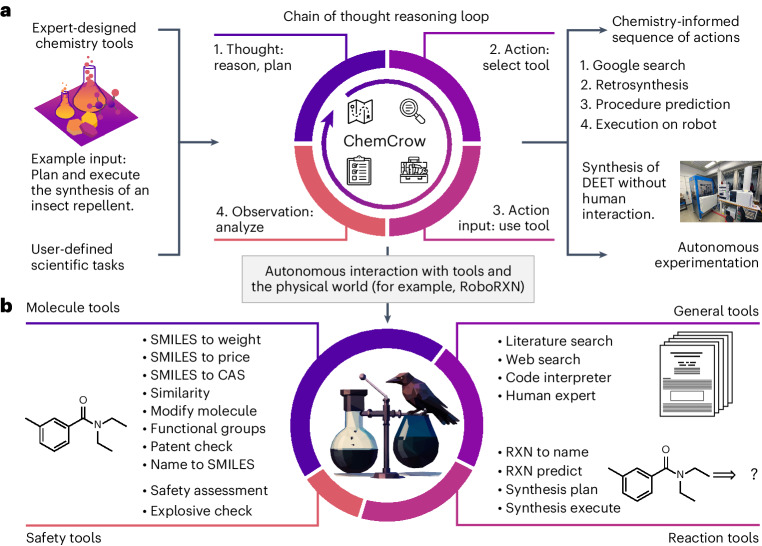
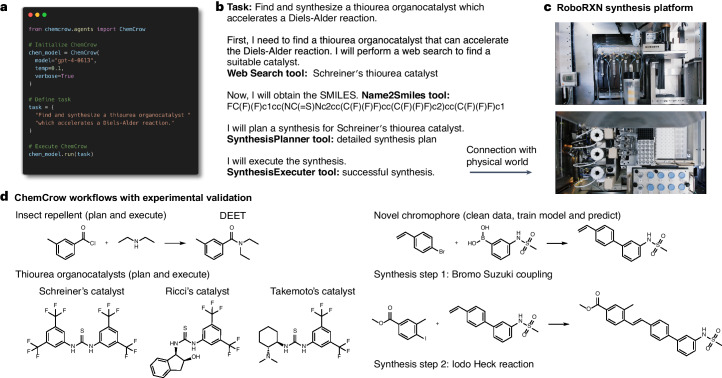
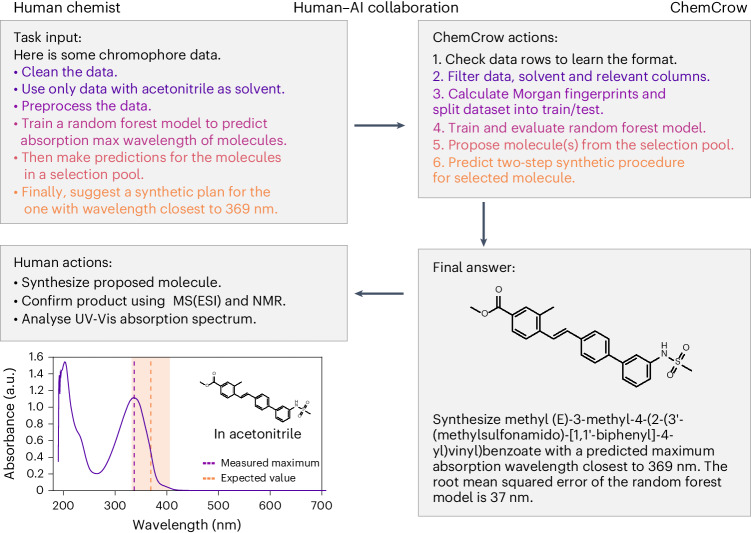
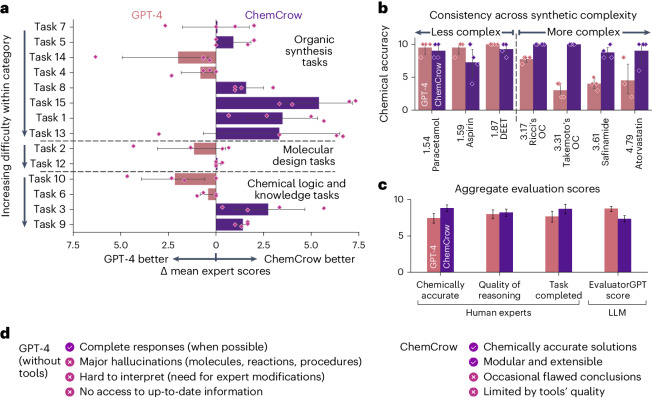
Large language models (LLMs) have shown strong performance in tasks across domains but struggle with chemistry-related problems. These models also lack access to external knowledge sources, limiting their usefulness in scientific applications. We introduce ChemCrow, an LLM chemistry agent designed to accomplish tasks across organic synthesis, drug discovery and materials design. By integrating 18 expert-designed tools and using GPT-4 as the LLM, ChemCrow augments the LLM performance in chemistry, and new capabilities emerge. Our agent autonomously planned and executed the syntheses of an insect repellent and three organocatalysts and guided the discovery of a novel chromophore. Our evaluation, including both LLM and expert assessments, demonstrates ChemCrow’s effectiveness in automating a diverse set of chemical tasks. Our work not only aids expert chemists and lowers barriers for non-experts but also fosters scientific advancement by bridging the gap between experimental and computational chemistry.
Overview
The claims and statistics of this paper haven’t been checked yet.
Free: it reads the open-access text and checks the first 5 claims that cite a source we can check. Create a free account to check every claim.
Integrity signals
Registry
Cites
Statistics
Figures
Verification
Claims the paper makes
The claims and statistics of this paper haven’t been checked yet.
Free: it reads the open-access text and checks the first 5 claims that cite a source we can check. Create a free account to check every claim.
Claims other papers make about this one
Each is checked against this paper’s own text: does it say what the citing paper says it does?
The source backs part of the claim, not all of it — or backs it for a different population, condition or comparison.
In the citing paper
“In parallel, chemistry-oriented reviews have shown that large language models can move beyond text generation toward tool use, retrieval, planning, code execution, and multi-agent coordination [5-10].”
From From Scientific Copilots to Tool-Grounded Autonomy: AI Agents in Simulation-Driven Materials Discovery (2026) · cites this paper as [7]
Experimental — accuracy not yet measuredThe source backs part of the claim, not all of it — or backs it for a different population, condition or comparison.
In the citing paper
“The broader literature on autonomous scientific systems has already argued for more rigorous evaluation protocols and transparent tool interfaces [3,5,7-12].”
From From Scientific Copilots to Tool-Grounded Autonomy: AI Agents in Simulation-Driven Materials Discovery (2026) · cites this paper as [7]
Experimental — accuracy not yet measuredThe source backs part of the claim, not all of it — or backs it for a different population, condition or comparison.
In the citing paper
“In scientific discovery, agents dynamically compose and execute hypothesis-testing pipelines spanning simulations, lab protocols, and data analysis [61, 62, 63, 64].”
From Code as Agent Harness (2026) · cites this paper as [61]
Experimental — accuracy not yet measuredThe source backs part of the claim, not all of it — or backs it for a different population, condition or comparison.
In the citing paper
“ChemCrow [61] similarly integrates RDKit, retrosynthesis engines, and reaction predictors so that an agent can 'execute' a candidate synthesis virtually before committing to a wet-lab run.”
From Code as Agent Harness (2026) · cites this paper as [61]
Experimental — accuracy not yet measuredThe source backs part of the claim, not all of it — or backs it for a different population, condition or comparison.
In the citing paper
“In chemistry, language-model tools, yield predictors, Bayesian optimization, and robotic laboratories provide complementary components for selecting and testing reactions [28, 42-46].”
From RSI-Anything: Unlocking Recursive Self-Improvement with World Models (2026) · cites this paper as [43]
Experimental — accuracy not yet measured
5 more claims about this paper
Create a free account to see every claim other papers make about this one.
Self-check
Percentages, sums and reported differences re-computed from the paper’s own numbers.
The self-check needs the paper’s full text.
Citations
Cites
Vaswani, A., Shazeer, N., Parmar, N., Uszkoreit, J., Jones, L., Gomez, A. N., Kaiser, L., & Polosukhin, I. (2017) · arXiv · doi:10.48550/arxiv.1706.03762 · Cited by 120,404 · cited 1×
“These specialized tools provide exact answers, thereby compensating for the inherent deficiencies of LLMs in specific domains and enhancing their overall performance and applicability.”
BackgroundLanguage Models are Few-Shot Learners
Brown, T. B., Mann, B., Ryder, N., Subbiah, M., Kaplan, J., Dhariwal, P., Neelakantan, A., Shyam, P., Sastry, G., Askell, A., et al. (2020) · arXiv · doi:10.48550/arxiv.2005.14165 · Cited by 23,372 · cited 1×
“…as a field, has been impacted through expert-designed artificial intelligence (AI) systems that tackle specific problems, such as reaction prediction 16–20 , retrosynthesis planning 21–27 , molecular property prediction 28–32 , de-novo molecular generation 33,34 , materials design 35,36 and,…”
BackgroundExtended-Connectivity Fingerprints
Rogers, D., & Hahn, M. (2010) · Journal of Chemical Information and Modeling · doi:10.1021/ci100050t · Cited by 7,524 · cited 1×
“Similarity The primary function of this tool is to evaluate the similarity between two molecules, utilizing the Tanimoto similarity measure 90 based on the ECFP2 molecular fingerprints 91 of the input molecules.”
MethodThe National Center for Biotechnology Information
Benson, D., Boguski, M., Lipman, D. J., & Ostell, J. (1990) · Genomics · doi:10.1016/0888-7543(90)90583-g · Cited by 5,126
LLaMA: Open and Efficient Foundation Language Models
Touvron, H., Lavril, T., Izacard, G., Martinet, X., Lachaux, M.-A., Lacroix, T., Rozière, B., Goyal, N., Hambro, E., Azhar, F., et al. (2023) · arXiv · doi:10.48550/arxiv.2302.13971 · Cited by 4,602 · cited 1×
“…is the lack of reproducibility of individual results under the current API-based approach to LLMs, as closed-source models provide limited control, see Appendix E. Recent open-source models 76–78 offer a potential solution to this issue, albeit with a possible trade-off in reasoning power.”
BackgroundChain-Of-Thought Prompting Elicits Reasoning in Large Language Models
Wei, J., Wang, X., Schuurmans, D., Bosma, M., Ichter, B., Xia, F., Chi, E., Le, Q. V., & Zhou, D. (2022) · Advances in Neural Information Processing Systems 35 · doi:10.52202/068431-1800 · Cited by 4,505
Chain-of-Thought Prompting Elicits Reasoning in Large Language Models
Wei, J., Wang, X., Schuurmans, D., Bosma, M., Ichter, B., Xia, F., Chi, E., Le, Q., & Zhou, D. (2022) · arXiv · doi:10.48550/arxiv.2201.11903 · Cited by 4,263 · cited 1×
“The tools used can be classified into general tools, molecular tools, and chemical reaction tools.”
MethodBillion-scale similarity search with GPUs
Johnson, J., Douze, M., & Jegou, H. (2021) · IEEE Transactions on Big Data · doi:10.1109/tbdata.2019.2921572 · Cited by 4,228
Training language models to follow instructions with human feedback
Ouyang, L., Wu, J., Jiang, X., Almeida, D., Wainwright, C. L., Mishkin, P., Zhang, C., Agarwal, S., Slama, K., Ray, A., et al. (2022) · arXiv · doi:10.48550/arxiv.2203.02155 · Cited by 4,208 · cited 2×
“5 13 cannot consistently and accurately multiply 12345*98765 or convert IUPAC names into the corresponding molecular graph 14 .”
BackgroundBillion-scale similarity search with GPUs
Johnson, J., Douze, M., & Jégou, H. (2017) · arXiv · doi:10.48550/arxiv.1702.08734 · Cited by 4,140 · cited 1×
“The CAS number serves as a precise and universally recognized chemical identifier, enabling researchers to access relevant data and resources with ease, and ensuring that they obtain accurate and consistent information about the target molecule 89 .”
Background
Research works printed but not linked: 4
- Devlin, J., Chang, M.-W., Lee, K. & Toutanova, K. Bert: pre-training of deep bidirectional transformers for language understanding. In Proc. Conference of the North American Chapter of the Association for Computational Linguistics: Human Language Technologies (eds Burstein, J. et al.) 4171–4186 (Association for Computational Linguistics, 2019).
- Li, R. et al. Starcoder: may the source be with you! Trans. Mach. Learn. Res. https://openreview.net/pdf?id=KoFOg41haE (2023).
- Zelikman E Wu Y Mu J Goodman N Star: bootstrapping reasoning with reasoning Adv. Neural Inf. Process. Syst. 2022 35 15476 15488
- Lowe, D. M. Extraction of Chemical Structures and Reactions from the Literature. PhD thesis, Univ. of Cambridge (2012).
Cited by
Items 401–500 of 1,026
Chain-aware graph neural networks for molecular property prediction
Wang, H., Zhang, A., Zhong, Y., Tang, J., Zhang, K., & Li, P. (2024) · Bioinformatics · doi:10.1093/bioinformatics/btae574 · Cited by 23
AstroMLab 1: Who wins astronomy jeopardy!?
Ting, Y.-S., Nguyen, T. D., Ghosal, T., Pan, R., Arora, H., Sun, Z., de Haan, T., Ramachandra, N., Wells, A., Madireddy, S., et al. (2024) · Astronomy and Computing · doi:10.1016/j.ascom.2024.100893 · Cited by 28
Mathur, S., van der Vleuten, N., Yager, K. G., & Tsai, E. H. R. (2025) · Machine Learning Science and Technology · doi:10.1088/2632-2153/add9e4 · Cited by 33
“Tools like ChemCrow [40] and Coscientist [60] enhance LLMs with specialized chemistry tools for autonomous experimental planning and execution, bridging computational and experimental domains.”
CFD-LLMBench: A Benchmark Suite for Evaluating Large Language Models in Computational Fluid DynamicsPreprint
Somasekharan, N., Yue, L., Cao, Y., Li, W.-C., Emami, P., Bhargav, P. S., Acharya, A., Xie, X., & Pan, S.-W. (2025) · arXiv.org · doi:10.48550/arxiv.2509.20374 · Cited by 6
FeaGPT: an End-to-End Agentic-AI for Finite Element AnalysisPreprint
Qi, Y., Xu, R., & Chu, X. (2026) · Research Square · doi:10.21203/rs.3.rs-8562963/v1 · Cited by 23
AutoResearch AI: Towards AI-Powered Research Automation for Scientific DiscoveryPreprint
Tie, G., Shi, J., Song, D., Huang, Y., Sheng, Z., Zhou, X., Liu, D., Zhou, P., Chen, Y., Xu, R., et al. (2026) · arXiv (Cornell University) · doi:10.48550/arxiv.2605.23204 · Cited by 22
BioMaster: Multi-agent System for Automated Bioinformatics Analysis Workflow
Su, H., Long, W., & Zhang, Y. (2025) · doi:10.1101/2025.01.23.634608 · Cited by 18
Bayerlein, B., Waitelonis, J., Birkholz, H., Jung, M., Schilling, M., Hartrott, P. V., Bruns, M., Schaarschmidt, J., Beilke, K., Mutz, M., et al. (2024) · Advanced Engineering Materials · doi:10.1002/adem.202401092 · Cited by 19
Tooling or Not Tooling? The Impact of Tools on Language Agents for Chemistry Problem Solving
Yu, B., Baker, F. N., Chen, Z., Herb, G., Gou, B., Adu‐Ampratwum, D., Ning, X., & Sun, H. (2025) · Findings of the Association for Computational Linguistics: NAACL · doi:10.18653/v1/2025.findings-naacl.424 · Cited by 33
Material intelligence by the convergence of artificial intelligence and robotic platforms
Zhang, X., Chen, Z., Chen, F., Fanady, B., Wang, B., Ni, Z., Zhou, S., Ye, J., Chen, G., Liu, J., et al. (2025) · Nexus · doi:10.1016/j.ynexs.2025.100083 · Cited by 20
The (R)evolution of Scientific Workflows in the Agentic AI Era: Towards Autonomous Science
Shin, W., Souza, R., Rosendo, D., Suter, F., Wang, F., Balaprakash, P., & da Silva, R. F. (2025) · International Conference for High Performance Computing, Networking, Storage and Analysis (SC) · doi:10.1145/3731599.3767580 · Cited by 27
OptiChat: Bridging Optimization Models and Practitioners with Large Language Models
Chen, H., Constante‐Flores, G. E., Mantri, K. S. I., Kompalli, S. M., Ahluwalia, A. S., & Li, C. (2025) · INFORMS Journal on Data Science · doi:10.1287/ijds.2025.0074 · Cited by 18
Jiang, Q., & Karniadakis, G. E. (2026) · npj Artificial Intelligence · doi:10.1038/s44387-026-00102-5 · Cited by 30
The ADePT framework for assessing autonomous laboratory robotics
Villacis, P. J. S., & Benyahia, B. (2026) · Communications Chemistry · doi:10.1038/s42004-026-01932-9 · Cited by 21
Boosting Computational Catalysis and Chemical Reactivity with Artificial Intelligence
Vogiatzis, K. D., Corminbœuf, C., Nova, A., Jorner, K., Kästner, J., Meuwly, M., Schwaller, P., Böttcher, V., Δρόσου, Μ., Fako, E., et al. (2026) · Journal of the American Chemical Society · doi:10.1021/jacs.5c17786 · Cited by 20
Self-citationChen, H., Liu, F., & Lin, Z. (2025) · Pharmacophore · doi:10.51847/bhyi6rjara · Cited by 18
Wang, Z., Lu, Y., Zhang, Y., Chen, P., Dong, Z., Huang, J., Gesi, J., Tang, X., Luo, C., Liu, Q., et al. (2026) · Proceedings of the conference - Association for Computational Linguistics. Meeting · doi:10.18653/v1/2026.acl-long.2037 · Cited by 27
SciVideoBench: Benchmarking Scientific Video Reasoning in Large Multimodal ModelsPreprint
Deng, A., Yang, T., Yu, S., Spencer, L., Bansal, M., Chen, C., Yeung, S. Y., & Wang, X. (2025) · arXiv (Cornell University) · doi:10.48550/arxiv.2510.08559 · Cited by 20
BioAgents: Democratizing Bioinformatics Analysis with Multi-Agent SystemsPreprint
Mehandru, N., Hall, A. K., Melnichenko, O., Dubinina, Y., Tsirulnikov, D., Bamman, D., Alaa, A., Saponas, S., & Malladi, V. S. (2025) · arXiv (Cornell University) · doi:10.48550/arxiv.2501.06314 · Cited by 29
“While existing multi-agent systems primarily rely on large language models [21, 30], we leveraged a smaller, more efficient language model, Phi-3 [1].”
Agentic AI for Scientific Discovery: A Survey of Progress, Challenges, and Future Directions
Gridach, M., Nanavati, J., Abidine, K. Z. E., Mendes, L., & Mack, C. (2025) · arXiv · doi:10.48550/arxiv.2503.08979 · Cited by 18
“Similarly, M. Bran et al. (2024) introduced ChemCrow, which extends the capabilities of GPT-4 by integrating 18 expert-designed tools for tasks such as organic synthesis, drug discovery, and materials design.”
Democratising real-world drug discovery through agentic AI
He, J., Lai, H., Saigiridharan, L., Ghiandoni, G. M., Jenei, K., Gokalp, U., Nuković, A., Engkvist, O., Janet, J. P., & Genheden, S. (2026) · Drug Discovery Today · doi:10.1016/j.drudis.2026.104605 · Cited by 17
ReWOO: Decoupling Reasoning from Observations for Efficient Augmented Language Models
Xu, B., Peng, Z., Lei, B., Mukherjee, S., Liu, Y., & Xu, D. (2023) · arXiv · doi:10.48550/arxiv.2305.18323 · Cited by 17
Chained LLM-human interactive framework for electrolyte design in four-electron Zn-I2 batteries
Chen, Z., Zhang, J., Zhao, G., Wang, Q., Yang, C., & Guo, Y. (2025) · Science China Chemistry · doi:10.1007/s11426-025-2789-5 · Cited by 17
PRO-V-R1: Reasoning Enhanced Programming Agent for RTL Verification
Zhao, Y., Wu, Z., Yuan, B., Yu, Z., Zhang, H., Ni, W., Ho, C.-T., Ren, H. M., & Zhao, J. (2026) · ACM/IEEE Design Automation Conference (DAC) · doi:10.1145/3770743.3803912 · Cited by 18
Generative exaggeration in LLM social agents: Consistency, bias, and toxicity
Nudo, J., Pandolfo, M. E., Loru, E., Samory, M., Cinelli, M., & Quattrociocchi, W. (2025) · Online Social Networks and Media · doi:10.1016/j.osnem.2025.100344 · Cited by 30
Luo, Q., Lin, Q., Xu, L., Wu, S., Mao, R., Wang, C., Feng, H., Huang, B., & Du, Z. (2026) · Big Earth Data · doi:10.1080/20964471.2026.2615511 · Cited by 18
El agente cuántico: automating quantum simulations
Gustín, I., Calderón, L., Pérez-Sánchez, J. B., Crebolder, C., Gonthier, J. F., Vakili, M. G., Nakamura, Y., Panicker, K., Ramprasad, M., Yin, A., et al. (2026) · Reports on Progress in Physics · doi:10.1088/1361-6633/ae8933 · Cited by 20
Unveiling the power of language models in chemical research question answering
Chen, X., Wang, T., Guo, T., Guo, K., Zhou, J., Li, H., Song, Z., Gao, X., & Zhang, X. (2025) · Communications Chemistry · doi:10.1038/s42004-024-01394-x · Cited by 36
AI-empowered digital design of zeolites: Progress, challenges, and perspectives
Wu, M., Zhang, S., & Ren, J. (2025) · APL Materials · doi:10.1063/5.0253847 · Cited by 19
Automated Retrosynthesis Planning of Macromolecules Using Large Language Models and Knowledge Graphs
Ma, Q., Zhou, Y., & Li, J. (2025) · Macromolecular Rapid Communications · doi:10.1002/marc.202500065 · Cited by 20
Benchmarking large language models for materials synthesis: The case of atomic layer deposition
Yanguas-Gil, Á., Dearing, M. T., Elam, J. W., Jones, J. C., Kim, S., Mohammad, A., Nguyen, C. T., & Sengupta, B. (2025) · Journal of Vacuum Science & Technology A Vacuum Surfaces and Films · doi:10.1116/6.0004319 · Cited by 19
Li, Z., Liu, Z., Sa, G., Sun, J., Hou, M., Tan, J., Sun, L., & Wei, J. (2025) · Applied Soft Computing · doi:10.1016/j.asoc.2025.113147 · Cited by 17
PEACE: Empowering Geologic Map Holistic Understanding with MLLMs
Huang, Y., Gao, T., Xu, H., Zhao, Q., Yang, S., Gui, Z., Lv, T., Chen, H., Cui, L., Li, S., et al. (2025) · IEEE Computer Society Conference on Computer Vision and Pattern Recognition/Proceedings - IEEE Computer Society Conference on Computer Vision and Pattern Recognition/Proceedings · doi:10.1109/cvpr52734.2025.00369 · Cited by 30
Decoding complexity through machine learning is redefining scientific discovery
Vinuesa, R., Cinnella, P., Rabault, J., Azizpour, H., Bauer, S., Brunton, B. W., Elofsson, A., Jarlebring, E., Kjellström, H., Markidis, S., et al. (2026) · Communications Physics · doi:10.1038/s42005-026-02676-7 · Cited by 21
HoneyBee: Progressive Instruction Finetuning of Large Language Models for Materials SciencePreprint
Song, Y., Miret, S., Zhang, H., & Liu, B. (2023) · Conference on Empirical Methods in Natural Language Processing · doi:10.48550/arxiv.2310.08511 · Cited by 48
“…NLP tools for materials science, recent advancements have led to the emergence of large language models (LLMs) proficient in handling general language tasks that concurrently demonstrate substantial aptitude in areas like chemistry and materials science (Bran et al., 2023; Boiko et al., 2023).”
BackgroundKasmaee, A. S., Khodadad, M., Saloot, M. A., Sherck, N., Dokas, S., Mahyar, H., & Samiee, S. (2024) · arXiv (Cornell University) · doi:10.48550/arxiv.2412.00532 · Cited by 25
Bai, J., Rihm, S. D., Kondinski, A., Saluz, F., Deng, X., Brownbridge, G., Mosbach, S., Akroyd, J., & Kraft, M. (2025) · Digital Discovery · doi:10.1039/d5dd00069f · Cited by 18
Towards Understanding, Analyzing, and Optimizing Agentic AI Execution: A CPU-Centric PerspectivePreprint
Raj, R., Kundu, S., Vohra, I., Wang, H., & Krishna, T. (2025) · arXiv (Cornell University) · doi:10.48550/arxiv.2511.00739 · Cited by 15
Autonomous Research Agents: A Survey of AI Scientists and the Verification GapPreprint
Ding, T., Nannapaneni, A., Liu, B., & Zhang, L. (2026) · arXiv (Cornell University) · doi:10.48550/arxiv.2608.05179 · Cited by 23
Knowledge-driven autonomous materials research via collaborative multi-agent and robotic system
Shi, T., Li, Y., Wang, Z., Xu, W., Jiang, G., Dai, D., Zhou, J., Huang, H., He, R., Ramakrishna, S., et al. (2026) · Matter · doi:10.1016/j.matt.2025.102577 · Cited by 16
Knowledge-guided large language model for material science
Wang, G., Hu, J., Zhou, J., Liu, S., Li, Q., & Sun, Z. (2025) · Review of Materials Research · doi:10.1016/j.revmat.2025.100007 · Cited by 16
Liu, B., Li, X., Zhang, J., Wang, J., He, T., Hong, S., Liu, H., Zhang, S., Song, K., Zhu, K., et al. (2025) · arXiv · doi:10.48550/arxiv.2504.01990 · Cited by 16
LLM Agents can Autonomously Hack Websites
Fang, R., Bindu, R., Gupta, A., Zhan, Q., & Kang, D. (2024) · arXiv · doi:10.48550/arxiv.2402.06664 · Cited by 16
“For example, LLM agents can aid in scientific discovery (Bran et al., 2023; Boiko et al., 2023).”
BackgroundInternational AI Safety Report
Bengio, Y., Mindermann, S., Privitera, D., Besiroglu, T., Bommasani, R., Casper, S., Choi, Y., Fox, P., Garfinkel, B., Goldfarb, D., et al. (2025) · arXiv · doi:10.48550/arxiv.2501.17805 · Cited by 16
Generative artificial intelligence performs rudimentary structural biology modeling
Ille, A. M., Markosian, C., Burley, S. K., Mathews, M. B., Pasqualini, R., & Arap, W. (2024) · Scientific Reports · doi:10.1038/s41598-024-69021-2 · Cited by 16
Wang, Y., Pang, Y., Liu, Y., Zhang, Y., Zhang, L., Zhang, M., & Wang, D. (2025) · IEEE Internet of Things Journal · doi:10.1109/jiot.2025.3573056 · Cited by 18
“Recently, large language models (LLMs) have developed rapidly, show-casing excellent performance in handling general-purpose tasks across various fields [20], [21], [22], [23], [24], [25].”
Dadfar, B., Alemdag, B., & Kabay, G. (2025) · Macromolecular rapid communications · doi:10.1002/marc.202500380 · Cited by 12
“Models like GPT-4 are already used to generate experimental procedures and optimize protocols from text inputs [111].”
Jiang, P., Han, J., & Ahmed‐Kristensen, S. (2025) · Sustainable Futures · doi:10.1016/j.sftr.2025.101094 · Cited by 18
Standardizing Intelligence: Aligning Generative AI for Regulatory and Operational Compliance
Imperial, J. M., Jones, M. D., & Madabushi, H. T. (2025) · SuperIntelligence - Robotics - Safety & Alignment · doi:10.70777/si.v2i5.16189 · Cited by 16
Hellert, T., Bertwistle, D., Leemann, S. C., Sulc, A., & Venturini, M. (2026) · Physical Review Research · doi:10.1103/jtqy-9jz1 · Cited by 25
“…to simulated or low-stakes domains; several domain-focused systems illustrate this diversity: ChemCrow augments LMs with chemistry-specific tools [19], Co-scientist enables autonomous experimental planning in chemistry [20], and CRISPR-GPT applies agentic orchestration to gene-editing workflows…”
ChemPile: A 250 GB Diverse and Curated Dataset for Chemical Foundation Models
Mirza, A., Alampara, N., Ríos-García, M., Abdelalim, M., Butler, J., Connolly, B. M., Doğan, T., Nezhurina, M., Şen, B., Tirunagari, S., et al. (2025) · neural information processing systems · doi:10.52202/085713-1861 · Cited by 19
Self-citationFrom Prompt to Drug: Toward Pharmaceutical Superintelligence
Zhavoronkov, A. A., Gennert, D. G., & Shi, J. (2026) · ACS Central Science · doi:10.1021/acscentsci.5c01473 · Cited by 20
Towards AI as Colleagues: Multi-Agent System Improves Structured Ideation Processes
Quan, K., Albassam, D., Wu, M., Ding, Z., & Chin, J. (2026) · CHI Conference on Human Factors in Computing Systems · doi:10.1145/3772318.3790375 · Cited by 19
Aegis:An Advanced LLM-Based Multi-Agent for Intelligent Functional Safety Engineering
Shi, L., Qi, B., Luo, J., Zhang, Y., Liang, Z., Gao, Z., Deng, W., & Sun, L. (2024) · Conference on Empirical Methods in Natural Language Processing (EMNLP) · doi:10.18653/v1/2024.emnlp-industry.115 · Cited by 25
AI agents in chemical research: GVIM – an intelligent research assistant system
Ma, K. (2025) · Digital Discovery · doi:10.1039/d4dd00398e · Cited by 26
Large Language Models (LLMs) as Graphing Tools for Advanced Chemistry Education and Research
Subasinghe, S. M. S., Gersib, S. G., & Mankad, N. P. (2025) · Journal of Chemical Education · doi:10.1021/acs.jchemed.4c01498 · Cited by 17
Zheng, X., Yang, J., Zhou, L., Qin, L., Lu, C., Alonso‐Vante, N., Huang, Z., Zhang, P., Zhou, Y., Luo, Z.-H., et al. (2025) · Chemical Engineering Science · doi:10.1016/j.ces.2025.121740 · Cited by 16
Lessons from the trenches on evaluating machine learning systems in materials science
Alampara, N., Schilling-Wilhelmi, M., & Jablonka, K. M. (2025) · Computational Materials Science · doi:10.1016/j.commatsci.2025.114041 · Cited by 22
Survey on recent progress of AI for chemistry: methods, applications, and opportunities
Hu, D. Y., Hua, P., & Huang, Z. (2026) · Frontiers of Computer Science · doi:10.1007/s11704-025-50127-3 · Cited by 18
“To provide a thorough introduction to the advancement of AI for Chemistry from the lens of computer science, it is essential to first clarify the paradigm of AI research, particularly in machine learning.”
Crystalyse: a multi-tool agent for materials designPreprint
Nduma, R., Park, H., & Walsh, A. (2025) · arXiv (Cornell University) · doi:10.48550/arxiv.2512.00977 · Cited by 17
Designing Domain-Specific Agents via Hierarchical Task Abstraction MechanismPreprint
Li, K., Wang, J., Wang, Z., Qiao, H., Zhang, W., Meng, D., & Cao, X. (2025) · arXiv (Cornell University) · doi:10.48550/arxiv.2511.17198 · Cited by 19
AlphaEvolve: A coding agent for scientific and algorithmic discovery
Novikov, A., Vũ, N., Eisenberger, M., Dupont, E., Huang, P.-S., Wagner, A. Z., Shirobokov, S., Kozlovskii, B., Ruiz, F. J. R., Mehrabian, A., et al. (2025) · arXiv · doi:10.48550/arxiv.2506.13131 · Cited by 15
“Other works use LLMs to optimize experimental planning and design [7, 10, 43, 75] or experiment execution and workflow [28, 62, 82, 105, 116].”
From Persona to Personalization: A Survey on Role-Playing Language Agents
Chen, J., Wang, X., Xu, R., Yuan, S., Zhang, Y., Shi, W., Xie, J., Li, S., Yang, R., Zhu, T., et al. (2024) · arXiv · doi:10.48550/arxiv.2404.18231 · Cited by 15
Can GPT-4 Perform Neural Architecture Search?
Zheng, M., Su, X., You, S., Wang, F., Qian, C., Xu, C., & Albanie, S. (2023) · arXiv · doi:10.48550/arxiv.2304.10970 · Cited by 15
“Exploring applications in the chemistry domain, concurrent work explores how GPT-4 can be coupled to existing tools like web search and code execution to advance chemical research [1, 3].”
BackgroundGender, Age, and Technology Education Influence the Adoption and Appropriation of LLMs
Draxler, F., Buschek, D., Tavast, M., Hämäläinen, P., Schmidt, A., Kulshrestha, J., & Welsch, R. (2023) · arXiv · doi:10.48550/arxiv.2310.06556 · Cited by 15
“For example, interface layers could enable fact-checking [21], and integrating expert tools into LLM-based systems could improve the output accuracy [1].”
BackgroundQuantum many-body physics calculations with large language models
Pan, H., Mudur, N., Taranto, W., Tikhanovskaya, M., Venugopalan, S., Bahri, Y., Brenner, M. P., & Kim, E.-A. (2025) · Communications Physics · doi:10.1038/s42005-025-01956-y · Cited by 15
ML@ChemE: Past, Present, and Future of Machine Learning in Chemical Engineering
Özdemir, P., & Yıldırım, R. (2025) · ChemBioEng Reviews · doi:10.1002/cben.70012 · Cited by 15
Text mining in MOF research: from manual curation to large language model-based automation
Bae, S., Jeon, M., & Moon, H. R. (2025) · Chemical Communications · doi:10.1039/d5cc02511g · Cited by 16
A survey on large language models in biology and chemistry
Ashyrmamatov, I., Gwak, S. J., Jin, S.-Y., Jun, I., Ucak, U. V., Lee, J. Y., & Lee, J. (2026) · Experimental & Molecular Medicine · doi:10.1038/s12276-025-01583-1 · Cited by 17
“Coscientist 154 , ChemCrow 155 and ChatMOF 156 exemplify such frameworks, integrating web search, retrosynthesis tools and laboratory protocols into interactive agents.”
Perspectives for artificial intelligence in bioprocess automation
Helleckes, L. M., Putz, S., Gupta, K., Franzreb, M., & Martin, H. G. (2025) · Current Opinion in Biotechnology · doi:10.1016/j.copbio.2025.103392 · Cited by 18
A conversational multi-agent AI system for automated plant phenotyping
Chen, F., Stogiannidis, I., Wood, A., Bueno, D., Williams, D., Macfarlane, F., Grieve, B., Wells, D. M., Atkinson, J. A., Hawkesford, M. J., et al. (2026) · Nature Communications · doi:10.1038/s41467-026-71090-y · Cited by 19
“An effective strategy is to augment LLMs with instructions and external tools forming AI agents capable of automatically executing tailored computational routines and data analysis pipelines.”
30 years of AI for electrocatalysis: Where we are and what’s next?
Chen, H., Kätelhön, E., Lu, Y., Cheng, J., Tian, Z., & Compton, R. G. (2025) · eScience · doi:10.1016/j.esci.2025.100515 · Cited by 15
Yao, T., Huang, J., Yan, Y., Yang, Y., Wang, Z., Shao, X., Gao, Z., & Yang, W. (2025) · AI Agent · doi:10.20517/aiagent.2025.03 · Cited by 16
Reconstruction of human metabolic models with large language models
Luo, J., Wang, H., Moyer, D. C., Guo, Z., Robinson, J. L., Gustafsson, J., Anton, M., Chen, Y., Kerkhoven, E. J., Nielsen, J., et al. (2026) · Proceedings of the National Academy of Sciences · doi:10.1073/pnas.2516511123 · Cited by 16
LARC: Towards Human-level Constrained Retrosynthesis Planning through an Agentic Framework
Baker, F. N., Adu‐Ampratwum, D., Averly, R., Yu, B., Sun, H., & Ning, X. (2026) · EPiC series in technology · doi:10.29007/z3hb · Cited by 16
GenoMAS: Guided Multi-Agent Programming for Scientific Discovery from Genomic Data
Liu, H., Li, Y., & Wang, H. (2026) · Findings of the Association for Computational Linguistics: EMNLP (Findings of EMNLP) · doi:10.18653/2026.findings-emnlp.1395 · Cited by 15
Tutorial: guidance on the use of large language models for medical research
Jin, Q., Wan, N., Leaman, R., Tian, S., Wang, Z., Yang, Y., Wang, Z., Xiong, G., Lai, P.-T., Zhu, Q. L., et al. (2026) · Nature Protocols · doi:10.1038/s41596-026-01408-z · Cited by 16
AcademicGPT: Empowering Academic ResearchPreprint
Wei, S., Xu, X., Qi, X., Yin, X., Xia, J. W., Ren, J., Tang, P., Zhong, Y., Chen, Y., Ren, X., et al. (2023) · arXiv (Cornell University) · doi:10.48550/arxiv.2311.12315 · Cited by 18
“In conclusion, LLMs have revolutionized numerous industries (Bran et al., 2023; Chen and Koohy, 2024; Cui et al., 2023; Luo et al., 2022; Rozi`ere et al., 2023; Scarlatos and Lan, 2023; Singhal et al., 2022; Wu et al., 2023b; Zheng et al., 2023).”
BackgroundEcoAct: Economic Agent Determines When to Register What ActionPreprint
Zhang, S., Zhang, J., Ding, D., Garcia, M. H., Mallick, A., Madrigal, D., Xia, M., Rühle, V., Wu, Q., & Wang, C. (2024) · arXiv (Cornell University) · doi:10.48550/arxiv.2411.01643 · Cited by 16
Park, N. H., Callahan, T. J., Hedrick, J. L., Erdmann, T., & Capponi, S. (2024) · arXiv (Cornell University) · doi:10.48550/arxiv.2408.11793 · Cited by 15
“…while the LLM systems have been demonstrated to search APIs such as PubChem or the general internet in the performance of chemistry-focused tasks, 5 these search interfaces do not offer the potential breadth of both query options or structural similarity features that may be possible when using…”
BackgroundYang, S., Han, S. C., Ding, Y., Wang, S., & Hoy, E. (2026) · International Conference on Learning Representations · doi:10.48550/arxiv.2603.12740 · Cited by 28
ijlessjournal (2026) · مجلة القانون والأعمال الدولية · doi:10.63585/ozsp2793 · Cited by 15
Busch, M., Tacke, M., Lamaka, S. V., Zheludkevich, M. L., Linka, K., Cyron, C. J., Feiler, C., & Aydin, R. C. (2025) · Corrosion Science · doi:10.1016/j.corsci.2025.113080 · Cited by 18
Agentic Large Language Models for Conceptual Systems Engineering and Design
Massoudi, S., & Fuge, M. (2025) · Journal of Mechanical Design · doi:10.1115/1.4070328 · Cited by 14
Artificial intelligence/machine learning of polymer materials and discovery chemistry
Chen, J., Christakopoulos, P., Ivanov, I. N., Vasudevan, R. K., Kumar, R., Sumpter, B. G., & Advíncula, R. C. (2025) · MRS Bulletin · doi:10.1557/s43577-025-00986-9 · Cited by 16
Can we automate scientific reasoning in closed-loop experiments using large language models?
Cisse, A., Cooper, M., Zhu, M., Evangelopoulos, X., & Cooper, A. I. (2026) · Digital Discovery · doi:10.1039/d5dd00520e · Cited by 21
Materials Databases: Foundations of Modern Digital Materials
Zhuang, Y., Yang, X., Zhang, C., Jia, X., Zhang, D., Li, M., Yao, T., Peng, J., Gao, Z., Yang, W., et al. (2026) · Precision Chemistry · doi:10.1021/prechem.5c00449 · Cited by 16
Li, H., Fang, X., Li, Y., Huang, C., Wang, J., Wang, X., Bai, H., Hao, B., Lin, S., Liang, H., et al. (2026) · Journal of Chemical Information and Modeling · doi:10.1021/acs.jcim.6c00286 · Cited by 17
Formalizing chemical physics using the Lean theorem prover
Bobbin, M., Sharlin, S., Feyzishendi, P., Dang, A. H., Wraback, C. M., & Josephson, T. R. (2024) · Digital Discovery · doi:10.1039/d3dd00077j · Cited by 28
MolTailor: Tailoring Chemical Molecular Representation to Specific Tasks via Text Prompts
Guo, H., Zhao, S., Wang, H., Du, Y., & Qin, B. (2024) · Proceedings of the AAAI Conference on Artificial Intelligence · doi:10.1609/aaai.v38i16.29772 · Cited by 22
Jalali, M., Luo, Y., Caulfield, L., Sauter, E., Nefedov, A., & Wöll, C. (2024) · Materials Today Communications · doi:10.1016/j.mtcomm.2024.109801 · Cited by 22
Leveraging GPT-4 to transform chemistry from paper to practice
Zhang, W., Guy, M. A., Yang, J., Hao, L., Liu, J., Hawkins, J. M., Mustakis, J., Monfette, S., & Hein, J. E. (2024) · Digital Discovery · doi:10.1039/d4dd00248b · Cited by 18
Transform Drug Discovery and Development With Generative Artificial Intelligence
Lavecchia, A. (2025) · Wiley eBooks · doi:10.1002/9781394280735.ch25 · Cited by 24
Walsh, M. (2025) · Risk Analysis · doi:10.1111/risa.17691 · Cited by 15
Jiang, J., Lin, Q., Guan, X., Zhou, S., Zhong, S., Xiang, X., Wang, Z., Chen, G., & Guo, G. (2025) · ACS ES&T Engineering · doi:10.1021/acsestengg.4c00830 · Cited by 14
Ito, S., Muraoka, K., & Nakayama, A. (2025) · Chemistry of Materials · doi:10.1021/acs.chemmater.4c02726 · Cited by 18
Enhancing molecular structure elucidation with reasoning-capable LLMs
Priessner, M., Lewis, R. J., Johansson, M. J., Goodman, J. M., Janet, J. P., & Tomberg, A. (2026) · Digital Discovery · doi:10.1039/d5dd00359h · Cited by 14
EscapeBench: Towards Advancing Creative Intelligence of Language Model Agents
Qian, C., Han, P., Luo, Q.-Y., He, B.-X., Chen, X.-S., Zhang, Y.-J., Du, H.-Y., Yao, J., Yang, X.-C., Zhang, D.-H., et al. (2024) · Annual Meeting of the Association for Computational Linguistics · doi:10.18653/v1/2025.acl-long.39 · Cited by 7
Peng, C., Wang, B., Wu, L., Jin, H., Li, Y., Gao, W., Zhou, J., Jiang, G., Wang, C., Wang, J., et al. (2025) · Angewandte Chemie International Edition · doi:10.1002/anie.202508454 · Cited by 14
Large Language Models for Heterogeneous Catalysis
Yao, Y., Zhu, J., Liu, Y., Ren, G., Li, X., & Ou, P. (2025) · Wiley Interdisciplinary Reviews Computational Molecular Science · doi:10.1002/wcms.70046 · Cited by 16
“For instance, ChemCrow [13] exemplifies this potential by using a “Thought–Action– Observation” loop in combination with 18 chemistry-specific tools, including retrosynthesis engines, molecule editors, and condition predictors to plan and execute multistep syntheses (Figure 5a).”
Metadata
- Authors
- M. Bran, A., Cox, S., Schilter, O., Baldassari, C., White, A. D., & Schwaller, P.
- Affiliations
- Future House, Inc. (US)
- IBM Research - Zurich (CH)
- NCCR Catalysis (CH)
- Corresponding author
- White, Andrew D.
- Schwaller, Philippe
- Venue
- Nature Machine Intelligence
- Published
- 2024-05-08
- Volume
- 6
- Issue
- 5
- Pages
- 525-535
- ISSN
- 2522-5839 (ISSN-L)
- PMC
- PMC11116106
- OpenAlex
- W4396723768
- Cited by
- 794
- References
- 76
- Citations by year
- 2026: 395 · 2025: 305 · 2024: 83
- FWCI
- 76.42
- Type
- journal article
- Language
- en
- Open access
- hybrid
- doi.org
- Licence
- cc-by
- creativecommons.org/licenses/by/4.0 (tdm)
- creativecommons.org/licenses/by/4.0 (vor)
- Locations
- Nature Machine Intelligence (publishedVersion, cc-by)
- PubMed Central (publishedVersion, cc-by-nd)
- PubMed (publishedVersion)
- Infoscience (Ecole Polytechnique Fédérale de Lausanne) (submittedVersion, cc-by-nc-nd)
- Funders
- Schweizerischer Nationalfonds zur Förderung der Wissenschaftlichen Forschung (180544)
- National Science Foundation (1751471)
- Topics
- Physical Sciences › Materials Science › Materials Chemistry › Machine Learning in Materials Science
- Life Sciences › Pharmacology, Toxicology and Pharmaceutics › Drug Discovery › Computational Drug Discovery Methods
- Physical Sciences › Computer Science › Artificial Intelligence › Artificial Intelligence Applications
- Keywords
- large language models, GPT-4, organic synthesis planning, drug discovery, materials design, organocatalysts
About these checks
Registry, retraction, Cites and statistics results are computed, not judged, with one exception: a printed reference that no index lists is read once by a model before it counts as a citation error. Claims are extracted by a model and kept only when their quote appears verbatim in the text; each cited source is then checked, with a model’s help, for whether it says what the claim relies on. Those verdicts can be wrong — read the claim’s quote and the cited source before relying on one.
Statistics and arithmetic are recomputed, not judged.
Confidence bands are shown only for fields calibrated on our annotated test set. None is calibrated yet, so no band is shown.
What counts as a claim ›How we measure confidence ›How we check this ›
Are you an author, or do you see a problem with this page? Request a review
Data sources
Bibliographic data: Semantic Scholar, OpenAlex, Crossref.
Contains information from the Semantic Scholar Academic Graph Datasets, made available under the ODC Attribution License (ODC-BY 1.0).
Semantic Scholar’s data is described in: Kinney, R., et al. (2023). The Semantic Scholar Open Data Platform. arXiv:2301.10140.
