

Augmenting large language models with chemistry tools
Open accessThe DOI matches its Crossref record; 94 of the 94 references it cites were found in a registry or an index.
Abstract
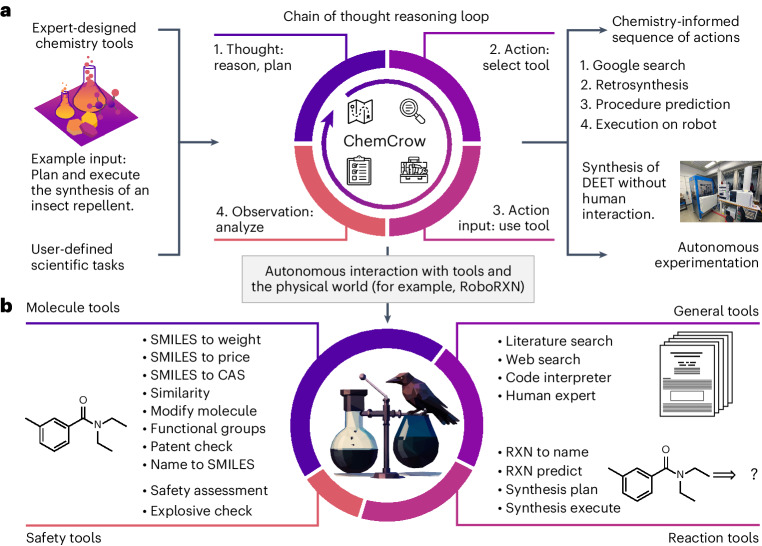
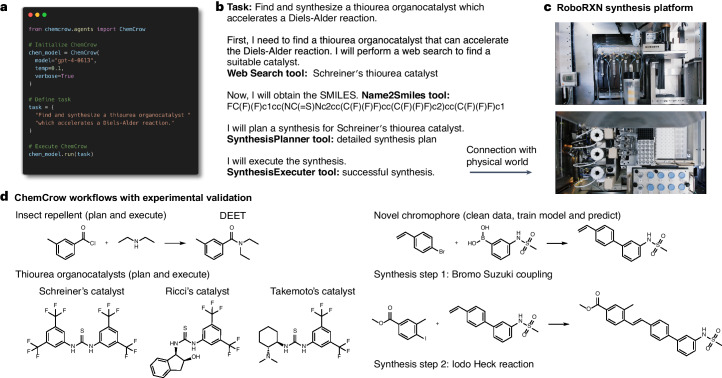
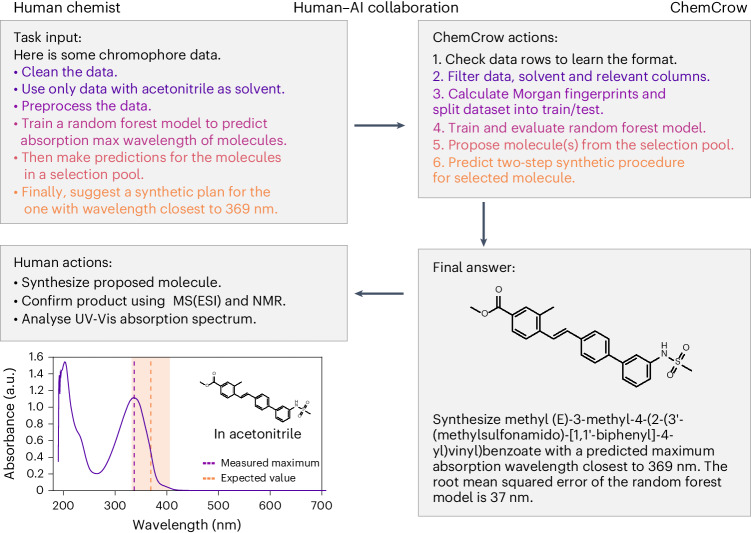
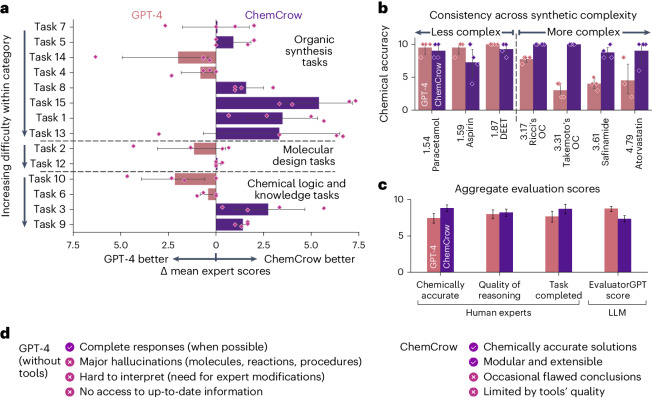
Large language models (LLMs) have shown strong performance in tasks across domains but struggle with chemistry-related problems. These models also lack access to external knowledge sources, limiting their usefulness in scientific applications. We introduce ChemCrow, an LLM chemistry agent designed to accomplish tasks across organic synthesis, drug discovery and materials design. By integrating 18 expert-designed tools and using GPT-4 as the LLM, ChemCrow augments the LLM performance in chemistry, and new capabilities emerge. Our agent autonomously planned and executed the syntheses of an insect repellent and three organocatalysts and guided the discovery of a novel chromophore. Our evaluation, including both LLM and expert assessments, demonstrates ChemCrow’s effectiveness in automating a diverse set of chemical tasks. Our work not only aids expert chemists and lowers barriers for non-experts but also fosters scientific advancement by bridging the gap between experimental and computational chemistry.
Overview
The claims and statistics of this paper haven’t been checked yet.
Free: it reads the open-access text and checks the first 5 claims that cite a source we can check. Create a free account to check every claim.
Integrity signals
Registry
Cites
Statistics
Figures
Verification
Claims the paper makes
The claims and statistics of this paper haven’t been checked yet.
Free: it reads the open-access text and checks the first 5 claims that cite a source we can check. Create a free account to check every claim.
Claims other papers make about this one
Each is checked against this paper’s own text: does it say what the citing paper says it does?
The source backs part of the claim, not all of it — or backs it for a different population, condition or comparison.
In the citing paper
“In parallel, chemistry-oriented reviews have shown that large language models can move beyond text generation toward tool use, retrieval, planning, code execution, and multi-agent coordination [5-10].”
From From Scientific Copilots to Tool-Grounded Autonomy: AI Agents in Simulation-Driven Materials Discovery (2026) · cites this paper as [7]
Experimental — accuracy not yet measuredThe source backs part of the claim, not all of it — or backs it for a different population, condition or comparison.
In the citing paper
“The broader literature on autonomous scientific systems has already argued for more rigorous evaluation protocols and transparent tool interfaces [3,5,7-12].”
From From Scientific Copilots to Tool-Grounded Autonomy: AI Agents in Simulation-Driven Materials Discovery (2026) · cites this paper as [7]
Experimental — accuracy not yet measuredThe source backs part of the claim, not all of it — or backs it for a different population, condition or comparison.
In the citing paper
“In scientific discovery, agents dynamically compose and execute hypothesis-testing pipelines spanning simulations, lab protocols, and data analysis [61, 62, 63, 64].”
From Code as Agent Harness (2026) · cites this paper as [61]
Experimental — accuracy not yet measuredThe source backs part of the claim, not all of it — or backs it for a different population, condition or comparison.
In the citing paper
“ChemCrow [61] similarly integrates RDKit, retrosynthesis engines, and reaction predictors so that an agent can 'execute' a candidate synthesis virtually before committing to a wet-lab run.”
From Code as Agent Harness (2026) · cites this paper as [61]
Experimental — accuracy not yet measuredThe source backs part of the claim, not all of it — or backs it for a different population, condition or comparison.
In the citing paper
“In chemistry, language-model tools, yield predictors, Bayesian optimization, and robotic laboratories provide complementary components for selecting and testing reactions [28, 42-46].”
From RSI-Anything: Unlocking Recursive Self-Improvement with World Models (2026) · cites this paper as [43]
Experimental — accuracy not yet measured
5 more claims about this paper
Create a free account to see every claim other papers make about this one.
Self-check
Percentages, sums and reported differences re-computed from the paper’s own numbers.
The self-check needs the paper’s full text.
Citations
Cites
Vaswani, A., Shazeer, N., Parmar, N., Uszkoreit, J., Jones, L., Gomez, A. N., Kaiser, L., & Polosukhin, I. (2017) · arXiv · doi:10.48550/arxiv.1706.03762 · Cited by 120,404 · cited 1×
“These specialized tools provide exact answers, thereby compensating for the inherent deficiencies of LLMs in specific domains and enhancing their overall performance and applicability.”
BackgroundLanguage Models are Few-Shot Learners
Brown, T. B., Mann, B., Ryder, N., Subbiah, M., Kaplan, J., Dhariwal, P., Neelakantan, A., Shyam, P., Sastry, G., Askell, A., et al. (2020) · arXiv · doi:10.48550/arxiv.2005.14165 · Cited by 23,372 · cited 1×
“…as a field, has been impacted through expert-designed artificial intelligence (AI) systems that tackle specific problems, such as reaction prediction 16–20 , retrosynthesis planning 21–27 , molecular property prediction 28–32 , de-novo molecular generation 33,34 , materials design 35,36 and,…”
BackgroundExtended-Connectivity Fingerprints
Rogers, D., & Hahn, M. (2010) · Journal of Chemical Information and Modeling · doi:10.1021/ci100050t · Cited by 7,524 · cited 1×
“Similarity The primary function of this tool is to evaluate the similarity between two molecules, utilizing the Tanimoto similarity measure 90 based on the ECFP2 molecular fingerprints 91 of the input molecules.”
MethodThe National Center for Biotechnology Information
Benson, D., Boguski, M., Lipman, D. J., & Ostell, J. (1990) · Genomics · doi:10.1016/0888-7543(90)90583-g · Cited by 5,126
LLaMA: Open and Efficient Foundation Language Models
Touvron, H., Lavril, T., Izacard, G., Martinet, X., Lachaux, M.-A., Lacroix, T., Rozière, B., Goyal, N., Hambro, E., Azhar, F., et al. (2023) · arXiv · doi:10.48550/arxiv.2302.13971 · Cited by 4,602 · cited 1×
“…is the lack of reproducibility of individual results under the current API-based approach to LLMs, as closed-source models provide limited control, see Appendix E. Recent open-source models 76–78 offer a potential solution to this issue, albeit with a possible trade-off in reasoning power.”
BackgroundChain-Of-Thought Prompting Elicits Reasoning in Large Language Models
Wei, J., Wang, X., Schuurmans, D., Bosma, M., Ichter, B., Xia, F., Chi, E., Le, Q. V., & Zhou, D. (2022) · Advances in Neural Information Processing Systems 35 · doi:10.52202/068431-1800 · Cited by 4,505
Chain-of-Thought Prompting Elicits Reasoning in Large Language Models
Wei, J., Wang, X., Schuurmans, D., Bosma, M., Ichter, B., Xia, F., Chi, E., Le, Q., & Zhou, D. (2022) · arXiv · doi:10.48550/arxiv.2201.11903 · Cited by 4,263 · cited 1×
“The tools used can be classified into general tools, molecular tools, and chemical reaction tools.”
MethodBillion-scale similarity search with GPUs
Johnson, J., Douze, M., & Jegou, H. (2021) · IEEE Transactions on Big Data · doi:10.1109/tbdata.2019.2921572 · Cited by 4,228
Training language models to follow instructions with human feedback
Ouyang, L., Wu, J., Jiang, X., Almeida, D., Wainwright, C. L., Mishkin, P., Zhang, C., Agarwal, S., Slama, K., Ray, A., et al. (2022) · arXiv · doi:10.48550/arxiv.2203.02155 · Cited by 4,208 · cited 2×
“5 13 cannot consistently and accurately multiply 12345*98765 or convert IUPAC names into the corresponding molecular graph 14 .”
BackgroundBillion-scale similarity search with GPUs
Johnson, J., Douze, M., & Jégou, H. (2017) · arXiv · doi:10.48550/arxiv.1702.08734 · Cited by 4,140 · cited 1×
“The CAS number serves as a precise and universally recognized chemical identifier, enabling researchers to access relevant data and resources with ease, and ensuring that they obtain accurate and consistent information about the target molecule 89 .”
Background
Research works printed but not linked: 4
- Devlin, J., Chang, M.-W., Lee, K. & Toutanova, K. Bert: pre-training of deep bidirectional transformers for language understanding. In Proc. Conference of the North American Chapter of the Association for Computational Linguistics: Human Language Technologies (eds Burstein, J. et al.) 4171–4186 (Association for Computational Linguistics, 2019).
- Li, R. et al. Starcoder: may the source be with you! Trans. Mach. Learn. Res. https://openreview.net/pdf?id=KoFOg41haE (2023).
- Zelikman E Wu Y Mu J Goodman N Star: bootstrapping reasoning with reasoning Adv. Neural Inf. Process. Syst. 2022 35 15476 15488
- Lowe, D. M. Extraction of Chemical Structures and Reactions from the Literature. PhD thesis, Univ. of Cambridge (2012).
Cited by
Items 801–900 of 1,026
CiteME: Can Language Models Accurately Cite Scientific Claims?
Press, O., Hochlehnert, A., Prabhu, A., Udandarao, V., Press, O., & Bethge, M. (2024) · arXiv · doi:10.48550/arxiv.2407.12861 · Cited by 4
“Paper discovery is a crucial component of systems that automate scientific research as shown in [10, 47, 54, 61, 78].”
BackgroundAI4Research: a survey of artificial intelligence for scientific research
Chen, Q., Yang, M., Qin, L., Liu, J., Yan, Z., Guan, J., Peng, D., Ji, Y., Li, H., Hu, M., et al. (2026) · Science China Information Sciences · doi:10.1007/s11432-025-5000-y · Cited by 4
ChemAgent: Self-updating Library in Large Language Models Improves Chemical Reasoning
Tang, X., Hu, T., Ye, M., Shao, Y., Yin, X., Ouyang, S., Zhou, W., Lu, P., Zhang, Z., Zhao, Y., et al. (2025) · arXiv · doi:10.48550/arxiv.2501.06590 · Cited by 4
Toward a Team of AI-made Scientists for Scientific Discovery from Gene Expression Data
Liu, H., Li, Y., Jian, J., Cheng, Y., Lu, J., Guo, S., Zhu, J., Zhang, M., Zhang, M., & Wang, H. (2024) · arXiv · doi:10.48550/arxiv.2402.12391 · Cited by 4
“Researchers have also been trying to incorporate LLMs into scientific discovery such as in chemistry (Bran et al., 2023; Guo et al., 2023), biotechnology (Madani et al., 2023) and medical (Singhal et al., 2023; Yang et al., 2023c) areas by training or finetuning LLMs on domain-specific data.”
BackgroundEmpowering scientific discovery with explainable small domain-specific and large language models
Yu, H., Wang, Y., Cheng, T., Yan, Y., Dawson, K. A., Li, S. F. Y., Zheng, Y., & Jin, Y. (2025) · Artificial Intelligence Review · doi:10.1007/s10462-025-11365-w · Cited by 5
Li, L., Liu, M., & Dai, H. (2025) · Animal Diseases · doi:10.1186/s44149-025-00203-9 · Cited by 4
“Furthermore, the application of autonomous AI-driven experimental platforms (e.g., Coscientist, ChemCrow) could streamline compound validation and translation from bench to field (Boiko et al. 2023; Bran et al. 2024).”
Egent: An Autonomous Agent for Equivalent Width Measurement
Ting, Y.-S., Saad, S. M., Liu, F., & Shen, Y. (2026) · The Open Journal of Astrophysics · doi:10.33232/001c.161879 · Cited by 4
SynthStrategy: Extracting and Formalizing Latent Strategic Insights from LLMs in Organic Chemistry
Armstrong, D. M., Jončev, Z., Bran, A. M., Nguyen, X. V., Neukomm, T. A., & Schwaller, P. (2026) · Journal of Chemical Information and Modeling · doi:10.1021/acs.jcim.6c01688 · Cited by 4
Self-citationSyed, A., Guo, X., Wang, N., Sun, L., Zhang, S., Hua, C., & Tayab, A. (2025) · Applied Energy · doi:10.1016/j.apenergy.2025.127300 · Cited by 4
Chemical language models for generating compounds with triple-target activity
Srinivasan, S., & Bajorath, J. (2026) · Cell Reports Physical Science · doi:10.1016/j.xcrp.2025.103054 · Cited by 4
What are the limits to biomedical research acceleration through general-purpose AI?
Hebenstreit, K., Convalexius, C., Reichl, S., Huber, S. E., Bock, C., & Samwald, M. (2026) · Scientific Reports · doi:10.1038/s41598-025-32583-w · Cited by 5
“Advanced systems can autonomously generate and, in some cases, rank candidate hypotheses by novelty and feasibility, then refine key research questions into actionable, experimentally testable goals 24,25,42,45 .”
LLM-Powered Multi-Agent Collaboration for Intelligent Industrial On-Call Automation
Fu, R., Zhang, Y., Che, Z., Wu, X., Zhong, Z., Ren, Z., Zhang, S., Wang, F., Sun, Y., Liu, X., et al. (2025) · IEEE/ACM International Conference on Automated Software Engineering (ASE) · doi:10.1109/ase63991.2025.00184 · Cited by 8
“However, individual LLMs still struggle with complex tasks requiring intensive domain knowledge and sophisticated reasoning [10]–[12].”
Tool-wielding language model-based agent offers conversational exploration of clinical tabular data
Yang, A. J., Woo, J. J., Zhang, R., Mach, A., Ramkumar, P., & Ma, Y. (2026) · npj Artificial Intelligence · doi:10.1038/s44387-025-00070-2 · Cited by 4
Clouseau: A Hierarchical Multi-Agent Approach for Autonomous Attack Investigation
Aldaihan, A., Alotaibi, F., & Maffeis, S. (2025) · Annual Computer Security Applications Conference · doi:10.1109/acsac67867.2025.00051 · Cited by 11
Han, T., Wu, S., Wang, J., Zhou, Y., Lv, R., Zhao, B., Hu, W., & Qu, L. (2026) · Findings of the Association for Computational Linguistics: EMNLP (Findings of EMNLP) · doi:10.18653/2026.findings-emnlp.196 · Cited by 4
EcoRxAgent: an AI agent for generating economically substitutable prescriptions
Li, C., Lai, P., Zhang, N., Wen, C., Cai, H., Zheng, G., Wu, Z., Liang, L., Zeng, G., Yang, T., et al. (2026) · npj Digital Medicine · doi:10.1038/s41746-026-02612-7 · Cited by 4
JustShape: Exploring Co-Speech Gestures for Multimodal LLM-Powered 3D Parametric Modeling
Duan, R., Chen, Y., Hu, Y., Liu, Z., Zhu, C., Hu, X., Ma, D., Wang, X., & Ramani, K. (2026) · CHI Conference on Human Factors in Computing Systems · doi:10.1145/3772318.3790641 · Cited by 5
Fu, H., Chen, Q., Tang, C., Deng, Z., Ng, J., Niu, J., Zhu, R., & Li, S. (2026) · Water Research · doi:10.1016/j.watres.2026.125990 · Cited by 4
Agada, J. O., & Biswas, A. (2026) · MRS Bulletin · doi:10.1557/s43577-026-01057-3 · Cited by 5
Liu, Y., & Ou, P. (2026) · npj Artificial Intelligence · doi:10.1038/s44387-026-00111-4 · Cited by 6
Deep learning-driven integrated pipeline for de novo design and synthesis of antimicrobial peptides
Liu, J., Chen, Y., Tang, J., Xing, X., Lin, J., Sun, J., Xing, X., Li, J., & Zhang, C. Y. (2026) · npj Drug Discovery. · doi:10.1038/s44386-026-00045-6 · Cited by 4
Design and performance of AI agents interfacing with an atomic layer deposition tool
Yanguas-Gil, Á., Jones, J. C., Kim, S., Nguyen, C. T., & Elam, J. W. (2026) · Review of Scientific Instruments · doi:10.1063/5.0318770 · Cited by 4
Gangwal, A., & Lavecchia, A. (2026) · Medicinal Research Reviews · doi:10.1002/med.70074 · Cited by 4
TeachMaster: Generative Teaching via Code
Wang, Y., Yang, R., Wu, L., Zhang, J. M., Fan, J., Zhou, T., Fu, R., Li, H., Shi, R., Chen, S., et al. (2026) · Proceedings of the conference - Association for Computational Linguistics. Meeting · doi:10.18653/v1/2026.acl-industry.7 · Cited by 5
From Chatbots to Chemists: Autonomous Agents for Heterogeneous Catalysis
Jin, M., Liao, C., Xu, Z., Song, Y., He, R., Zhang, Y., Hu, X., & Shen, Z. (2026) · ACS Catalysis · doi:10.1021/acscatal.6c02268 · Cited by 4
Federated learning from molecules to processes: A perspective
Rittig, J. G., & Kortmann, C. (2026) · Chemical Engineering Research and Design · doi:10.1016/j.cherd.2026.07.011 · Cited by 4
CLVisc Agent for autonomous relativistic hydrodynamics studies
Wang, Q., Pang, L.-G., Pu, S., & Wang, X.-N. (2026) · Chinese Physics C · doi:10.1088/1674-1137/aebd6f · Cited by 5
AI-ML innovations in membrane technology: current progress and future prospects
Ramkumar, N., Chandran, D. G., & Monash, P. (2026) · Chemical Engineering Journal Advances · doi:10.1016/j.ceja.2026.101408 · Cited by 4
Chen, S., Tao, L., Li, Q., Duan, L., Chen, C., Huang, Z., Cui, Y.-L., Fu, Z.-F., Chen, X., Deng, X.-B., et al. (2026) · Food & medicine homology. · doi:10.26599/fmh.2026.9420165 · Cited by 4
Machine Learning for Synthetic Organic Chemistry: Methods, Applications, and Best Practices
Hölter, N., Katzenburg, F., Boser, F., & Glorius, F. (2026) · Angewandte Chemie Novit · doi:10.1002/anov.70032 · Cited by 4
Djeddi, W. E., Yahia, S. B., & Nguifo, E. M. (2025) · Expert Systems with Applications · doi:10.1016/j.eswa.2025.126755 · Cited by 4
The Hitchhiker’s Guide to Autonomous Research: A Survey of Scientific Agents
Wang, X.-M., Xu, J., Lian, S., Chen, Y., Guo, H.-Y., Zhu, F., Shao, Y.-Q., Ren, M.-S., Yi, H.-Z., Feng, A. H., et al. (2026) · IEEE Transactions on Pattern Analysis and Machine Intelligence · doi:10.1109/tpami.2026.3721500 · Cited by 13
“In ChemCrow [33] and Agent Laboratory [48], such tools provide the evidential entry point for downstream planning rather than serving as passive search utilities.”
InfluentialLarge language model agents as experimental orchestrators in data-driven enzyme engineering
Gao, Y., Fu, L., & Si, T. (2025) · Current Opinion in Biotechnology · doi:10.1016/j.copbio.2025.103376 · Cited by 5
Transforming Molecular Synthesis With Large Language Models
Xu, L., Zhu, D.-X., Tang, M., Liu, T., Liu, Y.-Z., Ma, C., Li, Z.-X., Zhang, S., & Hong, X. (2026) · Chemistry - A European Journal · doi:10.1002/chem.71074 · Cited by 7
Organic Chemistry as a Catalyst for AI Innovation: Challenges, Methods, and Emerging Paradigms
Chawla, N. V., González‐Montiel, G. A., Guo, K., Guo, T., Hua, T., Huang, X., Inae, E., Jiang, M., Le, K., Liu, G., et al. (2026) · Chemical Reviews · doi:10.1021/acs.chemrev.5c01081 · Cited by 4
Designing a Large Language Model Based Open Data Assistant for Effective Use
Schelhorn, T. C., Gnewuch, U., & Maedche, A. (2024) · Lecture notes in computer science · doi:10.1007/978-3-031-61175-9_27 · Cited by 5
Yang, S., Liu, J., Jin, F., & Lu, Y. (2024) · Chinese Science Bulletin (Chinese Version) · doi:10.1360/tb-2024-0404 · Cited by 5
AI-Empowered Genome Decoding: Applications of Large Language Models in Genomics
Li, S., Fan, W., & Zhou, Y. (2025) · Frontiers of digital education. · doi:10.1007/s44366-025-0051-1 · Cited by 4
Key technologies and applications of large language models for materials science
Danyu, L. U. O., Liyang, W. E. N., Chen, B., Sijia, G. U. O., Wang, H., Ziping, W. A. N., Chen, L., & Chen, X. (2025) · Scientia Sinica Informationis · doi:10.1360/ssi-2025-0169 · Cited by 5
“ChemCrow [105] 集成多个化学工具作为推理引擎 , 在有机合成、药物发现和材料设计等 领域实现了自动化任务处理 , 并通过多轮交互优化任务执行 .”
Quantum Descriptor-Based Machine-Learning Modeling of Thermal Hazard of Cyclic Sulfamidates
Dabros, M., Münkler, H., Yerly, F., Marti, R. E., Parmentier, M., & Udvarhelyi, A. (2025) · Journal of Chemical Information and Modeling · doi:10.1021/acs.jcim.5c01048 · Cited by 4
Ewais, A. (2025) · International Journal of Artificial Intelligence Tools · doi:10.1142/s0218213025500150 · Cited by 5
Osobase, K. O., Akadiri, O. O., Dirisu, C. D., Asolo, E., Adewara, D. E., & Ekechi, C. C. (2025) · Asian Journal of Basic Science & Research · doi:10.38177/ajbsr.2025.7312 · Cited by 8
da Silva, R. F., Abolhasani, M., Antonopoulos, D., Biven, L., Coffee, R., Foster, I. T., Hamilton, L., Jha, S., Mayer, T., Mintz, B., et al. (2025) · ICPP Workshops · doi:10.1145/3750720.3757292 · Cited by 11
“Deploy a knowledge integration system with 3+ facilities, propa-gatinginsightsacrosssitesinreal-timetoreducerequiredexperiments by>30%whileachieving>90%scientistapprovalofreasoningtraces.”
Knowledge-Informed Molecular Learning: A Survey on Paradigm Transfer
Yin, F., Chen, Z., Fan, X., Zhang, N., & Chen, H. (2024) · Lecture notes in computer science · doi:10.1007/978-981-97-5492-2_7 · Cited by 4
Review of Low-cost Self-driving Laboratories: The "Frugal Twin" ConceptPreprint
Lo, S., Baird, S. G., Schrier, J., Blaiszik, B. J., Kalinin, S. V., Tran, H., Sparks, T. D., & Aspuru‐Guzik, A. (2023) · ChemRxiv · doi:10.26434/chemrxiv-2023-6z9mq · Cited by 4
Humanity Amplified: The Fusion of Deep Learning and Human Insight to Shape the Future of InnovationPreprint
Bauschard, S., & Quidwai, S. (2023) · SSRN Electronic Journal · doi:10.2139/ssrn.4621210 · Cited by 6
Integrating Chemistry Knowledge in Large Language Models Via Prompt EngineeringPreprint
Liu, H., Yin, H., Luo, Z., & Wang, X. (2024) · SSRN Electronic Journal · doi:10.2139/ssrn.4790854 · Cited by 4
A multi-agent-driven robotic AI chemist enabling autonomous chemical research on demandPreprint
Song, T., Luo, M., Chen, L., Huang, Y. H., Zhu, Q., Liu, D., Zhang, B., Zou, G., Zhang, F., Shang, W., et al. (2024) · ChemRxiv · doi:10.26434/chemrxiv-2024-w953h · Cited by 10
ChemHTS: Hierarchical Tool Stacking for Enhancing Chemical AgentsPreprint
Li, Z., Jin, X., Zhang, B., Zhou, Z., He, Q., Cao, F., Liang, J., & Qi, Y. (2025) · arXiv (Cornell University) · doi:10.48550/arxiv.2502.14327 · Cited by 5
Almanac Copilot: Towards Autonomous Electronic Health Record NavigationPreprint
Zakka, C., Cho, J., Fahed, G., Shad, R., Moor, M., Fong, R., Kaur, D., Ravi, V., Aalami, O., Daneshjou, R., et al. (2025) · Research Square · doi:10.21203/rs.3.rs-6102516/v1 · Cited by 5
Bekbergenova, M., Pradi, L., Navet, B., Tysinger, E., Michel, F., Feraud, M., Taghzouti, Y., Chen, Y. Z., Kirchhoffer, O. A., Mehl, F., et al. (2025) · Research Square · doi:10.21203/rs.3.rs-6591884/v1 · Cited by 6
Guided multi-agent AI invents highly accurate, uncertainty-aware transcriptomic aging clocksPreprint
Agarwal, V., Li, O., Petty, C. A., Kassis, T., Rothemund, P. W. K., Sinclair, D. A., & Gopinath, A. (2025) · bioRxiv (Cold Spring Harbor Laboratory) · doi:10.1101/2025.09.08.674588 · Cited by 4
ChemOrch: Empowering LLMs with Chemical Intelligence via Synthetic InstructionsPreprint
Huang, Y., Jiang, Z., Luo, X., Guo, K., Zhuang, H., Zhou, Y., Yuan, Z., Sun, X., Schleinitz, J., Wang, Y., et al. (2025) · arXiv (Cornell University) · doi:10.48550/arxiv.2509.16543 · Cited by 6
“An emerging paradigm involves deploying LLMs as autonomous agents [39, 40], exemplified by systems like ChemCrow [41] and Coscientist [42], which integrate the LLM’s reasoning capabilities with specialized external tools to automate complex scientific workflows.”
Atom-anchored LLMs speak Chemistry: A Retrosynthesis DemonstrationPreprint
Hassen, A. K., Bernatavicius, A., Janssen, A. P. A., Preuß, M., van Westen, G. J. P., & Clevert, D.-A. (2025) · arXiv (Cornell University) · doi:10.48550/arxiv.2510.16590 · Cited by 4
ChemLabs on ChemO: A Multi-Agent System for Multimodal Reasoning on IChO 2025Preprint
Xu, Q., Bai, S.-Y., Chen, L.-Q., Liu, Z.-J., & Li, Y. (2025) · arXiv.org · doi:10.48550/arxiv.2511.16205 · Cited by 3
Quantifying The Limits of AI Reasoning: Systematic Neural Network Representations of AlgorithmsPreprint
Kratsios, A., Zvigelsky, D. Y., & Hart, B. (2025) · arXiv (Cornell University) · doi:10.48550/arxiv.2508.18526 · Cited by 4
TrafficSimAgent: A Hierarchical Agent Framework for Autonomous Traffic Simulation with MCP ControlPreprint
Du, Y., Zhang, J., Feng, J., Liu, Z., Yuan, J., & Li, Y. (2025) · arXiv (Cornell University) · doi:10.48550/arxiv.2512.20996 · Cited by 6
S1-NexusAgent: a Self-Evolving Agent Framework for Multidisciplinary Scientific ResearchPreprint
NexusAgent Team (2026) · arXiv (Cornell University) · doi:10.48550/arxiv.2602.01550 · Cited by 4
“…intelligent agents have shown initial promise in scientific reasoning and tool invocation in special domains (Bai et al., 2025; Boiko et al., 2023; Bran et al., 2024; Gottweis et al., 2025; Hu et al., 2025; Huang et al., 2025; Jaiswal et al., 2024; Jin et al., 2025; Kang et al., 2023; Moss, 2025;…”
Djidrovski, I. (2026) · bioRxiv (Cold Spring Harbor Laboratory) · doi:10.64898/2026.02.06.703989 · Cited by 4
Trustworthy Agentic AI Requires Deterministic Architectural BoundariesPreprint
Bhattarai, M., & Vu, M. (2026) · arXiv (Cornell University) · doi:10.48550/arxiv.2602.09947 · Cited by 9
From Perception to Autonomous Computational Modeling: A Multi-Agent ApproachPreprint
Wilke, D. N. (2026) · arXiv (Cornell University) · doi:10.48550/arxiv.2604.06788 · Cited by 5
“MetaGPT [19], AutoGen [20], ReAct [21], and Reflexion [22] show coordinated LLM agents solving complex tasks; in science, agents have run chemical experiments [23] and designed syntheses [24].”
Somasekharan, N., Pathak, R., Dhanakoti, M., Zhang, T., Yue, L., Zhu, A., & Pan, S. (2026) · arXiv (Cornell University) · doi:10.48550/arxiv.2605.06607 · Cited by 4
ToolMol: Evolutionary Agentic Framework for Multi-objective Drug DiscoveryPreprint
Zhou, A. Y., Vadgama, S., Varambally, S., Eckmann, P., Gilson, M. K., & Yu, R. (2026) · arXiv (Cornell University) · doi:10.48550/arxiv.2605.12784 · Cited by 4
STRIDE: A Self-Reflective Agent Framework for Reliable Automatic Equation DiscoveryPreprint
Su, J., Tu, S., Sun, B., & Liang, X. (2026) · arXiv (Cornell University) · doi:10.48550/arxiv.2605.17790 · Cited by 5
LiveFigure: Generating Editable Scientific Illustration with VLM AgentsPreprint
Shao, C., Liu, J., Xu, F., & Li, Y. (2026) · arXiv (Cornell University) · doi:10.48550/arxiv.2605.23527 · Cited by 5
MolLingo: Molecule-Native Representations for LLM-Powered Scientific AgentsPreprint
Nguyen, T., & Ji, H. (2026) · arXiv (Cornell University) · doi:10.48550/arxiv.2605.27853 · Cited by 4
Deep Research in Physical Sciences: A Multi-Agent Framework and Comprehensive BenchmarkPreprint
Jiang, Y., Yang, T., Cui, T., Wan, J., Wang, Y., Wang, W., Liu, Z., Peng, C., Luo, B., Gao, M., et al. (2026) · arXiv (Cornell University) · doi:10.48550/arxiv.2606.18648 · Cited by 4
Agentic Publication Protocol: An Attempt to Modernize Scientific PublicationPreprint
Lu, S.-R., & Qi, X.-L. (2026) · arXiv.org · doi:10.48550/arxiv.2606.27386 · Cited by 4
Evaluating Large Language Models in Scientific Discovery
Song, Z., Lu, J., Du, Y., Yu, B., Pruyn, T. M., Huang, Y., Guo, K., Luo, X., Qu, Y., Qu, Y., et al. (2025) · arXiv · Cited by 3
Self-citationMADD: multi-agent drug discovery orchestra
Solovev, G. V., Zhidkovskaya, A. B., Orlova, A., Gubina, N., Vepreva, A., Golovinskii, R., Tonkii, I., Dubrovsky, I., Gurev, I., Gilemkhanov, D., et al. (2025) · Findings of the Association for Computational Linguistics: EMNLP 2025 · doi:10.18653/v1/2025.findings-emnlp.367 · Cited by 3
Speculative Exploration on the Concept of Artificial Agents Conducting Autonomous Research
Takagi, S. (2023) · arXiv · doi:10.48550/arxiv.2312.03497 · Cited by 3
“Emerging research examines the potential of LLMs, especially these GPTs, in various research fields, including the natural sciences [10, 80, 81, 116, 117, 118, 119, 120, 121, 122, 123, 124, 125, 126], mathematics and engineering [127, 128, 129, 130, 131, 132], and social sciences [71, 133, 134, 135,…”
BackgroundReactGPT: Understanding of Chemical Reactions via In-Context Tuning
Chen, Z., Fang, Z., Tian, W., Long, Z., Sun, C., Chen, Y., Yuan, H., Li, H., & Lan, M. (2025) · Proceedings of the AAAI Conference on Artificial Intelligence · doi:10.1609/aaai.v39i1.31983 · Cited by 18
Haro, L. P. D. (2025) · Applied Biosafety · doi:10.1089/apb.2024.0068 · Cited by 3
An approach to optimizing semantic consistency for text-to-digital human generation
Liu, X., Liu, X., Yang, P., Wang, Z., & Liu, F. (2025) · Engineering Applications of Artificial Intelligence · doi:10.1016/j.engappai.2025.111909 · Cited by 4
Vision language models excel at perception but struggles with scientific reasoning
(2025) · Nature Computational Science · doi:10.1038/s43588-025-00871-0 · Cited by 4
Mahoney, B., Gyabaah, K. Y., Mensah, P. F., Martey, A. K., & Li, G. (2025) · Cleaner Materials · doi:10.1016/j.clema.2025.100353 · Cited by 4
LABMATE: Language Model Based Multi-Agent System to Accelerate Catalysis Experiments
Acharya, A., Sharma, A. K., Parker, D., Vega, T., Ashraf, R. A., Isenberg, N. M., Strube, J., & Ralló, R. (2025) · International Conference for High Performance Computing, Networking, Storage and Analysis (SC) · doi:10.1145/3731599.3767399 · Cited by 3
Teaching Astronomy with Large Language Models
Ting, Y.-S., & O'Briain, T. B. (2026) · The Open Journal of Astrophysics · doi:10.33232/001c.160220 · Cited by 3
Prompt2Poly: ask, specify, create – a dialogue-based large language model for targeted TSMPs design
Das, B., Peters, A. J., Li, G., & Hei, X. (2025) · Polymer Chemistry · doi:10.1039/d5py00921a · Cited by 3
Smart Biosensing Platforms for Osteochondral Tissue Engineering
Onesto, V., Cedrún‐Morales, M., Vanoni, G., Soprano, E., Grasso, G., Nigro, S. L., Forciniti, S., Bove, R., Colella, F., Carnevali, F., et al. (2026) · Springer eBooks · doi:10.1007/978-3-031-80976-7_43-1 · Cited by 3
Ivana, K., Ilic, V., & Tadić, J. (2026) · Lecture notes in networks and systems · doi:10.1007/978-3-032-04890-5_24 · Cited by 3
AI-Driven Drug Discovery: Focus on Targets for Solid Tumors
Wu, J., He, J., Ni, Q., Li, Z., Lin, X., Zhao, Z., Qiu, L., WANG, H., Li, S., Shi, C., et al. (2026) · Pharmaceutics · doi:10.3390/pharmaceutics18030329 · Cited by 3
“This integration significantly improves the accuracy, interpretability, and generalization of LLMs in drug discovery tasks [68].”
Song, Z., Cai, Y., Yu, Y., Xiang, P., Li, M., Liu, Z., & Dai, M. (2026) · Materials Genome Engineering Advances · doi:10.1002/mgea.70042 · Cited by 3
Accelerating Catalyst Materials Discovery With Large Artificial Intelligence Models
Zhang, D., Chen, Y., Liu, C., Liu, Y., Xin, H., Peng, J., Ou, P., & Li, H. C. (2026) · Angewandte Chemie · doi:10.1002/ange.202526150 · Cited by 16
Roy, A., Grisan, E., Buckeridge, J., & Gattinoni, C. (2026) · Digital Discovery · doi:10.1039/d5dd00521c · Cited by 8
Li, Y., Zhe, W. A. N. G., Lian, X., Lyu, G., & Ye, Z. (2026) · Journal of Manufacturing Systems · doi:10.1016/j.jmsy.2026.03.017 · Cited by 3
A comprehensive survey of AI-based retrosynthesis planning: Datasets, models, and tools
Zhao, P.-C., Zhou, H.-Z., Wang, Q., Wu, Z.-Y., Yu, H., & Shi, J. W. (2026) · The Innovation Informatics · doi:10.59717/j.xinn-inform.2026.100026 · Cited by 7
Generative intelligence explores the chemical space of ten million catalysts
Li, R., Zhang, S., Tang, Q., Mao, Q., Das, R., Qi, R., Zhu, B., & Gao, Y. (2026) · Chemical Science · doi:10.1039/d6sc01469k · Cited by 3
TeLLAgent: a dual-agent framework for reliable scientific discovery with tool-enhanced LLMs
Sun, J., Zhou, J., Wang, H., Liu, W., Yuan, J., Wang, Y., Xie, T., Tan, L., Zhang, H., Zou, Y., et al. (2026) · Chemical Science · doi:10.1039/d5sc09883a · Cited by 4
Aryan, M., Struble, D. C., Campbell, F. A., Upreti, S., Abedin, A., Khambhawla, A., Mittal, J., Dimitriyev, M. S., Pentzer, E., Sukhishvili, S. A., et al. (2026) · RSC Applied Polymers · doi:10.1039/d5lp00380f · Cited by 3
Peivaste, I., Boscher, N. D., Makradi, A., & Belouettar, S. (2026) · npj Computational Materials · doi:10.1038/s41524-026-02168-w · Cited by 3
“Recent work has explored LLMs as assistants for retrosynthesis 26 , molecular property prediction 27 , deriving design rules 28 , and reaction optimization 29 , but their application to multi-criteria materials discovery with explicit chemical reasoning remains largely unexplored.”
Evaluating LLM-generated code for domain-specific languages: Molecular dynamics with LAMMPS
Holbrook, E., Verduzco, J. C., & Strachan, A. H. (2026) · Computational Materials Science · doi:10.1016/j.commatsci.2026.114839 · Cited by 5
“For instance, projects like CoScientist 11 and Chem-Crow 12 have already demonstrated that LLMs can design and execute wet-lab protocols or plan chemical syntheses by integrating external tools.”
Rethinking Scientific Practice in the Age of Artificial Intelligence
Eren, M. E., & Perez, D. M. (2026) · ACM AI Letters · doi:10.1145/3803866 · Cited by 3
“AI is already delivering measurable benefits across scientific domains from materials discovery and chemistry [Bran et al., 2024; Darvish et al., 2025] to genomics [Dalla-Torre et al., 2025] and biomedicine [Gao et al., 2024; Kim et al., 2024; Tang et al., 2023].”
Qiao, Z., Liang, B., Li, T., Li, Y., Lin, S., Liu, M., Li, H., Zeng, Y., Sun, X., Duan, C., et al. (2026) · Chemical Engineering Science · doi:10.1016/j.ces.2026.124406 · Cited by 4
Breaking Bottlenecks in Solid Electrolyte Discovery With Large Artificial Intelligence Models
Cheng, E. J., Hong, M., Zeng, Z., Liu, C., Wang, Q., Meadowcroft, M. J., Badilita, V., Costa, C. M., Lanceros-Méndez, S., Li, Y., et al. (2026) · Advanced Materials · doi:10.1002/adma.75354 · Cited by 3
Kusne, A. G., & McDannald, A. (2026) · Communications Materials · doi:10.1038/s43246-026-01219-5 · Cited by 5
Xu, L., Wang, J., Zhang, C., Huang, J. Y., Zhou, J., Ren, Z., Yao, J., Li, J., Jiang, H., Huang, M., et al. (2026) · ACS Catalysis · doi:10.1021/acscatal.6c03989 · Cited by 3
Schmid, N., Wanner, M., Fischetti, G., Henrici, A., Meshkian, M., Bruderer, S., Füchslin, R. M., Heitmann, B., Wegner, J. D., Sigel, R. K. O., et al. (2026) · Analytical Chemistry · doi:10.1021/acs.analchem.5c03465 · Cited by 3
Development of AI-eChemist Laboratory
Tan, Y., Chen, L., Shan, X., Tu, Y., Wang, P., Xu, J., Gao, H., & Zhou, M. (2026) · AI Agent · doi:10.20517/aiagent.2026.15 · Cited by 3
Computational materials agents: from task demonstrations to executable scientific workflows
Hu, C., & Wang, Z. (2026) · AI Agent · doi:10.20517/aiagent.2026.38 · Cited by 3
Metadata
- Authors
- M. Bran, A., Cox, S., Schilter, O., Baldassari, C., White, A. D., & Schwaller, P.
- Affiliations
- Future House, Inc. (US)
- IBM Research - Zurich (CH)
- NCCR Catalysis (CH)
- Corresponding author
- White, Andrew D.
- Schwaller, Philippe
- Venue
- Nature Machine Intelligence
- Published
- 2024-05-08
- Volume
- 6
- Issue
- 5
- Pages
- 525-535
- ISSN
- 2522-5839 (ISSN-L)
- PMC
- PMC11116106
- OpenAlex
- W4396723768
- Cited by
- 794
- References
- 76
- Citations by year
- 2026: 395 · 2025: 305 · 2024: 83
- FWCI
- 76.42
- Type
- journal article
- Language
- en
- Open access
- hybrid
- doi.org
- Licence
- cc-by
- creativecommons.org/licenses/by/4.0 (tdm)
- creativecommons.org/licenses/by/4.0 (vor)
- Locations
- Nature Machine Intelligence (publishedVersion, cc-by)
- PubMed Central (publishedVersion, cc-by-nd)
- PubMed (publishedVersion)
- Infoscience (Ecole Polytechnique Fédérale de Lausanne) (submittedVersion, cc-by-nc-nd)
- Funders
- Schweizerischer Nationalfonds zur Förderung der Wissenschaftlichen Forschung (180544)
- National Science Foundation (1751471)
- Topics
- Physical Sciences › Materials Science › Materials Chemistry › Machine Learning in Materials Science
- Life Sciences › Pharmacology, Toxicology and Pharmaceutics › Drug Discovery › Computational Drug Discovery Methods
- Physical Sciences › Computer Science › Artificial Intelligence › Artificial Intelligence Applications
- Keywords
- large language models, GPT-4, organic synthesis planning, drug discovery, materials design, organocatalysts
About these checks
Registry, retraction, Cites and statistics results are computed, not judged, with one exception: a printed reference that no index lists is read once by a model before it counts as a citation error. Claims are extracted by a model and kept only when their quote appears verbatim in the text; each cited source is then checked, with a model’s help, for whether it says what the claim relies on. Those verdicts can be wrong — read the claim’s quote and the cited source before relying on one.
Statistics and arithmetic are recomputed, not judged.
Confidence bands are shown only for fields calibrated on our annotated test set. None is calibrated yet, so no band is shown.
What counts as a claim ›How we measure confidence ›How we check this ›
Are you an author, or do you see a problem with this page? Request a review
Data sources
Bibliographic data: Semantic Scholar, OpenAlex, Crossref.
Contains information from the Semantic Scholar Academic Graph Datasets, made available under the ODC Attribution License (ODC-BY 1.0).
Semantic Scholar’s data is described in: Kinney, R., et al. (2023). The Semantic Scholar Open Data Platform. arXiv:2301.10140.
