

Augmenting large language models with chemistry tools
Open accessThe DOI matches its Crossref record; 94 of the 94 references it cites were found in a registry or an index.
Abstract
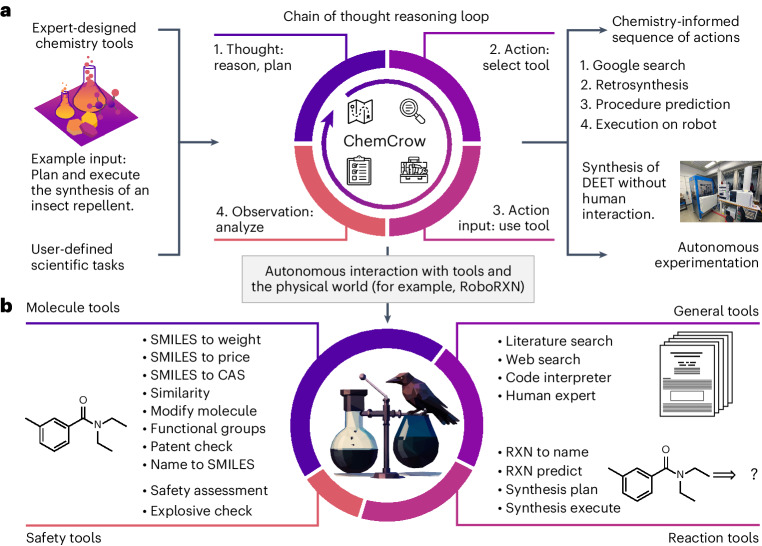
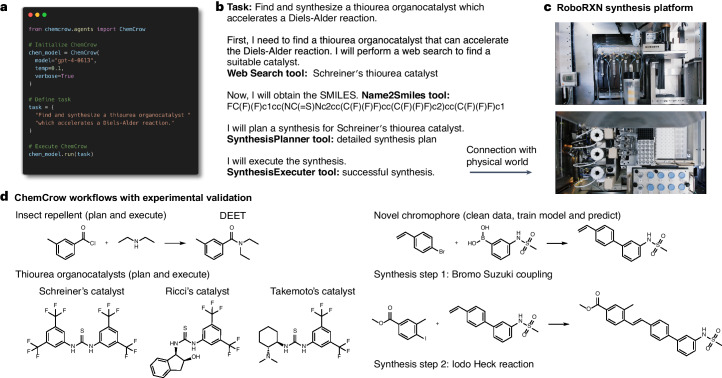
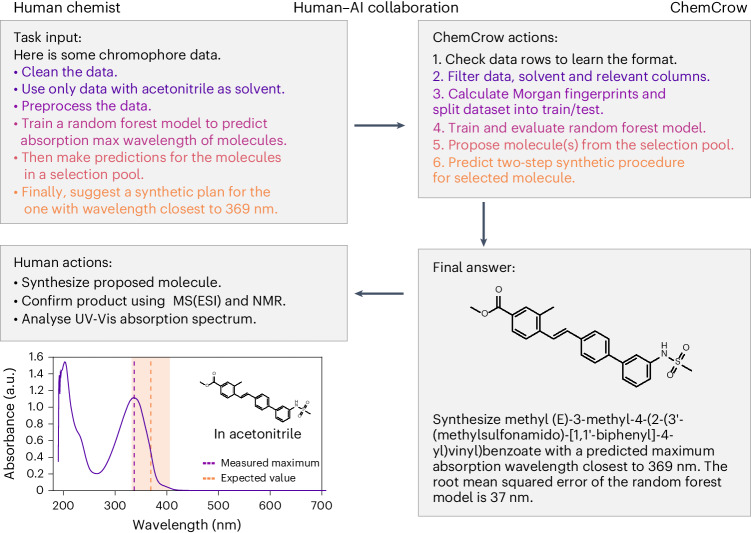
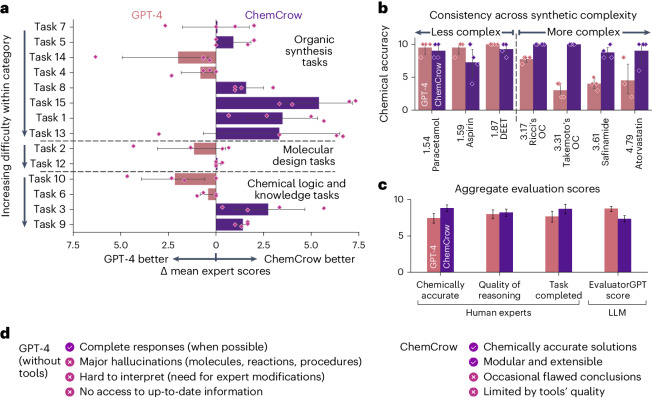
Large language models (LLMs) have shown strong performance in tasks across domains but struggle with chemistry-related problems. These models also lack access to external knowledge sources, limiting their usefulness in scientific applications. We introduce ChemCrow, an LLM chemistry agent designed to accomplish tasks across organic synthesis, drug discovery and materials design. By integrating 18 expert-designed tools and using GPT-4 as the LLM, ChemCrow augments the LLM performance in chemistry, and new capabilities emerge. Our agent autonomously planned and executed the syntheses of an insect repellent and three organocatalysts and guided the discovery of a novel chromophore. Our evaluation, including both LLM and expert assessments, demonstrates ChemCrow’s effectiveness in automating a diverse set of chemical tasks. Our work not only aids expert chemists and lowers barriers for non-experts but also fosters scientific advancement by bridging the gap between experimental and computational chemistry.
Overview
The claims and statistics of this paper haven’t been checked yet.
Free: it reads the open-access text and checks the first 5 claims that cite a source we can check. Create a free account to check every claim.
Integrity signals
Registry
Cites
Statistics
Figures
Verification
Claims the paper makes
The claims and statistics of this paper haven’t been checked yet.
Free: it reads the open-access text and checks the first 5 claims that cite a source we can check. Create a free account to check every claim.
Claims other papers make about this one
Each is checked against this paper’s own text: does it say what the citing paper says it does?
The source backs part of the claim, not all of it — or backs it for a different population, condition or comparison.
In the citing paper
“In parallel, chemistry-oriented reviews have shown that large language models can move beyond text generation toward tool use, retrieval, planning, code execution, and multi-agent coordination [5-10].”
From From Scientific Copilots to Tool-Grounded Autonomy: AI Agents in Simulation-Driven Materials Discovery (2026) · cites this paper as [7]
Experimental — accuracy not yet measuredThe source backs part of the claim, not all of it — or backs it for a different population, condition or comparison.
In the citing paper
“The broader literature on autonomous scientific systems has already argued for more rigorous evaluation protocols and transparent tool interfaces [3,5,7-12].”
From From Scientific Copilots to Tool-Grounded Autonomy: AI Agents in Simulation-Driven Materials Discovery (2026) · cites this paper as [7]
Experimental — accuracy not yet measuredThe source backs part of the claim, not all of it — or backs it for a different population, condition or comparison.
In the citing paper
“In scientific discovery, agents dynamically compose and execute hypothesis-testing pipelines spanning simulations, lab protocols, and data analysis [61, 62, 63, 64].”
From Code as Agent Harness (2026) · cites this paper as [61]
Experimental — accuracy not yet measuredThe source backs part of the claim, not all of it — or backs it for a different population, condition or comparison.
In the citing paper
“ChemCrow [61] similarly integrates RDKit, retrosynthesis engines, and reaction predictors so that an agent can 'execute' a candidate synthesis virtually before committing to a wet-lab run.”
From Code as Agent Harness (2026) · cites this paper as [61]
Experimental — accuracy not yet measuredThe source backs part of the claim, not all of it — or backs it for a different population, condition or comparison.
In the citing paper
“In chemistry, language-model tools, yield predictors, Bayesian optimization, and robotic laboratories provide complementary components for selecting and testing reactions [28, 42-46].”
From RSI-Anything: Unlocking Recursive Self-Improvement with World Models (2026) · cites this paper as [43]
Experimental — accuracy not yet measured
5 more claims about this paper
Create a free account to see every claim other papers make about this one.
Self-check
Percentages, sums and reported differences re-computed from the paper’s own numbers.
The self-check needs the paper’s full text.
Citations
Cites
Vaswani, A., Shazeer, N., Parmar, N., Uszkoreit, J., Jones, L., Gomez, A. N., Kaiser, L., & Polosukhin, I. (2017) · arXiv · doi:10.48550/arxiv.1706.03762 · Cited by 120,404 · cited 1×
“These specialized tools provide exact answers, thereby compensating for the inherent deficiencies of LLMs in specific domains and enhancing their overall performance and applicability.”
BackgroundLanguage Models are Few-Shot Learners
Brown, T. B., Mann, B., Ryder, N., Subbiah, M., Kaplan, J., Dhariwal, P., Neelakantan, A., Shyam, P., Sastry, G., Askell, A., et al. (2020) · arXiv · doi:10.48550/arxiv.2005.14165 · Cited by 23,372 · cited 1×
“…as a field, has been impacted through expert-designed artificial intelligence (AI) systems that tackle specific problems, such as reaction prediction 16–20 , retrosynthesis planning 21–27 , molecular property prediction 28–32 , de-novo molecular generation 33,34 , materials design 35,36 and,…”
BackgroundExtended-Connectivity Fingerprints
Rogers, D., & Hahn, M. (2010) · Journal of Chemical Information and Modeling · doi:10.1021/ci100050t · Cited by 7,524 · cited 1×
“Similarity The primary function of this tool is to evaluate the similarity between two molecules, utilizing the Tanimoto similarity measure 90 based on the ECFP2 molecular fingerprints 91 of the input molecules.”
MethodThe National Center for Biotechnology Information
Benson, D., Boguski, M., Lipman, D. J., & Ostell, J. (1990) · Genomics · doi:10.1016/0888-7543(90)90583-g · Cited by 5,126
LLaMA: Open and Efficient Foundation Language Models
Touvron, H., Lavril, T., Izacard, G., Martinet, X., Lachaux, M.-A., Lacroix, T., Rozière, B., Goyal, N., Hambro, E., Azhar, F., et al. (2023) · arXiv · doi:10.48550/arxiv.2302.13971 · Cited by 4,602 · cited 1×
“…is the lack of reproducibility of individual results under the current API-based approach to LLMs, as closed-source models provide limited control, see Appendix E. Recent open-source models 76–78 offer a potential solution to this issue, albeit with a possible trade-off in reasoning power.”
BackgroundChain-Of-Thought Prompting Elicits Reasoning in Large Language Models
Wei, J., Wang, X., Schuurmans, D., Bosma, M., Ichter, B., Xia, F., Chi, E., Le, Q. V., & Zhou, D. (2022) · Advances in Neural Information Processing Systems 35 · doi:10.52202/068431-1800 · Cited by 4,505
Chain-of-Thought Prompting Elicits Reasoning in Large Language Models
Wei, J., Wang, X., Schuurmans, D., Bosma, M., Ichter, B., Xia, F., Chi, E., Le, Q., & Zhou, D. (2022) · arXiv · doi:10.48550/arxiv.2201.11903 · Cited by 4,263 · cited 1×
“The tools used can be classified into general tools, molecular tools, and chemical reaction tools.”
MethodBillion-scale similarity search with GPUs
Johnson, J., Douze, M., & Jegou, H. (2021) · IEEE Transactions on Big Data · doi:10.1109/tbdata.2019.2921572 · Cited by 4,228
Training language models to follow instructions with human feedback
Ouyang, L., Wu, J., Jiang, X., Almeida, D., Wainwright, C. L., Mishkin, P., Zhang, C., Agarwal, S., Slama, K., Ray, A., et al. (2022) · arXiv · doi:10.48550/arxiv.2203.02155 · Cited by 4,208 · cited 2×
“5 13 cannot consistently and accurately multiply 12345*98765 or convert IUPAC names into the corresponding molecular graph 14 .”
BackgroundBillion-scale similarity search with GPUs
Johnson, J., Douze, M., & Jégou, H. (2017) · arXiv · doi:10.48550/arxiv.1702.08734 · Cited by 4,140 · cited 1×
“The CAS number serves as a precise and universally recognized chemical identifier, enabling researchers to access relevant data and resources with ease, and ensuring that they obtain accurate and consistent information about the target molecule 89 .”
Background
Research works printed but not linked: 4
- Devlin, J., Chang, M.-W., Lee, K. & Toutanova, K. Bert: pre-training of deep bidirectional transformers for language understanding. In Proc. Conference of the North American Chapter of the Association for Computational Linguistics: Human Language Technologies (eds Burstein, J. et al.) 4171–4186 (Association for Computational Linguistics, 2019).
- Li, R. et al. Starcoder: may the source be with you! Trans. Mach. Learn. Res. https://openreview.net/pdf?id=KoFOg41haE (2023).
- Zelikman E Wu Y Mu J Goodman N Star: bootstrapping reasoning with reasoning Adv. Neural Inf. Process. Syst. 2022 35 15476 15488
- Lowe, D. M. Extraction of Chemical Structures and Reactions from the Literature. PhD thesis, Univ. of Cambridge (2012).
Cited by
Items 301–400 of 1,026
Toward self-driving laboratory 2.0 for chemistry and materials discovery
Lee, H., Yoo, H. J., Jang, H. S., Park, B., Park, Y. J., & Han, S. S. (2026) · Materials Horizons · doi:10.1039/d5mh01984b · Cited by 38
IUPAC’s 2023 Top Ten Emerging Technologies in Chemistry
Gomollón‐Bel, F. (2023) · Chemistry International · doi:10.1515/ci-2023-0403 · Cited by 28
SynerGPT: In-Context Learning for Personalized Drug Synergy Prediction and Drug DesignPreprint
Edwards, C., Naik, A., Khot, T., Burke, M. D., Ji, H., & Hope, T. (2023) · bioRxiv (Cold Spring Harbor Laboratory) · doi:10.1101/2023.07.06.547759 · Cited by 35
“Very recently, considerable interest has grown in using language models, particularly GPT-4 [54], for uncovering chemical knowledge and molecular discovery [24, 83, 7, 5, 84, 9], including work in the few-shot setting [59, 27].”
BackgroundZimmermann, Y., Bazgir, A., Afzal, Z., Agbere, F., Ai, Q., Alampara, N., Al‐Feghali, A., Ansari, M., Antypov, D., Aswad, A., et al. (2024) · arXiv (Cornell University) · doi:10.13016/m2bej2-ogic · Cited by 31
Yang, T., Xiao, Y., Bao, Z., Hao, J., & Peng, J. (2025) · Briefings in Bioinformatics · doi:10.1093/bib/bbaf601 · Cited by 34
LLM-guided chemical process optimization with a multi-agent approach
Zeng, T., Badrinarayanan, S., Ock, J., Lai, C.-K., & Farimani, A. B. (2025) · Machine Learning Science and Technology · doi:10.1088/2632-2153/ae2382 · Cited by 40
“For material discovery, LLM-based agents such as ChemCrow [23] have successfully planned and executed syntheses using automated laboratory platforms.”
Vatsal, S., Dubey, H., & Singh, A. (2026) · IEEE Access · doi:10.1109/access.2026.3651218 · Cited by 31
“In discovery, chemistry agents plan syntheses and reason over lab tools as illustrated by ChemCrow [129].”
Rethinking chemical research in the age of large language models
MacKnight, R., Boiko, D. A., Regio, J. E., Gallegos, L. C., Neukomm, T. A., & Gomes, G. (2025) · Nature Computational Science · doi:10.1038/s43588-025-00811-y · Cited by 32
“Importantly, such studies do not incorporate literature search tools, which is a key feature of LLM agents 18,29,54 .”
InfluentialDistilling Knowledge from Catalysis Literature with Long-Context Large Language Model Agents
Chen, H., Liu, H., Tew, Y., Ren, X., Tang, X., & Wang, X. (2025) · ACS Catalysis · doi:10.1021/acscatal.5c06431 · Cited by 29
Process-Centric Analysis of Agentic Software Systems
Liu, S., Chen, Y., Krishna, R., Sinha, S., Ganhotra, J., & Jabbarvand, R. (2026) · Proceedings of the ACM on Programming Languages · doi:10.1145/3798271 · Cited by 44
The elephant in the lab: synthesizability in generative small-molecule design
Papidocha, S. M., Burger, A., Bernales, V., & Aspuru‐Guzik, A. (2025) · Current Opinion in Chemical Engineering · doi:10.1016/j.coche.2025.101217 · Cited by 31
Sprueill, H. W., Edwards, C., Olarte, M. V., Sanyal, U., Ji, H., & Choudhury, S. (2023) · Findings of the Association for Computational Linguistics: EMNLP (Findings of EMNLP) · doi:10.18653/v1/2023.findings-emnlp.560 · Cited by 37
PatCID: an open-access dataset of chemical structures in patent documents
Morin, L., Weber, V., Meijer, G. I., Yu, F., & Staar, P. (2024) · Nature Communications · doi:10.1038/s41467-024-50779-y · Cited by 26
From RAG to QA-RAG: Integrating Generative AI for Pharmaceutical Regulatory Compliance Process
Kim, J., Hur, M., & Min, M. (2025) · Proceedings of the 40th ACM/SIGAPP Symposium on Applied Computing · doi:10.1145/3672608.3707749 · Cited by 25
Corradi, M., Luechtefeld, T. H., de Haan, A. M., Pieters, R. H. H., Freedman, J. H., Vanhaecke, T., Vinken, M., & Teunis, M. (2024) · Frontiers in Toxicology · doi:10.3389/ftox.2024.1393662 · Cited by 27
chatHPC: Empowering HPC users with large language models
Yin, J., Hines, J., Herron, E., Ghosal, T., Liu, H., Prentice, S., Lama, V., & Wang, F. (2024) · The Journal of Supercomputing · doi:10.1007/s11227-024-06637-1 · Cited by 33
Leveraging large language models for peptide antibiotic design
Guan, C., Fernandes, F. C., Franco, O. L., & de la Fuente‐Núñez, C. (2024) · Cell Reports Physical Science · doi:10.1016/j.xcrp.2024.102359 · Cited by 35
Choudhary, K. K. (2025) · The Journal of Physical Chemistry Letters · doi:10.1021/acs.jpclett.4c03137 · Cited by 25
Augmented and Programmatically Optimized LLM Prompts Reduce Chemical Hallucinations
Reed, S. M. (2025) · Journal of Chemical Information and Modeling · doi:10.1021/acs.jcim.4c02322 · Cited by 30
Wong, K., Arruda, T. R., Butler, K. T., Guldin, S., & Schrettl, S. (2025) · Current Opinion in Colloid & Interface Science · doi:10.1016/j.cocis.2025.101937 · Cited by 25
El Agente Quntur: A research collaborator agent for quantum chemistry
Pérez-Sánchez, J. B., Zou, Y., Campos-Gonzalez-Angulo, J. A., Müller, M., Gustín, I., Wang, A., Hao, H., Ko, T. W., Choi, C., Isbrandt, E. S., et al. (2026) · Chem · doi:10.1016/j.chempr.2026.103259 · Cited by 32
General-Purpose Models for the Chemical Sciences: LLMs and Beyond
Alampara, N., Aneesh, A., Ríos-García, M., Mirza, A., Schilling-Wilhelmi, M., Aghajani, A. A., Sun, M., Prastalo, G., & Jablonka, K. M. (2026) · Chemical Reviews · doi:10.1021/acs.chemrev.5c00583 · Cited by 37
Reactive Machine Learning Interatomic Potentials for Chemistry and Materials Science
Kim, J., Cho, H., Jeon, H., Jung, J., & Han, S. (2026) · Chemical Reviews · doi:10.1021/acs.chemrev.5c00728 · Cited by 40
ReLM: Leveraging Language Models for Enhanced Chemical Reaction Prediction
Shi, Y., Zhang, A., Zhang, E., Liu, Z., & Wang, X. (2023) · Findings of the Association for Computational Linguistics: EMNLP (Findings of EMNLP) · doi:10.18653/v1/2023.findings-emnlp.366 · Cited by 37
Designing workflows for materials characterization
Kalinin, S. V., Ziatdinov, M. A., Ahmadi, M., Ghosh, A., Roccapriore, K. M., Liu, Y., & Vasudevan, R. K. (2024) · Applied Physics Reviews · doi:10.1063/5.0169961 · Cited by 31
Who&When Pro: Can LLMs Really Attribute Failures in AI Agents?Preprint
Liu, J., Xi, H., Zhang, S., Zeng, Y., Yue, T., Wang, C., Kang, J., Wu, Q., & Wang, H. (2026) · arXiv (Cornell University) · doi:10.48550/arxiv.2607.09996 · Cited by 27
Toward Automated Simulation Research Workflow through LLM Prompt Engineering Design
Liu, Z., Chai, Y., & Li, J. (2025) · Journal of Chemical Information and Modeling · doi:10.1021/acs.jcim.4c01653 · Cited by 24
PiNN: Equivariant Neural Network Suite for Modeling Electrochemical Systems
Li, J., Knijff, L., Zhang, Z., Andersson, L., & Zhang, C. (2025) · Journal of Chemical Theory and Computation · doi:10.1021/acs.jctc.4c01570 · Cited by 25
Shi, Z., Xin, C., Huo, T., Jiang, Y., Wu, B., Chen, X., Qin, W. D., Ma, X., Huang, G., Wang, Z., et al. (2025) · Scientific Reports · doi:10.1038/s41598-025-92337-6 · Cited by 45
“ChemCrow 21 leverages API tools to tackle chemistry-related problems, and HoneyComb 22 explores LLM-based agent systems for materials science, albeit without fine-tuning.”
RePower: An LLM-driven autonomous platform for power system data-guided research
Liu, Y., Jia, M., Zhang, Y., Wang, J., He, G., Zhong, S., & Dang, Z. (2025) · Patterns · doi:10.1016/j.patter.2025.101211 · Cited by 24
BatGPT-Chem: A Foundation Large Model for Chemical Engineering
Yang, Y., Shi, R., Li, Z., Jiang, S., Lu, B., Zhao, Q., Yang, Y., & Zhao, H. (2025) · Research · doi:10.34133/research.0827 · Cited by 34
Yao, T., Yang, Y., Cai, J., Liu, R., Dong, Z., Tang, X., Shao, X., Gao, Z., An, G., & Yang, W. (2025) · Journal of Magnesium and Alloys · doi:10.1016/j.jma.2025.08.021 · Cited by 29
How Far Are AI Scientists from Changing the World? A Survey of Autonomous Scientific Discovery
Xie, Q., Weng, Y., Zhu, M., 方俊英, Shen, F., Huang, S., Lin, Z., Wang, Z., Li, S., Zhou, J., et al. (2026) · Conference on Empirical Methods in Natural Language Processing (EMNLP) · doi:10.48550/arxiv.2507.23276 · Cited by 24
Operating advanced scientific instruments with AI agents that learn on the job
Vriza, A., Prince, M. H., Zhou, T., Chan, H., & Cherukara, M. J. (2026) · npj Computational Materials · doi:10.1038/s41524-026-02005-0 · Cited by 42
“15,16 19 These systems draw inspiration from human scientific discovery processes and are designed to complement human creativity and expertise with AI's ability to analyze vast datasets, navigate hypothesis spaces and execute repetitive tasks.”
L+M-24: Building a Dataset for Language+Molecules @ ACL 2024
Edwards, C., Wang, Q., Zhao, L., & Ji, H. (2024) · doi:10.18653/v1/2024.langmol-1.1 · Cited by 43
Smith, N. S. S., Yuan, X., Melissinos, C., & Moghe, G. D. (2024) · Bioinformatics · doi:10.1093/bioinformatics/btae756 · Cited by 24
“Similarly, LLMs enhanced with explicit chemistry knowledge outper-formed others in chemistry-related tasks, including organic synthesis and the discovery of novel chromophores (Bran et al. 2024).”
Velasco, P. Q., Hippalgaonkar, K., & Ramalingam, B. (2025) · Beilstein Journal of Organic Chemistry · doi:10.3762/bjoc.21.3 · Cited by 29
Yao, L., Samantray, S., Ghosh, A., Roccapriore, K. M., Kovarik, L., Allec, S. I., & Ziatdinov, M. A. (2025) · arXiv (Cornell University) · doi:10.48550/arxiv.2508.06569 · Cited by 30
Toward Greater Autonomy in Materials Discovery Agents: Unifying Planning, Physics, and Scientists
Zhou, L., Ling, H., Yan, K., Zhao, K., Qian, X., Arróyave, R., Qian, X., & Ji, S. (2026) · Transactions on machine learning research · doi:10.48550/arxiv.2506.05616 · Cited by 26
“Systems such as ChemCrow [21] enable autonomous chemical synthesis by combining LLMs with several chemistry tools.”
El Agente Gráfico: A Semantic Execution Runtime for Scientific AgentsPreprint
Bai, J., Aldossary, A., Swanick, T., Müller, M., Kang, Y., Choi, C., Yoshikawa, N., Zhang, Z., Lee, J. W., Ko, T. W., et al. (2026) · arXiv (Cornell University) · doi:10.48550/arxiv.2602.17902 · Cited by 26
Artificial Intelligence Index Report 2026Preprint
Sajadieh, S., Fattorini, L., Perrault, R., Gil, Y., Parli, V., Santarlasci, L., Pava, J., Maslej, N., Altman, R. B., Brynjolfsson, E., et al. (2026) · arXiv (Cornell University) · doi:10.48550/arxiv.2606.15708 · Cited by 50
Executable Code Actions Elicit Better LLM Agents
Wang, X., Chen, Y., Yuan, L., Zhang, Y., Li, Y., Peng, H., & Ji, H. (2024) · arXiv · doi:10.48550/arxiv.2402.01030 · Cited by 23
How deep do large language models internalize scientific literature and citation practices?
Algaba, A., Holst, V., Tori, F., Mobini, M., Verbeken, B., Wenmackers, S., & Ginis, V. (2026) · Quantitative Science Studies · doi:10.1162/qss.a.502 · Cited by 27
Kim, Y.-H., Doo, H., Shin, D., Lee, S. Y., Roh, Y., Park, S., Song, H., Jung, Y., Yoo, H. J., Han, S. S., et al. (2025) · Computers & Chemical Engineering · doi:10.1016/j.compchemeng.2025.109266 · Cited by 25
Hassouna, A. B., Chaari, H., & Belhaj, I. (2025) · Information Fusion · doi:10.1016/j.inffus.2025.103865 · Cited by 29
“…(Toolformer [38], Confucius [39], ToolAlpaca [40], Gorilla [41], ToolLLM [42], GPT4Tools [43]), memory management (ChatDB [23]), planning (Chameleon [8], LLM+P [44]), chemistry applications (ChemCrow [12]), security (LLMSafeGuard [45]), and proprietary systems (ChatGPT 4o and ChatGPT 4o mini).”
InfluentialHuang, P., Liu, W., Sun, C., Li, Z., Wang, Y., & Chen, Y. (2025) · Materials Genome Engineering Advances · doi:10.1002/mgea.70036 · Cited by 23
Jiang, P., Wang, C., She, W., Ye, W., Li, Y., Ji, T., Mu, L., Lu, X., & Zhu, J. (2025) · Renewable and Sustainable Energy Reviews · doi:10.1016/j.rser.2025.116439 · Cited by 27
iDesignGPT enhances conceptual design via large language model agentic workflows
Liu, S., Shen, Y., Zhang, Y., Hou, Z., Wang, X., Luo, J., & Zhang, Z. (2026) · Nature Communications · doi:10.1038/s41467-026-68672-1 · Cited by 31
Pagel, S., Jirásek, M., & Cronin, L. (2026) · Communications Chemistry · doi:10.1038/s42004-026-01993-w · Cited by 27
A Survey on the Optimization of Large Language Model-based Agents
Du, S., Zhao, J., Shi, J., Xie, Z., Jiang, X., Bai, Y., & He, L. (2025) · arXiv · doi:10.48550/arxiv.2503.12434 · Cited by 22
“SWE-Agent [183] and CodeAgent [203] enhance repository-wide code navigation, retrieval, and modification by integrating programming tools for automated testing and execution, which allow agents to operate beyond code generation, supporting repository-level understanding and iterative refinement.”
Cheng, A., Ser, C. T., Skreta, M., Guzmán-Cordero, A., Thiede, L., Burger, A., Aldossary, A., Leong, S. X., Pablo‐García, S., Strieth‐Kalthoff, F., et al. (2025) · Faraday Discussions · doi:10.1039/d4fd00153b · Cited by 29
Large Language Models (LLMs) for Materials Design
Zhang, L., Liu, Z., Ni, B., & Wang, Q. (2025) · Advanced Functional Materials · doi:10.1002/adfm.202525897 · Cited by 36
Huang, J., Teng, Y., Liu, Q., Gao, L., Li, X., Zhang, C., & Xu, G. (2025) · npj Advanced Manufacturing · doi:10.1038/s44334-025-00061-w · Cited by 22
“In recent years, with the increasing application of large language models (LLMs) across various domains 37 – 43 , manufacturing systems have increasingly relied on AI to enhance quality, productivity, and overall performance 44 .”
Ghafarollahi, A., & Buehler, M. J. (2026) · npj Computational Materials · doi:10.1038/s41524-026-02205-8 · Cited by 26
“LLM-basedmulti-agentframeworkshavedemonstratedearlypromisein acceleratingscienti fi c discovery across domains including AI 40 , chemistry 41 , biomaterials 31,42,43 , and alloy design 44,45 .”
Cesaro, A., & de la Fuente‐Núñez, C. (2023) · Nature Chemical Biology · doi:10.1038/s41589-023-01448-6 · Cited by 23
Signals in the Cells: Multimodal and Contextualized Machine Learning Foundations for TherapeuticsPreprint
Velez-Arce, A., Lin, X., Li, M. M., Huang, K., Gao, W., Fu, T., Pentelute, B. L., Kellis, M., & Žitnik, M. (2024) · bioRxiv (Cold Spring Harbor Laboratory) · doi:10.1101/2024.06.12.598655 · Cited by 30
“Out-of-distribution (OOD) generalization [5] and incorporation of novel tools [6] and modalities [4, 7] remain as challenges for biomedical machine learning models across a broad range of tasks.”
InfluentialVoxelPrompt: A Vision Agent for End-to-End Medical Image AnalysisPreprint
Hoopes, A., Dey, N., Butoi, V. I., Guttag, J. V., & Dalca, A. V. (2024) · arXiv (Cornell University) · doi:10.48550/arxiv.2410.08397 · Cited by 25
AI and the Future of Academic Peer ReviewPreprint
Mann, S. P., Aboy, M., Seah, J. J., Lin, Z., Luo, X., Rodger, D., Zohny, H., Minssen, T., Savulescu, J., & Earp, B. D. (2025) · arXiv (Cornell University) · doi:10.48550/arxiv.2509.14189 · Cited by 35
LAB-Bench: Measuring Capabilities of Language Models for Biology Research
Laurent, J. M., Janizek, J. D., Ruzo, M., Hinks, M. M., Hammerling, M. J., Narayanan, S., Ponnapati, M., White, A. D., & Rodriques, S. G. (2024) · arXiv · doi:10.48550/arxiv.2407.10362 · Cited by 21
“Domain-or application-specific evaluation strategies will be particularly important as AI systems are increasingly used as functional tools in specific areas, including scientific research [5, 31].”
BackgroundSelf-citationTool Learning in the Wild: Empowering Language Models as Automatic Tool Agents
Shi, Z., Gao, S., Yan, L., Feng, Y., Chen, X., Chen, Z., Yin, D., Verberne, S., & Ren, Z. (2025) · Proceedings of the ACM on Web Conference 2025 · doi:10.1145/3696410.3714825 · Cited by 21
Artificial intelligence-driven advances in photocatalytic hydrogen production
de Araujo, L. G., & Farrusseng, D. (2025) · New Journal of Chemistry · doi:10.1039/d5nj00505a · Cited by 21
Automating traffic model enhancement with AI research agent
Guo, X., Yang, X., Peng, M., Lu, H., Zhu, M., & Yang, H. (2025) · Transportation Research Part C Emerging Technologies · doi:10.1016/j.trc.2025.105187 · Cited by 30
Building hybrid AI models in chemical engineering: A tutorial review
Chakraborty, A., Taskiran, N. P., Kottooru, R., Mann, V., & Venkatasubramanian, V. (2025) · Computers & Chemical Engineering · doi:10.1016/j.compchemeng.2025.109236 · Cited by 23
Khoo, T. L., Lee, T. S., Bee, S., Ma, C., & Zhang, Y.-Y. (2025) · Processes · doi:10.3390/pr13092680 · Cited by 23
Large Language Model Agent for Managing Patients With Suspected Hypertension
Wang, Y., Tan, W., Cheng, S., Peng, C., Jin, P. K., Qin, F., Tang, L., Zhu, T., Wu, B., Liu, J., et al. (2025) · Hypertension · doi:10.1161/hypertensionaha.125.25305 · Cited by 21
Diefenbacher, S., Hallin, A., Kasieczka, G., Krämer, M., Lauscher, A., & Lukas, T. (2026) · SciPost Physics · doi:10.21468/scipostphys.20.3.091 · Cited by 23
HoneyBee: Progressive Instruction Finetuning of Large Language Models for Materials Science
Song, Y., Miret, S., Zhang, H., & Liu, B. (2023) · Findings of the Association for Computational Linguistics: EMNLP (Findings of EMNLP) · doi:10.18653/v1/2023.findings-emnlp.380 · Cited by 42
Schmid, S. P., Schlosser, L., Glorius, F., & Jorner, K. (2024) · Beilstein Journal of Organic Chemistry · doi:10.3762/bjoc.20.196 · Cited by 22
Wang, Y., Guo, M., Chen, X., & Ai, D. (2025) · Scientific Reports · doi:10.1038/s41598-025-86840-z · Cited by 24
A Survey of Pre-trained Language Models for Processing Scientific TextPreprint
Ho, X., Nguyen, A.-K. D., Dao, A., Jiang, J., Chida, Y., Sugimoto, K., To, H. Q., Boudin, F., & Aizawa, A. (2024) · arXiv · doi:10.48550/arxiv.2401.17824 · Cited by 26
A Human-Like Reasoning Framework for Multi-Phases Planning Task with Large Language ModelsPreprint
Xie, C., & Zou, D. (2024) · arXiv (Cornell University) · doi:10.48550/arxiv.2405.18208 · Cited by 29
“In addition, multi-agent systems have been effectively employed for reasoning in embodied environments [9, 61] and have demonstrated their potential in scientific research [4, 5].”
BackgroundMachine Learning in Homogeneous Catalysis: Basic Concepts and Best Practices
Dalmau, D., García‐Abellán, S., & Alegre-Requena, J. V. (2025) · ACS Catalysis · doi:10.1021/acscatal.5c06439 · Cited by 23
“Promising results have already been reported by the teams of Gomes, 70 White, 71 Laino, 72 and Schwaller, 73 among others.”
From Question Answering to Task Completion: A Survey on Agent System and Harness DesignPreprint
Guo, J., Hao, Z., Wang, C., Fan, C., Luo, T., Li, H., Gao, Y., Mei, H., Peng, J., Xu, R., et al. (2026) · Preprints.org · doi:10.20944/preprints202606.1312.v1 · Cited by 22
Machine learning-assisted retrosynthesis planning: Current status and future prospects
Wei, Y., Shan, L., Qiu, T., Lu, D., & Liu, Z. (2024) · Chinese Journal of Chemical Engineering · doi:10.1016/j.cjche.2024.10.014 · Cited by 22
Liu, S., Wen, T., Ye, B., Li, Z., Liu, H., Ren, Y., & Srolovitz, D. J. (2025) · Digital Discovery · doi:10.1039/d5dd00061k · Cited by 28
Hynek, N. (2025) · AI & Society · doi:10.1007/s00146-025-02576-4 · Cited by 25
Synthesis-Aware Materials Redesign via Large Language Models
Choi, J., Kim, S.-M., & Jung, Y. (2025) · Journal of the American Chemical Society · doi:10.1021/jacs.5c07743 · Cited by 25
Towards greener-by-design fine chemicals. Part 2: technological frontiers
Gazis, T. A., Teixeira, R. I., Volpin, G., Yewale, A., Ince, M. C., Ford, M. J., Harmsen, J., Uboldi, M., Melocchi, A., Sponchioni, M., et al. (2026) · Chemical Society Reviews · doi:10.1039/d5cs00930h · Cited by 23
Qi, M., Zhu, T., Zhang, L., Li, N., Tan, Y., & Zhou, W. (2026) · IEEE Transactions on Network Science and Engineering · doi:10.1109/tnse.2026.3659486 · Cited by 28
Ahlawat, D. K., Mishra, V., Singh, S., Zaki, M. F. M., Bihani, V., Grover, H. S., Mishra, B., Miret, S., Mausam, & Krishnan, N. M. A. (2026) · Nature Machine Intelligence · doi:10.1038/s42256-026-01199-8 · Cited by 33
The need for verification in artificial intelligence-driven scientific discovery
Cornelio, C., Ito, T., Cory-Wright, R., Dash, S., & Horesh, L. (2026) · Philosophical Transactions of the Royal Society A Mathematical Physical and Engineering Sciences · doi:10.1098/rsta.2024.0591 · Cited by 24
Hatakeyama‐Sato, K., Watanabe, S., Yamane, N., Igarashi, Y., & Oyaizu, K. (2023) · Digital Discovery · doi:10.1039/d3dd00138e · Cited by 23
Li, M., & Zhang, J. (2023) · Chemical Science · doi:10.1039/d3sc90185h · Cited by 21
Lu, M., Gao, F., Tang, X., & Chen, L. (2024) · iScience · doi:10.1016/j.isci.2024.109451 · Cited by 23
Can large language models predict antimicrobial peptide activity and toxicity?
Orsi, M., & Reymond, J. (2024) · RSC Medicinal Chemistry · doi:10.1039/d4md00159a · Cited by 24
Learning to Use Tools via Cooperative and Interactive Agents
Shi, Z., Gao, S., Chen, X., Feng, Y., Yan, L., Shi, H., Yin, D., Ren, P., Verberne, S., & Ren, Z. (2024) · Findings of the Association for Computational Linguistics: EMNLP (Findings of EMNLP) · doi:10.18653/v1/2024.findings-emnlp.624 · Cited by 50
GenoTEX: An LLM Agent Benchmark for Automated Gene Expression Data AnalysisPreprint
Liu, H., Chen, S., Zhang, Y., & Wang, H. (2024) · arXiv (Cornell University) · doi:10.48550/arxiv.2406.15341 · Cited by 26
Agentic Services ComputingPreprint
Deng, S.-G., Zhao, H.-L., Wang, Z.-Q., Cheng, G., Chen, P., Qian, W.-Z., Ling, Z.-W., Yin, J.-W., Zomaya, A. Y., & Dustdar, S. (2025) · arXiv.org · doi:10.48550/arxiv.2509.24380 · Cited by 10
“These findings highlight the critical need for risk-sensitive evaluation frameworks that support proactive safety assurance and institutional accountability.”
BioAgents: Bridging the gap in bioinformatics analysis with multi-agent systems
Mehandru, N., Hall, A. K., Melnichenko, O., Dubinina, Y., Tsirulnikov, D., Bamman, D., Alaa, A., Saponas, S., & Malladi, V. S. (2025) · Scientific Reports · doi:10.1038/s41598-025-25919-z · Cited by 19
“While existing multi-agent systems primarily rely on large language models 24,32,33 , we leveraged a smaller, more efficient language model, Phi-3 34 .”
Modular large language model agents for multi-task computational materials science
Chaudhari, A., Ock, J., & Barati Farimani, A. (2026) · Communications Materials · doi:10.1038/s43246-025-00994-x · Cited by 19
Hu, X., Chen, S., Chen, L., Wang, H., Zhang, X., & Zhou, Z. (2025) · National Science Review · doi:10.1093/nsr/nwaf372 · Cited by 19
“LLM agents [19 ] serve as intelligent systems that bridge the gap between LLMs and practical applications, making significant impacts in various fields like human behavior simulation [20 ], chemistry [21 –24 ], bioinformatics [25 ] and paper searching [26 ].”
Chiang, Y., Hsieh, E., Chou, C.-H., & Riebesell, J. (2024) · arXiv · doi:10.48550/arxiv.2401.17244 · Cited by 19
“ChemCrow [23] gathers multiple molecule and safety tools to enhance organic chemistry experiment and molecule design.”
BackgroundTxAgent: An AI Agent for Therapeutic Reasoning Across a Universe of Tools
Gao, S., Zhu, R., Kong, Z., Noori, A., Su, X., Ginder, C., Tsiligkaridis, T., & Zitnik, M. (2025) · arXiv · doi:10.48550/arxiv.2503.10970 · Cited by 19
AI and automation: democratizing automation and the evolution towards true AI-autonomous robotics
Takahashi, L., Kuwahara, M., & TAKAHASHI, K. G. (2025) · Chemical Science · doi:10.1039/d5sc03183d · Cited by 26
“59,60 ,64 – 66 Other examples include ChemCrow, which is used to handle multi-step tasks such as synthesis planning and execution, and ChatMOF, which is designed to handle metal – organic framework (MOF)-speci c research.”
Automation and AI-Powered Prediction in Chromatographic Separation
Liu, C., & Mo, F. (2025) · Accounts of Chemical Research · doi:10.1021/acs.accounts.5c00677 · Cited by 21
Wang, H., Chen, J., Liu, W., Wang, D., Song, Y., Hong, H., Wang, T., Anastas, P. T., & Zimmerman, J. B. (2026) · Chemical Reviews · doi:10.1021/acs.chemrev.5c00828 · Cited by 20
AI agents for solid electrolytes: opportunities, challenges, and future directions
Wang, Q., Sato, R., García-Méndez, R., Jang, W., Ou, P., Soon, A., Zhao, J., Wang, X., Orimo, S.-I., & Cheng, E. J. (2025) · AI Agent · doi:10.20517/aiagent.2025.10 · Cited by 21
Large language model agent as a mechanical designer
Jadhav, Y., & Farimani, A. B. (2026) · Journal of Engineering Design · doi:10.1080/09544828.2026.2624356 · Cited by 32
The Virtual Biotech: A multi-agent AI framework for therapeutic discovery and development
Zhang, H. G., Eckmann, P., Miao, J., Mahon, A. B., & Zou, J. (2026) · Science · doi:10.1126/science.aeg6779 · Cited by 6
Active Learning of Ligands That Enhance Perovskite Nanocrystal Luminescence
Kim, M. A., Ai, Q., Norquist, A. J., Schrier, J., & Chan, E. M. (2024) · ACS Nano · doi:10.1021/acsnano.4c02094 · Cited by 19
Metadata
- Authors
- M. Bran, A., Cox, S., Schilter, O., Baldassari, C., White, A. D., & Schwaller, P.
- Affiliations
- Future House, Inc. (US)
- IBM Research - Zurich (CH)
- NCCR Catalysis (CH)
- Corresponding author
- White, Andrew D.
- Schwaller, Philippe
- Venue
- Nature Machine Intelligence
- Published
- 2024-05-08
- Volume
- 6
- Issue
- 5
- Pages
- 525-535
- ISSN
- 2522-5839 (ISSN-L)
- PMC
- PMC11116106
- OpenAlex
- W4396723768
- Cited by
- 794
- References
- 76
- Citations by year
- 2026: 395 · 2025: 305 · 2024: 83
- FWCI
- 76.42
- Type
- journal article
- Language
- en
- Open access
- hybrid
- doi.org
- Licence
- cc-by
- creativecommons.org/licenses/by/4.0 (tdm)
- creativecommons.org/licenses/by/4.0 (vor)
- Locations
- Nature Machine Intelligence (publishedVersion, cc-by)
- PubMed Central (publishedVersion, cc-by-nd)
- PubMed (publishedVersion)
- Infoscience (Ecole Polytechnique Fédérale de Lausanne) (submittedVersion, cc-by-nc-nd)
- Funders
- Schweizerischer Nationalfonds zur Förderung der Wissenschaftlichen Forschung (180544)
- National Science Foundation (1751471)
- Topics
- Physical Sciences › Materials Science › Materials Chemistry › Machine Learning in Materials Science
- Life Sciences › Pharmacology, Toxicology and Pharmaceutics › Drug Discovery › Computational Drug Discovery Methods
- Physical Sciences › Computer Science › Artificial Intelligence › Artificial Intelligence Applications
- Keywords
- large language models, GPT-4, organic synthesis planning, drug discovery, materials design, organocatalysts
About these checks
Registry, retraction, Cites and statistics results are computed, not judged, with one exception: a printed reference that no index lists is read once by a model before it counts as a citation error. Claims are extracted by a model and kept only when their quote appears verbatim in the text; each cited source is then checked, with a model’s help, for whether it says what the claim relies on. Those verdicts can be wrong — read the claim’s quote and the cited source before relying on one.
Statistics and arithmetic are recomputed, not judged.
Confidence bands are shown only for fields calibrated on our annotated test set. None is calibrated yet, so no band is shown.
What counts as a claim ›How we measure confidence ›How we check this ›
Are you an author, or do you see a problem with this page? Request a review
Data sources
Bibliographic data: Semantic Scholar, OpenAlex, Crossref.
Contains information from the Semantic Scholar Academic Graph Datasets, made available under the ODC Attribution License (ODC-BY 1.0).
Semantic Scholar’s data is described in: Kinney, R., et al. (2023). The Semantic Scholar Open Data Platform. arXiv:2301.10140.
