

Augmenting large language models with chemistry tools
Open accessThe DOI matches its Crossref record; 94 of the 94 references it cites were found in a registry or an index.
Abstract
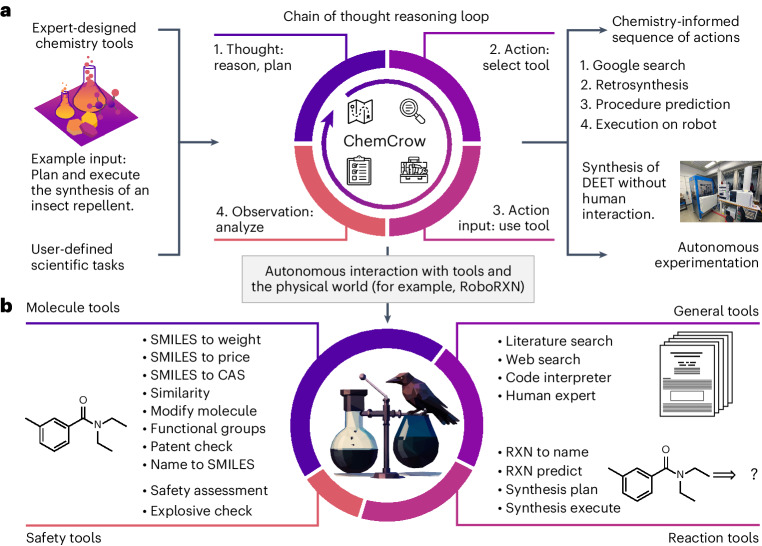
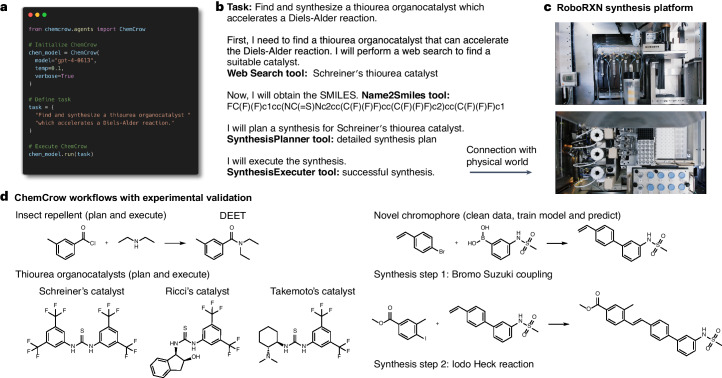
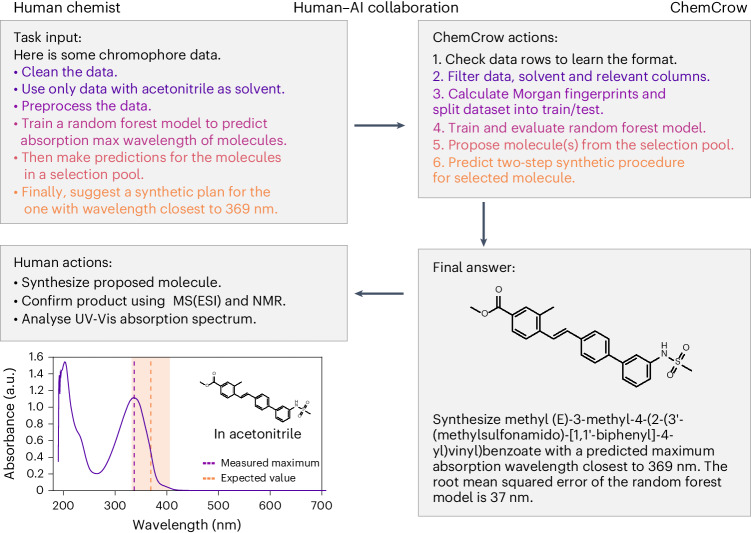
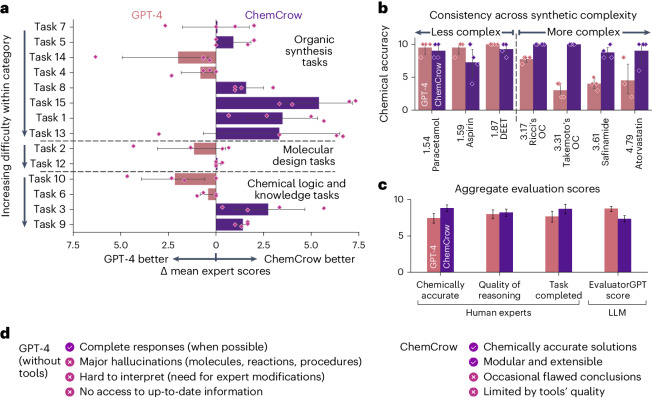
Large language models (LLMs) have shown strong performance in tasks across domains but struggle with chemistry-related problems. These models also lack access to external knowledge sources, limiting their usefulness in scientific applications. We introduce ChemCrow, an LLM chemistry agent designed to accomplish tasks across organic synthesis, drug discovery and materials design. By integrating 18 expert-designed tools and using GPT-4 as the LLM, ChemCrow augments the LLM performance in chemistry, and new capabilities emerge. Our agent autonomously planned and executed the syntheses of an insect repellent and three organocatalysts and guided the discovery of a novel chromophore. Our evaluation, including both LLM and expert assessments, demonstrates ChemCrow’s effectiveness in automating a diverse set of chemical tasks. Our work not only aids expert chemists and lowers barriers for non-experts but also fosters scientific advancement by bridging the gap between experimental and computational chemistry.
Overview
The claims and statistics of this paper haven’t been checked yet.
Free: it reads the open-access text and checks the first 5 claims that cite a source we can check. Create a free account to check every claim.
Integrity signals
Registry
Cites
Statistics
Figures
Verification
Claims the paper makes
The claims and statistics of this paper haven’t been checked yet.
Free: it reads the open-access text and checks the first 5 claims that cite a source we can check. Create a free account to check every claim.
Claims other papers make about this one
Each is checked against this paper’s own text: does it say what the citing paper says it does?
The source backs part of the claim, not all of it — or backs it for a different population, condition or comparison.
In the citing paper
“In parallel, chemistry-oriented reviews have shown that large language models can move beyond text generation toward tool use, retrieval, planning, code execution, and multi-agent coordination [5-10].”
From From Scientific Copilots to Tool-Grounded Autonomy: AI Agents in Simulation-Driven Materials Discovery (2026) · cites this paper as [7]
Experimental — accuracy not yet measuredThe source backs part of the claim, not all of it — or backs it for a different population, condition or comparison.
In the citing paper
“The broader literature on autonomous scientific systems has already argued for more rigorous evaluation protocols and transparent tool interfaces [3,5,7-12].”
From From Scientific Copilots to Tool-Grounded Autonomy: AI Agents in Simulation-Driven Materials Discovery (2026) · cites this paper as [7]
Experimental — accuracy not yet measuredThe source backs part of the claim, not all of it — or backs it for a different population, condition or comparison.
In the citing paper
“In scientific discovery, agents dynamically compose and execute hypothesis-testing pipelines spanning simulations, lab protocols, and data analysis [61, 62, 63, 64].”
From Code as Agent Harness (2026) · cites this paper as [61]
Experimental — accuracy not yet measuredThe source backs part of the claim, not all of it — or backs it for a different population, condition or comparison.
In the citing paper
“ChemCrow [61] similarly integrates RDKit, retrosynthesis engines, and reaction predictors so that an agent can 'execute' a candidate synthesis virtually before committing to a wet-lab run.”
From Code as Agent Harness (2026) · cites this paper as [61]
Experimental — accuracy not yet measuredThe source backs part of the claim, not all of it — or backs it for a different population, condition or comparison.
In the citing paper
“In chemistry, language-model tools, yield predictors, Bayesian optimization, and robotic laboratories provide complementary components for selecting and testing reactions [28, 42-46].”
From RSI-Anything: Unlocking Recursive Self-Improvement with World Models (2026) · cites this paper as [43]
Experimental — accuracy not yet measured
5 more claims about this paper
Create a free account to see every claim other papers make about this one.
Self-check
Percentages, sums and reported differences re-computed from the paper’s own numbers.
The self-check needs the paper’s full text.
Citations
Cites
Vaswani, A., Shazeer, N., Parmar, N., Uszkoreit, J., Jones, L., Gomez, A. N., Kaiser, L., & Polosukhin, I. (2017) · arXiv · doi:10.48550/arxiv.1706.03762 · Cited by 120,404 · cited 1×
“These specialized tools provide exact answers, thereby compensating for the inherent deficiencies of LLMs in specific domains and enhancing their overall performance and applicability.”
BackgroundLanguage Models are Few-Shot Learners
Brown, T. B., Mann, B., Ryder, N., Subbiah, M., Kaplan, J., Dhariwal, P., Neelakantan, A., Shyam, P., Sastry, G., Askell, A., et al. (2020) · arXiv · doi:10.48550/arxiv.2005.14165 · Cited by 23,372 · cited 1×
“…as a field, has been impacted through expert-designed artificial intelligence (AI) systems that tackle specific problems, such as reaction prediction 16–20 , retrosynthesis planning 21–27 , molecular property prediction 28–32 , de-novo molecular generation 33,34 , materials design 35,36 and,…”
BackgroundExtended-Connectivity Fingerprints
Rogers, D., & Hahn, M. (2010) · Journal of Chemical Information and Modeling · doi:10.1021/ci100050t · Cited by 7,524 · cited 1×
“Similarity The primary function of this tool is to evaluate the similarity between two molecules, utilizing the Tanimoto similarity measure 90 based on the ECFP2 molecular fingerprints 91 of the input molecules.”
MethodThe National Center for Biotechnology Information
Benson, D., Boguski, M., Lipman, D. J., & Ostell, J. (1990) · Genomics · doi:10.1016/0888-7543(90)90583-g · Cited by 5,126
LLaMA: Open and Efficient Foundation Language Models
Touvron, H., Lavril, T., Izacard, G., Martinet, X., Lachaux, M.-A., Lacroix, T., Rozière, B., Goyal, N., Hambro, E., Azhar, F., et al. (2023) · arXiv · doi:10.48550/arxiv.2302.13971 · Cited by 4,602 · cited 1×
“…is the lack of reproducibility of individual results under the current API-based approach to LLMs, as closed-source models provide limited control, see Appendix E. Recent open-source models 76–78 offer a potential solution to this issue, albeit with a possible trade-off in reasoning power.”
BackgroundChain-Of-Thought Prompting Elicits Reasoning in Large Language Models
Wei, J., Wang, X., Schuurmans, D., Bosma, M., Ichter, B., Xia, F., Chi, E., Le, Q. V., & Zhou, D. (2022) · Advances in Neural Information Processing Systems 35 · doi:10.52202/068431-1800 · Cited by 4,505
Chain-of-Thought Prompting Elicits Reasoning in Large Language Models
Wei, J., Wang, X., Schuurmans, D., Bosma, M., Ichter, B., Xia, F., Chi, E., Le, Q., & Zhou, D. (2022) · arXiv · doi:10.48550/arxiv.2201.11903 · Cited by 4,263 · cited 1×
“The tools used can be classified into general tools, molecular tools, and chemical reaction tools.”
MethodBillion-scale similarity search with GPUs
Johnson, J., Douze, M., & Jegou, H. (2021) · IEEE Transactions on Big Data · doi:10.1109/tbdata.2019.2921572 · Cited by 4,228
Training language models to follow instructions with human feedback
Ouyang, L., Wu, J., Jiang, X., Almeida, D., Wainwright, C. L., Mishkin, P., Zhang, C., Agarwal, S., Slama, K., Ray, A., et al. (2022) · arXiv · doi:10.48550/arxiv.2203.02155 · Cited by 4,208 · cited 2×
“5 13 cannot consistently and accurately multiply 12345*98765 or convert IUPAC names into the corresponding molecular graph 14 .”
BackgroundBillion-scale similarity search with GPUs
Johnson, J., Douze, M., & Jégou, H. (2017) · arXiv · doi:10.48550/arxiv.1702.08734 · Cited by 4,140 · cited 1×
“The CAS number serves as a precise and universally recognized chemical identifier, enabling researchers to access relevant data and resources with ease, and ensuring that they obtain accurate and consistent information about the target molecule 89 .”
Background
Research works printed but not linked: 4
- Devlin, J., Chang, M.-W., Lee, K. & Toutanova, K. Bert: pre-training of deep bidirectional transformers for language understanding. In Proc. Conference of the North American Chapter of the Association for Computational Linguistics: Human Language Technologies (eds Burstein, J. et al.) 4171–4186 (Association for Computational Linguistics, 2019).
- Li, R. et al. Starcoder: may the source be with you! Trans. Mach. Learn. Res. https://openreview.net/pdf?id=KoFOg41haE (2023).
- Zelikman E Wu Y Mu J Goodman N Star: bootstrapping reasoning with reasoning Adv. Neural Inf. Process. Syst. 2022 35 15476 15488
- Lowe, D. M. Extraction of Chemical Structures and Reactions from the Literature. PhD thesis, Univ. of Cambridge (2012).
Cited by
Items 101–200 of 1,026
Large Language Models for Inorganic Synthesis Predictions
Kim, S., Jung, Y., & Schrier, J. (2024) · Journal of the American Chemical Society · doi:10.1021/jacs.4c05840 · Cited by 73
Xiao, T., & Xu, P. (2024) · Energy and Buildings · doi:10.1016/j.enbuild.2024.114691 · Cited by 95
Agent-based learning of materials datasets from the scientific literature
Ansari, M., & Moosavi, S. M. (2024) · Digital Discovery · doi:10.1039/d4dd00252k · Cited by 103
Foundation models for atomistic simulation of chemistry and materials
Yuan, E. C., Liu, Y., Chen, J., Zhong, P., Raja, S., Kreiman, T., Vargas, S., Xu, W., Head‐Gordon, M., Yang, C., et al. (2026) · Nature Reviews Chemistry · doi:10.1038/s41570-025-00793-5 · Cited by 122
Chan, A., Ezell, C., Kaufmann, M., Wei, K., Hammond, L., Bradley, H., Bluemke, E., Rajkumar, N., Krueger, D., Kolt, N., et al. (2024) · The 2024 ACM Conference on Fairness, Accountability, and Transparency · doi:10.1145/3630106.3658948 · Cited by 84
Advancing materials discovery through artificial intelligence
Otyepka, M., Pykal, M., & Otyepka, M. (2025) · Applied Materials Today · doi:10.1016/j.apmt.2025.102981 · Cited by 105
Application of Transformers in Cheminformatics
Luong, K.-D., & Singh, A. K. (2024) · Journal of Chemical Information and Modeling · doi:10.1021/acs.jcim.3c02070 · Cited by 87
Graph Machine Learning in the Era of Large Language Models (LLMs)
Wang, S., Huang, J., Chen, Z., Song, Y., Tang, W., Mao, H., Fan, W., Liu, H., Liu, X., Yin, D., et al. (2025) · ACM Transactions on Intelligent Systems and Technology · doi:10.1145/3732786 · Cited by 103
From screens to scenes: A survey of embodied AI in healthcare
Liu, Y., Cao, X., Chen, T., Jiang, Y., You, J., Wu, M., Wang, X., Feng, M., Jin, Y., & Chen, J. (2025) · Information Fusion · doi:10.1016/j.inffus.2025.103033 · Cited by 92
From intuition to AI: evolution of small molecule representations in drug discovery
McGibbon, M., Shave, S., Dong, J. N., Gao, Y., Houston, D. R., Xie, J., Yang, Y., Schwaller, P., & Blay, V. (2023) · Briefings in Bioinformatics · doi:10.1093/bib/bbad422 · Cited by 89
“Recently, LLMs like GPT-4 GPT-4 [ 94, 114] have been trained on natural language text, When used with responsibility, such LLM agents can lower the barrier for non-experts to access various powerful tools and information efficiently leading to a speed-up of research processes [116].”
MethodSelf-citationRecent advances in AI-based toxicity prediction for drug discovery
Lee, H., Kim, J., Kim, J.-W., & Lee, Y. (2025) · Frontiers in Chemistry · doi:10.3389/fchem.2025.1632046 · Cited by 76
AIGC-empowered smart manufacturing: Prospects and challenges
Leng, J., Zheng, K., Li, R. C., Chen, C., Wang, B., Liu, Q., Chen, X., & Shen, W. (2025) · Robotics and Computer-Integrated Manufacturing · doi:10.1016/j.rcim.2025.103076 · Cited by 84
MISATO: machine learning dataset of protein–ligand complexes for structure-based drug discovery
Siebenmorgen, T., Menezes, F., Benassou, S., Merdivan, E., Didi, K., Mourão, A. S. D., Kitel, R., Liò, P., Kesselheim, S., Piraud, M., et al. (2024) · Nature Computational Science · doi:10.1038/s43588-024-00627-2 · Cited by 75
Image and data mining in reticular chemistry powered by GPT-4V
Zheng, Z., He, Z., Khattab, O., Rampal, N., Zaharia, M. A., Borgs, C., Chayes, J. T., & Yaghi, O. M. (2024) · Digital Discovery · doi:10.1039/d3dd00239j · Cited by 68
LLM Voting: Human Choices and AI Collective Decision-Making
Yang, J. C., Dailisan, D. N., Korecki, M., Hausladen, C. I., & Helbing, D. (2024) · Proceedings of the AAAI/ACM Conference on AI Ethics and Society · doi:10.1609/aies.v7i1.31758 · Cited by 139
Exploration of crystal chemical space using text-guided generative artificial intelligence
Park, H., Onwuli, A., & Walsh, A. (2025) · Nature Communications · doi:10.1038/s41467-025-59636-y · Cited by 104
Studying Noncovalent Interactions in Molecular Systems with Machine Learning
Tretiakov, S., Nigam, A., & Pollice, R. (2025) · Chemical Reviews · doi:10.1021/acs.chemrev.4c00893 · Cited by 85
Steering towards safe self-driving laboratories
Leong, S. X., Griesbach, C. E., Zhang, R., Darvish, K., Zhao, Y., Mandal, A., Zou, Y., Hao, H., Bernales, V., & Aspuru‐Guzik, A. (2025) · Nature Reviews Chemistry · doi:10.1038/s41570-025-00747-x · Cited by 97
“Similarly, ChemCrow used LLMs to provide a safety summary for a given molecule based on its available safety data sheet (SDS) information to facilitate the automated experiment planning process 70 .”
Large Language Models are Zero Shot Hypothesis ProposersPreprint
Qi, B., Zhang, K., Li, H., Tian, K., Zeng, S., Chen, Z.-R., & Zhou, B. (2023) · arXiv (Cornell University) · doi:10.48550/arxiv.2311.05965 · Cited by 95
“LAAs have demonstrated significant potential in addressing complex real-world tasks, including software development [22, 11], drama creation [17], course design [6], chemistry experiments [2] and more.”
BackgroundAutomating alloy design and discovery with physics-aware multimodal multiagent AI
Ghafarollahi, A., & Buehler, M. J. (2025) · Proceedings of the National Academy of Sciences · doi:10.1073/pnas.2414074122 · Cited by 72
Emergent autonomous scientific research capabilities of large language models
Boiko, D. A., MacKnight, R., & Gomes, G. (2023) · arXiv · doi:10.48550/arxiv.2304.05332 · Cited by 72
“The Agent can use tools 13 to browse the internet and relevant documentation, use robotic experimentation APIs, and leverage other LLMs for various tasks.”
MethodTemperature excavation to boost machine learning battery thermochemical predictions
Wang, Y., Feng, X., Guo, D., Hsu, H., Hou, J., Zhang, F., Xu, C., Chen, X., Wang, L., Zhang, Q., et al. (2024) · Joule · doi:10.1016/j.joule.2024.07.002 · Cited by 73
Large language model-based evolutionary optimizer: Reasoning with elitism
Brahmachary, S., Joshi, S. M., Panda, A., Koneripalli, K., Sagotra, A. K., Patel, H., Sharma, A., Jagtap, A. D., & Kalyanaraman, K. (2024) · Neurocomputing · doi:10.1016/j.neucom.2024.129272 · Cited by 95
Large language models to accelerate organic chemistry synthesis
Zhang, Y., Han, Y., Chen, S., Yu, R., Zhao, X. Z., Liu, X., Zeng, K., Yu, M., Tian, J., Zhu, F., et al. (2025) · Nature Machine Intelligence · doi:10.1038/s42256-025-01066-y · Cited by 105
MDCrow: automating molecular dynamics workflows with large language models
Campbell, Q., Cox, S., Medina, J., Watterson, B., & White, A. (2026) · Machine Learning Science and Technology · doi:10.1088/2632-2153/ae4b07 · Cited by 87
“Large language model (LLM) agent frameworks, such as Toolformer [32], MRKL [33], ReAct [34], Aviary [35], have gained popularity for their ability to automate technical tasks through scientific reasoning and tool usage.”
Self-citationFrom intention to implementation: automating biomedical research via LLMs
Luo, Y., Shi, L., Li, Y., Zhuang, A., Gong, Y., Liu, L., & Chen, L. (2025) · Science China Information Sciences · doi:10.1007/s11432-024-4485-0 · Cited by 88
AgentMD: Empowering language agents for risk prediction with large-scale clinical tool learning
Jin, Q., Wang, Z., Yang, Y., Zhu, Q., Wright, D., Huang, T. Y., Khandekar, N., Wan, N., Ai, X., Wilbur, W. J., et al. (2025) · Nature Communications · doi:10.1038/s41467-025-64430-x · Cited by 87
Gu, X., & Krenn, M. (2026) · Proceedings of the National Academy of Sciences · doi:10.48550/arxiv.2405.17044 · Cited by 66
Wellawatte, G. P., & Schwaller, P. (2025) · Communications Chemistry · doi:10.1038/s42004-024-01393-y · Cited by 76
Self-citationPaSa: An LLM Agent for Comprehensive Academic Paper Search
He, Y., Huang, G., Feng, P., Lin, Y., Zhang, Y., Li, H., & Weinan, E. (2025) · Proceedings of the conference - Association for Computational Linguistics. Meeting · doi:10.18653/v1/2025.acl-long.572 · Cited by 101
33 Unresolved Questions in Nanoscience and Nanotechnology
Mirkin, C. A., Petrosko, S. H., Artzi, N., Aydın, K., Biaggne, A., Brinker, C. J., Bujold, K. E., Cao, Y. C., Chan, R. R., Chen, C., et al. (2025) · ACS Nano · doi:10.1021/acsnano.5c12854 · Cited by 69
Large language models for science and medicine
Telenti, A., Auli, M., Hie, B. L., Maher, C., Saria, S., & Ioannidis, J. P. A. (2024) · European Journal of Clinical Investigation · doi:10.1111/eci.14183 · Cited by 54
Integrating chemistry knowledge in large language models via prompt engineering
Liu, H., Yin, H., Luo, Z., & Wang, X. (2024) · Synthetic and Systems Biotechnology · doi:10.1016/j.synbio.2024.07.004 · Cited by 81
Sun, D., Guo, D., Lu, Y., Chen, J., Lu, Y., Han, X., Feng, X., Lu, L., Wang, H., & Ouyang, M. (2024) · Energy & Environmental Science · doi:10.1039/d4ee03063j · Cited by 65
AI, agentic models and lab automation for scientific discovery — the beginning of scAInce
Härtung, T. (2025) · Frontiers in Artificial Intelligence · doi:10.3389/frai.2025.1649155 · Cited by 73
“The archetype is the ChemCrow architecture (Bran et al., 2024), which grafts a large-language-model front-end onto a set of specialized chemistry tools—spectrometers, liquid-handling robots, chromatography systems—via an action-queue API.”
A Survey on the Optimization of Large Language Model-based Agents
Du, S., Zhao, J., Shi, J., Xie, Z., Jiang, X., Bai, Y., & He, L. (2026) · ACM Computing Surveys · doi:10.1145/3789261 · Cited by 26
“SWE-Agent [183] and CodeAgent [203] enhance repository-wide code navigation, retrieval, and modification by integrating programming tools for automated testing and execution, which allow agents to operate beyond code generation, supporting repository-level understanding and iterative refinement.”
HANNA: hard-constraint neural network for consistent activity coefficient prediction
Specht, T., Nagda, M. K., Fellenz, S., Mandt, S., Hasse, H., & Jirasek, F. (2024) · Chemical Science · doi:10.1039/d4sc05115g · Cited by 74
“5,6 These models are universal and highly flexible function approximators, 7 which perform best if they have large amounts of training data.”
Efficient Evolutionary Search Over Chemical Space with Large Language Models
Wang, H., Skreta, M., Ser, C. T., Gao, W., Kong, L., Strieth-Kalthoff, F., Duan, C., Zhuang, Y., Yu, Y., Zhu, Y., et al. (2025) · International Conference on Learning Representations · doi:10.48550/arxiv.2406.16976 · Cited by 75
Unleashing the Potential of LLMs for Quantum Computing: A Study in Quantum Architecture DesignPreprint
Liang, Z., Cheng, J., Yang, R., Ren, H., Song, Z., Wu, D., Qian, X., Li, T., & Shi, Y. (2023) · arXiv (Cornell University) · doi:10.48550/arxiv.2307.08191 · Cited by 66
“Beyond computer science, researchers in health care [6], advanced chemistry [5], [39], and other domains [7] have explored the integration of GPT with existing execution tools to further advance the research process in their respective fields.”
How Far Are We From AGI: Are LLMs All We Need?
Feng, T., Jin, C., Liu, J., Zhu, K., Tu, H., Cheng, Z., Lin, G., & You, J. (2024) · Transactions on machine learning research · doi:10.48550/arxiv.2405.10313 · Cited by 95
BotChat: Evaluating LLMs’ Capabilities of Having Multi-Turn Dialogues
Duan, H., Wei, J., Wang, C., Liu, H., Fang, Y., Zhang, S., Lin, D., & Chen, K. (2024) · Findings of the Association for Computational Linguistics: NAACL · doi:10.18653/v1/2024.findings-naacl.201 · Cited by 95
Cross-disciplinary perspectives on the potential for artificial intelligence across chemistry
Mroz, A. M., Basford, A. R., Hastedt, F., Jayasekera, I. S., Mosquera‐Lois, I., Sedgwick, R., Ballester, P. J., Bocarsly, J. D., del Rio‐Chanona, E. A., Evans, M. L., et al. (2025) · Chemical Society Reviews · doi:10.1039/d5cs00146c · Cited by 73
RedAgent: An Autonomous Agent for Context-Aware Red Teaming of LLM Jailbreaks
Xu, H., Zhang, W., Wang, Z., Xiao, F., Zheng, R., Ba, Z., & Ren, K. (2026) · IEEE Transactions on Dependable and Secure Computing · doi:10.1109/tdsc.2026.3665230 · Cited by 76
GeoTool-GPT: a trainable method for facilitating Large Language Models to master GIS tools
Cheng, W., Zhang, Y., Zhao, X., Zeng, Z., Wang, Z., Lin, J., Guan, Q., & Yu, W. (2024) · International Journal of Geographical Information Science · doi:10.1080/13658816.2024.2438937 · Cited by 69
The Emerged Security and Privacy of LLM Agent: A Survey with Case Studies
He, F., Zhu, T., Ye, D., Liu, B., Zhou, W., & Yu, P. S. (2024) · arXiv · doi:10.48550/arxiv.2407.19354 · Cited by 60
EconAgent: Large Language Model-Empowered Agents for Simulating Macroeconomic Activities
Li, N., Gao, C., Li, M., Li, Y., & Liao, Q. (2024) · Proceedings of the 62nd Annual Meeting of the Association for Computational Linguistics (Volume 1: Long Papers) · doi:10.18653/v1/2024.acl-long.829 · Cited by 59
“With these advanced abilities, LLM agents have been widely used in many areas, including social science (Park et al., 2022, 2023; Kovaˇc et al., 2023; Gao et al., 2023b; Jinxin et al., 2023), natural science (Boiko et al., 2023; Bran et al., 2023), etc .”
MethodWickramasekara, A., Breitinger, F., & Scanlon, M. (2025) · Forensic Science International Digital Investigation · doi:10.1016/j.fsidi.2024.301859 · Cited by 89
“Several LLMs have been trained and harnessed, each tailored with specific capabilities for diverse fields such as security, chemistry, engineering, medicine, business, tourism, and language-related applications.”
Towards Scientific Discovery with Generative AI: Progress, Opportunities, and Challenges
Reddy, C. K. A., & Shojaee, P. (2025) · Proceedings of the AAAI Conference on Artificial Intelligence · doi:10.1609/aaai.v39i27.35084 · Cited by 131
Simulacrum of Stories: Examining Large Language Models as Qualitative Research Participants
Kapania, S., Agnew, W. S., Eslami, M., Heidari, H., & Fox, S. (2025) · CHI Conference on Human Factors in Computing Systems · doi:10.1145/3706598.3713220 · Cited by 86
“This interest has led to the development of AI agents based on LLMs [113], across various applications, including single-agent setups [18, 34, 62, 76], multi-agent systems [45, 120], and human-agent interactions [51].”
Artificial Intelligence‐Driven Approaches in Semiconductor Research
Zheng, Y., Xu, H., Li, Z., Li, L., Yu, Y., Jiang, P., Shi, Y., Zhang, J., Huang, Y., Luo, Q., et al. (2025) · Advanced Materials · doi:10.1002/adma.202504378 · Cited by 66
Sparks: Multi-Agent Artificial Intelligence Model Discovers Protein Design PrinciplesPreprint
Ghafarollahi, A., & Buehler, M. J. (2025) · arXiv (Cornell University) · doi:10.48550/arxiv.2504.19017 · Cited by 77
Formal Policy Enforcement for Agentic SystemsPreprint
Palumbo, N., Choudhary, S., Choi, J., Amir, G., Chalasani, P., Dillig, I., & Jha, S. (2026) · arXiv (Cornell University) · doi:10.48550/arxiv.2602.16708 · Cited by 74
The Emerged Security and Privacy of LLM Agent: A Survey with Case Studies
He, F., Zhu, T., Ye, D., Liu, B., Zhou, W., & Yu, P. S. (2026) · ACM Computing Surveys · doi:10.1145/3773080 · Cited by 58
Large Language Models as Molecular Design Engines
Bhattacharya, D., Cassady, H. J., Hickner, M. A., & Reinhart, W. F. (2024) · Journal of Chemical Information and Modeling · doi:10.1021/acs.jcim.4c01396 · Cited by 68
A prompt-engineered large language model, deep learning workflow for materials classification
Liu, S., Wen, T., Pattamatta, A. S. L. S., & Srolovitz, D. J. (2024) · Materials Today · doi:10.1016/j.mattod.2024.08.028 · Cited by 67
Generative Deep Learning for de Novo Drug Design─A Chemical Space Odyssey
Özçelik, R., Brinkmann, H., Criscuolo, E., & Grisoni, F. (2025) · Journal of Chemical Information and Modeling · doi:10.1021/acs.jcim.5c00641 · Cited by 74
AI-driven advances in metal–organic frameworks: from data to design and applications
Song, Y., Li, J., Chi, D., Xu, Z., Liu, J., Chen, M., & Wang, Z. (2025) · Chemical Communications · doi:10.1039/d5cc04220h · Cited by 60
The Ethics of Advanced AI Assistants
Gabriel, I., Manzini, A., Keeling, G., Hendricks, L. A., Rieser, V., Iqbal, H., Tomašev, N., Ktena, I., Kenton, Z., Rodriguez, M., et al. (2024) · arXiv · doi:10.48550/arxiv.2404.16244 · Cited by 57
Raza, S., Sapkota, R., Karkee, M., & Emmanouilidis, C. (2026) · AI Open · doi:10.1016/j.aiopen.2026.02.006 · Cited by 57
Identifying and Mitigating the Security Risks of Generative AI
Barrett, C., Boyd, B., Bursztein, E., Carlini, N., Chen, B., Choi, J., Chowdhury, A. R., Christodorescu, M., Datta, A., Feizi, S., et al. (2023) · Foundations and Trends® in Privacy and Security · doi:10.1561/3300000041 · Cited by 57
“Moreover, LLMs can be used to create intelligent-agent systems for autonomous design planning and execution of attacks, where multiple LLMs can handle different roles, such as planning, reconnaissance, searching/scanning, code execution, remote control, and exfiltration.”
BackgroundChatGPT-powered Conversational Drug Editing Using Retrieval and Domain Feedback
Liu, S., Wang, J., Yang, Y., Wang, C., Liu, L., Guo, H., & Xiao, C. (2024) · International Conference on Learning Representations · doi:10.48550/arxiv.2305.18090 · Cited by 66
Opportunities for retrieval and tool augmented large language models in scientific facilities
Prince, M. H., Chan, H., Vriza, A., Zhou, T., Sastry, V. K., Luo, Y., Dearing, M. T., Harder, R., Vasudevan, R. K., & Cherukara, M. J. (2024) · npj Computational Materials · doi:10.1038/s41524-024-01423-2 · Cited by 87
“Their work fl ow combines planning via Chain of Thought reasoning (CoT) and tool utilization 12 .”
AI Approaches to Homogeneous Catalysis with Transition Metal Complexes
Morán‐González, L., Burnage, A. L., Nova, A., & Balcells, D. (2025) · ACS Catalysis · doi:10.1021/acscatal.5c01202 · Cited by 65
Automating quantum computing laboratory experiments with an agent-based AI framework
Cao, S., Zhang, Z., Alghadeer, M., Fasciati, S. D., Piscitelli, M., Bakr, M. S., Leek, P., & Aspuru‐Guzik, A. (2025) · Patterns · doi:10.1016/j.patter.2025.101372 · Cited by 78
“63,64,73,74 To enable the execution agents to conduct experiments, we integrated the k-agents framework with the LeeQ framework, 62 customized software used for controlling superconducting quantum processors in the lab.”
Autonomous catalysis research with human–AI–robot collaboration
Orouji, N., Bennett, J. A., Canty, R. B., Qi, L., Sun, S., Majumdar, P., Liu, C., López, N., Schweitzer, N. M., Kitchin, J., et al. (2025) · Nature Catalysis · doi:10.1038/s41929-025-01430-6 · Cited by 46
PaperQA: Retrieval-Augmented Generative Agent for Scientific Research
Lála, J., O'Donoghue, O., Shtedritski, A., Cox, S., Rodriques, S. G., & White, A. D. (2023) · arXiv · doi:10.48550/arxiv.2312.07559 · Cited by 55
“In contrast, open-ended tasks, such as conducting chemical synthesis planning [55] or offering healthcare support [56], necessitate manual evaluation to effectively measure an LLM’s capabilities.”
BackgroundSelf-citationPrompt engineering of GPT-4 for chemical research: what can/cannot be done?
Hatakeyama‐Sato, K., Yamane, N., Igarashi, Y., Nabae, Y., & Hayakawa, T. (2023) · Science and Technology of Advanced Materials Methods · doi:10.1080/27660400.2023.2260300 · Cited by 80
CACTUS: Chemistry Agent Connecting Tool Usage to Science
McNaughton, A. D., Sankar Ramalaxmi, G. K., Kruel, A., Knutson, C. R., Varikoti, R. A., & Kumar, N. (2024) · ACS Omega · doi:10.1021/acsomega.4c08408 · Cited by 30
ChemGraph as an agentic framework for computational chemistry workflows
Pham, T. D., Tanikanti, A., & Keçeli, M. (2026) · Communications Chemistry · doi:10.1038/s42004-025-01776-9 · Cited by 77
Testing AI on language comprehension tasks reveals insensitivity to underlying meaning
Dentella, V., Günther, F., Murphy, E., Marcus, G., & Leivada, E. (2024) · Scientific Reports · doi:10.1038/s41598-024-79531-8 · Cited by 54
Shi, W., Xu, R., Zhuang, Y., Yu, Y., Zhang, J., Wu, H., Zhu, Y., Ho, J. C., Yang, C., & Wang, M. D. (2024) · Proceedings of the 2024 Conference on Empirical Methods in Natural Language Processing · doi:10.18653/v1/2024.emnlp-main.1245 · Cited by 54
“We will explore stricter evaluation metrics to assess the cases of misinformation that could pose a risk within clinical settings in our future work.”
MethodWu, Y., Ding, X., Wang, Y., & Ouyang, D. (2024) · Burns & Trauma · doi:10.1093/burnst/tkae053 · Cited by 59
CGMI: Configurable General Multi-Agent Interaction FrameworkPreprint
Shi, J., Zhao, J.-B., Wang, Y.-L., Wu, X.-J., Li, J., & He, L.-B. (2023) · arXiv.org · doi:10.48550/arxiv.2308.12503 · Cited by 59
From Intention To Implementation: Automating Biomedical Research via LLMs
Luo, Y., Shi, L., Li, Y., Zhuang, A., Gong, Y., Liu, L., & Lin, C. (2024) · arXiv · doi:10.48550/arxiv.2412.09429 · Cited by 53
Comparing SMILES and SELFIES tokenization for enhanced chemical language modeling
Leon, M., Perezhohin, Y., Peres, F., Popovič, A., & Castelli, M. (2024) · Scientific Reports · doi:10.1038/s41598-024-76440-8 · Cited by 63
“Bran et al. 24 addressed this concern by introducing ChemCrow, a framework that enhances GPT-4 25 with 18 integrated tools, such as Web Search, Name2Smiles, SynthesisPlanner, and SynthesisExecuter.”
MethodSong, Z., Lu, S., Ju, M., Zhou, Q., & Wang, J. (2025) · Nature Communications · doi:10.1038/s41467-025-61778-y · Cited by 72
MYCRUNCHGPT: A LLM ASSISTED FRAMEWORK FOR SCIENTIFIC MACHINE LEARNING
Kumar, V., Gleyzer, L., Kahana, A., Shukla, K., & Karniadakis, G. E. (2023) · Journal of Machine Learning for Modeling and Computing · doi:10.1615/jmachlearnmodelcomput.2023049518 · Cited by 79
What is missing in autonomous discovery: open challenges for the community
Maffettone, P. M., Friederich, P., Baird, S. G., Blaiszik, B. J., Brown, K. A., Campbell, S. I., Cohen, O., Davis, R. L., Foster, I. T., Haghmoradi, N., et al. (2023) · Digital Discovery · doi:10.1039/d3dd00143a · Cited by 68
Shi, H., Fang, L.-R., Chen, X.-Y., Gu, C.-H., Ma, K., Zhang, X.-S., Zhang, Z., Gu, J.-P., & Lim, E.-G. (2024) · IET Smart Grid · doi:10.1049/stg2.12191 · Cited by 47
Živić, F., Kaplarevic-Malisic, A. M., Grujović, N., Stojanovic, B. S., & Ivanovic, M. R. (2025) · Materials Today Communications · doi:10.1016/j.mtcomm.2025.113525 · Cited by 65
Zimmermann, Y., Bazgir, A., Al‐Feghali, A., Ansari, M., Bocarsly, J. D., Brinson, L. C., Chiang, Y., Çırcı, D., Chiu, M., Daelman, N., et al. (2025) · Machine Learning Science and Technology · doi:10.1088/2632-2153/ae011a · Cited by 63
Self-citationZhang, Z., Yao, Y., Zhang, A., Tang, X., Ma, X., He, Z., Wang, Y., Gerstein, M., Wang, R., Liu, G., et al. (2025) · ACM Computing Surveys · doi:10.1145/3719341 · Cited by 51
BioPlanner: Automatic Evaluation of LLMs on Protocol Planning in Biology
O’Donoghue, O., Shtedritski, A., Ginger, J., Abboud, R., Ghareeb, A. E., & Rodriques, S. G. (2023) · Conference on Empirical Methods in Natural Language Processing (EMNLP) · doi:10.18653/v1/2023.emnlp-main.162 · Cited by 75
Quo Vadis ChatGPT? From Large Language Models to Large Knowledge Models
Venkatasubramanian, V., & Chakraborty, A. (2024) · Computers and Chemical Engineering · doi:10.1016/j.compchemeng.2024.108895 · Cited by 42
Chakraborty, C., Bhattacharya, M., Pal, S., Chatterjee, S., Das, A., & Lee, S. (2025) · Journal of Advanced Research · doi:10.1016/j.jare.2025.02.011 · Cited by 60
“Therefore, several molecular structures can be generated through LMs or LLMs using the SMILES string [35,36].”
LLM-Powered AI Agent Systems and Their Applications in Industry
Liang, G.-N., & Tong, Q.-Q. (2025) · 2025 IEEE World AI IoT Congress (AIIoT) · doi:10.1109/aiiot65859.2025.11105299 · Cited by 44
“Additionally, LLM-powered agents are being deployed in domain-specific education, such as mathematics [75] and science [76], [77], where they guide students through complex reasoning tasks.”
An In-depth Survey of Large Language Model-based Artificial Intelligence AgentsPreprint
Zhao, P., Jin, Z., & Cheng, N. (2023) · arXiv (Cornell University) · doi:10.48550/arxiv.2309.14365 · Cited by 64
“Throughout the process, ChemCrow serves as an assistant to expert chemists while simultaneously lowering the entry barrier for non-experts by offering a simple interface to access accurate chemical knowledge.”
MethodInfluentialLLM as OS, Agents as Apps: Envisioning AIOS, Agents and the AIOS-Agent EcosystemPreprint
Ge, Y.-Q., Ren, Y., Hua, W.-Y., Xu, S.-Y., Tan, J., & Zhang, Y. (2023) · arXiv.org · doi:10.48550/arxiv.2312.03815 · Cited by 53
“This category focuses on leveraging the capabilities of agents to generate programs.”
BackgroundMethodFrom language to action: a review of large language models as autonomous agents and tool users
Chowa, S. S., Alvi, R., Rahman, S. S., Rahman, M. A., Raiaan, M. A. K., Islam, M. R., Hussain, M., & Azam, S. (2026) · Artificial Intelligence Review · doi:10.1007/s10462-025-11471-9 · Cited by 50
Fine-tuning GPT-3 for machine learning electronic and functional properties of organic molecules
Xie, Z., Evangelopoulos, X., Omar, Ö. H., Troisi, A., Cooper, A. I., & Chen, L. (2023) · Chemical Science · doi:10.1039/d3sc04610a · Cited by 50
Augmenting DMTA using predictive AI modelling at AstraZeneca
Ghiandoni, G. M., Evertsson, E., Riley, D. J., Tyrchan, C., & Rathi, P. C. (2024) · Drug Discovery Today · doi:10.1016/j.drudis.2024.103945 · Cited by 56
Beyond Chemical QA: Evaluating LLM's Chemical Reasoning with Modular Chemical OperationsPreprint
Li, H., Cao, H., Feng, B., Shao, Y., Tang, X., Yan, Z., Li, Y., Tian, Y., & Yu, L. H. (2025) · arXiv (Cornell University) · doi:10.48550/arxiv.2505.21318 · Cited by 54
Multimodal language and graph learning of adsorption configuration in catalysis
Ock, J., Badrinarayanan, S., Magar, R., Antony, A., & Farimani, A. B. (2024) · Nature Machine Intelligence · doi:10.1038/s42256-024-00930-7 · Cited by 57
Large language model for knowledge synthesis and AI-enhanced biomanufacturing.
Li, W.-Y., Mao, Z.-T., Xiao, Z.-Y., Liao, X.-P., Koffas, M., Chen, Y.-X., Ma, H.-W., & Tang, Y.-J. J. (2025) · Trends in Biotechnology · doi:10.1016/j.tibtech.2025.02.008 · Cited by 44
CellAgent: LLM-Driven Multi-Agent Framework for Natural Language-Based Single-Cell AnalysisPreprint
Xiao, Y., Liu, J., Zheng, Y., Jiao, S., Hao, J., Xie, X., Li, M., Wang, R., Ni, F., Li, Y., et al. (2024) · bioRxiv (Cold Spring Harbor Laboratory) · doi:10.1101/2024.05.13.593861 · Cited by 50
A Survey of Scientific Large Language Models: From Data Foundations to Agent FrontiersPreprint
Hu, M., Ma, C., Li, W., Xu, W., Wu, J., Hu, J., Li, T., Zhuang, G., Liu, J., Lu, Y., et al. (2025) · arXiv (Cornell University) · doi:10.48550/arxiv.2508.21148 · Cited by 60
System of agentic AI for the discovery of metal–organic frameworks
Inizan, T. J., Yang, S., Kaplan, A. D., Lin, Y.-H., Yin, J., Mirzaei, S., Abdelgaid, M., Alawadhi, A. H., Cho, K., Zheng, Z., et al. (2026) · Nature Computational Science · doi:10.48550/arxiv.2504.14110 · Cited by 55
Developing ChemDFM as a large language foundation model for chemistry
Zhao, Z., Ma, D., Chen, L., Sun, L., Li, Z., Xia, Y., Chen, B., Xu, H., Zhu, Z., Zhu, S., et al. (2024) · arXiv · doi:10.48550/arxiv.2401.14818 · Cited by 48
“…exploits LLMs’ strong natural language understanding and reasoning abilities, using them directly to handle complex chemical tasks described in natural language [Hatakeyama-Sato et al., 2023, Cao et al., 2023b, Boiko et al., 2023, Yoshikawa et al., 2023, M. Bran et al., 2024, Ruan et al., 2024].”
A Deep Generative Model for the Inverse Design of Transition Metal Ligands and Complexes
Strandgaard, M., Linjordet, T., Kneiding, H., Burnage, A. L., Nova, A., Jensen, J. H., & Balcells, D. (2025) · JACS Au · doi:10.1021/jacsau.5c00242 · Cited by 54
Generative AI for design of nanoporous materials: review and future prospects
Xie, E., Wang, X., Siepmann, J. I., Chen, H., & Snurr, R. Q. (2025) · Digital Discovery · doi:10.1039/d5dd00221d · Cited by 53
Metadata
- Authors
- M. Bran, A., Cox, S., Schilter, O., Baldassari, C., White, A. D., & Schwaller, P.
- Affiliations
- Future House, Inc. (US)
- IBM Research - Zurich (CH)
- NCCR Catalysis (CH)
- Corresponding author
- White, Andrew D.
- Schwaller, Philippe
- Venue
- Nature Machine Intelligence
- Published
- 2024-05-08
- Volume
- 6
- Issue
- 5
- Pages
- 525-535
- ISSN
- 2522-5839 (ISSN-L)
- PMC
- PMC11116106
- OpenAlex
- W4396723768
- Cited by
- 794
- References
- 76
- Citations by year
- 2026: 395 · 2025: 305 · 2024: 83
- FWCI
- 76.42
- Type
- journal article
- Language
- en
- Open access
- hybrid
- doi.org
- Licence
- cc-by
- creativecommons.org/licenses/by/4.0 (tdm)
- creativecommons.org/licenses/by/4.0 (vor)
- Locations
- Nature Machine Intelligence (publishedVersion, cc-by)
- PubMed Central (publishedVersion, cc-by-nd)
- PubMed (publishedVersion)
- Infoscience (Ecole Polytechnique Fédérale de Lausanne) (submittedVersion, cc-by-nc-nd)
- Funders
- Schweizerischer Nationalfonds zur Förderung der Wissenschaftlichen Forschung (180544)
- National Science Foundation (1751471)
- Topics
- Physical Sciences › Materials Science › Materials Chemistry › Machine Learning in Materials Science
- Life Sciences › Pharmacology, Toxicology and Pharmaceutics › Drug Discovery › Computational Drug Discovery Methods
- Physical Sciences › Computer Science › Artificial Intelligence › Artificial Intelligence Applications
- Keywords
- large language models, GPT-4, organic synthesis planning, drug discovery, materials design, organocatalysts
About these checks
Registry, retraction, Cites and statistics results are computed, not judged, with one exception: a printed reference that no index lists is read once by a model before it counts as a citation error. Claims are extracted by a model and kept only when their quote appears verbatim in the text; each cited source is then checked, with a model’s help, for whether it says what the claim relies on. Those verdicts can be wrong — read the claim’s quote and the cited source before relying on one.
Statistics and arithmetic are recomputed, not judged.
Confidence bands are shown only for fields calibrated on our annotated test set. None is calibrated yet, so no band is shown.
What counts as a claim ›How we measure confidence ›How we check this ›
Are you an author, or do you see a problem with this page? Request a review
Data sources
Bibliographic data: Semantic Scholar, OpenAlex, Crossref.
Contains information from the Semantic Scholar Academic Graph Datasets, made available under the ODC Attribution License (ODC-BY 1.0).
Semantic Scholar’s data is described in: Kinney, R., et al. (2023). The Semantic Scholar Open Data Platform. arXiv:2301.10140.
