

H/C atomic ratio as a smart linkage between pyrolytic temperatures, aromatic clusters and sorption properties of biochars derived from diverse precursory materials
Open accessThe DOI matches its Crossref record; 76 of the 76 references it cites were found in a registry or an index.
Abstract
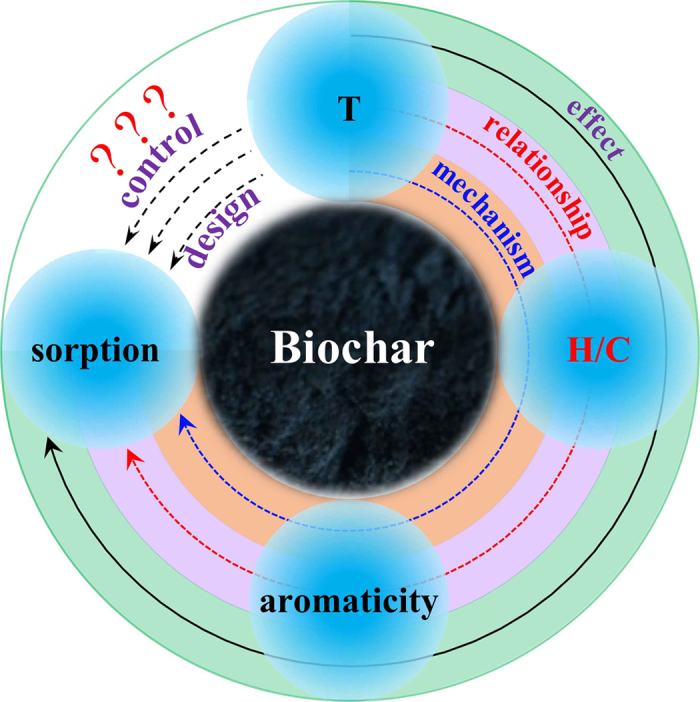
Biochar is increasingly gaining attention due to multifunctional roles in soil amelioration, pollution mitigation and carbon sequestration. It is a significant challenge to compare the reported results from world-wide labs regarding the structure and sorption of biochars derived from various precursors under different pyrolytic conditions due to a lack of a simple linkage. By combining the published works on various biochars, we established a quantitative relationship between H/C atomic ratio and pyrolytic temperature (T), aromatic structure and sorption properties for naphthalene and phenanthrene. A reverse sigmoid shape between T and the H/C ratio was observed, which was independent of the precursors of biochars, including the ash contents. Linear correlations of Freundlich parameters (N, log Kf) and sorption amount (log Qe, log QA) with H/C ratios were found. A rectangle-like model was proposed to predict the aromatic cluster sizes of biochars from their H/C ratios and then a good structure-sorption relationship was derived. These quantitative relationships indicate that the H/C atomic ratio is a universal linkage to predict pyrolytic temperatures, aromatic cluster sizes and sorption characteristics. This study would guide the global study of biochars toward being comparable and then the development of the structure-sorption relationships will benefit the structural design and environmental application of biochars.
Overview
The claims and statistics of this paper haven’t been checked yet.
Free: it reads the open-access text and checks the first 5 claims that cite a source we can check. Create a free account to check every claim.
Integrity signals
Registry
Cites
Statistics
Figures


Verification
Claims the paper makes
The claims and statistics of this paper haven’t been checked yet.
Free: it reads the open-access text and checks the first 5 claims that cite a source we can check. Create a free account to check every claim.
Claims other papers make about this one
Each is checked against this paper’s own text: does it say what the citing paper says it does?
The check wasn’t confident either way, so it gives no verdict — never disputed.
In the citing paper
“This biochar has an alkaline pH, a low ash content (18.5%; Table 1) suggesting it has limited acid neutralizing capacity (Yuan and Xu, 2012, Xiao et al., 2016).”
From Remediation of an acidic mine spoil: Miscanthus biochar and lime amendment affects metal availability, plant growth, and soil enzyme activity (2018) · cites this paper as Xiao et al., 2016
Experimental — accuracy not yet measured
Self-check
Percentages, sums and reported differences re-computed from the paper’s own numbers.
The self-check needs the paper’s full text.
Citations
Cites
Characteristics of hemicellulose, cellulose and lignin pyrolysis
Yang, H., Yan, R., Chen, H., Lee, D. H., & Zheng, C. (2007) · Fuel · doi:10.1016/j.fuel.2006.12.013 · Cited by 8,155
Biochar as a sorbent for contaminant management in soil and water: A review
Ahmad, M., Rajapaksha, A. U., Lim, J. E., Zhang, M., Bolan, N., Mohan, D., Vithanage, M., Lee, S. S., & Ok, Y. S. (2014) · Chemosphere · doi:10.1016/j.chemosphere.2013.10.071 · Cited by 4,662
Dynamic Molecular Structure of Plant Biomass-Derived Black Carbon (Biochar)
Keiluweit, M., Nico, P. S., Johnson, M. G., & Kleber, M. (2010) · Environmental Science & Technology · doi:10.1021/es9031419 · Cited by 3,230
Bio-char Sequestration in Terrestrial Ecosystems – A Review
Lehmann, J., Gaunt, J., & Rondon, M. (2006) · Mitigation and Adaptation Strategies for Global Change · doi:10.1007/s11027-005-9006-5 · Cited by 3,053 · cited 1×
“1038/srep22644 = + Q K N C log log log (9) e f e”
Lehmann, J. (2007) · Nature · doi:10.1038/447143a · Cited by 2,477 · cited 2×
“The reasons why the H/C atomic ratio was chosen are as follows: (1) The H/C atomic ratio is a quantity obtained by taking biochar as a whole and is easily acquired from elemental analysis.”
BackgroundMethodBiochar for Environmental Management: Science, Technology and Implementation
(2015) · doi:10.4324/9780203762264 · Cited by 2,280
Chen, B., Zhou, D., & Zhu, L. (2008) · Environmental Science & Technology · doi:10.1021/es8002684 · Cited by 1,823 · cited 2×
“(3) The H/C atomic ratio is often connected to the O/C ratio in van Krevelen plots50.”
BackgroundSelf-citationImpact of pyrolysis temperature and manure source on physicochemical characteristics of biochar
Cantrell, K. B., Hunt, P. G., Uchimiya, M., Novak, J. M., & Ro, K. S. (2012) · Bioresource Technology · doi:10.1016/j.biortech.2011.11.084 · Cited by 1,502
Ahmad, M., Lee, S. S., Dou, X., Mohan, D., Sung, J.-K., Yang, J. E., & Ok, Y. S. (2012) · Bioresource Technology · doi:10.1016/j.biortech.2012.05.042 · Cited by 1,357
Kim, S., Kramer, R. W., & Hatcher, P. G. (2003) · Analytical Chemistry · doi:10.1021/ac034415p · Cited by 1,336
Black carbon in soils and sediments: Analysis, distribution, implications, and current challenges
Schmidt, M. W. I., & Noack, A. G. (2000) · Global Biogeochemical Cycles · doi:10.1029/1999gb001208 · Cited by 1,334
Dairy-Manure Derived Biochar Effectively Sorbs Lead and Atrazine
Cao, X., Ma, L., Gao, B., & Harris, W. (2009) · Environmental Science & Technology · doi:10.1021/es803092k · Cited by 1,251 · cited 3×
“Q PHE: log 1 7173 H C 4 9249(R 0 5389) (8) A 2”
BackgroundMethodBeesley, L., Moreno-Jiménez, E., & Gomez-Eyles, J. L. (2010) · Environmental Pollution · doi:10.1016/j.envpol.2010.02.003 · Cited by 1,242
Review of the stability of biochar in soils: predictability of O:C molar ratios
Spokas, K. A. (2010) · Carbon Management · doi:10.4155/cmt.10.32 · Cited by 1,160
Kloss, S., Zehetner, F., Dellantonio, A., Hamid, R., Ottner, F., Liedtke, V., Schwanninger, M., Gerzabek, M. H., & Soja, G. (2012) · Journal of Environmental Quality · doi:10.2134/jeq2011.0070 · Cited by 1,014
Biochar for Environmental Management
Shackley, S. J., Clare, A., Joseph, S. D., McCarl, B. A., & Schmidt, H. (2009) · Taylor and Francis · Cited by 961
Cheng, C.-H., Lehmann, J., & Engelhard, M. H. (2008) · Geochimica et Cosmochimica Acta · doi:10.1016/j.gca.2008.01.010 · Cited by 936
Influence of Pyrolysis Temperature on Biochar Property and Function as a Heavy Metal Sorbent in Soil
Uchimiya, M., Wartelle, L. H., Klasson, K. T., Fortier, C. A., & Lima, I. M. (2011) · Journal of Agricultural and Food Chemistry · doi:10.1021/jf104206c · Cited by 854
(2010) · Joint Research Centre (European Commission) · doi:10.2788/472 · Cited by 851
Characterization of biochar from fast pyrolysis and gasification systems
Brewer, C. E., Schmidt‐Rohr, K., Satrio, J. A., & Brown, R. C. (2009) · Environmental Progress & Sustainable Energy · doi:10.1002/ep.10378 · Cited by 833
Adsorption of Polycyclic Aromatic Hydrocarbons by Graphene and Graphene Oxide Nanosheets
Wang, J., Chen, Z., & Chen, B. (2014) · Environmental Science & Technology · doi:10.1021/es405227u · Cited by 798
Self-citationPromoting Interspecies Electron Transfer with Biochar
Chen, S., Rotaru, A.-E., Shrestha, P. M., Malvankar, N. S., Liu, F., Fan, W., Nevin, K. P., & Lovley, D. R. (2014) · Scientific Reports · doi:10.1038/srep05019 · Cited by 727
Bio-oil and bio-char production from corn cobs and stover by fast pyrolysis
Mullen, C. A., Boateng, A. A., Goldberg, N. M., Lima, I. M., Laird, D. A., & Hicks, K. B. (2010) · Biomass and Bioenergy · doi:10.1016/j.biombioe.2009.09.012 · Cited by 717
Chen, B., & Chen, Z. (2009) · Chemosphere · doi:10.1016/j.chemosphere.2009.02.004 · Cited by 654 · cited 3×
“Theoretically, the structure-adsorption relationship can be developed because H/C in equations (7) and (8) was an index of the aromatic cluster structure of biochar, and it was a one-to-one relationship when m = n according to the rectangle-like polycyclic aromatic ring model.”
BackgroundMethodSelf-citationLiu, P., Liu, W.-J., Jiang, H., Chen, J.-J., Li, W.-W., & Yu, H.-Q. (2012) · Bioresource Technology · doi:10.1016/j.biortech.2012.06.085 · Cited by 643
Xiao, X., Chen, B., & Zhu, L. (2014) · Environmental Science & Technology · doi:10.1021/es405676h · Cited by 567
Self-citationXu, Y., & Chen, B. (2013) · Bioresource Technology · doi:10.1016/j.biortech.2013.07.086 · Cited by 562
Self-citationMohan, D., Rajput, S., Singh, V. K., Steele, P. H., & Pittman, C. U. (2011) · Journal of Hazardous Materials · doi:10.1016/j.jhazmat.2011.01.127 · Cited by 548
Liu, Z., Zhang, F.-S., & Wu, J. (2010) · Fuel · doi:10.1016/j.fuel.2009.08.042 · Cited by 545
Plant growth improvement mediated by nitrate capture in co-composted biochar
Kammann, C. I., Schmidt, H.-P., Messerschmidt, N., Linsel, S., Steffens, D., Müller, C., Koyro, H.-W., Conte, P., & Joseph, S. (2015) · Scientific Reports · doi:10.1038/srep11080 · Cited by 535
Marris, E. (2006) · Nature · doi:10.1038/442624a · Cited by 504
Characterization of Biochars Produced from Cornstovers for Soil Amendment
Lee, J. W., Kidder, M., Evans, B. R., Paik, S., Buchanan III, A. C., Garten, C. T., & Brown, R. C. (2010) · Environmental Science & Technology · doi:10.1021/es101337x · Cited by 473
Fang, Q., Chen, B., Lin, Y., & Guan, Y. (2014) · Environmental Science & Technology · doi:10.1021/es403711y · Cited by 446
Hale, S., Hanley, K., Lehmann, J., Zimmerman, A., & Cornelissen, G. (2011) · Environmental Science & Technology · doi:10.1021/es202970x · Cited by 435
Harvey, O. R., Kuo, L.-J., Zimmerman, A. R., Louchouarn, P., Amonette, J. E., & Herbert, B. E. (2012) · Environmental Science & Technology · doi:10.1021/es2040398 · Cited by 429 · cited 2×
“(2) The organic matter in HTB contains mainly carbon and hydrogen, and the H/C atomic ratio was relatively accurate compared with other atoms ratios.”
BackgroundZhu, D., & Pignatello, J. J. (2005) · Environmental Science & Technology · doi:10.1021/es0491376 · Cited by 425
Water extractable organic carbon in untreated and chemical treated biochars
Lin, Y., Munroe, P., Joseph, S., Henderson, R., & Ziolkowski, A. (2012) · Chemosphere · doi:10.1016/j.chemosphere.2011.12.007 · Cited by 343
Rapid pyrolysis of wood block by microwave heating
Miura, M., Kaga, H., Sakurai, A., Kakuchi, T., & Takahashi, K. (2004) · Journal of Analytical and Applied Pyrolysis · doi:10.1016/s0165-2370(03)00087-1 · Cited by 336
Fast and Slow Rates of Naphthalene Sorption to Biochars Produced at Different Temperatures
Chen, Z., Chen, B., & Chiou, C. T. (2012) · Environmental Science & Technology · doi:10.1021/es302345e · Cited by 329
Self-citationPhenanthrene Sorption to Sequentially Extracted Soil Humic Acids and Humins
Kang, S., & Xing, B. (2005) · Environmental Science & Technology · doi:10.1021/es0490828 · Cited by 317
Keiluweit, M., Kleber, M., Sparrow, M. A., Simoneit, B. R. T., & Prahl, F. G. (2012) · Environmental Science & Technology · doi:10.1021/es302125k · Cited by 296
Perminova, I. V., Grechishcheva, N. Y., & Petrosyan, V. S. (1999) · Environmental Science & Technology · doi:10.1021/es990056x · Cited by 290
Qian, L., & Chen, B. (2013) · Environmental Science & Technology · doi:10.1021/es401756h · Cited by 289
Self-citationMicrowave and slow pyrolysis biochar—Comparison of physical and functional properties
Mašek, O., Budarin, V., Gronnow, M., Crombie, K., Brownsort, P., Fitzpatrick, E., & Hurst, P. (2013) · Journal of Analytical and Applied Pyrolysis · doi:10.1016/j.jaap.2012.11.015 · Cited by 256
Guo, J., & Chen, B. (2014) · Environmental Science & Technology · doi:10.1021/es405647e · Cited by 254
Self-citationMarked changes in herbicide sorption–desorption upon ageing of biochars in soil
Martin, S. M., Kookana, R. S., Van Zwieten, L., & Krull, E. (2012) · Journal of Hazardous Materials · doi:10.1016/j.jhazmat.2012.06.040 · Cited by 243
Rice Husk‐Derived Graphene with Nano‐Sized Domains and Clean Edges
Muramatsu, H., Kim, Y. A., Yang, K., Cruz‐Silva, R., Toda, I., Yamada, T., Terrones, M., Endo, M., Hayashi, T., & Saitoh, H. (2014) · Small · doi:10.1002/smll.201400017 · Cited by 243
Sorption of Organic Contaminants by Carbon Nanotubes: Influence of Adsorbed Organic Matter
Wang, X., Lu, J., & Xing, B. (2008) · Environmental Science & Technology · doi:10.1021/es702971g · Cited by 236
Ro, K. S., Cantrell, K. B., & Hunt, P. G. (2010) · Industrial & Engineering Chemistry Research · doi:10.1021/ie101155m · Cited by 234
Biochar from the Straw-Stalk of Rapeseed Plant
Karaosmanoǧlu, F., Işıḡıgür-Ergüdenler, A., & Sever, A. (2000) · Energy & Fuels · doi:10.1021/ef9901138 · Cited by 210
Harvey, O. R., Herbert, B. E., Kuo, L.-J., & Louchouarn, P. (2012) · Environmental Science & Technology · doi:10.1021/es302971d · Cited by 204
Ducey, T. F., Ippolito, J. A., Cantrell, K. B., Novak, J. M., & Lentz, R. D. (2013) · Applied Soil Ecology · doi:10.1016/j.apsoil.2013.01.006 · Cited by 203
Reaction kinetics of hydrothermal carbonization of loblolly pine
Reza, M. T., Yan, W., Uddin, M. H., Lynam, J. G., Hoekman, S. K., Coronella, C. J., & Vásquez, V. R. (2013) · Bioresource Technology · doi:10.1016/j.biortech.2013.04.028 · Cited by 200
Sorption of naphthalene and phenanthrene by soil humic acids
Xing, B. (2001) · Environmental Pollution · doi:10.1016/s0269-7491(00)00065-8 · Cited by 198
Effective Alleviation of Aluminum Phytotoxicity by Manure-Derived Biochar
Qian, L., Chen, B., & Hu, D. (2013) · Environmental Science & Technology · doi:10.1021/es3047872 · Cited by 184
Self-citationSorption of Deisopropylatrazine on Broiler Litter Biochars
Uchimiya, M., Wartelle, L. H., Lima, I. M., & Klasson, K. T. (2010) · Journal of Agricultural and Food Chemistry · doi:10.1021/jf102152q · Cited by 182
Chen, Z., Chen, B., Zhou, D., & Chen, W. (2012) · Environmental Science & Technology · doi:10.1021/es303351e · Cited by 175
Self-citationZizzamia, D. (2015) · A Companion to the History of American Science · doi:10.1002/9781119072218.ch26 · Cited by 164
Lattao, C., Cao, X., Mao, J., Schmidt-Rohr, K., & Pignatello, J. J. (2014) · Environmental Science & Technology · doi:10.1021/es405096q · Cited by 160
Sorption of Organic Contaminants by Biopolymer-Derived Chars
Wang, X., & Xing, B. (2007) · Environmental Science & Technology · doi:10.1021/es071290n · Cited by 137
Zhao, X., Song, Z., Liu, H., Li, Z., Li, L., & Ma, C. (2010) · Journal of Analytical and Applied Pyrolysis · doi:10.1016/j.jaap.2010.06.001 · Cited by 123
Lian, F., Huang, F., Chen, W., Xing, B., & Zhu, L. Y. (2011) · Environmental Pollution · doi:10.1016/j.envpol.2011.01.002 · Cited by 113
Qiu, M., Sun, K., Jin, J., Gao, B., Yan, Y., Han, L., Wu, F., & Xing, B. (2014) · Scientific Reports · doi:10.1038/srep05295 · Cited by 101
Hydrothermal carbonization of olive mill wastewater
Pöerschmann, J., Baskyr, I., Weiner, B. A., Koehler, R., Wedwitschka, H., & Kopinke, F. (2013) · Bioresource Technology · doi:10.1016/j.biortech.2013.01.154 · Cited by 100
Xu, Y., & Chen, B. (2014) · Journal of Soils and Sediments · doi:10.1007/s11368-014-0969-2 · Cited by 99
Self-citationHan, L., Sun, K., Jin, J., Wei, X., Xia, X., Wu, F., Gao, B., & Xing, B. (2014) · Environmental Science & Technology · doi:10.1021/es5022087 · Cited by 92
Effect of physical forms of soil organic matter on phenanthrene sorption
Pan, B., Xing, B., Tao, S., et al. (2007) · Chemosphere · doi:10.1016/j.chemosphere.2007.01.054 · Cited by 78
Uptake Mechanism for Iodine Species to Black Carbon
Choung, S., Um, W., Kim, M., & Kim, M. G. (2013) · Environmental Science & Technology · doi:10.1021/es401570a · Cited by 69
Yang, C., Huang, W., Xiao, B., et al. (2004) · Environmental Science & Technology · doi:10.1021/es0350381 · Cited by 45
Tang, J., & Weber, W. J. J. (2006) · Environmental Science & Technology · doi:10.1021/es051665+ · Cited by 37
Clover leaf-shaped Al2O3 extrudate as a support for high-capacity and cost-effective CO2 sorbent
Yan, X., Zhang, Y., Qiao, K., Li, X., Zhang, Z., Yan, Z., & Komarneni, S. (2011) · Journal of Hazardous Materials · doi:10.1016/j.jhazmat.2011.06.067 · Cited by 26
Zhang, J., & He, M. (2010) · Journal of Hazardous Materials · doi:10.1016/j.jhazmat.2010.08.123 · Cited by 24
Huang, H., Wang, Y., Tang, J., Tang, J., & Zhu, W.-Y. (2014) · PubMed · Cited by 15
Composition and sorption properties of rice-straw derived biochars
Zhou, D. (2013) · Acta Scientiae Circumstantiae · Cited by 14
Phenanthrene sorption to Chinese coal: Importance of coal's geochemical properties
Yan, C., Yang, Y., Liu, M., Nie, M., & Zhou, J. L. (2011) · Journal of Hazardous Materials · doi:10.1016/j.jhazmat.2011.04.101 · Cited by 11
Zhang, J., He, M., Lin, C., et al. (2009) · Environmental Monitoring and Assessment · doi:10.1007/s10661-009-1014-6 · Cited by 10
Cited by
Zhu, X., Chen, B., Zhu, L., & Xing, B. (2017) · Environmental Pollution · doi:10.1016/j.envpol.2017.04.032 · Cited by 1,021
“S1) (Hale et al., 2015; Xiao et al., 2016).”
Self-citationXiao, X., Chen, B., Chen, Z., Zhu, L., & Schnoor, J. L. (2018) · Environmental Science & Technology · doi:10.1021/acs.est.7b06487 · Cited by 914
Self-citationWang, L., O’Connor, D., Rinklebe, J., Ok, Y. S., Tsang, D. C. W., Shen, Z., & Hou, D. (2020) · Environmental Science & Technology · doi:10.1021/acs.est.0c04033 · Cited by 655
Hassan, M., Liu, Y., Naidu, R., Parikh, S. J., Du, J., Qi, F., & Willett, I. R. (2020) · Science of The Total Environment · doi:10.1016/j.scitotenv.2020.140714 · Cited by 610
Prediction of Soil Heavy Metal Immobilization by Biochar Using Machine Learning
Palansooriya, K. N., Li, J., Dissanayake, P. D., Suvarna, M., Li, L., Yuan, X., Sarkar, B., Tsang, D. C. W., Rinklebe, J., Wang, X., et al. (2022) · Environmental Science & Technology · doi:10.1021/acs.est.1c08302 · Cited by 518
Metadata
- Authors
- Xiao, X., Chen, Z., & Chen, B.
- Affiliations
- Zhejiang University (CN)
- Ningbo University (CN)
- Corresponding author
- Chen, Baoliang
- Venue
- Scientific Reports
- Published
- 2016-03-04
- Volume
- 6
- Issue
- 1
- Pages
- 22644-22644
- ISSN
- 2045-2322 (ISSN-L)
- PMC
- PMC4778134
- OpenAlex
- W2330543631
- Cited by
- 309
- References
- 76
- Citations by year
- 2026: 23 · 2025: 45 · 2024: 38 · 2023: 36 · 2022: 35 · 2021: 35 · 2020: 37 · 2019: 22 · 2018: 16 · 2017: 16 · 2016: 6
- FWCI
- 11.84
- Type
- journal article
- Language
- en
- Open access
- gold
- doi.org
- Licence
- cc-by
- creativecommons.org/licenses/by/4.0 (tdm)
- creativecommons.org/licenses/by/4.0 (vor)
- Locations
- Scientific Reports (publishedVersion, cc-by)
- PubMed Central (publishedVersion, cc-by)
- PubMed (publishedVersion)
- Funders
- National Natural Science Foundation of China (2014CB441106, 21537005, 21425730, 21277120)
- National Key Research and Development Program of China (2014CB441106, 21537005, 21425730)
- Topics
- Physical Sciences › Environmental Science › Water Science and Technology › Adsorption and biosorption for pollutant removal
- Physical Sciences › Energy › Fuel Technology › Thermochemical Biomass Conversion Processes
- Life Sciences › Agricultural and Biological Sciences › Soil Science › Soil Carbon and Nitrogen Dynamics
- Keywords
- biochar, H/C ratio, pyrolysis temperature, aromatic clusters, Freundlich isotherm, ash content, aromaticity
About these checks
Registry, retraction, Cites and statistics results are computed, not judged, with one exception: a printed reference that no index lists is read once by a model before it counts as a citation error. Claims are extracted by a model and kept only when their quote appears verbatim in the text; each cited source is then checked, with a model’s help, for whether it says what the claim relies on. Those verdicts can be wrong — read the claim’s quote and the cited source before relying on one.
Statistics and arithmetic are recomputed, not judged.
Confidence bands are shown only for fields calibrated on our annotated test set. None is calibrated yet, so no band is shown.
What counts as a claim ›How we measure confidence ›How we check this ›
Are you an author, or do you see a problem with this page? Request a review
Data sources
Bibliographic data: Semantic Scholar, OpenAlex, Crossref.
Contains information from the Semantic Scholar Academic Graph Datasets, made available under the ODC Attribution License (ODC-BY 1.0).
Semantic Scholar’s data is described in: Kinney, R., et al. (2023). The Semantic Scholar Open Data Platform. arXiv:2301.10140.
