

Innovation, organizational capabilities, and the born-global firm
Open accessThe DOI matches its Crossref record; 106 of the 106 references it cites were found in a registry or an index; none of the 100 sources its claims cite is checked for support yet.
Overview
CoChat Summary
## TL;DR
This study argues that born-global firms succeed because early internationalization is supported by an innovative culture and a distinctive set of organizational capabilities. Using qualitative case studies followed by a survey of 203 usable responses, the authors find that several capability links are significant and that these capabilities are associated with performance in international markets.
## Key findings
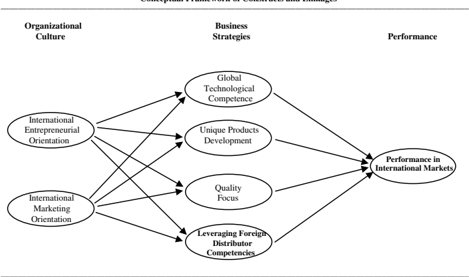
- The survey analysis found that international entrepreneurial orientation significantly predicted global technological competence with a standardized coefficient of 0.28; the link from international marketing orientation to global technological competence was not significant.
- Unique products development was significantly predicted by both international entrepreneurial orientation (0.19) and international marketing orientation (0.24).
- Quality focus was significantly predicted by both international entrepreneurial orientation (0.23) and international marketing orientation (0.35).
- Leveraging foreign distributor competences was significantly predicted by international marketing orientation (0.26) but not by international entrepreneurial orientation; these strategy variables were also significant drivers of performance in international markets: global technological competence (0.21), unique products development (0.14), quality focus (0.30), and leveraging foreign distributor competences (0.18).
## Methods
- The paper uses a two-phase design: first qualitative interviews/case studies to develop constructs and hypotheses, then a cross-industry field survey to test them.
- The qualitative phase included 33 professionals: 24 senior managers at early internationalizing firms, 6 scholars, and 3 international trade experts; the firms were mostly founded after 1985, sold half or more of their sales abroad, and had entered foreign markets within 3 years of founding.
- The survey was mailed to a random sample of 900 manufacturing firms in the United States founded in 1980 or later and exporting at least 25% of total production; 203 usable surveys were returned (about 23% response rate). The main analysis used LISREL8 path analysis, with exploratory factor analysis and confirmatory factor analysis for scale purification and validity checks.
## Limitations
- The paper states that “little empirical work” had been attempted on born globals and that there had been “almost no empirical research” on the factors driving their superior international performance.
- The study itself is focused on U.S. manufacturing firms that were selected using a 25% export threshold, so the evidence is tied to that sample and entry-mode context; this is evident from the text.
- The paper notes that the survey results are based on self-reported measures from responding firms; this is evident from the questionnaire-based design, though the paper does not frame it explicitly as a limitation.
Model-written summary. Check it against the paper before relying on it.
Integrity signals
Registry
Cites
Statistics
Figures
Verification
Claims the paper makes
0 Valid · 0 Not valid · 53 Not checked · 112 Own results and interpretations
A result the paper reports from its own data — it cites no other source for it, so there is none to check. The quote shows it is in the paper.
In the paper
“Despite the scarce resources typical of young firms, our findings reveal that born-global firms leverage a distinctive mix of orientations and strategies that allow them to succeed in diverse international markets.”
plainstates a cause- Asserted: passes — The authors put it forward as true.
- Checkable: passes — It can be checked against evidence.
- Load-bearing: passes — The paper’s conclusions depend on it.
- Based: passes — The paper gives a reason why it holds.
- Rests on an assumption not shown here.
A result the paper reports from its own data — it cites no other source for it, so there is none to check. The quote shows it is in the paper.
In the paper
“The critical role of marketing prowess overseas was also strongly emphasized by virtually all interviewees in the case studies.”
boosted- Asserted: passes — The authors put it forward as true.
- Checkable: passes — It can be checked against evidence.
- Load-bearing: unclear — It is unclear whether the paper’s conclusions depend on it.
- Based: passes — The paper gives a reason why it holds.
A result the paper states — it cites no source for it, so there is none to check. The quote shows it is in the paper.
In the paper
“Most interviewed firms exhibited strong technological capabilities in their respective product or industry categories.”
plain- Asserted: passes — The authors put it forward as true.
- Checkable: passes — It can be checked against evidence.
- Load-bearing: unclear — It is unclear whether the paper’s conclusions depend on it.
- Based: passes — The paper gives a reason why it holds.
A result the paper reports from its own data — it cites no other source for it, so there is none to check. The quote shows it is in the paper.
In the paper
“In general, the qualitative phase of the study revealed that born globals are likely to be formed by entrepreneurs who pursue foreign ventures with a strong marketing orientation.”
hedgedstates an association- Asserted: passes — The authors put it forward as true.
- Checkable: passes — It can be checked against evidence.
- Load-bearing: passes — The paper’s conclusions depend on it.
- Based: passes — The paper gives a reason why it holds.
A result the paper states — it cites no source for it, so there is none to check. The quote shows it is in the paper.
In the paper
“In contrast, born globals leverage a collection of fundamental intangible knowledge-based capabilities in the cultivation of foreign markets early in their evolution.”
plainstates a cause- Asserted: passes — The authors put it forward as true.
- Checkable: passes — It can be checked against evidence.
- Load-bearing: passes — The paper’s conclusions depend on it.
- Based: unclear — It is unclear why the paper says it holds.
- Rests on an assumption not shown here.
84 more claims
Create a free account to see all 165 claims and to verify the 3 references still open.
- It may state two separate claims as one. 33
- Probably not a substantial claim. 54
Citations
Cites
Evaluating Structural Equation Models with Unobservable Variables and Measurement Error
Fornell, C., & Larcker, D. F. (1981) · Journal of Marketing Research · doi:10.2307/3151312 · Cited by 109,314 · cited 2×
“Composite reliability was calculated using the procedures outlined by Fornell and Larcker (1981).”
MethodInfluentialEvaluating structural equation models with unobservable variables and measurement error
Fornell, C., & Larcker, D. F. (1981) · Journal of Marketing Research · doi:10.1177/002224378101800104 · Cited by 109,190
Firm Resources and Sustained Competitive Advantage
Barney, J. (1991) · Journal of Management · doi:10.1177/014920639101700108 · Cited by 48,334
(1994) · Journal of the American Dietetic Association · doi:10.1016/0002-8223(94)92216-0 · Cited by 45,910
Firm resources and sustained competitive advantage
Barney, J. B. (2004) · Advances in Strategic Management · doi:10.1016/s0742-3322(00)17018-4 · Cited by 38,152
Absorptive Capacity: A New Perspective on Learning and Innovation
Cohen, W. M., & Levinthal, D. A. (1990) · Administrative Science Quarterly · doi:10.2307/2393553 · Cited by 35,728
A resource‐based view of the firm
Wernerfelt, B. (1984) · Strategic Management Journal · doi:10.1002/smj.4250050207 · Cited by 25,635
The Theory of Economic Development
Schumpeter, J., & Backhaus, U. (2006) · The European Heritage in Economics and the Social Sciences · doi:10.1007/0-306-48082-4_3 · Cited by 22,506
An Evolutionary Theory of Economic Change.
Loasby, B. J., Nelson, R. R., & Winter, S. G. (1983) · The Economic Journal · doi:10.2307/2232409 · Cited by 21,366
A Dynamic Theory of Organizational Knowledge Creation
Nonaka, I. (1994) · Organization Science · doi:10.1287/orsc.5.1.14 · Cited by 17,809
Research works printed but not linked: 5
- Nikkei Sangyoo Shimbun (1995) Benchaa Shin Sedai (New Generation Ventures) , Nihon Keizai Shimbun: Tokyo.
- Nunnally, J.C. (1978) Psychometric Theory
- Porter, M.E. (1980) Competitive Strategy , The Free Press: New York.
- Rennie, M. (1993) 'Born global', McKinsey Quarterly (4): 45-52. Rosson, P. and Ford, I.D. (1982) 'Manufacturer-overseas distributor relations and export performance', Journal of International Business Studies 13 (2): 57-72.
- Schumpeter, J. (1939) Business Cycles , Vol. 1 McGraw-Hill: New York.
Cited by
Items 1,601–1,700 of 3,020
Capabilities, Strategy, and Performance: The Case of ICT Firms in New Zealand
Ng, P. Y., & Hamilton, R. T. (2015) · Journal of Asia-Pacific Business · doi:10.1080/10599231.2015.1091710 · Cited by 7
“As defined by Knight and Cavusgil (2004), organizational capability reflects the ability of a firm to perform repeatedly productive tasks that create value by transforming inputs into outputs.”
BackgroundThinking about Entry of Firms: A Theoretical Discussion
Garavaglia, C. (2016) · International Business Research · doi:10.5539/ibr.v9n2p46 · Cited by 4
“…the introduction of the new technology, with respect to the incumbents which are locked into old procedures and routines (Autio et al., 2000; Zahra et al., 2000): their organizational capabilities and innovativeness support their superior performance in various countries (Knight & Cavusgil, 2004).”
BackgroundYoon, H.-D., Seo, R., & 곽기영 (2012) · Asia-Pacific Journal of Business Venturing and Entrepreneurship · doi:10.16972/apjbve.7.3.201209.1 · Cited by 7
A Comparative Analysis of Polish and Czech International New Ventures
Danik, L., Kowalik, I., & Král, P. (2016) · Central European Business Review · doi:10.18267/j.cebr.152 · Cited by 10
“The main traits of INVs are: the global vision, the international business competence of their managers and poverty of resources at the time of start-up (McDougall, Shane & Oviatt, 1994; McDougall & Oviatt, 1994; Knight & Cavusgil, 2004).”
BackgroundPronina, M., Kuivalainen, O., Torkkeli, L., & Gracheva, P. (2016) · International Journal of Multinational Corporation Strategy · doi:10.1504/ijmcs.2016.079453 · Cited by 6
“The growing phenomenon of small firm’s internationalization since the early 1990s has raised the question of what competencies they need to develop in order to internationalize successfully (Knight and Cavusgil, 2004; Knight and Kim, 2009; Kuivalainen et al., 2010).”
BackgroundTorkkeli, L., Saarenketo, S., Salojärvi, H., & Sainio, L. (2016) · Springer eBooks · doi:10.1007/978-3-319-39369-8_15 · Cited by 16
Aloulou, W. J. (2017) · Marché et organisations · doi:10.3917/maorg.028.0035 · Cited by 6
노두환, 박호영, & 정영근 (2016) · Asia-Pacific Journal of Business Venturing and Entrepreneurship · doi:10.16972/apjbve.11.1.201602.1 · Cited by 6
Born Globals or Born Regionals? A Study of 32 Early Internationalizing SMEs
Hånell, S. M., Nordman, E. R., & Tolstoy, D. (2019) · Emerald Group Publishing Limited eBooks · doi:10.1108/s1745-886220190000014016 · Cited by 6
Top management team regional diversity and internationalization
Agnihotri, A., & Bhattacharya, S. (2019) · International Journal of Cross Cultural Management · doi:10.1177/1470595819890363 · Cited by 9
“This enhances their ability to internationalize (Knight and Cavusgil, 2004).”
Pérez‐Pérez, C., Benito‐Osorio, D., & Moreno, S. M. G. (2021) · Administrative Sciences · doi:10.3390/admsci11030098 · Cited by 8
“…empirical research will be needed to check if platforms fit within this model, as, for example, born global firms are said to need managers with a strong international orientation, which drives them to develop better competitive advantages both in goods and technology (Knight and Cavusgil 2004).”
BackgroundAre governance mode and foreign location choices independent?
Leiblein, M. J., Larsen, M. M., & Pedersen, T. (2021) · Global Strategy Journal · doi:10.1002/gsj.1420 · Cited by 7
Born brothers, born global: multiple possible faces of the internationalization path
Caputo, F., Fiano, F., Briamonte, M. F., & Sorrentino, M. (2022) · Journal of Knowledge Management · doi:10.1108/jkm-04-2021-0295 · Cited by 10
How much does firm-specific intellectual capital vary? Cross-industry and cross-national comparison
Sáenz, J., Aramburu, N., Buenechea, M., Vanhala, M., & Ritala, P. (2017) · European J of International Management · doi:10.1504/ejim.2017.082529 · Cited by 18
Maldonado, I., Pinho, C., Lobo, C. A., & Pacheco, L. (2023) · Journal of Organizational Change Management · doi:10.1108/jocm-03-2022-0069 · Cited by 12
Born global phenomenon: a critical review and avenues for future research
Mostafiz, M. I., Sambasivan, M., & Goh, S. K. (2023) · European J of International Management · doi:10.1504/ejim.2023.131701 · Cited by 12
Williams, D. W. (2010) · Digital Archive @ GSU · doi:10.57709/1416907 · Cited by 12
Kundu, S. C., & Rani, S. (2007) · Managing Global Transitions · Cited by 8
A conceptual study of immigrant born globals and their multinationalization process
Qiu, R., & Gupta, V. (2015) · Journal of global entrepreneurship research · doi:10.1186/s40497-015-0018-7 · Cited by 14
“Knight and Cavusgil (2004) identify two factors – global technological competence and unique product development – that characterize the unique skillset of resource-derived capabilities.”
Chang, S., Jaw, Y.-L., & Chiu, H.-J. C. (2012) · Tamkang University Institutional Repository (TKUIR) · Cited by 11
Entrepreneurial orientation and international performance: A contingent approach
Kuivalainen, O., Sundqvist, S., & Cadogan, J. W. (2010) · Progress in international business research · doi:10.1108/s1745-8862(2010)0000005016 · Cited by 6
Almor, T. (2018) · International Studies of Management and Organization · doi:10.1080/00208825.2018.1443736 · Cited by 7
“…create innovative products that are leveraged worldwide in specific global niches (Oviatt and McDougall 1994; Coviello and Munro 1995; Jones 1999, 2001; Aspelund and Moen 2001; Rialp-Criado, Rialp-Criado, and Knight 2002; Almor and Hashai 2004; Hashai and Almor 2004; Knight and Cavusgil 2004).”
BackgroundJankowska, B., & Götz, M. A. (2018) · Advances in spatial science · doi:10.1007/978-3-319-90575-4_4 · Cited by 6
Análisis de las Born Global en Colombia: Pequeñas y medianas empresas del Departamento de Córdoba
Vásquez, M. A. P., Muñoz, M. E., & Campillo, É. T. G. (2021) · doi:10.31876/rcs.v27i.36507 · Cited by 8
Aureli, S., & Baldo, M. D. (2013) · International Journal of Applied Behavioral Economics · doi:10.4018/ijabe.2013040102 · Cited by 6
Organizational Innovation and Human Resource Practice: A View of Strategic Human Resource Bundling
Liu, B., Zhu, X., & Tang, N. (2007) · International Conference on Service Systems and Service Management · doi:10.1109/icsssm.2007.4280086 · Cited by 7
“According to organizational innovation, just like what Wong, Shaw and Sher (1998), Laursen and Foss (2003) and Knight and Cavusgil (2004) did, let leaders from the R & D and marketing departments subjectively evaluate it based on the organizational performing in recent 5 years by“Absolutely our…”
BackgroundSocial Capital Types and Internationalization: A Study of Indian Software SMEsPreprint
Prashantham, S., & Zahra, S. A. (2008) · SSRN Electronic Journal · doi:10.2139/ssrn.1309510 · Cited by 6
Network exploration and exploitation in international entrepreneurship: an opportunity-based view
Faroque, A. R. (2014) · UC Research Repository (University of Canterbury) · doi:10.26021/5343 · Cited by 8
Agbobli, E. K. (2015) · Cited by 9
Knight, G. (2015) · Wiley eBooks · doi:10.1002/9781118663202.wberen138 · Cited by 6
Self-citationThe Born Global - Redefined: On the Determinants of SMEs Pace of Internationalization
Karlsen, S. M. F. (2007) · NVA (Nasjonalt vitenarkiv) · Cited by 14
Antecedents of High-growth and Gazelle Enterprises: An Empirical Study
Sheppard, M. J. (2010) · UWSpace (University of Waterloo) · Cited by 10
The Influence of Entrepreneurial Mindsets and Business Model Practices on Firm Internationalization
Gabrielsson, M., Julkunen, S., & Andersson, S. (2025) · Management International Review · doi:10.1007/s11575-025-00572-w · Cited by 9
“Prior research acknowledges the role of innovativeness, proactiveness and risk-seeking behaviour of entrepreneurial firms trading across national borders and creating value (Dai et al., 2014; Knight & Cavusgil, 2004; Martin & Javalgi, 2016; McDougall & Oviatt, 2000; Zhou et al., 2010).”
Sadraei, R., Jafari‐Sadeghi, V., Marvi, R., & Yoruk, E. (2025) · Strategic Change · doi:10.1002/jsc.2675 · Cited by 13
Early Internationalization: A Meta‐Analysis of Antecedents, Dimensions, and Performance
Fariborzi, H., Verbeke, A. C., & Steel, P. (2025) · Journal of Management Studies · doi:10.1111/joms.70008 · Cited by 7
Leitão, J. C. C., & Pereira, D. B. (2022) · Studies on entrepreneurship, structural change and industrial dynamics · doi:10.1007/978-3-031-05307-8_3 · Cited by 5
The Influence of Entrepreneurs’ Culture and Ethnicity on Firms’ Degree of Hybridity
Angulo‐Ruiz, F., & Muralidharan, E. K. (2023) · Global Business Review · doi:10.1177/09721509231195169 · Cited by 8
Presutti, M., Fratocchi, L., & Odorici, V. (2024) · Management International Review · doi:10.1007/s11575-024-00552-6 · Cited by 17
“While specific definitions may vary according to export intensity threshold, speed, and global reach (Evers et al., 2019; Knight & Cavusgil, 1996, 2004 ; Madsen & Servais, 1997 ; Oviatt & McDougall, 1994 ), scholars agree that these firms started international activities very early (Hennart, 2014).”
Chen, C., Song, Y., & Chow, B.-K. (2024) · Long Range Planning · doi:10.1016/j.lrp.2024.102485 · Cited by 6
Parga, M. A. R., Rialp, A., & Rincón, V. A. G. (2025) · Strategic Change · doi:10.1002/jsc.2633 · Cited by 5
Garmroudesfandiari, E., Farokhmanesh, T., Baghersad, V., & Davari, A. (2025) · Journal of East-West Business · doi:10.1080/10669868.2025.2464245 · Cited by 7
“For instance, examining the role of cultural dimensions (Knight and Cavusgil 2004) and their interaction with institutional factors could provide a more comprehensive understanding of the internationalization process.”
Bridging creativity and international business competence through digital capabilities
Camillo, G. M., de Vasconcellos, S. L., Amal, M., & Parente, R. (2025) · Future Business Journal · doi:10.1186/s43093-025-00494-x · Cited by 10
“SMEs often grapple with resource constraints but must cultivate unique resources, capabilities, and strategies to bolster their performance amid international growth [32, 33]; all this is deeply related to managers’ abilities [40].”
Nessel, K. (2013) · Journal of Entrepreneurship Management and Innovation · doi:10.7341/2013915 · Cited by 9
Importance of dynamic capabilities in Colombian born global enterprise
Barbosa, D. E., Orjuela, A. R., & Espallardo, M. H. (2013) · Cuadernos de Administración · doi:10.11144/javeriana.cao26-47.icde · Cited by 4
Determinants of Export Market Destination for Outputs from Small Locally-Owned Firms
Williams, D. A. (2009) · Small Business Institute Journal · Cited by 5
The Role of Market Orientation in Internationalization of SMEs
Nahan-Suomela, R., & Lautamäki, S. (2013) · IGI Global eBooks · doi:10.4018/978-1-4666-3966-9.ch013 · Cited by 5
Compressed internationalisation: New internationalisation behaviour of small New Zealand firms
Oyson, M. J. (2020) · Journal of International Entrepreneurship · doi:10.1007/s10843-020-00273-5 · Cited by 9
Understanding The Internalization Stratey For MSMEs
Wilujeng, I. P. (2021) · International Journal Of Science Technology & Management · doi:10.46729/ijstm.v2i4.249 · Cited by 7
Export Entrepreneurship and SMEs: Determinants and Performance
Santhosh, C. (2021) · The International Trade Journal · doi:10.1080/08853908.2021.1963888 · Cited by 5
“To explain the phenomenon of internationalization patterns, scholars have developed various internationalization models/theories (Barney 1991; Johanson and Vahlne 1977, 1990; Knight and Cavusgil 2004).”
BackgroundResultInfluentialInternationalization of China’s medical device industry: a case study in Brazil
Pereira, G. M. D. C., & Ogasavara, M. H. (2021) · RAUSP Management Journal · doi:10.1108/rausp-03-2021-0046 · Cited by 6
Bastian, B., & Zucchella, A. (2022) · Contributions to management science · doi:10.1007/978-3-030-85950-3_5 · Cited by 6
Can Arab-origin brands go global? An exploratory study
Farrag, D. A., & Gharara, S. R. A. (2022) · Journal of Islamic marketing · doi:10.1108/jima-07-2021-0228 · Cited by 5
Knowledge and Innovation: From Path Dependency Toward Managerial Agency
Volberda, H., Schneidmüller, T., & Zadeh, T. (2021) · Oxford University Press eBooks · doi:10.1093/oso/9780190090883.003.0025 · Cited by 6
Key Factors for a Successful OBM Transformation with DEMATEL–ANP
Nguyen, T. S., Chen, J., Tseng, S., & Lin, L.-F. (2023) · Mathematics · doi:10.3390/math11112439 · Cited by 5
Coudounaris, D. N., & Björk, P. (2023) · Review of International Business and Strategy · doi:10.1108/ribs-06-2023-0064 · Cited by 5
Zheng, Y., & Abbott, P. Y. (2013) · European Conference on Information Systems · Cited by 5
İsmail, D. (2014) · Jurnal Pengurusan · doi:10.17576/pengurusan-2014-40-01 · Cited by 10
Kahveci, E. (2012) · Ankara Üniversitesi SBF Dergisi · doi:10.1501/sbfder_0000002250 · Cited by 5
Exploring radical innovation search practices
Ledwith, A., Martini, A., Nicholas, J. M., & Nosella, A. (2012) · International Journal of Technology Intelligence and Planning · doi:10.1504/ijtip.2012.051781 · Cited by 5
“Many authors have singled out innovation as an organisational process that contributes to firm survival and performance (Zahra, 1993; Lumpkin and Dess, 1995; Knight and Cavusgil, 2004; Cefis and Marsili, 2006; Roberts, 2007).”
BackgroundGülsoy, T. Y., Özkanlı, Ö., & Lynch, R. (2012) · Procedia - Social and Behavioral Sciences · doi:10.1016/j.sbspro.2012.04.016 · Cited by 5
Osei-Bonsu, N. (2014) · Journal of Management Research · doi:10.5296/jmr.v6i3.5414 · Cited by 5
Internal and External Learning Races in ‘Born Transnationals’: What are the Driving Forces?
Freiling, J., & Zimmermann, M. (2014) · Entrepreneurial Business and Economics Review · doi:10.15678/eber.2014.020103 · Cited by 5
“If foreign experience relevant to business issues is available, it is typically bound to the entrepreneur(s) so that it is not institutionalized, yet (Madsen & Servais, 1997; Knight & Cavusgil, 2004).”
BackgroundBorn Globals: How are they Different?
Wong, H. Y., & Merrilees, B. (2012) · Advances in international marketing · doi:10.1108/s1474-7979(2012)0000023019 · Cited by 13
Blesa, A., Meliá, M. R., & Monferrer, D. (2009) · RePEc: Research Papers in Economics · Cited by 14
The Effect of Islamic Work Ethics (Akhlaq) to Innovation Capability
Mahfoudh, A., Din, M. S., & Jusoh, M. S. (2016) · Springer eBooks · doi:10.1007/978-981-10-1452-9_35 · Cited by 8
Jie-yi, L., Liu, Y., & Cao, J. (2017) · Journal of Interdisciplinary Mathematics · doi:10.1080/09720502.2017.1386904 · Cited by 7
“(4) The research scale proposed by Knight & Cavusgil (2004) is used for measuring internationalization performance, which is divided into (1)financial performance and (2)strategic performance.”
Factors Influencing Public Sector Auditees on Implementing Audit Recommendations
Dain, N., & Rahmat, M. M. (2017) · Jurnal Pengurusan · doi:10.17576/pengurusan-2018-51-17 · Cited by 5
Emergence of a higher education born global in Africa
Merino, P. B., Lavissière, A., & Mandják, T. (2018) · The International Journal of Entrepreneurship and Innovation · doi:10.1177/1465750318762864 · Cited by 5
The Impact of Inter-Firm Collaborations on SME Internationalisation
Ghauri, P. N., & Elg, U. (2018) · Emerald Group Publishing Limited eBooks · doi:10.1108/s1876-066x20180000034003 · Cited by 11
Creating an Organizational Climate for Global Partnerships: Challenges and Opportunities
Tierney, W. G. (2019) · Springer eBooks · doi:10.1007/978-3-030-25525-1_2 · Cited by 5
Oliveira, L., Bai, W., Johanson, M., Ratajczak‐Mrozek, M., & Francioni, B. (2019) · Emerald Group Publishing Limited eBooks · doi:10.1108/s1745-886220190000014018 · Cited by 9
Analyzing the Role of Dynamic Capabilities in the Internationalization of Gradual Global SMEs
Tartaglione, A. M., Sanguigni, V., Cavacece, Y., & Fedele, M. (2019) · International Business Research · doi:10.5539/ibr.v12n12p61 · Cited by 5
“Adaptability is the reconfiguration of resources and processes according to changes in the environment and to national differences (Knight & Cavusgil, 2004), in order to keep a constant balance between the firm's routines and local needs (Frasquet et al., 2013).”
BackgroundHOW TRANSNATIONAL LIVING LABS CAN HELP SMEs TO INTERNATIONALISE
Santonen, T., & Julin, M. V. (2019) · International Journal of Innovation Management · doi:10.1142/s1363919619400036 · Cited by 5
The Role of Gig Economy in Supporting SME Internationalisation
Youssef, S. K., & Sikdar, A. (2020) · Springer eBooks · doi:10.1007/978-981-15-4454-5_6 · Cited by 8
Machado, M. A., & Bischoff, V. (2021) · International Journal of Emerging Markets · doi:10.1108/ijoem-09-2020-1114 · Cited by 6
Shah, S. Z. A., Hussain, C. M., & Anwar, M. (2021) · Journal of Chinese Economic and Business Studies · doi:10.1080/14765284.2021.2021489 · Cited by 7
“Knight and Cavusgil (2004) claim that proactive firms into a new market earlier than other firms and seize the initial opportunities and profit.”
BackgroundPutting the magnifying glass on minorities groups in entrepreneurship: What can we observe?
Sampaio, C. A. F., Farinha, L. M. D. C., Sebastião, J. R., & Fernandes, A. (2022) · Strategic Change · doi:10.1002/jsc.2510 · Cited by 5
Born Digitals: Understanding the Sustainable Competitive Advantage Across Different Markets
Jarosiński, M., Sekliuckienė, J., & Kozma, M. (2022) · FGF studies in small business and entrepreneurship · doi:10.1007/978-3-031-11371-0_3 · Cited by 13
Which Variables Predict the Internationalization Type of Academic Spin-Offs?
Alles, M. D. L. L. F., Vissak, T., & Lukason, O. (2022) · Heliyon · doi:10.1016/j.heliyon.2023.e13172 · Cited by 8
Influence of Organizational Culture on Employees' Performance: Evidence from Oman
Isa, M. F. M., Ugheoke, S. O., & Noor, W. S. W. M. (2021) · Journal of Entrepreneurship and Business · doi:10.17687/jeb.v4i2.73 · Cited by 7
Exporting construction professional services in a global service economy
Jewell, C. (2010) · Cited by 5
The Effect of Entrepreneurial Orientation on Results: An Application to the Hotel Sector
Cossío‐Silva, F., Vega‐Vázquez, M., & Revilla‐Camacho, M. (2014) · Springer eBooks · doi:10.1007/978-3-319-08888-4_8 · Cited by 7
A Big Picture of Dynamic Capabilities
Yassien, E. (2015) · Journal of Management Research · doi:10.5296/jmr.v7i5.8007 · Cited by 8
“Although several other researchers emphasize the role of leadership in DC success as critical (Galunic and Eisenhardt, 2001; Colbert, 2004; Knight and Cavusgil, 2004; Santos and Eisenhardt, 2005; Sapienza et al., 2006; Zahra et al., 2006) but it was never included in DC models.”
BackgroundVirtuous entrepreneurs: a rethinking of the way to create relational trust in a global economy
Toledano, N., & Karanda, C. (2014) · International Journal of Business and Globalisation · doi:10.1504/ijbg.2015.066101 · Cited by 6
“is possible since individuals possess a natural disposition to trust” [McKnight et al., (1998), p.”
BackgroundInternal Determinants of the Internationalization Behavior Dynamics of Young Firms
Ayadi-Frikha, M. (2015) · Journal of Behavioural Economics, Finance, Entrepreneurship, Accounting and Transport · doi:10.12691/jbe-3-1-4 · Cited by 5
Terrorism Studies in International Business: Increasing Knowledge, Reducing Victimization
Suder, G. G. S., & Czinkota, M. (2013) · AIB Insights · doi:10.46697/001c.16940 · Cited by 5
“3 Thus new ventures do not operate in an environment 1 Some scholars use the term born global (Knight & Cavusgil, 2004).”
BackgroundWei, L., Wu, L., Cheung, Y. H., & Chiu, R. K. (2011) · Journal of General Management · doi:10.1177/030630701103700204 · Cited by 8
Zapletalová, Š. (2017) · Central European Business Review · doi:10.18267/j.cebr.186 · Cited by 5
“Introduction and Theoretical Background Several studies have analyzed the factors that drive the internationalization activities of SMEs (Gabrielsson & Kirpalani, 2004; Knight & Cavusgil, 2004; Filatotchev et al., 2009).”
BackgroundWang, C., Dai, S., Xu, H., & Li, X. (2018) · Journal of China Tourism Research · doi:10.1080/19388160.2018.1482247 · Cited by 5
“This lack of flexibility may limit these companies’ geographic expansion (Knight & Cavusgil, 2004).”
BackgroundGrillitsch, M., & Chamináde, C. (2018) · European Planning Studies · doi:10.1080/09654313.2018.1520812 · Cited by 8
“Second, in line with the extensive literature on born globals (Knight & Cavusgil, 2004), there is growing evidence of the capacity of small firms to engage in GINs (Barnard & Chaminade, 2017) as well as their positive effect on the degree of novelty (Aslesen & Harirchi, 2015).”
ResultThe Management of International Business
Fatehi, K., & Choi, J. (2018) · Springer texts in business and economics · doi:10.1007/978-3-319-96622-9_1 · Cited by 5
Bartosik‐Purgat, M., & Jankowska, B. (2019) · International Journal of E-Services and Mobile Applications · doi:10.4018/ijesma.2019070101 · Cited by 5
Ayakwah, A., Osabutey, E. L. C., & Damoah, I. S. (2019) · Emerald Group Publishing Limited eBooks · doi:10.1108/s2040-724620190000010008 · Cited by 5
Exploring Resources and Capabilities Factors Among Entrepreneurial Ventures Using DEMATEL Approach
Dakare, O., Adebiyi, S. O., & Amole, B. B. (2019) · International Journal of Management Economics and Social Sciences · doi:10.32327/ijmess/8.1.2019.3 · Cited by 5
“For Hashai and Almor (2004), and Knight and Cavusgil (2004), unique technologies and innovation factors are significant determinants of sustainable competitive advantage, superior capability to perform R&D activities (Knight and Cavusgil, 2004; Manalova, 2003), network partnerships that provide…”
BackgroundLes entreprises à internationalisation précoce et rapide
Servantie, V. (2012) · Revue internationale P M E Économie et gestion de la petite et moyenne entreprise · doi:10.7202/1012685ar · Cited by 5
Civil Engineering Consultants from Developing Countries: An Exploration of Malaysian Firms
Aziz, A., & Law, Y.-H. (2012) · International Journal of Construction Management · doi:10.1080/15623599.2012.10773187 · Cited by 5
“The study also affirms the observation that this diversity gives rise to non-sequential and at times accelerated process of internationalisation (Knight and Cavusgil 2004).”
BackgroundMusuva, A. M., Ogutu, M., Awino, Z. B., & Yabs, J. (2013) · DBA-Africa Management Review · Cited by 5
On the emergence and diffusion of technological capabilities and the theory of the MNC
Blomkvist, K., Kappen, P., & Zander, I. (2018) · Management international · doi:10.7202/1043079ar · Cited by 5
“…firms also represent only a subgroup of a larger and more differentiated set of MNCs, which includes firms with recent and rapid internationalization processes that could display other types of organizational dynamics (Oviatt & McDougall, 1994; Knight & Cavusgil, 2004; Zander & Mathews, 2010).”
BackgroundNikolchenko, N., Zenkevich, N. A., & Lebedeva, A. V. (2018) · Journal of East-West Business · doi:10.1080/10669868.2018.1467842 · Cited by 7
“Similarly, Knight and Cavusgil (2004) argue that the resource-based view helps explain how unique organizational capabilities are developed and leveraged by internationalizing new venture.”
Background
Metadata
- Authors
- Knight, G. A., & Cavusgil, S. T.
- Affiliations
- Florida State University (US)
- Corresponding author
- Knight, Gary A
- ORCID
- Knight, Gary A
- Venue
- Journal of International Business Studies
- Published
- 2004-01-08
- Volume
- 35
- Issue
- 2
- Pages
- 124-141
- ISSN
- 0047-2506 (ISSN-L)
- 1478-6990
- OpenAlex
- W2127709152
- Semantic Scholar
- d24960b5342d0dd3b86be002ab18a80e7b6fb5c9
- Cited by
- 3,013
- References
- 102
- Citations by year
- 2026: 121 · 2025: 123 · 2024: 157 · 2023: 154 · 2022: 182 · 2021: 196 · 2020: 189 · 2019: 180 · 2018: 199 · 2017: 172 · 2016: 188 · 2015: 187 · 2014: 178 · 2013: 167 · 2012: 129
- FWCI
- 137.12
- Type
- journal article
- Language
- en
- Update notices
- correction (2004-07-16)
- Open access
- bronze
- doi.org
- Licence
- www.springer.com/tdm (tdm)
- Locations
- Journal of International Business Studies (publishedVersion)
- RePEc: Research Papers in Economics (submittedVersion)
- Funders
- Michigan State University
- College of Engineering, Michigan State University
- Topics
- Social Sciences › Business, Management and Accounting › Strategy and Management › International Business and FDI
- Social Sciences › Business, Management and Accounting › Strategy and Management › Innovation and Knowledge Management
- Social Sciences › Communication › International Student and Expatriate Challenges
- Keywords
- born global firms, early internationalization, organizational capabilities, innovation, innovation culture, international business strategy, international success, young firms, internationalization of firms
About these checks
Registry, retraction, Cites and statistics results are computed, not judged, with one exception: a printed reference that no index lists is read once by a model before it counts as a citation error. Claims are extracted by a model and kept only when their quote appears verbatim in the text; each cited source is then checked, with a model’s help, for whether it says what the claim relies on. Those verdicts can be wrong — read the claim’s quote and the cited source before relying on one.
A language model drew the claims from the paper on 2026-10-10, under version 3 of the claim definition (model deepseek-v4.1-flash, prompt extract-v3).
A second model labelled each claim on 2026-10-10 (model jev-1.13-20260917, definition revision gold-guideline-v0.2).
Statistics and arithmetic are recomputed, not judged.
Confidence bands are shown only for fields calibrated on our annotated test set. None is calibrated yet, so no band is shown.
What counts as a claim ›How we measure confidence ›How we check this ›
Are you an author, or do you see a problem with this page? Request a review
Data sources
Bibliographic data: Semantic Scholar, OpenAlex, Crossref.
Contains information from the Semantic Scholar Academic Graph Datasets, made available under the ODC Attribution License (ODC-BY 1.0).
Semantic Scholar’s data is described in: Kinney, R., et al. (2023). The Semantic Scholar Open Data Platform. arXiv:2301.10140.
