

Innovation, organizational capabilities, and the born-global firm
Open accessThe DOI matches its Crossref record; 106 of the 106 references it cites were found in a registry or an index; none of the 100 sources its claims cite is checked for support yet.
Overview
CoChat Summary
## TL;DR
This study argues that born-global firms succeed because early internationalization is supported by an innovative culture and a distinctive set of organizational capabilities. Using qualitative case studies followed by a survey of 203 usable responses, the authors find that several capability links are significant and that these capabilities are associated with performance in international markets.
## Key findings
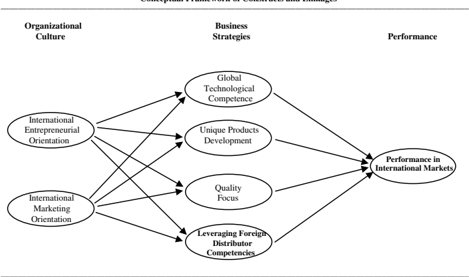
- The survey analysis found that international entrepreneurial orientation significantly predicted global technological competence with a standardized coefficient of 0.28; the link from international marketing orientation to global technological competence was not significant.
- Unique products development was significantly predicted by both international entrepreneurial orientation (0.19) and international marketing orientation (0.24).
- Quality focus was significantly predicted by both international entrepreneurial orientation (0.23) and international marketing orientation (0.35).
- Leveraging foreign distributor competences was significantly predicted by international marketing orientation (0.26) but not by international entrepreneurial orientation; these strategy variables were also significant drivers of performance in international markets: global technological competence (0.21), unique products development (0.14), quality focus (0.30), and leveraging foreign distributor competences (0.18).
## Methods
- The paper uses a two-phase design: first qualitative interviews/case studies to develop constructs and hypotheses, then a cross-industry field survey to test them.
- The qualitative phase included 33 professionals: 24 senior managers at early internationalizing firms, 6 scholars, and 3 international trade experts; the firms were mostly founded after 1985, sold half or more of their sales abroad, and had entered foreign markets within 3 years of founding.
- The survey was mailed to a random sample of 900 manufacturing firms in the United States founded in 1980 or later and exporting at least 25% of total production; 203 usable surveys were returned (about 23% response rate). The main analysis used LISREL8 path analysis, with exploratory factor analysis and confirmatory factor analysis for scale purification and validity checks.
## Limitations
- The paper states that “little empirical work” had been attempted on born globals and that there had been “almost no empirical research” on the factors driving their superior international performance.
- The study itself is focused on U.S. manufacturing firms that were selected using a 25% export threshold, so the evidence is tied to that sample and entry-mode context; this is evident from the text.
- The paper notes that the survey results are based on self-reported measures from responding firms; this is evident from the questionnaire-based design, though the paper does not frame it explicitly as a limitation.
Model-written summary. Check it against the paper before relying on it.
Integrity signals
Registry
Cites
Statistics
Figures
Verification
Claims the paper makes
0 Valid · 0 Not valid · 53 Not checked · 112 Own results and interpretations
A result the paper reports from its own data — it cites no other source for it, so there is none to check. The quote shows it is in the paper.
In the paper
“Despite the scarce resources typical of young firms, our findings reveal that born-global firms leverage a distinctive mix of orientations and strategies that allow them to succeed in diverse international markets.”
plainstates a cause- Asserted: passes — The authors put it forward as true.
- Checkable: passes — It can be checked against evidence.
- Load-bearing: passes — The paper’s conclusions depend on it.
- Based: passes — The paper gives a reason why it holds.
- Rests on an assumption not shown here.
A result the paper reports from its own data — it cites no other source for it, so there is none to check. The quote shows it is in the paper.
In the paper
“The critical role of marketing prowess overseas was also strongly emphasized by virtually all interviewees in the case studies.”
boosted- Asserted: passes — The authors put it forward as true.
- Checkable: passes — It can be checked against evidence.
- Load-bearing: unclear — It is unclear whether the paper’s conclusions depend on it.
- Based: passes — The paper gives a reason why it holds.
A result the paper states — it cites no source for it, so there is none to check. The quote shows it is in the paper.
In the paper
“Most interviewed firms exhibited strong technological capabilities in their respective product or industry categories.”
plain- Asserted: passes — The authors put it forward as true.
- Checkable: passes — It can be checked against evidence.
- Load-bearing: unclear — It is unclear whether the paper’s conclusions depend on it.
- Based: passes — The paper gives a reason why it holds.
A result the paper reports from its own data — it cites no other source for it, so there is none to check. The quote shows it is in the paper.
In the paper
“In general, the qualitative phase of the study revealed that born globals are likely to be formed by entrepreneurs who pursue foreign ventures with a strong marketing orientation.”
hedgedstates an association- Asserted: passes — The authors put it forward as true.
- Checkable: passes — It can be checked against evidence.
- Load-bearing: passes — The paper’s conclusions depend on it.
- Based: passes — The paper gives a reason why it holds.
A result the paper states — it cites no source for it, so there is none to check. The quote shows it is in the paper.
In the paper
“In contrast, born globals leverage a collection of fundamental intangible knowledge-based capabilities in the cultivation of foreign markets early in their evolution.”
plainstates a cause- Asserted: passes — The authors put it forward as true.
- Checkable: passes — It can be checked against evidence.
- Load-bearing: passes — The paper’s conclusions depend on it.
- Based: unclear — It is unclear why the paper says it holds.
- Rests on an assumption not shown here.
84 more claims
Create a free account to see all 165 claims and to verify the 3 references still open.
- It may state two separate claims as one. 33
- Probably not a substantial claim. 54
Citations
Cites
Evaluating Structural Equation Models with Unobservable Variables and Measurement Error
Fornell, C., & Larcker, D. F. (1981) · Journal of Marketing Research · doi:10.2307/3151312 · Cited by 109,314 · cited 2×
“Composite reliability was calculated using the procedures outlined by Fornell and Larcker (1981).”
MethodInfluentialEvaluating structural equation models with unobservable variables and measurement error
Fornell, C., & Larcker, D. F. (1981) · Journal of Marketing Research · doi:10.1177/002224378101800104 · Cited by 109,190
Firm Resources and Sustained Competitive Advantage
Barney, J. (1991) · Journal of Management · doi:10.1177/014920639101700108 · Cited by 48,334
(1994) · Journal of the American Dietetic Association · doi:10.1016/0002-8223(94)92216-0 · Cited by 45,910
Firm resources and sustained competitive advantage
Barney, J. B. (2004) · Advances in Strategic Management · doi:10.1016/s0742-3322(00)17018-4 · Cited by 38,152
Absorptive Capacity: A New Perspective on Learning and Innovation
Cohen, W. M., & Levinthal, D. A. (1990) · Administrative Science Quarterly · doi:10.2307/2393553 · Cited by 35,728
A resource‐based view of the firm
Wernerfelt, B. (1984) · Strategic Management Journal · doi:10.1002/smj.4250050207 · Cited by 25,635
The Theory of Economic Development
Schumpeter, J., & Backhaus, U. (2006) · The European Heritage in Economics and the Social Sciences · doi:10.1007/0-306-48082-4_3 · Cited by 22,506
An Evolutionary Theory of Economic Change.
Loasby, B. J., Nelson, R. R., & Winter, S. G. (1983) · The Economic Journal · doi:10.2307/2232409 · Cited by 21,366
A Dynamic Theory of Organizational Knowledge Creation
Nonaka, I. (1994) · Organization Science · doi:10.1287/orsc.5.1.14 · Cited by 17,809
Research works printed but not linked: 5
- Nikkei Sangyoo Shimbun (1995) Benchaa Shin Sedai (New Generation Ventures) , Nihon Keizai Shimbun: Tokyo.
- Nunnally, J.C. (1978) Psychometric Theory
- Porter, M.E. (1980) Competitive Strategy , The Free Press: New York.
- Rennie, M. (1993) 'Born global', McKinsey Quarterly (4): 45-52. Rosson, P. and Ford, I.D. (1982) 'Manufacturer-overseas distributor relations and export performance', Journal of International Business Studies 13 (2): 57-72.
- Schumpeter, J. (1939) Business Cycles , Vol. 1 McGraw-Hill: New York.
Cited by
Items 1,701–1,800 of 3,020
Transnational board interlocks: The influence of degree of internationalization and psychic distance
González, C. (2019) · Cross Cultural & Strategic Management · doi:10.1108/ccsm-10-2018-0154 · Cited by 7
O grau de internacionalização, as competências e o desempenho da PME brasileira
Floriani, D. E. (2010) · Digital Library of Theses and Dissertations (Universidade de São Paulo) · doi:10.11606/t.12.2010.tde-24062010-105659 · Cited by 22
Born Globals brasileiras: estudo da internacionalização de empresas de base tecnológica
Ribeiro, F. C. F. (2012) · Digital Library of Theses and Dissertations (Universidade de São Paulo) · doi:10.11606/t.12.2012.tde-26032012-205850 · Cited by 16
La orientación al mercado como determinante de la internacionalización de las nuevas empresasPreprint
Blesa, A., Meliá, M. R., & Monferrer, D. (2008) · RePEc: Research Papers in Economics · Cited by 13
Corporate Relocation in Venture Capital FinancePreprint
Cumming, D. J., Fleming, G. A., & Schwienbacher, A. (2005) · SSRN Electronic Journal · doi:10.2139/ssrn.676521 · Cited by 5
The efficacy of SMME incubation as a strategy for enterprise development in South Africa
Ntlamelle, T. (2015) · Cited by 17
Knowledge Transfer from Multinationals through Labour Mobility: Learning from Export ExperiencePreprint
Masso, J., & Vahter, P. (2016) · SSRN Electronic Journal · doi:10.2139/ssrn.2840444 · Cited by 5
Joensuu‐Salo, S., Sorama, K., & Kettunen, S. (2016) · Theseus (Ammattikorkeakoulujen) · Cited by 8
Context and Complexity of International Entrepreneurship as a Field of Research
Cesinger, B. (2013) · Cited by 5
Jean, R. “., Kim, D., Çavuşgil, E., Tsuteaki, H., & Ojala, A. (2025) · International Business Review · doi:10.1016/j.ibusrev.2025.102399 · Cited by 5
A quantitative approach to foreign market selection for digital platform companies
Eskiyerli, D. Y., & PEREZ, X. A. V. I. E. R. A. (2024) · Journal of Digital Economy · doi:10.1016/j.jdec.2025.04.001 · Cited by 6
Airports and regional inequality: Evidence from China
Zuo, W., & Chen, F. (2025) · Transport Policy · doi:10.1016/j.tranpol.2025.103829 · Cited by 5
Adu, D. A., Mangena, M., Adegbite, E. O., & Boateng, F. (2025) · Business Strategy and the Environment · doi:10.1002/bse.70328 · Cited by 7
Scaffolding artifact in entrepreneurship: A design science approach
Malik, F. S., & Terzidis, O. (2025) · Journal of Business Venturing Design · doi:10.1016/j.jbvd.2025.100035 · Cited by 7
Fernhaber, S. A., & Schwens, C. (2025) · Journal of Business Venturing · doi:10.1016/j.jbusvent.2025.106560 · Cited by 5
25 Years internationalization research in SMEs, a scientometric analysis
Daei, A., Zanjirchi, S. M., Mirghafoori, S. H., & Sadrabadi, A. N. (2023) · Competitiveness Review An International Business Journal incorporating Journal of Global Competitiveness · doi:10.1108/cr-09-2022-0139 · Cited by 8
The Role of Entrepreneurial Leadership to Rural Development and Resilience in Indonesia
Kusmulyono, M. S., Dhewanto, W., & Famiola, M. (2024) · International Journal of Rural Management · doi:10.1177/09730052231213165 · Cited by 4
“Proactiveness is characterised by a leader’s revolutionary perspective on the market’s future desires (Engelen et al. 2014; Knight and Cavusgil 2004; Shane and Venkataraman 2000).”
Corvello, V., Felicetti, A. M., Pini, B., & Bigliardi, B. (2024) · Journal of International Entrepreneurship · doi:10.1007/s10843-024-00368-3 · Cited by 5
“2 The constructs identified Buccieri et al. 2020; Knight and Cavusgil 2004).”
A typology of born global firms’ attributes and future directions
Khan, H., & Cavusgil, S. T. (2024) · Multinational Business Review · doi:10.1108/mbr-03-2024-0034 · Cited by 6
Self-citationIsmail, D., Isa, A. M., & Ali, M. (2013) · Jurnal Pengurusan · doi:10.17576/pengurusan-2013-38-05 · Cited by 5
“Accordingly, in the current study, we view organizational capabilities as a demonstration of the firm’s capacity to perform repetitive constructive tasks that relate to its ability to create value, as captured by Knight and Cavusgil (2004). In particular, the present study examines the firmspecific capability that fac…”
BackgroundParola, F., Persico, L., & Satta, G. (2013) · Journal of Industrial and Business Economics · doi:10.3280/poli2013-001004 · Cited by 4
Falcão, R. P. D. Q., Machado, M. M., Cruz, E. P., & Cunha, R. M. (2021) · REAd Revista Eletrônica de Administração (Porto Alegre) · doi:10.1590/1413-2311.335.109038 · Cited by 7
New venture internationalization and performance: the role of founding team and alliances
Jiang, G. (2022) · Journal of Small Business & Entrepreneurship · doi:10.1080/08276331.2022.2057163 · Cited by 5
“It is particularly true for new ventures whose business is constrained within domestic market (Knight and Cavusgil 2004; Lu and Beamish 2001).”
BackgroundRoecker, R., & Floriani, D. E. (2022) · Contextus - Revista Contemporânea de Economia e Gestão · doi:10.19094/contextus.2022.72806 · Cited by 8
“When focusing on Born Globals, entrepreneurial startups that, since or close to their founding, managers have sought to obtain a substantial proportion of their revenue from selling products in international markets (Knight & Cavusgil, 2004).”
BackgroundIvory Tower or Tower of Babel? The challenge of multilingualism for the globally embedded university
Mizrahi‐Shtelman, R., & Drori, G. S. (2022) · Higher Education · doi:10.1007/s10734-022-00894-w · Cited by 8
“Such a notion of multilingua franca is highly relevant to discussions of “born global” (e.g., Knight and Cavusgil, 2004), considering the imprint upon organizations that are “born multilingual.””
BackgroundTHE LIMITS TO INTERNATIONAL OPEN INNOVATION WITHIN SMEs: THE ROLE OF DISTANCE
Tchouwo, C. T., Veilleux, S., & Poulin, D. (2022) · International Journal of Innovation Management · doi:10.1142/s1363919622500517 · Cited by 4
Otomo, S., Ishida, S., & Yang-Yoshihara, M. (2023) · Administrative Sciences · doi:10.3390/admsci13040107 · Cited by 9
Wasi, K., Hasan, Z., Parameswar, N., Patnaik, J., & Ganesh, M. P. (2024) · International Journal of Productivity and Performance Management · doi:10.1108/ijppm-01-2024-0032 · Cited by 6
The underappreciated role of logistics in national systems of entrepreneurship
Friske, W., Yun, G., & Özpolat, K. (2024) · Journal of Research in Marketing and Entrepreneurship · doi:10.1108/jrme-05-2024-0134 · Cited by 6
The Role of Networks in the Accelerated Internationalisation of Indian Firms
Varma, S. (2011) · Transnational Corporation Review · doi:10.1080/19186444.2011.11658289 · Cited by 5
“The ability to consistently replicate the firm’s capabilities across numerous and varied markets produces value for born globals by supporting, especially, international expansion (Knight and Cavusgil 2004).”
BackgroundThe role graduate quantity surveyors in the Malaysian construction industry
Chong, B. L., & Lee, W. P. (2010) · Universiti Utara Malaysia Institutional Repository (Universiti Utara Malaysia) · Cited by 5
Kodydek, G., & Hochreiter, R. (2013) · Organizacija · doi:10.2478/orga-2013-0017 · Cited by 4
“Thus, organizations have to adapt quickly in order to compete effectively and achieve sustainable growth in multinational industries to remain successful on the market (Knight and Cavusgil, 2004).”
BackgroundAn analysis of the internationalization of small Brazilian software companies
Cortezia, S. L. D., & de Souza, Y. S. (2011) · Brazilian Business Review · doi:10.15728/bbr.2011.8.4.2 · Cited by 4
Hutzschenreuter, T., Guenther, F., & Oehring, B. (2005) · Journal of Small Business & Entrepreneurship · doi:10.1080/08276331.2005.10593333 · Cited by 4
The Alliance Capability of Technology-Based Born Globals
Altshuler, L., & Elg, U. (2015) · Emerald Group Publishing Limited eBooks · doi:10.1108/s1474-797920140000025004 · Cited by 6
Albarracín, É. J. G. (2015) · Cuadernos de Administración · doi:10.11144/javeriana.cao28-50.eadr · Cited by 4
Investigating the influence of external networks on internationalization success of firms
Behyan, M. (2016) · International Conference on e-Commerce in Developing Countries: with focus on e-Tourism (ECDC) · doi:10.1109/ecdc.2016.7492980 · Cited by 9
Prospecting theoretical approaches to understand internationalization of creative economy firms
de Vasconcellos, S. L., Monticelli, J. M., Calixto, C. V., et al. (2017) · Internext · doi:10.18568/1980-4865.12377-92 · Cited by 4
“Their perceptions of the external environment have connections to the Transaction Costs Theory (Anderson; Gatignon, 1986; Williamson, 1975), Networks theory (Johanson & Vahlne, 2003, 2009), and theories of Innovation (Cavusgil & Knight, 2015; Knight & Cavusgil, 2004).”
BackgroundMathew, N., & Javalgi, R. (2018) · KnE Social Sciences · doi:10.18502/kss.v3i10.2888 · Cited by 4
“The influence of these orientations on firm’s internationalization is reported in research findings concerning ‘born-global’ firms [19, 20] and small- to medium-sized firms.”
BackgroundUzhegova, M., Torkkeli, L., & Ivanova-Gongne, M. (2019) · Palgrave studies of internationalization in emerging markets · doi:10.1007/978-3-030-27285-2_2 · Cited by 5
Trustfulness as a Key Factor of Competitiveness in Medium-Sized Companies in Colombia
Lozano-Correa, L. J., Uribe, R. I. P., & Ocampo-Guzmán, D. (2020) · Advances in business strategy and competitive advantage book series · doi:10.4018/978-1-7998-2019-2.ch015 · Cited by 4
Osei-Bonsu, N. (2020) · Journal of Management Research · doi:10.5296/jmr.v12i2.16080 · Cited by 4
“Consistent with previous SME research (Knight & Cavusgil, 2004; Manolova & Manev 2019), and has highlighted the valuable contribution that CEOs and senior managers of SMEs can make towards the development of the firm innovations.”
ResultThe Rise of Unicorn Companies: A Magical Growth?
Calixto, C. V. (2020) · Springer eBooks · doi:10.1007/978-3-030-42412-1_29 · Cited by 6
Godinez, J., Sanchez-Barrios, L. J., Lopez-Gomez, S., & Núñez, L. G. (2021) · Latin American Business Review · doi:10.1080/10978526.2021.1873799 · Cited by 4
“For this reason, the education level of staff should also be considered when analyzing the experiential resources leading to start an export strategy (Knight & Cavusgil, 2004).”
BackgroundSales growth or employment growth? Exporting conundrum for new ventures
Chen, M., Ni, P., Reve, T., Huang, J., & Lu, R. (2021) · Review of International Business and Strategy · doi:10.1108/ribs-04-2020-0048 · Cited by 7
Uthamaputhran, S. A. L., Zaato, S. G., Zainol, N. R., Sabri, N. A. A., & Said, N. M. (2021) · Lecture notes in networks and systems · doi:10.1007/978-3-030-69221-6_2 · Cited by 5
“Knight and Cavusgil (2004) also emphasized early internationalization by emphasizing the development of innovation activities and technologies.”
BackgroundMalega, P., Majerník, M., Rudy, V., & Daneshjo, N. (2021) · Polish Journal of Environmental Studies · doi:10.15244/pjoes/130910 · Cited by 7
Determinants of internationalisation by firms from Sub-Saharan Africa
Fasanya, D. O., Ingham, H., & Read, R. (2022) · Journal of Business Research · doi:10.1016/j.jbusres.2022.01.098 · Cited by 11
Export development of Taiwanese food and beverage processing SMEs: A test of a DOI model
Shih, T.-Y., Wickramasekera, R., & Li, D. (2022) · Asia Pacific Journal of Management · doi:10.1007/s10490-022-09806-z · Cited by 9
“However, with the advent of research into rapid internationalization “born globals” (Knight & Cavusgil, 2004) and international new ventures (Oviatt & McDougall, 2005), the utility of the U-model has lessened.”
Chen, Y., Wang, Y., Zhao, H., & Xu, W. (2023) · PLoS ONE · doi:10.1371/journal.pone.0280237 · Cited by 5
Dynamic Capabilities View within the Field of Strategic Management Field: A Bibliometric Analysis
Marco‐Lajara, B., Ruiz‐Fernández, L., & Seva‐Larrosa, P. (2022) · Contemporary Management Research · doi:10.7903/cmr.21267 · Cited by 8
Szanyi-Gyenes, X., & Almási, A. (2023) · Acta Polytechnica Hungarica · doi:10.12700/aph.20.9.2023.9.3 · Cited by 4
“They internationalise quickly and generally successfully [46] and focus on developing the skills needed to achieve success internationally [47], becoming more competitive overall.”
The Effect of Entrepreneurial Orientation on Firm Performance: The Role of Networking Capability
Rahman, A. A., Pratikto, H., & Siswanto, E. (2022) · Brilliant International Journal Of Management And Tourism · doi:10.55606/bijmt.v2i3.816 · Cited by 7
Chung, H. F. L., & Ho, M. H.-W. (2024) · Journal of Business and Industrial Marketing · doi:10.1108/jbim-12-2023-0761 · Cited by 7
Campins, M. (2015) · Apuntes Revista de Ciencias Sociales · doi:10.21678/apuntes.76.730 · Cited by 4
The success of born global firms: a conceptual model
Sultan, P., & Wong, H. Y. (2011) · J for Global Business Advancement · doi:10.1504/jgba.2011.043276 · Cited by 10
Samson, A. T. (2014) · THE INTERNATIONAL JOURNAL OF MANAGEMENT SCIENCE AND BUSINESS ADMINISTRATION · doi:10.18775/ijmsba.1849-5664-5419.2014.23.1004 · Cited by 8
“Even though there have been studies on strategic orientations and export performance (Cadogan, 2012; Knight & Cavusgil, 2004).”
BackgroundNew Perspectives on the Internationalisation of Micro-Businesses
Moraes, A. J. D., Ekanem, I., & Osabutey, E. L. C. (2016) · Advances in business strategy and competitive advantage book series · doi:10.4018/978-1-5225-1991-1.ch007 · Cited by 4
“These businesses face very different challenges to larger businesses both in their domestic and international markets (Madsen et al, 2000; Knight and Cavusgil, 2004).”
BackgroundNetwork Market Orientation, Knowledge Management and Born Globals’ Competitiveness
Monferrer, D., & Guillén, M. E. (2017) · InTech eBooks · doi:10.5772/intechopen.70064 · Cited by 7
“In this line, Knight and Cavusgil [31] point out that the market orientation of new international ventures enhances their understanding of their customers’ present and future needs and optimises the development of distinctive actions that can meet these needs by providing a more valuable offer than that of their rival…”
BackgroundEntrepreneurial Marketing as a Key Driver of Early and Sustained Internationalisation
Hagen, B., & Zucchella, A. (2018) · Emerald Group Publishing Limited eBooks · doi:10.1108/s1876-066x20180000034002 · Cited by 4
Lévesque, M., Choi, Y. R., & Hsuan, J. (2018) · IEEE Transactions on Engineering Management · doi:10.1109/tem.2018.2858550 · Cited by 4
“Firms entering foreign markets, for instance, must frequently adapt their operations and practices to successfully serve those markets [35], [36].”
BackgroundBORN GLOBAL COMPANIES. IS THIS A FUTURE FOR ECONOMY OF LATVIA? A PRELIMINARY STUDY
Vaivode, I. (2018) · Verslas teorija ir praktika · doi:10.3846/btp.2018.29 · Cited by 4
Home Country Institutions and International Entrepreneurship
Muralidharan, E. K., & Pathak, S. (2020) · Advances in business strategy and competitive advantage book series · doi:10.4018/978-1-7998-1981-3.ch014 · Cited by 5
Győri, Á., & Czakó, Á. (2019) · Szociológiai szemle · doi:10.51624/szocszemle.2019.1.4 · Cited by 13
Lavinsaa, P., Somu, H., Ahmad, N. H., et al. (2020) · doi:10.2991/aebmr.k.200514.012 · Cited by 4
“Likert scales were used to minimize executive response time and effort [21].”
MethodDo Born Global Firms Represent a Truly Distinct Type of Organisation
Dow, D. (2005) · Cited by 4
Born foreign firms in Cambodia
Hipsher, S. A. (2008) · International Journal of Emerging Markets · doi:10.1108/17468800810849259 · Cited by 4
THE FUTURE OF INTERNATIONAL BUSINESS AS A STUDY FIELD
Amatucci, M. (2010) · Internext · doi:10.18568/1980-4865.511-32 · Cited by 4
Globalization beyond partitioning: back to Krugman’s world
Jørgensen, J. G., Schröder, P. J. H., & Yu, Z. (2011) · Review of World Economics · doi:10.1007/s10290-011-0111-0 · Cited by 4
Internationalization Decision of a Born Global: the Case of Information Technology Companies
Sekliuckienė, J., & Maciulskaite, S. (2013) · Social Sciences · doi:10.5755/j01.ss.80.2.4644 · Cited by 5
“Many born globals are focusing on the attribute of quality in their products and services to achieve a competitive advantage (Knight and Cavusgil, 2004).”
BackgroundInfluentialInternational Entrepreneurship: Case of Happiest Minds
Kumar, N. (2012) · South Asian Journal of Business and Management Cases · doi:10.1177/227797791200100103 · Cited by 4
“Furthermore, unlike well-established firms, Born-Global firms suffer from a lack of resources and capabilities (Knight & Cavusgil, 2004; Oviatt & McDougall, 1994).”
BackgroundThe Need for International Intellectual Entrepreneurs and How Business Schools Can Help
Kirpalani, V. H., & Gabrielsson, M. (2005) · Journal of Teaching in International Business · doi:10.1300/j066v16n01_06 · Cited by 4
“They are faced by the changed external business environment, which is driven by the globalization of markets and technological advances in information and communications technologies (Knight and Cavusgil, 2004).”
BackgroundBuilding Sustainable R&D Centers in Emerging Technology Regions
Grzegorczyk, M., & Trzmielak, D. (2015) · Masarykova univerzita eBooks · doi:10.5817/cz.muni.p210-7855-2015 · Cited by 8
A Study on Entrepreneurship, Competitiveness of SWOT, and Performance in Hidden Champion Firm
Lee, S. (2016) · Asia-Pacific Journal of Business Venturing and Entrepreneurship · doi:10.16972/apjbve.11.2.201604.21 · Cited by 4
Survival and Failure of Born Globals: The Case of Software Firms
Gabrielsson, M., & Gabrielsson, P. (2009) · Palgrave Macmillan UK eBooks · doi:10.1057/9780230237322_7 · Cited by 4
Innovation as a driver of internationalization in the software industry
Rönkkö, M., Ojala, A., & Tyrväinen, P. (2013) · International Conference on Research and Innovation in Information Systems · doi:10.1109/icriis.2013.6716684 · Cited by 6
“One of the premises of the theory concerning INVs is that a firm must control unique and non-imitable resources, capable of creating competitive advantage [4] internationally.”
BackgroundResultInfluentialGarcı́a, H. C., & Kolbe, D. (2016) · Economía Agraria y Recursos Naturales · doi:10.7201/earn.2016.02.01 · Cited by 4
Bembenek, B., & Frankowska, M. (2015) · Modern Management Review · doi:10.7862/rz.2015.mmr.52 · Cited by 4
Sánchez‐Matamoros, J. B., & Roca, F. J. F. (2017) · Revista de Historia Económica / Journal of Iberian and Latin American Economic History · doi:10.1017/s0212610917000118 · Cited by 4
Should Be A Process The Internationalization Of A Firm? Born Globals As An Exception
Roldán, L. S., & Fernández, G. A. M. (2013) · RePEc: Research Papers in Economics · Cited by 4
Santhosh, C., & Subrahmanya, M. H. B. (2020) · Journal of Entrepreneurship and Innovation in Emerging Economies · doi:10.1177/2393957520913762 · Cited by 4
“One of the distinct motives for internationalisation is influenced as a result of unsolicited orders from a foreign customer or unanticipated events that have been identified as a major export stimulation (Ciravegna et al., 2014; Knight & Cavusgil, 2004).”
BackgroundPrashantham, S. (2013) · AIB Insights · doi:10.46697/001c.16941 · Cited by 4
“3 Thus new ventures do not operate in an environment 1 Some scholars use the term born global (Knight & Cavusgil, 2004).”
BackgroundNurhas, I., Geisler, S., & Pawlowski, J. Μ. (2021) · International Joint Conference on Knowledge Discovery, Knowledge Engineering and Knowledge Management · doi:10.5220/0010652100003064 · Cited by 8
“We supplement previous research on global innovation success (Bauman & Lucy, 2019; Jensen, 2017; Knight & Cavusgil, 2004) and intergenerational competencies in start-up development (Bauman & Lucy, 2019).”
BackgroundMethodInfluentialIntroduction to Small and Medium Sized Enterprises and the COVID-19 Response
Etemad, H. (2022) · Edward Elgar Publishing eBooks · doi:10.4337/9781802205770.00012 · Cited by 4
Identifying and implementing adaptive strategy in the U.S. military
Kropp, F., Zolin, R., & Lindsay, N. (2009) · Advances in entrepreneurship, firm emergence, and growth · doi:10.1108/s1074-7540(2009)0000011008 · Cited by 4
MODERATING EFFECT OF EXTERNAL ENVIRONMENT ON PERFORMANCE OF SMES IN PAKISTAN
Jabeen, R. (2014) · UUM Electronic Theses and Dissertation [eTheses] (Northern University of Malaysia) · Cited by 7
Meaningful internationalization : a study among the leaders of Brazilian smaller enterprises
Seifert, R. E. (2010) · University of Birmingham Institutional Research Archive (University of Birmingham) · Cited by 13
Johansson, N., Landström, M. D., & Palmer, S. J. (2013) · KTH Publication Database DiVA (KTH Royal Institute of Technology) · Cited by 4
Equity Commitment under Uncertainty: A Hierarchical Model of Real Option Entry Mode ChoicesPreprint
Wooster, R. B., Blanco, L. R., & Sawyer, W. C. (2014) · SSRN Electronic Journal · doi:10.2139/ssrn.2403006 · Cited by 4
“6 As a sensitivity analysis, we also estimated all models in Table 3 with an alternative proxy for international investment experience which captures whether a firm is born global or not (Knight and Cavusgil, 2004).”
MethodModelling the Speed: Examining the Different Modes of Internationalization by the Timing and SpeedPreprint
Kotosaka, M. (2011) · SSRN Electronic Journal · doi:10.2139/ssrn.1969313 · Cited by 4
Samson, A. T. (2015) · UUM Electronic Theses and Dissertation [eTheses] (Northern University of Malaysia) · Cited by 10
Turunen, H. (2014) · UTUPub (University of Turku) · Cited by 12
Internationalization as an entrepreneurial process.
Chandra, Y. (2007) · UNSWorks (University of New South Wales, Sydney, Australia) · doi:10.26190/unsworks/17573 · Cited by 20
Abrahamsson, J. (2016) · DiVA at Umeå University (Umeå University) · Cited by 7
International Entrepreneurship and Networks
Ahmad, S., & Dimitratos, P. (2017) · Wiley eBooks · doi:10.1002/9781118970812.ch20 · Cited by 5
The influence of IFRS implementation on business management in Finnish Born Globals.
Wirtanen, J. (2009) · Aaltodoc (Aalto University) · Cited by 4
Forouharfar, A. (2020) · Springer eBooks · doi:10.1007/978-3-319-31816-5_3893-1 · Cited by 7
The determinants of SMEs’ internationalisation among MEDA transitional economiesPreprint
Scalamonti, F. (2025) · SSRN Electronic Journal · doi:10.2139/ssrn.5084116 · Cited by 6
Challenges in Conducting International Market Research
Engélen, A., Engelen, M., & Craig, C. S. (2021) · Springer eBooks · doi:10.1007/978-3-319-57413-4_6 · Cited by 3
Metadata
- Authors
- Knight, G. A., & Cavusgil, S. T.
- Affiliations
- Florida State University (US)
- Corresponding author
- Knight, Gary A
- ORCID
- Knight, Gary A
- Venue
- Journal of International Business Studies
- Published
- 2004-01-08
- Volume
- 35
- Issue
- 2
- Pages
- 124-141
- ISSN
- 0047-2506 (ISSN-L)
- 1478-6990
- OpenAlex
- W2127709152
- Semantic Scholar
- d24960b5342d0dd3b86be002ab18a80e7b6fb5c9
- Cited by
- 3,013
- References
- 102
- Citations by year
- 2026: 121 · 2025: 123 · 2024: 157 · 2023: 154 · 2022: 182 · 2021: 196 · 2020: 189 · 2019: 180 · 2018: 199 · 2017: 172 · 2016: 188 · 2015: 187 · 2014: 178 · 2013: 167 · 2012: 129
- FWCI
- 137.12
- Type
- journal article
- Language
- en
- Update notices
- correction (2004-07-16)
- Open access
- bronze
- doi.org
- Licence
- www.springer.com/tdm (tdm)
- Locations
- Journal of International Business Studies (publishedVersion)
- RePEc: Research Papers in Economics (submittedVersion)
- Funders
- Michigan State University
- College of Engineering, Michigan State University
- Topics
- Social Sciences › Business, Management and Accounting › Strategy and Management › International Business and FDI
- Social Sciences › Business, Management and Accounting › Strategy and Management › Innovation and Knowledge Management
- Social Sciences › Communication › International Student and Expatriate Challenges
- Keywords
- born global firms, early internationalization, organizational capabilities, innovation, innovation culture, international business strategy, international success, young firms, internationalization of firms
About these checks
Registry, retraction, Cites and statistics results are computed, not judged, with one exception: a printed reference that no index lists is read once by a model before it counts as a citation error. Claims are extracted by a model and kept only when their quote appears verbatim in the text; each cited source is then checked, with a model’s help, for whether it says what the claim relies on. Those verdicts can be wrong — read the claim’s quote and the cited source before relying on one.
A language model drew the claims from the paper on 2026-10-10, under version 3 of the claim definition (model deepseek-v4.1-flash, prompt extract-v3).
A second model labelled each claim on 2026-10-10 (model jev-1.13-20260917, definition revision gold-guideline-v0.2).
Statistics and arithmetic are recomputed, not judged.
Confidence bands are shown only for fields calibrated on our annotated test set. None is calibrated yet, so no band is shown.
What counts as a claim ›How we measure confidence ›How we check this ›
Are you an author, or do you see a problem with this page? Request a review
Data sources
Bibliographic data: Semantic Scholar, OpenAlex, Crossref.
Contains information from the Semantic Scholar Academic Graph Datasets, made available under the ODC Attribution License (ODC-BY 1.0).
Semantic Scholar’s data is described in: Kinney, R., et al. (2023). The Semantic Scholar Open Data Platform. arXiv:2301.10140.
