

Cooperative behavior cascades in human social networks
Open accessThe DOI matches its Crossref record; 55 of the 56 references it cites were found in a registry or an index; 1 of the 67 sources its claims cite were checked for support.
Abstract
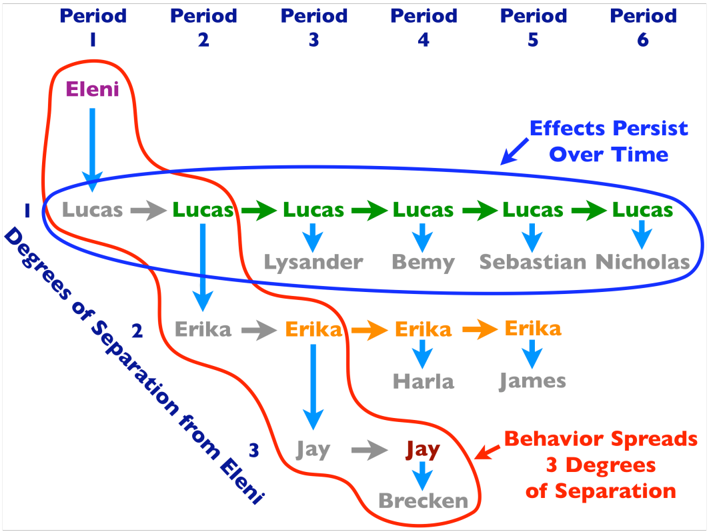
Theoretical models suggest that social networks influence the evolution of cooperation, but to date there have been few experimental studies. Observational data suggest that a wide variety of behaviors may spread in human social networks, but subjects in such studies can choose to befriend people with similar behaviors, posing difficulty for causal inference. Here, we exploit a seminal set of laboratory experiments that originally showed that voluntary costly punishment can help sustain cooperation. In these experiments, subjects were randomly assigned to a sequence of different groups to play a series of single-shot public goods games with strangers; this feature allowed us to draw networks of interactions to explore how cooperative and uncooperative behaviors spread from person to person to person. We show that, in both an ordinary public goods game and in a public goods game with punishment, focal individuals are influenced by fellow group members’ contribution behavior in future interactions with other individuals who were not a party to the initial interaction. Furthermore, this influence persists for multiple periods and spreads up to three degrees of separation (from person to person to person to person). The results suggest that each additional contribution a subject makes to the public good in the first period is tripled over the course of the experiment by other subjects who are directly or indirectly influenced to contribute more as a consequence. These results show experimentally that cooperative behavior cascades in human social networks.
Overview
CoChat Summary
TL;DR
Reanalyzing Fehr-Gächter public goods experiments, Fowler and Christakis find that cooperative and uncooperative contributions spread causally from person to person to person, up to three degrees of separation, and persist over multiple periods. Each additional 1 MU contributed in period 1 approximately triples over the experiment through direct and indirect network effects.
Key findings
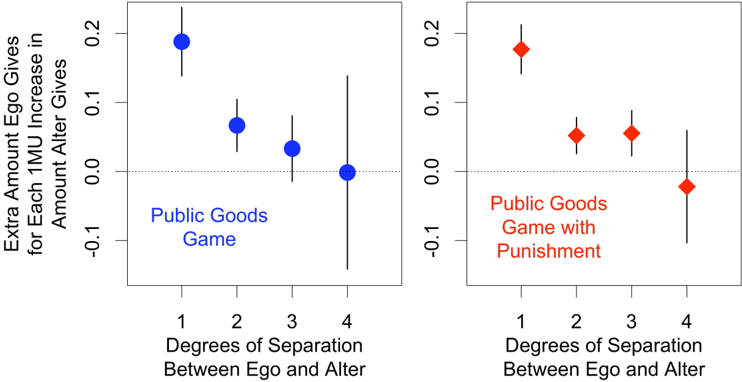
- Direct influence: each 1 MU contributed by an alter increased ego’s next-period contribution by 0.19 MUs (95% CI 0.14–0.24, p<0.0001) in the basic public goods game and 0.18 MUs (0.14–0.21, p<0.0001) in the punishment version.
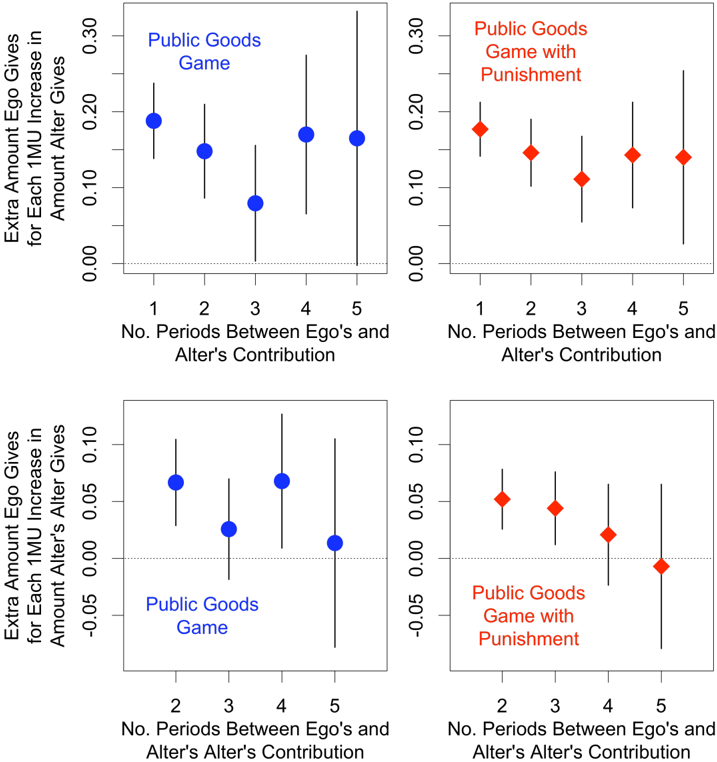
- Indirect influence: each 1 MU contributed by an alter’s alter increased ego’s contribution two periods later by 0.07 MUs (0.03–0.10, p=0.0005) in the basic game and 0.05 MUs (0.03–0.08, p=0.0001) with punishment; in the punishment game, alter’s alter’s alter increased ego’s contribution by 0.06 MUs (0.02–0.09, p=0.001) three periods later.
- Cascade size: an extra 1 MU in period 1 caused 3 other subjects to increase total contributions by 1.8 MUs over the next 4 periods in the basic game or 2.1 MUs over the next 5 periods with punishment, plus indirect increases of 1.2 or 0.9 MUs, totaling 3 MUs (95% CI 2.4–3.6) in both versions.
- Punishment: each punishment point an alter’s alter gave to an alter increased ego’s contribution two rounds later by 0.13 MUs (0.02–0.23, p=0.02), but this did not spread further (p=0.25); punishment behavior itself did not spread (p=0.83).
Methods
- Reanalysis of previously published Fehr-Gächter public goods game experiments with 240 subjects; groups of four, 20 MUs, six periods, random assignment, strict anonymity, and no subject paired with another more than once; the punishment version allowed spending up to 10 MUs to reduce a target’s income by 3 MUs per 1 MU.
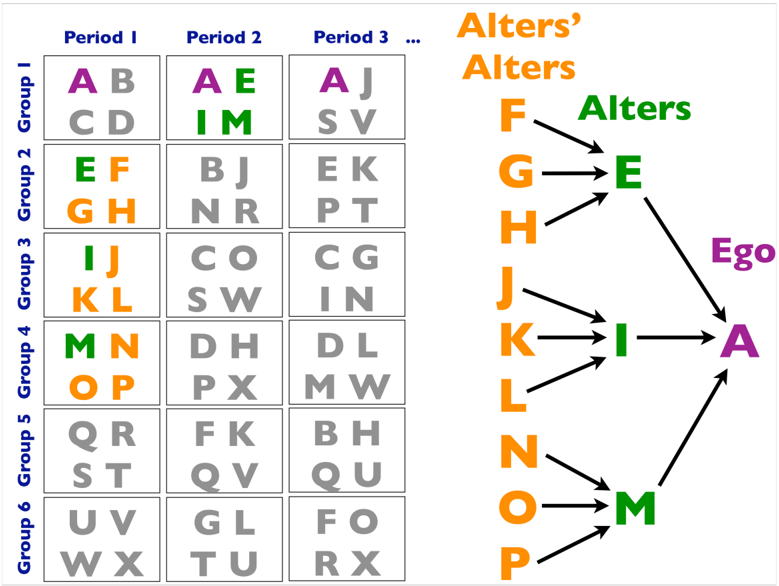
- Interaction networks were constructed from group assignments, with ties defined by the ability to observe another subject’s contribution in the preceding period; direct and indirect effects were estimated up to three degrees of separation.
- Interval (Tobit) regression with Huber-White clustered standard errors on ego and alter, controlling for ego’s prior contribution and period fixed effects; robustness checks included group-level models, additional lags, ego fixed effects, and Sobel mediation tests.
Limitations
- Paper-stated: results come from a particular experimentally controlled network structure, and whether “pay it forward” behavior spreads more widely in natural human networks remains an open question; interval regression coefficients apply to the latent outcome, group-level models are downwardly biased due to censoring, and fixed-effects models are biased toward zero.
- Evident from the text: anonymous, single-shot stranger groups with no reputations or repeated ties may not capture real-world social ties; per-MU effects are small, and cascade estimates rely on effects with p<0.05.
Model-written summary. Check it against the paper before relying on it.
Integrity signals
Registry
Cites
Statistics
Figures
Verification
Claims the paper makes
1 Valid · 4 Not valid · 30 Not checked · 161 Own results and interpretations
Every source the paper cites for this claim was checked and supports it.
In the paper
“However, it is worth reiterating that most of our subjects violated this supposition: since all interactions are single-shot, the equilibrium prediction is to contribute nothing and to pay nothing to punish noncontributors, yet this was not what the subjects did ( 36 ).”
What the sources say
- Supportedcites [36] 36. Fehr E, Gachter S (2002) Altruistic punishment in humans. Nature 415: 137-140. source
Fehr & Gächter (2002) state the selfish benchmark explicitly — 'it was always in the material self-interest of any subject to keep all MUs privately' and 'purely selfish subjects will never cooperate or punish others, because cooperation and punishment are costly and yield no pecuniary benefits' (p. 1) — with groups randomly recomposed so no subject met another twice, i.e. single-shot interactions. Their results then show most subjects acted against that benchmark: 84.3% of subjects punished at least once out of 1,270 punishment acts (Altruistic punishment and cooperation, p. 1), and cooperation rose in the punishment treatment with 94.2%/91.4% of subjects investing more under punishment than without (Results, p. 2). Together these support the paraphrase that most subjects violated the selfish-payoff-maximising supposition in both contributing and punishing. (LLM, conf=0.88)
plain- Asserted: passes — The authors put it forward as true.
- Checkable: passes — It can be checked against evidence.
- Load-bearing: passes — The paper’s conclusions depend on it.
- Based: passes — The paper gives a reason why it holds.
- Supported
A result the paper reports from its own data — it cites no other source for it, so there is none to check. The quote shows it is in the paper.
In the paper
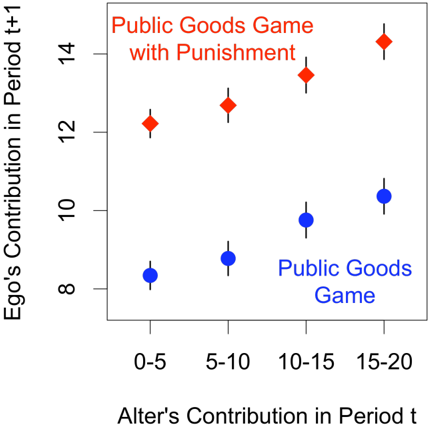
“A summary of the raw data (Fig. 2) shows that, indeed, future contributions by focal individuals ('egos') are significantly related to the amount contributed by each group member with whom the ego interacted in the previous period ('alters') in both the basic public goods game and the public goods game with punishment.”
plainstates an association- Asserted: passes — The authors put it forward as true.
- Checkable: passes — It can be checked against evidence.
- Load-bearing: passes — The paper’s conclusions depend on it.
- Based: passes — The paper gives a reason why it holds.
A result the paper reports from its own data — it cites no other source for it, so there is none to check. The quote shows it is in the paper.
In the paper
“Remarkably, even though egos do not observe the contributions of their alters' alters (two degrees of separation), they too significantly affect ego's contribution decisions.”
plainstates a cause- Asserted: passes — The authors put it forward as true.
- Checkable: passes — It can be checked against evidence.
- Load-bearing: passes — The paper’s conclusions depend on it.
- Based: passes — The paper gives a reason why it holds.
A result the paper reports from its own data — it cites no other source for it, so there is none to check. The quote shows it is in the paper.
In the paper
“For each 1MU contributed by an alter, ego contributes an additional 0.19 MUs (95% C.I. 0.14 to 0.24, p <0.0001) in the next period in the basic public goods game and an additional 0.18MUs (0.14 to 0.21, p <0.0001) in the public goods game with punishment.”
plainstates a cause- Asserted: passes — The authors put it forward as true.
- Checkable: passes — It can be checked against evidence.
- Load-bearing: passes — The paper’s conclusions depend on it.
- Based: passes — The paper gives a reason why it holds.
A result the paper reports from its own data — it cites no other source for it, so there is none to check. The quote shows it is in the paper.
In the paper
“Furthermore, this influence persists for multiple periods and spreads up to three degrees of separation (from person to person to person to person).”
plainstates a cause- Asserted: passes — The authors put it forward as true.
- Checkable: passes — It can be checked against evidence.
- Load-bearing: passes — The paper’s conclusions depend on it.
- Based: passes — The paper gives a reason why it holds.
104 more claims
Create a free account to see all 196 claims and to verify the 54 references still open.
- It may state two separate claims as one. 38
- Probably not a substantial claim. 57
- The quote only partly states this claim. 7
Claims other papers make about this one
Each is checked against this paper’s own text: does it say what the citing paper says it does?
The cited source says what the claim attributes to it.
In the citing paper
“Furthermore, recent evidence from both lab and field studies suggests that people behave more prosocially after observing others engaging in behaviors such as cooperation and generosity 8 – 10 .”
From Crowdsourcing punishment: Individuals reference group preferences to inform their own punitive decisions (2019) · cites this paper as [8]
Citations
Cites
Birds of a Feather: Homophily in Social Networks
McPherson, M., Smith-Lovin, L., & Cook, J. M. (2001) · Annual Review of Sociology · doi:10.1146/annurev.soc.27.1.415 · Cited by 18,567
Olson, M. (1965) · doi:10.4159/9780674041660 · Cited by 14,191
Asymptotic Confidence Intervals for Indirect Effects in Structural Equation Models
Sobel, M. E. (1982) · Sociological Methodology · doi:10.2307/270723 · Cited by 12,810
The Logic of Collective Action: Public Goods and the Theory of Groups.
Sufrin, S. C., & Olson, M. (1966) · Industrial and Labor Relations Review · doi:10.2307/2521228 · Cited by 11,518
The Evolution of Reciprocal Altruism
Trivers, R. L. (1971) · The Quarterly Review of Biology · doi:10.1086/406755 · Cited by 11,010
Five Rules for the Evolution of Cooperation
Nowak, M. A. (2006) · Science · doi:10.1126/science.1133755 · Cited by 5,894
Altruistic punishment in humans
Fehr, E., & Gächter, S. (2002) · Nature · doi:10.1038/415137a · Cited by 5,616
The Spread of Obesity in a Large Social Network over 32 Years
Christakis, N. A., & Fowler, J. H. (2007) · New England Journal of Medicine · doi:10.1056/nejmsa066082 · Cited by 5,007
Self-citationCollins, R. (2004) · doi:10.1515/9781400851744 · Cited by 4,726
Szabó, G., & Fáth, G. (2007) · Physics Reports · doi:10.1016/j.physrep.2007.04.004 · Cited by 2,974
Cited by
Items 201–300 of 768
Quantifying the Role of Homophily in Human Cooperation Using Multiplex Evolutionary Game Theory
Stefano, A. D., Scatà, M., Corte, A. L., Lió, P., Catania, E., Guardo, E., & Pagano, S. (2015) · PLoS ONE · doi:10.1371/journal.pone.0140646 · Cited by 43
Reconciling long-term cultural diversity and short-term collective social behavior
Valori, L., Picciolo, F., Allansdottir, A., & Garlaschelli, D. (2012) · Proceedings of the National Academy of Sciences · doi:10.1073/pnas.1109514109 · Cited by 40
The Social Contagion of Antisocial Behavior
Tsvetkova, M., & Macy, M. W. (2015) · Sociological Science · doi:10.15195/v2.a4 · Cited by 42
You, S., Lee, J., Lee, Y., & Kim, E. (2018) · Personality and Individual Differences · doi:10.1016/j.paid.2018.04.005 · Cited by 54
Average is Boring: How Similarity Kills a Meme's Success
Coscia, M. (2014) · Scientific Reports · doi:10.1038/srep06477 · Cited by 39
Norms and the Flexibility of Moral Action
FeldmanHall, O., Son, J.-Y., & Heffner, J. (2018) · Personality Neuroscience · doi:10.1017/pen.2018.13 · Cited by 49
Passing on the good vibes: Entrepreneurs’ social support
Nielsen, M. S. (2019) · The International Journal of Entrepreneurship and Innovation · doi:10.1177/1465750319842530 · Cited by 52
Exploring Antecedents and Consequences of Toxicity in Online Discussions: A Case Study on Reddit
Xia, Y., Zhu, H., Lu, T., Zhang, P., & Gu, N. (2020) · Proceedings of the ACM on Human-Computer Interaction · doi:10.1145/3415179 · Cited by 62
The evolution of charitable behaviour and the power of reputation
Barclay, P. (2011) · Oxford University Press eBooks · doi:10.1093/acprof:oso/9780199586073.003.0010 · Cited by 46
Li, K. T., Tang, W., Wu, D., Huang, W., Wu, F., Lee, A., Feng, H. J., Pan, S. W., Han, L., Mak, V., et al. (2018) · The Lancet Infectious Diseases · doi:10.1016/s1473-3099(18)30556-5 · Cited by 43
Understanding Underachievement
Siegle, D. (2018) · Springer eBooks · doi:10.1007/978-3-319-77004-8_16 · Cited by 51
Cooperative behavior evolution of small groups on interconnected networks
Huang, K., Cheng, Y., Zheng, X., & Yang, Y. (2015) · Chaos Solitons & Fractals · doi:10.1016/j.chaos.2015.06.016 · Cited by 38
Evolution of cooperation driven by zealotsPreprint
Masuda, N. (2012) · Cited by 40
Son, J.-Y., Bhandari, A., & FeldmanHall, O. (2019) · Scientific Reports · doi:10.1038/s41598-019-48050-2 · Cited by 37
The joint emergence of group competition and within-group cooperation
Puurtinen, M., Heap, S. M., & Mappes, T. (2014) · Evolution and Human Behavior · doi:10.1016/j.evolhumbehav.2014.11.005 · Cited by 45
Do good actions inspire good actions in others?
Capraro, V., & Marcelletti, A. (2014) · Scientific Reports · doi:10.1038/srep07470 · Cited by 41
Building community resilience: can everyone enjoy a good life?
Cinderby, S., Haq, G., Cambridge, H., & Lock, K. (2015) · Local Environment · doi:10.1080/13549839.2015.1100597 · Cited by 48
How natural selection can create both self-and other-regarding preferences, and networked minds
Grund, T., Waloszek, C., & Helbing, D. (2013) · RWTH Publications (RWTH Aachen) · Cited by 37
McLaughlin, D., Mewhirter, J. M., & Lubell, M. N. (2021) · Journal of Public Administration Research and Theory · doi:10.1093/jopart/muab045 · Cited by 42
Novak, S., Chatterjee, K., & Nowak, M. A. (2013) · Journal of Theoretical Biology · doi:10.1016/j.jtbi.2013.05.029 · Cited by 42
Commentary—Contagion in Prescribing Behavior Among Networks of Doctors
Christakis, N. A., & Fowler, J. H. (2010) · Marketing Science · doi:10.1287/mksc.1100.0595 · Cited by 45
Self-citationNaroditskiy, V., Jennings, N. R., Hentenryck, P. V., & Cebrián, M. (2014) · Journal of The Royal Society Interface · doi:10.1098/rsif.2014.0532 · Cited by 46
Conti, M., Lain, D., Lazzeretti, R., Lovisotto, G., & Quattrociocchi, W. (2017) · 2017 IEEE Workshop on Information Forensics and Security (WIFS) · doi:10.1109/wifs.2017.8267653 · Cited by 34
Sharma, G., Guo, H., Shen, C., & Tanimoto, J. (2023) · Journal of The Royal Society Interface · doi:10.1098/rsif.2023.0301 · Cited by 50
Nicholson, G. J., Kiel, G. C., & Kiel-Chisholm, S. (2011) · Corporate Governance An International Review · doi:10.1111/j.1467-8683.2011.00883.x · Cited by 46
Collaboration in social networks
Dall’Asta, L., Marsili, M., & Pin, P. (2012) · Proceedings of the National Academy of Sciences · doi:10.1073/pnas.1105757109 · Cited by 40
Empathetic decision making in social networks
Salehi‐Abari, A., Boutilier, C. E., & Larson, K. S. (2019) · Artificial Intelligence · doi:10.1016/j.artint.2019.05.004 · Cited by 38
Qi, G., Hou, L., Chen, J., Liang, Y., & Zhang, Q. (2021) · Journal of Global Information Management · doi:10.4018/jgim.2021050108 · Cited by 39
Two is better than one: Apologies from two robots are preferred
Okada, Y., Kimoto, M., Iio, T., Shimohara, K., & Shiomi, M. (2023) · PLoS ONE · doi:10.1371/journal.pone.0281604 · Cited by 43
Cooperation dynamics of polycentric climate governance
de Vasconcelos, V. V. L., Santos, F. C., & Pacheco, J. M. (2015) · Mathematical Models and Methods in Applied Sciences · doi:10.1142/s0218202515400163 · Cited by 35
FeldmanHall, O., & Chang, L. J. (2018) · Elsevier eBooks · doi:10.1016/b978-0-12-812098-9.00014-0 · Cited by 38
Effects of rewiring strategies on information spreading in complex dynamic networks
Ally, A. F., & Zhang, N. (2017) · Communications in Nonlinear Science and Numerical Simulation · doi:10.1016/j.cnsns.2017.08.031 · Cited by 33
Beyond Contagion: Reality Mining Reveals Complex Patterns of Social Influence
Alshamsi, A., Pianesi, F., Lepri, B., Pentland, A., & Rahwan, I. (2015) · PLoS ONE · doi:10.1371/journal.pone.0135740 · Cited by 37
Human social preferences cluster and spread in the field
Ehlert, A., Kindschi, M., Algesheimer, R., & Rauhut, H. (2020) · Proceedings of the National Academy of Sciences · doi:10.1073/pnas.2000824117 · Cited by 34
Zhang, H., Wang, Q., Zhang, W., Havlin, S., & Gao, J. (2022) · Nature Ecology & Evolution · doi:10.1038/s41559-022-01850-8 · Cited by 32
Emotional contagion and proto-organizing in human interaction dynamics
Hazy, J. K., & Boyatzis, R. E. (2015) · Frontiers in Psychology · doi:10.3389/fpsyg.2015.00806 · Cited by 36
Social influence and spread dynamics in social networks
Zheng, X., Zhong, Y., Zeng, D. D., & Wang, F. (2012) · Frontiers of Computer Science · doi:10.1007/s11704-012-1176-1 · Cited by 41
Network multipliers and public health
VanderWeele, T. J., & Christakis, N. A. (2019) · International Journal of Epidemiology · doi:10.1093/ije/dyz010 · Cited by 38
Self-citationVanderWeele, T. J. (2021) · Journal of Education · doi:10.1177/00220574211026905 · Cited by 43
Du, F., & Fu, F. (2011) · Dynamic Games and Applications · doi:10.1007/s13235-011-0015-6 · Cited by 32
Florea, A., Bercu, F., Radu, R. I., & Stanciu, S. (2019) · Sustainability · doi:10.3390/su11215927 · Cited by 34
Spörlein, C., & Schlueter, E. (2020) · European Sociological Review · doi:10.1093/esr/jcaa053 · Cited by 37
Public responses to foreign protectionism: Evidence from the US-China trade war
Steinberg, D. A., & Tan, Y. (2022) · The Review of International Organizations · doi:10.1007/s11558-022-09468-y · Cited by 44
Social Influence and Reciprocity in Online Gift Giving
Kizilcec, R. F., Bakshy, E., Eckles, D., & Burke, M. (2018) · CHI Conference on Human Factors in Computing Systems · doi:10.1145/3173574.3173700 · Cited by 55
Parker, A., Pallotti, F., & Lomi, A. (2021) · Organizational Research Methods · doi:10.1177/10944281211005167 · Cited by 36
Sparks, A. M., Fessler, D. M. T., & Holbrook, C. (2019) · PLoS ONE · doi:10.1371/journal.pone.0226071 · Cited by 45
Perkins, N., Sehmbi, T., & Smith, P. A. (2022) · Mindfulness · doi:10.1007/s12671-022-01925-4 · Cited by 47
Cognitive strategies take advantage of the cooperative potential of heterogeneous networks
Vukov, J., Santos, F. C., & Pacheco, J. M. (2012) · New Journal of Physics · doi:10.1088/1367-2630/14/6/063031 · Cited by 30
Social networking agency and prosociality are inextricably linked in economic games
Jia, D., Romić, I., Ши, Л., Su, Q., Liu, C., Liu, J., Holme, P., Li, X., & Wang, Z. (2025) · Nature Human Behaviour · doi:10.1038/s41562-025-02289-0 · Cited by 47
Braithwaite, J. B. (2019) · International Journal of Comparative and Applied Criminal Justice · doi:10.1080/01924036.2019.1675180 · Cited by 31
Prosociality predicts individual behavior and collective outcomes in the COVID-19 pandemic
Fang, X., Freyer, T., Ho, C.-Y., Chen, Z., & Goette, L. F. (2022) · Social Science & Medicine · doi:10.1016/j.socscimed.2022.115192 · Cited by 34
Emotional Contagion in the Online Depression Community
Tang, J., Yu, G., & Yao, X. (2021) · Healthcare · doi:10.3390/healthcare9121609 · Cited by 32
Scaling of prosocial behavior in cities
Arbesman, S., & Christakis, N. A. (2011) · Physica A Statistical Mechanics and its Applications · doi:10.1016/j.physa.2011.02.013 · Cited by 30
Self-citationCompetencies of Coaches that Predict Client Behavior Change
Boyatzis, R., Liu, H., Smith, A., Zwygart, K., & Quinn, J. (2024) · The Journal of Applied Behavioral Science · doi:10.1177/00218863231204050 · Cited by 27
International REACH forgiveness intervention: a multisite randomised controlled trial
Ho, M. Y., Worthington, E. L., Cowden, R. G., Bechara, A. O., Chen, Z. J., Gunatirin, E. Y., Joynt, S., Khalanskyi, V. V., Korzhov, H., Kurniati, N. M. T., et al. (2024) · BMJ Public Health · doi:10.1136/bmjph-2023-000072 · Cited by 55
Analytical reasoning task reveals limits of social learning in networks
Rahwan, I., Krasnoshtan, D., Shariff, A., & Bonnefon, J. (2014) · Journal of The Royal Society Interface · doi:10.1098/rsif.2013.1211 · Cited by 43
Baker, W. E. (2014) · Emerald Group Publishing Limited eBooks · doi:10.1108/s0733-558x(2014)0000040003 · Cited by 30
“I can't express my thanks enough”: The “gratitude cycle” in online communities
Makri, S., & Turner, S. (2019) · Journal of the Association for Information Science and Technology · doi:10.1002/asi.24257 · Cited by 35
Social networks as tools for the prevention and promotion of health among youth
del Castillo, J. A. G., del Castillo‐López, Á. G., Dias, P. C., & García-Castillo, F. (2020) · Psicologia Reflexão e Crítica · doi:10.1186/s41155-020-00150-z · Cited by 50
A limited mobility of minorities facilitates cooperation in social dilemmas
Li, W., Jiang, L.-L., & Perc, M. (2020) · Applied Mathematics and Computation · doi:10.1016/j.amc.2020.125705 · Cited by 29
Words on the Web: Noninvasive Detection of Emotional Contagion in Online Social Networks
Coviello, L., Fowler, J. H., & Franceschetti, M. (2014) · Proceedings of the IEEE · doi:10.1109/jproc.2014.2366052 · Cited by 33
Self-citationPisani, A. R., leRoux, P., & Siegel, D. M. (2010) · Academic Medicine · doi:10.1097/acm.0b013e318204fd94 · Cited by 27
We Know Who You Are: Discovering Similar Groups Across Multiple Social Networks
Liu, X., Shen, C. Q., Guan, X., & Zhou, Y. (2018) · IEEE Transactions on Systems Man and Cybernetics Systems · doi:10.1109/tsmc.2018.2826555 · Cited by 29
Aggregation Method to Strategy Consensus of Large-Size Networked Evolutionary Matrix Games
Li, H., Wang, S., & Li, W. (2023) · IEEE Transactions on Automatic Control · doi:10.1109/tac.2023.3340558 · Cited by 28
Santini, Z. I., Meilstrup, C., Hinrichsen, C., Nielsen, L., Koyanagi, A., Krokstad, S., Keyes, C. L. M., & Koushede, V. (2018) · Social Currents · doi:10.1177/2329496518815868 · Cited by 45
Empathy and Prosociality in Social Agents
Paiva, A., Correia, F., Oliveira, R., Santos, F., & Arriaga, P. (2021) · The Handbook on Socially Interactive Agents · doi:10.1145/3477322.3477334 · Cited by 27
On the inaccuracy of numerical ratings: dealing with biased opinions in social networks
Centeno, R., Hermoso, R., & Fasli, M. (2014) · Information Systems Frontiers · doi:10.1007/s10796-014-9526-1 · Cited by 34
Chung, D., Yun, K., & Jeong, J. (2015) · Social Cognitive and Affective Neuroscience · doi:10.1093/scan/nsv006 · Cited by 27
Spreading paths in partially observed social networks
Onnela, J.-P. “., & Christakis, N. A. (2012) · Physical Review E · doi:10.1103/physreve.85.036106 · Cited by 30
Self-citationNorm Uncertainty and Voluntary Payments in the Field
Feldhaus, C., Sobotta, T., & Werner, P. (2018) · Management Science · doi:10.1287/mnsc.2017.2937 · Cited by 28
Shore, D. M., Rychlowska, M., van der Schalk, J., Parkinson, B., & Manstead, A. S. R. (2019) · Emotion · doi:10.1037/emo0000463 · Cited by 26
Reward from Punishment Does Not Emerge at All Costs
Vukov, J., Pinheiro, F. L., Santos, F. C., & Pacheco, J. M. (2013) · PLoS Computational Biology · doi:10.1371/journal.pcbi.1002868 · Cited by 25
Bouanan, Y., Zacharewicz, G., Ribault, J., & Vallespir, B. (2018) · SIMULATION · doi:10.1177/0037549718776368 · Cited by 28
Cui, P.-B., & Wu, Z.-X. (2014) · Journal of Theoretical Biology · doi:10.1016/j.jtbi.2014.07.021 · Cited by 25
Contagious Animosity in the Field: Evidence from the Federal Criminal Justice System
McConnell, B., & Rasul, I. (2020) · Journal of Labor Economics · doi:10.1086/711180 · Cited by 34
Semi‐tensor product approach to minimal‐agent consensus control of networked evolutionary games
Li, Y., Li, H., Xu, X., & Li, Y. (2018) · IET Control Theory and Applications · doi:10.1049/iet-cta.2018.5230 · Cited by 24
The role of peer reward and punishment for public goods problems in a localized society
Ozono, H., Kamijo, Y., & Shimizu, K. (2020) · Scientific Reports · doi:10.1038/s41598-020-64930-4 · Cited by 31
Multiple social network influences can generate unexpected environmental outcomes
Yletyinen, J., Perry, G. L. W., Brown, P. H., Pech, R. P., & Tylianakis, J. M. (2021) · Scientific Reports · doi:10.1038/s41598-021-89143-1 · Cited by 28
Andersson, C., Mellner, C., Lilliengren, P., Einhorn, S., Bergsten, K. L., Stenström, E., & Osika, W. (2022) · Frontiers in Psychology · doi:10.3389/fpsyg.2021.748140 · Cited by 34
Options for mobility and network reciprocity to jointly yield robust cooperation in social dilemmas
Li, W., Chen, Z., Jin, K.-Z., Wang, J., Lin, Y., Gu, C., Jiang, L.-L., & Perc, M. (2022) · Applied Mathematics and Computation · doi:10.1016/j.amc.2022.127456 · Cited by 29
Multi-layer Crisis Mapping: A Social Media-Based Approach
Birregah, B., Top, T., Pérez, C., Châtelet, Ė., Matta, N., Lemercier, M., & Snoussi, H. (2012) · IEEE International Conference on Enabling Technologies: Infrastructure for Collaborative Enterprises (WETICE) · doi:10.1109/wetice.2012.47 · Cited by 27
Not-so Random Acts of Kindness: A Guide to Intentional Kindness in the Classroom
Binfet, J.-T. (2015) · OAR@UM (University of Malta) · Cited by 46
Transient nature of cooperation by pay-it-forward reciprocity
Horita, Y., Takezawa, M., Kinjo, T., Nakawake, Y., & Masuda, N. (2016) · Scientific Reports · doi:10.1038/srep19471 · Cited by 29
Fan, J., Peng, L., Chen, T., & Cong, G. (2024) · Electronic Markets · doi:10.1007/s12525-024-00698-z · Cited by 26
How kindness can be contagious in healthcare
Tang, W., Wu, D., Yang, F., Wang, C., Gong, W., Gray, K. J., & Tucker, J. D. (2021) · Nature Medicine · doi:10.1038/s41591-021-01401-x · Cited by 23
Rinner, M. T. B., Haller, E., Meyer, A. H., & Gloster, A. T. (2022) · Journal of Contextual Behavioral Science · doi:10.1016/j.jcbs.2022.03.011 · Cited by 32
Information sharing promotes cooperation among mobile individuals in multiplex networks
Li, W., Chen, Z., Jiang, L.-L., & Perc, M. (2024) · Nonlinear Dynamics · doi:10.1007/s11071-024-10100-4 · Cited by 24
Information theoretical methods for complex network structure reconstruction
Lemus, E. H., & Siqueiros-Garcia, J. M. (2013) · Complex Adaptive Systems Modeling · doi:10.1186/2194-3206-1-8 · Cited by 23
Confiding About Problems in Marriage and Long‐Term Committed Relationships: A National Study
Seal, K. L., Doherty, W. J., & Harris, S. M. (2015) · Journal of Marital and Family Therapy · doi:10.1111/jmft.12134 · Cited by 30
What's Different about How Volunteers Work? Relationship Building for Wellbeing and Change
Aked, J. (2015) · IDS Bulletin · doi:10.1111/1759-5436.12173 · Cited by 30
Diffusion and Adoption: Factors Impacting Adoption of Sustainable Agricultural Practices
Peshin, R., Bano, F., & Kumar, R. (2019) · Sustainability in plant and crop protection · doi:10.1007/978-3-319-99768-1_14 · Cited by 25
A generalized linear threshold model for an improved description of the spreading dynamics
Ran, Y., Deng, X., Wang, X., & Jia, T. (2020) · Chaos An Interdisciplinary Journal of Nonlinear Science · doi:10.1063/5.0011658 · Cited by 23
The Origins of WEIRD PsychologyPreprint
Schulz, J., Barahmi-Rad, D., Beauchamp, J. P., & Henrich, J. (2018) · PsyArXiv (OSF Preprints) · doi:10.31234/osf.io/d6qhu · Cited by 35
Effect of heterogeneous sub-populations on the evolution of cooperation
Huang, K., Zheng, X., & Su, Y. (2015) · Applied Mathematics and Computation · doi:10.1016/j.amc.2015.08.057 · Cited by 23
Coevolution of Networks and Beliefs in U.S. Environmental Risk Policy
Henry, A. D., Dietz, T. M., & Sweeney, R. (2020) · Policy Studies Journal · doi:10.1111/psj.12407 · Cited by 27
Evolution of tag-mediated altruistic behavior in one-shot encounters on large-scale complex networks
Hadzibeganovic, T., Lima, F. W. S., & Stauffer, D. (2012) · Computer Physics Communications · doi:10.1016/j.cpc.2012.05.020 · Cited by 22
(2016) · University Press of Florida eBooks · doi:10.2307/j.ctvx076fd · Cited by 33
How do scientific papers from different journal tiers gain attention on social media?
Cao, R., Liu, X. F., Fang, Z., Xu, X.-K., & Wang, X. (2022) · Information Processing & Management · doi:10.1016/j.ipm.2022.103152 · Cited by 28
Schwyck, M. E., Du, M., Li, Y., Chang, L. J., & Parkinson, C. M. (2023) · Personality and Social Psychology Bulletin · doi:10.1177/01461672221140269 · Cited by 24
Montes, F., Blanco, M., Useche, A. F., Sánchez-Franco, S., Caro, C., Tong, L., Li, J., Zhou, H., Murray, J., Sarmiento, O. L., et al. (2023) · Scientific Reports · doi:10.1038/s41598-023-28161-7 · Cited by 26
Metadata
- Authors
- Fowler, J. H., & Christakis, N. A.
- Affiliations
- University of California San Diego (US)
- Harvard University (US)
- Venue
- Proceedings of the National Academy of Sciences
- Publisher
- National Academy of Sciences
- Published
- 2010-03-08
- Volume
- 107
- Issue
- 12
- Pages
- 5334-5338
- ISSN
- 0027-8424 (ISSN-L)
- 1091-6490
- PMC
- PMC2851803
- OpenAlex
- W2111394372
- Cited by
- 767
- References
- 54
- Citations by year
- 2026: 38 · 2025: 39 · 2024: 54 · 2023: 39 · 2022: 40 · 2021: 60 · 2020: 61 · 2019: 50 · 2018: 47 · 2017: 38 · 2016: 33 · 2015: 50 · 2014: 66 · 2013: 44 · 2012: 49
- FWCI
- 155.53
- Type
- journal article
- Language
- en
- Open access
- green
- www.ncbi.nlm.nih.gov
- Locations
- Proceedings of the National Academy of Sciences (publishedVersion)
- PubMed Central (publishedVersion)
- PubMed (publishedVersion)
- arXiv (Cornell University) (submittedVersion)
- Digital Access to Scholarship at Harvard (DASH) (Harvard University) (submittedVersion, cc-by)
- arXiv (Cornell University)
- Funders
- Robert Wood Johnson Foundation
- John Templeton Foundation
- University of Notre Dame
- National Institutes of Health
- National Institute on Aging (P30AG034420, P01AG031093)
- Topics
- Social Sciences › Sociology and Political Science › Evolutionary Game Theory and Cooperation
- Social Sciences › Economics, Econometrics and Finance › Economics and Econometrics › Experimental Behavioral Economics Studies
- Social Sciences › Sociology and Political Science › Social Power and Status Dynamics
- Keywords
- evolution of cooperation, social networks, costly punishment, public goods game, costly cooperation, indirect influence, costly signaling
- MeSH terms
- Cooperative Behavior, Humans, Interpersonal Relations, Models, Psychological, Punishment, Social Support, Models, Economic
About these checks
Registry, retraction, Cites and statistics results are computed, not judged, with one exception: a printed reference that no index lists is read once by a model before it counts as a citation error. Claims are extracted by a model and kept only when their quote appears verbatim in the text; each cited source is then checked, with a model’s help, for whether it says what the claim relies on. Those verdicts can be wrong — read the claim’s quote and the cited source before relying on one.
A language model drew the claims from the paper on 2026-11-20, under version 3 of the claim definition (model deepseek-v4.1-flash, prompt extract-v3).
A second model labelled each claim on 2026-11-20 (model jev-1.13-20260917, definition revision gold-guideline-v0.2).
Cited sources are checked with a language model’s help (qwen3.8-omni-flash).
Statistics and arithmetic are recomputed, not judged.
Confidence bands are shown only for fields calibrated on our annotated test set. None is calibrated yet, so no band is shown.
What counts as a claim ›How we measure confidence ›How we check this ›
Are you an author, or do you see a problem with this page? Request a review
Data sources
Bibliographic data: Semantic Scholar, OpenAlex, Crossref.
Contains information from the Semantic Scholar Academic Graph Datasets, made available under the ODC Attribution License (ODC-BY 1.0).
Semantic Scholar’s data is described in: Kinney, R., et al. (2023). The Semantic Scholar Open Data Platform. arXiv:2301.10140.
