

Cooperative behavior cascades in human social networks
Open accessThe DOI matches its Crossref record; 55 of the 56 references it cites were found in a registry or an index; 1 of the 67 sources its claims cite were checked for support.
Abstract
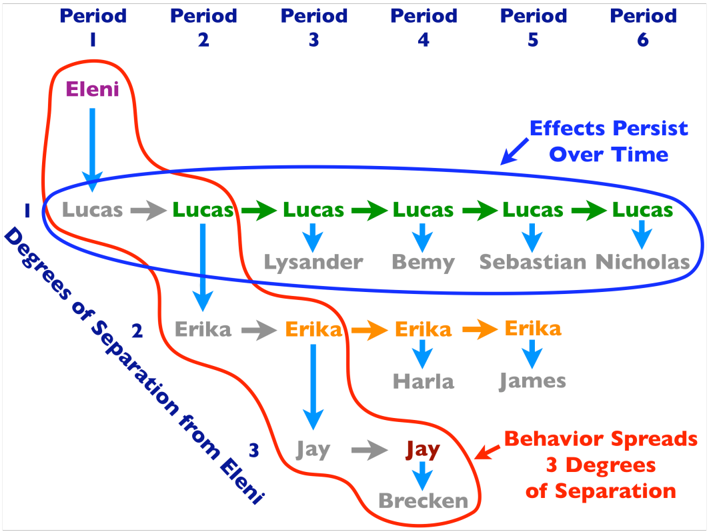
Theoretical models suggest that social networks influence the evolution of cooperation, but to date there have been few experimental studies. Observational data suggest that a wide variety of behaviors may spread in human social networks, but subjects in such studies can choose to befriend people with similar behaviors, posing difficulty for causal inference. Here, we exploit a seminal set of laboratory experiments that originally showed that voluntary costly punishment can help sustain cooperation. In these experiments, subjects were randomly assigned to a sequence of different groups to play a series of single-shot public goods games with strangers; this feature allowed us to draw networks of interactions to explore how cooperative and uncooperative behaviors spread from person to person to person. We show that, in both an ordinary public goods game and in a public goods game with punishment, focal individuals are influenced by fellow group members’ contribution behavior in future interactions with other individuals who were not a party to the initial interaction. Furthermore, this influence persists for multiple periods and spreads up to three degrees of separation (from person to person to person to person). The results suggest that each additional contribution a subject makes to the public good in the first period is tripled over the course of the experiment by other subjects who are directly or indirectly influenced to contribute more as a consequence. These results show experimentally that cooperative behavior cascades in human social networks.
Overview
CoChat Summary
TL;DR
Reanalyzing Fehr-Gächter public goods experiments, Fowler and Christakis find that cooperative and uncooperative contributions spread causally from person to person to person, up to three degrees of separation, and persist over multiple periods. Each additional 1 MU contributed in period 1 approximately triples over the experiment through direct and indirect network effects.
Key findings
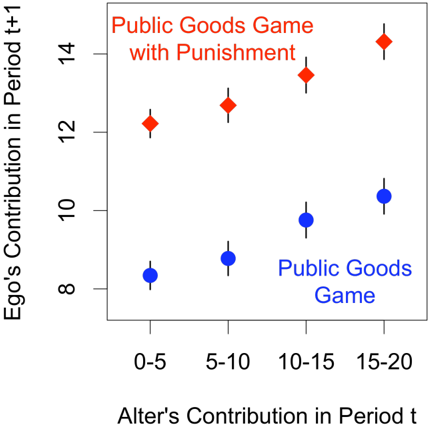
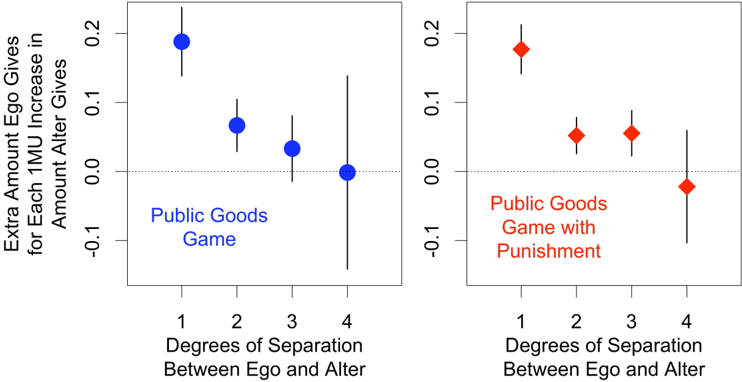
- Direct influence: each 1 MU contributed by an alter increased ego’s next-period contribution by 0.19 MUs (95% CI 0.14–0.24, p<0.0001) in the basic public goods game and 0.18 MUs (0.14–0.21, p<0.0001) in the punishment version.
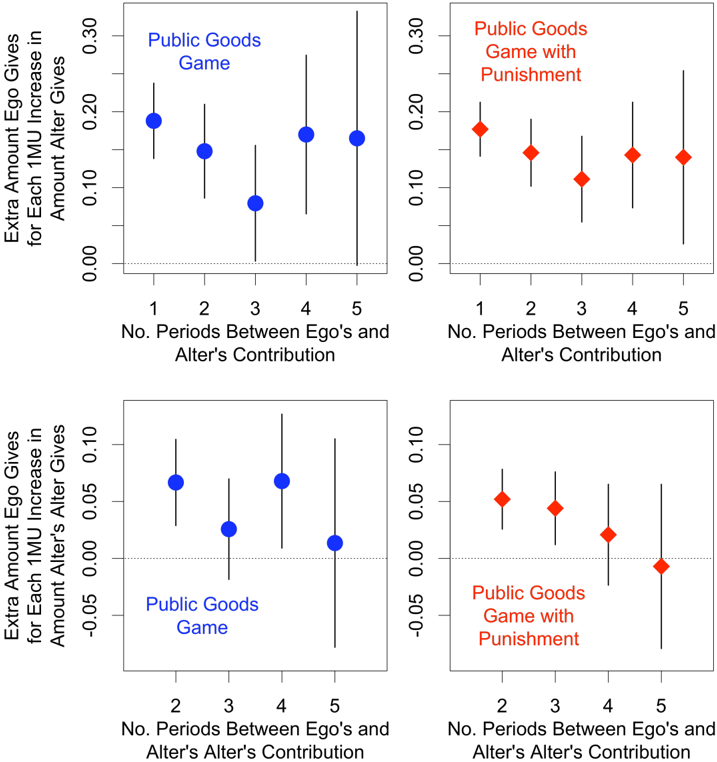
- Indirect influence: each 1 MU contributed by an alter’s alter increased ego’s contribution two periods later by 0.07 MUs (0.03–0.10, p=0.0005) in the basic game and 0.05 MUs (0.03–0.08, p=0.0001) with punishment; in the punishment game, alter’s alter’s alter increased ego’s contribution by 0.06 MUs (0.02–0.09, p=0.001) three periods later.
- Cascade size: an extra 1 MU in period 1 caused 3 other subjects to increase total contributions by 1.8 MUs over the next 4 periods in the basic game or 2.1 MUs over the next 5 periods with punishment, plus indirect increases of 1.2 or 0.9 MUs, totaling 3 MUs (95% CI 2.4–3.6) in both versions.
- Punishment: each punishment point an alter’s alter gave to an alter increased ego’s contribution two rounds later by 0.13 MUs (0.02–0.23, p=0.02), but this did not spread further (p=0.25); punishment behavior itself did not spread (p=0.83).
Methods
- Reanalysis of previously published Fehr-Gächter public goods game experiments with 240 subjects; groups of four, 20 MUs, six periods, random assignment, strict anonymity, and no subject paired with another more than once; the punishment version allowed spending up to 10 MUs to reduce a target’s income by 3 MUs per 1 MU.
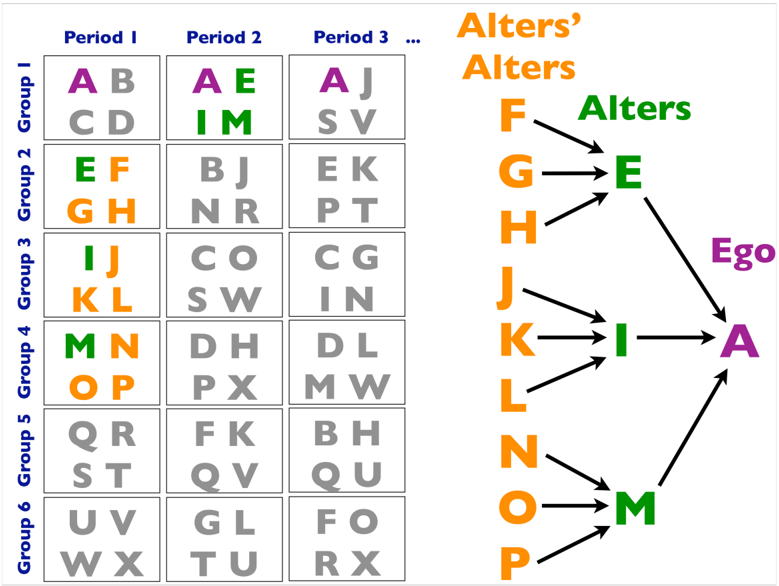
- Interaction networks were constructed from group assignments, with ties defined by the ability to observe another subject’s contribution in the preceding period; direct and indirect effects were estimated up to three degrees of separation.
- Interval (Tobit) regression with Huber-White clustered standard errors on ego and alter, controlling for ego’s prior contribution and period fixed effects; robustness checks included group-level models, additional lags, ego fixed effects, and Sobel mediation tests.
Limitations
- Paper-stated: results come from a particular experimentally controlled network structure, and whether “pay it forward” behavior spreads more widely in natural human networks remains an open question; interval regression coefficients apply to the latent outcome, group-level models are downwardly biased due to censoring, and fixed-effects models are biased toward zero.
- Evident from the text: anonymous, single-shot stranger groups with no reputations or repeated ties may not capture real-world social ties; per-MU effects are small, and cascade estimates rely on effects with p<0.05.
Model-written summary. Check it against the paper before relying on it.
Integrity signals
Registry
Cites
Statistics
Figures
Verification
Claims the paper makes
1 Valid · 4 Not valid · 30 Not checked · 161 Own results and interpretations
Every source the paper cites for this claim was checked and supports it.
In the paper
“However, it is worth reiterating that most of our subjects violated this supposition: since all interactions are single-shot, the equilibrium prediction is to contribute nothing and to pay nothing to punish noncontributors, yet this was not what the subjects did ( 36 ).”
What the sources say
- Supportedcites [36] 36. Fehr E, Gachter S (2002) Altruistic punishment in humans. Nature 415: 137-140. source
Fehr & Gächter (2002) state the selfish benchmark explicitly — 'it was always in the material self-interest of any subject to keep all MUs privately' and 'purely selfish subjects will never cooperate or punish others, because cooperation and punishment are costly and yield no pecuniary benefits' (p. 1) — with groups randomly recomposed so no subject met another twice, i.e. single-shot interactions. Their results then show most subjects acted against that benchmark: 84.3% of subjects punished at least once out of 1,270 punishment acts (Altruistic punishment and cooperation, p. 1), and cooperation rose in the punishment treatment with 94.2%/91.4% of subjects investing more under punishment than without (Results, p. 2). Together these support the paraphrase that most subjects violated the selfish-payoff-maximising supposition in both contributing and punishing. (LLM, conf=0.88)
plain- Asserted: passes — The authors put it forward as true.
- Checkable: passes — It can be checked against evidence.
- Load-bearing: passes — The paper’s conclusions depend on it.
- Based: passes — The paper gives a reason why it holds.
- Supported
A result the paper reports from its own data — it cites no other source for it, so there is none to check. The quote shows it is in the paper.
In the paper
“A summary of the raw data (Fig. 2) shows that, indeed, future contributions by focal individuals ('egos') are significantly related to the amount contributed by each group member with whom the ego interacted in the previous period ('alters') in both the basic public goods game and the public goods game with punishment.”
plainstates an association- Asserted: passes — The authors put it forward as true.
- Checkable: passes — It can be checked against evidence.
- Load-bearing: passes — The paper’s conclusions depend on it.
- Based: passes — The paper gives a reason why it holds.
A result the paper reports from its own data — it cites no other source for it, so there is none to check. The quote shows it is in the paper.
In the paper
“Remarkably, even though egos do not observe the contributions of their alters' alters (two degrees of separation), they too significantly affect ego's contribution decisions.”
plainstates a cause- Asserted: passes — The authors put it forward as true.
- Checkable: passes — It can be checked against evidence.
- Load-bearing: passes — The paper’s conclusions depend on it.
- Based: passes — The paper gives a reason why it holds.
A result the paper reports from its own data — it cites no other source for it, so there is none to check. The quote shows it is in the paper.
In the paper
“For each 1MU contributed by an alter, ego contributes an additional 0.19 MUs (95% C.I. 0.14 to 0.24, p <0.0001) in the next period in the basic public goods game and an additional 0.18MUs (0.14 to 0.21, p <0.0001) in the public goods game with punishment.”
plainstates a cause- Asserted: passes — The authors put it forward as true.
- Checkable: passes — It can be checked against evidence.
- Load-bearing: passes — The paper’s conclusions depend on it.
- Based: passes — The paper gives a reason why it holds.
A result the paper reports from its own data — it cites no other source for it, so there is none to check. The quote shows it is in the paper.
In the paper
“Furthermore, this influence persists for multiple periods and spreads up to three degrees of separation (from person to person to person to person).”
plainstates a cause- Asserted: passes — The authors put it forward as true.
- Checkable: passes — It can be checked against evidence.
- Load-bearing: passes — The paper’s conclusions depend on it.
- Based: passes — The paper gives a reason why it holds.
104 more claims
Create a free account to see all 196 claims and to verify the 54 references still open.
- It may state two separate claims as one. 38
- Probably not a substantial claim. 57
- The quote only partly states this claim. 7
Claims other papers make about this one
Each is checked against this paper’s own text: does it say what the citing paper says it does?
The cited source says what the claim attributes to it.
In the citing paper
“Furthermore, recent evidence from both lab and field studies suggests that people behave more prosocially after observing others engaging in behaviors such as cooperation and generosity 8 – 10 .”
From Crowdsourcing punishment: Individuals reference group preferences to inform their own punitive decisions (2019) · cites this paper as [8]
Citations
Cites
Birds of a Feather: Homophily in Social Networks
McPherson, M., Smith-Lovin, L., & Cook, J. M. (2001) · Annual Review of Sociology · doi:10.1146/annurev.soc.27.1.415 · Cited by 18,567
Olson, M. (1965) · doi:10.4159/9780674041660 · Cited by 14,191
Asymptotic Confidence Intervals for Indirect Effects in Structural Equation Models
Sobel, M. E. (1982) · Sociological Methodology · doi:10.2307/270723 · Cited by 12,810
The Logic of Collective Action: Public Goods and the Theory of Groups.
Sufrin, S. C., & Olson, M. (1966) · Industrial and Labor Relations Review · doi:10.2307/2521228 · Cited by 11,518
The Evolution of Reciprocal Altruism
Trivers, R. L. (1971) · The Quarterly Review of Biology · doi:10.1086/406755 · Cited by 11,010
Five Rules for the Evolution of Cooperation
Nowak, M. A. (2006) · Science · doi:10.1126/science.1133755 · Cited by 5,894
Altruistic punishment in humans
Fehr, E., & Gächter, S. (2002) · Nature · doi:10.1038/415137a · Cited by 5,616
The Spread of Obesity in a Large Social Network over 32 Years
Christakis, N. A., & Fowler, J. H. (2007) · New England Journal of Medicine · doi:10.1056/nejmsa066082 · Cited by 5,007
Self-citationCollins, R. (2004) · doi:10.1515/9781400851744 · Cited by 4,726
Szabó, G., & Fáth, G. (2007) · Physics Reports · doi:10.1016/j.physrep.2007.04.004 · Cited by 2,974
Cited by
Items 101–200 of 768
Gorton, G., Grennan, J., & Zentefis, A. (2022) · Annual Review of Financial Economics · doi:10.1146/annurev-financial-092321-124541 · Cited by 134
Heterogeneous mental health consequences of COVID-19: Costs and benefits.
Mancini, A. D. (2020) · Psychological Trauma Theory Research Practice and Policy · doi:10.1037/tra0000894 · Cited by 96
Trust and partner selection in social networks: An experimentally grounded model
Bravo, G., Squazzoni, F., & Boero, R. (2012) · Social Networks · doi:10.1016/j.socnet.2012.03.001 · Cited by 85
“Gulati (1995) found the same in an empirical study on corporate alliances.”
BackgroundA new sociology of humans and machines
Tsvetkova, M., Yasseri, T., Pescetelli, N., & Werner, T. (2024) · Nature Human Behaviour · doi:10.1038/s41562-024-02001-8 · Cited by 189
A new sociology of humans and machines
Tsvetkova, M., Yasseri, T., Pescetelli, N., & Werner, T. (2024) · arXiv · doi:10.48550/arxiv.2402.14410 · Cited by 83
Social Networks and Causal Inference
VanderWeele, T. J., & An, W. (2013) · Handbooks of sociology and social research · doi:10.1007/978-94-007-6094-3_17 · Cited by 119
Kantian fractionalization predicts the conflict propensity of the international system
Cranmer, S. J., Menninga, E. J., & Mucha, P. J. (2015) · Proceedings of the National Academy of Sciences · doi:10.1073/pnas.1509423112 · Cited by 82
Formation of raiding parties for intergroup violence is mediated by social network structure
Glowacki, L., Isakov, A., Wrangham, R. W., McDermott, R., Fowler, J. H., & Christakis, N. A. (2016) · Proceedings of the National Academy of Sciences · doi:10.1073/pnas.1610961113 · Cited by 82
Self-citationReceptiveness to Opposing Views: Conceptualization and Integrative Review
Minson, J. A., & Chen, F. S. (2021) · Personality and Social Psychology Review · doi:10.1177/10888683211061037 · Cited by 113
Social network predictors of latrine ownership
Shakya, H. B., Christakis, N. A., & Fowler, J. H. (2014) · Social Science & Medicine · doi:10.1016/j.socscimed.2014.03.009 · Cited by 93
Self-citationVoting contagion: Modeling and analysis of a century of U.S. presidential elections
Braha, D., & de Aguiar, M. A. M. (2017) · PLoS ONE · doi:10.1371/journal.pone.0177970 · Cited by 107
Kotera, Y., Green, P., & Sheffield, D. (2021) · International Journal of Mental Health and Addiction · doi:10.1007/s11469-020-00466-y · Cited by 160
Kumar, N., Oles, W. C., Howell, B. A., Janmohamed, K., Lee, S. T., Funaro, M. C., O’Connor, P. G., & Alexander, M. (2021) · Journal of Substance Abuse Treatment · doi:10.1016/j.jsat.2021.108367 · Cited by 103
Mihailidis, P. (2014) · Information Communication & Society · doi:10.1080/1369118x.2013.877054 · Cited by 105
Optimal Decision Making Approach for Cyber Security Defense Using Evolutionary Game
Hu, H., Liu, Y., Chen, C., Zhang, H., & Liu, Y. (2020) · IEEE Transactions on Network and Service Management · doi:10.1109/tnsm.2020.2995713 · Cited by 79
Two distinct neural mechanisms underlying indirect reciprocity
Watanabe, T., Takezawa, M., Nakawake, Y., Kunimatsu, A., Yamasue, H., Nakamura, M., Miyashita, Y., & Masuda, N. (2014) · Proceedings of the National Academy of Sciences · doi:10.1073/pnas.1318570111 · Cited by 78
Singh, N. N., Lancioni, G. E., Medvedev, O. N., Hwang, Y.-S., & Myers, R. E. (2021) · Mindfulness · doi:10.1007/s12671-020-01376-9 · Cited by 76
Reinforcement Learning Explains Conditional Cooperation and Its Moody Cousin
Ezaki, T., Horita, Y., Takezawa, M., & Masuda, N. (2016) · PLoS Computational Biology · doi:10.1371/journal.pcbi.1005034 · Cited by 80
Prosocial modeling: person role models and the media
Greitemeyer, T. (2021) · Current Opinion in Psychology · doi:10.1016/j.copsyc.2021.08.024 · Cited by 96
Transmission and development of costly punishment in children
Salalι, G. D., Juda, M., & Henrich, J. (2014) · Evolution and Human Behavior · doi:10.1016/j.evolhumbehav.2014.09.004 · Cited by 89
Tailored implementation of evidence-based practice for patients with chronic diseases
Wensing, M., Huntink, E., van Lieshout, J., Godycki-Cwirko, M., Kowalczyk, A., Jäger, C., Steinhäuser, J., Aakhus, E., Flottorp, S., Eccles, M., et al. (2014) · PLoS ONE · doi:10.1371/journal.pone.0101981 · Cited by 74
Toward a Model of Work Team Altruism
Li, N., Kirkman, B. L., & Porter, C. O. L. H. (2014) · Academy of Management Review · doi:10.5465/amr.2011.0160 · Cited by 91
Social Norms of Cooperation in Small-Scale Societies
Santos, F. P., Santos, F. C., & Pacheco, J. M. (2016) · PLoS Computational Biology · doi:10.1371/journal.pcbi.1004709 · Cited by 93
Complex Contagion of Campaign Donations
Traag, V. (2016) · PLoS ONE · doi:10.1371/journal.pone.0153539 · Cited by 81
Leimgruber, K. L., Ward, A. F., Widness, J., Norton, M. I., Olson, K. R., Gray, K. J., & Santos, L. R. (2014) · PLoS ONE · doi:10.1371/journal.pone.0087035 · Cited by 83
Constraints on the evolution of social institutions and their implications for information flow
DUNBAR, R. I. M. (2011) · Journal of Institutional Economics · doi:10.1017/s1744137410000366 · Cited by 71
EVOLUTIONARY DYNAMICS OF CLIMATE CHANGE UNDER COLLECTIVE-RISK DILEMMAS
Santos, F. C., de Vasconcelos, V. V. L., Santos, M. D., NEVES, P. N. B., & Pacheco, J. M. (2012) · Mathematical Models and Methods in Applied Sciences · doi:10.1142/s0218202511400045 · Cited by 74
Flourishing in critical dialogue
VanderWeele, T. J., Case, B. W., Chen, Y., Cowden, R. G., Johnson, B. R., Lee, M. T., Lomas, T., & Long, K. N. G. (2022) · SSM - Mental Health · doi:10.1016/j.ssmmh.2022.100172 · Cited by 96
Evolution of cooperation driven by zealots
Masuda, N. (2012) · Scientific Reports · doi:10.1038/srep00646 · Cited by 86
From Local to Global Dilemmas in Social Networks
Pinheiro, F. L., Pacheco, J. M., & Santos, F. C. (2012) · PLoS ONE · doi:10.1371/journal.pone.0032114 · Cited by 67
The Role of Social Influence in Security Feature Adoption
Das, S., Kramer, A. D. I., Dabbish, L. A., & Hong, J. I. (2015) · Proceedings of the 18th ACM Conference on Computer Supported Cooperative Work & Social Computing · doi:10.1145/2675133.2675225 · Cited by 65
Li, J., Yao, M., & Liu, H. (2020) · Child Indicators Research · doi:10.1007/s12187-020-09755-3 · Cited by 86
Wang, X. (2013) · Journal of Knowledge Management · doi:10.1108/13673271311315213 · Cited by 76
Picking teams: When dominant facial structure is preferred
Hehman, E., Leitner, J. B., Deegan, M. P., & Gaertner, S. L. (2015) · Journal of Experimental Social Psychology · doi:10.1016/j.jesp.2015.03.007 · Cited by 68
The indirect paths to cascading effects of extinctions in mutualistic networks
Pires, M. M., O’Donnell, J. L., Burkle, L. A., Díaz‐Castelazo, C., Hembry, D. H., Yeakel, J. D., Newman, E. A., Medeiros, L. P., de Aguiar, M. A. M., & Guimarães, P. R. (2020) · Ecology · doi:10.1002/ecy.3080 · Cited by 71
Optimal network topology for responsive collective behavior
Mateo, D., Horsevad, N., Hassani, V., Chamanbaz, M., & Bouffanais, R. (2019) · Science Advances · doi:10.1126/sciadv.aau0999 · Cited by 65
Kohrt, B. A., Jordans, M. J. D., Koirala, S., & Worthman, C. M. (2015) · American Journal of Human Biology · doi:10.1002/ajhb.22651 · Cited by 62
Litwiller, F., White, C. M., Hamilton-Hinch, B., & Gilbert, R. W. (2018) · Leisure Sciences · doi:10.1080/01490400.2018.1483851 · Cited by 80
The social transmission of overconfidence.
Cheng, J. T., Anderson, C. D., Tenney, E. R., Brion, S., Moore, D. A., & Logg, J. M. (2021) · Journal of Experimental Psychology General · doi:10.1037/xge0000787 · Cited by 66
Whitham, M. M. (2021) · American Sociological Review · doi:10.1177/00031224211007450 · Cited by 74
Wessels, E., & Wood, L. A. (2019) · South African Journal of Education · doi:10.15700/saje.v39n1a1619 · Cited by 89
Strength of Social Tie Predicts Cooperative Investment in a Human Social Network
Harrison, F., Sciberras, J., & James, R. (2011) · PLoS ONE · doi:10.1371/journal.pone.0018338 · Cited by 74
Rebaudo, F., & Dangles, O. J. (2011) · PLoS Computational Biology · doi:10.1371/journal.pcbi.1002222 · Cited by 67
Social learning and the demise of costly cooperation in humans
Burton-Chellew, M. N., Mouden, C. E., & West, S. A. (2017) · Proceedings of the Royal Society B Biological Sciences · doi:10.1098/rspb.2017.0067 · Cited by 75
An agent-based modeling framework for integrated pest management dissemination programs
Rebaudo, F., & Dangles, O. J. (2012) · Environmental Modelling & Software · doi:10.1016/j.envsoft.2012.06.014 · Cited by 72
Strong ties promote the evolution of cooperation in dynamic networks
Melamed, D., & Simpson, B. (2015) · Social Networks · doi:10.1016/j.socnet.2015.11.001 · Cited by 73
Minority influence in climate change mitigation
Bolderdijk, J. W., & Jans, L. (2021) · Current Opinion in Psychology · doi:10.1016/j.copsyc.2021.02.005 · Cited by 59
Gossip drives vicarious learning and facilitates social connection
Jolly, E., & Chang, L. J. (2021) · Current Biology · doi:10.1016/j.cub.2021.03.090 · Cited by 81
The Emerging Science of Interacting Minds
Wheatley, T. P., Thornton, M. A., Stolk, A., & Chang, L. J. (2023) · Perspectives on Psychological Science · doi:10.1177/17456916231200177 · Cited by 93
Saltz, J. B. (2013) · Proceedings of the Royal Society B Biological Sciences · doi:10.1098/rspb.2013.1926 · Cited by 71
Miller, H. J. (2013) · Journal of Transport Geography · doi:10.1016/j.jtrangeo.2013.04.007 · Cited by 67
Religious Motivations for Cooperation: An Experimental Investigation Using Explicit Primes
Rand, D. G., Dreber, A., Haque, O. S., Kane, R. J., Nowak, M. A., & Coakley, S. (2012) · Religion Brain & Behavior · doi:10.1080/2153599x.2013.775664 · Cited by 63
Hyon, R., Youm, Y., Kim, J., Chey, J., Kwak, S., & Parkinson, C. (2020) · Proceedings of the National Academy of Sciences · doi:10.1073/pnas.2013606117 · Cited by 57
Revenge is seductive, if not sweet: Why friends matter for prevention efforts
Frey, K. S., Pearson, C. R., & Cohen, D. (2014) · Journal of Applied Developmental Psychology · doi:10.1016/j.appdev.2014.08.002 · Cited by 67
Kinship intensity and the use of mental states in moral judgment across societies
Curtin, C. M., Barrett, H. C., Bolyanatz, A., Crittenden, A. N., Fessler, D. M. T., Fitzpatrick, S., Gurven, M., Kanovský, M., Kushnick, G., Laurence, S., et al. (2020) · Evolution and Human Behavior · doi:10.1016/j.evolhumbehav.2020.07.002 · Cited by 68
Predicting emerging social conventions in online social networks
Kooti, F., Mason, W. A., Gummadi, K. P., & Cha, M. (2012) · Proceedings of the 21st ACM international conference on Information and knowledge management · doi:10.1145/2396761.2396820 · Cited by 55
The Multifaceted Nature of Civic Participation: A Literature Review
Cnaan, R. A., & Park, S. (2015) · Voluntaristics Review · doi:10.1163/24054933-12340001 · Cited by 71
Evolutionary dynamics of group fairness
Santos, F. P., Santos, F. C., Paiva, A., & Pacheco, J. M. (2015) · Journal of Theoretical Biology · doi:10.1016/j.jtbi.2015.04.025 · Cited by 60
Think global, act local: Preserving the global commons
Hauser, O., Hendriks, A., Rand, D. G., & Nowak, M. A. (2016) · Scientific Reports · doi:10.1038/srep36079 · Cited by 67
Reach and speed of judgment propagation in the laboratory
Moussaïd, M., Herzog, S. M., Kämmer, J. E., & Hertwig, R. (2017) · Proceedings of the National Academy of Sciences · doi:10.1073/pnas.1611998114 · Cited by 54
Yang, F., Zhang, T. P., Tang, W., Ong, J. J., Alexander, M., Forastiere, L., Kumar, N., Li, K. T., Zou, F., Yang, L., et al. (2020) · The Lancet Infectious Diseases · doi:10.1016/s1473-3099(20)30172-9 · Cited by 68
Self-citationEvolutionary dynamics of cooperation in the N-person stag hunt game
Luo, Q., Liu, L., & Chen, X. (2021) · Physica D Nonlinear Phenomena · doi:10.1016/j.physd.2021.132943 · Cited by 59
Estimating peer effects in longitudinal dyadic data using instrumental variables
O’Malley, A. J., Elwert, F., Rosenquist, J. N., Zaslavsky, A. M., & Christakis, N. A. (2014) · Biometrics · doi:10.1111/biom.12172 · Cited by 61
Self-citationCompetition and Success in the Meme Pool: A Case Study on Quickmeme.com
Coscia, M. (2021) · Proceedings of the International AAAI Conference on Web and Social Media · doi:10.1609/icwsm.v7i1.14385 · Cited by 53
Origin of Peer Influence in Social Networks
Pinheiro, F. L., Santos, M. D., Santos, F. C., & Pacheco, J. M. (2014) · Physical Review Letters · doi:10.1103/physrevlett.112.098702 · Cited by 59
Social Networks and Charitable Giving: Trusting, Doing, Asking, and Alter Primacy
Herzog, P. S., & Yang, S. (2017) · Nonprofit and Voluntary Sector Quarterly · doi:10.1177/0899764017746021 · Cited by 64
Learning moral values: Another’s desire to punish enhances one’s own punitive behavior.
FeldmanHall, O., Otto, A. R., & Phelps, E. A. (2018) · Journal of Experimental Psychology: General · doi:10.1037/xge0000405 · Cited by 51
van der Schalk, J., Kuppens, T., Bruder, M., & Manstead, A. S. R. (2015) · Journal of Experimental Psychology General · doi:10.1037/xge0000036 · Cited by 60
Getting the word out: neural correlates of enthusiastic message propagation
Falk, E. B., O’Donnell, M. B., & Lieberman, M. D. (2012) · Frontiers in Human Neuroscience · doi:10.3389/fnhum.2012.00313 · Cited by 62
Reinforcement learning accounts for moody conditional cooperation behavior: experimental results
Horita, Y., Takezawa, M., Inukai, K., Kita, T., & Masuda, N. (2017) · Scientific Reports · doi:10.1038/srep39275 · Cited by 56
Susceptibility to prosocial and antisocial influence in adolescence
Ahmed, S. P., Foulkes, L., Leung, J. T., Griffin, C., Sakhardande, A., Bennett, M., Dunning, D. L., Griffiths, K., Parker, J., Kuyken, W., et al. (2020) · Journal of Adolescence · doi:10.1016/j.adolescence.2020.07.012 · Cited by 74
An empirical model for strategic network formation
Christakis, N. A., Fowler, J. H., Imbens, G. W., & Kalyanaraman, K. (2026) · doi:10.1920/wp.cem.2010.1610 · Cited by 57
Self-citationCeballos, H. G., Fangmeyer, J., Galeano, N., Juarez, E., & Cantú-Ortiz, F. J. (2017) · Knowledge Management Research & Practice · doi:10.1057/s41275-017-0064-8 · Cited by 55
Adolescents’ Conceptualizations of Kindness and its Links with Well-being: A Focus Group Study
Cotney, J., & Banerjee, R. A. (2017) · Journal of Social and Personal Relationships · doi:10.1177/0265407517738584 · Cited by 63
Reiter, J. G., Hilbe, C., Rand, D. G., Chatterjee, K., & Nowak, M. A. (2018) · Nature Communications · doi:10.1038/s41467-017-02721-8 · Cited by 50
Rhoads, S. A., Cutler, J., & Marsh, A. A. (2021) · Social Cognitive and Affective Neuroscience · doi:10.1093/scan/nsab079 · Cited by 54
Costs for switching partners reduce network dynamics but not cooperative behaviour
Bednarik, P., Fehl, K., & Semmann, D. (2014) · Proceedings of the Royal Society B: Biological Sciences · doi:10.1098/rspb.2014.1661 · Cited by 49
Every Man for Himself! Gender, Norms and Survival in Maritime Disasters
Elinder, M., & Erixson, O. (2012) · Proceedings of the National Academy of Sciences · doi:10.1073/pnas.1207156109 · Cited by 78
Norm, network, and commons: The invisible hand of community
Lejano, R. P., & de Castro, F. F. (2013) · Environmental Science & Policy · doi:10.1016/j.envsci.2013.07.012 · Cited by 60
Hu, L., He, N., Weng, Q., Chen, X., & Perc, M. (2020) · Chaos Solitons & Fractals · doi:10.1016/j.chaos.2020.109694 · Cited by 47
Altruism in networks: the effect of connections
Curry, O. S., & Dunbar, R. (2011) · Biology Letters · doi:10.1098/rsbl.2010.1202 · Cited by 60
How Natural Selection Can Create Both Self- and Other-Regarding Preferences and Networked Minds
Grund, T., Waloszek, C., & Helbing, D. (2013) · Scientific Reports · doi:10.1038/srep01480 · Cited by 47
Behavioral adaptation to climate change in wildfire‐prone forests
Hamilton, M., Fischer, A. P., Guikema, S. D., & Keppel‐Aleks, G. (2018) · Wiley Interdisciplinary Reviews Climate Change · doi:10.1002/wcc.553 · Cited by 56
Continuous measurement of dynamic classroom social interactions
Messinger, D. S., Prince, E. B., Zheng, M., Martin, K. B., Mitsven, S. G., Huang, S., Stölzel, T., Johnson, N. F., Rudolph, U., Perry, L. K., et al. (2019) · International Journal of Behavioral Development · doi:10.1177/0165025418820708 · Cited by 49
Parks, P. (2021) · Journalism Studies · doi:10.1080/1461670x.2020.1807395 · Cited by 56
Induction of social contagion for diverse outcomes in structured experiments in isolated villages
Airoldi, E. M., & Christakis, N. A. (2024) · Science · doi:10.1126/science.adi5147 · Cited by 89
Self-citationAdaptive and Bounded Investment Returns Promote Cooperation in Spatial Public Goods Games
Chen, X., Liu, Y., Zhou, Y., Wang, L., & Perc, M. (2012) · PLoS ONE · doi:10.1371/journal.pone.0036895 · Cited by 47
Disconnected, fragmented, or united? a trans-disciplinary review of network science
Hidalgo, C. A. (2016) · Applied Network Science · doi:10.1007/s41109-016-0010-3 · Cited by 76
An Agent-Based Model of Centralized Institutions, Social Network Technology, and Revolution
Makowsky, M. D., & Rubin, J. (2013) · PLoS ONE · doi:10.1371/journal.pone.0080380 · Cited by 58
Impact of link deletions on public cooperation in scale-free networks
Jiang, L.-L., Perc, M., Wang, W.-X., Lai, Y., & Wang, B.-H. (2011) · Europhysics Letters (EPL) · doi:10.1209/0295-5075/93/40001 · Cited by 47
Analysis and Control of Networked Game Dynamics via A Microscopic Deterministic Approach
Tan, S., Wang, Y., & Lü, J. (2016) · IEEE Transactions on Automatic Control · doi:10.1109/tac.2016.2545106 · Cited by 44
Developmental Differences in Prosocial Behavior Between Preschool and Late Elementary School
Flook, L., Zahn‐Waxler, C., & Davidson, R. J. (2019) · Frontiers in Psychology · doi:10.3389/fpsyg.2019.00876 · Cited by 55
Konrath, S., Falk, E. B., Fuhrel-Forbis, A., Liu, M., Swain, J. E., Tolman, R. M., Cunningham, R. M., & Walton, M. A. (2015) · PLoS ONE · doi:10.1371/journal.pone.0137585 · Cited by 58
Personal Trust Increases Cooperation beyond General Trust
Acedo‐Carmona, C., & Gomila, A. (2014) · PLoS ONE · doi:10.1371/journal.pone.0105559 · Cited by 51
Probabilistic reward or punishment promotes cooperation in evolutionary games
Wu, Y., Zhang, B., & Zhang, S. (2017) · Chaos Solitons & Fractals · doi:10.1016/j.chaos.2017.06.015 · Cited by 45
Kim, Y., & Khang, H. (2014) · Computers in Human Behavior · doi:10.1016/j.chb.2014.03.044 · Cited by 69
Models and Methods to Identify Peer Effects
An, W. (2014) · SAGE Publications Ltd eBooks · doi:10.4135/9781446294413.n34 · Cited by 56
Effect of Correlations in Swarms on Collective Response
Mateo, D., Kuan, Y. K., & Bouffanais, R. (2017) · Scientific Reports · doi:10.1038/s41598-017-09830-w · Cited by 47
Cognitive cascades: How to model (and potentially counter) the spread of fake news
Rabb, N., Cowen, L., de Ruiter, J. P., & Scheutz, M. J. (2022) · PLoS ONE · doi:10.1371/journal.pone.0261811 · Cited by 58
Lomas, T., Pawelski, J. O., & VanderWeele, T. J. (2024) · The Journal of Positive Psychology · doi:10.1080/17439760.2024.2362435 · Cited by 71
Metadata
- Authors
- Fowler, J. H., & Christakis, N. A.
- Affiliations
- University of California San Diego (US)
- Harvard University (US)
- Venue
- Proceedings of the National Academy of Sciences
- Publisher
- National Academy of Sciences
- Published
- 2010-03-08
- Volume
- 107
- Issue
- 12
- Pages
- 5334-5338
- ISSN
- 0027-8424 (ISSN-L)
- 1091-6490
- PMC
- PMC2851803
- OpenAlex
- W2111394372
- Cited by
- 767
- References
- 54
- Citations by year
- 2026: 38 · 2025: 39 · 2024: 54 · 2023: 39 · 2022: 40 · 2021: 60 · 2020: 61 · 2019: 50 · 2018: 47 · 2017: 38 · 2016: 33 · 2015: 50 · 2014: 66 · 2013: 44 · 2012: 49
- FWCI
- 155.53
- Type
- journal article
- Language
- en
- Open access
- green
- www.ncbi.nlm.nih.gov
- Locations
- Proceedings of the National Academy of Sciences (publishedVersion)
- PubMed Central (publishedVersion)
- PubMed (publishedVersion)
- arXiv (Cornell University) (submittedVersion)
- Digital Access to Scholarship at Harvard (DASH) (Harvard University) (submittedVersion, cc-by)
- arXiv (Cornell University)
- Funders
- Robert Wood Johnson Foundation
- John Templeton Foundation
- University of Notre Dame
- National Institutes of Health
- National Institute on Aging (P30AG034420, P01AG031093)
- Topics
- Social Sciences › Sociology and Political Science › Evolutionary Game Theory and Cooperation
- Social Sciences › Economics, Econometrics and Finance › Economics and Econometrics › Experimental Behavioral Economics Studies
- Social Sciences › Sociology and Political Science › Social Power and Status Dynamics
- Keywords
- evolution of cooperation, social networks, costly punishment, public goods game, costly cooperation, indirect influence, costly signaling
- MeSH terms
- Cooperative Behavior, Humans, Interpersonal Relations, Models, Psychological, Punishment, Social Support, Models, Economic
About these checks
Registry, retraction, Cites and statistics results are computed, not judged, with one exception: a printed reference that no index lists is read once by a model before it counts as a citation error. Claims are extracted by a model and kept only when their quote appears verbatim in the text; each cited source is then checked, with a model’s help, for whether it says what the claim relies on. Those verdicts can be wrong — read the claim’s quote and the cited source before relying on one.
A language model drew the claims from the paper on 2026-11-20, under version 3 of the claim definition (model deepseek-v4.1-flash, prompt extract-v3).
A second model labelled each claim on 2026-11-20 (model jev-1.13-20260917, definition revision gold-guideline-v0.2).
Cited sources are checked with a language model’s help (qwen3.8-omni-flash).
Statistics and arithmetic are recomputed, not judged.
Confidence bands are shown only for fields calibrated on our annotated test set. None is calibrated yet, so no band is shown.
What counts as a claim ›How we measure confidence ›How we check this ›
Are you an author, or do you see a problem with this page? Request a review
Data sources
Bibliographic data: Semantic Scholar, OpenAlex, Crossref.
Contains information from the Semantic Scholar Academic Graph Datasets, made available under the ODC Attribution License (ODC-BY 1.0).
Semantic Scholar’s data is described in: Kinney, R., et al. (2023). The Semantic Scholar Open Data Platform. arXiv:2301.10140.
