

Cooperative behavior cascades in human social networks
Open accessThe DOI matches its Crossref record; 55 of the 56 references it cites were found in a registry or an index; 1 of the 67 sources its claims cite were checked for support.
Abstract
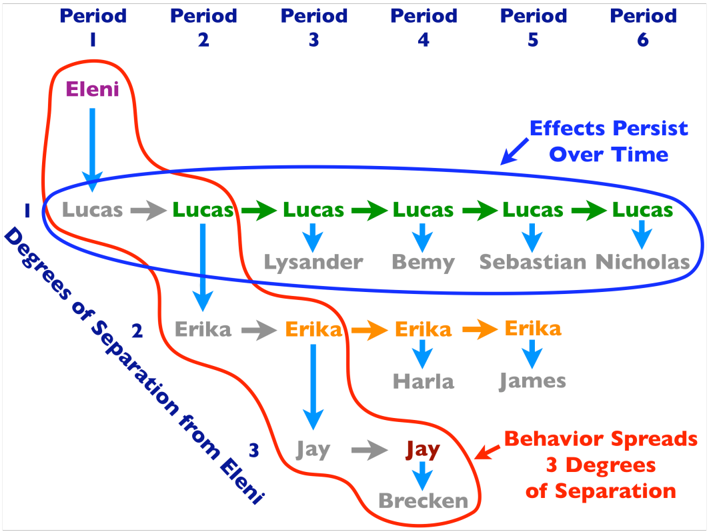
Theoretical models suggest that social networks influence the evolution of cooperation, but to date there have been few experimental studies. Observational data suggest that a wide variety of behaviors may spread in human social networks, but subjects in such studies can choose to befriend people with similar behaviors, posing difficulty for causal inference. Here, we exploit a seminal set of laboratory experiments that originally showed that voluntary costly punishment can help sustain cooperation. In these experiments, subjects were randomly assigned to a sequence of different groups to play a series of single-shot public goods games with strangers; this feature allowed us to draw networks of interactions to explore how cooperative and uncooperative behaviors spread from person to person to person. We show that, in both an ordinary public goods game and in a public goods game with punishment, focal individuals are influenced by fellow group members’ contribution behavior in future interactions with other individuals who were not a party to the initial interaction. Furthermore, this influence persists for multiple periods and spreads up to three degrees of separation (from person to person to person to person). The results suggest that each additional contribution a subject makes to the public good in the first period is tripled over the course of the experiment by other subjects who are directly or indirectly influenced to contribute more as a consequence. These results show experimentally that cooperative behavior cascades in human social networks.
Overview
CoChat Summary
TL;DR
Reanalyzing Fehr-Gächter public goods experiments, Fowler and Christakis find that cooperative and uncooperative contributions spread causally from person to person to person, up to three degrees of separation, and persist over multiple periods. Each additional 1 MU contributed in period 1 approximately triples over the experiment through direct and indirect network effects.
Key findings
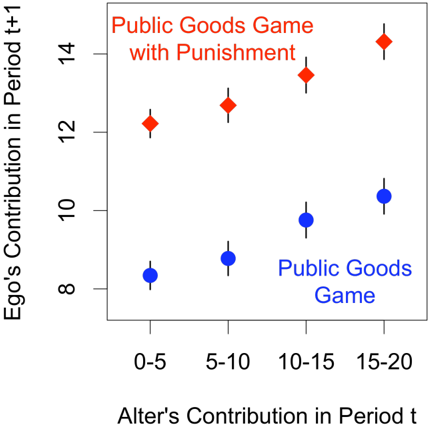
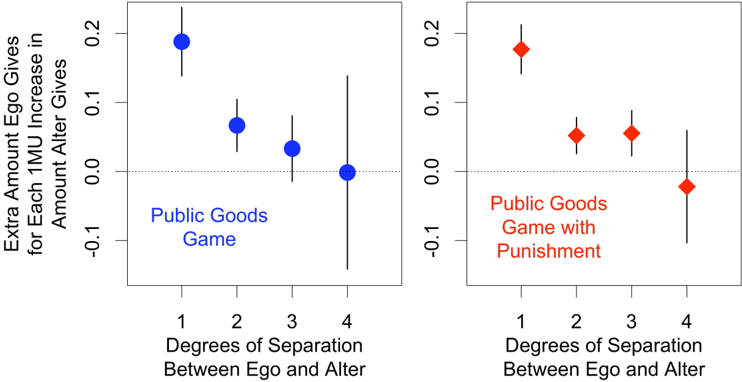
- Direct influence: each 1 MU contributed by an alter increased ego’s next-period contribution by 0.19 MUs (95% CI 0.14–0.24, p<0.0001) in the basic public goods game and 0.18 MUs (0.14–0.21, p<0.0001) in the punishment version.
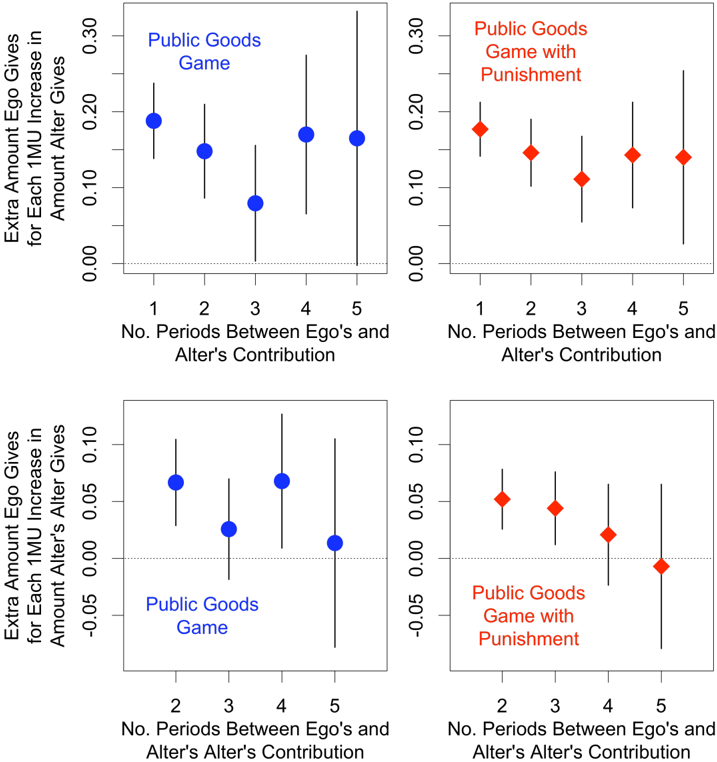
- Indirect influence: each 1 MU contributed by an alter’s alter increased ego’s contribution two periods later by 0.07 MUs (0.03–0.10, p=0.0005) in the basic game and 0.05 MUs (0.03–0.08, p=0.0001) with punishment; in the punishment game, alter’s alter’s alter increased ego’s contribution by 0.06 MUs (0.02–0.09, p=0.001) three periods later.
- Cascade size: an extra 1 MU in period 1 caused 3 other subjects to increase total contributions by 1.8 MUs over the next 4 periods in the basic game or 2.1 MUs over the next 5 periods with punishment, plus indirect increases of 1.2 or 0.9 MUs, totaling 3 MUs (95% CI 2.4–3.6) in both versions.
- Punishment: each punishment point an alter’s alter gave to an alter increased ego’s contribution two rounds later by 0.13 MUs (0.02–0.23, p=0.02), but this did not spread further (p=0.25); punishment behavior itself did not spread (p=0.83).
Methods
- Reanalysis of previously published Fehr-Gächter public goods game experiments with 240 subjects; groups of four, 20 MUs, six periods, random assignment, strict anonymity, and no subject paired with another more than once; the punishment version allowed spending up to 10 MUs to reduce a target’s income by 3 MUs per 1 MU.
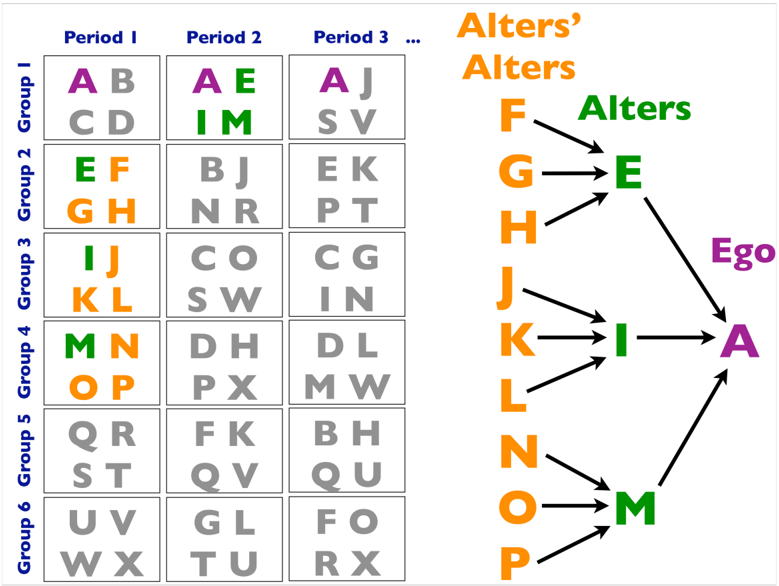
- Interaction networks were constructed from group assignments, with ties defined by the ability to observe another subject’s contribution in the preceding period; direct and indirect effects were estimated up to three degrees of separation.
- Interval (Tobit) regression with Huber-White clustered standard errors on ego and alter, controlling for ego’s prior contribution and period fixed effects; robustness checks included group-level models, additional lags, ego fixed effects, and Sobel mediation tests.
Limitations
- Paper-stated: results come from a particular experimentally controlled network structure, and whether “pay it forward” behavior spreads more widely in natural human networks remains an open question; interval regression coefficients apply to the latent outcome, group-level models are downwardly biased due to censoring, and fixed-effects models are biased toward zero.
- Evident from the text: anonymous, single-shot stranger groups with no reputations or repeated ties may not capture real-world social ties; per-MU effects are small, and cascade estimates rely on effects with p<0.05.
Model-written summary. Check it against the paper before relying on it.
Integrity signals
Registry
Cites
Statistics
Figures
Verification
Claims the paper makes
1 Valid · 4 Not valid · 30 Not checked · 161 Own results and interpretations
Every source the paper cites for this claim was checked and supports it.
In the paper
“However, it is worth reiterating that most of our subjects violated this supposition: since all interactions are single-shot, the equilibrium prediction is to contribute nothing and to pay nothing to punish noncontributors, yet this was not what the subjects did ( 36 ).”
What the sources say
- Supportedcites [36] 36. Fehr E, Gachter S (2002) Altruistic punishment in humans. Nature 415: 137-140. source
Fehr & Gächter (2002) state the selfish benchmark explicitly — 'it was always in the material self-interest of any subject to keep all MUs privately' and 'purely selfish subjects will never cooperate or punish others, because cooperation and punishment are costly and yield no pecuniary benefits' (p. 1) — with groups randomly recomposed so no subject met another twice, i.e. single-shot interactions. Their results then show most subjects acted against that benchmark: 84.3% of subjects punished at least once out of 1,270 punishment acts (Altruistic punishment and cooperation, p. 1), and cooperation rose in the punishment treatment with 94.2%/91.4% of subjects investing more under punishment than without (Results, p. 2). Together these support the paraphrase that most subjects violated the selfish-payoff-maximising supposition in both contributing and punishing. (LLM, conf=0.88)
plain- Asserted: passes — The authors put it forward as true.
- Checkable: passes — It can be checked against evidence.
- Load-bearing: passes — The paper’s conclusions depend on it.
- Based: passes — The paper gives a reason why it holds.
- Supported
A result the paper reports from its own data — it cites no other source for it, so there is none to check. The quote shows it is in the paper.
In the paper
“A summary of the raw data (Fig. 2) shows that, indeed, future contributions by focal individuals ('egos') are significantly related to the amount contributed by each group member with whom the ego interacted in the previous period ('alters') in both the basic public goods game and the public goods game with punishment.”
plainstates an association- Asserted: passes — The authors put it forward as true.
- Checkable: passes — It can be checked against evidence.
- Load-bearing: passes — The paper’s conclusions depend on it.
- Based: passes — The paper gives a reason why it holds.
A result the paper reports from its own data — it cites no other source for it, so there is none to check. The quote shows it is in the paper.
In the paper
“Remarkably, even though egos do not observe the contributions of their alters' alters (two degrees of separation), they too significantly affect ego's contribution decisions.”
plainstates a cause- Asserted: passes — The authors put it forward as true.
- Checkable: passes — It can be checked against evidence.
- Load-bearing: passes — The paper’s conclusions depend on it.
- Based: passes — The paper gives a reason why it holds.
A result the paper reports from its own data — it cites no other source for it, so there is none to check. The quote shows it is in the paper.
In the paper
“For each 1MU contributed by an alter, ego contributes an additional 0.19 MUs (95% C.I. 0.14 to 0.24, p <0.0001) in the next period in the basic public goods game and an additional 0.18MUs (0.14 to 0.21, p <0.0001) in the public goods game with punishment.”
plainstates a cause- Asserted: passes — The authors put it forward as true.
- Checkable: passes — It can be checked against evidence.
- Load-bearing: passes — The paper’s conclusions depend on it.
- Based: passes — The paper gives a reason why it holds.
A result the paper reports from its own data — it cites no other source for it, so there is none to check. The quote shows it is in the paper.
In the paper
“Furthermore, this influence persists for multiple periods and spreads up to three degrees of separation (from person to person to person to person).”
plainstates a cause- Asserted: passes — The authors put it forward as true.
- Checkable: passes — It can be checked against evidence.
- Load-bearing: passes — The paper’s conclusions depend on it.
- Based: passes — The paper gives a reason why it holds.
104 more claims
Create a free account to see all 196 claims and to verify the 54 references still open.
- It may state two separate claims as one. 38
- Probably not a substantial claim. 57
- The quote only partly states this claim. 7
Claims other papers make about this one
Each is checked against this paper’s own text: does it say what the citing paper says it does?
The cited source says what the claim attributes to it.
In the citing paper
“Furthermore, recent evidence from both lab and field studies suggests that people behave more prosocially after observing others engaging in behaviors such as cooperation and generosity 8 – 10 .”
From Crowdsourcing punishment: Individuals reference group preferences to inform their own punitive decisions (2019) · cites this paper as [8]
Citations
Cites
Birds of a Feather: Homophily in Social Networks
McPherson, M., Smith-Lovin, L., & Cook, J. M. (2001) · Annual Review of Sociology · doi:10.1146/annurev.soc.27.1.415 · Cited by 18,567
Olson, M. (1965) · doi:10.4159/9780674041660 · Cited by 14,191
Asymptotic Confidence Intervals for Indirect Effects in Structural Equation Models
Sobel, M. E. (1982) · Sociological Methodology · doi:10.2307/270723 · Cited by 12,810
The Logic of Collective Action: Public Goods and the Theory of Groups.
Sufrin, S. C., & Olson, M. (1966) · Industrial and Labor Relations Review · doi:10.2307/2521228 · Cited by 11,518
The Evolution of Reciprocal Altruism
Trivers, R. L. (1971) · The Quarterly Review of Biology · doi:10.1086/406755 · Cited by 11,010
Five Rules for the Evolution of Cooperation
Nowak, M. A. (2006) · Science · doi:10.1126/science.1133755 · Cited by 5,894
Altruistic punishment in humans
Fehr, E., & Gächter, S. (2002) · Nature · doi:10.1038/415137a · Cited by 5,616
The Spread of Obesity in a Large Social Network over 32 Years
Christakis, N. A., & Fowler, J. H. (2007) · New England Journal of Medicine · doi:10.1056/nejmsa066082 · Cited by 5,007
Self-citationCollins, R. (2004) · doi:10.1515/9781400851744 · Cited by 4,726
Szabó, G., & Fáth, G. (2007) · Physics Reports · doi:10.1016/j.physrep.2007.04.004 · Cited by 2,974
Cited by
Items 601–700 of 768
Modeling and predicting cascading removal phenomenon over social networks
Razavi, A. H., Anggraini, D., Missaoui, R., Vaillancourt, J., & Talbi, M. (2014) · Social Network Analysis and Mining · doi:10.1007/s13278-014-0233-1 · Cited by 1
Sundaram, H. (2012) · International Workshop on Socially-Aware Multimedia (SAM) · doi:10.1145/2390876.2390878 · Cited by 1
Cooperation with potential leaders in evolutionary game study of networking agents
Zhang, J., Zhang, C., Cao, M., & Chu, T. (2014) · IEEE Congress on Evolutionary Computation (CEC) · doi:10.1109/cec.2014.6900363 · Cited by 3
Twin Goals and Two Communities: A Behavioural Approach
van Dijk, G., Sergaki, P., & Baourakis, G. (2019) · Cooperative management · doi:10.1007/978-3-030-16279-5_4 · Cited by 1
The Manifestations of Generosity: From Cooperation to Social Justice
Herzog, P. S. (2019) · Springer eBooks · doi:10.1007/978-3-030-26500-7_2 · Cited by 2
A Hybrid Routing Protocol to Establish Communication in Mobility Cast Using Mobility Pattern
Singh, R. K., Kumar, B., & Ahmad, M. S. (2024) · Wireless Personal Communications · doi:10.1007/s11277-024-11081-8 · Cited by 1
Event-Triggered Observation and Control of Positive Complex Networks Using Linear Programming
Sun, Y., Zhang, J., Xing, W., Wu, Y., & Teng, S. (2024) · Youth Academic Annual Conference of Chinese Association of Automation (YAC) · doi:10.1109/yac63405.2024.10598444 · Cited by 1
Development and validation of the prosocial conformity tendency scale in adolescents
Xu, Y., Zhao, X., Yu, D., & Xu, H. (2024) · Personality and Individual Differences · doi:10.1016/j.paid.2024.112932 · Cited by 1
Sun, G.-Q., Li, L., & Pei, Y. (2025) · Physics of Life Reviews · doi:10.1016/j.plrev.2025.01.001 · Cited by 2
Growth-induced percolation on complex networks
Sun, H., Chen, S., Xie, J., & Hu, Y. (2025) · PNAS Nexus · doi:10.1093/pnasnexus/pgaf192 · Cited by 2
Strategic foundation of computational social science
Sohn, Y. (2014) · International World Wide Web Conference (WWW) · doi:10.1145/2567948.2567962 · Cited by 1
The Effects of Social Media and Mobile Apps Use on Political Participation in Taiwan
Chen, Y.-N. K. (2016) · Mobile communication in Asia · doi:10.1007/978-94-024-0917-8_10 · Cited by 2
Obesity overtaken by leanness as a repeated game: social networks and indirect reciprocity
Runge, C. F., Nelson, E. J., Runge, C. P., & Levine, J. A. (2017) · Environmental Economics · Cited by 1
Reciprocity and cooperative’s performance. The example of mandatory Greek cooperatives
Sergaki, P., Kontogeorgos, A., Kalogeras, N., & van Dijk, G. (2020) · Dialnet (Universidad de la Rioja) · Cited by 1
El Conflicto entre la Necesidad física y psíquica del contacto humano y el Miedo a las personas
Zafra, M. R., Martín-Sánchez, A., & Ceniceros-Estévez, J. C. (2021) · Acción Psicológica · doi:10.5944/ap.18.1.28884 · Cited by 1
Trust, Emotional Commitments and Reputation
Spikins, P. (2022) · White Rose University Press eBooks · doi:10.22599/hiddendepths.d · Cited by 1
Aso Ebi : impact of the social uniform in Nigerian caucuses, Yoruba culture and contemporary trends
Orimolade, A. O. (2014) · Unisa Institutional Repository (University of South Africa) · Cited by 1
Is Oprah Contagious? Identifying Demand Spillovers in Product Networks
Carmi, E., Oestreicher-Singer, G., & Sundararajan, A. (2010) · Faculty Digital Archive (New York University Florence) · Cited by 1
The Social Maintenance of Cooperation through HypocrisyPreprint
Bodnar, T. J., & Salathé, M. (2013) · arXiv (Cornell University) · doi:10.48550/arxiv.1304.3747 · Cited by 1
Computational perspectives on large-scale social networks
Ugander, J. H. (2014) · eCommons (Cornell University) · Cited by 2
The Contagion Of Social Behavior
Tsvetkova, M. (2015) · eCommons (Cornell University) · Cited by 1
Finding the Missing Links: A Comparison of Social Network Analysis Methods
Mehess, S. (2000) · doi:10.15760/etd.2724 · Cited by 1
Why I Pay it Forward: Motivations and Basic Psychological Needs of Young Adult Peer Educators
McFarlane, J. (2016) · SUNScholar (Stellenbosch University) · Cited by 3
Group decision making and preference learning on social networks
Salehi‐Abari, A. (2016) · TSpace (University of Toronto) · Cited by 1
Temporal and population dynamics of depressive symptoms : empirical and modeling approaches
Rosenström, T. H. (2013) · Helda - University of Helsinki Institutional Repository · Cited by 1
Personal and Social Proximity: Shaping Leadership in a Free Software ProjectPreprint
Bert-Erboul, C., & Vonortas, N. S. (2018) · SSRN Electronic Journal · doi:10.2139/ssrn.3251327 · Cited by 1
Identify and understand pay-it-forward reciprocity using millions of online red packets.Preprint
Yuan, Y., Liu, T. X., Tan, C., Chen, Q., Pentland, A., & Tang, J. (2019) · arXiv (Cornell University) · Cited by 1
Computational Human DynamicsPreprint
Karsai, M. (2019) · arXiv (Cornell University) · doi:10.48550/arxiv.1907.07475 · Cited by 4
Life history theory and the social clustering of adolescent behaviour
van Leeuwen, S. (2016) · UCL Discovery (University College London) · Cited by 1
Gift Contagion in Online Groups: Evidence From WeChat Red PacketsPreprint
Yuan, Y., Liu, T., Tan, C., Chen, Q., Pentland, A., & Tang, J. (2019) · Social Science Research Network · doi:10.2139/ssrn.3817775 · Cited by 1
Neural Similarity Predicts Whether Strangers Become FriendsPreprint
Shen, Y. L., Hyon, R., Kleinbaum, A. M., Welker, C. L., Parkinson, C. M., & Wheatley, T. P. (2016) · SSRN Electronic Journal · doi:10.2139/ssrn.2881692 · Cited by 2
An Experiment: Voluntary Separation in Indefinitely Repeated Prisoner's Dilemma GamePreprint
Lee, H. (2018) · SSRN Electronic Journal · doi:10.2139/ssrn.3207669 · Cited by 3
van Winden, F. A. A. M. (2021) · SSRN Electronic Journal · doi:10.2139/ssrn.3777026 · Cited by 1
Direct and Indirect Influence of Altruistic Behavior in a Social Network
Liu, P.-P., Safin, V., Yang, B., & Luhmann, C. C. (2014) · PsycEXTRA Dataset · doi:10.1037/e528942014-194 · Cited by 1
Simple bots breed social punishment in humansPreprint
Chen, S., He, Z., Ши, Л., Wang, Z., & Tanimoto, J. (2022) · arXiv (Cornell University) · doi:10.48550/arxiv.2211.13943 · Cited by 1
Temporal network epistemology: On reaching consensus in a real-world setting
Michalski, R., Serwata, D., Nurek, M., Szymanski, B. K., Kazienko, P., & Jia, T. (2022) · Chaos An Interdisciplinary Journal of Nonlinear Science · doi:10.1063/5.0074992 · Cited by 11
Editor's introduction : Six themes of 'six degrees'
Schnettler, S. (2013)
Rogers, K. L. (2011) · SSRN Electronic Journal · doi:10.2139/ssrn.1873493
Social Experiments and Computing
Helbing, D. (2012) · Understanding complex systems · doi:10.1007/978-3-642-24004-1_11
Characterizing and modeling the dynamics of cyber movements
Xiao, W., & Ke, Z. (2013) · IEEE International Conference on Service Operations and Logistics, and Informatics (SOLI) · doi:10.1109/soli.2013.6611429
Complexity Analysis and Critical Factor Identity in Multimedia Social Systems
Li, D. (2014) · Journal of Multimedia · doi:10.4304/jmm.9.4.590-597
Velichety, S., & Ram, S. (2012) · SSRN Electronic Journal · doi:10.2139/ssrn.2103282
Climate Change Governance, Cooperation and Self-organization
Santos, F. C. (2016) · Conference on Artificial Life (ALIFE) · doi:10.7551/978-0-262-33936-0-ch008
Essays on innovation and mutual insurance
Wirtz, J. K. (2026) · Warwick Research Archive Portal (University of Warwick) · doi:10.82444/warw.33646078
Behavioral Dynamics under Climate Change Dilemmas
Santos, F. C., & Pacheco, J. M. (2013) · Springer eBooks · doi:10.1007/978-94-007-5845-2_10
Coviello, L., Fowler, J. H., & Franceschetti, M. (2014)
Self-citationSocial Approaches to Disease Prediction
Mansouri, M. (2014) · UVic’s Research and Learning Repository (University of Victoria)
Action and Interaction of Design by the Social Contagion with Consumer's BehaviorPreprint
Akil, R., Gdoura, I. A., & Abdellatif, T. (2015) · SSRN Electronic Journal · doi:10.2139/ssrn.2653971
The Impact of Gratitude-Embedded Messages on Online Pro-Social BehaviorsPreprint
Yim, D., Viswanathan, S., & Lucas, H. C. (2015) · SSRN Electronic Journal · doi:10.2139/ssrn.2694084
The analytical modelling of collective capability of human networks
Hosseini, E. (2016) · Brunel University Research Archive (BURA) (Brunel University London)
Do good actions inspire good actions inPreprint
Marcelletti, A. (2014) · SSRN Electronic Journal
Modeling the Diffusion of Psychological Stress
Cipresso, P., Serino, S., Gaggioli, A., & Riva, G. (2013) · Advances in healthcare information systems and administration book series · doi:10.4018/978-1-4666-4619-3.ch010
Chapter 7 Institutional Moral Architecture: From Schools to Prisons
Wagner, P. A. (2011) · Advances in educational administration · doi:10.1108/s1479-3660(2011)0000012010
Content-based emotion classification in online social networks for Chinese Microblogs
Xu, X., Zhao, X., Xiong, F., Shan, S., & Liu, Y. (2017) · Australasian Computer Science Week Multiconference (ACSW) · doi:10.1145/3014812.3014866 · Cited by 1
The Last Piece of the Puzzle?—Cooperation Over Our Heads
Lindenfors, P. (2017) · Springer eBooks · doi:10.1007/978-3-319-50874-0_9
Depth Experience, Faith, and Democratic Life
White, S. K. (2017) · Cambridge University Press eBooks · doi:10.1017/9781316717394.005
Conceptualizing philanthropic behavior and its antecedents of volunteers in health care
Alias, S. N., & Ismail, M. (2013) · Universiti Putra Malaysia Institutional Repository (Universiti Putra Malaysia) · Cited by 4
Theoretical and empirical analysis of the evolution of cooperation
Bednarik, P. (2014) · eDiss (Georg-August-Universität Göttingen) · doi:10.53846/goediss-4681
Observation and contagion effects in cooperation: An experimental investigation
Cartwright, E. J., & Singh, T. B. (2018) · Journal of Behavioral and Experimental Economics · doi:10.1016/j.socec.2018.04.006
Guimarães, P. R., Pires, M. M., Cantor, M., & Coltri, P. P. (2018) · bioRxiv (Cold Spring Harbor Laboratory) · doi:10.1101/302570
Leveraging the Social Network to Support Engagement in an Academic Environment
Gibeson, & Glenn, M. (2017)
Network Experiments Through Academic-Industry Collaboration
Bond, R. M., Fariss, C. J., Jones, J. J., & Settle, J. E. (2018) · Computational social sciences · doi:10.1007/978-3-319-77332-2_18 · Cited by 1
Morales, D. M. O. (2016) · Cuadernos Hispanoamericanos de Psicología · doi:10.18270/chps..v15i2.1911
The Consequences of Generosity: From the Interpersonal to the Collective
Herzog, P. S. (2019) · Springer eBooks · doi:10.1007/978-3-030-26500-7_4 · Cited by 2
Sistema Colaborativo para Captação de Doadores de Sangue
da Silva, A. O., Rodrigues, L. L., Oliveira, R. R., & Oliveira, R. R. (2017) · Simpósio Brasileiro de Sistemas Colaborativos (SBSC) · doi:10.5753/sbsc.2017.9947
The Counseling Field and the Rights of the Children
Zalaquett, C. P., Chatters, S. J., Ivey, A. E., Calandriello, F. M., & Joo, H. (2020) · Springer eBooks · doi:10.1007/978-3-030-37119-7_26
Экспериментальные подходы к выявлению склонности к благотворительности
Бабичева, Э. С., Майборода, Т. Л., & Кравченко, А. А. (2020) · Belarusian Economic Journal · doi:10.46782/10.46782/1818-4510-2020-3-74-8
Voting contagion: Modeling and analysis of a century of U.S. presidential electionsPreprint
Braha, D., & de Aguiar, M. A. M. (2018) · SocArXiv (OSF Preprints) · doi:10.31235/osf.io/mzxnr
How Social Networks Dynamics can Affect Collaborative Decision Making on Crowdfunding Platforms
Hu, Y., & Lang, K. R. (2020) · Lecture notes in business information processing · doi:10.1007/978-3-030-67781-7_1 · Cited by 1
Frątczak-Müller, J., & Mielczarek‐Żejmo, A. (2021) · Lecture notes in networks and systems · doi:10.1007/978-3-030-64877-0_17
Do personality traits drive online commitment to vote in social networks
Wood, M. A. (2019) · Minerva Access (University of Melbourne) · Cited by 1
Why does Europe have a drinking problem
Anderson (2012) · doi:10.26481/spe.20120530pa
Western Thinking at Its Best: Systems Theory and Psychology
Brunnhuber, S. (2021) · Springer eBooks · doi:10.1007/978-3-030-64826-8_3
Urban Legend PropagationPreprint
Miller, I. D. (2019) · PsyArXiv (OSF Preprints) · doi:10.31234/osf.io/qrsvg
Adornato, A. C. (2021) · Routledge eBooks · doi:10.4324/9781003186779-9
Cognitive Contagion: How to model (and potentially counter) the spread of fake news.Preprint
Rabb, N., Cowen, L., de Ruiter, J. P., & Scheutz, M. J. (2021) · arXiv (Cornell University)
Leacox, E. (2021) · ScholarWorks (Boise State University) · doi:10.18122/td.1824.boisestate
Ozono, H., Kamijo, Y., & Shimizu, K. (2019) · RePEc: Research Papers in Economics · Cited by 1
The Internet of Social Robots with Things (IoSRT)Preprint
Hargreaves, R. (2022) · PsyArXiv (OSF Preprints) · doi:10.31234/osf.io/zq2ve
Pay It Forward: Theory and ExperimentPreprint
Chuan, A., & Zhang, H. (2021) · SSRN Electronic Journal · doi:10.2139/ssrn.3930741
Mancini, A. D., Westphal, M., & Griffin, P. (2019) · PsyArXiv (OSF Preprints) · doi:10.31234/osf.io/bm9kh
Leveraging the Social Network to Support Engagement in an Academic Environment
Gibeson, G. (2017) · Louisiana State University · doi:10.31390/gradschool_dissertations.4130
Spikins, P. (2022) · White Rose University Press eBooks · doi:10.22599/hiddendepths.a
Spikins, P. (2022) · White Rose University Press eBooks · doi:10.22599/hiddendepths.j
Oliveros, D. A. V., & Koren, O. (2022) · doi:10.36227/techrxiv.21266766.v1
Zhang, Q., Ma, J., Wang, Y., Lu, X., & Fan, C. (2022) · Frontiers in Psychology · doi:10.3389/fpsyg.2022.1005772 · Cited by 1
Oliveros, D. A. V., & Koren, O. (2022) · doi:10.36227/techrxiv.21266766.v2
Rebaudo, F., & Dangles, O. J. (2012) · OpenGrey (Institut de l'Information Scientifique et Technique)
Unions and Key Players in Network Games with Conflicts and SpilloversPreprint
Mauleón, A., Nanumyan, M., Schopohl, S., & Vannetelbosch, V. J. (2023) · SSRN Electronic Journal · doi:10.2139/ssrn.4455736
Westliches Denken in seiner Bestform: Systemtheorie und Psychologie
Brunnhuber, S. (2023) · Springer eBooks · doi:10.1007/978-3-031-19625-6_3
Teaching Social Dilemma through Simulating Cooperation: A Classroom Experiment
Kim, J.-W., & Hanneman, R. A. (2023) · Journal of University Teaching and Learning Practice · doi:10.53761/1.20.6.3 · Cited by 2
In or out? The paradox of exclusionary mechanisms in keeping cooperation going
Fernandes, C. A. D. M. (2023) · University of Groningen research database (University of Groningen / Centre for Information Technology) · doi:10.33612/diss.768055223 · Cited by 15
Chen, H., Zheng, X., & Zhou, X. (2023) · SSRN Electronic Journal · doi:10.2139/ssrn.4609420
(2024) · V&R unipress eBooks · doi:10.14220/9783737016803.133
Part one: Around Meaning. Kindness in philosophy – the philosophy of kindness
(2024) · V&R unipress eBooks · doi:10.14220/9783737016803.19
(2024) · V&R unipress eBooks · doi:10.14220/9783737016803.15
(2024) · V&R unipress eBooks · doi:10.14220/9783737016803.front
Part two: Around Meaning. Conceptualization of Kindness – Research Project
(2024) · V&R unipress eBooks · doi:10.14220/9783737016803.61
Metadata
- Authors
- Fowler, J. H., & Christakis, N. A.
- Affiliations
- University of California San Diego (US)
- Harvard University (US)
- Venue
- Proceedings of the National Academy of Sciences
- Publisher
- National Academy of Sciences
- Published
- 2010-03-08
- Volume
- 107
- Issue
- 12
- Pages
- 5334-5338
- ISSN
- 0027-8424 (ISSN-L)
- 1091-6490
- PMC
- PMC2851803
- OpenAlex
- W2111394372
- Cited by
- 767
- References
- 54
- Citations by year
- 2026: 38 · 2025: 39 · 2024: 54 · 2023: 39 · 2022: 40 · 2021: 60 · 2020: 61 · 2019: 50 · 2018: 47 · 2017: 38 · 2016: 33 · 2015: 50 · 2014: 66 · 2013: 44 · 2012: 49
- FWCI
- 155.53
- Type
- journal article
- Language
- en
- Open access
- green
- www.ncbi.nlm.nih.gov
- Locations
- Proceedings of the National Academy of Sciences (publishedVersion)
- PubMed Central (publishedVersion)
- PubMed (publishedVersion)
- arXiv (Cornell University) (submittedVersion)
- Digital Access to Scholarship at Harvard (DASH) (Harvard University) (submittedVersion, cc-by)
- arXiv (Cornell University)
- Funders
- Robert Wood Johnson Foundation
- John Templeton Foundation
- University of Notre Dame
- National Institutes of Health
- National Institute on Aging (P30AG034420, P01AG031093)
- Topics
- Social Sciences › Sociology and Political Science › Evolutionary Game Theory and Cooperation
- Social Sciences › Economics, Econometrics and Finance › Economics and Econometrics › Experimental Behavioral Economics Studies
- Social Sciences › Sociology and Political Science › Social Power and Status Dynamics
- Keywords
- evolution of cooperation, social networks, costly punishment, public goods game, costly cooperation, indirect influence, costly signaling
- MeSH terms
- Cooperative Behavior, Humans, Interpersonal Relations, Models, Psychological, Punishment, Social Support, Models, Economic
About these checks
Registry, retraction, Cites and statistics results are computed, not judged, with one exception: a printed reference that no index lists is read once by a model before it counts as a citation error. Claims are extracted by a model and kept only when their quote appears verbatim in the text; each cited source is then checked, with a model’s help, for whether it says what the claim relies on. Those verdicts can be wrong — read the claim’s quote and the cited source before relying on one.
A language model drew the claims from the paper on 2026-11-20, under version 3 of the claim definition (model deepseek-v4.1-flash, prompt extract-v3).
A second model labelled each claim on 2026-11-20 (model jev-1.13-20260917, definition revision gold-guideline-v0.2).
Cited sources are checked with a language model’s help (qwen3.8-omni-flash).
Statistics and arithmetic are recomputed, not judged.
Confidence bands are shown only for fields calibrated on our annotated test set. None is calibrated yet, so no band is shown.
What counts as a claim ›How we measure confidence ›How we check this ›
Are you an author, or do you see a problem with this page? Request a review
Data sources
Bibliographic data: Semantic Scholar, OpenAlex, Crossref.
Contains information from the Semantic Scholar Academic Graph Datasets, made available under the ODC Attribution License (ODC-BY 1.0).
Semantic Scholar’s data is described in: Kinney, R., et al. (2023). The Semantic Scholar Open Data Platform. arXiv:2301.10140.
