

Cooperative behavior cascades in human social networks
Open accessThe DOI matches its Crossref record; 55 of the 56 references it cites were found in a registry or an index; 1 of the 67 sources its claims cite were checked for support.
Abstract
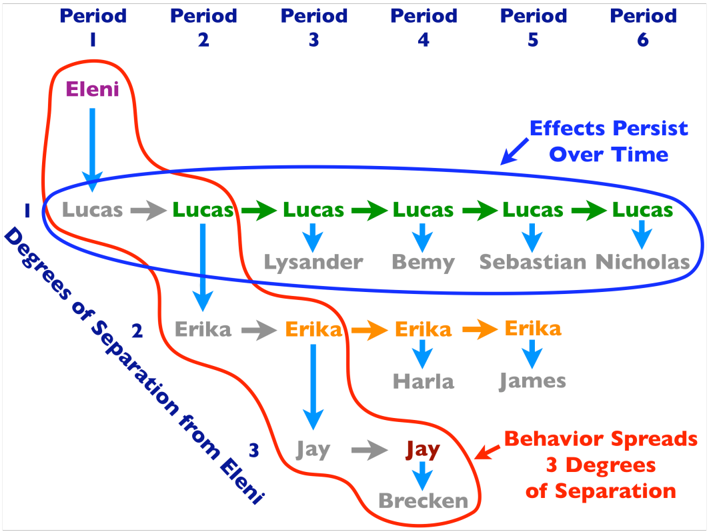
Theoretical models suggest that social networks influence the evolution of cooperation, but to date there have been few experimental studies. Observational data suggest that a wide variety of behaviors may spread in human social networks, but subjects in such studies can choose to befriend people with similar behaviors, posing difficulty for causal inference. Here, we exploit a seminal set of laboratory experiments that originally showed that voluntary costly punishment can help sustain cooperation. In these experiments, subjects were randomly assigned to a sequence of different groups to play a series of single-shot public goods games with strangers; this feature allowed us to draw networks of interactions to explore how cooperative and uncooperative behaviors spread from person to person to person. We show that, in both an ordinary public goods game and in a public goods game with punishment, focal individuals are influenced by fellow group members’ contribution behavior in future interactions with other individuals who were not a party to the initial interaction. Furthermore, this influence persists for multiple periods and spreads up to three degrees of separation (from person to person to person to person). The results suggest that each additional contribution a subject makes to the public good in the first period is tripled over the course of the experiment by other subjects who are directly or indirectly influenced to contribute more as a consequence. These results show experimentally that cooperative behavior cascades in human social networks.
Overview
CoChat Summary
TL;DR
Reanalyzing Fehr-Gächter public goods experiments, Fowler and Christakis find that cooperative and uncooperative contributions spread causally from person to person to person, up to three degrees of separation, and persist over multiple periods. Each additional 1 MU contributed in period 1 approximately triples over the experiment through direct and indirect network effects.
Key findings
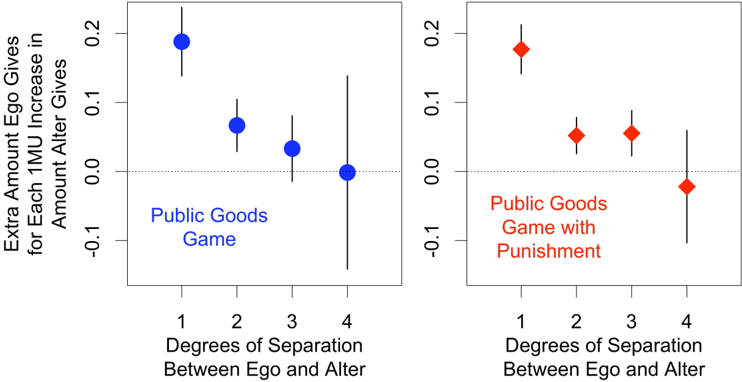
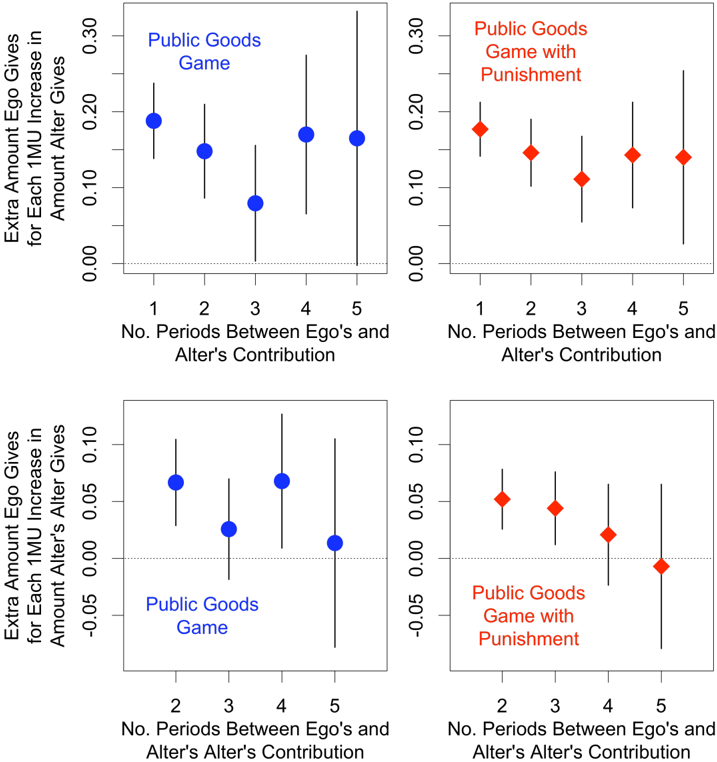
- Direct influence: each 1 MU contributed by an alter increased ego’s next-period contribution by 0.19 MUs (95% CI 0.14–0.24, p<0.0001) in the basic public goods game and 0.18 MUs (0.14–0.21, p<0.0001) in the punishment version.
- Indirect influence: each 1 MU contributed by an alter’s alter increased ego’s contribution two periods later by 0.07 MUs (0.03–0.10, p=0.0005) in the basic game and 0.05 MUs (0.03–0.08, p=0.0001) with punishment; in the punishment game, alter’s alter’s alter increased ego’s contribution by 0.06 MUs (0.02–0.09, p=0.001) three periods later.
- Cascade size: an extra 1 MU in period 1 caused 3 other subjects to increase total contributions by 1.8 MUs over the next 4 periods in the basic game or 2.1 MUs over the next 5 periods with punishment, plus indirect increases of 1.2 or 0.9 MUs, totaling 3 MUs (95% CI 2.4–3.6) in both versions.
- Punishment: each punishment point an alter’s alter gave to an alter increased ego’s contribution two rounds later by 0.13 MUs (0.02–0.23, p=0.02), but this did not spread further (p=0.25); punishment behavior itself did not spread (p=0.83).
Methods
- Reanalysis of previously published Fehr-Gächter public goods game experiments with 240 subjects; groups of four, 20 MUs, six periods, random assignment, strict anonymity, and no subject paired with another more than once; the punishment version allowed spending up to 10 MUs to reduce a target’s income by 3 MUs per 1 MU.
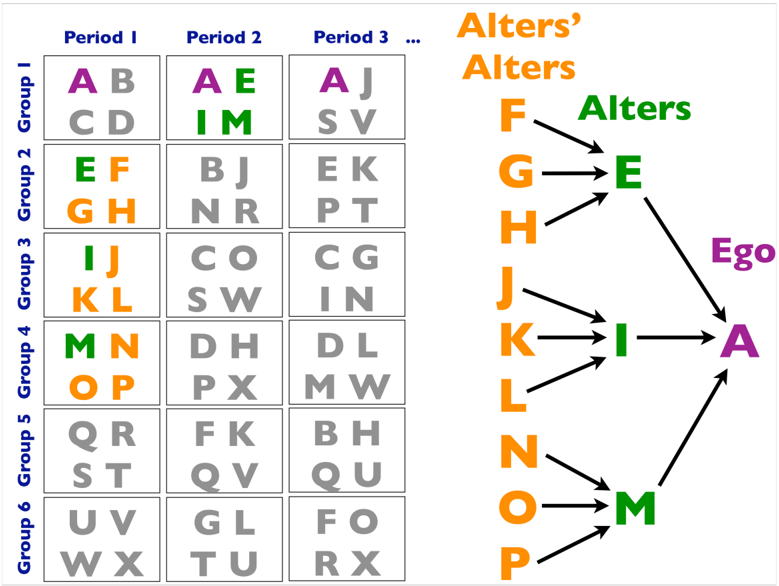
- Interaction networks were constructed from group assignments, with ties defined by the ability to observe another subject’s contribution in the preceding period; direct and indirect effects were estimated up to three degrees of separation.
- Interval (Tobit) regression with Huber-White clustered standard errors on ego and alter, controlling for ego’s prior contribution and period fixed effects; robustness checks included group-level models, additional lags, ego fixed effects, and Sobel mediation tests.
Limitations
- Paper-stated: results come from a particular experimentally controlled network structure, and whether “pay it forward” behavior spreads more widely in natural human networks remains an open question; interval regression coefficients apply to the latent outcome, group-level models are downwardly biased due to censoring, and fixed-effects models are biased toward zero.
- Evident from the text: anonymous, single-shot stranger groups with no reputations or repeated ties may not capture real-world social ties; per-MU effects are small, and cascade estimates rely on effects with p<0.05.
Model-written summary. Check it against the paper before relying on it.
Integrity signals
Registry
Cites
Statistics
Figures
Verification
Claims the paper makes
1 Valid · 4 Not valid · 30 Not checked · 161 Own results and interpretations
Every source the paper cites for this claim was checked and supports it.
In the paper
“However, it is worth reiterating that most of our subjects violated this supposition: since all interactions are single-shot, the equilibrium prediction is to contribute nothing and to pay nothing to punish noncontributors, yet this was not what the subjects did ( 36 ).”
What the sources say
- Supportedcites [36] 36. Fehr E, Gachter S (2002) Altruistic punishment in humans. Nature 415: 137-140. source
Fehr & Gächter (2002) state the selfish benchmark explicitly — 'it was always in the material self-interest of any subject to keep all MUs privately' and 'purely selfish subjects will never cooperate or punish others, because cooperation and punishment are costly and yield no pecuniary benefits' (p. 1) — with groups randomly recomposed so no subject met another twice, i.e. single-shot interactions. Their results then show most subjects acted against that benchmark: 84.3% of subjects punished at least once out of 1,270 punishment acts (Altruistic punishment and cooperation, p. 1), and cooperation rose in the punishment treatment with 94.2%/91.4% of subjects investing more under punishment than without (Results, p. 2). Together these support the paraphrase that most subjects violated the selfish-payoff-maximising supposition in both contributing and punishing. (LLM, conf=0.88)
plain- Asserted: passes — The authors put it forward as true.
- Checkable: passes — It can be checked against evidence.
- Load-bearing: passes — The paper’s conclusions depend on it.
- Based: passes — The paper gives a reason why it holds.
- Supported
A result the paper reports from its own data — it cites no other source for it, so there is none to check. The quote shows it is in the paper.
In the paper
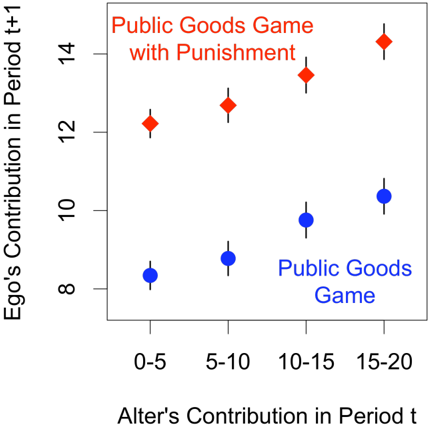
“A summary of the raw data (Fig. 2) shows that, indeed, future contributions by focal individuals ('egos') are significantly related to the amount contributed by each group member with whom the ego interacted in the previous period ('alters') in both the basic public goods game and the public goods game with punishment.”
plainstates an association- Asserted: passes — The authors put it forward as true.
- Checkable: passes — It can be checked against evidence.
- Load-bearing: passes — The paper’s conclusions depend on it.
- Based: passes — The paper gives a reason why it holds.
A result the paper reports from its own data — it cites no other source for it, so there is none to check. The quote shows it is in the paper.
In the paper
“Remarkably, even though egos do not observe the contributions of their alters' alters (two degrees of separation), they too significantly affect ego's contribution decisions.”
plainstates a cause- Asserted: passes — The authors put it forward as true.
- Checkable: passes — It can be checked against evidence.
- Load-bearing: passes — The paper’s conclusions depend on it.
- Based: passes — The paper gives a reason why it holds.
A result the paper reports from its own data — it cites no other source for it, so there is none to check. The quote shows it is in the paper.
In the paper
“For each 1MU contributed by an alter, ego contributes an additional 0.19 MUs (95% C.I. 0.14 to 0.24, p <0.0001) in the next period in the basic public goods game and an additional 0.18MUs (0.14 to 0.21, p <0.0001) in the public goods game with punishment.”
plainstates a cause- Asserted: passes — The authors put it forward as true.
- Checkable: passes — It can be checked against evidence.
- Load-bearing: passes — The paper’s conclusions depend on it.
- Based: passes — The paper gives a reason why it holds.
A result the paper reports from its own data — it cites no other source for it, so there is none to check. The quote shows it is in the paper.
In the paper
“Furthermore, this influence persists for multiple periods and spreads up to three degrees of separation (from person to person to person to person).”
plainstates a cause- Asserted: passes — The authors put it forward as true.
- Checkable: passes — It can be checked against evidence.
- Load-bearing: passes — The paper’s conclusions depend on it.
- Based: passes — The paper gives a reason why it holds.
104 more claims
Create a free account to see all 196 claims and to verify the 54 references still open.
- It may state two separate claims as one. 38
- Probably not a substantial claim. 57
- The quote only partly states this claim. 7
Claims other papers make about this one
Each is checked against this paper’s own text: does it say what the citing paper says it does?
The cited source says what the claim attributes to it.
In the citing paper
“Furthermore, recent evidence from both lab and field studies suggests that people behave more prosocially after observing others engaging in behaviors such as cooperation and generosity 8 – 10 .”
From Crowdsourcing punishment: Individuals reference group preferences to inform their own punitive decisions (2019) · cites this paper as [8]
Citations
Cites
Birds of a Feather: Homophily in Social Networks
McPherson, M., Smith-Lovin, L., & Cook, J. M. (2001) · Annual Review of Sociology · doi:10.1146/annurev.soc.27.1.415 · Cited by 18,567
Olson, M. (1965) · doi:10.4159/9780674041660 · Cited by 14,191
Asymptotic Confidence Intervals for Indirect Effects in Structural Equation Models
Sobel, M. E. (1982) · Sociological Methodology · doi:10.2307/270723 · Cited by 12,810
The Logic of Collective Action: Public Goods and the Theory of Groups.
Sufrin, S. C., & Olson, M. (1966) · Industrial and Labor Relations Review · doi:10.2307/2521228 · Cited by 11,518
The Evolution of Reciprocal Altruism
Trivers, R. L. (1971) · The Quarterly Review of Biology · doi:10.1086/406755 · Cited by 11,010
Five Rules for the Evolution of Cooperation
Nowak, M. A. (2006) · Science · doi:10.1126/science.1133755 · Cited by 5,894
Altruistic punishment in humans
Fehr, E., & Gächter, S. (2002) · Nature · doi:10.1038/415137a · Cited by 5,616
The Spread of Obesity in a Large Social Network over 32 Years
Christakis, N. A., & Fowler, J. H. (2007) · New England Journal of Medicine · doi:10.1056/nejmsa066082 · Cited by 5,007
Self-citationCollins, R. (2004) · doi:10.1515/9781400851744 · Cited by 4,726
Szabó, G., & Fáth, G. (2007) · Physics Reports · doi:10.1016/j.physrep.2007.04.004 · Cited by 2,974
Cited by
Items 701–768 of 768
(2024) · V&R unipress eBooks · doi:10.14220/9783737016803.toc
(2024) · V&R unipress eBooks · doi:10.14220/9783737016803.147
Preface: Semantics. Polish and English understandings of the word “kindness”
(2024) · V&R unipress eBooks · doi:10.14220/9783737016803.9
Szafran, J., & Cwojdzińska, A. (2024) · V&R unipress eBooks · doi:10.14220/9783737016803 · Cited by 2
Promotion of Physical Activity for Women's Health
Pekmezi, D., Linke, S., Hartman, S. J., & Marcus, B. H. (2013) · Wiley eBooks · doi:10.1002/9781394260454.ch11
Member Preferences for Cooperative Attributes: A Best-Worst Scale Analysis
Manousakis, T., Sergaki, P., Kalogeras, N., & van Dijk, G. (2024) · Cooperative management · doi:10.1007/978-3-031-49845-9_3
From i-level to g-level- to s-level change: New methods for a new mindset for consumer researchersPreprint
Grinstein, A., Bolderdijk, J. W., & Risselada, H. (2024) · SSRN Electronic Journal · doi:10.2139/ssrn.4781525
Tipping Points to Transitions: PEA and NEA (Principles 2 and 3)
Boyatzis, R. E. (2024) · Oxford University Press eBooks · doi:10.1093/9780197765142.003.0003
Resonant Relationships Are the Context for Change (Principle 7)
Boyatzis, R. E. (2024) · Oxford University Press eBooks · doi:10.1093/9780197765142.003.0007
Dreams, Shared Vision, and Purpose as the Driver of Change (Principle 1)
Boyatzis, R. E. (2024) · Oxford University Press eBooks · doi:10.1093/9780197765142.003.0002
The Real Self: Who Am I? Who Are We? (Principle 4)
Boyatzis, R. E. (2024) · Oxford University Press eBooks · doi:10.1093/9780197765142.003.0004
The Quest for Sustained, Desired Change
Boyatzis, R. E. (2024) · Oxford University Press eBooks · doi:10.1093/9780197765142.003.0001
What Next? The Call to Study Change
Boyatzis, R. E. (2024) · Oxford University Press eBooks · doi:10.1093/9780197765142.003.0009
A Path to My/Our Dreams: Joyful Planning and Preparation (Principle 5)
Boyatzis, R. E. (2024) · Oxford University Press eBooks · doi:10.1093/9780197765142.003.0005
Exploring Possibilities: Experimenting and Practice to Mastery (Principle 6)
Boyatzis, R. E. (2024) · Oxford University Press eBooks · doi:10.1093/9780197765142.003.0006
Boyatzis, R. E. (2024) · Oxford University Press eBooks · doi:10.1093/9780197765142.005.0001
Leading Change at Multiple Levels (Principles 8, 9, and 10)
Boyatzis, R. E. (2024) · Oxford University Press eBooks · doi:10.1093/9780197765142.003.0008
Sozialstruktur und Netzwerkanalyse
Schnettler, S. (2024) · Springer eBooks · doi:10.1007/978-3-658-39745-6_52
Strategy Consensus of Networked Evolutionary Games Based on Network Aggregation and Pinning Control
Li, H., Geng, Z., & Qin, M. (2025) · Games · doi:10.3390/g16010010
Emergence of cooperation promoted by higher-order strategy updatesPreprint
Wang, D., Peng, Y. M., Hong, Y., Chen, J., & Yan, G. (2025) · bioRxiv (Cold Spring Harbor Laboratory) · doi:10.1101/2025.02.20.639241 · Cited by 1
GPU-Accelerated Structural Diversity Search in Graphs
Huang, J. D., Huang, X. S., Xu, J., Choi, B. K. K., & Peng, Y. (2025) · IEEE Transactions on Knowledge and Data Engineering · doi:10.1109/tkde.2025.3547443
Assuming risks in sustainable behaviours: the role of subjective risk intelligence and prosociality
Zarbo, R., Buccheri, S. L., Iacolino, C., Magnano, P., & Guarnera, M. A. (2025) · Journal of Environmental Studies and Sciences · doi:10.1007/s13412-025-01020-9 · Cited by 1
Interpersonal Trust in the Presence of Generative AI
Pavleska, T. (2025) · Lecture notes in computer science · doi:10.1007/978-3-031-93412-4_25 · Cited by 1
Zhao, Y., Yang, F., Cheng, Y., & Ren, Y. (2025) · Communications in computer and information science · doi:10.1007/978-3-031-94153-5_30
Quand la générosité renforce l’immunité
Rapoport-Hubschman, N. (2025) · Cerveau & Psycho · doi:10.3917/cerpsy.178.0060
Information Cascades in Signed HypergraphsPreprint
Wang, Y., Ke, X., Zhang, J., Cui, L., Liu, Y., Zhang, J., Yang, P., & Meng, F. (2025) · SSRN Electronic Journal · doi:10.2139/ssrn.5367288 · Cited by 1
Community through market competition
Althorpe, C. (2025) · Economics and Philosophy · doi:10.1017/s0266267125100576
A Community Detection Model Based on Dynamic Propagation-Aware Multi-Hop Feature Aggregation
Lei, C., Xiao, Y., Jin, S., Huang, T., Zhang, C., & Cheng, M. (2025) · Entropy · doi:10.3390/e27101053
Arnold, C., Hennrich, P., Koetsenruijter, J., van Lieshout, J., Peters-Klimm, F., & Wensing, M. (2020) · Figshare · doi:10.6084/m9.figshare.12814452
Arnold, C., Hennrich, P., Koetsenruijter, J., van Lieshout, J., Peters-Klimm, F., & Wensing, M. (2020) · Figshare · doi:10.6084/m9.figshare.12814440
Arnold, C., Hennrich, P., Koetsenruijter, J., van Lieshout, J., Peters-Klimm, F., & Wensing, M. (2020) · Figshare · doi:10.6084/m9.figshare.12814449
Arnold, C., Hennrich, P., Koetsenruijter, J., van Lieshout, J., Peters-Klimm, F., & Wensing, M. (2020) · Figshare · doi:10.6084/m9.figshare.12814443
Arnold, C., Hennrich, P., Koetsenruijter, J., van Lieshout, J., Peters-Klimm, F., & Wensing, M. (2020) · Figshare · doi:10.6084/m9.figshare.12814458
Arnold, C., Hennrich, P., Koetsenruijter, J., van Lieshout, J., Peters-Klimm, F., & Wensing, M. (2020) · Figshare · doi:10.6084/m9.figshare.12814446
Arnold, C., Hennrich, P., Koetsenruijter, J., van Lieshout, J., Peters-Klimm, F., & Wensing, M. (2020) · Figshare · doi:10.6084/m9.figshare.12814455
Singh, S. (2026) · International Journal of Sociology and Social Policy · doi:10.1108/ijssp-05-2025-0296
Shibah, S. R. M. (2026) · SSRN Electronic Journal · doi:10.2139/ssrn.6037355
Turnbull, S., Jordan, M., Linnett, R. J., & Bondy, K. (2026) · Archives of Public Health · doi:10.1186/s13690-026-01843-0
Responsibility sharing in a public bad experiment
He, S., Zhu, X., & Zou, X. (2026) · Economic Theory · doi:10.1007/s00199-026-01708-1 · Cited by 1
Li, A., & Li, D. (2026) · 2012 International Conference on Computing, Networking and Communications (ICNC) · doi:10.1109/icnc68183.2026.11416874
Balbuena, L., Kolla, N. J., & Logan, J. (2026) · Evolutionary Psychology · doi:10.1177/14747049261435215
Bialkowski, A., Collins, M. D., Ashkanasy, N. M., & Härtel, C. E. J. (2026) · SSRN Electronic Journal · doi:10.2139/ssrn.6470958
Artificial Influence: How AI Role and Gender Reshape Team DynamicsPreprint
Traeger, M. L., Kormylo, C., Hubbard, T. D., & Villano, M. A. (2026) · SSRN Electronic Journal · doi:10.2139/ssrn.6469423
Information cascades in signed hypergraphs
Wang, Y., Zhang, J., Yang, P., & Meng, F. (2026) · Physica A Statistical Mechanics and its Applications · doi:10.1016/j.physa.2026.131543 · Cited by 1
Guido, A. (2019) · theses.fr (ABES) · doi:10.70675/a85945b6z7958z44cdz9d34z080084c1d7d7
La croyance et le désir : une approche tardienne des conflits hydriques
Orlando, L. (2020) · theses.fr (ABES) · doi:10.70675/2dfa3030z647cz4293zb167z6bfa42e382eb
The Impact of Agricultural Corporate Social Responsibility Transparency on Consumers' Impulse BuyingPreprint
Fu, S., Wu, W., Qiu, J., & Yang, T. (2026) · SSRN Electronic Journal · doi:10.2139/ssrn.6585568
Reputation or Norms? Unravelling the Mechanisms of Eye Cues in Promoting Social Mindfulness
Lei, H., Zhang, S., Chen, Z., Huang, W., ZHENG, Y., Dou, K., & Huang, L. (2026) · International Journal of Psychology · doi:10.1002/ijop.70219 · Cited by 1
The Influence “Paradox”: When More Network Ties Lead to Less Change
Hsiao, Y., & Christakis, N. A. (2026) · American Sociological Review · doi:10.1177/00031224261438845
Self-citationCooperation dynamics driven by inequality-averse reward in structured populations
Gong, N., Zhang, Y., Lu, Y., Li, S., & Shi, L. (2026) · Applied Mathematics and Computation · doi:10.1016/j.amc.2026.130194
A dataset of a whole network to investigate healthy and unhealthy behaviors in an Italian Community
Sarti, S., Terraneo, M., & Consolazio, D. (2026) · Frontiers in Sociology · doi:10.3389/fsoc.2026.1743234
Encouraging socially considerate behavior in green travel: A field experiment with shared bicycles
Su, D., Lien, J. W., Wang, Y., Wang, J., & Fu, T. (2026) · Transportation Research Part A Policy and Practice · doi:10.1016/j.tra.2026.105109 · Cited by 1
Strahringer, L., Prüß, S. E., & Riemer, K. (2026) · SSRN Electronic Journal · doi:10.2139/ssrn.6962767
Situated generosity in clinical care: A mixed-methods study of STI services in China
Zhou, K., Ho, D., Day, S., Fitzpatrick, T., Li, K. T., Hlatshwako, T. G., Luo, D., Yin, Z., Marley, G., Yang, L., et al. (2026) · PLoS ONE · doi:10.1371/journal.pone.0352469
Diffusion of HIV Prevention Advocacy in Social Networks of Persons Living with HIV in Uganda
Wagner, G. J., Bogart, L. M., Okoboi, S., Gwokyalya, V., Green, H. D., Klein, D. J., Ninsiima, S., & Matovu, J. K. B. (2026) · International Journal of Behavioral Medicine · doi:10.1007/s12529-026-10478-y
Epidemics by beneficial microorganisms drive evolution
Rosenberg, E. (2026) · Infection Genetics and Evolution · doi:10.2139/ssrn.7154275
Lu, Y., Gong, N., Zhang, Y., Du, C., & Park, J. (2026) · Applied Mathematics and Computation · doi:10.1016/j.amc.2026.130252
Guo, W., Fang, D., Lu, W., & Tan, Y. (2026) · Journal of Construction Engineering and Management · doi:10.1061/jcemd4.coeng-17705
Metastability and Entropy Peaks in Antagonistic Multiplex Consensus Dynamics
Hughes, J. C. M., Kusmartseva, A. F., Muschert, G. W., Jelinek, H. F., & Kusmartsev, F. V. (2026) · Entropy · doi:10.3390/e28080857
Stewart, M. (2026) · International Organization · doi:10.1017/s0020818326101453
Objectionable Solidarity and Fractures in the Ethics of Global Health Solidarity
Chingarande, G. R. (2026) · Journal of Bioethical Inquiry · doi:10.1007/s11673-026-10602-3
Motivation complementarities in prosocial behavior: Evidence from social networks of blood donors
Bruhin, A., Haenni, S., Jiang, L., Roethlisberger, A., Buchli, R., Frey, B. M., & Goette, L. F. (2026) · Games and Economic Behavior · doi:10.1016/j.geb.2026.08.007
(2026) · Vandenhoeck & Ruprecht eBooks · doi:10.13109/9783666409073.282
EMPIRICAL CALIBRATION OF ADAPTIVE BOUNDED-CONFIDENCE DYNAMICS IN REFUGEE–HOST INTERACTION NETWORKS
Hafez, S., Farag, F. R., & Tawadros, A. S. N. (2026) · Advances in Complex Systems · doi:10.1142/s0219525926500086
Newcomers help most after being helped, veterans do not: Evidence from Stack Overflow
Strahringer, L., Prüß, S. E., & Riemer, K. (2026) · Computers in Human Behavior · doi:10.1016/j.chb.2026.109193
A net social propagation index for blood pressure: evidence from a randomized trial
Zoughbie, D. E., Huddleston, D., & Ding, E. L. (2026) · Scientific Reports · doi:10.1038/s41598-026-49304-6
Paying forward kindness at the checkout? Note on a natural field experiment
Schnedler, W. (2026) · Journal of Economic Psychology · doi:10.1016/j.joep.2026.102948
Metadata
- Authors
- Fowler, J. H., & Christakis, N. A.
- Affiliations
- University of California San Diego (US)
- Harvard University (US)
- Venue
- Proceedings of the National Academy of Sciences
- Publisher
- National Academy of Sciences
- Published
- 2010-03-08
- Volume
- 107
- Issue
- 12
- Pages
- 5334-5338
- ISSN
- 0027-8424 (ISSN-L)
- 1091-6490
- PMC
- PMC2851803
- OpenAlex
- W2111394372
- Cited by
- 767
- References
- 54
- Citations by year
- 2026: 38 · 2025: 39 · 2024: 54 · 2023: 39 · 2022: 40 · 2021: 60 · 2020: 61 · 2019: 50 · 2018: 47 · 2017: 38 · 2016: 33 · 2015: 50 · 2014: 66 · 2013: 44 · 2012: 49
- FWCI
- 155.53
- Type
- journal article
- Language
- en
- Open access
- green
- www.ncbi.nlm.nih.gov
- Locations
- Proceedings of the National Academy of Sciences (publishedVersion)
- PubMed Central (publishedVersion)
- PubMed (publishedVersion)
- arXiv (Cornell University) (submittedVersion)
- Digital Access to Scholarship at Harvard (DASH) (Harvard University) (submittedVersion, cc-by)
- arXiv (Cornell University)
- Funders
- Robert Wood Johnson Foundation
- John Templeton Foundation
- University of Notre Dame
- National Institutes of Health
- National Institute on Aging (P30AG034420, P01AG031093)
- Topics
- Social Sciences › Sociology and Political Science › Evolutionary Game Theory and Cooperation
- Social Sciences › Economics, Econometrics and Finance › Economics and Econometrics › Experimental Behavioral Economics Studies
- Social Sciences › Sociology and Political Science › Social Power and Status Dynamics
- Keywords
- evolution of cooperation, social networks, costly punishment, public goods game, costly cooperation, indirect influence, costly signaling
- MeSH terms
- Cooperative Behavior, Humans, Interpersonal Relations, Models, Psychological, Punishment, Social Support, Models, Economic
About these checks
Registry, retraction, Cites and statistics results are computed, not judged, with one exception: a printed reference that no index lists is read once by a model before it counts as a citation error. Claims are extracted by a model and kept only when their quote appears verbatim in the text; each cited source is then checked, with a model’s help, for whether it says what the claim relies on. Those verdicts can be wrong — read the claim’s quote and the cited source before relying on one.
A language model drew the claims from the paper on 2026-11-20, under version 3 of the claim definition (model deepseek-v4.1-flash, prompt extract-v3).
A second model labelled each claim on 2026-11-20 (model jev-1.13-20260917, definition revision gold-guideline-v0.2).
Cited sources are checked with a language model’s help (qwen3.8-omni-flash).
Statistics and arithmetic are recomputed, not judged.
Confidence bands are shown only for fields calibrated on our annotated test set. None is calibrated yet, so no band is shown.
What counts as a claim ›How we measure confidence ›How we check this ›
Are you an author, or do you see a problem with this page? Request a review
Data sources
Bibliographic data: Semantic Scholar, OpenAlex, Crossref.
Contains information from the Semantic Scholar Academic Graph Datasets, made available under the ODC Attribution License (ODC-BY 1.0).
Semantic Scholar’s data is described in: Kinney, R., et al. (2023). The Semantic Scholar Open Data Platform. arXiv:2301.10140.
