

Cooperative behavior cascades in human social networks
Open accessThe DOI matches its Crossref record; 55 of the 56 references it cites were found in a registry or an index; 1 of the 67 sources its claims cite were checked for support.
Abstract
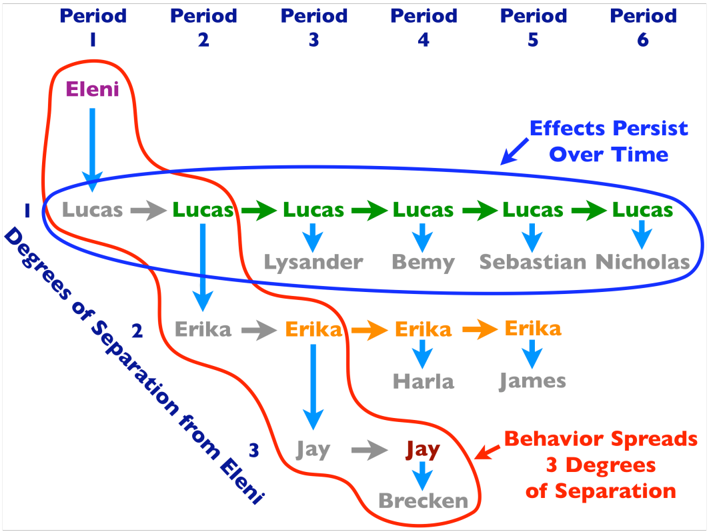
Theoretical models suggest that social networks influence the evolution of cooperation, but to date there have been few experimental studies. Observational data suggest that a wide variety of behaviors may spread in human social networks, but subjects in such studies can choose to befriend people with similar behaviors, posing difficulty for causal inference. Here, we exploit a seminal set of laboratory experiments that originally showed that voluntary costly punishment can help sustain cooperation. In these experiments, subjects were randomly assigned to a sequence of different groups to play a series of single-shot public goods games with strangers; this feature allowed us to draw networks of interactions to explore how cooperative and uncooperative behaviors spread from person to person to person. We show that, in both an ordinary public goods game and in a public goods game with punishment, focal individuals are influenced by fellow group members’ contribution behavior in future interactions with other individuals who were not a party to the initial interaction. Furthermore, this influence persists for multiple periods and spreads up to three degrees of separation (from person to person to person to person). The results suggest that each additional contribution a subject makes to the public good in the first period is tripled over the course of the experiment by other subjects who are directly or indirectly influenced to contribute more as a consequence. These results show experimentally that cooperative behavior cascades in human social networks.
Overview
CoChat Summary
TL;DR
Reanalyzing Fehr-Gächter public goods experiments, Fowler and Christakis find that cooperative and uncooperative contributions spread causally from person to person to person, up to three degrees of separation, and persist over multiple periods. Each additional 1 MU contributed in period 1 approximately triples over the experiment through direct and indirect network effects.
Key findings
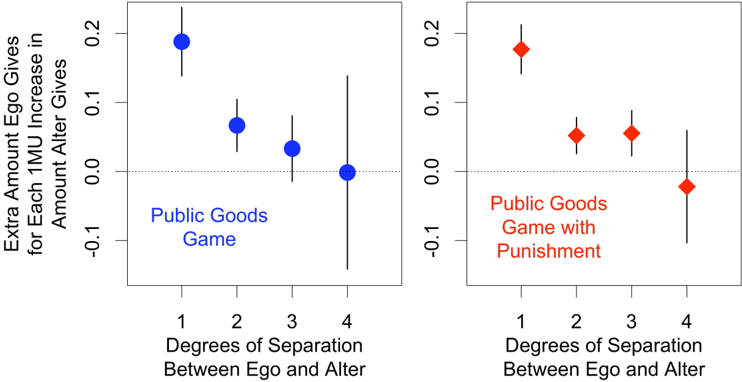
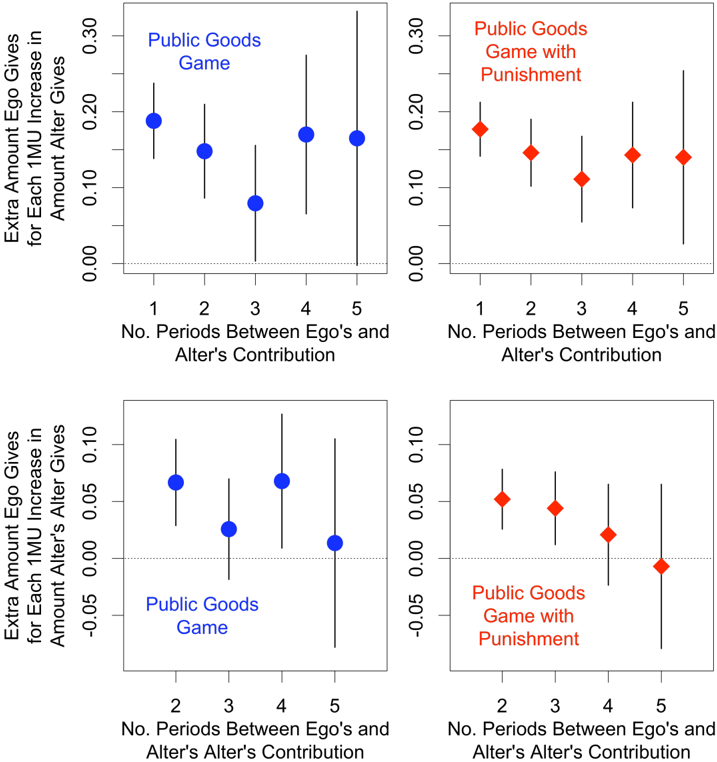
- Direct influence: each 1 MU contributed by an alter increased ego’s next-period contribution by 0.19 MUs (95% CI 0.14–0.24, p<0.0001) in the basic public goods game and 0.18 MUs (0.14–0.21, p<0.0001) in the punishment version.
- Indirect influence: each 1 MU contributed by an alter’s alter increased ego’s contribution two periods later by 0.07 MUs (0.03–0.10, p=0.0005) in the basic game and 0.05 MUs (0.03–0.08, p=0.0001) with punishment; in the punishment game, alter’s alter’s alter increased ego’s contribution by 0.06 MUs (0.02–0.09, p=0.001) three periods later.
- Cascade size: an extra 1 MU in period 1 caused 3 other subjects to increase total contributions by 1.8 MUs over the next 4 periods in the basic game or 2.1 MUs over the next 5 periods with punishment, plus indirect increases of 1.2 or 0.9 MUs, totaling 3 MUs (95% CI 2.4–3.6) in both versions.
- Punishment: each punishment point an alter’s alter gave to an alter increased ego’s contribution two rounds later by 0.13 MUs (0.02–0.23, p=0.02), but this did not spread further (p=0.25); punishment behavior itself did not spread (p=0.83).
Methods
- Reanalysis of previously published Fehr-Gächter public goods game experiments with 240 subjects; groups of four, 20 MUs, six periods, random assignment, strict anonymity, and no subject paired with another more than once; the punishment version allowed spending up to 10 MUs to reduce a target’s income by 3 MUs per 1 MU.
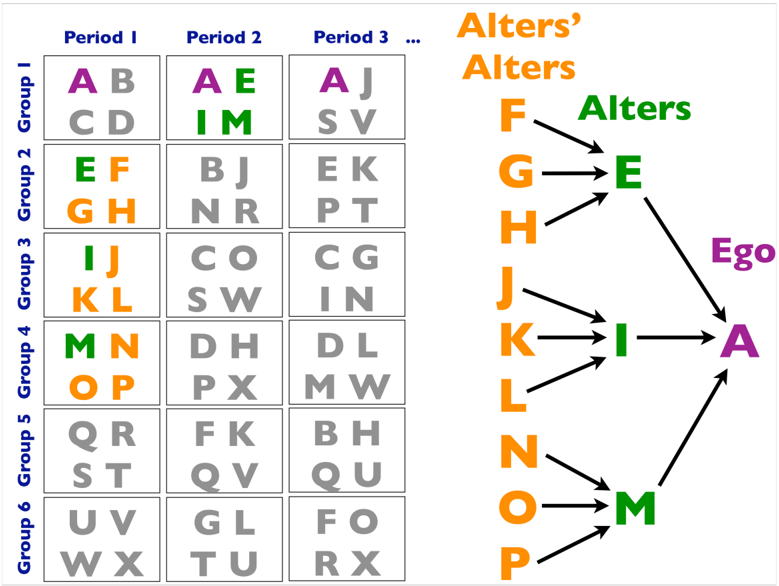
- Interaction networks were constructed from group assignments, with ties defined by the ability to observe another subject’s contribution in the preceding period; direct and indirect effects were estimated up to three degrees of separation.
- Interval (Tobit) regression with Huber-White clustered standard errors on ego and alter, controlling for ego’s prior contribution and period fixed effects; robustness checks included group-level models, additional lags, ego fixed effects, and Sobel mediation tests.
Limitations
- Paper-stated: results come from a particular experimentally controlled network structure, and whether “pay it forward” behavior spreads more widely in natural human networks remains an open question; interval regression coefficients apply to the latent outcome, group-level models are downwardly biased due to censoring, and fixed-effects models are biased toward zero.
- Evident from the text: anonymous, single-shot stranger groups with no reputations or repeated ties may not capture real-world social ties; per-MU effects are small, and cascade estimates rely on effects with p<0.05.
Model-written summary. Check it against the paper before relying on it.
Integrity signals
Registry
Cites
Statistics
Figures
Verification
Claims the paper makes
1 Valid · 4 Not valid · 30 Not checked · 161 Own results and interpretations
Every source the paper cites for this claim was checked and supports it.
In the paper
“However, it is worth reiterating that most of our subjects violated this supposition: since all interactions are single-shot, the equilibrium prediction is to contribute nothing and to pay nothing to punish noncontributors, yet this was not what the subjects did ( 36 ).”
What the sources say
- Supportedcites [36] 36. Fehr E, Gachter S (2002) Altruistic punishment in humans. Nature 415: 137-140. source
Fehr & Gächter (2002) state the selfish benchmark explicitly — 'it was always in the material self-interest of any subject to keep all MUs privately' and 'purely selfish subjects will never cooperate or punish others, because cooperation and punishment are costly and yield no pecuniary benefits' (p. 1) — with groups randomly recomposed so no subject met another twice, i.e. single-shot interactions. Their results then show most subjects acted against that benchmark: 84.3% of subjects punished at least once out of 1,270 punishment acts (Altruistic punishment and cooperation, p. 1), and cooperation rose in the punishment treatment with 94.2%/91.4% of subjects investing more under punishment than without (Results, p. 2). Together these support the paraphrase that most subjects violated the selfish-payoff-maximising supposition in both contributing and punishing. (LLM, conf=0.88)
plain- Asserted: passes — The authors put it forward as true.
- Checkable: passes — It can be checked against evidence.
- Load-bearing: passes — The paper’s conclusions depend on it.
- Based: passes — The paper gives a reason why it holds.
- Supported
A result the paper reports from its own data — it cites no other source for it, so there is none to check. The quote shows it is in the paper.
In the paper
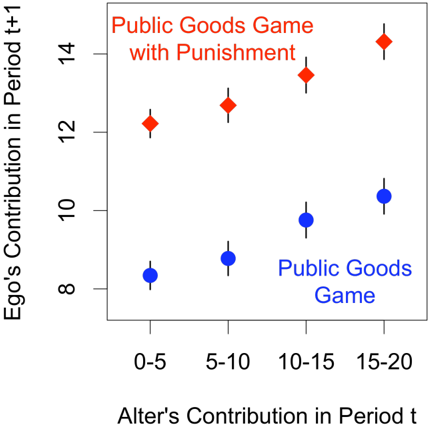
“A summary of the raw data (Fig. 2) shows that, indeed, future contributions by focal individuals ('egos') are significantly related to the amount contributed by each group member with whom the ego interacted in the previous period ('alters') in both the basic public goods game and the public goods game with punishment.”
plainstates an association- Asserted: passes — The authors put it forward as true.
- Checkable: passes — It can be checked against evidence.
- Load-bearing: passes — The paper’s conclusions depend on it.
- Based: passes — The paper gives a reason why it holds.
A result the paper reports from its own data — it cites no other source for it, so there is none to check. The quote shows it is in the paper.
In the paper
“Remarkably, even though egos do not observe the contributions of their alters' alters (two degrees of separation), they too significantly affect ego's contribution decisions.”
plainstates a cause- Asserted: passes — The authors put it forward as true.
- Checkable: passes — It can be checked against evidence.
- Load-bearing: passes — The paper’s conclusions depend on it.
- Based: passes — The paper gives a reason why it holds.
A result the paper reports from its own data — it cites no other source for it, so there is none to check. The quote shows it is in the paper.
In the paper
“For each 1MU contributed by an alter, ego contributes an additional 0.19 MUs (95% C.I. 0.14 to 0.24, p <0.0001) in the next period in the basic public goods game and an additional 0.18MUs (0.14 to 0.21, p <0.0001) in the public goods game with punishment.”
plainstates a cause- Asserted: passes — The authors put it forward as true.
- Checkable: passes — It can be checked against evidence.
- Load-bearing: passes — The paper’s conclusions depend on it.
- Based: passes — The paper gives a reason why it holds.
A result the paper reports from its own data — it cites no other source for it, so there is none to check. The quote shows it is in the paper.
In the paper
“Furthermore, this influence persists for multiple periods and spreads up to three degrees of separation (from person to person to person to person).”
plainstates a cause- Asserted: passes — The authors put it forward as true.
- Checkable: passes — It can be checked against evidence.
- Load-bearing: passes — The paper’s conclusions depend on it.
- Based: passes — The paper gives a reason why it holds.
104 more claims
Create a free account to see all 196 claims and to verify the 54 references still open.
- It may state two separate claims as one. 38
- Probably not a substantial claim. 57
- The quote only partly states this claim. 7
Claims other papers make about this one
Each is checked against this paper’s own text: does it say what the citing paper says it does?
The cited source says what the claim attributes to it.
In the citing paper
“Furthermore, recent evidence from both lab and field studies suggests that people behave more prosocially after observing others engaging in behaviors such as cooperation and generosity 8 – 10 .”
From Crowdsourcing punishment: Individuals reference group preferences to inform their own punitive decisions (2019) · cites this paper as [8]
Citations
Cites
Birds of a Feather: Homophily in Social Networks
McPherson, M., Smith-Lovin, L., & Cook, J. M. (2001) · Annual Review of Sociology · doi:10.1146/annurev.soc.27.1.415 · Cited by 18,567
Olson, M. (1965) · doi:10.4159/9780674041660 · Cited by 14,191
Asymptotic Confidence Intervals for Indirect Effects in Structural Equation Models
Sobel, M. E. (1982) · Sociological Methodology · doi:10.2307/270723 · Cited by 12,810
The Logic of Collective Action: Public Goods and the Theory of Groups.
Sufrin, S. C., & Olson, M. (1966) · Industrial and Labor Relations Review · doi:10.2307/2521228 · Cited by 11,518
The Evolution of Reciprocal Altruism
Trivers, R. L. (1971) · The Quarterly Review of Biology · doi:10.1086/406755 · Cited by 11,010
Five Rules for the Evolution of Cooperation
Nowak, M. A. (2006) · Science · doi:10.1126/science.1133755 · Cited by 5,894
Altruistic punishment in humans
Fehr, E., & Gächter, S. (2002) · Nature · doi:10.1038/415137a · Cited by 5,616
The Spread of Obesity in a Large Social Network over 32 Years
Christakis, N. A., & Fowler, J. H. (2007) · New England Journal of Medicine · doi:10.1056/nejmsa066082 · Cited by 5,007
Self-citationCollins, R. (2004) · doi:10.1515/9781400851744 · Cited by 4,726
Szabó, G., & Fáth, G. (2007) · Physics Reports · doi:10.1016/j.physrep.2007.04.004 · Cited by 2,974
Cited by
A 61-million-person experiment in social influence and political mobilization
Bond, R. M., Fariss, C. J., Jones, J. J., Kramer, A. D. I., Marlow, C., Settle, J. E., & Fowler, J. H. (2012) · Nature · doi:10.1038/nature11421 · Cited by 2,575
Self-citationSocial contagion theory: examining dynamic social networks and human behavior
Christakis, N. A., & Fowler, J. H. (2013) · Statistics in Medicine · doi:10.1002/sim.5408 · Cited by 1,303
Self-citationHomophily and contagion are generically confounded in observational social network studies
Shalizi, C. R., & Thomas, A. C. (2011) · Sociological Methods & Research · doi:10.1177/0049124111404820 · Cited by 994
Zaki, J. (2014) · Psychological Bulletin · doi:10.1037/a0037679 · Cited by 821
Walsh, R. (2011) · American Psychologist · doi:10.1037/a0021769 · Cited by 692
Social networks and cooperation in hunter-gatherers.
Apicella, C. L., Marlowe, F. W., Fowler, J. H., & Christakis, N. A. (2012) · Nature · doi:10.1038/nature10736 · Cited by 698
Self-citationStructural diversity in social contagion
Ugander, J., Backstrom, L., Marlow, C., & Kleinberg, J. (2012) · Proceedings of the National Academy of Sciences · doi:10.1073/pnas.1116502109 · Cited by 695
Bolino, M. C., & Grant, A. M. (2016) · Academy of Management Annals · doi:10.5465/19416520.2016.1153260 · Cited by 682
Dynamic social networks promote cooperation in experiments with humans
Rand, D. G., Arbesman, S., & Christakis, N. A. (2011) · Proceedings of the National Academy of Sciences · doi:10.1073/pnas.1108243108 · Cited by 653
Self-citationSocial Network Sensors for Early Detection of Contagious Outbreaks
Christakis, N. A., & Fowler, J. H. (2010) · PLoS ONE · doi:10.1371/journal.pone.0012948 · Cited by 535
Self-citationSayed, A. H., Tu, S.-Y., Chen, J., Zhao, X., & Towfic, Z. J. (2013) · IEEE Signal Processing Magazine · doi:10.1109/msp.2012.2231991 · Cited by 494
Detecting Emotional Contagion in Massive Social Networks
Coviello, L., Sohn, Y., Kramer, A. D. I., Marlow, C., Franceschetti, M., Christakis, N. A., & Fowler, J. H. (2014) · PLoS ONE · doi:10.1371/journal.pone.0090315 · Cited by 478
Self-citationThe Origins and Psychology of Human Cooperation
Henrich, J., & Muthukrishna, M. (2021) · Annual Review of Psychology · doi:10.1146/annurev-psych-081920-042106 · Cited by 457
Short-term compassion training increases prosocial behavior in a newly developed prosocial game
Leiberg, S., Klimecki, O., & Singer, T. (2011) · PLoS ONE · doi:10.1371/journal.pone.0017798 · Cited by 442
Kremer, H., Villamor, I., & Aguinis, H. (2019) · Business Horizons · doi:10.1016/j.bushor.2018.08.010 · Cited by 423
Adaptation, Learning, and Optimization over Networks
Sayed, A. (2014) · now publishers, Inc. eBooks · doi:10.1561/9781601988515 · Cited by 415
Tie Strength, Embeddedness, and Social Influence: A Large-Scale Networked Experiment
Aral, S., & Walker, D. (2014) · Management Science · doi:10.1287/mnsc.2014.1936 · Cited by 389
Layous, K., Nelson, S. K., Oberle, E., Schonert-Reichl, K. A., & Lyubomirsky, S. (2012) · PLoS ONE · doi:10.1371/journal.pone.0051380 · Cited by 372
Beyond Altruism: Sociological Foundations of Cooperation and Prosocial Behavior
Simpson, B., & Willer, R. (2015) · Annual Review of Sociology · doi:10.1146/annurev-soc-073014-112242 · Cited by 357
Cooperation and Contagion in Web-Based, Networked Public Goods Experiments
Suri, S., & Watts, D. J. (2011) · PLoS ONE · doi:10.1371/journal.pone.0016836 · Cited by 354
Kim, D. A., Hwong, A. R., Stafford, D., Hughes, D. A., O'Malley, A. J., Fowler, J. H., & Christakis, N. A. (2015) · The Lancet · doi:10.1016/s0140-6736(15)60095-2 · Cited by 350
Self-citationXia, C., Wang, J., Perc, M., & Wang, Z. (2023) · Physics of Life Reviews · doi:10.1016/j.plrev.2023.05.002 · Cited by 339
Strong contributors to network persistence are the most vulnerable to extinction
Saavedra, S., Stouffer, D. B., Uzzi, B., & Bascompte, J. (2011) · Nature · doi:10.1038/nature10433 · Cited by 341
Emotions as infectious diseases in a large social network: the SISa model
Hill, A. L., Rand, D. G., Nowak, M. A., & Christakis, N. A. (2010) · Proceedings of the Royal Society B: Biological Sciences · doi:10.1098/rspb.2010.1217 · Cited by 334
Self-citationThe measurement of partisan sorting for 180 million voters
Brown, J. R., & Enos, R. D. (2021) · Nature Human Behaviour · doi:10.1038/s41562-021-01066-z · Cited by 330
Elwert, F. (2013) · Handbooks of Sociology and Social Research · doi:10.1007/978-94-007-6094-3_13 · Cited by 325
Placebo Effects: From the Neurobiological Paradigm to Translational Implications
Benedetti, F. (2014) · Neuron · doi:10.1016/j.neuron.2014.10.023 · Cited by 317
Cooperation and contagion in web-based, networked public goods experiments
Suri, S., & Watts, D. J. (2011) · ACM SIGecom Exchanges · doi:10.1145/1998549.1998550 · Cited by 318
Keltner, D., Kogan, A., Piff, P. K., & Saturn, S. R. (2014) · Annual Review of Psychology · doi:10.1146/annurev-psych-010213-115054 · Cited by 298
Perkins, J. M., Subramanian, S. V., & Christakis, N. A. (2015) · Social Science & Medicine · doi:10.1016/j.socscimed.2014.08.019 · Cited by 295
Self-citationThe genesis of climate change activism: from key beliefs to political action
Roser-Renouf, C., Maibach, E. W., Leiserowitz, A., & Zhao, X. (2014) · Climatic Change · doi:10.1007/s10584-014-1173-5 · Cited by 291
Indirect effects drive coevolution in mutualistic networks
Guimarães, P. R., Pires, M. M., Jordano, P., Bascompte, J., & Thompson, J. N. (2017) · Nature · doi:10.1038/nature24273 · Cited by 288
Risk of collective failure provides an escape from the tragedy of the commons
Santos, F. C., & Pacheco, J. M. (2011) · Proceedings of the National Academy of Sciences · doi:10.1073/pnas.1015648108 · Cited by 283
Media Literacy as a Core Competency for Engaged Citizenship in Participatory Democracy
Mihailidis, P., & Thevenin, B. (2013) · American Behavioral Scientist · doi:10.1177/0002764213489015 · Cited by 262
Open collaboration for innovation: Principles and performance
Levine, S. S., & Prietula, M. J. (2014) · Organization Science · doi:10.1287/orsc.2013.0872 · Cited by 263
Nowak, M. A. (2012) · Journal of Theoretical Biology · doi:10.1016/j.jtbi.2012.01.014 · Cited by 232
Mapping social dynamics on Facebook: The Brexit debate
Del Vicario, M., Zollo, F., Caldarelli, G., Scala, A., & Quattrociocchi, W. (2017) · Social Networks · doi:10.1016/j.socnet.2017.02.002 · Cited by 233
Infectious Disease Modeling of Social Contagion in Networks
Hill, A. L., Rand, D. G., Nowak, M. A., & Christakis, N. A. (2010) · PLoS Computational Biology · doi:10.1371/journal.pcbi.1000968 · Cited by 229
Self-citationAn empirical examination of echo chambers in US climate policy networks
Jasny, L., Waggle, J., & Fisher, D. R. (2015) · Nature Climate Change · doi:10.1038/nclimate2666 · Cited by 227
Evolution of in-group favoritism
Fu, F., Tarnita, C. E., Christakis, N. A., Wang, L., Rand, D. G., & Nowak, M. A. (2012) · Scientific Reports · doi:10.1038/srep00460 · Cited by 216
Self-citationThe role of diversity in the evolution of cooperation
Santos, F. C., Pinheiro, F. L., Lenaerts, T., & Pacheco, J. M. (2012) · Journal of Theoretical Biology · doi:10.1016/j.jtbi.2011.09.003 · Cited by 197
The Big Man Mechanism: how prestige fosters cooperation and creates prosocial leaders
Henrich, J., Chudek, M., & Boyd, R. (2015) · Philosophical Transactions of the Royal Society B: Biological Sciences · doi:10.1098/rstb.2015.0013 · Cited by 196
Correlated genotypes in friendship networks
Fowler, J. H., Settle, J. E., & Christakis, N. A. (2011) · Proceedings of the National Academy of Sciences · doi:10.1073/pnas.1011687108 · Cited by 188
Self-citationProsocial Conformity: Prosocial Norms Generalize Across Behavior and Empathy
Nook, E. C., Ong, D. C., Morelli, S. A., Mitchell, J. P., & Zaki, J. (2016) · Personality and Social Psychology Bulletin · doi:10.1177/0146167216649932 · Cited by 186
Barrett, L., Henzi, S. P., & Lusseau, D. (2012) · Philosophical Transactions of the Royal Society B: Biological Sciences · doi:10.1098/rstb.2012.0113 · Cited by 183
A bottom-up institutional approach to cooperative governance of risky commons
Vasconcelos, V. V., Santos, F. C., & Pacheco, J. M. (2013) · Nature Climate Change · doi:10.1038/nclimate1927 · Cited by 183
Modeling opinion dynamics in social networks
Das, A., Gollapudi, S., & Munagala, K. (2014) · Proceedings of the 7th ACM international conference on Web search and data mining · doi:10.1145/2556195.2559896 · Cited by 170
Yoo, E., Rand, W., Eftekhar, M., & Rabinovich, E. (2016) · Journal of Operations Management · doi:10.1016/j.jom.2016.05.007 · Cited by 173
The use of field experiments to increase tax compliance
Hallsworth, M. (2014) · Oxford Review of Economic Policy · doi:10.1093/oxrep/gru034 · Cited by 170
Paying it forward: Generalized reciprocity and the limits of generosity.
Gray, K., Ward, A. F., & Norton, M. I. (2014) · Journal of Experimental Psychology: General · doi:10.1037/a0031047 · Cited by 172
Collective behavior and evolutionary games – An introduction
Perc, M., & Grigolini, P. (2013) · Chaos, Solitons & Fractals · doi:10.1016/j.chaos.2013.06.002 · Cited by 168
The Spread of Sleep Loss Influences Drug Use in Adolescent Social Networks
Mednick, S. C., Christakis, N. A., & Fowler, J. H. (2010) · PLoS ONE · doi:10.1371/journal.pone.0009775 · Cited by 164
Self-citationInformation spreading on dynamic social networks
Liu, C., & Zhang, Z.-K. (2014) · Communications in Nonlinear Science and Numerical Simulation · doi:10.1016/j.cnsns.2013.08.028 · Cited by 163
Kogan, A., Oveis, C., Carr, E. W., Gruber, J., Mauss, I. B., Shallcross, A., Impett, E. A., van der Lowe, I., Hui, B., Cheng, C., et al. (2014) · Journal of Personality and Social Psychology · doi:10.1037/a0037509 · Cited by 162
The Ethnicity–Policy Preference Link in Sub-Saharan Africa
Lieberman, E. S., & McClendon, G. H. (2013) · Comparative Political Studies · doi:10.1177/0010414012463876 · Cited by 161
The Social Contagion of Generosity
Tsvetkova, M., & Macy, M. W. (2014) · PLoS ONE · doi:10.1371/journal.pone.0087275 · Cited by 160
Grant, A. M., & Patil, S. V. (2012) · Academy of Management Review · doi:10.5465/amr.2010.0437 · Cited by 160
Climate policies under wealth inequality
Vasconcelos, V. V., Santos, F. C., Pacheco, J. M., & Levin, S. A. (2014) · Proceedings of the National Academy of Sciences · doi:10.1073/pnas.1323479111 · Cited by 157
Boyatzis, R. E., Rochford, K. C., & Taylor, S. N. (2015) · Frontiers in Psychology · doi:10.3389/fpsyg.2015.00670 · Cited by 217
Vogus, T. J., & McClelland, L. E. (2015) · Human Resource Management Review · doi:10.1016/j.hrmr.2015.09.005 · Cited by 216
Correlated pay-offs are key to cooperation
Taborsky, M., Frommen, J. G., & Riehl, C. (2016) · Philosophical Transactions of the Royal Society B Biological Sciences · doi:10.1098/rstb.2015.0084 · Cited by 169
Networks and the Challenge of Sustainable Development
Henry, A. D., & Vollan, B. (2014) · Annual Review of Environment and Resources · doi:10.1146/annurev-environ-101813-013246 · Cited by 172
Smith, K. M., Larroucau, T., Mabulla, I. A., & Apicella, C. L. (2018) · Current Biology · doi:10.1016/j.cub.2018.07.064 · Cited by 152
Hayes, S. C., Merwin, R. M., McHugh, L., Sandoz, E. K., A-Tjak, J. G. L., Ruiz, F. J., Barnes-Holmes, D., Bricker, J. B., Ciarrochi, J., Dixon, M. R., et al. (2021) · Journal of Contextual Behavioral Science · doi:10.1016/j.jcbs.2021.03.007 · Cited by 136
Vulnerable robots positively shape human conversational dynamics in a human–robot team
Traeger, M. L., Strohkorb Sebo, S., Jung, M., Scassellati, B., & Christakis, N. A. (2020) · Proceedings of the National Academy of Sciences · doi:10.1073/pnas.1910402117 · Cited by 140
Self-citationCoaching With Compassion: Inspiring Health, Well-Being, and Development in Organizations
Boyatzis, R. E., Smith, M. L., & Beveridge, A. J. (2012) · The Journal of Applied Behavioral Science · doi:10.1177/0021886312462236 · Cited by 204
Climate change governance, cooperation and self-organization
Pacheco, J. M., de Vasconcelos, V. V. L., & Santos, F. C. (2014) · Physics of Life Reviews · doi:10.1016/j.plrev.2014.02.003 · Cited by 149
McDermott, R., Fowler, J. H., & Christakis, N. A. (2013) · Social Forces · doi:10.1093/sf/sot096 · Cited by 157
Self-citationToward A Model of Meme Diffusion (M3D)
Spitzberg, B. H. (2014) · Communication Theory · doi:10.1111/comt.12042 · Cited by 130
Sensitivity Analysis for Contagion Effects in Social Networks
VanderWeele, T. J. (2011) · Sociological Methods & Research · doi:10.1177/0049124111404821 · Cited by 130
Noel, H., & Nyhan, B. (2011) · Social Networks · doi:10.1016/j.socnet.2011.05.003 · Cited by 128
Jones, J. J., Bond, R. M., Bakshy, E., Eckles, D., & Fowler, J. H. (2017) · PLOS ONE · doi:10.1371/journal.pone.0173851 · Cited by 127
Self-citationDiffusion in Social Networks: A Multiagent Perspective
Jiang, Y., & Jiang, J. (2014) · IEEE Transactions on Systems Man and Cybernetics Systems · doi:10.1109/tsmc.2014.2339198 · Cited by 134
Three Prompts for Collective Action in the Context of Digital Media
Bimber, B. (2016) · Political Communication · doi:10.1080/10584609.2016.1223772 · Cited by 157
Climate, Collective Action and Individual Ethical Obligations
Hourdequin, M. (2010) · Environmental Values · doi:10.3197/096327110x531552 · Cited by 125
Karsai, M., Iñiguez, G., Kikas, R., Kaski, K. K., & Kertész, J. (2016) · Scientific Reports · doi:10.1038/srep27178 · Cited by 127
Everyday prosociality in the workplace: The reinforcing benefits of giving, getting, and glimpsing.
Chancellor, J., Margolis, S., Jacobs Bao, K., & Lyubomirsky, S. (2018) · Emotion · doi:10.1037/emo0000321 · Cited by 118
Social balance in signed networks
Zheng, X., Zeng, D. D., & Wang, F. (2014) · Information Systems Frontiers · doi:10.1007/s10796-014-9483-8 · Cited by 122
Benedetti, F., Durando, J., & Vighetti, S. (2014) · Pain · doi:10.1016/j.pain.2014.01.016 · Cited by 109
Quantitative Study of Individual Emotional States in Social Networks
Tang, J., Zhang, Y., Sun, J., Rao, J., Yu, W., Chen, Y., & Fong, A. C. M. (2011) · IEEE Transactions on Affective Computing · doi:10.1109/t-affc.2011.23 · Cited by 112
Reputation management: Why and how gossip enhances generosity
Wu, J., Balliet, D. P., & Lange, P. A. M. V. (2015) · Evolution and Human Behavior · doi:10.1016/j.evolhumbehav.2015.11.001 · Cited by 127
Social Networks and the Targeting of Vote Buying
Cruz, C. (2018) · Comparative Political Studies · doi:10.1177/0010414018784062 · Cited by 134
THE EVOLUTION OF GENERALIZED RECIPROCITY ON SOCIAL INTERACTION NETWORKS
van Doorn, G. S., & Taborsky, M. (2011) · Evolution · doi:10.1111/j.1558-5646.2011.01479.x · Cited by 121
An Empirical Model for Strategic Network Formation
Christakis, N. A., Fowler, J. H., Imbens, G. W., & Kalyanaraman, K. (2010) · National Bureau of Economic Research · doi:10.3386/w16039 · Cited by 122
Self-citationStatistical inference links data and theory in network science
Peel, L., Peixoto, T. P., & Domenico, M. D. (2022) · Nature Communications · doi:10.1038/s41467-022-34267-9 · Cited by 143
Political agency: The key to tackling climate change
O’Brien, K. L. (2015) · Science · doi:10.1126/science.aad0267 · Cited by 118
Toward a social ecology of prosociality: why, when, and where nature enhances social connection
Goldy, S. P., & Piff, P. K. (2019) · Current Opinion in Psychology · doi:10.1016/j.copsyc.2019.06.016 · Cited by 131
The social nature of mitochondria: Implications for human health
Picard, M. A., & Sandi, C. (2020) · Neuroscience & Biobehavioral Reviews · doi:10.1016/j.neubiorev.2020.04.017 · Cited by 108
Sueur, C., Deneubourg, J., & Petit, O. (2012) · PLoS ONE · doi:10.1371/journal.pone.0032566 · Cited by 124
A tethered generation: Exploring the role of mobile phones in the daily life of young people
Mihailidis, P. (2014) · Mobile Media & Communication · doi:10.1177/2050157913505558 · Cited by 99
McClelland, L. E., & Vogus, T. J. (2014) · Health Services Research · doi:10.1111/1475-6773.12186 · Cited by 98
Contagion of Cooperation in Static and Fluid Social Networks
Jordan, J. J., Rand, D. G., Arbesman, S., Fowler, J. H., & Christakis, N. A. (2013) · PLoS ONE · doi:10.1371/journal.pone.0066199 · Cited by 95
Self-citationUnderstanding Social Networks From a Multiagent Perspective
Jiang, Y., & Jiang, J. (2013) · IEEE Transactions on Parallel and Distributed Systems · doi:10.1109/tpds.2013.254 · Cited by 99
From social data mining to forecasting socio-economic crises
Helbing, D., & Balietti, S. (2011) · The European Physical Journal Special Topics · doi:10.1140/epjst/e2011-01401-8 · Cited by 91
Formalising the multidimensional nature of social networks
Lusseau, D., Barrett, L., & Henzi, S. P. (2011) · doi:10.48550/arxiv.1101.3735 · Cited by 92
Humanism as a common factor in psychotherapy.
Wampold, B. E. (2012) · Psychotherapy · doi:10.1037/a0027113 · Cited by 89
Hong, Y., Kim, J., & Xiong, L. (2019) · Journal of Environmental Psychology · doi:10.1016/j.jenvp.2019.04.005 · Cited by 98
IRONMAN: Using Social Networks to Add Incentives and Reputation to Opportunistic Networks
Bigwood, G., & Henderson, T. (2011) · International Conference on Social Computing · doi:10.1109/passat/socialcom.2011.60 · Cited by 93
Quality versus quantity of social ties in experimental cooperative networks
Shirado, H., Fu, F., Fowler, J. H., & Christakis, N. A. (2013) · Nature Communications · doi:10.1038/ncomms3814 · Cited by 89
Self-citationAnomalous structure and dynamics in news diffusion among heterogeneous individuals
Wang, X., Lan, Y., & Xiao, J. (2019) · Nature Human Behaviour · doi:10.1038/s41562-019-0605-7 · Cited by 91
Metadata
- Authors
- Fowler, J. H., & Christakis, N. A.
- Affiliations
- University of California San Diego (US)
- Harvard University (US)
- Venue
- Proceedings of the National Academy of Sciences
- Publisher
- National Academy of Sciences
- Published
- 2010-03-08
- Volume
- 107
- Issue
- 12
- Pages
- 5334-5338
- ISSN
- 0027-8424 (ISSN-L)
- 1091-6490
- PMC
- PMC2851803
- OpenAlex
- W2111394372
- Cited by
- 767
- References
- 54
- Citations by year
- 2026: 38 · 2025: 39 · 2024: 54 · 2023: 39 · 2022: 40 · 2021: 60 · 2020: 61 · 2019: 50 · 2018: 47 · 2017: 38 · 2016: 33 · 2015: 50 · 2014: 66 · 2013: 44 · 2012: 49
- FWCI
- 155.53
- Type
- journal article
- Language
- en
- Open access
- green
- www.ncbi.nlm.nih.gov
- Locations
- Proceedings of the National Academy of Sciences (publishedVersion)
- PubMed Central (publishedVersion)
- PubMed (publishedVersion)
- arXiv (Cornell University) (submittedVersion)
- Digital Access to Scholarship at Harvard (DASH) (Harvard University) (submittedVersion, cc-by)
- arXiv (Cornell University)
- Funders
- Robert Wood Johnson Foundation
- John Templeton Foundation
- University of Notre Dame
- National Institutes of Health
- National Institute on Aging (P30AG034420, P01AG031093)
- Topics
- Social Sciences › Sociology and Political Science › Evolutionary Game Theory and Cooperation
- Social Sciences › Economics, Econometrics and Finance › Economics and Econometrics › Experimental Behavioral Economics Studies
- Social Sciences › Sociology and Political Science › Social Power and Status Dynamics
- Keywords
- evolution of cooperation, social networks, costly punishment, public goods game, costly cooperation, indirect influence, costly signaling
- MeSH terms
- Cooperative Behavior, Humans, Interpersonal Relations, Models, Psychological, Punishment, Social Support, Models, Economic
About these checks
Registry, retraction, Cites and statistics results are computed, not judged, with one exception: a printed reference that no index lists is read once by a model before it counts as a citation error. Claims are extracted by a model and kept only when their quote appears verbatim in the text; each cited source is then checked, with a model’s help, for whether it says what the claim relies on. Those verdicts can be wrong — read the claim’s quote and the cited source before relying on one.
A language model drew the claims from the paper on 2026-11-20, under version 3 of the claim definition (model deepseek-v4.1-flash, prompt extract-v3).
A second model labelled each claim on 2026-11-20 (model jev-1.13-20260917, definition revision gold-guideline-v0.2).
Cited sources are checked with a language model’s help (qwen3.8-omni-flash).
Statistics and arithmetic are recomputed, not judged.
Confidence bands are shown only for fields calibrated on our annotated test set. None is calibrated yet, so no band is shown.
What counts as a claim ›How we measure confidence ›How we check this ›
Are you an author, or do you see a problem with this page? Request a review
Data sources
Bibliographic data: Semantic Scholar, OpenAlex, Crossref.
Contains information from the Semantic Scholar Academic Graph Datasets, made available under the ODC Attribution License (ODC-BY 1.0).
Semantic Scholar’s data is described in: Kinney, R., et al. (2023). The Semantic Scholar Open Data Platform. arXiv:2301.10140.
