

Cooperative behavior cascades in human social networks
Open accessThe DOI matches its Crossref record; 55 of the 56 references it cites were found in a registry or an index; 1 of the 67 sources its claims cite were checked for support.
Abstract
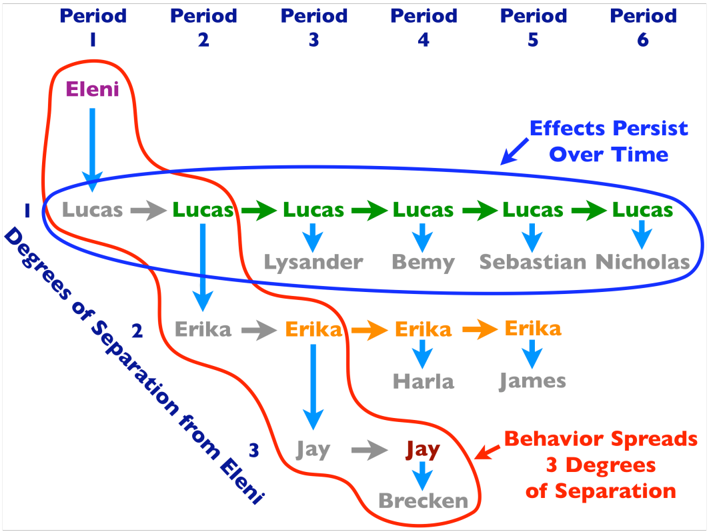
Theoretical models suggest that social networks influence the evolution of cooperation, but to date there have been few experimental studies. Observational data suggest that a wide variety of behaviors may spread in human social networks, but subjects in such studies can choose to befriend people with similar behaviors, posing difficulty for causal inference. Here, we exploit a seminal set of laboratory experiments that originally showed that voluntary costly punishment can help sustain cooperation. In these experiments, subjects were randomly assigned to a sequence of different groups to play a series of single-shot public goods games with strangers; this feature allowed us to draw networks of interactions to explore how cooperative and uncooperative behaviors spread from person to person to person. We show that, in both an ordinary public goods game and in a public goods game with punishment, focal individuals are influenced by fellow group members’ contribution behavior in future interactions with other individuals who were not a party to the initial interaction. Furthermore, this influence persists for multiple periods and spreads up to three degrees of separation (from person to person to person to person). The results suggest that each additional contribution a subject makes to the public good in the first period is tripled over the course of the experiment by other subjects who are directly or indirectly influenced to contribute more as a consequence. These results show experimentally that cooperative behavior cascades in human social networks.
Overview
CoChat Summary
TL;DR
Reanalyzing Fehr-Gächter public goods experiments, Fowler and Christakis find that cooperative and uncooperative contributions spread causally from person to person to person, up to three degrees of separation, and persist over multiple periods. Each additional 1 MU contributed in period 1 approximately triples over the experiment through direct and indirect network effects.
Key findings
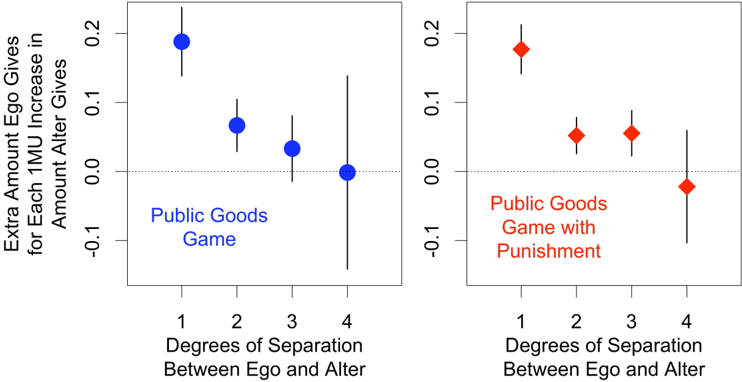
- Direct influence: each 1 MU contributed by an alter increased ego’s next-period contribution by 0.19 MUs (95% CI 0.14–0.24, p<0.0001) in the basic public goods game and 0.18 MUs (0.14–0.21, p<0.0001) in the punishment version.
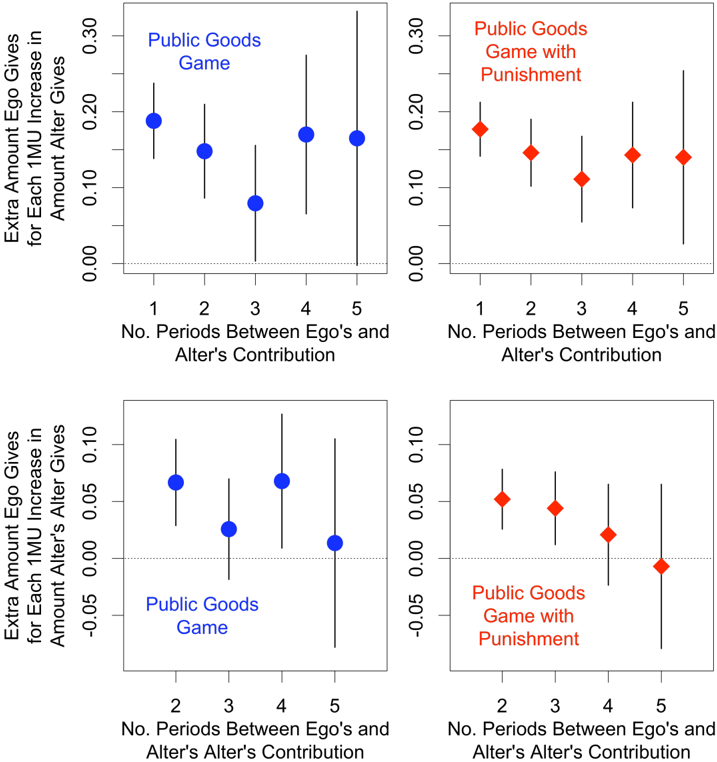
- Indirect influence: each 1 MU contributed by an alter’s alter increased ego’s contribution two periods later by 0.07 MUs (0.03–0.10, p=0.0005) in the basic game and 0.05 MUs (0.03–0.08, p=0.0001) with punishment; in the punishment game, alter’s alter’s alter increased ego’s contribution by 0.06 MUs (0.02–0.09, p=0.001) three periods later.
- Cascade size: an extra 1 MU in period 1 caused 3 other subjects to increase total contributions by 1.8 MUs over the next 4 periods in the basic game or 2.1 MUs over the next 5 periods with punishment, plus indirect increases of 1.2 or 0.9 MUs, totaling 3 MUs (95% CI 2.4–3.6) in both versions.
- Punishment: each punishment point an alter’s alter gave to an alter increased ego’s contribution two rounds later by 0.13 MUs (0.02–0.23, p=0.02), but this did not spread further (p=0.25); punishment behavior itself did not spread (p=0.83).
Methods
- Reanalysis of previously published Fehr-Gächter public goods game experiments with 240 subjects; groups of four, 20 MUs, six periods, random assignment, strict anonymity, and no subject paired with another more than once; the punishment version allowed spending up to 10 MUs to reduce a target’s income by 3 MUs per 1 MU.
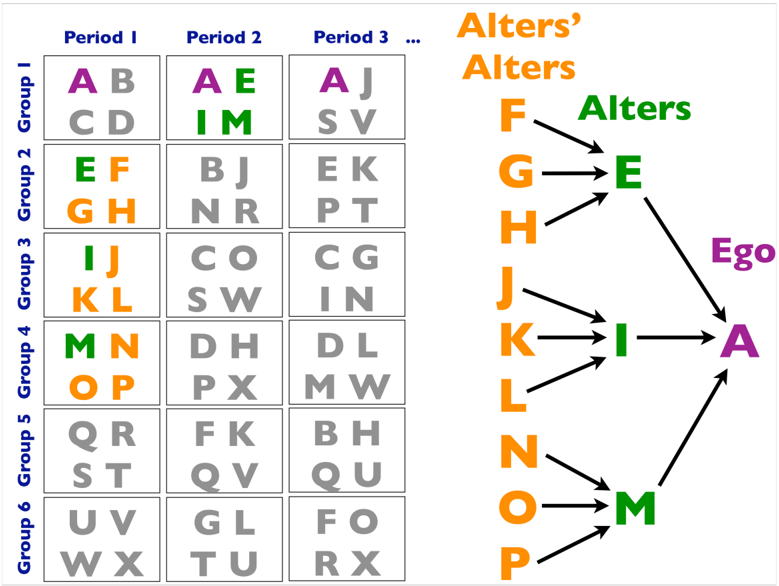
- Interaction networks were constructed from group assignments, with ties defined by the ability to observe another subject’s contribution in the preceding period; direct and indirect effects were estimated up to three degrees of separation.
- Interval (Tobit) regression with Huber-White clustered standard errors on ego and alter, controlling for ego’s prior contribution and period fixed effects; robustness checks included group-level models, additional lags, ego fixed effects, and Sobel mediation tests.
Limitations
- Paper-stated: results come from a particular experimentally controlled network structure, and whether “pay it forward” behavior spreads more widely in natural human networks remains an open question; interval regression coefficients apply to the latent outcome, group-level models are downwardly biased due to censoring, and fixed-effects models are biased toward zero.
- Evident from the text: anonymous, single-shot stranger groups with no reputations or repeated ties may not capture real-world social ties; per-MU effects are small, and cascade estimates rely on effects with p<0.05.
Model-written summary. Check it against the paper before relying on it.
Integrity signals
Registry
Cites
Statistics
Figures
Verification
Claims the paper makes
1 Valid · 4 Not valid · 30 Not checked · 161 Own results and interpretations
Every source the paper cites for this claim was checked and supports it.
In the paper
“However, it is worth reiterating that most of our subjects violated this supposition: since all interactions are single-shot, the equilibrium prediction is to contribute nothing and to pay nothing to punish noncontributors, yet this was not what the subjects did ( 36 ).”
What the sources say
- Supportedcites [36] 36. Fehr E, Gachter S (2002) Altruistic punishment in humans. Nature 415: 137-140. source
Fehr & Gächter (2002) state the selfish benchmark explicitly — 'it was always in the material self-interest of any subject to keep all MUs privately' and 'purely selfish subjects will never cooperate or punish others, because cooperation and punishment are costly and yield no pecuniary benefits' (p. 1) — with groups randomly recomposed so no subject met another twice, i.e. single-shot interactions. Their results then show most subjects acted against that benchmark: 84.3% of subjects punished at least once out of 1,270 punishment acts (Altruistic punishment and cooperation, p. 1), and cooperation rose in the punishment treatment with 94.2%/91.4% of subjects investing more under punishment than without (Results, p. 2). Together these support the paraphrase that most subjects violated the selfish-payoff-maximising supposition in both contributing and punishing. (LLM, conf=0.88)
plain- Asserted: passes — The authors put it forward as true.
- Checkable: passes — It can be checked against evidence.
- Load-bearing: passes — The paper’s conclusions depend on it.
- Based: passes — The paper gives a reason why it holds.
- Supported
A result the paper reports from its own data — it cites no other source for it, so there is none to check. The quote shows it is in the paper.
In the paper
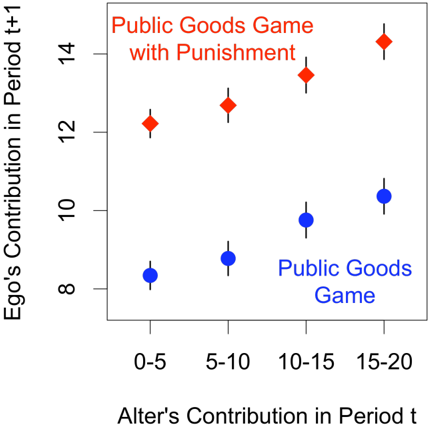
“A summary of the raw data (Fig. 2) shows that, indeed, future contributions by focal individuals ('egos') are significantly related to the amount contributed by each group member with whom the ego interacted in the previous period ('alters') in both the basic public goods game and the public goods game with punishment.”
plainstates an association- Asserted: passes — The authors put it forward as true.
- Checkable: passes — It can be checked against evidence.
- Load-bearing: passes — The paper’s conclusions depend on it.
- Based: passes — The paper gives a reason why it holds.
A result the paper reports from its own data — it cites no other source for it, so there is none to check. The quote shows it is in the paper.
In the paper
“Remarkably, even though egos do not observe the contributions of their alters' alters (two degrees of separation), they too significantly affect ego's contribution decisions.”
plainstates a cause- Asserted: passes — The authors put it forward as true.
- Checkable: passes — It can be checked against evidence.
- Load-bearing: passes — The paper’s conclusions depend on it.
- Based: passes — The paper gives a reason why it holds.
A result the paper reports from its own data — it cites no other source for it, so there is none to check. The quote shows it is in the paper.
In the paper
“For each 1MU contributed by an alter, ego contributes an additional 0.19 MUs (95% C.I. 0.14 to 0.24, p <0.0001) in the next period in the basic public goods game and an additional 0.18MUs (0.14 to 0.21, p <0.0001) in the public goods game with punishment.”
plainstates a cause- Asserted: passes — The authors put it forward as true.
- Checkable: passes — It can be checked against evidence.
- Load-bearing: passes — The paper’s conclusions depend on it.
- Based: passes — The paper gives a reason why it holds.
A result the paper reports from its own data — it cites no other source for it, so there is none to check. The quote shows it is in the paper.
In the paper
“Furthermore, this influence persists for multiple periods and spreads up to three degrees of separation (from person to person to person to person).”
plainstates a cause- Asserted: passes — The authors put it forward as true.
- Checkable: passes — It can be checked against evidence.
- Load-bearing: passes — The paper’s conclusions depend on it.
- Based: passes — The paper gives a reason why it holds.
104 more claims
Create a free account to see all 196 claims and to verify the 54 references still open.
- It may state two separate claims as one. 38
- Probably not a substantial claim. 57
- The quote only partly states this claim. 7
Claims other papers make about this one
Each is checked against this paper’s own text: does it say what the citing paper says it does?
The cited source says what the claim attributes to it.
In the citing paper
“Furthermore, recent evidence from both lab and field studies suggests that people behave more prosocially after observing others engaging in behaviors such as cooperation and generosity 8 – 10 .”
From Crowdsourcing punishment: Individuals reference group preferences to inform their own punitive decisions (2019) · cites this paper as [8]
Citations
Cites
Birds of a Feather: Homophily in Social Networks
McPherson, M., Smith-Lovin, L., & Cook, J. M. (2001) · Annual Review of Sociology · doi:10.1146/annurev.soc.27.1.415 · Cited by 18,567
Olson, M. (1965) · doi:10.4159/9780674041660 · Cited by 14,191
Asymptotic Confidence Intervals for Indirect Effects in Structural Equation Models
Sobel, M. E. (1982) · Sociological Methodology · doi:10.2307/270723 · Cited by 12,810
The Logic of Collective Action: Public Goods and the Theory of Groups.
Sufrin, S. C., & Olson, M. (1966) · Industrial and Labor Relations Review · doi:10.2307/2521228 · Cited by 11,518
The Evolution of Reciprocal Altruism
Trivers, R. L. (1971) · The Quarterly Review of Biology · doi:10.1086/406755 · Cited by 11,010
Five Rules for the Evolution of Cooperation
Nowak, M. A. (2006) · Science · doi:10.1126/science.1133755 · Cited by 5,894
Altruistic punishment in humans
Fehr, E., & Gächter, S. (2002) · Nature · doi:10.1038/415137a · Cited by 5,616
The Spread of Obesity in a Large Social Network over 32 Years
Christakis, N. A., & Fowler, J. H. (2007) · New England Journal of Medicine · doi:10.1056/nejmsa066082 · Cited by 5,007
Self-citationCollins, R. (2004) · doi:10.1515/9781400851744 · Cited by 4,726
Szabó, G., & Fáth, G. (2007) · Physics Reports · doi:10.1016/j.physrep.2007.04.004 · Cited by 2,974
Cited by
Items 301–400 of 768
Prosocial punishment bots breed social punishment in human players
Shen, C., He, Z., Ши, Л., Wang, Z., & Tanimoto, J. (2024) · Journal of The Royal Society Interface · doi:10.1098/rsif.2024.0019 · Cited by 27
Toward a Caribbean Psychology: An African-Centered Approach
Sutherland, M. E. (2011) · Journal of Black Studies · doi:10.1177/0021934711410547 · Cited by 29
An empirical model for strategic network formation
Christakis, N. A., Fowler, J. H., Imbens, G. W., & Kalyanaraman, K. (2020) · Elsevier eBooks · doi:10.1016/b978-0-12-811771-2.00012-2 · Cited by 51
Self-citationRole of conformity in opinion dynamics in social networks
Das, A., Gollapudi, S., Khan, A., & Leme, R. P. (2014) · Conference on Online Social Networks · doi:10.1145/2660460.2660479 · Cited by 21
Chen, X., & Deng, H. (2019) · Transportation Research Part F Traffic Psychology and Behaviour · doi:10.1016/j.trf.2019.03.015 · Cited by 22
Political economy with affect: On the role of emotions and relationships in political economics
van Winden, F. A. A. M. (2015) · European Journal of Political Economy · doi:10.1016/j.ejpoleco.2015.05.005 · Cited by 26
Link recommendations: Their impact on network structure and minorities
Ferrara, A., Espin-Noboa, L., Karimi, F., & Wagner, C. (2022) · 14th ACM Web Science Conference 2022 · doi:10.1145/3501247.3531583 · Cited by 22
The key to happiness in collaborative workplaces. Evidence from coworking spaces
Berdicchia, D., Fortezza, F., & Masino, G. (2022) · Review of Managerial Science · doi:10.1007/s11846-022-00558-0 · Cited by 35
Disaster preparedness and community helping behaviour in the wake of the 2020 Oregon wildfires
Siddiqi, M. U. A., Giordono, L. S., Zanocco, C. M., Stelmach, G., Flora, J. A., & Boudet, H. S. (2023) · Disasters · doi:10.1111/disa.12584 · Cited by 23
Reconstructing direct and indirect interactions in networked public goods game
Han, X., Shen, Z., Wang, W.-X., Lai, Y., & Grebogi, C. (2016) · Scientific Reports · doi:10.1038/srep30241 · Cited by 22
Harvey, J., & Berndt, M. (2020) · Anxiety Stress & Coping · doi:10.1080/10615806.2020.1845432 · Cited by 23
Worline, M. C., & Dutton, J. E. (2021) · Management Learning · doi:10.1177/13505076211044611 · Cited by 26
Arnold, C., Hennrich, P., Koetsenruijter, J., van Lieshout, J., Peters-Klimm, F., & Wensing, M. (2020) · BMC Family Practice · doi:10.1186/s12875-020-01229-3 · Cited by 21
Indirect influence in social networks as an induced percolation phenomenon
Xie, J., Wang, X., Feng, L., Zhao, J.-H., Liu, W., Moreno, Y., & Hu, Y. (2022) · Proceedings of the National Academy of Sciences · doi:10.1073/pnas.2100151119 · Cited by 21
Hidden Depths: The Origins of Human Connection
Spikins, P. (2022) · White Rose University Press eBooks · doi:10.22599/hiddendepths · Cited by 29
Influence of network structure on cooperative dynamics in coupled socio-ecological systems
Chung, N. N., Chew, L. Y., & Lai, C. H. (2013) · Europhysics Letters (EPL) · doi:10.1209/0295-5075/104/28003 · Cited by 22
Individual behavior and social influence in online social systems
Papagelis, M., Murdock, V., & van Zwol, R. (2011) · ACM Conference on Hypertext and Social Media (HT) · doi:10.1145/1995966.1995998 · Cited by 19
Anderson, P., Harrison, O., Cooper, C. L., & Jané‐Llopis, E. (2011) · Journal of Health Communication · doi:10.1080/10810730.2011.601531 · Cited by 26
Mental health and global well-being
Anderson, P., & Jané‐Llopis, E. (2011) · Health Promotion International · doi:10.1093/heapro/dar060 · Cited by 30
Singh, B. (2021) · Medical Anthropology Quarterly · doi:10.1111/maq.12629 · Cited by 18
Economic Inequality and Mental Health: Causality, Mechanisms, and Interventions
Rakesh, D., Shiba, K., Lamont, M., Lund, C., Pickett, K. E., VanderWeele, T. J., & Patel, V. (2025) · Annual Review of Clinical Psychology · doi:10.1146/annurev-clinpsy-081423-025710 · Cited by 24
THE CASCADE EFFECT OF COLLABORATIVE INNOVATION IN INFRASTRUCTURE PROJECT NETWORKS
Zhang, R., Xue, X., & Zhang, Y. (2021) · Journal of Civil Engineering and Management · doi:10.3846/jcem.2021.14525 · Cited by 20
Evolutionary shift dynamics on a cycle
Allen, B., & Nowak, M. A. (2012) · Journal of Theoretical Biology · doi:10.1016/j.jtbi.2012.07.006 · Cited by 21
Glen, A. S., Latham, M. C., Anderson, D. P., Leckie, C., Niemiec, R. M., Pech, R. P., & Byrom, A. E. (2016) · Biological Invasions · doi:10.1007/s10530-016-1282-3 · Cited by 20
Conditional cooperation in network public goods experiments
Boosey, L. (2017) · Journal of Behavioral and Experimental Economics · doi:10.1016/j.socec.2017.01.001 · Cited by 24
The Relationship between Social Networks and Volunteerism among Seniors
de León, M. C. D. (2017) · Journal of Social Service Research · doi:10.1080/01488376.2017.1395382 · Cited by 23
Singh, N. N., Lancioni, G. E., Myers, R. E., Karazsia, B. T., McPherson, C. L., Jackman, M. M., Kim, E.-J., & Thompson, T. M. (2018) · Advances in Neurodevelopmental Disorders · doi:10.1007/s41252-018-0073-5 · Cited by 21
Frątczak-Müller, J., & Mielczarek‐Żejmo, A. (2019) · European Planning Studies · doi:10.1080/09654313.2019.1623972 · Cited by 18
Li, K. T., Huang, W., Tang, W., Wu, F., Zhao, Y., Wu, D., Yang, F., Zhang, T. P., Forastiere, L., Alexander, M., et al. (2020) · Sexually Transmitted Diseases · doi:10.1097/olq.0000000000001161 · Cited by 18
Media Portrayals and Public Health Implications for Suicide and Other Behaviors
VanderWeele, T. J., Mathur, M. B., & Chen, Y. (2019) · JAMA Psychiatry · doi:10.1001/jamapsychiatry.2019.0842 · Cited by 20
Schleussner, C., Donges, J. F., Engemann, D. A., & Levermann, A. (2016) · Scientific Reports · doi:10.1038/srep30790 · Cited by 19
Seward, M. W., Marso, C. C., Soled, D. R., & Briggs, L. G. (2020) · American Journal of Lifestyle Medicine · doi:10.1177/1559827620983782 · Cited by 19
The Effects of Robots’ Altruistic Behaviours and Reciprocity on Human-robot Trust
Chen, N., Zhai, Y., & Liu, X. (2022) · International Journal of Social Robotics · doi:10.1007/s12369-022-00899-6 · Cited by 22
Harrell, A., Melamed, D., & Simpson, B. (2018) · Science Advances · doi:10.1126/sciadv.aau9109 · Cited by 22
Kanamori, M., Rosa, M. R. D. L., Shrader, C., Munayco, C. V., Doblecki‐Lewis, S., Prado, G. J., Safren, S. A., Trepka, M. J., & Fujimoto, K. (2019) · International Journal of Environmental Research and Public Health · doi:10.3390/ijerph16224530 · Cited by 20
Learning to Resolve Social Dilemmas: A Survey
Fatima, S. S., Jennings, N. R., & Wooldridge, M. (2024) · Journal of Artificial Intelligence Research · doi:10.1613/jair.1.15167 · Cited by 33
Bargaining models of depression and evolution of cooperation
Rosenström, T. H. (2013) · Journal of Theoretical Biology · doi:10.1016/j.jtbi.2013.04.012 · Cited by 17
Martin-Moreno, J. M., Apfel, F., Sánchez, J. L. A., Galea, G., & Jakab, Z. (2011) · Journal of Health Communication · doi:10.1080/10810730.2011.596915 · Cited by 22
Periodic behavior of a diffusion model over directed graphs
Gao, Z., Chen, X., Liu, J., & Başar, T. (2016) · IEEE Conference on Decision and Control (CDC) · doi:10.1109/cdc.2016.7798243 · Cited by 20
Structural power and the evolution of collective fairness in social networks
Santos, F. P., Pacheco, J. M., Paiva, A., & Santos, F. C. (2017) · PLoS ONE · doi:10.1371/journal.pone.0175687 · Cited by 16
A Public Health Approach to Negative News Media: The 3-to-1 Solution
VanderWeele, T. J., & Brooks, A. C. (2020) · American Journal of Health Promotion · doi:10.1177/0890117120914227 · Cited by 16
Mancini, A. D., Westphal, M., & Griffin, P. W. (2021) · Personality and Social Psychology Bulletin · doi:10.1177/0146167221990488 · Cited by 18
A collaborative learning health system agent‐based model: Computational and face validity
Seid, M., Bridgeland, D. M., Bridgeland, A., & Hartley, D. (2021) · Learning Health Systems · doi:10.1002/lrh2.10261 · Cited by 20
Network Structure Impacts the Synchronization of Collective Beliefs
Vlasceanu, M., Morais, M. J., & Coman, A. (2021) · Journal of Cognition and Culture · doi:10.1163/15685373-12340120 · Cited by 16
Community Resilience Optimization Subject to Power Flow Constraints in Cyber-Physical-Social Systems
Valinejad, J., & Mili, L. (2022) · IEEE Systems Journal · doi:10.1109/jsyst.2022.3210075 · Cited by 22
Network public goods with asymmetric information about cooperation preferences and network degree
Dijkstra, J. W. E., & van Assen, M. A. L. M. (2013) · Social Networks · doi:10.1016/j.socnet.2013.08.005 · Cited by 17
Hoskinson, A.-M. (2010) · CBE—Life Sciences Education · doi:10.1187/cbe.10-03-0041 · Cited by 16
Coevolution of Cooperation, Response to Adverse Social Ties and Network Structure
Segbroeck, S. V., Santos, F. C., Pacheco, J. M., & Lenaerts, T. (2010) · Games · doi:10.3390/g1030317 · Cited by 18
Is Oprah Contagious? Identifying Demand Spillovers in Online NetworksPreprint
Carmi, E., Oestreicher-Singer, G., & Sundararajan, A. (2010) · SSRN Electronic Journal · doi:10.2139/ssrn.1694308 · Cited by 20
Competition and Success in the Meme Pool: a Case Study on Quickmeme.comPreprint
Coscia, M. (2013) · arXiv (Cornell University) · doi:10.48550/arxiv.1304.1712 · Cited by 16
A Democratic Bearing: Admirable Citizens, Uneven Injustice, and Critical Theory
White, S. K. (2017) · Cited by 15
Liang, Y., Zhao, Y., Ji, W., Bian, X., & Xi, J. (2022) · International Journal of Disaster Risk Reduction · doi:10.1016/j.ijdrr.2022.103520 · Cited by 15
Diversity of social ties in scientific collaboration networks
Shi, Q., Xu, B., Xu, X., Xiao, Y., Wang, W., & Wang, H. (2011) · Physica A Statistical Mechanics and its Applications · doi:10.1016/j.physa.2011.06.072 · Cited by 20
Horn, L., Hungerländer, N., Windhager, S., Bugnyar, T., & Massen, J. J. M. (2018) · Scientific Reports · doi:10.1038/s41598-018-27468-0 · Cited by 20
Effect of migration based on strategy and cost on the evolution of cooperation
Li, Y., & Ye, H. (2015) · Chaos Solitons & Fractals · doi:10.1016/j.chaos.2015.04.006 · Cited by 15
Stephens, J. P., & Lyddy, C. J. (2016) · Frontiers in Psychology · doi:10.3389/fpsyg.2016.00362 · Cited by 21
Hong, Y., Lee, T., & Kim, J. (2019) · International Journal of Environmental Research and Public Health · doi:10.3390/ijerph16020223 · Cited by 19
Plaidoyer pour un leadership bienveillant
Cohen, R. H. (2013) · L Expansion Management Review · doi:10.3917/emr.148.0090 · Cited by 14
Network Structure, Efficiency, and Performance in WikiProjects
Platt, E., & Romero, D. M. (2018) · Proceedings of the International AAAI Conference on Web and Social Media · doi:10.1609/icwsm.v12i1.15035 · Cited by 18
Norbutas, L., & Corten, R. (2018) · International Journal of the Commons · doi:10.18352/ijc.789 · Cited by 18
Yan, Z., & King, R. B. (2023) · Assessment in Education Principles Policy and Practice · doi:10.1080/0969594x.2023.2198676 · Cited by 30
THE EFFECT OF IN-GROUP FAVORITISM ON THE COLLECTIVE BEHAVIOR OF INDIVIDUALS' OPINIONS
Alizadeh, M., Cioffi‐Revilla, C. A., & Crooks, A. T. (2015) · Advances in Complex Systems · doi:10.1142/s0219525915500022 · Cited by 17
Cooperation under Indirect Reciprocity and Imitative Trust
Saavedra, S., Smith, D. A. B., & Reed‐Tsochas, F. (2010) · PLoS ONE · doi:10.1371/journal.pone.0013475 · Cited by 19
The Therapeutic Value of the Relationship for Placebo Effects and Other Healing Practices
Wampold, B. E. (2018) · International review of neurobiology · doi:10.1016/bs.irn.2018.07.019 · Cited by 20
Positive Relationships at Work
Langley, S. (2011) · Springer eBooks · doi:10.1007/978-94-007-2147-0_10 · Cited by 17
Friends Asking Friends for Charity: The Importance of Gifts and AudiencePreprint
Castillo, M. E., Petrie, R., & Wardell, C. (2015) · SSRN Electronic Journal · doi:10.2139/ssrn.2658294 · Cited by 20
Reciprocal altruism in Norway rats
Engelhardt, S. C., & Taborsky, M. (2023) · Ethology · doi:10.1111/eth.13418 · Cited by 14
Does cooperation among conspecifics facilitate the coexistence of species?
Duan, X., Ye, J., Lu, Y., Du, C., Jang, B., & Park, J. (2024) · Chaos Solitons & Fractals · doi:10.1016/j.chaos.2024.115308 · Cited by 13
Boyatzis, R. E. (2024) · doi:10.1093/9780197765142.001.0001 · Cited by 26
ACTPred: Activity prediction in mobile social networks
Gong, J., Tang, J., & Fong, A. C. M. (2014) · Tsinghua Science & Technology · doi:10.1109/tst.2014.6838197 · Cited by 13
Antecedents of philanthropic behavior of health care volunteers
Alias, S. N., & Ismail, M. (2015) · European journal of training and development · doi:10.1108/ejtd-01-2014-0005 · Cited by 19
Personal trust extends cooperation beyond trustees: A Mexican study
Acedo‐Carmona, C., & Gomila, A. (2018) · International Journal of Psychology · doi:10.1002/ijop.12500 · Cited by 15
Situmorang, M., Gultom, S., Abdul Hamid, K., Panjaitan, A. M., & Ritonga, W. (2018) · International Journal of Training Research · doi:10.1080/14480220.2018.1576324 · Cited by 21
Stochastic model for emotion contagion in social networks security based on machine learning
Fei, D. (2019) · Safety Science · doi:10.1016/j.ssci.2019.06.004 · Cited by 16
Shilton, T., Mancini, A. D., Perlstein, S., DiDomenico, G. E., Visoki, E., Greenberg, D. M., Brown, L. A., Gur, R. C., Gur, R. E., Waller, R. E., et al. (2023) · Stress and Health · doi:10.1002/smi.3233 · Cited by 14
The evolution of generalized reciprocity in social interaction networks
Voelkl, B. (2015) · Theoretical Population Biology · doi:10.1016/j.tpb.2015.06.005 · Cited by 19
Associative nature of event participation dynamics: A network theory approach
Smiljanić, J., & Dankulov, M. M. (2017) · PLoS ONE · doi:10.1371/journal.pone.0171565 · Cited by 14
Testosterone‐mediated behaviour shapes the emergent properties of social networks
Dakin, R., Moore, I. T., Horton, B. M., Vernasco, B. J., & Ryder, T. B. (2020) · Journal of Animal Ecology · doi:10.1111/1365-2656.13305 · Cited by 16
Candau, J. (2012) · Terrain · doi:10.4000/terrain.14604 · Cited by 31
Crowdsourcing DilemmaPreprint
Naroditskiy, V., Jennings, N. R., Hentenryck, P. V., & Cebrián, M. (2013) · arXiv (Cornell University) · doi:10.48550/arxiv.1304.3548 · Cited by 13
Adolescent indirect reciprocity: Evidence from incentivized economic paradigms
Hu, Y., Ma, J., Luan, Z., Dubas, J. S., & Xi, J. (2019) · Journal of Adolescence · doi:10.1016/j.adolescence.2019.06.010 · Cited by 12
Social learning with complex contagion
Chiba-Okabe, H., & Plotkin, J. B. (2024) · Proceedings of the National Academy of Sciences · doi:10.1073/pnas.2414291121 · Cited by 18
Truss-Based Structural Diversity Search in Large Graphs
Huang, J., Huang, X. S., & Xu, J. (2020) · IEEE Transactions on Knowledge and Data Engineering · doi:10.1109/tkde.2020.3027950 · Cited by 13
Agent-Based Models and Integrated Pest Management Diffusion in Small Scale Farmer Communities
Rebaudo, F., Carpio, C., Crespo‐Pérez, V., Herrera, M., de Scurrah, M. M., Canto, R. C., Montañez, A. G., Bonifacio, A., Mamani, M., Saravia, R., et al. (2014) · Springer eBooks · doi:10.1007/978-94-007-7802-3_15 · Cited by 12
Entendiendo la economía circular desde una visión ecuatoriana y latinoamericana
Chafla-Martínez, P. R., & Lascano-Vaca, M. (2021) · Ciencia Unemi · doi:10.29076/issn.2528-7737vol14iss36.2021pp73-86p · Cited by 12
Coucke, N., Heinrich, M. K., Cleeremans, A., & Dorigo, M. (2021) · Swarm Intelligence · doi:10.1007/s11721-021-00199-1 · Cited by 12
Evolution and social epidemiology
Nishi, A. (2015) · Social Science & Medicine · doi:10.1016/j.socscimed.2015.08.015 · Cited by 17
Buchan, N. R., Fatás, E., & Grimalda, G. F. (2012) · Oxford University Press eBooks · doi:10.1093/oxfordhb/9780199730858.013.0012 · Cited by 14
Stanley, M. L., Neck, C. P., & Neck, C. B. (2023) · Journal of Experimental Social Psychology · doi:10.1016/j.jesp.2023.104503 · Cited by 17
Blum, R., & Noel, H. (2024) · Cambridge University Press eBooks · doi:10.1017/9781009495615 · Cited by 9
Affective Social Ties—Missing Link in Governance Theory
van Winden, F. A. A. M. (2012) · Rationality, markets and morals · doi:10.22029/jlupub-389 · Cited by 14
Social Network Analysis for Analyzing Groups as Complex Systems
Quinn, A. S., Woehle, R., & Tiemann, K. A. (2012) · Journal of Social Service Research · doi:10.1080/01488376.2012.721278 · Cited by 15
Welch, B. M., O'Connell, N. S., Qanungo, S., Halbert, C. H., & Schiffman, J. D. (2015) · PubMed Central · Cited by 11
Locality based wealth rule favors cooperation in costly public goods games
Li, J., & Wang, J. (2018) · Chaos Solitons & Fractals · doi:10.1016/j.chaos.2018.08.029 · Cited by 10
Shi, Y., Pollack, C. E., Soulos, P. R., Herrin, J. S., Christakis, N. A., Xu, X. J., & Gross, C. P. (2019) · Medical Care · doi:10.1097/mlr.0000000000001123 · Cited by 11
Self-citationRoy, B., Riley, C. L., Herrin, J. S., Spatz, E. S., Hamar, B., Kell, K. P., Rula, E. Y., & Krumholz, H. M. (2019) · BMJ Open · doi:10.1136/bmjopen-2019-030017 · Cited by 12
Mutz, M., Burrmann, U., & Braun, S. T. (2020) · VOLUNTAS International Journal of Voluntary and Nonprofit Organizations · doi:10.1007/s11266-020-00274-x · Cited by 11
Learning self-driven collective dynamics with graph networks
Wang, R., Fang, F., Cui, J., & Zheng, W. (2022) · Scientific Reports · doi:10.1038/s41598-021-04456-5 · Cited by 14
Salazar, M., Shaw, D. J., Czekóová, K., Staněk, R., & Brázdil, M. (2022) · Journal of Economic Psychology · doi:10.1016/j.joep.2022.102520 · Cited by 17
Orr, M., & Evans, C. R. (2011) · Research in Human Development · doi:10.1080/15427609.2011.549702 · Cited by 12
Metadata
- Authors
- Fowler, J. H., & Christakis, N. A.
- Affiliations
- University of California San Diego (US)
- Harvard University (US)
- Venue
- Proceedings of the National Academy of Sciences
- Publisher
- National Academy of Sciences
- Published
- 2010-03-08
- Volume
- 107
- Issue
- 12
- Pages
- 5334-5338
- ISSN
- 0027-8424 (ISSN-L)
- 1091-6490
- PMC
- PMC2851803
- OpenAlex
- W2111394372
- Cited by
- 767
- References
- 54
- Citations by year
- 2026: 38 · 2025: 39 · 2024: 54 · 2023: 39 · 2022: 40 · 2021: 60 · 2020: 61 · 2019: 50 · 2018: 47 · 2017: 38 · 2016: 33 · 2015: 50 · 2014: 66 · 2013: 44 · 2012: 49
- FWCI
- 155.53
- Type
- journal article
- Language
- en
- Open access
- green
- www.ncbi.nlm.nih.gov
- Locations
- Proceedings of the National Academy of Sciences (publishedVersion)
- PubMed Central (publishedVersion)
- PubMed (publishedVersion)
- arXiv (Cornell University) (submittedVersion)
- Digital Access to Scholarship at Harvard (DASH) (Harvard University) (submittedVersion, cc-by)
- arXiv (Cornell University)
- Funders
- Robert Wood Johnson Foundation
- John Templeton Foundation
- University of Notre Dame
- National Institutes of Health
- National Institute on Aging (P30AG034420, P01AG031093)
- Topics
- Social Sciences › Sociology and Political Science › Evolutionary Game Theory and Cooperation
- Social Sciences › Economics, Econometrics and Finance › Economics and Econometrics › Experimental Behavioral Economics Studies
- Social Sciences › Sociology and Political Science › Social Power and Status Dynamics
- Keywords
- evolution of cooperation, social networks, costly punishment, public goods game, costly cooperation, indirect influence, costly signaling
- MeSH terms
- Cooperative Behavior, Humans, Interpersonal Relations, Models, Psychological, Punishment, Social Support, Models, Economic
About these checks
Registry, retraction, Cites and statistics results are computed, not judged, with one exception: a printed reference that no index lists is read once by a model before it counts as a citation error. Claims are extracted by a model and kept only when their quote appears verbatim in the text; each cited source is then checked, with a model’s help, for whether it says what the claim relies on. Those verdicts can be wrong — read the claim’s quote and the cited source before relying on one.
A language model drew the claims from the paper on 2026-11-20, under version 3 of the claim definition (model deepseek-v4.1-flash, prompt extract-v3).
A second model labelled each claim on 2026-11-20 (model jev-1.13-20260917, definition revision gold-guideline-v0.2).
Cited sources are checked with a language model’s help (qwen3.8-omni-flash).
Statistics and arithmetic are recomputed, not judged.
Confidence bands are shown only for fields calibrated on our annotated test set. None is calibrated yet, so no band is shown.
What counts as a claim ›How we measure confidence ›How we check this ›
Are you an author, or do you see a problem with this page? Request a review
Data sources
Bibliographic data: Semantic Scholar, OpenAlex, Crossref.
Contains information from the Semantic Scholar Academic Graph Datasets, made available under the ODC Attribution License (ODC-BY 1.0).
Semantic Scholar’s data is described in: Kinney, R., et al. (2023). The Semantic Scholar Open Data Platform. arXiv:2301.10140.
