

Cooperative behavior cascades in human social networks
Open accessThe DOI matches its Crossref record; 55 of the 56 references it cites were found in a registry or an index; 1 of the 67 sources its claims cite were checked for support.
Abstract
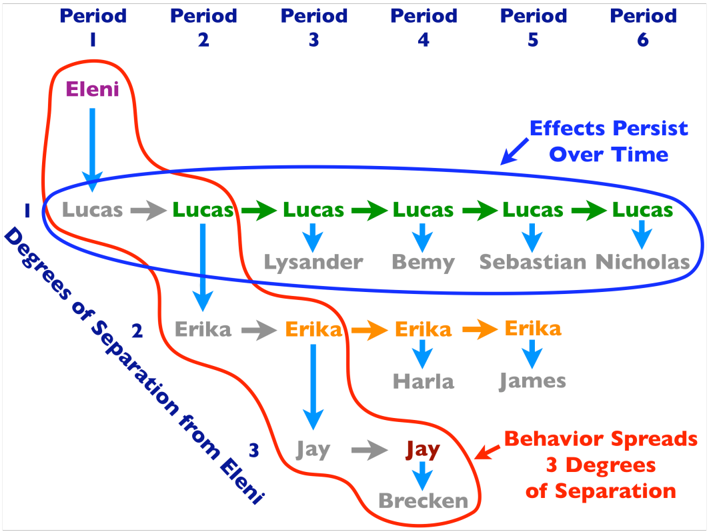
Theoretical models suggest that social networks influence the evolution of cooperation, but to date there have been few experimental studies. Observational data suggest that a wide variety of behaviors may spread in human social networks, but subjects in such studies can choose to befriend people with similar behaviors, posing difficulty for causal inference. Here, we exploit a seminal set of laboratory experiments that originally showed that voluntary costly punishment can help sustain cooperation. In these experiments, subjects were randomly assigned to a sequence of different groups to play a series of single-shot public goods games with strangers; this feature allowed us to draw networks of interactions to explore how cooperative and uncooperative behaviors spread from person to person to person. We show that, in both an ordinary public goods game and in a public goods game with punishment, focal individuals are influenced by fellow group members’ contribution behavior in future interactions with other individuals who were not a party to the initial interaction. Furthermore, this influence persists for multiple periods and spreads up to three degrees of separation (from person to person to person to person). The results suggest that each additional contribution a subject makes to the public good in the first period is tripled over the course of the experiment by other subjects who are directly or indirectly influenced to contribute more as a consequence. These results show experimentally that cooperative behavior cascades in human social networks.
Overview
CoChat Summary
TL;DR
Reanalyzing Fehr-Gächter public goods experiments, Fowler and Christakis find that cooperative and uncooperative contributions spread causally from person to person to person, up to three degrees of separation, and persist over multiple periods. Each additional 1 MU contributed in period 1 approximately triples over the experiment through direct and indirect network effects.
Key findings
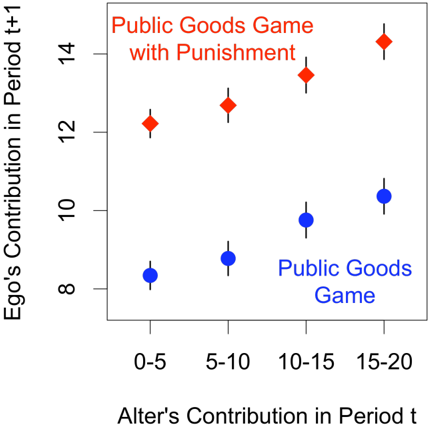
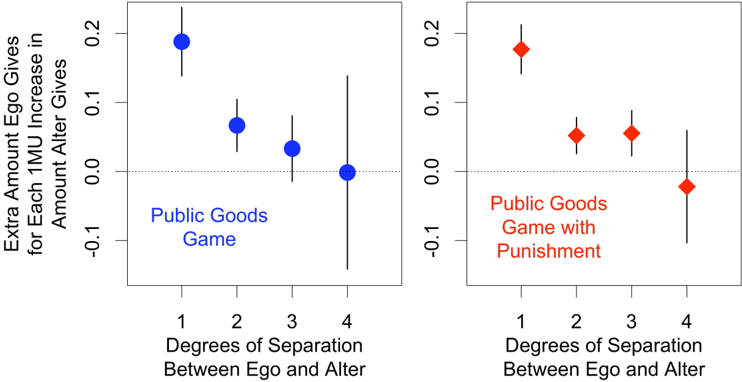
- Direct influence: each 1 MU contributed by an alter increased ego’s next-period contribution by 0.19 MUs (95% CI 0.14–0.24, p<0.0001) in the basic public goods game and 0.18 MUs (0.14–0.21, p<0.0001) in the punishment version.
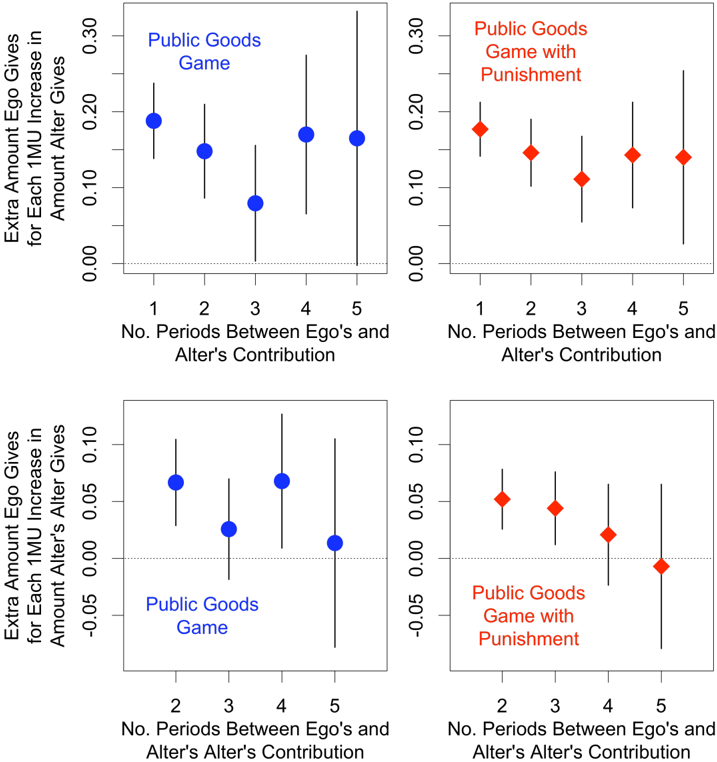
- Indirect influence: each 1 MU contributed by an alter’s alter increased ego’s contribution two periods later by 0.07 MUs (0.03–0.10, p=0.0005) in the basic game and 0.05 MUs (0.03–0.08, p=0.0001) with punishment; in the punishment game, alter’s alter’s alter increased ego’s contribution by 0.06 MUs (0.02–0.09, p=0.001) three periods later.
- Cascade size: an extra 1 MU in period 1 caused 3 other subjects to increase total contributions by 1.8 MUs over the next 4 periods in the basic game or 2.1 MUs over the next 5 periods with punishment, plus indirect increases of 1.2 or 0.9 MUs, totaling 3 MUs (95% CI 2.4–3.6) in both versions.
- Punishment: each punishment point an alter’s alter gave to an alter increased ego’s contribution two rounds later by 0.13 MUs (0.02–0.23, p=0.02), but this did not spread further (p=0.25); punishment behavior itself did not spread (p=0.83).
Methods
- Reanalysis of previously published Fehr-Gächter public goods game experiments with 240 subjects; groups of four, 20 MUs, six periods, random assignment, strict anonymity, and no subject paired with another more than once; the punishment version allowed spending up to 10 MUs to reduce a target’s income by 3 MUs per 1 MU.
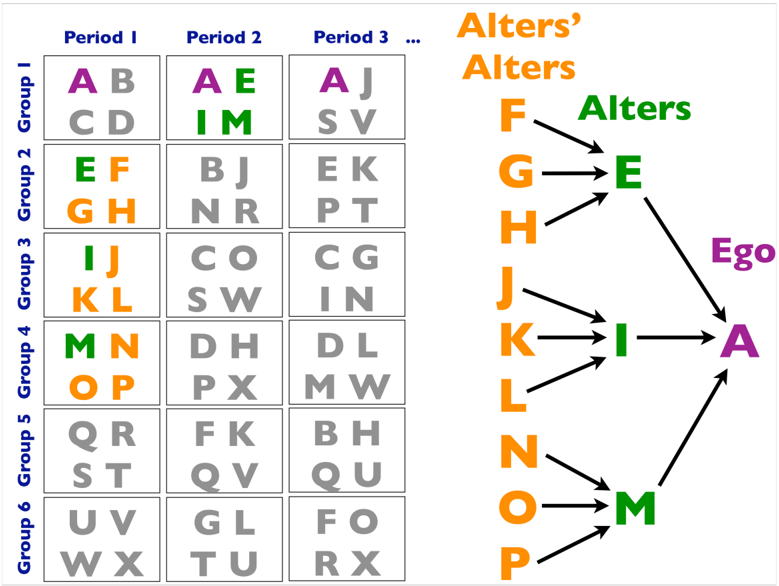
- Interaction networks were constructed from group assignments, with ties defined by the ability to observe another subject’s contribution in the preceding period; direct and indirect effects were estimated up to three degrees of separation.
- Interval (Tobit) regression with Huber-White clustered standard errors on ego and alter, controlling for ego’s prior contribution and period fixed effects; robustness checks included group-level models, additional lags, ego fixed effects, and Sobel mediation tests.
Limitations
- Paper-stated: results come from a particular experimentally controlled network structure, and whether “pay it forward” behavior spreads more widely in natural human networks remains an open question; interval regression coefficients apply to the latent outcome, group-level models are downwardly biased due to censoring, and fixed-effects models are biased toward zero.
- Evident from the text: anonymous, single-shot stranger groups with no reputations or repeated ties may not capture real-world social ties; per-MU effects are small, and cascade estimates rely on effects with p<0.05.
Model-written summary. Check it against the paper before relying on it.
Integrity signals
Registry
Cites
Statistics
Figures
Verification
Claims the paper makes
1 Valid · 4 Not valid · 30 Not checked · 161 Own results and interpretations
Every source the paper cites for this claim was checked and supports it.
In the paper
“However, it is worth reiterating that most of our subjects violated this supposition: since all interactions are single-shot, the equilibrium prediction is to contribute nothing and to pay nothing to punish noncontributors, yet this was not what the subjects did ( 36 ).”
What the sources say
- Supportedcites [36] 36. Fehr E, Gachter S (2002) Altruistic punishment in humans. Nature 415: 137-140. source
Fehr & Gächter (2002) state the selfish benchmark explicitly — 'it was always in the material self-interest of any subject to keep all MUs privately' and 'purely selfish subjects will never cooperate or punish others, because cooperation and punishment are costly and yield no pecuniary benefits' (p. 1) — with groups randomly recomposed so no subject met another twice, i.e. single-shot interactions. Their results then show most subjects acted against that benchmark: 84.3% of subjects punished at least once out of 1,270 punishment acts (Altruistic punishment and cooperation, p. 1), and cooperation rose in the punishment treatment with 94.2%/91.4% of subjects investing more under punishment than without (Results, p. 2). Together these support the paraphrase that most subjects violated the selfish-payoff-maximising supposition in both contributing and punishing. (LLM, conf=0.88)
plain- Asserted: passes — The authors put it forward as true.
- Checkable: passes — It can be checked against evidence.
- Load-bearing: passes — The paper’s conclusions depend on it.
- Based: passes — The paper gives a reason why it holds.
- Supported
A result the paper reports from its own data — it cites no other source for it, so there is none to check. The quote shows it is in the paper.
In the paper
“A summary of the raw data (Fig. 2) shows that, indeed, future contributions by focal individuals ('egos') are significantly related to the amount contributed by each group member with whom the ego interacted in the previous period ('alters') in both the basic public goods game and the public goods game with punishment.”
plainstates an association- Asserted: passes — The authors put it forward as true.
- Checkable: passes — It can be checked against evidence.
- Load-bearing: passes — The paper’s conclusions depend on it.
- Based: passes — The paper gives a reason why it holds.
A result the paper reports from its own data — it cites no other source for it, so there is none to check. The quote shows it is in the paper.
In the paper
“Remarkably, even though egos do not observe the contributions of their alters' alters (two degrees of separation), they too significantly affect ego's contribution decisions.”
plainstates a cause- Asserted: passes — The authors put it forward as true.
- Checkable: passes — It can be checked against evidence.
- Load-bearing: passes — The paper’s conclusions depend on it.
- Based: passes — The paper gives a reason why it holds.
A result the paper reports from its own data — it cites no other source for it, so there is none to check. The quote shows it is in the paper.
In the paper
“For each 1MU contributed by an alter, ego contributes an additional 0.19 MUs (95% C.I. 0.14 to 0.24, p <0.0001) in the next period in the basic public goods game and an additional 0.18MUs (0.14 to 0.21, p <0.0001) in the public goods game with punishment.”
plainstates a cause- Asserted: passes — The authors put it forward as true.
- Checkable: passes — It can be checked against evidence.
- Load-bearing: passes — The paper’s conclusions depend on it.
- Based: passes — The paper gives a reason why it holds.
A result the paper reports from its own data — it cites no other source for it, so there is none to check. The quote shows it is in the paper.
In the paper
“Furthermore, this influence persists for multiple periods and spreads up to three degrees of separation (from person to person to person to person).”
plainstates a cause- Asserted: passes — The authors put it forward as true.
- Checkable: passes — It can be checked against evidence.
- Load-bearing: passes — The paper’s conclusions depend on it.
- Based: passes — The paper gives a reason why it holds.
104 more claims
Create a free account to see all 196 claims and to verify the 54 references still open.
- It may state two separate claims as one. 38
- Probably not a substantial claim. 57
- The quote only partly states this claim. 7
Claims other papers make about this one
Each is checked against this paper’s own text: does it say what the citing paper says it does?
The cited source says what the claim attributes to it.
In the citing paper
“Furthermore, recent evidence from both lab and field studies suggests that people behave more prosocially after observing others engaging in behaviors such as cooperation and generosity 8 – 10 .”
From Crowdsourcing punishment: Individuals reference group preferences to inform their own punitive decisions (2019) · cites this paper as [8]
Citations
Cites
Birds of a Feather: Homophily in Social Networks
McPherson, M., Smith-Lovin, L., & Cook, J. M. (2001) · Annual Review of Sociology · doi:10.1146/annurev.soc.27.1.415 · Cited by 18,567
Olson, M. (1965) · doi:10.4159/9780674041660 · Cited by 14,191
Asymptotic Confidence Intervals for Indirect Effects in Structural Equation Models
Sobel, M. E. (1982) · Sociological Methodology · doi:10.2307/270723 · Cited by 12,810
The Logic of Collective Action: Public Goods and the Theory of Groups.
Sufrin, S. C., & Olson, M. (1966) · Industrial and Labor Relations Review · doi:10.2307/2521228 · Cited by 11,518
The Evolution of Reciprocal Altruism
Trivers, R. L. (1971) · The Quarterly Review of Biology · doi:10.1086/406755 · Cited by 11,010
Five Rules for the Evolution of Cooperation
Nowak, M. A. (2006) · Science · doi:10.1126/science.1133755 · Cited by 5,894
Altruistic punishment in humans
Fehr, E., & Gächter, S. (2002) · Nature · doi:10.1038/415137a · Cited by 5,616
The Spread of Obesity in a Large Social Network over 32 Years
Christakis, N. A., & Fowler, J. H. (2007) · New England Journal of Medicine · doi:10.1056/nejmsa066082 · Cited by 5,007
Self-citationCollins, R. (2004) · doi:10.1515/9781400851744 · Cited by 4,726
Szabó, G., & Fáth, G. (2007) · Physics Reports · doi:10.1016/j.physrep.2007.04.004 · Cited by 2,974
Cited by
Items 501–600 of 768
Utilizing social foraging as a framework to study decisions in groups
Garg, K., Deng, W., & Mobbs, D. (2026) · iScience · doi:10.1016/j.isci.2026.114940 · Cited by 8
Chung, H., Jiang, R., Shen, S., & Yang, X. J. (2025) · International Journal of Human-Computer Interaction · doi:10.1080/10447318.2025.2526645 · Cited by 6
From evolution to revolution: understanding mutability in large and disruptive human groups
Whitaker, R. M., Felmlee, D., Verma, D. C., Preece, A. D., & Williams, G.-R. (2017) · Proceedings of SPIE, the International Society for Optical Engineering/Proceedings of SPIE · doi:10.1117/12.2267996 · Cited by 4
The Evolution of Cooperation and Diversity under Integrated Indirect Reciprocity
Sasaki, T., Uchida, S., Okada, I., & Yamamoto, H. (2024) · Games · doi:10.3390/g15020015 · Cited by 10
Social interaction models for trust systems design
Pavleska, T. (2024) · CCF Transactions on Pervasive Computing and Interaction · doi:10.1007/s42486-024-00172-x · Cited by 4
Modeling for user interaction by influence transfer effect in online social networks
Sun, Q., Wang, N., Zhou, Y., Wang, H., & Sui, L. (2014) · Conference on Local Computer Networks · doi:10.1109/lcn.2014.6925823 · Cited by 4
Spread of Cooperation in Complex Agent Networks Based on Expectation of Cooperation
Shibusawa, R., Otsuka, T., & Sugawara, T. (2016) · Lecture notes in computer science · doi:10.1007/978-3-319-44832-9_5 · Cited by 4
Introduction: The Science of Generosity: From Disparate to Integrated
Herzog, P. S. (2019) · Springer eBooks · doi:10.1007/978-3-030-26500-7_1 · Cited by 5
van Winden, F. A. A. M. (2023) · Journal of Economic Psychology · doi:10.1016/j.joep.2023.102625 · Cited by 5
A two-network adversarial game: Model, strategy, and structure
Lyu, D., Liu, H., Wang, L., & Wang, X. (2024) · Communications in Nonlinear Science and Numerical Simulation · doi:10.1016/j.cnsns.2024.108043 · Cited by 4
A game‐theoretic model for users' participation in ephemeral social vehicular networks
Esmaeilyfard, R., Hendessi, F., Manshaei, M. H., & Großklags, J. (2019) · International Journal of Communication Systems · doi:10.1002/dac.3998 · Cited by 4
Sending the elevator back down: a mutual constitution between vertical and horizontal inequality
Oppel, A. (2021) · SN Social Sciences · doi:10.1007/s43545-021-00162-1 · Cited by 4
Reveley, J. (2012) · Business History · doi:10.1080/00076791.2012.685164 · Cited by 4
L’efficacité des interventions favorisant le bonheur : une synthèse
Cobb, A. M., Stone, B. M., & Parks, A. C. (2017) · Revue québécoise de psychologie · doi:10.7202/1040074ar · Cited by 4
The Impact of Digital Profile Enrichment on Charitable Giving in Social Networking SitesPreprint
Tan, X., Lu, Y., Tan, Y., & Wu, J. (2016) · SSRN Electronic Journal · doi:10.2139/ssrn.2820219 · Cited by 4
Toward Promoting Prosocial Interactions between Humans with Autonomous Agents
Hu, X., Mehrotra, S., Misu, T., Akash, K., & Steyvers, M. (2025) · ACM Transactions on Human-Robot Interaction · doi:10.1145/3746462 · Cited by 4
Shaping network structures in evolutionary games for stronger cooperation
Shiu, R.-A., & Lee, H.-W. (2025) · Proceedings of the Royal Society A Mathematical Physical and Engineering Sciences · doi:10.1098/rspa.2025.0346 · Cited by 4
On the optimal integration of intelligent agents into network systems to steer cooperation
Fu, F., Chen, X., & Christakis, N. A. (2026) · Proceedings of the National Academy of Sciences · doi:10.1073/pnas.2537939123 · Cited by 7
Self-citationTang, F. F.-Y., Kosana, P., Jit, M., Terris‐Prestholt, F., Wu, D., Ong, J. J., & Tucker, J. D. (2023) · PLOS Global Public Health · doi:10.1371/journal.pgph.0001590 · Cited by 4
A general network complexity reduction method for cooperative evolution in structured populations
Wu, C., Deng, H., & Tu, C. (2024) · Chaos Solitons & Fractals · doi:10.1016/j.chaos.2024.115494 · Cited by 4
Frémeaux, S., Sferrazzo, R., & Grevin, A. (2025) · Journal of Business Ethics · doi:10.1007/s10551-025-06016-7 · Cited by 7
Chung, H., & Yang, X. J. (2025) · Proceedings of the Human Factors and Ergonomics Society Annual Meeting · doi:10.1177/10711813251358779 · Cited by 5
Monitoring of social networking sites
Suciu, G. D., Albu, B. F., Stefan, S. I., Suciu, V., Halunga, S. V., Mohamad, O. A., Hameed, R. T., & Butca, C. (2015) · RoEduNet Conference: Networking in Education and Research (RoEduNet) · doi:10.1109/roedunet.2015.7311997 · Cited by 3
Oliveros, D. A. V., & Koren, O. (2023) · IEEE Transactions on Computational Social Systems · doi:10.1109/tcss.2023.3241173 · Cited by 4
Cultivating Compassion for Resilience and Wellbeing: Applications for Individuals and Workplaces
Henderson, J. D., de León, A., & Christensen, J. K. (2023) · Advances in psychology, mental health, and behavioral studies (APMHBS) book series · doi:10.4018/978-1-6684-8565-1.ch015 · Cited by 3
Obayashi, S., Inaba, M., Ohdaira, T., & Kiyonari, T. (2023) · Journal of Computational Social Science · doi:10.1007/s42001-023-00221-y · Cited by 8
Information-sharing and cooperation in networked collective action groups
Harrell, A., & Wolff, T. (2023) · PNAS Nexus · doi:10.1093/pnasnexus/pgad399 · Cited by 4
Analysis of payoff expectation in evolutionary game based on Bush–Mosteller model
Han, Z., Wu, W., Song, Q., & Zhu, P. (2024) · Chaos Solitons & Fractals · doi:10.1016/j.chaos.2024.115161 · Cited by 5
Family Ties as Corporate Power
Balán, P., Dodyk, J., & Puente, I. (2025) · The Journal of Politics · doi:10.1086/736563 · Cited by 3
Borbora, Z. H., Chandra, A., Kumaraguru, P., & Srivastava, J. (2019) · IEEE/ACM International Conference on Advances in Social Networks Analysis and Mining (ASONAM) · doi:10.1145/3341161.3344378 · Cited by 3
Incentive-Aware Opportunistic Network Routing
Bigwood, G., & Henderson, T. (2013) · Springer eBooks · doi:10.1007/978-1-4614-3514-3_14 · Cited by 3
Altruísmo no Brasil: Um Estudo Exploratório
Hoffman, E., Silveira, R. F., & Polydoro, J. I. (2010) · Mudanças - Psicologia da Saúde · doi:10.15603/2176-1019/mud.v18n1-2p36-46 · Cited by 6
Search in Social Networks: Designing Models and Algorithms That Maximize Human Influence
Marin, E., & de Carvalho, C. L. (2014) · Hawaii International Conference on System Sciences (HICSS) · doi:10.1109/hicss.2014.203 · Cited by 3
Friendship, not altruism: an economic theory with cross-cultural applications
Farmer, A., & Kali, R. (2017) · Review of Social Economy · doi:10.1080/00346764.2017.1349331 · Cited by 5
Edmund, L. (2011) · Springer eBooks · doi:10.1007/978-94-007-2147-0_16 · Cited by 4
Fiorini, R. A., Alvarez-Pereira, C., Jacobs, G., Kiniger-Passigli, D., Zucconi, A., Nešković, N., Schopper, H., Mitić, V. V., Henderson, H., Todorova, M., et al. (2020) · DOAJ (DOAJ: Directory of Open Access Journals) · Cited by 4
Fight Alone or Together? The Influence of Risk Perception on Helping Behavior
Yin, L., & Wu, Y. J. (2022) · Journal of risk and financial management · doi:10.3390/jrfm15020078 · Cited by 3
Nascimbeni, F. (2012) · LA Referencia (Red Federada de Repositorios Institucionales de Publicaciones Científicas) · Cited by 3
Valinejad, J., & Mili, L. (2020) · arXiv (Cornell University) · doi:10.48550/arxiv.2004.00772 · Cited by 3
A Graphical Lasso Approach to Estimating Network Connections: The Case of U.S. Lawmakers
Battaglini, M., Crawford, F. W., Patacchini, E., & Peng, S. (2020) · National Bureau of Economic Research · doi:10.3386/w27557 · Cited by 4
Open Collaboration for Innovation: Principles and PerformancePreprint
Levine, S. S., & Prietula, M. J. (2008) · SSRN Electronic Journal · doi:10.2139/ssrn.1096442 · Cited by 8
How neurons, norms, and institutions shape group cooperationPreprint
Bavel, J. J. V., Pärnamets, P., Reinero, D. A., & Packer, D. J. (2022) · doi:10.31234/osf.io/jqhp4 · Cited by 4
Public responses to foreign protectionism: Evidence from the US-China trade warPreprint
Tan, Y., & Steinberg, D. A. (2022) · SSRN Electronic Journal · doi:10.2139/ssrn.4148690 · Cited by 3
The responsibility of setting a bad example: Models are blamed for their imitators’ behaviour
Kardoš, P., Leidner, B., & Lickel, B. A. (2024) · European Journal of Social Psychology · doi:10.1002/ejsp.3101 · Cited by 3
Scarcity and Cooperation: The Modulation of Social Norms
Luo, Q., Qiu, C., Dong, S., Tang, R., & Kang, C. (2025) · Behavioral Sciences · doi:10.3390/bs15070913 · Cited by 2
Schwyck, M. E., & Parkinson, C. M. (2025) · Journal of Experimental Social Psychology · doi:10.1016/j.jesp.2025.104784 · Cited by 2
Su, C. (2025) · Communication Research · doi:10.1177/00936502251392774 · Cited by 2
Enhancing Volunteerism in Healthcare: Mediating Effect of Social Network
Alias, S. N., Ismail, M., Suandi, T., & Omar, Z. B. (2018) · International Journal of Academic Research in Business and Social Sciences · doi:10.6007/ijarbss/v8-i12/5003 · Cited by 3
A Knowledge Network Approach to Understanding Water Shortage Adaptation in Kiribati
Cunningham, R., Mukheibir, P., Jacobs, B. C., Boronyak, L., & Alofa, P. (2020) · Climate change management · doi:10.1007/978-3-030-40552-6_8 · Cited by 2
Tests for Network Cascades via Branching Processes
Bertolotti, P., Jadbabaie, A., & Christia, F. (2020) · IEEE Transactions on Network Science and Engineering · doi:10.1109/tnse.2020.2981327 · Cited by 2
Encoding Protest Duration In An Agent-Based Model As Characteristic Phase Transitions
Goode, B. J., & Pires, B. (2022) · Annual Modeling and Simulation Conference (ANNSIM) · doi:10.23919/annsim55834.2022.9859477 · Cited by 2
How teams adapt to exogenous shocks: Experimental evidence with node knockouts of central members
Edgerton, J. F., Cranmer, S., & Finomore, V. S. (2022) · Network Science · doi:10.1017/nws.2022.26 · Cited by 3
Be kind. Use systems. Improve care
Fraze, T., & Mutha, S. (2023) · Health Services Research · doi:10.1111/1475-6773.14135 · Cited by 1
Micheli, L. R., Breil, C., & Böckler, A. (2024) · Journal of Personality and Social Psychology · doi:10.1037/pspi0000437 · Cited by 4
Engelhardt, S. C., Weladji, R. B., Holand, Ø., Røed, K. H., & Nieminen, M. (2023) · PLoS ONE · doi:10.1371/journal.pone.0295497 · Cited by 2
The Study of Cooperative Behaviour in Network Evolutionary Games Based on Reinforcement Learning
陈, 倩. (2024) · Operations Research and Fuzziology · doi:10.12677/orf.2024.143340 · Cited by 2
Burningham, A., Brendgen, M. R., Turgeon, L., & Vitaro, F. (2024) · Research on Child and Adolescent Psychopathology · doi:10.1007/s10802-024-01229-2 · Cited by 3
Information, Entanglement, and Emergent Social Norms: Searching for ‘Normal’
Cardinal, J. S., & Loughmiller-Cardinal, J. (2024) · Societies · doi:10.3390/soc14110227 · Cited by 7
Zoughbie, D. E., Huddleston, D., & Ding, E. L. (2025) · PLOS complex systems. · doi:10.1371/journal.pcsy.0000031 · Cited by 3
Makovi, K., Bonnefon, J., Oudah, M., Sargsyan, A., & Rahwan, T. (2025) · iScience · doi:10.1016/j.isci.2025.112833 · Cited by 7
Zoughbie, D. E., Ding, E. L., & Ng, T. L. J. (2025) · PLOS complex systems. · doi:10.1371/journal.pcsy.0000052 · Cited by 2
Computer simulation of dental professionals as a moral community
Chambers, D. W. (2014) · Medicine Health Care and Philosophy · doi:10.1007/s11019-014-9556-y · Cited by 2
Task-Oriented Social Ego Network Generation via Dynamic Collaborator Selection
Fang, X., & Zhan, J. (2012) · International Conference on Social Computing · doi:10.1109/socialcom-passat.2012.46 · Cited by 2
Cooperatives in Economic Literature—Capita Selecta
van Dijk, G., Sergaki, P., & Baourakis, G. (2019) · Cooperative management · doi:10.1007/978-3-030-16279-5_7 · Cited by 2
Hierarchical Neighbors Embedding
Liu, S., Yu, Y., Liu, K., Wang, F., Wen, W., & Qiao, H. (2022) · IEEE Transactions on Neural Networks and Learning Systems · doi:10.1109/tnnls.2022.3221103 · Cited by 3
Social intelligence of students with and without hearing impairment in mainstream schools
Adibsereshki, N., & Hatamizadeh, N. (2023) · International Journal of Special Education (IJSE) · doi:10.52291/ijse.2023.38.22 · Cited by 4
Where and When Can Open Source Thrive? Towards a Theory of Robust Performance
Levine, S. S., & Prietula, M. J. (2010) · IFIP International Federation for Information Processing/IFIP · doi:10.1007/978-3-642-13244-5_13 · Cited by 5
Friendsourcing to detect network manipulation
Shankesi, R. (2013) · Illinois Digital Environment for Access to Learning and Scholarship (University of Illinois at Urbana-Champaign) · Cited by 2
Social Network Analysis of the Caste-Based Reservation System in India
Saxena, A., Sethiya, N., Saini, J. S., Gupta, Y., & Iyengar, S. R. S. (2023) · Lecture notes in computer science · doi:10.1007/978-3-031-26303-3_18 · Cited by 2
Wang, S., Lu, K., Li, M., Zhen, Q., & Che, X. (2016) · International Conference on Dependable Systems and Their Applications (DSA) · doi:10.1109/tsa.2016.14 · Cited by 2
Xue, J., Ichikawa, M., & Deguchi, H. (2015) · The Communications in Information Science and Management Engineering · doi:10.5963/cisme0501001 · Cited by 1
Robust spread of cooperation by expectation-of-cooperation strategy with simple labeling method
Otsuka, T., & Sugawara, T. (2017) · IEEE/WIC/ACM International Conference on Web Intelligence · doi:10.1145/3106426.3106458 · Cited by 2
Zárate, C. A. (2017) · Revista Innovaciones de Negocios · doi:10.29105/rinn13.26-4 · Cited by 2
Patel, A. B. (2021) · Elsevier eBooks · doi:10.1016/b978-0-12-821573-9.00011-4 · Cited by 3
The psychology of bureaucracy: A normative account inspired by Rom Harré
Moghaddam, F. M. (2021) · Journal for the Theory of Social Behaviour · doi:10.1111/jtsb.12290 · Cited by 2
People punish defection, not failures to conform to the majority
Philippsen, A., Mieth, L., Buchner, A., & Bell, R. (2024) · Scientific Reports · doi:10.1038/s41598-023-50414-8 · Cited by 3
Scientific Collaboration Analytics based on Multi-Player Game Theory
Deonauth, N., Chen, X., & Li, M. (2021) · International Conference on Ubiquitous Information Management and Communication (IMCOM) · doi:10.1109/imcom51814.2021.9377429 · Cited by 2
Kosić, A., & Ignjatović, T. D. (2021) · IntechOpen eBooks · doi:10.5772/intechopen.97858 · Cited by 3
Excess of Social Behavior Reduces the Capacity to Respond to PerturbationsPreprint
Mateo, D., Kuan, Y. K., & Bouffanais, R. (2015) · arXiv (Cornell University) · doi:10.48550/arxiv.1509.08157 · Cited by 2
Helpful Thirds and the Durability of Collaborative TiesPreprint
Samila, S., Oettl, A., & Hasan, S. (2015) · SSRN Electronic Journal · doi:10.2139/ssrn.2601338 · Cited by 2
Emergence of Modern Impersonal Exchange: Role of Formalization in the Rise of Modern CapitalismPreprint
Raj, P. (2017) · SSRN Electronic Journal · doi:10.2139/ssrn.3033861 · Cited by 2
Large-scale network analysis reveals cheating spreads through victimization and observation.Preprint
Kim, J. E., & Tsvetkova, M. (2020) · arXiv (Cornell University) · Cited by 2
Induced Percolation on Networked SystemsPreprint
Xie, J., Wang, X., Feng, L., Zhao, J.-H., Moreno, Y., & Hu, Y. (2020) · arXiv (Cornell University) · doi:10.48550/arxiv.2011.14034 · Cited by 3
Crowd control: Reducing individual estimation bias by sharing biased social informationPreprint
Jayles, B., Sire, C., & Kurvers, R. H. J. M. (2019) · doi:10.31234/osf.io/hn8rz · Cited by 2
Clustered networks protect cooperation against catastrophic collapse
Spencer, G. (2018) · Network Science · doi:10.1017/nws.2018.5 · Cited by 1
Chen, Y., & Xue, C. (2023) · International Journal of Human-Computer Interaction · doi:10.1080/10447318.2023.2241288 · Cited by 4
Calvelli, H. R., Gardiner, H. M., Gadegbeku, C. A., Reese, P. P., Zoran Obradovic, A., Fink, E. L., & Gillespie, A. (2024) · Kidney360 · doi:10.34067/kid.0000000000000383 · Cited by 1
Marliyah, M., Dharma, B. E., & Syarbaini, A. M. B. (2024) · F1000Research · doi:10.12688/f1000research.144610.1 · Cited by 9
Evolution of “Pay-It-Forward” in the Presence of the Temptation to Free-Ride
Uchida, S., Sasaki, T., Yamamoto, H., & Okada, I. (2024) · Games · doi:10.3390/g15030016 · Cited by 1
Fernandes, C. A. D. M., Flache, A., & Bakker, D. M. (2025) · Computational and Mathematical Organization Theory · doi:10.1007/s10588-025-09399-0 · Cited by 1
Wavelet-based coarse graining for percolation criticality from a single system size
Oh, S. M., & Vidaković, B. (2025) · Chaos An Interdisciplinary Journal of Nonlinear Science · doi:10.1063/5.0276783 · Cited by 1
Liu, W., Mark, I. G., Korn, C. W., & Rosenblau, G. (2025) · Journal of Adolescence · doi:10.1002/jad.70025 · Cited by 2
What Can Alcohol Reduction ‘Do’ for/in Midlife Women's Hopes? A Qualitative Study in Australia
Ward, P., Foley, K. M., & Lunnay, B. (2025) · Sociology of Health & Illness · doi:10.1111/1467-9566.70114 · Cited by 1
Chain mentoring in a U.S. secondary STEM teacher education programme
Craig, C. J., Evans, P. K., Stokes, D. W., Curtis, G. A., Manuel, M., & Silk, M. N. (2025) · Teachers and Teaching · doi:10.1080/13540602.2025.2578674 · Cited by 1
The evolution of cooperation shaped by asymmetric link-weight integration capabilities
Li, X., Guo, S., Li, D., & Lin, Z. (2025) · Chaos Solitons & Fractals · doi:10.1016/j.chaos.2025.117587 · Cited by 3
Craig, C. J., Evans, P. K., Stokes, D. W., Curtis, G. A., Manuel, M., & Silk, M. N. (2026) · Teaching and Teacher Education · doi:10.1016/j.tate.2025.105356 · Cited by 1
Climate change and social health
Bower, M., Filia, K., Lawrance, E. L., Card, K. G., Teesson, L., Smout, S., Gao, C., Naderpajouh, N., Donohoe‐Bales, A., Lagi, R., et al. (2026) · Nature Human Behaviour · doi:10.1038/s41562-026-02455-y · Cited by 2
Tracking the Evolution of Cooperation in Complex Networked Populations
Pinheiro, F. L., Santos, F. C., & Pacheco, J. M. (2012) · Lecture notes in computer science · doi:10.1007/978-3-642-29066-4_8 · Cited by 1
Is technology shaping our mobility lives?
Idrobo, A. M. O. (2014) · Sistemas y Telemática · doi:10.18046/syt.v12i31.1911 · Cited by 1
Metadata
- Authors
- Fowler, J. H., & Christakis, N. A.
- Affiliations
- University of California San Diego (US)
- Harvard University (US)
- Venue
- Proceedings of the National Academy of Sciences
- Publisher
- National Academy of Sciences
- Published
- 2010-03-08
- Volume
- 107
- Issue
- 12
- Pages
- 5334-5338
- ISSN
- 0027-8424 (ISSN-L)
- 1091-6490
- PMC
- PMC2851803
- OpenAlex
- W2111394372
- Cited by
- 767
- References
- 54
- Citations by year
- 2026: 38 · 2025: 39 · 2024: 54 · 2023: 39 · 2022: 40 · 2021: 60 · 2020: 61 · 2019: 50 · 2018: 47 · 2017: 38 · 2016: 33 · 2015: 50 · 2014: 66 · 2013: 44 · 2012: 49
- FWCI
- 155.53
- Type
- journal article
- Language
- en
- Open access
- green
- www.ncbi.nlm.nih.gov
- Locations
- Proceedings of the National Academy of Sciences (publishedVersion)
- PubMed Central (publishedVersion)
- PubMed (publishedVersion)
- arXiv (Cornell University) (submittedVersion)
- Digital Access to Scholarship at Harvard (DASH) (Harvard University) (submittedVersion, cc-by)
- arXiv (Cornell University)
- Funders
- Robert Wood Johnson Foundation
- John Templeton Foundation
- University of Notre Dame
- National Institutes of Health
- National Institute on Aging (P30AG034420, P01AG031093)
- Topics
- Social Sciences › Sociology and Political Science › Evolutionary Game Theory and Cooperation
- Social Sciences › Economics, Econometrics and Finance › Economics and Econometrics › Experimental Behavioral Economics Studies
- Social Sciences › Sociology and Political Science › Social Power and Status Dynamics
- Keywords
- evolution of cooperation, social networks, costly punishment, public goods game, costly cooperation, indirect influence, costly signaling
- MeSH terms
- Cooperative Behavior, Humans, Interpersonal Relations, Models, Psychological, Punishment, Social Support, Models, Economic
About these checks
Registry, retraction, Cites and statistics results are computed, not judged, with one exception: a printed reference that no index lists is read once by a model before it counts as a citation error. Claims are extracted by a model and kept only when their quote appears verbatim in the text; each cited source is then checked, with a model’s help, for whether it says what the claim relies on. Those verdicts can be wrong — read the claim’s quote and the cited source before relying on one.
A language model drew the claims from the paper on 2026-11-20, under version 3 of the claim definition (model deepseek-v4.1-flash, prompt extract-v3).
A second model labelled each claim on 2026-11-20 (model jev-1.13-20260917, definition revision gold-guideline-v0.2).
Cited sources are checked with a language model’s help (qwen3.8-omni-flash).
Statistics and arithmetic are recomputed, not judged.
Confidence bands are shown only for fields calibrated on our annotated test set. None is calibrated yet, so no band is shown.
What counts as a claim ›How we measure confidence ›How we check this ›
Are you an author, or do you see a problem with this page? Request a review
Data sources
Bibliographic data: Semantic Scholar, OpenAlex, Crossref.
Contains information from the Semantic Scholar Academic Graph Datasets, made available under the ODC Attribution License (ODC-BY 1.0).
Semantic Scholar’s data is described in: Kinney, R., et al. (2023). The Semantic Scholar Open Data Platform. arXiv:2301.10140.
