

The biomass distribution on Earth
Open accessThe DOI matches its Crossref record; 263 of the 263 references it cites were found in a registry or an index; 11 of the 41 sources its claims cite were checked for support.
Abstract
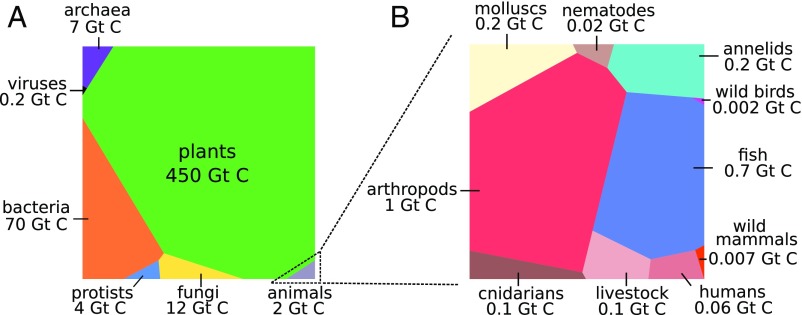
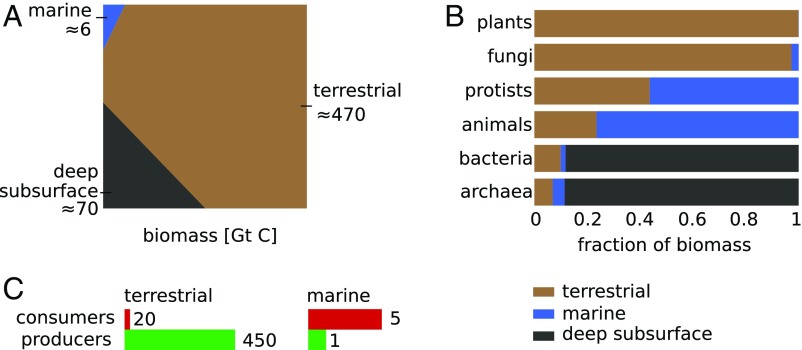
A census of the biomass on Earth is key for understanding the structure and dynamics of the biosphere. However, a global, quantitative view of how the biomass of different taxa compare with one another is still lacking. Here, we assemble the overall biomass composition of the biosphere, establishing a census of the ≈550 gigatons of carbon (Gt C) of biomass distributed among all of the kingdoms of life. We find that the kingdoms of life concentrate at different locations on the planet; plants (≈450 Gt C, the dominant kingdom) are primarily terrestrial, whereas animals (≈2 Gt C) are mainly marine, and bacteria (≈70 Gt C) and archaea (≈7 Gt C) are predominantly located in deep subsurface environments. We show that terrestrial biomass is about two orders of magnitude higher than marine biomass and estimate a total of ≈6 Gt C of marine biota, doubling the previous estimated quantity. Our analysis reveals that the global marine biomass pyramid contains more consumers than producers, thus increasing the scope of previous observations on inverse food pyramids. Finally, we highlight that the mass of humans is an order of magnitude higher than that of all wild mammals combined and report the historical impact of humanity on the global biomass of prominent taxa, including mammals, fish, and plants.
Overview
CoChat Summary
TL;DR
The paper assembles a global census of biomass across all kingdoms of life, estimating Earth’s total biomass at ≈550 Gt C, dominated by plants. It also compares biomass across environments and trophic modes, highlighting large uncertainties and human impacts on the biosphere.
Key findings
- Total global biomass is ≈550 Gt C, with plants ≈450 Gt C (≈80%), bacteria ≈70 Gt C (≈15%), fungi ≈12 Gt C, archaea ≈7 Gt C, protists ≈4 Gt C, animals ≈2 Gt C, and viruses ≈0.2 Gt C.
- Land biomass (≈470 Gt C) is about two orders of magnitude higher than marine biomass (≈6 Gt C); the deep subsurface holds ≈15% of total biomass, chiefly bacteria and archaea.
- In the ocean, ≈1 Gt C of primary producers supports ≈5 Gt C of consumer biomass, an inverted standing biomass distribution; marine biomass is ≈70% microbes, mainly bacteria and protists.
- Human-associated biomass is large relative to wild vertebrates: humans ≈0.06 Gt C, livestock ≈0.1 Gt C, wild mammals ≈0.007 Gt C, domesticated poultry ≈0.005 Gt C versus wild birds ≈0.002 Gt C; total plant biomass has declined approximately twofold relative to pre-human civilization.
Methods
- The authors synthesize hundreds of studies and generate estimates for major taxonomic groups, reporting biomass as gigatons of carbon (Gt C) and using a kingdom-level framework plus viruses.
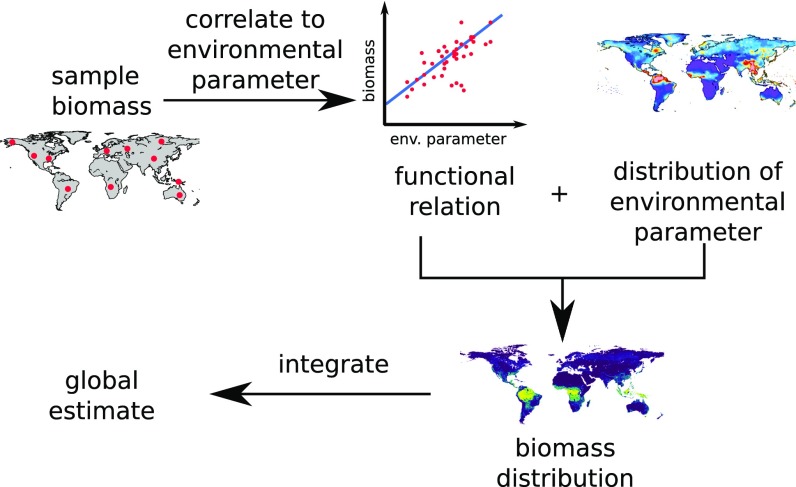
- For many taxa, local biomass samples are extrapolated globally by correlating biomass density with environmental parameters known at global scale; best estimates often use a geometric mean of independent estimates.
- Uncertainty is reported as multiplicative fold-change projections akin to 95% confidence intervals, incorporating intrastudy, interstudy, and intermethod variation; data and code are open-sourced.
Limitations
- The paper states that most datasets rely on fragmentary sampling, causing large uncertainties; sampling is scarce in the deep ocean (usually deeper than 200 m) and deep soil (usually deeper than 1 m), and some estimates may be biased by sampling toward high-abundance areas.
- The paper states that deep subsurface environments have particularly high uncertainty and unknown systematic biases, including unresolved distribution of biomass between aquifer fluids and rocks and among microbial taxa.
- The paper states that current and prehuman vertebrate biomass estimates are only a crude first step, amphibians remain poorly characterized, and parasite biomass is not resolved from hosts; evident from the text, kingdom-level grouping was chosen because much data lack finer taxonomic detail, and some uncertainty projections rely on analogous taxa or expert consultation.
Model-written summary. Check it against the paper before relying on it.
Integrity signals
Registry
Cites
Statistics
Figures
Verification
Claims the paper makes
9 Valid · 7 Not valid · 16 Not checked · 53 Own results and interpretations
Every source the paper cites for this claim was checked and supports it.
In the paper
“The biomass of amphibians, which are experiencing a dramatic population decline (42), remains poorly characterized.”
§ The biomass distribution on Earth > Discussion
What the sources say
- Supportedcites [42] Wake DB Vredenburg VT 2008 Colloquium paper: Are we in the midst of the sixth mass extinction? A view from the world of amphibians Proc Natl Acad Sci USA 105 11466 11473 18695221 PMC2556420 source
The citation is attached to the clause about amphibian population decline, not the separate statement that their biomass is poorly characterized. The passage reporting the Global Amphibian Assessment (labeled Abstract in our copy) says that 43% of amphibian species have declining populations. (LLM, conf=0.92)
plain- Asserted: passes — The authors put it forward as true.
- Checkable: passes — It can be checked against evidence.
- Load-bearing: unclear — It is unclear whether the paper’s conclusions depend on it.
- Based: passes — The paper gives a reason why it holds.
- Supported
Every source the paper cites for this claim was checked and supports it.
In the paper
“In the case of prokaryotes, some major improvements were recently realized, with global estimates of marine deep subsurface prokaryote biomass reduced by about two orders of magnitude due to an increased diversity of sampling locations (7).”
§ The biomass distribution on Earth > Discussion
What the sources say
- Supportedcites [7] Kallmeyer J Pockalny R Adhikari RR Smith DC D’Hondt S 2012 Global distribution of microbial abundance and biomass in subseafloor sediment Proc Natl Acad Sci USA 109 16213 16216 22927371 PMC3479597 source
The Discussion reports a revised subseafloor microbial biomass estimate of 4.1 Pg C versus a previous estimate of 303 Pg C—about a 74-fold reduction. It also identifies a more geographically diverse sampling database, including low-abundance ocean gyres, as a reason the new estimate is lower. The paper identifies other contributing factors as well. (LLM, conf=0.88)
plainstates a cause- Asserted: passes — The authors put it forward as true.
- Checkable: passes — It can be checked against evidence.
- Load-bearing: unclear — It is unclear whether the paper’s conclusions depend on it.
- Based: passes — The paper gives a reason why it holds.
- Supported
The sources with a verdict support this claim; the rest weren’t checked yet, have no full text we could read, or their verdicts aren’t rated yet.
In the paper
“Such inverted biomass distributions can occur when primary producers have a rapid turnover of biomass [on the order of days (34)], while consumer biomass turns over much more slowly [a few years in the case of mesopelagic fish (35)].”
§ The biomass distribution on Earth > Results > The Distribution of Biomass Across Environments and Trophic Modes.
What the sources say
- Supportedcites [34] Zubkov MV 2014 Faster growth of the major prokaryotic versus eukaryotic CO2 fixers in the oligotrophic ocean Nat Commun 5 3776 24777140 PMC4015317 source
The Results (Comparison of the growth rates of the CO2 fixers; page unavailable) report growth rates of 0.1–0.6 per day for the studied oceanic primary producers, consistent with biomass turnover on the order of days. The few-years estimate for mesopelagic fish is assigned to a different citation, not this source. (LLM, conf=0.91)
- Not checked — no full text of the sourcecites [35] Catul V Gauns M Karuppasamy PK 2011 A review on mesopelagic fishes belonging to family Myctophidae Rev Fish Biol Fish 21 339 354 source
plainstates a possible cause- Asserted: passes — The authors put it forward as true.
- Checkable: passes — It can be checked against evidence.
- Load-bearing: passes — The paper’s conclusions depend on it.
- Based: passes — The paper gives a reason why it holds.
- Supported
The cited sources support only part of this claim — read each source’s verdict below.
In the paper
“Combining data from independent sources such as these enables a robust assessment of the total plant biomass (17).”
§ The biomass distribution on Earth > Results > The Uncertainty Associated with Global Biomass Estimates.
What the sources say
- Partly supportedcites [17] Erb K-H 2017 Unexpectedly large impact of forest management and grazing on global vegetation biomass Nature 553 73 76 29258288 PMC5756473 sourceExperimental — accuracy not yet measured
The Methods describe combining multiple datasets and types of evidence to estimate global vegetation biomass stocks. But the paper also says global stocks remain uncertain, reports uncertainty ranges around 35% of the median estimate, and describes more robust estimates as a future prospect. It therefore supports the use of independent sources for an assessment, but not the unqualified characterization of that assessment as robust. (LLM, conf=0.84)
plainstates a cause- Asserted: passes — The authors put it forward as true.
- Checkable: passes — It can be checked against evidence.
- Load-bearing: passes — The paper’s conclusions depend on it.
- Based: passes — The paper gives a reason why it holds.
- Partly supported
A result the paper states — it cites no source for it, so there is none to check. The quote shows it is in the paper.
In the paper
“Plant biomass includes ≈70% stems and tree trunks, which are mostly woody, and thus relatively metabolically inert.”
§ The biomass distribution on Earth > Results > The Biomass Distribution of the Biosphere by Kingdom.
plain- Asserted: passes — The authors put it forward as true.
- Checkable: passes — It can be checked against evidence.
- Load-bearing: unclear — It is unclear whether the paper’s conclusions depend on it.
- Based: passes — The paper gives a reason why it holds.
27 more claims
Create a free account to see all 85 claims and to verify the 2 references still open.
- It may state two separate claims as one. 32
- Probably not a substantial claim. 28
Claims other papers make about this one
Each is checked against this paper’s own text: does it say what the citing paper says it does?
The cited source doesn’t support the claim as written.
In the citing paper
“and less than 10% that of the world ' s current human population ( 52 ).”
From Pervasive human-driven decline of life on Earth points to the need for transformative change (2019) · cites this paper as [52]
Checked by a reasoning model — may be wrong.
Experimental — accuracy not yet measuredThe cited source says what the claim attributes to it.
In the citing paper
“Approximately 450 Gt of C is bound up in terrestrial biota, primarily in plants (86), while only ~6 Gt of C is found in ocean biota (87).”
From Earth beyond six of nine planetary boundaries (2023) · cites this paper as [87]
The cited source says what the claim attributes to it.
In the citing paper
“The amount of metabolic energy available to a biosphere powered by O 2 is vast, such that the O 2 -rich ocean-atmosphere system of the modern Earth supports staggering levels of standing biomass (Bar-On et al. 2018), energy flow (Falkowski et al. 2008), and ecological complexity (Steele 1974).”
From The History of Ocean Oxygenation (2022) · cites this paper as Bar-On et al. 2018
In the citing paper
“Global populations of domestic ruminants (cattle, sheep, and goats) (Ripple et al. 2013) poultry, and pigs (Bennett et al. 2018) used to feed the growing human population now exceed 100 million tons of carbon (Bar-On et al. 2018), and livestock populations are growing rapidly.”
From Scientists’ warning to humanity on the freshwater biodiversity crisis (2021) · cites this paper as Bar-On et al. 2018
Citations
Cites
The worldwide leaf economics spectrum
Wright, I. J., Reich, P. B., Westoby, M., Ackerly, D. D., Baruch, Z., Bongers, F., Cavender-Bares, J., Chapin, T., Cornelissen, J. H. C., Diemer, M., et al. (2004) · Nature · doi:10.1038/nature02403 · Cited by 9,021 · cited 1×
“We then convert the total area of leaves to an estimate of the total dry mass of leaves by using the Glopnet database (24), which measured leaf mass per area (LMA) for ≈2500 plant species.”
MethodA large and persistent carbon sink in the world’s forests
Pan, Y., Birdsey, R. A., Fang, J., Houghton, R., Kauppi, P. E., Kurz, W. A., Phillips, O. L., Shvidenko, A., Lewis, S. L., Canadell, J. G., et al. (2011) · Science · doi:10.1126/science.1201609 · Cited by 8,458
Soil Sampling and Methods of Analysis
(2007) · CRC Press eBooks · doi:10.1201/9781420005271 · Cited by 6,469
Primary production of the biosphere: Integrating terrestrial and oceanic components
Field, C. B., Behrenfeld, M. J., Randerson, J. T., & Falkowski, P. (1998) · Science · doi:10.1126/science.281.5374.237 · Cited by 6,371
Prokaryotes: The unseen majority
Whitman, W. B., Coleman, D. C., & Wiebe, W. J. (1998) · Proceedings of the National Academy of Sciences · doi:10.1073/pnas.95.12.6578 · Cited by 4,871
Global effects of land use on local terrestrial biodiversity
Newbold, T., Hudson, L. N., Hill, S. L. L., Contu, S., Lysenko, I., Senior, R. A., Börger, L., Bennett, D. J., Choimes, A., Collen, B., et al. (2015) · Nature · doi:10.1038/nature14324 · Cited by 4,352
Belowground biodiversity and ecosystem functioning
Bardgett, R. D., & van der Putten, W. H. (2014) · Nature · doi:10.1038/nature13855 · Cited by 3,990 · cited 4×
“This was recommended by experts in the field for estimation of arbuscular mycorrhizal fungi abundance (117).”
BackgroundInfluentialMangroves among the most carbon-rich forests in the tropics
Donato, D. C., Kauffman, J. B., Murdiyarso, D., Kurnianto, S., Stidham, M., & Kanninen, M. (2011) · Nature Geoscience · doi:10.1038/ngeo1123 · Cited by 3,374
Poorter, H., Niklas, K. J., Reich, P. B., Oleksyn, J., Poot, P., & Mommer, L. (2012) · New Phytologist · doi:10.1111/j.1469-8137.2011.03952.x · Cited by 3,163 · cited 1×
“The first relies on a meta-analysis of the biomass allocation to different plant compartments across biomes (19).”
BackgroundA global analysis of root distributions for terrestrial biomes
Jackson, R. B., Canadell, J., Ehleringer, J. R., Mooney, H. A., Sala, O. E., & Schulze, E. D. (1996) · Oecologia · doi:10.1007/bf00333714 · Cited by 3,071 · cited 4×
“assumed the distribution of microbial biomass with depth follows the biomass density versus depth profile of root biomass (21).”
BackgroundMethodInfluential
Research works printed but not linked: 1
- Chapman AD 2009 Numbers of Living Species in Australia and the World Australian Biological Resources Study Canberra, Australia
Cited by
Items 1,601–1,700 of 3,743
Discovery and Implications of a Nanoscale Rare Earth Mineral in a Hyperaccumulator Plant
He, L., Xian, H., Yang, Y., Cao, J., Yang, H., Xie, J., Xi, J., Yang, Y., Li, S., Zhu, R., et al. (2025) · Environmental Science & Technology · doi:10.1021/acs.est.5c09617 · Cited by 12
Evolution of Terrestrial Planetary Bodies and Implications for Habitability
Cawood, P. A., Stüeken, E. E., Chowdhury, P., Hawkesworth, C. J., & Mulder, J. A. (2025) · Reviews of Geophysics · doi:10.1029/2025rg000902 · Cited by 15
“…than the denser, basaltic oceanic crust, enabling the formation of dry land areas (Chowdhury et al., 2025; Flament et al., 2008; Korenaga et al., 2017) that offer a range of ecological niches, such that on the present‐day Earth terrestrial environments contain the bulk of the biomass (Bar‐”
Nine changes needed to deliver a radical transformation in biodiversity measurement
Sutherland, W. J., Burgess, N. D., Edwards, S. V., Jones, J. P. G., Soltis, P. S., Tilman, D. G., Allen, J. M., Andrianandrasana, H. T., Armour, C. J., August, T., et al. (2026) · Proceedings of the National Academy of Sciences · doi:10.1073/pnas.2519345123 · Cited by 20
Self-citationDestoumieux‐Garzón, D., Bonnet, P., Teplitsky, C., Criscuolo, F., Henry, P., Mazurais, D., Prunet, P., Salvat, G., Usseglio‐Polatera, P., Verrier, É., et al. (2020) · animal · doi:10.1016/j.animal.2020.100053 · Cited by 16
“Only a very limited number of species are farmed, but they contribute a significant amount of biomass with, for example, mammalian livestock accounting for 60% of global mammalian biomass (Bar-On et al., 2018).”
BackgroundSymbiosis in a Rapidly Changing World
Oliver, K. M., & Higashi, C. H. V. (2021) · Advances in environmental microbiology · doi:10.1007/978-3-030-63512-1_16 · Cited by 10
Changes of the intestinal microbiota along the gut of Japanese Eel ( Anguilla japonica )
Zhu, P., Wong, M. K., Lin, X., Chan, T., Wong, C. K. C., Lai, K. P., & Tse, W. K. F. (2021) · Letters in Applied Microbiology · doi:10.1111/lam.13539 · Cited by 6
“Bacteria and protists contribute 70% of the total marine biomass, while the remaining 30% is contributed by mainly arthropods and fish (Ringø et al. 2006; Bar-On et al. 2018).”
BackgroundAbbott, B. W. (2022) · Springer eBooks · doi:10.1007/978-3-030-81253-9_10 · Cited by 10
Use of Bacteria to Activate Ground-Granulated Blast-Furnace Slag (GGBFS) as Cementless Binder
Yum, W. S., & Do, J. (2022) · Materials · doi:10.3390/ma15103620 · Cited by 8
Forest Resource Availability After Nuclear War or Other Sun‐Blocking Catastrophes
Winstead, D. J., & Jacobson, M. G. (2022) · Earth s Future · doi:10.1029/2021ef002509 · Cited by 11
“In fact, about three-fourths of the world's plant carbon resides in forests which equates to about 2 × 10 18 kcal of available energy in carbohydrates (Bar-On et al., 2018; Pan et al., 2019; Pettersen, 1984).”
BackgroundDifficulties in summing log-normal distributions for abundance and potential solutions
Talis, E. J., Che‐Castaldo, C., & Lynch, H. J. (2023) · PLoS ONE · doi:10.1371/journal.pone.0280351 · Cited by 8
“In addition to animal abundance, examples include quantities like biomass, mortality, and rainfall [44–46].”
Murthy, P. S., Mohan, T. V. K., Nanchariah, Y. V., Adhikari, S., Ramadass, G. A., Gupta, G. V. M., Dharani, G., Saravanane, N., & Murthy, M. V. R. (2023) · Elsevier eBooks · doi:10.1016/b978-0-323-91762-9.00006-x · Cited by 10
Attackers gain the upper hand over plants in the face of rapid global change
Austin, A. T., & Ballaré, C. L. (2023) · Current Biology · doi:10.1016/j.cub.2023.03.082 · Cited by 11
Maar, K., Papadimitraki, M., Ruiz, L. H., Broughton, R., & Jónasdóttir, S. H. (2023) · Marine Ecology Progress Series · doi:10.3354/meps14366 · Cited by 7
“Current estimates range from 10 9 t (Gjøsaeter & Kawaguchi 1980, Bar-On et al. 2018), which corresponds to the total biomass of all other terrestrial and marine vertebrates combined (Bar-On et al. 2018), to an order of magnitude higher (10 10 t: Irigoien et al. 2014).”
BackgroundImpact of xylan on field productivity and wood saccharification properties in aspen
Derba‐Maceluch, M., Sivan, P., Donev, E. N., Gandla, M. L., Yassin, Z., Vaasan, R., Heinonen, E., Andersson, S., Amini, F., Scheepers, G., et al. (2023) · Frontiers in Plant Science · doi:10.3389/fpls.2023.1218302 · Cited by 6
“Lignocellulose derived from plant cell walls is the largest source of carbon on the Earth (Bar-On et al., 2018) and can be used for sustainable production of energy carriers, green chemicals, and materials.”
BackgroundTakawira, L. T., Bachir, I. H., Ployet, R., et al. (2023) · Plant Molecular Biology · doi:10.1007/s11103-023-01376-y · Cited by 7
“%) of the world’s carbon biomass (Bar-On et al. 2018), the majority of which is comprised of lignified secondary cell walls (SCWs).”
BackgroundCommon Asset Trusts for blue commons stewardship
Hernández‐Blanco, M., Costanza, R., Agardy, T. S., et al. (2023) · Marine Policy · doi:10.1016/j.marpol.2023.105957 · Cited by 7
“Indeed, the majority of animal life is marine [3].”
Fecal and skin microbiota of two rescued Mediterranean monk seal pups during rehabilitation
Dosi, A., Meziti, A., Tounta, E., Koemtzopoulos, K., Komnenou, A. T., Dendrinos, P., & Kormas, K. A. (2023) · Microbiology Spectrum · doi:10.1128/spectrum.02805-23 · Cited by 7
“…biomass of marine mammals across the world’s oceans is only 0.3% of the total marine animal biomass, when arthropods and fish have 38.6% and 27.0% (19), respectively, several of these species are endangered and protected due to anthropogenic activities, like the Mediterranean monk seal, Monachus…”
BackgroundInfluentialOriginal sin or natural order: Dialogical construction of social knowledge of animal production
Häkli, T., & Hakoköngäs, E. J. (2024) · European Journal of Social Psychology · doi:10.1002/ejsp.3032 · Cited by 9
Harianja, M. F., Stone, J., Mamat, W. Z. W., Hadi, M. A., Luke, S. H., Azhar, B., & Turner, E. C. (2024) · Journal of Applied Ecology · doi:10.1111/1365-2664.14615 · Cited by 7
“As a result, a wide range of terrestrial and aquatic taxa have experienced reductions in diversity, abundance and biomass (Bar-On et al., 2018; Davison et al., 2021).”
BackgroundFind the Plant—An Educational Game Fosters Plant Species Literacy
Lindemann‐Matthies, P., Heber, E., & Remmele, M. (2024) · Sustainability · doi:10.3390/su16114702 · Cited by 15
Phase synchronization between culture and climate forcing
Timmermann, A., Wasay, A., & Raia, P. (2024) · Proceedings of the Royal Society B Biological Sciences · doi:10.1098/rspb.2024.0320 · Cited by 6
“Today’s situation, however, is markedly different: even though humans account only for 0.01% of all biomass on earth [9], they have been able to monopolize a large fraction of global resources [10], which in turn jeopardizes the survival of wild fauna globally [11].”
BackgroundInfluentialFernandes, T. V., Parr, C. L., Campos, R. I., Neves, F. S., & Solar, R. (2024) · Ecology · doi:10.1002/ecy.4365 · Cited by 7
Kubik, B. C., & Holden, J. F. (2024) · Applied and Environmental Microbiology · doi:10.1128/aem.00292-24 · Cited by 8
“Understanding the factors that influence competition between thermophilic chemoli thoautotrophs in hydrothermal environments provides insight into modern subseafloor processes as well as life on the early Earth and the search for extraterrestrial life.”
BackgroundThe changes in zoological publication rates and focal subdisciplines between 1960 and 2022
Tianbao, L. U. O., Liyu, L. I., Wang, Q., Wentong, L. I. U., Guo, J., Yan, Y., CHRIS, N., Zhou, Y., & Zhao, J. (2024) · Integrative Zoology · doi:10.1111/1749-4877.12883 · Cited by 9
Kowalczyk, D., & Kazimierczak, W. (2024) · Coatings · doi:10.3390/coatings14091116 · Cited by 8
Beach wrack as a potential microplastic hot spot in the South-Eastern Baltic Sea environment
Sabaliauskaitė, V., Balčiūnas, A., Rubavičiūtė, R., Iamshchikov, E., Pinto, L. M., Tiškus, E., & Kataržytė, M. (2024) · Marine Pollution Bulletin · doi:10.1016/j.marpolbul.2024.117139 · Cited by 8
Aluja, M., Cerqueda‐García, D., Altúzar‐Molina, A., Guillén, L., Acosta, E., Conde-Alarcón, J., & Moyá, A. (2024) · PeerJ · doi:10.7717/peerj.18555 · Cited by 8
Plants' Contributions to People Shift With Glacier Extinction
Khelidj, N., Balestra, S., Caccianiga, M. S., Cerabolini, B. E. L., Tampucci, D., & Losapio, G. (2025) · Plant-Environment Interactions · doi:10.1002/pei3.70041 · Cited by 7
The Carbon Cycle of Terrestrial Ecosystems
Schlesinger, W. H., & Bernhardt, E. S. (2020) · Elsevier eBooks · doi:10.1016/b978-0-12-814608-8.00005-0 · Cited by 12
Ogodo, A. C., Narayana, M. S. S. V., Vardhan, P. S., et al. (2020) · Elsevier eBooks · doi:10.1016/b978-0-12-820284-5.00001-0 · Cited by 7
Characteristics of aquatic biospheres on temperate planets around Sun-like stars and M dwarfs
Lingam, M., & Loeb, A. (2021) · Monthly Notices of the Royal Astronomical Society · doi:10.1093/mnras/stab611 · Cited by 8
The Role of Predator Removal by Fishing on Ocean Carbon Dynamics
Stafford, R., Boakes, Z., Hall, A. E., & Jones, G. C. A. (2021) · Anthropocene Science · doi:10.1007/s44177-021-00005-x · Cited by 12
Translating research on evolutionary transitions into the teaching of biological complexity
Michod, R. E., Davison, D. R., Sanders, H., Hoskinson, J. S., & Gagnier, K. M. (2022) · Evolution · doi:10.1111/evo.14479 · Cited by 10
“Complex animals with which we are most familiar make up a tiny component of earth’s biomass, while simple unicellular organisms are a major contributor to the biomass present on earth (Bar-On et al. 2018).”
BackgroundChecklist of the arthropod fauna of the Sierra Nevada Mountain range (Almería and Granada, Spain)
Tinaut, A., Cortés, P. J. S., Becerra, D. A., de Figueroa, J. M. T., & Ruano, F. (2022) · Ecosistemas · doi:10.7818/ecos.2356 · Cited by 7
Emergence of networks of shared restriction-modification systems in phage–bacteria ecosystems
Eriksen, R. S., Malhotra, N., Seshasayee, A. S. N., Sneppen, K., & Krishna, S. (2022) · Journal of Biosciences · doi:10.1007/s12038-022-00274-7 · Cited by 8
“These bacterial viruses outnumber the bacteria 10 to 1 and are a major contributor to bacterial death, for instance, in the ocean, where phages are responsible for 20% of the bacterial deaths (Suttle 2007; Knowles et al. 2016; Bar-On et al. 2018).”
BackgroundLand Use, Microorganisms, and Soil Organic Carbon: Putting the Pieces Together
Mo, L., Zanella, A., Bolzonella, C., Squartini, A., Xu, G.-L., Banas, D., Rosatti, M., Longo, E., Pindo, M., Concheri, G., et al. (2022) · Diversity · doi:10.3390/d14080638 · Cited by 7
General Overview of Climate Change and Global Warming: Their Effect on Microorganisms
Elshafei, A. M. (2022) · International Journal of Environment and Climate Change · doi:10.9734/ijecc/2022/v12i1131116 · Cited by 7
Nisal, A., Diwekar, U. M., Hanumante, N. C., Shastri, Y., Cabezas, H., Rico-Ramírez, V., & Rodriguez-Gonzalez, P. T. (2022) · Frontiers in Sustainability · doi:10.3389/frsus.2022.948443 · Cited by 9
Li, X., Wang, Z., Qin, W., Gao, X., Wu, J., Zhao, S., & Jiao, T. (2022) · Italian Journal of Animal Science · doi:10.1080/1828051x.2022.2121666 · Cited by 9
“Livestock production provides significant benefits to human life (Bar-On et al. 2018); however, the shortage of forage resources has become the main factor restricting the development of animal husbandry in China (Qin 2021).”
BackgroundChallenges in sustainable resource management
Fath, B. D. (2022) · Frontiers in Sustainable Resource Management · doi:10.3389/fsrma.2022.943359 · Cited by 7
“For example, currently, around 96% of all biomass of large terrestrial mammals is either humans or the livestock we grow for our use (Bar-On et al., 2017).”
BackgroundXue, J., Wang, J., Bingxin, L., Huang, P., & Liu, L. (2022) · Earth Science-Journal of China University of Geosciences · doi:10.3799/dqkx.2022.332 · Cited by 9
The role of agriculture in human infectious disease outbreaks
Morand, S. (2022) · CABI Reviews · doi:10.1079/cabireviews202217060 · Cited by 11
Santoro, F., Pastore, G., Fox, V., Petit, M., Iannelli, F., & Pozzi, G. (2023) · Microbiology Spectrum · doi:10.1128/spectrum.04211-22 · Cited by 7
Marine methods for carbon dioxide removal: fundamentals and myth-busting for the wider community
Rohling, E. J. (2023) · Oxford Open Climate Change · doi:10.1093/oxfclm/kgad004 · Cited by 11
Ceccarini, M. R., Ripanti, F., Raggi, V., Paciaroni, A., Petrillo, C., Comez, L., Donato, K., Bertelli, M., Beccari, T., & Valentini, L. (2023) · Journal of Functional Biomaterials · doi:10.3390/jfb14050280 · Cited by 9
“Deoxyribonucleic acid (DNA), a natural polymer that can be extracted from living organisms, has unique physiological and optical properties [8,9], and it is available in large amounts considering that approximately 50 billion metric tons are actually discarded [10].”
BackgroundLohay, G. G., Lee, D., Wu‐Cavener, L., Pearce, D. L., Hou, X., Bond, M. L., & Cavener, D. R. (2023) · Ecology and Evolution · doi:10.1002/ece3.10160 · Cited by 9
Resurrecting Gaia: harnessing the Free Energy Principle to preserve life as we know it
Montgomery, C., & Hipólito, I. (2023) · Frontiers in Psychology · doi:10.3389/fpsyg.2023.1206963 · Cited by 8
“5 x 10¹⁴ kg of organic matter in the known universe (Bar-On et al., 2018), Gaia is a geophysiological entity, since the totality of life and its non-living environment are bound as a single interdependent system (Lovelock, 1989).”
BackgroundPhysical virology: how physics is enabling a better understanding of recent viral invaders
Cardoso-Lima, R., Santos‐Oliveira, R., Souza, P. F. N., Barbosa, L. R. S., Wuite, G. J. L., & Alencar, L. M. R. (2023) · Biophysical Reviews · doi:10.1007/s12551-023-01075-4 · Cited by 8
“The estimated number of viruses on Earth is approximately 10 to the power of 31, or ten thousand quadrillions, a hundred million times greater than the number of stars in the observable universe (Hendrix et al. 1999; Bar-On et al. 2018; Mushegian 2020).”
BackgroundThe role of remote sensing in tropical grassland nutrient estimation: a review
Arogoundade, A. M., Mutanga, O., Odindi, J., & Naicker, R. (2023) · Environmental Monitoring and Assessment · doi:10.1007/s10661-023-11562-6 · Cited by 11
“Globally, grasslands are the second-largest carbon sinks (Latham et al., 2014), accounting for over 40% of the landmass (Bar-On et al., 2018).”
Backgroundde Castro, T. L. A., dos Santos, J. V. D. A., de Oliveira, K. M. P., & Cardoso, C. A. L. (2023) · Sustainable Chemistry and Pharmacy · doi:10.1016/j.scp.2023.101198 · Cited by 9
Xu, M., Song, Y., Zhou, Y., Wang, Y., Xu, T., Zhao, X., Li, Z., & Wang, L. (2023) · Journal of Sustainable Agriculture and Environment · doi:10.1002/sae2.12066 · Cited by 7
Cha, J., Lee, S., Lee, E., et al. (2023) · Geophysical Research Letters · doi:10.1029/2023gl103731 · Cited by 7
Diversity of early flowering plants of the Ulytau mountains (Central Kazakhstan)
Pozdnyakova, Y., Sailau, A., Solyanov, D., Айтишева, Л. Б., Tatina, Y. S., & Britko, V. (2023) · Biosystems Diversity · doi:10.15421/012329 · Cited by 9
Evolution of biological cooperation: an algorithmic approach
Sudakow, I., Reinitz, J., Vakulenko, S. A., & Grigoriev, D. Y. (2024) · Scientific Reports · doi:10.1038/s41598-024-52028-0 · Cited by 9
“In fact, it is known that the current distribution of life’s kingdoms is as follows: plants dominate with approximately 450 gigatons of carbon (Gt C), while animals account for about 2 Gt C, bacteria for approximately 70 Gt C, and archaea for around 7 Gt C 46 .”
BackgroundBrochosome size variation and its influence on leafhopper (Hemiptera: Cicadellidae) wing wettability
Bello, E., & Alleyne, M. (2024) · Journal of Insect Science · doi:10.1093/jisesa/ieae003 · Cited by 7
Foraging theory provides a useful framework for livestock predation management
Haswell, P. M., Shepherd, E. A., Stone, S. A., Purcell, B., & Hayward, M. W. (2019) · Journal for Nature Conservation · doi:10.1016/j.jnc.2019.03.004 · Cited by 12
Myers, K. N., Conn, D., & Brown, A. M. V. (2021) · mSystems · doi:10.1128/msystems.01048-20 · Cited by 7
“747 13,797 349 All Xiphinematobacter (1096) Outgroup Verrucomicrobia (14,146)”
BackgroundDenny, M. W., & Dowd, W. W. (2021) · Annual Review of Marine Science · doi:10.1146/annurev-marine-040221-115454 · Cited by 8
Awais, M., Fatma, S., Naveed, A., et al. (2021) · Biomass Conversion and Biorefinery · doi:10.1007/s13399-021-01932-w · Cited by 7
A whale of an appetite revealed by analysis of prey consumption
Smetacek, V. S. (2021) · Nature · doi:10.1038/d41586-021-02951-3 · Cited by 8
Secondary metabolites and nutrients explain fungal community composition in aspen wood
Birkemoe, T., Nybakken, L., Andelic, M., et al. (2021) · Fungal ecology · doi:10.1016/j.funeco.2021.101115 · Cited by 7
Microbial Interactions in Soil
Brözel, V. S. (2022) · Microorganisms · doi:10.3390/microorganisms10101939 · Cited by 7
“6 of protists [4], so bacteria constitute the largest part of microbiota, not only by number, but also by biomass.”
BackgroundImproving estimates of global ant biomass and abundance
Fayle, T. M., & Klimeš, P. (2022) · Proceedings of the National Academy of Sciences · doi:10.1073/pnas.2214825119 · Cited by 12
“We currently have good estimates of global abundance and biomass of vertebrates (10) but not of terrestrial invertebrates, where the current best estimate of 200 megatonnes of carbon (Mt C) (10) is based on a semiquantitative expert opinion of global arthropod abundance from over 60 y ago (11).”
BackgroundKarnachuk, O. V., Panova, I. A., Rusanov, I. I., Schetinina, L., Lepokurova, O. E., Domrocheva, E. V., Kadnikov, V. V., Avakyan, M. R., Lukina, A. P., Glukhova, L. B., et al. (2023) · Microbial Ecology · doi:10.1007/s00248-023-02196-9 · Cited by 12
“Recent estimates of the overall Earth biomass have documented that the deep subsurface holds about 15% of the total biomass in the biosphere, which is mainly composed of bacteria and archaea [1].”
BackgroundVeganomics : vers une approche économique du véganisme ?
Treich, N. (2019) · Revue française d économie · doi:10.3917/rfe.184.0003 · Cited by 12
Revisiting tradeoffs in Rubisco kinetic parametersPreprint
Flamholz, A. I., Prywes, N., Moran, U., Davidi, D., Bar‐On, Y. M., Oltrogge, L. M., Alves, R., Savage, D. F., & Milo, R. (2018) · bioRxiv (Cold Spring Harbor Laboratory) · doi:10.1101/470021 · Cited by 7
“As Rubisco is so highly expressed and plants are the dominant constituents of planetary biomass (3) , it is often said that Rubisco is the most abundant enzyme on Earth (1).”
BackgroundSelf-citationA global perspective on microbial diversity in the terrestrial deep subsurfacePreprint
Soares, A., Edwards, A., An, D., Bagnoud, A., Bomberg, M., Budwill, K., Caffrey, S. M., Fields, M. W., Gralnick, J. A., Kadnikov, V. V., et al. (2019) · bioRxiv (Cold Spring Harbor Laboratory) · doi:10.1101/602672 · Cited by 7
gen3sis: the general engine for eco-evolutionary simulations on the origins of biodiversityPreprint
Hagen, O., Flück, B., Fopp, F., et al. (2021) · bioRxiv (Cold Spring Harbor Laboratory) · doi:10.1101/2021.03.24.436109 · Cited by 7
“3, and (iii) range size frequencies with a decrease in the number of large456 range species with a tolerance of 5% [93-95] (Note S1).”
BackgroundThe collapse and recovery potential of carbon sequestration by baleen whales in the Southern OceanPreprint
Durfort, A., Mariani, G., Troussellier, M., Tulloch, V., & Mouillot, D. (2020) · Research Square · doi:10.21203/rs.3.rs-92037/v1 · Cited by 13
“We applied the Taylor's law 78 to 540 estimate the associated variance (V) of a biological measure from its mean (μ) using the power 541 (8) (9)”
MethodLetter to the Editor: Accurate Direct PCR with Arabidopsis and Rice
Lynagh, P. G., Osuna-Kleist, P., Wang, B., et al. (2022) · Plant and Cell Physiology · doi:10.1093/pcp/pcac145 · Cited by 7
Sánchez, P., Sebastián, M., Pernice, M. C., et al. (2023) · bioRxiv (Cold Spring Harbor Laboratory) · doi:10.1101/2023.02.06.526790 · Cited by 7
One Health: What’s the Problem?
van de Pas, R. (2023) · Development · doi:10.1057/s41301-023-00398-9 · Cited by 6
“60% of all mammals on Earth are live-stock, mostly cattle and pigs, 36% are human and just 4% are wild animals (Bar-On et al. 2018).”
Disentangling Ecosystem Necromass Dynamics for Biodiversity Conservation
Barton, P. S., Schultz, N. L., Butterworth, N. J., Ulyshen, M. D., Mateo‐Tomás, P., & Newsome, T. M. (2024) · Ecosystems · doi:10.1007/s10021-024-00907-y · Cited by 9
Genomic tailoring of autogenous poultry vaccines to reduce Campylobacter from farm to fork
Calland, J., Pesonen, M. E., Mehat, J. W., Pascoe, B., Haydon, D. J., Lourenço, J., Lukasiewicz, B., Mourkas, E., Hitchings, M. D., Ragione, R. M. L., et al. (2024) · npj Vaccines · doi:10.1038/s41541-024-00879-z · Cited by 8
Piferrer, F., Miska, E. A., & Anastasiadi, D. (2024) · Elsevier eBooks · doi:10.1016/b978-0-443-19051-3.00010-3 · Cited by 5
Forms and fluxes of carbon: Surface to deep
Brovarone, A. V., Wong, K., Giovannelli, D., de Pins, B., Gaillard, F., Massuyeau, M., Nestola, F., Pamato, M. G., & Daniel, I. (2024) · Elsevier eBooks · doi:10.1016/b978-0-323-99762-1.00142-x · Cited by 10
Addis, H. K., Tamir, S., Belay, B., Mekuriaw, S., Birehanu, T., & Wuletaw, Y. (2024) · Environmental Research Communications · doi:10.1088/2515-7620/ad9c1e · Cited by 10
Zhu, Z. J., Higashi, M., & Saito, S. (2024) · Journal of Chemical Theory and Computation · doi:10.1021/acs.jctc.4c01214 · Cited by 8
Old but not ancient: Rock-leached organic carbon drives groundwater microbiomes
Heinze, B. M., Schwab, V. F., Trumbore, S. E., Schroeter, S. A., Xu, X., Chaudhari, N. M., & Küsel, K. (2024) · The Science of The Total Environment · doi:10.1016/j.scitotenv.2024.178212 · Cited by 6
Infection and Genomic Properties of Single- and Double-Stranded DNA Cellulophaga Phages
Howard‐Varona, C., Solonenko, N., Burris, M. N., et al. (2025) · Viruses · doi:10.3390/v17030365 · Cited by 6
Graham, M. E., Wilson, B. A., Ramkumar, D. P., Rosencranz, H., & Ramkumar, J. (2025) · Challenges · doi:10.3390/challe16020022 · Cited by 10
Hu, X., Wu, X., Xiang, S., Chen, Y., Jiang, L., Eisenhauer, N., Reich, P. B., & Sun, S. (2025) · Global Change Biology · doi:10.1111/gcb.70277 · Cited by 6
“Arthropods are also among the most speciose animal groups, with ~1.11 million described species making up almost 85% of the species in the animal Kingdom (Bar-On et al. 2018; Eisenhauer and Hines 2021; Rosenberg et al. 2023).”
InfluentialUnearthing roundworms: Nematodes as determinants of human health
van Sluijs, L., Geisen, S., Lozano‐Torres, J. L., Sterken, M. G., Vervoort, M. T. W., & Wilbers, R. H. P. (2025) · One Health · doi:10.1016/j.onehlt.2025.101103 · Cited by 10
“Only soil nematodes have 60 billion times more individuals than humans [8], with aquatic nematodes likely adding a similar number of individuals [9].”
DeWitt, K., Carrell, A. A., Rocca, J. D., Votzke, S., Yammine, A., Peralta, A. L., Weston, D. J., Pelletier, D. A., & Gibert, J. P. (2025) · mSphere · doi:10.1128/msphere.00309-25 · Cited by 5
“Despite covering less than 3% of the Earth’s surface, these ecosys tems store approximately 25%–30% of the world’s soil carbon as recalcitrant peat (88).”
Climate change enhances soil fauna population and biomass in grasslands of the Loess Plateau
Xi, Y., Shao, M., & Li, T. (2025) · Communications Earth & Environment · doi:10.1038/s43247-025-02542-4 · Cited by 5
Yang, J., Cai, M., Zhang, P., Han, M.-X., Liu, H., Xiao, H., Han, J., Zhang, X., & Jiang, H. (2025) · Geochimica et Cosmochimica Acta · doi:10.1016/j.gca.2025.08.030 · Cited by 7
A Techno‐Societal Framework for Quantifying the Risk of Heavy Rainfall Events Over Ramsar Wetlands
Rakkasagi, S., Goyal, M. K., & Jha, S. (2025) · Journal of Geophysical Research Oceans · doi:10.1029/2025jc022563 · Cited by 7
Subsurface Life on Earth as a Key to Unlock Extraterrestrial Mysteries
Vidal, E., Lindsay, M. R., Bradley, J. A., Osburn, M. R., & Ruff, S. E. (2025) · Microbial Biotechnology · doi:10.1111/1751-7915.70286 · Cited by 8
Tan, Z., Lin, Y., Leiqiang, G., Yao, J., Li, Y., Wang, X., Li, X., & Cai, Y. (2026) · Water Resources Research · doi:10.1029/2024wr039631 · Cited by 7
High risk of extinction across the flowering plant tree of life
Forest, F., Brown, R., Buerki, S., Colville, J. F., Moat, J. F., Lughadha, E. N., Owen, N., Raimondo, D. C., Rivers, M., Rosindell, J., et al. (2026) · Science · doi:10.1126/science.adz0773 · Cited by 14
Methane on Mars: subsurface sourcing and conflicting atmospheric measurements
Oehler, D. Z., & Etiope, G. (2021) · Elsevier eBooks · doi:10.1016/b978-0-12-820245-6.00007-0 · Cited by 11
The preservation of cause and effect in the rock record
D’Antonio, M. P., Ibarra, D. E., & Boyce, C. K. (2022) · Paleobiology · doi:10.1017/pab.2022.33 · Cited by 9
“Today, the group represents ∼80% of total global biomass (Bar-On et al. 2018) and is responsible for ∼50% of net primary productivity (Field et al. 1998).”
BackgroundLi, J., Liu, S., Zhang, Y., Huang, Q., Zhang, H., Ouyang, J., Mao, F., Fan, H., Yi, W., Dong, M., et al. (2022) · Frontiers in Immunology · doi:10.3389/fimmu.2022.971883 · Cited by 7
“With approximately 200 thousand extant species, mollusks comprise one of the largest animal phyla, second only to the arthropods (20) and accounting for roughly 10% of the animal biomass (21).”
BackgroundImpact of Wood Age on Termite Microbial Assemblages
Chakraborty, A., Šobotník, J., Votýpková, K., Hradecký, J., Stiblík, P., Synek, J., Bourguignon, T., Baldrián, P., Engel, M. S., Novotný, V., et al. (2023) · Applied and Environmental Microbiology · doi:10.1128/aem.00361-23 · Cited by 9
Dead or alive: carbon as a currency to integrate disease and ecosystem ecology theory
Seabloom, E. W., Peace, A., Asik, L., Everett, R. A., Frenken, T., González, A. L., Strauss, A. T., de Waal, D. B. V., White, L. A., & Borer, E. T. (2023) · Oikos · doi:10.1111/oik.09880 · Cited by 6
Komatsu, S., Hamada, K., Furuya, T., et al. (2023) · International Journal of Molecular Sciences · doi:10.3390/ijms24109014 · Cited by 6
Co-Creation of a Center for a Regenerative Future
Bexell, S. M., Saitta, D. J., Sher, A. A., & Sutton, P. C. (2023) · Sustainability · doi:10.3390/su151712861 · Cited by 9
Wendt, J. A. F., McWethy, D. B., Hempson, G. P., Brookshire, E. N. J., & Fuhlendorf, S. D. (2023) · Environmental Research Letters · doi:10.1088/1748-9326/ad0ad0 · Cited by 8
Dong, Y., Wu, N., Li, F., Wei, F., & Lü, H. (2024) · The Science of The Total Environment · doi:10.1016/j.scitotenv.2024.170050 · Cited by 7
Selection versus transmission: Quantitative and organismic biology in antibiotic resistance
Baquero, F., Pérez‐Cobas, A. E., Aracil‐Gisbert, S., Coque, T. M., & Zamora, J. (2024) · Infection Genetics and Evolution · doi:10.1016/j.meegid.2024.105606 · Cited by 9
Metadata
- Authors
- Bar-On, Y. M., Phillips, R., & Milo, R.
- Affiliations
- Department of Plant and Environmental Sciences, Weizmann Institute of Science, 76100 Rehovot, Israel;
- California Institute of Technology (US)
- Weizmann Institute of Science (IL)
- Corresponding author
- Milo, Ron
- Venue
- Proceedings of the National Academy of Sciences
- Publisher
- National Academy of Sciences
- Published
- 2018-05-21
- Volume
- 115
- Issue
- 25
- Pages
- 6506-6511
- ISSN
- 0027-8424 (ISSN-L)
- 1091-6490
- PMC
- PMC6016768
- OpenAlex
- W2804910112
- Cited by
- 3,723
- References
- 263
- Citations by year
- 2026: 349 · 2025: 450 · 2024: 589 · 2023: 617 · 2022: 498 · 2021: 498 · 2020: 419 · 2019: 246 · 2018: 49
- FWCI
- 239.98
- Type
- journal article
- Language
- en
- Open access
- hybrid
- doi.org
- Licence
- Locations
- Proceedings of the National Academy of Sciences (publishedVersion, cc-by-nc-nd)
- Europe PMC (PubMed Central) (publishedVersion, cc-by-nc-nd)
- PubMed Central (publishedVersion, cc-by-nc-nd)
- PubMed (publishedVersion)
- CaltechAUTHORS (California Institute of Technology) (submittedVersion, cc-by-nc-nd)
- Funders
- National Institutes of Health (5r35gm118043-07)
- National Institute of General Medical Sciences (R35 GM118043)
- Topics
- Physical Sciences › Environmental Science › Nature and Landscape Conservation › Ecology and Vegetation Dynamics Studies
- Physical Sciences › Environmental Science › Global and Planetary Change › Earth Systems and Cosmic Evolution
- Life Sciences › Agricultural and Biological Sciences › Soil Science › Soil Carbon and Nitrogen Dynamics
- Keywords
- biomass allocation, biomass carbon, terrestrial biomass, marine biomass, bacteria, archaea, food pyramid, wild mammals, fish biomass, plant biomass
- MeSH terms
- Animals, Archaea, Bacteria, Carbon, Humans, Plants, Ecosystem, Biomass, Earth, Planet, Biota
About these checks
Registry, retraction, Cites and statistics results are computed, not judged, with one exception: a printed reference that no index lists is read once by a model before it counts as a citation error. Claims are extracted by a model and kept only when their quote appears verbatim in the text; each cited source is then checked, with a model’s help, for whether it says what the claim relies on. Those verdicts can be wrong — read the claim’s quote and the cited source before relying on one.
The claim verdicts this report counts are experimental: their accuracy is not yet measured.
A language model drew the claims from the paper on 2026-10-10, under version 3 of the claim definition (model deepseek-v4.1-flash, prompt extract-v3).
A second model labelled each claim on 2026-10-10 (model jev-1.13-20260917, definition revision gold-guideline-v0.2).
Cited sources are checked with a language model’s help (gpt-6-sol).
Statistics and arithmetic are recomputed, not judged.
Confidence bands are shown only for fields calibrated on our annotated test set. None is calibrated yet, so no band is shown.
What counts as a claim ›How we measure confidence ›How we check this ›
Are you an author, or do you see a problem with this page? Request a review
Data sources
Bibliographic data: Semantic Scholar, OpenAlex, Crossref.
Contains information from the Semantic Scholar Academic Graph Datasets, made available under the ODC Attribution License (ODC-BY 1.0).
Semantic Scholar’s data is described in: Kinney, R., et al. (2023). The Semantic Scholar Open Data Platform. arXiv:2301.10140.
