

The biomass distribution on Earth
Open accessThe DOI matches its Crossref record; 263 of the 263 references it cites were found in a registry or an index; 11 of the 41 sources its claims cite were checked for support.
Abstract
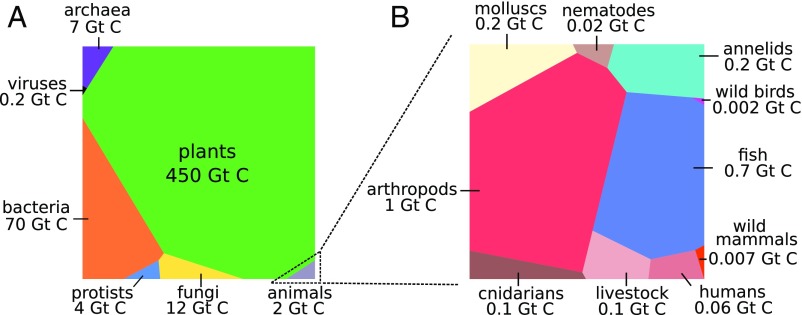
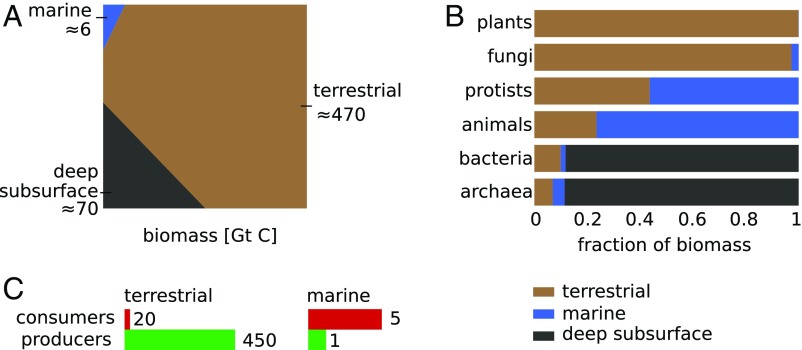
A census of the biomass on Earth is key for understanding the structure and dynamics of the biosphere. However, a global, quantitative view of how the biomass of different taxa compare with one another is still lacking. Here, we assemble the overall biomass composition of the biosphere, establishing a census of the ≈550 gigatons of carbon (Gt C) of biomass distributed among all of the kingdoms of life. We find that the kingdoms of life concentrate at different locations on the planet; plants (≈450 Gt C, the dominant kingdom) are primarily terrestrial, whereas animals (≈2 Gt C) are mainly marine, and bacteria (≈70 Gt C) and archaea (≈7 Gt C) are predominantly located in deep subsurface environments. We show that terrestrial biomass is about two orders of magnitude higher than marine biomass and estimate a total of ≈6 Gt C of marine biota, doubling the previous estimated quantity. Our analysis reveals that the global marine biomass pyramid contains more consumers than producers, thus increasing the scope of previous observations on inverse food pyramids. Finally, we highlight that the mass of humans is an order of magnitude higher than that of all wild mammals combined and report the historical impact of humanity on the global biomass of prominent taxa, including mammals, fish, and plants.
Overview
CoChat Summary
TL;DR
The paper assembles a global census of biomass across all kingdoms of life, estimating Earth’s total biomass at ≈550 Gt C, dominated by plants. It also compares biomass across environments and trophic modes, highlighting large uncertainties and human impacts on the biosphere.
Key findings
- Total global biomass is ≈550 Gt C, with plants ≈450 Gt C (≈80%), bacteria ≈70 Gt C (≈15%), fungi ≈12 Gt C, archaea ≈7 Gt C, protists ≈4 Gt C, animals ≈2 Gt C, and viruses ≈0.2 Gt C.
- Land biomass (≈470 Gt C) is about two orders of magnitude higher than marine biomass (≈6 Gt C); the deep subsurface holds ≈15% of total biomass, chiefly bacteria and archaea.
- In the ocean, ≈1 Gt C of primary producers supports ≈5 Gt C of consumer biomass, an inverted standing biomass distribution; marine biomass is ≈70% microbes, mainly bacteria and protists.
- Human-associated biomass is large relative to wild vertebrates: humans ≈0.06 Gt C, livestock ≈0.1 Gt C, wild mammals ≈0.007 Gt C, domesticated poultry ≈0.005 Gt C versus wild birds ≈0.002 Gt C; total plant biomass has declined approximately twofold relative to pre-human civilization.
Methods
- The authors synthesize hundreds of studies and generate estimates for major taxonomic groups, reporting biomass as gigatons of carbon (Gt C) and using a kingdom-level framework plus viruses.
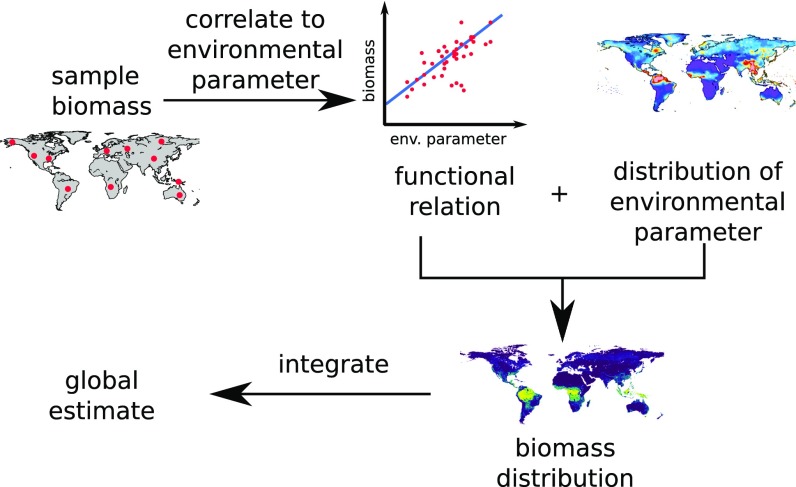
- For many taxa, local biomass samples are extrapolated globally by correlating biomass density with environmental parameters known at global scale; best estimates often use a geometric mean of independent estimates.
- Uncertainty is reported as multiplicative fold-change projections akin to 95% confidence intervals, incorporating intrastudy, interstudy, and intermethod variation; data and code are open-sourced.
Limitations
- The paper states that most datasets rely on fragmentary sampling, causing large uncertainties; sampling is scarce in the deep ocean (usually deeper than 200 m) and deep soil (usually deeper than 1 m), and some estimates may be biased by sampling toward high-abundance areas.
- The paper states that deep subsurface environments have particularly high uncertainty and unknown systematic biases, including unresolved distribution of biomass between aquifer fluids and rocks and among microbial taxa.
- The paper states that current and prehuman vertebrate biomass estimates are only a crude first step, amphibians remain poorly characterized, and parasite biomass is not resolved from hosts; evident from the text, kingdom-level grouping was chosen because much data lack finer taxonomic detail, and some uncertainty projections rely on analogous taxa or expert consultation.
Model-written summary. Check it against the paper before relying on it.
Integrity signals
Registry
Cites
Statistics
Figures
Verification
Claims the paper makes
9 Valid · 7 Not valid · 16 Not checked · 53 Own results and interpretations
Every source the paper cites for this claim was checked and supports it.
In the paper
“The biomass of amphibians, which are experiencing a dramatic population decline (42), remains poorly characterized.”
§ The biomass distribution on Earth > Discussion
What the sources say
- Supportedcites [42] Wake DB Vredenburg VT 2008 Colloquium paper: Are we in the midst of the sixth mass extinction? A view from the world of amphibians Proc Natl Acad Sci USA 105 11466 11473 18695221 PMC2556420 source
The citation is attached to the clause about amphibian population decline, not the separate statement that their biomass is poorly characterized. The passage reporting the Global Amphibian Assessment (labeled Abstract in our copy) says that 43% of amphibian species have declining populations. (LLM, conf=0.92)
plain- Asserted: passes — The authors put it forward as true.
- Checkable: passes — It can be checked against evidence.
- Load-bearing: unclear — It is unclear whether the paper’s conclusions depend on it.
- Based: passes — The paper gives a reason why it holds.
- Supported
Every source the paper cites for this claim was checked and supports it.
In the paper
“In the case of prokaryotes, some major improvements were recently realized, with global estimates of marine deep subsurface prokaryote biomass reduced by about two orders of magnitude due to an increased diversity of sampling locations (7).”
§ The biomass distribution on Earth > Discussion
What the sources say
- Supportedcites [7] Kallmeyer J Pockalny R Adhikari RR Smith DC D’Hondt S 2012 Global distribution of microbial abundance and biomass in subseafloor sediment Proc Natl Acad Sci USA 109 16213 16216 22927371 PMC3479597 source
The Discussion reports a revised subseafloor microbial biomass estimate of 4.1 Pg C versus a previous estimate of 303 Pg C—about a 74-fold reduction. It also identifies a more geographically diverse sampling database, including low-abundance ocean gyres, as a reason the new estimate is lower. The paper identifies other contributing factors as well. (LLM, conf=0.88)
plainstates a cause- Asserted: passes — The authors put it forward as true.
- Checkable: passes — It can be checked against evidence.
- Load-bearing: unclear — It is unclear whether the paper’s conclusions depend on it.
- Based: passes — The paper gives a reason why it holds.
- Supported
The sources with a verdict support this claim; the rest weren’t checked yet, have no full text we could read, or their verdicts aren’t rated yet.
In the paper
“Such inverted biomass distributions can occur when primary producers have a rapid turnover of biomass [on the order of days (34)], while consumer biomass turns over much more slowly [a few years in the case of mesopelagic fish (35)].”
§ The biomass distribution on Earth > Results > The Distribution of Biomass Across Environments and Trophic Modes.
What the sources say
- Supportedcites [34] Zubkov MV 2014 Faster growth of the major prokaryotic versus eukaryotic CO2 fixers in the oligotrophic ocean Nat Commun 5 3776 24777140 PMC4015317 source
The Results (Comparison of the growth rates of the CO2 fixers; page unavailable) report growth rates of 0.1–0.6 per day for the studied oceanic primary producers, consistent with biomass turnover on the order of days. The few-years estimate for mesopelagic fish is assigned to a different citation, not this source. (LLM, conf=0.91)
- Not checked — no full text of the sourcecites [35] Catul V Gauns M Karuppasamy PK 2011 A review on mesopelagic fishes belonging to family Myctophidae Rev Fish Biol Fish 21 339 354 source
plainstates a possible cause- Asserted: passes — The authors put it forward as true.
- Checkable: passes — It can be checked against evidence.
- Load-bearing: passes — The paper’s conclusions depend on it.
- Based: passes — The paper gives a reason why it holds.
- Supported
The cited sources support only part of this claim — read each source’s verdict below.
In the paper
“Combining data from independent sources such as these enables a robust assessment of the total plant biomass (17).”
§ The biomass distribution on Earth > Results > The Uncertainty Associated with Global Biomass Estimates.
What the sources say
- Partly supportedcites [17] Erb K-H 2017 Unexpectedly large impact of forest management and grazing on global vegetation biomass Nature 553 73 76 29258288 PMC5756473 sourceExperimental — accuracy not yet measured
The Methods describe combining multiple datasets and types of evidence to estimate global vegetation biomass stocks. But the paper also says global stocks remain uncertain, reports uncertainty ranges around 35% of the median estimate, and describes more robust estimates as a future prospect. It therefore supports the use of independent sources for an assessment, but not the unqualified characterization of that assessment as robust. (LLM, conf=0.84)
plainstates a cause- Asserted: passes — The authors put it forward as true.
- Checkable: passes — It can be checked against evidence.
- Load-bearing: passes — The paper’s conclusions depend on it.
- Based: passes — The paper gives a reason why it holds.
- Partly supported
A result the paper states — it cites no source for it, so there is none to check. The quote shows it is in the paper.
In the paper
“Plant biomass includes ≈70% stems and tree trunks, which are mostly woody, and thus relatively metabolically inert.”
§ The biomass distribution on Earth > Results > The Biomass Distribution of the Biosphere by Kingdom.
plain- Asserted: passes — The authors put it forward as true.
- Checkable: passes — It can be checked against evidence.
- Load-bearing: unclear — It is unclear whether the paper’s conclusions depend on it.
- Based: passes — The paper gives a reason why it holds.
27 more claims
Create a free account to see all 85 claims and to verify the 2 references still open.
- It may state two separate claims as one. 32
- Probably not a substantial claim. 28
Claims other papers make about this one
Each is checked against this paper’s own text: does it say what the citing paper says it does?
The cited source doesn’t support the claim as written.
In the citing paper
“and less than 10% that of the world ' s current human population ( 52 ).”
From Pervasive human-driven decline of life on Earth points to the need for transformative change (2019) · cites this paper as [52]
Checked by a reasoning model — may be wrong.
Experimental — accuracy not yet measuredThe cited source says what the claim attributes to it.
In the citing paper
“Approximately 450 Gt of C is bound up in terrestrial biota, primarily in plants (86), while only ~6 Gt of C is found in ocean biota (87).”
From Earth beyond six of nine planetary boundaries (2023) · cites this paper as [87]
The cited source says what the claim attributes to it.
In the citing paper
“The amount of metabolic energy available to a biosphere powered by O 2 is vast, such that the O 2 -rich ocean-atmosphere system of the modern Earth supports staggering levels of standing biomass (Bar-On et al. 2018), energy flow (Falkowski et al. 2008), and ecological complexity (Steele 1974).”
From The History of Ocean Oxygenation (2022) · cites this paper as Bar-On et al. 2018
In the citing paper
“Global populations of domestic ruminants (cattle, sheep, and goats) (Ripple et al. 2013) poultry, and pigs (Bennett et al. 2018) used to feed the growing human population now exceed 100 million tons of carbon (Bar-On et al. 2018), and livestock populations are growing rapidly.”
From Scientists’ warning to humanity on the freshwater biodiversity crisis (2021) · cites this paper as Bar-On et al. 2018
Citations
Cites
The worldwide leaf economics spectrum
Wright, I. J., Reich, P. B., Westoby, M., Ackerly, D. D., Baruch, Z., Bongers, F., Cavender-Bares, J., Chapin, T., Cornelissen, J. H. C., Diemer, M., et al. (2004) · Nature · doi:10.1038/nature02403 · Cited by 9,021 · cited 1×
“We then convert the total area of leaves to an estimate of the total dry mass of leaves by using the Glopnet database (24), which measured leaf mass per area (LMA) for ≈2500 plant species.”
MethodA large and persistent carbon sink in the world’s forests
Pan, Y., Birdsey, R. A., Fang, J., Houghton, R., Kauppi, P. E., Kurz, W. A., Phillips, O. L., Shvidenko, A., Lewis, S. L., Canadell, J. G., et al. (2011) · Science · doi:10.1126/science.1201609 · Cited by 8,458
Soil Sampling and Methods of Analysis
(2007) · CRC Press eBooks · doi:10.1201/9781420005271 · Cited by 6,469
Primary production of the biosphere: Integrating terrestrial and oceanic components
Field, C. B., Behrenfeld, M. J., Randerson, J. T., & Falkowski, P. (1998) · Science · doi:10.1126/science.281.5374.237 · Cited by 6,371
Prokaryotes: The unseen majority
Whitman, W. B., Coleman, D. C., & Wiebe, W. J. (1998) · Proceedings of the National Academy of Sciences · doi:10.1073/pnas.95.12.6578 · Cited by 4,871
Global effects of land use on local terrestrial biodiversity
Newbold, T., Hudson, L. N., Hill, S. L. L., Contu, S., Lysenko, I., Senior, R. A., Börger, L., Bennett, D. J., Choimes, A., Collen, B., et al. (2015) · Nature · doi:10.1038/nature14324 · Cited by 4,352
Belowground biodiversity and ecosystem functioning
Bardgett, R. D., & van der Putten, W. H. (2014) · Nature · doi:10.1038/nature13855 · Cited by 3,990 · cited 4×
“This was recommended by experts in the field for estimation of arbuscular mycorrhizal fungi abundance (117).”
BackgroundInfluentialMangroves among the most carbon-rich forests in the tropics
Donato, D. C., Kauffman, J. B., Murdiyarso, D., Kurnianto, S., Stidham, M., & Kanninen, M. (2011) · Nature Geoscience · doi:10.1038/ngeo1123 · Cited by 3,374
Poorter, H., Niklas, K. J., Reich, P. B., Oleksyn, J., Poot, P., & Mommer, L. (2012) · New Phytologist · doi:10.1111/j.1469-8137.2011.03952.x · Cited by 3,163 · cited 1×
“The first relies on a meta-analysis of the biomass allocation to different plant compartments across biomes (19).”
BackgroundA global analysis of root distributions for terrestrial biomes
Jackson, R. B., Canadell, J., Ehleringer, J. R., Mooney, H. A., Sala, O. E., & Schulze, E. D. (1996) · Oecologia · doi:10.1007/bf00333714 · Cited by 3,071 · cited 4×
“assumed the distribution of microbial biomass with depth follows the biomass density versus depth profile of root biomass (21).”
BackgroundMethodInfluential
Research works printed but not linked: 1
- Chapman AD 2009 Numbers of Living Species in Australia and the World Australian Biological Resources Study Canberra, Australia
Cited by
Items 1,401–1,500 of 3,743
Lüskow, F., Christiansen, B., Chi, X., Silva, P., Neitzel, P., Brooks, M., & Jaspers, C. (2022) · Marine Environmental Research · doi:10.1016/j.marenvres.2022.105566 · Cited by 14
Salinity Fluctuation on the Genetic Regulatory Mechanisms of the Crustacean, Charybdis japonica
Shui, B., Wang, Y., Lou, F., & Han, Z. (2022) · Frontiers in Marine Science · doi:10.3389/fmars.2022.870891 · Cited by 10
“org July 2022 | Volume 9 | Article 870891 Crustaceans are one of the most species-abundant taxa in the ocean and are widely distributed (Greenaway, 2003; Bar-On et al., 2018).”
BackgroundYu, Z., Chen, J., Tan, Y., Shen, Y., Zhu, L., & Yu, P. (2022) · Environmental Science & Technology · doi:10.1021/acs.est.2c04745 · Cited by 14
One Health challenges for pig reproduction
Peltoniemi, O. A. T., Tanskanen, T., & Kareskoski, M. (2023) · Molecular Reproduction and Development · doi:10.1002/mrd.23666 · Cited by 13
“On the other hand, numerous species are on the edge of extinction while the population sizes of production animals and other domestic animals are growing and are overrepresented in biomass estimates (Bar‐On et al., 2018).”
BackgroundDifferential roles of the fish chitinous membrane in gut barrier immunity and digestive compartments
Yue, Z., Fan, Z., Zhang, H., Feng, B., Wu, C., Chen, S., Ouyang, J., Fan, H., Weng, P., Feng, H., et al. (2023) · EMBO Reports · doi:10.15252/embr.202256645 · Cited by 11
Soil gases in mineral exploration: a review and the potential for future developments
Plet, ., & Noble, R. R. P. (2023) · Geochemistry Exploration Environment Analysis · doi:10.1144/geochem2023-008 · Cited by 10
Salliou, N. (2023) · Frontiers in Sustainable Food Systems · doi:10.3389/fsufs.2023.1122992 · Cited by 16
“Given the number of livestock in the world (Bar-On et al., 2018), sanctuaries can only play a niche role.”
BackgroundHard rock dark biosphere and habitability
Escudero, C., & Amils, R. (2023) · Frontiers in Astronomy and Space Sciences · doi:10.3389/fspas.2023.1203845 · Cited by 11
Intelligent DNA-Based Hydrogels for Bioanalysis and Therapeutics
Zhu, Q., Shen, C., Chen, R., Mao, C., He, Y., & Yang, K. (2023) · ACS Applied Polymer Materials · doi:10.1021/acsapm.3c01131 · Cited by 10
Ratanpara, A. P., Ricca, J. G., Gowda, A., Abraham, A., Wiskoff, S., Zauder, V., Sharma, R., Hafez, M., & Kim, M. (2023) · Journal of Environmental Management · doi:10.1016/j.jenvman.2023.118760 · Cited by 9
Sinel, M., & Weis, T. (2024) · Environment and Planning E Nature and Space · doi:10.1177/25148486241229012 · Cited by 10
“…and growing global populations of chickens, geese, ducks, turkeys, and pigs present an abundant habitat for in fl uenzas, with poultry birds now far outweighing the total biomass of all wild birds on the planet and roughly 70 billion birds slaughtered in 2021 (Bar-On et al., 2018; FAOSTATS, 2023).”
Guo, Y., He, J., Zhang, H., et al. (2024) · Agriculture · doi:10.3390/agriculture14030378 · Cited by 10
Zhang, C., Lu, Z., Zhuang, H., Zhou, J., Zhang, Y., Lv, X., Chen, M., Krzton, A., & Xia, W. (2024) · Ecology and Evolution · doi:10.1002/ece3.11600 · Cited by 12
Martins, T. M., Martins, C., & Pereira, C. S. (2019) · Advances in microbial physiology/Advances in Microbial Physiology · doi:10.1016/bs.ampbs.2019.07.003 · Cited by 11
Prospects for Life on Temperate Planets around Brown Dwarfs
Lingam, M., Ginsburg, I., & Loeb, A. (2020) · The Astrophysical Journal · doi:10.3847/1538-4357/ab5b13 · Cited by 12
“On Earth, chemotrophs make up ∼ 10% of the total biomass (Bar-On et al. 2018).”
Rath, K., Ranganathan, P., Vasappa, R. K., & Sridharan, T. B. (2019) · IET Nanobiotechnology · doi:10.1049/iet-nbt.2019.0189 · Cited by 10
Microbial metabolic potential in deep crystalline bedrock
Bomberg, M., Miettinen, H., Kietäväinen, R., Purkamo, L., Ahonen, L., & Vikman, M. (2020) · Elsevier eBooks · doi:10.1016/b978-0-12-818695-4.00003-4 · Cited by 12
Do pastoralist cattle fear African lions?
Beck, J. M., Moll, R. J., Kissui, B. M., & Montgomery, R. A. (2020) · Oikos · doi:10.1111/oik.07965 · Cited by 13
Towards Innovative Governance of Nature Areas
Krozer, Y., Coenen, F. H. J. M., Hanganu, J., Lordkipanidze, M., & Sbarcea, M. (2020) · Sustainability · doi:10.3390/su122410624 · Cited by 12
“This is because more crops and cattle do not compensate for the degradation of pristine ecosystems caused by capture of land, monocultures, excessive extractions, pollution, climate change, and other human interventions [2].”
BackgroundTønnessen, M. (2021) · Sign Systems Studies · doi:10.12697/sss.2021.49.1-2.02 · Cited by 14
On the Horns of a Dilemma: Let the Northern White Rhino Vanish or Intervene?
Callender, C. (2021) · Ethics Policy & Environment · doi:10.1080/21550085.2021.1961199 · Cited by 11
“If we focus on mammals, land and marine, we learn that human activity has decreased wild mammals to only 4.2% of total mammal biomass (Bar-On et al., 2018).”
BackgroundInfluentialNieberding, C. M., Marcantonio, M., Vodă, R., Enriquez, T., & Visser, B. (2021) · Genes · doi:10.3390/genes12101466 · Cited by 10
“Small-brained, non-social invertebrates are particularly relevant to study, because they make up at least half of the species diversity on Earth [77,78].”
Uller, H. F., Oliveira, L. Z., Klitzke, A. R., et al. (2021) · Canadian Journal of Forest Research · doi:10.1139/cjfr-2020-0215 · Cited by 10
Biogeochemical Cycles in Soil Microbiomes in Response to Climate Change
Mohanty, B., Pradhan, D., Das, R., & Das, M. T. (2021) · Soil biology · doi:10.1007/978-3-030-76863-8_26 · Cited by 13
Excitation Properties of Photopigments and Their Possible Dependence on the Host Star
Lingam, M., Balbi, A., & Mahajan, S. M. (2021) · The Astrophysical Journal Letters · doi:10.3847/2041-8213/ac3478 · Cited by 12
“The vast majority of current biomass on Earth is dependent, either directly or indirectly, on (oxygenic) photosynthesis (Bar-On et al. 2018); this is not surprising given the bountiful supply of sunlight.”
BackgroundApplications of Microbes in Soil Health Maintenance for Agricultural Applications
Aslam, A. A., Shamim, M., Nazir, M. S., Ishtaiq, M., Akhtar, M. N., Ali, Z., Tahir, Z., & Abdullah, M. A. (2022) · Environmental and microbial biotechnology · doi:10.1007/978-981-16-2225-0_12 · Cited by 12
Transcriptional regulation of secondary cell wall formation and lignification
Hussey, S. G. (2022) · Advances in botanical research · doi:10.1016/bs.abr.2022.03.007 · Cited by 11
Nieberding, C. M., Kaisin, A., & Visser, B. (2022) · Entomologia Generalis · doi:10.1127/entomologia/2022/1417 · Cited by 10
Complex and flexible catabolism in Aromatoleum aromaticum pCyN1
Becker, P., Döhmann, A., Wöhlbrand, L., Thies, D., Hinrichs, C., Buschen, R., Wünsch, D., Neumann‐Schaal, M., Schomburg, D., Winklhofer, M., et al. (2022) · Environmental Microbiology · doi:10.1111/1462-2920.16074 · Cited by 12
Returning to “Normal”? Evolutionary Roots of the Human Prospect
Ehrlich, P. R., & Ehrlich, A. H. (2022) · BioScience · doi:10.1093/biosci/biac044 · Cited by 12
Minimum levels of atmospheric oxygen from fossil tree roots imply new plant−oxygen feedback
Sønderholm, F., & Bjerrum, C. J. (2021) · Geobiology · doi:10.1111/gbi.12435 · Cited by 11
Zanchi, C., Moret, Y., & Gillingham, M. A. F. (2019) · bioRxiv (Cold Spring Harbor Laboratory) · doi:10.1101/774893 · Cited by 14
Ubiquity of inverted ’gelatinous’ ecosystem pyramids in the global oceanPreprint
Lombard, F., Guidi, L., Brandão, M. C., Coelho, L. P., Colin, S., Dolan, J. R., Elineau, A., Gasol, J. M., Grondin, P., Henry, N., et al. (2024) · bioRxiv (Cold Spring Harbor Laboratory) · doi:10.1101/2024.02.09.579612 · Cited by 12
PlantCAD2: a DNA foundation model for interpreting genomes across flowering plantsPreprint
Zhai, J., Gokaslan, A., Hsu, S., Chen, S.-P., Liu, Z.-Y., Marroquin, E., Czech, E., Cannon, B. R., Berthel, A., Romay, M. C., et al. (2025) · bioRxiv (Cold Spring Harbor Laboratory) · doi:10.1101/2025.08.27.672609 · Cited by 12
Earth 2020: An Insider’s Guide to a Rapidly Changing Planet
Tortell, P. D. (2020) · Open Book Publishers · doi:10.11647/obp.0193 · Cited by 30
Shinnerl, H. E., Banks, I. J., & Dilger, R. N. (2025) · Carbohydrate Polymers · doi:10.1016/j.carbpol.2025.124496 · Cited by 15
Water Versus Land on Temperate Rocky Planets
Guimond, C. M., Spohn, T., Berdyugina, S. V., Byrne, P. K., Coltice, N., Glaser, D. M., Lingam, M., Lineweaver, C. H., & Cawood, P. A. (2026) · Space Science Reviews · doi:10.1007/s11214-025-01264-5 · Cited by 10
“As mentioned above, the modern land biomass ultimately dominates the marine biomass by about two orders of magnitude (Bar-On et al. 2018) — though Sect.”
Biomass for photocatalysis, photocatalysis for biomass: Two-way route of sustainable use of biomass
Naseri, A., Samadi, M., Nosratpour, M. J., Vidyasagar, D., Moshfegh, A. Z., & Choi, W. (2026) · Applied Catalysis B: Environmental · doi:10.1016/j.apcatb.2026.126768 · Cited by 16
Uncovering patterns of the evolution of genomic sequence entropy and complexity
Simões, R. P., Wolf, I. R., Correa, B. A., & Valente, G. T. (2020) · Molecular Genetics and Genomics · doi:10.1007/s00438-020-01729-y · Cited by 9
Deep Trek: Science of Subsurface Habitability & Life on Mars
Stamenković, V., Lynch, K. L., Boston, P. J., Tarnas, J., Edwards, C. D., Lollar, B. S., Atreya, S. K., Templeton, A. S., Freeman, A., Fischer, W. W., et al. (2021) · doi:10.3847/25c2cfeb.dc18f731 · Cited by 13
Landecker, H. L. (2023) · Duke University Press eBooks · doi:10.1215/9781478024064-003 · Cited by 10
Sobol, M. S., Hoshino, T., Delgado, V., Futagami, T., Kadooka, C., Inagaki, F., & Reese, B. K. (2023) · BMC Genomics · doi:10.1186/s12864-023-09320-6 · Cited by 15
“Invariably, marine sedimentary fungi have been overlooked in recent global biomass estimates [1, 24].”
BackgroundThe Effect of Habitat on Insect Movements: Experimental Evidence from Wild-Caught Butterflies
Marcantonio, M., Vodă, R., Re, D. D., Igot, Q., Dennis, R. L. H., Vielfaure, A., Vanwambeke, S., & Nieberding, C. M. (2023) · Insects · doi:10.3390/insects14090737 · Cited by 9
Situating defaunation in an operational framework to advance biodiversity conservation
Poulsen, J. R., Maicher, V., Malinowski, H., & DeSisto, C. M. M. (2023) · BioScience · doi:10.1093/biosci/biad079 · Cited by 11
“With only 3% of the Earth’s land surface considered faunally intact (Plumptre et al. 2021 ), the global biomass of wild animals is now less than 25% of that before the Pleistocene megafaunal extinction (Bar-On et al. 2018 ).”
BackgroundCao, J., Li, Z., He, F., Tong, Z., Wang, Y., Wang, L., Zheng, G., & Zhang, Y. (2023) · Chemical and Biological Technologies in Agriculture · doi:10.1186/s40538-023-00490-9 · Cited by 9
“Microbiomes are essential components of soil ecosystems and play a fundamental role in the direct and indirect maintenance of soil fertility and nutrient cycling, and in plant and animal health [3–7].”
BackgroundColonialism, Domestication, & Extinction: A Pre-Mortem for Our Ecological Futures
Chang, D., & Corman, L. (2023) · Animal studies journal · doi:10.14453/asj/v12i2.5 · Cited by 9
Sindhu, L., Song, Y., Li, L., Dong, Z., Yang, Q., Mangi, S. S., Guo, W., Yang, L., Cui, H., Lv, S., et al. (2024) · Ecological Indicators · doi:10.1016/j.ecolind.2024.111852 · Cited by 10
Zorzetto, F., Ballesteros‐Plata, D., Perosa, A., Rodrı́guez-Castellón, E., Selva, M., & Rodríguez‐Padrón, D. (2024) · Green Chemistry · doi:10.1039/d3gc04848a · Cited by 9
Are cereal grasses a single genetic system?
Mascher, M., Marone, M. P., Schreiber, M., & Stein, N. (2024) · Nature Plants · doi:10.1038/s41477-024-01674-3 · Cited by 9
“These two groups combined now make up 96% of terrestrial mammalian biomass 6 .”
N-alkane shape distinctive microbial patterns in Kuroshio Extension
Hu, X., Zhao, S., Li, H., Pan, Y., Fan, Z., Lu, J., Li, Y., Song, G., Zhang, H., Liu, Q., et al. (2024) · Environment International · doi:10.1016/j.envint.2024.108757 · Cited by 8
Rodríguez‐Caro, R. C., Morales‐Reyes, Z., Aguión, A., Arias‐Real, R., Arrondo, E., Aspillaga, E., Boada, J., Campos‐Candela, A., Expósito‐Granados, M., Forcada, A., et al. (2024) · Biological Conservation · doi:10.1016/j.biocon.2024.110755 · Cited by 13
Microbiome-Driven Soil Fertility: Understanding Symbiotic Relationships
khan, M., Khan, T. A., Tabassum, B., & Hashim, M. (2024) · Progress in soil science · doi:10.1007/978-3-031-71487-0_4 · Cited by 14
Impact of farming practices on soil microbial biomass: An international synthesis
Dunn, L., Dequiedt, S. S., Marilleau, N., Lang, C., Djemiel, C., Cottin, A., Horrigue, W., Sadet-Bourgeteau, S., Ranjard, L., & Prévost‐Bouré, N. C. (2025) · Agriculture Ecosystems & Environment · doi:10.1016/j.agee.2025.109513 · Cited by 15
Why the superb physiological capacity of birds matters
Hawkes, L. A. (2025) · Journal of Experimental Biology · doi:10.1242/jeb.247986 · Cited by 12
Hackenberger, D., Imtiaz, H., Raphenya, A. R., Alcock, B. P., Poinar, H. N., Wright, G. D., & McArthur, A. G. (2025) · Applied and Environmental Microbiology · doi:10.1128/aem.01876-24 · Cited by 14
“Since bacteria are likely to be the most abun dant organism in most metagenomic samples (45), the second filter is a BLASTN (46) search against the nt database to minimize off-target enrichment and remove probes with >80% identity over <50 nt to any bacterial sequence, as any probe similar to a…”
Chen, M., Jiang, P., Li, M., Zhao, G., Han, L., Mu, L., Lau, L. C., & Zhu, J. (2025) · Biomass and Bioenergy · doi:10.1016/j.biombioe.2025.107755 · Cited by 12
Biomass-based carbon material for next-generation sodium-ion batteries: insights and SWOT evaluation
Kumar, A., Arora, N., Rawat, S., Mishra, R. K., Deshpande, A. C., Hotha, S., & Bhaskar, T. (2025) · Environmental Research · doi:10.1016/j.envres.2025.121854 · Cited by 11
Brain–Behavior Differences in Premodern and Modern Lineages of Domestic Dogs
Barton, S. A., Smaers, J. B., Serpell, J. A., & Hecht, E. E. (2025) · Journal of Neuroscience · doi:10.1523/jneurosci.2032-24.2025 · Cited by 14
The global biomass of mammals since 1850
Greenspoon, L., Ramot, N., Moran, U., Roll, U., Phillips, R., Noor, Ε., & Milo, R. (2025) · Nature Communications · doi:10.1038/s41467-025-63888-z · Cited by 25
“Biomass can serve as a metric giving an integrative global view across groups of species 9 while answering a very basic curiosity-driven question regarding the ubiquity of life.”
Self-citationAn inherited complex organic molecule reservoir in a warm planet-hosting disk
Booth, A. S., Walsh, C. M., van Scheltinga, J. T., et al. (2021) · White Rose Research Online (University of Leeds, The University of Sheffield, University of York) · doi:10.48550/arxiv.2104.08348 · Cited by 9
Microbial helpers allow cyanobacteria to thrive in ferruginous waters
Szeinbaum, N., Toporek, Y. J., Reinhard, C. T., & Glass, J. B. (2021) · Geobiology · doi:10.1111/gbi.12443 · Cited by 9
“At around 2.3 Ga, the Great Oxidation Event (GOE) resulted in the initial oxygenation of the atmosphere and surficial biosphere, which ultimately led to the modern dominance of aerobic organisms on Earth’s surface (Bar-On et al., 2018; Luo et al., 2016).”
BackgroundInfluentialAnthroponumbers.org: A quantitative database of human impacts on Planet Earth
Chure, G., Banks, R. A., Flamholz, A. I., Sarai, N. S., Kamb, M., Lopez‐Gomez, I., Bar‐On, Y. M., Milo, R., & Phillips, R. (2022) · Patterns · doi:10.1016/j.patter.2022.100552 · Cited by 13
Self-citationThompson, V. (2022) · Ecological Entomology · doi:10.1111/een.13192 · Cited by 9
“Mycorrhizal fungi are an important part of the biosphere, with an estimated total biomass of 0.35 gigatons of C (0.20 gigatons for EM, 0.15 gigatons for AM), about six times the biomass of humans (Bar-On et al., 2018, supp. info. appendix, pp. 25–27).”
BackgroundInfluentialResearch on Selected Wildlife Infections in the Circumpolar Arctic—A Bibliometric Review
Emelyanova, A., Savolainen, A., Oksanen, A., et al. (2022) · International Journal of Environmental Research and Public Health · doi:10.3390/ijerph191811260 · Cited by 9
Organizational Energy Conservation Matters in the Anthropocene
Kotsopoulos, D. (2022) · Energies · doi:10.3390/en15218214 · Cited by 10
Anaerobic Thermodesulfovibrio and Aerobic Meiothermus Coexist in Deep Thermal Water
Lukina, A. P., Kadnikov, V. V., Rusanov, I. I., Avakyan, M. R., Beletsky, A. V., Mardanov, A. V., Пименов, Н. В., Ravin, N. V., & Karnachuk, O. V. (2023) · Microbiology · doi:10.1134/s0026261723600234 · Cited by 9
“Keywords: deep biosphere, aerobic and anaerobic prokaryotes, sulfate-reducing bacteria, Meiothermus, Thermodesulfovibrio DOI: 10.1134/S0026261723600234 According to current estimates, deep horizonsinhabiting bacteria and archaea account for 15% of the Earth’s whole biomass (Bar-On et al., 2018).”
BackgroundInfluentialPhotosynthetic adaptation and multicellularity in the Antarctic psychrophile, Chlamydomonas priscuii
Hüner, N. P. A., Szyszka‐Mroz, B., Ivanov, A. G., Kata, V., Lye, H., & Smith, D. R. (2023) · Algal Research · doi:10.1016/j.algal.2023.103220 · Cited by 11
“Furthermore, C. priscuii is deficient in the capacity to perform state transitions [5,11,125,126].”
BackgroundInfluentialA glimpse of the paleome in endolithic microbial communities
Wegner, C., Stahl, R., Velsko, I. M., Hübner, A., Fagernäs, Z., Warinner, C., Lehmann, R. G., Ritschel, T., Totsche, K. U., & Küsel, K. (2023) · Microbiome · doi:10.1186/s40168-023-01647-2 · Cited by 11
The Fundamental Processes in Ecology: Life and the Earth System
Wilkinson, D. M. (2023) · doi:10.1093/oso/9780192884640.001.0001 · Cited by 10
Chu, Z., Zhou, Y., Liu, М., Lin, H., Cheng, M., Xie, H., Yuan, L., Zhang, Z., Zhang, Q., Li, C., et al. (2023) · Environmental Science & Technology · doi:10.1021/acs.est.3c05164 · Cited by 9
Li, T., Allan, E., Yang, S., Liu, Y., Inbar, M., Wang, D., & Zhong, Z. (2024) · Functional Ecology · doi:10.1111/1365-2435.14533 · Cited by 9
Sindhu, L., Song, Y., Li, L., Cui, H., Guo, W., Lv, S., Yu, Y., & Men, X. (2024) · Plant Stress · doi:10.1016/j.stress.2024.100460 · Cited by 10
Actinomycetes Associated with Arthropods as a Source of New Bioactive Compounds
Olano, C., & Rodríguez, M. G. (2024) · Current Issues in Molecular Biology · doi:10.3390/cimb46050238 · Cited by 10
“This group includes invertebrate animals with an external skeleton and articulated appendages such as insects, arachnids, crustaceans, and myriapods, which make up about 50% of the Earth’s animal biomass [24].”
BackgroundResponse of temperate anecic earthworm individual biomass to species interactions
Hoeffner, K., Monard, C., Cluzeau, D., et al. (2019) · Applied Soil Ecology · doi:10.1016/j.apsoil.2019.06.017 · Cited by 9
“Introduction 40 Earthworms are widespread organisms and constitute the most important animal biomass 41 in European soil under temperate climates (Hole, 1981; Curry, 1994; Bar-On et al., 2018).”
BackgroundExtracellular Vesicles in the Environment
Biller, S. J. (2020) · Springer eBooks · doi:10.1007/978-3-030-36331-4_4 · Cited by 9
Plant sciences for the Anthropocene: What can we learn from research in urban areas?
Kueffer, C. (2020) · Plants People Planet · doi:10.1002/ppp3.10124 · Cited by 13
The Isotopic Imprint of Life on an Evolving Planet
Lloyd, M. K., McClelland, H. L. O., Antler, G., Bradley, A. S., Halevy, I., Junium, C. K., Wankel, S. D., & Zerkle, A. L. (2020) · Space Science Reviews · doi:10.1007/s11214-020-00730-6 · Cited by 8
Kang, G.-U., Ibal, J. C., Lee, S., Jang, M. H., Park, Y.-J., Kim, M., Park, T.-H., Kim, M.-S., Kim, R.-H., & Shin, J. (2021) · Journal of Agricultural and Food Chemistry · doi:10.1021/acs.jafc.1c01314 · Cited by 9
Seguimiento de artrópodos bioindicadores en áreas urbanas: objetivos, experiencias y perspectivas
Cabrero-Sañudo, F. J., García, R. C., Caro-Miralles, E., et al. (2022) · Ecosistemas · doi:10.7818/ecos.2340 · Cited by 9
Krause, J., Harfoot, M., Hoeks, S., Anthoni, P. M., Brown, C., Rounsevell, M., & Arneth, A. (2022) · Ecological Modelling · doi:10.1016/j.ecolmodel.2022.110061 · Cited by 14
Walton, G., Mitchley, J., Reid, G., & Batke, S. P. (2023) · Plants People Planet · doi:10.1002/ppp3.10373 · Cited by 15
Pérez-González, G., Tompsett, G. A., Mastalerz, K., Timko, M. T., & Goodell, B. S. (2023) · iScience · doi:10.1016/j.isci.2023.106851 · Cited by 10
“Wood-degrading fungi govern the decomposition of the largest terrestrial reservoir of fixed carbon on the planet.(1,2) Thus, these fungi are critical in carbon cycling in the environment, and potentially in regulating climate change.”
BackgroundAssessing lignocellulosic biomass as a source of emergency foods
Siva, N., & Anderson, C. T. (2023) · Current Research in Food Science · doi:10.1016/j.crfs.2023.100586 · Cited by 10
“Overall, plants are estimated to embody a total global biomass of 450 Gt of carbon (Bar-On et al., 2018), roughly half of which is in the form of cellulose (Bengtsson et al.”
BackgroundPotential for Liquid Water Biochemistry Deep under the Surfaces of the Moon, Mars, and beyond
Lingam, M., & Loeb, A. (2020) · The Astrophysical Journal Letters · doi:10.3847/2041-8213/abb608 · Cited by 10
“On Earth, subsurface rock-based (endolithic) environments are known to host rich and thriving biospheres (Gold 1992; Edwards et al. 2012), and the total biomass in these settings is predicted to be ∼ 10% of Earth’s overall value (Whitman et al. 1998; Bar-On et al. 2018).”
BackgroundInfluentialFrom drug discovery to coronaviruses: why restoring natural habitats is good for human health
Murage, P., Batalha, H. R., Lino, S., & Sterniczuk, K. (2021) · BMJ · doi:10.1136/bmj.n2329 · Cited by 9
Huge and variable diversity of episymbiotic CPR bacteria and DPANN archaea in groundwater ecosystemsPreprint
He, C., Keren, R., Whittaker, M. L., Farag, I. F., Doudna, J., Cate, J., & Banfield, J. (2020) · bioRxiv · doi:10.1101/2020.05.14.094862 · Cited by 9
DiversityScanner: Robotic discovery of small invertebrates with machine learning methodsPreprint
Wührl, L., Pylatiuk, C., Giersch, M., et al. (2021) · bioRxiv (Cold Spring Harbor Laboratory) · doi:10.1101/2021.05.17.444523 · Cited by 9
“…to terrestrial animal diversity, invertebrates would receive most of the attention because they contribute >45 times the biomass of wild vertebrates (Table S23 in (Bar-On et al. 2018)), contain >90% of the species diversity (Groombridge 1992), and much of the functional and evolutionary diversity.”
BackgroundPollard, M. D., & Puckett, E. E. (2021) · bioRxiv (Cold Spring Harbor Laboratory) · doi:10.1101/2021.09.15.460515 · Cited by 8
“Increased herbivore diversification may be explained by primary producers comprising the largest proportion of biomass on Earth (Bar-On et al. 2018), suggesting that more herbivorous species can be supported globally.”
BackgroundOksana, T., & Gulevets, D. (2021) · Encyclopedia of the UN sustainable development goals · doi:10.1007/978-3-319-70061-8_103-1 · Cited by 11
Environmental gradients reveal stress hubs predating plant terrestrializationPreprint
Dadras, A., Fürst‐Jansen, J. M. R., Darienko, T., et al. (2022) · bioRxiv (Cold Spring Harbor Laboratory) · doi:10.1101/2022.10.17.512551 · Cited by 9
Global diversity of enterococci and description of 18 novel speciesPreprint
Schwartzman, J. A., Lebreton, F., Salamzade, R., Martin, M. J., Schaufler, K., Urhan, A., Abeel, T., Camargo, I. L. B. D. C., Sgardioli, B. F., Prichula, J., et al. (2023) · bioRxiv (Cold Spring Harbor Laboratory) · doi:10.1101/2023.05.18.540996 · Cited by 9
“We used our isolation data, and published estimates of global animal biomass and animal species diversity (Bar-On et al., 2018; Barrowclough et al., 2016; Stork, 2018), to understand the depth to which we had sampled the diversity of different animal taxa, and to extrapolate an upper bound for…”
New Types of Land Ownership to Sustain Life on Land
Theesfeld, I., & Curtiss, J. (2016) · MDPI eBooks · doi:10.3390/books978-3-03897-879-4-12 · Cited by 7
Sanyal, S. K., Sharma, K., Bisht, D., Sharma, S., Sushmita, K., Kateriya, S., & Pandey, G. K. (2023) · International Journal of Biological Macromolecules · doi:10.1016/j.ijbiomac.2023.124163 · Cited by 9
Pacifici, M., Cristiano, A., Lumbierres, M., Lucherini, M., Mallon, D. P., Meijaard, E., Solari, S., Tognelli, M. F., Belant, J. L., Butynski, T. M., et al. (2023) · Global Change Biology · doi:10.1111/gcb.16964 · Cited by 12
“Globally, nearly a quarter of the Earth's terrestrial surface is dedicated to livestock farming, and a significant portion of this land consists of protected areas and remaining natural habitats (Bar-On et al., 2018; Filazzola et al., 2020).”
BackgroundFan, Y., Mandal, M. S. H., Nakabayashi, M., & Hosaka, T. (2024) · Biological Conservation · doi:10.1016/j.biocon.2024.110590 · Cited by 11
Tyvijärvi, A., Stark, S., Ylänne, H., Castaño, C., & Adamczyk, B. (2024) · Soil Biology and Biochemistry · doi:10.1016/j.soilbio.2024.109441 · Cited by 8
Revealing the hierarchical structure of microbial communities
Ruth, B., Peter, S., Ibrahim, B., et al. (2024) · Scientific Reports · doi:10.1038/s41598-024-61836-3 · Cited by 8
Mather, T. N., Siva, N., Jauregui, M., et al. (2024) · Current Protocols · doi:10.1002/cpz1.1090 · Cited by 8
“Plant biomass is plentiful across the Earth’s land surfaces, translating into ∼ 450 Gt of carbon (Bar-On et al., 2018).”
BackgroundIndirect and direct drivers of floristic condition in a threatened temperate woodland
Bowd, E., & Lindenmayer, D. B. (2024) · The Science of The Total Environment · doi:10.1016/j.scitotenv.2024.174786 · Cited by 9
Knock down to level up: Reframing RNAi for invertebrate ecophysiology
Lebenzon, J. E., & Toxopeus, J. (2024) · Comparative Biochemistry and Physiology Part A Molecular & Integrative Physiology · doi:10.1016/j.cbpa.2024.111703 · Cited by 8
Metadata
- Authors
- Bar-On, Y. M., Phillips, R., & Milo, R.
- Affiliations
- Department of Plant and Environmental Sciences, Weizmann Institute of Science, 76100 Rehovot, Israel;
- California Institute of Technology (US)
- Weizmann Institute of Science (IL)
- Corresponding author
- Milo, Ron
- Venue
- Proceedings of the National Academy of Sciences
- Publisher
- National Academy of Sciences
- Published
- 2018-05-21
- Volume
- 115
- Issue
- 25
- Pages
- 6506-6511
- ISSN
- 0027-8424 (ISSN-L)
- 1091-6490
- PMC
- PMC6016768
- OpenAlex
- W2804910112
- Cited by
- 3,723
- References
- 263
- Citations by year
- 2026: 349 · 2025: 450 · 2024: 589 · 2023: 617 · 2022: 498 · 2021: 498 · 2020: 419 · 2019: 246 · 2018: 49
- FWCI
- 239.98
- Type
- journal article
- Language
- en
- Open access
- hybrid
- doi.org
- Licence
- Locations
- Proceedings of the National Academy of Sciences (publishedVersion, cc-by-nc-nd)
- Europe PMC (PubMed Central) (publishedVersion, cc-by-nc-nd)
- PubMed Central (publishedVersion, cc-by-nc-nd)
- PubMed (publishedVersion)
- CaltechAUTHORS (California Institute of Technology) (submittedVersion, cc-by-nc-nd)
- Funders
- National Institutes of Health (5r35gm118043-07)
- National Institute of General Medical Sciences (R35 GM118043)
- Topics
- Physical Sciences › Environmental Science › Nature and Landscape Conservation › Ecology and Vegetation Dynamics Studies
- Physical Sciences › Environmental Science › Global and Planetary Change › Earth Systems and Cosmic Evolution
- Life Sciences › Agricultural and Biological Sciences › Soil Science › Soil Carbon and Nitrogen Dynamics
- Keywords
- biomass allocation, biomass carbon, terrestrial biomass, marine biomass, bacteria, archaea, food pyramid, wild mammals, fish biomass, plant biomass
- MeSH terms
- Animals, Archaea, Bacteria, Carbon, Humans, Plants, Ecosystem, Biomass, Earth, Planet, Biota
About these checks
Registry, retraction, Cites and statistics results are computed, not judged, with one exception: a printed reference that no index lists is read once by a model before it counts as a citation error. Claims are extracted by a model and kept only when their quote appears verbatim in the text; each cited source is then checked, with a model’s help, for whether it says what the claim relies on. Those verdicts can be wrong — read the claim’s quote and the cited source before relying on one.
The claim verdicts this report counts are experimental: their accuracy is not yet measured.
A language model drew the claims from the paper on 2026-10-10, under version 3 of the claim definition (model deepseek-v4.1-flash, prompt extract-v3).
A second model labelled each claim on 2026-10-10 (model jev-1.13-20260917, definition revision gold-guideline-v0.2).
Cited sources are checked with a language model’s help (gpt-6-sol).
Statistics and arithmetic are recomputed, not judged.
Confidence bands are shown only for fields calibrated on our annotated test set. None is calibrated yet, so no band is shown.
What counts as a claim ›How we measure confidence ›How we check this ›
Are you an author, or do you see a problem with this page? Request a review
Data sources
Bibliographic data: Semantic Scholar, OpenAlex, Crossref.
Contains information from the Semantic Scholar Academic Graph Datasets, made available under the ODC Attribution License (ODC-BY 1.0).
Semantic Scholar’s data is described in: Kinney, R., et al. (2023). The Semantic Scholar Open Data Platform. arXiv:2301.10140.
