

The biomass distribution on Earth
Open accessThe DOI matches its Crossref record; 263 of the 263 references it cites were found in a registry or an index; 11 of the 41 sources its claims cite were checked for support.
Abstract
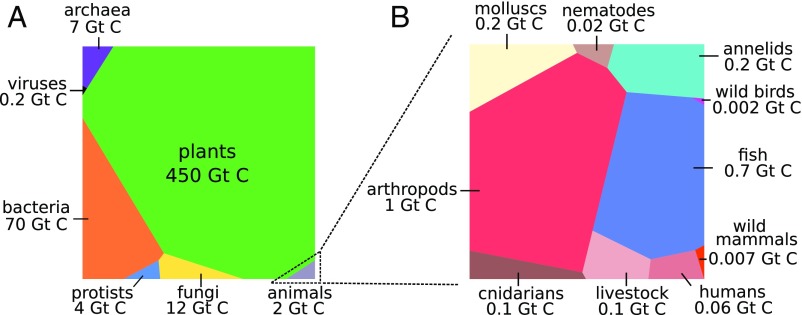
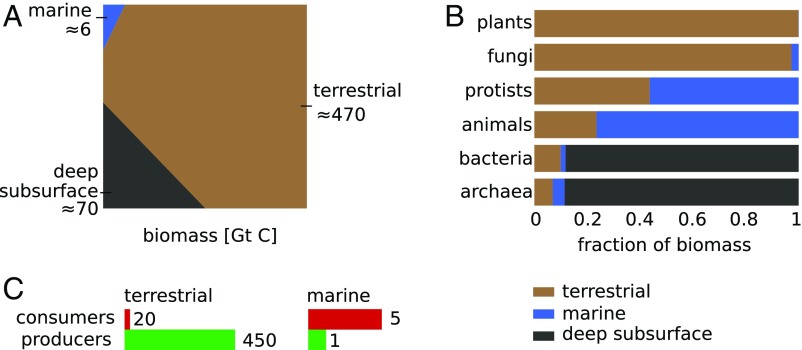
A census of the biomass on Earth is key for understanding the structure and dynamics of the biosphere. However, a global, quantitative view of how the biomass of different taxa compare with one another is still lacking. Here, we assemble the overall biomass composition of the biosphere, establishing a census of the ≈550 gigatons of carbon (Gt C) of biomass distributed among all of the kingdoms of life. We find that the kingdoms of life concentrate at different locations on the planet; plants (≈450 Gt C, the dominant kingdom) are primarily terrestrial, whereas animals (≈2 Gt C) are mainly marine, and bacteria (≈70 Gt C) and archaea (≈7 Gt C) are predominantly located in deep subsurface environments. We show that terrestrial biomass is about two orders of magnitude higher than marine biomass and estimate a total of ≈6 Gt C of marine biota, doubling the previous estimated quantity. Our analysis reveals that the global marine biomass pyramid contains more consumers than producers, thus increasing the scope of previous observations on inverse food pyramids. Finally, we highlight that the mass of humans is an order of magnitude higher than that of all wild mammals combined and report the historical impact of humanity on the global biomass of prominent taxa, including mammals, fish, and plants.
Overview
CoChat Summary
TL;DR
The paper assembles a global census of biomass across all kingdoms of life, estimating Earth’s total biomass at ≈550 Gt C, dominated by plants. It also compares biomass across environments and trophic modes, highlighting large uncertainties and human impacts on the biosphere.
Key findings
- Total global biomass is ≈550 Gt C, with plants ≈450 Gt C (≈80%), bacteria ≈70 Gt C (≈15%), fungi ≈12 Gt C, archaea ≈7 Gt C, protists ≈4 Gt C, animals ≈2 Gt C, and viruses ≈0.2 Gt C.
- Land biomass (≈470 Gt C) is about two orders of magnitude higher than marine biomass (≈6 Gt C); the deep subsurface holds ≈15% of total biomass, chiefly bacteria and archaea.
- In the ocean, ≈1 Gt C of primary producers supports ≈5 Gt C of consumer biomass, an inverted standing biomass distribution; marine biomass is ≈70% microbes, mainly bacteria and protists.
- Human-associated biomass is large relative to wild vertebrates: humans ≈0.06 Gt C, livestock ≈0.1 Gt C, wild mammals ≈0.007 Gt C, domesticated poultry ≈0.005 Gt C versus wild birds ≈0.002 Gt C; total plant biomass has declined approximately twofold relative to pre-human civilization.
Methods
- The authors synthesize hundreds of studies and generate estimates for major taxonomic groups, reporting biomass as gigatons of carbon (Gt C) and using a kingdom-level framework plus viruses.
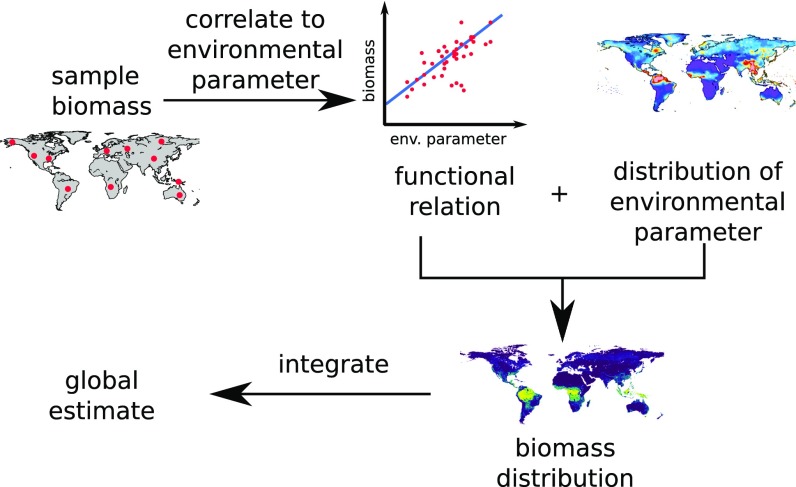
- For many taxa, local biomass samples are extrapolated globally by correlating biomass density with environmental parameters known at global scale; best estimates often use a geometric mean of independent estimates.
- Uncertainty is reported as multiplicative fold-change projections akin to 95% confidence intervals, incorporating intrastudy, interstudy, and intermethod variation; data and code are open-sourced.
Limitations
- The paper states that most datasets rely on fragmentary sampling, causing large uncertainties; sampling is scarce in the deep ocean (usually deeper than 200 m) and deep soil (usually deeper than 1 m), and some estimates may be biased by sampling toward high-abundance areas.
- The paper states that deep subsurface environments have particularly high uncertainty and unknown systematic biases, including unresolved distribution of biomass between aquifer fluids and rocks and among microbial taxa.
- The paper states that current and prehuman vertebrate biomass estimates are only a crude first step, amphibians remain poorly characterized, and parasite biomass is not resolved from hosts; evident from the text, kingdom-level grouping was chosen because much data lack finer taxonomic detail, and some uncertainty projections rely on analogous taxa or expert consultation.
Model-written summary. Check it against the paper before relying on it.
Integrity signals
Registry
Cites
Statistics
Figures
Verification
Claims the paper makes
9 Valid · 7 Not valid · 16 Not checked · 53 Own results and interpretations
Every source the paper cites for this claim was checked and supports it.
In the paper
“The biomass of amphibians, which are experiencing a dramatic population decline (42), remains poorly characterized.”
§ The biomass distribution on Earth > Discussion
What the sources say
- Supportedcites [42] Wake DB Vredenburg VT 2008 Colloquium paper: Are we in the midst of the sixth mass extinction? A view from the world of amphibians Proc Natl Acad Sci USA 105 11466 11473 18695221 PMC2556420 source
The citation is attached to the clause about amphibian population decline, not the separate statement that their biomass is poorly characterized. The passage reporting the Global Amphibian Assessment (labeled Abstract in our copy) says that 43% of amphibian species have declining populations. (LLM, conf=0.92)
plain- Asserted: passes — The authors put it forward as true.
- Checkable: passes — It can be checked against evidence.
- Load-bearing: unclear — It is unclear whether the paper’s conclusions depend on it.
- Based: passes — The paper gives a reason why it holds.
- Supported
Every source the paper cites for this claim was checked and supports it.
In the paper
“In the case of prokaryotes, some major improvements were recently realized, with global estimates of marine deep subsurface prokaryote biomass reduced by about two orders of magnitude due to an increased diversity of sampling locations (7).”
§ The biomass distribution on Earth > Discussion
What the sources say
- Supportedcites [7] Kallmeyer J Pockalny R Adhikari RR Smith DC D’Hondt S 2012 Global distribution of microbial abundance and biomass in subseafloor sediment Proc Natl Acad Sci USA 109 16213 16216 22927371 PMC3479597 source
The Discussion reports a revised subseafloor microbial biomass estimate of 4.1 Pg C versus a previous estimate of 303 Pg C—about a 74-fold reduction. It also identifies a more geographically diverse sampling database, including low-abundance ocean gyres, as a reason the new estimate is lower. The paper identifies other contributing factors as well. (LLM, conf=0.88)
plainstates a cause- Asserted: passes — The authors put it forward as true.
- Checkable: passes — It can be checked against evidence.
- Load-bearing: unclear — It is unclear whether the paper’s conclusions depend on it.
- Based: passes — The paper gives a reason why it holds.
- Supported
The sources with a verdict support this claim; the rest weren’t checked yet, have no full text we could read, or their verdicts aren’t rated yet.
In the paper
“Such inverted biomass distributions can occur when primary producers have a rapid turnover of biomass [on the order of days (34)], while consumer biomass turns over much more slowly [a few years in the case of mesopelagic fish (35)].”
§ The biomass distribution on Earth > Results > The Distribution of Biomass Across Environments and Trophic Modes.
What the sources say
- Supportedcites [34] Zubkov MV 2014 Faster growth of the major prokaryotic versus eukaryotic CO2 fixers in the oligotrophic ocean Nat Commun 5 3776 24777140 PMC4015317 source
The Results (Comparison of the growth rates of the CO2 fixers; page unavailable) report growth rates of 0.1–0.6 per day for the studied oceanic primary producers, consistent with biomass turnover on the order of days. The few-years estimate for mesopelagic fish is assigned to a different citation, not this source. (LLM, conf=0.91)
- Not checked — no full text of the sourcecites [35] Catul V Gauns M Karuppasamy PK 2011 A review on mesopelagic fishes belonging to family Myctophidae Rev Fish Biol Fish 21 339 354 source
plainstates a possible cause- Asserted: passes — The authors put it forward as true.
- Checkable: passes — It can be checked against evidence.
- Load-bearing: passes — The paper’s conclusions depend on it.
- Based: passes — The paper gives a reason why it holds.
- Supported
The cited sources support only part of this claim — read each source’s verdict below.
In the paper
“Combining data from independent sources such as these enables a robust assessment of the total plant biomass (17).”
§ The biomass distribution on Earth > Results > The Uncertainty Associated with Global Biomass Estimates.
What the sources say
- Partly supportedcites [17] Erb K-H 2017 Unexpectedly large impact of forest management and grazing on global vegetation biomass Nature 553 73 76 29258288 PMC5756473 sourceExperimental — accuracy not yet measured
The Methods describe combining multiple datasets and types of evidence to estimate global vegetation biomass stocks. But the paper also says global stocks remain uncertain, reports uncertainty ranges around 35% of the median estimate, and describes more robust estimates as a future prospect. It therefore supports the use of independent sources for an assessment, but not the unqualified characterization of that assessment as robust. (LLM, conf=0.84)
plainstates a cause- Asserted: passes — The authors put it forward as true.
- Checkable: passes — It can be checked against evidence.
- Load-bearing: passes — The paper’s conclusions depend on it.
- Based: passes — The paper gives a reason why it holds.
- Partly supported
A result the paper states — it cites no source for it, so there is none to check. The quote shows it is in the paper.
In the paper
“Plant biomass includes ≈70% stems and tree trunks, which are mostly woody, and thus relatively metabolically inert.”
§ The biomass distribution on Earth > Results > The Biomass Distribution of the Biosphere by Kingdom.
plain- Asserted: passes — The authors put it forward as true.
- Checkable: passes — It can be checked against evidence.
- Load-bearing: unclear — It is unclear whether the paper’s conclusions depend on it.
- Based: passes — The paper gives a reason why it holds.
27 more claims
Create a free account to see all 85 claims and to verify the 2 references still open.
- It may state two separate claims as one. 32
- Probably not a substantial claim. 28
Claims other papers make about this one
Each is checked against this paper’s own text: does it say what the citing paper says it does?
The cited source doesn’t support the claim as written.
In the citing paper
“and less than 10% that of the world ' s current human population ( 52 ).”
From Pervasive human-driven decline of life on Earth points to the need for transformative change (2019) · cites this paper as [52]
Checked by a reasoning model — may be wrong.
Experimental — accuracy not yet measuredThe cited source says what the claim attributes to it.
In the citing paper
“Approximately 450 Gt of C is bound up in terrestrial biota, primarily in plants (86), while only ~6 Gt of C is found in ocean biota (87).”
From Earth beyond six of nine planetary boundaries (2023) · cites this paper as [87]
The cited source says what the claim attributes to it.
In the citing paper
“The amount of metabolic energy available to a biosphere powered by O 2 is vast, such that the O 2 -rich ocean-atmosphere system of the modern Earth supports staggering levels of standing biomass (Bar-On et al. 2018), energy flow (Falkowski et al. 2008), and ecological complexity (Steele 1974).”
From The History of Ocean Oxygenation (2022) · cites this paper as Bar-On et al. 2018
In the citing paper
“Global populations of domestic ruminants (cattle, sheep, and goats) (Ripple et al. 2013) poultry, and pigs (Bennett et al. 2018) used to feed the growing human population now exceed 100 million tons of carbon (Bar-On et al. 2018), and livestock populations are growing rapidly.”
From Scientists’ warning to humanity on the freshwater biodiversity crisis (2021) · cites this paper as Bar-On et al. 2018
Citations
Cites
The worldwide leaf economics spectrum
Wright, I. J., Reich, P. B., Westoby, M., Ackerly, D. D., Baruch, Z., Bongers, F., Cavender-Bares, J., Chapin, T., Cornelissen, J. H. C., Diemer, M., et al. (2004) · Nature · doi:10.1038/nature02403 · Cited by 9,021 · cited 1×
“We then convert the total area of leaves to an estimate of the total dry mass of leaves by using the Glopnet database (24), which measured leaf mass per area (LMA) for ≈2500 plant species.”
MethodA large and persistent carbon sink in the world’s forests
Pan, Y., Birdsey, R. A., Fang, J., Houghton, R., Kauppi, P. E., Kurz, W. A., Phillips, O. L., Shvidenko, A., Lewis, S. L., Canadell, J. G., et al. (2011) · Science · doi:10.1126/science.1201609 · Cited by 8,458
Soil Sampling and Methods of Analysis
(2007) · CRC Press eBooks · doi:10.1201/9781420005271 · Cited by 6,469
Primary production of the biosphere: Integrating terrestrial and oceanic components
Field, C. B., Behrenfeld, M. J., Randerson, J. T., & Falkowski, P. (1998) · Science · doi:10.1126/science.281.5374.237 · Cited by 6,371
Prokaryotes: The unseen majority
Whitman, W. B., Coleman, D. C., & Wiebe, W. J. (1998) · Proceedings of the National Academy of Sciences · doi:10.1073/pnas.95.12.6578 · Cited by 4,871
Global effects of land use on local terrestrial biodiversity
Newbold, T., Hudson, L. N., Hill, S. L. L., Contu, S., Lysenko, I., Senior, R. A., Börger, L., Bennett, D. J., Choimes, A., Collen, B., et al. (2015) · Nature · doi:10.1038/nature14324 · Cited by 4,352
Belowground biodiversity and ecosystem functioning
Bardgett, R. D., & van der Putten, W. H. (2014) · Nature · doi:10.1038/nature13855 · Cited by 3,990 · cited 4×
“This was recommended by experts in the field for estimation of arbuscular mycorrhizal fungi abundance (117).”
BackgroundInfluentialMangroves among the most carbon-rich forests in the tropics
Donato, D. C., Kauffman, J. B., Murdiyarso, D., Kurnianto, S., Stidham, M., & Kanninen, M. (2011) · Nature Geoscience · doi:10.1038/ngeo1123 · Cited by 3,374
Poorter, H., Niklas, K. J., Reich, P. B., Oleksyn, J., Poot, P., & Mommer, L. (2012) · New Phytologist · doi:10.1111/j.1469-8137.2011.03952.x · Cited by 3,163 · cited 1×
“The first relies on a meta-analysis of the biomass allocation to different plant compartments across biomes (19).”
BackgroundA global analysis of root distributions for terrestrial biomes
Jackson, R. B., Canadell, J., Ehleringer, J. R., Mooney, H. A., Sala, O. E., & Schulze, E. D. (1996) · Oecologia · doi:10.1007/bf00333714 · Cited by 3,071 · cited 4×
“assumed the distribution of microbial biomass with depth follows the biomass density versus depth profile of root biomass (21).”
BackgroundMethodInfluential
Research works printed but not linked: 1
- Chapman AD 2009 Numbers of Living Species in Australia and the World Australian Biological Resources Study Canberra, Australia
Cited by
Items 1,201–1,300 of 3,743
Wild ungulate responses to anthropogenic land use: a comparative Pantropical analysis
Costa, H. C. M., Benchimol, M., & Peres, C. A. (2021) · Mammal Review · doi:10.1111/mam.12252 · Cited by 20
Synnott, D. P., Schwark, L., Dewing, K., Percy, E. L., & Pedersen, P. K. (2021) · Geochimica et Cosmochimica Acta · doi:10.1016/j.gca.2021.06.005 · Cited by 14
Shah, R. B., Shah, R. D., Retzinger, D. G., Retzinger, A. C., Retzinger, D. A., & Retzinger, G. S. (2021) · Pathogens · doi:10.3390/pathogens10091204 · Cited by 16
“Still, because in comparison to plants, fungi and even viruses, humans contribute only very little to the biomass on planet Earth [32], it seems likely some larger purpose is served by interplay between the three bioaerosols.”
BackgroundHidden intermediates in Mango III RNA aptamer folding revealed by pressure perturbation
Harish, B., Wang, J., Hayden, E. J., Grabe, B., Hiller, W., Winter, R., & Royer, C. A. (2021) · Biophysical Journal · doi:10.1016/j.bpj.2021.12.037 · Cited by 14
Jiang, J., Fei, W., Pu, M., Chai, Z., & Wu, Z. (2022) · Advanced Materials Interfaces · doi:10.1002/admi.202200516 · Cited by 16
Duchemin, B. (2022) · Green Chemistry · doi:10.1039/d1gc03262c · Cited by 16
Temporal change of prokaryotic community in surface sediments of the Chukchi Sea
Sun, J., Zhou, H., Cheng, H., Zhu, C., & Wang, Y. (2022) · Ecohydrology & Hydrobiology · doi:10.1016/j.ecohyd.2022.06.001 · Cited by 14
Bearzi, G., & Reeves, R. R. (2022) · ICES Journal of Marine Science · doi:10.1093/icesjms/fsac173 · Cited by 14
Connecting soils to life in conservation planning, nutrient cycling, and planetary science
Lybrand, R. A. (2022) · Earth-Science Reviews · doi:10.1016/j.earscirev.2022.104247 · Cited by 20
Coltelli, M., Morganti, P., & Lazzeri, A. (2023) · Elsevier eBooks · doi:10.1016/b978-0-323-91696-7.00016-7 · Cited by 21
Ma, X., Ren, B., Yu, J., Wang, J., Bai, L., Li, J., Li, D., & Meng, M. (2023) · Frontiers in Microbiology · doi:10.3389/fmicb.2023.1205574 · Cited by 17
“Compared with soil microorganisms such as fungi, actinomycetes and soil protozoa, soil bacteria are the most important taxon, accounting for about 70 to 90% of the total soil microorganisms, and play a dominant role in biogeochemical cycling processes (Van der Heijden et al., 2008; Bar-On et al., 2018).”
BackgroundPhotosynthesis on exoplanets and exomoons from reflected light
Lingam, M., & Loeb, A. (2019) · International Journal of Astrobiology · doi:10.1017/s1473550419000247 · Cited by 16
“The overwhelming majority of Earth’s biomass is dependent, either directly or indirectly, on photosynthesis for its maintenance and growth (Bar-On et al. 2018).”
BackgroundInfluentialPedersen, S., Gangås, K. E., Chetri, M., & Andreassen, H. P. (2020) · Sustainability · doi:10.3390/su12093557 · Cited by 17
“In total, there are about 550 gigatons [12] of carbon (Gt C) biomass in all kingdoms of life—of which, terrestrial plants are the dominant biomass, with 450 Gt C [13].”
BackgroundXie, Y., Zhang, P., Xue, B., Cao, X., Ren, X., Wang, L., Sun, Y., Yang, H., & Zhang, L. (2020) · bioRxiv (Cold Spring Harbor Laboratory) · doi:10.1101/2020.03.06.980219 · Cited by 12
“…The marine environment, consisting of the open ocean, the upper 10-50 cm of the ocean seafloor sediment, as well as the underlying oceanic deep subsurface, is primarily occupied by microbes, mainly bacteria and protists, which account for about 70% of the total marine biomass (Bar-On et al. 2018).”
BackgroundAssessment of Nuclear Energy to Support Negative Emission Technologies
Stauff, N., USDOE Office of Nuclear Energy (NE), Mann, W., Moisseytsev, A. V., Durvasulu, V., Mantripragada, H., & Fout, T. (2023) · OSTI OAI (U.S. Department of Energy Office of Scientific and Technical Information) · doi:10.2172/1998558 · Cited by 18
Subramanian, V., Adler, M. J., Benyamin, M. S., Pullen, R. M., Servinsky, M. D., Kozlowski, M. T., & Decker, S. R. (2025) · Biotechnology for Biofuels and Bioproducts · doi:10.1186/s13068-025-02712-8 · Cited by 21
“As plants comprise around 80% of the biomass-based carbon on the planet [140], it is unsurprising that fungi have evolved a highly complex and adaptable suite of enzymes targeting this vast sugar reservoir [141] and the vast majority of industrial biomass-degrading enzymes are produced by…”
KEY ECOLOGICAL PARAMETERS OF IMMOTILE VERSUS LOCOMOTIVE LIFE
Gorshkov, V. G., & Makarieva, A. M. (2020) · Russian Journal of Ecosystem Ecology · doi:10.21685/2500-0578-2020-1-1 · Cited by 16
Caruso, T., & Bardgett, R. D. (2021) · Pedobiologia · doi:10.1016/j.pedobi.2021.150741 · Cited by 14
Benchmarking organic electrochemical transistors for plant electrophysiology
Armada‐Moreira, A., Diacci, C., Dar, A. M., et al. (2022) · Frontiers in Plant Science · doi:10.3389/fpls.2022.916120 · Cited by 13
“Plants are the most widespread organisms on the planet, representing the majority of Earth’s biomass (Bar-On et al., 2018).”
BackgroundDujon, A. M., Boutry, J., Tissot, S., Meliani, J., Guimard, L., Rieu, O., Újvári, B., & Thomas, F. (2022) · Methods in Ecology and Evolution · doi:10.1111/2041-210x.13938 · Cited by 18
The coordination of green–brown food webs and their disruption by anthropogenic nutrient inputs
Zelnik, Y. R., Manzoni, S., & Bommarco, R. (2022) · Global Ecology and Biogeography · doi:10.1111/geb.13576 · Cited by 16
Trophic State Drives the Diversity of Protists in a Tropical River (New River, Belize)
Barbosa, M., Lefler, F. W., Berthold, D. E., Briggs‐Gonzalez, V., Mazzotti, F. J., & Laughinghouse, H. D. (2022) · Microorganisms · doi:10.3390/microorganisms10122425 · Cited by 16
Evolution of European bison image and its implications for current species conservation
Samojlik, T., Daszkiewicz, P., Fedotova, A. A., et al. (2023) · PLoS ONE · doi:10.1371/journal.pone.0281113 · Cited by 13
Morono, Y. (2023) · Progress in Earth and Planetary Science · doi:10.1186/s40645-023-00551-5 · Cited by 14
“8% of the total living biomass on Earth (Bar-On et al. 2018; Kallmeyer et al. 2012; Magnabosco et al. 2018; Whitman et al. 1998).”
BackgroundInfluentialWillemen, L., Kenter, J. O., O’Connor, S., & van Noordwijk, M. (2023) · Current Opinion in Environmental Sustainability · doi:10.1016/j.cosust.2023.101317 · Cited by 17
Touzout, S. N., Merghni, A., Laouani, A., Boukhibar, H., Alenazy, R., Alobaid, A., Alenazy, M., Ben‐Attia, M., Saguem, K., & El-Bok, S. (2023) · Microorganisms · doi:10.3390/microorganisms11082062 · Cited by 22
The low permeability of the Earth’s Precambrian crust
Ferguson, G., McIntosh, J. C., Warr, O., & Lollar, B. S. (2023) · Communications Earth & Environment · doi:10.1038/s43247-023-00968-2 · Cited by 16
Endophytic ancestors of modern leaf miners may have evolved in the Late Carboniferous
Knecht, R. J., Swain, A., Benner, J. S., et al. (2023) · New Phytologist · doi:10.1111/nph.19266 · Cited by 13
Newberger, D. R., Minas, I. S., Manter, D. K., & Vivanco, J. M. (2023) · Scientific Reports · doi:10.1038/s41598-023-44104-8 · Cited by 20
“The soil hosts interactions between the largest global biomass distribution of terrestrial plants and microbes 1 .”
BackgroundEngineered Materials: Bioinspired “Good Enough” versus Maximized Performance
van Nieuwenhoven, R. W., Drack, M., & Gebeshuber, I. C. (2023) · Advanced Functional Materials · doi:10.1002/adfm.202307127 · Cited by 23
Niu, G., Liu, T., Zhao, Z., Zhang, X., Guan, H., He, X., & Lu, X. (2024) · Forest Ecosystems · doi:10.1016/j.fecs.2024.100172 · Cited by 17
Eggers, J. M. V., Wisnoski, N. I., Calder, J. W., Capo, É., Groff, D. V., Krist, A. C., & Shuman, B. N. (2024) · Environmental Microbiology · doi:10.1111/1462-2920.16607 · Cited by 13
Rook, G. A. W. (2024) · Neuroscience & Biobehavioral Reviews · doi:10.1016/j.neubiorev.2024.105653 · Cited by 12
Cornejo, J., Sierra-García, J. E., Gómez-Gil, F. J., Weitzenfeld, A., Acevedo, F. E., Escalante, I., Recuero, E., & Wehrtmann, I. S. (2024) · Bioinspiration & Biomimetics · doi:10.1088/1748-3190/ad5778 · Cited by 14
“Global Animal Biomass—Arthropods [9].”
Wood formation in trees responding to nitrogen availability
Lu, Y., Zheng, B., Zhang, C., Yu, C., & Luo, J. (2024) · Industrial Crops and Products · doi:10.1016/j.indcrop.2024.118978 · Cited by 17
Divonne, S. D. L. F., Pouzadoux, J., Romatif, O., Montagnani, C., Mitta, G., Destoumieux‐Garzón, D., Gourbal, B., Charrière, G. M., & Vignal, E. (2025) · eLife · doi:10.7554/elife.102622.4 · Cited by 18
Improving wood carbon fractions for multiscale forest carbon estimation
Doraisami, M., Domke, G. M., & Martin, A. R. (2024) · Carbon Balance and Management · doi:10.1186/s13021-024-00272-2 · Cited by 16
“Our commentary here focuses specifically on the live woody biomass of forest C pools, which represent the largest component of forest biomass C [10]).”
BackgroundEvolution of the iodine cycle and the late stabilization of the Earth’s ozone layer
Liu, J., Hardisty, D. S., Kasting, J. F., Fakhraee, M., & Planavsky, N. J. (2025) · Proceedings of the National Academy of Sciences · doi:10.1073/pnas.2412898121 · Cited by 19
Biomass-to-electricity conversion technologies: a review
Balopi, B., Moyo, M., Gorimbo, J., & Liu, X. (2025) · Waste Disposal & Sustainable Energy · doi:10.1007/s42768-025-00226-5 · Cited by 25
The scale of life and its lessons for humanity
Burgess, M. G., & Gaines, S. D. (2018) · Proceedings of the National Academy of Sciences · doi:10.1073/pnas.1807019115 · Cited by 16
From inert matter to the global society life as multi-level networks of processes
Chavalarias, D. (2020) · Philosophical Transactions of the Royal Society B Biological Sciences · doi:10.1098/rstb.2019.0329 · Cited by 14
“[50] estimated that humans represent only 0.”
BackgroundOrcutt, B. N., D’Angelo, T., Wheat, C. G., & Trembath‐Reichert, E. (2020) · Environmental Microbiology · doi:10.1111/1462-2920.15366 · Cited by 15
François, S., Antoine-Lorquin, A., Kulikowski, M., et al. (2021) · Viruses · doi:10.3390/v13050791 · Cited by 13
“Yet, insects belong to the most widespread and diversified group of animals on Earth, and despite their relatively small size, they represent a significant part of the terrestrial biomass [2].”
BackgroundMarine Biopolymer Dynamics, Gel Formation, and Carbon Cycling in the Ocean
Verdugo, P. (2021) · Gels · doi:10.3390/gels7030136 · Cited by 13
Vereshchaka, A. L., Lunina, A. A., & Mikaelyan, A. S. (2021) · Global Ecology and Biogeography · doi:10.1111/geb.13435 · Cited by 14
Idea Colliders: The Future of Science Museums
Gorman, M. J. (2020) · The MIT Press eBooks · doi:10.7551/mitpress/11019.001.0001 · Cited by 13
Enya, K., Yamagishi, A., Kobayashi, K., & Yoshimura, Y. (2022) · Life Sciences in Space Research · doi:10.1016/j.lssr.2022.07.001 · Cited by 19
Mateos, G., Martínez-Bonilla, A., de Polanco, S. D. F., Martínez, J. M., Escudero, C., Rodríguez, N., Sánchez‐Andrea, I., & Amils, R. (2022) · Microorganisms · doi:10.3390/microorganisms10081585 · Cited by 14
“The deep subsurface is no longer dismissed as devoid of life, in fact, bacteria and archaea are thought to have most of their biomass on such environments [95].”
BackgroundGroult, B., Bredin, P., & Lazar, C. S. (2022) · Environmental Microbiology · doi:10.1111/1462-2920.16219 · Cited by 14
Light-driven processes: key players of the functional biodiversity in microalgae
Falciatore, A., Bailleul, B., Boulouis, A., Bouly, J., Bujaldon, S., Cheminant-Navarro, S., Choquet, Y., de Vitry, C., Eberhard, S., Jaubert, M., et al. (2022) · Comptes Rendus Biologies · doi:10.5802/crbiol.80 · Cited by 14
The Porifera microeukaryome: Addressing the neglected associations between sponges and protists
Nascimento-Silva, G., Hardoim, C. C. P., & Custódio, M. R. (2022) · Microbiological Research · doi:10.1016/j.micres.2022.127210 · Cited by 15
Aridity could have driven the local extinction of a common and multivoltine butterfly
Gil‐Tapetado, D., Soria, C. D., Gómez, J. F., Sesma, J. M., & Cabrero-Sañudo, F. J. (2022) · Ecological Entomology · doi:10.1111/een.13200 · Cited by 14
“Arthropods constitute half of the current animal biomass (Bar-On et al., 2018), of which insects are the most diverse and cosmopolitan group, with more than 1 million species and an estimated 80% yet to be described (Chapman, 2009).”
BackgroundMaillard, F., Leduc, V., Bach, C., Thébault, É., Reichard, A., Morin, E., Saint‐André, L., Zeller, B., & Buée, M. (2022) · Applied Soil Ecology · doi:10.1016/j.apsoil.2022.104776 · Cited by 15
Environmental Selection and Biogeography Shape the Microbiome of Subsurface Petroleum Reservoirs
Gittins, D. A., Bhatnagar, S., & Hubert, C. R. J. (2023) · mSystems · doi:10.1128/msystems.00884-22 · Cited by 13
“Oil reservoirs are generally considered extreme environments as a result of high temperature, high pressure, and millions of years of isolation from the Earth’s surface (5).”
BackgroundInfluentialImperforate tracheary element classification for studies of xylem structure-function relations
Olson, M. E. (2023) · IAWA Journal - KU Leuven/IAWA Journal · doi:10.1163/22941932-bja10125 · Cited by 18
Tian, L., Liao, L., Tao, Y., Wu, X., & Li, M. (2023) · Remote Sensing · doi:10.3390/rs15112862 · Cited by 12
Shang, Y., Wang, X., Wu, X., et al. (2024) · Microbiology Spectrum · doi:10.1128/spectrum.03245-23 · Cited by 13
Burnham, T. C., & Phelan, J. (2019) · Journal of Bioeconomics · doi:10.1007/s10818-019-09287-z · Cited by 13
Liu, W., Jiang, H., Zhang, X., Zhao, Y., Sun, S., & Qiao, J. (2019) · Journal of Materials Chemistry A · doi:10.1039/c9ta08943h · Cited by 13
Stability and resilience in a nutrient-phytoplankton marine ecosystem model
Kovač, Ž., Platt, T., & Sathyendranath, S. (2020) · ICES Journal of Marine Science · doi:10.1093/icesjms/fsaa067 · Cited by 13
Termites host specific fungal communities that differ from those in their ambient environments
Větrovský, T., Soukup, P., Stiblík, P., Votýpková, K., Chakraborty, A., Larrañaga, I. O., Sillam‐Dussès, D., Lo, N. C., Bourguignon, T., Baldrián, P., et al. (2020) · Fungal ecology · doi:10.1016/j.funeco.2020.100991 · Cited by 13
Tandem communication improves ant foraging success in a highly competitive tropical habitat
Glaser, S. M., Feitosa, R. M., Koch, A., et al. (2021) · Insectes Sociaux · doi:10.1007/s00040-021-00810-y · Cited by 13
Fungal Diversity: Global Perspective and Ecosystem Dynamics
Bajpai, A., Rawat, S., & Johri, B. N. (2019) · Springer eBooks · doi:10.1007/978-981-13-8315-1_4 · Cited by 19
Evaluation of two pit and fissure sealants: an in vitro study.
Retief, D. H., & MALLORY, W. (1981) · PubMed · Cited by 13
Martínez, T. M. G., Rodríguez, B., Rodríguez-Montaño, M., Alfau, J., Reyes, C., Fernandez, Y., Ramos, R. T. J., Franco, E. F., & Maroto-Martín, L. O. (2025) · Applied Microbiology · doi:10.3390/applmicrobiol5010026 · Cited by 20
The contribution of pelagic fungi to ocean biomass
Breyer, E., Stix, C., Kilker, S., Roller, B. R. K., Panagou, F., Doebke, C., Amano, C., Saavedra, D. E. M., Coll-García, G., Steger-Mähnert, B., et al. (2025) · Cell · doi:10.1016/j.cell.2025.05.004 · Cited by 21
“Oceanic microbes comprise 70%–90% of the biomass of marine biota 1,2 and are the main drivers of marine biogeochemical cycles.”
Mechanochemical Preparation of Biomass-Derived Porous Carbons
Choma, J., Szczęśniak, B., & Jaroniec, M. (2025) · Molecules · doi:10.3390/molecules30153125 · Cited by 16
“Around 60% of biomass is on the Earth’s surface [34].”
Human transformation of past terrestrial ecosystems
Nogué, S., Morueta‐Holme, N., Fernández‐Palacios, J. M., Alsos, I. G., Brown, A. G., Roberts, P., & Peñuelas, J. (2025) · Nature Reviews Biodiversity · doi:10.1038/s44358-025-00081-6 · Cited by 19
Marginal lands and fungi – linking the type of soil contamination with fungal community composition
Okrasińska, A., Decewicz, P., Majchrowska, M., Dziewit, Ł., Muszewska, A., Dolatabadi, S., Kruszewski, Ł., Błocka, Z., & Pawłowska, J. (2022) · Environmental Microbiology · doi:10.1111/1462-2920.16007 · Cited by 19
“Fungi are a diverse and abundant group of eukaryotic organisms and their representatives are found in almost all ecosystems (Bar-On et al., 2018), including deep oceans (Nagano and Nagahama, 2012), deserts (Sun et al., 2019) and the permafrost of Antarctica (de Menezes et al., 2020).”
BackgroundHigh Microeukaryotic Diversity in the Cold-Seep Sediment
Xu, Z., Chen, J., Li, Y., Shekarriz, E., Wu, W., Chen, B., & Liu, H. (2023) · Microbial Ecology · doi:10.1007/s00248-023-02212-y · Cited by 12
“1 3 of eukaryotic diversity and biomass in most ecosystems including both water and sediment [10, 11].”
BackgroundMoravcová, A., Barbi, F., Brabcová, V., Cajthaml, T., Martinović, T., Soudzilovskaia, N. A., Vlk, L., Baldrián, P., & Kohout, P. (2023) · FEMS Microbiology Ecology · doi:10.1093/femsec/fiad041 · Cited by 12
Life strategies for Aminicenantia in subseafloor oceanic crust
Booker, A. E., D’Angelo, T., Adams-Beyea, A., Brown, J. M., Nigro, O. D., Rappé, M. S., Stepanauskas, R., & Orcutt, B. N. (2023) · The ISME Journal · doi:10.1038/s41396-023-01454-5 · Cited by 13
Legrand, W., Kuokkanen, H., Marucco, F., Hazenberg, S., & Fischer, F. (2023) · Cornell Hospitality Quarterly · doi:10.1177/19389655231182083 · Cited by 15
“Today, wild mammals and birds collectively account for about 0.38% of biomass on earth, while livestock, accounting for about 4% of biomass on earth, outweighs wild mammals and birds by a factor of 10 (Bar-On et al., 2018).”
BackgroundInfluentialHumans in/of/are nature: Re-embedding reality in sustainability sciences
Morgan, C., Brevik, K. A., Barbieri, L. K., & Ament, J. A. (2023) · Elementa Science of the Anthropocene · doi:10.1525/elementa.2021.00083 · Cited by 13
Chang, L., Yu, G., & Liu, C. (2023) · Science China Earth Sciences · doi:10.1007/s11430-023-1141-x · Cited by 11
Foreign Aid and Its Unintended Consequences
Koch, D. (2023) · Routledge eBooks · doi:10.4324/9781003356851 · Cited by 32
Bregnard, D., Leins, A., Cailleau, G., Vieth‐Hillebrand, A., Eichinger, F., Iannotta, J., Hoffmann, R., Uhde, J., Bindschedler, S., Regenspurg, S., et al. (2023) · Geothermal Energy · doi:10.1186/s40517-023-00269-z · Cited by 23
“Indeed, it is estimated that most prokaryotic life on Earth is located in the deep biosphere (Bar-On et al. 2018; Magnabosco et al. 2018; Drake and Reiners 2021) and the discoveries of life in such extreme habitats challenge our understanding of the limits of life (Inagaki et al. 2003; Orsi, Biddle…”
BackgroundUrban greenspaces shape soil protist communities in a location-specific manner.
Shangguan, H.-Y., Geisen, S., Li, Z.-P., Yao, H., Li, G., Breed, M., Scheu, S., & Sun, X. (2023) · Environmental Research · doi:10.1016/j.envres.2023.117485 · Cited by 12
The wild cost of invasive feral animals worldwide
Soto, I., Balzani, P., Oficialdegui, F. J., Molinero, C., Kouba, A., Ahmed, D. A., Turbelin, A. J., Hudgins, E. J., Bodey, T. W., Gojery, S. A., et al. (2023) · The Science of The Total Environment · doi:10.1016/j.scitotenv.2023.169281 · Cited by 18
Animal roles in organizations: A framework for exploring organizational human–animal relations
Kandel, I. J., Dlouhy, K., & Schmitt, A. (2023) · Organization · doi:10.1177/13505084231217079 · Cited by 23
Imaging tree root systems using ground penetrating radar (GPR) data in Brazil
Rocha, A. A., Borges, W. R., Huelsen, M. G. V., et al. (2024) · Frontiers in Earth Science · doi:10.3389/feart.2024.1353572 · Cited by 12
ARGONAUTE10 controls cell fate specification and formative cell divisions in the Arabidopsis root
Arbi, N. E., Schürholz, A.-K., Handl, M. U., Schiffner, A., Hidalgo, I., Schnurbusch, L., Wenzl, C., Zhao, X., Zeng, J., Lohmann, J. U., et al. (2024) · The EMBO Journal · doi:10.1038/s44318-024-00072-x · Cited by 19
“One of the key evolutionary innovations that allowed plants to dominate the vast majority of terrestrial habitats (Bar-On et al, 2018) was the development of vascular systems comprised of xylem and phloem cells which allowed water and nutrient transport over long distances (Lucas et al, 2013).”
Raval, P. K., MacLeod, A. I., & Gould, S. B. (2024) · PLoS Biology · doi:10.1371/journal.pbio.3002608 · Cited by 18
Li, F., Shi, Z., Liu, S., Chen, M., Xu, G., Chen, J., & Xing, H. (2024) · European Journal of Forest Research · doi:10.1007/s10342-024-01697-7 · Cited by 14
“Biomass is used to quantify the productivity and carbon sequestration capacity of forest ecosystems, where about 80% of aboveground carbon stocks in terrestrial ecosystems come from forest ecosystems and play a vital role in atmospheric carbon dioxide sources and sinks (Bar-On et al. 2018).”
Quantifying heterogeneity of hominin environments in and out of Africa using herbivore dental traits
Foister, T. I. F., Liu, L., Saarinen, J. J., Tallavaara, M., Zhang, H., & Žliobaitė, I. (2024) · Quaternary Science Reviews · doi:10.1016/j.quascirev.2024.108791 · Cited by 13
Structure–function relationships in pure archaeal bipolar tetraether lipids
Bhattacharya, A., Falk, I. D., Moss, F. R., Weiss, T. M., Tran, K. N., Burns, N. Z., & Boxer, S. G. (2024) · Chemical Science · doi:10.1039/d4sc03788j · Cited by 11
Evolution of phosphate scouting in the terrestrial biosphere
Abel, S., & Naumann, C. (2024) · Philosophical Transactions of the Royal Society B Biological Sciences · doi:10.1098/rstb.2023.0355 · Cited by 13
Biotic Deterioration and Homogenization: Why It Matters
Hessen, D. O. (2024) · International Journal of Politics Culture and Society · doi:10.1007/s10767-024-09498-x · Cited by 22
Microfluidics for studying the deep underground biosphere: from applications to fundamentals
Morais, S., Vidal, E., Cario, A., Marre, S., & Ranchou‐Peyruse, A. (2024) · FEMS Microbiology Ecology · doi:10.1093/femsec/fiae151 · Cited by 14
Microbes in Health and Disease: Human Gut Microbiota
Hu, C., & Shen, H. (2024) · Applied Sciences · doi:10.3390/app142311354 · Cited by 20
Biodiversity restated: > 99.9% of global species in Soil Biota
Blakemore, R. J. (2025) · ZooKeys · doi:10.3897/zookeys.1224.131153 · Cited by 22
“For estimates of around 3 × 10 29 cells in soils, Flemming and Wuertz (2019), as for Bar-On et al. (2018), also give no species data.”
Skidmore, A. K., Abdullah, H. J., Siegenthaler, A., et al. (2025) · International Journal of Remote Sensing · doi:10.1080/01431161.2025.2464958 · Cited by 12
“…of forest soil fungi and bacteria influences image spectroscopy is unknown, but with forest soil bacterial and fungal mass comprising 82 Gt C compared to a total plant biomass of 450 Gt C globally, even a direct signal should not be dismissed without further study (Bar-On, Phillips, and Milo 2018).”
Climates of Warm Earth-like Planets. III. Fractional Habitability from a Water Cycle Perspective
Genio, A. D. D., Way, M. J., Kiang, N. Y.-L., Aleinov, I., Puma, M. J., & Cook, B. I. (2019) · The Astrophysical Journal · doi:10.3847/1538-4357/ab57fd · Cited by 15
“On land, forests (which inhabit “humid” aridity index regions) make up the bulk of the biomass (Bar-On et al. 2018; Erb et al. 2018), but the relationship between the production of biosignature gases and biomass amount is complex (Seager et al. 2013; Schwieterman et al. 2018).”
BackgroundClarifying Terrestrial Recycling Pathways
Bishop, T. R., Griffiths, H. M., Ashton, L. A., Eggleton, P., Woon, J. S., & Parr, C. L. (2020) · Trends in Ecology & Evolution · doi:10.1016/j.tree.2020.09.005 · Cited by 13
Doctors and overpopulation 48 years later: a second notice
Greguš, J., & Guillebaud, J. (2020) · The European Journal of Contraception & Reproductive Health Care · doi:10.1080/13625187.2020.1821356 · Cited by 16
“Yet it is hardly unexpected that zoonotic disease viruses, being obligate intra-cellular parasites, would now and repeatedly utilise the vast ‘culture medium’ presented by human flesh: our huge collective biomass [10].”
BackgroundInsect reproductive behaviors are important mediators of carrion nutrient release into soil
Woelber-Kastner, B. K., Frey, S. D., Howard, D. R., & Hall, C. L. (2021) · Scientific Reports · doi:10.1038/s41598-021-82988-6 · Cited by 17
Sun, Y., Lin, Y., Zhao, G., et al. (2021) · Sensors · doi:10.3390/s21103329 · Cited by 12
“5 million varieties [1], and represented by 1 gigaton of carbon, they account for the largest fraction of the total animal biomass [2].”
BackgroundImportance, Tools, and Challenges of Protecting Trees
Kozlowski, G., & Song, Y. (2022) · Sustainability · doi:10.3390/su142013107 · Cited by 17
“[1]; thus, trees and other woody plants constitute more than 70% of the total biomass on Earth [8,11].”
BackgroundWang, Z., Xu, S., Zheng, X., Zheng, X., Liu, M., Guo, G., Yu, Y., Han, X., Liu, Y., Wang, K., et al. (2022) · Applied and Environmental Microbiology · doi:10.1128/aem.01061-22 · Cited by 14
“At present, with a seemingly insatiable demand for poultry meat and eggs, poultry accounts for 70% of the earth’s bird biomass (36).”
BackgroundRégimes de sélection microbienne
Tancoigne, É. (2021) · Revue d anthropologie des connaissances · doi:10.4000/rac.25075 · Cited by 12
Metadata
- Authors
- Bar-On, Y. M., Phillips, R., & Milo, R.
- Affiliations
- Department of Plant and Environmental Sciences, Weizmann Institute of Science, 76100 Rehovot, Israel;
- California Institute of Technology (US)
- Weizmann Institute of Science (IL)
- Corresponding author
- Milo, Ron
- Venue
- Proceedings of the National Academy of Sciences
- Publisher
- National Academy of Sciences
- Published
- 2018-05-21
- Volume
- 115
- Issue
- 25
- Pages
- 6506-6511
- ISSN
- 0027-8424 (ISSN-L)
- 1091-6490
- PMC
- PMC6016768
- OpenAlex
- W2804910112
- Cited by
- 3,723
- References
- 263
- Citations by year
- 2026: 349 · 2025: 450 · 2024: 589 · 2023: 617 · 2022: 498 · 2021: 498 · 2020: 419 · 2019: 246 · 2018: 49
- FWCI
- 239.98
- Type
- journal article
- Language
- en
- Open access
- hybrid
- doi.org
- Licence
- Locations
- Proceedings of the National Academy of Sciences (publishedVersion, cc-by-nc-nd)
- Europe PMC (PubMed Central) (publishedVersion, cc-by-nc-nd)
- PubMed Central (publishedVersion, cc-by-nc-nd)
- PubMed (publishedVersion)
- CaltechAUTHORS (California Institute of Technology) (submittedVersion, cc-by-nc-nd)
- Funders
- National Institutes of Health (5r35gm118043-07)
- National Institute of General Medical Sciences (R35 GM118043)
- Topics
- Physical Sciences › Environmental Science › Nature and Landscape Conservation › Ecology and Vegetation Dynamics Studies
- Physical Sciences › Environmental Science › Global and Planetary Change › Earth Systems and Cosmic Evolution
- Life Sciences › Agricultural and Biological Sciences › Soil Science › Soil Carbon and Nitrogen Dynamics
- Keywords
- biomass allocation, biomass carbon, terrestrial biomass, marine biomass, bacteria, archaea, food pyramid, wild mammals, fish biomass, plant biomass
- MeSH terms
- Animals, Archaea, Bacteria, Carbon, Humans, Plants, Ecosystem, Biomass, Earth, Planet, Biota
About these checks
Registry, retraction, Cites and statistics results are computed, not judged, with one exception: a printed reference that no index lists is read once by a model before it counts as a citation error. Claims are extracted by a model and kept only when their quote appears verbatim in the text; each cited source is then checked, with a model’s help, for whether it says what the claim relies on. Those verdicts can be wrong — read the claim’s quote and the cited source before relying on one.
The claim verdicts this report counts are experimental: their accuracy is not yet measured.
A language model drew the claims from the paper on 2026-10-10, under version 3 of the claim definition (model deepseek-v4.1-flash, prompt extract-v3).
A second model labelled each claim on 2026-10-10 (model jev-1.13-20260917, definition revision gold-guideline-v0.2).
Cited sources are checked with a language model’s help (gpt-6-sol).
Statistics and arithmetic are recomputed, not judged.
Confidence bands are shown only for fields calibrated on our annotated test set. None is calibrated yet, so no band is shown.
What counts as a claim ›How we measure confidence ›How we check this ›
Are you an author, or do you see a problem with this page? Request a review
Data sources
Bibliographic data: Semantic Scholar, OpenAlex, Crossref.
Contains information from the Semantic Scholar Academic Graph Datasets, made available under the ODC Attribution License (ODC-BY 1.0).
Semantic Scholar’s data is described in: Kinney, R., et al. (2023). The Semantic Scholar Open Data Platform. arXiv:2301.10140.
