

The biomass distribution on Earth
Open accessThe DOI matches its Crossref record; 263 of the 263 references it cites were found in a registry or an index; 11 of the 41 sources its claims cite were checked for support.
Abstract
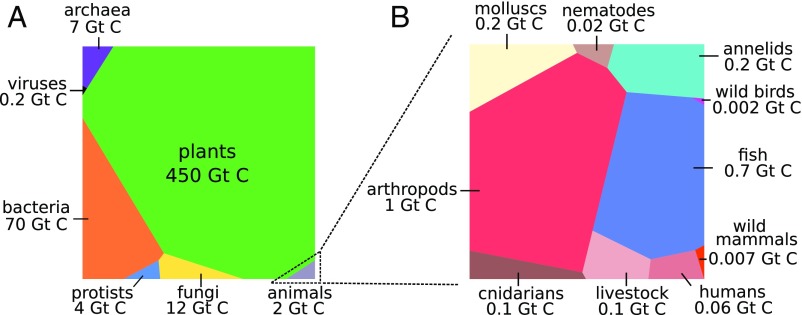
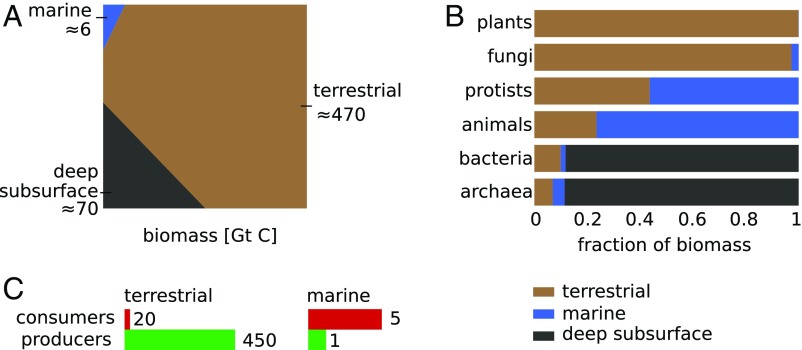
A census of the biomass on Earth is key for understanding the structure and dynamics of the biosphere. However, a global, quantitative view of how the biomass of different taxa compare with one another is still lacking. Here, we assemble the overall biomass composition of the biosphere, establishing a census of the ≈550 gigatons of carbon (Gt C) of biomass distributed among all of the kingdoms of life. We find that the kingdoms of life concentrate at different locations on the planet; plants (≈450 Gt C, the dominant kingdom) are primarily terrestrial, whereas animals (≈2 Gt C) are mainly marine, and bacteria (≈70 Gt C) and archaea (≈7 Gt C) are predominantly located in deep subsurface environments. We show that terrestrial biomass is about two orders of magnitude higher than marine biomass and estimate a total of ≈6 Gt C of marine biota, doubling the previous estimated quantity. Our analysis reveals that the global marine biomass pyramid contains more consumers than producers, thus increasing the scope of previous observations on inverse food pyramids. Finally, we highlight that the mass of humans is an order of magnitude higher than that of all wild mammals combined and report the historical impact of humanity on the global biomass of prominent taxa, including mammals, fish, and plants.
Overview
CoChat Summary
TL;DR
The paper assembles a global census of biomass across all kingdoms of life, estimating Earth’s total biomass at ≈550 Gt C, dominated by plants. It also compares biomass across environments and trophic modes, highlighting large uncertainties and human impacts on the biosphere.
Key findings
- Total global biomass is ≈550 Gt C, with plants ≈450 Gt C (≈80%), bacteria ≈70 Gt C (≈15%), fungi ≈12 Gt C, archaea ≈7 Gt C, protists ≈4 Gt C, animals ≈2 Gt C, and viruses ≈0.2 Gt C.
- Land biomass (≈470 Gt C) is about two orders of magnitude higher than marine biomass (≈6 Gt C); the deep subsurface holds ≈15% of total biomass, chiefly bacteria and archaea.
- In the ocean, ≈1 Gt C of primary producers supports ≈5 Gt C of consumer biomass, an inverted standing biomass distribution; marine biomass is ≈70% microbes, mainly bacteria and protists.
- Human-associated biomass is large relative to wild vertebrates: humans ≈0.06 Gt C, livestock ≈0.1 Gt C, wild mammals ≈0.007 Gt C, domesticated poultry ≈0.005 Gt C versus wild birds ≈0.002 Gt C; total plant biomass has declined approximately twofold relative to pre-human civilization.
Methods
- The authors synthesize hundreds of studies and generate estimates for major taxonomic groups, reporting biomass as gigatons of carbon (Gt C) and using a kingdom-level framework plus viruses.
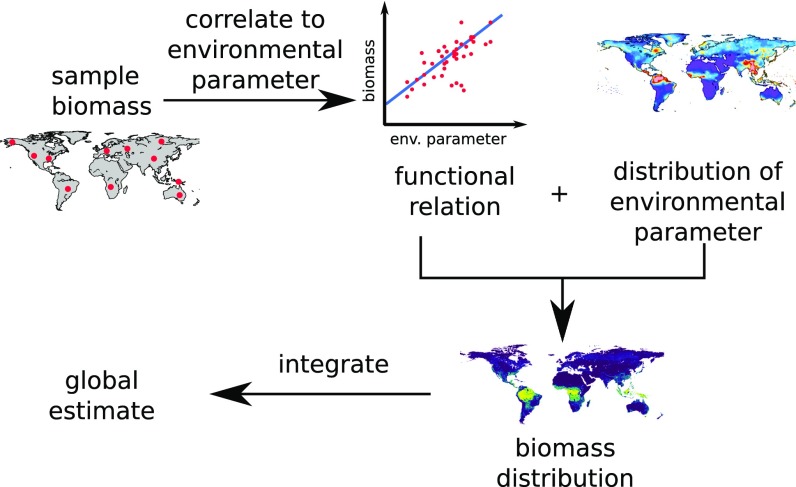
- For many taxa, local biomass samples are extrapolated globally by correlating biomass density with environmental parameters known at global scale; best estimates often use a geometric mean of independent estimates.
- Uncertainty is reported as multiplicative fold-change projections akin to 95% confidence intervals, incorporating intrastudy, interstudy, and intermethod variation; data and code are open-sourced.
Limitations
- The paper states that most datasets rely on fragmentary sampling, causing large uncertainties; sampling is scarce in the deep ocean (usually deeper than 200 m) and deep soil (usually deeper than 1 m), and some estimates may be biased by sampling toward high-abundance areas.
- The paper states that deep subsurface environments have particularly high uncertainty and unknown systematic biases, including unresolved distribution of biomass between aquifer fluids and rocks and among microbial taxa.
- The paper states that current and prehuman vertebrate biomass estimates are only a crude first step, amphibians remain poorly characterized, and parasite biomass is not resolved from hosts; evident from the text, kingdom-level grouping was chosen because much data lack finer taxonomic detail, and some uncertainty projections rely on analogous taxa or expert consultation.
Model-written summary. Check it against the paper before relying on it.
Integrity signals
Registry
Cites
Statistics
Figures
Verification
Claims the paper makes
9 Valid · 7 Not valid · 16 Not checked · 53 Own results and interpretations
Every source the paper cites for this claim was checked and supports it.
In the paper
“The biomass of amphibians, which are experiencing a dramatic population decline (42), remains poorly characterized.”
§ The biomass distribution on Earth > Discussion
What the sources say
- Supportedcites [42] Wake DB Vredenburg VT 2008 Colloquium paper: Are we in the midst of the sixth mass extinction? A view from the world of amphibians Proc Natl Acad Sci USA 105 11466 11473 18695221 PMC2556420 source
The citation is attached to the clause about amphibian population decline, not the separate statement that their biomass is poorly characterized. The passage reporting the Global Amphibian Assessment (labeled Abstract in our copy) says that 43% of amphibian species have declining populations. (LLM, conf=0.92)
plain- Asserted: passes — The authors put it forward as true.
- Checkable: passes — It can be checked against evidence.
- Load-bearing: unclear — It is unclear whether the paper’s conclusions depend on it.
- Based: passes — The paper gives a reason why it holds.
- Supported
Every source the paper cites for this claim was checked and supports it.
In the paper
“In the case of prokaryotes, some major improvements were recently realized, with global estimates of marine deep subsurface prokaryote biomass reduced by about two orders of magnitude due to an increased diversity of sampling locations (7).”
§ The biomass distribution on Earth > Discussion
What the sources say
- Supportedcites [7] Kallmeyer J Pockalny R Adhikari RR Smith DC D’Hondt S 2012 Global distribution of microbial abundance and biomass in subseafloor sediment Proc Natl Acad Sci USA 109 16213 16216 22927371 PMC3479597 source
The Discussion reports a revised subseafloor microbial biomass estimate of 4.1 Pg C versus a previous estimate of 303 Pg C—about a 74-fold reduction. It also identifies a more geographically diverse sampling database, including low-abundance ocean gyres, as a reason the new estimate is lower. The paper identifies other contributing factors as well. (LLM, conf=0.88)
plainstates a cause- Asserted: passes — The authors put it forward as true.
- Checkable: passes — It can be checked against evidence.
- Load-bearing: unclear — It is unclear whether the paper’s conclusions depend on it.
- Based: passes — The paper gives a reason why it holds.
- Supported
The sources with a verdict support this claim; the rest weren’t checked yet, have no full text we could read, or their verdicts aren’t rated yet.
In the paper
“Such inverted biomass distributions can occur when primary producers have a rapid turnover of biomass [on the order of days (34)], while consumer biomass turns over much more slowly [a few years in the case of mesopelagic fish (35)].”
§ The biomass distribution on Earth > Results > The Distribution of Biomass Across Environments and Trophic Modes.
What the sources say
- Supportedcites [34] Zubkov MV 2014 Faster growth of the major prokaryotic versus eukaryotic CO2 fixers in the oligotrophic ocean Nat Commun 5 3776 24777140 PMC4015317 source
The Results (Comparison of the growth rates of the CO2 fixers; page unavailable) report growth rates of 0.1–0.6 per day for the studied oceanic primary producers, consistent with biomass turnover on the order of days. The few-years estimate for mesopelagic fish is assigned to a different citation, not this source. (LLM, conf=0.91)
- Not checked — no full text of the sourcecites [35] Catul V Gauns M Karuppasamy PK 2011 A review on mesopelagic fishes belonging to family Myctophidae Rev Fish Biol Fish 21 339 354 source
plainstates a possible cause- Asserted: passes — The authors put it forward as true.
- Checkable: passes — It can be checked against evidence.
- Load-bearing: passes — The paper’s conclusions depend on it.
- Based: passes — The paper gives a reason why it holds.
- Supported
The cited sources support only part of this claim — read each source’s verdict below.
In the paper
“Combining data from independent sources such as these enables a robust assessment of the total plant biomass (17).”
§ The biomass distribution on Earth > Results > The Uncertainty Associated with Global Biomass Estimates.
What the sources say
- Partly supportedcites [17] Erb K-H 2017 Unexpectedly large impact of forest management and grazing on global vegetation biomass Nature 553 73 76 29258288 PMC5756473 sourceExperimental — accuracy not yet measured
The Methods describe combining multiple datasets and types of evidence to estimate global vegetation biomass stocks. But the paper also says global stocks remain uncertain, reports uncertainty ranges around 35% of the median estimate, and describes more robust estimates as a future prospect. It therefore supports the use of independent sources for an assessment, but not the unqualified characterization of that assessment as robust. (LLM, conf=0.84)
plainstates a cause- Asserted: passes — The authors put it forward as true.
- Checkable: passes — It can be checked against evidence.
- Load-bearing: passes — The paper’s conclusions depend on it.
- Based: passes — The paper gives a reason why it holds.
- Partly supported
A result the paper states — it cites no source for it, so there is none to check. The quote shows it is in the paper.
In the paper
“Plant biomass includes ≈70% stems and tree trunks, which are mostly woody, and thus relatively metabolically inert.”
§ The biomass distribution on Earth > Results > The Biomass Distribution of the Biosphere by Kingdom.
plain- Asserted: passes — The authors put it forward as true.
- Checkable: passes — It can be checked against evidence.
- Load-bearing: unclear — It is unclear whether the paper’s conclusions depend on it.
- Based: passes — The paper gives a reason why it holds.
27 more claims
Create a free account to see all 85 claims and to verify the 2 references still open.
- It may state two separate claims as one. 32
- Probably not a substantial claim. 28
Claims other papers make about this one
Each is checked against this paper’s own text: does it say what the citing paper says it does?
The cited source doesn’t support the claim as written.
In the citing paper
“and less than 10% that of the world ' s current human population ( 52 ).”
From Pervasive human-driven decline of life on Earth points to the need for transformative change (2019) · cites this paper as [52]
Checked by a reasoning model — may be wrong.
Experimental — accuracy not yet measuredThe cited source says what the claim attributes to it.
In the citing paper
“Approximately 450 Gt of C is bound up in terrestrial biota, primarily in plants (86), while only ~6 Gt of C is found in ocean biota (87).”
From Earth beyond six of nine planetary boundaries (2023) · cites this paper as [87]
The cited source says what the claim attributes to it.
In the citing paper
“The amount of metabolic energy available to a biosphere powered by O 2 is vast, such that the O 2 -rich ocean-atmosphere system of the modern Earth supports staggering levels of standing biomass (Bar-On et al. 2018), energy flow (Falkowski et al. 2008), and ecological complexity (Steele 1974).”
From The History of Ocean Oxygenation (2022) · cites this paper as Bar-On et al. 2018
In the citing paper
“Global populations of domestic ruminants (cattle, sheep, and goats) (Ripple et al. 2013) poultry, and pigs (Bennett et al. 2018) used to feed the growing human population now exceed 100 million tons of carbon (Bar-On et al. 2018), and livestock populations are growing rapidly.”
From Scientists’ warning to humanity on the freshwater biodiversity crisis (2021) · cites this paper as Bar-On et al. 2018
Citations
Cites
The worldwide leaf economics spectrum
Wright, I. J., Reich, P. B., Westoby, M., Ackerly, D. D., Baruch, Z., Bongers, F., Cavender-Bares, J., Chapin, T., Cornelissen, J. H. C., Diemer, M., et al. (2004) · Nature · doi:10.1038/nature02403 · Cited by 9,021 · cited 1×
“We then convert the total area of leaves to an estimate of the total dry mass of leaves by using the Glopnet database (24), which measured leaf mass per area (LMA) for ≈2500 plant species.”
MethodA large and persistent carbon sink in the world’s forests
Pan, Y., Birdsey, R. A., Fang, J., Houghton, R., Kauppi, P. E., Kurz, W. A., Phillips, O. L., Shvidenko, A., Lewis, S. L., Canadell, J. G., et al. (2011) · Science · doi:10.1126/science.1201609 · Cited by 8,458
Soil Sampling and Methods of Analysis
(2007) · CRC Press eBooks · doi:10.1201/9781420005271 · Cited by 6,469
Primary production of the biosphere: Integrating terrestrial and oceanic components
Field, C. B., Behrenfeld, M. J., Randerson, J. T., & Falkowski, P. (1998) · Science · doi:10.1126/science.281.5374.237 · Cited by 6,371
Prokaryotes: The unseen majority
Whitman, W. B., Coleman, D. C., & Wiebe, W. J. (1998) · Proceedings of the National Academy of Sciences · doi:10.1073/pnas.95.12.6578 · Cited by 4,871
Global effects of land use on local terrestrial biodiversity
Newbold, T., Hudson, L. N., Hill, S. L. L., Contu, S., Lysenko, I., Senior, R. A., Börger, L., Bennett, D. J., Choimes, A., Collen, B., et al. (2015) · Nature · doi:10.1038/nature14324 · Cited by 4,352
Belowground biodiversity and ecosystem functioning
Bardgett, R. D., & van der Putten, W. H. (2014) · Nature · doi:10.1038/nature13855 · Cited by 3,990 · cited 4×
“This was recommended by experts in the field for estimation of arbuscular mycorrhizal fungi abundance (117).”
BackgroundInfluentialMangroves among the most carbon-rich forests in the tropics
Donato, D. C., Kauffman, J. B., Murdiyarso, D., Kurnianto, S., Stidham, M., & Kanninen, M. (2011) · Nature Geoscience · doi:10.1038/ngeo1123 · Cited by 3,374
Poorter, H., Niklas, K. J., Reich, P. B., Oleksyn, J., Poot, P., & Mommer, L. (2012) · New Phytologist · doi:10.1111/j.1469-8137.2011.03952.x · Cited by 3,163 · cited 1×
“The first relies on a meta-analysis of the biomass allocation to different plant compartments across biomes (19).”
BackgroundA global analysis of root distributions for terrestrial biomes
Jackson, R. B., Canadell, J., Ehleringer, J. R., Mooney, H. A., Sala, O. E., & Schulze, E. D. (1996) · Oecologia · doi:10.1007/bf00333714 · Cited by 3,071 · cited 4×
“assumed the distribution of microbial biomass with depth follows the biomass density versus depth profile of root biomass (21).”
BackgroundMethodInfluential
Research works printed but not linked: 1
- Chapman AD 2009 Numbers of Living Species in Australia and the World Australian Biological Resources Study Canberra, Australia
Cited by
Items 1,301–1,400 of 3,743
Field testing of transgenic aspen from large greenhouse screening identifies unexpected winners
Donev, E. N., Derba‐Maceluch, M., Yassin, Z., Gandla, M. L., Sivan, P., Heinonen, E., Kumar, V., Scheepers, G., Vilaplana, F., Johansson, U., et al. (2023) · Plant Biotechnology Journal · doi:10.1111/pbi.14012 · Cited by 15
“Wood is the most abundant, naturally degradable and renewable carbon source on Earth (Bar-On et al ., 2018), and technologies are currently being developed allowing its complete utilization.”
Romero, D. H. M., Junca, J. S. G., Navarro, L. K. T., & Vélez, J. P. A. (2023) · International Journal of Sustainable Energy · doi:10.1080/14786451.2023.2167997 · Cited by 13
“Recently, it has been estimated that approximately 550 gigatons of biomass carbon are present on the planet, whereas plants contribute approximately 450 gigatons of carbon (Bar-On, Phillips, and Milo 2018).”
BackgroundTemporal disturbance of a model stream ecosystem by high microbial diversity from treated wastewater
Stach, T. L., Sieber, G., Shah, M., Simon, S. A., Soares, A., Bornemann, T. L. V., Plewka, J., Künkel, J., Becker, C., Meyer, F., et al. (2023) · MicrobiologyOpen · doi:10.1002/mbo3.1347 · Cited by 12
Severe, E., Errigo, I. M., Proteau, M., Sayedi, S. S., Kolbe, T., Marçais, J., Thomas, Z., Petton, C., Rouault, F., Vautier, C., et al. (2023) · The Science of The Total Environment · doi:10.1016/j.scitotenv.2023.163178 · Cited by 13
A predictive indicator assessing effect of cropping system and surrounding landscape on biodiversity
Soulé, E., Hawes, C., Young, M., Henckel, L., Michel, N., Michonneau, P., & Bockstaller, C. (2023) · Ecological Indicators · doi:10.1016/j.ecolind.2023.110289 · Cited by 21
Energy Limits for Life in the Subsurface
LaRowe, D. E., & Amend, J. P. (2019) · Cambridge University Press eBooks · doi:10.1017/9781108677950.019 · Cited by 19
The fitness of chemotrophs increases when their catabolic by‐products are consumed by other species
Seto, M., & Iwasa, Y. (2019) · Ecology Letters · doi:10.1111/ele.13397 · Cited by 12
Termite Evolution: A Primal Knock on Wood or a Hearty Mouthful of Dirt
Engel, M. S. (2019) · Current Biology · doi:10.1016/j.cub.2019.09.016 · Cited by 12
Daoism and the Project of an Ecological Civilization or Shengtai Wenming 生态文明
Schönfeld, M., & Chen, X. (2019) · Religions · doi:10.3390/rel10110630 · Cited by 14
“…Panel on Climate Change IPCC).7 Today, 96% of all mammals are humans and livestock, and 70% of all birds are chicken and poultry (Fletcher 2019; Bar-On et al. 2018).8 In the 20th century, before the extinction unfolded in earnest, conservationism involved saving endangered species and…”
BackgroundFinding fungal ecological strategies: Is recycling an option?
Zanne, A. E., Powell, J. R., Flores‐Moreno, H., Kiers, E. T., Padje, A. V. ’., & Cornwell, W. K. (2019) · Fungal ecology · doi:10.1016/j.funeco.2019.100902 · Cited by 11
Global human “predation” on plant growth and biomass
Jenkins, D. G., Haberl, H., Erb, K., & Nevai, A. L. (2020) · Global Ecology and Biogeography · doi:10.1111/geb.13087 · Cited by 16
Peters, A. M., & GmbH, S.-V. (2020) · Beiträge zum ausländischen öffentlichen Recht und Völkerrecht · doi:10.1007/978-3-662-60756-5 · Cited by 22
Human carnivory as a major driver of vertebrate extinction
Coimbra, Z. H., Gomes-Jr, L., & Fernandez, F. A. S. (2020) · Perspectives in Ecology and Conservation · doi:10.1016/j.pecon.2020.10.002 · Cited by 20
Development and Future of Grassland Ecosystems: Do We Need a Paradigm Shift?
Hobohm, C., Janišová, M., & Vahle, H.-C. (2021) · Environmental challenges and solutions · doi:10.1007/978-3-030-57710-0_14 · Cited by 12
Galindo, P. G. E., Anslan, S., Frenzel, P. F., Künzel, S., Vences, M., Pérez, L., Börner, N., Kang, W., Schwarz, A., Wang, J., et al. (2021) · Environmental DNA · doi:10.1002/edn3.222 · Cited by 14
Santos, A. A., Nel, A., Rodríguez-Barreiro, I., et al. (2022) · Biology · doi:10.3390/biology11020273 · Cited by 12
Fones, E. M., Templeton, A. S., Mogk, D. W., & Boyd, E. S. (2022) · Environmental Microbiology · doi:10.1111/1462-2920.16041 · Cited by 13
Classic Psychedelics and Human–Animal Relations
Pöllänen, E., Osika, W., Stenfors, C. U. D., & Simonsson, O. (2022) · International Journal of Environmental Research and Public Health · doi:10.3390/ijerph19138114 · Cited by 14
“The biomass of humans and livestock (mainly cattle and pigs) far surpasses that of wild mammals [1], a current reality that is driving climate change, environmental degradation and biodiversity loss [2–4].”
BackgroundSimilarities, differences and mechanisms of climate impact on terrestrial vs. marine ecosystems
d’Alcalà, M. R. (2019) · Nature Conservation · doi:10.3897/natureconservation.34.30923 · Cited by 14
“In terrestrial systems, the third dimension has a limited thickness, with the exception of the overlying atmosphere which, however, hosts only a very small fraction of biomass (Bar-On et al. 2018).”
BackgroundDisruptive evolution: harnessing functional excess, experimentation, and science as tool
Felin, T., & Kauffman, S. (2023) · Industrial and Corporate Change · doi:10.1093/icc/dtad057 · Cited by 11
Biodiversity–ecosystem function research must consider abundance and not just diversity
Winfree, R., Reilly, J. R., & Genung, M. A. (2025) · Nature Reviews Biodiversity · doi:10.1038/s44358-025-00040-1 · Cited by 11
Zhang, Y., Si, C., Jia, Y., Li, T., Huang, C., Zhang, Z., & Ren, S. (2025) · Construction and Building Materials · doi:10.1016/j.conbuildmat.2025.141392 · Cited by 11
Production and fate of macroalgal carbon in the ocean: How much do macroalgal organics matter?
Gould, J., Bell, T. W., & Stubbins, A. (2025) · Limnology and Oceanography Letters · doi:10.1002/lol2.70037 · Cited by 13
“1 ) but due to its persistence for centuries to millennia, it has accumulated to dominate the pool of ocean DOC ( (cid:1) 630 Pg-C; Hansell 2013).”
InfluentialMicrobial oxidation significantly reduces methane export from global groundwaters
Heinze, B. M., Schwab, V. F., Küsel, K., Schlömer, S., Roskam, A., Xu, X., & Trumbore, S. E. (2025) · Proceedings of the National Academy of Sciences · doi:10.1073/pnas.2508773122 · Cited by 15
“Type III methanotrophs of the Methylacidiphilaceae are known from acidic geothermal environments ( 97 ), but have also been detected in groundwater ( 90 ) and lake sediments ( 81 ).”
Soil microbes are the tiny bioengineers running Earth’s underground factory
Hassan-Dalléac, S., Guiga, W., & Suau, A. (2026) · Communications Earth & Environment · doi:10.1038/s43247-026-03544-6 · Cited by 21
“Ameta-analysis ofover400studiesshowedthatsingle-straininoculantsenhancedcrop growthupto41%moreeffectivelythanmicrobialconsortia 3 .”
InfluentialPerissi, I., & Bardi, U. (2021) · Springer eBooks · doi:10.1007/978-3-030-51898-1_6 · Cited by 33
Competition alters species’ plastic and genetic response to environmental change
Govaert, L., Gilarranz, L. J., & Altermatt, F. (2021) · Scientific Reports · doi:10.1038/s41598-021-02841-8 · Cited by 11
Cellulose-Based Photothermal Microspheres: A Sustainable Solution to Harvesting Freshwater Outdoor
Wen, C., Tian, W., Ji, X., et al. (2022) · ACS Sustainable Chemistry & Engineering · doi:10.1021/acssuschemeng.2c05293 · Cited by 11
Consumption, Sustainability and Everyday Life
Hansen, A., & Nielsen, K. B. (2023) · Consumption and public life · doi:10.1007/978-3-031-11069-6 · Cited by 23
Healthy diets for sustainable food systems: a narrative review
Arrieta, E. M., & Aguiar, S. (2023) · Environmental Science Advances · doi:10.1039/d2va00214k · Cited by 19
Latest advances in ionic liquids promoted synthesis and application of advanced biomass materials
He, T., Yan, J., Xiao, W., & Sun, J. (2023) · Frontiers of Chemical Science and Engineering · doi:10.1007/s11705-023-2316-x · Cited by 11
Landscape-scale mapping of soil fungal distribution: proposing a new NGS-based approach
Janowski, D., & Leski, T. (2023) · Scientific Reports · doi:10.1038/s41598-023-37538-7 · Cited by 13
Osorio‐Leon, I., Bouchez, C., Chatton, E., Lavenant, N., Longuevergne, L., & Borgne, T. L. (2023) · Water Resources Research · doi:10.1029/2023wr034986 · Cited by 15
“The cycle of DO is thus closely related to the geochemical cycles of carbon (Bar-on et al., 2018; Petsch et al., 2004), iron (Kappler et al.”
BackgroundBenefitting Nonhuman Animals with AI: Why Going Beyond “Do No Harm” Is Important
Bossert, L. N. (2023) · Philosophy & Technology · doi:10.1007/s13347-023-00658-z · Cited by 14
Cattle aggregations at shared resources create potential parasite exposure hotspots for wildlife
Titcomb, G., Hulke, J. M., Mantas, J. N., Gituku, B. C., & Young, H. S. (2023) · Proceedings of the Royal Society B Biological Sciences · doi:10.1098/rspb.2023.2239 · Cited by 14
Amara, S., Lecomte, J., Barouh, N., Sahaka, M., Lafont, D., Rodier, J.-D., Parsiegla, G., Demarne, F., Gontero, B., Villeneuve, P., et al. (2024) · ACS Sustainable Chemistry & Engineering · doi:10.1021/acssuschemeng.3c07439 · Cited by 13
Lindsay, M. R., D’Angelo, T., Munson-McGee, J. H., Saidi‐Mehrabad, A., Devlin, M., McGonigle, J. M., Goodell, E. W., Herring, M., Lubelczyk, L. C., Mascena, C. J., et al. (2024) · Proceedings of the National Academy of Sciences · doi:10.1073/pnas.2309636121 · Cited by 14
Ecological genomics in the Northern krill uncovers loci for local adaptation across ocean basins
Unneberg, P., Larsson, M., Olsson, A., Wallerman, O., Petri, A., Bunikis, I., Pettersson, O. V., Papetti, C., Gíslason, Á., Glenner, H., et al. (2024) · Nature Communications · doi:10.1038/s41467-024-50239-7 · Cited by 14
“25; Supplementary Data 10).”
Improving Ocean Management Using Insights from Space
McCauley, D. J., Andrzejaczek, S., Block, B. A., Cavanaugh, K. C., Cubaynes, H. C., Hazen, E. L., Hu, C., Kroodsma, D. A., Li, J., & Young, H. S. (2024) · Annual Review of Marine Science · doi:10.1146/annurev-marine-050823-120619 · Cited by 17
Fan, S., Tang, Y., Yang, H., Hu, Y., Zeng, Y., Wang, Y., Zhao, Y., Chen, X., Wu, Y., & Wang, G. (2024) · Plants · doi:10.3390/plants13182665 · Cited by 13
“This knowledge was essential for a comprehensive understanding of plant-soil-microbe relationships.”
BackgroundGreen Power: The Role of Plant‐Based Biochar in Advanced Energy Storage
Simon, S., Harikumar, P., & Sreeja, P. B. (2024) · ChemPhysChem · doi:10.1002/cphc.202400569 · Cited by 16
Suzuki, Y., Webb, S. J., Kouduka, M., Kobayashi, H., Castillo, J., Kallmeyer, J., Moganedi, K. L. M., Allwright, A. J., Klemd, R., Roelofse, F., et al. (2024) · Microbial Ecology · doi:10.1007/s00248-024-02434-8 · Cited by 13
“The terrestrial subsurface is defined by depths greater than 8 m from the ground surface, excluding soil [1], where a significant portion of the Earth’s prokaryotic biomass resides [2–4].”
BackgroundUnderwater Communication Systems and Their Impact on Aquatic Life—A Survey
Domingos, F. P. F., Lotfi, A., Ihianle, I. K., Kaiwartya, O., & Machado, P. (2024) · Electronics · doi:10.3390/electronics14010007 · Cited by 12
Biomass Refined: 99% of Organic Carbon in Soils
Blakemore, R. J. (2024) · Biomass · doi:10.3390/biomass4040070 · Cited by 13
Ervens, B., Amato, P., Aregahegn, K. Z., Joly, M., Khaled, A., Labed‐Veydert, T., Mathonat, F., López, L. N., Péguilhan, R., & Zhang, M. (2025) · Biogeosciences · doi:10.5194/bg-22-243-2025 · Cited by 20
Li, L., Cao, R., Zhao, L., Liu, N., Sun, H., Zhang, Z., & Sun, Y. (2025) · Foods · doi:10.3390/foods14081293 · Cited by 17
Uniting Discoveries of Abundance-Size Distributions from Soils and Seas
Polishchuk, L. V., & Blanchard, J. L. (2018) · Trends in Ecology & Evolution · doi:10.1016/j.tree.2018.10.007 · Cited by 12
Morimoto, D., Šulčius, S., Tominaga, K., & Yoshida, T. (2020) · Advances in applied microbiology · doi:10.1016/bs.aambs.2020.06.001 · Cited by 13
Supporting Cross-Domain System-Level Environmental and Earth Science
Vermeulen, A. T., Glaves, H., Pouliquen, S., & Kokkinaki, A. (2020) · Lecture notes in computer science · doi:10.1007/978-3-030-52829-4_1 · Cited by 10
Antimicrobial Resistance, Food Systems and Climate Change
Mohsin, M., Shad, A. A., Ali, J., & Sajjad-ur-Rahman (2020) · Sustainable agriculture reviews · doi:10.1007/978-3-030-53024-2_3 · Cited by 14
Quinn, J. H., Lee, S., Greeley, D., Gehman, A.-L. M., Kuris, A. M., & Wood, C. L. (2021) · Proceedings of the Royal Society B Biological Sciences · doi:10.1098/rspb.2020.3036 · Cited by 11
Plant chemistry and food web health
Schlaeppi, K., Gross, J. J., Hapfelmeier, S., & Erb, M. (2021) · New Phytologist · doi:10.1111/nph.17385 · Cited by 13
“Phytochemicals account for up to 90% of the continuous production of organic molecules on our planet (Bar-On et al., 2018).”
BackgroundNature, COVID-19, disease prevention, and climate change
Lovejoy, T. Ε. (2021) · Biological Conservation · doi:10.1016/j.biocon.2021.109213 · Cited by 11
“(They represent 59.9% and 35.9% of mammalian biomass respectively (Bar-On et al., 2018)).”
BackgroundInfluentialMarine Protists: A Hitchhiker’s Guide to their Role in the Marine Microbiome
Bachy, C., Hehenberger, E., Ling, Y.-C., Needham, D. M., Strauss, J., Wilken, S., & Worden, A. Z. (2022) · The microbiomes of humans, animals, plants, and the environment · doi:10.1007/978-3-030-90383-1_4 · Cited by 20
Nisal, A., Diwekar, U. M., Hanumante, N. C., Shastri, Y., & Cabezas, H. (2022) · PLoS ONE · doi:10.1371/journal.pone.0267403 · Cited by 11
“Livestock in the world accounts for approximately 60% of the total biomass on Earth while, wild animals account for 4%, and humans contribute 36% [22].”
BackgroundCarbon Tectonics: A new paradigm for Earth system science
Li, S., Liu, L., Suo, Y., Li, X., Zhou, J., Jiang, Z., Guan, H., Sun, G., Yu, L., Liu, P., et al. (2023) · Chinese Science Bulletin (Chinese Version) · doi:10.1360/tb-2022-0741 · Cited by 12
A New Definition of Exoplanet Habitability: Introducing the Photosynthetic Habitable Zone
Hall, C., Stancil, P. C., Terry, J. P., & Ellison, C. K. (2023) · The Astrophysical Journal Letters · doi:10.3847/2041-8213/acccfb · Cited by 18
“For almost all the biomass on Earth, this energy source is oxygenic photosynthesis (Bar-On et al. 2018).”
BackgroundKonno, K. (2023) · Scientific Reports · doi:10.1038/s41598-023-36735-8 · Cited by 11
“Equation (3) means that PDMv is positively correlated with eh × Gh, and is proportional to eh × Gh when Gh is sufficiently high.”
BackgroundLaibl, L., Guériau, P., Saleh, F., Pérez‐Peris, F., Lustri, L., Drage, H. B., Enright, O. G. B., Potin, G. J.-M., & Daley, A. C. (2023) · Frontiers in Ecology and Evolution · doi:10.3389/fevo.2023.1232612 · Cited by 14
Transforming our Critical Systems: How Can We Achieve the Systemic Change the World Needs?
van der Zanden, G., & Henzen, R. (2024) · Cambridge University Press eBooks · doi:10.1017/9781009410311 · Cited by 13
Chen, G., Gu, X., Mo, Y., & Cui, B. (2024) · Journal of Environmental Management · doi:10.1016/j.jenvman.2024.120140 · Cited by 13
Primpke, S., Meyer, B., Falcou-Préfol, M., Schütte, W., & Gerdts, G. (2024) · The Science of The Total Environment · doi:10.1016/j.scitotenv.2024.170618 · Cited by 14
“Krill is a keystone species in the Southern Ocean ecosystem with the largest biomass of a wild living animal on our planet, ranging between 300 and 500 million tons (Atkinson et al., 2009) This biomass corresponds to 300 – 400 trillion individuals (Bar-On et al., 2018).”
BackgroundCLASH – Climate-responsive Land Allocation model with carbon Storage and Harvests
Ekholm, T., Freistetter, N., Rautiainen, A., & Thölix, L. (2024) · Geoscientific model development · doi:10.5194/gmd-17-3041-2024 · Cited by 14
Monolithic DNApatite: An Elastic Apatite with Sub‐Nanometer Scale Organo–Inorganic Structures
Lee, J. W., Lee, B., Park, C. H., Heo, J. H., Lee, T. Y., Lee, D., Bae, J., Sundharbaabu, P. R., Yeom, W. K., Chae, S., et al. (2024) · Advanced Materials · doi:10.1002/adma.202406179 · Cited by 15
Biodiversity, Species Protection, and Animal Welfare Under International Law
Futhazar, G. (2020) · Beiträge zum ausländischen öffentlichen Recht und Völkerrecht · doi:10.1007/978-3-662-60756-5_9 · Cited by 11
Mikhailovsky, G. E., & Gordon, R. (2020) · Biosystems · doi:10.1016/j.biosystems.2020.104131 · Cited by 10
Wild and domestic savanna herbivores increase smaller vertebrate diversity, but less than additively
Wells, H. B. M., Kimuyu, D. M., Odadi, W. O., Dougill, A. J., Stringer, L. C., & Young, T. P. (2021) · Journal of Applied Ecology · doi:10.1111/1365-2664.13843 · Cited by 16
Housekeeping in the Hydrosphere: Microbial Cooking, Cleaning, and Control under Stress
Biddanda, B. A., Dila, D. K., Weinke, A. D., Mancuso, J. L., Villar‐Argáiz, M., Medina‐Sánchez, J. M., González‐Olalla, J. M., & Carrillo, P. (2021) · Life · doi:10.3390/life11020152 · Cited by 10
“Phytoplankton may be the smallest photosynthetic organisms on Earth, but their contribution to primary production in diverse ways makes them aster chefs in the aquatic kitchen [27].”
BackgroundInfluentialBiodiversity and landscape diversity as indicators of sustainable development
Sonko, S. P., Maksymenko, N. V., Vasylenko, O., Chornomorets, V., & Koval, I. (2021) · E3S Web of Conferences · doi:10.1051/e3sconf/202125501046 · Cited by 11
Temporal Changes in the Function of Bacterial Assemblages Associated With Decomposing Earthworms
Sun, Y.-Q., & Ge, Y. (2021) · Frontiers in Microbiology · doi:10.3389/fmicb.2021.682224 · Cited by 10
“…gigatons of carbon in terrestrial ecosystems) and the rapid mineralization of animal tissues, studies regarding animal decomposition have historically lagged far behind those focusing on plant litter decomposition (Bar-On et al., 2018; Barton et al., 2019; Herzog et al., 2019; Benbow et al., 2020).”
BackgroundDebating animal agriculture in contemporary India: Ethics, politics, ecologies
Srinivasan, K. (2021) · Environment and Planning E Nature and Space · doi:10.1177/25148486211045477 · Cited by 26
Air Pollution and Climate Change: Sustainability, Restoration, and Ethical Implications
Chen, J., Dahlin, M. J., Luuppala, L., Bickford, D., Boljka, L., Burns, V., & Johnson, M. S. (2020) · Springer eBooks · doi:10.1007/978-1-0716-0596-7_1082 · Cited by 15
Tracking Microbial Evolution in the Subseafloor Biosphere
Anderson, R. E. (2021) · mSystems · doi:10.1128/msystems.00731-21 · Cited by 11
“About 80% of all archaea and bacteria on Earth inhabit the subsurface, and of those, the majority can be found in the multitude of habitats that make up the marine subsurface (6, 7).”
BackgroundGlobally invariant metabolism but density-diversity mismatch in springtailsPreprint
Potapov, A., Guerra, C. A., van den Hoogen, J., Бабенко, А. Б., Bellini, B. C., Berg, M. P., Chown, S. L., Deharveng, L., Kováč, Ľ., Kuznetsova, N. A., et al. (2022) · bioRxiv (Cold Spring Harbor Laboratory) · doi:10.1101/2022.01.07.475345 · Cited by 13
Forest Carbon Stock and Fluxes: Distribution, Biogeochemical Cycles, and Measurement Techniques
Mukul, S. A., Halim, M. A., & Herbohn, J. (2020) · Encyclopedia of the UN sustainable development goals · doi:10.1007/978-3-319-95981-8_23 · Cited by 13
Global convergence of dominance and neglect in flying insect diversityPreprint
Srivathsan, A., Ang, Y., Heraty, J. M., et al. (2022) · bioRxiv (Cold Spring Harbor Laboratory) · doi:10.1101/2022.08.02.502512 · Cited by 11
Synteny-aware functional annotation of bacteriophage genomes with PhyntenyPreprint
Grigson, S. R., Bouras, G. S., Papudeshi, B. N., Mallawaarachchi, V., Roach, M. J., Decewicz, P., & Edwards, R. A. (2025) · bioRxiv (Cold Spring Harbor Laboratory) · doi:10.1101/2025.07.28.667340 · Cited by 18
Premises for digital twins reporting on Atlantic salmon wellbeing
Giske, J., Dumitru, M. L., Enberg, K., Folkedal, O., Handeland, S. O., Higginson, A. D., Opdal, A. F., Rønnestad, I., Salvanes, A. G. V., Vollset, K. W., et al. (2025) · Behavioural Processes · doi:10.1016/j.beproc.2025.105163 · Cited by 14
A roadmap to developing unified streptophyte algal model systems
Carrillo‐Carrasco, V. P., Hernández‐García, J., Girou, C., Grubor, I., Keller, J., Lim, E., Schmidt, V., Sørensen, I., Vosolsobě, S., Buschmann, H., et al. (2025) · Current Biology · doi:10.1016/j.cub.2025.05.023 · Cited by 12
Thermal Tolerance of Two Diptera Pollinating Thermogenic Plants
Leclerc, M. A. J., Guivarc'h, L., Lazzari, C. R., & Pincebourde, S. (2022) · Journal of Thermal Biology · doi:10.1016/j.jtherbio.2022.103339 · Cited by 13
Research on Self-Recovery Control Algorithm of Quadruped Robot Fall Based on Reinforcement Learning
Zhang, G., Liu, H., Qin, Z., Moiseev, G. V., & Huo, J. (2023) · Actuators · doi:10.3390/act12030110 · Cited by 13
Annexe B : Bilan énergétique de la France
Blanc, G., & Noûs, C. (2023) · Université Paris Cité eBooks · doi:10.53480/physique-societe.ee1cb3 · Cited by 11
Ultraviolet control of bacterial biofilms in microfluidic chips
Ramos, G., Toulouze, C., Rima, M., Liot, O., Duru, P., & Davit, Y. (2023) · Biomicrofluidics · doi:10.1063/5.0135722 · Cited by 14
Grazing regime effects on bird biodiversity overwhelmed by an interference competitor
Lindenmayer, D. B., Blanchard, W., Florance, D., Beggs, R., Smith, D., Crane, C., Lang, E., Siegrist, A., Lavery, T. H., Bowd, E., et al. (2023) · Biological Conservation · doi:10.1016/j.biocon.2023.110085 · Cited by 10
Velenovsky, J. F., Martini, F. D., Hileman, J. T., Gordon, J. M., Su, N., Gile, G. H., & Chouvenc, T. (2023) · Symbiosis · doi:10.1007/s13199-023-00917-9 · Cited by 10
“Globally, their biomass is comparable to that of ants (Bar-On et al. 2018; Eggleton 2020).”
BackgroundMicrobial redox cycling enhances ecosystem thermodynamic efficiency and productivity
Seto, M., & Kondoh, M. (2023) · Ecology Letters · doi:10.1111/ele.14287 · Cited by 10
“Nevertheless, the microbial biomass in the subsurface 58 today is several to tens of PgC (Kallmeyer et al. 2012; Bar-On et al. 2018; Magnabosco 59 et al. 2018), comprising nearly 70% of the overall microbial cells on Earth (Flemming 60 & Wuertz 2019).”
BackgroundRivas, A. S., & Olson, M. E. (2023) · Integrative and Comparative Biology · doi:10.1093/icb/icad110 · Cited by 10
Can industrial agglomeration affect biodiversity loss?
Xing, L., & Wang, S. (2023) · Energy & Environment · doi:10.1177/0958305x231200575 · Cited by 12
Wind power distribution across subalpine, boreal, and temperate landscapes
Svensson, J. S., Neumann, W., Bjärstig, T., & Thellbro, C. (2023) · Ecology and Society · doi:10.5751/es-14452-280418 · Cited by 11
“As a late-arriving and major land use, onshore wind power commonly expands in landscapes that already have a pronounced land use footprint (e.g., Bar-On et al. 2018, Pasqualetti and Stremke 2018, Stoessel et al. 2022)—in other words, in anthropogenic landscapes with existing losses and degradation…”
BackgroundDuo, H., Chhabra, R., Muthusamy, V., Zunjare, R. U., & Hossain, F. (2024) · Molecular Genetics and Genomics · doi:10.1007/s00438-024-02096-8 · Cited by 11
“Globally, an estimate of 1.3 million tonnes of synthetic methionine is produced annually, and the methionine industry is expected to grow to a level of US$ 4.5 billion by 2027 (Bar-on et al. 2018).”
InfluentialChapter 1: The Astrobiology Primer 3.0
Schaible, M. J., Szeinbaum, N., Bozdag, G. O., Chou, L., Grefenstette, N. M., Colón‐Santos, S. M., Rodriguez, L. E., Styczinski, M. J., Thweatt, J. L., Todd, Z. R., et al. (2024) · Astrobiology · doi:10.1089/ast.2021.0129 · Cited by 15
“Current oxygen levels arose through later innovations in cyanobacteria and eukaryotic photosynthesizers, the plants, which constitute the largest amount of biomass on Earth (Bar-on et al., 2018).”
A method for sampling the living wood microbiome
Arnold, W., Gewirtzman, J., Raymond, P. A., Bradford, M. A., Butler, C. E., & Peccia, J. (2024) · Methods in Ecology and Evolution · doi:10.1111/2041-210x.14311 · Cited by 12
“…trees are increasingly well characterized, comparatively little research has investigated the role of endophytic microbial taxa within the stems of trees, which constitute the largest portion of their biomass (Baldrian, 2016), and comprise the largest pool of biomass on Earth (Bar-On et al., 2018).”
BackgroundThe Greening of One Health: Plants, Pathogens, and the Environment
Scholthof, K. G. (2024) · Annual Review of Phytopathology · doi:10.1146/annurev-phyto-121423-042102 · Cited by 15
Proterozoic microfossils continue to provide new insights into the rise of complex eukaryotic life
Anderson, R. P., Mughal, S., & Wedlake, G. O. (2024) · Royal Society Open Science · doi:10.1098/rsos.240154 · Cited by 11
Bai, R., Hu, H., Ge, A., Zhou, M. Y., Sheng, J., Yuan, G., Zhang, W., & Bai, W. (2024) · Journal of Ecology · doi:10.1111/1365-2745.14467 · Cited by 12
“In the terrestrial biosphere, plants constitute an estimated 80% of total biomass, with fungi potentially serving as the second most prevalent biomass group (Bar-On et al., 2018 ; Thompson, 2018 ).”
Záhonová, K., Lukeš, J., & Dacks, J. B. (2025) · Current Biology · doi:10.1016/j.cub.2025.02.032 · Cited by 8
Patsis, A., Schuler, C. J., Toner, B. M., Santelli, C. M., & Sheik, C. S. (2025) · Nature Communications · doi:10.1038/s41467-025-59241-z · Cited by 14
Energy flows reveal declining ecosystem functions by animals across Africa
Loft, T., Menor, I. O., Stevens, N., Beyer, R. M., Clements, H. S., Santini, L., Thomas, S., Tobias, J. A., & Malhi, Y. S. (2025) · Nature · doi:10.1038/s41586-025-09660-1 · Cited by 19
“We focus on birds and mammals because they are important components of animal biomass 29 , as well as data-rich groups with well-understood ecological functions, while acknowledging that invertebrates have a major but data-challenged role in ecosystem energetics.”
Vilmi, A., Karjalainen, S. M., Wang, J., & Heino, J. (2019) · Journal of Biogeography · doi:10.1111/jbi.13584 · Cited by 12
Vallina, S. M., Martínez‐García, R., Smith, S. L., & Bonachela, J. A. (2019) · Elsevier eBooks · doi:10.1016/b978-0-12-809633-8.20789-9 · Cited by 14
Metadata
- Authors
- Bar-On, Y. M., Phillips, R., & Milo, R.
- Affiliations
- Department of Plant and Environmental Sciences, Weizmann Institute of Science, 76100 Rehovot, Israel;
- California Institute of Technology (US)
- Weizmann Institute of Science (IL)
- Corresponding author
- Milo, Ron
- Venue
- Proceedings of the National Academy of Sciences
- Publisher
- National Academy of Sciences
- Published
- 2018-05-21
- Volume
- 115
- Issue
- 25
- Pages
- 6506-6511
- ISSN
- 0027-8424 (ISSN-L)
- 1091-6490
- PMC
- PMC6016768
- OpenAlex
- W2804910112
- Cited by
- 3,723
- References
- 263
- Citations by year
- 2026: 349 · 2025: 450 · 2024: 589 · 2023: 617 · 2022: 498 · 2021: 498 · 2020: 419 · 2019: 246 · 2018: 49
- FWCI
- 239.98
- Type
- journal article
- Language
- en
- Open access
- hybrid
- doi.org
- Licence
- Locations
- Proceedings of the National Academy of Sciences (publishedVersion, cc-by-nc-nd)
- Europe PMC (PubMed Central) (publishedVersion, cc-by-nc-nd)
- PubMed Central (publishedVersion, cc-by-nc-nd)
- PubMed (publishedVersion)
- CaltechAUTHORS (California Institute of Technology) (submittedVersion, cc-by-nc-nd)
- Funders
- National Institutes of Health (5r35gm118043-07)
- National Institute of General Medical Sciences (R35 GM118043)
- Topics
- Physical Sciences › Environmental Science › Nature and Landscape Conservation › Ecology and Vegetation Dynamics Studies
- Physical Sciences › Environmental Science › Global and Planetary Change › Earth Systems and Cosmic Evolution
- Life Sciences › Agricultural and Biological Sciences › Soil Science › Soil Carbon and Nitrogen Dynamics
- Keywords
- biomass allocation, biomass carbon, terrestrial biomass, marine biomass, bacteria, archaea, food pyramid, wild mammals, fish biomass, plant biomass
- MeSH terms
- Animals, Archaea, Bacteria, Carbon, Humans, Plants, Ecosystem, Biomass, Earth, Planet, Biota
About these checks
Registry, retraction, Cites and statistics results are computed, not judged, with one exception: a printed reference that no index lists is read once by a model before it counts as a citation error. Claims are extracted by a model and kept only when their quote appears verbatim in the text; each cited source is then checked, with a model’s help, for whether it says what the claim relies on. Those verdicts can be wrong — read the claim’s quote and the cited source before relying on one.
The claim verdicts this report counts are experimental: their accuracy is not yet measured.
A language model drew the claims from the paper on 2026-10-10, under version 3 of the claim definition (model deepseek-v4.1-flash, prompt extract-v3).
A second model labelled each claim on 2026-10-10 (model jev-1.13-20260917, definition revision gold-guideline-v0.2).
Cited sources are checked with a language model’s help (gpt-6-sol).
Statistics and arithmetic are recomputed, not judged.
Confidence bands are shown only for fields calibrated on our annotated test set. None is calibrated yet, so no band is shown.
What counts as a claim ›How we measure confidence ›How we check this ›
Are you an author, or do you see a problem with this page? Request a review
Data sources
Bibliographic data: Semantic Scholar, OpenAlex, Crossref.
Contains information from the Semantic Scholar Academic Graph Datasets, made available under the ODC Attribution License (ODC-BY 1.0).
Semantic Scholar’s data is described in: Kinney, R., et al. (2023). The Semantic Scholar Open Data Platform. arXiv:2301.10140.
