

The biomass distribution on Earth
Open accessThe DOI matches its Crossref record; 263 of the 263 references it cites were found in a registry or an index; 11 of the 41 sources its claims cite were checked for support.
Abstract
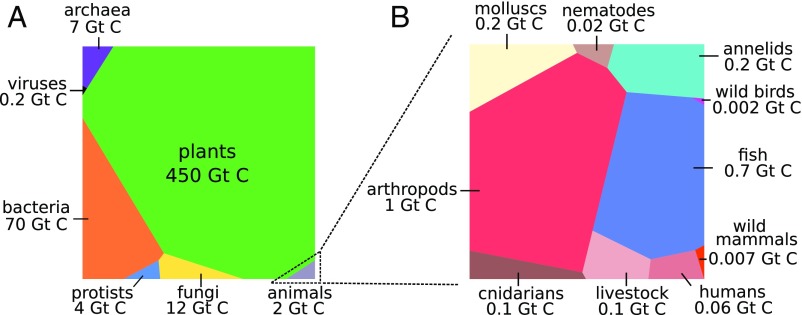
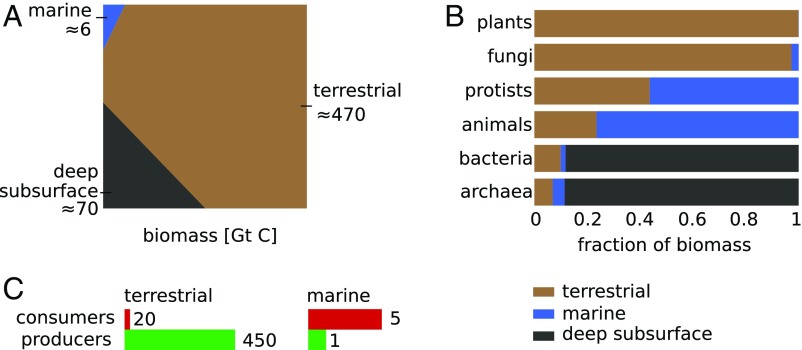
A census of the biomass on Earth is key for understanding the structure and dynamics of the biosphere. However, a global, quantitative view of how the biomass of different taxa compare with one another is still lacking. Here, we assemble the overall biomass composition of the biosphere, establishing a census of the ≈550 gigatons of carbon (Gt C) of biomass distributed among all of the kingdoms of life. We find that the kingdoms of life concentrate at different locations on the planet; plants (≈450 Gt C, the dominant kingdom) are primarily terrestrial, whereas animals (≈2 Gt C) are mainly marine, and bacteria (≈70 Gt C) and archaea (≈7 Gt C) are predominantly located in deep subsurface environments. We show that terrestrial biomass is about two orders of magnitude higher than marine biomass and estimate a total of ≈6 Gt C of marine biota, doubling the previous estimated quantity. Our analysis reveals that the global marine biomass pyramid contains more consumers than producers, thus increasing the scope of previous observations on inverse food pyramids. Finally, we highlight that the mass of humans is an order of magnitude higher than that of all wild mammals combined and report the historical impact of humanity on the global biomass of prominent taxa, including mammals, fish, and plants.
Overview
CoChat Summary
TL;DR
The paper assembles a global census of biomass across all kingdoms of life, estimating Earth’s total biomass at ≈550 Gt C, dominated by plants. It also compares biomass across environments and trophic modes, highlighting large uncertainties and human impacts on the biosphere.
Key findings
- Total global biomass is ≈550 Gt C, with plants ≈450 Gt C (≈80%), bacteria ≈70 Gt C (≈15%), fungi ≈12 Gt C, archaea ≈7 Gt C, protists ≈4 Gt C, animals ≈2 Gt C, and viruses ≈0.2 Gt C.
- Land biomass (≈470 Gt C) is about two orders of magnitude higher than marine biomass (≈6 Gt C); the deep subsurface holds ≈15% of total biomass, chiefly bacteria and archaea.
- In the ocean, ≈1 Gt C of primary producers supports ≈5 Gt C of consumer biomass, an inverted standing biomass distribution; marine biomass is ≈70% microbes, mainly bacteria and protists.
- Human-associated biomass is large relative to wild vertebrates: humans ≈0.06 Gt C, livestock ≈0.1 Gt C, wild mammals ≈0.007 Gt C, domesticated poultry ≈0.005 Gt C versus wild birds ≈0.002 Gt C; total plant biomass has declined approximately twofold relative to pre-human civilization.
Methods
- The authors synthesize hundreds of studies and generate estimates for major taxonomic groups, reporting biomass as gigatons of carbon (Gt C) and using a kingdom-level framework plus viruses.
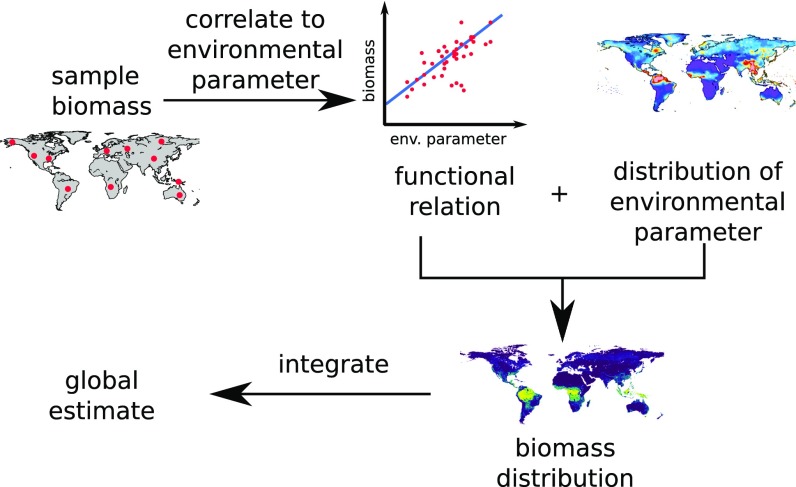
- For many taxa, local biomass samples are extrapolated globally by correlating biomass density with environmental parameters known at global scale; best estimates often use a geometric mean of independent estimates.
- Uncertainty is reported as multiplicative fold-change projections akin to 95% confidence intervals, incorporating intrastudy, interstudy, and intermethod variation; data and code are open-sourced.
Limitations
- The paper states that most datasets rely on fragmentary sampling, causing large uncertainties; sampling is scarce in the deep ocean (usually deeper than 200 m) and deep soil (usually deeper than 1 m), and some estimates may be biased by sampling toward high-abundance areas.
- The paper states that deep subsurface environments have particularly high uncertainty and unknown systematic biases, including unresolved distribution of biomass between aquifer fluids and rocks and among microbial taxa.
- The paper states that current and prehuman vertebrate biomass estimates are only a crude first step, amphibians remain poorly characterized, and parasite biomass is not resolved from hosts; evident from the text, kingdom-level grouping was chosen because much data lack finer taxonomic detail, and some uncertainty projections rely on analogous taxa or expert consultation.
Model-written summary. Check it against the paper before relying on it.
Integrity signals
Registry
Cites
Statistics
Figures
Verification
Claims the paper makes
9 Valid · 7 Not valid · 16 Not checked · 53 Own results and interpretations
Every source the paper cites for this claim was checked and supports it.
In the paper
“The biomass of amphibians, which are experiencing a dramatic population decline (42), remains poorly characterized.”
§ The biomass distribution on Earth > Discussion
What the sources say
- Supportedcites [42] Wake DB Vredenburg VT 2008 Colloquium paper: Are we in the midst of the sixth mass extinction? A view from the world of amphibians Proc Natl Acad Sci USA 105 11466 11473 18695221 PMC2556420 source
The citation is attached to the clause about amphibian population decline, not the separate statement that their biomass is poorly characterized. The passage reporting the Global Amphibian Assessment (labeled Abstract in our copy) says that 43% of amphibian species have declining populations. (LLM, conf=0.92)
plain- Asserted: passes — The authors put it forward as true.
- Checkable: passes — It can be checked against evidence.
- Load-bearing: unclear — It is unclear whether the paper’s conclusions depend on it.
- Based: passes — The paper gives a reason why it holds.
- Supported
Every source the paper cites for this claim was checked and supports it.
In the paper
“In the case of prokaryotes, some major improvements were recently realized, with global estimates of marine deep subsurface prokaryote biomass reduced by about two orders of magnitude due to an increased diversity of sampling locations (7).”
§ The biomass distribution on Earth > Discussion
What the sources say
- Supportedcites [7] Kallmeyer J Pockalny R Adhikari RR Smith DC D’Hondt S 2012 Global distribution of microbial abundance and biomass in subseafloor sediment Proc Natl Acad Sci USA 109 16213 16216 22927371 PMC3479597 source
The Discussion reports a revised subseafloor microbial biomass estimate of 4.1 Pg C versus a previous estimate of 303 Pg C—about a 74-fold reduction. It also identifies a more geographically diverse sampling database, including low-abundance ocean gyres, as a reason the new estimate is lower. The paper identifies other contributing factors as well. (LLM, conf=0.88)
plainstates a cause- Asserted: passes — The authors put it forward as true.
- Checkable: passes — It can be checked against evidence.
- Load-bearing: unclear — It is unclear whether the paper’s conclusions depend on it.
- Based: passes — The paper gives a reason why it holds.
- Supported
The sources with a verdict support this claim; the rest weren’t checked yet, have no full text we could read, or their verdicts aren’t rated yet.
In the paper
“Such inverted biomass distributions can occur when primary producers have a rapid turnover of biomass [on the order of days (34)], while consumer biomass turns over much more slowly [a few years in the case of mesopelagic fish (35)].”
§ The biomass distribution on Earth > Results > The Distribution of Biomass Across Environments and Trophic Modes.
What the sources say
- Supportedcites [34] Zubkov MV 2014 Faster growth of the major prokaryotic versus eukaryotic CO2 fixers in the oligotrophic ocean Nat Commun 5 3776 24777140 PMC4015317 source
The Results (Comparison of the growth rates of the CO2 fixers; page unavailable) report growth rates of 0.1–0.6 per day for the studied oceanic primary producers, consistent with biomass turnover on the order of days. The few-years estimate for mesopelagic fish is assigned to a different citation, not this source. (LLM, conf=0.91)
- Not checked — no full text of the sourcecites [35] Catul V Gauns M Karuppasamy PK 2011 A review on mesopelagic fishes belonging to family Myctophidae Rev Fish Biol Fish 21 339 354 source
plainstates a possible cause- Asserted: passes — The authors put it forward as true.
- Checkable: passes — It can be checked against evidence.
- Load-bearing: passes — The paper’s conclusions depend on it.
- Based: passes — The paper gives a reason why it holds.
- Supported
The cited sources support only part of this claim — read each source’s verdict below.
In the paper
“Combining data from independent sources such as these enables a robust assessment of the total plant biomass (17).”
§ The biomass distribution on Earth > Results > The Uncertainty Associated with Global Biomass Estimates.
What the sources say
- Partly supportedcites [17] Erb K-H 2017 Unexpectedly large impact of forest management and grazing on global vegetation biomass Nature 553 73 76 29258288 PMC5756473 sourceExperimental — accuracy not yet measured
The Methods describe combining multiple datasets and types of evidence to estimate global vegetation biomass stocks. But the paper also says global stocks remain uncertain, reports uncertainty ranges around 35% of the median estimate, and describes more robust estimates as a future prospect. It therefore supports the use of independent sources for an assessment, but not the unqualified characterization of that assessment as robust. (LLM, conf=0.84)
plainstates a cause- Asserted: passes — The authors put it forward as true.
- Checkable: passes — It can be checked against evidence.
- Load-bearing: passes — The paper’s conclusions depend on it.
- Based: passes — The paper gives a reason why it holds.
- Partly supported
A result the paper states — it cites no source for it, so there is none to check. The quote shows it is in the paper.
In the paper
“Plant biomass includes ≈70% stems and tree trunks, which are mostly woody, and thus relatively metabolically inert.”
§ The biomass distribution on Earth > Results > The Biomass Distribution of the Biosphere by Kingdom.
plain- Asserted: passes — The authors put it forward as true.
- Checkable: passes — It can be checked against evidence.
- Load-bearing: unclear — It is unclear whether the paper’s conclusions depend on it.
- Based: passes — The paper gives a reason why it holds.
27 more claims
Create a free account to see all 85 claims and to verify the 2 references still open.
- It may state two separate claims as one. 32
- Probably not a substantial claim. 28
Claims other papers make about this one
Each is checked against this paper’s own text: does it say what the citing paper says it does?
The cited source doesn’t support the claim as written.
In the citing paper
“and less than 10% that of the world ' s current human population ( 52 ).”
From Pervasive human-driven decline of life on Earth points to the need for transformative change (2019) · cites this paper as [52]
Checked by a reasoning model — may be wrong.
Experimental — accuracy not yet measuredThe cited source says what the claim attributes to it.
In the citing paper
“Approximately 450 Gt of C is bound up in terrestrial biota, primarily in plants (86), while only ~6 Gt of C is found in ocean biota (87).”
From Earth beyond six of nine planetary boundaries (2023) · cites this paper as [87]
The cited source says what the claim attributes to it.
In the citing paper
“The amount of metabolic energy available to a biosphere powered by O 2 is vast, such that the O 2 -rich ocean-atmosphere system of the modern Earth supports staggering levels of standing biomass (Bar-On et al. 2018), energy flow (Falkowski et al. 2008), and ecological complexity (Steele 1974).”
From The History of Ocean Oxygenation (2022) · cites this paper as Bar-On et al. 2018
In the citing paper
“Global populations of domestic ruminants (cattle, sheep, and goats) (Ripple et al. 2013) poultry, and pigs (Bennett et al. 2018) used to feed the growing human population now exceed 100 million tons of carbon (Bar-On et al. 2018), and livestock populations are growing rapidly.”
From Scientists’ warning to humanity on the freshwater biodiversity crisis (2021) · cites this paper as Bar-On et al. 2018
Citations
Cites
The worldwide leaf economics spectrum
Wright, I. J., Reich, P. B., Westoby, M., Ackerly, D. D., Baruch, Z., Bongers, F., Cavender-Bares, J., Chapin, T., Cornelissen, J. H. C., Diemer, M., et al. (2004) · Nature · doi:10.1038/nature02403 · Cited by 9,021 · cited 1×
“We then convert the total area of leaves to an estimate of the total dry mass of leaves by using the Glopnet database (24), which measured leaf mass per area (LMA) for ≈2500 plant species.”
MethodA large and persistent carbon sink in the world’s forests
Pan, Y., Birdsey, R. A., Fang, J., Houghton, R., Kauppi, P. E., Kurz, W. A., Phillips, O. L., Shvidenko, A., Lewis, S. L., Canadell, J. G., et al. (2011) · Science · doi:10.1126/science.1201609 · Cited by 8,458
Soil Sampling and Methods of Analysis
(2007) · CRC Press eBooks · doi:10.1201/9781420005271 · Cited by 6,469
Primary production of the biosphere: Integrating terrestrial and oceanic components
Field, C. B., Behrenfeld, M. J., Randerson, J. T., & Falkowski, P. (1998) · Science · doi:10.1126/science.281.5374.237 · Cited by 6,371
Prokaryotes: The unseen majority
Whitman, W. B., Coleman, D. C., & Wiebe, W. J. (1998) · Proceedings of the National Academy of Sciences · doi:10.1073/pnas.95.12.6578 · Cited by 4,871
Global effects of land use on local terrestrial biodiversity
Newbold, T., Hudson, L. N., Hill, S. L. L., Contu, S., Lysenko, I., Senior, R. A., Börger, L., Bennett, D. J., Choimes, A., Collen, B., et al. (2015) · Nature · doi:10.1038/nature14324 · Cited by 4,352
Belowground biodiversity and ecosystem functioning
Bardgett, R. D., & van der Putten, W. H. (2014) · Nature · doi:10.1038/nature13855 · Cited by 3,990 · cited 4×
“This was recommended by experts in the field for estimation of arbuscular mycorrhizal fungi abundance (117).”
BackgroundInfluentialMangroves among the most carbon-rich forests in the tropics
Donato, D. C., Kauffman, J. B., Murdiyarso, D., Kurnianto, S., Stidham, M., & Kanninen, M. (2011) · Nature Geoscience · doi:10.1038/ngeo1123 · Cited by 3,374
Poorter, H., Niklas, K. J., Reich, P. B., Oleksyn, J., Poot, P., & Mommer, L. (2012) · New Phytologist · doi:10.1111/j.1469-8137.2011.03952.x · Cited by 3,163 · cited 1×
“The first relies on a meta-analysis of the biomass allocation to different plant compartments across biomes (19).”
BackgroundA global analysis of root distributions for terrestrial biomes
Jackson, R. B., Canadell, J., Ehleringer, J. R., Mooney, H. A., Sala, O. E., & Schulze, E. D. (1996) · Oecologia · doi:10.1007/bf00333714 · Cited by 3,071 · cited 4×
“assumed the distribution of microbial biomass with depth follows the biomass density versus depth profile of root biomass (21).”
BackgroundMethodInfluential
Research works printed but not linked: 1
- Chapman AD 2009 Numbers of Living Species in Australia and the World Australian Biological Resources Study Canberra, Australia
Cited by
Items 1,501–1,600 of 3,742
Confronting the United Nations’ Pro-growth Agenda: A Call to Reverse Ecological Overshoot
Bajaj, N., Crist, E. L., & Stade, K. (2024) · The Journal of Population and Sustainability · doi:10.3197/jps.63799977346495 · Cited by 14
Du, Y., Zheng, X., Ma, Y., Ge, F., Li, Q., Xiang, H., Chen, X., Zhou, H., Sun, T., & Chen, T. (2024) · ACS Sustainable Chemistry & Engineering · doi:10.1021/acssuschemeng.4c04145 · Cited by 10
Zooarchaeology of Managed, Captive, Tame, and Domestic Birds: Shifts in Human–Avian Relationships
Yeomans, L. (2025) · Journal of Archaeological Research · doi:10.1007/s10814-024-09206-5 · Cited by 14
“A recent estimate of wild bird and poultry biomass (Bar-On et al. 2018) showed that the farmed birds comprise two and a half times the biomass of their wild relatives, demonstrating humanity’s profound influence on ecosystems.”
Kim, J. S., Romero, E. M., Cho, Y., et al. (2025) · The Journal of Microbiology · doi:10.71150/jm.2411029 · Cited by 8
Tracing the evolutionary pathway: on the origin of mitochondria and eukaryogenesis
Bravo‐Arévalo, J. E. (2025) · FEBS Journal · doi:10.1111/febs.70109 · Cited by 11
“This is evident in the plurality of multicellular organisms and the participation of eukaryotic life in nearly 86% of the total biomass on the planet [3,4].”
Impact of prophages on gut microbiota and disease associations
Mahmoud, A. A., Wang, X., Liao, X., Zhang, S., Ding, T., & Ahn, J. (2025) · Microbial Pathogenesis · doi:10.1016/j.micpath.2025.107642 · Cited by 10
Freshwater Phytoplankton: The Significant Ecosystems Services Provider in Aquatic Environment
Updhyay, D., Shukla, K., Mishra, A., & Shukla, S. (2025) · Green energy and technology · doi:10.1007/978-981-96-3993-9_9 · Cited by 15
Post K-Pg rise in ant and termite prevalence underlies convergent dietary specialization in mammals
Vida, T. P., Calamari, Z. T., & Barden, P. (2025) · Evolution · doi:10.1093/evolut/qpaf121 · Cited by 10
Lei, Y., Zhu, G., Liu, X., Wu, X., Fu, B., & Chen, Y. (2025) · Biomass and Bioenergy · doi:10.1016/j.biombioe.2025.108118 · Cited by 9
Vegetation height from L-band SAR backscatter and interferometric temporal coherence measurements
Telli, C., Lavalle, M., & Pierdicca, N. (2025) · Remote Sensing of Environment · doi:10.1016/j.rse.2025.114879 · Cited by 14
Movement of bacteria in the soil and the rhizosphere
Alexandre, G. M. (2025) · Applied and Environmental Microbiology · doi:10.1128/aem.00246-25 · Cited by 12
Li, B., An, L., Pu, S., et al. (2025) · Chemical Engineering Journal · doi:10.1016/j.cej.2025.170551 · Cited by 8
Švedovs, O., Sturmane, A., Feofilovs, M., Kirsanovs, V., & Romagnoli, F. (2025) · Biomass and Bioenergy · doi:10.1016/j.biombioe.2025.108880 · Cited by 11
Rubber-like DNA hydrogel enabled by fast-shrinking-induced entanglement
Lin, Z., 方树冉, HUANG, Q., Xiao, X., Jiang, J., Zhao, L., Wu, G., Zhang, G., Zhang, Z., & Wu, Y. (2026) · Nature Communications · doi:10.1038/s41467-026-68363-x · Cited by 12
“There are ~50 billion metric tons of biomass DNA on the Earth, and utilizing ~0.7% of it would be suf fi cient to replace the total annual production of synthetic polymers 8 .”
Influential‘Knowing-with’ in the era of the Anthropocene
Rantala, O., Höckert, E., & Ilola, H. (2019) · Matkailututkimus · doi:10.33351/mt.88263 · Cited by 15
The Global Carbon and Oxygen Cycles
Schlesinger, W. H., & Bernhardt, E. S. (2020) · Elsevier eBooks · doi:10.1016/b978-0-12-814608-8.00011-6 · Cited by 10
Diverse Bacteriophages Infecting the Bacterial Striped Catfish Pathogen Edwardsiella ictaluri
Nguyen, T.-T., Xuan, T. T. T., Ngoc, T. H., et al. (2021) · Microorganisms · doi:10.3390/microorganisms9091830 · Cited by 8
“Due to the fascinating biological properties of phages, they were ideally considered to be employed as natural bio-control agents in alternative methods to fight against the pathogenic bacteria [12,13].”
BackgroundMiller, R., Zimmer, A., Moutot, G., Mesnard, J.-M., & Chazal, N. (2021) · Viruses · doi:10.3390/v13112221 · Cited by 11
Chitin and Lignin: Old Polymers and New Bio-Tissue- Carriers
Morganti, P., Morganti, G., Yudin, V. E., & Chen, H. (2021) · Dermatology and Dermatitis · doi:10.31579/2578-8949/083 · Cited by 8
Fertility, Population Growth, and Population Composition
Skirbekk, V. (2022) · Springer eBooks · doi:10.1007/978-3-030-91611-4_18 · Cited by 9
High-pressure SAXS, deep life, and extreme biophysics
Gillilan, R. E. (2022) · Methods in enzymology on CD-ROM/Methods in enzymology · doi:10.1016/bs.mie.2022.08.025 · Cited by 6
Synthesis and Potential of Autoinducer‐2 and Analogs to Manipulate Inter‐Species Quorum Sensing
Rodrigues, M. V., Kis, P., Xavier, K. B., & Ventura, M. R. (2023) · Israel Journal of Chemistry · doi:10.1002/ijch.202200091 · Cited by 13
Okanishi, M., Kohtsuka, H., Wu, Q., et al. (2023) · Metabarcoding and Metagenomics · doi:10.3897/mbmg.7.94298 · Cited by 8
Campbell, N., Peacock, J., & Bacon, K. L. (2023) · PLoS ONE · doi:10.1371/journal.pone.0283386 · Cited by 8
“Plants account for over 80% of biomass on the planet [1] but many people struggle to identify even common plants in their own areas [2–5].”
BackgroundStephan, O. O. H. (2023) · Cytoskeleton · doi:10.1002/cm.21758 · Cited by 9
Burgold-Voigt, S., Monecke, S., Busch, A., Bocklisch, H., Braun, S. D., Diezel, C., Hotzel, H., Liebler–Tenorio, E., Müller, E., Reinicke, M., et al. (2023) · Pathogens · doi:10.3390/pathogens12050704 · Cited by 9
“Currently, domestic animals vastly outnumber wildlife species in terms of both head-count as well as biomass [67].”
BackgroundIndustrial fisheries have reversed the carbon sequestration by tuna carcasses into emissions
Mouillot, D., Derminon, S., Mariani, G., Senina, I. N., Fromentin, J., Lehodey, P., & Troussellier, M. (2023) · Global Change Biology · doi:10.1111/gcb.16823 · Cited by 12
Interactions between temperature and predation impact insect emergence in alpine lakes
Owens, C., Lee, M. J., Grim, M., Schroeder, J., & Young, H. S. (2023) · Ecosphere · doi:10.1002/ecs2.4619 · Cited by 12
“Insects make up as much as 30% of terrestrial animal biomass (Bar-On et al., 2018) and play critical roles in many ecosystem functions.”
BackgroundAvila-Santos, A. P., Nata’ala, M. K., Kasmanas, J. C., Bartholomäus, A., Keller‐Costa, T., Jurburg, S. D., Tal, T. L., Camarinha‐Silva, A., Saraiva, J., de Carvalho, A. C. P. L. F., et al. (2023) · Animal Microbiome · doi:10.1186/s42523-023-00267-3 · Cited by 10
“A study concerning biomass distribution on Earth [153] highlighted the impact of human civilization on global biomass through livestock.”
BackgroundChoquet, M., Lenner, F., Cocco, A., Toullec, G., Corre, E., Toullec, J., & Wållberg, A. (2023) · Molecular Biology and Evolution · doi:10.1093/molbev/msad225 · Cited by 8
“The large Antarctic krill Euphausia superba is among the most abundant animals on Earth (Bar-On et al. 2018) but does not appear to be hypervariable (Bortolotto et al. 2011; Shao et al. 2023).”
BackgroundCuevas, M., Moya, A. J., Hodaifa, G., Sánchez, S., & Mateo, S. (2024) · Environmental Research · doi:10.1016/j.envres.2024.118243 · Cited by 8
Bavachin Rejuvenates Sensitivity of Colistin against Colistin-Resistant Gram-Negative Bacteria
Li, J., Han, N., He, Z., Dai, X., Zhao, F., Li, Y., Xiong, W., & Zeng, Z. (2024) · International Journal of Molecular Sciences · doi:10.3390/ijms25042349 · Cited by 8
Pathways of megaherbivore rewilding transitions: typologies from an Andean gradient
Grau, H. R., Aráoz, E., Navarro, C. J., Nanni, A. S., & Malizia, A. (2020) · Elementa Science of the Anthropocene · doi:10.1525/elementa.415 · Cited by 8
Wick, L. Y. (2020) · The handbook of environmental chemistry · doi:10.1007/698_2020_568 · Cited by 8
Quantifying the classification of exoplanets: in search for the right habitability metric
Safonova, M., Mathur, A., Basak, S., Bora, K., & Agrawal, S. (2021) · The European Physical Journal Special Topics · doi:10.1140/epjs/s11734-021-00211-z · Cited by 12
Hornborg, A. (2021) · Sustainability · doi:10.3390/su13095009 · Cited by 10
“today, 59% are livestock; 36% humans; and less than 5% wild mammals, birds, reptiles, and amphibians [56].”
BackgroundThe selectionist rationale for evolutionary progress
Desmond, H. (2021) · Biology & Philosophy · doi:10.1007/s10539-021-09806-1 · Cited by 14
Hędrzak, M., Badach, E., & Kornaś, S. A. (2021) · Sustainability · doi:10.3390/su13126793 · Cited by 8
Bruns, M. A. (2021) · Elsevier eBooks · doi:10.1016/b978-0-12-820202-9.00005-8 · Cited by 13
Jiang, Y., Chen, J., Wang, J., Zeng, Q., Zhang, Z., & Zhu, D. (2021) · Journal of Soils and Sediments · doi:10.1007/s11368-021-02979-y · Cited by 8
Beacham, J. (2021) · Geographical Journal · doi:10.1111/geoj.12407 · Cited by 12
Reese, B. K., Sobol, M. S., Bowles, M. W., & Hinrichs, K. (2021) · Frontiers in Fungal Biology · doi:10.3389/ffunb.2021.727543 · Cited by 12
“8% of this biomass is made up of prokaryotes in the marine subsurface (Bar-On et al., 2018).”
BackgroundInfluentialSurvival in a Sea of Gradients: Bacterial and Archaeal Foraging in a Heterogeneous Ocean
Clerc, E. E., Raina, J., Peaudecerf, F. J., Seymour, J. R., & Stocker, R. (2022) · The microbiomes of humans, animals, plants, and the environment · doi:10.1007/978-3-030-90383-1_2 · Cited by 12
Islam, S. S., Xue, X., Caballero‐Solares, A., Bradbury, I., Rise, M. L., & Fleming, I. A. (2022) · Molecular Ecology · doi:10.1111/mec.16418 · Cited by 13
“The extent of subsequent genetic consequence of hybridization will be dependent on the relationship between wild and farmed strains resulting from both the degree of domestication selection and the ancestral relationship of farmed strains to wild populations (Baskett & Waples, 2013; Neff, 2004).”
BackgroundLi, Y., Wei, J., Yang, H., Zhang, D., & Hu, C. (2022) · Frontiers in Microbiology · doi:10.3389/fmicb.2022.848908 · Cited by 9
“Archaeal Community Distribution Patterns Were Associated With Different Attribute Environments Most archaea inhabit marine sediments and 8–5,000 m deep underground, accounting for approximately 20% of the total microbial community, while only 1% exists in the dryland topsoil with frequent WS changes, high light intens…”
BackgroundThe sixth R: Revitalizing the natural phosphorus pump
Abraham, A. J., Roman, J., & Doughty, C. E. (2022) · The Science of The Total Environment · doi:10.1016/j.scitotenv.2022.155023 · Cited by 10
Cohen, I. R., & Marron, A. (2020) · F1000Research · doi:10.12688/f1000research.24447.2 · Cited by 15
Plants and water in a changing world: a physiological and ecological perspective
Caferri, R., & Bassi, R. (2022) · RENDICONTI LINCEI · doi:10.1007/s12210-022-01084-7 · Cited by 12
National accounting scheme for biodiversity loss: An international trade perspective
Li, X., Xing, L., Zhang, Z., & Zhang, Y. (2022) · Frontiers in Environmental Science · doi:10.3389/fenvs.2022.1000970 · Cited by 9
“01% of global biomass, but they occupy 90% of the global biological activity area and destroy 83% of wild animals and 50% of plants (Bar-on et al., 2018).”
BackgroundLiu, T., Wang, P., Tian, J., Guo, J., Zhu, W., Seidi, F., Jin, Y., Xiao, H., & Song, J. (2022) · Bioresource Technology · doi:10.1016/j.biortech.2022.127904 · Cited by 9
Zhang, Y., Dekas, A., Hawkins, A. J., Primo, J. C., Gorbatenko, O. V., & Horne, R. N. (2022) · Water · doi:10.3390/w14182921 · Cited by 8
Estimating Aboveground Forest Biomass Using Radar Methods
Babiy, I. A., Im, S. T., & Kharuk, V. I. (2022) · Contemporary Problems of Ecology · doi:10.1134/s1995425522050031 · Cited by 10
“Quantitative descriptions of the distribution of biomass in general and forest biomass in particular are required to inventory biosequestered carbon and 433 model global biogeochemical cycles with the purpose of understanding historical and future impacts of human activities (Bar-On et al., 2018).”
BackgroundDesing, H. (2022) · Environmental Science Advances · doi:10.1039/d2va00168c · Cited by 12
Chemo‐Enzymatic Synthesis of Long‐Chain Oligosaccharides for Studying Xylan‐Modifying Enzymes
Álvarez‐Martínez, I., Ruprecht, C., Senf, D., Wang, H., Urbanowicz, B. R., & Pfrengle, F. (2023) · Chemistry - A European Journal · doi:10.1002/chem.202203941 · Cited by 9
Schrey, S. D., Diaz, J. M., Becker, L., et al. (2023) · Frontiers in Plant Science · doi:10.3389/fpls.2023.1191249 · Cited by 8
“Plant cell walls are the most abundant non-fossil carbon resource on earth (Bar-On et al., 2018).”
BackgroundNarvaes, I. D. S., dos Santos, J. R., Bispo, P. D. C., Graça, P. M. L. D. A., Guimarães, U. S., & Gama, F. F. (2023) · Forests · doi:10.3390/f14050941 · Cited by 9
Biogeography, Ecology, and Evolution of Deep Life
Magnabosco, C., Biddle, J. F., Cockell, C. S., Jungbluth, S. P., & Twing, K. I. (2019) · Cambridge University Press eBooks · doi:10.1017/9781108677950.017 · Cited by 12
“Cellular estimates for the subsurface (1,8 – 10), soils (11), oceans (9,11), and animal guts (9,12) are illustrated to show the relative sizes of each biome. addition of higher-energy electron acceptors such as nitrate (42).”
The Laegeren Site: An Augmented Forest Laboratory
Morsdorf, F., Schneider, F., Gullien, C., Kükenbrink, D., Leiterer, R., & Schaepman, M. E. (2020) · Springer eBooks · doi:10.1007/978-3-030-33157-3_4 · Cited by 10
Rucińska, A., Olszak, M., Świerszcz, S., Nobis, M., Zubek, S., Kusza, G. M., Boczkowska, M., & Nowak, A. S. (2021) · Biomolecules · doi:10.3390/biom11020318 · Cited by 9
“Due to the fact that the community composition has a major impact on the soil habitat and the rest of the biodiversity that resides within the belowground matrix [61], the high influence of vegetation type on the quality of DNA extracted from belowground biomass is potentially involved with roots exudates and microorg…”
BackgroundGroom, Q., Adriaens, T., Bertolino, S., Phelps, K. L., Poelen, J. H., Reeder, D. M., Richardson, D. M., Simmons, N. B., & Upham, N. S. (2021) · Biodiversity Data Journal · doi:10.3897/bdj.9.e65371 · Cited by 8
Ritter, C. D., Machado, A. F., Ribeiro, K. F., & Dunthorn, M. (2021) · Biota Neotropica · doi:10.1590/1676-0611-bn-2021-1214 · Cited by 11
Evolution of placentation in cattle and antelopes
Carter, A. M. (2019) · Animal Reproduction · doi:10.21451/1984-3143-ar2018-0145 · Cited by 15
Thrust and Power Output of the Bacterial Flagellar Motor: A Micromagnetic Tweezers Approach
Pierce, C. J., Osborne, E., Mumper, E., Lower, B. H., Lower, S. K., & Sooryakumar, R. (2019) · Biophysical Journal · doi:10.1016/j.bpj.2019.08.036 · Cited by 8
“~Fðr; z0Þ 1⁄4 ~V ~m , ~BCoFeðr; z0Þþ~BextðtÞ 1⁄4 cV Vm0~V ~BCoFeðr; z0Þ þ ~BextðtÞ (2): (2)”
Giant Virus-Eukaryote Interactions as Ecological and Evolutionary Driving Forces
Ku, C. (2021) · mSystems · doi:10.1128/msystems.00737-21 · Cited by 8
“up less than 1% of the biomass on our planet (2), they can pose public health concerns”
BackgroundEcological Integrity: Conceptual Foundations and Applications
Hughes, R. M. (2019) · Oxford University Press eBooks · doi:10.1093/obo/9780199363445-0113 · Cited by 20
Pawar, S. S., Huxley, P. J., Smallwood, T. R. C., Nesbit, M. L., Chan, A. H. H., Shocket, M. S., Johnson, L. R., Kontopoulos, D. ‐. G., & Cator, L. J. (2023) · bioRxiv (Cold Spring Harbor Laboratory) · doi:10.1101/2023.01.18.524448 · Cited by 8
Camtrap DP: An open standard for the FAIR exchange and archiving of camera trap dataPreprint
Bubnicki, J. W., Norton, B., Baskauf, S., Bruce, T., Cagnacci, F., Casaer, J., Churski, M., Cromsigt, J. P. G. M., Farra, S. D., Fiderer, C., et al. (2023) · doi:10.32942/x2bc8j · Cited by 8
Huang, T., Hu, Q., Yan, S., Anglés, A., & Fernández‐Remolar, D. C. (2023) · Elsevier eBooks · doi:10.1016/b978-0-12-822562-2.00347-9 · Cited by 13
Schadt, C. W., Martin, S., Carrell, A. A., et al. (2024) · Scientific Data · doi:10.1038/s41597-024-03069-7 · Cited by 8
Divonne, S. D. L. F., Pouzadoux, J., Romatif, O., Montagnani, C., Mitta, G., Destoumieux‐Garzón, D., Gourbal, B., Charrière, G. M., & Vignal, E. (2025) · eLife · doi:10.7554/elife.102622 · Cited by 16
Vandvik, V., Halbritter, A. H., Macias‐Fauria, M., et al. (2025) · Scientific Data · doi:10.1038/s41597-025-05509-4 · Cited by 8
Sustainable bioremediation through microbial community design and smart ecological monitoring
Pegu, D., Sarkar, S., Kumar, A. A., & Teronpi, V. (2025) · Annals of Microbiology · doi:10.1186/s13213-025-01831-9 · Cited by 10
“Balanced microbial eco-systems that can prevent pathogens from establishing or largely reduce their impact are the characteristics of these beneficial soils (Bar-On et al. 2018; Doran & Zeiss 2000).”
Non-Additive Axiologies in Large Worlds
Tarsney, C. J., & Thomas, J. T. (2024) · Ergo an Open Access Journal of Philosophy · doi:10.3998/ergo.5714 · Cited by 9
“6Total utilitarianism is arguably endorsed (with varying degrees of clarity and explicitness) by classical utilitarians like Hutcheson (1738), Bentham (1789), Mill (1863), and Sidgwick (1874), and has more recently been defended by Hudson (1987), de Lazari-Radek and Singer (2014), and Gustafsson (2020), among others.”
BackgroundForest Landscape Restoration and Sustainable Biomass Utilization in Central Asia
Thevs, N. (2016) · MDPI eBooks · doi:10.3390/books978-3-03897-879-4-7 · Cited by 6
Agency, Teleonomy, Purpose, and Evolutionary Change in Plant Systems
TREWAVAS, A. J. (2023) · The MIT Press eBooks · doi:10.7551/mitpress/14642.003.0019 · Cited by 7
Jákói, Z., Lemmer, B., Dobozi, R., Hodúr, C., & Beszédes, S. (2023) · Fermentation · doi:10.3390/fermentation9100902 · Cited by 9
Global trends and future prospects of lactic acid production from lignocellulosic biomass
Yue, S., & Zhang, M. (2023) · RSC Advances · doi:10.1039/d3ra06577d · Cited by 9
Detection of Zika Virus by the Development of a Colloidal Gold Nanoparticle-Based Immunosensor
Cuapa-González, M. A., Santos‐López, G., Orduña-Díaz, A., Martínez‐Gutiérrez, H., & Rojas‐López, M. (2024) · Analytical Letters · doi:10.1080/00032719.2024.2313708 · Cited by 10
“Viruses, infectious entities that infect a broad spectrum of organisms, including bacteria, plants, and animals, constitute approximately 0.16% of the biomass (Bar-On, Phillips, and Milo 2018).”
InfluentialSuccessional changes in bacterial phyllosphere communities are plant-host species dependent
Bechtold, E. K., Wanek, W., Nuesslein, B., DaCosta, M., & Nüsslein, K. R. (2024) · Applied and Environmental Microbiology · doi:10.1128/aem.01750-23 · Cited by 11
“Recent studies have estimated that plants and bacteria are the two leading sources of biomass on earth (16).”
BackgroundDefensive glands in Stylotermitidae (Blattodea, Isoptera)
Thakur, H., Agarwal, S., Buček, A., et al. (2024) · Arthropod Structure & Development · doi:10.1016/j.asd.2024.101346 · Cited by 7
The challenge of estimating global termite methane emissions
Law, S. J., Allison, S., Davies, A. B., Flores‐Moreno, H., Wijas, B. J., Yatsko, A. R., Zhou, Y., Zanne, A. E., & Eggleton, P. (2024) · Global Change Biology · doi:10.1111/gcb.17390 · Cited by 15
“The global biomass of termites, estimated at approximately 0.8 Gt and equivalent to that of livestock (Bar-On et al., 2018; Rosenberg et al., 2023), is concentrated in tropical latitudes where emissions from methanogenic bacteria are the highest (Chandra et al., 2024), so termites are potentially…”
BackgroundInfluentialImpacts of Vertical Migrants on Biogeochemistry in an Earth System Model
Getzlaff, J., & Kriest, I. (2024) · Global Biogeochemical Cycles · doi:10.1029/2023gb007842 · Cited by 9
“Although biomass estimates of mesopelagic fish are not well constrained and range from early estimates of 1 Gt (Gjøsæter & Kawaguchi, 1980) to more recent estimates of ∼ 10 Gt (Irigoien et al., 2014), these estimated are close or even larger than estimates of the epipelagic fish biomass (Bar‐”
Grant, E. H. C., Fleming, J., Bastiaans, E., Brand, A. B., Brooks, J. L., Devlin, C. M., Epp, K., Evans, M., Fisher‐Reid, M. C., Gratwicke, B., et al. (2024) · Biology Letters · doi:10.1098/rsbl.2024.0033 · Cited by 12
Այվազյան, Գ., Muradyan, V. S., Medvedev, A., Khlghatyan, A., & Asmaryan, S. (2024) · Applied Sciences · doi:10.3390/app142210205 · Cited by 10
Tachioka, M., Tsudome, M., Tsuda, M., Hiraoka, S., Miyazaki, M., Takaki, Y., & Deguchi, S. (2024) · Journal of Wood Science · doi:10.1186/s10086-024-02168-8 · Cited by 8
“Land plants, especially those with significant woody biomass such as stems and trunks, represent the largest biomass on Earth [1].”
Earth's most needed uncultivated aquatic prokaryotes
Simon, S. A., Aschmann, V., Behrendt, A., Hügler, M., Engl, L. M., Pohlner, M., Rolfes, S., Brinkhoff, T., Engelen, B., Könneke, M., et al. (2024) · Water Research · doi:10.1016/j.watres.2024.122928 · Cited by 10
SPECTRE : Standardised Global Spatial Data on Terrestrial SPecies and ECosystems ThREats
Branco, V. V., Capinha, C., Rocha, J., Correia, L. M. P., & Cardoso, P. (2024) · Global Ecology and Biogeography · doi:10.1111/geb.13949 · Cited by 13
Time-series forest age estimation in Xinjiang based on forest disturbance and recovery detection
Zhai, L., Zan, M., Ye, M., Jia, Z., Xue, C., Yang, S., & Liu, Y. (2025) · Ecological Indicators · doi:10.1016/j.ecolind.2024.113043 · Cited by 8
Ilmiawati, A., Solikhin, A., Mangurai, S. U. N. M., Setiawan, Y. A., Istikorini, Y., Lowe, A. J., Malik, A., Mubarok, M., Herawati, E., Khabibi, J., et al. (2025) · International Journal of Biological Macromolecules · doi:10.1016/j.ijbiomac.2025.140305 · Cited by 8
A novel framework for phytoplankton biomonitoring: Trait assignment of 23S rRNA sequences
Tapolczai, K., Rimet, F., Ćirić, M. D., Ballot, A., Laplace-Treyture, C., & Alric, B. (2025) · Ecological Indicators · doi:10.1016/j.ecolind.2025.113361 · Cited by 10
The Viability of Glycine Fermentation in Titan’s Subsurface Ocean
Affholder, A., Higgins, P. M., Cockell, C. S., Neish, C. D., Soderlund, K. M., Malaska, M. J., Farnsworth, K., Lopes, R. M. C., Nixon, C. A., Daswani, M. M., et al. (2025) · The Planetary Science Journal · doi:10.3847/psj/adbc66 · Cited by 9
Irfan, J. A., Charulatha, G., Mary, L. M., Ramanamoorthy, S., Karthikeyan, C., Saravanakumar, N. K., Manikandan, G., Jayaprakash, J., & Palani, K. N. (2025) · Future Batteries · doi:10.1016/j.fub.2025.100077 · Cited by 12
Sternberg, J., Sequerth, O., & Pilla, S. (2025) · Polymer · doi:10.1016/j.polymer.2025.128516 · Cited by 7
Plant microbiome for soil borne pathogen – current status and future challenges
Chandrasekaran, S. D., Kathithachalam, A., Iruthayasamy, J., Muthusamy, K., Ramachandran, K., & Poorniammal, R. (2025) · Physiological and Molecular Plant Pathology · doi:10.1016/j.pmpp.2025.102827 · Cited by 12
Robache, K., Hubert, Z., Gallot, C., et al. (2025) · Ocean science · doi:10.5194/os-21-1787-2025 · Cited by 7
Zheng, Z., Li, X., Huang, S., Wang, X., Jia, X., Wang, H., Zhou, J., & Ma, L. (2025) · Environment International · doi:10.1016/j.envint.2025.109752 · Cited by 7
Adjusting the management of the Antarctic krill fishery to meet the challenges of the 21st century
Meyer, B., Arata, J. A., Atkinson, A., Bahlburg, D., Bernard, K. S., Cárdenas, C. A., Grant, S. M., Hill, S. L., Hüppe, L., Ichii, T., et al. (2025) · Proceedings of the National Academy of Sciences · doi:10.1073/pnas.2412624122 · Cited by 8
Eukaryogenesis From FECA to LECA: Radical Steps Along the Way
Speijer, D. (2025) · BioEssays · doi:10.1002/bies.70063 · Cited by 11
A global deep terrestrial biosphere core microbiome
González, C., Somee, M. R., Buck, M., Bertilsson, S., Mehrshad, M., & Dopson, M. (2025) · ISME Communications · doi:10.1093/ismeco/ycaf176 · Cited by 7
“Estimates suggest that the deep subsurface hosts circa 90% of the total bacteria and archaea biomass, accounting for ∼ 10%–20% of the Earth’s total biomass [12, 13].”
Memory in the wall: expanding our understanding of the roles of plant cell walls
Shikata, H., Yoshinari, A., Asaoka, M., & Takahashi, D. (2025) · New Phytologist · doi:10.1111/nph.70677 · Cited by 10
Metadata
- Authors
- Bar-On, Y. M., Phillips, R., & Milo, R.
- Affiliations
- Department of Plant and Environmental Sciences, Weizmann Institute of Science, 76100 Rehovot, Israel;
- California Institute of Technology (US)
- Weizmann Institute of Science (IL)
- Corresponding author
- Milo, Ron
- Venue
- Proceedings of the National Academy of Sciences
- Publisher
- National Academy of Sciences
- Published
- 2018-05-21
- Volume
- 115
- Issue
- 25
- Pages
- 6506-6511
- ISSN
- 0027-8424 (ISSN-L)
- 1091-6490
- PMC
- PMC6016768
- OpenAlex
- W2804910112
- Cited by
- 3,723
- References
- 263
- Citations by year
- 2026: 349 · 2025: 450 · 2024: 589 · 2023: 617 · 2022: 498 · 2021: 498 · 2020: 419 · 2019: 246 · 2018: 49
- FWCI
- 239.98
- Type
- journal article
- Language
- en
- Open access
- hybrid
- doi.org
- Licence
- Locations
- Proceedings of the National Academy of Sciences (publishedVersion, cc-by-nc-nd)
- Europe PMC (PubMed Central) (publishedVersion, cc-by-nc-nd)
- PubMed Central (publishedVersion, cc-by-nc-nd)
- PubMed (publishedVersion)
- CaltechAUTHORS (California Institute of Technology) (submittedVersion, cc-by-nc-nd)
- Funders
- National Institutes of Health (5r35gm118043-07)
- National Institute of General Medical Sciences (R35 GM118043)
- Topics
- Physical Sciences › Environmental Science › Nature and Landscape Conservation › Ecology and Vegetation Dynamics Studies
- Physical Sciences › Environmental Science › Global and Planetary Change › Earth Systems and Cosmic Evolution
- Life Sciences › Agricultural and Biological Sciences › Soil Science › Soil Carbon and Nitrogen Dynamics
- Keywords
- biomass allocation, biomass carbon, terrestrial biomass, marine biomass, bacteria, archaea, food pyramid, wild mammals, fish biomass, plant biomass
- MeSH terms
- Animals, Archaea, Bacteria, Carbon, Humans, Plants, Ecosystem, Biomass, Earth, Planet, Biota
About these checks
Registry, retraction, Cites and statistics results are computed, not judged, with one exception: a printed reference that no index lists is read once by a model before it counts as a citation error. Claims are extracted by a model and kept only when their quote appears verbatim in the text; each cited source is then checked, with a model’s help, for whether it says what the claim relies on. Those verdicts can be wrong — read the claim’s quote and the cited source before relying on one.
The claim verdicts this report counts are experimental: their accuracy is not yet measured.
A language model drew the claims from the paper on 2026-10-10, under version 3 of the claim definition (model deepseek-v4.1-flash, prompt extract-v3).
A second model labelled each claim on 2026-10-10 (model jev-1.13-20260917, definition revision gold-guideline-v0.2).
Cited sources are checked with a language model’s help (gpt-6-sol).
Statistics and arithmetic are recomputed, not judged.
Confidence bands are shown only for fields calibrated on our annotated test set. None is calibrated yet, so no band is shown.
What counts as a claim ›How we measure confidence ›How we check this ›
Are you an author, or do you see a problem with this page? Request a review
Data sources
Bibliographic data: Semantic Scholar, OpenAlex, Crossref.
Contains information from the Semantic Scholar Academic Graph Datasets, made available under the ODC Attribution License (ODC-BY 1.0).
Semantic Scholar’s data is described in: Kinney, R., et al. (2023). The Semantic Scholar Open Data Platform. arXiv:2301.10140.
