

The biomass distribution on Earth
Open accessThe DOI matches its Crossref record; 263 of the 263 references it cites were found in a registry or an index; 11 of the 41 sources its claims cite were checked for support.
Abstract
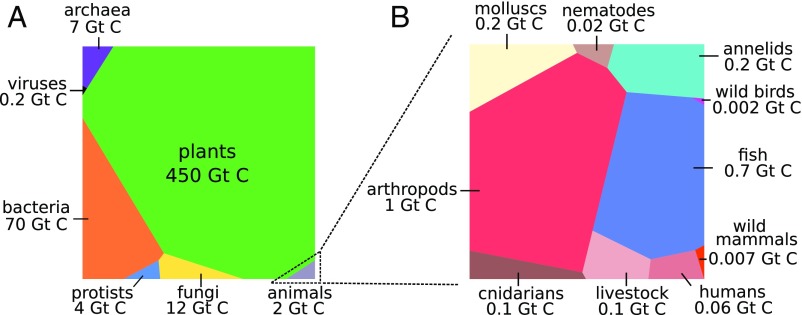
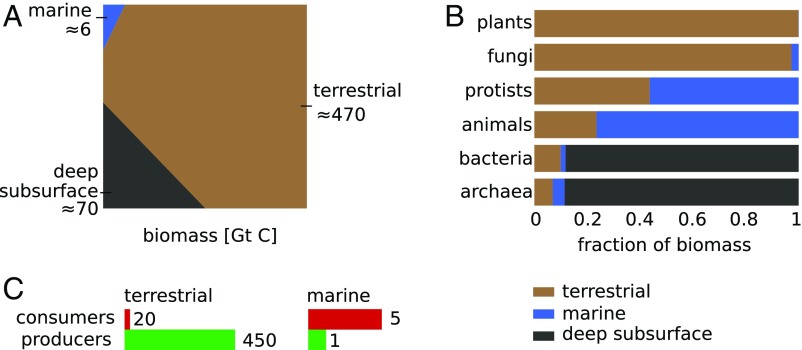
A census of the biomass on Earth is key for understanding the structure and dynamics of the biosphere. However, a global, quantitative view of how the biomass of different taxa compare with one another is still lacking. Here, we assemble the overall biomass composition of the biosphere, establishing a census of the ≈550 gigatons of carbon (Gt C) of biomass distributed among all of the kingdoms of life. We find that the kingdoms of life concentrate at different locations on the planet; plants (≈450 Gt C, the dominant kingdom) are primarily terrestrial, whereas animals (≈2 Gt C) are mainly marine, and bacteria (≈70 Gt C) and archaea (≈7 Gt C) are predominantly located in deep subsurface environments. We show that terrestrial biomass is about two orders of magnitude higher than marine biomass and estimate a total of ≈6 Gt C of marine biota, doubling the previous estimated quantity. Our analysis reveals that the global marine biomass pyramid contains more consumers than producers, thus increasing the scope of previous observations on inverse food pyramids. Finally, we highlight that the mass of humans is an order of magnitude higher than that of all wild mammals combined and report the historical impact of humanity on the global biomass of prominent taxa, including mammals, fish, and plants.
Overview
CoChat Summary
TL;DR
The paper assembles a global census of biomass across all kingdoms of life, estimating Earth’s total biomass at ≈550 Gt C, dominated by plants. It also compares biomass across environments and trophic modes, highlighting large uncertainties and human impacts on the biosphere.
Key findings
- Total global biomass is ≈550 Gt C, with plants ≈450 Gt C (≈80%), bacteria ≈70 Gt C (≈15%), fungi ≈12 Gt C, archaea ≈7 Gt C, protists ≈4 Gt C, animals ≈2 Gt C, and viruses ≈0.2 Gt C.
- Land biomass (≈470 Gt C) is about two orders of magnitude higher than marine biomass (≈6 Gt C); the deep subsurface holds ≈15% of total biomass, chiefly bacteria and archaea.
- In the ocean, ≈1 Gt C of primary producers supports ≈5 Gt C of consumer biomass, an inverted standing biomass distribution; marine biomass is ≈70% microbes, mainly bacteria and protists.
- Human-associated biomass is large relative to wild vertebrates: humans ≈0.06 Gt C, livestock ≈0.1 Gt C, wild mammals ≈0.007 Gt C, domesticated poultry ≈0.005 Gt C versus wild birds ≈0.002 Gt C; total plant biomass has declined approximately twofold relative to pre-human civilization.
Methods
- The authors synthesize hundreds of studies and generate estimates for major taxonomic groups, reporting biomass as gigatons of carbon (Gt C) and using a kingdom-level framework plus viruses.
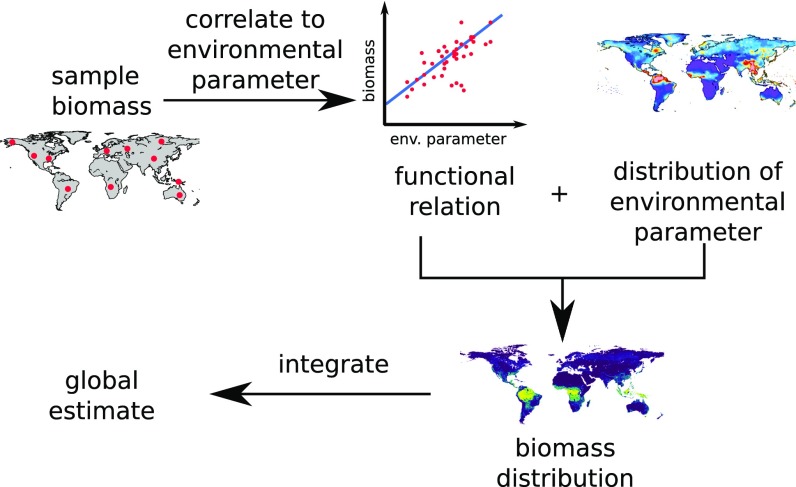
- For many taxa, local biomass samples are extrapolated globally by correlating biomass density with environmental parameters known at global scale; best estimates often use a geometric mean of independent estimates.
- Uncertainty is reported as multiplicative fold-change projections akin to 95% confidence intervals, incorporating intrastudy, interstudy, and intermethod variation; data and code are open-sourced.
Limitations
- The paper states that most datasets rely on fragmentary sampling, causing large uncertainties; sampling is scarce in the deep ocean (usually deeper than 200 m) and deep soil (usually deeper than 1 m), and some estimates may be biased by sampling toward high-abundance areas.
- The paper states that deep subsurface environments have particularly high uncertainty and unknown systematic biases, including unresolved distribution of biomass between aquifer fluids and rocks and among microbial taxa.
- The paper states that current and prehuman vertebrate biomass estimates are only a crude first step, amphibians remain poorly characterized, and parasite biomass is not resolved from hosts; evident from the text, kingdom-level grouping was chosen because much data lack finer taxonomic detail, and some uncertainty projections rely on analogous taxa or expert consultation.
Model-written summary. Check it against the paper before relying on it.
Integrity signals
Registry
Cites
Statistics
Figures
Verification
Claims the paper makes
9 Valid · 7 Not valid · 16 Not checked · 53 Own results and interpretations
Every source the paper cites for this claim was checked and supports it.
In the paper
“The biomass of amphibians, which are experiencing a dramatic population decline (42), remains poorly characterized.”
§ The biomass distribution on Earth > Discussion
What the sources say
- Supportedcites [42] Wake DB Vredenburg VT 2008 Colloquium paper: Are we in the midst of the sixth mass extinction? A view from the world of amphibians Proc Natl Acad Sci USA 105 11466 11473 18695221 PMC2556420 source
The citation is attached to the clause about amphibian population decline, not the separate statement that their biomass is poorly characterized. The passage reporting the Global Amphibian Assessment (labeled Abstract in our copy) says that 43% of amphibian species have declining populations. (LLM, conf=0.92)
plain- Asserted: passes — The authors put it forward as true.
- Checkable: passes — It can be checked against evidence.
- Load-bearing: unclear — It is unclear whether the paper’s conclusions depend on it.
- Based: passes — The paper gives a reason why it holds.
- Supported
Every source the paper cites for this claim was checked and supports it.
In the paper
“In the case of prokaryotes, some major improvements were recently realized, with global estimates of marine deep subsurface prokaryote biomass reduced by about two orders of magnitude due to an increased diversity of sampling locations (7).”
§ The biomass distribution on Earth > Discussion
What the sources say
- Supportedcites [7] Kallmeyer J Pockalny R Adhikari RR Smith DC D’Hondt S 2012 Global distribution of microbial abundance and biomass in subseafloor sediment Proc Natl Acad Sci USA 109 16213 16216 22927371 PMC3479597 source
The Discussion reports a revised subseafloor microbial biomass estimate of 4.1 Pg C versus a previous estimate of 303 Pg C—about a 74-fold reduction. It also identifies a more geographically diverse sampling database, including low-abundance ocean gyres, as a reason the new estimate is lower. The paper identifies other contributing factors as well. (LLM, conf=0.88)
plainstates a cause- Asserted: passes — The authors put it forward as true.
- Checkable: passes — It can be checked against evidence.
- Load-bearing: unclear — It is unclear whether the paper’s conclusions depend on it.
- Based: passes — The paper gives a reason why it holds.
- Supported
The sources with a verdict support this claim; the rest weren’t checked yet, have no full text we could read, or their verdicts aren’t rated yet.
In the paper
“Such inverted biomass distributions can occur when primary producers have a rapid turnover of biomass [on the order of days (34)], while consumer biomass turns over much more slowly [a few years in the case of mesopelagic fish (35)].”
§ The biomass distribution on Earth > Results > The Distribution of Biomass Across Environments and Trophic Modes.
What the sources say
- Supportedcites [34] Zubkov MV 2014 Faster growth of the major prokaryotic versus eukaryotic CO2 fixers in the oligotrophic ocean Nat Commun 5 3776 24777140 PMC4015317 source
The Results (Comparison of the growth rates of the CO2 fixers; page unavailable) report growth rates of 0.1–0.6 per day for the studied oceanic primary producers, consistent with biomass turnover on the order of days. The few-years estimate for mesopelagic fish is assigned to a different citation, not this source. (LLM, conf=0.91)
- Not checked — no full text of the sourcecites [35] Catul V Gauns M Karuppasamy PK 2011 A review on mesopelagic fishes belonging to family Myctophidae Rev Fish Biol Fish 21 339 354 source
plainstates a possible cause- Asserted: passes — The authors put it forward as true.
- Checkable: passes — It can be checked against evidence.
- Load-bearing: passes — The paper’s conclusions depend on it.
- Based: passes — The paper gives a reason why it holds.
- Supported
The cited sources support only part of this claim — read each source’s verdict below.
In the paper
“Combining data from independent sources such as these enables a robust assessment of the total plant biomass (17).”
§ The biomass distribution on Earth > Results > The Uncertainty Associated with Global Biomass Estimates.
What the sources say
- Partly supportedcites [17] Erb K-H 2017 Unexpectedly large impact of forest management and grazing on global vegetation biomass Nature 553 73 76 29258288 PMC5756473 sourceExperimental — accuracy not yet measured
The Methods describe combining multiple datasets and types of evidence to estimate global vegetation biomass stocks. But the paper also says global stocks remain uncertain, reports uncertainty ranges around 35% of the median estimate, and describes more robust estimates as a future prospect. It therefore supports the use of independent sources for an assessment, but not the unqualified characterization of that assessment as robust. (LLM, conf=0.84)
plainstates a cause- Asserted: passes — The authors put it forward as true.
- Checkable: passes — It can be checked against evidence.
- Load-bearing: passes — The paper’s conclusions depend on it.
- Based: passes — The paper gives a reason why it holds.
- Partly supported
A result the paper states — it cites no source for it, so there is none to check. The quote shows it is in the paper.
In the paper
“Plant biomass includes ≈70% stems and tree trunks, which are mostly woody, and thus relatively metabolically inert.”
§ The biomass distribution on Earth > Results > The Biomass Distribution of the Biosphere by Kingdom.
plain- Asserted: passes — The authors put it forward as true.
- Checkable: passes — It can be checked against evidence.
- Load-bearing: unclear — It is unclear whether the paper’s conclusions depend on it.
- Based: passes — The paper gives a reason why it holds.
27 more claims
Create a free account to see all 85 claims and to verify the 2 references still open.
- It may state two separate claims as one. 32
- Probably not a substantial claim. 28
Claims other papers make about this one
Each is checked against this paper’s own text: does it say what the citing paper says it does?
The cited source doesn’t support the claim as written.
In the citing paper
“and less than 10% that of the world ' s current human population ( 52 ).”
From Pervasive human-driven decline of life on Earth points to the need for transformative change (2019) · cites this paper as [52]
Checked by a reasoning model — may be wrong.
Experimental — accuracy not yet measuredThe cited source says what the claim attributes to it.
In the citing paper
“Approximately 450 Gt of C is bound up in terrestrial biota, primarily in plants (86), while only ~6 Gt of C is found in ocean biota (87).”
From Earth beyond six of nine planetary boundaries (2023) · cites this paper as [87]
The cited source says what the claim attributes to it.
In the citing paper
“The amount of metabolic energy available to a biosphere powered by O 2 is vast, such that the O 2 -rich ocean-atmosphere system of the modern Earth supports staggering levels of standing biomass (Bar-On et al. 2018), energy flow (Falkowski et al. 2008), and ecological complexity (Steele 1974).”
From The History of Ocean Oxygenation (2022) · cites this paper as Bar-On et al. 2018
In the citing paper
“Global populations of domestic ruminants (cattle, sheep, and goats) (Ripple et al. 2013) poultry, and pigs (Bennett et al. 2018) used to feed the growing human population now exceed 100 million tons of carbon (Bar-On et al. 2018), and livestock populations are growing rapidly.”
From Scientists’ warning to humanity on the freshwater biodiversity crisis (2021) · cites this paper as Bar-On et al. 2018
Citations
Cites
The worldwide leaf economics spectrum
Wright, I. J., Reich, P. B., Westoby, M., Ackerly, D. D., Baruch, Z., Bongers, F., Cavender-Bares, J., Chapin, T., Cornelissen, J. H. C., Diemer, M., et al. (2004) · Nature · doi:10.1038/nature02403 · Cited by 9,021 · cited 1×
“We then convert the total area of leaves to an estimate of the total dry mass of leaves by using the Glopnet database (24), which measured leaf mass per area (LMA) for ≈2500 plant species.”
MethodA large and persistent carbon sink in the world’s forests
Pan, Y., Birdsey, R. A., Fang, J., Houghton, R., Kauppi, P. E., Kurz, W. A., Phillips, O. L., Shvidenko, A., Lewis, S. L., Canadell, J. G., et al. (2011) · Science · doi:10.1126/science.1201609 · Cited by 8,458
Soil Sampling and Methods of Analysis
(2007) · CRC Press eBooks · doi:10.1201/9781420005271 · Cited by 6,469
Primary production of the biosphere: Integrating terrestrial and oceanic components
Field, C. B., Behrenfeld, M. J., Randerson, J. T., & Falkowski, P. (1998) · Science · doi:10.1126/science.281.5374.237 · Cited by 6,371
Prokaryotes: The unseen majority
Whitman, W. B., Coleman, D. C., & Wiebe, W. J. (1998) · Proceedings of the National Academy of Sciences · doi:10.1073/pnas.95.12.6578 · Cited by 4,871
Global effects of land use on local terrestrial biodiversity
Newbold, T., Hudson, L. N., Hill, S. L. L., Contu, S., Lysenko, I., Senior, R. A., Börger, L., Bennett, D. J., Choimes, A., Collen, B., et al. (2015) · Nature · doi:10.1038/nature14324 · Cited by 4,352
Belowground biodiversity and ecosystem functioning
Bardgett, R. D., & van der Putten, W. H. (2014) · Nature · doi:10.1038/nature13855 · Cited by 3,990 · cited 4×
“This was recommended by experts in the field for estimation of arbuscular mycorrhizal fungi abundance (117).”
BackgroundInfluentialMangroves among the most carbon-rich forests in the tropics
Donato, D. C., Kauffman, J. B., Murdiyarso, D., Kurnianto, S., Stidham, M., & Kanninen, M. (2011) · Nature Geoscience · doi:10.1038/ngeo1123 · Cited by 3,374
Poorter, H., Niklas, K. J., Reich, P. B., Oleksyn, J., Poot, P., & Mommer, L. (2012) · New Phytologist · doi:10.1111/j.1469-8137.2011.03952.x · Cited by 3,163 · cited 1×
“The first relies on a meta-analysis of the biomass allocation to different plant compartments across biomes (19).”
BackgroundA global analysis of root distributions for terrestrial biomes
Jackson, R. B., Canadell, J., Ehleringer, J. R., Mooney, H. A., Sala, O. E., & Schulze, E. D. (1996) · Oecologia · doi:10.1007/bf00333714 · Cited by 3,071 · cited 4×
“assumed the distribution of microbial biomass with depth follows the biomass density versus depth profile of root biomass (21).”
BackgroundMethodInfluential
Research works printed but not linked: 1
- Chapman AD 2009 Numbers of Living Species in Australia and the World Australian Biological Resources Study Canberra, Australia
Cited by
Items 101–200 of 3,743
Humboldt and the reinvention of nature
Pausas, J. G., & Bond, W. J. (2019) · Journal of Ecology · doi:10.1111/1365-2745.13109 · Cited by 185
Extinction in the Anthropocene
Turvey, S. T., & Crees, J. J. (2019) · Current Biology · doi:10.1016/j.cub.2019.07.040 · Cited by 181
The use of machine learning methods to estimate aboveground biomass of grasslands: A review
Morais, T. G., Teixeira, R. F. M., Figueiredo, M., & Domingos, T. (2021) · Ecological Indicators · doi:10.1016/j.ecolind.2021.108081 · Cited by 180
Recent advances in lithium-sulfur batteries using biomass-derived carbons as sulfur host
Benítez, A., Amaro-Gahete, J., Chien, Y.-C., Caballero, Á., Morales, J., & Brandell, D. (2022) · Renewable and Sustainable Energy Reviews · doi:10.1016/j.rser.2021.111783 · Cited by 177
“The estimate of animal biomass production worldwide is 2 Gt, which is a significantly lower figure compared to plants, bacteria and fungi (532 Gt) [65].”
BackgroundTrophic rewilding can expand natural climate solutions
Schmitz, O. J., Sylvén, M., Atwood, T. B., Bakker, E. S., Berzaghi, F., Brodie, J. F., Cromsigt, J. P. G. M., Davies, A. B., Leroux, S. J., Schepers, F. J., et al. (2023) · Nature Climate Change · doi:10.1038/s41558-023-01631-6 · Cited by 180
“Wild animals contain only 0.3% of carbon held in biomass globally 50 .”
BackgroundInfluentialWild birds as reservoirs for diverse and abundant gamma- and deltacoronaviruses
Wille, M., & Holmes, E. C. (2020) · FEMS Microbiology Reviews · doi:10.1093/femsre/fuaa026 · Cited by 179
Microbial ecology of the atmosphere
Šantl-Temkiv, T., Amato, P., Casamayor, E. O., Lee, P. K. H., & Pointing, S. B. (2022) · FEMS Microbiology Reviews · doi:10.1093/femsre/fuac009 · Cited by 171
“…of atmospheric microorganisms The physical volume of the troposphere dwarfs that of the equivalent microbially inhabited layers of the ocean (i.e. the photic zone) or land (i.e. topsoil) although microbial abundance is several orders of magnitude lower (Whitman et al. 1998, Bar-On et al. 2018).”
BackgroundA phase-separated nuclear GBPL circuit controls immunity in plants
Huang, S., Zhu, S., Kumar, P., & MacMicking, J. D. (2021) · Nature · doi:10.1038/s41586-021-03572-6 · Cited by 171
The role of large wild animals in climate change mitigation and adaptation
Malhi, Y., Lander, T., le Roux, E., Stevens, N., Macias-Fauria, M., Wedding, L., Girardin, C., Kristensen, J. Å., Sandom, C. J., Evans, T. D., et al. (2022) · Current Biology · doi:10.1016/j.cub.2022.01.041 · Cited by 168
“Marine autotrophs account for (cid:1) 1 Gt (1 x 10 9 tonnes) carbon out of (cid:1) 6 Gt carbon in all marine biomass; this may be compared with 450 Gt in terrestrial autotrophs out of (cid:1) 470 Gt C in terrestrial biomass 2 .”
BackgroundInfluentialClimate change and its implications for food safety and spoilage
Misiou, O., & Koutsoumanis, K. (2022) · Trends in Food Science & Technology · doi:10.1016/j.tifs.2021.03.031 · Cited by 168
Molecular tug-of-war: Plant immune recognition of herbivory
Snoeck, S., Guayazán-Palacios, N., & Steinbrenner, A. D. (2022) · The Plant Cell · doi:10.1093/plcell/koac009 · Cited by 164
Synthesizing the effects of large, wild herbivore exclusion on ecosystem function
Forbes, E. S., Cushman, J. H., Burkepile, D. E., Young, T. P., Klope, M., & Young, H. S. (2019) · Functional Ecology · doi:10.1111/1365-2435.13376 · Cited by 164
Shifting from fossil-based economy to bio-based economy: Status quo, challenges, and prospects
Yang, L., Wang, X.-C., Dai, M., Chen, B., Qiao, Y., Deng, H., Zhang, D., Zhang, Y., Villas Bôas de Almeida, C. M., Chiu, A. S. F., et al. (2021) · Energy · doi:10.1016/j.energy.2021.120533 · Cited by 164
The Ecology of Tropical East Asia
Corlett, R. T. (2019) · doi:10.1093/oso/9780198817017.001.0001 · Cited by 164
A methodological framework to embrace soil biodiversity
Geisen, S., Briones, M. J. I., Gan, H., Behan-Pelletier, V. M., Friman, V.-P., de Groot, G. A., Hannula, S. E., Lindo, Z., Philippot, L., Tiunov, A. V., et al. (2019) · Soil Biology and Biochemistry · doi:10.1016/j.soilbio.2019.107536 · Cited by 162
Earth at risk: An urgent call to end the age of destruction and forge a just and sustainable future
Fletcher, C., Ripple, W. J., Newsome, T., Barnard, P., Beamer, K., Behl, A., Bowen, J., Cooney, M., Crist, E., Field, C., et al. (2024) · PNAS Nexus · doi:10.1093/pnasnexus/pgae106 · Cited by 162
“By one estimate (158), 94% of nonhuman mammal biomass is now livestock, and 71% of bird biomass is poultry livestock.”
Insect Rearing: Potential, Challenges, and Circularity
Cadinu, L. A., Barra, P., Torre, F., Delogu, F., & Madau, F. A. (2020) · Sustainability · doi:10.3390/su12114567 · Cited by 161
“Moreover, it is precisely at the small scale that humans find a global wet biomass that is almost twice the size of common livestock [10].”
BackgroundDahl, T. W., & Arens, S. K. M. (2020) · Chemical Geology · doi:10.1016/j.chemgeo.2020.119665 · Cited by 160
“The land biota (mainly plants) contains ~100 fold more biomass than that present in the marine realm (Bar-On et al., 2018), and there is yet still more organic carbon in soils than in the”
BackgroundMapping global forest age from forest inventories, biomass and climate data
Besnard, S., Koirala, S., Santoro, M., Weber, U., Nelson, J. A., Gütter, J., Hérault, B., N’Dja, J. K., N’Guessan, A. E., Neigh, C. S. R., et al. (2021) · Earth system science data · doi:10.5194/essd-13-4881-2021 · Cited by 212
The Biomass Composition of the Oceans: A Blueprint of Our Blue Planet
Bar‐On, Y. M., & Milo, R. (2019) · Cell · doi:10.1016/j.cell.2019.11.018 · Cited by 158
Self-citationAnt‐termite interactions: an important but under‐explored ecological linkage
Tůma, J., Eggleton, P., & Fayle, T. M. (2019) · Biological reviews/Biological reviews of the Cambridge Philosophical Society · doi:10.1111/brv.12577 · Cited by 184
GAPeDNA: Assessing and mapping global species gaps in genetic databases for eDNA metabarcoding
Marques, V., Milhau, T., Albouy, C. P., Déjean, T., Manel, S., Mouillot, D., & Juhel, J. (2021) · Diversity and Distributions · doi:10.1111/ddi.13142 · Cited by 193
Bacteria as genetically programmable producers of bioactive natural products
Hug, J. J., Krug, D., & Müller, R. (2020) · Nature Reviews Chemistry · doi:10.1038/s41570-020-0176-1 · Cited by 167
Halbritter, A. H., Boeck, H. J. D., Eycott, A. E., Reinsch, S., Robinson, D. A., Vicca, S., Berauer, B. J., Christiansen, C. T., Estiarte, M., Grünzweig, J. M., et al. (2019) · Methods in Ecology and Evolution · doi:10.1111/2041-210x.13331 · Cited by 158
Extinction risk predictions for the world's flowering plants to support their conservation
Bachman, S. P., Brown, M. J. M., Leão, T. C. C., Lughadha, E. N., & Walker, B. E. (2024) · New Phytologist · doi:10.1111/nph.19592 · Cited by 190
The what, how and why of doing macroecology
McGill, B. J. (2018) · Global Ecology and Biogeography · doi:10.1111/geb.12855 · Cited by 158
Environmental selection shapes the formation of near-surface groundwater microbiomes
Yan, L., Herrmann, M., Kampe, B., Lehmann, R. G., Totsche, K. U., & Küsel, K. (2019) · Water Research · doi:10.1016/j.watres.2019.115341 · Cited by 152
Let more big fish sink: Fisheries prevent blue carbon sequestration—half in unprofitable areas
Mariani, G., Cheung, W. W. L., Lyet, A., Sala, E., Mayorga, J., Velez, L., Gaines, S. D., Déjean, T., Troussellier, M., & Mouillot, D. (2020) · Science Advances · doi:10.1126/sciadv.abb4848 · Cited by 180
“7 Gt (7), has received little attention, even though these large animals can store carbon through different ways.”
BackgroundSerra, O., & Geldner, N. (2022) · New Phytologist · doi:10.1111/nph.18202 · Cited by 147
“Whilst big city dwellers among our readers might not immediately be able to convince themselves of this fact by looking out of their windows, it is nonetheless estimated that their c. 300 000 species form close to 80% of Earth’s biomass (Bar-On et al., 2018).”
BackgroundWang, R., Feng, Y., Li, D., Li, K., & Yan, Y. G. (2024) · Green Chemistry · doi:10.1039/d4gc01771d · Cited by 164
Buffalo, V. (2021) · eLife · doi:10.7554/elife.67509 · Cited by 141
“Future work might also use other ecological information, such as total biomass, or species distribution modeling to improve census size estimates (Bar-On et al., 2018; Mora et al., 2011).”
BackgroundMethodLeroy, F., Abraini, F., Beal, T., Domínguez-Salas, P., Gregorini, P., Manzano, P., Rowntree, J. E., & van Vliet, S. (2022) · animal · doi:10.1016/j.animal.2022.100457 · Cited by 192
Microbial functional diversity and redundancy: moving forward
Ramond, P., Galand, P. E., & Logares, R. (2024) · FEMS Microbiology Reviews · doi:10.1093/femsre/fuae031 · Cited by 195
Overcoming plant blindness in science, education, and society
Jose, S. B., Wu, C., & Kamoun, S. (2019) · Plants People Planet · doi:10.1002/ppp3.51 · Cited by 180
Genome evolution and the emergence of pathogenicity in avian Escherichia coli
Mageiros, L., Méric, G., Bayliss, S., Pensar, J., Pascoe, B., Mourkas, E., Calland, J., Yahara, K., Murray, S., Wilkinson, T. S., et al. (2021) · Nature Communications · doi:10.1038/s41467-021-20988-w · Cited by 168
sPlotOpen – An environmentally balanced, open‐access, global dataset of vegetation plots
Sabatini, F. M., Lenoir, J., Hattab, T., Arnst, E., Chytrý, M., Dengler, J., de Ruffray, P., Hennekens, S. M., Jandt, U., Jansen, F., et al. (2021) · Global Ecology and Biogeography · doi:10.1111/geb.13346 · Cited by 163
Globally invariant metabolism but density-diversity mismatch in springtails
Potapov, A., Guerra, C. A., van den Hoogen, J., Бабенко, А. Б., Bellini, B. C., Berg, M. P., Chown, S. L., Deharveng, L., Kováč, Ľ., Kuznetsova, N. A., et al. (2023) · Nature Communications · doi:10.1038/s41467-023-36216-6 · Cited by 169
Genomic Analysis Enlightens Agaricales Lifestyle Evolution and Increasing Peroxidase Diversity
Ruiz-Dueñas, F. J., Barrasa, J. M., Sánchez‐García, M., Camarero, S., Miyauchi, S., Serrano, A. M., Linde, D., Babiker, R., Drula, É., Ayuso‐Fernández, I., et al. (2020) · Molecular Biology and Evolution · doi:10.1093/molbev/msaa301 · Cited by 152
Friends or Foes—Microbial Interactions in Nature
Weiland‐Bräuer, N. (2021) · Biology · doi:10.3390/biology10060496 · Cited by 175
“Exemplarily, bacteria reach abundances of 1 × 10⁸ cells/g and viruses even of 5 × 10⁹ particles/g in dry soil; in oceans, bacteria achieve densities of 5 × 10⁵ cells/mL and viral particles 1 × 10¹¹ viruses/mL [2].”
BackgroundEstimating the quality of eukaryotic genomes recovered from metagenomic analysis with EukCC
Saary, P., Mitchell, A. L., & Finn, R. D. (2020) · Genome Biology · doi:10.1186/s13059-020-02155-4 · Cited by 131
Liu, W., & Yu, H. (2021) · ACS Environmental Au · doi:10.1021/acsenvironau.1c00025 · Cited by 143
Lisý, A., Ház, A., Nadányi, R., Jablonský, M., & Šurina, I. (2022) · Energies · doi:10.3390/en15176213 · Cited by 159
Estimating global biomass and biogeochemical cycling of marine fish with and without fishing
Bianchi, D., Carozza, D. A., Galbraith, E. D., Guiet, J., & DeVries, T. (2021) · Science Advances · doi:10.1126/sciadv.abd7554 · Cited by 153
“While this is on the high end of previous estimates, it lies within the published range of 5 to 20 Gt from recent global models (19, 20) and meta-analyses (21) for the biomass of fish and other consumers in the ocean (Fig.”
BackgroundTranscriptional landscape of highly lignified poplar stems at single-cell resolution
Chen, Y., Tong, S., Jiang, Y., Ai, F., Feng, Y., Zhang, J., Gong, J., Qin, J., Zhang, Y., Zhu, Y., et al. (2021) · Genome biology · doi:10.1186/s13059-021-02537-2 · Cited by 150
“A typical feature of this process is thickening of the cell wall in the specialized xylem and phloem cell types, a continuous process of carbon accumulation and generation of the most abundant form of biomass in the world: wood [4].”
BackgroundMarco, M. D., Harwood, T., Hoskins, A. J., Ware, C., Hill, S. L. L., & Ferrier, S. (2019) · Global Change Biology · doi:10.1111/gcb.14663 · Cited by 143
Widespread energy limitation to life in global subseafloor sediments
Bradley, J. A., Arndt, S., Amend, J. P., Burwicz, E., Dale, A. W., Egger, M., & LaRowe, D. E. (2020) · Science Advances · doi:10.1126/sciadv.aba0697 · Cited by 146
“This study advances previous knowledge of the abundance, distribution, and activity of microorganisms in the subsurface (1, 32, 33) by providing the catabolic rates and specific activities of these microorganisms on a global scale.”
BackgroundConvergence of dominance and neglect in flying insect diversity
Srivathsan, A., Ang, Y., Heraty, J. M., Hwang, W. S., Jusoh, W. F. A., Kutty, S. N., Puniamoorthy, J., Yeo, D. C. J., Roslin, T. V., & Meier, R. (2023) · Nature Ecology & Evolution · doi:10.1038/s41559-023-02066-0 · Cited by 170
Getting Back to Nature: Feralization in Animals and Plants
Gering, E., Incorvaia, D. C., Henriksen, R., Conner, J. K., Getty, T., & Wright, D. (2019) · Trends in Ecology & Evolution · doi:10.1016/j.tree.2019.07.018 · Cited by 133
“Domesticated animals and plants comprise a rapidly growing proportion of life on our planet [1].”
BackgroundSustainable biochar for advanced electrochemical/energy storage applications
Rawat, S., Wang, C., Lay, C., Hotha, S., & Bhaskar, T. (2023) · Journal of Energy Storage · doi:10.1016/j.est.2023.107115 · Cited by 142
Virus–virus interactions and host ecology are associated with RNA virome structure in wild birds
Wille, M., Eden, J., Shī, M., Klaassen, M., Hurt, A. C., & Holmes, E. C. (2018) · Molecular Ecology · doi:10.1111/mec.14918 · Cited by 131
Economics for the future – Beyond the superorganism
Hagens, N. J. (2019) · Ecological Economics · doi:10.1016/j.ecolecon.2019.106520 · Cited by 187
Intensive farming drives long-term shifts in avian community composition
Hendershot, J. N., Smith, J. R., Anderson, C. B., Letten, A. D., Frishkoff, L. O., Zook, J. R., Fukami, T., & Daily, G. C. (2020) · Nature · doi:10.1038/s41586-020-2090-6 · Cited by 144
Collingro, A., Köstlbacher, S., & Horn, M. (2020) · Trends in Microbiology · doi:10.1016/j.tim.2020.05.020 · Cited by 140
Recent advances in the development and applications of biomass-derived carbons with uniform porosity
Szczęśniak, B., Phuriragpitikhon, J., Choma, J., & Jaroniec, M. (2020) · Journal of Materials Chemistry A · doi:10.1039/d0ta05094f · Cited by 125
Meyer, B., Atkinson, A., Bernard, K. S., Brierley, A. S., Driscoll, R., Hill, S. L., Marschoff, E. R., Maschette, D., Perry, F. A., Reiss, C. S., et al. (2020) · Communications Earth & Environment · doi:10.1038/s43247-020-00026-1 · Cited by 132
On the Three Major Recycling Pathways in Terrestrial Ecosystems
Pausas, J. G., & Bond, W. J. (2020) · Trends in Ecology & Evolution · doi:10.1016/j.tree.2020.04.004 · Cited by 138
“Plant Biomass Plants dominate the Earth, at least in terms of biomass [1], and to keep this dominance plants continually absorb nutrients from the soil and CO2 from the atmosphere.”
BackgroundRole of jellyfish in the plankton ecosystem revealed using a global ocean biogeochemical model
Wright, R. M., Quéré, C. L., Buitenhuis, E. T., Pitois, S., & Gibbons, M. J. (2021) · Biogeosciences · doi:10.5194/bg-18-1291-2021 · Cited by 143
“Jellyfish biomass in PlankTOM11 is within the range but towards the lower end of observations at 0.13 PgC, with jellyfish accounting for 16 % of the total zooplankton biomass (Table 6).”
BackgroundMethodInfluentialAlgal blooms in the ocean: hot spots for chemically mediated microbial interactions
Kuhlisch, C., Shemi, A., Barak-Gavish, N., Schatz, D., & Vardi, A. (2023) · Nature Reviews Microbiology · doi:10.1038/s41579-023-00975-2 · Cited by 140
“Despite their productivity, phytoplankton account for only ~0.2% of global photosynthetic biomass 2 as they feed the entire marine food web and are under the control of various mortality agents such as grazing and viral lysis.”
InfluentialGlobal engineering effects of soil invertebrates on ecosystem functions
Wu, D., Du, E., Eisenhauer, N., Mathieu, J., & Chu, C. (2025) · Nature · doi:10.1038/s41586-025-08594-y · Cited by 156
“This would occur because the capture of even small amounts of resources by soil engineers in low-NPP environments would result in the creation of patches that are distinctly resource ‐ rich compared with the surrounding matrix 6 .”
InfluentialDu, L., Zhang, G., Liu, X., Hassanpour, A., Dubois, M., Tavares, A. C., & Sun, S. (2020) · Carbon Energy · doi:10.1002/cey2.73 · Cited by 120
Valente, J. D. P. S., Fiedler, R. A., Heidemann, M. S., & Molento, C. F. M. (2019) · PLoS ONE · doi:10.1371/journal.pone.0221129 · Cited by 140
Termite evolution: mutualistic associations, key innovations, and the rise of Termitidae
Chouvenc, T., Šobotník, J., Engel, M. S., & Bourguignon, T. (2021) · Cellular and Molecular Life Sciences · doi:10.1007/s00018-020-03728-z · Cited by 132
Wang, D., Cui, J., Gan, M., Xue, Z., Wang, J., Liu, P., Hu, Y., Pardo, Y. A., Hamada, S., Yang, D., et al. (2020) · Journal of the American Chemical Society · doi:10.1021/jacs.0c02438 · Cited by 119
Contribution of soil algae to the global carbon cycle
Jassey, V. E. J., Walcker, R., Kardol, P., Geisen, S., Heger, T. J., Lamentowicz, M., Hamard, S., & Lara, E. (2022) · New Phytologist · doi:10.1111/nph.17950 · Cited by 146
“Such a contribution to terrestrial NPP might seem relatively high considering the low C biomass of soil algae compared with terrestrial plant biomass (Bar-On et al., 2018).”
BackgroundSystems biology-guided understanding of white-rot fungi for biotechnological applications: A review
Kijpornyongpan, T., Schwartz, A., Yaguchi, A., & Salvachúa, D. (2022) · iScience · doi:10.1016/j.isci.2022.104640 · Cited by 134
“…lignin remains quite nascent in understanding, and rigorous studies of bacterial lignin conversion (Rouches et al., 2021; Salvachúa et al., 2018, 2020) have not yet elucidatedmolecular pathways for the conversion of lignin oligomers larger than dimers (Beckham et al., 2016; Kamimura et al., 2017).”
Multiplex CRISPR editing of wood for sustainable fiber production
Sulis, D. B., Jiang, X., Yang, C., Marques, B. M., Matthews, M. L., Miller, Z. D., Lan, K., Cofre-Vega, C., Liu, B., Sun, R., et al. (2023) · Science · doi:10.1126/science.add4514 · Cited by 128
Self-citationScientists’ call to action: Microbes, planetary health, and the Sustainable Development Goals
Crowther, T. W., Rappuoli, R., Corinaldesi, C., Danovaro, R., Donohue, T. J., Huisman, J., Stein, L. Y., Timmis, K. N., Timmis, K. N., Anderson, M. Z., et al. (2024) · Cell · doi:10.1016/j.cell.2024.07.051 · Cited by 148
Applications of biomass-derived materials for energy production, conversion, and storage
Kumar, A., Bhattacharya, T., Hasnain, S. M. M., Nayak, A. K., & Hasnain, M. S. (2020) · Materials Science for Energy Technologies · doi:10.1016/j.mset.2020.10.012 · Cited by 148
Nair, R. R., Vasse, M., Wielgoss, S., Sun, L., Yu, Y. N., & Velicer, G. J. (2019) · Nature Communications · doi:10.1038/s41467-019-12140-6 · Cited by 126
Zago, S., Scarpetta-Pizo, L. C., Zagal, J. H., & Specchia, S. (2024) · Electrochemical Energy Reviews · doi:10.1007/s41918-023-00197-3 · Cited by 125
Major advances in the development of ordered mesoporous materials
Szczęśniak, B., Choma, J., & Jaroniec, M. (2020) · Chemical Communications · doi:10.1039/d0cc02840a · Cited by 123
The global ocean size spectrum from bacteria to whales
Hatton, I. A., Heneghan, R., Bar‐On, Y. M., & Galbraith, E. D. (2021) · Science Advances · doi:10.1126/sciadv.abh3732 · Cited by 127
Self-citationSaravanakumar, A., Vijayakumar, P., Hoang, A. T., Kwon, E. E., & Chen, W. (2022) · Bioresource Technology · doi:10.1016/j.biortech.2022.128562 · Cited by 122
The global biomass and number of terrestrial arthropods
Rosenberg, Y., Bar‐On, Y. M., Fromm, A., Ostikar, M., Shoshany, A., Giz, O., & Milo, R. (2023) · Science Advances · doi:10.1126/sciadv.abq4049 · Cited by 141
“Their biomass is similar to all humans and their livestock and also similar to the biomass of earthworms, enchytraeids, and nematodes combined (20).”
BackgroundResultInfluentialSelf-citationTrophic rewilding as a restoration approach under emerging novel biosphere conditions
Svenning, J., Buitenwerf, R., & le Roux, E. (2024) · Current Biology · doi:10.1016/j.cub.2024.02.044 · Cited by 145
Safeguarding our future by protecting biodiversity
Corlett, R. T. (2020) · Acta Botanica Yunnanica · doi:10.1016/j.pld.2020.04.002 · Cited by 136
“15%), with fungi, archaea, protists, and animals, in that order, making up the remainder (Bar-On et al., 2018).”
BackgroundBraun, A., Spona-Friedl, M., Avramov, M., Elsner, M., Baltar, F., Reinthaler, T., Herndl, G. J., & Griebler, C. (2021) · Biogeosciences · doi:10.5194/bg-18-3689-2021 · Cited by 129
Do, T., Page, J. E., & Walker, S. (2020) · Journal of Biological Chemistry · doi:10.1074/jbc.rev119.010155 · Cited by 110
“At least a million different species of bacteria inhabit the earth, and they are incredibly diverse with respect to size, shape, life cycle, and ecological niche (1, 2).”
BackgroundDiversityScanner: Robotic handling of small invertebrates with machine learning methods
Wührl, L., Pylatiuk, C., Giersch, M., Lapp, F., von Rintelen, T., Balke, M., Schmidt, S., Cerretti, P., & Meier, R. (2021) · Molecular Ecology Resources · doi:10.1111/1755-0998.13567 · Cited by 134
“They contribute more than 45 times the biomass of wild vertebrates (table S23 in Bar-On et al., 2018), contain > 90% of the estimated species diversity (e.g., Groombridge, 1992), and comprise much of the functional and evo - lutionary diversity.”
BackgroundThe botanical education extinction and the fall of plant awareness
Stroud, S., Fennell, M., Mitchley, J., Lydon, S. J., Peacock, J., & Bacon, K. L. (2022) · Ecology and Evolution · doi:10.1002/ece3.9019 · Cited by 162
Bifacial cambium stem cells generate xylem and phloem during radial plant growth
Shi, D., Lebovka, I., Lopéz-Salmerón, V., Sánchez, P., & Greb, T. (2019) · Development · doi:10.1242/dev.171355 · Cited by 109
“Radial growth is fundamental for plant growth, as it provides long-distance transport capacities for nutrients and water (xylem) and assimilates (phloem) for the enlarging plant body, and it is the most important process for terrestrial biomass accumulation (Bar-On et al., 2018).”
BackgroundPlue, J., Calster, H. V., Auestad, I., Basto, S., Bekker, R. M., Bruun, H. H., Chevalier, R., Decocq, G., Grandin, U., Hermy, M., et al. (2020) · Global Ecology and Biogeography · doi:10.1111/geb.13201 · Cited by 115
“To characterize the local climate at each study plot, we downloaded the time series (1979–2013) climate data from the CHELSA database (Climatologies at High resolution for the Earth’s Land Surface Areas; https://chelsa-climate.org/), including mean, minimum and maximum monthly temperatures and monthly precipitation at…”
BackgroundInfluentialMetagenomic assessment of the global diversity and distribution of bacteria and fungi
Bahram, M., Netherway, T., Frioux, C., Ferretti, P., Coelho, L. P., Geisen, S., Bork, P., & Hildebrand, F. (2020) · Environmental Microbiology · doi:10.1111/1462-2920.15314 · Cited by 125
“versity and biomass (Bar-On et al., 2018), and are funda-”
BackgroundAerobic microbial life persists in oxic marine sediment as old as 101.5 million years
Morono, Y., Ito, M., Hoshino, T., Terada, T., Hori, T., Ikehara, M., D'Hondt, S. L., & Inagaki, F. (2020) · Nature Communications · doi:10.1038/s41467-020-17330-1 · Cited by 109
Phytoremediation, Bioaugmentation, and the Plant Microbiome
Simmer, R. A., & Schnoor, J. L. (2022) · Environmental Science & Technology · doi:10.1021/acs.est.2c05970 · Cited by 109
Community-level respiration of prokaryotic microbes may rise with global warming
Smith, T., Thomas, T. J. H., García‐Carreras, B., Sal, S., Yvon‐Durocher, G., Bell, T., & Pawar, S. S. (2019) · Nature Communications · doi:10.1038/s41467-019-13109-1 · Cited by 121
A phylogenomically informed five-order system for the closest relatives of land plants
Hess, S., Williams, S. K., Busch, A., Irisarri, I., Delwiche, C. F., de Vries, S., Darienko, T., Roger, A. J., Archibald, J. M., Buschmann, H., et al. (2022) · Current Biology · doi:10.1016/j.cub.2022.08.022 · Cited by 117
Shao, C., Sun, S., Liu, K., Wang, J., Li, S., Liu, Q., Deagle, B. E., Seim, I., Biscontin, A., Wang, Q., et al. (2023) · Cell · doi:10.1016/j.cell.2023.02.005 · Cited by 119
“Cell 186, 1–16, This is an open access article under the CC BY-N The biomass of Antarctic krill (Euphausia superba) (Figure 1A) is 300–500 million tons, the largest of any wild animal species on the planet.(1) The highly abundant species is a cornerstone of the Antarctic marine ecosystem, forming an ecological link”
Seager, S., Petkowski, J. J., Gao, P., Bains, W., Bryan, N. C., Ranjan, S., & Greaves, J. (2021) · Astrobiology · doi:10.1089/ast.2020.2244 · Cited by 129
“For the context, Earth is estimated to have more than 10 30 free-living single-celled microbes (Whitman et al. , 1998; Bar-On et al. , 2018), with a rough estimate of 10 24 total cells in Earth’s aerial biosphere (Bryan et al. , 2019).”
Large deep-sea zooplankton biomass mirrors primary production in the global ocean
Hernández‐León, S., Koppelmann, R., Fraile‐Nuez, E., Bode, A., Mompeán, C., Irigoien, X., Olivar, M. P., Echevarría, F., de Puelles, M. L. F., González-Gordillo, J. I., et al. (2020) · Nature Communications · doi:10.1038/s41467-020-19875-7 · Cited by 124
Beilsmith, K. R., Thoen, M. P. M., Brachi, B., Gloss, A. D., Khan, M. H., & Bergelson, J. M. (2019) · The Plant Journal · doi:10.1111/tpj.14170 · Cited by 109
Towards Quantifying Carrion Biomass in Ecosystems
Barton, P. S., Evans, M. J., Foster, C. N., Pechal, J. L., Bump, J. K., Quaggiotto, M.-M., & Benbow, M. E. (2019) · Trends in Ecology & Evolution · doi:10.1016/j.tree.2019.06.001 · Cited by 119
“78 Globally, animal biomass is estimated to be 2 Gt, which is a fraction of global biomass 79 of plants (450 Gt), bacteria (70 Gt), or fungi (12 Gt) [25].”
BackgroundHeděnec, P., Jiménez, J. J., Moradi, J., Domene, X., Hackenberger, D., Barot, S., Frossard, A., Oktaba, L., Filser, J., Kindlmann, P., et al. (2022) · Scientific Reports · doi:10.1038/s41598-022-21563-z · Cited by 105
Looking back on biodiversity change: lessons for the road ahead
Dornelas, M., Chase, J. M., Gotelli, N. J., Magurran, A. E., McGill, B. J., Antão, L. H., Blowes, S. A., Daskalova, G. N., Leung, B., Martins, I. S., et al. (2023) · Philosophical Transactions of the Royal Society B Biological Sciences · doi:10.1098/rstb.2022.0199 · Cited by 136
Trends and knowledge gaps in field research investigating effects of anthropogenic noise
Jerem, P., & Mathews, F. (2020) · Conservation Biology · doi:10.1111/cobi.13510 · Cited by 118
“Estimates suggest that fish and invertebrates make up approximately 90% of the total biomass attributed to the taxonomic groups examined in this review (Bar-On et al. 2018).”
BackgroundA circadian clock in a nonphotosynthetic prokaryote
Eelderink-Chen, Z., Bosman, J., Sartor, F., Dodd, A. N., Kovács, Á. T., & Merrow, M. W. (2021) · Science Advances · doi:10.1126/sciadv.abe2086 · Cited by 105
Sustainable Bioplastic Made from Biomass DNA and Ionomers
Han, J., Guo, Y., Wang, H., Zhang, K., & Yang, D. (2021) · Journal of the American Chemical Society · doi:10.1021/jacs.1c08888 · Cited by 111
The Kunming-Montreal Global Biodiversity Framework: Business as usual or a turning point?
Obura, D. O. (2023) · One Earth · doi:10.1016/j.oneear.2023.01.013 · Cited by 120
The plight and role of wild birds in the current bird flu panzootic
Klaassen, M., & Wille, M. (2023) · Nature Ecology & Evolution · doi:10.1038/s41559-023-02182-x · Cited by 104
Peymanfar, R., & Mirkhan, A. (2022) · Chemical Engineering Journal · doi:10.1016/j.cej.2022.136903 · Cited by 106
Metadata
- Authors
- Bar-On, Y. M., Phillips, R., & Milo, R.
- Affiliations
- Department of Plant and Environmental Sciences, Weizmann Institute of Science, 76100 Rehovot, Israel;
- California Institute of Technology (US)
- Weizmann Institute of Science (IL)
- Corresponding author
- Milo, Ron
- Venue
- Proceedings of the National Academy of Sciences
- Publisher
- National Academy of Sciences
- Published
- 2018-05-21
- Volume
- 115
- Issue
- 25
- Pages
- 6506-6511
- ISSN
- 0027-8424 (ISSN-L)
- 1091-6490
- PMC
- PMC6016768
- OpenAlex
- W2804910112
- Cited by
- 3,723
- References
- 263
- Citations by year
- 2026: 349 · 2025: 450 · 2024: 589 · 2023: 617 · 2022: 498 · 2021: 498 · 2020: 419 · 2019: 246 · 2018: 49
- FWCI
- 239.98
- Type
- journal article
- Language
- en
- Open access
- hybrid
- doi.org
- Licence
- Locations
- Proceedings of the National Academy of Sciences (publishedVersion, cc-by-nc-nd)
- Europe PMC (PubMed Central) (publishedVersion, cc-by-nc-nd)
- PubMed Central (publishedVersion, cc-by-nc-nd)
- PubMed (publishedVersion)
- CaltechAUTHORS (California Institute of Technology) (submittedVersion, cc-by-nc-nd)
- Funders
- National Institutes of Health (5r35gm118043-07)
- National Institute of General Medical Sciences (R35 GM118043)
- Topics
- Physical Sciences › Environmental Science › Nature and Landscape Conservation › Ecology and Vegetation Dynamics Studies
- Physical Sciences › Environmental Science › Global and Planetary Change › Earth Systems and Cosmic Evolution
- Life Sciences › Agricultural and Biological Sciences › Soil Science › Soil Carbon and Nitrogen Dynamics
- Keywords
- biomass allocation, biomass carbon, terrestrial biomass, marine biomass, bacteria, archaea, food pyramid, wild mammals, fish biomass, plant biomass
- MeSH terms
- Animals, Archaea, Bacteria, Carbon, Humans, Plants, Ecosystem, Biomass, Earth, Planet, Biota
About these checks
Registry, retraction, Cites and statistics results are computed, not judged, with one exception: a printed reference that no index lists is read once by a model before it counts as a citation error. Claims are extracted by a model and kept only when their quote appears verbatim in the text; each cited source is then checked, with a model’s help, for whether it says what the claim relies on. Those verdicts can be wrong — read the claim’s quote and the cited source before relying on one.
The claim verdicts this report counts are experimental: their accuracy is not yet measured.
A language model drew the claims from the paper on 2026-10-10, under version 3 of the claim definition (model deepseek-v4.1-flash, prompt extract-v3).
A second model labelled each claim on 2026-10-10 (model jev-1.13-20260917, definition revision gold-guideline-v0.2).
Cited sources are checked with a language model’s help (gpt-6-sol).
Statistics and arithmetic are recomputed, not judged.
Confidence bands are shown only for fields calibrated on our annotated test set. None is calibrated yet, so no band is shown.
What counts as a claim ›How we measure confidence ›How we check this ›
Are you an author, or do you see a problem with this page? Request a review
Data sources
Bibliographic data: Semantic Scholar, OpenAlex, Crossref.
Contains information from the Semantic Scholar Academic Graph Datasets, made available under the ODC Attribution License (ODC-BY 1.0).
Semantic Scholar’s data is described in: Kinney, R., et al. (2023). The Semantic Scholar Open Data Platform. arXiv:2301.10140.
